Completely Test-Driven
   ian.truslove@nsidc.org
   @iantruslove


  UCAR Software Engineering Assembly, Feb 21, 2012
What’s In It For Me?
•  “So, that TDD sounds great and all, but what
   about <thing>?”
•  See some techniques that really are
   necessary for TDD (and some others that are
   just cool)
•  Start TDD?!
Outline
•    TDD Refresher
•    FIRST: Good Unit Tests
•    For business’s sake, AT!
•    The Test Double family
•    Testing the UI?
•    External resources, aka “What about the DB?”
•    Reality: Legacy Code
•    Wrap-up
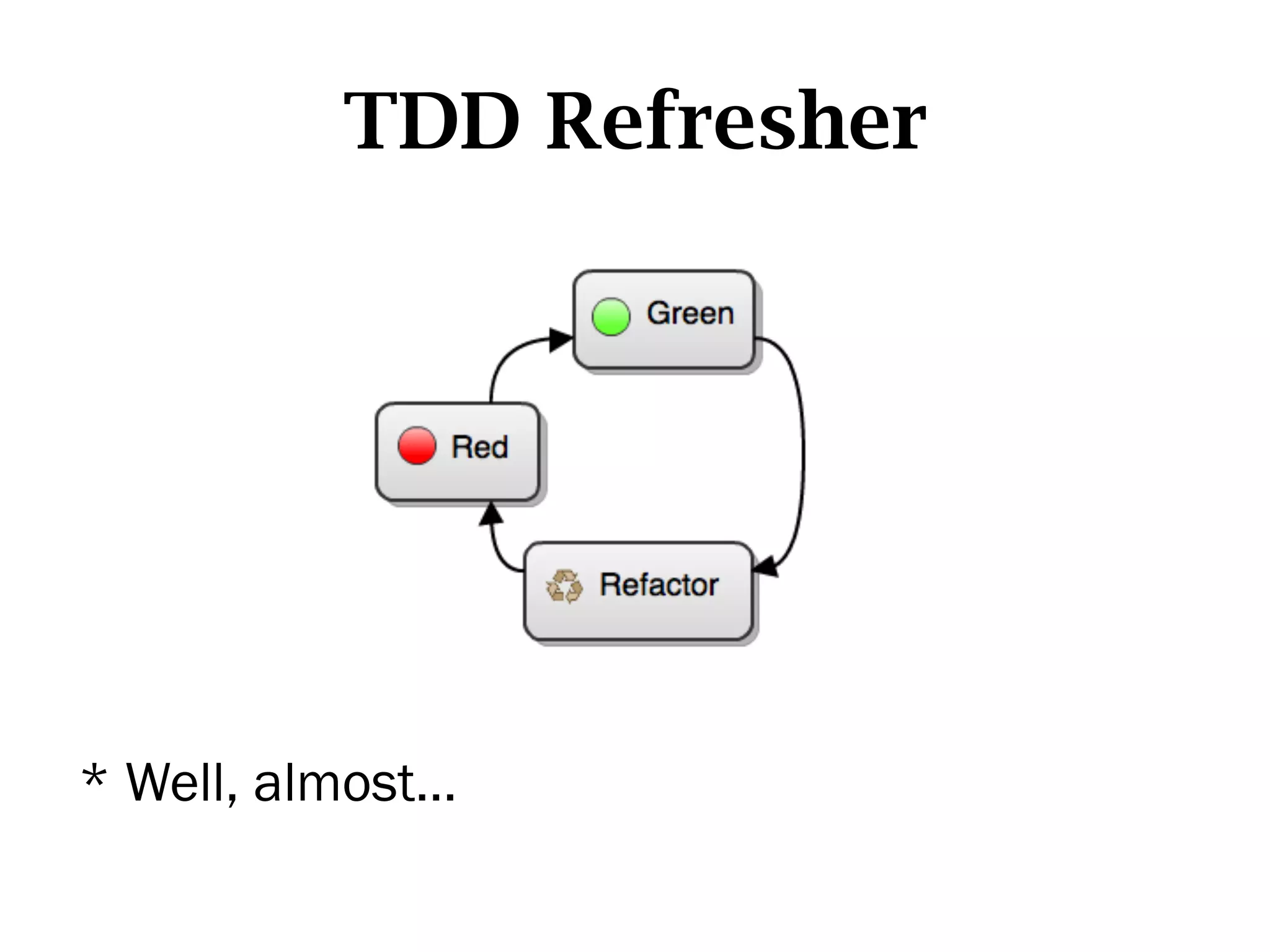
TDD Refresher


* Well, almost…
TDD Refresher
Behavior-Driven Development style
  –  (“should” instead of “assert”)
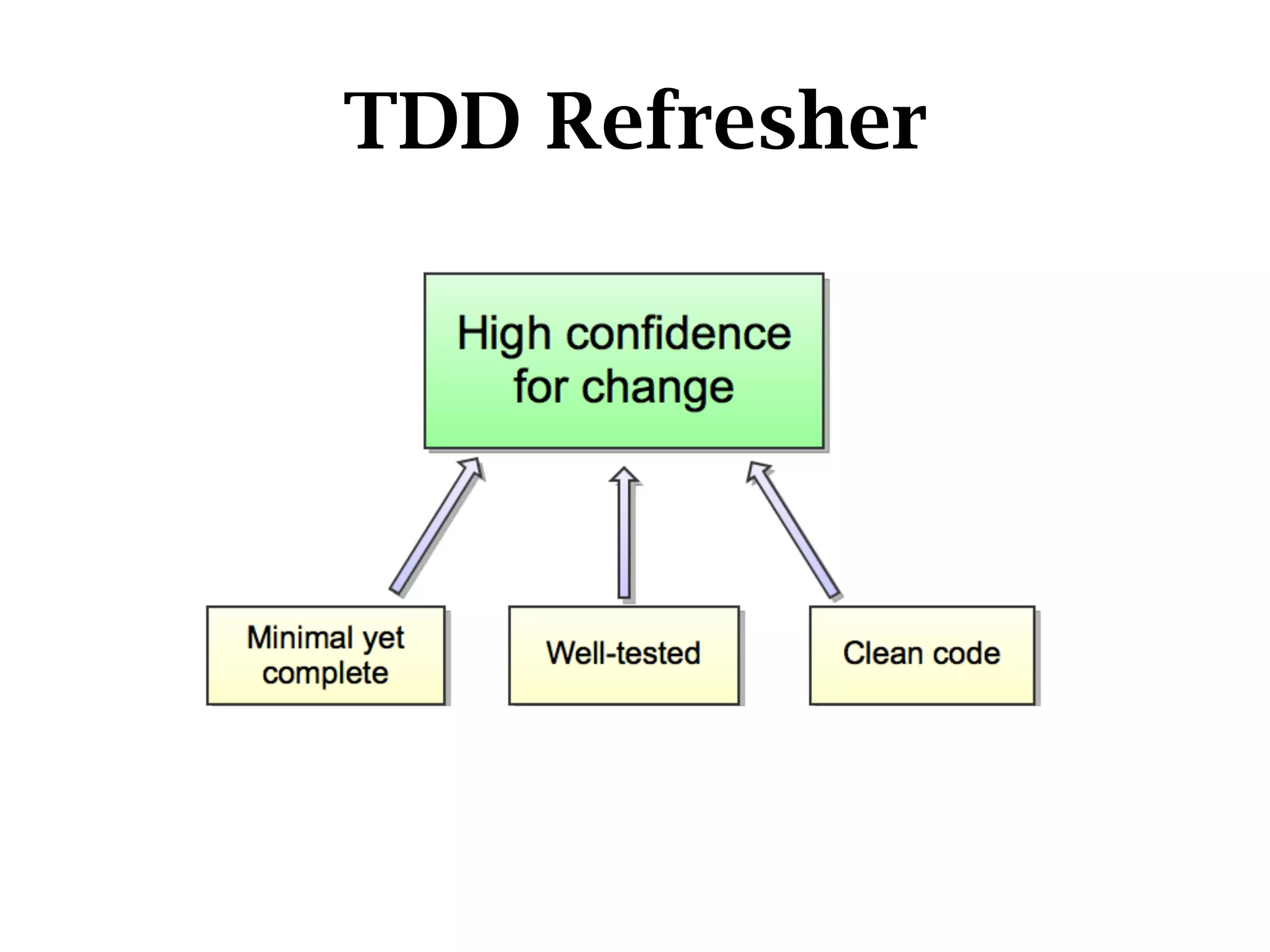
TDD Refresher
TDD Refresher
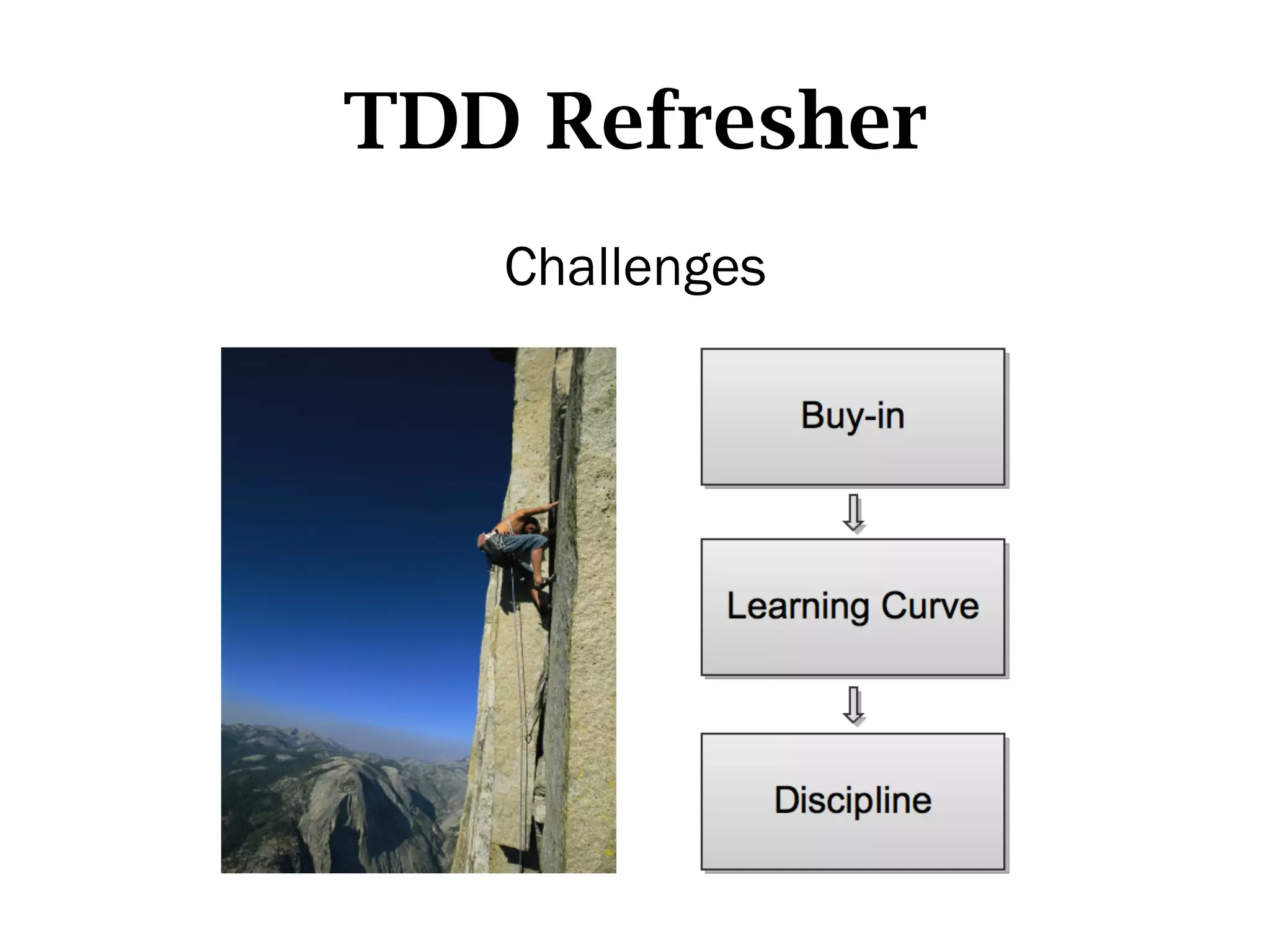
   Challenges
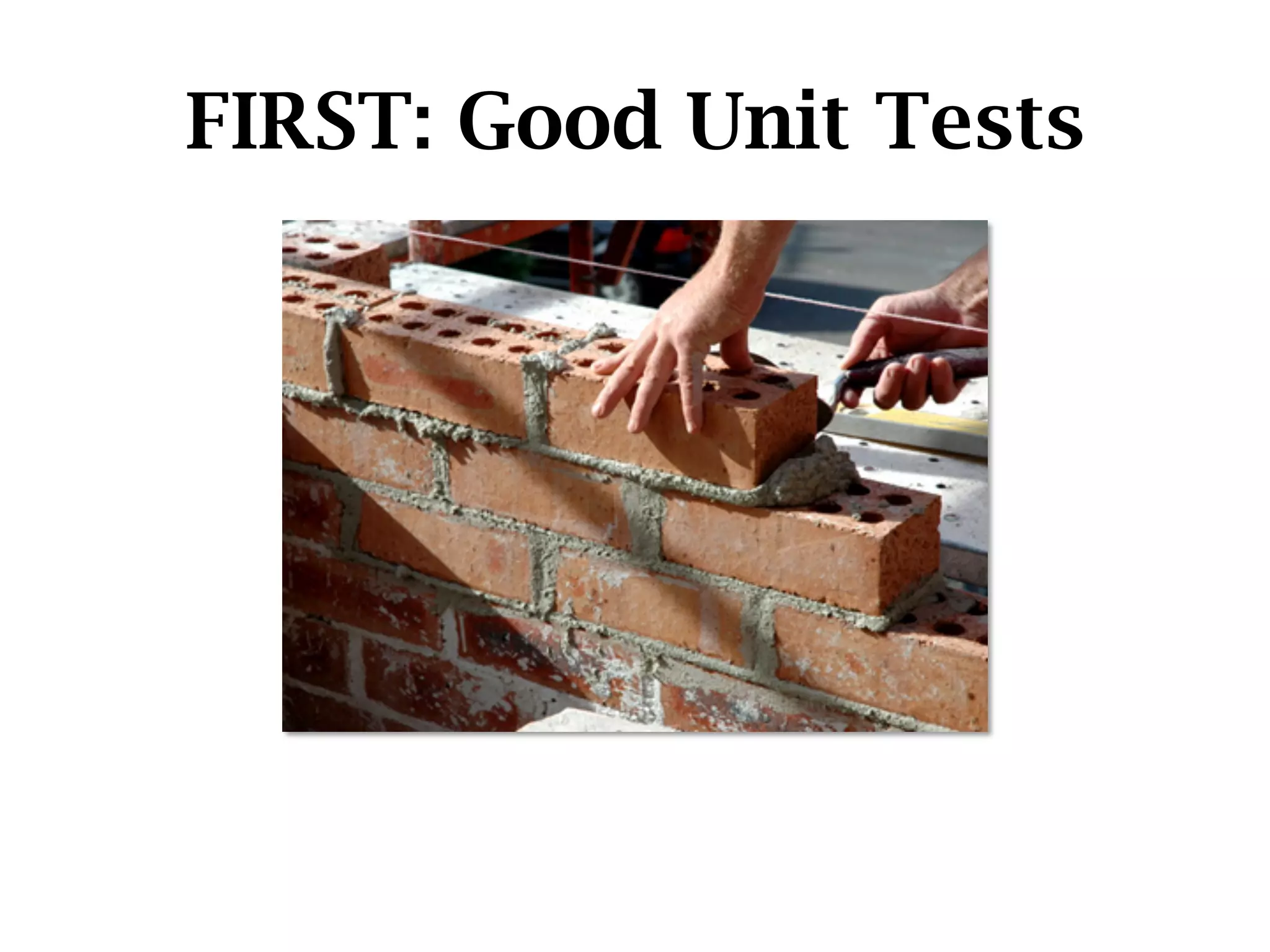
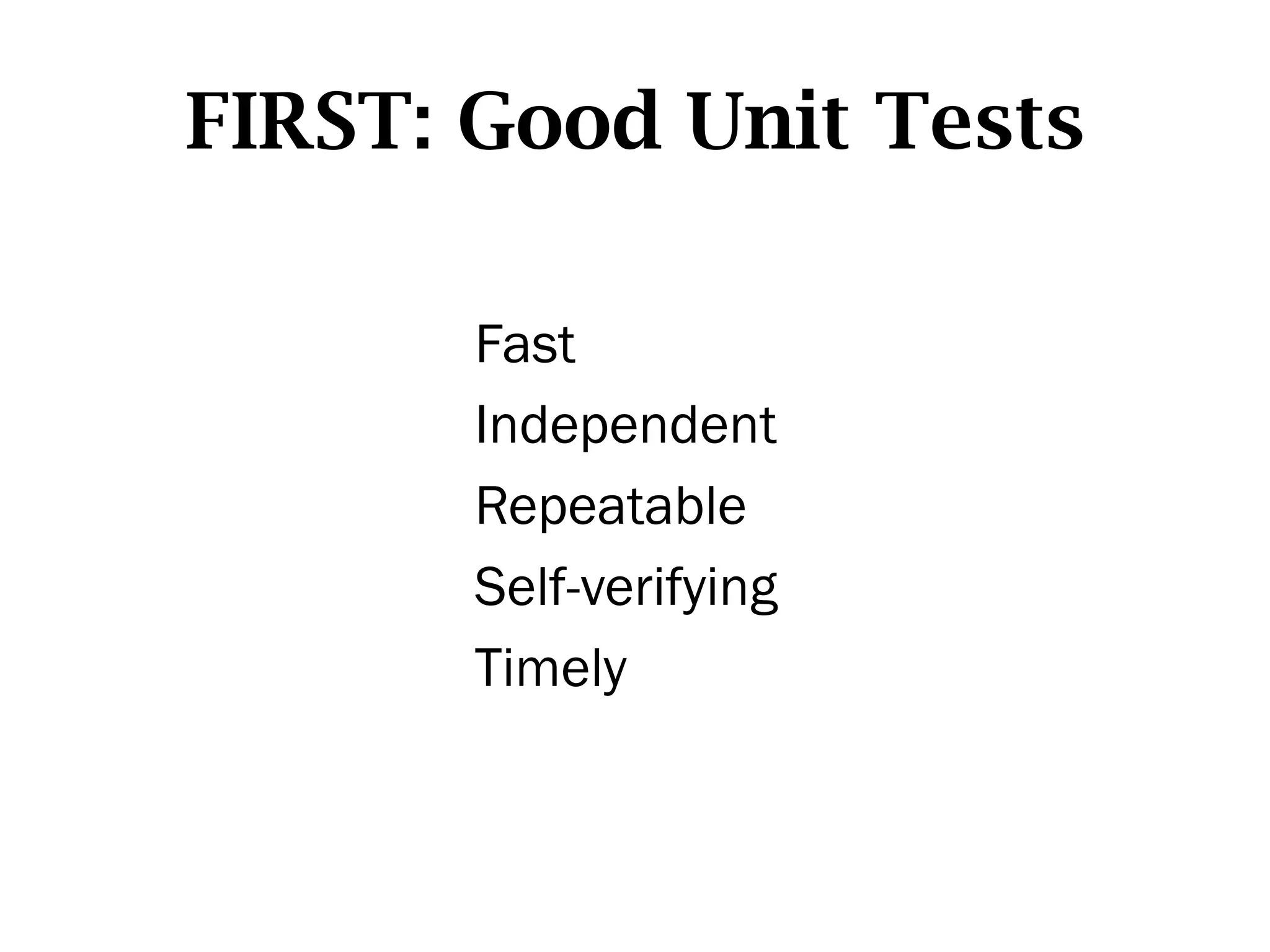
FIRST: Good Unit Tests

       Fast
       Independent
       Repeatable
       Self-verifying
       Timely
FIRST: Good Unit Tests

  Test behaviors, not methods
    –  Don’t test your privates?
FIRST: Good Unit Tests

Each test should test only one thing
  –  One assertion per test?
FIRST: Good Unit Tests

  Only one “real” class per test
    –  Mock the collaborators
    –  But don’t mock values
       (e.g. java.net.URI)
FIRST: Good Unit Tests

  Smell: Test code is hard to read
    –  not enough refactoring
FIRST: Good Unit Tests

Smell: Big ripples of red during changes
  –  not enough refactoring, tests are
     too complex
For business’s sake, AT!
•  Acceptance Criteria are specifications for
   what the software needs to do, written in
   domain language, by domain experts.
•  Acceptance Tests (ATs) are executable
   Acceptance Criteria.
•  Unambiguous, executable, repeatable
   specifications and documentation
For business’s sake, AT!


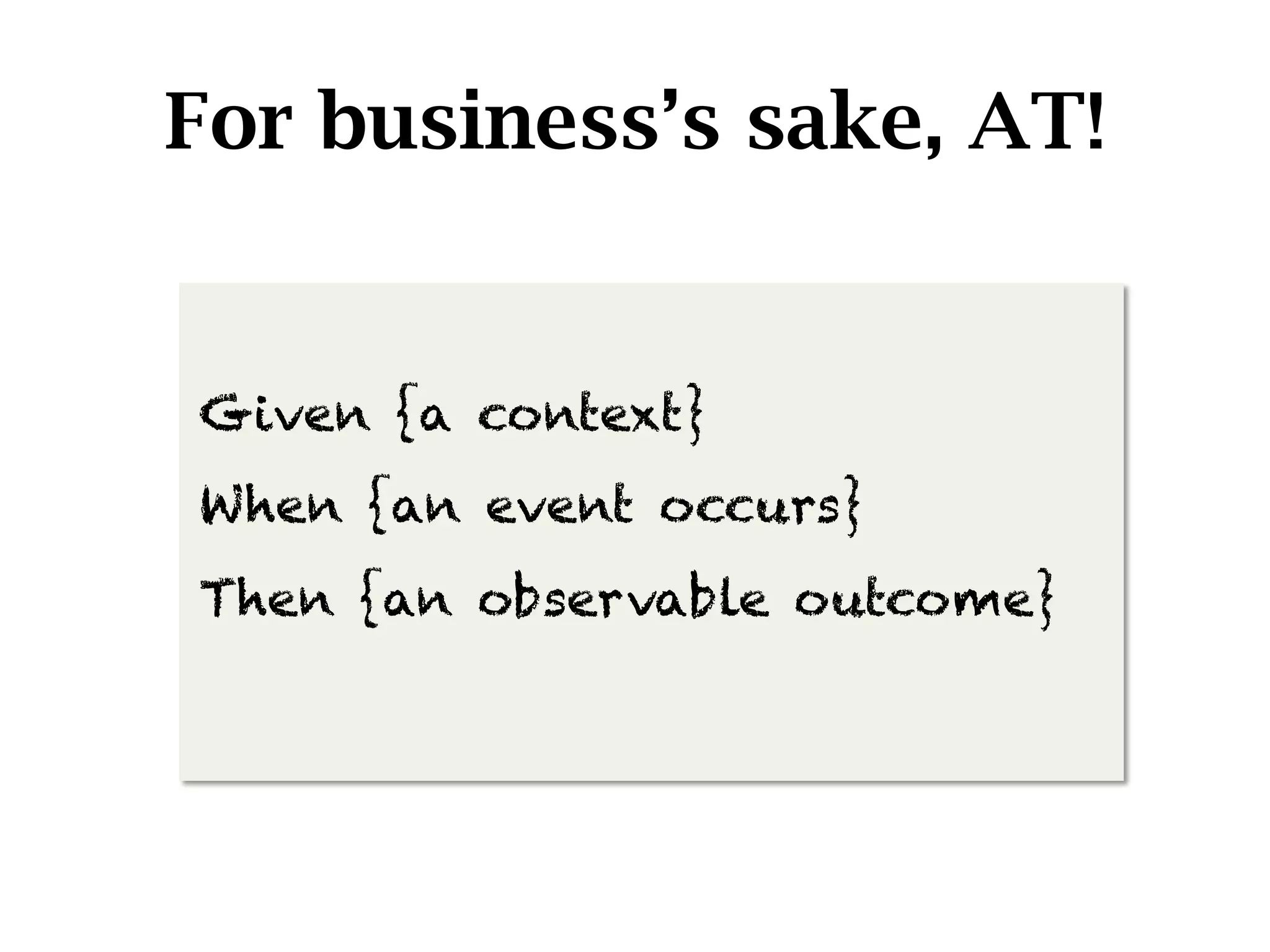
Given {a context}
When {an event occurs}
Then {an observable outcome}
For business’s sake, AT!


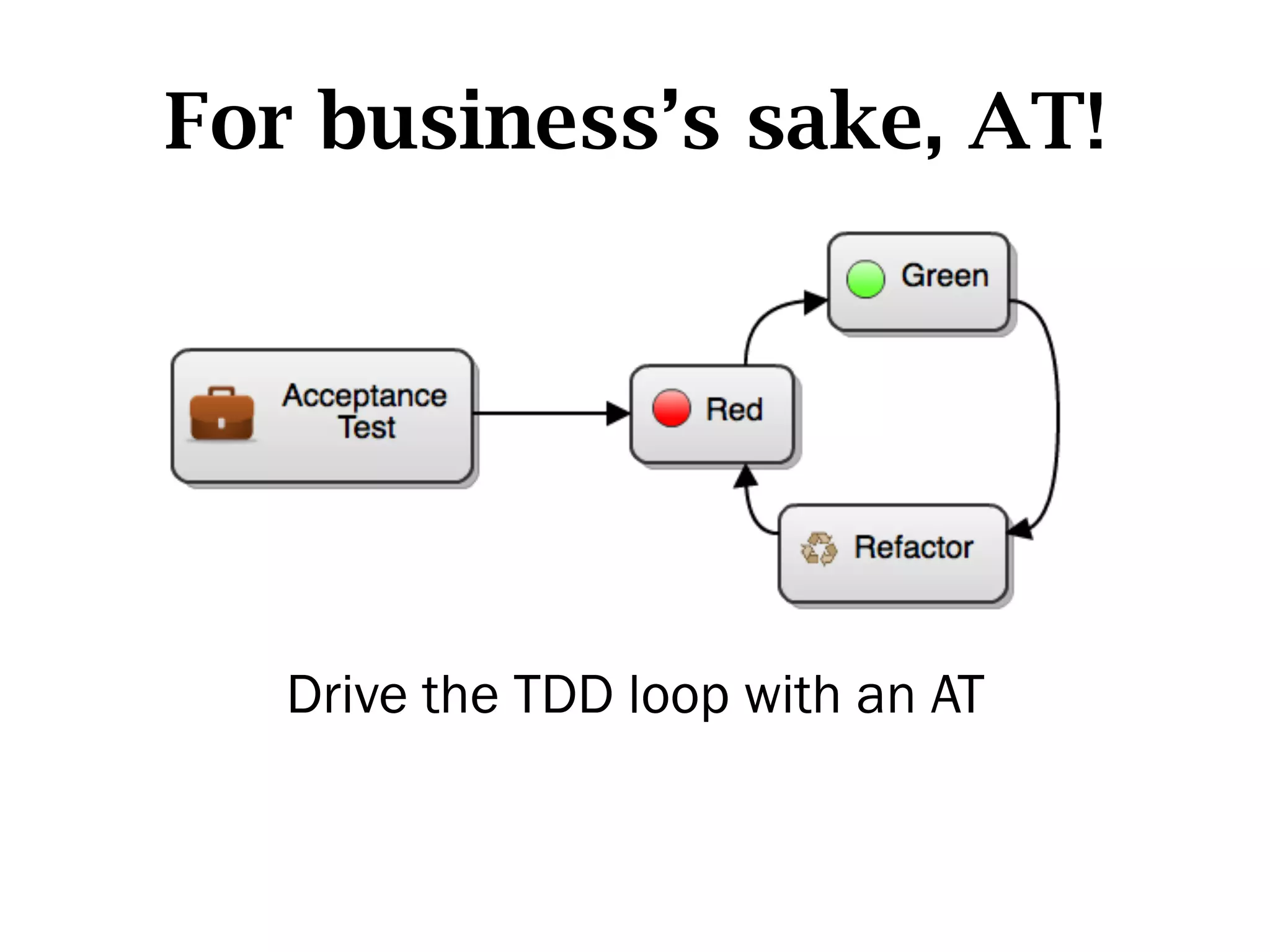
   Drive the TDD loop with an AT
For business’s sake, AT!
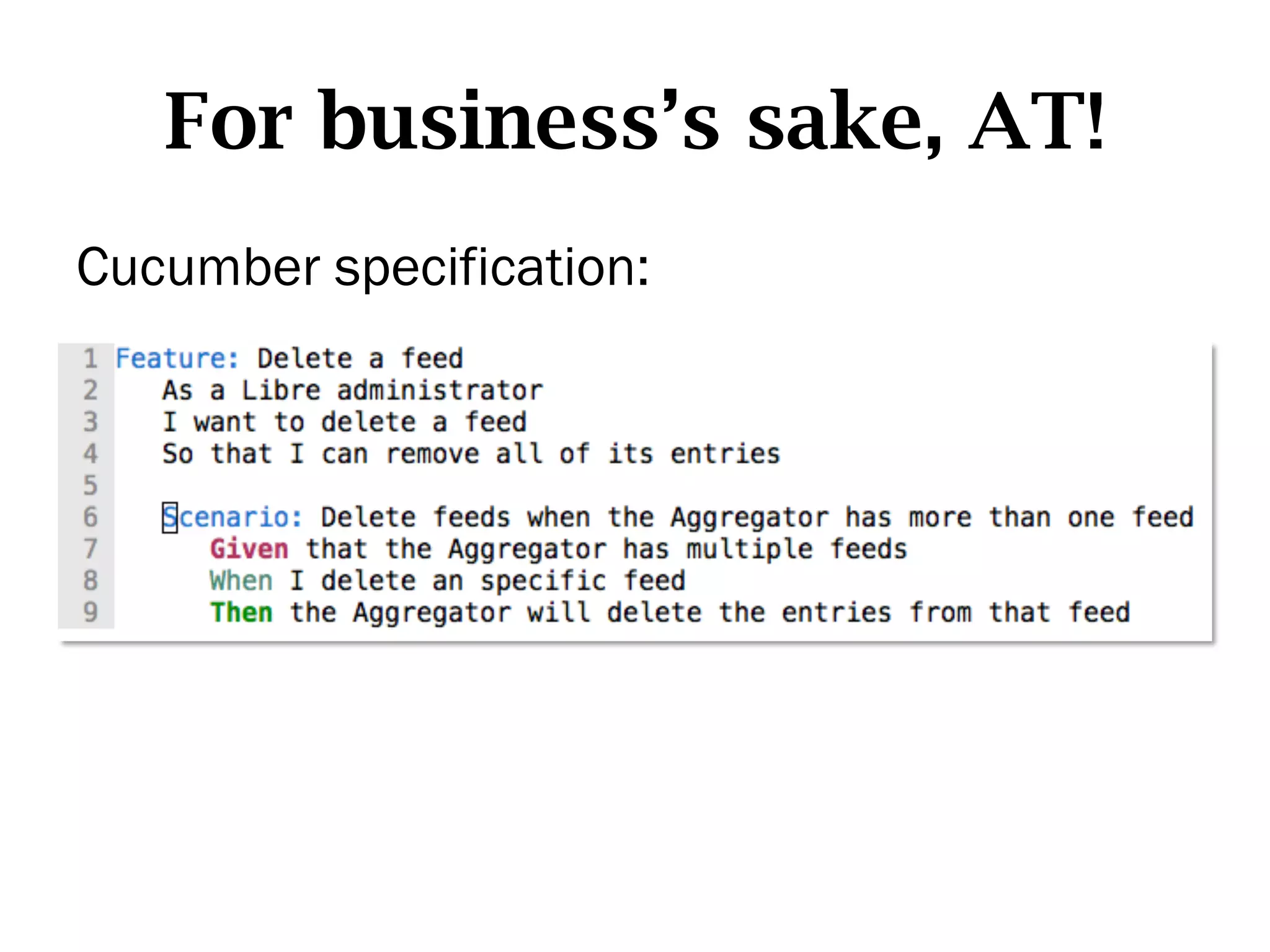
Cucumber specification:
For business’s sake, AT!
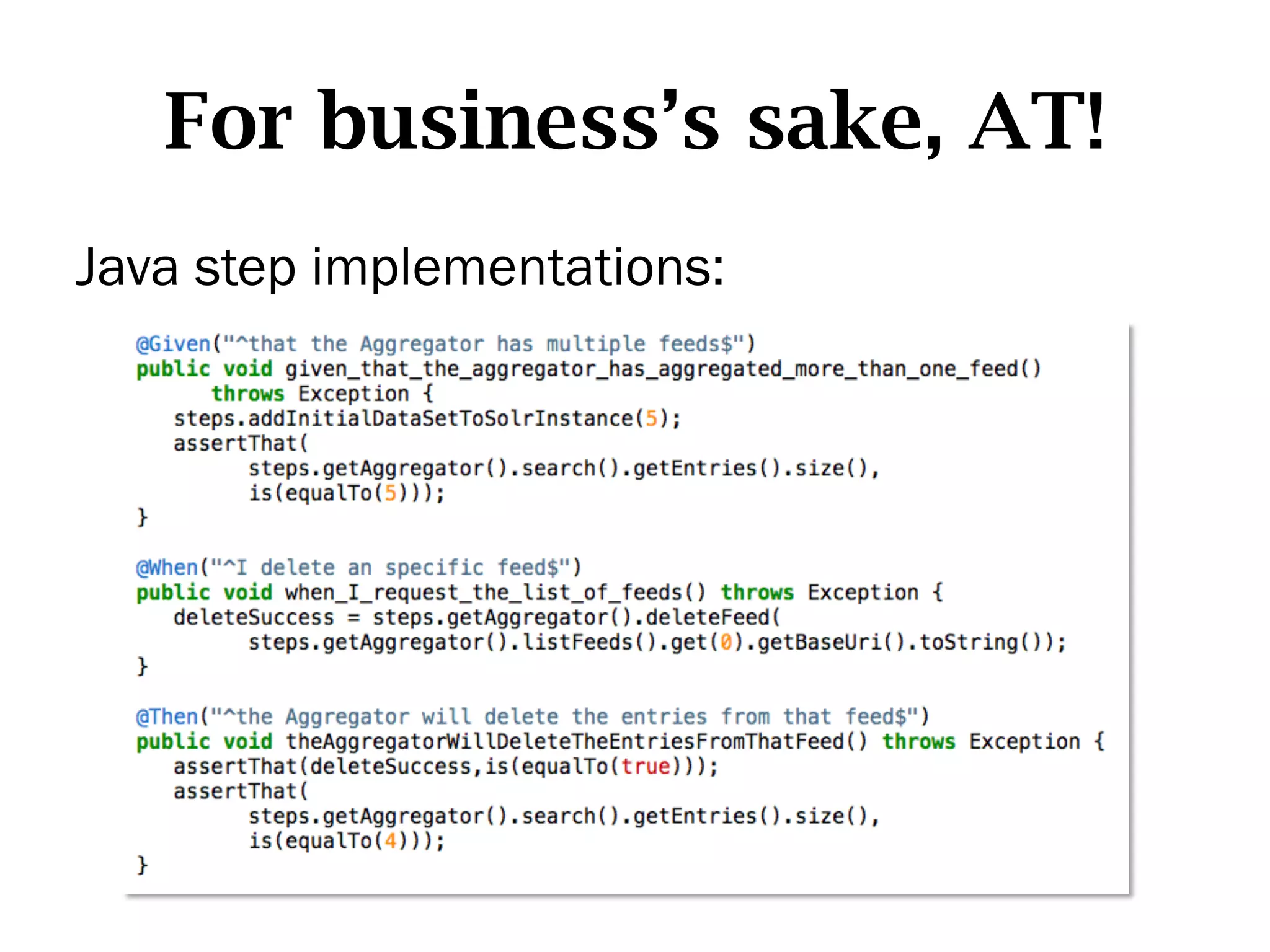
Java step implementations:
For business’s sake, AT!

Smell: ATs with lots of technical details
  –  you’re using ATs instead of UTs,
     or not testing from the outermost
     point of view
For business’s sake, AT!

   Smell: ATs keep breaking
     –  not abstract enough;
        perhaps too imperative
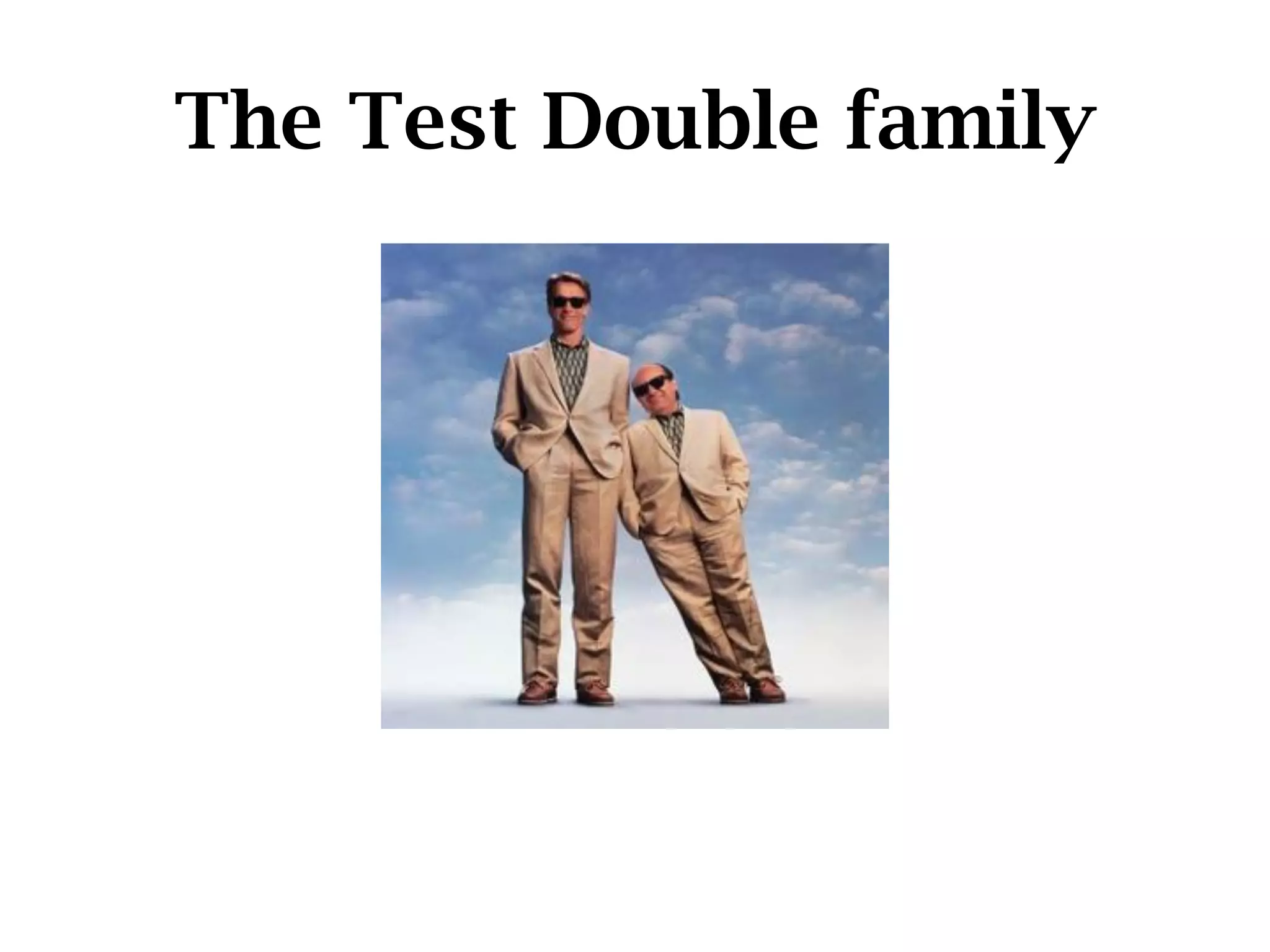
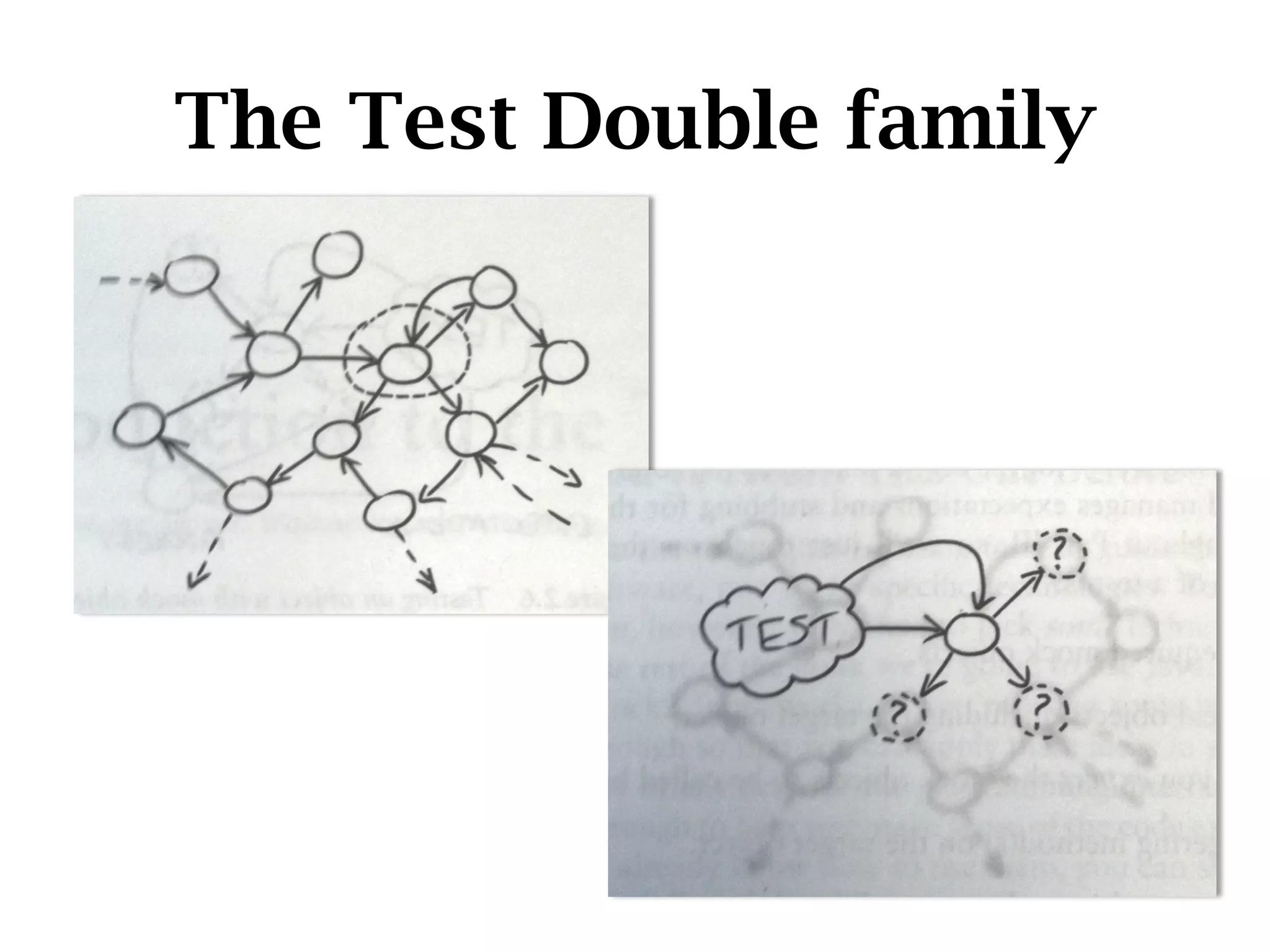
The Test Double family
(“Mock object” often means Test Double)

In increasing order of trickiness:
   –  Dummy object
   –  Stub
   –  Mock


this != Meszaros’ xUnit Patterns != Sinon.JS
The Test Double family

Smell: Enormous effort setting up mock
  –  pull the complexity into e.g. domain
     façade objects
The Test Double family

 Smell: Lots of test doubles in a test
   –  poor encapsulation
Testing the UI?
Testing the UI?
Diminishing returns: can you write an
automated test to tell you whether the UI looks
nice? Flows well?


                  Yes, but at what cost?!
Testing the UI?


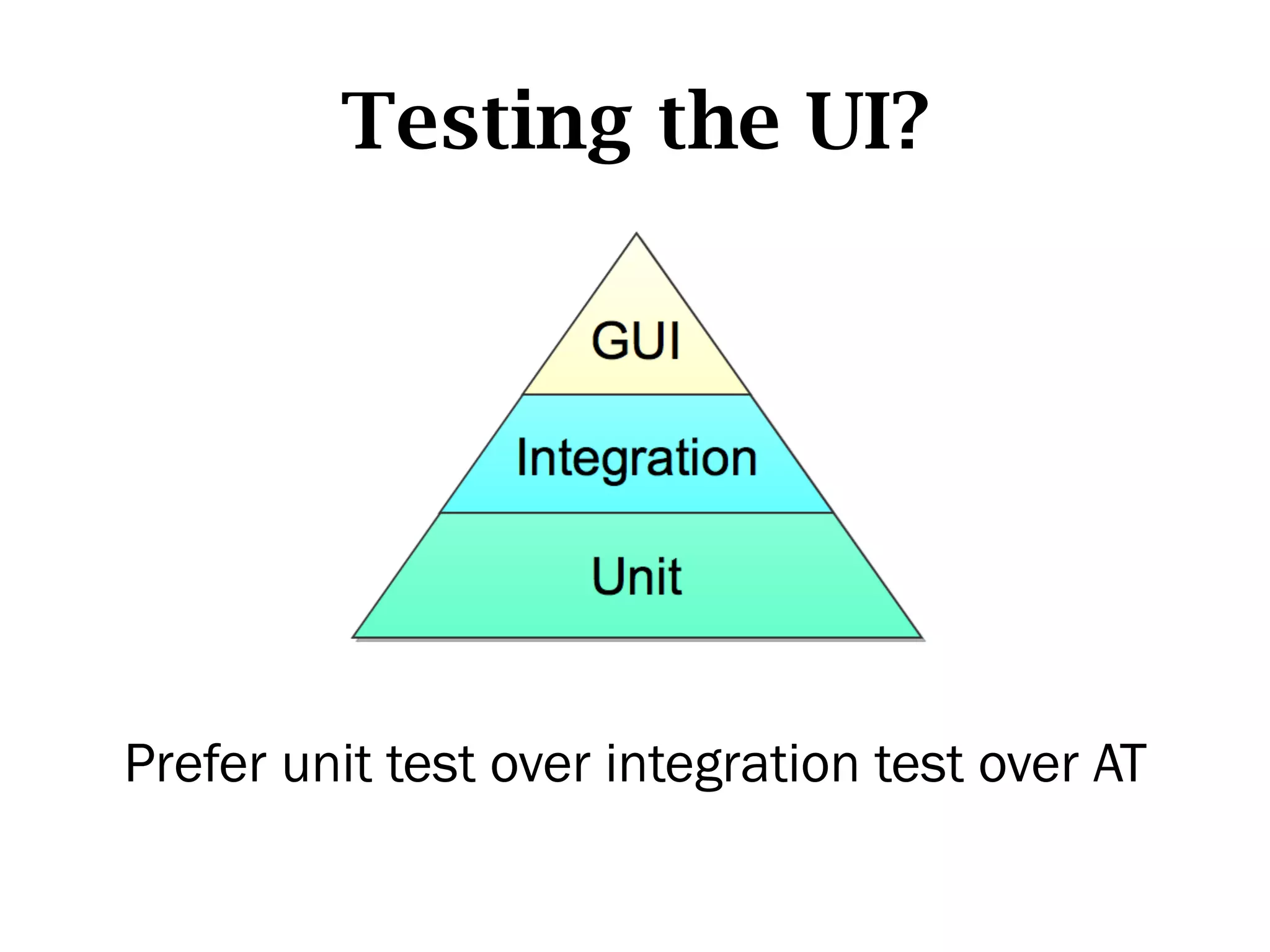
Prefer unit test over integration test over AT
Testing the UI?

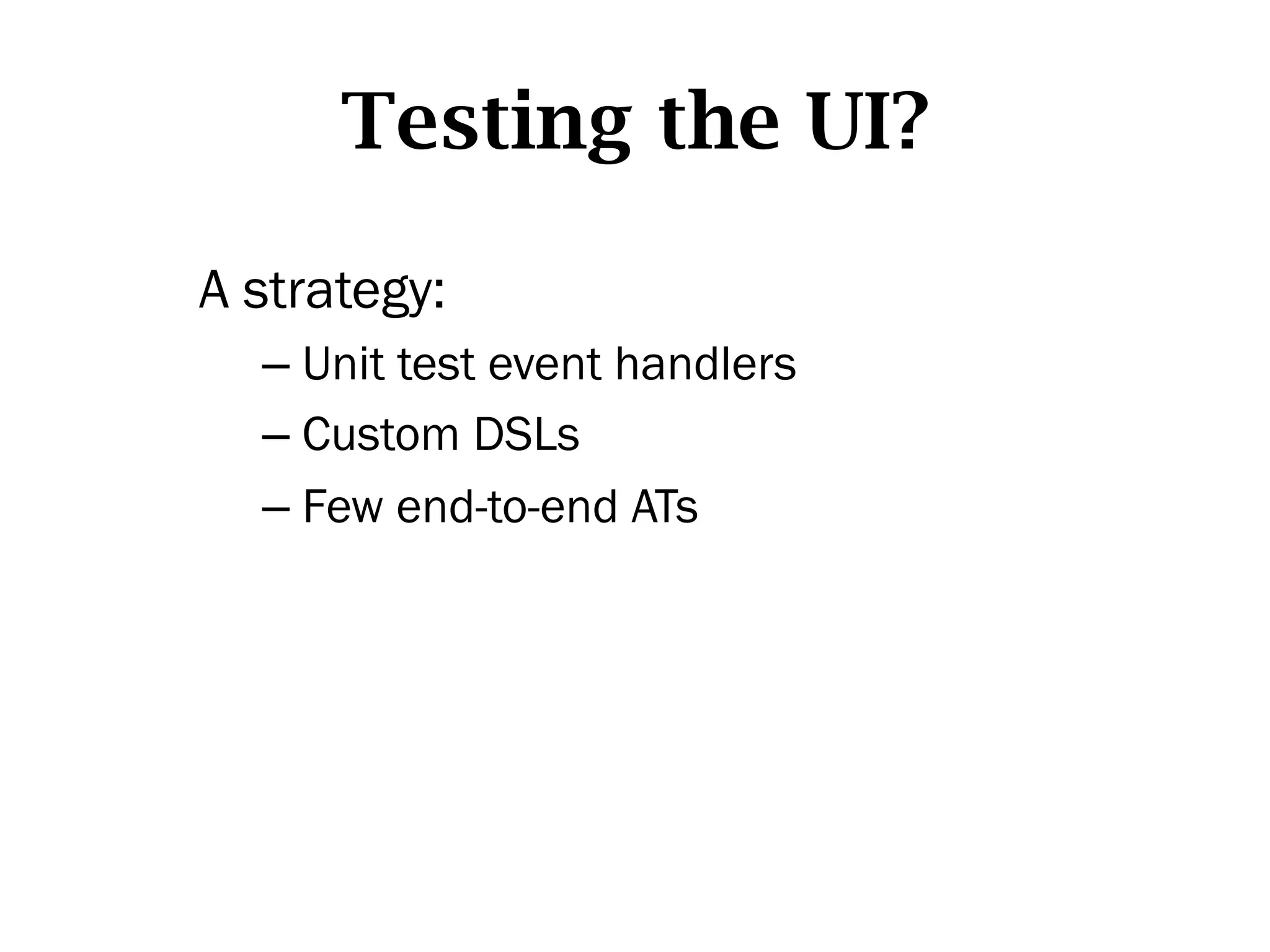
A strategy:
  –  Unit test event handlers
  –  Custom DSLs
  –  Few end-to-end ATs
Testing the UI?
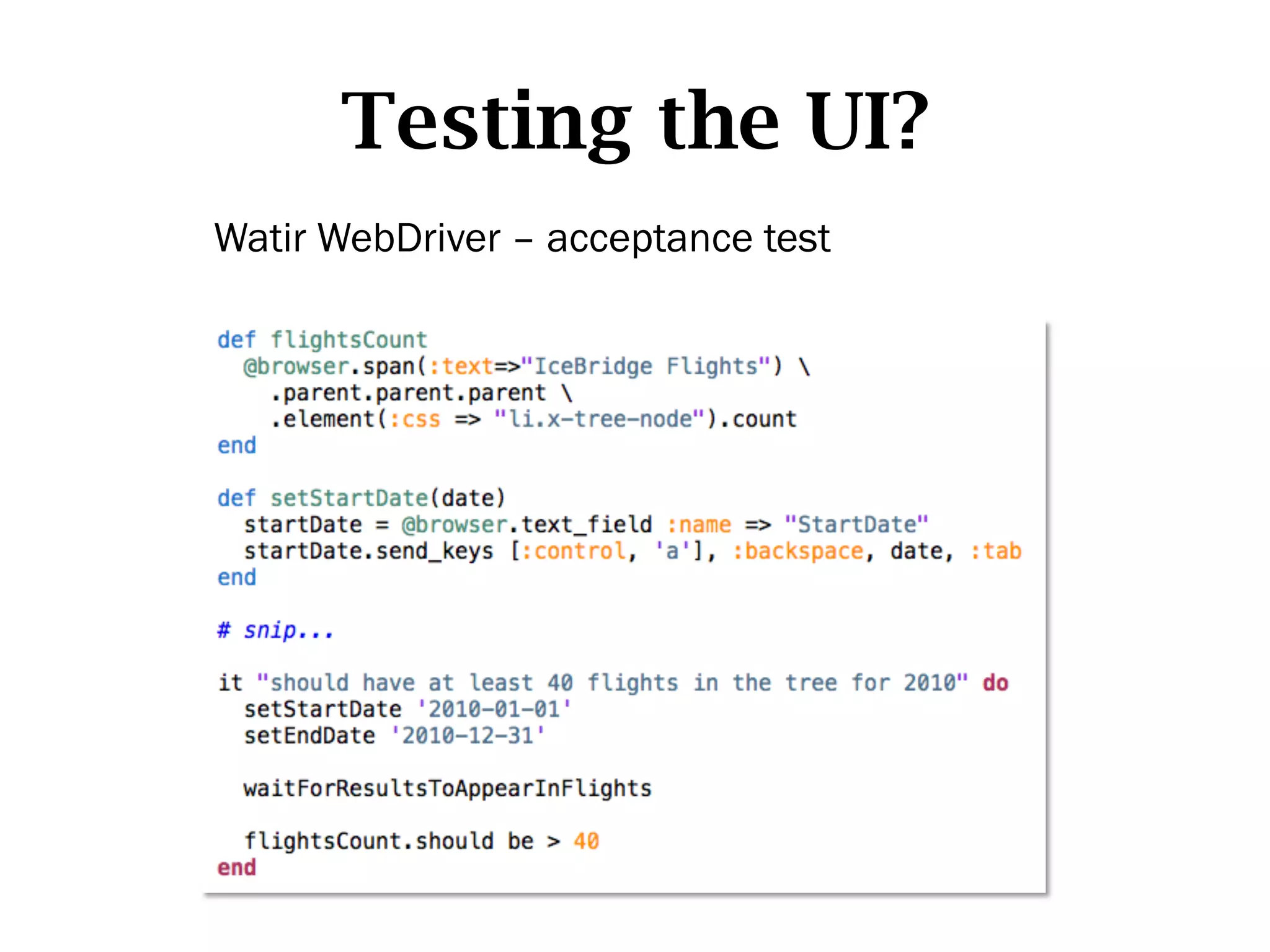
Watir WebDriver – acceptance test
Testing the UI?
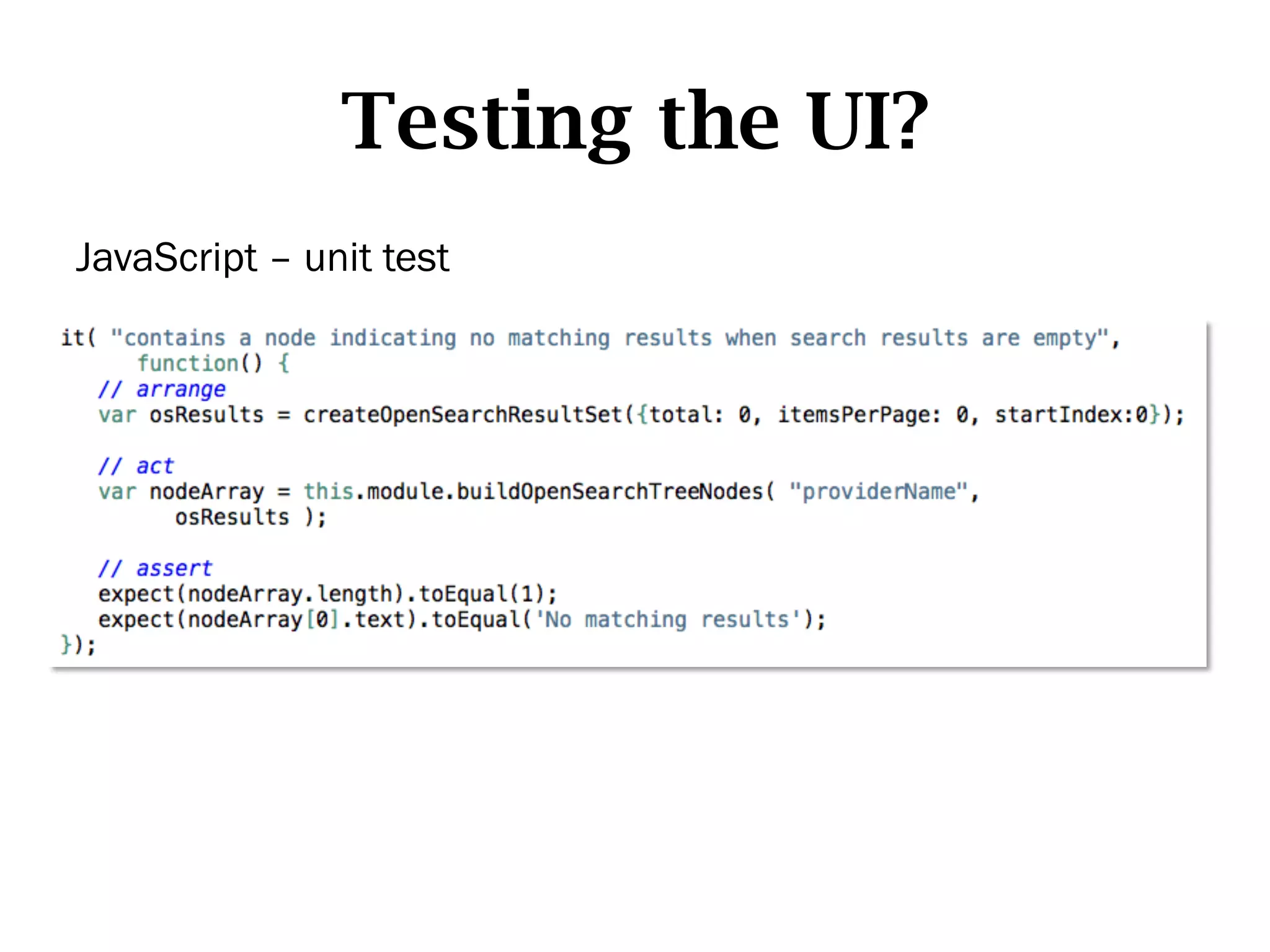
JavaScript – unit test
External resources, aka “What
       about the DB?”
External resources, aka “What
       about the DB?”

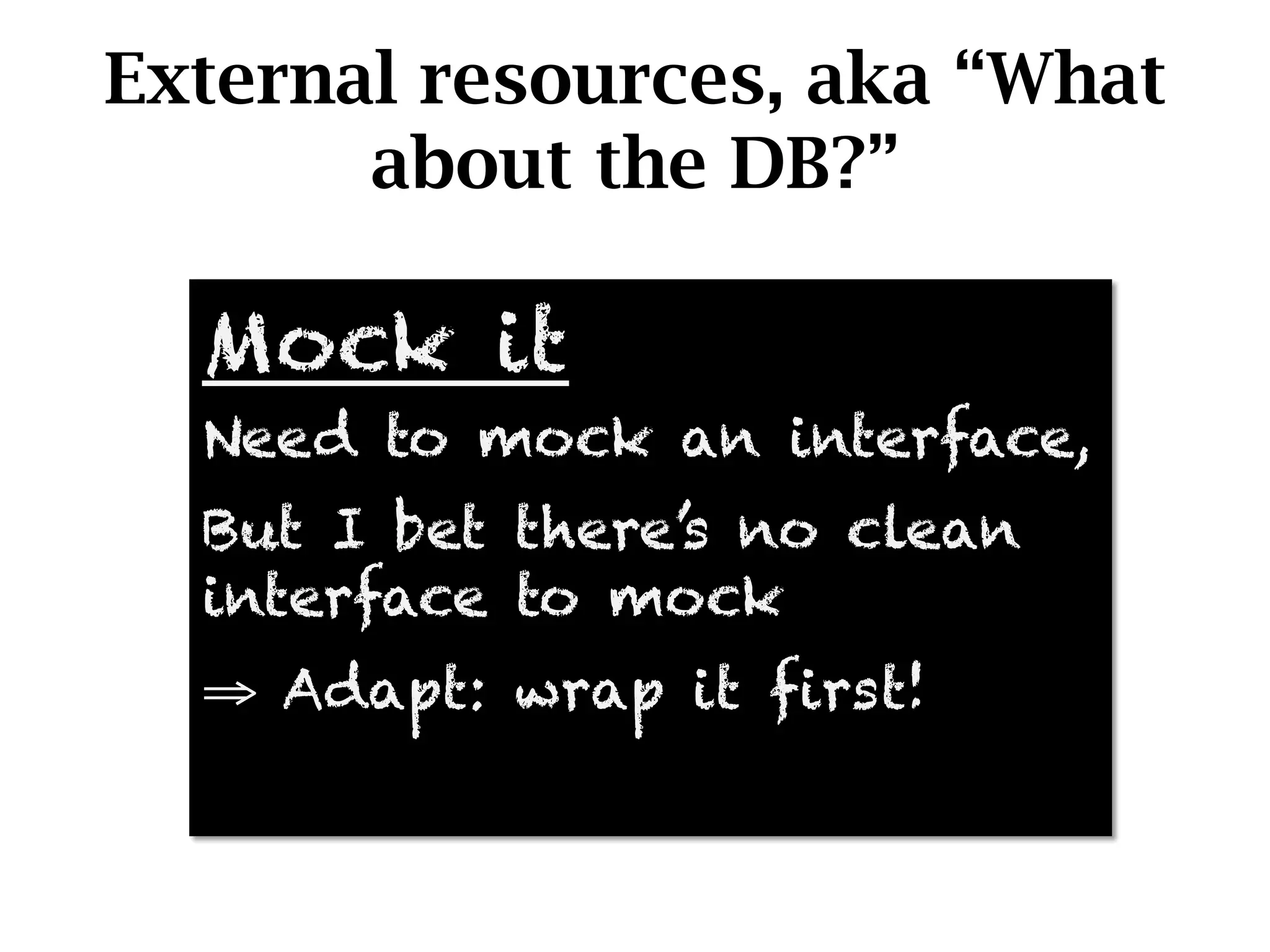
  Mock it
  Need to mock an interface,
  But I bet there’s no clean
  interface to mock
  ⇒  Adapt: wrap it first!
Reality: Legacy Code
•  It’s hard. Don’t start here.
•  Fowler’s Refactoring book – small, safe
   changes
•  Wrap in tests
•  Improve what you touch – “shine a light”
•  100% TDD any new code
•  Feathers’ Legacy Code book
Wrap-up
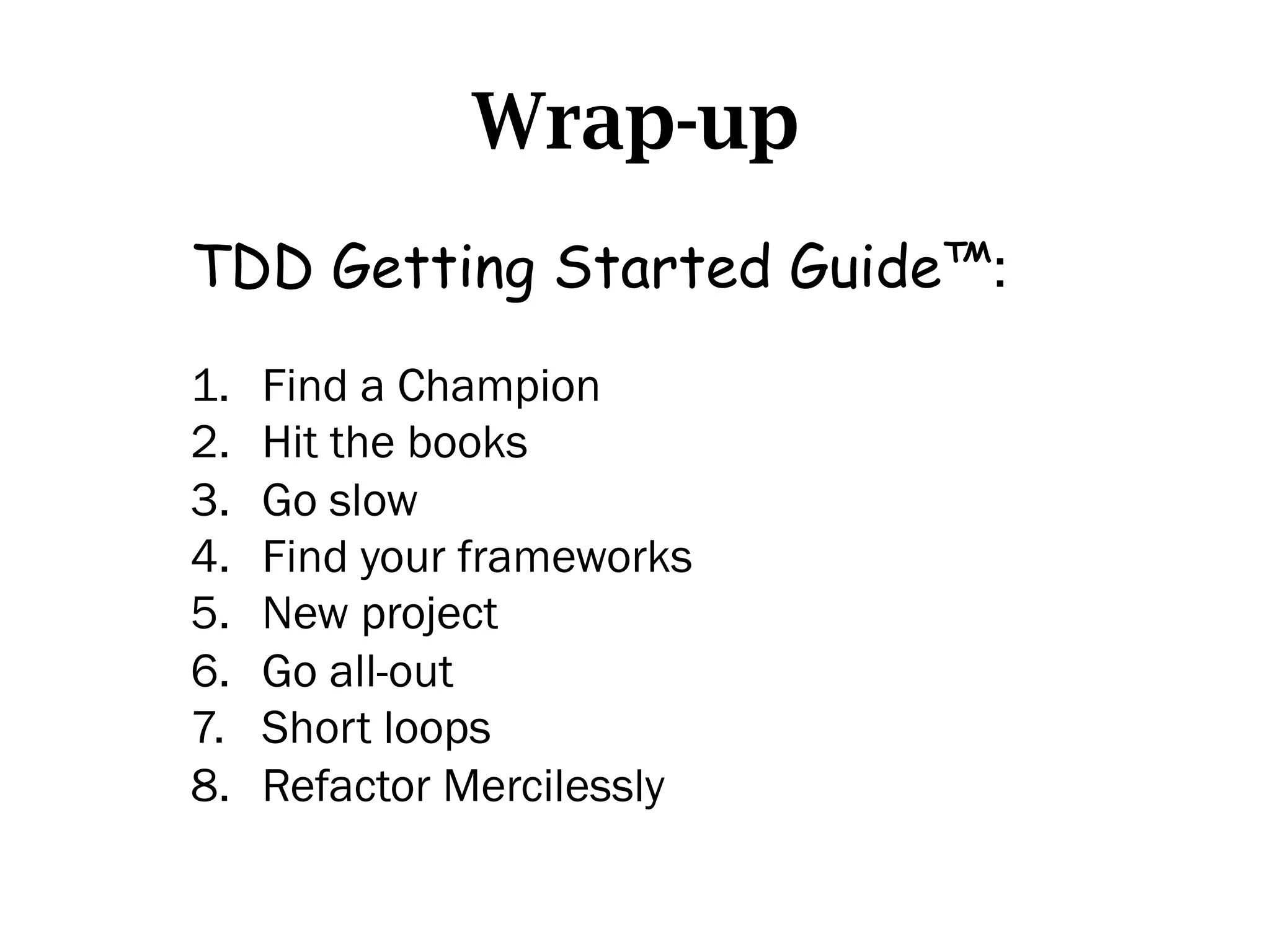
TDD Getting Started Guide™:
1.    Find a Champion
2.    Hit the books
3.    Go slow
4.    Find your frameworks
5.    New project
6.    Go all-out
7.    Short loops
8.    Refactor Mercilessly
Wrap-up
Things to read:
•  Growing Object-Oriented Software, Guided By Tests - Freeman &
   Pryce
•  Test-Driven Development: By Example – Beck
•  XUnit Test Patterns - Meszaros
•  The RSpec Book - Chelimsky, Astels et al
•  Clean Code: A Handbook of Agile Software Craftsmanship - Uncle
   Bob
•  Test Driven: TDD and Acceptance TDD for Java Developers –
   Lasse Koskela
•  Continuous Delivery - Humble & Farley
•  Refactoring: Improving the Design of Existing Code - Fowler
•  Working Effectively With Legacy Code - Feathers
•  Gojko Adzik’s myriad web papers on automated testing
Questions


                  Online at http://bit.ly/yravMa or
http://dl.dropbox.com/u/4292130/UCAR_SEA_20120221/CompletelyTestDriven.pdf

Completely Test-Driven

  • 1.
    Completely Test-Driven ian.truslove@nsidc.org @iantruslove UCAR Software Engineering Assembly, Feb 21, 2012
  • 2.
    What’s In ItFor Me? •  “So, that TDD sounds great and all, but what about <thing>?” •  See some techniques that really are necessary for TDD (and some others that are just cool) •  Start TDD?!
  • 3.
    Outline •  TDD Refresher •  FIRST: Good Unit Tests •  For business’s sake, AT! •  The Test Double family •  Testing the UI? •  External resources, aka “What about the DB?” •  Reality: Legacy Code •  Wrap-up
  • 4.
  • 5.
    TDD Refresher Behavior-Driven Developmentstyle –  (“should” instead of “assert”)
  • 6.
  • 7.
    TDD Refresher Challenges
  • 8.
  • 9.
    FIRST: Good UnitTests Fast Independent Repeatable Self-verifying Timely
  • 10.
    FIRST: Good UnitTests Test behaviors, not methods –  Don’t test your privates?
  • 11.
    FIRST: Good UnitTests Each test should test only one thing –  One assertion per test?
  • 12.
    FIRST: Good UnitTests Only one “real” class per test –  Mock the collaborators –  But don’t mock values (e.g. java.net.URI)
  • 13.
    FIRST: Good UnitTests Smell: Test code is hard to read –  not enough refactoring
  • 14.
    FIRST: Good UnitTests Smell: Big ripples of red during changes –  not enough refactoring, tests are too complex
  • 15.
  • 16.
    For business’s sake,AT! •  Acceptance Criteria are specifications for what the software needs to do, written in domain language, by domain experts. •  Acceptance Tests (ATs) are executable Acceptance Criteria. •  Unambiguous, executable, repeatable specifications and documentation
  • 17.
    For business’s sake,AT! Given {a context} When {an event occurs} Then {an observable outcome}
  • 18.
    For business’s sake,AT! Drive the TDD loop with an AT
  • 19.
    For business’s sake,AT! Cucumber specification:
  • 20.
    For business’s sake,AT! Java step implementations:
  • 21.
    For business’s sake,AT! Smell: ATs with lots of technical details –  you’re using ATs instead of UTs, or not testing from the outermost point of view
  • 22.
    For business’s sake,AT! Smell: ATs keep breaking –  not abstract enough; perhaps too imperative
  • 23.
  • 24.
  • 25.
    The Test Doublefamily (“Mock object” often means Test Double) In increasing order of trickiness: –  Dummy object –  Stub –  Mock this != Meszaros’ xUnit Patterns != Sinon.JS
  • 26.
    The Test Doublefamily Smell: Enormous effort setting up mock –  pull the complexity into e.g. domain façade objects
  • 27.
    The Test Doublefamily Smell: Lots of test doubles in a test –  poor encapsulation
  • 28.
  • 29.
    Testing the UI? Diminishingreturns: can you write an automated test to tell you whether the UI looks nice? Flows well? Yes, but at what cost?!
  • 30.
    Testing the UI? Preferunit test over integration test over AT
  • 31.
    Testing the UI? Astrategy: –  Unit test event handlers –  Custom DSLs –  Few end-to-end ATs
  • 32.
    Testing the UI? WatirWebDriver – acceptance test
  • 33.
  • 34.
    External resources, aka“What about the DB?”
  • 35.
    External resources, aka“What about the DB?” Mock it Need to mock an interface, But I bet there’s no clean interface to mock ⇒  Adapt: wrap it first!
  • 36.
  • 37.
    Reality: Legacy Code • It’s hard. Don’t start here. •  Fowler’s Refactoring book – small, safe changes •  Wrap in tests •  Improve what you touch – “shine a light” •  100% TDD any new code •  Feathers’ Legacy Code book
  • 38.
    Wrap-up TDD Getting StartedGuide™: 1.  Find a Champion 2.  Hit the books 3.  Go slow 4.  Find your frameworks 5.  New project 6.  Go all-out 7.  Short loops 8.  Refactor Mercilessly
  • 39.
    Wrap-up Things to read: • Growing Object-Oriented Software, Guided By Tests - Freeman & Pryce •  Test-Driven Development: By Example – Beck •  XUnit Test Patterns - Meszaros •  The RSpec Book - Chelimsky, Astels et al •  Clean Code: A Handbook of Agile Software Craftsmanship - Uncle Bob •  Test Driven: TDD and Acceptance TDD for Java Developers – Lasse Koskela •  Continuous Delivery - Humble & Farley •  Refactoring: Improving the Design of Existing Code - Fowler •  Working Effectively With Legacy Code - Feathers •  Gojko Adzik’s myriad web papers on automated testing
  • 40.
    Questions Online at http://bit.ly/yravMa or http://dl.dropbox.com/u/4292130/UCAR_SEA_20120221/CompletelyTestDriven.pdf