Planning XPPlanning XP
Mark Windholtz
ObjectWind Software Ltd
www.ObjectWind.com 2
Who Am I
♦ Mark Windholtz
♦ ObjectWind Software Ltd
♦ 14 years Building Professional Software
♦ Business, Medical, Engineering, Military
♦ First contact with XP in Oct 1996
♦ Started Six XP teams
♦ Consulted for Eight other XP teams
www.ObjectWind.com 3
Delivering to Deadline
XP is about delivering to deadline.
Every two weeks you release something
and every two weeks you check your plan.
You get really good at getting stuff done.
- James Grenning, ObjectMentor
www.ObjectWind.com 4
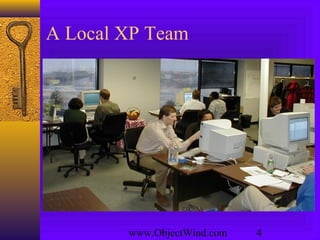
A Local XP Team
www.ObjectWind.com 5
What Management Gets
♦ Management gets …
– An Overall release plan (What, when, and how much)
– Most value out of each programming week
– Visible Progress: code running repeatable tests
– To Change direction as business changes
– Be informed early of schedule changes
www.ObjectWind.com 6
What Programmers Get
♦ Programmers are …
– told what is needed in priority order
– Allowed to produce quality work
– Allowed to ask for help
– Allowed to make and update estimates
– Allowed to accept responsibility
www.ObjectWind.com 7
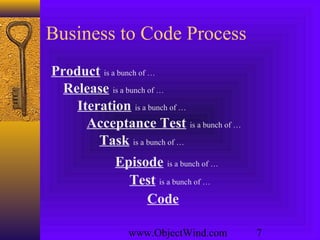
Business to Code Process
Product is a bunch of …
Release is a bunch of …
Iteration is a bunch of …
Acceptance Test is a bunch of …
Task is a bunch of …
Episode is a bunch of …
Test is a bunch of …
Code
www.ObjectWind.com 8
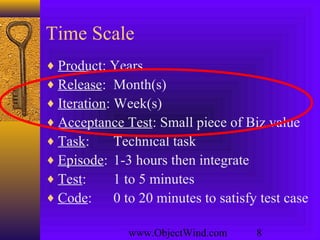
Time Scale
♦ Product: Years
♦ Release: Month(s)
♦ Iteration: Week(s)
♦ Acceptance Test: Small piece of Biz value
♦ Task: Technical task
♦ Episode: 1-3 hours then integrate
♦ Test: 1 to 5 minutes
♦ Code: 0 to 20 minutes to satisfy test case
www.ObjectWind.com 9
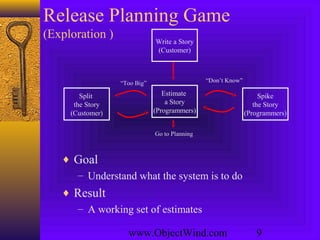
Release Planning Game
(Exploration )
“Too Big”
Split
the Story
(Customer)
Write a Story
(Customer)
Spike
the Story
(Programmers)
Estimate
a Story
(Programmers)
“Don’t Know”
Go to Planning
♦ Goal
– Understand what the system is to do
♦ Result
– A working set of estimates
www.ObjectWind.com 10
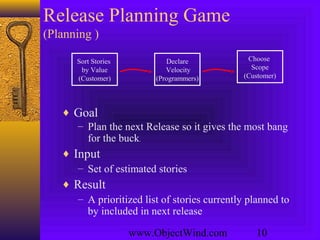
Release Planning Game
(Planning )
Choose
Scope
(Customer)
Sort Stories
by Value
(Customer)
Declare
Velocity
(Programmers)
♦ Goal
– Plan the next Release so it gives the most bang
for the buck.
♦ Input
– Set of estimated stories
♦ Result
– A prioritized list of stories currently planned to
by included in next release
www.ObjectWind.com 11
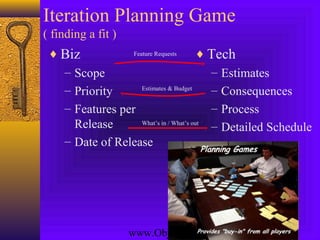
Iteration Planning Game
( finding a fit )
♦ Biz
– Scope
– Priority
– Features per
Release
– Date of Release
♦ Tech
– Estimates
– Consequences
– Process
– Detailed Schedule
Feature Requests
Estimates & Budget
What’s in / What’s out
www.ObjectWind.com 12
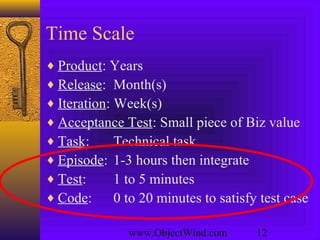
Time Scale
♦ Product: Years
♦ Release: Month(s)
♦ Iteration: Week(s)
♦ Acceptance Test: Small piece of Biz value
♦ Task: Technical task
♦ Episode: 1-3 hours then integrate
♦ Test: 1 to 5 minutes
♦ Code: 0 to 20 minutes to satisfy test case
www.ObjectWind.com 13
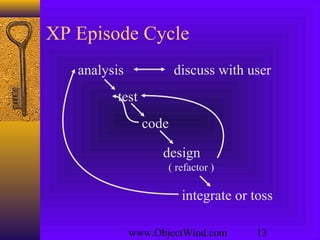
XP Episode Cycle
analysis
test
code
design
( refactor )
discuss with user
integrate or toss
www.ObjectWind.com 14
Velocity
♦ Tasks are estimated
– 1 to 3 ideal days
– Measured in relative task points
♦ How many task points were done?
♦ Historical velocity data
– Rough (but real) predictor future progress
– Cost, scope, schedule
www.ObjectWind.com 15
What is Progress?
♦ A Task is either Done or Not Done
– 70% done is meaningless
♦ Done means done!
– Done but not tested is meaningless
– Done but not integrated is meaningless
♦ Code is written in small, running pieces
♦ No large leaps forward in a fog …
… and falling off a cliff
www.ObjectWind.com 16
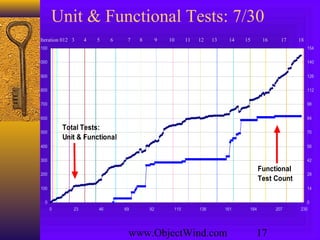
Unit Tests
♦ All production code is tested
♦ Tests provide incremental certitude
♦ Test graph
– Rough measure of accomplishment
– Quick indicator of a stalling project
www.ObjectWind.com 17
Unit & Functional Tests: 7/30
0
100
200
300
400
500
600
700
800
900
1000
1100
0 23 46 69 92 115 138 161 184 207 230
0
14
28
42
56
70
84
98
112
126
140
154
Total Tests:
Unit & Functional
Functional
Test Count
Iteration 012 3 4 5 6 7 8 9 10 11 12 13 14 15 16 17 18
www.ObjectWind.com 18
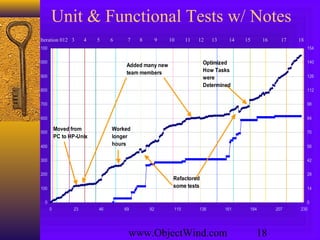
Unit & Functional Tests w/ Notes
0
100
200
300
400
500
600
700
800
900
1000
1100
0 23 46 69 92 115 138 161 184 207 230
0
14
28
42
56
70
84
98
112
126
140
154
Added many new
team members
Moved from
PC to HP-Unix
Worked
longer
hours
Refactored
some tests
Optimized
How Tasks
were
Determined
Iteration 012 3 4 5 6 7 8 9 10 11 12 13 14 15 16 17 18
www.ObjectWind.com 19
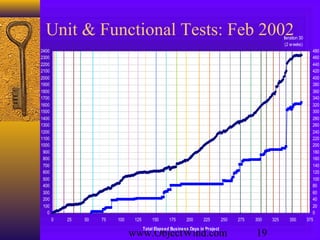
Unit & Functional Tests: Feb 2002
0
100
200
300
400
500
600
700
800
900
1000
1100
1200
1300
1400
1500
1600
1700
1800
1900
2000
2100
2200
2300
2400
0 25 50 75 100 125 150 175 200 225 250 275 300 325 350 375
Total Elapsed Business Days in Project
0
20
40
60
80
100
120
140
160
180
200
220
240
260
280
300
320
340
360
380
400
420
440
460
480
Iteration 30
(2 weeks)
www.ObjectWind.com 20
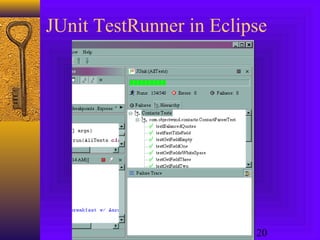
JUnit TestRunner in Eclipse
www.ObjectWind.com 21
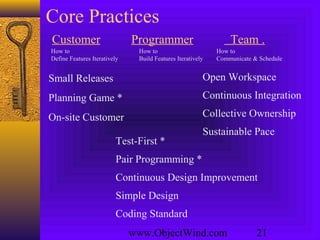
Core Practices
Small Releases
Planning Game *
On-site Customer
Open Workspace
Continuous Integration
Collective Ownership
Sustainable Pace
Test-First *
Pair Programming *
Continuous Design Improvement
Simple Design
Coding Standard
Customer Programmer Team .
How to
Define Features Iteratively
How to
Build Features Iteratively
How to
Communicate & Schedule
www.ObjectWind.com 22
ObjectWind Services
♦ Agile Software Engineering Practices
– Your team, or
– Outsourced XP Projects
♦ Project Services
– Before: Design Reviews
– During: Project Reviews & Expert Coding
– After: Retrospectives (Lessons Learned)
♦ Training with Object Mentor
www.ObjectWind.com

Planning XP

  • 1.
    Planning XPPlanning XP MarkWindholtz ObjectWind Software Ltd
  • 2.
    www.ObjectWind.com 2 Who AmI ♦ Mark Windholtz ♦ ObjectWind Software Ltd ♦ 14 years Building Professional Software ♦ Business, Medical, Engineering, Military ♦ First contact with XP in Oct 1996 ♦ Started Six XP teams ♦ Consulted for Eight other XP teams
  • 3.
    www.ObjectWind.com 3 Delivering toDeadline XP is about delivering to deadline. Every two weeks you release something and every two weeks you check your plan. You get really good at getting stuff done. - James Grenning, ObjectMentor
  • 4.
  • 5.
    www.ObjectWind.com 5 What ManagementGets ♦ Management gets … – An Overall release plan (What, when, and how much) – Most value out of each programming week – Visible Progress: code running repeatable tests – To Change direction as business changes – Be informed early of schedule changes
  • 6.
    www.ObjectWind.com 6 What ProgrammersGet ♦ Programmers are … – told what is needed in priority order – Allowed to produce quality work – Allowed to ask for help – Allowed to make and update estimates – Allowed to accept responsibility
  • 7.
    www.ObjectWind.com 7 Business toCode Process Product is a bunch of … Release is a bunch of … Iteration is a bunch of … Acceptance Test is a bunch of … Task is a bunch of … Episode is a bunch of … Test is a bunch of … Code
  • 8.
    www.ObjectWind.com 8 Time Scale ♦Product: Years ♦ Release: Month(s) ♦ Iteration: Week(s) ♦ Acceptance Test: Small piece of Biz value ♦ Task: Technical task ♦ Episode: 1-3 hours then integrate ♦ Test: 1 to 5 minutes ♦ Code: 0 to 20 minutes to satisfy test case
  • 9.
    www.ObjectWind.com 9 Release PlanningGame (Exploration ) “Too Big” Split the Story (Customer) Write a Story (Customer) Spike the Story (Programmers) Estimate a Story (Programmers) “Don’t Know” Go to Planning ♦ Goal – Understand what the system is to do ♦ Result – A working set of estimates
  • 10.
    www.ObjectWind.com 10 Release PlanningGame (Planning ) Choose Scope (Customer) Sort Stories by Value (Customer) Declare Velocity (Programmers) ♦ Goal – Plan the next Release so it gives the most bang for the buck. ♦ Input – Set of estimated stories ♦ Result – A prioritized list of stories currently planned to by included in next release
  • 11.
    www.ObjectWind.com 11 Iteration PlanningGame ( finding a fit ) ♦ Biz – Scope – Priority – Features per Release – Date of Release ♦ Tech – Estimates – Consequences – Process – Detailed Schedule Feature Requests Estimates & Budget What’s in / What’s out
  • 12.
    www.ObjectWind.com 12 Time Scale ♦Product: Years ♦ Release: Month(s) ♦ Iteration: Week(s) ♦ Acceptance Test: Small piece of Biz value ♦ Task: Technical task ♦ Episode: 1-3 hours then integrate ♦ Test: 1 to 5 minutes ♦ Code: 0 to 20 minutes to satisfy test case
  • 13.
    www.ObjectWind.com 13 XP EpisodeCycle analysis test code design ( refactor ) discuss with user integrate or toss
  • 14.
    www.ObjectWind.com 14 Velocity ♦ Tasksare estimated – 1 to 3 ideal days – Measured in relative task points ♦ How many task points were done? ♦ Historical velocity data – Rough (but real) predictor future progress – Cost, scope, schedule
  • 15.
    www.ObjectWind.com 15 What isProgress? ♦ A Task is either Done or Not Done – 70% done is meaningless ♦ Done means done! – Done but not tested is meaningless – Done but not integrated is meaningless ♦ Code is written in small, running pieces ♦ No large leaps forward in a fog … … and falling off a cliff
  • 16.
    www.ObjectWind.com 16 Unit Tests ♦All production code is tested ♦ Tests provide incremental certitude ♦ Test graph – Rough measure of accomplishment – Quick indicator of a stalling project
  • 17.
    www.ObjectWind.com 17 Unit &Functional Tests: 7/30 0 100 200 300 400 500 600 700 800 900 1000 1100 0 23 46 69 92 115 138 161 184 207 230 0 14 28 42 56 70 84 98 112 126 140 154 Total Tests: Unit & Functional Functional Test Count Iteration 012 3 4 5 6 7 8 9 10 11 12 13 14 15 16 17 18
  • 18.
    www.ObjectWind.com 18 Unit &Functional Tests w/ Notes 0 100 200 300 400 500 600 700 800 900 1000 1100 0 23 46 69 92 115 138 161 184 207 230 0 14 28 42 56 70 84 98 112 126 140 154 Added many new team members Moved from PC to HP-Unix Worked longer hours Refactored some tests Optimized How Tasks were Determined Iteration 012 3 4 5 6 7 8 9 10 11 12 13 14 15 16 17 18
  • 19.
    www.ObjectWind.com 19 Unit &Functional Tests: Feb 2002 0 100 200 300 400 500 600 700 800 900 1000 1100 1200 1300 1400 1500 1600 1700 1800 1900 2000 2100 2200 2300 2400 0 25 50 75 100 125 150 175 200 225 250 275 300 325 350 375 Total Elapsed Business Days in Project 0 20 40 60 80 100 120 140 160 180 200 220 240 260 280 300 320 340 360 380 400 420 440 460 480 Iteration 30 (2 weeks)
  • 20.
  • 21.
    www.ObjectWind.com 21 Core Practices SmallReleases Planning Game * On-site Customer Open Workspace Continuous Integration Collective Ownership Sustainable Pace Test-First * Pair Programming * Continuous Design Improvement Simple Design Coding Standard Customer Programmer Team . How to Define Features Iteratively How to Build Features Iteratively How to Communicate & Schedule
  • 22.
    www.ObjectWind.com 22 ObjectWind Services ♦Agile Software Engineering Practices – Your team, or – Outsourced XP Projects ♦ Project Services – Before: Design Reviews – During: Project Reviews & Expert Coding – After: Retrospectives (Lessons Learned) ♦ Training with Object Mentor www.ObjectWind.com