Systems Analysis
and Design
By : Ajeng Savitri P, M.Kom
Prepared by Kevin C. Dittman for
Systems Analysis & Design Methods 4ed
by J. L. Whitten & L. D. Bentley
Testing
2
• Learning the definition of software testing
• Learning testing strategy
• Learning Black box testing
Introduction
4
Definition
• Testing is intended to show that a program does what it is intended to do and to
discover program defects before it is put into use.
• When you test software, you execute a program using artificial data.
• You check the results of the test run for errors, anomalies or information about
the program’s non-functional attributes.
• Can reveal the presence of errors NOT their absence.
Testing
Is a set of activities that can be planned in
advance and conducted systematically.
For this reason a template for software testing—a set of steps into
which you can place specific test case design techniques and testing
methods—should be defined for the software process.
Testing Goals
• To demonstrate to the developer and the customer that the software meets its
requirements (leads to validation testing)
• To discover situations in which the behavior of the software is incorrect,
undesirable or does not conform to its specification (leads to defect testing)
Verification VS Validation
• Verification:
"Are we building the product right?”.
• The software should conform to its specification.
• Validation:
"Are we building the right product?”.
• The software should do what the user really requires.
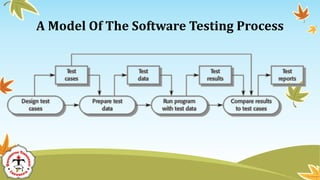
A Model Of The Software Testing Process
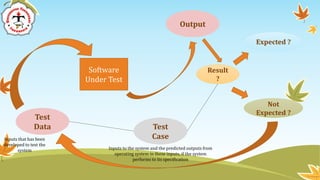
Software
Under Test
Test
Data
Output
Result
?
Expected ?
Not
Expected ?
Test
CaseInputs that has been
developed to test the
system Inputs to the system and the predicted outputs from
operating system in these inputs, if the system
performs to its specification
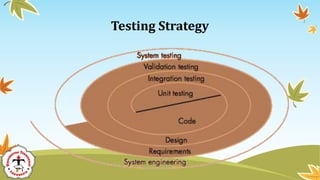
Testing Strategy
12
Testing Strategy
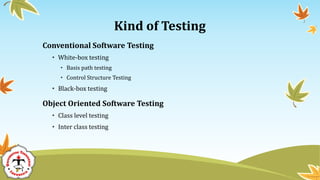
Kind of Testing
Conventional Software Testing
• White-box testing
• Basis path testing
• Control Structure Testing
• Black-box testing
Object Oriented Software Testing
• Class level testing
• Inter class testing
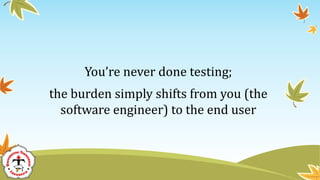
You’re never done testing;
the burden simply shifts from you (the
software engineer) to the end user
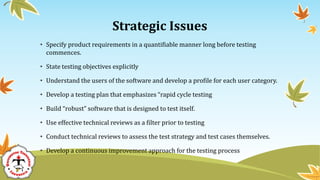
Strategic Issues
• Specify product requirements in a quantifiable manner long before testing
commences.
• State testing objectives explicitly
• Understand the users of the software and develop a profile for each user category.
• Develop a testing plan that emphasizes “rapid cycle testing
• Build “robust” software that is designed to test itself.
• Use effective technical reviews as a filter prior to testing
• Conduct technical reviews to assess the test strategy and test cases themselves.
• Develop a continuous improvement approach for the testing process
Object Oriented Software Testing
Unlike conventional test-case design, which is driven by an input-
process-output view of software or the algorithmic detail of
individual modules, object-oriented testing focuses on designing
appropriate sequences of operations to exercise the states of a class.
Black Box Testing
18
Black Box
• Disebut juga dengan pengujian perilaku (behavioral testing) atau pengujian
fungsi (functional testing)
• Fokus pada kebutuhan fungsi (functional requirement) dari PL
• Sebagai pelengkap bagi white box testing (bukan sebagai alternatif)
• Jenis :
• Pengujian klas ekivalen (equivalence class testing)
• Pengujian batas (limit testing)
• Pengujian acak (robustness testing)
• Pengujian kebutuhan (requirements testing)
Aspek Pengujian
• Menemukan kesalahan dalam katagori :
• Fungsi – fungsi yang tidak benar atau hilang
• Kesalahan interface
• Kesalahan dalam struktur data atau akses database eksternal
• Kesalahan kinerja
• Inisialisasi dan kesalahan terminasi/penghentian
Equivalence Class Testing
• Dikenal juga sebagai Pengujian Partisi Ekivalen (equivalence partitioning
testing)
• Pengujian kotak hitam yang membagi domain masukan sebuah program
menjadi klas-klas data dimana kasus uji nantinya akan diturunkan
• Satu kasus uji men-cover satu klas kesalahan
• Kumpulan data dari setiap klas data memiliki pengaruh yang sama terhadap
program
• Mengurangi jumlah kasus uji : efisiensi
• Sebuah klas ekivalen merepresentasikan sebuah kondisi masukan yg mewakili
keadaan valid atau tidak valid
Limit Testing
• Dikenal juga sbg. Pengujian Analisis Nilai Batas (boundary value analysis testing
- BVA)
• Pengujian kotak hitam yg. menguji nilai-nilai yang terdapat di perbatasan (limit)
• Pedoman umum - jika suatu kondisi masukan adalah sebuah rentang antara a
dan b maka kasus ujinya (2 kasus valid dan 2 kasus tidak valid)
Robustness Testing
• Pengujian kotak hitam dengan memasukkan nilai-nilai yang diluar dari
kebutuhan yang ditentukan (requirement)
• Tujuan : untuk membuktikan bahwa tidak ada even yang kacau (catasthropic :
hang, shutdown, dll.) pada PL dengan dimasukkannya nilai-nilai yang tidak
normal
Requirements Testing
• Pengujian kotak hitam yang dilakukan untuk menguji apakah kebutuhan
(requirement : functional, performance, security, dll.) yang ditentukan selama
proses analisis kebutuhan terpenuhi atau tidak
• Setiap kebutuhan harus bisa dilacak ke kasus uji dengan menggunakan
traceability matrix
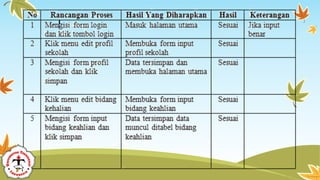
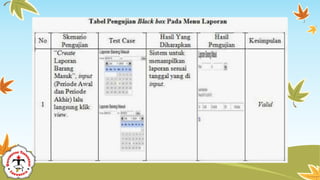
Contoh
Black Box Testing
25
Terima Kasih
ajeng.savitri@tekokrat.ac.id
https://teknokrat.ac.id/en/

Testing

  • 1.
    Systems Analysis and Design By: Ajeng Savitri P, M.Kom Prepared by Kevin C. Dittman for Systems Analysis & Design Methods 4ed by J. L. Whitten & L. D. Bentley
  • 2.
  • 3.
    • Learning thedefinition of software testing • Learning testing strategy • Learning Black box testing
  • 4.
  • 6.
    Definition • Testing isintended to show that a program does what it is intended to do and to discover program defects before it is put into use. • When you test software, you execute a program using artificial data. • You check the results of the test run for errors, anomalies or information about the program’s non-functional attributes. • Can reveal the presence of errors NOT their absence.
  • 7.
    Testing Is a setof activities that can be planned in advance and conducted systematically. For this reason a template for software testing—a set of steps into which you can place specific test case design techniques and testing methods—should be defined for the software process.
  • 8.
    Testing Goals • Todemonstrate to the developer and the customer that the software meets its requirements (leads to validation testing) • To discover situations in which the behavior of the software is incorrect, undesirable or does not conform to its specification (leads to defect testing)
  • 9.
    Verification VS Validation •Verification: "Are we building the product right?”. • The software should conform to its specification. • Validation: "Are we building the right product?”. • The software should do what the user really requires.
  • 10.
    A Model OfThe Software Testing Process
  • 11.
    Software Under Test Test Data Output Result ? Expected ? Not Expected? Test CaseInputs that has been developed to test the system Inputs to the system and the predicted outputs from operating system in these inputs, if the system performs to its specification
  • 12.
  • 13.
  • 14.
    Kind of Testing ConventionalSoftware Testing • White-box testing • Basis path testing • Control Structure Testing • Black-box testing Object Oriented Software Testing • Class level testing • Inter class testing
  • 15.
    You’re never donetesting; the burden simply shifts from you (the software engineer) to the end user
  • 16.
    Strategic Issues • Specifyproduct requirements in a quantifiable manner long before testing commences. • State testing objectives explicitly • Understand the users of the software and develop a profile for each user category. • Develop a testing plan that emphasizes “rapid cycle testing • Build “robust” software that is designed to test itself. • Use effective technical reviews as a filter prior to testing • Conduct technical reviews to assess the test strategy and test cases themselves. • Develop a continuous improvement approach for the testing process
  • 17.
    Object Oriented SoftwareTesting Unlike conventional test-case design, which is driven by an input- process-output view of software or the algorithmic detail of individual modules, object-oriented testing focuses on designing appropriate sequences of operations to exercise the states of a class.
  • 18.
  • 19.
    Black Box • Disebutjuga dengan pengujian perilaku (behavioral testing) atau pengujian fungsi (functional testing) • Fokus pada kebutuhan fungsi (functional requirement) dari PL • Sebagai pelengkap bagi white box testing (bukan sebagai alternatif) • Jenis : • Pengujian klas ekivalen (equivalence class testing) • Pengujian batas (limit testing) • Pengujian acak (robustness testing) • Pengujian kebutuhan (requirements testing)
  • 20.
    Aspek Pengujian • Menemukankesalahan dalam katagori : • Fungsi – fungsi yang tidak benar atau hilang • Kesalahan interface • Kesalahan dalam struktur data atau akses database eksternal • Kesalahan kinerja • Inisialisasi dan kesalahan terminasi/penghentian
  • 21.
    Equivalence Class Testing •Dikenal juga sebagai Pengujian Partisi Ekivalen (equivalence partitioning testing) • Pengujian kotak hitam yang membagi domain masukan sebuah program menjadi klas-klas data dimana kasus uji nantinya akan diturunkan • Satu kasus uji men-cover satu klas kesalahan • Kumpulan data dari setiap klas data memiliki pengaruh yang sama terhadap program • Mengurangi jumlah kasus uji : efisiensi • Sebuah klas ekivalen merepresentasikan sebuah kondisi masukan yg mewakili keadaan valid atau tidak valid
  • 22.
    Limit Testing • Dikenaljuga sbg. Pengujian Analisis Nilai Batas (boundary value analysis testing - BVA) • Pengujian kotak hitam yg. menguji nilai-nilai yang terdapat di perbatasan (limit) • Pedoman umum - jika suatu kondisi masukan adalah sebuah rentang antara a dan b maka kasus ujinya (2 kasus valid dan 2 kasus tidak valid)
  • 23.
    Robustness Testing • Pengujiankotak hitam dengan memasukkan nilai-nilai yang diluar dari kebutuhan yang ditentukan (requirement) • Tujuan : untuk membuktikan bahwa tidak ada even yang kacau (catasthropic : hang, shutdown, dll.) pada PL dengan dimasukkannya nilai-nilai yang tidak normal
  • 24.
    Requirements Testing • Pengujiankotak hitam yang dilakukan untuk menguji apakah kebutuhan (requirement : functional, performance, security, dll.) yang ditentukan selama proses analisis kebutuhan terpenuhi atau tidak • Setiap kebutuhan harus bisa dilacak ke kasus uji dengan menggunakan traceability matrix
  • 25.
  • 28.

Editor's Notes

  • #14 Unit testing begins at the vortex of the spiral and concentrates on each unit (e.g., component, class, or WebApp content object) of the software as implemented in source code. Testing progresses by moving outward along the spiral to integration testing, where the focus is on design and the construction of the software architecture. Taking another turn outward on the spiral, you encounter validation testing, where requirements established as part of requirements modeling are validated against the software that has been constructed. Finally, you arrive at system testing, where the software and other system elements are tested as a whole. To test computer software, you spiral out in a clockwise direction along streamlines that broaden the scope of testing with each turn.