Test Switch Operation and Accessories
Instructor John Greenewald
National Sales Manager- TESCO, The Eastern Specialty Company
John and TESCO have been intimately involved with several AMI pilot
programs, meter certification projects, and subsequent deployments over the
past several years. TESCO has been asked to provide customized
equipment to assist with the certification of new AMI meters and the
functional testing of newly received meters, customized software modules to
assist in the deployment, and meter engineers and meter technicians to
assist throughout the deployment projects in a variety of capacities needed
by the different AMI teams.
2016 Meter School
Agenda
2016 Meter School
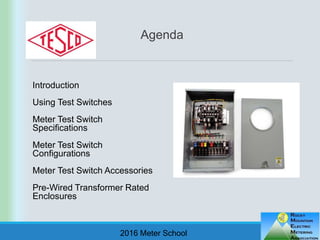
Introduction
Using Test Switches
Meter Test Switch
Specifications
Meter Test Switch
Configurations
Meter Test Switch Accessories
Pre-Wired Transformer Rated
Enclosures
2016 Meter School
•Typically found in
residential metering
•Meters are capable of
handling the direct incoming
amperage
•Meter is connected directly
to the load being measured
•Meter is part of the circuit
•When the meter is
removed from the socket,
power to the customer is
interrupted
Typical Self Contained Service
Transformer Rated Service
•Meter measures scaled
down representation of the
load.
•Scaling is accomplished by
the use of external current
transformers (CTs) and
sometimes voltage
transformers or
PTs).
•The meter is NOT part of
the circuit
•When the meter is
removed from the socket,
power to the customer is
not effected.
2016 Meter School
Transformer Rated Service
5A
PHASE A
SOURCE
PHASE C
PHASE B
LOAD
400A
400A
400A
5A5A
5A 5A 5A
9S Meter Installation with 400:5 CT’s
2016 Meter School
SAFETY
Testing current transformers while they are in service can be a
dangerous operation if certain safety procedures are not followed. The
secondary loop of a current transformer must NEVER BE OPENED when
service current is present in the primary. When there is current in the
primary, and the secondary of a current transformer is open circuited, the
voltage across the secondary can rise to hundreds and even thousands
of volts, creating an extremely dangerous situation. The open CT
secondary voltage magnitude varies with CT design and primary
current flow. The high voltage that is present on the open secondary of
an energized current transformer generates two great hazards. The first
hazard is ELECTRICAL SHOCK TO TESTING PERSONNEL. The second
hazard is THE BREAKDOWN OF THE CURRENT TRANSFORMER
INSULATION. Both hazards can be avoided provided that the secondary
of the current transformer is never opened. The safest current
transformer installations for testing are those that have a Test Switch as
part of the secondary loop. A Test Switch is a device that will facilitate
inserting instrumentation in the current transformer secondary loop
without the danger of opening the circuit.
2016 Meter School
Typical Connections
for Common Meter
Forms
2016 Meter School
• ANSI C12 Definitions
• Test Switch Materials
• Plating
• Barriers
• Wiring Connections
• What to look for
• Covers
Test Switch Specifications
2016 Meter School
ANSI C12.9
Test Switch
Definitions
For Test Switches and Jacks for Transformer-Rated Meters
1 Scope
This standard is intended to encompass the dimensions and functions of meter test switches
used with transformer-rated watthour meters in conjunction with instrument transformers and test
plugs used in conjunction with the test switch.
2 Definitions
2.1 short-circuiting switch
A single-pole double-throw (make-before-break) transfer switch used to transfer current
away from the meter.
2.2 test jack
A spring-jaw receptacle in the current element of a test switch that provides a bipolar test
connection in the metering current circuit without interruption of the current circuit.
2.3 test jack switch
A single-pole single-throw disconnect switch used in conjunction with a test jack to
provide a parallel current path during normal operating conditions.
2.4 test plug
A bipolar mating plug to a test jack for inserting instrumentation into the metering current
circuit.
2.5 voltage switch
A single-pole single-throw switch used to open or close a voltage circuit.
3 Standard ratings
3.1 Current
The current rating shall be 20 A minimum.
3.2 Voltage
The voltage rating shall be 300 V or 600 V.
4 General requirements for test switches
4.1 Material and workmanship
The test switch and its components shall be substantially constructed of suitable material in a
workmanlike manner.
4.2 Nameplates
Nameplates are not required on these test switches, but a manufacturer's identifying marking
(such as catalog number, trademark, etc.) shall be stamped, printed, affixed, or cast in a
convenient place on each test switch. When required, a warning label indicating hidden internal
jumpers should be affixed.
4.3 Movable parts
Movable conducting parts such as blade hinges shall be held in place by locknuts or pins or their
equivalent, arranged so that a firm and secure connection will be maintained at any position of
the switch blade.
AMERICAN NATIONAL STANDARD ANSI C12.9-2011
2016 Meter School
ANSI C12.9
Test Switches
2016 Meter School
ANSI C12.9
Test Switches
2016 Meter School
ANSI C12.9
General Test
Switch
Specifications
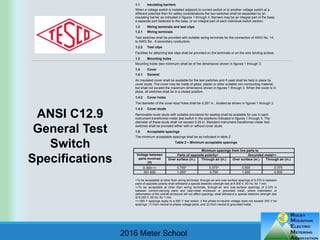
1.1 Insulating barriers
When a voltage switch is installed adjacent to current switch or to another voltage switch at a
different potential then for safety considerations the two switches shall be separated by an
insulating barrier as indicated in figures 1 through 3. Barriers may be an integral part of the base,
a separate part fastened to the base, or an integral part of each individual switch section.
1.2 Wiring terminals and test clips
1.2.1 Wiring terminals
Test switches shall be provided with suitable wiring terminals for the connection of AWG No. 14
to AWG No. 8 secondary conductors.
1.2.2 Test clips
Facilities for attaching test clips shall be provided on the terminals or on the wire binding screws.
1.3 Mounting holes
Mounting holes (two minimum) shall be of the dimensions shown in figures 1 through 3.
1.4 Cover
1.4.1 General
An insulated cover shall be available for the test switches and if used shall be held in place by
cover studs. The cover may be made of glass, plastic or other suitable non-conducting material,
but shall not exceed the maximum dimensions shown in figures 1 through 3. When the cover is in
place, all switches shall be in a closed position.
1.4.2 Cover holes
The diameter of the cover-stud holes shall be 0.281 in., located as shown in figures 1 through 3.
1.4.3 Cover studs
Removable cover studs with suitable provisions for sealing shall be available for use in each
instrument-transformer-meter test switch in the positions indicated in figures 1 through 3. The
diameter of these studs shall not exceed 0.25 in. Standard instrument-transformer-meter test
switches shall be provided either with or without cover studs.
1.5 Acceptable spacings
The minimum acceptable spacings shall be as indicated in table 2.
Table 2 – Minimum acceptable spacings
Minimum spacings from live parts to
Parts of opposite polarity Grounded metalVoltage between
parts involved
(V)
Over surface (in.) Through air (in.) Over surface (in.) Through air (in.)
0-300 0.750* 0.375* 0.500 0.375
301-600 1.250* 0.750 1.000 0.500
To be acceptable at other than wiring terminals, through-air and over-surface spacings of 0.375 in between
parts of opposite polarity shall withstand a special dielectric strength test at 6 000 V, 60 Hz, for 1 min.
To be acceptable at other than wiring terminals, through-air and over-surface spacings of 0.375 in
between current-carrying parts and cast-metal enclosure or grounded metal, where indentation or
deformation of the overall enclosure will not affect spacings, shall withstand a special dielectric strength test
at 6 000 V, 60 Hz, for 1 min.
300 V spacings apply to a 600 V test switch, if the phase-to-neutral voltage does not exceed 300 V for
spacings: (1) from neutral to phase-voltage parts, and (2) from neutral to grounded metal.
2016 Meter School
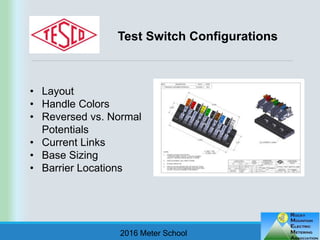
• Layout
• Handle Colors
• Reversed vs. Normal
Potentials
• Current Links
• Base Sizing
• Barrier Locations
Test Switch Configurations
2016 Meter School
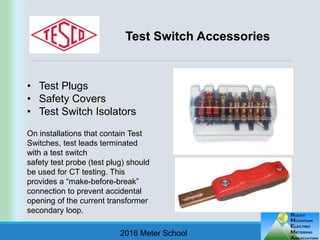
• Test Plugs
• Safety Covers
• Test Switch Isolators
Test Switch Accessories
On installations that contain Test
Switches, test leads terminated
with a test switch
safety test probe (test plug) should
be used for CT testing. This
provides a “make-before-break”
connection to prevent accidental
opening of the current transformer
secondary loop.
2016 Meter School
ANSI C12.9
Test Jack
Specifications
4.6 Provision for test plugs
Each double-pole short-circuiting current switch shall incorporate a test jack which is designed to
permit the insertion of a test plug. The test-jack switch can be either in the left-hand or the right-
hand position. In order to assure proper mating with the test plug the test jack shall conform to
Figure 4.
D
A
A
C
W
S
X
SECTION A-A
.
.
Y
DETAIL C
SCALE 2:1
Maximum deflection
of switch blades with
probe inserted
Figure 4 – Test switch typical cross section
Table 1 – Test switch dimensions
TEST SWITCH DIMENSIONS
DIMENSION MINIMUM PREFERRED MAXIMUM
S 0.900 1.200 1.250
W 0.125 0.140 0.175
X 0.430 0.500 0.550
D 1.280 1.350 N/A
Y 0.188
2016 Meter School
ANSI C12.9
Test Plug
Specifications
1 General requirements for test plugs
1.1 Materials and workmanship
The test plug shall be constructed with an insulated handle providing an anti-slip gripping area
and a barrier to help prevent the user’s gloved hand from slipping into contact with the test switch.
B
B
L
M
..
.
Ymax /2
R1
SECTION B-B
SCALE 2 : 1
Insertion
Guide
Standard
Wmin
Alternate #1
R
G
T
P
.
Figure 6 – Typical test plug
Notes:
(1) When the insertion guide takes the form of Section B-B Alternate #1, then for a switch
with a slot width Wmin, the switch Jaws shall not be separated by more than Ymax =
0.188” when inserted.
(2) If a positive stop is provided on the probe blade to limit insertion depth of the probe to M
by bottoming out against S of the switch, then L may exceed Lmax provided M < Dmin –
Smax = 0.030”.
Table 3 – Test plug dimensions
TEST PLUG DIMENSIONS
DIMENSION MINIMUM PREFERRED MAXIMUM
L 1.100 1.200 1.260
M 0 0.140 0.175
R 0.090 0.110 0.120
R1 n/a n/a 0.156
T 0.100 0.130 0.156
G 0.040 0.125 0.175
ALERT TO USERS: Prior to adoption of this standard there are known instances of probes and
switches where interferences exist which may not allow all probes and switches to mate or which
may lead to probes shorting to undesired conductors.
2016 Meter School
• Cover Types
• Wiring
• Sockets
Pre-Wired Transformer Rated
Enclosures
2016 Meter School
Questions?
Metering Leader since 1904
2016 Meter School
QUIZ
1. Which type of metering service typically has a test switch?
A. Self Contained
B. Transformer Rated
C. Gas
2. Why would you want to reverse the potentials on test switch?
A. Aesthetics
B. To use multiple voltages
C. To de-energize the potential blades when open for safety
3. What is the purpose of a current link on a test switch?
A. To enable connection of the test jack and shunt in the current
pair to complete the current loop.
B. To connect the current pairs to the potentials
C. To eliminate the need for barriers between the poles

Test Switch Operation and Accessories

  • 1.
    Test Switch Operationand Accessories Instructor John Greenewald National Sales Manager- TESCO, The Eastern Specialty Company John and TESCO have been intimately involved with several AMI pilot programs, meter certification projects, and subsequent deployments over the past several years. TESCO has been asked to provide customized equipment to assist with the certification of new AMI meters and the functional testing of newly received meters, customized software modules to assist in the deployment, and meter engineers and meter technicians to assist throughout the deployment projects in a variety of capacities needed by the different AMI teams. 2016 Meter School
  • 2.
    Agenda 2016 Meter School Introduction UsingTest Switches Meter Test Switch Specifications Meter Test Switch Configurations Meter Test Switch Accessories Pre-Wired Transformer Rated Enclosures
  • 3.
    2016 Meter School •Typicallyfound in residential metering •Meters are capable of handling the direct incoming amperage •Meter is connected directly to the load being measured •Meter is part of the circuit •When the meter is removed from the socket, power to the customer is interrupted Typical Self Contained Service
  • 4.
    Transformer Rated Service •Metermeasures scaled down representation of the load. •Scaling is accomplished by the use of external current transformers (CTs) and sometimes voltage transformers or PTs). •The meter is NOT part of the circuit •When the meter is removed from the socket, power to the customer is not effected.
  • 5.
    2016 Meter School TransformerRated Service 5A PHASE A SOURCE PHASE C PHASE B LOAD 400A 400A 400A 5A5A 5A 5A 5A 9S Meter Installation with 400:5 CT’s
  • 6.
    2016 Meter School SAFETY Testingcurrent transformers while they are in service can be a dangerous operation if certain safety procedures are not followed. The secondary loop of a current transformer must NEVER BE OPENED when service current is present in the primary. When there is current in the primary, and the secondary of a current transformer is open circuited, the voltage across the secondary can rise to hundreds and even thousands of volts, creating an extremely dangerous situation. The open CT secondary voltage magnitude varies with CT design and primary current flow. The high voltage that is present on the open secondary of an energized current transformer generates two great hazards. The first hazard is ELECTRICAL SHOCK TO TESTING PERSONNEL. The second hazard is THE BREAKDOWN OF THE CURRENT TRANSFORMER INSULATION. Both hazards can be avoided provided that the secondary of the current transformer is never opened. The safest current transformer installations for testing are those that have a Test Switch as part of the secondary loop. A Test Switch is a device that will facilitate inserting instrumentation in the current transformer secondary loop without the danger of opening the circuit.
  • 7.
    2016 Meter School TypicalConnections for Common Meter Forms
  • 8.
    2016 Meter School •ANSI C12 Definitions • Test Switch Materials • Plating • Barriers • Wiring Connections • What to look for • Covers Test Switch Specifications
  • 9.
    2016 Meter School ANSIC12.9 Test Switch Definitions For Test Switches and Jacks for Transformer-Rated Meters 1 Scope This standard is intended to encompass the dimensions and functions of meter test switches used with transformer-rated watthour meters in conjunction with instrument transformers and test plugs used in conjunction with the test switch. 2 Definitions 2.1 short-circuiting switch A single-pole double-throw (make-before-break) transfer switch used to transfer current away from the meter. 2.2 test jack A spring-jaw receptacle in the current element of a test switch that provides a bipolar test connection in the metering current circuit without interruption of the current circuit. 2.3 test jack switch A single-pole single-throw disconnect switch used in conjunction with a test jack to provide a parallel current path during normal operating conditions. 2.4 test plug A bipolar mating plug to a test jack for inserting instrumentation into the metering current circuit. 2.5 voltage switch A single-pole single-throw switch used to open or close a voltage circuit. 3 Standard ratings 3.1 Current The current rating shall be 20 A minimum. 3.2 Voltage The voltage rating shall be 300 V or 600 V. 4 General requirements for test switches 4.1 Material and workmanship The test switch and its components shall be substantially constructed of suitable material in a workmanlike manner. 4.2 Nameplates Nameplates are not required on these test switches, but a manufacturer's identifying marking (such as catalog number, trademark, etc.) shall be stamped, printed, affixed, or cast in a convenient place on each test switch. When required, a warning label indicating hidden internal jumpers should be affixed. 4.3 Movable parts Movable conducting parts such as blade hinges shall be held in place by locknuts or pins or their equivalent, arranged so that a firm and secure connection will be maintained at any position of the switch blade. AMERICAN NATIONAL STANDARD ANSI C12.9-2011
  • 10.
    2016 Meter School ANSIC12.9 Test Switches
  • 11.
    2016 Meter School ANSIC12.9 Test Switches
  • 12.
    2016 Meter School ANSIC12.9 General Test Switch Specifications 1.1 Insulating barriers When a voltage switch is installed adjacent to current switch or to another voltage switch at a different potential then for safety considerations the two switches shall be separated by an insulating barrier as indicated in figures 1 through 3. Barriers may be an integral part of the base, a separate part fastened to the base, or an integral part of each individual switch section. 1.2 Wiring terminals and test clips 1.2.1 Wiring terminals Test switches shall be provided with suitable wiring terminals for the connection of AWG No. 14 to AWG No. 8 secondary conductors. 1.2.2 Test clips Facilities for attaching test clips shall be provided on the terminals or on the wire binding screws. 1.3 Mounting holes Mounting holes (two minimum) shall be of the dimensions shown in figures 1 through 3. 1.4 Cover 1.4.1 General An insulated cover shall be available for the test switches and if used shall be held in place by cover studs. The cover may be made of glass, plastic or other suitable non-conducting material, but shall not exceed the maximum dimensions shown in figures 1 through 3. When the cover is in place, all switches shall be in a closed position. 1.4.2 Cover holes The diameter of the cover-stud holes shall be 0.281 in., located as shown in figures 1 through 3. 1.4.3 Cover studs Removable cover studs with suitable provisions for sealing shall be available for use in each instrument-transformer-meter test switch in the positions indicated in figures 1 through 3. The diameter of these studs shall not exceed 0.25 in. Standard instrument-transformer-meter test switches shall be provided either with or without cover studs. 1.5 Acceptable spacings The minimum acceptable spacings shall be as indicated in table 2. Table 2 – Minimum acceptable spacings Minimum spacings from live parts to Parts of opposite polarity Grounded metalVoltage between parts involved (V) Over surface (in.) Through air (in.) Over surface (in.) Through air (in.) 0-300 0.750* 0.375* 0.500 0.375 301-600 1.250* 0.750 1.000 0.500 To be acceptable at other than wiring terminals, through-air and over-surface spacings of 0.375 in between parts of opposite polarity shall withstand a special dielectric strength test at 6 000 V, 60 Hz, for 1 min. To be acceptable at other than wiring terminals, through-air and over-surface spacings of 0.375 in between current-carrying parts and cast-metal enclosure or grounded metal, where indentation or deformation of the overall enclosure will not affect spacings, shall withstand a special dielectric strength test at 6 000 V, 60 Hz, for 1 min. 300 V spacings apply to a 600 V test switch, if the phase-to-neutral voltage does not exceed 300 V for spacings: (1) from neutral to phase-voltage parts, and (2) from neutral to grounded metal.
  • 13.
    2016 Meter School •Layout • Handle Colors • Reversed vs. Normal Potentials • Current Links • Base Sizing • Barrier Locations Test Switch Configurations
  • 14.
    2016 Meter School •Test Plugs • Safety Covers • Test Switch Isolators Test Switch Accessories On installations that contain Test Switches, test leads terminated with a test switch safety test probe (test plug) should be used for CT testing. This provides a “make-before-break” connection to prevent accidental opening of the current transformer secondary loop.
  • 15.
    2016 Meter School ANSIC12.9 Test Jack Specifications 4.6 Provision for test plugs Each double-pole short-circuiting current switch shall incorporate a test jack which is designed to permit the insertion of a test plug. The test-jack switch can be either in the left-hand or the right- hand position. In order to assure proper mating with the test plug the test jack shall conform to Figure 4. D A A C W S X SECTION A-A . . Y DETAIL C SCALE 2:1 Maximum deflection of switch blades with probe inserted Figure 4 – Test switch typical cross section Table 1 – Test switch dimensions TEST SWITCH DIMENSIONS DIMENSION MINIMUM PREFERRED MAXIMUM S 0.900 1.200 1.250 W 0.125 0.140 0.175 X 0.430 0.500 0.550 D 1.280 1.350 N/A Y 0.188
  • 16.
    2016 Meter School ANSIC12.9 Test Plug Specifications 1 General requirements for test plugs 1.1 Materials and workmanship The test plug shall be constructed with an insulated handle providing an anti-slip gripping area and a barrier to help prevent the user’s gloved hand from slipping into contact with the test switch. B B L M .. . Ymax /2 R1 SECTION B-B SCALE 2 : 1 Insertion Guide Standard Wmin Alternate #1 R G T P . Figure 6 – Typical test plug Notes: (1) When the insertion guide takes the form of Section B-B Alternate #1, then for a switch with a slot width Wmin, the switch Jaws shall not be separated by more than Ymax = 0.188” when inserted. (2) If a positive stop is provided on the probe blade to limit insertion depth of the probe to M by bottoming out against S of the switch, then L may exceed Lmax provided M < Dmin – Smax = 0.030”. Table 3 – Test plug dimensions TEST PLUG DIMENSIONS DIMENSION MINIMUM PREFERRED MAXIMUM L 1.100 1.200 1.260 M 0 0.140 0.175 R 0.090 0.110 0.120 R1 n/a n/a 0.156 T 0.100 0.130 0.156 G 0.040 0.125 0.175 ALERT TO USERS: Prior to adoption of this standard there are known instances of probes and switches where interferences exist which may not allow all probes and switches to mate or which may lead to probes shorting to undesired conductors.
  • 17.
    2016 Meter School •Cover Types • Wiring • Sockets Pre-Wired Transformer Rated Enclosures
  • 18.
  • 19.
    2016 Meter School QUIZ 1.Which type of metering service typically has a test switch? A. Self Contained B. Transformer Rated C. Gas 2. Why would you want to reverse the potentials on test switch? A. Aesthetics B. To use multiple voltages C. To de-energize the potential blades when open for safety 3. What is the purpose of a current link on a test switch? A. To enable connection of the test jack and shunt in the current pair to complete the current loop. B. To connect the current pairs to the potentials C. To eliminate the need for barriers between the poles