Section 6 – Steel Structures (SI)
C6 - 1
C6.1
Most of the provisions for proportioning
main elements are grouped by structural action:
 Tension and combined tension and flexure
(Article 6.8)
 Compression and combined compression
and flexure (Article 6.9)
 Flexure and flexural shear:
 I-sections (Article 6.10)
 box sections (Article 6.1 1 )
 miscellaneous sections (Article 6.12)
Provisions for connections and splices are
contained in Article 6.13.
Article 6.14 contains provisions specific to
particular assemblages or structural types, e.g.,
through-girder spans, trusses, orthotropic deck
systems, and arches.
C6.4.1
The term "yield strength" is used in
these Specifications as a generic term to denote
either the minimum specified yield point or the
minimum specified yield stress.
The main difference, and in most cases
the only difference, between AASHTO and
ASTM requirements is the inclusion of
mandatory notch toughness and weldability
requirements in the AASHTO Material
Standards. Steels meeting the AASHTO
Material requirements are prequalified for use in
welded bridges.
The yield strength in the direction
parallel to the direction of rolling is of primary
interest in the design of most steel structures. In
welded bridges, notch toughness is of equal
importance. Other mechanical and physical
properties of rolled steel, such as anisotropy,
ductility, formability, and corrosion resistance,
may also be important to ensure the satisfactory
performance of the structure.
No specification can anticipate all of the
unique or especially demanding applications that
may arise. The literature on specific properties
of concern and appropriate supplementary
material production or quality requirements,
provided in the AASHTO and ASTM Material
Specifications and the ANSI/AASHTO/AWS
Bridge Welding Code, should be considered, if
appropriate.
ASTM A 709M, Grade HPS485W, has
replaced AASHTO M 270M, Grade 485W, in
Table 1. The intent of this replacement is to
encourage the use of HPS steel over
conventional bridge steels due to its enhanced
properties. AASHTO M 270M, Grade 485W, is
still available, but should be used only with the
owners approval. The available lengths of
ASTM A 709M, Grade HPS485W, are a
function of the processing of the plate, with
longer lengths produced as as-rolled plate.
C6.4.3.1
The ASTM standard for A 307 bolts
covers two grades of fasteners. There is no
corresponding AASHTO standard. Either grade
may be used under these Specifications;
however, Grade B is intended for pipe-flange
bolting, and Grade A is the quality traditionally
used for structural applications.
The purpose of the dye is to allow a
visual check to be made for the lubricant at the
time of field installation. Black bolts must be
oily to the touch when delivered and installed.
C6.4.3.2
All galvanized nuts shall be lubricated
with a lubricant containing a visible dye.
C6.4.3.3
Installation provisions for washers are
covered in the AASHTO LRFD Bridge
Construction Specifications (1998).
C6.4.3.5
Section 6 – Steel Structures (SI)
C6 - 2
Installation provisions for load-
indicating devices are covered in the AASHTO
LRFD Bridge Construction Specifications
(1998).
C6.4.4
Physical properties, test methods and
certification of steel shear connectors are
covered in the AASHTO LRFD Bridge
Construction Specifications (1998).
C6.4.5
The AWS designation systems are not
consistent. For example, there are differences
between the system used for designating
electrodes for shielded metal arc welding and the
system used for designating submerged arc
welding. Therefore, when specifying weld metal
and/or flux by AWS designation, the applicable
specification should be reviewed to ensure a
complete understanding of the designation
reference.
C6.5.2
The intent of this provision is to prevent
permanent deformations due to localized
yielding.
C6.5.4.2
Base metal  as appropriate for
resistance under consideration.
The basis for the resistance factors for
driven steel piles is described in Article 6.15.2.
Indicated values of c and f for
combined axial and flexural resistance are for
use in interaction equations in Article 6.9.2.2.
Further limitations on usable resistance during
driving are specified in Article 10.7.1.16.
C6.6.1.1
In the AASHTO Standard Specifications
for Highway Bridges (16th edition), the
provisions explicitly relating to fatigue dealt
only with load-induced fatigue.
C6.6.1.2.1
Concrete can provide significant
resistance to tensile stress at service load levels.
Recognizing this behavior will have a
significantly beneficial effect on the
computation of fatigue stress ranges in top
flanges in regions of stress reversal and in
regions of negative flexure. By utilizing shear
connectors in these regions to ensure composite
action in combination with the required 1
percent longitudinal reinforcement wherever the
longitudinal tensile stress in the slab exceeds the
factored modulus of rupture of the concrete,
crack length and width can be controlled so that
full-depth cracks should not occur. When a
crack does occur, the stress in the longitudinal
reinforcement increases until the crack is
arrested. Ultimately, the cracked concrete and
the reinforcement reach equilibrium. Thus, the
slab may contain a small number of staggered
cracks at any given section. Properly placed
longitudinal reinforcement prevents coalescence
of these cracks.
It has been shown that the level of total
applied stress is insignificant for a welded steel
detail. Residual stresses due to welding are
implicitly included through the specification of
stress range as the sole dominant stress
parameter for fatigue design. This same concept
of considering only stress range has been applied
to rolled, bolted, and riveted details where far
different residual stress fields exist. The
application to nonwelded details is conservative.
The live load stress due to the passage
of the fatigue load is approximately one-half that
of the heaviest truck expected to cross the bridge
in 75 years.
C6.6.1.2.2
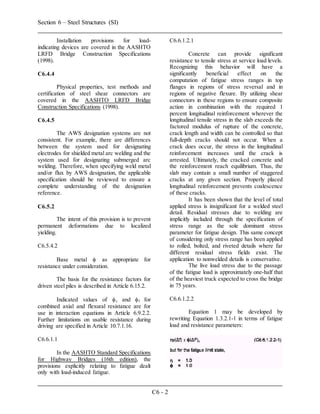
Equation 1 may be developed by
rewriting Equation 1.3.2.1-1 in terms of fatigue
load and resistance parameters:
Section 6 – Steel Structures (SI)
C6 - 3
C6.6.1.2.3
Components and details susceptible to
load-induced fatigue cracking have been
grouped into eight categories, called detail
categories, by fatigue resistance.
Experience indicates that in the design
process the fatigue considerations for Detail
Categories A through B' rarely, if ever, govern.
Components and details with fatigue resistances
greater than Detail Category C have been
included in Tables 1 and 2 for completeness.
Investigation of details with fatigue resistance
greater than Detail Category C may be
appropriate in unusual design cases.
Category F for allowable shear stress
range on the throat of a fillet weld has been
eliminated from Table 1 and replaced by
Category E. Category F was not as well defined.
Category E can be conservatively applied in
place of Category F. When fillet welds are
properly sized for strength considerations,
Category F should not govern.
In Table 1, "Longitudinally Loaded''
signifies that the direction of applied stress is
parallel to the longitudinal axis of the weld.
”Transversely Loaded" signifies that the
direction of applied stress is perpendicular to the
longitudinal axis of the weld.
Research on end-bolted cover plates is
discussed in Wattar et al. (1985).
Table 2 contains special details for
orthotropic plates. These details require careful
consideration of not only the specification
requirements, but also the application guidelines
in the commentary.
 Welded deck plate field splices, Cases (1),
(2), (3) - The current specifications
distinguish between the transverse and the
longitudinal deck plate splices and treat the
transverse splices more conservatively.
However, there appears to be no valid
reason for such differential treatment; in
fact, the longitudinal deck plate splices may
be subjected to higher stresses under the
effects of local wheel loads. Therefore, only
the governing fatigue stress range should
govern. One of the disadvantages of field
splices with backing bars left in place is
possible vertical misalignment and corrosion
susceptibility. Intermittent tack welds inside
of the groove may be acceptable because the
tack welds are ultimately fused with the
groove weld material. The same
considerations apply to welded closed rib
splices.
 Bolted deck or rib splices, Case (4) - Bolted
deck splices are not applicable where thin
surfacings are intended. However, bolted rib
splices, requiring "bolting windows", but
having a favorable fatigue rating, combined
with welded deck splices, are favored in
American practice.
 Welded deck and rib shop splices - Case (6)
corresponds to the current provision. Case
(5) gives a more favorable classification for
welds ground flush.
 “Window" rib splice - Case (7) is the
method favored by designers for welded
splices of closed ribs, offering the advantage
of easy adjustment in the field. According to
ECSC research, a large welding gap
improves fatigue strength. A disadvantage of
this splice is inferior quality and reduced
fatigue resistance of the manual overhead
weld between the rib insert and the deck
plate, and fatigue sensitive junction of the
shop and the field deck/rib weld.
 Ribs at intersections with floorbeams – A
distinction is made between rib walls
subjected to axial stresses only, i.e., Case
(8), closed ribs with internal diaphragm, or
open rib, and rib walls subjected to
additional out-of-plane bending, i.e., Case
(9), closed ribs without internal diaphragms,
where out-of-plane bending caused by
complex interaction of the closed-rib wall
with the "tooth" of the floorbeam web
between the ribs contributes additional
flexural stresses in the rib wall which should
be added to the axial stresses in calculations
of the governing stress range. Calculation of
the interaction forces and additional flexure
in the rib walls is extremely complex
because of the many geometric parameters
involved and may be accomplished only by
Section 6 – Steel Structures (SI)
C6 - 4
a refined FEM analysis. Obviously, this is
often not a practical design option, and it is
expected that the designers will choose Case
(8) with an interior diaphragm, in which
case there is no cantilever in- plane bending
of the floorbeam "tooth" and no associated
interaction stress causing bending of the rib
wall. However, Case (9) may serve for
evaluation of existing decks without internal
diaphragms inside the closed ribs.
 Floorbeam web at intersection with the rib -
Similarly, as in the cases above, distinction
is made between the closed ribs with and
without internal diaphragms in the plane of
the floorbeam web. For the Case (l0), the
stress flow in the floorbeam web is assumed
to be uninterrupted by the cutout for the rib;
however, an additional axial stress
component acting on the connecting welds
due to the tension field in the "tooth" of the
floorbeam web caused by shear applied at
the floorbeamldeck plate junction must be
added to the axial stress f1. A local flexural
stress f2 in the floorbeam web is due to the
out-of-plane bending of the web caused by
the rotation of the rib in its plane under the
effects of unsymmetrical live loads on the
deck. Both stresses f1,and f2 at the toe of the
weld are directly additive; however, only
stress f1, is to be included in checking the
load carrying capacity of filled welds by
Equation 6.6.1.2.5-3. The connection
between the rib wall and floorbeam web or
rib wall and internal diaphragm plate can
also be made using a combination
groove/fillet weld connection. The fatigue
resistance of the combination groove/fillet
weld connection has been found to be
Category C and is not governed by Equation
6.6.1.2.5-3. See also Note e), Figure
9.8.3.7.4-1. Stress f2, can be calculated from
considerations of rib rotation under variable
live load and geometric parameters
accounting for rotational restraints at the rib
support, e.g., floorbeam depth, floorbeam
web thickness. For Case (11), without an
internal diaphragm, the stresses in the web
are very complex and comments for Case
(9) apply.
 Deck plate at the connection to the
floorbeam web - For Case (12) basic
considerations apply for a stress flow in the
direction parallel to the floorbeam web
locally deviated by a longitudinal weld, for
which Category E is usually assigned.
Tensile stress in the deck, which is relevant
for fatigue analysis, will occur in floorbeams
continuous over a longitudinal girder, or in a
floorbeam cantilever. Additional local
stresses in the deck plate in the direction of
the floorbeam web will occur in closed-rib
decks of traditional design where the deck
plate is unsupported over the rib cavity.
Resulting stress flow concentration at the
edges of floorbeam "teeth" may cause very
high peak stresses. This has resulted in
severe cracking in some thin deck plates
which were 12 mm thick or less. This
additional out-of-plane local stress may be
reduced by extending the internal diaphragm
plate inside the closed rib and fitting it
tightly against the underside of the deck
plate to provide continuous support,
Wolchuk (1999). Reduction of these stresses
in thicker deck plates remains to be studied.
A thick surfacing may also contribute to a
wider load distribution and deck plate stress
reduction. Fatigue tests on a full-scale
prototype orthotropic deck demonstrated
that a deck plate of 16 mm was sufficient to
prevent any cracking after 15.5 million
cycles. The applied load was 3.6 times the
equivalent fatigue-limit state wheel load and
there was no wearing surface on the test
specimen. However, the minimum deck
plate thickness allowed by these
specifications is 14 mm. Where interior
diaphragms are used, extending the
diaphragms to fit the underside of the deck
is suggested as a safety precaution,
especially if large rib web spacing is used.
 Additional commentary on the use of
internal diaphragms versus cutouts in the
floorbeam web can be found in Article
C9.8.3.7.4.
C6.6.1.2.5
Section 6 – Steel Structures (SI)
C6 - 5
The fatigue resistance above the
constant amplitude fatigue threshold, in terms of
cycles, is inversely proportional to the cube of
the stress range, e.g., if the stress range is
reduced by a factor of 2, the fatigue life
increases by a factor of 23
.
The requirement on higher-traffic-
volume bridges that the maximum stress range
experienced by a detail be less than the constant-
amplitude fatigue threshold provides a
theoretically infinite fatigue life. The maximum
stress range is assumed to be twice the live load
stress range due to the passage of the fatigue
load, factored in accordance with the load factor
in Table 3.4.1-1 for the fatigue load
combination.
In the AASHTO 1996 Standard
Specifications, the constant amplitude fatigue
threshold was termed the allowable fatigue
stress range for more than 2 million cycles on a
redundant load path structure. The design life
has been considered to be 75 years in the overall
development of these LRFD Specifications. If a
design life other than 75 years is sought, a
number other than 75 may be inserted in the
equation for N.
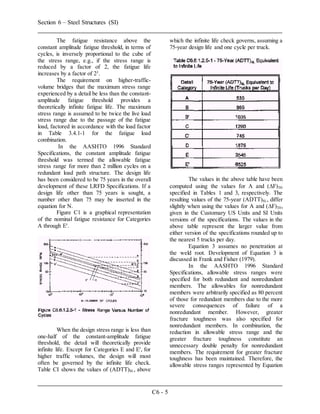
Figure C1 is a graphical representation
of the nominal fatigue resistance for Categories
A through E'.
When the design stress range is less than
one-half of the constant-amplitude fatigue
threshold, the detail will theoretically provide
infinite life. Except for Categories E and E', for
higher traffic volumes, the design will most
often be governed by the infinite life check.
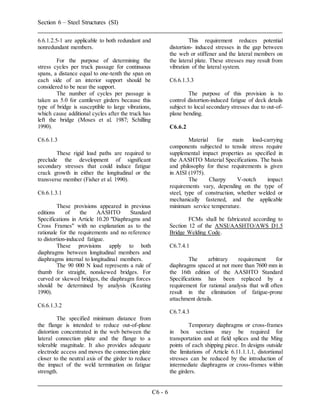
Table CI shows the values of (ADTT)SL, above
which the infinite life check governs, assuming a
75-year design life and one cycle per truck.
The values in the above table have been
computed using the values for A and (F)TH
specified in Tables 1 and 3, respectively. The
resulting values of the 75-year (ADTT)SL, differ
slightly when using the values for A and (F)TH,
given in the Customary US Units and SI Units
versions of the specifications. The values in the
above table represent the larger value from
either version of the specifications rounded up to
the nearest 5 trucks per day.
Equation 3 assumes no penetration at
the weld root. Development of Equation 3 is
discussed in Frank and Fisher (1979).
In the AASHTO 1996 Standard
Specifications, allowable stress ranges were
specified for both redundant and nonredundant
members. The allowables for nonredundant
members were arbitrarily specified as 80 percent
of those for redundant members due to the more
severe consequences of failure of a
nonredundant member. However, greater
fracture toughness was also specified for
nonredundant members. In combination, the
reduction in allowable stress range and the
greater fracture toughness constitute an
unnecessary double penalty for nonredundant
members. The requirement for greater fracture
toughness has been maintained. Therefore, the
allowable stress ranges represented by Equation
Section 6 – Steel Structures (SI)
C6 - 6
6.6.1.2.5-1 are applicable to both redundant and
nonredundant members.
For the purpose of determining the
stress cycles per truck passage for continuous
spans, a distance equal to one-tenth the span on
each side of an interior support should be
considered to be near the support.
The number of cycles per passage is
taken as 5.0 for cantilever girders because this
type of bridge is susceptible to large vibrations,
which cause additional cycles after the truck has
left the bridge (Moses et al. 1987; Schilling
1990).
C6.6.1.3
These rigid load paths are required to
preclude the development of significant
secondary stresses that could induce fatigue
crack growth in either the longitudinal or the
transverse member (Fisher et al. 1990).
C6.6.1.3.1
These provisions appeared in previous
editions of the AASHTO Standard
Specifications in Article 10.20 "Diaphragms and
Cross Frames" with no explanation as to the
rationale for the requirements and no reference
to distortion-induced fatigue.
These provisions apply to both
diaphragms between longitudinal members and
diaphragms internal to longitudinal members.
The 90 000 N load represents a rule of
thumb for straight, nonskewed bridges. For
curved or skewed bridges, the diaphragm forces
should be determined by analysis (Keating
1990).
C6.6.1.3.2
The specified minimum distance from
the flange is intended to reduce out-of-plane
distortion concentrated in the web between the
lateral connection plate and the flange to a
tolerable magnitude. It also provides adequate
electrode access and moves the connection plate
closer to the neutral axis of the girder to reduce
the impact of the weld termination on fatigue
strength.
This requirement reduces potential
distortion- induced stresses in the gap between
the web or stiffener and the lateral members on
the lateral plate. These stresses may result from
vibration of the lateral system.
C6.6.1.3.3
The purpose of this provision is to
control distortion-induced fatigue of deck details
subject to local secondary stresses due to out-of-
plane bending.
C6.6.2
Material for main load-carrying
components subjected to tensile stress require
supplemental impact properties as specified in
the AASHTO Material Specifications. The basis
and philosophy for these requirements is given
in AISI (1975).
The Charpy V-notch impact
requirements vary, depending on the type of
steel, type of construction, whether welded or
mechanically fastened, and the applicable
minimum service temperature.
FCMs shall be fabricated according to
Section 12 of the ANSI/AASHTO/AWS D1.5
Bridge Welding Code.
C6.7.4.1
The arbitrary requirement for
diaphragms spaced at not more than 7600 mm in
the 16th edition of the AASHTO Standard
Specifications has been replaced by a
requirement for rational analysis that will often
result in the elimination of fatigue-prone
attachment details.
C6.7.4.3
Temporary diaphragms or cross-frames
in box sections may be required for
transportation and at field splices and the Ming
points of each shipping piece. In designs outside
the limitations of Article 6.11.1.1.1, distortional
stresses can be reduced by the introduction of
intermediate diaphragms or cross-frames within
the girders.
Section 6 – Steel Structures (SI)
C6 - 7
C6.7.5.2
Wind-load stresses in I-sections may be
reduced by:
 Changing the flange size,
 Reducing the diaphragm or cross-frame
spacing, or
 Adding lateral bracing.
The relative economy of these methods should
be investigated.
C6.7.5.3
Investigation will generally show that a
lateral bracing system is not required between
straight multiple box sections.
In box sections with sloping webs, the
horizontal component of web shear acts as a
lateral horizontal force on the flange of the box
girder. Internal lateral bracing or struts may be
required to resist this force prior to deck
placement.
For straight box sections with spans less
than about 45 000 mm, at least one panel of
horizontal lateral bracing should be provided on
each side of a lifting point. Straight box sections
with spans greater than about 45 000 mm may
require a full length lateral bracing system to
prevent distortions brought about by temperature
changes occurring prior to concrete slab
placement.
C6.7.6.2.1
The development of Equation 1 is
discussed in Kulicki (1983).
C6.8.1
The provisions of the AISC (1993) may
be used to design tapered tension members.
C6.8.2.1
The reduction factor, U, does not apply
when checking yielding on the gross section
because yielding tends to equalize the
nonuniform tensile stresses caused over the
cross-section by shear lag.
Due to strain hardening, a ductile steel
loaded in axial tension can resist a force greater
than the product of its gross area and its' yield
strength prior to fracture. However, excessive
elongation due to uncontrolled yielding of gross
area not only marks the limit of usefulness but
can precipitate failure of the structural system of
which it is a part. Depending on the ratio of net
area to gross area and the mechanical properties
of the steel, the component can fracture by
failure of the net area at a load smaller than that
required to yield the gross area. General yielding
of the gross area and fracture of the net area both
constitute measures of component strength. The
relative values of the resistance factors for
yielding and fracture reflect the different
reliability indices deemed proper for the two
modes.
The part of the component occupied by
the net area at fastener holes generally has a
negligible length relative to the total length of
the member. As a result, the strain hardening is
quickly reached and, therefore, yielding of the
net area at fastener holes does not constitute a
strength limit of practical significance, except
perhaps for some builtup members of unusual
proportions.
For welded connections, An, is the gross
section less any access holes in the connection
region.
C6.8.2.2
For shear lag in flexural components,
see Article 4.6.2.6. These cases include builtup
members, wide-flange shapes, channels, tees,
and angles. For bolted connections, Munse and
Chesson (1963) observed that the loss in
efficiency at the net section due to shear lag was
related to the ratio of the length, L, of the
connection and the eccentricity, x, between the
shear plane and the centroidal axis of the
connected component. They concluded that a
decrease in joint length increases the shear lag
effect. To approximate the efficiency of the net
Section 6 – Steel Structures (SI)
C6 - 8
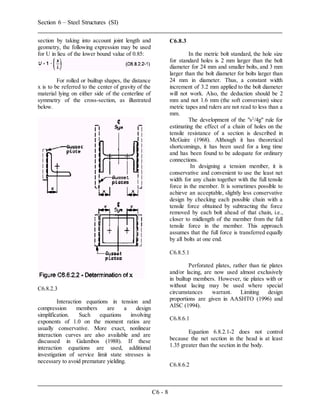
section by taking into account joint length and
geometry, the following expression may be used
for U in lieu of the lower bound value of 0.85:
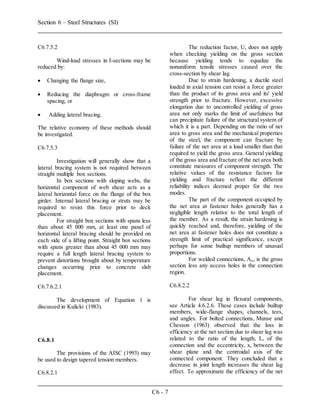
For rolled or builtup shapes, the distance
x is to be referred to the center of gravity of the
material lying on either side of the centerline of
symmetry of the cross-section, as illustrated
below.
C6.8.2.3
Interaction equations in tension and
compression members are a design
simplification. Such equations involving
exponents of 1.0 on the moment ratios are
usually conservative. More exact, nonlinear
interaction curves are also available and are
discussed in Galambos (1988). If these
interaction equations are used, additional
investigation of service limit state stresses is
necessary to avoid premature yielding.
C6.8.3
In the metric bolt standard, the hole size
for standard holes is 2 mm larger than the bolt
diameter for 24 mm and smaller bolts, and 3 mm
larger than the bolt diameter for bolts larger than
24 mm in diameter. Thus, a constant width
increment of 3.2 mm applied to the bolt diameter
will not work. Also, the deduction should be 2
mm and not 1.6 mm (the soft conversion) since
metric tapes and rulers are not read to less than a
mm.
The development of the "s2
/4g" rule for
estimating the effect of a chain of holes on the
tensile resistance of a section is described in
McGuire (1968). Although it has theoretical
shortcomings, it has been used for a long time
and has been found to be adequate for ordinary
connections.
In designing a tension member, it is
conservative and convenient to use the least net
width for any chain together with the full tensile
force in the member. It is sometimes possible to
achieve an acceptable, slightly less conservative
design by checking each possible chain with a
tensile force obtained by subtracting the force
removed by each bolt ahead of that chain, i.e.,
closer to midlength of the member from the full
tensile force in the member. This approach
assumes that the full force is transferred equally
by all bolts at one end.
C6.8.5.1
Perforated plates, rather than tie plates
and/or lacing, are now used almost exclusively
in builtup members. However, tie plates with or
without lacing may be used where special
circumstances warrant. Limiting design
proportions are given in AASHTO (1996) and
AISC (1994).
C6.8.6.1
Equation 6.8.2.1-2 does not control
because the net section in the head is at least
1.35 greater than the section in the body.
C6.8.6.2
Section 6 – Steel Structures (SI)
C6 - 9
The limitation on the hole diameter for
steel with yield strengths above 485 MPa, which
is not included in the 16th edition of the
AASHTO Standard Specifications, 1996, is
intended to prevent dishing beyond the pin hole
(AISC 1994).
C6.8.6.3
The eyebar assembly should be detailed
to prevent corrosion-causing elements from
entering the joints. Eyebars sometimes vibrate
perpendicular to their plane. The intent of this
provision is to prevent repeated eyebar contact
by providing adequate spacing or by clamping.
C6.8.7.3
The proportions specified in this article
assure that the member will not fail in the region
of the hole if the strength limit state is satisfied
in the main plate away from the hole.
C6.8.7.4
The pin-connected assembly should be
detailed to prevent corrosion-causing elements
from entering the joints.
C6.9.1
Conventional column design formulas
contain allowances for imperfections and
eccentricities permissible in normal fabrication
and erection. The effect of any significant
additional eccentricity should be accounted for
in bridge design.
Torsional buckling or flexural-torsional
buckling of singly symmetric and unsymmetric
compression members and doubly symmetric
compression members with very thin walls
should be investigated. Pertinent provisions of
AISC (1994) can be used to design tapered
compression members.
C6.9.2.2
These equations are identical to the
provisions in AISC LRFD Specification (1994).
They were selected for use in that Specification
after being compared with a number of
alternative formulations with the results of
refined inelastic analyses of 82 frame sidesway
cases (Kanchanalai 1977). Pu, Mux, and Muy, are
simultaneous axial and flexural forces on cross-
sections determined by analysis under factored
loads. The maximum calculated moment in the
member in each direction including the second
order effects, should be considered. Where
maxima occur on different cross-sections, each
should be checked.
C6.9.4.1
These equations are identical to the
column design equations of AISC (1993). Both
are essentially the same as column strength
curve 2P of Galambos (1988). They incorporate
an out-of-straightness criterion of L/500. The
development of the mathematical form of these
equations is described in Tide (1985), and the
structural reliability they are intended to provide
is discussed in Galambos (1988).
Singly symmetric and unsymmetric
compression member, such as angles or tees,and
doubly symmetric compression members, such
as cruciform members or builtup members with
very thin walls, may be governed by the modes
of flexural-torsional buckling or torsional
buckling rather than the conventional axial
buckling mode reflected by Equations 1 and 2.
The design of these members for these less
conventional buckling modes is covered in
AISC (1993).
Member elements not satisfying the
width/thickness requirements of Article 6.9.4.2
should be classified as slender elements. The
design of members including such elements is
covered in AISC (1993).
C6.9.4.2
The purpose of this article is to ensure
that uniformly compressed components can
develop the yield strength in compression before
the onset of local buckling. This does not
guarantee that the component has the ability to
strain inelasticity at constant stress sufficient to
permit full plastification of the cross-section for
which the more stringent width-to-thickness
requirements of the applicable portion of Article
6.10 apply.
Section 6 – Steel Structures (SI)
C6 - 10
The form of the width-to-thickness
equations derives from the classical elastic
critical stress formula for plates: Fcr =
[π2
kE]/[12(1-2
)(b/t)2
], in which the buckling
coefficient, k, is a function of loading and
support conditions. For a long, uniformly
compressed plate with one longitudinal edge
simply supported against rotation and the other
free, k = 0.425, and for both edges simply
supported, k = 4.00 (Timoshenko and Gere
1961). For these conditions, the coefficients of
the b/t equation become 0.620 and 1.90l,
respectively. The coefficients specified herein
are the result of further analyses and numerous
tests and reflect the effect of residual stresses,
initial imperfections, and actual (as opposed to
ideal) support conditions.
The Specified minimum wall
thicknesses of tubing are identical to those of the
1995 AC1 Building Code. Their purpose is to
prevent buckling of the steel pipe or tubing
before yielding.
C6.9.5.1
The procedure for the design of
composite columns is the same as that for the
design of steel columns, except that the yield
strength of structural steel, the modulus of
elasticity of steel, and the radius of gyration of
the steel section are modified to account for the
effect of concrete and of longitudinal reinforcing
bars. Explanation of the origin of these
modifications and comparison of the design
procedure, with the results of numerous tests,
may be found in SSRC Task Group 20 (1979)
and Galambos and Chapuis (1980).
C6.9.5.2.1
Little of the test data supporting the
development of the present provisions for design
of composite columns involved concrete
strengths in excess of 40 MPa. Normal density
concrete was believed to have been used in all
tests. A lower limit of 20 MPa is specified to
encourage the use of good-quality concrete.
C6.9.5.2.3
Concrete-encased shapes are not subject
to the width/thickness limitations specified in
Article 6.9.4.2 because it has been shown that
the concrete provides adequate support against
local buckling.
C6.10.1
Noncomposite sections are not
recommended but are permitted.
C6.10.2.1
The ratio of Iyc/Iy determines the
location of the shear center of a singly
symmetric section. Girders with ratios outside of
the limits specified are like a "T" section with
the shear center located at the intersection of the
larger flange and the web. The formulas for
lateral torsional buckling used in the
Specification are not valid for such sections.
C6.10.2.2
The specified web slenderness limit for
sections without longitudinal stiffeners
corresponds to the upper limit for transversely
stiffened webs in AASHTO (1996). This limit
defines an upperbound below which fatigue due
to excessive lateral web deflections is not a
consideration (Yen and Mueller 1966; Mueller
and Yen 1968).
The specified web slenderness limit for
longitudinally stiffened webs is retained from
the Load Factor Design portion of AASHTO
(1996). Static tests of large-size late girders
fabricated from A 36 steel with D/tw ratios
greater than 400 have demonstrated the
effectiveness of longitudinal stiffeners in
minimizing lateral web deflections (Cooper
1967). Accordingly, the web slenderness limit
given by Equation 2 is used for girders with
transverse and longitudinal stiffeners. The
specified web slenderness limit is twice that for
girders with transverse stiffeners only. Practical
upper limits are specified on the limiting web
slenderness ratios computed from either
Equation 1 or 2. The upper limits are slightly
above the web slenderness limit computed from
Equation 1 or 2 when fc is taken equal to 250
MPa.
Section 6 – Steel Structures (SI)
C6 - 11
When the compression flange is at a
dead-load tress of fc, considering the deck-
placement sequence, the corresponding stress in
a web of slenderness 2Dc/tw between the limit
specified by Equation 1 and a slenderness of
λb(E/fc,)1/2
, where λb is defined in Article
6.10.4.2.6a, will be slightly above the elastic
web buckling stress. For this case, the nominal
flexural resistance of the steel section must be
reduced accordingly by an Rb factor less than
1.0.
C6.10.2.3
The minimum compression flange width
on fabricated I-sections, given by Equation 1, is
specified to ensure that the web is adequately
restrained by the flanges to control web bend
buckling. Equation 1 specifies an absolute
minimum width. In actuality, it would be
preferable for b, to be greater than or equal to
0.4Dc. In addition, the compression flange
thickness, tf, should preferably be greater than or
equal to 1.5 times the web thickness, tw. These
recommended proportions are based on a study
(Zureick and Shih 1994) on doubly symmetric
tangent I-sections, which clearly showed that the
web bend buckling resistance was dramatically
reduced when the compression flange buckled
prior to the web. Although this study was
limited to doubly symmetric I-sections, the
recommended minimum flange proportions from
this study are deemed to be adequate for
reasonably proportioned singly symmetric I-
sections by incorporating the depth of the web of
the steel section in compression in the elastic
range, Dc, in Equation 1. The advent of
composite design has led to a significant
reduction in the size of compression flanges in
regions of positive flexure. These smaller
flanges are most likely to be governed by these
proportion limits. Providing minimum
compression flange widths that satisfy these
limits in these regions will help ensure a more
stable girder that is easier to handle.
The slenderness of tension flanges on
fabricated I-sections is limited to a practical
upper limit of 12.0 by Equation 2 to ensure the
flanges will not distort excessively when welded
to the web. Also, an upper limit on the tension
flange slenderness covers the case where the
flange may be subject to an unanticipated stress
reversal.
C6.10.3.1.2
The yield moment, My, of a composite
section is needed only for the strength limit state
investigation of the following types of
composite sections:
 Compact positive bending sections in
continuous spans,
 Negative bending sections designed by the
Q formula,
 Hybrid negative bending sections for which
the neutral axis is more than 10 percent of
the web depth from middepth of the web,
 Compact homogeneous sections with
stiffened webs subjected to combined
moment and shear values exceeding
specified limits, and
 Noncompact sections used at the last plastic
hinge to form inelastic designs.
A procedure for calculating the yield
moment is presented in Appendix A.
C6.10.3.1.3
The plastic moment of a composite
section in positive flexure can be determined by:
 Calculating the element forces and using
them to determine whether the plastic
neutral axis is in the web, top flange, or slab,
 Calculating the location of the plastic neutral
axis within the element determined in the
first step; and
 Calculating Mp. Equations for the five cases
most likely to occur in practice are given in
Appendix A.
The forces in the longitudinal reinforcement
may be conservatively neglected. To do this, set
Section 6 – Steel Structures (SI)
C6 - 12
Prb, and Prt, equal to 0 in the equations in
Appendix A.
The plastic moment of a composite section
in negative flexure can be calculated by an
analogous procedure. Equations for the two
cases most likely to occur in practice are also
given in Appendix A.
C6.10.3.1.4a
For composite sections, Dc, is a function
of the algebraic sum of the stresses caused by
loads acting on the steel, long-term composite,
and short-term composite sections. Thus, Dc, is a
function of the dead-to-live load stress ratio. At
sections in positive flexure, Dc, of the composite
section will increase with increasing span
because of the increasing dead-to-live load ratio.
As a result, using Dc, of the short-term
composite section, as has been customary in the
past, is unconservative. In lieu of computing Dc,
at sections in positive flexure from the stress
diagrams, the following equation may be used:
At sections in negative flexure, using Dc, of the
composite section consisting of the steel section
plus the longitudinal reinforcement is
conservative.
C6.10.3.1.4b
The location of the neutral axis may be
determined from the conditions listed in
Appendix A.
C6.10.3.2.1
The entire concrete deck may not be cast
in one stage; thus parts of the girders may
become composite in sequential stages. If certain
deck casting sequences are followed, the
temporary moments induced in the girders
during the deck staging can be considerably
higher than the final noncomposite dead load
moments after the sequential casting is
complete, and all the concrete has hardened.
Economical composite girders normally
have smaller top flanges than bottom flanges in
positive bending regions. Thus, more than half
of the noncomposite web depth is typically in
compression in these regions during deck
construction. If the higher moments generated
during the deck casting sequence are not
considered in the design, these conditions,
coupled with narrow top compression flanges,
can lead to problems during construction, such
as out-of-plane distortions of the girder
compression flanges and web. Limiting the
length of girder shipping pieces to
approximately 85 times the minimum
compression-flange width in the shipping piece
can help to minimize potential problems.
Sequentially staged concrete placement
can also result in significant tensile strains in the
previously cast deck in adjacent spans.
Temporary dead load deflections during
sequential deck casting can also be different
from final noncomposite dead load deflections.
This should be considered when establishing
camber and screed requirements. These
constructability concerns apply to deck
replacement construction as well as initial
construction.
During construction of steel girder
bridges, concrete deck overhang loads are
typically supported by cantilever forming
brackets placed every 900 or 1200 mm along the
exterior members. Bracket loads applied
eccentrically to the exterior girder centerline
create applied torsional moments to the exterior
girders at intervals in between the cross-frames,
which tend to twist the girder top flanges
Section 6 – Steel Structures (SI)
C6 - 13
outward. As a result, two potential problems
arise:
 The applied torsional moments cause
additional longitudinal stresses in the
exterior girder flanges, and
 The horizontal components of the resultant
loads in the cantilever-forming brackets are
oíten transmitted directly onto the exterior
girder web. The girder web may deflect
laterally due to these applied loads.
Consideration should be given to these
effects in the design of exterior members. Where
practical, forming brackets should be carried to
the intersection of the bottom flange and the
web.
C6.10.3.2.2
For composite sections, the flow charts
represented by Figures C6.10.4-1 and C6.10.4-2
must be used twice: first for the girder in the
final condition when it behaves as a composite
section, and second to investigate the
constructibilitv of the girder prior to the
hardening of the concrete deck when the girder
behaves as a noncomposite section.
Equation 1 limits the maximum
compressive flexural stress in the web resulting
from the various stages of the deck placement
sequence to the theoretical elastic bend-
buckling stress of the web. The bend-buckling
coefficient, k, for webs without longitudinal
stiffeners is calculated assuming partial
rotational restraint at the flanges and simply
supported boundary conditions at the transverse
stiffeners. The equation for k includes the depth
of the web in compression of the steel section,
Dc, in order to address unsymmetrical sections.
A factor α of 1.25 is applied in the numerator of
Equation 1 for webs without longitudinal
stiffeners. The factor offsets the specified
maximum permanent-load load factor of 1.25
applied to the component dead load flexural
stresses in the web. Thus, for webs without
longitudinal stiffeners, local web buckling
during construction is essentially being checked
as a service limit state criterion. In the final
condition at the strength limit state, the
appropriate checks are made to ensure that the
web has adequate postbuckling resistance.
Should the calculated maximum
compressive flexural stress in a web without
longitudinal stiffeners fail to satisfy Equation 1
for the construction condition, the Engineer has
several options to consider. These options
include providing a larger top flange or a smaller
bottom flange to decrease the depth of the web
in compression, adjusting the deck-casting
sequence to reduce the compressive stress in the
web, or providing a thicker web. Should these
options not prove to be practical or cost-
effective, a longitudinal stiffener can be
provided.
The derivation of the bend-buckling
coefficient k in Equation 1 specified for webs
with longitudinal stiffeners is discussed in
C6.10.4.3.2a. An. a factor of 1.0 is
conservatively applied in the numerator of
Equation 1 for webs with longitudinal stiffeners,
which limits the maximum compressive flexural
stress in the web during the construction
condition factored by the maximum permanent-
load load factor of 1.25 to the elastic web bend-
buckling stress. As specified in Article
6.10.8.3.1, the longitudinal stiffener must be
located vertically on the web to both satisfy
Equation 1 for the construction condition and to
ensure that the composite section has adequate
factored flexural resistance at the strength limit
state. For composite sections in regions of
positive flexure in particular, several locations
may need to be investigated in order to
determine the optimum location.
C6.10.3.2.3
The web is investigated for the sum of
the factored permanent loads acting on both the
noncomposite and composite sections during
construction because the total shear due to these
loads is critical in checking the stability of the
web during construction. The nominal shear
resistance for this check is limited to the shear
buckling or shear yield force. Tension field
action is not permitted under factored dead load
alone. The shear force in unstiffened webs and
in webs of hybrid sections is limited to either the
shear yield or shear buckling force at the
strength limit state, consequently the
Section 6 – Steel Structures (SI)
C6 - 14
requirement in this article need not be
investigated for those sections.
C6.10.3.3.1
The plastic moment of noncomposite
sections may be calculated by eliminating the
terms pertaining to the concrete slab and
longitudinal reinforcement from the equations in
Appendix A for composite sections.
C6.10.3.3.2
If the inequality is satisfied, the neutral
axis is in Fyw, the web. If it is not, the neutral
axis is in the flange, fc, and Dcp, is equal to the
depth of the web.
C6.10.3.4
In line with common practice, it is
specified that the stiffness of the steel section
alone be used for noncomposite sections, even
though numerous field tests have shown that
considerable unintended composite action
occurs in such sections.
Field tests of composite continuous
bridges have shown that there is considerable
composite action in negative bending regions
(Baldwin et al. 1978; Roeder and Eltvik 1985).
Therefore, it is conveniently specified that the
stiffness of the full composite section may be
used over the entire bridge length, where
appropriate.
The Engineer may use other stiffness
approximations based on sound engineering
principles. One alternative is to use the cracked-
section stiffness for a distance on each side of
piers equal to 15 percent of each adjacent span
length. This approximation is used in Great
Britain (Johnson and Buckby 1986).
C6.10.3.5.1
Compact sections are designed to
sustain the plastic moment, which theoretically
causes yielding of the entire cross-section.
Therefore, the combined effects of wind and
other loadings cannot be accounted for by
summing the elastic stresses caused by the
various loadings. Instead, it is assumed that the
lateral wind moment is carried by a pair of fully
yielded widths that are discounted from the
section assumed to resist the vertical loads.
Determination of the wind moment in the flange
is covered in Article 4.6.2.7.
C6.10.3.5.2
For noncompact sections, the combined
effects of wind and other loadings are accounted
for by summing the elastic stresses caused in the
bottom flange by the various loadings. The wind
stress in the bottom flange is equal to the wind
moment divided by the section modulus of the
flange acting in the lateral direction.
The peak wind stresses may be
conservatively combined with peak stresses
from other loadings, even though they may
occur at different locations. This is justified
because the wind stresses are usually small and
generally do not control the design.
For investigating wind loading on
sections designed by the optional Q formula
specified in Article 6.10.4.2.3, it is necessary to
apply the procedures specified in Article
6.10.3.5.1 for compact sections, even if the
actual sections are not compact, because the
design using the optional Q formula is
performed in terms of moment, rather than
stresses.
C6.10.3.6
Equation 1 defines an effective area for
a tension flange with holes to be used to
determine the section properties for a flexural
member at the strength limit state. The equation
replaces the 15 percent rule given in past
editions of the Standard Specifications and the
First Edition of the LRFD Specifications. If the
stress due to the factored loads on the effective
area of the tension flange is limited to the yield
stress, fracture on the net section of the flange is
theoretically prevented and need not be
explicitly checked.
The effective area is equal to the net
area of the flange plus a factor ß times the gross
area of the flange. The sum is not to exceed the
gross area. For AASHTO M 270M, Grade 690
or 690W steels, with a yield-to-tensile strength
Section 6 – Steel Structures (SI)
C6 - 15
ratio of approximately 0.9, the calculated value
of the factor β from Equation 1 will be negative.
However, since β cannot be less than 0.0
according to Equation 1, β is to be taken as 0.0
for these steels resulting in an effective flange
area equal to the net flange area. The factor is
also defined as 0.0 when the holes exceed 32
mm in diameter, AASHTO (1991). For all other
steels and when the holes are less than or equal
to 32 mm in diameter, the factor β depends on
the ratio of the tensile strength of the flange to
the yield strength of the flange and on the ratio
of the net flange area to the gross flange area.
For compression flanges, net section
fracture is not a concern and the effective flange
area is to be taken as the gross flange area as
defined in Equation 2.
C6.10.3.7
The use of 1 percent reinforcement with
a size not exceeding No. 19 bars is intended to
provide rebar spacing that will be small enough
to control slab cracking. Reinforcement with a
yield strength of at least 420 MPa is expected to
remain elastic, even if inelastic redistribution of
negative moments occurs. Thus, elastic recovery
is expected to occur after the live load is
removed, and this should tend to close the slab
cracks. Pertinent criteria for concrete crack
control are discussed in more detail in AASHTO
(1991) and in Haaijer et al. (1987). Previously,
the requirement for 1 percent longitudinal
reinforcement was limited to negative flexure
regions of continuous spans, which are often
implicitly taken as the regions between points of
dead load contraflexure. Under moving live
loads, the slab can experience significant tensile
stresses outside the points of dead load
contraflexure. Placement of the concrete slab in
stages can also produce negative flexure during
construction in regions where the slab has
hardened and that are primarily subject to
positive flexure in the final condition. Thermal
and shrinkage stresses can also cause tensile
stresses in the slab in regions where such
stresses might not otherwise be anticipated. To
address at least some of these issues, the 1
percent longitudinal reinforcement is to be
placed wherever the tensile stress in the slab due
to either factored construction loads, including
during the various phases of the deck placement
sequence, or due to Load Combination Service
II in Table 3.4.1-1 exceeds φfr. By controlling
the crack size in regions where adequate shear
connection is also provided, the concrete slab
can be considered to be effective in tension for
computing fatigue stress ranges, as permitted in
Article 6.6.1.2.1, and flexural stresses on the
composite section due to Load Combination
Service II, as permitted in Articles 6.10.5.1 and
6.10.10.2.1.
C6.10.4
Article 6.10.4 is written in the form of a
flow chart, shown schematically in Figure C1, to
facilitate the investigation of the flexural
resistance of a particular I-section. Figure C2
shows the expanded flow chart when the
optional Q formula of Article 6.10.4.2.3 is
considered. For compact sections, the calculated
moments in simple and continuous spans are
compared with the plastic moment capacities of
the sections, even though the moments may have
been based upon an elastic analysis.
Nevertheless, unless an inelastic structural
analysis is made, it is customary to call the
process an "elastic" one. The AASHTO
Standard Specifications recognize inelastic
behavior by:
 Utilizing the plastic moment capacity of
compact sections, and
 Permitting an arbitrary 10 percent
redistribution of peak negative moments at
both overload and maximum load.
The Guide Specifications for Alternate
Load Factor Design (ALFD) permit inelastic
calculations for compact sections (AASHTO
1991). Most of the provisions of those Guide
Specifications are incorporated into Article
6.10.10 of these Specifications.
C6.10.4.1.1
Two different entry points for the flow
charts are required to characterize the flexural
resistance at the strength limit state, in part
because the moment-rotation behavior of steels
having yield strengths exceeding 485 MPa has
Section 6 – Steel Structures (SI)
C6 - 16
not been sufficiently documented to extend
plastic moment capacity to those materials.
Similar logic applies to flexural members of
variable depth section and with longitudinal
stiffeners. At sections of flexural members with
holes in the tension flange, it has also not been
fully documented that complete plastification of
the cross-section can be achieved prior to
fracture on the net section of the flange.
In general, compression flange
slenderness and bracing requirements need not
be investigated and can be considered
automatically satisfied at the strength limit state
for both compact and noncompact composite
sections in positive flexure because the hardened
concrete slab prevents local and lateral
compression flange buckling. However, when
precast decks are used with shear connectors
clustered in block-outs spaced several feet apart,
consideration should be given to checking the
compression flange slenderness requirement at
the strength limit state and computing the
nominal flexural resistance of the flange
according to Equation 6.10.4.2.4a-2.
C6.10.4.1.2
The web slenderness requirement of this
article is adopted from AISC (1993) and gives
approximately the same allowable web
slenderness as specified for compact sections in
AASHTO (1996). Most composite sections in
positive flexure will qualify as compact
according to this criterion because the concrete
deck causes an upward shift in the neutral axis,
which greatly reduces the depth of the web in
compression.
C6.10.4.1.3
The compression-flange requirement for
compact negative flexural sections is retained
from AASHTO (1996).
C6.10.4.1.4
The slenderness is limited to a practical
upper limit of 12.0 in Equation 1 to ensure the
flange will not distort excessively when welded
to the web. The nominal flexural resistance of
the compression flange for noncompact sections,
other than for noncompact composite sections in
positive flexure in their final condition, that
satisfy the bracing requirement of Article
6.10.4.1.9 depends on the slenderness of the
flange according to Equation 6.10.4.2.4a-2. For
sections without longitudinal web stiffeners, the
nominal flexural resistance is also a function of
the web slenderness. For compression-flange
slenderness ratios at or near the limit given by
Equation 1, the nominal flexural resistance will
typically be below Fyc, according to Equation
6.10.4.2.b-2. To utilize a nominal flexural
resistance at or near Fyc, a lower compression-
flange slenderness ratio will be required.
C6.10.4.1.6a
The slenderness interaction relationship
for compact sections is retained from the
Standard Specifications. A review of the
moment-rotation test data available in the
literature suggests that compact sections may not
be able to reach the plastic moment when the
web and compression-flange slenderness ratios
both exceed 75 percent of the limits given in
Equations 6.10.4.1.2-1 and 6.10.4.1.3-1,
respectively. The slenderness interaction
relationship given in Equation 6.10.4.1.6b-1
redefines the allowable limits when this occurs
(Grubb and Carskaddan 1981).
C6.10.4.1.7
This article provides a continuous
function relating unbraced length and end
moment ratio. There is a substantial increase in
the allowable unbraced length if the member is
bent in reverse curvature between brace points
because yielding is confined to zones close to
the brace points. The formula was developed to
provide inelastic rotation capacities of at least
three times the elastic rotation corresponding to
the plastic moment (Yura et al. 1978);
C6.10.4.1.9
This article defines the maximum
unbraced length for which a section can reach
the specified minimum yield strength times the
applicable flange stress reduction factors, under
Section 6 – Steel Structures (SI)
C6 - 17
a uniform moment, before the onset of lateral
torsional buckling. Under a moment gradient,
sections with larger unbraced lengths can still
reach the yield strength. This larger allowable
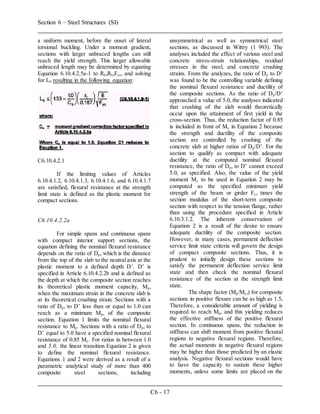
unbraced length may be determined by equating
Equation 6.10.4.2.5a-1 to Rb,Rh,Fyc, and solving
for Lb resulting in the following equation:
C6.10.4.2.1
If the limiting values of Articles
6.10.4.1.2, 6.10.4.1.3, 6.10.4.1.6, and 6.10.4.1.7
are satisfied, flexural resistance at the strength
limit state is defined as the plastic moment for
compact sections.
C6.10.4.2.2a
For simple spans and continuous spans
with compact interior support sections, the
equation defining the nominal flexural resistance
depends on the ratio of Dp, which is the distance
from the top of the slab to the neutral axis at the
plastic moment to a defined depth D’. D’ is
specified in Article 6.10.4.2.2b and is defined as
the depth at which the composite section reaches
its theoretical plastic moment capacity, Mp,
when the maximum strain in the concrete slab is
at its theoretical crushing strain. Sections with a
ratio of Dp, to D’ less than or equal to 1.0 can
reach as a minimum Mp, of the composite
section. Equation 1 limits the nominal flexural
resistance to Mp. Sections with a ratio of Dp, to
D’ equal to 5.0 have a specified nominal flexural
resistance of 0.85 My. For ratios in between 1.0
and 5.0, the linear transition Equation 2 is given
to define the nominal flexural resistance.
Equations 1 and 2 were derived as a result of a
parametric analytical study of more than 400
composite steel sections, including
unsymmetrical as well as symmetrical steel
sections, as discussed in Wittry (1 993). The
analyses included the effect of various steel and
concrete stress-strain relationships, residual
stresses in the steel, and concrete crushing
strains. From the analyzes, the ratio of Dp to D’
was found to be the controlling variable defining
the nominal flexural resistance and ductility of
the composite sections. As the ratio of Dp/D’
approached a value of 5.0, the analyses indicated
that crushing of the slab would theoretically
occur upon the attainment of first yield in the
cross-section. Thus, the reduction factor of 0.85
is included in front of My in Equation 2 because
the strength and ductility of the composite
section are controlled by crushing of the
concrete slab at higher ratios of Dp/D’. For the
section to qualify as compact with adequate
ductility at the computed nominal flexural
resistance, the ratio of Dp, to D’ cannot exceed
5.0, as specified. Also, the value of the yield
moment My to be used in Equation 2 may be
computed as the specified minimum yield
strength of the beam or girder Fy, times the
section modulus of the short-term composite
section with respect to the tension flange, rather
than using the procedure specified in Article
6.10.3.1.2. The inherent conservatism of
Equation 2 is a result of the desire to ensure
adequate ductility of the composite section.
However, in many cases, permanent deflection
service limit state criteria will govern the design
of compact composite sections. Thus, it is
prudent to initially design these sections to
satisfy the permanent deflection service limit
state and then check the nominal flexural
resistance of the section at the strength limit
state.
The shape factor (Mp/My,) for composite
sections in positive flexure can be as high as 1.5.
Therefore, a considerable amount of yielding is
required to reach Mp, and this yielding reduces
the effective stiffness of the positive flexural
section. In continuous spans, the reduction in
stiffness can shift moment from positive flexural
regions to negative flexural regions. Therefore,
the actual moments in negative flexural regions
may be higher than those predicted by an elastic
analysis. Negative flexural sections would have
to have the capacity to sustain these higher
moments, unless some limits are placed on the
Section 6 – Steel Structures (SI)
C6 - 18
extent of the yielding of the positive moment
section. This latter approach is used in the
Specification for continuous spans with
noncompact interior-support sections.
The live loading patterns causing the
maximum elastic moments in negative flexural
sections are different than those causing
maximum moments in positive flexural sections.
When the loading pattern causing maximum
positive flexural moments is applied, the
concurrent negative flexural moments are
usually below the flexural resistance of the
sections in those regions. Therefore, the
specifications conservatively allow additional
moment above My to be applied to positive
flexural sections of continuous spans with
noncompact interior support sections, not to
exceed the nominal flexural resistance given by
Equations 1 or 2 to ensure adequate ductility of
the composite section. Compact interior support
sections have sufficient capacity to sustain the
higher moments caused by the reduction in
stiffness of the positive flexural region. Thus,
the nominal flexural resistance of positive
flexural sections in members with compact
interior support sections is not limited due to the
effect of this moment shifting.
Note that Equation 4 requires the use of
the absolute value of the term (Mnp-Mcp).
C6.10.4.2.2b
The ductility requirement specified in
this Article is equivalent to the requirement
given in AASHTO (1995).
The ratio of Dp, to D' is limited to a
value of 5.0 to ensure that the tension flange of
the steel section reaches strain hardening prior to
crushing of the concrete slab. D' is defined as the
depth at which the composite section reaches its
theoretical plastic moment capacity Mp, when
the maximum strain in the concrete slab is at its
theoretical crushing strain. The term
(d+ts+th)/7.5 in the definition of D', hereafter
referred to as D', was derived by assuming that
the concrete slab is at the theoretical crushing
strain of 0.3 percent and that the tension flange
is at the assumed strain-hardening strain of 1.2
percent. The compression depth of the
composite section, Dp, was divided by a factor
of 1.5 to ensure that the actual neutral axis of the
composite section at the plastic moment is
always above the neutral axis computed using
the assumed strain values (Ansourian 1982).
From the results of a parametric analytical study
of 400 different composite steel sections,
including unsymmetrical as well as symmetrical
steel sections, as discussed in Wittry (1993), it
was determined that sections utilizing 250 MPa
steel reached Mp, at a ratio of Dp/D’ equal to
approximately 0.9, and sections utilizing 345
MPa steel reached Mp, at a ratio of Dp to D’
equal to approximately 0.7. Thus, 0.9 and 0.7 are
specified as the values to use for the factor,
which is multiplied by D* to compute D’ for 250
MPa and 345 MPa yield strength steels. A value
of 0.7, thought to be conservative based upon
limited data available in late 1998, is specified
for ASTM A709M, Grade HPS485W, until
more data is available. Equation 1 need not be
checked at sections where the stress in either
flange due to the factored loadings does not
exceed Rh, Fyf, because there will be insufficient
strain in the steel section at or below the yield
strength for a potential concrete crushing failure
of the deck to occur.
C6.10.4.2.3
Equation 2 defines a transition in the
nominal flexural resistance from Mp, to
approximately 0.7 My.
The nominal flexural resistance given by
Equation 2 is based on the inelastic buckling
strength of the compression flange and results
from a fit to available experimental data. The
equation considers the interaction of the web and
compression-flange slenderness in the
determination of the resistance of the section by
using a flange buckling coefficient, k, =
4.92/(2Dcp,/tw)1/2
, in computing the Qfl,
parameter in Equation 7. Qfl, is the ratio of the
buckling capacity of the flange to the yield
strength of the flange. The buckling coefficient
given above was based on the test results
reported in Johnson (1985) and data from other
available composite and noncomposite steel
beam tests. A similar buckling coefficient is
given in Section B5.3 of AISC (1993). Equation
6 is specified to compute Qfl, if the compression-
flange slenderness Is less than the value
specified in Article 6.10.4.1.3 to effectively limit
Section 6 – Steel Structures (SI)
C6 - 19
the increase in the bending resistance at a given
web slenderness with a reduction in the
compression-flange slenderness below this
value. Equation 6 is obtained by substituting the
compression-flange slenderness limit from
Article 6.10.4.1.3 in Equation 7.
Equation 2 represents a linear fit of the
experimental data between a flexural resistance
of Mp, and 0.7 My. The Qp, parameter,defined as
the web and compression-flange slenderness to
reach a flexural resistance of Mp, was derived to
ensure the equation yields a linear fit to the
experimental data. Equation 2 was derived to
determine the maximum flexural resistance and
does not necessarily ensure a desired inelastic
rotation capacity. Sections in negative flexure
that are required to sustain plastic rotations may
be designed according to the procedures
specified in Article 6.10.10. If elastic procedures
are used and Equation 2 is not used to determine
the nominal flexural resistance, the resistance
shall be determined according to the procedures
specified in Article 6.10.4.2.4.
C6.10.4.2.4a
For composite noncompact sections in
positive flexure in their final condition, the
nominal flexural resistance of the compression
flange at the strength limit state is equal to the
yield stress of the flange, Fyc, reduced by the
specified reduction factors. For all other
noncompact sections in their final condition and
for constructibility, where the limiting value of
Article 6.10.4.1.9 is satisfied, the nominal
flexural resistance of the compression flange is
equal to Fcr, times the specified reduction
factors. Fcr, represents a critical compression-
flange local buckling stress, which cannot
exceed Fyc. For sections without longitudinal
web stiffeners, Fcr, depends on the actual
compression flange and web slenderness ratios.
This equation for Fcr, was not developed for
application to sections with longitudinal web
stiffeners. For those sections, the expression for
Fcr, was derived from the compression- flange
slenderness limit for braced noncompact
sections specified in the Load Factor Design
portion of the AASHTO Standard Specifications
(1996). By expressing the nominal flexural
resistance of the compression flange as a
function of Fcr, larger compression-flange
slenderness ratios may be used at more lightly
loaded sections for a given web slenderness. To
achieve a value of Fcr, at or near Fyc, at more
critical sections, a lower compression-flange
slenderness ratio will be required.
The nominal flexural resistance of the
compression-flange is also modified by the
hybrid factor Rh, and the load-shedding factor
Rb. Rh, accounts for the increase in flange stress
resulting from web yielding in hybrid girders
and is computed according to the provisions of
Article 6.10.4.3.1. Rh, should be taken as 1.0 for
constructibility checks because web yielding is
limited. Rh, accounts for the increase in
compression-flange stress resulting from local
web bend buckling and is computed according to
the provisions of Article 6.10.4.3.2. Rh, is
computed based on the actual stress fc, in the
compression flange due to the factored loading
under investigation, which should not exceed
Fyc.
C6.10.4.2.5a
The provisions for lateral-torsional
buckling in this article differ from those
specified in Article 6.10.4.2.6 because they
attempt to handle the complex general problem
of lateral-torsional buckling of a constant or
variable depth section with stepped flanges
constrained against lateral displacement at the
top flange by the composite concrete slab. The
equations provided in this article are based on
the assumption that only the flexural stiffness of
the compression flange will prevent the lateral
displacement of that element between brace
points, which ignores the effect of the restraint
offered by the concrete slab (Basler and
Thurlimann 1961). As such, the behavior of a
compression flange in resisting lateral buckling
between brace points is assumed to be analogous
to that of a column. These simplified equations,
developed based on this assumption, are felt to
yield conservative results for composite sections
under the various conditions listed above.
The effect of the variation in the
compressive force along the length between
brace points is accounted for by using the factor
Cb. If the cross-section is constant between brace
points, Ml/Mh, is expressed in terms of Pl/Ph and
Section 6 – Steel Structures (SI)
C6 - 20
may be used in calculating Cb. The ratio is taken
as positive when the moments cause single
curvature within the unbraced length.
Cb has a minimum value of 1.0 when
the flange compressive force and corresponding
moment are constant over the unbraced length.
As the compressive force at one of the brace
points is progressively reduced. Cb, becomes
lamer and is taken as 1.75 when this force is 0.0.
For the case of single curvature, it is
conservative and convenient to use the
maximum moments from the moment envelope
at both brace points in computing the ratio of
Ml/Mh, or Pl/Ph, although the actual behavior
depends on the concurrent moments at these
points.
If the force at the end is then
progressively increased in tension, which results
in reverse curvature, the ratio is taken as
negative and, continues to increase. However, in
this case, Using the concurrent moments at the
brace points, which are not normally tracked in
the analysis, to compute the ratio in Equation 4
gives the lowest value of Cb, Therefore, Cb, is
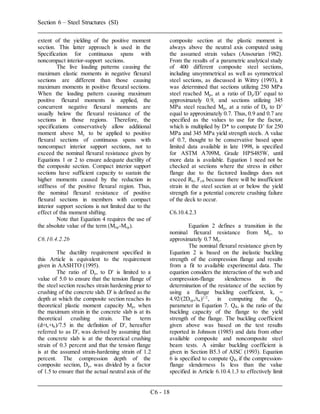
conservatively limited to a maximum value of
1.75 if the moment envelope values at both
brace points are used to compute the ratio in
Equation 4. If the concurrent moment at the
brace point with the lower compression-flange
force is available from the analysis and is used
to compute the ratio, Cb, is allowed to exceed
1.75 up to a maximum value of 2.3.
An alternative formulation for Cb is
given by the following formula (AISC 1993):
This formulation gives improved results
for the cases of nonlinear moment gradients and
moment reversal.
The effect of a variation in the lateral
stiffness properties, rt, between brace points can
be conservatively accounted for by using the
minimum value that occurs anywhere between
the brace points. Alternatively, a weighted
average rt, could be used to provide a reasonable
but somewhat less conservative answer.
The use of the moment envelope values
at both brace Points will be conservative for
both single and reverse curvature when this
formulation is used.
Other formulations for Cb, to handle
nontypical cases of compression flange bracing
may be found in Galambos (1998).
C6.10. 4.2.6a
Much of the discussion of the lateral
buckling formulas in Article C6.10.4.2.5a also
applies to this article. The formulas of this
article are simplifications of the formulas
presented in AISC (1993) and Kitipornchai and
Trahair (1980) for the lateral buckling capacity
of unsymmetrical girders.
The formulas predict the lateral buckling
moment within approximately 10 percent of the
more complex Trahair equations for sections
satisfying the proportions specified in Article
6.10.2.1. The formulas treat girders with slender
webs differently than girders with stocky webs.
For sections with stocky webs with a web
slenderness less than or equal to λb(E/Fyc)ln, or
with longitudinally stiffened webs, bend-
buckling of the web is theoretically prevented.
For these sections, the St. Venant torsional
stiffness and the warping torsional stiffness are
included in computing the elastic lateral
buckling moment given by Equation 1. For
sections with thinner webs or without
longitudinal stiffeners, cross-sectional distortion
is possible; thus, the St. Venant torsional
stiffness is ignored for these sections. Equation 3
is the elastic lateral torsional buckling moment
given by Equation 1 with J taken as 0.0.
Equation 2 represents a straight line
estimate of the inelastic lateral buckling
resistance between Rb Rh My and 0.5 Rb Rh My.
Section 6 – Steel Structures (SI)
C6 - 21
A straight line transition similar to this is not
included for sections with stocky webs or
longitudinally stiffened webs because the added
complexity is not justified.
A discussion of the derivation of the
value of λb, may be found in Article
C6.10.4.3.2a.
The equation for J herein is a special
case of Equation C4.6.2.1-1.
C6.10.4.3.1a
This factor accounts for the nonlinear
variation of stresses caused by yielding of the
lower strength steel in the web of a hybrid beam.
The formulas defining this factor are the same as
those given in AASHTO (1996) and are based
on experimental and theoretical studies of
composite and noncomposite beams and girders
(ASCE 1968; Schilling 1968; and Schilling and
Frost 1964). The factor applies to noncompact
sections in both shored and unshored
construction.
C6.10.4.3.1c
Equation 1 approximates the reduction
in the moment resistance due to yielding for a
girder with the neutral axis located at middepth
of the web. For girders with the neutral axis
located within 10 percent of the depth from the
middepth of the web, the change of the value of
Rh from that given by Equation 1 is thought to
be small enough to ignore. Equation 2 gives a
more accurate procedure to determine the
reduction in the moment resistance.
The following approximate method
illustrated in Figure C1 may be used in
determining the yield moment resistance, Myr,
when web yielding is accounted for. The solid
line connecting Fyf, with fr represents the
distribution of stress at My if web yielding is
neglected. For unshored construction, this
distribution can be obtained by first applying the
proper permanent load to the steel section, then
applying the proper permanent load and live
load to the composite section, and combining the
two stress distributions. The dashed lines define
a triangular stress block whose moment about
the neutral axis is subtracted from My to account
for the web yielding at a lower stress than the
flange. My may be determined as specified in
Article 6.10.3.1.2. Thus,
Figure 1 is specifically for the case
where the elastic neutral axis is above middepth
of the web and web yielding occurs only below
the neutral axis. However, the same approach
can be used if web yielding occurs both above
and below the neutral axis or only above the
neutral axis. The moment due to each triangular
stress block due to web yielding must be
subtracted from My.
This approach is approximate because
web yielding causes a small shift in the location
of the neutral axis. The effect of this shift on
Myr, is almost always small enough to be
neglected. The exact value of Myr, can be
calculated from the stress distribution by
accounting for yielding (Schilling 1968).
Section 6 – Steel Structures (SI)
C6 - 22
C6.10.4.3.2a
The Rb factor is a postbuckling strength
reduction factor that accounts for the nonlinear
variation of stresses caused by local buckling of
slender webs subjected to flexural stresses. The
factor recognizes the reduction in the section
resistance caused by the resulting shedding of
the compressive stresses in the web to the
compression-flange.
For webs without longitudinal stiffeners
that satisfy Equation 1 with the compression-
flange at a stress fc, the Rb factor is taken equal
to 1.0 since the web is below its theoretical elask
bend-buckling stress. The value of λb, in
Equation 1 reflects different assumptions of
support provided to the web by the flanges. The
value of 4.64 for sections where Dc, is greater
than D/2 is based on the theoretical elastic bend-
buckling coefficient k of 23.9 for simply
supported boundary conditions at the flanges.
The value of 5.76 for members where Dc, is less
than or equal to D/2 is based on a value of k
between the value for simply supported
boundary conditions and the theoretical k value
of 39.6 for fixed boundary conditions at the
flanges (Timoshenko and Gere 1961).
For webs with one or two longitudinal
stiffeners that satisfy Equation 2 with the
compression-flange at a stress fc, the Rb factor is
again taken equal to 1.0 since the web is below
its theoretical elastic bend-buckling stress. Two
different theoretical elastic bend-buckling
coefficients k are specified for webs with one or
two longitudinal stiffeners. The value of k to be
used depends on the location of the closest
longitudinal web stiffener to the compression-
flange with respect to its optimum location
(Frank and Helwig 1995).
Equations 4 and 5 specify the value of k
for a longitudinally stiffened web. The equation
to be used depends on the location of the critical
longitudinal web stiffener with respect to a
theoretical optimum location of 0.4Dc, (Vincent
1969) from the compression-flange. The
specified k values and the associated optimum
stiffener location assume simply supported
boundary conditions at the flanges. Changes in
flange size along the girder cause Dc, to vary
along the length of the girder. If the longitudinal
stiffener is located a fixed distance from the
compression-flange, which is normally the case,
the stiffener cannot be at its optimum location
all along the girder. Also, the position of the
longitudinal stiffener relative to Dc, in a
composite girder changes due to the shift in the
location of the neutral axis after the concrete
slab hardens. This shift in the neutral axis is
particularly evident in regions of positive
flexure. Thus, the specification equations for k
allow the Engineer to compute the web bend-
buckling capacity for any position of the
longitudinal stiffener with respect to Dc. When
the distance from the longitudinal stiffener to the
compression-flange ds, is less than 0.4Dc, the
stiffener is above its optimum location and web
bend-buckling occurs in the panel between the
stiffener and the tension flange. When ds, is
greater than 0.4Dc, web bend- buckling occurs in
the panel between the stiffener and the
compression-flange. When d, is equal to 0.4Dc,
the stiffener is at its optimum location and bend-
buckling occurs in both panels. For this case,
both equations yield a value of k equal to 129.3
for a symmetrical girder (Dubas 1948).
Since a longitudinally stiffened web
must be investigated for the stress conditions at
different limit states and at various locations
along the girder, it is possible that the stiffener
might be located at an inefficient location for a
particular condition resulting in a very low bend-
buckling coefficient from Equation 4 or 5.
Because simply-supported boundary conditions
were assumed in the development of Equations 4
and 5, it is conceivable that the computed web
bend-buckling resistance for the longitudinally
stiffened web may be less than that computed
for a web without longitudinal stiffeners where
some rotational restraint from the flanges has
been assumed. To prevent this anomaly, the
specifications state that the k value for a
longitudinally stiffened web must equal or
exceed a value of 9.0(D/Dc)2
, which is the k
value for a web without longitudinal stiffeners
computed assuming partial rotational restraint
from the flanges. Also, near points of dead load
contraflexure, both edges of the web may be in
compression when stresses in the steel and
composite sections due to moments of opposite
sign are accumulated. In this case, the neutral
axis lies outside the web. Thus, the
specifications also limit the minimum value of k
Section 6 – Steel Structures (SI)
C6 - 23
to 7.2, which is approximately equal to the
theoretical bend-buckling coefficient for a web
plate under uniform compression assuming fixed
boundary conditions at the flanges (Timoshenko
and Gere 1961).
Equation 3 is based on extensive
experimental and theoretical studies (Galambos
1988) and represents the exact formulation for
the Rb, factor given by Basler (1961). For rare
cases where Equation 3 must be used to compute
Rb, at the strength limit state for composite
sections in regions of positive flexure, a separate
calculation should be performed to determine a
more appropriate value of Ac, to be used to
calculate ar, in Equation 6. For this particular
case, to be consistent with the original derivation
of Rb, it is recommended that Ac, be calculated
as a combined area for the top flange and the
transformed concrete slab that gives the
calculated value of D, for the composite section.
The following equation may be used to compute
such an effective combined value of Ac:
In addition, when the top flange is
composite, the stresses that are shed from the
web to the flange are resisted in proportion to
the relative stiffness of the steel flange and
concrete slab. The Rb, factor is to be applied
only to the stresses in the steel flange. Thus, in
this case, a modified & factor for the top flange,
termed R’b, can be computed as follows:
For a composite section with or without
a longitudinally stiffened web, Dc, must be
calculated according to the provisions of Article
6.10.3.1.4a.
C6.10.4.3.2b
Rb is 1.0 for tension flanges because the
increase in flange stresses due to web buckling
occurs primarily in the compression flange, and
the tension flange stress is not significantly
increased by the web buckling (Basler 1961).
C6.10.4.4
This provision gives partial recognition
to the philosophy of plastic design. Figure C1
illustrates the application of this provision in a
two-span continuous beam:
C6.10.5.1
The provisions are intended to apply to
the design live load specified in Article 3.6.1.1.
If this criterion were to be applied to a permit
Section 6 – Steel Structures (SI)
C6 - 24
load situation, a reduction in the load factor for
live load should be considered.
This limit state check is intended to
prevent objectionable permanent deflections due
to expected severe traffic loadings that would
impair rideability. It corresponds to the overload
check in the 1996 AASHTO Standard
Specifications and is merely an indicator of
successful past practice, the development of
which is described in Vincent (1969).
Under the load combinations specified
in Table 3.4.1-1, the criterion for control of
permanent deflections does not govern for
composite noncompact sections; therefore, it
need not be checked for those sections. This may
not be the case under a different set of load
combinations.
Web bend buckling under Load
Combination Service II is controlled by limiting
the maximum compressive flexural stress in the
web to the elastic web bend buckling stress
given by Equation 6.10.3.2.2-1. For composite
sections, the appropriate value of the depth of
the web in compression in the elastic range, Dc,
specified in Article 6.10.3.1.4a, is to be used in
the equation.
Article 6.10.3.7 requires that 1 percent
longitudinal reinforcement be placed wherever
the tensile stress in the slab due to either
factored construction loads or due to Load
Combination Service II exceeds the factored
modulus of rupture of the concrete. By
controlling the crack size in regions where
adequate shear connection is also provided, the
concrete slab can be considered to be effective
in tension for computing flexural stresses on the
composite section due to Load Combination
Service II. If the concrete slab is assumed to be
fully effective in negative flexural regions, more
than half of the web will typically be in
compression increasing the susceptibility of the
web to bend buckling.
C6.10.5.2
A resistance factor is not applied
because the specified limit is a serviceability
criterion for which the resistance factor is 1.0.
C6.10.6.1
If the provisions specified in Articles
6.10.6.3 and 6.10.6.4 are satisfied, significant
elastic flexing of the web is not expected to
occur, and the member is assumed to be able to
sustain an infinite number of smaller loadings
without fatigue cracking.
These provisions are included here,
rather than in Article 6.6, because they involve a
check of maximum web buckling stresses
instead of a check of the stress ranges caused by
cyclic loading.
C6.10.6.3
The elastic bend-buckling capacity of
the web given by Equation 2 is based on an
elastic buckling coefficient, k, equal to 36.0.
This value is between the theoretical k value for
bending-buckling of 23.9 for simply supported
boundary conditions at the flanges and the
theoretical k value of 39.6 for fixed boundary
conditions at the flanges (Timoshenko and Gere
1961). This intermediate k value is used to
reflect the rotational restraint offered by the
flanges. The specified web slenderness limit of
5.70 (E/Fyw)1/2
is the web slenderness at which
the section reaches the yield strength according
to Equation 2.
Longitudinal stiffeners theoretically
prevent bend-buckling of the web; thus, the
provisions in this article do not apply to sections
with longitudinally stiffened webs.
For the loading and load combination
applicable to this limit state, it is assumed that
the entire cross-section will remain elastic and,
therefore, Dc, can be determined as specified in
Article 6.10.3.1 .4a.
C6.10.6.4
The shear force in unstiffened webs and
in webs of hybrid sections is already limited to
either the shear yielding or the shear buckling
force at the strength limit state by the provisions
of Article 6.10.7.2. Consequently, the
requirement in this article need not be checked
for those sections.
C6.10.7.1
This article applies to:
Section 6 – Steel Structures (SI)
C6 - 25
 Sections without stiffeners,
 Sections with transverse stiffeners only, and
 Sections with both transverse and
longitudinal stiffeners.
A flow chart for shear capacity of I-
sections is shown below.
Unstiffened and stiffened interior web
panels are defined according to the maximum
transverse stiffener spacing requirements
specified in this article. The nominal shear
resistance of unstiffened web panels in both
homogeneous and hybrid sections is defined by
either shear yield or shear buckling, depending
on the web slenderness ratio, as specified in
Article 6.10.7.2. The nominal shear resistance of
stiffened interior web panels of homogeneous
sections is defined by the sum of the shear-
yielding or shear-buckling resistance and the
post-buckling resistance from tension-field
action, modified as necessary by any moment-
shear interaction effects, as specified in Article
6.10.7.3.3. For compact sections, this nominal
shear resistance is specified by either Equation
6.10.7.3.3a-1 or Equation 6.10.7.3.3a-2. For
noncompact sections, this nominal shear
resistance is specified by either Equation
6.10.7.3.3b-1 or Equation 6.10.7.3.3b-2. For
homogeneous sections, the nominal shear
resistance of end panels in stiffened webs is
defined by either shear yielding or shear
buckling, as specified in Article 6.10.7.3.3c. For
hybrid sections, the nominal shear resistance of
all stiffened web panels is defined by either
shear yielding or shear buckling, as specified in
Article 6.10.7.3.4.
Separate interaction equations are given
to define the effect of concurrent moment for
compact and noncompact sections because
compact sections are designed in terms of
moments, whereas noncompact sections are
designed in terms of stresses. For convenience, it
is conservatively specified that the maximum
moments and shears from the moment and shear
envelopes be used in the interaction equations.
C6.10.7.2
The nominal shear resistance of
unstiffened webs of hybrid and homogeneous
girders is limited to the elastic shear buckling
force given by Equation 1. The consideration of
tension-field action (Basler 1961) is not
permitted for unstiffened webs. The elastic shear
buckling force is calculated as the Product of the
constant C specified in Article 6.10.7.3.3a times
the plastic shear force, Vp, given by Equation 2.
The plastic shear force is equal to the web area
times the assumed shear yield strength of
Fyw/(3)0.5
. The shear bucking coefficient, k, to be
used in calculating the constant C is defined as
5.0 for unstiffened web panels, which is a
conservative approximation of the exact value of
5.35 for an infinitely long strip, with simply
supported edges (Timoshenko and Gere 1961).
C6.10.7.3.1
Longitudinal stiffeners divide a web
panel into subpanels. The shear resistance of the
entire panel can be taken as the sum of the shear
resistance of the subpanels (Cooper 1967).
However, the contribution of the longitudinal
stiffener at a distance of 2Dc/5 from the
compression flange is relatively small. Thus, it is
conservatively recommended that the influence
of the longitudinal stiffener be neglected in
Section 6 – Steel Structures (SI)
C6 - 26
computing the nominal shear resistance of the
web plate.
C6.10.7.3.2
Transverse stiffeners are required on
web panels with a slenderness ratio greater than
150 in order to facilitate handling of sections
without longitudinal stiffeners during fabrication
and erection. The spacing of the transverse
stiffeners is arbitrarily limited by Equation 2
(Basler 1961). Substituting a web slenderness of
150 into Equation 2 results in a maximum
transverse stiffener spacing of 3D, which
corresponds to the maximum spacing
requirement in Article 6.10.7.1 for web panels
without longitudinal stiffeners. For higher web
slenderness ratios, the maximum allowable
spacing is reduced to less than 3D.
The requirement in Equation 2 is not
needed for web panels with longitudinal
stiffeners because maximum transverse stiffener
spacing is already limited to 1.5D.
C6.10.7.3.3a
Stiffened interior web panels of
homogeneous sections may develop post-
buckling shear resistance due to tension-field
action (Basler 1961). The action is analogous to
that of the tension diagonals of a Pratt truss. The
nominal shear resistance of these panels can be
computed by summing the contributions of
beam action and of the post-buckling tension-
field action. The resulting expression is given in
Equation 1, where the first term in the bracket
relates to either the shear yield or shear buckling
force and the second term relates to the post-
buckling tension-field force.
The coefficient, C, is equal to the ratio
of the elastic hear buckling stress of the panel,
computed assuming simply supported boundary
conditions, to the shear yield strength assumed
to be equal to Fyw/(3)0.5
. Equation 7 is applicable
only for C values not exceeding 0.8 (Basler
1961). Above 0.8, C values are given by
Equation 6 until a limiting slenderness ratio is
reached where the shear buckling stress is equal
to the shear yield strength and C = 1.0. Equation
8 for the shear buckling coefficient is a
simplification of two exact equations for k that
depend on the panel aspect ratio.
When both shear and flexural moment
are high in a stiffened interior panel under
tension-field action, the web plate must resist the
shear and also participate in resisting the
moment. Panels whose resistance is limited to
the shear buckling or shear yield force are not
subject to moment-shear interaction effects.
Basler (1961) shows that stiffened web plates in
noncompact sections are capable of resisting
both moment and shear, as long as the shear
force due to the factored loadings is less than
0.6φvVn or the flexural stress in the compression
flange due to the factored loading is less than
0.75φfFy. For compact sections, flexural
resistances are expressed in terms of moments
rather than stresses. For convenience, a limiting
moment of 0.5φfMp is defined rather than a
limiting moment of 0.75φfMy in determining
when the moment-shear interaction occurs by
using an assumed shape factor (Mp/My) of 1.5.
This eliminates the need to compute the yield
moment to simply check whether or not the
interaction effect applies. When the moment due
to factored loadings exceeds 0.5φfMp, the
nominal shear resistance is taken as Vn, given by
Equation 2, reduced by the specified interaction
factor, R.
Both upper and lower limits are placed
on the nominal shear resistance in Equation 2
determined by applying the interaction factor, R.
The lower limit is either the shear yield or shear
buckling force. Sections with a shape factor
below 1.5 could potentially exceed Vn,
according to the interaction equation at moments
due to the factored loadings slightly above the
defined limiting value of 0.5φfMp. Thus, for
compact sections, an upper limit of 1.0 is placed
on R.
To avoid the interaction effect,
transverse stiffeners may be spaced so that the
shear due to the factored loadings does not
exceed the larger of:
 0.60φvVn, where Vn, is given by Equation 1
or
 The factored shear buckling or shear yield
resistance equal to φvCVp.
Section 6 – Steel Structures (SI)
C6 - 27
k is known as the shear buckling coefficient.
C6.10.7.3.3b
The commentary of Article 6.1 0.7.3.3a
applies, except that for noncompact sections,
flexural resistances are expressed in terms of
stress rather than moment in the interaction
equation. The upper limit of 1.0 applied to R in
Equation 6.10.7.3.3a-3 applies to compact
sections and need not be applied to Equation
6.10.7.3.3b-3 for noncompact sections.
C6.10.7.3.3c
The shear in end panels is limited to
either the shear yield or shear buckling force
given by Equation I in order to provide an
anchor for the tension field in adjacent interior
panels.
C6.10.7.3.4
Tension-field action is not permitted for
hybrid sections. Thus, the nominal shear
resistance is limited to either the shear yield or
the shear buckling force given by Equation 1.
C6.10.7.4.1b
The parameters I and Q should be
determined using the deck within the effective
flange width. However, in negative flexure
regions, the parameters I and Q may be
determined using the reinforcement within the
effective flange width for negative moment,
unless the concrete slab is considered to be fully
effective for negative moment in computing the
longitudinal range of stress, as permitted in
Article 6.6.1.2.1.
The maximum fatigue shear range is
produced by to the right of the point under
consideration. For the load in these positions,
positive moments are placing the fatigue live
load immediately to the left and produced over
significant portions of the girder length. Thus,
the use of the full composite section, including
the concrete deck, is reasonable for computing
the shear range along the entire span. Also, the
horizontal shear force in the deck is most often
considered to be effective along the entire span
in the analysis. To satisfy this assumption, the
shear force in the deck must be developed along
the entire span. An option is permitted to ignore
the concrete deck in computing the shear range
in regions of negative flexure, unless the
concrete is considered to be fully effective in
computing the longitudinal range of stress, in
which case the shear force in the deck must be
developed. If the concrete is ignored in these
regions, the specified maximum pitch must not
be exceeded.
C6.10.7.4.1d
Stud connectors should penetrate
through the haunch between the bottom of the
deck and top flange, if present, and into the
deck. Otherwise, the haunch should be
reinforced to contain the stud connector and
develop its load in the deck.
C6.10.7.4.2
For development of this information, see
Slutter and Fisher (1966).
C6.10.7.4.3
The purpose of the additional connectors
is to develop the reinforcing bars used as part of
the negative flexural composite section.
C6.10.7.4.4b
Composite beams in which the
longitudinal spacing of shear connectors has
been varied according to the intensity of shear
and duplicate beams where the number of
connectors were uniformly spaced have
exhibited essentially the same ultimate strength
and the same amount of deflection at service
loads. Only a slight deformation in the concrete
and the more heavily stressed connectors is
needed to redistribute the horizontal shear to
other less heavily stressed connectors. The
important consideration is that the total number
of connectors be sufficient to develop the shear,
Vh, on either side of the point of maximum
moment.
In negative flexure regions, sufficient
shear connectors are required to transfer the
Section 6 – Steel Structures (SI)
C6 - 28
ultimate tensile force in the reinforcement from
the slab to the steel section.
C6.10.7.4.4c
Studies have defined stud shear
connector strength as a function of both the
concrete modulus of elasticity and concrete
strength (Ollgaard et al. 1971). Note that an
upper bound on stud shear strength is the
product of the cross-sectional area of the stud
times its ultimate tensile strength.
Equation 2 is a modified form of the
formula for the resistance of channel shear
connectors developed in Slutter and Driscoll
(1965), which extended its use to low-density as
well as normal density concrete.
C6.10.8.1.2
The requirements in this article are
intended to prevent local buckling of the
transverse stiffener.
C6.10.8.1.3
For the web to adequately develop the
tension field, the transverse stiffener must have
sufficient rigidity to cause a node to form along
the line of the stiffener. For ratios of (do/D) less
than 1.0, much larger values of It, are required,
as discussed in Timoshenko and Gere (1961).
Lateral loads along the length of a
longitudinal stiffener are transferred to the
adjacent transverse stiffeners as concentrated
reactions (Cooper 1967). Equation 3 gives a
relationship between the moments of inertia of
the longitudinal and transverse stiffeners to
ensure that the latter does not fail under the
concentrated reactions. Equation 3 is equivalent
to Equation 10-111 in AASHTO (1996).
C6.10.8.1.4
Transverse stiffeners need sufficient
area to resist the vertical component of the
tension field. The formula for the required
stiffener area can give a negative result. In that
case, the required area is 0.0. A negative result
indicates that the web alone is sufficient to resist
the vertical component of the tension field. The
stiffener then need only be proportioned for
stiffness according to Article 6.10.8.1.3 and
satisfy the projecting width requirements of
Article 6.10.8.1.2. For web panels not required
to develop a tension field, this requirement need
not be investigated.
C6.10.8.2.1
Inadequate provision to resist
concentrated loads has resulted in failures,
particularly in temporary construction.
If an owner chooses not to utilize
bearing stiffeners where specified in this article,
the web crippling provisions of AISC (1993)
should be used to investigate the adequacy of the
component to resist a concentrated load.
C6.10.8.2.2
The provision specified in this article is
intended to prevent local buckling of the bearing
stiffener plates.
C6.10.8.2.3
To bring bearing stiffener plates tight
against the flanges, part of the stiffener must be
clipped to clear the web-to-flange fillet weld.
Thus, the area of direct bearing is less than the
gross area of the stiffener. The bearing
resistance is based on this bearing area and the
yield strength of the stiffener.
C6.10.8.2.4a
A portion of the web is assumed to act
in combination with the bearing stiffener plates.
The end restraint against column
buckling provided by the flanges allows for the
use of a reduced effective length.
The web of hybrid girders is not
included in the computation of the radius of
gyration because the web may be yielding due to
longitudinal flexural stress. At end supports
where the moment is 0.0, the web may be
included.
C6.10.8.3.1
Section 6 – Steel Structures (SI)
C6 - 29
For composite sections in regions of
positive flexure, the vertical position of a
longitudinal web stiffener, most often located a
fixed distance from the compression- flange,
relative to Dc, changes after the concrete slab
hardens. Thus, the computed web bend-buckling
resistance is different before and after the slab
hardens. As a result, an investigation of several
trial locations of the stiffener may be necessary
to determine the optimal location of the stiffener
to provide both adequate elastic web bend-
buckling resistance for constructibility and
adequate web postbuckling resistance at the
strength limit state along the girder. The
following equation may be used to determine an
initial trial stiffener location for composite
sections in regions of positive flexure:
For composite sections in regions of
negative flexure and for noncomposite sections,
it is suggested that an initial trial stiffener
location of 2Dc/5 from the inner surface of the
compression-flange be examined, where Dc, is
the depth of the web in compression at the
section with the maximum flexural compressive
stress due to the factored loads. Furthermore, for
composite sections in regions of negative
flexure, it is suggested that Dc, be computed for
the section consisting of the steel girder plus the
longitudinal reinforcement since the distance
between the neutral-axis locations for the steel
and composite sections is typically not large in
regions of negative flexure. Theoretical and
experimental studies on noncomposite girders
have indicated that the optimum location of one
longitudinal stiffener is 2Dc/5 for bending and
D/2 for shear. Tests have also shown that
longitudinal stiffeners located at 2Dc/5 on these
sections can effectively control lateral web
deflections under flexure (Cooper 1967). The
distance 2Dc/5 is recommended because shear is
always accompanied by moment and because a
properly proportioned longitudinal stiffener
reduces lateral web deflections caused by shear.
Also, because Dc, may vary along the length of
the span, it is recommended that the stiffener be
located based on Dc, computed at the section
with the largest compressive flexural stress.
Thus, the stiffener may not be located at its
optimum location at other sections with a lower
stress and a different Dc. These sections should
also be examined to ensure that they satisfy the
specified limit states.
In regions where the web undergoes
stress reversal, it may be necessary, or desirable,
to use two longitudinal stiffeners on the web.
Alternately, it may be possible to place one
stiffener on the web such that the limit states are
adequately satisfied with either edge of the web
in compression.
Longitudinal stiffeners placed on the
opposite side of the web from transverse
intermediate stiffeners are preferred. At bearing
stiffeners and connection plates where the
longitudinal stiffener and transverse web
elements must intersect, the Engineer may
discontinue either the longitudinal stiffener or
the transverse web element. However, the
discontinued element should be fitted and
attached to both sides of the continuous element
with connections sufficient to develop the
flexural and axial resistance of the discontinued
element. Preferably, the longitudinal stiffeners
should be made continuous. Should the
longitudinal stiffener be interrupted and not be
attached to the transverse web element, its area
should not be included when calculating section
properties. All interruptions must be carefully
designed with respect to fatigue. For various
stiffener end details and their associated fatigue
Section 6 – Steel Structures (SI)
C6 - 30
details see (Schilling 1986). Copes should
always be provided to avoid intersecting welds.
Longitudinal stiffeners should not be
located in yielded portions of the web of hybrid
sections. Longitudinal stiffeners are subject to
the same flexural stress as the web at their
vertical location on the web and must have
sufficient rigidity and strength to resist bend
buckling of the web. Thus, yielding of the
stiffeners should not be permitted on either
hybrid or nonhybrid sections.
C6.10.8.3.2
This requirement is intended to prevent
local buckling of the longitudinal stiffener.
C6.10.8.3.3
The moment of inertia requirement is to
ensure that the stiffener will have adequate
rigidity to force a horizontal line of nil
deflection in the web panel. The radius of
gyration requirement is to ensure that the
longitudinal stiffener will be rigid enough to
withstand the axial compressive stress without
lateral buckling. A partially restrained end
condition is assumed for the stiffener acting as a
column. It is also assumed in the development of
Equation 2 that the eccentricity of the load and
initial out-of-straightness cause a 20 percent
increase in stress in the stiffener.
A longitudinal stiffener meeting the
requirements of Articles 6.10.8.3.2 and
6.10.8.3.3 will have sufficient area to anchor the
tension field. Therefore, no additional area
requirement is given for longitudinal stiffeners.
C6.10.9.2.3
Research on end-bolted cover plates is
discussed in Wattar et al. (1985).
C6.10.10.1.1
The inelastic procedures are similar to
the Alternate Load Factor Design (ALFD)
procedures adopted as guide specifications
(AASHTO 1991).
Two inelastic analytical methods are
permitted for use at the strength limit state:
 The mechanism method (ASCE 1971), and
 The unified autostress method (Schilling
1991).
Computer programs are generally required to
utilize these methods efficiently for continuous
beams and girders with more than two spans.
The two methods are applicable to both
compact and noncompact sections if the plastic
rotation characteristics of such sections are
known. These characteristics have not yet been
adequately established for the full range of
noncompact section geometries.
In plastic design, there are any number
of pairs of positive and negative flexural
sections which can support loads in a span or
spans. This is because equilibrium is satisfied in
a collapse mechanism. Given the positive and
negative flexural resistance for assumed hinge
locations, which constitute a mechanism, the
applied load corresponding to that mechanism
can be calculated directly.
The practical significance of this is that
it is possible, and desirable, to chose the positive
and negative flexural sections for optimum
fabrication and economy.
The ultimate load-carrying capacity of a
continuous member is reached when enough
plastic hinges occur to form a mechanism
(ASCE 1971). All except the last hinge to form
are expected to sustain additional plastic
rotations.
The web slenderness, compression
flange slenderness, compression flange bracing,
and bearing stiffener requirements specified in
this article ensure that the sections can sustain
this additional plastic rotation. The slenderness
and bracing requirements essentially correspond
to the requirements given previously for
compact sections.
One method of performing a mechanism
analysis for moving loads can be found in
Dishongh (1995).
C6.10.10.1.2b
Section 6 – Steel Structures (SI)
C6 - 31
In conventional plastic design, plastic
rotations are assumed to occur at a point (ASCE
1971). However, yielding occurs over a finite
length. Thus, it is suggested that transitions be
located a minimum of twice the depth of the
steel section from each side of the section
required to sustain plastic rotations to ensure that
excess yielding will not occur at any transition
locations in this region. Transition locations
outside this region shall be checked according to
the provisions specified in Article 6.10.10.1.2c.
C6.10.10.1.2d
In the conventional mechanism method,
cross-sections are proportioned so that they can
sustain the full plastic moment through a
sufficient plastic rotation to form a mechanism
(ASCE 1971). Cross-sections with flange and/or
web slenderness ratios too high to satisfy this
requirement can still be designed by the
mechanism method if an effective plastic
moment is used instead of the full plastic
moment (Haaijer et al. 1987; Schilling and
Morcos 1988). The effective plastic moment is
smaller than the full plastic moment and can be
sustained through a sufficient plastic rotation to
form a mechanism (Haaijer et al. 1987; Schilling
and Morcos 1988).
AASHTO (1991) gave an empirical
procedure for calculating the effective plastic
moment for compact sections (Grubb and
Carskaddan 1981; Haaijer et al. 1987). In this
procedure, the effective plastic moment is
calculated by applying effective yield strengths
to the flanges and web of the section (AASHTO
1991; Haaijer et al. 1987). These effective yield
strengths depend on the compression flange and
web slenderness ratios as specified. When these
slenderness ratios are below limiting values, the
effective yield strengths may be taken as the
actual yield strengths; otherwise, the effective
yield strengths are below the actual yield
strengths, and the effective plastic moment is
below the actual plastic moment.
The effective plastic moment of
composite negative and positive flexural
sections can be calculated by the procedures in
Article 6.10.3.1.3. In these procedures, the
actual yield strengths of the elements of the
section are to be replaced by the effective yield
strengths specified in this Article. Usually, the
effective plastic moment capacity is required
only for negative flexural sections.
C6.10.10.1.3
The unified autostress method is
described in Schilling (1991). In this method, the
correct plastic rotations and moments at all yield
locations are determined by satisfying two
relationships: a continuity relationship and a
rotation relationship. The continuity relationship
interrelates the plastic rotations at all yield
locations and the moments at all interior support
locations; it depends on the stiffness properties
of the girder. The rotation relationship
interrelates the plastic rotation and moment at
each yield location and depends on the
properties of the cross-section at that location.
The unified autostress method differs
from the mechanism method in that it
determines the actual moments at all plastic
hinge locations for any given loading. In
contrast, the mechanism method uses
conservative estimates of the plastic hinge
moments to determine the maximum possible
loadings for the girder. These Conservative
estimates are based on the slenderness ratios for
the section and estimates of the amount of
plastic rotation required to form a mechanism.
Also, the unified autostress method can be
applied in both the strength and permanent-
deflection checks, but the mechanism method
can be applied only in the strength check.
C6.10.10.2.2
These limits are the same as those used
in the overload check in AASHTO (1996).
C6.10.10.2.3
Calculated steel stresses in negative
flexural sections at piers are not limited, but if
they exceed the limiting stresses specified in
Article 6.10.5.2, the resulting redistribution
moments must be calculated. Thus, it is assumed
that if the stresses in negative flexural sections
do not exceed the limiting stresses, objectionable
permanent deflections will not occur.
Section 6 – Steel Structures (SI)
C6 - 32
Yielding in negative flexural sections at
piers causes small permanent deflections that
can be calculated by inelastic procedures
(AASHTO 1991; Haaijer et al. 1987; Schilling
1991). AASHTO (1991) suggests that the dead
load camber be increased by the amount of this
permanent deflection. This suggestion was not
included in this edition of the Specifications
because the calculated permanent deflection is
generally small, and the actual permanent
deflection is expected to be even smaller due to
various conservative assumptions in the
calculation procedures. The Engineer, of course,
may choose to include part or all of the
calculated permanent deflection in the dead load
camber.
A full scale bridge designed to permit
inelastic redistribution of negative moments
under the overload condition, specified in
AASHTO (1996), sustained only very small
permanent deflections when tested under the
specified loading (Roeder and Eltvik 1985).
It is intended that the yielding required
for moment redistribution occur only at piers.
Therefore, it is specified that the steel stresses,
including the redistribution stresses, at any
flange transition location in negative flexural
regions be kept below the yield strength times
various applicable factors. The redistribution
stresses at such locations usually subtract from
the applied elastic stresses.
C6.10.10.2.4
AASHTO (1991) included provisions
for the inelastic redistribution of moments at
overload; these provisions were based on the
autostress method (Haaijer et al. 1987). This
edition of the Specifications utilize similar
procedures, but the terms "automoment" and
"autostress" used in the past have been replaced
by "redistribution moment" and "redistribution
stress," respectively. These new terms were
chosen to reflect the fact that the moments and
stresses they refer to result from inelastic
redistribution of moments in continuous spans.
C6.10.10.2.4a
Article 6.10.4.4 permits an arbitrary
redistribution of 10 percent of the peak negative
flexural moment. In certain types of members
under Service II loads, this article permits the
actual redistribution to be estimated by suitable
inelastic procedures. Two suitable methods are
specifically permitted:
 Beam-line method (AASHTO 1991; Haaijer
et al. 1987), and
 Unified-autostress method (Schilling 1991).
For checking permanent deflection at the
service limit state, the resistance factor does not
apply, i.e., it is 1.0.
C6.10.10.2.4b
Loading two adjacent spans causes the
highest interior support moments and greatest
amount of yielding at an internal support.
Therefore, this loading is appropriate for
calculating the redistribution stresses. The
redistribution moments are locked into the girder
if the load is removed. However, if the load is
shifted to the next interior support, additional
yielding generally occurs at the first pier, and
new redistribution moments develop. If this
process is repeated at all of the interior supports,
and repeated again for a few additional passes,
the yielding will shake down to an equilibrium
condition, and no further yielding will occur. For
two- span bridges with only one interior support,
there is, of course, no need for successive
loading. Because this section deals with
serviceability, 4 percent should be an acceptable
limit for convergence.
C6.10.10.2.4c
Redistribution moments are formed by
short-term loads. Therefore, the short-term
composite stiffnesses are appropriate for positive
flexural regions. The corresponding locked-in
redistribution stresses caused in composite
sections tend to decrease with time as a result of
creep in the concrete. However, these
redistribution stresses may be continually
renewed by subsequent passages of similar
loadings. Therefore, the redistribution stresses
are conservatively treated as long- term stresses.
Section 6 – Steel Structures (SI)
C6 - 33
C6.10.10.2.4d
Equation 1 is a straight-line
approximation of the higher plastic rotation
curve, labeled noncomposite, given in AASHTO
(1991). It covers the loading portion of the
plastic rotation curve, which is needed in the
permanent deflection check (Haaijer et al. 1987;
Schilling 1991). The curve is independent of the
geometric proportions of the sections, except as
these proportions affect the plastic moment
capacity. The original ALFD curve was
developed from experimental data (Haaijer et al.
1987). The specified limit for use of the curve
assures that plastic rotations do not extend into
the unloading portions of the curve to control
permanent deformations at the pier section. If
available, a curve for the specific section being
used is permitted. A MRAD is 1/1000 of a RAD
and is equivalent to a slope of 1 in 1000.
The lower curve given in AASHTO
(1991), labeled composite, was developed from
the results of a test of the negative flexure region
of a composite model bridge (Carskaddan 1980).
The specimen was shored during construction.
This resulted in an overestimation of the plastic
rotation, R, used in the development of the
specification curve because of concrete crack
closure, which put the slab into compression and
confounded the computational procedure.
Examination of all moment rotation tests to date
has shown that the higher curve, labeled
noncomposite, is satisfactory for all compact
noncomposite and composite pier sections.
Equation 1 is a simplified straight-line
approximation of the higher curve. Equation I is
normalized with respect to Mmax, the maximum
moment resistance of the section.
For unshored construction, R should be
computed separately for the noncomposite dead
load using the properties of the steel section, and
for the composite dead load and live load using
the composite section properties. If it is desired
to include the calculated permanent deflection in
the dead load camber, separate permanent
deflection should be computed for the steel and
composite sections, and they should be added
together.
C6.11.1
The provisions for box sections are
directly applicable to straight bridges, either
right or with moderate skew. In the case of
bridges with large skew, additional torsional
effects may occur in the girders and the lateral
distribution of loads may also be affected. In
these cases, a more rigorous analysis of stresses
is necessary. Box section webs may be vertical
or inclined. Inclined webs are advantageous in
reducing the width of the bottom flange.
Comprehensive information regarding
the design of steel box girder bridges is
contained in FHWA (1980).
For a general overview on box girder
bridges, see Wolchuk (1990).
Painting the interior of box sections is
primarily done to facilitate inspections.
Therefore, the paint quality need not match that
normally used for exterior surfaces.
C6.11.1.1.1
When box sections are subjected to
eccentric loads, their cross-section becomes
distorted, giving rise to secondary bending
stresses. Loading the opposite side of the bridge
produces reversal of stress, and, therefore,
possible fatigue effects. The maximum stresses
and stress ranges occur in the center girder of
those bridges with an odd number of girders.
Limitations specified in this article are
necessary because the provisions concerning
lateral distribution of loads, secondary
distortional bending stresses, and the
effectiveness of the bottom flange plate are
based on an extensive study of multiple box
girder bridges that conform to these limitations.
This study utilized uncracked stiffness (Johnston
and Mattock 1967). Bridges that do not conform
should be investigated using one of the available
methods of refined structural analysis.
Some limitations are placed on the
variation of distance a with respect to distance w
because the studies on which some of the
provisions are based were made on bridges in
which "w" and "a" were equal. The limitations
given for nonparallel box sections will allow
some flexibility of layout in design while
Section 6 – Steel Structures (SI)
C6 - 34
generally maintaining the validity of the
provisions.
Several of the subsequent articles
incorporate simplifying assumptions and
simplified expressions whose validity has only
been demonstrated for the type of bridge defined
in Article 6.11.1.1.1.
Distortional stresses and stress ranges
and local plate vibration stresses in bridges
having proportions corresponding to the
specified limitations need not be considered in
design.
The requirement that shear connectors
be provided in negative moment regions of
multiple box girders is necessary to be consistent
with the prototype and model bridges that were
studied in the original development of the live
load distribution provisions for box sections.
C6.11.1.2.1
Placing the dead loads near the shear
center ensures minimal torsion. Items, such as
sound barriers, on one side of the bridge may be
critical on single box bridges. Haunched girders
with inclined webs are permitted. If the bridge is
to be launched, a constant depth box is
recommended.
There may be exceptions, such as top
flanges in negative moment regions where there
is adequate deck reinforcing to act as a top
flange, in which case the section need not be
considered fracture-critical. In such cases,
adequate shear connection must be provided.
C6.11.1.2.2
Significant torsional loads may occur
during construction and under live load. Live
loads at extremes of the deck can cause critical
torsional loads without causing critical vertical
moments. Live load positioning should be done
for flexure and torsion. The position of the
bearing should be recognized in the analysis in
sufficient completeness to permit direct
computation of the reactions.
Warping stresses are largest in the
corners of the box and should be considered for
fatigue (Wright and Abdel-Samad 1968). Tests
have indicated that warping stress does not
affect the ultimate strength of box girders of
typical proportions. The warping constant for a
closed box section is approximately equal to 0.0.
If the box is extremely wide with respect to the
span, a special investigation may be required.
C6.11.1.2.3
Placement of bearings is critical on
single box sections. Skewed bearings are apt to
be difficult to construct. Placing bearings
outboard of the box reduces Overturning loads
on the bearings and may eliminate uplift.
C6.11.2.1.2a
The tensile strength of the bottom flange
of single box sections is affected by the torsional
shear stress. The von Mises yield criterion
(Boresi et al. 1978) is used to consider the effect
of shear stress. The combined effect of torsional
shear and flexure are difficult to determine, but
the worst case of either may be added to obtain a
conservative estimate.
Stress analyses of actual box girder
bridge designs were carried out to evaluate the
effective width using a series of folded plate
equations (Goldberg and Leve 1957). Bridges
for which the span-to-flange width ratio varied
from 5.65 to 35.3 were included in the study.
The effective flange width as a ratio of the total
flange width covered a range of from 0.89 for
the bridge with the smallest span-to-width ratio
to 0.99 for the bridge with the largest span-to-
width ratio. On this basis, it is reasonable to
permit the flange plate to be considered fully
effective, provided that its width does not
exceed one-fifth of the span of the bridge.
Although the results quoted above were
obtained for simply supported bridges, this
criterion would apply equally to continuous
bridges, using the equivalent span, i.e., the
distance between points of permanent load
contraflexure over the internal support.
The effective flange width is used to
calculate the flexural stress in the flange. The
full flange width should be used to calculate the
nominal flexural resistance of the flange.
Section 6 – Steel Structures (SI)
C6 - 35
C6.11.2.1.3
There are no specific requirements for
compression flange bracing at negative bending
sections of box sections for the strength limit
state.
C6.11.2.1.3a
The provisions for compression flanges
with longitudinal stiffeners only are based on the
theory of elastic stability (Timoshenko and Gere
1961). The provisions are formulated in such a
way that, when more than one longitudinal
stiffener is used, the necessary stiffener stiffness
can be directly calculated that will result in
behavior corresponding to a selected value of the
buckling coefficient k. When only one
longitudinal stiffener is used, the minimum
stiffness specified will result in behavior
corresponding to a plate buckling coefficient, k,
of 4.
No provisions are included for the
design of bottom flange plates for a combination
of compression and of shear due to torsion of the
girders. This arises from the results obtained in
the analytical study of straight bridges of the
type covered by these provisions. It was found
that when such bridges were loaded so as to
produce maximum moment in a particular
girder, and hence maximum compression in the
flange plate near an intermediate support, the
amount of twist in that girder was negligible. It
therefore appears reasonable that, for bridges
conforming to the limitations set out in these
provisions, shear due to torsion need not be
considered in the design of the bottom flange
plates for maximum compression loads.
For bridges whose proportions do not
conform to the limitations of these provisions,
further study of the state of stress in the bottom
flange should be made (FHWA 1980). A general
discussion of the problem of reduction of critical
buckling stresses due to the presence of torsional
shear may be found in Johnston (1966).
C6.11.2.2.1
For multiple box sections, one-half the
distribution factor for moment should be used in
the calculation of the live load vertical shear in
each box section web.
For single box sections, web inclination
can be treated the same as for multiple box
sections, except that the shears caused by torsion
and flexure have to be combined.
C6.11.2.2.2
For purpose of calculating interface
shear between the deck and girder, the entire
deck is considered effective in the composite
section to ensure that adequate shear connection
is available.
All test specimens in the test program
that formed the basis of these provisions had
stud connectors throughout the negative flexure
region.
C6.11.3.2.1
The equation for the required
longitudinal stiffener inertia, Il, is an
approximate expression that within its range of
applicability yields values close to those
obtained by use of the exact but cumbersome
equations of elastic stability (Timoshenko and
Gere 1961).
The number of longitudinal flange
stiffeners, n, should preferably not exceed 2.
Equation 2 assumes that the bottom flange plate
and the stiffeners are infinitely long and ignores
the effect of any transverse bracing or stiffening.
Thus, when n exceeds 2, the required moment of
inertia from Equation 2 increases dramatically
so as to be become nearly impractical. For
designs where an exceptionally wide box flange
is required and n may exceed 2, it is suggested
that additional transverse flange stiffeners be
provided to reduce the required size of the
longitudinal stiffeners to a more practical value.
Provisions for the design of box flanges
stiffened both longitudinally and transversely,
which can be modified for use with Load and
Resistance Factor Design, are given in the
Allowable Stress Design portion of the
AASHTO Standard Specifications (1996).
Included are requirements related to the
necessary spacing and stiffness of the transverse
stiffeners. The bottom strut of the transverse
Section 6 – Steel Structures (SI)
C6 - 36
interior bracing in the box can be considered to
act as a transverse flange stiffener for this
purpose if the strut satisfies the applicable
stiffness requirements.
C6.11.3.2.2
When longitudinal compression flange
stiffeners are used, it is preferable to have at
least one transverse stiffener placed on the
compression flange near the point of permanent
load contraflexure.
If the design is predicated on use of both
longitudinal and transverse stiffeners, the state
of stress in the bottom flange should be
investigated.
A comprehensive discussion on box
girders is contained in SSRC (1988) and FHWA
(1980).
C6.11.4
If at least two intermediate diaphragms
are not provided in each span, it is essential that
the web flange welds be of sufficient size to
develop the full web section because of the
possibility of secondary flexural stresses
developing in box sections as a result of
vibrations and/or distortions in the section. In
Haaijer (1981), it was demonstrated that the
transverse secondary distortional stress range at
the web-to-flange welded joint is reduced more
than 50 percent when one interior intermediate
cross-frame per span is introduced and more
than 80 percent when two cross-frames per span
are introduced. Thus, if two or more interior
intermediate diaphragms or cross-frames are
used, the minimum size fillet welds on both
sides of the web may be assumed to be adequate.
It is essential that welds be deposited on
both sides of the connecting flange or web plate
whether full penetration or fillet welds are used.
This will reduce the bending stresses resulting
from the transverse bending moments to a
minimum and eliminate the possibility of fatigue
failure.
C6.11.5.1
The Designer should consider possible
eccentric loads that may occur during
construction. These may include uneven
placement of concrete and various equipment.
Temporary diaphragms or cross-frames that are
not pad of the original design should be removed
because the structural behavior of the box
section, including load distribution, may be
significantly affected if they are left in place.
Additional information on construction
of composite box sections may be found in
Highway Structures Design Handbook (1978)
and Steel/Concrete Composite Box-Girder
Bridges: A Construction Manual (1978).
C6.11.7
This limit state check is intended to
prevent objectionable permanent deflections due
to expected severe traffic loadings. It affects
only serviceability and corresponds to the
overload check in the AASHTO Standard
Specifications for Highway Bridges, 16th
Edition (1996). The development of the overload
provisions is described in Vincent (1969). The
provision applies only to positive flexural
regions of multiple box sections whose nominal
bending resistance can exceed the yield strength
of the flange at the strength limit state. This
check shall not apply to single box sections.
C6.12.1.1
This article covers small, rolled, or
builtup composite or noncomposite members
used primarily in trusses and frames or in
miscellaneous applications subjected to bending,
often in combination with axial loads.
For H-shaped members Mp =1.5FyS,
where S is the elastic section modulus about this
axis.
C6.12.2.2.2
The lateral-torsional resistance of box
shapes is usually quite high and its effect is often
ignored. For truss members and other situations
in which long unbraced lengths are possible, this
expediency may not be adequate. Equation 1
was derived from the elastic lateral torsional
buckling moment, Mcr, given by:
Section 6 – Steel Structures (SI)
C6 - 37
for which:
After substitution of Equations C2 and C3 into
C1:
It was assumed that buckling would be
in the inelastic range so the CRC column
equation was used to estimate the effect of
inelastic buckling as:
Substitution of Equation C4 into C5
leads to Equation 1.
C6.12.2.2.3
Equations 1 and 2 represent a step
function for nominal flexural resistance. No
accepted transition equation is available at this
writing.
C6.12.2.2.4b
These types of members, which are not
generally used as bending members, are covered
in AISC (1994).
C6.12.2.3.1
The behavior of the concrete-encased
shapes and concrete-filled tubes covered in this
article is discussed extensively in Galambos
(1988) and AISC (1994). Such members are
most often used as columns or beam columns.
The provisions for circular concrete-filled tubes
also apply to concrete-filled pipes.
The equation for M, when (Pu/φcPn)>0.3
is an approximate equation for the plastic
moment resistance that combines the flexural
strengths of the steel shape, the reinforcing bars,
and the reinforced concrete. These resistances
are defined in the first, second, and third terms
of the equation respectively (SSRC 1988). The
equation has been verified by extensive tests
(Galambos and Chapuis 1980).
No test data are available on the loss of
bond in composite beam columns. However,
consideration of tensile cracking of concrete
suggests (Pu/φcPn) = 0.3 as a conservative limit
(AISC 1994). It is assumed that when (Pu/φcPn)
is less than 0.3, the nominal flexural resistance is
reduced below the plastic moment resistance of
the composite section given by Equation 3.
When there is no axial load, even with
full encasement, it is assumed that the bond is
only capable of developing the lesser of the
plastic moment resistance of the steel section or
the yield moment resistance of the composite
section.
C6.12.2.3.2
Equations 1 and 2 represent a step
function for nominal flexural resistance. No
accepted transition equation is available at this
writing.
C6.13.1
Where a section changes at a splice, the
smaller section is to be used for these
requirements. These requirements are retained
from AASHTO (1996).
C6.13.2.1.1
In bolted slip-critical connections
subject to shear, the load is transferred between
the connected parts by friction up to a certain
level of force that is dependent upon the total
clamping force on the faying surfaces and the
coefficient of friction of the faying surfaces. The
connectors are not subject to shear, nor is the
connected material subject to bearing stress. As
loading is increased to a level in excess of the
Section 6 – Steel Structures (SI)
C6 - 38
frictional resistance between the faying surfaces,
slip occurs, but failure in the sense of rupture
does not occur. As a result, slip- critical
connections are able to resist even greater loads
by shear and bearing against the connected
material. The strength of the connection is not
related to the slip load. These Specifications
require that the slip resistance and the shear and
bearing resistance be computed separately.
Because the combined effect of frictional
resistance with shear or bearing has not been
systematically studied and is uncertain, any
potential greater resistance due to combined
effect is ignored.
For slotted holes, perpendicular to the
slot is defined as an angle between
approximately 80 to 100 degrees to the axis of
the slot.
The intent of this provision is to control
permanent deformations under overloads caused
by slip in joints that could adversely affect the
serviceability of the structure. The provisions are
intended to apply to the design live load
specified in Article 3.6.1.1. If this criterion were
to be applied to a permit load situation, a
reduction in the load factor for live load should
be considered. Slip-critical connections must
also be checked for the strength load
combinations in Table 3.4.1-1, assuming that the
connection has slipped at these high loads and
gone into bearing against the connected material.
C6.13.2.1.2
In bolted bearing-type connections, the
load is resisted by shear in the fastener and
bearing upon the connected material, plus some
uncertain amount of friction between the faying
surfaces. The final failure will be by shear
failure of the connectors, by tear out of the
connected material, or by unacceptable
ovalization of the holes. Final failure load is
independent of the clamping force provided by
the bolts (Kulak et al. 1987).
C6.13.2.2
Equation 1 applies to a service limit
state for which the resistance factor is 1.0, and,
hence, is not shown in the equation.
C6.13.2.3.2
Proper location of hardened washers is
as important to the performance of the bolts as
other elements of a detail. Drawings and details
should clearly reflect the number and disposition
of washers, especially the washers that are
required for slotted-hole applications.
C6.13.2.6.1
In uncoated weathering steel structures,
pack-out is not expected to occur in joints where
bolts satisfy the maximum spacing requirements
specified in Article 6.13.2.6.2 (Brockenbrough
1983).
C6.13.2.6.3
The intent of this provision is to ensure
that the parts act as a unit and, in compression
members, prevent buckling.
C6.13.2.6.6
Edge distances shown are consistent
with AISC values. They are based on the
following:
 Sheared Edges - 1.75 x diameter rounded to
even number mm
 Rolled Edges of Plates or Shapes, or Gas
Cut Edges - 1.25 x diameter rounded to even
number mm
C6.13.2.7
The nominal resistance in shear is based
upon the observation that the shear strength of a
single high-strength bolt is about 0.60 times the
tensile strength of that bolt (Kulak et al. 1987).
However, in shear connections with more than
two bolts in the line of force, deformation of the
connected material causes nonuniform bolt shear
force distribution so that the strength of the
connection in terms of the average bolt strength
decreases as the joint length increases. Rather
than provide a function that reflects this decrease
in average fastener strength with joint length, a
Section 6 – Steel Structures (SI)
C6 - 39
single reduction factor of 0.80 was applied to the
0.60 multiplier. Studies have shown that the
allowable stress factor of safety against shear
failure ranges from 3.3 for compact, i.e., short,
joints to approximately 2.0 for joints with an
overall length in excess of 1270 mm. It is of
interest to note that the longest and often the
most important joints had the lowest factor,
indicating that a factor of safety of 2.0 has
proven satisfactory in service (Kulak et al.
1987).
The average value of the nominal
resistance for bolts with threads in the shear
plane has been determined by a series of tests to
be 0.833 Fub, with a standard deviation of 0.03
(Yura et al. 1987). A value of about 0.80 was
selected for the specification formula based
upon the area corresponding to the nominal body
area of the bolt.
The shear strength of bolts is not
affected by pretension in the fasteners, provided
that the connected material is in contact at the
faying surfaces.
The factored resistance equals the
nominal shear resistance multiplied by a
resistance factor less than that used to determine
the factored resistance of a component. This
ensures that the maximum strength of the bridge
is limited by the strength of the main members
rather than by the connections.
The absence of design strength
provisions specifically for the case where a bolt
in double shear has a nonthreaded shank in one
shear plane and a threaded section in the other
shear plane is because of the uncertainty of
manner of sharing the load between the two
shear areas. It also recognizes that knowledge
about the bolt placement, which might leave
both shear planes in the threaded section, is not
ordinarily available to the Designer.
The threaded length of an A 307 bolt is
not as predictable as that of a high-strength bolt.
The requirement to use Equation 2 reflects that
uncertainty.
A 307 bolts with a long grip tend to
bend, thus reducing their resistance.
C6.13.2.8
Extensive data developed through
research has been statistically analyzed to
provide improved information on slip
probability of connections in which the bolts
have been preloaded to the requirements of
Table 1. Two principal variables, bolt pretension
and coefficient of friction, i.e., the surface
condition factor of the faying surfaces, were
found to have the greatest effect on the slip
resistance of connections.
Hole size factors less than 1.0 are
provided for bolts in oversize and slotted holes
because of their effects on the induced tension in
bolts using any of the specified installation
methods. In the case of bolts in long-slotted
holes, even though the slip load is the same for
bolts loaded transverse or parallel to the axis of
the slot, the values for bolts loaded parallel to
the axis have been further reduced, based upon
judgment, because of the greater consequences
of slip.
The criteria for slip resistance are for the
case of connections subject to a coaxial load. For
cases in which the load tends to rotate the
connection in the plane of the faying surface, a
modified formula accounting for the placement
of bolts relative to the center of rotation should
be used (Kulak et al. 1987).
The required tension specified for
M164M (ASTM A 325M) bolts larger than M24
reflects an update from the IS0 specification that
lists identical material properties for the size
range from Ml6 to M36. This update has not yet
been applied to the customary U.S.
specifications.
The minimum bolt tension values given
in Table 1 are equal to 70 percent of the
minimum tensile strength of the bolts. The same
percentage of the tensile strength has been
traditionally used for the required tension of the
bolts.
The effect of ordinary paint coatings on
limited portions of the contact area within joints
and the effect of overspray over the total contact
area have been investigated experimentally
(Polyzois and Frank 1986). The tests
demonstrated that the effective area for transfer
of shear by friction between contact surfaces
was concentrated in an annular ring around and
close to the bolts. Paint on the contact surfaces
approximately 25 mm, but not less than the bolt
diameter away from the edge of the hole did not
reduce the slip resistance. On the other hand,
Section 6 – Steel Structures (SI)
C6 - 40
bolt pretension might not be adequate to
completely flatten and pull thick material into
tight contact around every bolt. Therefore, these
Specifications require that all areas between
bolts also be free of paint.
On clean mill scale, this research found
that even the smallest amount of overspray of
ordinary paint, i.e., a coating not qualified as
Class A, within the specified paint-free area,
reduced the slip resistance significantly. On
blast-cleaned surfaces, the presence of a small
amount of overspray was not as detrimental. For
simplicity, these Specifications prohibit any
overspray from areas required to be free of paint
in slip-critical joints, regardless of whether the
surface is clean mill scale or blast-cleaned.
The mean value of slip coefficients from
many tests on clean mill scale, blast-cleaned
steel surfaces and galvanized and roughened
surfaces were taken as the basis for the three
classes of surfaces. As a result of research by
Frank and Yura (1981), a test method to
determine the slip coefficient for coatings used
in bolted joints was developed (AISC 1988).
The method includes long-term creep test
requirements to ensure reliable performance for
qualified paint coatings. The method, which
requires requalification if an essential variable is
changed, is the sole basis for qualification of any
coating to be used under these Specifications.
Further, normally only two categories of surface
conditions for paints to be used in slip-critical
joints are recognized: Class A for coatings that
do not reduce the slip coefficient below that
provided by clean mill scale, and Class B for
paints that do not reduce the slip coefficient
below that of blast- cleaned steel surfaces.
To cover those cases where a coefficient
of friction less than 0.33 might be adequate, the
Specification provides that, subject to the
approval of the Engineer, and provided that the
mean slip coefficient is determined by the
specified test procedure, faying surface coatings
providing lower slip resistance than Class A
coating may be used. It should be noted that
both Class A and Class B coatings are required
to be applied to blast-cleaned steel.
The research cited in the preceding
paragraph also investigated the effect of varying
the time from coating the faying surfaces to
assembly to ascertain if partially cured paint
continued to cure. It was found that all curing
ceased at the time the joint was assembled and
tightened and that paint coatings that were not
fully cured acted as lubricant. Thus, the slip
resistance of the joint was severely reduced.
On galvanized faying surfaces, research
has shown that the slip factor of galvanized
surfaces is significantly improved by treatments,
such as hand wire brushing or light "brush-off'
grit blasting (Birkemoe and Herrschaft 1970). In
either case, the treatment must be controlled in
order to achieve the necessary roughening or
scoring. Power wire brushing is unsatisfactory
because it tends to polish rather than roughen the
surface.
Tests on surfaces that were wire-brushed
after galvanizing have indicated an average
value of the slip coefficient equal to 0.35 (Kulak
et al. 1987). Untreated surfaces with normal zinc
have much smaller slip coefficients. Even
though the slip coefficient for Class C surfaces
is the same as for Class A surfaces, a separate
class is retained to avoid potential confusion.
The higher value of the slip coefficient equal to
0.40 in previous specifications assumes that the
surface has been blast- cleaned after galvanizing,
which is not the typical practice. Field
experience and test results have indicated that
galvanized members may have a tendency to
continue to slip under sustained loading (Kulak
et al. 1987). Tests of hot-dip galvanized joints
subject to sustained loading show a creep-type
behavior. Treatments to the galvanized faying
surfaces prior to assembly of the joint that
caused an increase in the slip resistance under
short-duration loads did not significantly
improve the slip behavior under sustained
loading.
Where hot-dip galvanized coatings are
used, and especially if the joint consists of many
plies of thickly coated material, relaxation of
bolt tension may be significant and may require
retensioning of the bolts subsequent to the initial
tightening. This loss may be allowed for in
design or pretension may be brought back to the
prescribed level by a retightening of the bolts
after an initial period of "settling-in."
While slip-critical connections with
bolts pretensioned to the levels specified in
Table 1 do not ordinarily slip into bearing when
subject to anticipated loads, it is required that
Section 6 – Steel Structures (SI)
C6 - 41
they meet the requirements of Article 6.13.2.7
and Article 6.13.2.9 in order to maintain a factor
of safety of 2.0, if the bolts slip into bearing as a
result of large, unforeseen loads.
C6.13.2.9
Bearing stress produced by a high-
strength bolt pressing against the side of the hole
in a connected part is important only as an index
to behavior of the connected part. Thus, the
same bearing resistance applies, regardless of
bolt shear strength or the presence or absence of
threads in the bearing area. The critical value
can be derived from the case of a single bolt at
the end of a tension member.
Using finger-tight bolts, it has been
shown that a connected plate will not fail by
tearing through the free edge of the material if
the distance L, measured parallel to the line of
applied force from a single bolt to the free edge
of the member toward which the force is
directed, is not less than the diameter of the bolt
multiplied by the ratio of the bearing stress to
the tensile strength of the connected part (Kulak
et al. 1987).
The criterion for nominal bearing
strength is
In these Specifications, the nominal
bearing resistance of an interior hole is based on
the clear distance between the hole and the
adjacent hole in the direction of the bearing
force. The nominal bearing resistance of an end
hole is based on the clear distance between the
hole and the end of the member. The nominal
bearing resistance of the connected member may
be taken as the sum of the resistances of the
individual holes. The clear distance is used to
simplify the computations for oversize and
slotted holes.
Holes may be spaced at clear distances
less than the specified values, as long as the
lower value specified by Equation 2 or Equation
4, as applicable, is used for the nominal bearing
resistance.
C6.13.2.10.2
The recommended design strength is
approximately equal to the initial tightening
force; thus, when loaded to the service load,
high-strength bolts will experience little, if any,
actual change in stress. For this reason, bolts in
connections, in which the applied loads subject
the bolts to axial tension, are required to be fully
tensioned.
C6.13.2.10.3
Properly tightened A 325M and A 490M
bolts are not adversely affected by repeated
application of the recommended service load
tensile stress, provided that the fitting material is
sufficiently stiff that the prying force is a
relatively small part of the applied tension. The
provisions covering bolt tensile fatigue are based
upon study of test reports of bolts that were
subjected to repeated tensile load to failure
(Kulak et al. 1987).
C6.13.2.10.4
Equation 1 for estimating the magnitude
of the force due to prying is a simplification
given in ASCE (1971) of a semiempirical
expression (Douty and McGuire 1965). This
simplified formula tends to overestimate the
prying force and provides conservative design
results (Nair et al. 1974).
C6.13.2.11
The nominal tensile resistance of bolts
subject to combined axial tension and shear is
provided by elliptical interaction curves, which
account for the connection length effect on bolts
loaded in shear, the ratio of shear strength to
tension strength of threaded bolts, and the ratios
of root area to nominal body area and tensile
stress area to nominal body area (Chesson et al.
1965). Equations 1 and 2 are conservative
Section 6 – Steel Structures (SI)
C6 - 42
simplifications of the set of elliptical curves, and
represents the case for A 325M bolts where
threads are not excluded from the shear plane.
Curves for other cases may be found in AISC
(1988). No reduction in the nominal tensile
resistance is required when the applied shear
force on the bolt due to the factored loads is less
than or equal to 33 percent of the nominal shear
resistance of the bolt.
C6.13.3.1
Use of undermatched weld metal is
highly encouraged for fillet welds connecting
steels with yield strength greater than 345 MPa.
Research has shown that undermatched welds
are much less sensitive to delayed hydrogen
cracking and are more likely to produce sound
welds on a consistent basis.
C6.13.3.2.1
The factored resistance of a welded
connection is governed by the resistance of the
base metal or the deposited weld metal. The
nominal resistance of fillet welds is determined
from the effective throat area, whereas the
nominal strength of the connected parts is
governed by their respective thickness.
The classification strength of the weld
metal can conservatively be taken as the
classification number, EXX. The letters XX
stand for the minimum strength levels of the
electrodes in Kips/inch2
(multiply by 6.895 to
convert to MPa).
C6.13.3.2.2a
In groove welds, the maximum forces
are usually tension or compression. Tests have
shown that groove welds of the same thickness
as the connected parts are adequate to develop
the factored resistance of the connected parts.
C6.13.3.2.3a
For restrictions on the use of partial
penetration groove welds in this application, see
Article 6.6.1.2.4.
C6.13.3.2.4a
Flange-to-web fillet-welded connections
may be designed without regard to the tensile or
compressive stress in those elements parallel to
the axis of the welds.
C6.13.3.2.4b
The factored resistance of fillet welds
subjected to shear along the length of the weld is
dependent upon the strength of the weld metal
and the direction of applied load, which may be
parallel or transverse to the weld. In both cases,
the weld fails in shear, but the plane of rupture is
not the same. Shear yielding is not critical in
welds because the material strain hardens
without large overall deformations occurring.
Therefore, the factored shear resistance is based
on the shear strength of the weld metal
multiplied by a suitable resistance factor to
ensure that the connected part will develop its
full strength without premature failure of the
weldment.
If fillet welds are subjected to eccentric
loads that produce a combination of shear and
bending stresses, they must be proportioned on
the basis of a direct vector addition of the shear
forces on the weld.
It is seldom that weld failure will ever
occur at the weld leg in the base metal. The
applicable effective area for the base metal is the
weld leg which is 30 percent greater than the
weld throat. If overstrength weld metal is used
or the weld throat has excessive convexity, the
capacity can be governed by the weld leg and
the shear fracture resistance of the base metal
0.6 Fu.
C6.13.3.3
Additional requirements can be found in
the ANSI/AASHTO/AWS Bridge Welding
Code D1.5, Article 2.3.
C6.13.3.4
The requirements for minimum size of
fillet welds are based upon the quench effect of
thick material on small welds, not on strength
considerations. Very rapid cooling of weld metal
may result in a loss of ductility. Further, the
restraint to weld metal shrinkage provided by
Section 6 – Steel Structures (SI)
C6 - 43
thick material may result in weld cracking. A 8
mm fillet weld is the largest that can be
deposited in a single pass by manual process, but
minimum preheat and interpass temperatures are
to be provided.
C6.13.3.6
End returns should not be provided
around transverse stiffeners.
C6.13.4
Block shear rupture is one of several
possible failure modes for splices, connections,
and gusset plates. Investigation of other failure
modes and critical sections is still required, e.g.,
a net section extending across the full plate
width, and, therefore, having no parallel planes,
may be a more severe requirement for a girder
flange or splice plate than the block shear
rupture mode. The provisions of Articles 6.13.5,
6.13.6 and 6.14.2.8 should be consulted.
Tests on coped beams have indicated
that a tearing failure mode can occur along the
perimeter of the bolt holes (Birkemoe and
Gilmour 1978). This block shear failure mode is
one in which the resistance is determined by the
sum of the nominal shear resistance on a failure
path(s) and the nominal tensile resistance on a
perpendicular segment. The block shear rupture
mode is not limited to the coped ends of beams.
Tension member connections are also
susceptible. The block shear rupture mode
should also be checked around the periphery of
welded connections.
More recent tests (Ricles and Yura
1983; Hardash and Bjorhovde 1985) suggest that
it is reasonable to add the yield strength on one
plane to the fracture strength of the
perpendicular plane. Therefore, two possible
block shear strengths can be calculated: either
fracture strength Fu on the net tensile section
along with shear yielding, 0.58 Fy, on the gross
section on the shear plane(s) or fracture 0.58 Fu
on the net shear area(s) combined with yielding
Fy on the gross tensile area.
The two formulae are consistent with
the philosophy for tension members, where
gross area is used for yielding, and the net area
is used for fracture. The controlling resistance
given by Equations I and 2 is selected by the
ratio of Atn to Avn.
C6.13.5.2
Tests have shown that yield will occur
on the gross section area before the tensile
capacity of the net section is reached if the ratio
An/Ag < 0.85 (Kulak et al. 1987). Because the
length of the connection plate, splice plate, or
gusset plate is small compared to the member
length, inelastic deformation of the gross section
is limited. Hence, the net area of the connecting
element is limited to 0.85 Ag in recognition of
the limited inelastic deformation and to provide
a reserve capacity.
C6.13.6.1.3
This is consistent with the provisions of
past editions of the Standard Specifications
which permitted up to 50 percent of the force in
a compression member to be carried through a
splice by bearing on milled ends of components.
C6.13.6.1.4a
Bolted splices located in regions of
stress reversal near points of dead-load
contraflexure must be checked for both positive
and negative flexure to determine the governing
condition.
To ensure proper alignment and stability
of the girder during construction, web and flange
splices are not to have less than two rows of
bolts on each side of the joint. Also, oversize or
slotted holes are not permitted in either the
member or the splice plates at bolted splices of
flexural members for improved geometry control
during erection and because a strength reduction
may occur when oversize or slotted holes are
used in eccentrically loaded bolted web
connections.
Also, for improved geometry control,
bolted connections for both web and flange
splices are to be proportioned to prevent slip
under the maximum actions induced during the
erection of the steel and during the casting of the
concrete deck.
At compact sections with holes, it has
not been fully documented that complete
Section 6 – Steel Structures (SI)
C6 - 44
plastification of the cross-section can occur prior
to fracture on the net section of the tension
flange. Therefore, the factored flexural
resistance of the section at a bolted splice at the
strength limit state is to be determined by
following the path for the categorization of the
flexural resistance of a noncompact section that
begins with Article 6.10.4.1.4. The stress due to
the factored loads in a noncompact section is not
permitted to exceed the yield stress in either one
or both flanges at the strength limit state; the
web must remain elastic. As a result, this
requirement will prevent bolted splices from
being located near sections of maximum applied
moment that qualify as compact, in which
yielding of the web is permitted.
Splices for flexural members have
typically been designed in the past by treating
the flanges and web of the girder as individual
components and then proportioning a calculated
design moment for the splice to each
component. However, for composite sections,
superposition of moments does not apply when
at elastic stress levels because the moments are
applied to different sections, whereas
superposition of stresses is valid. Thus, the use
of flexural stresses to compute the actions
necessary to design the splice is preferred.
Stresses due to the factored loads at the
point of splice at the strength limit state are to be
determined using the effective section defined in
Article 6.10.3.6, which is computed using an
effective area for the tension flange defined by
Equation 6.10.3.6-1. By limiting the stress due
to the factored loads on the effective area of the
tension flange to the yield stress, fracture on the
net section of the flange is theoretically
prevented and need not be explicitly checked.
Stresses for checking slip of the bolted
connections under Load Combination Service II,
as specified in Article 6.13.2.1.1, are to be
determined using the gross section, since net
section fracture is not a concern under this load
combination.
Fatigue of the base metal adjacent to the
slip critical connections in the splice plates may
be checked as specified in Table 6.6.1.2.3-1
using the gross section of the splice plates and
member. However, the areas of the flange and
web splice plates will often equal or exceed the
areas of the flange and web to which they are
attached. The flanges and web are checked
separately for either equivalent or more critical
fatigue category details. Therefore, fatigue will
generally not govern the design of the splice
plates.
negative for compression. For sections
where the neutral axis is located at the middepth
of the web, Huw, will equal zero. For all other
sections, Muw, and Huw, applied together will
yield a combined stress distribution equivalent
to the unsymmetrical stress distribution in the
web.
Equations 1 and 2 can also be used to
compute values of Muw and Huw, to be used
when checking for slip of the web bolts.
However, the following substitutions must first
be made in both equations:
 replace Fcf, with the maximum flexural
stress, fs, due to Load Combination Service
II at the midthickness of the flange under
consideration for the smaller section at the
point of splice,
 replace fncf, with the flexural stress, fos, due
to Load Combination Service II at the
midthickness of the other flange at the point
of splice concurrent with fs in the flange
under consideration, and
 set the factors Rh and Rcf equal to 1.0. It is
not necessary to determine a controlling and
noncontrolling flange when checking for
slip. The same sign convention applies to the
stresses.
In areas of stress reversal, Muw, and Huw,
must be computed independently for both
positive and negative flexure in order to
determine the governing condition. For web
splices not in an area of stress reversal, Muw, and
Huw, need only be computed for the loading
condition causing the maximum flexural stress
in the controlling flange at the strength limit
state or in the flange under consideration for
Load Combination Service II.
An alternative approach whereby all the
flexural moment is assumed to be resisted by the
flange splices, provided the flanges are capable
of resisting the design moment, is presented by
Sheikh-Ibrahim and Frank (1998). This method
Section 6 – Steel Structures (SI)
C6 - 45
is only to be applied at the strength limit state;
slip of the bolts should still be checked using the
conventional approach. Should the flanges not
be capable of resisting the full design moment,
the web splice is assumed to resist the additional
flexural moment in addition to the design shear
and the moment due to the eccentricity of the
design shear.
For bolt groups subject to eccentric shear, a
traditional approach is often used in which the
bolt group is subjected to a concentric shear and
a centroidal moment. A vector analysis is
performed assuming there is no friction, and that
the plates and bolts are elastic, AISC (1993).
The use of this traditional elastic approach is
preferred over the ultimate strength approach
given in AISC (1993), in which an empirical
load-deformation relationship of an individual
bolt is considered, because it provides a more
consistent factor of safety.
To effectively utilize the traditional elastic
approach to compute the maximum resultant
bolt force, all actions should be applied at the
middepth of the web and the polar moment of
inertia of the bolt group, Ip, should be computed
about the centroid of the connection. Shifting the
polar moment of inertia of the bolt group to the
neutral axis of the composite section, which is
typically not at the middepth of the web, may
cause the bolt forces to be underestimated unless
the location of the neutral axis is computed from
the summation of the stresses due to the
appropriate loadings acting on the respective
cross-sections supporting the loadings.
Therefore, to simplify the computations and
avoid possible errors, it is recommended that all
calculated actions in the web be applied at the
middepth of the web for the design of the splice.
The following formula, AISC (1963), may then
be used to compute Ip about the centroid of the
connection:
When checking the bearing resistance of the web
at bolt holes, the resistance of an outermost hole,
calculated using the clear edge distance, can
conservatively be checked against the maximum
resultant force acting on the extreme bolt in the
connection. This check is conservative since the
resultant force acts in the direction of an inclined
distance that is larger than the clear edge
distance. Should the bearing resistance be
exceeded, it is recommended that the edge
distance be increased slightly in lieu of
increasing the number of bolts or thickening the
web. Other options would be to calculate the
bearing resistance based on the inclined distance
or to resolve the resultant force in the direction
parallel to the edge distance. In cases where the
bearing resistance of the web splice plates
controls, the smaller of the clear edge or end
distance on the splice plates can be used to
compute the bearing resistance of the outermost
hole.
Web splice plates are to be symmetrical
on each side of the web and are to extend as near
as practical to the full depth of the web between
flanges without impinging on bolt assembly
clearances. The required bolt assembly
clearances are given in AISC (1993).
C6.13.6.1.4c
Equation 1 defines a design stress to be
multiplied by the smaller effective flange area
on either side of the splice in order to determine
a design force for the splice on the controlling
flange at the strength limit state.
The design stress is based on the general
design requirements specified in Article 6.13.1.
The use of the effective flange area, defined in
Article 6.10.3.6, ensures consistency with the
Section 6 – Steel Structures (SI)
C6 - 46
effective section used to compute the flexural
stresses at the splice and also ensures that
fracture on the net section of the tension flange
will theoretically be prevented at the splice. The
smaller value of the effective flange area on
either side of the splice is used to determine the
flange design force to ensure that the design
force does not exceed the factored resistance of
the smaller flange.
The controlling flange is defined as
either the top or bottom flange for the smaller
section at the point of splice, whichever flange
has the maximum ratio of the elastic flexural
stress at its midthickness due to the factored
loads for the loading condition under
investigation to its factored flexural resistance.
The other flange is termed the noncontrolling
flange. In areas of stress reversal, the splice must
be checked independently for both positive and
negative flexure. For composite sections in
positive flexure, the controlling flange is
typically the bottom flange. For sections in
negative flexure, either flange may qualify as the
controlling flange.
The factor α in Equation 1 is generally
taken as 1.0, except that a lower value equal to
the ratio of Fn to Fy may be used for flanges of
noncompact sections where Fn is less than Fyf.
Such cases include bottom flanges of I sections
or multiple box sections in compression, or
bottom flanges of single box sections in tension
or compression at the point of splice. In these
cases,the calculated Fn of the flange at the splice
may be significantly below Fyf making it overly
conservative to use Fyf in Equation 1 to
determine the flange design force for designing
the splice. For I section flanges in compression,
the reduction in Fn below Fyf is typically not as
large as for box section flanges. Thus, for
simplicity, a conservative value of a equal to 1.0
may be used for this case even though the
specification would permit the use of a lower
value.
Equation 2 defines a design stress for
the noncontrolling flange at the strength limit
state. In Equation 2, the flexural stress at the
midthickness of the noncontrolling flange,
concurrent with the stress in the controlling
flange, is factored up in the same proportion as
the flexural stress in the controlling flange in
order to satisfy the general design requirements
of Article 6.13.1. However, as a minimum, the
factored-up stress must be equal to or greater
than 0.75αFyf.
Equation 4 defines a design stress to be
used to compute a flange design force for
checking slip of the bolts under Load
Combination Service II given in Table 3.4.1-1.
Since net section fracture is not a concern when
checking for slip under this load combination,
the smaller gross flange area on either side of the
splice is used to compute the design force. When
checking the slip resistance, the use of a Class B
surface condition is recommended unless:
 Class A coatings are applied,
 unpainted clean mill scale is left on the
faying surface, or
 the coating has not been properly tested to
show conformance with the requirements for
Class B coatings.
Since flanges of hybrid girders are allowed
to reach Fyf, the applied flexural stress at the
midthickness of the flange in Equations 1, 2 and
4 is divided by the hybrid factor, Rh, instead of
reducing Fyf by Rh. In actuality, yielding in the
web results in an increase in the applied flange
stress. When the flange stress is less than or
equal to the specified minimum yield strength of
the web, Rh, is taken equal to 1.0 since there is
theoretically no yielding in the web. The load
shedding factor, Rb, is not included in these
equations since the presence of the web splice
plates precludes the possibility of local web
buckling.
Flange splice plates subjected to tension are
to be checked for yielding on the gross section,
fracture on the net section, and block shear
rupture at the strength limit state according to
the provisions of Article 6.13.5.2. Block shear
rupture will usually not govern the design of
splice plates of typical proportion. Flange splice
plates subjected to compression at the strength
limit state are to be checked only for yielding on
the gross section of the plates according to
Equation 3. Equation 3 assumes an unbraced
length of zero for the splice plates.
For a flange splice with inner and outer
splice plates, the flange design force at the
Section 6 – Steel Structures (SI)
C6 - 47
strength limit state may be assumed divided
equally to the inner and outer plates and their
connections when the areas of the inner and
outer plates do not differ by more than 10
percent. For this case, the connections would be
proportioned assuming double shear. Should the
areas of the inner and outer plates differ by more
than 10 percent, the design force in each splice
plate and its connection at the strength limit state
should instead be determined by multiplying the
flange design force by the ratio of the area of the
splice plate under consideration to the total area
of the inner and outer splice plates. For this case,
the shear resistance of the connection would be
checked for the maximum calculated splice-plate
force acting on a single shear plane. When
checking for slip of the connection for a flange
splice with inner and outer splice plates, the slip
resistance should always be determined by
dividing the flange design force equally to the
two slip planes regardless of the ratio of the
splice plate areas. Slip of the connection cannot
occur unless slip occurs on both planes.
C6.13.6.1.5
Fillers are to be secured by means of
additional fasteners so that the fillers are, in
effect, an integral part of a shear-connected
component at the strength limit state. The
integral connection results in well-defined shear
planes and no reduction in the factored shear
resistance of the bolts.
In lieu of extending and developing the
fillers, the reduction factor given by Equation 1
may instead be applied to the factored resistance
of the bolts in shear. This factor compensates for
the reduction in the nominal shear resistance of a
bolt caused by bending in the bolt and will
typically result in the need to provide additional
bolts in the connection. The reduction factor is
only to be applied on the side of the connection
with the fillers. The factor in Equation 1 was
developed mathematically, Sheikh-Ibrahim
(1999), and verified by comparison to the results
from an experimental program on axially loaded
bolted splice connections with undeveloped
fillers, Yura, et al, (1982). The factor is more
general than a similar factor given in AISC
(1993) in that it takes into account the areas of
the main connected plate, splice plates and
fillers and can be applied to fillers of any
thickness. Unlike the empirical AISC factor, the
factor given by Equation 1 will typically be less
than 1.0 for connections utilizing 6.0-mm thick
fillers in order to ensure both adequate shear
resistance and limited deformation of the
connection.
For slip-critical connections, the
factored slip resistance of a bolt at the Load
Combination Service II need not be adjusted for
the effect of the fillers. The resistance to slip
between filler and either connected part is
comparable to that which would exist between
the connected parts if fillers were not present.
C6.13.6.2
Flange width transition details typically
show the transition starting at the butt splice.
Figure 1 shows a referred detail where the splice
is located a minimum of 75 mm from the
transition for ease in fitting runoff abs. Where
possible, constant width flanges are referred in a
shipping piece.
C6.13.7.1
The provisions for rigid frame
connections are well documented in Chapter 8 of
ASCE (1971).
The rigidity is essential to the continuity
assumed as the basis for design.
C6.13.7.2
The provision for checking the beam or
connection web ensures adequate strength and
stiffness of the steel frame connection.
In bridge structures, diagonal stiffeners
of minimum thickness will provide sufficient
stiffness. Alternately, web thickness may be
increased in the connection region.
The provisions for investigating a
member subjected to concentrated forces applied
to its flange by the flanges of another member
framing into it are intended to prevent crippling
of the web and distortions of the flange. It is
conservative to provide stiffeners of a thickness
equal to that of the flanges of the other member.
Section 6 – Steel Structures (SI)
C6 - 48
C6.14.1
This requirement may be combined with
other plate stiffening requirements.
C6.14.2.2
Chord and web truss members should
usually be made of H-shaped, channel shaped, or
box-shaped members. The member or
component thereof may be a rolled shape or a
fabricated shape using welding or mechanical
fasteners. Side plates or components should be
solid. Cover plates or web plates may be solid or
perforated.
In chords composed of angles in
channel-shaped members, the vertical legs of the
angles preferably should extend downward.
Counters are sometimes used as web
members of light trusses.
Counters should be rigid. If used,
adjustable counters should have open
turnbuckles, and in the design of these members
an allowance of 70.0 MPa shall be made for
initial stress. Only one set of diagonals in any
panel should be adjustable. Sleeve nuts and loop
bars should not be used. The load factor for
initial stress should be taken as 1.0.
C6.14.2.7.3
Generally, full depth sway bracing is
easily accommodated in deck trusses, and its use
is encouraged.
C6.14.2.8
Gusset plates may be designed for shear,
bending, and axial force effects by the
conventional "Method-of-Section" procedures or
by continuum methods.
Plastic shape factors or other parameters
that imply plastification of the cross-section
should not be used.
C6.14.2.9
A discussion of the buckling analysis of
columns with elastic lateral supports is
contained in Timoshenko and Gere (1961) and
in SSRC (1988).
C6.14.3
Orthotropic deck roadways may be used
as upper or lower flanges of trusses, plate girder
or box girder bridges, stiffening members of
suspension or cable- stayed bridges, tension ties
of arch bridges, etc.
Detailed provisions for the design of
orthotropic decks are given in Article 9.8.3.
C6.14.3.3.2
Reduction of combined superimposed
local and global effects is justified by the small
probability of a simultaneous occurrence of the
maximum local and global tensile effects and
large capacity of orthotropic decks for local
overloads.
Global shear effects in orthotropic
decks, acting simultaneously with global tensile
effects, will increase governing tension in deck.
This may be assessed by the Huber-Mises yield
criterion used to define the total tensile force
effect in Formula 6.14.3.3.2-2. The effect of
simultaneous shear is usually not significant in
orthotropic roadways of girder or truss bridges,
but it may be important in decks used as tension
ties in arch or cable-stayed bridges.
C6.14.3.3.3
Elastic stability of orthotropic deck ribs
under combined loading may be evaluated by
formulas in Appendix II of Wolchuk (1963).
C6.15.1
Typically, due to the lack of a detailed
soil-structure interaction analysis of pile groups
containing both vertical and battered piles,
evaluation of combined axial and flexural
loading will only be applied to pile groups
containing all vertical piles.
C6.15.2
Due to the nature of pile driving,
additional factors must be considered in
Section 6 – Steel Structures (SI)
C6 - 49
selection of resistance factors that are not
normally accounted for in steel members. The
factors considered in development of the
specified resistance factors include:
 Unintended eccentricity of applied load
about pile axis.
 Variations in material properties of pile, and
 Pile damage due to driving.
These factors are discussed by
Davisson (1983). While the resistance factors
specified herein generally conform to the
recommendations given by Davisson (1983),
they have been modified to reflect current design
philosophy.
The factored compressive resistance, Pr,
includes reduction factors for unintended load
eccentricity and material property variations, as
well as a reduction for potential damage to piles
due to driving, which is most likely to occur
near the tip of the pile. The resistance factors for
computation of the factored axial pile capacity
near the tip of the pile are 0.50 to 0.60 and 0.60
to 0.70 for severe and good driving conditions,
respectively. These factors include a base axial
compression resistance factor c equal to 0.90,
modified by reduction multipliers of 0.78 and
0.87 for eccentric loading of H-Piles and pipe
piles, respectively, and reduction multipliers of
0.75 and 0.875 for difficult and moderately
difficult driving conditions,
For steel piles, flexure occurs primarily
toward the head of the pile. This upper zone of
the pile is less likely to experience damage due
to driving. Therefore, relative to combined axial
compression and flexure, the resistance factor
for axial resistance range of  = 0.70 to 0.80
accounts for both unintended load eccentricity
and pile material property variations, whereas
the resistance factor for flexural resistance of f
= 1.00 accounts only for base flexural resistance
This design approach is illustrated on Figure C1
which illustrates the depth to fixity as
determined by P-Δ analysis.
Figure C6.15.2-1 - Distribution of Moment and
Deflection in Vertical Piles Subjected to Lateral
Load
If an unusual situation resulted in
significant bending at the pile tip, possible pile
damage should be considered in evaluating
resistance to combined flexure and axial load.
C6.15.3.3
An approximate method acceptable to
the Engineer may be used in lieu of a P-Δ
analysis.

Section 6 .steel nscp commentary

  • 1.
    Section 6 –Steel Structures (SI) C6 - 1 C6.1 Most of the provisions for proportioning main elements are grouped by structural action:  Tension and combined tension and flexure (Article 6.8)  Compression and combined compression and flexure (Article 6.9)  Flexure and flexural shear:  I-sections (Article 6.10)  box sections (Article 6.1 1 )  miscellaneous sections (Article 6.12) Provisions for connections and splices are contained in Article 6.13. Article 6.14 contains provisions specific to particular assemblages or structural types, e.g., through-girder spans, trusses, orthotropic deck systems, and arches. C6.4.1 The term "yield strength" is used in these Specifications as a generic term to denote either the minimum specified yield point or the minimum specified yield stress. The main difference, and in most cases the only difference, between AASHTO and ASTM requirements is the inclusion of mandatory notch toughness and weldability requirements in the AASHTO Material Standards. Steels meeting the AASHTO Material requirements are prequalified for use in welded bridges. The yield strength in the direction parallel to the direction of rolling is of primary interest in the design of most steel structures. In welded bridges, notch toughness is of equal importance. Other mechanical and physical properties of rolled steel, such as anisotropy, ductility, formability, and corrosion resistance, may also be important to ensure the satisfactory performance of the structure. No specification can anticipate all of the unique or especially demanding applications that may arise. The literature on specific properties of concern and appropriate supplementary material production or quality requirements, provided in the AASHTO and ASTM Material Specifications and the ANSI/AASHTO/AWS Bridge Welding Code, should be considered, if appropriate. ASTM A 709M, Grade HPS485W, has replaced AASHTO M 270M, Grade 485W, in Table 1. The intent of this replacement is to encourage the use of HPS steel over conventional bridge steels due to its enhanced properties. AASHTO M 270M, Grade 485W, is still available, but should be used only with the owners approval. The available lengths of ASTM A 709M, Grade HPS485W, are a function of the processing of the plate, with longer lengths produced as as-rolled plate. C6.4.3.1 The ASTM standard for A 307 bolts covers two grades of fasteners. There is no corresponding AASHTO standard. Either grade may be used under these Specifications; however, Grade B is intended for pipe-flange bolting, and Grade A is the quality traditionally used for structural applications. The purpose of the dye is to allow a visual check to be made for the lubricant at the time of field installation. Black bolts must be oily to the touch when delivered and installed. C6.4.3.2 All galvanized nuts shall be lubricated with a lubricant containing a visible dye. C6.4.3.3 Installation provisions for washers are covered in the AASHTO LRFD Bridge Construction Specifications (1998). C6.4.3.5
  • 2.
    Section 6 –Steel Structures (SI) C6 - 2 Installation provisions for load- indicating devices are covered in the AASHTO LRFD Bridge Construction Specifications (1998). C6.4.4 Physical properties, test methods and certification of steel shear connectors are covered in the AASHTO LRFD Bridge Construction Specifications (1998). C6.4.5 The AWS designation systems are not consistent. For example, there are differences between the system used for designating electrodes for shielded metal arc welding and the system used for designating submerged arc welding. Therefore, when specifying weld metal and/or flux by AWS designation, the applicable specification should be reviewed to ensure a complete understanding of the designation reference. C6.5.2 The intent of this provision is to prevent permanent deformations due to localized yielding. C6.5.4.2 Base metal  as appropriate for resistance under consideration. The basis for the resistance factors for driven steel piles is described in Article 6.15.2. Indicated values of c and f for combined axial and flexural resistance are for use in interaction equations in Article 6.9.2.2. Further limitations on usable resistance during driving are specified in Article 10.7.1.16. C6.6.1.1 In the AASHTO Standard Specifications for Highway Bridges (16th edition), the provisions explicitly relating to fatigue dealt only with load-induced fatigue. C6.6.1.2.1 Concrete can provide significant resistance to tensile stress at service load levels. Recognizing this behavior will have a significantly beneficial effect on the computation of fatigue stress ranges in top flanges in regions of stress reversal and in regions of negative flexure. By utilizing shear connectors in these regions to ensure composite action in combination with the required 1 percent longitudinal reinforcement wherever the longitudinal tensile stress in the slab exceeds the factored modulus of rupture of the concrete, crack length and width can be controlled so that full-depth cracks should not occur. When a crack does occur, the stress in the longitudinal reinforcement increases until the crack is arrested. Ultimately, the cracked concrete and the reinforcement reach equilibrium. Thus, the slab may contain a small number of staggered cracks at any given section. Properly placed longitudinal reinforcement prevents coalescence of these cracks. It has been shown that the level of total applied stress is insignificant for a welded steel detail. Residual stresses due to welding are implicitly included through the specification of stress range as the sole dominant stress parameter for fatigue design. This same concept of considering only stress range has been applied to rolled, bolted, and riveted details where far different residual stress fields exist. The application to nonwelded details is conservative. The live load stress due to the passage of the fatigue load is approximately one-half that of the heaviest truck expected to cross the bridge in 75 years. C6.6.1.2.2 Equation 1 may be developed by rewriting Equation 1.3.2.1-1 in terms of fatigue load and resistance parameters:
  • 3.
    Section 6 –Steel Structures (SI) C6 - 3 C6.6.1.2.3 Components and details susceptible to load-induced fatigue cracking have been grouped into eight categories, called detail categories, by fatigue resistance. Experience indicates that in the design process the fatigue considerations for Detail Categories A through B' rarely, if ever, govern. Components and details with fatigue resistances greater than Detail Category C have been included in Tables 1 and 2 for completeness. Investigation of details with fatigue resistance greater than Detail Category C may be appropriate in unusual design cases. Category F for allowable shear stress range on the throat of a fillet weld has been eliminated from Table 1 and replaced by Category E. Category F was not as well defined. Category E can be conservatively applied in place of Category F. When fillet welds are properly sized for strength considerations, Category F should not govern. In Table 1, "Longitudinally Loaded'' signifies that the direction of applied stress is parallel to the longitudinal axis of the weld. ”Transversely Loaded" signifies that the direction of applied stress is perpendicular to the longitudinal axis of the weld. Research on end-bolted cover plates is discussed in Wattar et al. (1985). Table 2 contains special details for orthotropic plates. These details require careful consideration of not only the specification requirements, but also the application guidelines in the commentary.  Welded deck plate field splices, Cases (1), (2), (3) - The current specifications distinguish between the transverse and the longitudinal deck plate splices and treat the transverse splices more conservatively. However, there appears to be no valid reason for such differential treatment; in fact, the longitudinal deck plate splices may be subjected to higher stresses under the effects of local wheel loads. Therefore, only the governing fatigue stress range should govern. One of the disadvantages of field splices with backing bars left in place is possible vertical misalignment and corrosion susceptibility. Intermittent tack welds inside of the groove may be acceptable because the tack welds are ultimately fused with the groove weld material. The same considerations apply to welded closed rib splices.  Bolted deck or rib splices, Case (4) - Bolted deck splices are not applicable where thin surfacings are intended. However, bolted rib splices, requiring "bolting windows", but having a favorable fatigue rating, combined with welded deck splices, are favored in American practice.  Welded deck and rib shop splices - Case (6) corresponds to the current provision. Case (5) gives a more favorable classification for welds ground flush.  “Window" rib splice - Case (7) is the method favored by designers for welded splices of closed ribs, offering the advantage of easy adjustment in the field. According to ECSC research, a large welding gap improves fatigue strength. A disadvantage of this splice is inferior quality and reduced fatigue resistance of the manual overhead weld between the rib insert and the deck plate, and fatigue sensitive junction of the shop and the field deck/rib weld.  Ribs at intersections with floorbeams – A distinction is made between rib walls subjected to axial stresses only, i.e., Case (8), closed ribs with internal diaphragm, or open rib, and rib walls subjected to additional out-of-plane bending, i.e., Case (9), closed ribs without internal diaphragms, where out-of-plane bending caused by complex interaction of the closed-rib wall with the "tooth" of the floorbeam web between the ribs contributes additional flexural stresses in the rib wall which should be added to the axial stresses in calculations of the governing stress range. Calculation of the interaction forces and additional flexure in the rib walls is extremely complex because of the many geometric parameters involved and may be accomplished only by
  • 4.
    Section 6 –Steel Structures (SI) C6 - 4 a refined FEM analysis. Obviously, this is often not a practical design option, and it is expected that the designers will choose Case (8) with an interior diaphragm, in which case there is no cantilever in- plane bending of the floorbeam "tooth" and no associated interaction stress causing bending of the rib wall. However, Case (9) may serve for evaluation of existing decks without internal diaphragms inside the closed ribs.  Floorbeam web at intersection with the rib - Similarly, as in the cases above, distinction is made between the closed ribs with and without internal diaphragms in the plane of the floorbeam web. For the Case (l0), the stress flow in the floorbeam web is assumed to be uninterrupted by the cutout for the rib; however, an additional axial stress component acting on the connecting welds due to the tension field in the "tooth" of the floorbeam web caused by shear applied at the floorbeamldeck plate junction must be added to the axial stress f1. A local flexural stress f2 in the floorbeam web is due to the out-of-plane bending of the web caused by the rotation of the rib in its plane under the effects of unsymmetrical live loads on the deck. Both stresses f1,and f2 at the toe of the weld are directly additive; however, only stress f1, is to be included in checking the load carrying capacity of filled welds by Equation 6.6.1.2.5-3. The connection between the rib wall and floorbeam web or rib wall and internal diaphragm plate can also be made using a combination groove/fillet weld connection. The fatigue resistance of the combination groove/fillet weld connection has been found to be Category C and is not governed by Equation 6.6.1.2.5-3. See also Note e), Figure 9.8.3.7.4-1. Stress f2, can be calculated from considerations of rib rotation under variable live load and geometric parameters accounting for rotational restraints at the rib support, e.g., floorbeam depth, floorbeam web thickness. For Case (11), without an internal diaphragm, the stresses in the web are very complex and comments for Case (9) apply.  Deck plate at the connection to the floorbeam web - For Case (12) basic considerations apply for a stress flow in the direction parallel to the floorbeam web locally deviated by a longitudinal weld, for which Category E is usually assigned. Tensile stress in the deck, which is relevant for fatigue analysis, will occur in floorbeams continuous over a longitudinal girder, or in a floorbeam cantilever. Additional local stresses in the deck plate in the direction of the floorbeam web will occur in closed-rib decks of traditional design where the deck plate is unsupported over the rib cavity. Resulting stress flow concentration at the edges of floorbeam "teeth" may cause very high peak stresses. This has resulted in severe cracking in some thin deck plates which were 12 mm thick or less. This additional out-of-plane local stress may be reduced by extending the internal diaphragm plate inside the closed rib and fitting it tightly against the underside of the deck plate to provide continuous support, Wolchuk (1999). Reduction of these stresses in thicker deck plates remains to be studied. A thick surfacing may also contribute to a wider load distribution and deck plate stress reduction. Fatigue tests on a full-scale prototype orthotropic deck demonstrated that a deck plate of 16 mm was sufficient to prevent any cracking after 15.5 million cycles. The applied load was 3.6 times the equivalent fatigue-limit state wheel load and there was no wearing surface on the test specimen. However, the minimum deck plate thickness allowed by these specifications is 14 mm. Where interior diaphragms are used, extending the diaphragms to fit the underside of the deck is suggested as a safety precaution, especially if large rib web spacing is used.  Additional commentary on the use of internal diaphragms versus cutouts in the floorbeam web can be found in Article C9.8.3.7.4. C6.6.1.2.5
  • 5.
    Section 6 –Steel Structures (SI) C6 - 5 The fatigue resistance above the constant amplitude fatigue threshold, in terms of cycles, is inversely proportional to the cube of the stress range, e.g., if the stress range is reduced by a factor of 2, the fatigue life increases by a factor of 23 . The requirement on higher-traffic- volume bridges that the maximum stress range experienced by a detail be less than the constant- amplitude fatigue threshold provides a theoretically infinite fatigue life. The maximum stress range is assumed to be twice the live load stress range due to the passage of the fatigue load, factored in accordance with the load factor in Table 3.4.1-1 for the fatigue load combination. In the AASHTO 1996 Standard Specifications, the constant amplitude fatigue threshold was termed the allowable fatigue stress range for more than 2 million cycles on a redundant load path structure. The design life has been considered to be 75 years in the overall development of these LRFD Specifications. If a design life other than 75 years is sought, a number other than 75 may be inserted in the equation for N. Figure C1 is a graphical representation of the nominal fatigue resistance for Categories A through E'. When the design stress range is less than one-half of the constant-amplitude fatigue threshold, the detail will theoretically provide infinite life. Except for Categories E and E', for higher traffic volumes, the design will most often be governed by the infinite life check. Table CI shows the values of (ADTT)SL, above which the infinite life check governs, assuming a 75-year design life and one cycle per truck. The values in the above table have been computed using the values for A and (F)TH specified in Tables 1 and 3, respectively. The resulting values of the 75-year (ADTT)SL, differ slightly when using the values for A and (F)TH, given in the Customary US Units and SI Units versions of the specifications. The values in the above table represent the larger value from either version of the specifications rounded up to the nearest 5 trucks per day. Equation 3 assumes no penetration at the weld root. Development of Equation 3 is discussed in Frank and Fisher (1979). In the AASHTO 1996 Standard Specifications, allowable stress ranges were specified for both redundant and nonredundant members. The allowables for nonredundant members were arbitrarily specified as 80 percent of those for redundant members due to the more severe consequences of failure of a nonredundant member. However, greater fracture toughness was also specified for nonredundant members. In combination, the reduction in allowable stress range and the greater fracture toughness constitute an unnecessary double penalty for nonredundant members. The requirement for greater fracture toughness has been maintained. Therefore, the allowable stress ranges represented by Equation
  • 6.
    Section 6 –Steel Structures (SI) C6 - 6 6.6.1.2.5-1 are applicable to both redundant and nonredundant members. For the purpose of determining the stress cycles per truck passage for continuous spans, a distance equal to one-tenth the span on each side of an interior support should be considered to be near the support. The number of cycles per passage is taken as 5.0 for cantilever girders because this type of bridge is susceptible to large vibrations, which cause additional cycles after the truck has left the bridge (Moses et al. 1987; Schilling 1990). C6.6.1.3 These rigid load paths are required to preclude the development of significant secondary stresses that could induce fatigue crack growth in either the longitudinal or the transverse member (Fisher et al. 1990). C6.6.1.3.1 These provisions appeared in previous editions of the AASHTO Standard Specifications in Article 10.20 "Diaphragms and Cross Frames" with no explanation as to the rationale for the requirements and no reference to distortion-induced fatigue. These provisions apply to both diaphragms between longitudinal members and diaphragms internal to longitudinal members. The 90 000 N load represents a rule of thumb for straight, nonskewed bridges. For curved or skewed bridges, the diaphragm forces should be determined by analysis (Keating 1990). C6.6.1.3.2 The specified minimum distance from the flange is intended to reduce out-of-plane distortion concentrated in the web between the lateral connection plate and the flange to a tolerable magnitude. It also provides adequate electrode access and moves the connection plate closer to the neutral axis of the girder to reduce the impact of the weld termination on fatigue strength. This requirement reduces potential distortion- induced stresses in the gap between the web or stiffener and the lateral members on the lateral plate. These stresses may result from vibration of the lateral system. C6.6.1.3.3 The purpose of this provision is to control distortion-induced fatigue of deck details subject to local secondary stresses due to out-of- plane bending. C6.6.2 Material for main load-carrying components subjected to tensile stress require supplemental impact properties as specified in the AASHTO Material Specifications. The basis and philosophy for these requirements is given in AISI (1975). The Charpy V-notch impact requirements vary, depending on the type of steel, type of construction, whether welded or mechanically fastened, and the applicable minimum service temperature. FCMs shall be fabricated according to Section 12 of the ANSI/AASHTO/AWS D1.5 Bridge Welding Code. C6.7.4.1 The arbitrary requirement for diaphragms spaced at not more than 7600 mm in the 16th edition of the AASHTO Standard Specifications has been replaced by a requirement for rational analysis that will often result in the elimination of fatigue-prone attachment details. C6.7.4.3 Temporary diaphragms or cross-frames in box sections may be required for transportation and at field splices and the Ming points of each shipping piece. In designs outside the limitations of Article 6.11.1.1.1, distortional stresses can be reduced by the introduction of intermediate diaphragms or cross-frames within the girders.
  • 7.
    Section 6 –Steel Structures (SI) C6 - 7 C6.7.5.2 Wind-load stresses in I-sections may be reduced by:  Changing the flange size,  Reducing the diaphragm or cross-frame spacing, or  Adding lateral bracing. The relative economy of these methods should be investigated. C6.7.5.3 Investigation will generally show that a lateral bracing system is not required between straight multiple box sections. In box sections with sloping webs, the horizontal component of web shear acts as a lateral horizontal force on the flange of the box girder. Internal lateral bracing or struts may be required to resist this force prior to deck placement. For straight box sections with spans less than about 45 000 mm, at least one panel of horizontal lateral bracing should be provided on each side of a lifting point. Straight box sections with spans greater than about 45 000 mm may require a full length lateral bracing system to prevent distortions brought about by temperature changes occurring prior to concrete slab placement. C6.7.6.2.1 The development of Equation 1 is discussed in Kulicki (1983). C6.8.1 The provisions of the AISC (1993) may be used to design tapered tension members. C6.8.2.1 The reduction factor, U, does not apply when checking yielding on the gross section because yielding tends to equalize the nonuniform tensile stresses caused over the cross-section by shear lag. Due to strain hardening, a ductile steel loaded in axial tension can resist a force greater than the product of its gross area and its' yield strength prior to fracture. However, excessive elongation due to uncontrolled yielding of gross area not only marks the limit of usefulness but can precipitate failure of the structural system of which it is a part. Depending on the ratio of net area to gross area and the mechanical properties of the steel, the component can fracture by failure of the net area at a load smaller than that required to yield the gross area. General yielding of the gross area and fracture of the net area both constitute measures of component strength. The relative values of the resistance factors for yielding and fracture reflect the different reliability indices deemed proper for the two modes. The part of the component occupied by the net area at fastener holes generally has a negligible length relative to the total length of the member. As a result, the strain hardening is quickly reached and, therefore, yielding of the net area at fastener holes does not constitute a strength limit of practical significance, except perhaps for some builtup members of unusual proportions. For welded connections, An, is the gross section less any access holes in the connection region. C6.8.2.2 For shear lag in flexural components, see Article 4.6.2.6. These cases include builtup members, wide-flange shapes, channels, tees, and angles. For bolted connections, Munse and Chesson (1963) observed that the loss in efficiency at the net section due to shear lag was related to the ratio of the length, L, of the connection and the eccentricity, x, between the shear plane and the centroidal axis of the connected component. They concluded that a decrease in joint length increases the shear lag effect. To approximate the efficiency of the net
  • 8.
    Section 6 –Steel Structures (SI) C6 - 8 section by taking into account joint length and geometry, the following expression may be used for U in lieu of the lower bound value of 0.85: For rolled or builtup shapes, the distance x is to be referred to the center of gravity of the material lying on either side of the centerline of symmetry of the cross-section, as illustrated below. C6.8.2.3 Interaction equations in tension and compression members are a design simplification. Such equations involving exponents of 1.0 on the moment ratios are usually conservative. More exact, nonlinear interaction curves are also available and are discussed in Galambos (1988). If these interaction equations are used, additional investigation of service limit state stresses is necessary to avoid premature yielding. C6.8.3 In the metric bolt standard, the hole size for standard holes is 2 mm larger than the bolt diameter for 24 mm and smaller bolts, and 3 mm larger than the bolt diameter for bolts larger than 24 mm in diameter. Thus, a constant width increment of 3.2 mm applied to the bolt diameter will not work. Also, the deduction should be 2 mm and not 1.6 mm (the soft conversion) since metric tapes and rulers are not read to less than a mm. The development of the "s2 /4g" rule for estimating the effect of a chain of holes on the tensile resistance of a section is described in McGuire (1968). Although it has theoretical shortcomings, it has been used for a long time and has been found to be adequate for ordinary connections. In designing a tension member, it is conservative and convenient to use the least net width for any chain together with the full tensile force in the member. It is sometimes possible to achieve an acceptable, slightly less conservative design by checking each possible chain with a tensile force obtained by subtracting the force removed by each bolt ahead of that chain, i.e., closer to midlength of the member from the full tensile force in the member. This approach assumes that the full force is transferred equally by all bolts at one end. C6.8.5.1 Perforated plates, rather than tie plates and/or lacing, are now used almost exclusively in builtup members. However, tie plates with or without lacing may be used where special circumstances warrant. Limiting design proportions are given in AASHTO (1996) and AISC (1994). C6.8.6.1 Equation 6.8.2.1-2 does not control because the net section in the head is at least 1.35 greater than the section in the body. C6.8.6.2
  • 9.
    Section 6 –Steel Structures (SI) C6 - 9 The limitation on the hole diameter for steel with yield strengths above 485 MPa, which is not included in the 16th edition of the AASHTO Standard Specifications, 1996, is intended to prevent dishing beyond the pin hole (AISC 1994). C6.8.6.3 The eyebar assembly should be detailed to prevent corrosion-causing elements from entering the joints. Eyebars sometimes vibrate perpendicular to their plane. The intent of this provision is to prevent repeated eyebar contact by providing adequate spacing or by clamping. C6.8.7.3 The proportions specified in this article assure that the member will not fail in the region of the hole if the strength limit state is satisfied in the main plate away from the hole. C6.8.7.4 The pin-connected assembly should be detailed to prevent corrosion-causing elements from entering the joints. C6.9.1 Conventional column design formulas contain allowances for imperfections and eccentricities permissible in normal fabrication and erection. The effect of any significant additional eccentricity should be accounted for in bridge design. Torsional buckling or flexural-torsional buckling of singly symmetric and unsymmetric compression members and doubly symmetric compression members with very thin walls should be investigated. Pertinent provisions of AISC (1994) can be used to design tapered compression members. C6.9.2.2 These equations are identical to the provisions in AISC LRFD Specification (1994). They were selected for use in that Specification after being compared with a number of alternative formulations with the results of refined inelastic analyses of 82 frame sidesway cases (Kanchanalai 1977). Pu, Mux, and Muy, are simultaneous axial and flexural forces on cross- sections determined by analysis under factored loads. The maximum calculated moment in the member in each direction including the second order effects, should be considered. Where maxima occur on different cross-sections, each should be checked. C6.9.4.1 These equations are identical to the column design equations of AISC (1993). Both are essentially the same as column strength curve 2P of Galambos (1988). They incorporate an out-of-straightness criterion of L/500. The development of the mathematical form of these equations is described in Tide (1985), and the structural reliability they are intended to provide is discussed in Galambos (1988). Singly symmetric and unsymmetric compression member, such as angles or tees,and doubly symmetric compression members, such as cruciform members or builtup members with very thin walls, may be governed by the modes of flexural-torsional buckling or torsional buckling rather than the conventional axial buckling mode reflected by Equations 1 and 2. The design of these members for these less conventional buckling modes is covered in AISC (1993). Member elements not satisfying the width/thickness requirements of Article 6.9.4.2 should be classified as slender elements. The design of members including such elements is covered in AISC (1993). C6.9.4.2 The purpose of this article is to ensure that uniformly compressed components can develop the yield strength in compression before the onset of local buckling. This does not guarantee that the component has the ability to strain inelasticity at constant stress sufficient to permit full plastification of the cross-section for which the more stringent width-to-thickness requirements of the applicable portion of Article 6.10 apply.
  • 10.
    Section 6 –Steel Structures (SI) C6 - 10 The form of the width-to-thickness equations derives from the classical elastic critical stress formula for plates: Fcr = [π2 kE]/[12(1-2 )(b/t)2 ], in which the buckling coefficient, k, is a function of loading and support conditions. For a long, uniformly compressed plate with one longitudinal edge simply supported against rotation and the other free, k = 0.425, and for both edges simply supported, k = 4.00 (Timoshenko and Gere 1961). For these conditions, the coefficients of the b/t equation become 0.620 and 1.90l, respectively. The coefficients specified herein are the result of further analyses and numerous tests and reflect the effect of residual stresses, initial imperfections, and actual (as opposed to ideal) support conditions. The Specified minimum wall thicknesses of tubing are identical to those of the 1995 AC1 Building Code. Their purpose is to prevent buckling of the steel pipe or tubing before yielding. C6.9.5.1 The procedure for the design of composite columns is the same as that for the design of steel columns, except that the yield strength of structural steel, the modulus of elasticity of steel, and the radius of gyration of the steel section are modified to account for the effect of concrete and of longitudinal reinforcing bars. Explanation of the origin of these modifications and comparison of the design procedure, with the results of numerous tests, may be found in SSRC Task Group 20 (1979) and Galambos and Chapuis (1980). C6.9.5.2.1 Little of the test data supporting the development of the present provisions for design of composite columns involved concrete strengths in excess of 40 MPa. Normal density concrete was believed to have been used in all tests. A lower limit of 20 MPa is specified to encourage the use of good-quality concrete. C6.9.5.2.3 Concrete-encased shapes are not subject to the width/thickness limitations specified in Article 6.9.4.2 because it has been shown that the concrete provides adequate support against local buckling. C6.10.1 Noncomposite sections are not recommended but are permitted. C6.10.2.1 The ratio of Iyc/Iy determines the location of the shear center of a singly symmetric section. Girders with ratios outside of the limits specified are like a "T" section with the shear center located at the intersection of the larger flange and the web. The formulas for lateral torsional buckling used in the Specification are not valid for such sections. C6.10.2.2 The specified web slenderness limit for sections without longitudinal stiffeners corresponds to the upper limit for transversely stiffened webs in AASHTO (1996). This limit defines an upperbound below which fatigue due to excessive lateral web deflections is not a consideration (Yen and Mueller 1966; Mueller and Yen 1968). The specified web slenderness limit for longitudinally stiffened webs is retained from the Load Factor Design portion of AASHTO (1996). Static tests of large-size late girders fabricated from A 36 steel with D/tw ratios greater than 400 have demonstrated the effectiveness of longitudinal stiffeners in minimizing lateral web deflections (Cooper 1967). Accordingly, the web slenderness limit given by Equation 2 is used for girders with transverse and longitudinal stiffeners. The specified web slenderness limit is twice that for girders with transverse stiffeners only. Practical upper limits are specified on the limiting web slenderness ratios computed from either Equation 1 or 2. The upper limits are slightly above the web slenderness limit computed from Equation 1 or 2 when fc is taken equal to 250 MPa.
  • 11.
    Section 6 –Steel Structures (SI) C6 - 11 When the compression flange is at a dead-load tress of fc, considering the deck- placement sequence, the corresponding stress in a web of slenderness 2Dc/tw between the limit specified by Equation 1 and a slenderness of λb(E/fc,)1/2 , where λb is defined in Article 6.10.4.2.6a, will be slightly above the elastic web buckling stress. For this case, the nominal flexural resistance of the steel section must be reduced accordingly by an Rb factor less than 1.0. C6.10.2.3 The minimum compression flange width on fabricated I-sections, given by Equation 1, is specified to ensure that the web is adequately restrained by the flanges to control web bend buckling. Equation 1 specifies an absolute minimum width. In actuality, it would be preferable for b, to be greater than or equal to 0.4Dc. In addition, the compression flange thickness, tf, should preferably be greater than or equal to 1.5 times the web thickness, tw. These recommended proportions are based on a study (Zureick and Shih 1994) on doubly symmetric tangent I-sections, which clearly showed that the web bend buckling resistance was dramatically reduced when the compression flange buckled prior to the web. Although this study was limited to doubly symmetric I-sections, the recommended minimum flange proportions from this study are deemed to be adequate for reasonably proportioned singly symmetric I- sections by incorporating the depth of the web of the steel section in compression in the elastic range, Dc, in Equation 1. The advent of composite design has led to a significant reduction in the size of compression flanges in regions of positive flexure. These smaller flanges are most likely to be governed by these proportion limits. Providing minimum compression flange widths that satisfy these limits in these regions will help ensure a more stable girder that is easier to handle. The slenderness of tension flanges on fabricated I-sections is limited to a practical upper limit of 12.0 by Equation 2 to ensure the flanges will not distort excessively when welded to the web. Also, an upper limit on the tension flange slenderness covers the case where the flange may be subject to an unanticipated stress reversal. C6.10.3.1.2 The yield moment, My, of a composite section is needed only for the strength limit state investigation of the following types of composite sections:  Compact positive bending sections in continuous spans,  Negative bending sections designed by the Q formula,  Hybrid negative bending sections for which the neutral axis is more than 10 percent of the web depth from middepth of the web,  Compact homogeneous sections with stiffened webs subjected to combined moment and shear values exceeding specified limits, and  Noncompact sections used at the last plastic hinge to form inelastic designs. A procedure for calculating the yield moment is presented in Appendix A. C6.10.3.1.3 The plastic moment of a composite section in positive flexure can be determined by:  Calculating the element forces and using them to determine whether the plastic neutral axis is in the web, top flange, or slab,  Calculating the location of the plastic neutral axis within the element determined in the first step; and  Calculating Mp. Equations for the five cases most likely to occur in practice are given in Appendix A. The forces in the longitudinal reinforcement may be conservatively neglected. To do this, set
  • 12.
    Section 6 –Steel Structures (SI) C6 - 12 Prb, and Prt, equal to 0 in the equations in Appendix A. The plastic moment of a composite section in negative flexure can be calculated by an analogous procedure. Equations for the two cases most likely to occur in practice are also given in Appendix A. C6.10.3.1.4a For composite sections, Dc, is a function of the algebraic sum of the stresses caused by loads acting on the steel, long-term composite, and short-term composite sections. Thus, Dc, is a function of the dead-to-live load stress ratio. At sections in positive flexure, Dc, of the composite section will increase with increasing span because of the increasing dead-to-live load ratio. As a result, using Dc, of the short-term composite section, as has been customary in the past, is unconservative. In lieu of computing Dc, at sections in positive flexure from the stress diagrams, the following equation may be used: At sections in negative flexure, using Dc, of the composite section consisting of the steel section plus the longitudinal reinforcement is conservative. C6.10.3.1.4b The location of the neutral axis may be determined from the conditions listed in Appendix A. C6.10.3.2.1 The entire concrete deck may not be cast in one stage; thus parts of the girders may become composite in sequential stages. If certain deck casting sequences are followed, the temporary moments induced in the girders during the deck staging can be considerably higher than the final noncomposite dead load moments after the sequential casting is complete, and all the concrete has hardened. Economical composite girders normally have smaller top flanges than bottom flanges in positive bending regions. Thus, more than half of the noncomposite web depth is typically in compression in these regions during deck construction. If the higher moments generated during the deck casting sequence are not considered in the design, these conditions, coupled with narrow top compression flanges, can lead to problems during construction, such as out-of-plane distortions of the girder compression flanges and web. Limiting the length of girder shipping pieces to approximately 85 times the minimum compression-flange width in the shipping piece can help to minimize potential problems. Sequentially staged concrete placement can also result in significant tensile strains in the previously cast deck in adjacent spans. Temporary dead load deflections during sequential deck casting can also be different from final noncomposite dead load deflections. This should be considered when establishing camber and screed requirements. These constructability concerns apply to deck replacement construction as well as initial construction. During construction of steel girder bridges, concrete deck overhang loads are typically supported by cantilever forming brackets placed every 900 or 1200 mm along the exterior members. Bracket loads applied eccentrically to the exterior girder centerline create applied torsional moments to the exterior girders at intervals in between the cross-frames, which tend to twist the girder top flanges
  • 13.
    Section 6 –Steel Structures (SI) C6 - 13 outward. As a result, two potential problems arise:  The applied torsional moments cause additional longitudinal stresses in the exterior girder flanges, and  The horizontal components of the resultant loads in the cantilever-forming brackets are oíten transmitted directly onto the exterior girder web. The girder web may deflect laterally due to these applied loads. Consideration should be given to these effects in the design of exterior members. Where practical, forming brackets should be carried to the intersection of the bottom flange and the web. C6.10.3.2.2 For composite sections, the flow charts represented by Figures C6.10.4-1 and C6.10.4-2 must be used twice: first for the girder in the final condition when it behaves as a composite section, and second to investigate the constructibilitv of the girder prior to the hardening of the concrete deck when the girder behaves as a noncomposite section. Equation 1 limits the maximum compressive flexural stress in the web resulting from the various stages of the deck placement sequence to the theoretical elastic bend- buckling stress of the web. The bend-buckling coefficient, k, for webs without longitudinal stiffeners is calculated assuming partial rotational restraint at the flanges and simply supported boundary conditions at the transverse stiffeners. The equation for k includes the depth of the web in compression of the steel section, Dc, in order to address unsymmetrical sections. A factor α of 1.25 is applied in the numerator of Equation 1 for webs without longitudinal stiffeners. The factor offsets the specified maximum permanent-load load factor of 1.25 applied to the component dead load flexural stresses in the web. Thus, for webs without longitudinal stiffeners, local web buckling during construction is essentially being checked as a service limit state criterion. In the final condition at the strength limit state, the appropriate checks are made to ensure that the web has adequate postbuckling resistance. Should the calculated maximum compressive flexural stress in a web without longitudinal stiffeners fail to satisfy Equation 1 for the construction condition, the Engineer has several options to consider. These options include providing a larger top flange or a smaller bottom flange to decrease the depth of the web in compression, adjusting the deck-casting sequence to reduce the compressive stress in the web, or providing a thicker web. Should these options not prove to be practical or cost- effective, a longitudinal stiffener can be provided. The derivation of the bend-buckling coefficient k in Equation 1 specified for webs with longitudinal stiffeners is discussed in C6.10.4.3.2a. An. a factor of 1.0 is conservatively applied in the numerator of Equation 1 for webs with longitudinal stiffeners, which limits the maximum compressive flexural stress in the web during the construction condition factored by the maximum permanent- load load factor of 1.25 to the elastic web bend- buckling stress. As specified in Article 6.10.8.3.1, the longitudinal stiffener must be located vertically on the web to both satisfy Equation 1 for the construction condition and to ensure that the composite section has adequate factored flexural resistance at the strength limit state. For composite sections in regions of positive flexure in particular, several locations may need to be investigated in order to determine the optimum location. C6.10.3.2.3 The web is investigated for the sum of the factored permanent loads acting on both the noncomposite and composite sections during construction because the total shear due to these loads is critical in checking the stability of the web during construction. The nominal shear resistance for this check is limited to the shear buckling or shear yield force. Tension field action is not permitted under factored dead load alone. The shear force in unstiffened webs and in webs of hybrid sections is limited to either the shear yield or shear buckling force at the strength limit state, consequently the
  • 14.
    Section 6 –Steel Structures (SI) C6 - 14 requirement in this article need not be investigated for those sections. C6.10.3.3.1 The plastic moment of noncomposite sections may be calculated by eliminating the terms pertaining to the concrete slab and longitudinal reinforcement from the equations in Appendix A for composite sections. C6.10.3.3.2 If the inequality is satisfied, the neutral axis is in Fyw, the web. If it is not, the neutral axis is in the flange, fc, and Dcp, is equal to the depth of the web. C6.10.3.4 In line with common practice, it is specified that the stiffness of the steel section alone be used for noncomposite sections, even though numerous field tests have shown that considerable unintended composite action occurs in such sections. Field tests of composite continuous bridges have shown that there is considerable composite action in negative bending regions (Baldwin et al. 1978; Roeder and Eltvik 1985). Therefore, it is conveniently specified that the stiffness of the full composite section may be used over the entire bridge length, where appropriate. The Engineer may use other stiffness approximations based on sound engineering principles. One alternative is to use the cracked- section stiffness for a distance on each side of piers equal to 15 percent of each adjacent span length. This approximation is used in Great Britain (Johnson and Buckby 1986). C6.10.3.5.1 Compact sections are designed to sustain the plastic moment, which theoretically causes yielding of the entire cross-section. Therefore, the combined effects of wind and other loadings cannot be accounted for by summing the elastic stresses caused by the various loadings. Instead, it is assumed that the lateral wind moment is carried by a pair of fully yielded widths that are discounted from the section assumed to resist the vertical loads. Determination of the wind moment in the flange is covered in Article 4.6.2.7. C6.10.3.5.2 For noncompact sections, the combined effects of wind and other loadings are accounted for by summing the elastic stresses caused in the bottom flange by the various loadings. The wind stress in the bottom flange is equal to the wind moment divided by the section modulus of the flange acting in the lateral direction. The peak wind stresses may be conservatively combined with peak stresses from other loadings, even though they may occur at different locations. This is justified because the wind stresses are usually small and generally do not control the design. For investigating wind loading on sections designed by the optional Q formula specified in Article 6.10.4.2.3, it is necessary to apply the procedures specified in Article 6.10.3.5.1 for compact sections, even if the actual sections are not compact, because the design using the optional Q formula is performed in terms of moment, rather than stresses. C6.10.3.6 Equation 1 defines an effective area for a tension flange with holes to be used to determine the section properties for a flexural member at the strength limit state. The equation replaces the 15 percent rule given in past editions of the Standard Specifications and the First Edition of the LRFD Specifications. If the stress due to the factored loads on the effective area of the tension flange is limited to the yield stress, fracture on the net section of the flange is theoretically prevented and need not be explicitly checked. The effective area is equal to the net area of the flange plus a factor ß times the gross area of the flange. The sum is not to exceed the gross area. For AASHTO M 270M, Grade 690 or 690W steels, with a yield-to-tensile strength
  • 15.
    Section 6 –Steel Structures (SI) C6 - 15 ratio of approximately 0.9, the calculated value of the factor β from Equation 1 will be negative. However, since β cannot be less than 0.0 according to Equation 1, β is to be taken as 0.0 for these steels resulting in an effective flange area equal to the net flange area. The factor is also defined as 0.0 when the holes exceed 32 mm in diameter, AASHTO (1991). For all other steels and when the holes are less than or equal to 32 mm in diameter, the factor β depends on the ratio of the tensile strength of the flange to the yield strength of the flange and on the ratio of the net flange area to the gross flange area. For compression flanges, net section fracture is not a concern and the effective flange area is to be taken as the gross flange area as defined in Equation 2. C6.10.3.7 The use of 1 percent reinforcement with a size not exceeding No. 19 bars is intended to provide rebar spacing that will be small enough to control slab cracking. Reinforcement with a yield strength of at least 420 MPa is expected to remain elastic, even if inelastic redistribution of negative moments occurs. Thus, elastic recovery is expected to occur after the live load is removed, and this should tend to close the slab cracks. Pertinent criteria for concrete crack control are discussed in more detail in AASHTO (1991) and in Haaijer et al. (1987). Previously, the requirement for 1 percent longitudinal reinforcement was limited to negative flexure regions of continuous spans, which are often implicitly taken as the regions between points of dead load contraflexure. Under moving live loads, the slab can experience significant tensile stresses outside the points of dead load contraflexure. Placement of the concrete slab in stages can also produce negative flexure during construction in regions where the slab has hardened and that are primarily subject to positive flexure in the final condition. Thermal and shrinkage stresses can also cause tensile stresses in the slab in regions where such stresses might not otherwise be anticipated. To address at least some of these issues, the 1 percent longitudinal reinforcement is to be placed wherever the tensile stress in the slab due to either factored construction loads, including during the various phases of the deck placement sequence, or due to Load Combination Service II in Table 3.4.1-1 exceeds φfr. By controlling the crack size in regions where adequate shear connection is also provided, the concrete slab can be considered to be effective in tension for computing fatigue stress ranges, as permitted in Article 6.6.1.2.1, and flexural stresses on the composite section due to Load Combination Service II, as permitted in Articles 6.10.5.1 and 6.10.10.2.1. C6.10.4 Article 6.10.4 is written in the form of a flow chart, shown schematically in Figure C1, to facilitate the investigation of the flexural resistance of a particular I-section. Figure C2 shows the expanded flow chart when the optional Q formula of Article 6.10.4.2.3 is considered. For compact sections, the calculated moments in simple and continuous spans are compared with the plastic moment capacities of the sections, even though the moments may have been based upon an elastic analysis. Nevertheless, unless an inelastic structural analysis is made, it is customary to call the process an "elastic" one. The AASHTO Standard Specifications recognize inelastic behavior by:  Utilizing the plastic moment capacity of compact sections, and  Permitting an arbitrary 10 percent redistribution of peak negative moments at both overload and maximum load. The Guide Specifications for Alternate Load Factor Design (ALFD) permit inelastic calculations for compact sections (AASHTO 1991). Most of the provisions of those Guide Specifications are incorporated into Article 6.10.10 of these Specifications. C6.10.4.1.1 Two different entry points for the flow charts are required to characterize the flexural resistance at the strength limit state, in part because the moment-rotation behavior of steels having yield strengths exceeding 485 MPa has
  • 16.
    Section 6 –Steel Structures (SI) C6 - 16 not been sufficiently documented to extend plastic moment capacity to those materials. Similar logic applies to flexural members of variable depth section and with longitudinal stiffeners. At sections of flexural members with holes in the tension flange, it has also not been fully documented that complete plastification of the cross-section can be achieved prior to fracture on the net section of the flange. In general, compression flange slenderness and bracing requirements need not be investigated and can be considered automatically satisfied at the strength limit state for both compact and noncompact composite sections in positive flexure because the hardened concrete slab prevents local and lateral compression flange buckling. However, when precast decks are used with shear connectors clustered in block-outs spaced several feet apart, consideration should be given to checking the compression flange slenderness requirement at the strength limit state and computing the nominal flexural resistance of the flange according to Equation 6.10.4.2.4a-2. C6.10.4.1.2 The web slenderness requirement of this article is adopted from AISC (1993) and gives approximately the same allowable web slenderness as specified for compact sections in AASHTO (1996). Most composite sections in positive flexure will qualify as compact according to this criterion because the concrete deck causes an upward shift in the neutral axis, which greatly reduces the depth of the web in compression. C6.10.4.1.3 The compression-flange requirement for compact negative flexural sections is retained from AASHTO (1996). C6.10.4.1.4 The slenderness is limited to a practical upper limit of 12.0 in Equation 1 to ensure the flange will not distort excessively when welded to the web. The nominal flexural resistance of the compression flange for noncompact sections, other than for noncompact composite sections in positive flexure in their final condition, that satisfy the bracing requirement of Article 6.10.4.1.9 depends on the slenderness of the flange according to Equation 6.10.4.2.4a-2. For sections without longitudinal web stiffeners, the nominal flexural resistance is also a function of the web slenderness. For compression-flange slenderness ratios at or near the limit given by Equation 1, the nominal flexural resistance will typically be below Fyc, according to Equation 6.10.4.2.b-2. To utilize a nominal flexural resistance at or near Fyc, a lower compression- flange slenderness ratio will be required. C6.10.4.1.6a The slenderness interaction relationship for compact sections is retained from the Standard Specifications. A review of the moment-rotation test data available in the literature suggests that compact sections may not be able to reach the plastic moment when the web and compression-flange slenderness ratios both exceed 75 percent of the limits given in Equations 6.10.4.1.2-1 and 6.10.4.1.3-1, respectively. The slenderness interaction relationship given in Equation 6.10.4.1.6b-1 redefines the allowable limits when this occurs (Grubb and Carskaddan 1981). C6.10.4.1.7 This article provides a continuous function relating unbraced length and end moment ratio. There is a substantial increase in the allowable unbraced length if the member is bent in reverse curvature between brace points because yielding is confined to zones close to the brace points. The formula was developed to provide inelastic rotation capacities of at least three times the elastic rotation corresponding to the plastic moment (Yura et al. 1978); C6.10.4.1.9 This article defines the maximum unbraced length for which a section can reach the specified minimum yield strength times the applicable flange stress reduction factors, under
  • 17.
    Section 6 –Steel Structures (SI) C6 - 17 a uniform moment, before the onset of lateral torsional buckling. Under a moment gradient, sections with larger unbraced lengths can still reach the yield strength. This larger allowable unbraced length may be determined by equating Equation 6.10.4.2.5a-1 to Rb,Rh,Fyc, and solving for Lb resulting in the following equation: C6.10.4.2.1 If the limiting values of Articles 6.10.4.1.2, 6.10.4.1.3, 6.10.4.1.6, and 6.10.4.1.7 are satisfied, flexural resistance at the strength limit state is defined as the plastic moment for compact sections. C6.10.4.2.2a For simple spans and continuous spans with compact interior support sections, the equation defining the nominal flexural resistance depends on the ratio of Dp, which is the distance from the top of the slab to the neutral axis at the plastic moment to a defined depth D’. D’ is specified in Article 6.10.4.2.2b and is defined as the depth at which the composite section reaches its theoretical plastic moment capacity, Mp, when the maximum strain in the concrete slab is at its theoretical crushing strain. Sections with a ratio of Dp, to D’ less than or equal to 1.0 can reach as a minimum Mp, of the composite section. Equation 1 limits the nominal flexural resistance to Mp. Sections with a ratio of Dp, to D’ equal to 5.0 have a specified nominal flexural resistance of 0.85 My. For ratios in between 1.0 and 5.0, the linear transition Equation 2 is given to define the nominal flexural resistance. Equations 1 and 2 were derived as a result of a parametric analytical study of more than 400 composite steel sections, including unsymmetrical as well as symmetrical steel sections, as discussed in Wittry (1 993). The analyses included the effect of various steel and concrete stress-strain relationships, residual stresses in the steel, and concrete crushing strains. From the analyzes, the ratio of Dp to D’ was found to be the controlling variable defining the nominal flexural resistance and ductility of the composite sections. As the ratio of Dp/D’ approached a value of 5.0, the analyses indicated that crushing of the slab would theoretically occur upon the attainment of first yield in the cross-section. Thus, the reduction factor of 0.85 is included in front of My in Equation 2 because the strength and ductility of the composite section are controlled by crushing of the concrete slab at higher ratios of Dp/D’. For the section to qualify as compact with adequate ductility at the computed nominal flexural resistance, the ratio of Dp, to D’ cannot exceed 5.0, as specified. Also, the value of the yield moment My to be used in Equation 2 may be computed as the specified minimum yield strength of the beam or girder Fy, times the section modulus of the short-term composite section with respect to the tension flange, rather than using the procedure specified in Article 6.10.3.1.2. The inherent conservatism of Equation 2 is a result of the desire to ensure adequate ductility of the composite section. However, in many cases, permanent deflection service limit state criteria will govern the design of compact composite sections. Thus, it is prudent to initially design these sections to satisfy the permanent deflection service limit state and then check the nominal flexural resistance of the section at the strength limit state. The shape factor (Mp/My,) for composite sections in positive flexure can be as high as 1.5. Therefore, a considerable amount of yielding is required to reach Mp, and this yielding reduces the effective stiffness of the positive flexural section. In continuous spans, the reduction in stiffness can shift moment from positive flexural regions to negative flexural regions. Therefore, the actual moments in negative flexural regions may be higher than those predicted by an elastic analysis. Negative flexural sections would have to have the capacity to sustain these higher moments, unless some limits are placed on the
  • 18.
    Section 6 –Steel Structures (SI) C6 - 18 extent of the yielding of the positive moment section. This latter approach is used in the Specification for continuous spans with noncompact interior-support sections. The live loading patterns causing the maximum elastic moments in negative flexural sections are different than those causing maximum moments in positive flexural sections. When the loading pattern causing maximum positive flexural moments is applied, the concurrent negative flexural moments are usually below the flexural resistance of the sections in those regions. Therefore, the specifications conservatively allow additional moment above My to be applied to positive flexural sections of continuous spans with noncompact interior support sections, not to exceed the nominal flexural resistance given by Equations 1 or 2 to ensure adequate ductility of the composite section. Compact interior support sections have sufficient capacity to sustain the higher moments caused by the reduction in stiffness of the positive flexural region. Thus, the nominal flexural resistance of positive flexural sections in members with compact interior support sections is not limited due to the effect of this moment shifting. Note that Equation 4 requires the use of the absolute value of the term (Mnp-Mcp). C6.10.4.2.2b The ductility requirement specified in this Article is equivalent to the requirement given in AASHTO (1995). The ratio of Dp, to D' is limited to a value of 5.0 to ensure that the tension flange of the steel section reaches strain hardening prior to crushing of the concrete slab. D' is defined as the depth at which the composite section reaches its theoretical plastic moment capacity Mp, when the maximum strain in the concrete slab is at its theoretical crushing strain. The term (d+ts+th)/7.5 in the definition of D', hereafter referred to as D', was derived by assuming that the concrete slab is at the theoretical crushing strain of 0.3 percent and that the tension flange is at the assumed strain-hardening strain of 1.2 percent. The compression depth of the composite section, Dp, was divided by a factor of 1.5 to ensure that the actual neutral axis of the composite section at the plastic moment is always above the neutral axis computed using the assumed strain values (Ansourian 1982). From the results of a parametric analytical study of 400 different composite steel sections, including unsymmetrical as well as symmetrical steel sections, as discussed in Wittry (1993), it was determined that sections utilizing 250 MPa steel reached Mp, at a ratio of Dp/D’ equal to approximately 0.9, and sections utilizing 345 MPa steel reached Mp, at a ratio of Dp to D’ equal to approximately 0.7. Thus, 0.9 and 0.7 are specified as the values to use for the factor, which is multiplied by D* to compute D’ for 250 MPa and 345 MPa yield strength steels. A value of 0.7, thought to be conservative based upon limited data available in late 1998, is specified for ASTM A709M, Grade HPS485W, until more data is available. Equation 1 need not be checked at sections where the stress in either flange due to the factored loadings does not exceed Rh, Fyf, because there will be insufficient strain in the steel section at or below the yield strength for a potential concrete crushing failure of the deck to occur. C6.10.4.2.3 Equation 2 defines a transition in the nominal flexural resistance from Mp, to approximately 0.7 My. The nominal flexural resistance given by Equation 2 is based on the inelastic buckling strength of the compression flange and results from a fit to available experimental data. The equation considers the interaction of the web and compression-flange slenderness in the determination of the resistance of the section by using a flange buckling coefficient, k, = 4.92/(2Dcp,/tw)1/2 , in computing the Qfl, parameter in Equation 7. Qfl, is the ratio of the buckling capacity of the flange to the yield strength of the flange. The buckling coefficient given above was based on the test results reported in Johnson (1985) and data from other available composite and noncomposite steel beam tests. A similar buckling coefficient is given in Section B5.3 of AISC (1993). Equation 6 is specified to compute Qfl, if the compression- flange slenderness Is less than the value specified in Article 6.10.4.1.3 to effectively limit
  • 19.
    Section 6 –Steel Structures (SI) C6 - 19 the increase in the bending resistance at a given web slenderness with a reduction in the compression-flange slenderness below this value. Equation 6 is obtained by substituting the compression-flange slenderness limit from Article 6.10.4.1.3 in Equation 7. Equation 2 represents a linear fit of the experimental data between a flexural resistance of Mp, and 0.7 My. The Qp, parameter,defined as the web and compression-flange slenderness to reach a flexural resistance of Mp, was derived to ensure the equation yields a linear fit to the experimental data. Equation 2 was derived to determine the maximum flexural resistance and does not necessarily ensure a desired inelastic rotation capacity. Sections in negative flexure that are required to sustain plastic rotations may be designed according to the procedures specified in Article 6.10.10. If elastic procedures are used and Equation 2 is not used to determine the nominal flexural resistance, the resistance shall be determined according to the procedures specified in Article 6.10.4.2.4. C6.10.4.2.4a For composite noncompact sections in positive flexure in their final condition, the nominal flexural resistance of the compression flange at the strength limit state is equal to the yield stress of the flange, Fyc, reduced by the specified reduction factors. For all other noncompact sections in their final condition and for constructibility, where the limiting value of Article 6.10.4.1.9 is satisfied, the nominal flexural resistance of the compression flange is equal to Fcr, times the specified reduction factors. Fcr, represents a critical compression- flange local buckling stress, which cannot exceed Fyc. For sections without longitudinal web stiffeners, Fcr, depends on the actual compression flange and web slenderness ratios. This equation for Fcr, was not developed for application to sections with longitudinal web stiffeners. For those sections, the expression for Fcr, was derived from the compression- flange slenderness limit for braced noncompact sections specified in the Load Factor Design portion of the AASHTO Standard Specifications (1996). By expressing the nominal flexural resistance of the compression flange as a function of Fcr, larger compression-flange slenderness ratios may be used at more lightly loaded sections for a given web slenderness. To achieve a value of Fcr, at or near Fyc, at more critical sections, a lower compression-flange slenderness ratio will be required. The nominal flexural resistance of the compression-flange is also modified by the hybrid factor Rh, and the load-shedding factor Rb. Rh, accounts for the increase in flange stress resulting from web yielding in hybrid girders and is computed according to the provisions of Article 6.10.4.3.1. Rh, should be taken as 1.0 for constructibility checks because web yielding is limited. Rh, accounts for the increase in compression-flange stress resulting from local web bend buckling and is computed according to the provisions of Article 6.10.4.3.2. Rh, is computed based on the actual stress fc, in the compression flange due to the factored loading under investigation, which should not exceed Fyc. C6.10.4.2.5a The provisions for lateral-torsional buckling in this article differ from those specified in Article 6.10.4.2.6 because they attempt to handle the complex general problem of lateral-torsional buckling of a constant or variable depth section with stepped flanges constrained against lateral displacement at the top flange by the composite concrete slab. The equations provided in this article are based on the assumption that only the flexural stiffness of the compression flange will prevent the lateral displacement of that element between brace points, which ignores the effect of the restraint offered by the concrete slab (Basler and Thurlimann 1961). As such, the behavior of a compression flange in resisting lateral buckling between brace points is assumed to be analogous to that of a column. These simplified equations, developed based on this assumption, are felt to yield conservative results for composite sections under the various conditions listed above. The effect of the variation in the compressive force along the length between brace points is accounted for by using the factor Cb. If the cross-section is constant between brace points, Ml/Mh, is expressed in terms of Pl/Ph and
  • 20.
    Section 6 –Steel Structures (SI) C6 - 20 may be used in calculating Cb. The ratio is taken as positive when the moments cause single curvature within the unbraced length. Cb has a minimum value of 1.0 when the flange compressive force and corresponding moment are constant over the unbraced length. As the compressive force at one of the brace points is progressively reduced. Cb, becomes lamer and is taken as 1.75 when this force is 0.0. For the case of single curvature, it is conservative and convenient to use the maximum moments from the moment envelope at both brace points in computing the ratio of Ml/Mh, or Pl/Ph, although the actual behavior depends on the concurrent moments at these points. If the force at the end is then progressively increased in tension, which results in reverse curvature, the ratio is taken as negative and, continues to increase. However, in this case, Using the concurrent moments at the brace points, which are not normally tracked in the analysis, to compute the ratio in Equation 4 gives the lowest value of Cb, Therefore, Cb, is conservatively limited to a maximum value of 1.75 if the moment envelope values at both brace points are used to compute the ratio in Equation 4. If the concurrent moment at the brace point with the lower compression-flange force is available from the analysis and is used to compute the ratio, Cb, is allowed to exceed 1.75 up to a maximum value of 2.3. An alternative formulation for Cb is given by the following formula (AISC 1993): This formulation gives improved results for the cases of nonlinear moment gradients and moment reversal. The effect of a variation in the lateral stiffness properties, rt, between brace points can be conservatively accounted for by using the minimum value that occurs anywhere between the brace points. Alternatively, a weighted average rt, could be used to provide a reasonable but somewhat less conservative answer. The use of the moment envelope values at both brace Points will be conservative for both single and reverse curvature when this formulation is used. Other formulations for Cb, to handle nontypical cases of compression flange bracing may be found in Galambos (1998). C6.10. 4.2.6a Much of the discussion of the lateral buckling formulas in Article C6.10.4.2.5a also applies to this article. The formulas of this article are simplifications of the formulas presented in AISC (1993) and Kitipornchai and Trahair (1980) for the lateral buckling capacity of unsymmetrical girders. The formulas predict the lateral buckling moment within approximately 10 percent of the more complex Trahair equations for sections satisfying the proportions specified in Article 6.10.2.1. The formulas treat girders with slender webs differently than girders with stocky webs. For sections with stocky webs with a web slenderness less than or equal to λb(E/Fyc)ln, or with longitudinally stiffened webs, bend- buckling of the web is theoretically prevented. For these sections, the St. Venant torsional stiffness and the warping torsional stiffness are included in computing the elastic lateral buckling moment given by Equation 1. For sections with thinner webs or without longitudinal stiffeners, cross-sectional distortion is possible; thus, the St. Venant torsional stiffness is ignored for these sections. Equation 3 is the elastic lateral torsional buckling moment given by Equation 1 with J taken as 0.0. Equation 2 represents a straight line estimate of the inelastic lateral buckling resistance between Rb Rh My and 0.5 Rb Rh My.
  • 21.
    Section 6 –Steel Structures (SI) C6 - 21 A straight line transition similar to this is not included for sections with stocky webs or longitudinally stiffened webs because the added complexity is not justified. A discussion of the derivation of the value of λb, may be found in Article C6.10.4.3.2a. The equation for J herein is a special case of Equation C4.6.2.1-1. C6.10.4.3.1a This factor accounts for the nonlinear variation of stresses caused by yielding of the lower strength steel in the web of a hybrid beam. The formulas defining this factor are the same as those given in AASHTO (1996) and are based on experimental and theoretical studies of composite and noncomposite beams and girders (ASCE 1968; Schilling 1968; and Schilling and Frost 1964). The factor applies to noncompact sections in both shored and unshored construction. C6.10.4.3.1c Equation 1 approximates the reduction in the moment resistance due to yielding for a girder with the neutral axis located at middepth of the web. For girders with the neutral axis located within 10 percent of the depth from the middepth of the web, the change of the value of Rh from that given by Equation 1 is thought to be small enough to ignore. Equation 2 gives a more accurate procedure to determine the reduction in the moment resistance. The following approximate method illustrated in Figure C1 may be used in determining the yield moment resistance, Myr, when web yielding is accounted for. The solid line connecting Fyf, with fr represents the distribution of stress at My if web yielding is neglected. For unshored construction, this distribution can be obtained by first applying the proper permanent load to the steel section, then applying the proper permanent load and live load to the composite section, and combining the two stress distributions. The dashed lines define a triangular stress block whose moment about the neutral axis is subtracted from My to account for the web yielding at a lower stress than the flange. My may be determined as specified in Article 6.10.3.1.2. Thus, Figure 1 is specifically for the case where the elastic neutral axis is above middepth of the web and web yielding occurs only below the neutral axis. However, the same approach can be used if web yielding occurs both above and below the neutral axis or only above the neutral axis. The moment due to each triangular stress block due to web yielding must be subtracted from My. This approach is approximate because web yielding causes a small shift in the location of the neutral axis. The effect of this shift on Myr, is almost always small enough to be neglected. The exact value of Myr, can be calculated from the stress distribution by accounting for yielding (Schilling 1968).
  • 22.
    Section 6 –Steel Structures (SI) C6 - 22 C6.10.4.3.2a The Rb factor is a postbuckling strength reduction factor that accounts for the nonlinear variation of stresses caused by local buckling of slender webs subjected to flexural stresses. The factor recognizes the reduction in the section resistance caused by the resulting shedding of the compressive stresses in the web to the compression-flange. For webs without longitudinal stiffeners that satisfy Equation 1 with the compression- flange at a stress fc, the Rb factor is taken equal to 1.0 since the web is below its theoretical elask bend-buckling stress. The value of λb, in Equation 1 reflects different assumptions of support provided to the web by the flanges. The value of 4.64 for sections where Dc, is greater than D/2 is based on the theoretical elastic bend- buckling coefficient k of 23.9 for simply supported boundary conditions at the flanges. The value of 5.76 for members where Dc, is less than or equal to D/2 is based on a value of k between the value for simply supported boundary conditions and the theoretical k value of 39.6 for fixed boundary conditions at the flanges (Timoshenko and Gere 1961). For webs with one or two longitudinal stiffeners that satisfy Equation 2 with the compression-flange at a stress fc, the Rb factor is again taken equal to 1.0 since the web is below its theoretical elastic bend-buckling stress. Two different theoretical elastic bend-buckling coefficients k are specified for webs with one or two longitudinal stiffeners. The value of k to be used depends on the location of the closest longitudinal web stiffener to the compression- flange with respect to its optimum location (Frank and Helwig 1995). Equations 4 and 5 specify the value of k for a longitudinally stiffened web. The equation to be used depends on the location of the critical longitudinal web stiffener with respect to a theoretical optimum location of 0.4Dc, (Vincent 1969) from the compression-flange. The specified k values and the associated optimum stiffener location assume simply supported boundary conditions at the flanges. Changes in flange size along the girder cause Dc, to vary along the length of the girder. If the longitudinal stiffener is located a fixed distance from the compression-flange, which is normally the case, the stiffener cannot be at its optimum location all along the girder. Also, the position of the longitudinal stiffener relative to Dc, in a composite girder changes due to the shift in the location of the neutral axis after the concrete slab hardens. This shift in the neutral axis is particularly evident in regions of positive flexure. Thus, the specification equations for k allow the Engineer to compute the web bend- buckling capacity for any position of the longitudinal stiffener with respect to Dc. When the distance from the longitudinal stiffener to the compression-flange ds, is less than 0.4Dc, the stiffener is above its optimum location and web bend-buckling occurs in the panel between the stiffener and the tension flange. When ds, is greater than 0.4Dc, web bend- buckling occurs in the panel between the stiffener and the compression-flange. When d, is equal to 0.4Dc, the stiffener is at its optimum location and bend- buckling occurs in both panels. For this case, both equations yield a value of k equal to 129.3 for a symmetrical girder (Dubas 1948). Since a longitudinally stiffened web must be investigated for the stress conditions at different limit states and at various locations along the girder, it is possible that the stiffener might be located at an inefficient location for a particular condition resulting in a very low bend- buckling coefficient from Equation 4 or 5. Because simply-supported boundary conditions were assumed in the development of Equations 4 and 5, it is conceivable that the computed web bend-buckling resistance for the longitudinally stiffened web may be less than that computed for a web without longitudinal stiffeners where some rotational restraint from the flanges has been assumed. To prevent this anomaly, the specifications state that the k value for a longitudinally stiffened web must equal or exceed a value of 9.0(D/Dc)2 , which is the k value for a web without longitudinal stiffeners computed assuming partial rotational restraint from the flanges. Also, near points of dead load contraflexure, both edges of the web may be in compression when stresses in the steel and composite sections due to moments of opposite sign are accumulated. In this case, the neutral axis lies outside the web. Thus, the specifications also limit the minimum value of k
  • 23.
    Section 6 –Steel Structures (SI) C6 - 23 to 7.2, which is approximately equal to the theoretical bend-buckling coefficient for a web plate under uniform compression assuming fixed boundary conditions at the flanges (Timoshenko and Gere 1961). Equation 3 is based on extensive experimental and theoretical studies (Galambos 1988) and represents the exact formulation for the Rb, factor given by Basler (1961). For rare cases where Equation 3 must be used to compute Rb, at the strength limit state for composite sections in regions of positive flexure, a separate calculation should be performed to determine a more appropriate value of Ac, to be used to calculate ar, in Equation 6. For this particular case, to be consistent with the original derivation of Rb, it is recommended that Ac, be calculated as a combined area for the top flange and the transformed concrete slab that gives the calculated value of D, for the composite section. The following equation may be used to compute such an effective combined value of Ac: In addition, when the top flange is composite, the stresses that are shed from the web to the flange are resisted in proportion to the relative stiffness of the steel flange and concrete slab. The Rb, factor is to be applied only to the stresses in the steel flange. Thus, in this case, a modified & factor for the top flange, termed R’b, can be computed as follows: For a composite section with or without a longitudinally stiffened web, Dc, must be calculated according to the provisions of Article 6.10.3.1.4a. C6.10.4.3.2b Rb is 1.0 for tension flanges because the increase in flange stresses due to web buckling occurs primarily in the compression flange, and the tension flange stress is not significantly increased by the web buckling (Basler 1961). C6.10.4.4 This provision gives partial recognition to the philosophy of plastic design. Figure C1 illustrates the application of this provision in a two-span continuous beam: C6.10.5.1 The provisions are intended to apply to the design live load specified in Article 3.6.1.1. If this criterion were to be applied to a permit
  • 24.
    Section 6 –Steel Structures (SI) C6 - 24 load situation, a reduction in the load factor for live load should be considered. This limit state check is intended to prevent objectionable permanent deflections due to expected severe traffic loadings that would impair rideability. It corresponds to the overload check in the 1996 AASHTO Standard Specifications and is merely an indicator of successful past practice, the development of which is described in Vincent (1969). Under the load combinations specified in Table 3.4.1-1, the criterion for control of permanent deflections does not govern for composite noncompact sections; therefore, it need not be checked for those sections. This may not be the case under a different set of load combinations. Web bend buckling under Load Combination Service II is controlled by limiting the maximum compressive flexural stress in the web to the elastic web bend buckling stress given by Equation 6.10.3.2.2-1. For composite sections, the appropriate value of the depth of the web in compression in the elastic range, Dc, specified in Article 6.10.3.1.4a, is to be used in the equation. Article 6.10.3.7 requires that 1 percent longitudinal reinforcement be placed wherever the tensile stress in the slab due to either factored construction loads or due to Load Combination Service II exceeds the factored modulus of rupture of the concrete. By controlling the crack size in regions where adequate shear connection is also provided, the concrete slab can be considered to be effective in tension for computing flexural stresses on the composite section due to Load Combination Service II. If the concrete slab is assumed to be fully effective in negative flexural regions, more than half of the web will typically be in compression increasing the susceptibility of the web to bend buckling. C6.10.5.2 A resistance factor is not applied because the specified limit is a serviceability criterion for which the resistance factor is 1.0. C6.10.6.1 If the provisions specified in Articles 6.10.6.3 and 6.10.6.4 are satisfied, significant elastic flexing of the web is not expected to occur, and the member is assumed to be able to sustain an infinite number of smaller loadings without fatigue cracking. These provisions are included here, rather than in Article 6.6, because they involve a check of maximum web buckling stresses instead of a check of the stress ranges caused by cyclic loading. C6.10.6.3 The elastic bend-buckling capacity of the web given by Equation 2 is based on an elastic buckling coefficient, k, equal to 36.0. This value is between the theoretical k value for bending-buckling of 23.9 for simply supported boundary conditions at the flanges and the theoretical k value of 39.6 for fixed boundary conditions at the flanges (Timoshenko and Gere 1961). This intermediate k value is used to reflect the rotational restraint offered by the flanges. The specified web slenderness limit of 5.70 (E/Fyw)1/2 is the web slenderness at which the section reaches the yield strength according to Equation 2. Longitudinal stiffeners theoretically prevent bend-buckling of the web; thus, the provisions in this article do not apply to sections with longitudinally stiffened webs. For the loading and load combination applicable to this limit state, it is assumed that the entire cross-section will remain elastic and, therefore, Dc, can be determined as specified in Article 6.10.3.1 .4a. C6.10.6.4 The shear force in unstiffened webs and in webs of hybrid sections is already limited to either the shear yielding or the shear buckling force at the strength limit state by the provisions of Article 6.10.7.2. Consequently, the requirement in this article need not be checked for those sections. C6.10.7.1 This article applies to:
  • 25.
    Section 6 –Steel Structures (SI) C6 - 25  Sections without stiffeners,  Sections with transverse stiffeners only, and  Sections with both transverse and longitudinal stiffeners. A flow chart for shear capacity of I- sections is shown below. Unstiffened and stiffened interior web panels are defined according to the maximum transverse stiffener spacing requirements specified in this article. The nominal shear resistance of unstiffened web panels in both homogeneous and hybrid sections is defined by either shear yield or shear buckling, depending on the web slenderness ratio, as specified in Article 6.10.7.2. The nominal shear resistance of stiffened interior web panels of homogeneous sections is defined by the sum of the shear- yielding or shear-buckling resistance and the post-buckling resistance from tension-field action, modified as necessary by any moment- shear interaction effects, as specified in Article 6.10.7.3.3. For compact sections, this nominal shear resistance is specified by either Equation 6.10.7.3.3a-1 or Equation 6.10.7.3.3a-2. For noncompact sections, this nominal shear resistance is specified by either Equation 6.10.7.3.3b-1 or Equation 6.10.7.3.3b-2. For homogeneous sections, the nominal shear resistance of end panels in stiffened webs is defined by either shear yielding or shear buckling, as specified in Article 6.10.7.3.3c. For hybrid sections, the nominal shear resistance of all stiffened web panels is defined by either shear yielding or shear buckling, as specified in Article 6.10.7.3.4. Separate interaction equations are given to define the effect of concurrent moment for compact and noncompact sections because compact sections are designed in terms of moments, whereas noncompact sections are designed in terms of stresses. For convenience, it is conservatively specified that the maximum moments and shears from the moment and shear envelopes be used in the interaction equations. C6.10.7.2 The nominal shear resistance of unstiffened webs of hybrid and homogeneous girders is limited to the elastic shear buckling force given by Equation 1. The consideration of tension-field action (Basler 1961) is not permitted for unstiffened webs. The elastic shear buckling force is calculated as the Product of the constant C specified in Article 6.10.7.3.3a times the plastic shear force, Vp, given by Equation 2. The plastic shear force is equal to the web area times the assumed shear yield strength of Fyw/(3)0.5 . The shear bucking coefficient, k, to be used in calculating the constant C is defined as 5.0 for unstiffened web panels, which is a conservative approximation of the exact value of 5.35 for an infinitely long strip, with simply supported edges (Timoshenko and Gere 1961). C6.10.7.3.1 Longitudinal stiffeners divide a web panel into subpanels. The shear resistance of the entire panel can be taken as the sum of the shear resistance of the subpanels (Cooper 1967). However, the contribution of the longitudinal stiffener at a distance of 2Dc/5 from the compression flange is relatively small. Thus, it is conservatively recommended that the influence of the longitudinal stiffener be neglected in
  • 26.
    Section 6 –Steel Structures (SI) C6 - 26 computing the nominal shear resistance of the web plate. C6.10.7.3.2 Transverse stiffeners are required on web panels with a slenderness ratio greater than 150 in order to facilitate handling of sections without longitudinal stiffeners during fabrication and erection. The spacing of the transverse stiffeners is arbitrarily limited by Equation 2 (Basler 1961). Substituting a web slenderness of 150 into Equation 2 results in a maximum transverse stiffener spacing of 3D, which corresponds to the maximum spacing requirement in Article 6.10.7.1 for web panels without longitudinal stiffeners. For higher web slenderness ratios, the maximum allowable spacing is reduced to less than 3D. The requirement in Equation 2 is not needed for web panels with longitudinal stiffeners because maximum transverse stiffener spacing is already limited to 1.5D. C6.10.7.3.3a Stiffened interior web panels of homogeneous sections may develop post- buckling shear resistance due to tension-field action (Basler 1961). The action is analogous to that of the tension diagonals of a Pratt truss. The nominal shear resistance of these panels can be computed by summing the contributions of beam action and of the post-buckling tension- field action. The resulting expression is given in Equation 1, where the first term in the bracket relates to either the shear yield or shear buckling force and the second term relates to the post- buckling tension-field force. The coefficient, C, is equal to the ratio of the elastic hear buckling stress of the panel, computed assuming simply supported boundary conditions, to the shear yield strength assumed to be equal to Fyw/(3)0.5 . Equation 7 is applicable only for C values not exceeding 0.8 (Basler 1961). Above 0.8, C values are given by Equation 6 until a limiting slenderness ratio is reached where the shear buckling stress is equal to the shear yield strength and C = 1.0. Equation 8 for the shear buckling coefficient is a simplification of two exact equations for k that depend on the panel aspect ratio. When both shear and flexural moment are high in a stiffened interior panel under tension-field action, the web plate must resist the shear and also participate in resisting the moment. Panels whose resistance is limited to the shear buckling or shear yield force are not subject to moment-shear interaction effects. Basler (1961) shows that stiffened web plates in noncompact sections are capable of resisting both moment and shear, as long as the shear force due to the factored loadings is less than 0.6φvVn or the flexural stress in the compression flange due to the factored loading is less than 0.75φfFy. For compact sections, flexural resistances are expressed in terms of moments rather than stresses. For convenience, a limiting moment of 0.5φfMp is defined rather than a limiting moment of 0.75φfMy in determining when the moment-shear interaction occurs by using an assumed shape factor (Mp/My) of 1.5. This eliminates the need to compute the yield moment to simply check whether or not the interaction effect applies. When the moment due to factored loadings exceeds 0.5φfMp, the nominal shear resistance is taken as Vn, given by Equation 2, reduced by the specified interaction factor, R. Both upper and lower limits are placed on the nominal shear resistance in Equation 2 determined by applying the interaction factor, R. The lower limit is either the shear yield or shear buckling force. Sections with a shape factor below 1.5 could potentially exceed Vn, according to the interaction equation at moments due to the factored loadings slightly above the defined limiting value of 0.5φfMp. Thus, for compact sections, an upper limit of 1.0 is placed on R. To avoid the interaction effect, transverse stiffeners may be spaced so that the shear due to the factored loadings does not exceed the larger of:  0.60φvVn, where Vn, is given by Equation 1 or  The factored shear buckling or shear yield resistance equal to φvCVp.
  • 27.
    Section 6 –Steel Structures (SI) C6 - 27 k is known as the shear buckling coefficient. C6.10.7.3.3b The commentary of Article 6.1 0.7.3.3a applies, except that for noncompact sections, flexural resistances are expressed in terms of stress rather than moment in the interaction equation. The upper limit of 1.0 applied to R in Equation 6.10.7.3.3a-3 applies to compact sections and need not be applied to Equation 6.10.7.3.3b-3 for noncompact sections. C6.10.7.3.3c The shear in end panels is limited to either the shear yield or shear buckling force given by Equation I in order to provide an anchor for the tension field in adjacent interior panels. C6.10.7.3.4 Tension-field action is not permitted for hybrid sections. Thus, the nominal shear resistance is limited to either the shear yield or the shear buckling force given by Equation 1. C6.10.7.4.1b The parameters I and Q should be determined using the deck within the effective flange width. However, in negative flexure regions, the parameters I and Q may be determined using the reinforcement within the effective flange width for negative moment, unless the concrete slab is considered to be fully effective for negative moment in computing the longitudinal range of stress, as permitted in Article 6.6.1.2.1. The maximum fatigue shear range is produced by to the right of the point under consideration. For the load in these positions, positive moments are placing the fatigue live load immediately to the left and produced over significant portions of the girder length. Thus, the use of the full composite section, including the concrete deck, is reasonable for computing the shear range along the entire span. Also, the horizontal shear force in the deck is most often considered to be effective along the entire span in the analysis. To satisfy this assumption, the shear force in the deck must be developed along the entire span. An option is permitted to ignore the concrete deck in computing the shear range in regions of negative flexure, unless the concrete is considered to be fully effective in computing the longitudinal range of stress, in which case the shear force in the deck must be developed. If the concrete is ignored in these regions, the specified maximum pitch must not be exceeded. C6.10.7.4.1d Stud connectors should penetrate through the haunch between the bottom of the deck and top flange, if present, and into the deck. Otherwise, the haunch should be reinforced to contain the stud connector and develop its load in the deck. C6.10.7.4.2 For development of this information, see Slutter and Fisher (1966). C6.10.7.4.3 The purpose of the additional connectors is to develop the reinforcing bars used as part of the negative flexural composite section. C6.10.7.4.4b Composite beams in which the longitudinal spacing of shear connectors has been varied according to the intensity of shear and duplicate beams where the number of connectors were uniformly spaced have exhibited essentially the same ultimate strength and the same amount of deflection at service loads. Only a slight deformation in the concrete and the more heavily stressed connectors is needed to redistribute the horizontal shear to other less heavily stressed connectors. The important consideration is that the total number of connectors be sufficient to develop the shear, Vh, on either side of the point of maximum moment. In negative flexure regions, sufficient shear connectors are required to transfer the
  • 28.
    Section 6 –Steel Structures (SI) C6 - 28 ultimate tensile force in the reinforcement from the slab to the steel section. C6.10.7.4.4c Studies have defined stud shear connector strength as a function of both the concrete modulus of elasticity and concrete strength (Ollgaard et al. 1971). Note that an upper bound on stud shear strength is the product of the cross-sectional area of the stud times its ultimate tensile strength. Equation 2 is a modified form of the formula for the resistance of channel shear connectors developed in Slutter and Driscoll (1965), which extended its use to low-density as well as normal density concrete. C6.10.8.1.2 The requirements in this article are intended to prevent local buckling of the transverse stiffener. C6.10.8.1.3 For the web to adequately develop the tension field, the transverse stiffener must have sufficient rigidity to cause a node to form along the line of the stiffener. For ratios of (do/D) less than 1.0, much larger values of It, are required, as discussed in Timoshenko and Gere (1961). Lateral loads along the length of a longitudinal stiffener are transferred to the adjacent transverse stiffeners as concentrated reactions (Cooper 1967). Equation 3 gives a relationship between the moments of inertia of the longitudinal and transverse stiffeners to ensure that the latter does not fail under the concentrated reactions. Equation 3 is equivalent to Equation 10-111 in AASHTO (1996). C6.10.8.1.4 Transverse stiffeners need sufficient area to resist the vertical component of the tension field. The formula for the required stiffener area can give a negative result. In that case, the required area is 0.0. A negative result indicates that the web alone is sufficient to resist the vertical component of the tension field. The stiffener then need only be proportioned for stiffness according to Article 6.10.8.1.3 and satisfy the projecting width requirements of Article 6.10.8.1.2. For web panels not required to develop a tension field, this requirement need not be investigated. C6.10.8.2.1 Inadequate provision to resist concentrated loads has resulted in failures, particularly in temporary construction. If an owner chooses not to utilize bearing stiffeners where specified in this article, the web crippling provisions of AISC (1993) should be used to investigate the adequacy of the component to resist a concentrated load. C6.10.8.2.2 The provision specified in this article is intended to prevent local buckling of the bearing stiffener plates. C6.10.8.2.3 To bring bearing stiffener plates tight against the flanges, part of the stiffener must be clipped to clear the web-to-flange fillet weld. Thus, the area of direct bearing is less than the gross area of the stiffener. The bearing resistance is based on this bearing area and the yield strength of the stiffener. C6.10.8.2.4a A portion of the web is assumed to act in combination with the bearing stiffener plates. The end restraint against column buckling provided by the flanges allows for the use of a reduced effective length. The web of hybrid girders is not included in the computation of the radius of gyration because the web may be yielding due to longitudinal flexural stress. At end supports where the moment is 0.0, the web may be included. C6.10.8.3.1
  • 29.
    Section 6 –Steel Structures (SI) C6 - 29 For composite sections in regions of positive flexure, the vertical position of a longitudinal web stiffener, most often located a fixed distance from the compression- flange, relative to Dc, changes after the concrete slab hardens. Thus, the computed web bend-buckling resistance is different before and after the slab hardens. As a result, an investigation of several trial locations of the stiffener may be necessary to determine the optimal location of the stiffener to provide both adequate elastic web bend- buckling resistance for constructibility and adequate web postbuckling resistance at the strength limit state along the girder. The following equation may be used to determine an initial trial stiffener location for composite sections in regions of positive flexure: For composite sections in regions of negative flexure and for noncomposite sections, it is suggested that an initial trial stiffener location of 2Dc/5 from the inner surface of the compression-flange be examined, where Dc, is the depth of the web in compression at the section with the maximum flexural compressive stress due to the factored loads. Furthermore, for composite sections in regions of negative flexure, it is suggested that Dc, be computed for the section consisting of the steel girder plus the longitudinal reinforcement since the distance between the neutral-axis locations for the steel and composite sections is typically not large in regions of negative flexure. Theoretical and experimental studies on noncomposite girders have indicated that the optimum location of one longitudinal stiffener is 2Dc/5 for bending and D/2 for shear. Tests have also shown that longitudinal stiffeners located at 2Dc/5 on these sections can effectively control lateral web deflections under flexure (Cooper 1967). The distance 2Dc/5 is recommended because shear is always accompanied by moment and because a properly proportioned longitudinal stiffener reduces lateral web deflections caused by shear. Also, because Dc, may vary along the length of the span, it is recommended that the stiffener be located based on Dc, computed at the section with the largest compressive flexural stress. Thus, the stiffener may not be located at its optimum location at other sections with a lower stress and a different Dc. These sections should also be examined to ensure that they satisfy the specified limit states. In regions where the web undergoes stress reversal, it may be necessary, or desirable, to use two longitudinal stiffeners on the web. Alternately, it may be possible to place one stiffener on the web such that the limit states are adequately satisfied with either edge of the web in compression. Longitudinal stiffeners placed on the opposite side of the web from transverse intermediate stiffeners are preferred. At bearing stiffeners and connection plates where the longitudinal stiffener and transverse web elements must intersect, the Engineer may discontinue either the longitudinal stiffener or the transverse web element. However, the discontinued element should be fitted and attached to both sides of the continuous element with connections sufficient to develop the flexural and axial resistance of the discontinued element. Preferably, the longitudinal stiffeners should be made continuous. Should the longitudinal stiffener be interrupted and not be attached to the transverse web element, its area should not be included when calculating section properties. All interruptions must be carefully designed with respect to fatigue. For various stiffener end details and their associated fatigue
  • 30.
    Section 6 –Steel Structures (SI) C6 - 30 details see (Schilling 1986). Copes should always be provided to avoid intersecting welds. Longitudinal stiffeners should not be located in yielded portions of the web of hybrid sections. Longitudinal stiffeners are subject to the same flexural stress as the web at their vertical location on the web and must have sufficient rigidity and strength to resist bend buckling of the web. Thus, yielding of the stiffeners should not be permitted on either hybrid or nonhybrid sections. C6.10.8.3.2 This requirement is intended to prevent local buckling of the longitudinal stiffener. C6.10.8.3.3 The moment of inertia requirement is to ensure that the stiffener will have adequate rigidity to force a horizontal line of nil deflection in the web panel. The radius of gyration requirement is to ensure that the longitudinal stiffener will be rigid enough to withstand the axial compressive stress without lateral buckling. A partially restrained end condition is assumed for the stiffener acting as a column. It is also assumed in the development of Equation 2 that the eccentricity of the load and initial out-of-straightness cause a 20 percent increase in stress in the stiffener. A longitudinal stiffener meeting the requirements of Articles 6.10.8.3.2 and 6.10.8.3.3 will have sufficient area to anchor the tension field. Therefore, no additional area requirement is given for longitudinal stiffeners. C6.10.9.2.3 Research on end-bolted cover plates is discussed in Wattar et al. (1985). C6.10.10.1.1 The inelastic procedures are similar to the Alternate Load Factor Design (ALFD) procedures adopted as guide specifications (AASHTO 1991). Two inelastic analytical methods are permitted for use at the strength limit state:  The mechanism method (ASCE 1971), and  The unified autostress method (Schilling 1991). Computer programs are generally required to utilize these methods efficiently for continuous beams and girders with more than two spans. The two methods are applicable to both compact and noncompact sections if the plastic rotation characteristics of such sections are known. These characteristics have not yet been adequately established for the full range of noncompact section geometries. In plastic design, there are any number of pairs of positive and negative flexural sections which can support loads in a span or spans. This is because equilibrium is satisfied in a collapse mechanism. Given the positive and negative flexural resistance for assumed hinge locations, which constitute a mechanism, the applied load corresponding to that mechanism can be calculated directly. The practical significance of this is that it is possible, and desirable, to chose the positive and negative flexural sections for optimum fabrication and economy. The ultimate load-carrying capacity of a continuous member is reached when enough plastic hinges occur to form a mechanism (ASCE 1971). All except the last hinge to form are expected to sustain additional plastic rotations. The web slenderness, compression flange slenderness, compression flange bracing, and bearing stiffener requirements specified in this article ensure that the sections can sustain this additional plastic rotation. The slenderness and bracing requirements essentially correspond to the requirements given previously for compact sections. One method of performing a mechanism analysis for moving loads can be found in Dishongh (1995). C6.10.10.1.2b
  • 31.
    Section 6 –Steel Structures (SI) C6 - 31 In conventional plastic design, plastic rotations are assumed to occur at a point (ASCE 1971). However, yielding occurs over a finite length. Thus, it is suggested that transitions be located a minimum of twice the depth of the steel section from each side of the section required to sustain plastic rotations to ensure that excess yielding will not occur at any transition locations in this region. Transition locations outside this region shall be checked according to the provisions specified in Article 6.10.10.1.2c. C6.10.10.1.2d In the conventional mechanism method, cross-sections are proportioned so that they can sustain the full plastic moment through a sufficient plastic rotation to form a mechanism (ASCE 1971). Cross-sections with flange and/or web slenderness ratios too high to satisfy this requirement can still be designed by the mechanism method if an effective plastic moment is used instead of the full plastic moment (Haaijer et al. 1987; Schilling and Morcos 1988). The effective plastic moment is smaller than the full plastic moment and can be sustained through a sufficient plastic rotation to form a mechanism (Haaijer et al. 1987; Schilling and Morcos 1988). AASHTO (1991) gave an empirical procedure for calculating the effective plastic moment for compact sections (Grubb and Carskaddan 1981; Haaijer et al. 1987). In this procedure, the effective plastic moment is calculated by applying effective yield strengths to the flanges and web of the section (AASHTO 1991; Haaijer et al. 1987). These effective yield strengths depend on the compression flange and web slenderness ratios as specified. When these slenderness ratios are below limiting values, the effective yield strengths may be taken as the actual yield strengths; otherwise, the effective yield strengths are below the actual yield strengths, and the effective plastic moment is below the actual plastic moment. The effective plastic moment of composite negative and positive flexural sections can be calculated by the procedures in Article 6.10.3.1.3. In these procedures, the actual yield strengths of the elements of the section are to be replaced by the effective yield strengths specified in this Article. Usually, the effective plastic moment capacity is required only for negative flexural sections. C6.10.10.1.3 The unified autostress method is described in Schilling (1991). In this method, the correct plastic rotations and moments at all yield locations are determined by satisfying two relationships: a continuity relationship and a rotation relationship. The continuity relationship interrelates the plastic rotations at all yield locations and the moments at all interior support locations; it depends on the stiffness properties of the girder. The rotation relationship interrelates the plastic rotation and moment at each yield location and depends on the properties of the cross-section at that location. The unified autostress method differs from the mechanism method in that it determines the actual moments at all plastic hinge locations for any given loading. In contrast, the mechanism method uses conservative estimates of the plastic hinge moments to determine the maximum possible loadings for the girder. These Conservative estimates are based on the slenderness ratios for the section and estimates of the amount of plastic rotation required to form a mechanism. Also, the unified autostress method can be applied in both the strength and permanent- deflection checks, but the mechanism method can be applied only in the strength check. C6.10.10.2.2 These limits are the same as those used in the overload check in AASHTO (1996). C6.10.10.2.3 Calculated steel stresses in negative flexural sections at piers are not limited, but if they exceed the limiting stresses specified in Article 6.10.5.2, the resulting redistribution moments must be calculated. Thus, it is assumed that if the stresses in negative flexural sections do not exceed the limiting stresses, objectionable permanent deflections will not occur.
  • 32.
    Section 6 –Steel Structures (SI) C6 - 32 Yielding in negative flexural sections at piers causes small permanent deflections that can be calculated by inelastic procedures (AASHTO 1991; Haaijer et al. 1987; Schilling 1991). AASHTO (1991) suggests that the dead load camber be increased by the amount of this permanent deflection. This suggestion was not included in this edition of the Specifications because the calculated permanent deflection is generally small, and the actual permanent deflection is expected to be even smaller due to various conservative assumptions in the calculation procedures. The Engineer, of course, may choose to include part or all of the calculated permanent deflection in the dead load camber. A full scale bridge designed to permit inelastic redistribution of negative moments under the overload condition, specified in AASHTO (1996), sustained only very small permanent deflections when tested under the specified loading (Roeder and Eltvik 1985). It is intended that the yielding required for moment redistribution occur only at piers. Therefore, it is specified that the steel stresses, including the redistribution stresses, at any flange transition location in negative flexural regions be kept below the yield strength times various applicable factors. The redistribution stresses at such locations usually subtract from the applied elastic stresses. C6.10.10.2.4 AASHTO (1991) included provisions for the inelastic redistribution of moments at overload; these provisions were based on the autostress method (Haaijer et al. 1987). This edition of the Specifications utilize similar procedures, but the terms "automoment" and "autostress" used in the past have been replaced by "redistribution moment" and "redistribution stress," respectively. These new terms were chosen to reflect the fact that the moments and stresses they refer to result from inelastic redistribution of moments in continuous spans. C6.10.10.2.4a Article 6.10.4.4 permits an arbitrary redistribution of 10 percent of the peak negative flexural moment. In certain types of members under Service II loads, this article permits the actual redistribution to be estimated by suitable inelastic procedures. Two suitable methods are specifically permitted:  Beam-line method (AASHTO 1991; Haaijer et al. 1987), and  Unified-autostress method (Schilling 1991). For checking permanent deflection at the service limit state, the resistance factor does not apply, i.e., it is 1.0. C6.10.10.2.4b Loading two adjacent spans causes the highest interior support moments and greatest amount of yielding at an internal support. Therefore, this loading is appropriate for calculating the redistribution stresses. The redistribution moments are locked into the girder if the load is removed. However, if the load is shifted to the next interior support, additional yielding generally occurs at the first pier, and new redistribution moments develop. If this process is repeated at all of the interior supports, and repeated again for a few additional passes, the yielding will shake down to an equilibrium condition, and no further yielding will occur. For two- span bridges with only one interior support, there is, of course, no need for successive loading. Because this section deals with serviceability, 4 percent should be an acceptable limit for convergence. C6.10.10.2.4c Redistribution moments are formed by short-term loads. Therefore, the short-term composite stiffnesses are appropriate for positive flexural regions. The corresponding locked-in redistribution stresses caused in composite sections tend to decrease with time as a result of creep in the concrete. However, these redistribution stresses may be continually renewed by subsequent passages of similar loadings. Therefore, the redistribution stresses are conservatively treated as long- term stresses.
  • 33.
    Section 6 –Steel Structures (SI) C6 - 33 C6.10.10.2.4d Equation 1 is a straight-line approximation of the higher plastic rotation curve, labeled noncomposite, given in AASHTO (1991). It covers the loading portion of the plastic rotation curve, which is needed in the permanent deflection check (Haaijer et al. 1987; Schilling 1991). The curve is independent of the geometric proportions of the sections, except as these proportions affect the plastic moment capacity. The original ALFD curve was developed from experimental data (Haaijer et al. 1987). The specified limit for use of the curve assures that plastic rotations do not extend into the unloading portions of the curve to control permanent deformations at the pier section. If available, a curve for the specific section being used is permitted. A MRAD is 1/1000 of a RAD and is equivalent to a slope of 1 in 1000. The lower curve given in AASHTO (1991), labeled composite, was developed from the results of a test of the negative flexure region of a composite model bridge (Carskaddan 1980). The specimen was shored during construction. This resulted in an overestimation of the plastic rotation, R, used in the development of the specification curve because of concrete crack closure, which put the slab into compression and confounded the computational procedure. Examination of all moment rotation tests to date has shown that the higher curve, labeled noncomposite, is satisfactory for all compact noncomposite and composite pier sections. Equation 1 is a simplified straight-line approximation of the higher curve. Equation I is normalized with respect to Mmax, the maximum moment resistance of the section. For unshored construction, R should be computed separately for the noncomposite dead load using the properties of the steel section, and for the composite dead load and live load using the composite section properties. If it is desired to include the calculated permanent deflection in the dead load camber, separate permanent deflection should be computed for the steel and composite sections, and they should be added together. C6.11.1 The provisions for box sections are directly applicable to straight bridges, either right or with moderate skew. In the case of bridges with large skew, additional torsional effects may occur in the girders and the lateral distribution of loads may also be affected. In these cases, a more rigorous analysis of stresses is necessary. Box section webs may be vertical or inclined. Inclined webs are advantageous in reducing the width of the bottom flange. Comprehensive information regarding the design of steel box girder bridges is contained in FHWA (1980). For a general overview on box girder bridges, see Wolchuk (1990). Painting the interior of box sections is primarily done to facilitate inspections. Therefore, the paint quality need not match that normally used for exterior surfaces. C6.11.1.1.1 When box sections are subjected to eccentric loads, their cross-section becomes distorted, giving rise to secondary bending stresses. Loading the opposite side of the bridge produces reversal of stress, and, therefore, possible fatigue effects. The maximum stresses and stress ranges occur in the center girder of those bridges with an odd number of girders. Limitations specified in this article are necessary because the provisions concerning lateral distribution of loads, secondary distortional bending stresses, and the effectiveness of the bottom flange plate are based on an extensive study of multiple box girder bridges that conform to these limitations. This study utilized uncracked stiffness (Johnston and Mattock 1967). Bridges that do not conform should be investigated using one of the available methods of refined structural analysis. Some limitations are placed on the variation of distance a with respect to distance w because the studies on which some of the provisions are based were made on bridges in which "w" and "a" were equal. The limitations given for nonparallel box sections will allow some flexibility of layout in design while
  • 34.
    Section 6 –Steel Structures (SI) C6 - 34 generally maintaining the validity of the provisions. Several of the subsequent articles incorporate simplifying assumptions and simplified expressions whose validity has only been demonstrated for the type of bridge defined in Article 6.11.1.1.1. Distortional stresses and stress ranges and local plate vibration stresses in bridges having proportions corresponding to the specified limitations need not be considered in design. The requirement that shear connectors be provided in negative moment regions of multiple box girders is necessary to be consistent with the prototype and model bridges that were studied in the original development of the live load distribution provisions for box sections. C6.11.1.2.1 Placing the dead loads near the shear center ensures minimal torsion. Items, such as sound barriers, on one side of the bridge may be critical on single box bridges. Haunched girders with inclined webs are permitted. If the bridge is to be launched, a constant depth box is recommended. There may be exceptions, such as top flanges in negative moment regions where there is adequate deck reinforcing to act as a top flange, in which case the section need not be considered fracture-critical. In such cases, adequate shear connection must be provided. C6.11.1.2.2 Significant torsional loads may occur during construction and under live load. Live loads at extremes of the deck can cause critical torsional loads without causing critical vertical moments. Live load positioning should be done for flexure and torsion. The position of the bearing should be recognized in the analysis in sufficient completeness to permit direct computation of the reactions. Warping stresses are largest in the corners of the box and should be considered for fatigue (Wright and Abdel-Samad 1968). Tests have indicated that warping stress does not affect the ultimate strength of box girders of typical proportions. The warping constant for a closed box section is approximately equal to 0.0. If the box is extremely wide with respect to the span, a special investigation may be required. C6.11.1.2.3 Placement of bearings is critical on single box sections. Skewed bearings are apt to be difficult to construct. Placing bearings outboard of the box reduces Overturning loads on the bearings and may eliminate uplift. C6.11.2.1.2a The tensile strength of the bottom flange of single box sections is affected by the torsional shear stress. The von Mises yield criterion (Boresi et al. 1978) is used to consider the effect of shear stress. The combined effect of torsional shear and flexure are difficult to determine, but the worst case of either may be added to obtain a conservative estimate. Stress analyses of actual box girder bridge designs were carried out to evaluate the effective width using a series of folded plate equations (Goldberg and Leve 1957). Bridges for which the span-to-flange width ratio varied from 5.65 to 35.3 were included in the study. The effective flange width as a ratio of the total flange width covered a range of from 0.89 for the bridge with the smallest span-to-width ratio to 0.99 for the bridge with the largest span-to- width ratio. On this basis, it is reasonable to permit the flange plate to be considered fully effective, provided that its width does not exceed one-fifth of the span of the bridge. Although the results quoted above were obtained for simply supported bridges, this criterion would apply equally to continuous bridges, using the equivalent span, i.e., the distance between points of permanent load contraflexure over the internal support. The effective flange width is used to calculate the flexural stress in the flange. The full flange width should be used to calculate the nominal flexural resistance of the flange.
  • 35.
    Section 6 –Steel Structures (SI) C6 - 35 C6.11.2.1.3 There are no specific requirements for compression flange bracing at negative bending sections of box sections for the strength limit state. C6.11.2.1.3a The provisions for compression flanges with longitudinal stiffeners only are based on the theory of elastic stability (Timoshenko and Gere 1961). The provisions are formulated in such a way that, when more than one longitudinal stiffener is used, the necessary stiffener stiffness can be directly calculated that will result in behavior corresponding to a selected value of the buckling coefficient k. When only one longitudinal stiffener is used, the minimum stiffness specified will result in behavior corresponding to a plate buckling coefficient, k, of 4. No provisions are included for the design of bottom flange plates for a combination of compression and of shear due to torsion of the girders. This arises from the results obtained in the analytical study of straight bridges of the type covered by these provisions. It was found that when such bridges were loaded so as to produce maximum moment in a particular girder, and hence maximum compression in the flange plate near an intermediate support, the amount of twist in that girder was negligible. It therefore appears reasonable that, for bridges conforming to the limitations set out in these provisions, shear due to torsion need not be considered in the design of the bottom flange plates for maximum compression loads. For bridges whose proportions do not conform to the limitations of these provisions, further study of the state of stress in the bottom flange should be made (FHWA 1980). A general discussion of the problem of reduction of critical buckling stresses due to the presence of torsional shear may be found in Johnston (1966). C6.11.2.2.1 For multiple box sections, one-half the distribution factor for moment should be used in the calculation of the live load vertical shear in each box section web. For single box sections, web inclination can be treated the same as for multiple box sections, except that the shears caused by torsion and flexure have to be combined. C6.11.2.2.2 For purpose of calculating interface shear between the deck and girder, the entire deck is considered effective in the composite section to ensure that adequate shear connection is available. All test specimens in the test program that formed the basis of these provisions had stud connectors throughout the negative flexure region. C6.11.3.2.1 The equation for the required longitudinal stiffener inertia, Il, is an approximate expression that within its range of applicability yields values close to those obtained by use of the exact but cumbersome equations of elastic stability (Timoshenko and Gere 1961). The number of longitudinal flange stiffeners, n, should preferably not exceed 2. Equation 2 assumes that the bottom flange plate and the stiffeners are infinitely long and ignores the effect of any transverse bracing or stiffening. Thus, when n exceeds 2, the required moment of inertia from Equation 2 increases dramatically so as to be become nearly impractical. For designs where an exceptionally wide box flange is required and n may exceed 2, it is suggested that additional transverse flange stiffeners be provided to reduce the required size of the longitudinal stiffeners to a more practical value. Provisions for the design of box flanges stiffened both longitudinally and transversely, which can be modified for use with Load and Resistance Factor Design, are given in the Allowable Stress Design portion of the AASHTO Standard Specifications (1996). Included are requirements related to the necessary spacing and stiffness of the transverse stiffeners. The bottom strut of the transverse
  • 36.
    Section 6 –Steel Structures (SI) C6 - 36 interior bracing in the box can be considered to act as a transverse flange stiffener for this purpose if the strut satisfies the applicable stiffness requirements. C6.11.3.2.2 When longitudinal compression flange stiffeners are used, it is preferable to have at least one transverse stiffener placed on the compression flange near the point of permanent load contraflexure. If the design is predicated on use of both longitudinal and transverse stiffeners, the state of stress in the bottom flange should be investigated. A comprehensive discussion on box girders is contained in SSRC (1988) and FHWA (1980). C6.11.4 If at least two intermediate diaphragms are not provided in each span, it is essential that the web flange welds be of sufficient size to develop the full web section because of the possibility of secondary flexural stresses developing in box sections as a result of vibrations and/or distortions in the section. In Haaijer (1981), it was demonstrated that the transverse secondary distortional stress range at the web-to-flange welded joint is reduced more than 50 percent when one interior intermediate cross-frame per span is introduced and more than 80 percent when two cross-frames per span are introduced. Thus, if two or more interior intermediate diaphragms or cross-frames are used, the minimum size fillet welds on both sides of the web may be assumed to be adequate. It is essential that welds be deposited on both sides of the connecting flange or web plate whether full penetration or fillet welds are used. This will reduce the bending stresses resulting from the transverse bending moments to a minimum and eliminate the possibility of fatigue failure. C6.11.5.1 The Designer should consider possible eccentric loads that may occur during construction. These may include uneven placement of concrete and various equipment. Temporary diaphragms or cross-frames that are not pad of the original design should be removed because the structural behavior of the box section, including load distribution, may be significantly affected if they are left in place. Additional information on construction of composite box sections may be found in Highway Structures Design Handbook (1978) and Steel/Concrete Composite Box-Girder Bridges: A Construction Manual (1978). C6.11.7 This limit state check is intended to prevent objectionable permanent deflections due to expected severe traffic loadings. It affects only serviceability and corresponds to the overload check in the AASHTO Standard Specifications for Highway Bridges, 16th Edition (1996). The development of the overload provisions is described in Vincent (1969). The provision applies only to positive flexural regions of multiple box sections whose nominal bending resistance can exceed the yield strength of the flange at the strength limit state. This check shall not apply to single box sections. C6.12.1.1 This article covers small, rolled, or builtup composite or noncomposite members used primarily in trusses and frames or in miscellaneous applications subjected to bending, often in combination with axial loads. For H-shaped members Mp =1.5FyS, where S is the elastic section modulus about this axis. C6.12.2.2.2 The lateral-torsional resistance of box shapes is usually quite high and its effect is often ignored. For truss members and other situations in which long unbraced lengths are possible, this expediency may not be adequate. Equation 1 was derived from the elastic lateral torsional buckling moment, Mcr, given by:
  • 37.
    Section 6 –Steel Structures (SI) C6 - 37 for which: After substitution of Equations C2 and C3 into C1: It was assumed that buckling would be in the inelastic range so the CRC column equation was used to estimate the effect of inelastic buckling as: Substitution of Equation C4 into C5 leads to Equation 1. C6.12.2.2.3 Equations 1 and 2 represent a step function for nominal flexural resistance. No accepted transition equation is available at this writing. C6.12.2.2.4b These types of members, which are not generally used as bending members, are covered in AISC (1994). C6.12.2.3.1 The behavior of the concrete-encased shapes and concrete-filled tubes covered in this article is discussed extensively in Galambos (1988) and AISC (1994). Such members are most often used as columns or beam columns. The provisions for circular concrete-filled tubes also apply to concrete-filled pipes. The equation for M, when (Pu/φcPn)>0.3 is an approximate equation for the plastic moment resistance that combines the flexural strengths of the steel shape, the reinforcing bars, and the reinforced concrete. These resistances are defined in the first, second, and third terms of the equation respectively (SSRC 1988). The equation has been verified by extensive tests (Galambos and Chapuis 1980). No test data are available on the loss of bond in composite beam columns. However, consideration of tensile cracking of concrete suggests (Pu/φcPn) = 0.3 as a conservative limit (AISC 1994). It is assumed that when (Pu/φcPn) is less than 0.3, the nominal flexural resistance is reduced below the plastic moment resistance of the composite section given by Equation 3. When there is no axial load, even with full encasement, it is assumed that the bond is only capable of developing the lesser of the plastic moment resistance of the steel section or the yield moment resistance of the composite section. C6.12.2.3.2 Equations 1 and 2 represent a step function for nominal flexural resistance. No accepted transition equation is available at this writing. C6.13.1 Where a section changes at a splice, the smaller section is to be used for these requirements. These requirements are retained from AASHTO (1996). C6.13.2.1.1 In bolted slip-critical connections subject to shear, the load is transferred between the connected parts by friction up to a certain level of force that is dependent upon the total clamping force on the faying surfaces and the coefficient of friction of the faying surfaces. The connectors are not subject to shear, nor is the connected material subject to bearing stress. As loading is increased to a level in excess of the
  • 38.
    Section 6 –Steel Structures (SI) C6 - 38 frictional resistance between the faying surfaces, slip occurs, but failure in the sense of rupture does not occur. As a result, slip- critical connections are able to resist even greater loads by shear and bearing against the connected material. The strength of the connection is not related to the slip load. These Specifications require that the slip resistance and the shear and bearing resistance be computed separately. Because the combined effect of frictional resistance with shear or bearing has not been systematically studied and is uncertain, any potential greater resistance due to combined effect is ignored. For slotted holes, perpendicular to the slot is defined as an angle between approximately 80 to 100 degrees to the axis of the slot. The intent of this provision is to control permanent deformations under overloads caused by slip in joints that could adversely affect the serviceability of the structure. The provisions are intended to apply to the design live load specified in Article 3.6.1.1. If this criterion were to be applied to a permit load situation, a reduction in the load factor for live load should be considered. Slip-critical connections must also be checked for the strength load combinations in Table 3.4.1-1, assuming that the connection has slipped at these high loads and gone into bearing against the connected material. C6.13.2.1.2 In bolted bearing-type connections, the load is resisted by shear in the fastener and bearing upon the connected material, plus some uncertain amount of friction between the faying surfaces. The final failure will be by shear failure of the connectors, by tear out of the connected material, or by unacceptable ovalization of the holes. Final failure load is independent of the clamping force provided by the bolts (Kulak et al. 1987). C6.13.2.2 Equation 1 applies to a service limit state for which the resistance factor is 1.0, and, hence, is not shown in the equation. C6.13.2.3.2 Proper location of hardened washers is as important to the performance of the bolts as other elements of a detail. Drawings and details should clearly reflect the number and disposition of washers, especially the washers that are required for slotted-hole applications. C6.13.2.6.1 In uncoated weathering steel structures, pack-out is not expected to occur in joints where bolts satisfy the maximum spacing requirements specified in Article 6.13.2.6.2 (Brockenbrough 1983). C6.13.2.6.3 The intent of this provision is to ensure that the parts act as a unit and, in compression members, prevent buckling. C6.13.2.6.6 Edge distances shown are consistent with AISC values. They are based on the following:  Sheared Edges - 1.75 x diameter rounded to even number mm  Rolled Edges of Plates or Shapes, or Gas Cut Edges - 1.25 x diameter rounded to even number mm C6.13.2.7 The nominal resistance in shear is based upon the observation that the shear strength of a single high-strength bolt is about 0.60 times the tensile strength of that bolt (Kulak et al. 1987). However, in shear connections with more than two bolts in the line of force, deformation of the connected material causes nonuniform bolt shear force distribution so that the strength of the connection in terms of the average bolt strength decreases as the joint length increases. Rather than provide a function that reflects this decrease in average fastener strength with joint length, a
  • 39.
    Section 6 –Steel Structures (SI) C6 - 39 single reduction factor of 0.80 was applied to the 0.60 multiplier. Studies have shown that the allowable stress factor of safety against shear failure ranges from 3.3 for compact, i.e., short, joints to approximately 2.0 for joints with an overall length in excess of 1270 mm. It is of interest to note that the longest and often the most important joints had the lowest factor, indicating that a factor of safety of 2.0 has proven satisfactory in service (Kulak et al. 1987). The average value of the nominal resistance for bolts with threads in the shear plane has been determined by a series of tests to be 0.833 Fub, with a standard deviation of 0.03 (Yura et al. 1987). A value of about 0.80 was selected for the specification formula based upon the area corresponding to the nominal body area of the bolt. The shear strength of bolts is not affected by pretension in the fasteners, provided that the connected material is in contact at the faying surfaces. The factored resistance equals the nominal shear resistance multiplied by a resistance factor less than that used to determine the factored resistance of a component. This ensures that the maximum strength of the bridge is limited by the strength of the main members rather than by the connections. The absence of design strength provisions specifically for the case where a bolt in double shear has a nonthreaded shank in one shear plane and a threaded section in the other shear plane is because of the uncertainty of manner of sharing the load between the two shear areas. It also recognizes that knowledge about the bolt placement, which might leave both shear planes in the threaded section, is not ordinarily available to the Designer. The threaded length of an A 307 bolt is not as predictable as that of a high-strength bolt. The requirement to use Equation 2 reflects that uncertainty. A 307 bolts with a long grip tend to bend, thus reducing their resistance. C6.13.2.8 Extensive data developed through research has been statistically analyzed to provide improved information on slip probability of connections in which the bolts have been preloaded to the requirements of Table 1. Two principal variables, bolt pretension and coefficient of friction, i.e., the surface condition factor of the faying surfaces, were found to have the greatest effect on the slip resistance of connections. Hole size factors less than 1.0 are provided for bolts in oversize and slotted holes because of their effects on the induced tension in bolts using any of the specified installation methods. In the case of bolts in long-slotted holes, even though the slip load is the same for bolts loaded transverse or parallel to the axis of the slot, the values for bolts loaded parallel to the axis have been further reduced, based upon judgment, because of the greater consequences of slip. The criteria for slip resistance are for the case of connections subject to a coaxial load. For cases in which the load tends to rotate the connection in the plane of the faying surface, a modified formula accounting for the placement of bolts relative to the center of rotation should be used (Kulak et al. 1987). The required tension specified for M164M (ASTM A 325M) bolts larger than M24 reflects an update from the IS0 specification that lists identical material properties for the size range from Ml6 to M36. This update has not yet been applied to the customary U.S. specifications. The minimum bolt tension values given in Table 1 are equal to 70 percent of the minimum tensile strength of the bolts. The same percentage of the tensile strength has been traditionally used for the required tension of the bolts. The effect of ordinary paint coatings on limited portions of the contact area within joints and the effect of overspray over the total contact area have been investigated experimentally (Polyzois and Frank 1986). The tests demonstrated that the effective area for transfer of shear by friction between contact surfaces was concentrated in an annular ring around and close to the bolts. Paint on the contact surfaces approximately 25 mm, but not less than the bolt diameter away from the edge of the hole did not reduce the slip resistance. On the other hand,
  • 40.
    Section 6 –Steel Structures (SI) C6 - 40 bolt pretension might not be adequate to completely flatten and pull thick material into tight contact around every bolt. Therefore, these Specifications require that all areas between bolts also be free of paint. On clean mill scale, this research found that even the smallest amount of overspray of ordinary paint, i.e., a coating not qualified as Class A, within the specified paint-free area, reduced the slip resistance significantly. On blast-cleaned surfaces, the presence of a small amount of overspray was not as detrimental. For simplicity, these Specifications prohibit any overspray from areas required to be free of paint in slip-critical joints, regardless of whether the surface is clean mill scale or blast-cleaned. The mean value of slip coefficients from many tests on clean mill scale, blast-cleaned steel surfaces and galvanized and roughened surfaces were taken as the basis for the three classes of surfaces. As a result of research by Frank and Yura (1981), a test method to determine the slip coefficient for coatings used in bolted joints was developed (AISC 1988). The method includes long-term creep test requirements to ensure reliable performance for qualified paint coatings. The method, which requires requalification if an essential variable is changed, is the sole basis for qualification of any coating to be used under these Specifications. Further, normally only two categories of surface conditions for paints to be used in slip-critical joints are recognized: Class A for coatings that do not reduce the slip coefficient below that provided by clean mill scale, and Class B for paints that do not reduce the slip coefficient below that of blast- cleaned steel surfaces. To cover those cases where a coefficient of friction less than 0.33 might be adequate, the Specification provides that, subject to the approval of the Engineer, and provided that the mean slip coefficient is determined by the specified test procedure, faying surface coatings providing lower slip resistance than Class A coating may be used. It should be noted that both Class A and Class B coatings are required to be applied to blast-cleaned steel. The research cited in the preceding paragraph also investigated the effect of varying the time from coating the faying surfaces to assembly to ascertain if partially cured paint continued to cure. It was found that all curing ceased at the time the joint was assembled and tightened and that paint coatings that were not fully cured acted as lubricant. Thus, the slip resistance of the joint was severely reduced. On galvanized faying surfaces, research has shown that the slip factor of galvanized surfaces is significantly improved by treatments, such as hand wire brushing or light "brush-off' grit blasting (Birkemoe and Herrschaft 1970). In either case, the treatment must be controlled in order to achieve the necessary roughening or scoring. Power wire brushing is unsatisfactory because it tends to polish rather than roughen the surface. Tests on surfaces that were wire-brushed after galvanizing have indicated an average value of the slip coefficient equal to 0.35 (Kulak et al. 1987). Untreated surfaces with normal zinc have much smaller slip coefficients. Even though the slip coefficient for Class C surfaces is the same as for Class A surfaces, a separate class is retained to avoid potential confusion. The higher value of the slip coefficient equal to 0.40 in previous specifications assumes that the surface has been blast- cleaned after galvanizing, which is not the typical practice. Field experience and test results have indicated that galvanized members may have a tendency to continue to slip under sustained loading (Kulak et al. 1987). Tests of hot-dip galvanized joints subject to sustained loading show a creep-type behavior. Treatments to the galvanized faying surfaces prior to assembly of the joint that caused an increase in the slip resistance under short-duration loads did not significantly improve the slip behavior under sustained loading. Where hot-dip galvanized coatings are used, and especially if the joint consists of many plies of thickly coated material, relaxation of bolt tension may be significant and may require retensioning of the bolts subsequent to the initial tightening. This loss may be allowed for in design or pretension may be brought back to the prescribed level by a retightening of the bolts after an initial period of "settling-in." While slip-critical connections with bolts pretensioned to the levels specified in Table 1 do not ordinarily slip into bearing when subject to anticipated loads, it is required that
  • 41.
    Section 6 –Steel Structures (SI) C6 - 41 they meet the requirements of Article 6.13.2.7 and Article 6.13.2.9 in order to maintain a factor of safety of 2.0, if the bolts slip into bearing as a result of large, unforeseen loads. C6.13.2.9 Bearing stress produced by a high- strength bolt pressing against the side of the hole in a connected part is important only as an index to behavior of the connected part. Thus, the same bearing resistance applies, regardless of bolt shear strength or the presence or absence of threads in the bearing area. The critical value can be derived from the case of a single bolt at the end of a tension member. Using finger-tight bolts, it has been shown that a connected plate will not fail by tearing through the free edge of the material if the distance L, measured parallel to the line of applied force from a single bolt to the free edge of the member toward which the force is directed, is not less than the diameter of the bolt multiplied by the ratio of the bearing stress to the tensile strength of the connected part (Kulak et al. 1987). The criterion for nominal bearing strength is In these Specifications, the nominal bearing resistance of an interior hole is based on the clear distance between the hole and the adjacent hole in the direction of the bearing force. The nominal bearing resistance of an end hole is based on the clear distance between the hole and the end of the member. The nominal bearing resistance of the connected member may be taken as the sum of the resistances of the individual holes. The clear distance is used to simplify the computations for oversize and slotted holes. Holes may be spaced at clear distances less than the specified values, as long as the lower value specified by Equation 2 or Equation 4, as applicable, is used for the nominal bearing resistance. C6.13.2.10.2 The recommended design strength is approximately equal to the initial tightening force; thus, when loaded to the service load, high-strength bolts will experience little, if any, actual change in stress. For this reason, bolts in connections, in which the applied loads subject the bolts to axial tension, are required to be fully tensioned. C6.13.2.10.3 Properly tightened A 325M and A 490M bolts are not adversely affected by repeated application of the recommended service load tensile stress, provided that the fitting material is sufficiently stiff that the prying force is a relatively small part of the applied tension. The provisions covering bolt tensile fatigue are based upon study of test reports of bolts that were subjected to repeated tensile load to failure (Kulak et al. 1987). C6.13.2.10.4 Equation 1 for estimating the magnitude of the force due to prying is a simplification given in ASCE (1971) of a semiempirical expression (Douty and McGuire 1965). This simplified formula tends to overestimate the prying force and provides conservative design results (Nair et al. 1974). C6.13.2.11 The nominal tensile resistance of bolts subject to combined axial tension and shear is provided by elliptical interaction curves, which account for the connection length effect on bolts loaded in shear, the ratio of shear strength to tension strength of threaded bolts, and the ratios of root area to nominal body area and tensile stress area to nominal body area (Chesson et al. 1965). Equations 1 and 2 are conservative
  • 42.
    Section 6 –Steel Structures (SI) C6 - 42 simplifications of the set of elliptical curves, and represents the case for A 325M bolts where threads are not excluded from the shear plane. Curves for other cases may be found in AISC (1988). No reduction in the nominal tensile resistance is required when the applied shear force on the bolt due to the factored loads is less than or equal to 33 percent of the nominal shear resistance of the bolt. C6.13.3.1 Use of undermatched weld metal is highly encouraged for fillet welds connecting steels with yield strength greater than 345 MPa. Research has shown that undermatched welds are much less sensitive to delayed hydrogen cracking and are more likely to produce sound welds on a consistent basis. C6.13.3.2.1 The factored resistance of a welded connection is governed by the resistance of the base metal or the deposited weld metal. The nominal resistance of fillet welds is determined from the effective throat area, whereas the nominal strength of the connected parts is governed by their respective thickness. The classification strength of the weld metal can conservatively be taken as the classification number, EXX. The letters XX stand for the minimum strength levels of the electrodes in Kips/inch2 (multiply by 6.895 to convert to MPa). C6.13.3.2.2a In groove welds, the maximum forces are usually tension or compression. Tests have shown that groove welds of the same thickness as the connected parts are adequate to develop the factored resistance of the connected parts. C6.13.3.2.3a For restrictions on the use of partial penetration groove welds in this application, see Article 6.6.1.2.4. C6.13.3.2.4a Flange-to-web fillet-welded connections may be designed without regard to the tensile or compressive stress in those elements parallel to the axis of the welds. C6.13.3.2.4b The factored resistance of fillet welds subjected to shear along the length of the weld is dependent upon the strength of the weld metal and the direction of applied load, which may be parallel or transverse to the weld. In both cases, the weld fails in shear, but the plane of rupture is not the same. Shear yielding is not critical in welds because the material strain hardens without large overall deformations occurring. Therefore, the factored shear resistance is based on the shear strength of the weld metal multiplied by a suitable resistance factor to ensure that the connected part will develop its full strength without premature failure of the weldment. If fillet welds are subjected to eccentric loads that produce a combination of shear and bending stresses, they must be proportioned on the basis of a direct vector addition of the shear forces on the weld. It is seldom that weld failure will ever occur at the weld leg in the base metal. The applicable effective area for the base metal is the weld leg which is 30 percent greater than the weld throat. If overstrength weld metal is used or the weld throat has excessive convexity, the capacity can be governed by the weld leg and the shear fracture resistance of the base metal 0.6 Fu. C6.13.3.3 Additional requirements can be found in the ANSI/AASHTO/AWS Bridge Welding Code D1.5, Article 2.3. C6.13.3.4 The requirements for minimum size of fillet welds are based upon the quench effect of thick material on small welds, not on strength considerations. Very rapid cooling of weld metal may result in a loss of ductility. Further, the restraint to weld metal shrinkage provided by
  • 43.
    Section 6 –Steel Structures (SI) C6 - 43 thick material may result in weld cracking. A 8 mm fillet weld is the largest that can be deposited in a single pass by manual process, but minimum preheat and interpass temperatures are to be provided. C6.13.3.6 End returns should not be provided around transverse stiffeners. C6.13.4 Block shear rupture is one of several possible failure modes for splices, connections, and gusset plates. Investigation of other failure modes and critical sections is still required, e.g., a net section extending across the full plate width, and, therefore, having no parallel planes, may be a more severe requirement for a girder flange or splice plate than the block shear rupture mode. The provisions of Articles 6.13.5, 6.13.6 and 6.14.2.8 should be consulted. Tests on coped beams have indicated that a tearing failure mode can occur along the perimeter of the bolt holes (Birkemoe and Gilmour 1978). This block shear failure mode is one in which the resistance is determined by the sum of the nominal shear resistance on a failure path(s) and the nominal tensile resistance on a perpendicular segment. The block shear rupture mode is not limited to the coped ends of beams. Tension member connections are also susceptible. The block shear rupture mode should also be checked around the periphery of welded connections. More recent tests (Ricles and Yura 1983; Hardash and Bjorhovde 1985) suggest that it is reasonable to add the yield strength on one plane to the fracture strength of the perpendicular plane. Therefore, two possible block shear strengths can be calculated: either fracture strength Fu on the net tensile section along with shear yielding, 0.58 Fy, on the gross section on the shear plane(s) or fracture 0.58 Fu on the net shear area(s) combined with yielding Fy on the gross tensile area. The two formulae are consistent with the philosophy for tension members, where gross area is used for yielding, and the net area is used for fracture. The controlling resistance given by Equations I and 2 is selected by the ratio of Atn to Avn. C6.13.5.2 Tests have shown that yield will occur on the gross section area before the tensile capacity of the net section is reached if the ratio An/Ag < 0.85 (Kulak et al. 1987). Because the length of the connection plate, splice plate, or gusset plate is small compared to the member length, inelastic deformation of the gross section is limited. Hence, the net area of the connecting element is limited to 0.85 Ag in recognition of the limited inelastic deformation and to provide a reserve capacity. C6.13.6.1.3 This is consistent with the provisions of past editions of the Standard Specifications which permitted up to 50 percent of the force in a compression member to be carried through a splice by bearing on milled ends of components. C6.13.6.1.4a Bolted splices located in regions of stress reversal near points of dead-load contraflexure must be checked for both positive and negative flexure to determine the governing condition. To ensure proper alignment and stability of the girder during construction, web and flange splices are not to have less than two rows of bolts on each side of the joint. Also, oversize or slotted holes are not permitted in either the member or the splice plates at bolted splices of flexural members for improved geometry control during erection and because a strength reduction may occur when oversize or slotted holes are used in eccentrically loaded bolted web connections. Also, for improved geometry control, bolted connections for both web and flange splices are to be proportioned to prevent slip under the maximum actions induced during the erection of the steel and during the casting of the concrete deck. At compact sections with holes, it has not been fully documented that complete
  • 44.
    Section 6 –Steel Structures (SI) C6 - 44 plastification of the cross-section can occur prior to fracture on the net section of the tension flange. Therefore, the factored flexural resistance of the section at a bolted splice at the strength limit state is to be determined by following the path for the categorization of the flexural resistance of a noncompact section that begins with Article 6.10.4.1.4. The stress due to the factored loads in a noncompact section is not permitted to exceed the yield stress in either one or both flanges at the strength limit state; the web must remain elastic. As a result, this requirement will prevent bolted splices from being located near sections of maximum applied moment that qualify as compact, in which yielding of the web is permitted. Splices for flexural members have typically been designed in the past by treating the flanges and web of the girder as individual components and then proportioning a calculated design moment for the splice to each component. However, for composite sections, superposition of moments does not apply when at elastic stress levels because the moments are applied to different sections, whereas superposition of stresses is valid. Thus, the use of flexural stresses to compute the actions necessary to design the splice is preferred. Stresses due to the factored loads at the point of splice at the strength limit state are to be determined using the effective section defined in Article 6.10.3.6, which is computed using an effective area for the tension flange defined by Equation 6.10.3.6-1. By limiting the stress due to the factored loads on the effective area of the tension flange to the yield stress, fracture on the net section of the flange is theoretically prevented and need not be explicitly checked. Stresses for checking slip of the bolted connections under Load Combination Service II, as specified in Article 6.13.2.1.1, are to be determined using the gross section, since net section fracture is not a concern under this load combination. Fatigue of the base metal adjacent to the slip critical connections in the splice plates may be checked as specified in Table 6.6.1.2.3-1 using the gross section of the splice plates and member. However, the areas of the flange and web splice plates will often equal or exceed the areas of the flange and web to which they are attached. The flanges and web are checked separately for either equivalent or more critical fatigue category details. Therefore, fatigue will generally not govern the design of the splice plates. negative for compression. For sections where the neutral axis is located at the middepth of the web, Huw, will equal zero. For all other sections, Muw, and Huw, applied together will yield a combined stress distribution equivalent to the unsymmetrical stress distribution in the web. Equations 1 and 2 can also be used to compute values of Muw and Huw, to be used when checking for slip of the web bolts. However, the following substitutions must first be made in both equations:  replace Fcf, with the maximum flexural stress, fs, due to Load Combination Service II at the midthickness of the flange under consideration for the smaller section at the point of splice,  replace fncf, with the flexural stress, fos, due to Load Combination Service II at the midthickness of the other flange at the point of splice concurrent with fs in the flange under consideration, and  set the factors Rh and Rcf equal to 1.0. It is not necessary to determine a controlling and noncontrolling flange when checking for slip. The same sign convention applies to the stresses. In areas of stress reversal, Muw, and Huw, must be computed independently for both positive and negative flexure in order to determine the governing condition. For web splices not in an area of stress reversal, Muw, and Huw, need only be computed for the loading condition causing the maximum flexural stress in the controlling flange at the strength limit state or in the flange under consideration for Load Combination Service II. An alternative approach whereby all the flexural moment is assumed to be resisted by the flange splices, provided the flanges are capable of resisting the design moment, is presented by Sheikh-Ibrahim and Frank (1998). This method
  • 45.
    Section 6 –Steel Structures (SI) C6 - 45 is only to be applied at the strength limit state; slip of the bolts should still be checked using the conventional approach. Should the flanges not be capable of resisting the full design moment, the web splice is assumed to resist the additional flexural moment in addition to the design shear and the moment due to the eccentricity of the design shear. For bolt groups subject to eccentric shear, a traditional approach is often used in which the bolt group is subjected to a concentric shear and a centroidal moment. A vector analysis is performed assuming there is no friction, and that the plates and bolts are elastic, AISC (1993). The use of this traditional elastic approach is preferred over the ultimate strength approach given in AISC (1993), in which an empirical load-deformation relationship of an individual bolt is considered, because it provides a more consistent factor of safety. To effectively utilize the traditional elastic approach to compute the maximum resultant bolt force, all actions should be applied at the middepth of the web and the polar moment of inertia of the bolt group, Ip, should be computed about the centroid of the connection. Shifting the polar moment of inertia of the bolt group to the neutral axis of the composite section, which is typically not at the middepth of the web, may cause the bolt forces to be underestimated unless the location of the neutral axis is computed from the summation of the stresses due to the appropriate loadings acting on the respective cross-sections supporting the loadings. Therefore, to simplify the computations and avoid possible errors, it is recommended that all calculated actions in the web be applied at the middepth of the web for the design of the splice. The following formula, AISC (1963), may then be used to compute Ip about the centroid of the connection: When checking the bearing resistance of the web at bolt holes, the resistance of an outermost hole, calculated using the clear edge distance, can conservatively be checked against the maximum resultant force acting on the extreme bolt in the connection. This check is conservative since the resultant force acts in the direction of an inclined distance that is larger than the clear edge distance. Should the bearing resistance be exceeded, it is recommended that the edge distance be increased slightly in lieu of increasing the number of bolts or thickening the web. Other options would be to calculate the bearing resistance based on the inclined distance or to resolve the resultant force in the direction parallel to the edge distance. In cases where the bearing resistance of the web splice plates controls, the smaller of the clear edge or end distance on the splice plates can be used to compute the bearing resistance of the outermost hole. Web splice plates are to be symmetrical on each side of the web and are to extend as near as practical to the full depth of the web between flanges without impinging on bolt assembly clearances. The required bolt assembly clearances are given in AISC (1993). C6.13.6.1.4c Equation 1 defines a design stress to be multiplied by the smaller effective flange area on either side of the splice in order to determine a design force for the splice on the controlling flange at the strength limit state. The design stress is based on the general design requirements specified in Article 6.13.1. The use of the effective flange area, defined in Article 6.10.3.6, ensures consistency with the
  • 46.
    Section 6 –Steel Structures (SI) C6 - 46 effective section used to compute the flexural stresses at the splice and also ensures that fracture on the net section of the tension flange will theoretically be prevented at the splice. The smaller value of the effective flange area on either side of the splice is used to determine the flange design force to ensure that the design force does not exceed the factored resistance of the smaller flange. The controlling flange is defined as either the top or bottom flange for the smaller section at the point of splice, whichever flange has the maximum ratio of the elastic flexural stress at its midthickness due to the factored loads for the loading condition under investigation to its factored flexural resistance. The other flange is termed the noncontrolling flange. In areas of stress reversal, the splice must be checked independently for both positive and negative flexure. For composite sections in positive flexure, the controlling flange is typically the bottom flange. For sections in negative flexure, either flange may qualify as the controlling flange. The factor α in Equation 1 is generally taken as 1.0, except that a lower value equal to the ratio of Fn to Fy may be used for flanges of noncompact sections where Fn is less than Fyf. Such cases include bottom flanges of I sections or multiple box sections in compression, or bottom flanges of single box sections in tension or compression at the point of splice. In these cases,the calculated Fn of the flange at the splice may be significantly below Fyf making it overly conservative to use Fyf in Equation 1 to determine the flange design force for designing the splice. For I section flanges in compression, the reduction in Fn below Fyf is typically not as large as for box section flanges. Thus, for simplicity, a conservative value of a equal to 1.0 may be used for this case even though the specification would permit the use of a lower value. Equation 2 defines a design stress for the noncontrolling flange at the strength limit state. In Equation 2, the flexural stress at the midthickness of the noncontrolling flange, concurrent with the stress in the controlling flange, is factored up in the same proportion as the flexural stress in the controlling flange in order to satisfy the general design requirements of Article 6.13.1. However, as a minimum, the factored-up stress must be equal to or greater than 0.75αFyf. Equation 4 defines a design stress to be used to compute a flange design force for checking slip of the bolts under Load Combination Service II given in Table 3.4.1-1. Since net section fracture is not a concern when checking for slip under this load combination, the smaller gross flange area on either side of the splice is used to compute the design force. When checking the slip resistance, the use of a Class B surface condition is recommended unless:  Class A coatings are applied,  unpainted clean mill scale is left on the faying surface, or  the coating has not been properly tested to show conformance with the requirements for Class B coatings. Since flanges of hybrid girders are allowed to reach Fyf, the applied flexural stress at the midthickness of the flange in Equations 1, 2 and 4 is divided by the hybrid factor, Rh, instead of reducing Fyf by Rh. In actuality, yielding in the web results in an increase in the applied flange stress. When the flange stress is less than or equal to the specified minimum yield strength of the web, Rh, is taken equal to 1.0 since there is theoretically no yielding in the web. The load shedding factor, Rb, is not included in these equations since the presence of the web splice plates precludes the possibility of local web buckling. Flange splice plates subjected to tension are to be checked for yielding on the gross section, fracture on the net section, and block shear rupture at the strength limit state according to the provisions of Article 6.13.5.2. Block shear rupture will usually not govern the design of splice plates of typical proportion. Flange splice plates subjected to compression at the strength limit state are to be checked only for yielding on the gross section of the plates according to Equation 3. Equation 3 assumes an unbraced length of zero for the splice plates. For a flange splice with inner and outer splice plates, the flange design force at the
  • 47.
    Section 6 –Steel Structures (SI) C6 - 47 strength limit state may be assumed divided equally to the inner and outer plates and their connections when the areas of the inner and outer plates do not differ by more than 10 percent. For this case, the connections would be proportioned assuming double shear. Should the areas of the inner and outer plates differ by more than 10 percent, the design force in each splice plate and its connection at the strength limit state should instead be determined by multiplying the flange design force by the ratio of the area of the splice plate under consideration to the total area of the inner and outer splice plates. For this case, the shear resistance of the connection would be checked for the maximum calculated splice-plate force acting on a single shear plane. When checking for slip of the connection for a flange splice with inner and outer splice plates, the slip resistance should always be determined by dividing the flange design force equally to the two slip planes regardless of the ratio of the splice plate areas. Slip of the connection cannot occur unless slip occurs on both planes. C6.13.6.1.5 Fillers are to be secured by means of additional fasteners so that the fillers are, in effect, an integral part of a shear-connected component at the strength limit state. The integral connection results in well-defined shear planes and no reduction in the factored shear resistance of the bolts. In lieu of extending and developing the fillers, the reduction factor given by Equation 1 may instead be applied to the factored resistance of the bolts in shear. This factor compensates for the reduction in the nominal shear resistance of a bolt caused by bending in the bolt and will typically result in the need to provide additional bolts in the connection. The reduction factor is only to be applied on the side of the connection with the fillers. The factor in Equation 1 was developed mathematically, Sheikh-Ibrahim (1999), and verified by comparison to the results from an experimental program on axially loaded bolted splice connections with undeveloped fillers, Yura, et al, (1982). The factor is more general than a similar factor given in AISC (1993) in that it takes into account the areas of the main connected plate, splice plates and fillers and can be applied to fillers of any thickness. Unlike the empirical AISC factor, the factor given by Equation 1 will typically be less than 1.0 for connections utilizing 6.0-mm thick fillers in order to ensure both adequate shear resistance and limited deformation of the connection. For slip-critical connections, the factored slip resistance of a bolt at the Load Combination Service II need not be adjusted for the effect of the fillers. The resistance to slip between filler and either connected part is comparable to that which would exist between the connected parts if fillers were not present. C6.13.6.2 Flange width transition details typically show the transition starting at the butt splice. Figure 1 shows a referred detail where the splice is located a minimum of 75 mm from the transition for ease in fitting runoff abs. Where possible, constant width flanges are referred in a shipping piece. C6.13.7.1 The provisions for rigid frame connections are well documented in Chapter 8 of ASCE (1971). The rigidity is essential to the continuity assumed as the basis for design. C6.13.7.2 The provision for checking the beam or connection web ensures adequate strength and stiffness of the steel frame connection. In bridge structures, diagonal stiffeners of minimum thickness will provide sufficient stiffness. Alternately, web thickness may be increased in the connection region. The provisions for investigating a member subjected to concentrated forces applied to its flange by the flanges of another member framing into it are intended to prevent crippling of the web and distortions of the flange. It is conservative to provide stiffeners of a thickness equal to that of the flanges of the other member.
  • 48.
    Section 6 –Steel Structures (SI) C6 - 48 C6.14.1 This requirement may be combined with other plate stiffening requirements. C6.14.2.2 Chord and web truss members should usually be made of H-shaped, channel shaped, or box-shaped members. The member or component thereof may be a rolled shape or a fabricated shape using welding or mechanical fasteners. Side plates or components should be solid. Cover plates or web plates may be solid or perforated. In chords composed of angles in channel-shaped members, the vertical legs of the angles preferably should extend downward. Counters are sometimes used as web members of light trusses. Counters should be rigid. If used, adjustable counters should have open turnbuckles, and in the design of these members an allowance of 70.0 MPa shall be made for initial stress. Only one set of diagonals in any panel should be adjustable. Sleeve nuts and loop bars should not be used. The load factor for initial stress should be taken as 1.0. C6.14.2.7.3 Generally, full depth sway bracing is easily accommodated in deck trusses, and its use is encouraged. C6.14.2.8 Gusset plates may be designed for shear, bending, and axial force effects by the conventional "Method-of-Section" procedures or by continuum methods. Plastic shape factors or other parameters that imply plastification of the cross-section should not be used. C6.14.2.9 A discussion of the buckling analysis of columns with elastic lateral supports is contained in Timoshenko and Gere (1961) and in SSRC (1988). C6.14.3 Orthotropic deck roadways may be used as upper or lower flanges of trusses, plate girder or box girder bridges, stiffening members of suspension or cable- stayed bridges, tension ties of arch bridges, etc. Detailed provisions for the design of orthotropic decks are given in Article 9.8.3. C6.14.3.3.2 Reduction of combined superimposed local and global effects is justified by the small probability of a simultaneous occurrence of the maximum local and global tensile effects and large capacity of orthotropic decks for local overloads. Global shear effects in orthotropic decks, acting simultaneously with global tensile effects, will increase governing tension in deck. This may be assessed by the Huber-Mises yield criterion used to define the total tensile force effect in Formula 6.14.3.3.2-2. The effect of simultaneous shear is usually not significant in orthotropic roadways of girder or truss bridges, but it may be important in decks used as tension ties in arch or cable-stayed bridges. C6.14.3.3.3 Elastic stability of orthotropic deck ribs under combined loading may be evaluated by formulas in Appendix II of Wolchuk (1963). C6.15.1 Typically, due to the lack of a detailed soil-structure interaction analysis of pile groups containing both vertical and battered piles, evaluation of combined axial and flexural loading will only be applied to pile groups containing all vertical piles. C6.15.2 Due to the nature of pile driving, additional factors must be considered in
  • 49.
    Section 6 –Steel Structures (SI) C6 - 49 selection of resistance factors that are not normally accounted for in steel members. The factors considered in development of the specified resistance factors include:  Unintended eccentricity of applied load about pile axis.  Variations in material properties of pile, and  Pile damage due to driving. These factors are discussed by Davisson (1983). While the resistance factors specified herein generally conform to the recommendations given by Davisson (1983), they have been modified to reflect current design philosophy. The factored compressive resistance, Pr, includes reduction factors for unintended load eccentricity and material property variations, as well as a reduction for potential damage to piles due to driving, which is most likely to occur near the tip of the pile. The resistance factors for computation of the factored axial pile capacity near the tip of the pile are 0.50 to 0.60 and 0.60 to 0.70 for severe and good driving conditions, respectively. These factors include a base axial compression resistance factor c equal to 0.90, modified by reduction multipliers of 0.78 and 0.87 for eccentric loading of H-Piles and pipe piles, respectively, and reduction multipliers of 0.75 and 0.875 for difficult and moderately difficult driving conditions, For steel piles, flexure occurs primarily toward the head of the pile. This upper zone of the pile is less likely to experience damage due to driving. Therefore, relative to combined axial compression and flexure, the resistance factor for axial resistance range of  = 0.70 to 0.80 accounts for both unintended load eccentricity and pile material property variations, whereas the resistance factor for flexural resistance of f = 1.00 accounts only for base flexural resistance This design approach is illustrated on Figure C1 which illustrates the depth to fixity as determined by P-Δ analysis. Figure C6.15.2-1 - Distribution of Moment and Deflection in Vertical Piles Subjected to Lateral Load If an unusual situation resulted in significant bending at the pile tip, possible pile damage should be considered in evaluating resistance to combined flexure and axial load. C6.15.3.3 An approximate method acceptable to the Engineer may be used in lieu of a P-Δ analysis.