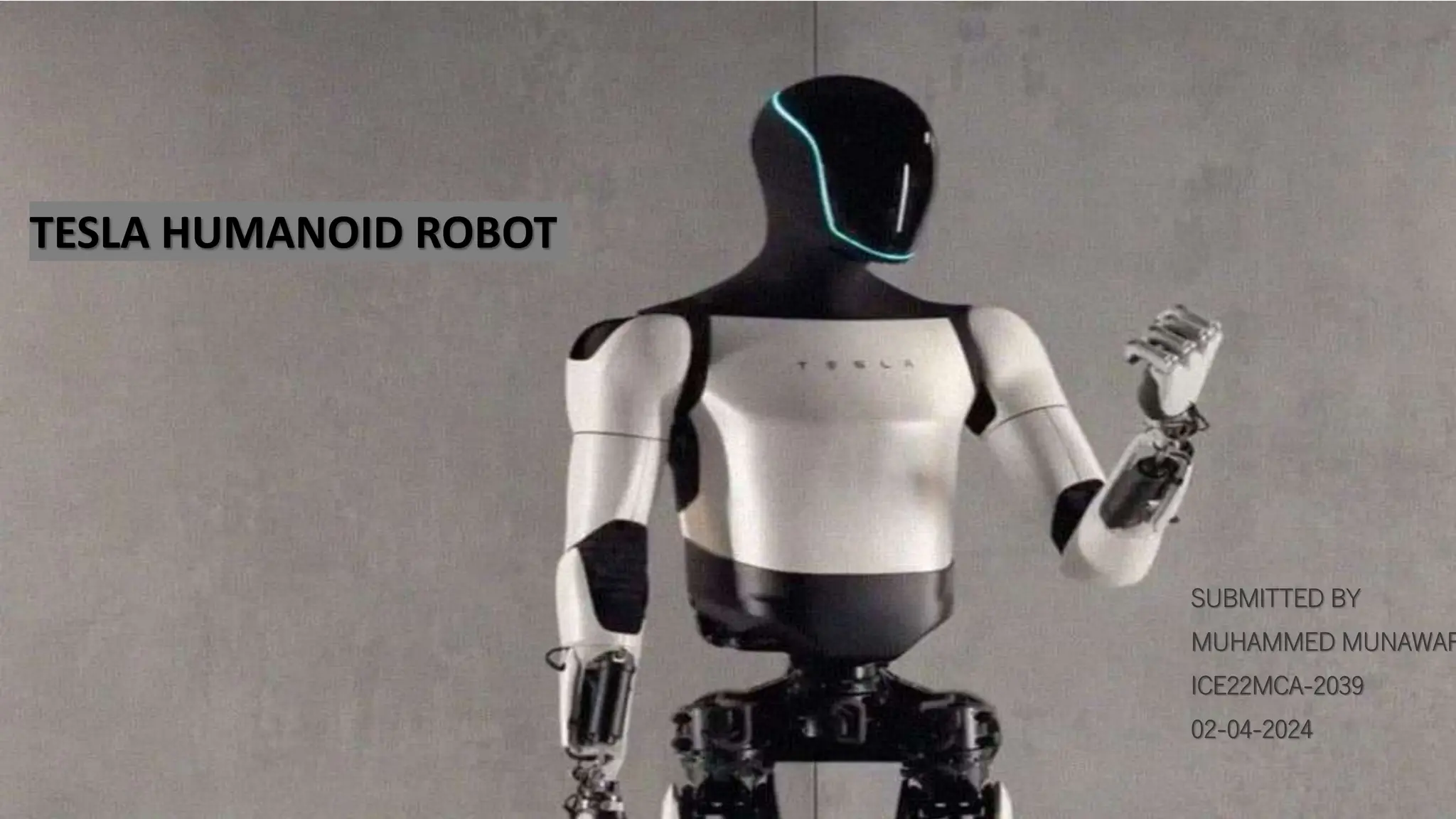
TESLA HUMANOID ROBOT
SUBMITTED BY
MUHAMMED MUNAWAR
ICE22MCA-2039
02-04-2024
INTRODUCTION
• In today's presentation, we will delve into the fascinating
world of humanoid robotics with a focus on Tesla's latest
venture - the Optimus humanoid robot.
• We will explore the objectives of Tesla's entry into the
humanoid robot market, the importance of this
development in the context of automation and AI, and the
relevance of Optimus in addressing various challenges and
opportunities in the service robotics industry.
OBJECTIVES OF THE PRESENTATION
• This presentation aims to delve into the development,
challenges, and potential impact of humanoid robots, with a
focus on Tesla's Optimus..
.
• Evaluate the challenges facing the widespread
adoption of humanoid robots in various industries, such
as ethical considerations, regulatory hurdles, and
societal acceptance, and explore potential solutions to
overcome these obstacles
• Analyse the technological advancements driving the
development of humanoid robots, including innovations
in artificial intelligence, machine learning, and sensor
technology
IMPORTANCE OF TESLA HUMANOID ROBOT
• Humanoid robots hold immense potential to revolutionize
automation and human-robot interactions across industries, making
this topic highly relevant in today's technological landscape.
• Taking on dangerous or unpleasant tasks: Optimus is designed
to handle jobs that are risky, repetitive, or simply not enjoyable for
humans [1]. This could free people up for more creative or strategic
work.
• Economic impact: Widespread adoption of humanoid robots could
significantly impact the economy. New jobs might be created in
robot design, maintenance, and programming, while other jobs may
BACKGROUND AND CONTEXT
EXPLANATIONOF THE BACKGROUNDOF THE TOPIC
• Challenges persist in achieving widespread adoption
• Tesla's entry into the humanoid robotics field marks a
significant milestone in the company's expansion
beyond electric vehicles and renewable energy,
signalling its ambitions to disrupt traditional industries
with innovative technology solutions.
• The unveiling of Tesla's Optimus prototype reflects the
growing interest and investment in humanoid robotics,
with the potential to redefine how tasks are performed
in various sectors, from manufacturing to hospitality.
RELEVANT HISTORICAL INFORMATION
• Concept Stage (2021): At Tesla's AI Day in August
2021, the concept for the humanoid robot, then called
Tesla Bot, was first announced.They even showed a
person in a robotic suit to represent the idea [3
• Prototype Reveal (2022): Things progressed quickly.
During a Tesla Giga Texas event in April 2022, a
display for the robot was shown, with hopes for
production by 2023 [2]. Later that year, in June, Elon
Musk announced the first working prototype would be
unveiled at the upcoming AI Day.
•
DEFINITIONS
• Optimus, also known as Tesla Bot, is a humanoid robot
that can learn tasks humans can do and is designed to
fit into the human world.
• It was unveiled at Tesla's AI Day in 2021 and is intended
to be a general-purpose machine that can handle tasks
that are repetitive, unsafe, or tedious for humans.
• Optimus is different from previous robots, which are
designed to do one task only
LITERATURE REVIEW:
SUMMARY:
• Existing research on humanoid robotics covers advancements,
applications, and challenges. These studies shed light on the
capabilities, limitations, and societal implications of humanoid
robots.
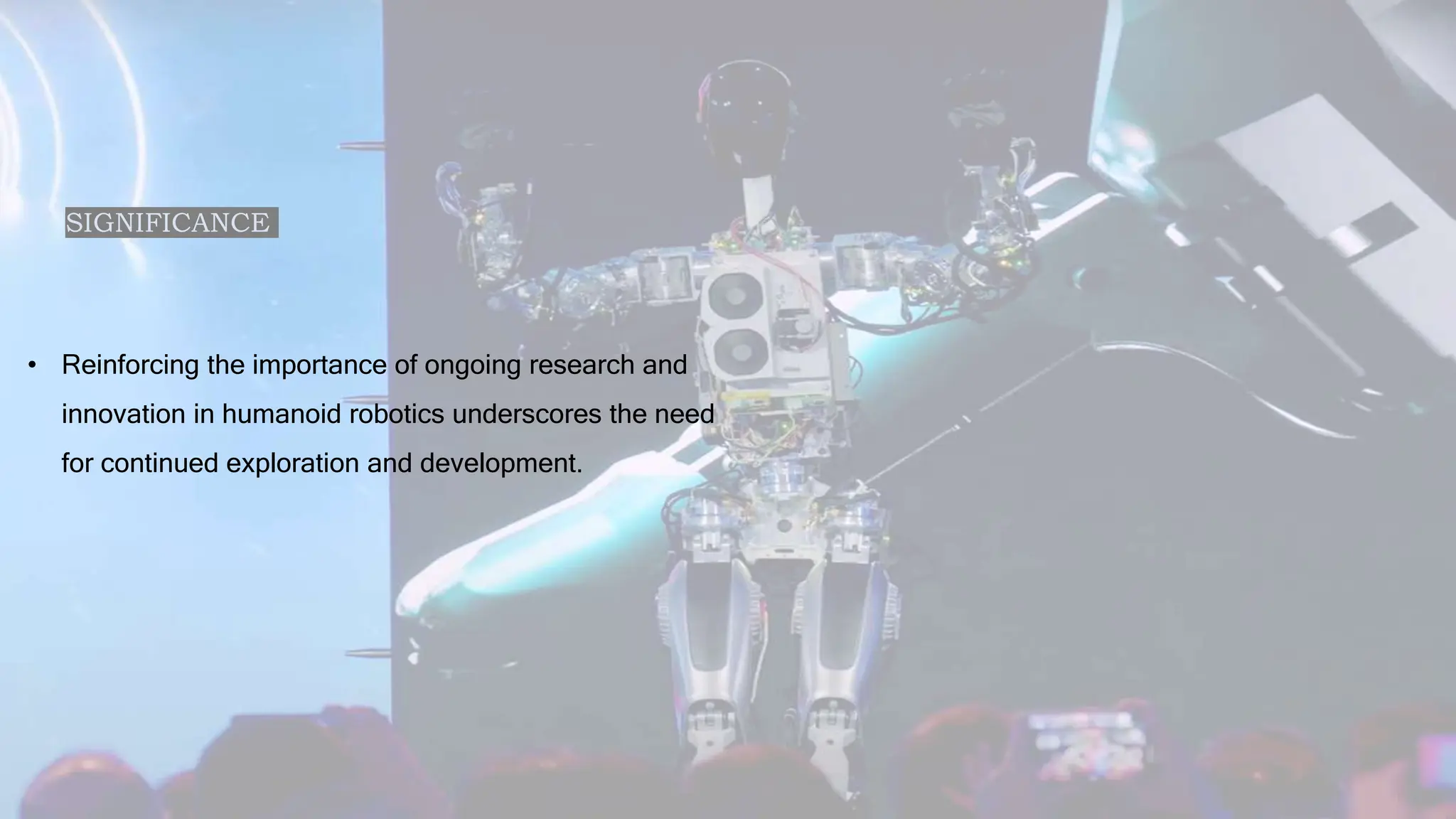
SIGNIFICANCE
• Reinforcing the importance of ongoing research and
innovation in humanoid robotics underscores the need
for continued exploration and development.
FUTURE RESEARCH
•Advancements in AI and Robotics: The development of
Optimus pushes the boundaries of artificial intelligence and
robotics, particularly in areas like balance, navigation, and
object manipulation.
•Potential Economic Impact: Widespread adoption of
humanoid robots could significantly impact the job market,
creating new opportunities in robot design, maintenance,
and programming, while potentially automating other jobs.
•Societal Considerations: As with any advanced
technology, the development of AI raises questions about
safety, ethics, and the future of work. Optimus serves as a
catalyst for discussions about these important topics
REFERENCES:
• 1.Branimir Ivšić; Zvonimir Šipuš; Juraj Bartolić; Josip Babić"Analysis of
Safe Ultrawideband Human-Robot Communication in Automated
Collaborative Warehouse".2020 14th European Conference on
Antennas and Propagation (EuCAP)
• 2.SHWETA MISHRA.P, India SONALI PATEL; NEHA
KUMARI; SHIVANI KHATEDIYA;NEHA KUMARI; SHIVANI
KHATEDIYA; MADHUR PATIDAR"Real-World Simulation Through
Obstacle Avoiding Robot" : 2021 5th International Conference on
Computing Methodologies and Communication (ICCMC)
• 3.Waiman Meinhold; Daniel Enrique Martinez; John Oshinski; Ai-Ping
Hu; Jun Ueda"A Direct Drive Parallel Plane Piezoelectric Needle
Positioning Robot for MRI Guided Intraspinal Injection" IEEE
Transactions on Biomedical Engineering ( Volume: 68, Issue: 3, March
2021)

Tesla Humanoid Robot - PPT in 11 Simple Slide

  • 1.
    TESLA HUMANOID ROBOT SUBMITTEDBY MUHAMMED MUNAWAR ICE22MCA-2039 02-04-2024
  • 2.
    INTRODUCTION • In today'spresentation, we will delve into the fascinating world of humanoid robotics with a focus on Tesla's latest venture - the Optimus humanoid robot. • We will explore the objectives of Tesla's entry into the humanoid robot market, the importance of this development in the context of automation and AI, and the relevance of Optimus in addressing various challenges and opportunities in the service robotics industry.
  • 3.
    OBJECTIVES OF THEPRESENTATION • This presentation aims to delve into the development, challenges, and potential impact of humanoid robots, with a focus on Tesla's Optimus.. . • Evaluate the challenges facing the widespread adoption of humanoid robots in various industries, such as ethical considerations, regulatory hurdles, and societal acceptance, and explore potential solutions to overcome these obstacles • Analyse the technological advancements driving the development of humanoid robots, including innovations in artificial intelligence, machine learning, and sensor technology
  • 4.
    IMPORTANCE OF TESLAHUMANOID ROBOT • Humanoid robots hold immense potential to revolutionize automation and human-robot interactions across industries, making this topic highly relevant in today's technological landscape. • Taking on dangerous or unpleasant tasks: Optimus is designed to handle jobs that are risky, repetitive, or simply not enjoyable for humans [1]. This could free people up for more creative or strategic work. • Economic impact: Widespread adoption of humanoid robots could significantly impact the economy. New jobs might be created in robot design, maintenance, and programming, while other jobs may
  • 5.
    BACKGROUND AND CONTEXT EXPLANATIONOFTHE BACKGROUNDOF THE TOPIC • Challenges persist in achieving widespread adoption • Tesla's entry into the humanoid robotics field marks a significant milestone in the company's expansion beyond electric vehicles and renewable energy, signalling its ambitions to disrupt traditional industries with innovative technology solutions. • The unveiling of Tesla's Optimus prototype reflects the growing interest and investment in humanoid robotics, with the potential to redefine how tasks are performed in various sectors, from manufacturing to hospitality.
  • 6.
    RELEVANT HISTORICAL INFORMATION •Concept Stage (2021): At Tesla's AI Day in August 2021, the concept for the humanoid robot, then called Tesla Bot, was first announced.They even showed a person in a robotic suit to represent the idea [3 • Prototype Reveal (2022): Things progressed quickly. During a Tesla Giga Texas event in April 2022, a display for the robot was shown, with hopes for production by 2023 [2]. Later that year, in June, Elon Musk announced the first working prototype would be unveiled at the upcoming AI Day. •
  • 7.
    DEFINITIONS • Optimus, alsoknown as Tesla Bot, is a humanoid robot that can learn tasks humans can do and is designed to fit into the human world. • It was unveiled at Tesla's AI Day in 2021 and is intended to be a general-purpose machine that can handle tasks that are repetitive, unsafe, or tedious for humans. • Optimus is different from previous robots, which are designed to do one task only
  • 8.
    LITERATURE REVIEW: SUMMARY: • Existingresearch on humanoid robotics covers advancements, applications, and challenges. These studies shed light on the capabilities, limitations, and societal implications of humanoid robots.
  • 9.
    SIGNIFICANCE • Reinforcing theimportance of ongoing research and innovation in humanoid robotics underscores the need for continued exploration and development.
  • 10.
    FUTURE RESEARCH •Advancements inAI and Robotics: The development of Optimus pushes the boundaries of artificial intelligence and robotics, particularly in areas like balance, navigation, and object manipulation. •Potential Economic Impact: Widespread adoption of humanoid robots could significantly impact the job market, creating new opportunities in robot design, maintenance, and programming, while potentially automating other jobs. •Societal Considerations: As with any advanced technology, the development of AI raises questions about safety, ethics, and the future of work. Optimus serves as a catalyst for discussions about these important topics
  • 11.
    REFERENCES: • 1.Branimir Ivšić;Zvonimir Šipuš; Juraj Bartolić; Josip Babić"Analysis of Safe Ultrawideband Human-Robot Communication in Automated Collaborative Warehouse".2020 14th European Conference on Antennas and Propagation (EuCAP) • 2.SHWETA MISHRA.P, India SONALI PATEL; NEHA KUMARI; SHIVANI KHATEDIYA;NEHA KUMARI; SHIVANI KHATEDIYA; MADHUR PATIDAR"Real-World Simulation Through Obstacle Avoiding Robot" : 2021 5th International Conference on Computing Methodologies and Communication (ICCMC) • 3.Waiman Meinhold; Daniel Enrique Martinez; John Oshinski; Ai-Ping Hu; Jun Ueda"A Direct Drive Parallel Plane Piezoelectric Needle Positioning Robot for MRI Guided Intraspinal Injection" IEEE Transactions on Biomedical Engineering ( Volume: 68, Issue: 3, March 2021)