~ II ~
REPORT ON
HUMAN RESOURCE ASPECT OF
MERGERS AND ACQUSITION
Submitted to:
Dr. Asrar H. Siddiqi
Faculty, Hamdard University
Submitted by:
Aamir Ali
Erum Naz
Karim Virani
Nazish Hussain
Dated: May 24, 2015
~ III ~
LETTER OF TRANSMITTAL
May 24, 2015
Dr. Asrar H. Siddiqi
Course Instructor
Hamdard University
Karachi
Dear Dr. Asrar H. Siddiqi,
This is the report assigned by you as a course requirement about on Human
Resource aspect of Mergers and Acquisition with a submission date of May 24th
2015
This report is to understand how HR drives value for the business and its role when
companies combine, we need to put Human Resources’ strategy in context with business
strategy
We have tried to apply the concepts taught by you in this report & would like to
show gratitude for providing us with the necessary guidelines to complete this
report.
Sincerely,
Aamir Ali
Erum Naz
Karim Virani
Nazish Hussain
~ IV ~
ACKNOWLEDGEMENT
First of all we would like to thank our course instructor Dr. Asrar H. Siddiqi who
have guided us at every step in preparing this report and from whom we can
confidently say that we learnt a lot.
We particularly want to thanks our friends, colleagues, and our family members
who have supported us, share their experiences and provide with their valuable
advises at every moment of our studies to do better and better.
~ V ~
EXECUTIVE SUMMARY
Mergers and acquisitions are increasingly being used by firms to strengthen and
maintain their position in the market place. They are seen by many as a relatively
fast and efficient way to expand into new markets and incorporate new technologies.
Yet their success is by no means assured. To the contrary, a majority fall short of
their stated goals and objectives. While some failure can be explained by financial
and market factors, a substantial number can be traced to neglected human resource
issues and activities. Numerous studies confirm the need for firms to systematically
address a variety of human resource issues and activities in their merger and
acquisition activities. This Report proposes a three-stage model of mergers and
acquisitions that systematically identifies several human resource issues and
activities. Numerous examples are offered to illustrate the issues and activities in
each of the three stages. The Report concludes with a description of the role and
importance of the HR department and leader.
~ VI ~
Table of Contents
INTRODUCTION ...................................................................................................................1
MERGERS AND ACQUISITION..........................................................................................3
TYPES ...................................................................................................................................3
REASONS.............................................................................................................................3
ASSUMPTIONS...................................................................................................................4
TRACK RECORD................................................................................................................4
REASONS FOR FAILURE .................................................................................................5
REASONS FOR SUCCESS.................................................................................................5
THE HUMAN SIDE OF M&A ..............................................................................................8
THREE STAGE MODEL OF MERGERS AND AQUISITIONS .....................................11
Stage 1 – Pre - Combination ............................................................................................13
Stage 2 – Combination – Integrating the Companies ..................................................17
Stage 3 – Solidification and Assessment of the New Entity .......................................23
ROLE OF HR DEPARTMENT IN M&A ACTIVITY .......................................................25
CONCLUSION......................................................................................................................29
At the Company Level .....................................................................................................29
At the HR Level.................................................................................................................30
REFERENCES........................................................................................................................33
~ 1 ~
INTRODUCTION
Companies today need to be fast growing, efficient, profitable, flexible, adaptable,
and future-ready and have a dominant market position. Without these qualities,
firms believe that it is virtually impossible to be competitive in today’s global
economy. In some industries such as insurance or banking, firms may move into
new markets. In others such as pharmaceuticals or software technology, firms may
work with smaller firms that have developed or are developing new products that
they can manufacture and/or distribute more efficiently, while other firms focus on
their own internal growth, leadership and development. Regardless of industry,
however, it appears that it has become all but impossible in our global environment
for firms to compete with others without growing and expanding through deals that
result in mergers or acquisitions (Lucenko, 2000; Galpin and Hemdon, 1999;
Deogun and Scannell, 1998, 2001). The deals between many of the largest and most
successful global firms such as Daimler–Chrysler, Chase–J.P. Morgan,
McKinsey–Envision, UBS–Paine Webber, Credit Sussie–DLJ, Celltech–Medeva, SKB
Glaxo, NationsBank–Bank of America, AOL–Time Warner, Pfizer–Warner
Lambert, Nestle´ –Purina, Deutsche Telekom–Voice Stream and GE–Honeywell
attest to this belief (Seriver, 2001; Fairlamb, 2000a; Lowry, 2000; Tierney and Green,
2000; Vlasic and Stertz, 2000a; Timmons, 2000; McLean, 2000; Ewing, 2000a,b,c;
Barrett, 2000a; Silverman, 2001; Tompkins, 2001). And the future appears to be ripe
for a continuation of the trend for annual increases in merger and acquisition (M&A)
activity: And why not? The factors that have driven the M&A activity in the past
decade are forecast only to intensify: need for large economies of scale, deregulation,
globalization, expanding markets, risk spreading, and need for rapid response to
market conditions. Many companies seem to be confronted with the need to do
mergers and acquisitions successfully, yet the odds of doing so are relatively low.
These odds, however, can be increased: some companies are quite successful in
mergers and acquisitions. Yes, experience helps, but it is the learning from the
experience that seems to be critical (Ashkenas et al.,2000). In general, what their
experiences appear to suggest is that firms that have a systematic approach to deal
making are more likely to be successful. Underlying this successful approach is
the recognition of attention to many people issues (a.k.a., human capital) that
exist throughout the stages of mergers and acquisitions. The purpose of this article is
to articulate a systematic, people-oriented, approach for effectively doing
mergers and acquisitions from beginning to integration and post-integration. We
begin by identifying the types of mergers and acquisitions, the reasons for their
successes and failures, and the many people issues involved. Then a three-stage
model is described. This is followed by an over view of the implication for the
Human Resource (HR) Departments and HR Professionals.
~ 2 ~
~ 3 ~
MERGERS AND ACQUISITION
Mergers and acquisitions represent the end of the continuum of options companies
have in combining with each other. Representing the least intense and complex form
of combination is licensing. Next come alliances and partnerships and then joint
ventures.
Mergers and then acquisitions conclude the combination options. It is the mergers
and acquisitions that are the combinations that have the greatest implications for size
of investment, control, integration requirements, pains of separation, and people
management issues (Doz and Hamel, 1998; Hamel, 1991; Harbison, 1996; Sparks,
1998, 1999). With our focus on mergers and acquisitions, it is important to
distinguish them. In a merger, two companies come together and create a new
entity. In an acquisition, one company buys another one and manages it consistent
with the acquirer’s needs.
TYPES
Further implications for people management issues are types of mergers and
acquisitions. In general there are mergers of equals which include the merger
between Citicorp and Travellers forming Citigroup; and between Ciba and Sandoz
forming Novartis.
There are also mergers between unequal such as between Chase and J.P. Morgan
creating JPMorgan-Chase. Similarly there are two major types of acquisitions: those
involving acquisition and integration such as those typically made by Cisco Systems;
and those involving acquisition and separation such as between Unilever and Best
foods. Acknowledging these types of mergers and acquisitions is critical in
describing and acting upon the unique people management issues each has. For
example, a merger of equals often compels the two companies to share in the
staffing implications; whereas a merger of unequal’s results in the staffing
implications being shared unequally (Kay and Shelton, 2000). An acquisition that
involves integration has greater staffing implications than one that involves
separation other differences are highlighted later in this report.
REASONS
There are numerous reasons for companies to merge or acquire. Some of the most
frequent include
 Horizontal mergers for market dominance; economies of scale
 Vertical mergers for channel control
~ 4 ~
 Hybrid mergers for risk spreading, cost cutting, synergies, defensive drivers
 Growth for world-class leadership and global reach
 Survival; critical mass
 Acquisition of cash, deferred taxes, and excess debt capacity
 Move quickly and inexpensively
 Flexibility; leverage
 Bigger asset base to leverage borrowing
 Adopt potentially disruptive technologies
 Financial gain and personal power
 Gaining a core competence to do more combinations
 Talent, knowledge, and technology today
Of these, it appears that the last one is rising in its level of importance.
ASSUMPTIONS
Regardless of the reasons companies have for merging or combining, there are
several basic assumptions being made, either explicitly or implicitly. These include:
 M&A’s are the fastest and easiest ways to grow
 M&A’s are likely to fall short of their initial goals
 M&A’s are difficult to do
 Creating synergies is a major challenge
 Molding cultures is a major challenge
 Soft and hard due diligence are necessary but not sufficient conditions
 Pre-planning can help increase chances for success.
It appears that companies that have gained from the experience of previous
combination efforts recognize and address these assumptions more effectively than
those that haven’t. And the more firms have experiences, the more they appear to
learn from each additional merger or acquisition, thus solidifying their core
competency and competitive advantage.
TRACK RECORD
With the importance of and need for mergers and acquisitions growing, and the
base of experience expanding, it may seem reasonable also to assume that success is
more likely to occur than failure in these types of combinations In fact large
combinations.
~ 5 ~
REASONS FOR FAILURE
Mergers and acquisitions fail for a variety of reasons, often several simultaneously.
Typical reasons for failure include:
 Expectations are unrealistic
 Hastily constructed strategy, poor planning, and unskilled execution.
 Failure/inability to unify behind a single macro message
 Talent is lost or mismanaged
 Power and politics are the driving forces, rather than productive objectives
 Requires an impossible degree of synergy
 Culture clashes between the two entities go unchecked
 Transition management fails
 The underestimation of transition costs
 Financial drain
 Defensive motivation
 Focus of executives is distracted from the core business.
Perhaps of these, culture clashes, gaps, or incompatibility and losses of key talent are
cited the most frequently, although even these become intertwined with other
reasons.
REASONS FOR SUCCESS
Perhaps not surprisingly some of the major reasons for success in mergers and
acquisitions include:
 Leadership
 Well-thought out goals and objectives
 Due diligence on hard and soft issues
 Well-managed M&A team
 Successful learning from previous experience
 Planning for combination and solidification steps completed early
 Key talent retained
 Extensive and timely communications to all stake-holders
These reasons are corroborated by the findings of Watson Wyatt’s Global M&A
Survey where it is reported that the key lessons for the next M&A project suggest
the need to:
~ 6 ~
 Develop a more realistic time scale, including allowance for the time
required to prepare for effective due diligence
 Start the planning of integration processes sooner and get HR involved earlier
 Work to align expectations in the acquirer and acquired businesses
 Confront difficult decisions, including employee and human resource issues,
earlier in the process
 Change managers quickly if they fail to adapt.
Watson Wyatt observed a disparity between the number of respondents who felt
that they had been relatively successful in their M&A experience, and the overall
success rate of deals. This indicates that there is a need for companies to be more
critical of their own performance in a deal to make sure that lessons are learned for
the future.
Thus, while there are many reasons for success and failure in mergers and
acquisitions, whether in North America, Europe, or Asia, at the core of many of them
are people issues.
~ 7 ~
~ 8 ~
THE HUMAN SIDE OF M&A
Plenty of attention is paid to the legal, financial, and operational elements of mergers
and acquisitions. But executives who have been through the merger process now
recognize that in today’s economy, the management of the human side of change is
the real key to maximizing the value of a deal.
“Employers now recognize that human resource issues are the primary indicator of the
success or failure of a deal. When we had mergers just five years ago, employers had much
more leverage than they do now. The full employment economy has been a huge problem,”
says Laura Carlson, a Minneapolis corporate finance lawyer at Faegre and Benson (Armour,
2000)
The management of the human side of M&A activity, however, based upon the
failure rates of M&A appears to be a somewhat neglected focus of the top
management’s attention.
‘Many mergers do not create the shareholder value expected of them. The combination of
cultural differences and an ill-conceived human resource integration strategy is one of the
most common reasons for that failure. Given the well-publicized war for talent, I am
constantly surprised by how little attention is paid to the matter of human capital
during mergers,’ Says David Kidd, a partner at Egon Zehnder International in Chicago.
So if people issues are so critical, why are they neglected? Possible reasons include
 The belief that they are too soft, and, therefore, hard to manage
 Lack of awareness or consensus that people issues are critical
 No spokesperson to articulate these issues
 No model or framework that can serve as a tool to systematically understand
and manage the people issues; and therefore
 The focus of attention in M & A activity is on other activities such as finance,
accounting, and manufacturing.
Research, however, indicates that people issues occur at several phases or stages of
M&A activity. More specifically, people issues in just the integration phase of
mergers and acquisitions include:
(1) Retention of key talent;
(2) Communications;
(3) Retention of key managers; and
(4) Integration of corporate cultures
~ 9 ~
From these flow numerous, more detailed people issues, e.g., evaluation and
selection of duplicate managerial talent to determine who remains and who departs
after the merger or acquisition. In the process of integrating corporate cultures,
entire sets of human resource policies and practice from both companies may be
subject to evaluation, revision, or replacement. While these human resource issues
are important in M&A activity throughout the world, their importance tends to vary
by the type of M&A combination. For example, if it is an acquisition that will allow
for separation of the acquired company, there may be fewer evaluation, selection,
and replacement decisions than in acquisitions that result in complete integration of
the two companies.
In addition to these people issues in the integration phase of M & A activity,
there are several other people issues that are evident in the phases before and after
integration. Those become more evident and more manageable by detailing a
model of activity.
~ 10 ~
~ 11 ~
THREE STAGE MODEL OF MERGERS AND
AQUISITIONS
The experiences of companies in merger and acquisition activity suggest a model of
M&A activity that has three stages:
(1) Pre-combination;
(2) Combination — integration of the partners; and
(3) Solidification and advancement — the new entity (Charman, 1999; Habeck et al.,
1999).
While these three stages are applicable to and encompass the larger set of business
functions such as business strategy, finance, marketing, distribution, IT, and
manufacturing, the issues highlighted here are those that reflect issues most closely
associated with human resource management.
Then to provide further focus and detail for these human resources (HR) issues in
M&A activity, HR implications and actions for the several issues in each stage are
identified.
~ 12 ~
~ 13 ~
Stage 1 – Pre - Combination
There are several human resource issues in this first stage of the M&A activity.
While discussed together, the differences that may accompany a merger rather than
an acquisition are noted. Because of the wide variation of mergers and acquisitions
that are possible, however, details of all such possible differences are not fully
articulated here
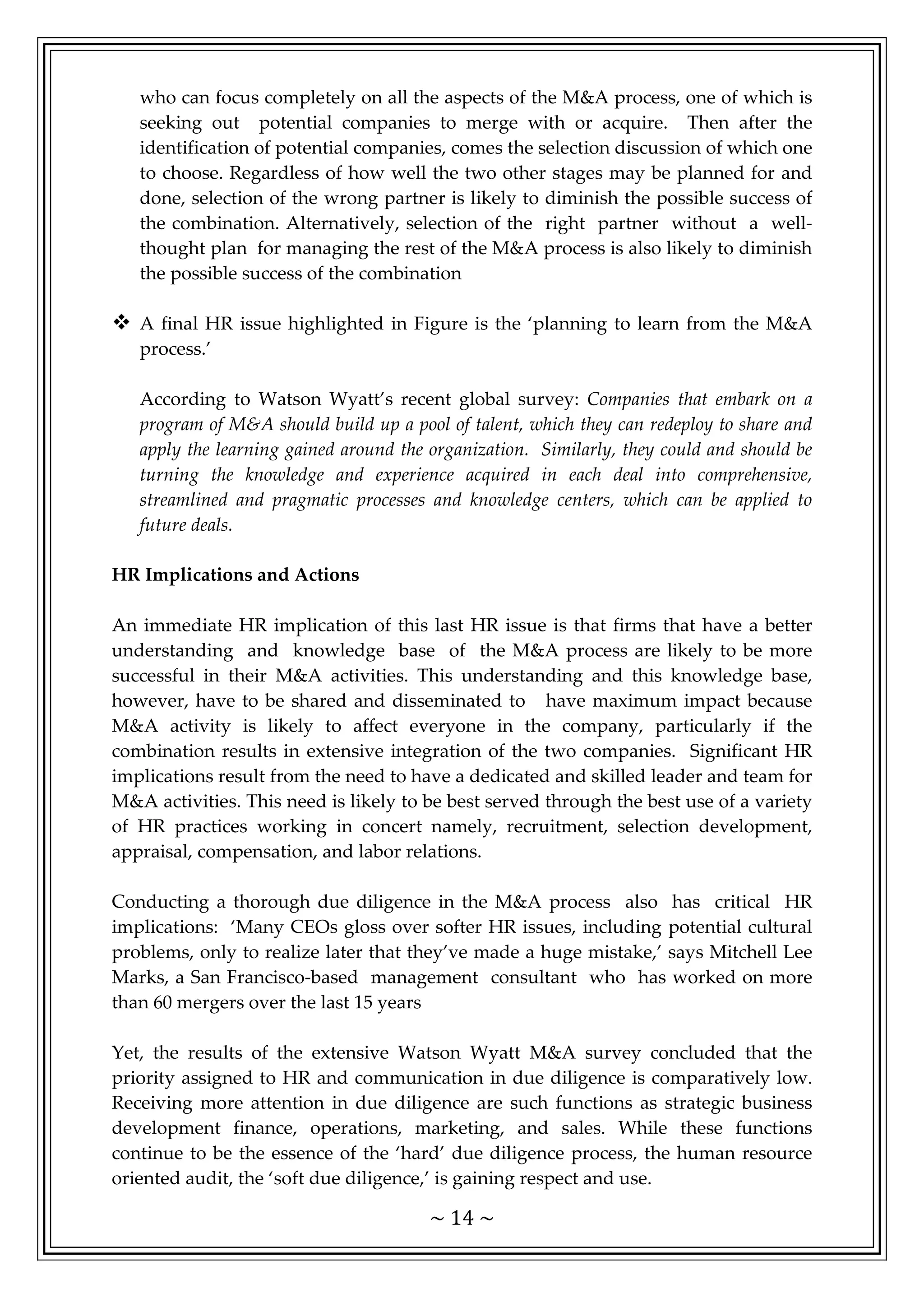
In this Pre-Combination stage the most significant HR issues and their more specific
implications and actions for M&A activity are illustrated in below Figure.
Figure 1 – Stage 1: Pre-combination
The HR issues are described first, followed by a discussion of the HR implications
and actions.
HR Issues:
 As highlighted in the above Figure, an important HR issue in the Pre-
Combination stage of any M&A activity is identifying the reasons to initiate the
activity. As described earlier, of the many possible reasons for an M&A, a
substantial number are human resource related, e.g., acquisition of key talent.
 Another important HR issue is the creation of a dedicated senior executive, As
suggested earlier, a key reason for M&A failure is the lack of a capable leader
~ 14 ~
who can focus completely on all the aspects of the M&A process, one of which is
seeking out potential companies to merge with or acquire. Then after the
identification of potential companies, comes the selection discussion of which one
to choose. Regardless of how well the two other stages may be planned for and

done, selection of the wrong partner is likely to diminish the possible success of

the combination. Alternatively, selection of the right partner without a well-
thought plan for managing the rest of the M&A process is also likely to diminish
the possible success of the combination
 A final HR issue highlighted in Figure is the ‘planning to learn from the M&A
process.’
According to Watson Wyatt’s recent global survey: Companies that embark on a
program of M&A should build up a pool of talent, which they can redeploy to share and
apply the learning gained around the organization. Similarly, they could and should be
turning the knowledge and experience acquired in each deal into comprehensive,
streamlined and pragmatic processes and knowledge centers, which can be applied to
future deals.
HR Implications and Actions
An immediate HR implication of this last HR issue is that firms that have a better
understanding and knowledge base of the M&A process are likely to be more
successful in their M&A activities. This understanding and this knowledge base,
however, have to be shared and disseminated to have maximum impact because
M&A activity is likely to affect everyone in the company, particularly if the
combination results in extensive integration of the two companies. Significant HR
implications result from the need to have a dedicated and skilled leader and team for
M&A activities. This need is likely to be best served through the best use of a variety
of HR practices working in concert namely, recruitment, selection development,
appraisal, compensation, and labor relations.
Conducting a thorough due diligence in the M&A process also has critical HR
implications: ‘Many CEOs gloss over softer HR issues, including potential cultural
problems, only to realize later that they’ve made a huge mistake,’ says Mitchell Lee
Marks, a San Francisco-based management consultant who has worked on more
than 60 mergers over the last 15 years
Yet, the results of the extensive Watson Wyatt M&A survey concluded that the
priority assigned to HR and communication in due diligence is comparatively low.
Receiving more attention in due diligence are such functions as strategic business
development finance, operations, marketing, and sales. While these functions
continue to be the essence of the ‘hard’ due diligence process, the human resource
oriented audit, the ‘soft due diligence,’ is gaining respect and use.
~ 15 ~
Consequently, cultural assessments, as an element of soft due diligence, are also
becoming common (Numerof and Abrams, 1998).
Cultural assessments involve describing and evaluating the two companies’
philosophies and values regarding such issues as: leadership styles; time horizons;
relative value of stakeholders; risk tolerance; and the value of teamwork versus
individual performance and recognition.
~ 16 ~
~ 17 ~
Stage 2 – Combination – Integrating the Companies
Although we are now at the second stage of the M&A process, it is important to
acknowledge the base that has been established by the activities in the first stage. For
example, for Stage 2 to be effective, it is important that planning for their integration
activities be skillfully prepared in Stage 1: ‘lack of integration planning is found in
80% of the M&A’s that underperform’ (Charman, 1999; Habeck et al., 1999).
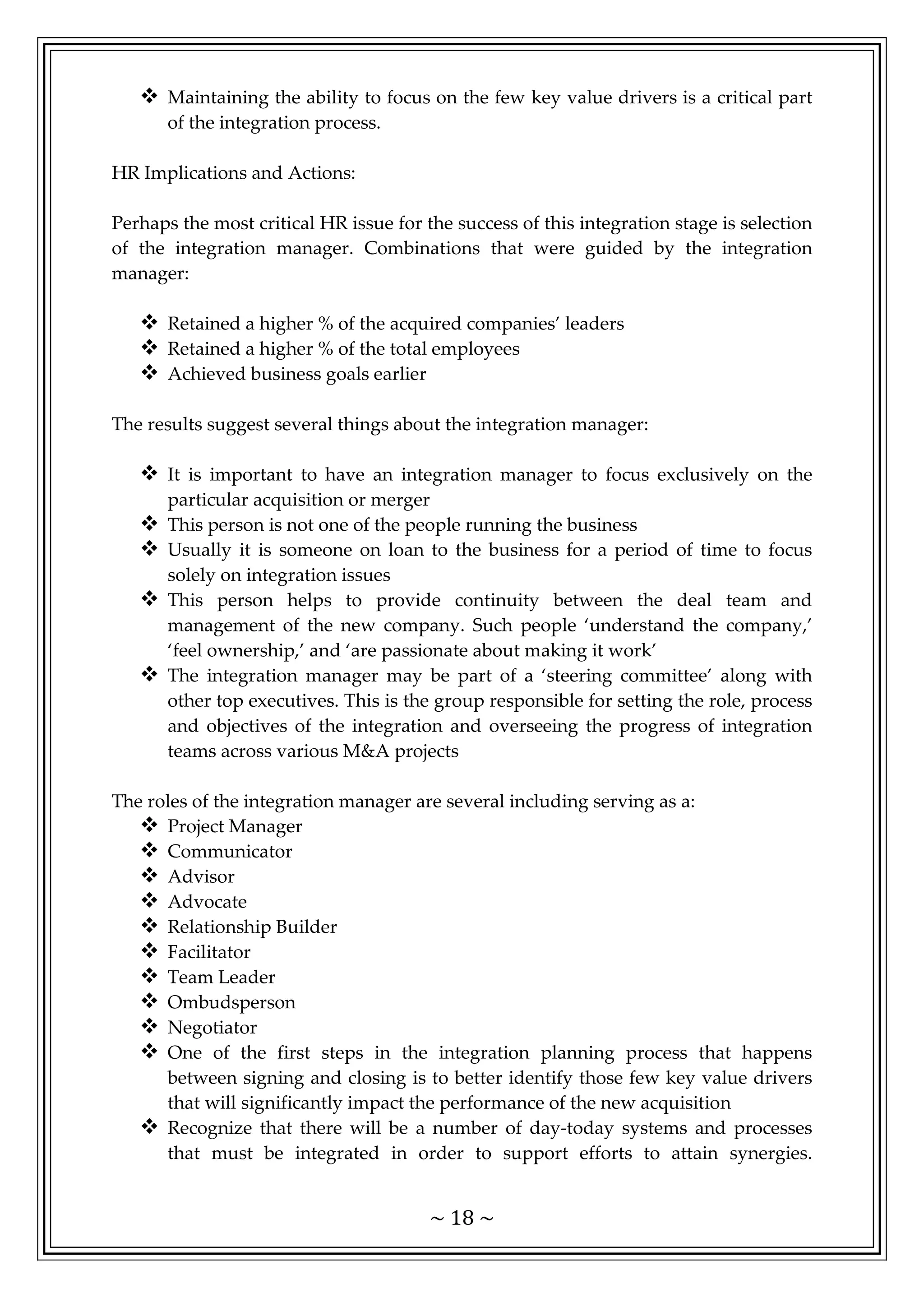
This crucial second stage incorporates a wide variety of activities as shown in Figure
2. In general, integration is the process by which two companies combine after a
merger or an acquisition is announced and pre-combination activities are completed.
Regardless of the specific area of breakdown or weakness, when poor integration
occurs:
 Productivity drops by 50 per cent
 Leadership attrition soars 47 per cent within 3 years
 Employee satisfaction drops 14 per cent
 90 per cent of high-tech mergers fail to deliver expected increases
 80 per cent of employees begin to feel management cares more about
financials than product quality or people.
Based upon a company study of the M&A process, it was found that:
 A systematic, explicit integration process is at the heart of a successful
acquisition
 All acquisitions require some degree of integration in both the area of day-to-
day systems and processes and in achieving key synergies
 It is important to tailor what is integrated and how it is done to the specific
strengths and weaknesses of the acquired company
 Integration efforts will differ depending on the company’s characteristics
~ 18 ~
 Maintaining the ability to focus on the few key value drivers is a critical part
of the integration process.
HR Implications and Actions:
Perhaps the most critical HR issue for the success of this integration stage is selection
of the integration manager. Combinations that were guided by the integration
manager:
 Retained a higher % of the acquired companies’ leaders
 Retained a higher % of the total employees
 Achieved business goals earlier
The results suggest several things about the integration manager:
 It is important to have an integration manager to focus exclusively on the
particular acquisition or merger
 This person is not one of the people running the business
 Usually it is someone on loan to the business for a period of time to focus
solely on integration issues
 This person helps to provide continuity between the deal team and
management of the new company. Such people ‘understand the company,’
‘feel ownership,’ and ‘are passionate about making it work’
 The integration manager may be part of a ‘steering committee’ along with
other top executives. This is the group responsible for setting the role, process
and objectives of the integration and overseeing the progress of integration
teams across various M&A projects
The roles of the integration manager are several including serving as a:
 Project Manager
 Communicator
 Advisor
 Advocate
 Relationship Builder
 Facilitator
 Team Leader
 Ombudsperson
 Negotiator
 One of the first steps in the integration planning process that happens
between signing and closing is to better identify those few key value drivers
that will significantly impact the performance of the new acquisition
 Recognize that there will be a number of day-today systems and processes
that must be integrated in order to support efforts to attain synergies.
~ 19 ~
Examples are sales reporting systems, certain IT systems, access to the global
e-mail network, and the distribution chain
 It is important to limit these activities to areas that are required to support the
achievement of key synergies
 One Company executive has stated: ‘We only attacked things that would
bring benefits to the business. We did not integrate just for the sake of
integrating’
 Once these key areas are identified, it may help to make sure that each one of
these value drivers has a team of people associated with it and those teams
are tracked for their progress
Another critical HR issue is the selection of a leader who will actually manage the
new business combination. If an acquired business has unclear or absent leadership,
the result will be crippling uncertainty, lack of direction, stalled new product
development, and the postponement of important decisions. Strong leadership is
essential to acquisition success — perhaps the single most important success factor.
A strong leader’s influence will be quickly recognized and praised.
Successful leaders of the new business are described as being:
 Sensitive to cultural differences
 Open-minded
 Flexible
 Able to recognize the relative strengths and weaknesses of both companies
 Committed to retaining key employees
 Good listeners
 Visionary
 Able to filter out distractions and focus on integrating key business drivers
such as R&D and customer interfaces.
To the extent that the acquired firm is closely integrated with the acquirer, it is
critical that the leader of the acquiring company has a solid knowledge about the
acquired company.
Some of the essential tasks this new business leader can perform include:
 Providing structure and strategy
 Managing the change process
 Retaining and motivating key employees
 Communicating with all stakeholders
It appears to be crucial that restructuring should be done early, fast, and once. This
minimizes the uncertainty of ‘waiting for the other shoe to drop.’ A historical
~ 20 ~
problem has been a tendency to restructure slowly and to rely heavily on people
rather than structures and processes.
‘Decisions about management structure, key roles, reporting relationships, layoffs,
restructuring, and other career-affecting aspects of the integration should be made,
announced, and implemented as soon as possible after the deal is signed — within days, if
possible. Creeping changes, uncertainty, and anxiety that last for months are debilitating and
immediately start to drain value from an acquisition’ (Ashkenas et al., 2000, p. 172).
To facilitate this restructuring phase, the leader can manage the process of change
itself.
There is no doubting the pressure of work caused by the need to manage integration
as well as ‘doing the day job’. Add to that the tendency for people to resist change
and the shortage of appropriately qualified management talent and you have a
recipe for an over-stressed, under-performing work environment.
Managing this involves preparing the staff for the change, involving them to help
ensure understanding, preparing a schedule for the changes, making the changes,
and then putting in place all the structures, policies and practices to support the new
operation.
Managing the communication process is also a valuable way to retain and motivate
key employees. It also plays a critical role in the process of change and the entire
stage of integration. The process of communicating can take several forms:
Acquiring companies are using the Internet, internal company Intranets and e-mail
to dispel rumors and keep employees updated about pending changes.
A final HR issue is the need to create policies and practices for learning and
knowledge sharing and transfer. Many of the same lessons were learned repeatedly
and simultaneously across business units as well as from other companies. Thus,
sharing those lessons enhances integration and improves the likelihood of success.
Forums for information sharing and the Intranet are tools that companies can use to
facilitate the sharing knowledge.
Helping ensure that knowledge and learning are shared across units are HR policies
and practices that appraise and reward employee sharing, flexibility, development
and long-term orientation.
Overall, this second stage of integration in an M&A activity is extensive and
complex. Whereas Stage 1 activities set the scene for M&A activity, those in Stage 2
are the ones that make the activity come to life. Clearly there are differences here
between a merger and an acquisition, differences between a merger of equals and
~ 21 ~
non-equals, and differences between an acquisition with inclusion and an acquisition
with separation. These differences probably impact the degree of applicability rather
than the kind of activities shown in Figures 1 and 2. Nonetheless these differences
must be kept in mind, particularly in the Stage 3.
~ 22 ~
~ 23 ~
Stage 3 – Solidification and Assessment of the New Entity
Particularly for a merger of equals with high levels of inclusion, there is a clear and
specific new entity that is created. This new entity, the new company, this, needs to
address several HR issues to ensure its viability and success. These HR issues and
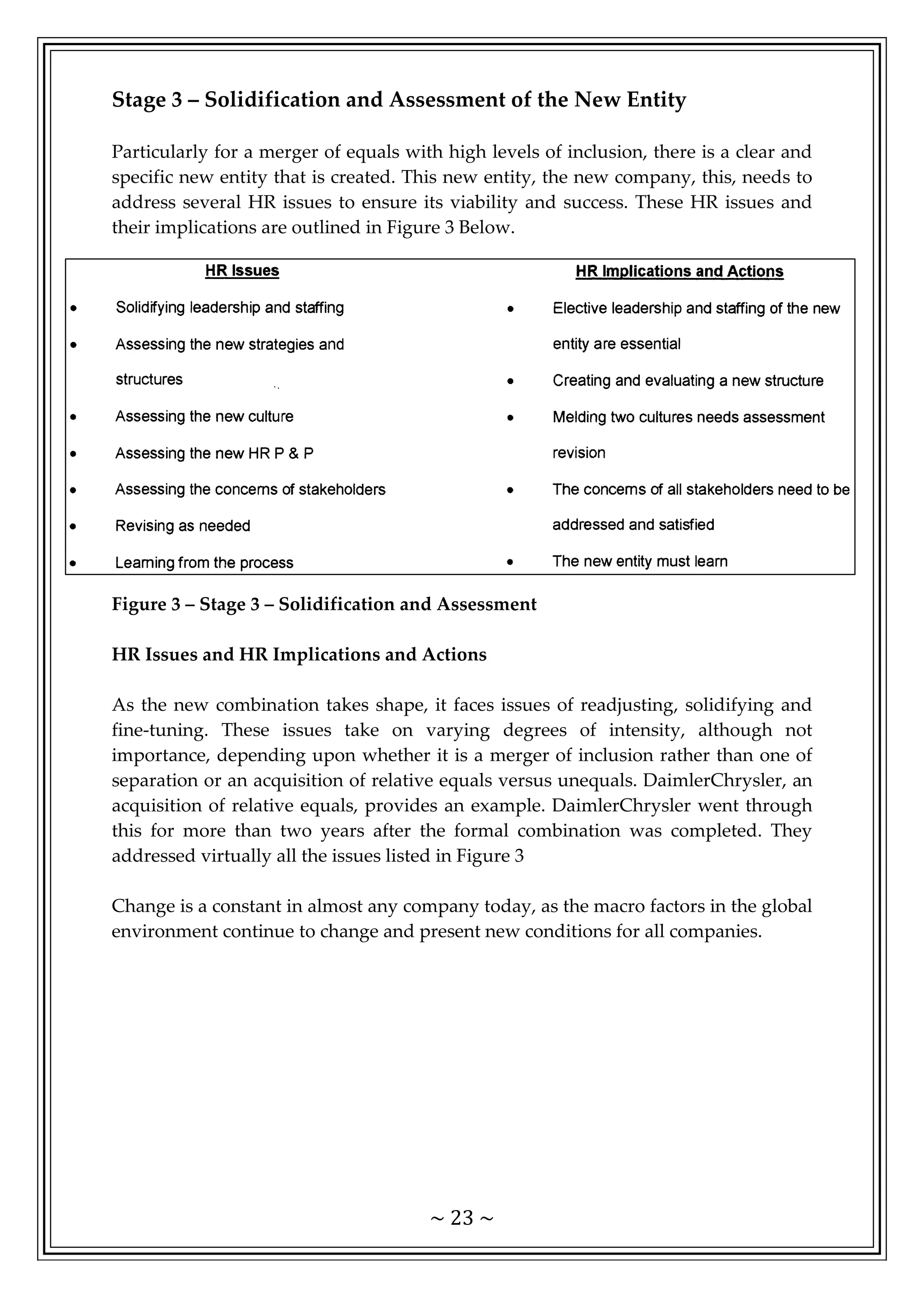
their implications are outlined in Figure 3 Below.
Figure 3 – Stage 3 – Solidification and Assessment
HR Issues and HR Implications and Actions
As the new combination takes shape, it faces issues of readjusting, solidifying and
fine-tuning. These issues take on varying degrees of intensity, although not
importance, depending upon whether it is a merger of inclusion rather than one of
separation or an acquisition of relative equals versus unequals. DaimlerChrysler, an
acquisition of relative equals, provides an example. DaimlerChrysler went through
this for more than two years after the formal combination was completed. They
addressed virtually all the issues listed in Figure 3
Change is a constant in almost any company today, as the macro factors in the global
environment continue to change and present new conditions for all companies.
~ 24 ~
.
~ 25 ~
ROLE OF HR DEPARTMENT IN M&A ACTIVITY
As illustrated in the Three-Stage Model of M&A’s, there are many people issues on
which the relative success or failure depends, particularly at the combination or
implementation stage. Yet research indicates that only 35 per cent of senior HR
executives are involved in M&A activities
80% of combinations fail at the implementation stage as a result of the following
factors; an inadequate road map, senior HR professionals brought in too little, too
late; senior HR professionals lacking in either/both business/global experience; an
inadequate skills base overall; and ultimately, failed organizational change.
Yet there are many activities that are consistent with and appropriate for the HR
professional’s skills and competencies. These include:
1. Developing key strategies for a company’s M&A activities. 85 per cent of
HR executives say they should be involved (Liberatore, 2000)
2. Managing the soft due diligence activity. This can mean:
 Gaining knowledge of the make-up and motivation of the two workforces
 Accessing management team of the other company
 Conducting analysis of its organizational structure
 Comparing benefits, compensation policies, and labor contracts of both firms
 Assessing the cultural match between the two firms
3. Providing input into managing the process of change:
 HR is a change champion providing the change management skills to align
the right people with the appropriate knowledge and skills base to meet the
shared goals of the enterprise (Charman, 1999)
4. Advising top management on the merged company’s new organizational
structure. Almost 75 per cent of HR executives think this, and only 9 per
cent think that HR should have full responsibility (Charman, 1999)
5. Creating transition teams, especially those that will:
 Develop infrastructure for new organization
 Process and design systems
 Address cultural issues
 Provide training
~ 26 ~
 Managing the activities associated with staffing, in particular, developing and
overseeing
 Selection processes
 Retention strategies
 Separation strategies
6. Overseeing the communications. Developing a communication plan aimed
at realizing a vision of the new organization through:
 Assessing issues re: audience, timing, method and message
 Information delivery
 Information gathering
 Change galvanization
 Helping employees cope with change
7. Managing the learning processes, e.g.,
 Building learning into the partnership agreement
 Staffing to learn
 Setting up learning-driven career plans
 Using training to stimulate the learning process
 Responsibility for learning should be specified
 Rewarding learning activities
8. Re-casting the HR department itself:
 Develop new policies and practices consistent with vision of new
organization
 Develop HR structure and staffing
 Determine service delivery model
9. Identifying and embracing new roles for the HR leader, namely,
 Partnership
 Change Facilitator
 Strategy Implementer
 Strategy Formulator
 Innovator
 Collaborator
~ 27 ~
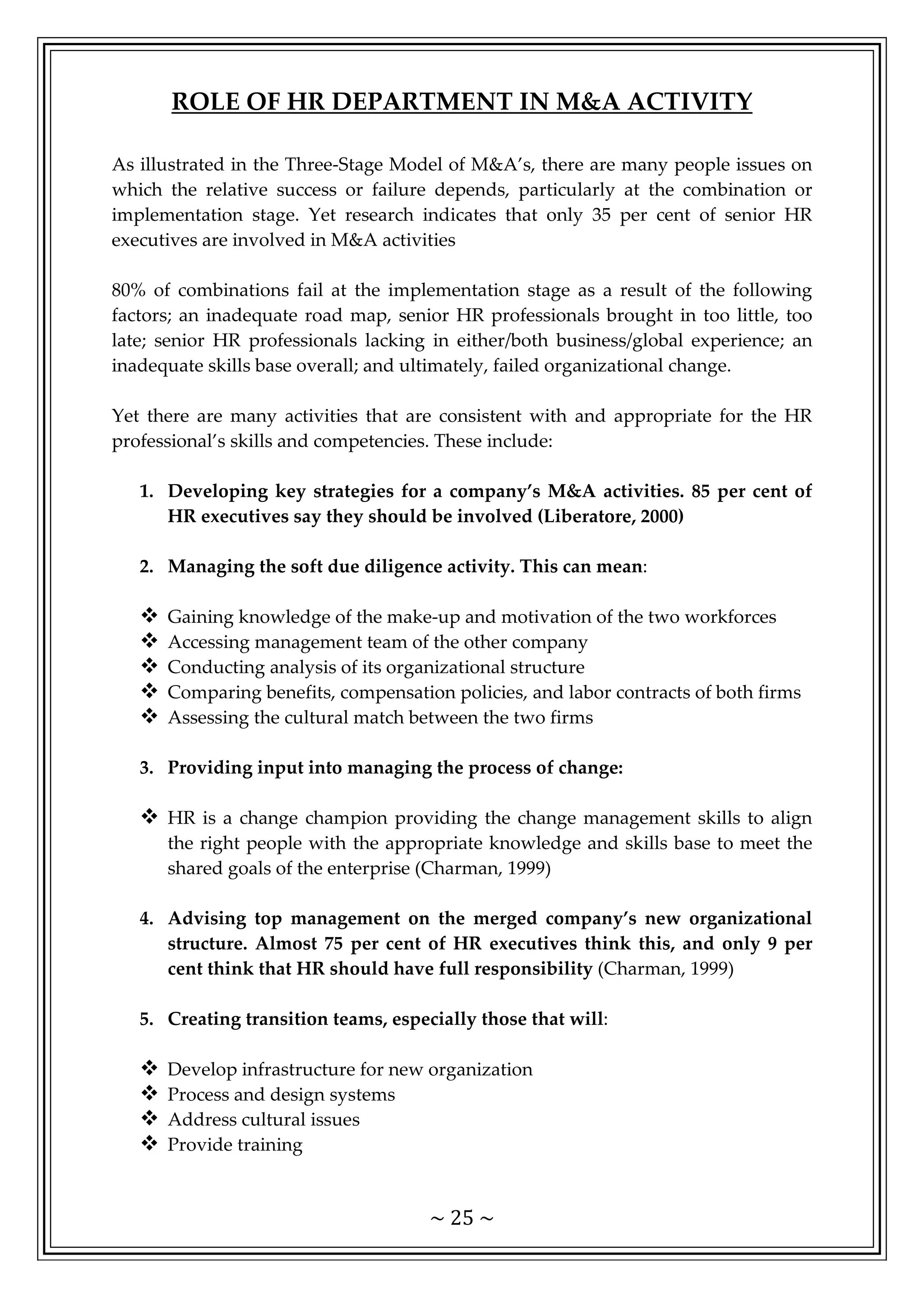
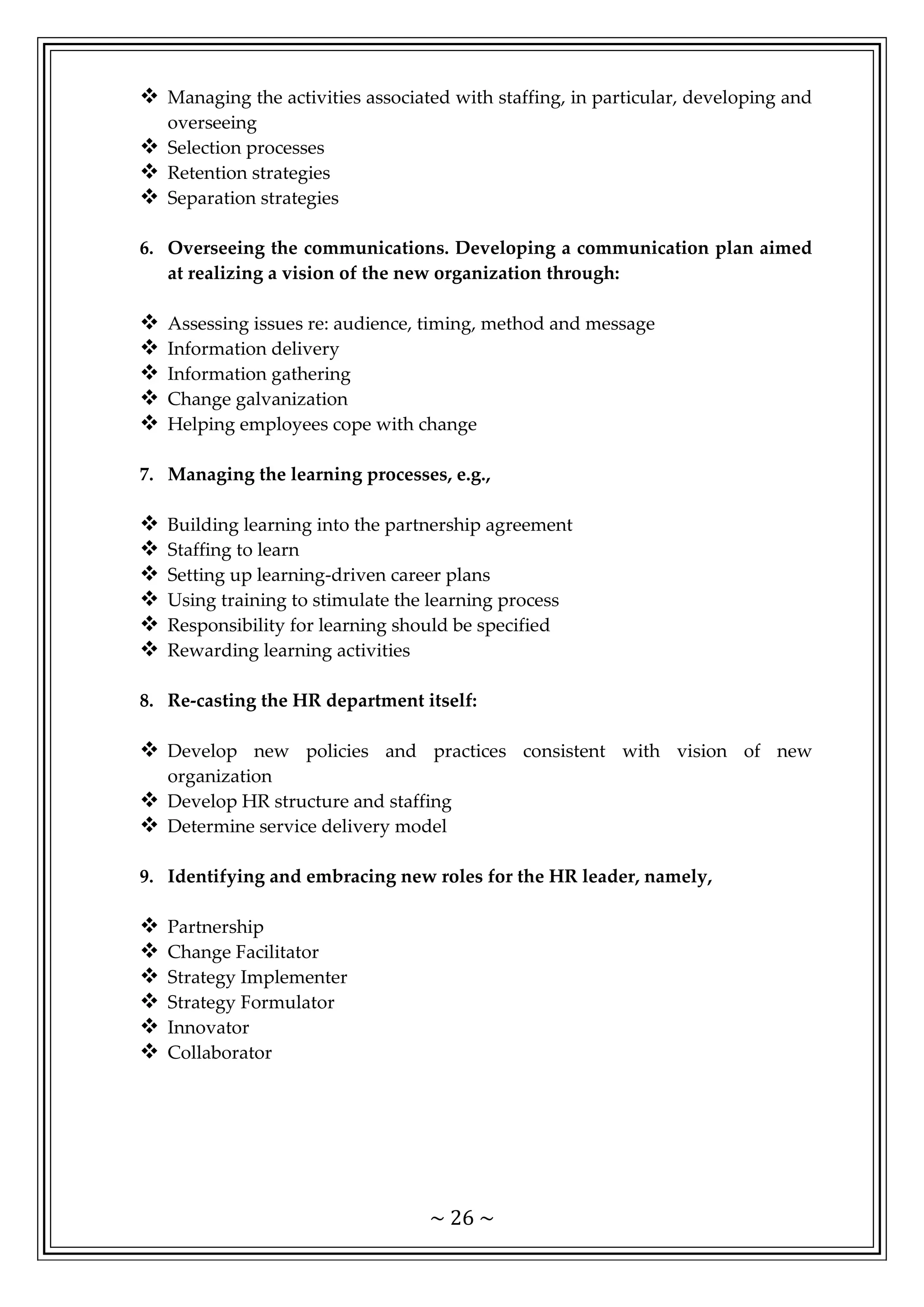
10. Identifying and developing new competencies, such as those shown in
Figure 4 Below
~ 28 ~
~ 29 ~
CONCLUSION
There are numerous conclusions that can be made about M&A activity, both at the
company level and at the HR level.
At the Company Level
 It is important that business and integration strategies be clear
 When the deal is concluded, there must be a clear vision of what the new
combination will look like:
• How will it be structured and run?
• Will it be stand-alone or connected?
 It is important that such decisions be made as early as possible and avoid
ambiguity in decision making guidance
 It is critical to have a clear plan on whether to merge acquired companies or
leave them alone
 It is important that performance expectations be reasonable and take into
account market conditions, capital investment requirement, etc.
 The seller’s picture is too often the starting point for ongoing operations (e.g.,
artificially inflated sales, lagging capital investment) — but is not realistic as a
performance goal
 Inflated performance expectations can lead executives to adopt short-term
focus and delay making investments in the business
 Financial expectations must be made clear, along with expectations with
respect to other things
 Discovery is a broader concept than legal ‘due diligence,’ covering internal
and external analysis, of all key functions and culture (soft and hard due
diligence)
 Thinking through the membership of due diligence teams and the
responsibilities of key participants is critical
~ 30 ~
 It is important to also make sure that areas such as HR, IT, Operations and
R&D are represented on the teams — participation will depend upon key
value drivers of the deal
 This has implications for capital expenditures, new product development,
management retention, etc.
 For acquisitions or mergers in new markets, it is essential to understand
market dynamics and customers
At the HR Level
 Companies should put their best people in charge of implementing M&A
deals
 More emphasis needs to be placed on early planning of the integration
process
 Difficult decisions should be dealt with quickly
 The time taken to complete the integration of a deal should not be
underestimated
 Employee communications, retention of key employees and cultural
integration are the most important activities in the HR area for successful
M&A integration
 Acquired company employees often identify cultural elements (e.g., flexibility
in decision-making) as integral to the company’s success
 It is important to be sensitive to cultural differences
 Acquired companies often view their culture as faster moving than that of
their new, larger parent
 It is possible that each side will perceive its culture as ‘better’ and does not
want to give it up
 Unmanaged cultural differences will lead to miscommunications and
misunderstandings
~ 31 ~
 It is also important to remember that each separate integration activity
changes the acquired company in some way. It is important to recognize and
preserve the important elements of the acquired company’s culture
 HR professionals still need to prove their worth in order to get a more central
role in the M&A process
 Companies with M&A as part of their future strategy should review how they
have managed M&A deals in the past and learn from these experiences when
embarking on future deals. This review should focus on:
• How to deal with inadequate information during due diligence
• Employee communication
• Identifying and dealing with integration bottlenecks
 M&A management can become a core competency for an HR department
~ 32 ~
~ 33 ~
REFERENCES
European Management Journal, Vol. 19, No. 3, pp. 239–253, 2001,
2001 Elsevier Science Ltd. All rights reserved.
http://www.washingtonandco.com/pdf/hr_issues_activities_mergers_acquisitions.pd
f
For Images : www.Google.com

Term Report on Human Resource Aspect of Mergers & Acquisition - Karim Virani

  • 2.
    ~ II ~ REPORTON HUMAN RESOURCE ASPECT OF MERGERS AND ACQUSITION Submitted to: Dr. Asrar H. Siddiqi Faculty, Hamdard University Submitted by: Aamir Ali Erum Naz Karim Virani Nazish Hussain Dated: May 24, 2015
  • 3.
    ~ III ~ LETTEROF TRANSMITTAL May 24, 2015 Dr. Asrar H. Siddiqi Course Instructor Hamdard University Karachi Dear Dr. Asrar H. Siddiqi, This is the report assigned by you as a course requirement about on Human Resource aspect of Mergers and Acquisition with a submission date of May 24th 2015 This report is to understand how HR drives value for the business and its role when companies combine, we need to put Human Resources’ strategy in context with business strategy We have tried to apply the concepts taught by you in this report & would like to show gratitude for providing us with the necessary guidelines to complete this report. Sincerely, Aamir Ali Erum Naz Karim Virani Nazish Hussain
  • 4.
    ~ IV ~ ACKNOWLEDGEMENT Firstof all we would like to thank our course instructor Dr. Asrar H. Siddiqi who have guided us at every step in preparing this report and from whom we can confidently say that we learnt a lot. We particularly want to thanks our friends, colleagues, and our family members who have supported us, share their experiences and provide with their valuable advises at every moment of our studies to do better and better.
  • 5.
    ~ V ~ EXECUTIVESUMMARY Mergers and acquisitions are increasingly being used by firms to strengthen and maintain their position in the market place. They are seen by many as a relatively fast and efficient way to expand into new markets and incorporate new technologies. Yet their success is by no means assured. To the contrary, a majority fall short of their stated goals and objectives. While some failure can be explained by financial and market factors, a substantial number can be traced to neglected human resource issues and activities. Numerous studies confirm the need for firms to systematically address a variety of human resource issues and activities in their merger and acquisition activities. This Report proposes a three-stage model of mergers and acquisitions that systematically identifies several human resource issues and activities. Numerous examples are offered to illustrate the issues and activities in each of the three stages. The Report concludes with a description of the role and importance of the HR department and leader.
  • 6.
    ~ VI ~ Tableof Contents INTRODUCTION ...................................................................................................................1 MERGERS AND ACQUISITION..........................................................................................3 TYPES ...................................................................................................................................3 REASONS.............................................................................................................................3 ASSUMPTIONS...................................................................................................................4 TRACK RECORD................................................................................................................4 REASONS FOR FAILURE .................................................................................................5 REASONS FOR SUCCESS.................................................................................................5 THE HUMAN SIDE OF M&A ..............................................................................................8 THREE STAGE MODEL OF MERGERS AND AQUISITIONS .....................................11 Stage 1 – Pre - Combination ............................................................................................13 Stage 2 – Combination – Integrating the Companies ..................................................17 Stage 3 – Solidification and Assessment of the New Entity .......................................23 ROLE OF HR DEPARTMENT IN M&A ACTIVITY .......................................................25 CONCLUSION......................................................................................................................29 At the Company Level .....................................................................................................29 At the HR Level.................................................................................................................30 REFERENCES........................................................................................................................33
  • 7.
    ~ 1 ~ INTRODUCTION Companiestoday need to be fast growing, efficient, profitable, flexible, adaptable, and future-ready and have a dominant market position. Without these qualities, firms believe that it is virtually impossible to be competitive in today’s global economy. In some industries such as insurance or banking, firms may move into new markets. In others such as pharmaceuticals or software technology, firms may work with smaller firms that have developed or are developing new products that they can manufacture and/or distribute more efficiently, while other firms focus on their own internal growth, leadership and development. Regardless of industry, however, it appears that it has become all but impossible in our global environment for firms to compete with others without growing and expanding through deals that result in mergers or acquisitions (Lucenko, 2000; Galpin and Hemdon, 1999; Deogun and Scannell, 1998, 2001). The deals between many of the largest and most successful global firms such as Daimler–Chrysler, Chase–J.P. Morgan, McKinsey–Envision, UBS–Paine Webber, Credit Sussie–DLJ, Celltech–Medeva, SKB Glaxo, NationsBank–Bank of America, AOL–Time Warner, Pfizer–Warner Lambert, Nestle´ –Purina, Deutsche Telekom–Voice Stream and GE–Honeywell attest to this belief (Seriver, 2001; Fairlamb, 2000a; Lowry, 2000; Tierney and Green, 2000; Vlasic and Stertz, 2000a; Timmons, 2000; McLean, 2000; Ewing, 2000a,b,c; Barrett, 2000a; Silverman, 2001; Tompkins, 2001). And the future appears to be ripe for a continuation of the trend for annual increases in merger and acquisition (M&A) activity: And why not? The factors that have driven the M&A activity in the past decade are forecast only to intensify: need for large economies of scale, deregulation, globalization, expanding markets, risk spreading, and need for rapid response to market conditions. Many companies seem to be confronted with the need to do mergers and acquisitions successfully, yet the odds of doing so are relatively low. These odds, however, can be increased: some companies are quite successful in mergers and acquisitions. Yes, experience helps, but it is the learning from the experience that seems to be critical (Ashkenas et al.,2000). In general, what their experiences appear to suggest is that firms that have a systematic approach to deal making are more likely to be successful. Underlying this successful approach is the recognition of attention to many people issues (a.k.a., human capital) that exist throughout the stages of mergers and acquisitions. The purpose of this article is to articulate a systematic, people-oriented, approach for effectively doing mergers and acquisitions from beginning to integration and post-integration. We begin by identifying the types of mergers and acquisitions, the reasons for their successes and failures, and the many people issues involved. Then a three-stage model is described. This is followed by an over view of the implication for the Human Resource (HR) Departments and HR Professionals.
  • 8.
  • 9.
    ~ 3 ~ MERGERSAND ACQUISITION Mergers and acquisitions represent the end of the continuum of options companies have in combining with each other. Representing the least intense and complex form of combination is licensing. Next come alliances and partnerships and then joint ventures. Mergers and then acquisitions conclude the combination options. It is the mergers and acquisitions that are the combinations that have the greatest implications for size of investment, control, integration requirements, pains of separation, and people management issues (Doz and Hamel, 1998; Hamel, 1991; Harbison, 1996; Sparks, 1998, 1999). With our focus on mergers and acquisitions, it is important to distinguish them. In a merger, two companies come together and create a new entity. In an acquisition, one company buys another one and manages it consistent with the acquirer’s needs. TYPES Further implications for people management issues are types of mergers and acquisitions. In general there are mergers of equals which include the merger between Citicorp and Travellers forming Citigroup; and between Ciba and Sandoz forming Novartis. There are also mergers between unequal such as between Chase and J.P. Morgan creating JPMorgan-Chase. Similarly there are two major types of acquisitions: those involving acquisition and integration such as those typically made by Cisco Systems; and those involving acquisition and separation such as between Unilever and Best foods. Acknowledging these types of mergers and acquisitions is critical in describing and acting upon the unique people management issues each has. For example, a merger of equals often compels the two companies to share in the staffing implications; whereas a merger of unequal’s results in the staffing implications being shared unequally (Kay and Shelton, 2000). An acquisition that involves integration has greater staffing implications than one that involves separation other differences are highlighted later in this report. REASONS There are numerous reasons for companies to merge or acquire. Some of the most frequent include  Horizontal mergers for market dominance; economies of scale  Vertical mergers for channel control
  • 10.
    ~ 4 ~ Hybrid mergers for risk spreading, cost cutting, synergies, defensive drivers  Growth for world-class leadership and global reach  Survival; critical mass  Acquisition of cash, deferred taxes, and excess debt capacity  Move quickly and inexpensively  Flexibility; leverage  Bigger asset base to leverage borrowing  Adopt potentially disruptive technologies  Financial gain and personal power  Gaining a core competence to do more combinations  Talent, knowledge, and technology today Of these, it appears that the last one is rising in its level of importance. ASSUMPTIONS Regardless of the reasons companies have for merging or combining, there are several basic assumptions being made, either explicitly or implicitly. These include:  M&A’s are the fastest and easiest ways to grow  M&A’s are likely to fall short of their initial goals  M&A’s are difficult to do  Creating synergies is a major challenge  Molding cultures is a major challenge  Soft and hard due diligence are necessary but not sufficient conditions  Pre-planning can help increase chances for success. It appears that companies that have gained from the experience of previous combination efforts recognize and address these assumptions more effectively than those that haven’t. And the more firms have experiences, the more they appear to learn from each additional merger or acquisition, thus solidifying their core competency and competitive advantage. TRACK RECORD With the importance of and need for mergers and acquisitions growing, and the base of experience expanding, it may seem reasonable also to assume that success is more likely to occur than failure in these types of combinations In fact large combinations.
  • 11.
    ~ 5 ~ REASONSFOR FAILURE Mergers and acquisitions fail for a variety of reasons, often several simultaneously. Typical reasons for failure include:  Expectations are unrealistic  Hastily constructed strategy, poor planning, and unskilled execution.  Failure/inability to unify behind a single macro message  Talent is lost or mismanaged  Power and politics are the driving forces, rather than productive objectives  Requires an impossible degree of synergy  Culture clashes between the two entities go unchecked  Transition management fails  The underestimation of transition costs  Financial drain  Defensive motivation  Focus of executives is distracted from the core business. Perhaps of these, culture clashes, gaps, or incompatibility and losses of key talent are cited the most frequently, although even these become intertwined with other reasons. REASONS FOR SUCCESS Perhaps not surprisingly some of the major reasons for success in mergers and acquisitions include:  Leadership  Well-thought out goals and objectives  Due diligence on hard and soft issues  Well-managed M&A team  Successful learning from previous experience  Planning for combination and solidification steps completed early  Key talent retained  Extensive and timely communications to all stake-holders These reasons are corroborated by the findings of Watson Wyatt’s Global M&A Survey where it is reported that the key lessons for the next M&A project suggest the need to:
  • 12.
    ~ 6 ~ Develop a more realistic time scale, including allowance for the time required to prepare for effective due diligence  Start the planning of integration processes sooner and get HR involved earlier  Work to align expectations in the acquirer and acquired businesses  Confront difficult decisions, including employee and human resource issues, earlier in the process  Change managers quickly if they fail to adapt. Watson Wyatt observed a disparity between the number of respondents who felt that they had been relatively successful in their M&A experience, and the overall success rate of deals. This indicates that there is a need for companies to be more critical of their own performance in a deal to make sure that lessons are learned for the future. Thus, while there are many reasons for success and failure in mergers and acquisitions, whether in North America, Europe, or Asia, at the core of many of them are people issues.
  • 13.
  • 14.
    ~ 8 ~ THEHUMAN SIDE OF M&A Plenty of attention is paid to the legal, financial, and operational elements of mergers and acquisitions. But executives who have been through the merger process now recognize that in today’s economy, the management of the human side of change is the real key to maximizing the value of a deal. “Employers now recognize that human resource issues are the primary indicator of the success or failure of a deal. When we had mergers just five years ago, employers had much more leverage than they do now. The full employment economy has been a huge problem,” says Laura Carlson, a Minneapolis corporate finance lawyer at Faegre and Benson (Armour, 2000) The management of the human side of M&A activity, however, based upon the failure rates of M&A appears to be a somewhat neglected focus of the top management’s attention. ‘Many mergers do not create the shareholder value expected of them. The combination of cultural differences and an ill-conceived human resource integration strategy is one of the most common reasons for that failure. Given the well-publicized war for talent, I am constantly surprised by how little attention is paid to the matter of human capital during mergers,’ Says David Kidd, a partner at Egon Zehnder International in Chicago. So if people issues are so critical, why are they neglected? Possible reasons include  The belief that they are too soft, and, therefore, hard to manage  Lack of awareness or consensus that people issues are critical  No spokesperson to articulate these issues  No model or framework that can serve as a tool to systematically understand and manage the people issues; and therefore  The focus of attention in M & A activity is on other activities such as finance, accounting, and manufacturing. Research, however, indicates that people issues occur at several phases or stages of M&A activity. More specifically, people issues in just the integration phase of mergers and acquisitions include: (1) Retention of key talent; (2) Communications; (3) Retention of key managers; and (4) Integration of corporate cultures
  • 15.
    ~ 9 ~ Fromthese flow numerous, more detailed people issues, e.g., evaluation and selection of duplicate managerial talent to determine who remains and who departs after the merger or acquisition. In the process of integrating corporate cultures, entire sets of human resource policies and practice from both companies may be subject to evaluation, revision, or replacement. While these human resource issues are important in M&A activity throughout the world, their importance tends to vary by the type of M&A combination. For example, if it is an acquisition that will allow for separation of the acquired company, there may be fewer evaluation, selection, and replacement decisions than in acquisitions that result in complete integration of the two companies. In addition to these people issues in the integration phase of M & A activity, there are several other people issues that are evident in the phases before and after integration. Those become more evident and more manageable by detailing a model of activity.
  • 16.
  • 17.
    ~ 11 ~ THREESTAGE MODEL OF MERGERS AND AQUISITIONS The experiences of companies in merger and acquisition activity suggest a model of M&A activity that has three stages: (1) Pre-combination; (2) Combination — integration of the partners; and (3) Solidification and advancement — the new entity (Charman, 1999; Habeck et al., 1999). While these three stages are applicable to and encompass the larger set of business functions such as business strategy, finance, marketing, distribution, IT, and manufacturing, the issues highlighted here are those that reflect issues most closely associated with human resource management. Then to provide further focus and detail for these human resources (HR) issues in M&A activity, HR implications and actions for the several issues in each stage are identified.
  • 18.
  • 19.
    ~ 13 ~ Stage1 – Pre - Combination There are several human resource issues in this first stage of the M&A activity. While discussed together, the differences that may accompany a merger rather than an acquisition are noted. Because of the wide variation of mergers and acquisitions that are possible, however, details of all such possible differences are not fully articulated here In this Pre-Combination stage the most significant HR issues and their more specific implications and actions for M&A activity are illustrated in below Figure. Figure 1 – Stage 1: Pre-combination The HR issues are described first, followed by a discussion of the HR implications and actions. HR Issues:  As highlighted in the above Figure, an important HR issue in the Pre- Combination stage of any M&A activity is identifying the reasons to initiate the activity. As described earlier, of the many possible reasons for an M&A, a substantial number are human resource related, e.g., acquisition of key talent.  Another important HR issue is the creation of a dedicated senior executive, As suggested earlier, a key reason for M&A failure is the lack of a capable leader
  • 20.
    ~ 14 ~ whocan focus completely on all the aspects of the M&A process, one of which is seeking out potential companies to merge with or acquire. Then after the identification of potential companies, comes the selection discussion of which one to choose. Regardless of how well the two other stages may be planned for and done, selection of the wrong partner is likely to diminish the possible success of the combination. Alternatively, selection of the right partner without a well- thought plan for managing the rest of the M&A process is also likely to diminish the possible success of the combination  A final HR issue highlighted in Figure is the ‘planning to learn from the M&A process.’ According to Watson Wyatt’s recent global survey: Companies that embark on a program of M&A should build up a pool of talent, which they can redeploy to share and apply the learning gained around the organization. Similarly, they could and should be turning the knowledge and experience acquired in each deal into comprehensive, streamlined and pragmatic processes and knowledge centers, which can be applied to future deals. HR Implications and Actions An immediate HR implication of this last HR issue is that firms that have a better understanding and knowledge base of the M&A process are likely to be more successful in their M&A activities. This understanding and this knowledge base, however, have to be shared and disseminated to have maximum impact because M&A activity is likely to affect everyone in the company, particularly if the combination results in extensive integration of the two companies. Significant HR implications result from the need to have a dedicated and skilled leader and team for M&A activities. This need is likely to be best served through the best use of a variety of HR practices working in concert namely, recruitment, selection development, appraisal, compensation, and labor relations. Conducting a thorough due diligence in the M&A process also has critical HR implications: ‘Many CEOs gloss over softer HR issues, including potential cultural problems, only to realize later that they’ve made a huge mistake,’ says Mitchell Lee Marks, a San Francisco-based management consultant who has worked on more than 60 mergers over the last 15 years Yet, the results of the extensive Watson Wyatt M&A survey concluded that the priority assigned to HR and communication in due diligence is comparatively low. Receiving more attention in due diligence are such functions as strategic business development finance, operations, marketing, and sales. While these functions continue to be the essence of the ‘hard’ due diligence process, the human resource oriented audit, the ‘soft due diligence,’ is gaining respect and use.
  • 21.
    ~ 15 ~ Consequently,cultural assessments, as an element of soft due diligence, are also becoming common (Numerof and Abrams, 1998). Cultural assessments involve describing and evaluating the two companies’ philosophies and values regarding such issues as: leadership styles; time horizons; relative value of stakeholders; risk tolerance; and the value of teamwork versus individual performance and recognition.
  • 22.
  • 23.
    ~ 17 ~ Stage2 – Combination – Integrating the Companies Although we are now at the second stage of the M&A process, it is important to acknowledge the base that has been established by the activities in the first stage. For example, for Stage 2 to be effective, it is important that planning for their integration activities be skillfully prepared in Stage 1: ‘lack of integration planning is found in 80% of the M&A’s that underperform’ (Charman, 1999; Habeck et al., 1999). This crucial second stage incorporates a wide variety of activities as shown in Figure 2. In general, integration is the process by which two companies combine after a merger or an acquisition is announced and pre-combination activities are completed. Regardless of the specific area of breakdown or weakness, when poor integration occurs:  Productivity drops by 50 per cent  Leadership attrition soars 47 per cent within 3 years  Employee satisfaction drops 14 per cent  90 per cent of high-tech mergers fail to deliver expected increases  80 per cent of employees begin to feel management cares more about financials than product quality or people. Based upon a company study of the M&A process, it was found that:  A systematic, explicit integration process is at the heart of a successful acquisition  All acquisitions require some degree of integration in both the area of day-to- day systems and processes and in achieving key synergies  It is important to tailor what is integrated and how it is done to the specific strengths and weaknesses of the acquired company  Integration efforts will differ depending on the company’s characteristics
  • 24.
    ~ 18 ~ Maintaining the ability to focus on the few key value drivers is a critical part of the integration process. HR Implications and Actions: Perhaps the most critical HR issue for the success of this integration stage is selection of the integration manager. Combinations that were guided by the integration manager:  Retained a higher % of the acquired companies’ leaders  Retained a higher % of the total employees  Achieved business goals earlier The results suggest several things about the integration manager:  It is important to have an integration manager to focus exclusively on the particular acquisition or merger  This person is not one of the people running the business  Usually it is someone on loan to the business for a period of time to focus solely on integration issues  This person helps to provide continuity between the deal team and management of the new company. Such people ‘understand the company,’ ‘feel ownership,’ and ‘are passionate about making it work’  The integration manager may be part of a ‘steering committee’ along with other top executives. This is the group responsible for setting the role, process and objectives of the integration and overseeing the progress of integration teams across various M&A projects The roles of the integration manager are several including serving as a:  Project Manager  Communicator  Advisor  Advocate  Relationship Builder  Facilitator  Team Leader  Ombudsperson  Negotiator  One of the first steps in the integration planning process that happens between signing and closing is to better identify those few key value drivers that will significantly impact the performance of the new acquisition  Recognize that there will be a number of day-today systems and processes that must be integrated in order to support efforts to attain synergies.
  • 25.
    ~ 19 ~ Examplesare sales reporting systems, certain IT systems, access to the global e-mail network, and the distribution chain  It is important to limit these activities to areas that are required to support the achievement of key synergies  One Company executive has stated: ‘We only attacked things that would bring benefits to the business. We did not integrate just for the sake of integrating’  Once these key areas are identified, it may help to make sure that each one of these value drivers has a team of people associated with it and those teams are tracked for their progress Another critical HR issue is the selection of a leader who will actually manage the new business combination. If an acquired business has unclear or absent leadership, the result will be crippling uncertainty, lack of direction, stalled new product development, and the postponement of important decisions. Strong leadership is essential to acquisition success — perhaps the single most important success factor. A strong leader’s influence will be quickly recognized and praised. Successful leaders of the new business are described as being:  Sensitive to cultural differences  Open-minded  Flexible  Able to recognize the relative strengths and weaknesses of both companies  Committed to retaining key employees  Good listeners  Visionary  Able to filter out distractions and focus on integrating key business drivers such as R&D and customer interfaces. To the extent that the acquired firm is closely integrated with the acquirer, it is critical that the leader of the acquiring company has a solid knowledge about the acquired company. Some of the essential tasks this new business leader can perform include:  Providing structure and strategy  Managing the change process  Retaining and motivating key employees  Communicating with all stakeholders It appears to be crucial that restructuring should be done early, fast, and once. This minimizes the uncertainty of ‘waiting for the other shoe to drop.’ A historical
  • 26.
    ~ 20 ~ problemhas been a tendency to restructure slowly and to rely heavily on people rather than structures and processes. ‘Decisions about management structure, key roles, reporting relationships, layoffs, restructuring, and other career-affecting aspects of the integration should be made, announced, and implemented as soon as possible after the deal is signed — within days, if possible. Creeping changes, uncertainty, and anxiety that last for months are debilitating and immediately start to drain value from an acquisition’ (Ashkenas et al., 2000, p. 172). To facilitate this restructuring phase, the leader can manage the process of change itself. There is no doubting the pressure of work caused by the need to manage integration as well as ‘doing the day job’. Add to that the tendency for people to resist change and the shortage of appropriately qualified management talent and you have a recipe for an over-stressed, under-performing work environment. Managing this involves preparing the staff for the change, involving them to help ensure understanding, preparing a schedule for the changes, making the changes, and then putting in place all the structures, policies and practices to support the new operation. Managing the communication process is also a valuable way to retain and motivate key employees. It also plays a critical role in the process of change and the entire stage of integration. The process of communicating can take several forms: Acquiring companies are using the Internet, internal company Intranets and e-mail to dispel rumors and keep employees updated about pending changes. A final HR issue is the need to create policies and practices for learning and knowledge sharing and transfer. Many of the same lessons were learned repeatedly and simultaneously across business units as well as from other companies. Thus, sharing those lessons enhances integration and improves the likelihood of success. Forums for information sharing and the Intranet are tools that companies can use to facilitate the sharing knowledge. Helping ensure that knowledge and learning are shared across units are HR policies and practices that appraise and reward employee sharing, flexibility, development and long-term orientation. Overall, this second stage of integration in an M&A activity is extensive and complex. Whereas Stage 1 activities set the scene for M&A activity, those in Stage 2 are the ones that make the activity come to life. Clearly there are differences here between a merger and an acquisition, differences between a merger of equals and
  • 27.
    ~ 21 ~ non-equals,and differences between an acquisition with inclusion and an acquisition with separation. These differences probably impact the degree of applicability rather than the kind of activities shown in Figures 1 and 2. Nonetheless these differences must be kept in mind, particularly in the Stage 3.
  • 28.
  • 29.
    ~ 23 ~ Stage3 – Solidification and Assessment of the New Entity Particularly for a merger of equals with high levels of inclusion, there is a clear and specific new entity that is created. This new entity, the new company, this, needs to address several HR issues to ensure its viability and success. These HR issues and their implications are outlined in Figure 3 Below. Figure 3 – Stage 3 – Solidification and Assessment HR Issues and HR Implications and Actions As the new combination takes shape, it faces issues of readjusting, solidifying and fine-tuning. These issues take on varying degrees of intensity, although not importance, depending upon whether it is a merger of inclusion rather than one of separation or an acquisition of relative equals versus unequals. DaimlerChrysler, an acquisition of relative equals, provides an example. DaimlerChrysler went through this for more than two years after the formal combination was completed. They addressed virtually all the issues listed in Figure 3 Change is a constant in almost any company today, as the macro factors in the global environment continue to change and present new conditions for all companies.
  • 30.
  • 31.
    ~ 25 ~ ROLEOF HR DEPARTMENT IN M&A ACTIVITY As illustrated in the Three-Stage Model of M&A’s, there are many people issues on which the relative success or failure depends, particularly at the combination or implementation stage. Yet research indicates that only 35 per cent of senior HR executives are involved in M&A activities 80% of combinations fail at the implementation stage as a result of the following factors; an inadequate road map, senior HR professionals brought in too little, too late; senior HR professionals lacking in either/both business/global experience; an inadequate skills base overall; and ultimately, failed organizational change. Yet there are many activities that are consistent with and appropriate for the HR professional’s skills and competencies. These include: 1. Developing key strategies for a company’s M&A activities. 85 per cent of HR executives say they should be involved (Liberatore, 2000) 2. Managing the soft due diligence activity. This can mean:  Gaining knowledge of the make-up and motivation of the two workforces  Accessing management team of the other company  Conducting analysis of its organizational structure  Comparing benefits, compensation policies, and labor contracts of both firms  Assessing the cultural match between the two firms 3. Providing input into managing the process of change:  HR is a change champion providing the change management skills to align the right people with the appropriate knowledge and skills base to meet the shared goals of the enterprise (Charman, 1999) 4. Advising top management on the merged company’s new organizational structure. Almost 75 per cent of HR executives think this, and only 9 per cent think that HR should have full responsibility (Charman, 1999) 5. Creating transition teams, especially those that will:  Develop infrastructure for new organization  Process and design systems  Address cultural issues  Provide training
  • 32.
    ~ 26 ~ Managing the activities associated with staffing, in particular, developing and overseeing  Selection processes  Retention strategies  Separation strategies 6. Overseeing the communications. Developing a communication plan aimed at realizing a vision of the new organization through:  Assessing issues re: audience, timing, method and message  Information delivery  Information gathering  Change galvanization  Helping employees cope with change 7. Managing the learning processes, e.g.,  Building learning into the partnership agreement  Staffing to learn  Setting up learning-driven career plans  Using training to stimulate the learning process  Responsibility for learning should be specified  Rewarding learning activities 8. Re-casting the HR department itself:  Develop new policies and practices consistent with vision of new organization  Develop HR structure and staffing  Determine service delivery model 9. Identifying and embracing new roles for the HR leader, namely,  Partnership  Change Facilitator  Strategy Implementer  Strategy Formulator  Innovator  Collaborator
  • 33.
    ~ 27 ~ 10.Identifying and developing new competencies, such as those shown in Figure 4 Below
  • 34.
  • 35.
    ~ 29 ~ CONCLUSION Thereare numerous conclusions that can be made about M&A activity, both at the company level and at the HR level. At the Company Level  It is important that business and integration strategies be clear  When the deal is concluded, there must be a clear vision of what the new combination will look like: • How will it be structured and run? • Will it be stand-alone or connected?  It is important that such decisions be made as early as possible and avoid ambiguity in decision making guidance  It is critical to have a clear plan on whether to merge acquired companies or leave them alone  It is important that performance expectations be reasonable and take into account market conditions, capital investment requirement, etc.  The seller’s picture is too often the starting point for ongoing operations (e.g., artificially inflated sales, lagging capital investment) — but is not realistic as a performance goal  Inflated performance expectations can lead executives to adopt short-term focus and delay making investments in the business  Financial expectations must be made clear, along with expectations with respect to other things  Discovery is a broader concept than legal ‘due diligence,’ covering internal and external analysis, of all key functions and culture (soft and hard due diligence)  Thinking through the membership of due diligence teams and the responsibilities of key participants is critical
  • 36.
    ~ 30 ~ It is important to also make sure that areas such as HR, IT, Operations and R&D are represented on the teams — participation will depend upon key value drivers of the deal  This has implications for capital expenditures, new product development, management retention, etc.  For acquisitions or mergers in new markets, it is essential to understand market dynamics and customers At the HR Level  Companies should put their best people in charge of implementing M&A deals  More emphasis needs to be placed on early planning of the integration process  Difficult decisions should be dealt with quickly  The time taken to complete the integration of a deal should not be underestimated  Employee communications, retention of key employees and cultural integration are the most important activities in the HR area for successful M&A integration  Acquired company employees often identify cultural elements (e.g., flexibility in decision-making) as integral to the company’s success  It is important to be sensitive to cultural differences  Acquired companies often view their culture as faster moving than that of their new, larger parent  It is possible that each side will perceive its culture as ‘better’ and does not want to give it up  Unmanaged cultural differences will lead to miscommunications and misunderstandings
  • 37.
    ~ 31 ~ It is also important to remember that each separate integration activity changes the acquired company in some way. It is important to recognize and preserve the important elements of the acquired company’s culture  HR professionals still need to prove their worth in order to get a more central role in the M&A process  Companies with M&A as part of their future strategy should review how they have managed M&A deals in the past and learn from these experiences when embarking on future deals. This review should focus on: • How to deal with inadequate information during due diligence • Employee communication • Identifying and dealing with integration bottlenecks  M&A management can become a core competency for an HR department
  • 38.
  • 39.
    ~ 33 ~ REFERENCES EuropeanManagement Journal, Vol. 19, No. 3, pp. 239–253, 2001, 2001 Elsevier Science Ltd. All rights reserved. http://www.washingtonandco.com/pdf/hr_issues_activities_mergers_acquisitions.pd f For Images : www.Google.com