A Look at the Theology of Rob Bell & “Love Wins”
                    Part 3
Review: What are we Talking About?

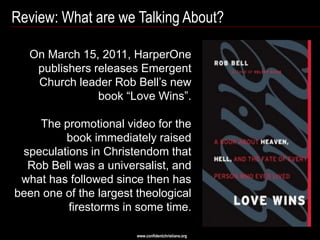
  On March 15, 2011, HarperOne
   publishers releases Emergent
   Church leader Rob Bell‘s new
               book ―Love Wins‖.

    The promotional video for the
         book immediately raised
 speculations in Christendom that
  Rob Bell was a universalist, and
 what has followed since then has
been one of the largest theological
          firestorms in some time.

                        www.confidentchristians.org
Review: What did We Cover Last Time?

• The Bible is clear on the teaching of Hell.
• Hell is not a purgatory or a place of
  correction; rather, it is the second death for
  those apart from Christ
• The teachings of Jesus and the apostles
  clearly teach the above
• No place in Scripture indicates a second
  chance after death to embrace Christ
• God is love, but His love is in keeping with
  His justice
• God exercises His mercy through His
  justice
• God‘s wrath is real and is clearly taught in
  Scripture as coming upon those who reject
  Christ


                                 www.confidentchristians.org
Is there Biblical Support for Universalism?
―And so, beginning with the early church,
there is a long tradition of Christians who
   believe that God will ultimately restore
      everything and everybody, because
 Jesus says in Matthew 19 that there will
be a ―renewal of all things,‖ Peter says in
               Acts 3 that Jesus will ―restore
everything,‖ and Paul says in Colossians
  1 that through Christ ―God was pleased
      to. . . .reconcile to himself all things,
       whether things on earth or things in
                                     heaven.‖
                                   - Rob Bell
                                    (pg. 107)


                                   www.confidentchristians.org
Point / Counter Point
Universalist Point
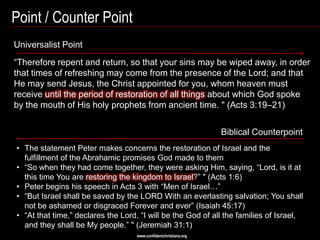
―Therefore repent and return, so that your sins may be wiped away, in order
that times of refreshing may come from the presence of the Lord; and that
He may send Jesus, the Christ appointed for you, whom heaven must
receive until the period of restoration of all things about which God spoke
by the mouth of His holy prophets from ancient time. " (Acts 3:19–21)


                                                                  Biblical Counterpoint
• The statement Peter makes concerns the restoration of Israel and the
  fulfillment of the Abrahamic promises God made to them
• ―So when they had come together, they were asking Him, saying, ―Lord, is it at
  this time You are restoring the kingdom to Israel?‖ " (Acts 1:6)
• Peter begins his speech in Acts 3 with ―Men of Israel…‖
• ―But Israel shall be saved by the LORD With an everlasting salvation; You shall
  not be ashamed or disgraced Forever and ever‖ (Isaiah 45:17)
• ―At that time,‖ declares the Lord, ―I will be the God of all the families of Israel,
  and they shall be My people.‖ " (Jeremiah 31:1)
                                    www.confidentchristians.org
Point / Counter Point
Universalist Point
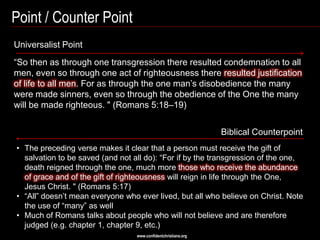
―So then as through one transgression there resulted condemnation to all
men, even so through one act of righteousness there resulted justification
of life to all men. For as through the one man‘s disobedience the many
were made sinners, even so through the obedience of the One the many
will be made righteous. " (Romans 5:18–19)


                                                                Biblical Counterpoint
• The preceding verse makes it clear that a person must receive the gift of
  salvation to be saved (and not all do): ―For if by the transgression of the one,
  death reigned through the one, much more those who receive the abundance
  of grace and of the gift of righteousness will reign in life through the One,
  Jesus Christ. " (Romans 5:17)
• ―All‖ doesn‘t mean everyone who ever lived, but all who believe on Christ. Note
  the use of ―many‖ as well
• Much of Romans talks about people who will not believe and are therefore
  judged (e.g. chapter 1, chapter 9, etc.)
                                  www.confidentchristians.org
Point / Counter Point
Universalist Point
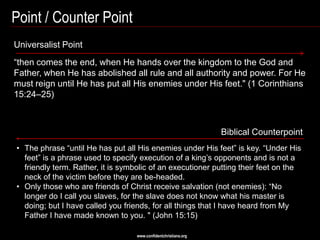
―then comes the end, when He hands over the kingdom to the God and
Father, when He has abolished all rule and all authority and power. For He
must reign until He has put all His enemies under His feet." (1 Corinthians
15:24–25)


                                                                 Biblical Counterpoint
• The phrase ―until He has put all His enemies under His feet‖ is key. ―Under His
  feet‖ is a phrase used to specify execution of a king‘s opponents and is not a
  friendly term. Rather, it is symbolic of an executioner putting their feet on the
  neck of the victim before they are be-headed.
• Only those who are friends of Christ receive salvation (not enemies): ―No
  longer do I call you slaves, for the slave does not know what his master is
  doing; but I have called you friends, for all things that I have heard from My
  Father I have made known to you. " (John 15:15)

                                   www.confidentchristians.org
Point / Counter Point
Universalist Point
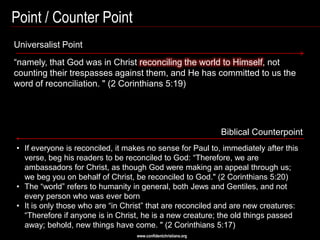
―namely, that God was in Christ reconciling the world to Himself, not
counting their trespasses against them, and He has committed to us the
word of reconciliation. " (2 Corinthians 5:19)


                                                                 Biblical Counterpoint
• If everyone is reconciled, it makes no sense for Paul to, immediately after this
  verse, beg his readers to be reconciled to God: ―Therefore, we are
  ambassadors for Christ, as though God were making an appeal through us;
  we beg you on behalf of Christ, be reconciled to God." (2 Corinthians 5:20)
• The ―world‖ refers to humanity in general, both Jews and Gentiles, and not
  every person who was ever born
• It is only those who are ―in Christ‖ that are reconciled and are new creatures:
  ―Therefore if anyone is in Christ, he is a new creature; the old things passed
  away; behold, new things have come. " (2 Corinthians 5:17)
                                   www.confidentchristians.org
Point / Counter Point
Universalist Point
―He made known to us the mystery of His will, according to His kind
intention which He purposed in Him with a view to an administration
suitable to the fullness of the times, that is, the summing up of all things in
Christ, things in the heavens and things on the earth." (Ephesians 1:9–10)


                                                                 Biblical Counterpoint
• The preceding verse 4 shows that it is only those who have been chosen who
  are saved: ―Blessed be the God and Father of our Lord Jesus Christ, who has
  blessed us with every spiritual blessing in the heavenly places in Christ, just as
  He chose us in Him before the foundation of the world, that we would be holy
  and blameless before Him." (Ephesians 1:3–4)
• The phrase ―in Christ‖ is never used anywhere in Scripture to refer to
  unbelievers, but only believers


                                   www.confidentchristians.org
Point / Counter Point
Universalist Point
―For it was the Father‘s good pleasure for all the fullness to dwell in Him,
and through Him to reconcile all things to Himself, having made peace
through the blood of His cross; through Him, I say, whether things on earth
or things in heaven. " (Colossians 1:19–20)


                                                               Biblical Counterpoint
• The following verses demonstrate the perseverance of the saints and show it
  is only those with saving faith who are reconciled: ―And although you were
  formerly alienated and hostile in mind, engaged in evil deeds, yet He has now
  reconciled you in His fleshly body through death, in order to present you
  before Him holy and blameless and beyond reproach— if indeed you continue
  in the faith firmly established and steadfast, and not moved away from the
  hope of the gospel that you have heard, which was proclaimed in all creation
  under heaven, and of which I, Paul, was made a minister. " (Colossians 1:21–
  23)
                                 www.confidentchristians.org
Why can’t a sovereign God save everyone?
―How great is God? Great enough to
 achieve what God sets out to do, or
kind of great, great most of the time,
     but in this, the fate of billions of
     people, not totally great. Sort of
   great. A little great‖ (pgs. 97–99).


                             www.confidentchristians.org
―Is God our friend, our provider, our
   protector, our father—or is God the kind of
   judge who may in the end declare that we
deserve to spend forever separated from our
 Father? Is God like the characters in a story
  Jesus would tell, … or, in the end, will God
give up? Will ‗all the ends of the earth‘ come,
  as God has decided, or only some? Will all
            feast as it‘s promised in Psalm 22,
     or only a few? Will everybody be given a
        new heart, or only a limited number of
 people? Will God, in the end, settle, saying:
      ‗Well, I tried, I gave it my best shot, and
     sometimes you just have to be okay with
 failure‘? Will God shrug God-size shoulders
      and say, ‗You can‘t always get what you
                           want‘?‖ (pp. 102-103)


                                    www.confidentchristians.org
What is Bell Alluding to in Scripture?


• ―This is good and acceptable in the sight of God our Savior, who desires all
  men to be saved and to come to the knowledge of the truth.‖ (1 Timothy
  2:3–4)

• ―The Lord is not slow about His promise, as some count slowness, but is
  patient toward you, not wishing for any to perish but for all to come to
  repentance.‖ (2 Peter 3:9)
                               www.confidentchristians.org
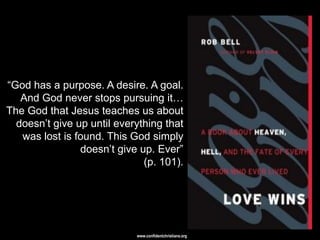
―God has a purpose. A desire. A goal.
   And God never stops pursuing it…
The God that Jesus teaches us about
  doesn‘t give up until everything that
   was lost is found. This God simply
                doesn‘t give up. Ever‖
                              (p. 101).


                            www.confidentchristians.org
Three Possible Wills in God
1. Decretive will - this form of God‘s
   will describes something that
   absolutely will happen and is
   unstoppable / irresistible (e.g.
   creating the universe; calling of
   Paul)
2. Prescriptive will – this describes
   something God morally
   prescribes for all, but may be
   disobeyed (e.g. the ten
   commandments)
3. Dispositional will – that which
   pleases or delights God (e.g.
   not delighting in the death of the
   wicked)
                           www.confidentchristians.org
The Various Wills of God in Action


 It was not the prescriptive will of God that Judas, Pilate, Herod, the
   Jewish leaders, and the Roman soldiers would betray, mock, lie
 about, and brutalize/murder Jesus. But Isaiah 53:0 says: ―Yet it was
  the will of the LORD to crush him‖ and Acts 2:23 states: ―this Man,
delivered over by the predetermined plan and foreknowledge of God,
  you nailed to a cross by the hands of godless men and put Him to
                                  death.‖

God must will in one sense what He does not will in another sense.

                              www.confidentchristians.org
The Various Wills of God in Action

―Do I have any pleasure in the death of the wicked,‖ declares
 the Lord God, ―rather than that he should turn from his ways
                    and live? ‖ (Ezekiel 18:23)
                                 Vs.
―But they [the sons of Eli] would not listen to the voice of their
       father, for the Lord desired to put them to death.‖
                         (1 Samuel 2:25)

God evidently willed the death of Eli‘s sons in one sense while
  not desiring the death of the wicked in another sense. The
dispositional will is seen in the first verse and the decretive will
                          in the second.

                            www.confidentchristians.org
Reconciling the Tension

―This is good and acceptable in the sight of God our Savior, who desires all
men to be saved and to come to the knowledge of the truth. ‖ (1 Timothy 2:3–
4)

―The Lord is not slow about His promise, as some count slowness, but is
patient toward you, not wishing for any to perish but for all to come to
repentance. ‖ (2 Peter 3:9)

Question: Which will of God is in vogue in the above verses? It cannot be the
decretive will of God or everyone would be saved as the universalist says. It
could be the prescriptive will of God, but seems odd in that, in a moral sense,
God ‗forbids‘ people to perish. The best application is that this is God‘s
dispositional will. In the same sense that He does not delight in the death of
the wicked, God takes no pleasure in people rejecting Him.


                                 www.confidentchristians.org
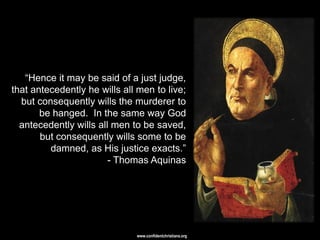
―Hence it may be said of a just judge,
that antecedently he wills all men to live;
  but consequently wills the murderer to
       be hanged. In the same way God
  antecedently wills all men to be saved,
       but consequently wills some to be
         damned, as His justice exacts.‖
                        - Thomas Aquinas


                              www.confidentchristians.org
More on 1 Timothy 2:3-4


―First of all, then, I urge that entreaties and prayers, petitions and
thanksgivings, be made on behalf of all men, for kings and all who are in
authority, so that we may lead a tranquil and quiet life in all godliness and
dignity. This is good and acceptable in the sight of God our Savior, who
desires all men to be saved and to come to the knowledge of the truth. ‖
(1 Timothy 2:3–4) .

Paul is asking for prayers for all kinds of people including even the ruthless
and godless kings who were reigning over them (e.g. Nero). Paul then
goes on to say that God desires that no one class of people be left out of
His salvation plan; all ―kinds‖ of people will be saved.
                                www.confidentchristians.org
More on 2 Peter 3:9
―This is now, beloved, the second letter I am writing to you in which I am stirring up
your sincere mind by way of reminder, that you should remember the words spoken
beforehand by the holy prophets and the commandment of the Lord and Savior
spoken by your apostles. Know this first of all, that in the last days mockers will
come with their mocking, following after their own lusts, and saying, ―Where is the
promise of His coming? For ever since the fathers fell asleep, all continues just as
it was from the beginning of creation.‖ For when they maintain this, it escapes their
notice that by the word of God the heavens existed long ago and the earth was
formed out of water and by water, through which the world at that time was
destroyed, being flooded with water. But by His word the present heavens and
earth are being reserved for fire, kept for the day of judgment and destruction of
ungodly men. But do not let this one fact escape your notice, beloved, that with the
Lord one day is like a thousand years, and a thousand years like one day. The Lord
is not slow about His promise, as some count slowness, but is patient toward you,
not wishing for any to perish but for all to come to repentance. ‖ (2 Peter 3:1–9)

Note the two groups that have been formed above: ―they‖ and ―you‖…


                                   www.confidentchristians.org
More on 2 Peter 3:9
―The Lord is not slow about His promise, as some count slowness,
but is patient toward you, not wishing for any to perish but for all to
come to repentance. ‖ (2 Peter 3:9)

Who is ―you‖? These are the Christians that Peter is writing to.
What/who does the term ―any‖ refer to? Grammatically it refers back
toward ―you‖. The statement then is one that says God has no
desire to see any of those He has chosen for salvation to perish
and is waiting for them to come to repentance. This would be the
decretive will of God as He is the One who grants repentance. ―The
Lord‘s bond-servant must not be quarrelsome, but be kind to all,
able to teach, patient when wronged, with gentleness correcting
those who are in opposition, if perhaps God may grant them
repentance leading to the knowledge of the truth, ‖ (2 Timothy 2:24–
25)
                              www.confidentchristians.org
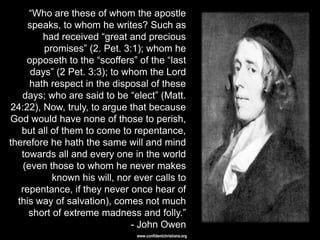
―Who are these of whom the apostle
     speaks, to whom he writes? Such as
         had received ―great and precious
         promises‖ (2. Pet. 3:1); whom he
     opposeth to the ―scoffers‖ of the ―last
      days‖ (2 Pet. 3:3); to whom the Lord
      hath respect in the disposal of these
   days; who are said to be ―elect‖ (Matt.
24:22), Now, truly, to argue that because
God would have none of those to perish,
   but all of them to come to repentance,
therefore he hath the same will and mind
   towards all and every one in the world
    (even those to whom he never makes
           known his will, nor ever calls to
   repentance, if they never once hear of
  this way of salvation), comes not much
     short of extreme madness and folly.‖
                              - John Owen
                               www.confidentchristians.org
Final thoughts concerning Rob Bell and Universalism
―Jesus isn‘t talking about
  forever as we think of forever.
    Jesus may be talking about
  something else, which has all
     sorts of implications for our
understanding of what happens
                     after we die‖
                           Pg. 92


                         www.confidentchristians.org
We should remember that the first
   doctrine to be denied in Scripture is
    judgment. The Bible records Satan
saying to Eve, ―You surely will not die!‖
       (Gen. 3:4). Unfortunately, many
  Universalists feel the same way and
  deny that an eternal separation from
God is a reality for anyone who refuses
                    Christ as their savior.

But simply put, those who reject Jesus
Christ in this life will have their request
                honored also in the next.


                               www.confidentchristians.org
Our Responsibility


―Son of man, I have appointed you a watchman to the house of
Israel; whenever you hear a word from My mouth, warn them from
Me. When I say to the wicked, ‗You will surely die,‘ and you do not
warn him or speak out to warn the wicked from his wicked way that
he may live, that wicked man shall die in his iniquity, but his blood I
will require at your hand. Yet if you have warned the wicked and he
does not turn from his wickedness or from his wicked way, he shall
die in his iniquity; but you have delivered yourself‖ (Ezek. 3:17-19).

                              www.confidentchristians.org
―For some, Hell is simply a
    truth realized too late.‖
             - Os Guinness


                    www.confidentchristians.org
"If sinners be dammed, at
    least let them leap to hell
  over our bodies. If they will
  perish, let them perish with
 our arms about their knees.
          Let no one go there
unwarned and unprayed for.‖
          - Charles Spurgeon


                      www.confidentchristians.org
Final Comments
      Rob Bell no doubt cares about
       people and has a passion for
    Christians to live authentic lives.
      However, while the doctrine of
            ultimate reconciliation or
   universalism may be appealing to
    human emotions, but it is simply
     wrong and unbiblical. Scripture
  teaches that beyond this life, there
are no second chances. Instead, the
 Bible declares, ―Today is the day of
       salvation‖ (2 Corinthians 6:2).

 Love does indeed win for those who
  turn by faith to Christ in this life and
               embrace Him as Savior.
                               www.confidentchristians.org
A Look at the Theology of Rob Bell & “Love Wins”

Heaven, Hell, Universalism and Rob Bell - Part 3

  • 1.
    A Look atthe Theology of Rob Bell & “Love Wins” Part 3
  • 2.
    Review: What arewe Talking About? On March 15, 2011, HarperOne publishers releases Emergent Church leader Rob Bell‘s new book ―Love Wins‖. The promotional video for the book immediately raised speculations in Christendom that Rob Bell was a universalist, and what has followed since then has been one of the largest theological firestorms in some time. www.confidentchristians.org
  • 3.
    Review: What didWe Cover Last Time? • The Bible is clear on the teaching of Hell. • Hell is not a purgatory or a place of correction; rather, it is the second death for those apart from Christ • The teachings of Jesus and the apostles clearly teach the above • No place in Scripture indicates a second chance after death to embrace Christ • God is love, but His love is in keeping with His justice • God exercises His mercy through His justice • God‘s wrath is real and is clearly taught in Scripture as coming upon those who reject Christ www.confidentchristians.org
  • 4.
    Is there BiblicalSupport for Universalism?
  • 5.
    ―And so, beginningwith the early church, there is a long tradition of Christians who believe that God will ultimately restore everything and everybody, because Jesus says in Matthew 19 that there will be a ―renewal of all things,‖ Peter says in Acts 3 that Jesus will ―restore everything,‖ and Paul says in Colossians 1 that through Christ ―God was pleased to. . . .reconcile to himself all things, whether things on earth or things in heaven.‖ - Rob Bell (pg. 107) www.confidentchristians.org
  • 6.
    Point / CounterPoint Universalist Point ―Therefore repent and return, so that your sins may be wiped away, in order that times of refreshing may come from the presence of the Lord; and that He may send Jesus, the Christ appointed for you, whom heaven must receive until the period of restoration of all things about which God spoke by the mouth of His holy prophets from ancient time. " (Acts 3:19–21) Biblical Counterpoint • The statement Peter makes concerns the restoration of Israel and the fulfillment of the Abrahamic promises God made to them • ―So when they had come together, they were asking Him, saying, ―Lord, is it at this time You are restoring the kingdom to Israel?‖ " (Acts 1:6) • Peter begins his speech in Acts 3 with ―Men of Israel…‖ • ―But Israel shall be saved by the LORD With an everlasting salvation; You shall not be ashamed or disgraced Forever and ever‖ (Isaiah 45:17) • ―At that time,‖ declares the Lord, ―I will be the God of all the families of Israel, and they shall be My people.‖ " (Jeremiah 31:1) www.confidentchristians.org
  • 7.
    Point / CounterPoint Universalist Point ―So then as through one transgression there resulted condemnation to all men, even so through one act of righteousness there resulted justification of life to all men. For as through the one man‘s disobedience the many were made sinners, even so through the obedience of the One the many will be made righteous. " (Romans 5:18–19) Biblical Counterpoint • The preceding verse makes it clear that a person must receive the gift of salvation to be saved (and not all do): ―For if by the transgression of the one, death reigned through the one, much more those who receive the abundance of grace and of the gift of righteousness will reign in life through the One, Jesus Christ. " (Romans 5:17) • ―All‖ doesn‘t mean everyone who ever lived, but all who believe on Christ. Note the use of ―many‖ as well • Much of Romans talks about people who will not believe and are therefore judged (e.g. chapter 1, chapter 9, etc.) www.confidentchristians.org
  • 8.
    Point / CounterPoint Universalist Point ―then comes the end, when He hands over the kingdom to the God and Father, when He has abolished all rule and all authority and power. For He must reign until He has put all His enemies under His feet." (1 Corinthians 15:24–25) Biblical Counterpoint • The phrase ―until He has put all His enemies under His feet‖ is key. ―Under His feet‖ is a phrase used to specify execution of a king‘s opponents and is not a friendly term. Rather, it is symbolic of an executioner putting their feet on the neck of the victim before they are be-headed. • Only those who are friends of Christ receive salvation (not enemies): ―No longer do I call you slaves, for the slave does not know what his master is doing; but I have called you friends, for all things that I have heard from My Father I have made known to you. " (John 15:15) www.confidentchristians.org
  • 9.
    Point / CounterPoint Universalist Point ―namely, that God was in Christ reconciling the world to Himself, not counting their trespasses against them, and He has committed to us the word of reconciliation. " (2 Corinthians 5:19) Biblical Counterpoint • If everyone is reconciled, it makes no sense for Paul to, immediately after this verse, beg his readers to be reconciled to God: ―Therefore, we are ambassadors for Christ, as though God were making an appeal through us; we beg you on behalf of Christ, be reconciled to God." (2 Corinthians 5:20) • The ―world‖ refers to humanity in general, both Jews and Gentiles, and not every person who was ever born • It is only those who are ―in Christ‖ that are reconciled and are new creatures: ―Therefore if anyone is in Christ, he is a new creature; the old things passed away; behold, new things have come. " (2 Corinthians 5:17) www.confidentchristians.org
  • 10.
    Point / CounterPoint Universalist Point ―He made known to us the mystery of His will, according to His kind intention which He purposed in Him with a view to an administration suitable to the fullness of the times, that is, the summing up of all things in Christ, things in the heavens and things on the earth." (Ephesians 1:9–10) Biblical Counterpoint • The preceding verse 4 shows that it is only those who have been chosen who are saved: ―Blessed be the God and Father of our Lord Jesus Christ, who has blessed us with every spiritual blessing in the heavenly places in Christ, just as He chose us in Him before the foundation of the world, that we would be holy and blameless before Him." (Ephesians 1:3–4) • The phrase ―in Christ‖ is never used anywhere in Scripture to refer to unbelievers, but only believers www.confidentchristians.org
  • 11.
    Point / CounterPoint Universalist Point ―For it was the Father‘s good pleasure for all the fullness to dwell in Him, and through Him to reconcile all things to Himself, having made peace through the blood of His cross; through Him, I say, whether things on earth or things in heaven. " (Colossians 1:19–20) Biblical Counterpoint • The following verses demonstrate the perseverance of the saints and show it is only those with saving faith who are reconciled: ―And although you were formerly alienated and hostile in mind, engaged in evil deeds, yet He has now reconciled you in His fleshly body through death, in order to present you before Him holy and blameless and beyond reproach— if indeed you continue in the faith firmly established and steadfast, and not moved away from the hope of the gospel that you have heard, which was proclaimed in all creation under heaven, and of which I, Paul, was made a minister. " (Colossians 1:21– 23) www.confidentchristians.org
  • 12.
    Why can’t asovereign God save everyone?
  • 13.
    ―How great isGod? Great enough to achieve what God sets out to do, or kind of great, great most of the time, but in this, the fate of billions of people, not totally great. Sort of great. A little great‖ (pgs. 97–99). www.confidentchristians.org
  • 14.
    ―Is God ourfriend, our provider, our protector, our father—or is God the kind of judge who may in the end declare that we deserve to spend forever separated from our Father? Is God like the characters in a story Jesus would tell, … or, in the end, will God give up? Will ‗all the ends of the earth‘ come, as God has decided, or only some? Will all feast as it‘s promised in Psalm 22, or only a few? Will everybody be given a new heart, or only a limited number of people? Will God, in the end, settle, saying: ‗Well, I tried, I gave it my best shot, and sometimes you just have to be okay with failure‘? Will God shrug God-size shoulders and say, ‗You can‘t always get what you want‘?‖ (pp. 102-103) www.confidentchristians.org
  • 15.
    What is BellAlluding to in Scripture? • ―This is good and acceptable in the sight of God our Savior, who desires all men to be saved and to come to the knowledge of the truth.‖ (1 Timothy 2:3–4) • ―The Lord is not slow about His promise, as some count slowness, but is patient toward you, not wishing for any to perish but for all to come to repentance.‖ (2 Peter 3:9) www.confidentchristians.org
  • 16.
    ―God has apurpose. A desire. A goal. And God never stops pursuing it… The God that Jesus teaches us about doesn‘t give up until everything that was lost is found. This God simply doesn‘t give up. Ever‖ (p. 101). www.confidentchristians.org
  • 17.
    Three Possible Willsin God 1. Decretive will - this form of God‘s will describes something that absolutely will happen and is unstoppable / irresistible (e.g. creating the universe; calling of Paul) 2. Prescriptive will – this describes something God morally prescribes for all, but may be disobeyed (e.g. the ten commandments) 3. Dispositional will – that which pleases or delights God (e.g. not delighting in the death of the wicked) www.confidentchristians.org
  • 18.
    The Various Willsof God in Action It was not the prescriptive will of God that Judas, Pilate, Herod, the Jewish leaders, and the Roman soldiers would betray, mock, lie about, and brutalize/murder Jesus. But Isaiah 53:0 says: ―Yet it was the will of the LORD to crush him‖ and Acts 2:23 states: ―this Man, delivered over by the predetermined plan and foreknowledge of God, you nailed to a cross by the hands of godless men and put Him to death.‖ God must will in one sense what He does not will in another sense. www.confidentchristians.org
  • 19.
    The Various Willsof God in Action ―Do I have any pleasure in the death of the wicked,‖ declares the Lord God, ―rather than that he should turn from his ways and live? ‖ (Ezekiel 18:23) Vs. ―But they [the sons of Eli] would not listen to the voice of their father, for the Lord desired to put them to death.‖ (1 Samuel 2:25) God evidently willed the death of Eli‘s sons in one sense while not desiring the death of the wicked in another sense. The dispositional will is seen in the first verse and the decretive will in the second. www.confidentchristians.org
  • 20.
    Reconciling the Tension ―Thisis good and acceptable in the sight of God our Savior, who desires all men to be saved and to come to the knowledge of the truth. ‖ (1 Timothy 2:3– 4) ―The Lord is not slow about His promise, as some count slowness, but is patient toward you, not wishing for any to perish but for all to come to repentance. ‖ (2 Peter 3:9) Question: Which will of God is in vogue in the above verses? It cannot be the decretive will of God or everyone would be saved as the universalist says. It could be the prescriptive will of God, but seems odd in that, in a moral sense, God ‗forbids‘ people to perish. The best application is that this is God‘s dispositional will. In the same sense that He does not delight in the death of the wicked, God takes no pleasure in people rejecting Him. www.confidentchristians.org
  • 21.
    ―Hence it maybe said of a just judge, that antecedently he wills all men to live; but consequently wills the murderer to be hanged. In the same way God antecedently wills all men to be saved, but consequently wills some to be damned, as His justice exacts.‖ - Thomas Aquinas www.confidentchristians.org
  • 22.
    More on 1Timothy 2:3-4 ―First of all, then, I urge that entreaties and prayers, petitions and thanksgivings, be made on behalf of all men, for kings and all who are in authority, so that we may lead a tranquil and quiet life in all godliness and dignity. This is good and acceptable in the sight of God our Savior, who desires all men to be saved and to come to the knowledge of the truth. ‖ (1 Timothy 2:3–4) . Paul is asking for prayers for all kinds of people including even the ruthless and godless kings who were reigning over them (e.g. Nero). Paul then goes on to say that God desires that no one class of people be left out of His salvation plan; all ―kinds‖ of people will be saved. www.confidentchristians.org
  • 23.
    More on 2Peter 3:9 ―This is now, beloved, the second letter I am writing to you in which I am stirring up your sincere mind by way of reminder, that you should remember the words spoken beforehand by the holy prophets and the commandment of the Lord and Savior spoken by your apostles. Know this first of all, that in the last days mockers will come with their mocking, following after their own lusts, and saying, ―Where is the promise of His coming? For ever since the fathers fell asleep, all continues just as it was from the beginning of creation.‖ For when they maintain this, it escapes their notice that by the word of God the heavens existed long ago and the earth was formed out of water and by water, through which the world at that time was destroyed, being flooded with water. But by His word the present heavens and earth are being reserved for fire, kept for the day of judgment and destruction of ungodly men. But do not let this one fact escape your notice, beloved, that with the Lord one day is like a thousand years, and a thousand years like one day. The Lord is not slow about His promise, as some count slowness, but is patient toward you, not wishing for any to perish but for all to come to repentance. ‖ (2 Peter 3:1–9) Note the two groups that have been formed above: ―they‖ and ―you‖… www.confidentchristians.org
  • 24.
    More on 2Peter 3:9 ―The Lord is not slow about His promise, as some count slowness, but is patient toward you, not wishing for any to perish but for all to come to repentance. ‖ (2 Peter 3:9) Who is ―you‖? These are the Christians that Peter is writing to. What/who does the term ―any‖ refer to? Grammatically it refers back toward ―you‖. The statement then is one that says God has no desire to see any of those He has chosen for salvation to perish and is waiting for them to come to repentance. This would be the decretive will of God as He is the One who grants repentance. ―The Lord‘s bond-servant must not be quarrelsome, but be kind to all, able to teach, patient when wronged, with gentleness correcting those who are in opposition, if perhaps God may grant them repentance leading to the knowledge of the truth, ‖ (2 Timothy 2:24– 25) www.confidentchristians.org
  • 25.
    ―Who are theseof whom the apostle speaks, to whom he writes? Such as had received ―great and precious promises‖ (2. Pet. 3:1); whom he opposeth to the ―scoffers‖ of the ―last days‖ (2 Pet. 3:3); to whom the Lord hath respect in the disposal of these days; who are said to be ―elect‖ (Matt. 24:22), Now, truly, to argue that because God would have none of those to perish, but all of them to come to repentance, therefore he hath the same will and mind towards all and every one in the world (even those to whom he never makes known his will, nor ever calls to repentance, if they never once hear of this way of salvation), comes not much short of extreme madness and folly.‖ - John Owen www.confidentchristians.org
  • 26.
    Final thoughts concerningRob Bell and Universalism
  • 27.
    ―Jesus isn‘t talkingabout forever as we think of forever. Jesus may be talking about something else, which has all sorts of implications for our understanding of what happens after we die‖ Pg. 92 www.confidentchristians.org
  • 28.
    We should rememberthat the first doctrine to be denied in Scripture is judgment. The Bible records Satan saying to Eve, ―You surely will not die!‖ (Gen. 3:4). Unfortunately, many Universalists feel the same way and deny that an eternal separation from God is a reality for anyone who refuses Christ as their savior. But simply put, those who reject Jesus Christ in this life will have their request honored also in the next. www.confidentchristians.org
  • 29.
    Our Responsibility ―Son ofman, I have appointed you a watchman to the house of Israel; whenever you hear a word from My mouth, warn them from Me. When I say to the wicked, ‗You will surely die,‘ and you do not warn him or speak out to warn the wicked from his wicked way that he may live, that wicked man shall die in his iniquity, but his blood I will require at your hand. Yet if you have warned the wicked and he does not turn from his wickedness or from his wicked way, he shall die in his iniquity; but you have delivered yourself‖ (Ezek. 3:17-19). www.confidentchristians.org
  • 30.
    ―For some, Hellis simply a truth realized too late.‖ - Os Guinness www.confidentchristians.org
  • 31.
    "If sinners bedammed, at least let them leap to hell over our bodies. If they will perish, let them perish with our arms about their knees. Let no one go there unwarned and unprayed for.‖ - Charles Spurgeon www.confidentchristians.org
  • 32.
    Final Comments Rob Bell no doubt cares about people and has a passion for Christians to live authentic lives. However, while the doctrine of ultimate reconciliation or universalism may be appealing to human emotions, but it is simply wrong and unbiblical. Scripture teaches that beyond this life, there are no second chances. Instead, the Bible declares, ―Today is the day of salvation‖ (2 Corinthians 6:2). Love does indeed win for those who turn by faith to Christ in this life and embrace Him as Savior. www.confidentchristians.org
  • 33.
    A Look atthe Theology of Rob Bell & “Love Wins”