CREATION: GENESIS AS
FOUNDATION—PART 1
Lesson 8
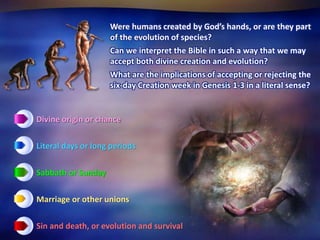
Divine origin or chance
Literal days or long periods
Sabbath or Sunday
Marriage or other unions
Sin and death, or evolution and survival
Were humans created by God’s hands, or are they part
of the evolution of species?
Can we interpret the Bible in such a way that we may
accept both divine creation and evolution?
What are the implications of accepting or rejecting the
six-day Creation week in Genesis 1-3 in a literal sense?
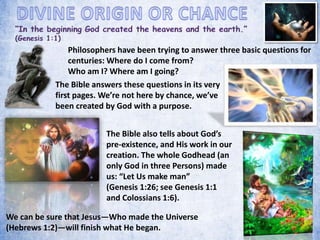
Philosophers have been trying to answer three basic questions for
centuries: Where do I come from?
Who am I? Where am I going?
The Bible answers these questions in its very
first pages. We’re not here by chance, we’ve
been created by God with a purpose.
The Bible also tells about God’s
pre-existence, and His work in our
creation. The whole Godhead (an
only God in three Persons) made
us: “Let Us make man”
(Genesis 1:26; see Genesis 1:1
and Colossians 1:6).
We can be sure that Jesus—Who made the Universe
(Hebrews 1:2)—will finish what He began.
“God called the light Day, and the darkness He called
Night. So the evening and the morning were the first
day.” (Genesis 1:5)
In order to make the Bible compatible with
the theory of evolution, some people have
interpreted the word “day” metaphorically as
long periods of time.
The fact that those days are divided into
periods of evening and morning highlights
the idea of those days being 24-hour periods.
There’s no mention of gaps between those
days, so they make a whole non-stop week
(day second, day third…). This is the
foundation of the Sabbath commandment
(Exodus 20:8-11).
Rejecting Creation’s literal week implies rejecting the
trustworthiness of the whole Bible.
“The first six days of each week are given to us in
which to labor, because God employed the same
period of the first week in the work of Creation.
The seventh day God has reserved as a day of rest,
in commemoration of His rest during the same
period after He had performed the work of
Creation in six days.
But the infidel supposition, that the events of the
first week required seven vast, indefinite periods
for their accomplishment, strikes directly at the
foundation of the Sabbath of the fourth
commandment. It makes indefinite and obscure
that which God has made very plain.”
E.G.W. (To Be Like Jesus, May 22)
“Then God blessed the seventh day and sanctified it, because in it
He rested from all His work which God had created and made.”
(Genesis 2:3)
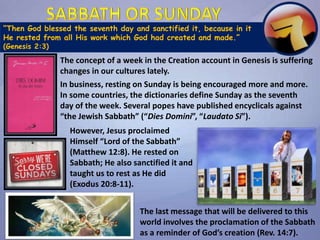
The concept of a week in the Creation account in Genesis is suffering
changes in our cultures lately.
In business, resting on Sunday is being encouraged more and more.
In some countries, the dictionaries define Sunday as the seventh
day of the week. Several popes have published encyclicals against
“the Jewish Sabbath” (“Dies Domini”, “Laudato Si”).
The last message that will be delivered to this
world involves the proclamation of the Sabbath
as a reminder of God’s creation (Rev. 14:7).
However, Jesus proclaimed
Himself “Lord of the Sabbath”
(Matthew 12:8). He rested on
Sabbath; He also sanctified it and
taught us to rest as He did
(Exodus 20:8-11).
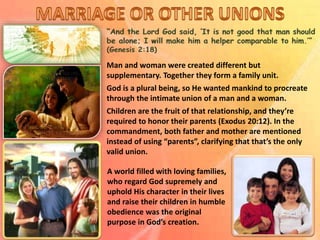
Man and woman were created different but
supplementary. Together they form a family unit.
God is a plural being, so He wanted mankind to procreate
through the intimate union of a man and a woman.
Children are the fruit of that relationship, and they’re
required to honor their parents (Exodus 20:12). In the
commandment, both father and mother are mentioned
instead of using “parents”, clarifying that that’s the only
valid union.
A world filled with loving families,
who regard God supremely and
uphold His character in their lives
and raise their children in humble
obedience was the original
purpose in God’s creation.
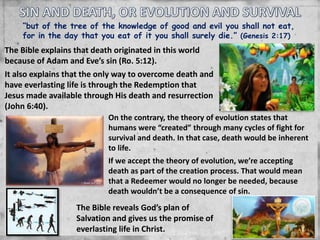
“but of the tree of the knowledge of good and evil you shall not eat,
for in the day that you eat of it you shall surely die.” (Genesis 2:17)
The Bible explains that death originated in this world
because of Adam and Eve’s sin (Ro. 5:12).
It also explains that the only way to overcome death and
have everlasting life is through the Redemption that
Jesus made available through His death and resurrection
(John 6:40).
On the contrary, the theory of evolution states that
humans were “created” through many cycles of fight for
survival and death. In that case, death would be inherent
to life.
If we accept the theory of evolution, we’re accepting
death as part of the creation process. That would mean
that a Redeemer would no longer be needed, because
death wouldn’t be a consequence of sin.
The Bible reveals God’s plan of
Salvation and gives us the promise of
everlasting life in Christ.
“ […] with what readiness the assumed period
of the earth’s development is from time to time
increased or diminished by millions of years;
and how the theories advanced by different
scientists conflict with one another,—
considering all this, shall we, for the privilege
of tracing our descent from germs and mollusks
and apes, consent to cast away that statement
of Holy Writ, so grand in its simplicity, “God
created man in His own image, in the image of
God created He him”?…
Rightly understood, both the revelations of
science and the experiences of life are in
harmony with the testimony of Scripture to
the constant working of God in nature.”
E.G.W. (Education, cp. 14, p. 130)
HOW TO
INTERPRET
THE BIBLE
THIS SERVICE IS FREE AND
YOU CAN USE IT Slideshare.net/chucho1943
We invite you to
download and study
each one of the 13
lessons about this
serie:

08 genesis creation 1

  • 1.
  • 3.
    Divine origin orchance Literal days or long periods Sabbath or Sunday Marriage or other unions Sin and death, or evolution and survival Were humans created by God’s hands, or are they part of the evolution of species? Can we interpret the Bible in such a way that we may accept both divine creation and evolution? What are the implications of accepting or rejecting the six-day Creation week in Genesis 1-3 in a literal sense?
  • 4.
    Philosophers have beentrying to answer three basic questions for centuries: Where do I come from? Who am I? Where am I going? The Bible answers these questions in its very first pages. We’re not here by chance, we’ve been created by God with a purpose. The Bible also tells about God’s pre-existence, and His work in our creation. The whole Godhead (an only God in three Persons) made us: “Let Us make man” (Genesis 1:26; see Genesis 1:1 and Colossians 1:6). We can be sure that Jesus—Who made the Universe (Hebrews 1:2)—will finish what He began.
  • 5.
    “God called thelight Day, and the darkness He called Night. So the evening and the morning were the first day.” (Genesis 1:5) In order to make the Bible compatible with the theory of evolution, some people have interpreted the word “day” metaphorically as long periods of time. The fact that those days are divided into periods of evening and morning highlights the idea of those days being 24-hour periods. There’s no mention of gaps between those days, so they make a whole non-stop week (day second, day third…). This is the foundation of the Sabbath commandment (Exodus 20:8-11). Rejecting Creation’s literal week implies rejecting the trustworthiness of the whole Bible.
  • 6.
    “The first sixdays of each week are given to us in which to labor, because God employed the same period of the first week in the work of Creation. The seventh day God has reserved as a day of rest, in commemoration of His rest during the same period after He had performed the work of Creation in six days. But the infidel supposition, that the events of the first week required seven vast, indefinite periods for their accomplishment, strikes directly at the foundation of the Sabbath of the fourth commandment. It makes indefinite and obscure that which God has made very plain.” E.G.W. (To Be Like Jesus, May 22)
  • 7.
    “Then God blessedthe seventh day and sanctified it, because in it He rested from all His work which God had created and made.” (Genesis 2:3) The concept of a week in the Creation account in Genesis is suffering changes in our cultures lately. In business, resting on Sunday is being encouraged more and more. In some countries, the dictionaries define Sunday as the seventh day of the week. Several popes have published encyclicals against “the Jewish Sabbath” (“Dies Domini”, “Laudato Si”). The last message that will be delivered to this world involves the proclamation of the Sabbath as a reminder of God’s creation (Rev. 14:7). However, Jesus proclaimed Himself “Lord of the Sabbath” (Matthew 12:8). He rested on Sabbath; He also sanctified it and taught us to rest as He did (Exodus 20:8-11).
  • 8.
    Man and womanwere created different but supplementary. Together they form a family unit. God is a plural being, so He wanted mankind to procreate through the intimate union of a man and a woman. Children are the fruit of that relationship, and they’re required to honor their parents (Exodus 20:12). In the commandment, both father and mother are mentioned instead of using “parents”, clarifying that that’s the only valid union. A world filled with loving families, who regard God supremely and uphold His character in their lives and raise their children in humble obedience was the original purpose in God’s creation.
  • 9.
    “but of thetree of the knowledge of good and evil you shall not eat, for in the day that you eat of it you shall surely die.” (Genesis 2:17) The Bible explains that death originated in this world because of Adam and Eve’s sin (Ro. 5:12). It also explains that the only way to overcome death and have everlasting life is through the Redemption that Jesus made available through His death and resurrection (John 6:40). On the contrary, the theory of evolution states that humans were “created” through many cycles of fight for survival and death. In that case, death would be inherent to life. If we accept the theory of evolution, we’re accepting death as part of the creation process. That would mean that a Redeemer would no longer be needed, because death wouldn’t be a consequence of sin. The Bible reveals God’s plan of Salvation and gives us the promise of everlasting life in Christ.
  • 10.
    “ […] withwhat readiness the assumed period of the earth’s development is from time to time increased or diminished by millions of years; and how the theories advanced by different scientists conflict with one another,— considering all this, shall we, for the privilege of tracing our descent from germs and mollusks and apes, consent to cast away that statement of Holy Writ, so grand in its simplicity, “God created man in His own image, in the image of God created He him”?… Rightly understood, both the revelations of science and the experiences of life are in harmony with the testimony of Scripture to the constant working of God in nature.” E.G.W. (Education, cp. 14, p. 130)
  • 11.
    HOW TO INTERPRET THE BIBLE THISSERVICE IS FREE AND YOU CAN USE IT Slideshare.net/chucho1943 We invite you to download and study each one of the 13 lessons about this serie: