Theology of the
Westminster Confession
Adult Sunday School
2017
God and the Holy Trinity
Foundations
WCF
2
Knowing God
• What is the “Shema Yisrael”?
• First two words of the daily prayers
• Most important prayers
• Introduction to a section of the Torah
• Deuteronomy 6:4 Hear, O Israel: The LORD our God,
the LORD is one.
• 1 Corinthians 8:4 Therefore, as to the eating of
food offered to idols, we know that “an idol has no
real existence,” and that “there is no God but one.”
• Galatians 3:20 Now an intermediary implies more
than one, but God is one.
God is One
WCF
2.1
Foundations
God is One
• What is the significance?
• Rules out all other “gods”
• What are the limits of this one God?
• None!
• Are there any limits to God’s being or
perfection?
• Infinite in being and perfection
• What are some implications of a God who is
limited
• In His being?
• In His perfection?
God is Unlimited
WCF
2.1
Foundations
Who is God?
• Attributes of God vs. Defining God
• How to describe God in His nature?
• Pure spirit
• Therefore: invisible, without body, parts or
passions
• No way to physically represent him—hence,
no images are to be made
• Without passions
• Is God devoid of emotions?
God is a spirit
WCF
2.1
Foundations
The impassivity of God
• God’s inability to be changed or change in regard to his
emotions
• Tied to all his other perfections
• Especially is Immutability
• Though God is not devoid of what we know of emotions,
His emotions are not expressed in any “changing” fashion
• His wrath, love, mercy, goodness are expressed constantly and
without change
• He is wholly active in these things
• God’s love is not like our love
• Not simply a more fervent or steady love – like ours, only
better
• It is infinite, never changing (increasing or decreasing)
• It is exactly what we need
God has no passions
WCF
2.1
Foundations
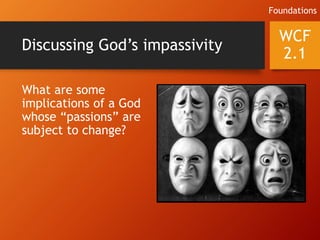
Discussing God’s impassivity
What are some
implications of a God
whose “passions” are
subject to change?
WCF
2.1
Foundations
The God of the Old & New
Testaments
• Is the God who Abraham knew the same
God we know?
• Malachi 3:6 For I the LORD do not change;
therefore you, O children of Jacob, are not
consumed.
• 1 Kings 8:27 But will God indeed dwell on
the earth? Behold, heaven and the highest
heaven cannot contain you; how much less
this house that I have built!
WCF
2.1
Foundations
Consider God’s name
• YHWH: I AM THAT I AM (Exo 3:14)
• He does not die: no beginning, no end (Pss
90:2; 102:26-27)
• His perfections are not altered
• He cannot get better, or know more, or
change plans
• His character does not change
• Can any of these characteristics “change”?
• No they cannot!
• Ours can change dramatically—for good or ill
WCF
2.1
Foundations
God does not change: OT witness
Exodus 34:5-7 The LORD descended in the cloud
and stood with him there, and proclaimed the
name of the LORD. 6 The LORD passed before him
and proclaimed, "The LORD, the LORD, a God
merciful and gracious, slow to anger, and
abounding in steadfast love and faithfulness, 7
keeping steadfast love for thousands, forgiving
iniquity and transgression and sin, but who will by
no means clear the guilty, visiting the iniquity of
the fathers on the children and the children's
children, to the third and the fourth generation."
WCF
2.1
Foundations
God does not change: NT witness
• God’s truth, ways, purposes, promises do
not change
• Not even His Son changes
• Hebrews 13:8 Jesus Christ is the same
yesterday and today and forever.
God cannot change
WCF
2.1
Foundations
God is different than us
• Consider God’s attributes: they are inseparable
• Immense. Psalm 139:7 Where shall I go from your Spirit? Or where
shall I flee from your presence?
• Eternal. No beginning, no end.
• Incomprehensible. Does this mean that it is impossible to know God?
We can know what God reveals – everything necessary for life in him.
• Almighty. There is nothing he cannot do. Power is unlimited
(omnipotent).
• Most wise. Omniscient – governed by perfection.
• Most holy
• Most free. To do what he wills. Psalm 135:6 Whatever the LORD
pleases, he does, in heaven and on earth, in the seas and all deeps.
• Most absolute. all else can cease to exist. He cannot cease to exist.
Everything derives from him!
God’s attributes are superlative and
inseparable
WCF
2.1
Foundations
God’s attributes taken together
• Human correlation
• What in your life correlates to the list of
attributes from the beginning of paragraph 2.1
to the phrase “for His own glory”?
• Some of his attributes God does not share with
his creatures or his creation
• For his own glory
• When we “give” God glory, we do not add to his
glory, but only “ascribe” him glory he already
possesses (Ps 29)
God has glorious, incommunicable attributes
WCF
2.1
Foundations
God’s communicable attributes
• Communicable / Moral attributes
• To what things can we relate, and in what way?
• How are those attributes in us like God’s?
• How are they not like God’s?
God has moral, communicable attributes
WCF
2.1
Foundations
God’s self-existence
• Doctrine of God’s aseity. God doesn’t need
us!
• We add nothing to God
• Glory, goodness, blessedness reside in God
• He manifests his own glory: in, by, unto,
and upon his creatures
• We are totally dependent upon God
• He is alone the fountain of all being
• We are subject to his sovereign will and plans—
whatever pleases him
God is totally self-existent and independent
WCF
2.2
Foundations
Aseity
Independence
from all
things
Implications of God’s self-
existence
• Nothing can surprise God
• Can something be “certain” in an absolute
sense—unless every circumstance is
planned/ordained?
• Hebrews 4:13 And no creature is hidden from
his sight, but all are naked and exposed to the
eyes of him to whom we must give account.
• Why do we not live in terror of God?
• God is due all worship and obedience
WCF
2.2
Foundations
God as Holy Trinity
• The Ontological Trinity
• Relationship of being between the Father, Son, and Spirit
• The Economic Trinity
• Relationship of work/function between the Father, Son,
and Spirit
• Trinity = Tri-unity
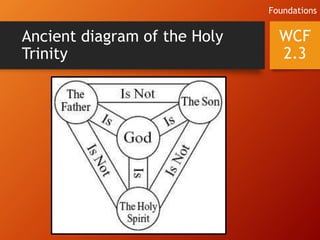
• The Father is God; the Son is God; the Holy Spirit is God
• The Father is not the Son nor the Spirit; the Son is not the
Father nor the Spirit; the Spirit is not the Father nor the
Son
• The One True God: three whos (persons) and one what
(substance)
God is a Trinity (three in one)
WCF
2.3
Foundations
Ancient diagram of the Holy
Trinity
WCF
2.3
Foundations
The Trinity in the Bible (1)
• God speaks of himself in the plural
• Genesis 1:26a Then God said, "Let us make
man in our image, after our likeness.
• Genesis 11:7 Come, let us go down and there
confuse their language, so that they may not
understand one another's speech.
• The Angel of the LORD is divine
• Genesis 16:7-13; 18:1-21
WCF
2.3
Foundations
The Trinity in the Bible (2)
• The Holy Spirit is a distinct person in the Godhead
• Isaiah 48:16 Draw near to me, hear this: from the
beginning I have not spoken in secret, from the time it
came to be I have been there." And now the Lord GOD
has sent me, and his Spirit.
• Isaiah 63:10 But they rebelled and grieved his Holy
Spirit; therefore he turned to be their enemy, and
himself fought against them.
• In the plan of redemption
• The Father sends the Son (Jn 17:3, 8, 18, 21, 23)
• The Father and Son send the Spirit (Jn 14:26; 15:26;
16:5-15; Acts 2:33)
• The Father chooses; the Son redeems; the Spirit applies
(Eph 1:1-14)
WCF
2.3
Foundations
The Trinity in the Bible (3)
• Three persons are expressly mentioned
• Baptism of Jesus. Mt 3:13-17; Lk 3:21-22
• Great Commission. Mt 28:19
• Apostolic Blessing. 2 Cor 13:13; cf. Lk 1:35
• God the Father
• Creator of all things. 1 Cor 8:6; Heb 12:9; Jas
1:17
• Father of Israel. Dt 32:6; Isa 63:16
• Father of Believers. Mt 5:45; 6:6, 9, 14; Rom
8:15
• Father of Jesus. Jn 1:4, 18; 8:54; 14:2-13
WCF
2.3
Foundations
The Trinity in the Bible (4)
• God the Son
• Begotten of the Father. Jn 1:14, 18; 3:16, 18; Gal 4:4
• Involved in creation. Jn 1:3, 10; Heb 2:3; Col 1:18
• Equated with God the Father. Jn 8:58; 10:30; 14:9; Isa
9:6
• Receives worship as God. Jn 20:28
• God the Holy Spirit
• Is a Person. Jn 14:16-17, 26; 15:26; 16:7-15; Rom 8:26
• Divinity ascribed to Him. Acts 5:3-4; 2 Tim 3:16
• Holy Spirit / Spirit of Christ used interchangeably. Rom
8:9-11; Acts 16:6-7
WCF
2.3
Foundations
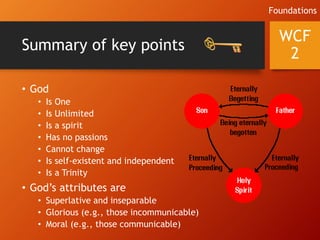
Summary of key points
• God
• Is One
• Is Unlimited
• Is a spirit
• Has no passions
• Cannot change
• Is self-existent and independent
• Is a Trinity
• God’s attributes are
• Superlative and inseparable
• Glorious (e.g., those incommunicable)
• Moral (e.g., those communicable)
WCF
2
Foundations
Memorize
And when Jesus was baptized,
immediately he went up from the
water, and behold, the heavens were
opened to him, and he saw the Spirit
of God descending like a dove and
coming to rest on him; and behold, a
voice from heaven said, “This is my
beloved Son, with whom I am well
pleased.”
Matthew 3:16-17
WCF
2
Foundations
Going deeper
Books
• Thorn, Joe. Experiencing the Trinity. (Beginner)
• Edgar, Brian. The Message of the Trinity.
(Intermediate)
• Frame, John. The Doctrine of God. (Advanced)
Articles
• Wells, David. The Rejection of the Classical
Doctrine of God.
• Boice, James Montgomery. The True God.
• Articles on Theology Proper at Monergism.com.
WCF
2
Foundations

WCF Chapter 2: God and the Holy Trinity

  • 1.
    Theology of the WestminsterConfession Adult Sunday School 2017
  • 2.
    God and theHoly Trinity Foundations WCF 2
  • 3.
    Knowing God • Whatis the “Shema Yisrael”? • First two words of the daily prayers • Most important prayers • Introduction to a section of the Torah • Deuteronomy 6:4 Hear, O Israel: The LORD our God, the LORD is one. • 1 Corinthians 8:4 Therefore, as to the eating of food offered to idols, we know that “an idol has no real existence,” and that “there is no God but one.” • Galatians 3:20 Now an intermediary implies more than one, but God is one. God is One WCF 2.1 Foundations
  • 4.
    God is One •What is the significance? • Rules out all other “gods” • What are the limits of this one God? • None! • Are there any limits to God’s being or perfection? • Infinite in being and perfection • What are some implications of a God who is limited • In His being? • In His perfection? God is Unlimited WCF 2.1 Foundations
  • 5.
    Who is God? •Attributes of God vs. Defining God • How to describe God in His nature? • Pure spirit • Therefore: invisible, without body, parts or passions • No way to physically represent him—hence, no images are to be made • Without passions • Is God devoid of emotions? God is a spirit WCF 2.1 Foundations
  • 6.
    The impassivity ofGod • God’s inability to be changed or change in regard to his emotions • Tied to all his other perfections • Especially is Immutability • Though God is not devoid of what we know of emotions, His emotions are not expressed in any “changing” fashion • His wrath, love, mercy, goodness are expressed constantly and without change • He is wholly active in these things • God’s love is not like our love • Not simply a more fervent or steady love – like ours, only better • It is infinite, never changing (increasing or decreasing) • It is exactly what we need God has no passions WCF 2.1 Foundations
  • 7.
    Discussing God’s impassivity Whatare some implications of a God whose “passions” are subject to change? WCF 2.1 Foundations
  • 8.
    The God ofthe Old & New Testaments • Is the God who Abraham knew the same God we know? • Malachi 3:6 For I the LORD do not change; therefore you, O children of Jacob, are not consumed. • 1 Kings 8:27 But will God indeed dwell on the earth? Behold, heaven and the highest heaven cannot contain you; how much less this house that I have built! WCF 2.1 Foundations
  • 9.
    Consider God’s name •YHWH: I AM THAT I AM (Exo 3:14) • He does not die: no beginning, no end (Pss 90:2; 102:26-27) • His perfections are not altered • He cannot get better, or know more, or change plans • His character does not change • Can any of these characteristics “change”? • No they cannot! • Ours can change dramatically—for good or ill WCF 2.1 Foundations
  • 10.
    God does notchange: OT witness Exodus 34:5-7 The LORD descended in the cloud and stood with him there, and proclaimed the name of the LORD. 6 The LORD passed before him and proclaimed, "The LORD, the LORD, a God merciful and gracious, slow to anger, and abounding in steadfast love and faithfulness, 7 keeping steadfast love for thousands, forgiving iniquity and transgression and sin, but who will by no means clear the guilty, visiting the iniquity of the fathers on the children and the children's children, to the third and the fourth generation." WCF 2.1 Foundations
  • 11.
    God does notchange: NT witness • God’s truth, ways, purposes, promises do not change • Not even His Son changes • Hebrews 13:8 Jesus Christ is the same yesterday and today and forever. God cannot change WCF 2.1 Foundations
  • 12.
    God is differentthan us • Consider God’s attributes: they are inseparable • Immense. Psalm 139:7 Where shall I go from your Spirit? Or where shall I flee from your presence? • Eternal. No beginning, no end. • Incomprehensible. Does this mean that it is impossible to know God? We can know what God reveals – everything necessary for life in him. • Almighty. There is nothing he cannot do. Power is unlimited (omnipotent). • Most wise. Omniscient – governed by perfection. • Most holy • Most free. To do what he wills. Psalm 135:6 Whatever the LORD pleases, he does, in heaven and on earth, in the seas and all deeps. • Most absolute. all else can cease to exist. He cannot cease to exist. Everything derives from him! God’s attributes are superlative and inseparable WCF 2.1 Foundations
  • 13.
    God’s attributes takentogether • Human correlation • What in your life correlates to the list of attributes from the beginning of paragraph 2.1 to the phrase “for His own glory”? • Some of his attributes God does not share with his creatures or his creation • For his own glory • When we “give” God glory, we do not add to his glory, but only “ascribe” him glory he already possesses (Ps 29) God has glorious, incommunicable attributes WCF 2.1 Foundations
  • 14.
    God’s communicable attributes •Communicable / Moral attributes • To what things can we relate, and in what way? • How are those attributes in us like God’s? • How are they not like God’s? God has moral, communicable attributes WCF 2.1 Foundations
  • 15.
    God’s self-existence • Doctrineof God’s aseity. God doesn’t need us! • We add nothing to God • Glory, goodness, blessedness reside in God • He manifests his own glory: in, by, unto, and upon his creatures • We are totally dependent upon God • He is alone the fountain of all being • We are subject to his sovereign will and plans— whatever pleases him God is totally self-existent and independent WCF 2.2 Foundations Aseity Independence from all things
  • 16.
    Implications of God’sself- existence • Nothing can surprise God • Can something be “certain” in an absolute sense—unless every circumstance is planned/ordained? • Hebrews 4:13 And no creature is hidden from his sight, but all are naked and exposed to the eyes of him to whom we must give account. • Why do we not live in terror of God? • God is due all worship and obedience WCF 2.2 Foundations
  • 17.
    God as HolyTrinity • The Ontological Trinity • Relationship of being between the Father, Son, and Spirit • The Economic Trinity • Relationship of work/function between the Father, Son, and Spirit • Trinity = Tri-unity • The Father is God; the Son is God; the Holy Spirit is God • The Father is not the Son nor the Spirit; the Son is not the Father nor the Spirit; the Spirit is not the Father nor the Son • The One True God: three whos (persons) and one what (substance) God is a Trinity (three in one) WCF 2.3 Foundations
  • 18.
    Ancient diagram ofthe Holy Trinity WCF 2.3 Foundations
  • 19.
    The Trinity inthe Bible (1) • God speaks of himself in the plural • Genesis 1:26a Then God said, "Let us make man in our image, after our likeness. • Genesis 11:7 Come, let us go down and there confuse their language, so that they may not understand one another's speech. • The Angel of the LORD is divine • Genesis 16:7-13; 18:1-21 WCF 2.3 Foundations
  • 20.
    The Trinity inthe Bible (2) • The Holy Spirit is a distinct person in the Godhead • Isaiah 48:16 Draw near to me, hear this: from the beginning I have not spoken in secret, from the time it came to be I have been there." And now the Lord GOD has sent me, and his Spirit. • Isaiah 63:10 But they rebelled and grieved his Holy Spirit; therefore he turned to be their enemy, and himself fought against them. • In the plan of redemption • The Father sends the Son (Jn 17:3, 8, 18, 21, 23) • The Father and Son send the Spirit (Jn 14:26; 15:26; 16:5-15; Acts 2:33) • The Father chooses; the Son redeems; the Spirit applies (Eph 1:1-14) WCF 2.3 Foundations
  • 21.
    The Trinity inthe Bible (3) • Three persons are expressly mentioned • Baptism of Jesus. Mt 3:13-17; Lk 3:21-22 • Great Commission. Mt 28:19 • Apostolic Blessing. 2 Cor 13:13; cf. Lk 1:35 • God the Father • Creator of all things. 1 Cor 8:6; Heb 12:9; Jas 1:17 • Father of Israel. Dt 32:6; Isa 63:16 • Father of Believers. Mt 5:45; 6:6, 9, 14; Rom 8:15 • Father of Jesus. Jn 1:4, 18; 8:54; 14:2-13 WCF 2.3 Foundations
  • 22.
    The Trinity inthe Bible (4) • God the Son • Begotten of the Father. Jn 1:14, 18; 3:16, 18; Gal 4:4 • Involved in creation. Jn 1:3, 10; Heb 2:3; Col 1:18 • Equated with God the Father. Jn 8:58; 10:30; 14:9; Isa 9:6 • Receives worship as God. Jn 20:28 • God the Holy Spirit • Is a Person. Jn 14:16-17, 26; 15:26; 16:7-15; Rom 8:26 • Divinity ascribed to Him. Acts 5:3-4; 2 Tim 3:16 • Holy Spirit / Spirit of Christ used interchangeably. Rom 8:9-11; Acts 16:6-7 WCF 2.3 Foundations
  • 23.
    Summary of keypoints • God • Is One • Is Unlimited • Is a spirit • Has no passions • Cannot change • Is self-existent and independent • Is a Trinity • God’s attributes are • Superlative and inseparable • Glorious (e.g., those incommunicable) • Moral (e.g., those communicable) WCF 2 Foundations
  • 24.
    Memorize And when Jesuswas baptized, immediately he went up from the water, and behold, the heavens were opened to him, and he saw the Spirit of God descending like a dove and coming to rest on him; and behold, a voice from heaven said, “This is my beloved Son, with whom I am well pleased.” Matthew 3:16-17 WCF 2 Foundations
  • 25.
    Going deeper Books • Thorn,Joe. Experiencing the Trinity. (Beginner) • Edgar, Brian. The Message of the Trinity. (Intermediate) • Frame, John. The Doctrine of God. (Advanced) Articles • Wells, David. The Rejection of the Classical Doctrine of God. • Boice, James Montgomery. The True God. • Articles on Theology Proper at Monergism.com. WCF 2 Foundations