TELLING TIME
Telling time is important for practical daily conversation. Here is the first of several Hints
on telling time in English.
TELLING TIME IN ENGLISH: HOURS
There are several common ways of telling the time when it is an hour (and no minutes):
What time is it?
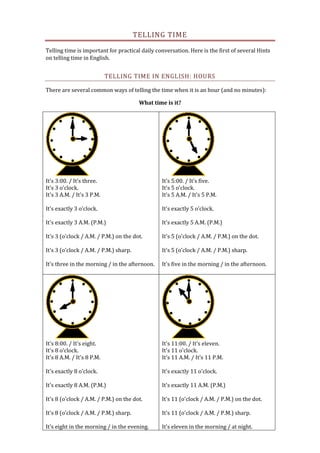
It's 3:00. / It's three.
It's 3 o'clock.
It's 3 A.M. / It's 3 P.M.
It's exactly 3 o'clock.
It's exactly 3 A.M. (P.M.)
It's 3 (o'clock / A.M. / P.M.) on the dot.
It's 3 (o'clock / A.M. / P.M.) sharp.
It's three in the morning / in the afternoon.
It's 5:00. / It's five.
It's 5 o'clock.
It's 5 A.M. / It's 5 P.M.
It's exactly 5 o'clock.
It's exactly 5 A.M. (P.M.)
It's 5 (o'clock / A.M. / P.M.) on the dot.
It's 5 (o'clock / A.M. / P.M.) sharp.
It's five in the morning / in the afternoon.
It's 8:00. / It's eight.
It's 8 o'clock.
It's 8 A.M. / It's 8 P.M.
It's exactly 8 o'clock.
It's exactly 8 A.M. (P.M.)
It's 8 (o'clock / A.M. / P.M.) on the dot.
It's 8 (o'clock / A.M. / P.M.) sharp.
It's eight in the morning / in the evening.
It's 11:00. / It's eleven.
It's 11 o'clock.
It's 11 A.M. / It's 11 P.M.
It's exactly 11 o'clock.
It's exactly 11 A.M. (P.M.)
It's 11 (o'clock / A.M. / P.M.) on the dot.
It's 11 (o'clock / A.M. / P.M.) sharp.
It's eleven in the morning / at night.
SPECIAL NOTES:
A.M. is an abbreviation for the Latin ante meridiem (before noon). A.M. is used for times
between midnight and noon--or morning.
P.M. is an abbreviation for the Latin post meridiem (after noon). A.M. is used for times
between noon and midnight--or afternoon, evening, and night.
Noon is 12:00 during the day. Midnight is 12:00 at night.
TELLING TIME IN ENGLISH: MINUTES 1-9
There are several common ways of telling the time when it is an hour and
minutes, and when the minutes are 1-9:
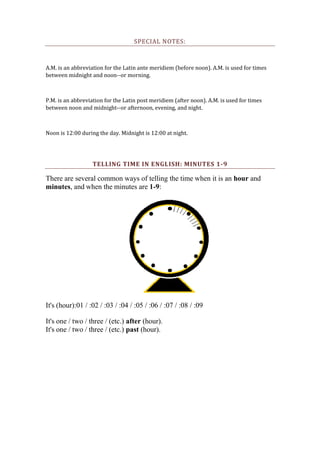
It's (hour):01 / :02 / :03 / :04 / :05 / :06 / :07 / :08 / :09
It's one / two / three / (etc.) after (hour).
It's one / two / three / (etc.) past (hour).
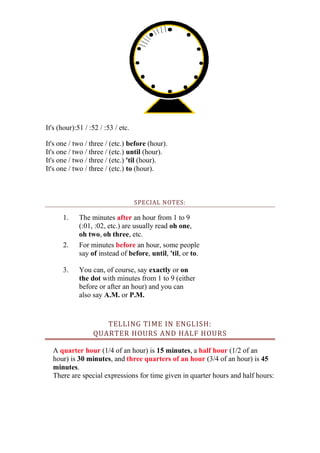
It's (hour):51 / :52 / :53 / etc.
It's one / two / three / (etc.) before (hour).
It's one / two / three / (etc.) until (hour).
It's one / two / three / (etc.) 'til (hour).
It's one / two / three / (etc.) to (hour).
SPECIAL NOTES:
1. The minutes after an hour from 1 to 9
(:01, :02, etc.) are usually read oh one,
oh two, oh three, etc.
2. For minutes before an hour, some people
say of instead of before, until, 'til, or to.
3. You can, of course, say exactly or on
the dot with minutes from 1 to 9 (either
before or after an hour) and you can
also say A.M. or P.M.
TELLING TIME IN ENGLISH:
QUARTER HOURS AND HALF HOURS
A quarter hour (1/4 of an hour) is 15 minutes, a half hour (1/2 of an
hour) is 30 minutes, and three quarters of an hour (3/4 of an hour) is 45
minutes.
There are special expressions for time given in quarter hours and half hours:
What Time is It?
It's 2:15.
It's a quarter after 2.
It's a quarter past 2.
It's 15 minutes past 2.
It's 15 past 2.
It's 15 minutes after 2.
It's 15 after 2.
It's 2:30
It's half past two.
It's 2:45
It's a quarter before 3. /
It's a quarter until 3. /
It's a quarter 'til 3. /
It's a quarter to 3. /
It's a quarter of 3.
It's 15 minutes before / until / 'til / to / of 3.
It's 15 before / until / 'til / to / of 3.
SPECIAL NOTES:
1. In English, at the half hour (2:30, 9:30,
11:30, etc.), we do not say "half + the
next hour" or "thirty before (etc.)
the next hour or "half before (etc.) the
next hour":
wrong: 5:30 = *half six / *thirty
before (etc.) six / *half before (etc.) six
right: 5:30 = half past five or five-thirty
2. In English, at 15 minutes before an
hour (2:45, 7:30, 10:45, etc.), we do
not say "15 minus (or less) the next hour":
wrong: 7:45 = *eight less 15 or *eight
minus 15
right: 7:45 = seven forty-five or
a quarter / fifteen (minutes) before /
until / 'til / to / of eight
IDIOMS AND FIXED EXPRESSIONS
RELATED TO TIME
on time: arriving at the correct / expected /
scheduled time
in time: not too late (maybe early, maybe
on time, maybe even afterthe scheduled
time--as long as one is not too late)
just in time: at the time when someone /
something is most needed
timely: punctual; happening at a convenient time
(just) in the nick of time: barely in time,
but not late
at ___ sharp / at ___ on the dot:
at exactly ___
at times: sometimes
from time to time: sometimes
all (of) the time: always; very often
much of the time: frequently
time after time: again and again; repeatedly
for the time being: for now (but not permanently)
(not) have a good (etc.) time: (not) enjoy oneself
time out: a short pause in a sporting event when
the "game clock" is temporarily stopped
take time off: take a vacation
take one's time: not hurry
two-time: date / have a relationship with
two men / women at the same time (while
pretending to be interested in only one person)
have the time of one's life: have an
extremely good time
double time: twice as fast as the normal speed
overtime: time spent in addition to normal
working hours; extra time added to a sporting
event if the score is tied at the time when the
game would normally end
halftime: "break" between the two halves of
a basketball game, (American) football game, etc.
(During this period, there is often entertainment.)
a timepiece: a watch
"Once upon a time": traditional way of
beginning a story (especially a children's story)
"A stitch in time saves nine": traditional
proverb. It refers to sewing and means that
taking precautions before they are necessary
will prevent problems that may happen later.

Telling time

  • 1.
    TELLING TIME Telling timeis important for practical daily conversation. Here is the first of several Hints on telling time in English. TELLING TIME IN ENGLISH: HOURS There are several common ways of telling the time when it is an hour (and no minutes): What time is it? It's 3:00. / It's three. It's 3 o'clock. It's 3 A.M. / It's 3 P.M. It's exactly 3 o'clock. It's exactly 3 A.M. (P.M.) It's 3 (o'clock / A.M. / P.M.) on the dot. It's 3 (o'clock / A.M. / P.M.) sharp. It's three in the morning / in the afternoon. It's 5:00. / It's five. It's 5 o'clock. It's 5 A.M. / It's 5 P.M. It's exactly 5 o'clock. It's exactly 5 A.M. (P.M.) It's 5 (o'clock / A.M. / P.M.) on the dot. It's 5 (o'clock / A.M. / P.M.) sharp. It's five in the morning / in the afternoon. It's 8:00. / It's eight. It's 8 o'clock. It's 8 A.M. / It's 8 P.M. It's exactly 8 o'clock. It's exactly 8 A.M. (P.M.) It's 8 (o'clock / A.M. / P.M.) on the dot. It's 8 (o'clock / A.M. / P.M.) sharp. It's eight in the morning / in the evening. It's 11:00. / It's eleven. It's 11 o'clock. It's 11 A.M. / It's 11 P.M. It's exactly 11 o'clock. It's exactly 11 A.M. (P.M.) It's 11 (o'clock / A.M. / P.M.) on the dot. It's 11 (o'clock / A.M. / P.M.) sharp. It's eleven in the morning / at night.
  • 2.
    SPECIAL NOTES: A.M. isan abbreviation for the Latin ante meridiem (before noon). A.M. is used for times between midnight and noon--or morning. P.M. is an abbreviation for the Latin post meridiem (after noon). A.M. is used for times between noon and midnight--or afternoon, evening, and night. Noon is 12:00 during the day. Midnight is 12:00 at night. TELLING TIME IN ENGLISH: MINUTES 1-9 There are several common ways of telling the time when it is an hour and minutes, and when the minutes are 1-9: It's (hour):01 / :02 / :03 / :04 / :05 / :06 / :07 / :08 / :09 It's one / two / three / (etc.) after (hour). It's one / two / three / (etc.) past (hour).
  • 3.
    It's (hour):51 /:52 / :53 / etc. It's one / two / three / (etc.) before (hour). It's one / two / three / (etc.) until (hour). It's one / two / three / (etc.) 'til (hour). It's one / two / three / (etc.) to (hour). SPECIAL NOTES: 1. The minutes after an hour from 1 to 9 (:01, :02, etc.) are usually read oh one, oh two, oh three, etc. 2. For minutes before an hour, some people say of instead of before, until, 'til, or to. 3. You can, of course, say exactly or on the dot with minutes from 1 to 9 (either before or after an hour) and you can also say A.M. or P.M. TELLING TIME IN ENGLISH: QUARTER HOURS AND HALF HOURS A quarter hour (1/4 of an hour) is 15 minutes, a half hour (1/2 of an hour) is 30 minutes, and three quarters of an hour (3/4 of an hour) is 45 minutes. There are special expressions for time given in quarter hours and half hours:
  • 4.
    What Time isIt? It's 2:15. It's a quarter after 2. It's a quarter past 2. It's 15 minutes past 2. It's 15 past 2. It's 15 minutes after 2. It's 15 after 2. It's 2:30 It's half past two. It's 2:45 It's a quarter before 3. / It's a quarter until 3. / It's a quarter 'til 3. / It's a quarter to 3. / It's a quarter of 3. It's 15 minutes before / until / 'til / to / of 3. It's 15 before / until / 'til / to / of 3.
  • 5.
    SPECIAL NOTES: 1. InEnglish, at the half hour (2:30, 9:30, 11:30, etc.), we do not say "half + the next hour" or "thirty before (etc.) the next hour or "half before (etc.) the next hour": wrong: 5:30 = *half six / *thirty before (etc.) six / *half before (etc.) six right: 5:30 = half past five or five-thirty 2. In English, at 15 minutes before an hour (2:45, 7:30, 10:45, etc.), we do not say "15 minus (or less) the next hour": wrong: 7:45 = *eight less 15 or *eight minus 15 right: 7:45 = seven forty-five or a quarter / fifteen (minutes) before / until / 'til / to / of eight IDIOMS AND FIXED EXPRESSIONS RELATED TO TIME on time: arriving at the correct / expected / scheduled time in time: not too late (maybe early, maybe on time, maybe even afterthe scheduled time--as long as one is not too late) just in time: at the time when someone / something is most needed timely: punctual; happening at a convenient time (just) in the nick of time: barely in time, but not late at ___ sharp / at ___ on the dot: at exactly ___
  • 6.
    at times: sometimes fromtime to time: sometimes all (of) the time: always; very often much of the time: frequently time after time: again and again; repeatedly for the time being: for now (but not permanently) (not) have a good (etc.) time: (not) enjoy oneself time out: a short pause in a sporting event when the "game clock" is temporarily stopped take time off: take a vacation take one's time: not hurry two-time: date / have a relationship with two men / women at the same time (while pretending to be interested in only one person) have the time of one's life: have an extremely good time double time: twice as fast as the normal speed overtime: time spent in addition to normal working hours; extra time added to a sporting event if the score is tied at the time when the game would normally end halftime: "break" between the two halves of a basketball game, (American) football game, etc. (During this period, there is often entertainment.) a timepiece: a watch "Once upon a time": traditional way of beginning a story (especially a children's story) "A stitch in time saves nine": traditional proverb. It refers to sewing and means that taking precautions before they are necessary will prevent problems that may happen later.