Telling the
  Harringay
      Story
  a (very) brief introduction
              by Hugh Flouch
Telling the
                                                        Harringay
                                                            Story
                                                                                      a (very) brief introduction
                                                                                                  by Hugh Flouch
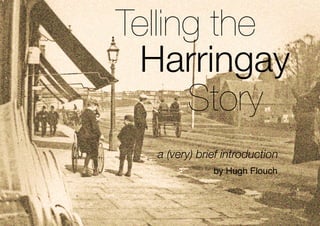
Cover image: From an original image held for the public in the archives of Bruce Castle Museum
                                                                                                         June 2011
i had an idea...

...i wanted to
tell a story
Top: Yves Guillou via Openclipart (Public Domain)   Bottom: © Andrew Endersby. Used with permission.


                                                                                                       page 1
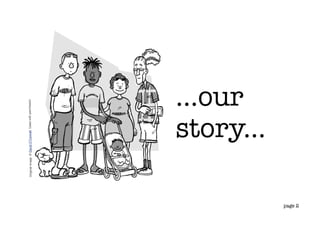
Original image © David O’Connell Used with permission


                               ...our
                               story...

page 2
Original image © alistairj. Used with permission
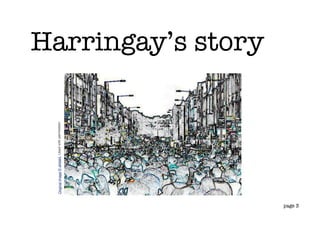
                                                            Harringay’s story


page 3
When I first looked in any detail at the history of Harringay, I found only
bits and pieces here and there. Our story was told in fragments, if at all. In
general it seemed to follow the historical boundaries of the old boroughs. So,
certain elements of the story to the west of Green Lanes were picked up by the
Hornsey Historical Society, whilst the history of the area to the east of Green
Lanes tended to be covered as an afterword in histories of Tottenham.
For my part, I thought Harringay’s history deserved better. So in 2007/2008 I
used Wikipedia to develop the first ever history of the whole of Harringay. I
chose to work online so that as many people as possible could have access to
the information.
The story I’ve written is told over nine well researched and referenced
articles. Although it’s far from complete (in fact for the last couple of years it’s
been something of an ‘opus interruptus’), and it needs a bit of wordsmithing, it
does for the first time tell a coherent story of the whole of Harringay.
I haven’t had much spare time since 2008. Nonetheless, the last two or three
1
 I’m thinking in particular of Alan Aris’ excellent article on the development of the Ladder at the end of the nineteenth century, Hugh Hayes’
work on Finsbury Park and Mike Ticher’s work on the Stadium and Arena.
                                                                                                                                           page 4
years have not been
wasted. Along with other
members of the
neighbourhood website
Harringay Online, I have
developed a significant
online collection of
historical materials. These
include:
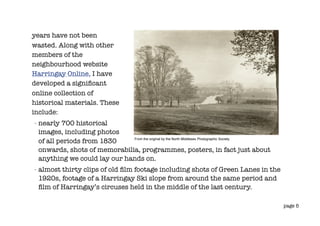
-   nearly 700 historical
    images, including photos
    of all periods from 1830    From the original by the North Middlesex Photographic Society


    onwards, shots of memorabilia, programmes, posters, in fact just about
    anything we could lay our hands on.
-   almost thirty clips of old film footage including shots of Green Lanes in the
    1920s, footage of a Harringay Ski slope from around the same period and
    film of Harringay’s circuses held in the middle of the last century.

                                                                                                page 5
-   just under 200 discussions, blogs and information postings in the History
    of Harringay group. These include first-hand recollections of members
    from as far away as Australia, sharing with us their memories going back
    as early as 1920 (including Arthur and his dancing bear). There’s also
    lots of precious newspaper articles from the past 100 years and some
    collaborative mapping of bomb damage to our neighbourhood during two
    world wars.
-   a collection of ‘virtual blue plaques’ for previously forgotten ‘heroes’ of the
    past who lived here, from one of the nineteenth century’s most prolific
    novelists to the inventor or the Times Roman font and even Barbara
    Windsor.
This is a monumental amount of information that puts me and anyone else
who is interested in a great position to understand our neighbourhood.
Through it, the Harringay of 100 years ago becomes a living place where
you can see pictures of the Edwardian shops along with contemporary
adverts and first hand memories of people who shopped there. You can
likely find a picture of your road 100 years ago, probably find out who lived

                                                                                      page 6
there and what they might have done for a living. And, if you’ve a mind to, you
can get a real sense of what a greyhound racing meeting at the Arena was like
in 1930 – look at the programme, see the ticket,
see a photo and perhaps even an old film clip.
Look further and you’ll find a welath of
fascinating titbits from the Harringay Arena.
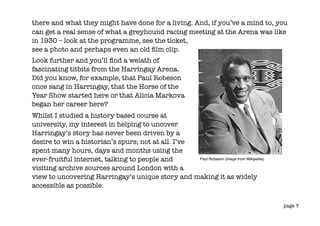
Did you know, for example, that Paul Robeson
once sang in Harringay, that the Horse of the
Year Show started here or that Alicia Markova
began her career here?
Whilst I studied a history based course at
university, my interest in helping to uncover
Harringay’s story has never been driven by a
desire to win a historian’s spurs; not at all. I’ve
spent many hours, days and months using the
ever-fruitful internet, talking to people and       Paul Robseon (image from Wikipedia)

visiting archive sources around London with a
view to uncovering Harringay’s unique story and making it as widely
accessible as possible.

                                                                                          page 7
Some of my passion comes from a real interest in history, but I’m driven in
equal part by a belief that the stronger the understanding of our past, the
stronger the sense of place; and the stronger the sense of place, the
stronger the bonds to it and between the people who live here.
In my journey so far I’ve been really grateful to be joined for bits of it by
some fellow travellers including Liz Ixer (and her general interest in the
built historical environment and her acquisitions of material through the
internet), Stephen Hartley (and his often transport-related historical
photos and documents) and Angela Burge (and her enthusiastic and
imaginative work in helping to build the family trees of the families who
lived in Harringay House – she always seemed to find the bits I never
could!).
I’m also grateful to Valerie Crosby, archivist at Bruce Castle,the ever
helpful Joy Nicholl at the Hornsey Historical Society and the National
Council of Archives who have recognised Harringay Online as a community
archive.


                                                                                page 8
I realised not long ago that what I’d written on Wikipedia amounts to
something like a 90 page book! So some while back, I started compiling it
into something that I plan to publish as a free e-book. However, I’m keen to
do justice to all the material that I and others have pulled together; I also
want to try and tease out some meaning and understanding from it all
beyond a simple statement of facts. So the e-book will be a while longer in
the baking yet.
In the meantime, on the following few pages, I’ve added an outline of all the
key articles I’ve written on Wikipedia about Harringay’s History. (Once
online you’ll find even more than I list here. I ended up adding other
articles that have come out of my Harringay work, such as a piece on John
Cathles Hill, who built up the Gardens and on Henry Harvey Vivian, one-
time Harringay resident who was a leader of the cooperative housing
movement. I’ve also done pieces on organisations linked to Harringay like
the Greyhound Racing Association and the Home and Colonial Stores. No
idea where I used to find the time!)
And, don’t forget, in addition to the Wikpedia material, there are all the
materials on Harringay Online.

                                                                                page 9
Overview
The history of Harringay tells the story of the development of Harringay, a district of London 5 miles from its centre,
affected by, but not always part of the great city's history.
1.   Etymology
2.   Prehistory to 1750
3.   1750 to 1880
4.   1880 - present day
5.   Harringay and entertainment
6.   Economic history
7.   Transport & communications history


Prehistory - 1750
During this period Harringay emerged from the mist of prehistory as a thickly forested area of southern England. By 1750
most of the forest had been cleared for agriculture, although settlement was still sparse.
1. Prehistory to Domesday
2. Domesday to 1750
      2.1. Characteristics of the landscape and land use
      2.2. Settlement
      2.3. Other development
      2.4. Land ownership
      2.5. Communications


                                                                                                                           page 10
1750 - 1880
This significant period in Harringay's history witnessed the transition from a purely pastoral society and set the stage for
the upheavals of the late 19th century.

1. A period of change
2. Harringay – 18th & 19th century leisure destination
       2.1 Hornsey Wood House
       2.2 Finsbury Park
       2.3 Alexandra Palace
       2.4 Queen's Head
3. Settlement
       3.1 Harringay House
       3.2 Other settlements
       3.3 Northumberland House
4. Economic history
       4.1 Tile kilns
5. Transport
       5.1 Railways
       5.2 Roads
6. Summary


                                                                                                                              page 11
1880 - Present
The advance of late Victorian urbanisation during the last twenty years of the 19th century swept away the eighteenth
and early nineteenth century houses, their grounds and the farmland. By 1900 Harringay was completely urbanised.

1. Urbanisation & change
2. 1880 to 1940
       2.1. The development of West Harringay
              2.1.1. A community establishes itself
3. Harringay during the Second World War
4. 1945 to the present day
5. Entertainment
       5.1. The Stadium and Arena
       5.2. Cinemas
       5.3. Other
6. Transport & communications history
       6.1. Roadways
       6.2. Rail
              6.2.1. Great Northern Railway
              6.2.2. Tottenham & Hampstead Junction Railway
              6.2.3. Palace Gates Line
              6.2.4. Great Northern & City Railway
         6.3. The Tube


                                                                                                                        page 12
Harringay Station
History


Harringay Green Lanes Station
History


Former cinemas in Harringay
In its days as an entertainment centre for London, Harringay in North London also provided more locally directed
entertainment in the shape of four cinemas. The earliest was opened in 1910 and was operating as a cinema until
January 2003.

1. Earliest film shows in Harringay
2. The Premier Electric
3. The Electric Coliseum
4. Grand Picture Palace
5. The Ritz


                                                                                                                   page 13
Harringay Stadium
Harringay Stadium was a major greyhound racing and speedway venue in Harringay, North London. It was built and
opened in 1927 and closed in 1987.

1. Construction
2. Greyhound Racing
       2.1. Cheetah Racing at Harringay
3. Speedway
4. Stock car racing
5. Other uses
6. Historical Notes
7. Closure & demolition


Harringay Arena
Harringay Arena was a sporting and events venue on Green Lanes in Harringay, North London, England. Built in 1936, it
lasted as a venue until 1958.

1. Construction
2. Sports venue
3. Entertainment venue
       3.1. Classical music and ballet
       3.2. Circuses
       3.3. Other events
4. Decline and fall


                                                                                                                        page 14
Published online in June 2011

Harringay’s History: History by Harringay people free to Harringay people, for Harringay People

Text ©Hugh Flouch

Contact Hugh at hugh@harringayonline.com

Telling the Harringay Story

  • 1.
    Telling the Harringay Story a (very) brief introduction by Hugh Flouch
  • 2.
    Telling the Harringay Story a (very) brief introduction by Hugh Flouch Cover image: From an original image held for the public in the archives of Bruce Castle Museum June 2011
  • 3.
    i had anidea... ...i wanted to tell a story Top: Yves Guillou via Openclipart (Public Domain) Bottom: © Andrew Endersby. Used with permission. page 1
  • 4.
    Original image ©David O’Connell Used with permission ...our story... page 2
  • 5.
    Original image ©alistairj. Used with permission Harringay’s story page 3
  • 6.
    When I firstlooked in any detail at the history of Harringay, I found only bits and pieces here and there. Our story was told in fragments, if at all. In general it seemed to follow the historical boundaries of the old boroughs. So, certain elements of the story to the west of Green Lanes were picked up by the Hornsey Historical Society, whilst the history of the area to the east of Green Lanes tended to be covered as an afterword in histories of Tottenham. For my part, I thought Harringay’s history deserved better. So in 2007/2008 I used Wikipedia to develop the first ever history of the whole of Harringay. I chose to work online so that as many people as possible could have access to the information. The story I’ve written is told over nine well researched and referenced articles. Although it’s far from complete (in fact for the last couple of years it’s been something of an ‘opus interruptus’), and it needs a bit of wordsmithing, it does for the first time tell a coherent story of the whole of Harringay. I haven’t had much spare time since 2008. Nonetheless, the last two or three 1 I’m thinking in particular of Alan Aris’ excellent article on the development of the Ladder at the end of the nineteenth century, Hugh Hayes’ work on Finsbury Park and Mike Ticher’s work on the Stadium and Arena. page 4
  • 7.
    years have notbeen wasted. Along with other members of the neighbourhood website Harringay Online, I have developed a significant online collection of historical materials. These include: - nearly 700 historical images, including photos of all periods from 1830 From the original by the North Middlesex Photographic Society onwards, shots of memorabilia, programmes, posters, in fact just about anything we could lay our hands on. - almost thirty clips of old film footage including shots of Green Lanes in the 1920s, footage of a Harringay Ski slope from around the same period and film of Harringay’s circuses held in the middle of the last century. page 5
  • 8.
    - just under 200 discussions, blogs and information postings in the History of Harringay group. These include first-hand recollections of members from as far away as Australia, sharing with us their memories going back as early as 1920 (including Arthur and his dancing bear). There’s also lots of precious newspaper articles from the past 100 years and some collaborative mapping of bomb damage to our neighbourhood during two world wars. - a collection of ‘virtual blue plaques’ for previously forgotten ‘heroes’ of the past who lived here, from one of the nineteenth century’s most prolific novelists to the inventor or the Times Roman font and even Barbara Windsor. This is a monumental amount of information that puts me and anyone else who is interested in a great position to understand our neighbourhood. Through it, the Harringay of 100 years ago becomes a living place where you can see pictures of the Edwardian shops along with contemporary adverts and first hand memories of people who shopped there. You can likely find a picture of your road 100 years ago, probably find out who lived page 6
  • 9.
    there and whatthey might have done for a living. And, if you’ve a mind to, you can get a real sense of what a greyhound racing meeting at the Arena was like in 1930 – look at the programme, see the ticket, see a photo and perhaps even an old film clip. Look further and you’ll find a welath of fascinating titbits from the Harringay Arena. Did you know, for example, that Paul Robeson once sang in Harringay, that the Horse of the Year Show started here or that Alicia Markova began her career here? Whilst I studied a history based course at university, my interest in helping to uncover Harringay’s story has never been driven by a desire to win a historian’s spurs; not at all. I’ve spent many hours, days and months using the ever-fruitful internet, talking to people and Paul Robseon (image from Wikipedia) visiting archive sources around London with a view to uncovering Harringay’s unique story and making it as widely accessible as possible. page 7
  • 10.
    Some of mypassion comes from a real interest in history, but I’m driven in equal part by a belief that the stronger the understanding of our past, the stronger the sense of place; and the stronger the sense of place, the stronger the bonds to it and between the people who live here. In my journey so far I’ve been really grateful to be joined for bits of it by some fellow travellers including Liz Ixer (and her general interest in the built historical environment and her acquisitions of material through the internet), Stephen Hartley (and his often transport-related historical photos and documents) and Angela Burge (and her enthusiastic and imaginative work in helping to build the family trees of the families who lived in Harringay House – she always seemed to find the bits I never could!). I’m also grateful to Valerie Crosby, archivist at Bruce Castle,the ever helpful Joy Nicholl at the Hornsey Historical Society and the National Council of Archives who have recognised Harringay Online as a community archive. page 8
  • 11.
    I realised notlong ago that what I’d written on Wikipedia amounts to something like a 90 page book! So some while back, I started compiling it into something that I plan to publish as a free e-book. However, I’m keen to do justice to all the material that I and others have pulled together; I also want to try and tease out some meaning and understanding from it all beyond a simple statement of facts. So the e-book will be a while longer in the baking yet. In the meantime, on the following few pages, I’ve added an outline of all the key articles I’ve written on Wikipedia about Harringay’s History. (Once online you’ll find even more than I list here. I ended up adding other articles that have come out of my Harringay work, such as a piece on John Cathles Hill, who built up the Gardens and on Henry Harvey Vivian, one- time Harringay resident who was a leader of the cooperative housing movement. I’ve also done pieces on organisations linked to Harringay like the Greyhound Racing Association and the Home and Colonial Stores. No idea where I used to find the time!) And, don’t forget, in addition to the Wikpedia material, there are all the materials on Harringay Online. page 9
  • 12.
    Overview The history ofHarringay tells the story of the development of Harringay, a district of London 5 miles from its centre, affected by, but not always part of the great city's history. 1. Etymology 2. Prehistory to 1750 3. 1750 to 1880 4. 1880 - present day 5. Harringay and entertainment 6. Economic history 7. Transport & communications history Prehistory - 1750 During this period Harringay emerged from the mist of prehistory as a thickly forested area of southern England. By 1750 most of the forest had been cleared for agriculture, although settlement was still sparse. 1. Prehistory to Domesday 2. Domesday to 1750 2.1. Characteristics of the landscape and land use 2.2. Settlement 2.3. Other development 2.4. Land ownership 2.5. Communications page 10
  • 13.
    1750 - 1880 Thissignificant period in Harringay's history witnessed the transition from a purely pastoral society and set the stage for the upheavals of the late 19th century. 1. A period of change 2. Harringay – 18th & 19th century leisure destination 2.1 Hornsey Wood House 2.2 Finsbury Park 2.3 Alexandra Palace 2.4 Queen's Head 3. Settlement 3.1 Harringay House 3.2 Other settlements 3.3 Northumberland House 4. Economic history 4.1 Tile kilns 5. Transport 5.1 Railways 5.2 Roads 6. Summary page 11
  • 14.
    1880 - Present Theadvance of late Victorian urbanisation during the last twenty years of the 19th century swept away the eighteenth and early nineteenth century houses, their grounds and the farmland. By 1900 Harringay was completely urbanised. 1. Urbanisation & change 2. 1880 to 1940 2.1. The development of West Harringay 2.1.1. A community establishes itself 3. Harringay during the Second World War 4. 1945 to the present day 5. Entertainment 5.1. The Stadium and Arena 5.2. Cinemas 5.3. Other 6. Transport & communications history 6.1. Roadways 6.2. Rail 6.2.1. Great Northern Railway 6.2.2. Tottenham & Hampstead Junction Railway 6.2.3. Palace Gates Line 6.2.4. Great Northern & City Railway 6.3. The Tube page 12
  • 15.
    Harringay Station History Harringay GreenLanes Station History Former cinemas in Harringay In its days as an entertainment centre for London, Harringay in North London also provided more locally directed entertainment in the shape of four cinemas. The earliest was opened in 1910 and was operating as a cinema until January 2003. 1. Earliest film shows in Harringay 2. The Premier Electric 3. The Electric Coliseum 4. Grand Picture Palace 5. The Ritz page 13
  • 16.
    Harringay Stadium Harringay Stadiumwas a major greyhound racing and speedway venue in Harringay, North London. It was built and opened in 1927 and closed in 1987. 1. Construction 2. Greyhound Racing 2.1. Cheetah Racing at Harringay 3. Speedway 4. Stock car racing 5. Other uses 6. Historical Notes 7. Closure & demolition Harringay Arena Harringay Arena was a sporting and events venue on Green Lanes in Harringay, North London, England. Built in 1936, it lasted as a venue until 1958. 1. Construction 2. Sports venue 3. Entertainment venue 3.1. Classical music and ballet 3.2. Circuses 3.3. Other events 4. Decline and fall page 14
  • 17.
    Published online inJune 2011 Harringay’s History: History by Harringay people free to Harringay people, for Harringay People Text ©Hugh Flouch Contact Hugh at hugh@harringayonline.com