Digital Balance Marja-Liisa Viherä, Ph.dr, 26.02.03
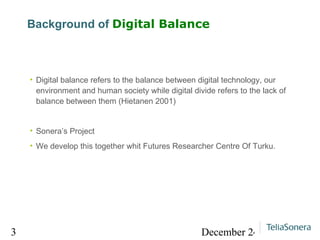
Background of  Digital Balance Digital balance refers to the balance between digital technology, our environment and human society while digital divide refers to the lack of balance between them (Hietanen 2001) Sonera’s Project We develop this together whit Futures Researcher Centre Of Turku.
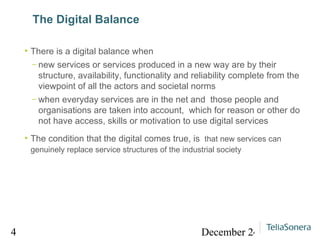
The Digital Balance There is a digital balance when  new services or services produced in a new way are by their structure, availability, functionality and reliability complete from the viewpoint of all the actors and societal norms when everyday services are in the net and  those people and organisations are taken into account,  which for reason or other do not have access, skills or motivation to use digital services The condition that the digital comes true, is  that new services can genuinely replace service structures of the industrial society
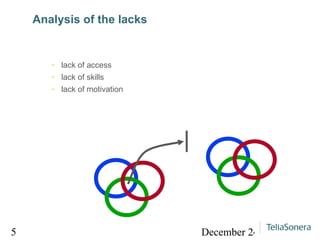
Analysis of the lacks lack of access lack of skills lack of motivation
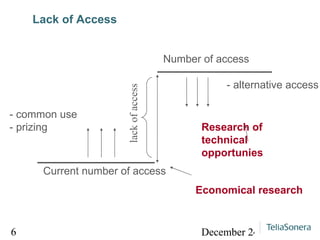
Lack of Access lack of access Current number of access Number of access - alternative access  - common use  - prizing Research of technical opportunies Economical research
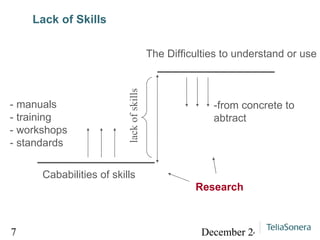
Lack of Skills lack of skills Cababilities of skills The Difficulties to understand or use -from concrete to abtract - manuals - training - workshops - standards Research
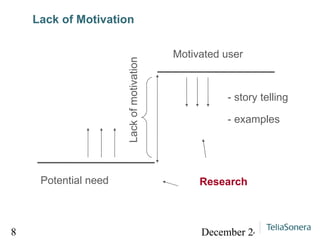
Lack of Motivation Lack of motivation Potential need  Motivated user Research - story telling  - examples
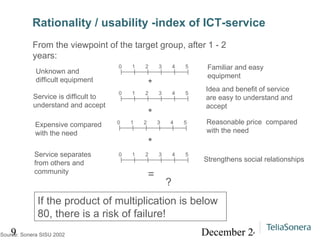
Rationality / usability -index of ICT-service Unknown and difficult equipment Familiar and easy equipment Service is difficult to understand and accept Idea and benefit of service  are easy to understand and accept Expensive compared with the need Strengthens social relationships Service separates from others and community Reasonable price  compared with the need * * = * ?  From the viewpoint of the target group, after 1 - 2 years:  If the product of multiplication is below 80, there is a risk of failure!  Source: Sonera SISU 2002 0 1 2 3 4 5 0 1 2 3 4 5 0 1 2 3 4 5 0 1 2 3 4 5
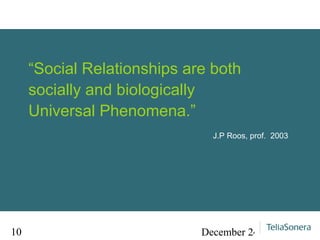
“ Social Relationships are both socially and biologically Universal Phenomena.” J.P Roos, prof.  2003
 

Teliasoneradigbal

  • 1.
  • 2.
    Digital Balance Marja-LiisaViherä, Ph.dr, 26.02.03
  • 3.
    Background of Digital Balance Digital balance refers to the balance between digital technology, our environment and human society while digital divide refers to the lack of balance between them (Hietanen 2001) Sonera’s Project We develop this together whit Futures Researcher Centre Of Turku.
  • 4.
    The Digital BalanceThere is a digital balance when new services or services produced in a new way are by their structure, availability, functionality and reliability complete from the viewpoint of all the actors and societal norms when everyday services are in the net and those people and organisations are taken into account, which for reason or other do not have access, skills or motivation to use digital services The condition that the digital comes true, is that new services can genuinely replace service structures of the industrial society
  • 5.
    Analysis of thelacks lack of access lack of skills lack of motivation
  • 6.
    Lack of Accesslack of access Current number of access Number of access - alternative access - common use - prizing Research of technical opportunies Economical research
  • 7.
    Lack of Skillslack of skills Cababilities of skills The Difficulties to understand or use -from concrete to abtract - manuals - training - workshops - standards Research
  • 8.
    Lack of MotivationLack of motivation Potential need Motivated user Research - story telling - examples
  • 9.
    Rationality / usability-index of ICT-service Unknown and difficult equipment Familiar and easy equipment Service is difficult to understand and accept Idea and benefit of service are easy to understand and accept Expensive compared with the need Strengthens social relationships Service separates from others and community Reasonable price compared with the need * * = * ? From the viewpoint of the target group, after 1 - 2 years: If the product of multiplication is below 80, there is a risk of failure! Source: Sonera SISU 2002 0 1 2 3 4 5 0 1 2 3 4 5 0 1 2 3 4 5 0 1 2 3 4 5
  • 10.
    “ Social Relationshipsare both socially and biologically Universal Phenomena.” J.P Roos, prof. 2003
  • 11.