Measuring Democracy and TechnologyDr. Juan Luis Manfredi SánchezCorreo-e: juan.manfredi@yahoo.esjuan.manfredi@ie.eduTwitter: @juanmanfredihttp://ciberdemocracia.blogspot.com
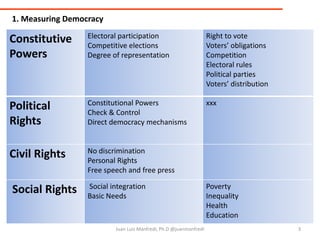
2Juan Luis Manfredi, Ph.D @juanmanfredi1. Measuring Democracy
3Juan Luis Manfredi, Ph.D @juanmanfredi1. Measuring Democracy
4Juan Luis Manfredi, Ph.D @juanmanfredi2. Measuring TechnologyInformation has gone from scarce to superabundantThat brings huge new benefits, but also big headachesThe capability of digital technology multiplies the information that was previously unavailable
5Juan Luis Manfredi, Ph.D @juanmanfredi2. Measuring TechnologyIt plays a central role both in macroeconomics and in economic development: it’s a key question in public policiesAgain, we have dozens of index: there’s no good index and bad indexOECD: “The Guide is a compilation of concepts, definitions, classifications and methods for information society measurement and analysis” in three dimensions:Information societyEconomic dimensionSocial dimensionLet’s see how
6Juan Luis Manfredi, Ph.D @juanmanfredi
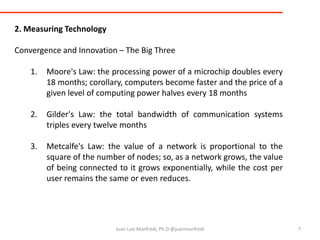
7Juan Luis Manfredi, Ph.D @juanmanfredi2. Measuring TechnologyConvergence and Innovation – The Big ThreeMoore's Law: the processing power of a microchip doubles every 18 months; corollary, computers become faster and the price of a given level of computing power halves every 18 monthsGilder's Law: the total bandwidth of communication systems triples every twelve monthsMetcalfe's Law: the value of a network is proportional to the square of the number of nodes; so, as a network grows, the value of being connected to it grows exponentially, while the cost per user remains the same or even reduces.
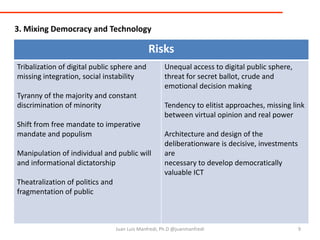
8Juan Luis Manfredi, Ph.D @juanmanfredi3. Mixing Democracy and Technology
9Juan Luis Manfredi, Ph.D @juanmanfredi3. Mixing Democracy and Technology
10Juan Luis Manfredi, Ph.D @juanmanfredi3. Mixing Democracy and Technology
11Juan Luis Manfredi, Ph.D @juanmanfredi4. Public PoliciesWhat to consider?Infrastructure availability
Cost of ICT goods and services
The ICT policy environment
Trust that users have in the online environment.
The education and skills base of the population (specialised and general)
Labour market supply and costs.
Innovation and R&D base, entrepreneurship culture and support (private and public)
A momentum effect driven by penetration of ICT
Productivity impacts of ICT investment and use.
Changes in the structure of economies
The growth of the ICT and services sectors
Changes to employment and the nature of work
Impact on globalisation
Facilitation of learning (both formal and informal)

Session 3 measuring democracy and technology

  • 1.
    Measuring Democracy andTechnologyDr. Juan Luis Manfredi SánchezCorreo-e: juan.manfredi@yahoo.esjuan.manfredi@ie.eduTwitter: @juanmanfredihttp://ciberdemocracia.blogspot.com
  • 2.
    2Juan Luis Manfredi,Ph.D @juanmanfredi1. Measuring Democracy
  • 3.
    3Juan Luis Manfredi,Ph.D @juanmanfredi1. Measuring Democracy
  • 4.
    4Juan Luis Manfredi,Ph.D @juanmanfredi2. Measuring TechnologyInformation has gone from scarce to superabundantThat brings huge new benefits, but also big headachesThe capability of digital technology multiplies the information that was previously unavailable
  • 5.
    5Juan Luis Manfredi,Ph.D @juanmanfredi2. Measuring TechnologyIt plays a central role both in macroeconomics and in economic development: it’s a key question in public policiesAgain, we have dozens of index: there’s no good index and bad indexOECD: “The Guide is a compilation of concepts, definitions, classifications and methods for information society measurement and analysis” in three dimensions:Information societyEconomic dimensionSocial dimensionLet’s see how
  • 6.
    6Juan Luis Manfredi,Ph.D @juanmanfredi
  • 7.
    7Juan Luis Manfredi,Ph.D @juanmanfredi2. Measuring TechnologyConvergence and Innovation – The Big ThreeMoore's Law: the processing power of a microchip doubles every 18 months; corollary, computers become faster and the price of a given level of computing power halves every 18 monthsGilder's Law: the total bandwidth of communication systems triples every twelve monthsMetcalfe's Law: the value of a network is proportional to the square of the number of nodes; so, as a network grows, the value of being connected to it grows exponentially, while the cost per user remains the same or even reduces.
  • 8.
    8Juan Luis Manfredi,Ph.D @juanmanfredi3. Mixing Democracy and Technology
  • 9.
    9Juan Luis Manfredi,Ph.D @juanmanfredi3. Mixing Democracy and Technology
  • 10.
    10Juan Luis Manfredi,Ph.D @juanmanfredi3. Mixing Democracy and Technology
  • 11.
    11Juan Luis Manfredi,Ph.D @juanmanfredi4. Public PoliciesWhat to consider?Infrastructure availability
  • 12.
    Cost of ICTgoods and services
  • 13.
    The ICT policyenvironment
  • 14.
    Trust that usershave in the online environment.
  • 15.
    The education andskills base of the population (specialised and general)
  • 16.
  • 17.
    Innovation and R&Dbase, entrepreneurship culture and support (private and public)
  • 18.
    A momentum effectdriven by penetration of ICT
  • 19.
    Productivity impacts ofICT investment and use.
  • 20.
    Changes in thestructure of economies
  • 21.
    The growth ofthe ICT and services sectors
  • 22.
    Changes to employmentand the nature of work
  • 23.
  • 24.
    Facilitation of learning(both formal and informal)