




Telephone Collection Techniques
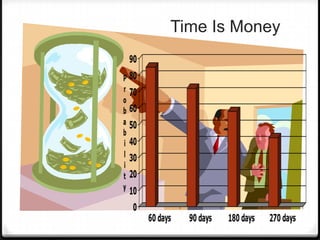
Time Is Money
Considerations

Company
Industry
Customers
Your Company and Industry Culture?

 0Sales Driven vs. Accounting
  Driven
 0How competitive is the
  industry you are in?
Know Your Customers

0 When do they pay?
0 What are their requirements?
0 Who to contact
0 How to contact
The Customer

0 Conform your approach to the customer type:
  0 Small high risk
  0 Startups
  0 Bureaucracies - Large company, government
  0 Privately held vs. Publicly owned
  0 Contractual partners
The Customer

0 What do you need to know to facilitate payment:
  0 Does customer provide notice of payment?
  0 Should you call to check on status before due?
  0 If an invoice is missed for payment, how do you best
    address?
  0 What do they need from you to facilitate payment
    more quickly?
Debtor Types
0 Able to pay
  0 Honestly overlooked
  0 Procrastinator
  0 Grievance or dispute
0 Actively-avoiding payment
  0 Poor budgeter
  0 Staller
  0 Temporary problem
0 High-risk
  0 Eventual insolvent
  0 Hardship case
  0 Credit criminal
Your Communication Style

0 When you are collecting from a customer, you
 represent your company so don’t . . .
  0 Use slang or swear
  0 Lose your cool
  0 Be less then professional
  0 Misrepresent your intentions
Your Collection Style

0 Reflects your company’s culture
0 Be pleasant yet firm.
0 Use the nonverbal part of your voice
0 Be persistent.
0 Be helpful.
0 Do what you say you’re going to do.
0 Try to resolve the issue with the first contact.
The Good, the Bad


  and the Ugly
Telephone Collections

0 Why?
0 When?
0 Five phases of a collection call.
0 Making the call.
0 Handling objections.
  0 Why can’t they pay?
  0 When will they be able to pay?
Why telephone contact?

0 Cost-effective
0 Provides you with immediate feedback.
0 Letters are being ignored.
0 When the customer’s sincerity is in doubt.
When?

0 Factors to consider
   0 Best time to reach
   0 Best place to reach
   0 When did you call last
Five Phases of a Collection Call

0 Preparation
0 Identification
0 Fact finding
0 Agreement
0 Follow-up
Precall Preparation

0 Validate the amount.
0 Evaluate the customer’s payment record.
0 Analyze the customer’s collection file.
0 Map out a plan of action.
Who to ask for?

0 The party who signed the agreement
0 The person who pays the bills
0 The person who can force payment
Identification of the Parties


0 Do you have the right
  person on the phone?
0 Consumer vs. Commercial
Identify Yourself

0 Be clear about who you are and who you represent.
Identify the Personality Type – Why?

 0 A good collector sells everyday.
 0 You need to build relationships.
 0 You are the “solution.”
Four Basic Personality Types

0 Steady Relater – open/indirect
  0 Usually cordial, willing to talk, noncommittal
0 Interactive Socializer – open/direct
   0 Cordial, willing, but can he get it done?
0 Cautious Thinker – self-contained/indirect
   0 Quiet and reserved, noncommittal
0 Dominant Director – self-contained/direct
  0 “Here’s what I’m gonna do for you.”
Fact Finding

0 The tactical pause –
   What do you hope to gain?
Use of Fact-Finding Questions

0 Requires the customer to supply specific reasons
  for late payment.
0 Provides collector with clues to potential solutions.
0 Ask questions but don’t interrogate.
0 No loaded questions.
Examples

0 How did this happen?
0 What caused you to fall behind?
0 What is the specific reason for your payment
  problems?
0 What can we do to help you get back on track?
Listening
 Let the customer talk.
 Identify the central
  problem.
 Search out solutions.
 Tune in to the customer.
 Earn the customer’s
  respect.
 Narrow the scope of the
  problem.
Reacting (cont.)

0 Complaints about goods and services
  0 Must be taken seriously.
  0 Don’t lose control by passing the buck.
  0 Investigate, promptly take the necessary action, and
    report back to the customer.
Reacting (cont.)

0 Denials of responsibility
  0 Must be treated with same courtesy as customers
    who complain.
0 Explanation of late payment or “the dog ate my
 homework.”
Challenges to Creditor’s Authority

0 They admit they owe, but challenge you to collect it.
0 They will attempt to distract or upset you.
What If They Don’t Want
        to Pay?
0 “Our policy is to put past-due accounts on credit
  hold [and . . .].”
0 “This may impact your future shipment schedule.”
0 “Customer delinquency is reported to the major
  credit bureaus.”
0 “Unless we can resolve this, we may have to use
  other collection methods.”
0 Contact your sales rep.
0 Escalate the claim as necessary.
Asking for Payment in Full

0 Present with confidence.
0 Presume an affirmative response.
0 Must be specific as to when.
0 Should identify the desired form of payment.
Reaching an Agreement

0 Negotiating a payment plan.
  0 Take control - ask for as much as you can as quickly
    as you can get it.
  0 Sell the benefits of the plan.
  0 Compromise when necessary.
  0 Obtain specific commitments.
  0 Always require a promissory note.
  0 Payment plan and continuing shipments
Reaching an Agreement (cont.)

0 Overcoming objections.
  0 Separate the sincere from the insincere.
  0 What is the customer objecting to?
  0 Listen to what the customer is telling you.
  0 Break the proposal into smaller, more manageable
    pieces.
  0 Obtain agreement on undisputed points.
  0 Return to disputed points and negotiate solutions.
Reaching an Agreement (cont.)

0 Overcoming Objections
  0 Look for answers – Double-check your records and
    make sure you know/have the facts.
  0 Get to the problem as quickly as possible.
  0 Take appropriate action.
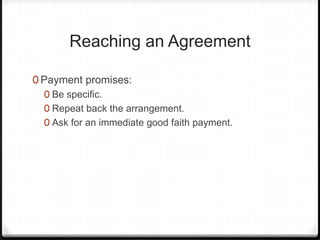
Reaching an Agreement

0 Payment promises:
  0 Be specific.
  0 Repeat back the arrangement.
  0 Ask for an immediate good faith payment.
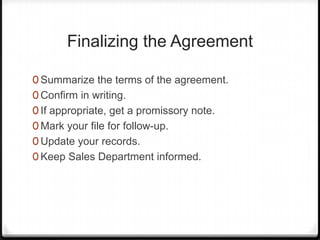
Finalizing the Agreement

0 Summarize the terms of the agreement.
0 Confirm in writing.
0 If appropriate, get a promissory note.
0 Mark your file for follow-up.
0 Update your records.
0 Keep Sales Department informed.
Following Up

0 Training the customer to keep the agreement.
0 Follow-up progressively.
Tips

0 Be willing to say no to any unacceptable
  arrangement.
0 Always throw the burden back on the debtor.
0 Never lose your cool.
0 If the debtor is cooperative and makes reasonable
  offers, you also need to cooperate.
Tips (cont.)

0 If the debtor is not reasonable, say what you’ll do
  and do it.
0 Your job is to have a policy and a point of view, not
  a snappy comeback.
  0 Essentially your point of view is,
    0 “You received the good or service, and you haven’t paid
      for it.”
    0 “Let’s figure out how to get over this hurdle and move
      forward in our relationship.”
Summary

0 Company Culture Must Be Considered.
0 Resources
0 Flexibility
0 Effectiveness
0 Know Your Customers
0 Listen, Listen, Listen!
0 Never lose your temper.
0 Maintain control of the conversation.
0 Always keep your word.
Telephone technique   18 oct 2012

Telephone technique 18 oct 2012

  • 1.
  • 2.
  • 3.
  • 4.
    Your Company andIndustry Culture? 0Sales Driven vs. Accounting Driven 0How competitive is the industry you are in?
  • 5.
    Know Your Customers 0When do they pay? 0 What are their requirements? 0 Who to contact 0 How to contact
  • 6.
    The Customer 0 Conformyour approach to the customer type: 0 Small high risk 0 Startups 0 Bureaucracies - Large company, government 0 Privately held vs. Publicly owned 0 Contractual partners
  • 7.
    The Customer 0 Whatdo you need to know to facilitate payment: 0 Does customer provide notice of payment? 0 Should you call to check on status before due? 0 If an invoice is missed for payment, how do you best address? 0 What do they need from you to facilitate payment more quickly?
  • 8.
    Debtor Types 0 Ableto pay 0 Honestly overlooked 0 Procrastinator 0 Grievance or dispute 0 Actively-avoiding payment 0 Poor budgeter 0 Staller 0 Temporary problem 0 High-risk 0 Eventual insolvent 0 Hardship case 0 Credit criminal
  • 9.
    Your Communication Style 0When you are collecting from a customer, you represent your company so don’t . . . 0 Use slang or swear 0 Lose your cool 0 Be less then professional 0 Misrepresent your intentions
  • 10.
    Your Collection Style 0Reflects your company’s culture 0 Be pleasant yet firm. 0 Use the nonverbal part of your voice 0 Be persistent. 0 Be helpful. 0 Do what you say you’re going to do. 0 Try to resolve the issue with the first contact.
  • 11.
    The Good, theBad and the Ugly
  • 12.
    Telephone Collections 0 Why? 0When? 0 Five phases of a collection call. 0 Making the call. 0 Handling objections. 0 Why can’t they pay? 0 When will they be able to pay?
  • 13.
    Why telephone contact? 0Cost-effective 0 Provides you with immediate feedback. 0 Letters are being ignored. 0 When the customer’s sincerity is in doubt.
  • 14.
    When? 0 Factors toconsider 0 Best time to reach 0 Best place to reach 0 When did you call last
  • 15.
    Five Phases ofa Collection Call 0 Preparation 0 Identification 0 Fact finding 0 Agreement 0 Follow-up
  • 16.
    Precall Preparation 0 Validatethe amount. 0 Evaluate the customer’s payment record. 0 Analyze the customer’s collection file. 0 Map out a plan of action.
  • 17.
    Who to askfor? 0 The party who signed the agreement 0 The person who pays the bills 0 The person who can force payment
  • 18.
    Identification of theParties 0 Do you have the right person on the phone? 0 Consumer vs. Commercial
  • 19.
    Identify Yourself 0 Beclear about who you are and who you represent.
  • 20.
    Identify the PersonalityType – Why? 0 A good collector sells everyday. 0 You need to build relationships. 0 You are the “solution.”
  • 21.
    Four Basic PersonalityTypes 0 Steady Relater – open/indirect 0 Usually cordial, willing to talk, noncommittal 0 Interactive Socializer – open/direct 0 Cordial, willing, but can he get it done? 0 Cautious Thinker – self-contained/indirect 0 Quiet and reserved, noncommittal 0 Dominant Director – self-contained/direct 0 “Here’s what I’m gonna do for you.”
  • 22.
    Fact Finding 0 Thetactical pause – What do you hope to gain?
  • 23.
    Use of Fact-FindingQuestions 0 Requires the customer to supply specific reasons for late payment. 0 Provides collector with clues to potential solutions. 0 Ask questions but don’t interrogate. 0 No loaded questions.
  • 24.
    Examples 0 How didthis happen? 0 What caused you to fall behind? 0 What is the specific reason for your payment problems? 0 What can we do to help you get back on track?
  • 25.
    Listening  Let thecustomer talk.  Identify the central problem.  Search out solutions.  Tune in to the customer.  Earn the customer’s respect.  Narrow the scope of the problem.
  • 26.
    Reacting (cont.) 0 Complaintsabout goods and services 0 Must be taken seriously. 0 Don’t lose control by passing the buck. 0 Investigate, promptly take the necessary action, and report back to the customer.
  • 27.
    Reacting (cont.) 0 Denialsof responsibility 0 Must be treated with same courtesy as customers who complain. 0 Explanation of late payment or “the dog ate my homework.”
  • 28.
    Challenges to Creditor’sAuthority 0 They admit they owe, but challenge you to collect it. 0 They will attempt to distract or upset you.
  • 29.
    What If TheyDon’t Want to Pay? 0 “Our policy is to put past-due accounts on credit hold [and . . .].” 0 “This may impact your future shipment schedule.” 0 “Customer delinquency is reported to the major credit bureaus.” 0 “Unless we can resolve this, we may have to use other collection methods.” 0 Contact your sales rep. 0 Escalate the claim as necessary.
  • 30.
    Asking for Paymentin Full 0 Present with confidence. 0 Presume an affirmative response. 0 Must be specific as to when. 0 Should identify the desired form of payment.
  • 31.
    Reaching an Agreement 0Negotiating a payment plan. 0 Take control - ask for as much as you can as quickly as you can get it. 0 Sell the benefits of the plan. 0 Compromise when necessary. 0 Obtain specific commitments. 0 Always require a promissory note. 0 Payment plan and continuing shipments
  • 32.
    Reaching an Agreement(cont.) 0 Overcoming objections. 0 Separate the sincere from the insincere. 0 What is the customer objecting to? 0 Listen to what the customer is telling you. 0 Break the proposal into smaller, more manageable pieces. 0 Obtain agreement on undisputed points. 0 Return to disputed points and negotiate solutions.
  • 33.
    Reaching an Agreement(cont.) 0 Overcoming Objections 0 Look for answers – Double-check your records and make sure you know/have the facts. 0 Get to the problem as quickly as possible. 0 Take appropriate action.
  • 34.
    Reaching an Agreement 0Payment promises: 0 Be specific. 0 Repeat back the arrangement. 0 Ask for an immediate good faith payment.
  • 35.
    Finalizing the Agreement 0Summarize the terms of the agreement. 0 Confirm in writing. 0 If appropriate, get a promissory note. 0 Mark your file for follow-up. 0 Update your records. 0 Keep Sales Department informed.
  • 36.
    Following Up 0 Trainingthe customer to keep the agreement. 0 Follow-up progressively.
  • 37.
    Tips 0 Be willingto say no to any unacceptable arrangement. 0 Always throw the burden back on the debtor. 0 Never lose your cool. 0 If the debtor is cooperative and makes reasonable offers, you also need to cooperate.
  • 38.
    Tips (cont.) 0 Ifthe debtor is not reasonable, say what you’ll do and do it. 0 Your job is to have a policy and a point of view, not a snappy comeback. 0 Essentially your point of view is, 0 “You received the good or service, and you haven’t paid for it.” 0 “Let’s figure out how to get over this hurdle and move forward in our relationship.”
  • 39.
    Summary 0 Company CultureMust Be Considered. 0 Resources 0 Flexibility 0 Effectiveness 0 Know Your Customers 0 Listen, Listen, Listen! 0 Never lose your temper. 0 Maintain control of the conversation. 0 Always keep your word.