





Telemetry doesn't have to be scary
Developer focused metrics that make sense.
  
Table of Contents
Why we need metrics
Impact Analysis
Privacy. It's a thing.
Telemetry Data Model
Metric Plugin Design
Using the Data
Get Involved!
New talk, who dis?
Ben Ford
Developer Advocate @ Puppet
@binford2k:   
Why we need metrics
It's not a huge task to design and build a simple, single-purpose, bespoke Puppet
module in a short period of time.

Maintenance is a different story

Hey, can we add ArchLinux support?
What about Windows 2012?
Here's a PR for a defined type to manage the database too... (MariaDB only)
Development resources
  
Every single platform or feature you support takes time to maintain it!


Data driven development decisions
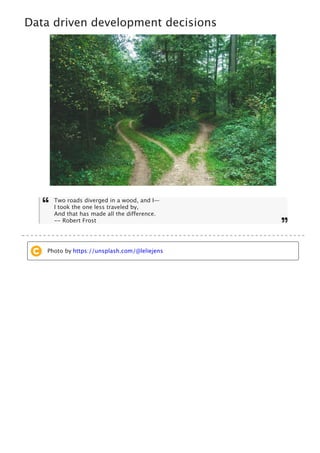
Two roads diverged in a wood, and I—
I took the one less traveled by,
And that has made all the difference.
-- Robert Frost
Photo by https://unsplash.com/@leliejens
Impact Analysis
Rangefinder
[~/Projects/puppetlabs-concat]$ rangefinder manifests/fragment.pp
[concat::fragment] is a _type_
==================================
The enclosing module is declared in 173 of 575 indexed public Puppetfiles
Breaking changes to this file WILL impact these modules:
* nightfly-ssh_keys (https://github.com/nightfly19/puppet-ssh_keys.git)
* viirya-mit_krb5 (git://github.com/viirya/puppet-mit_krb5.git)
* rjpearce-opendkim (https://github.com/rjpearce/puppet-opendkim)
* shadow-tor (git://github.com/LeShadow/puppet-tor.git)
[...]
Breaking changes to this file MAY impact these modules:
* empi89-quagga (UNKNOWN)
* unyonsys-keepalived (UNKNOWN)
* Flameeyes-udevnet (UNKNOWN)
* ricbra-ratbox (git://github.com/ricbra/puppet-ratbox.git)
[...]
https://github.com/puppetlabs/puppet-community-rangefinder
Identify the public Forge modules using parts of your code.
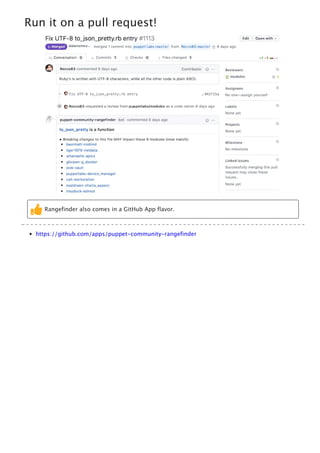
Run it on a pull request!
https://github.com/apps/puppet-community-rangefinder
Rangefinder also comes in a GitHub App flavor.
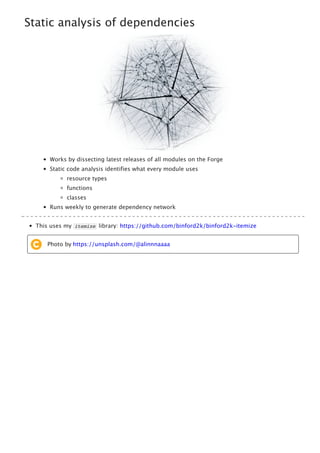
Static analysis of dependencies
Works by dissecting latest releases of all modules on the Forge
Static code analysis identifies what every module uses
resource types
functions
classes
Runs weekly to generate dependency network
This uses my itemize library: https://github.com/binford2k/binford2k-itemize
Photo by https://unsplash.com/@alinnnaaaa
Dependency data is public
Find more information about how it works and other cool queries you can run on the dataset powering
it at my blog: https://binford2k.com/2020/04/06/rangefinder/
The data Rangefinder uses is stored in a public BigQuery database.
Major limitation
Rangefinder only works on public Forge modules (currently).
Cannot identify how code is used by profiles or private modules.
Photo by https://unsplash.com/@sguestsmith
Privacy. It's a thing.
Business Identifiable Information
Most of you know BII's big cousin, PII.
But many of the same considerations apply to businesses.
Many companies don't allow phone-home metrics at all.
Sharing too much implementation information about how an infrastructure works is just
asking for security compromises.

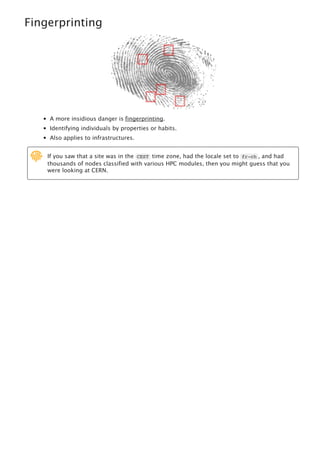
Fingerprinting
A more insidious danger is fingerprinting.
Identifying individuals by properties or habits.
Also applies to infrastructures.
If you saw that a site was in the CEST time zone, had the locale set to fr-ch , and had
thousands of nodes classified with various HPC modules, then you might guess that you
were looking at CERN.

Live example of fingerprinting
http://panopticlick.eff.org/
Hard requirements

1. Provide real value to the end user. (that's you)
2. Transparent about what data is collected, why, and what it's used for.
3. Give you the ability to opt in or out without gating other benefits.
4. The data collected can be aggregated to share publicly.
Telemetry Data Model
Public dataset
No access to individual records themselves
-- The top ten most used classes in the ecosystem
SELECT name, count
FROM `dataops-puppet-public-data.aggregated.class_usage_count`
ORDER BY count DESC
LIMIT 10
[
{ "name": "Resource_api::Agent", "count": "272" },
{ "name": "Account", "count": "272" },
{ "name": "Ssl::Params", "count": "272" },
{ "name": "Classification", "count": "272" },
{ "name": "Os_patching", "count": "269" },
{ "name": "Ntp", "count": "265" },
{ "name": "Ntp::Install", "count": "265" },
{ "name": "Ntp::Config", "count": "265" },
{ "name": "Ntp::Service", "count": "265" },
{ "name": "Zsh::Params", "count": "265" }
]
You'll need a Google Cloud account and then you can access the dataset with your browser via the
BigQuery Console. Then you can run any queries you'd like.
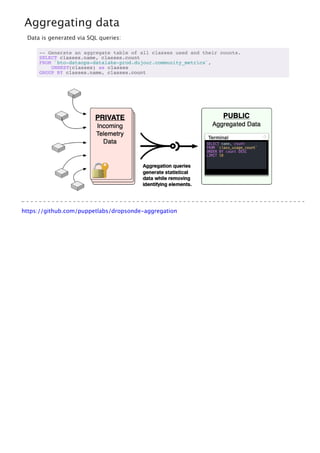
Aggregating data
Data is generated via SQL queries:
-- Generate an aggregate table of all classes used and their counts.
SELECT classes.name, classes.count
FROM `bto-dataops-datalake-prod.dujour.community_metrics`,
UNNEST(classes) as classes
GROUP BY classes.name, classes.count
https://github.com/puppetlabs/dropsonde-aggregation
Private dataset
So about that sensitive data...
Telemetry reports are not terribly sensitive, but they are fingerprintable.
So we store them only in a secured dataset.
Limited access, only myself and our BigQuery admin team.
Our own developers who want to use collected metrics data have to do it via aggregation
queries just like you would.

Metric Plugin Design
Plugin hook design
Plugins are implemented as hooks.
description
schema
example
run
Some hooks are optional
initialize
setup
cleanup
Schema hook
Describes data that the plugin is allowed to return.
Returns a BigQuery schema.
JSON format with an array of row definitions
def self.schema
[
{
"description": "The number of environments",
"mode": "NULLABLE",
"name": "environment_count",
"type": "INTEGER"
}
]
end
See full schema of all plugins with dropsonde dev schema
Run hook
Generates and returns data for the metric
Returns an array of rows of data.
Can return any data that the Puppet Server node can generate.
Use PuppetDB, codebase, etc.
Methods provided to filter out private modules.
Must match schema or plugin fails.
def self.run
[
:environment_count => Puppet.lookup(:environments).list.count,
]
end
Example hook
Representative example of sample data
Provide one element of randomized representative data.
Used to generate a dataset that's shaped like the real dataset.
Must match the schema or plugin fails.
Used for developers to generate aggregation queries.
def self.example
[
:environment_count => rand(1..100),
]
end
Available as dataops-puppet-public-data:community.community_metrics
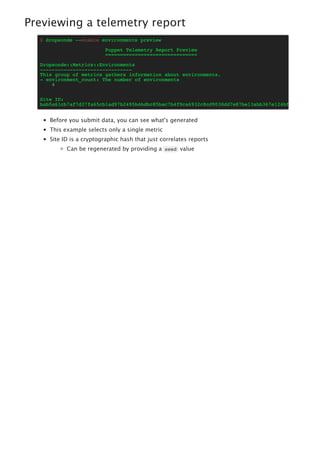
Previewing a telemetry report
$ dropsonde --enable environments preview
Puppet Telemetry Report Preview
===============================
Dropsonde::Metrics::Environments
-------------------------------
This group of metrics gathers information about environments.
- environment_count: The number of environments
4
Site ID:
bab5a61cb7af7d37fa65cb1ad97b2495b4bdbc85bac7b4f9ca6932c8cd9038dd7e87be13abb367e124bfdda2de14949
Before you submit data, you can see what's generated
This example selects only a single metric
Site ID is a cryptographic hash that just correlates reports
Can be regenerated by providing a seed value
Data validation
The plugin cannot return data that it does not declare.
The database schema is also defined from the plugin schemas.
Using the Data
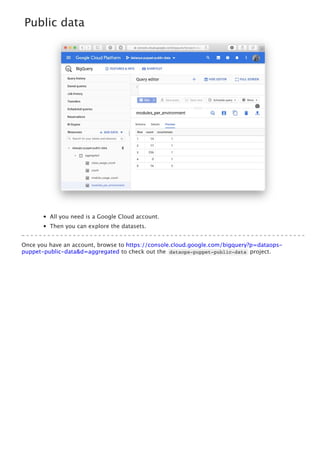
Public data
All you need is a Google Cloud account.
Then you can explore the datasets.
Once you have an account, browse to https://console.cloud.google.com/bigquery?p=dataops-
puppet-public-data&d=aggregated to check out the dataops-puppet-public-data project.
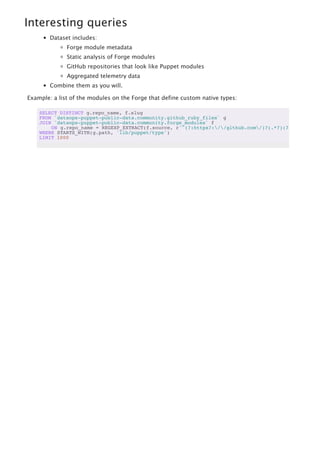
Interesting queries
Dataset includes:
Forge module metadata
Static analysis of Forge modules
GitHub repositories that look like Puppet modules
Aggregated telemetry data
Combine them as you will.
Example: a list of the modules on the Forge that define custom native types:
SELECT DISTINCT g.repo_name, f.slug
FROM `dataops-puppet-public-data.community.github_ruby_files` g
JOIN `dataops-puppet-public-data.community.forge_modules` f
ON g.repo_name = REGEXP_EXTRACT(f.source, r'^(?:https?://github.com/)?(.*?)(?:.git)?$'
WHERE STARTS_WITH(g.path, 'lib/puppet/type')
LIMIT 1000
So what else is possible?
Who knows, really.
Maybe we can incorporate Impact Analysis into PDK validations.
Maybe the Forge will start surfacing some of these metrics. (hint: it will)
Maybe Vox Pupuli will incorporate usage data into their Tasks management interface.
Maybe you will write something I haven't even thought of.
Get Involved!
What I'm asking from you
This is totally opt-in only right now.
puppet module install puppetlabs/dropsonde
Check out the example dataset and contribute some aggregation queries.
Develop and contribute a metric plugin.
Doesn't have to be strictly Puppet, just ecosystem:
Reid already made a plugin to see the impact of building a better control repo and
Puppetfile for better r10k deploys.
David could see how many people are using the Rocket.chat integration for
voxpupuli/puppet-webhook .
puppet module install puppetlabs/dropsonde
Build some tooling that uses the public data.
Seriously, install the module and classify your primary Puppet server. It would help a ton.
Dropsonde : an expendable weather reconnaissance device created by the National Center
for Atmospheric Research, designed to be dropped from an aircraft at altitude over water
to measure storm conditions as the device falls to the surface.

Installing Dropsonde is super straightforward. Install the puppetlabs-dropsonde Puppet
module and classify your Puppet server with the dropsonde class. If you have multiple
compile nodes, just classify the primary Puppet server. This will install the tool and
configure a weekly cron job to submit the reports.

Resources and Q&A

https://github.com/puppetlabs/dropsonde
https://github.com/puppetlabs/puppet-community-rangefinder
https://github.com/apps/puppet-community-rangefinder
https://binford2k.com/tags/#telemetry-ref
https://github.com/puppetlabs/dropsonde
https://github.com/puppetlabs/puppetlabs-dropsonde
https://github.com/puppetlabs/dropsonde-aggregation
https://binford2k.com/tags/#telemetry-ref
Impact Analysis of Puppet Modules
Downstream impact of pull requests
Telemetry that doesn't suck
Gathering metrics with a new Dropsonde plugin
Telemetry doesn't have to be scary; Ben Ford

Telemetry doesn't have to be scary; Ben Ford

  • 1.
    Telemetry doesn't haveto be scary Developer focused metrics that make sense.   
  • 2.
    Table of Contents Whywe need metrics Impact Analysis Privacy. It's a thing. Telemetry Data Model Metric Plugin Design Using the Data Get Involved!
  • 3.
    New talk, whodis? Ben Ford Developer Advocate @ Puppet @binford2k:   
  • 4.
    Why we needmetrics
  • 5.
    It's not ahuge task to design and build a simple, single-purpose, bespoke Puppet module in a short period of time. 
  • 6.
    Maintenance is adifferent story  Hey, can we add ArchLinux support? What about Windows 2012? Here's a PR for a defined type to manage the database too... (MariaDB only)
  • 7.
    Development resources   Every single platform or feature you support takes time to maintain it!
  • 8.
      Data driven developmentdecisions Two roads diverged in a wood, and I— I took the one less traveled by, And that has made all the difference. -- Robert Frost Photo by https://unsplash.com/@leliejens
  • 9.
  • 10.
    Rangefinder [~/Projects/puppetlabs-concat]$ rangefinder manifests/fragment.pp [concat::fragment]is a _type_ ================================== The enclosing module is declared in 173 of 575 indexed public Puppetfiles Breaking changes to this file WILL impact these modules: * nightfly-ssh_keys (https://github.com/nightfly19/puppet-ssh_keys.git) * viirya-mit_krb5 (git://github.com/viirya/puppet-mit_krb5.git) * rjpearce-opendkim (https://github.com/rjpearce/puppet-opendkim) * shadow-tor (git://github.com/LeShadow/puppet-tor.git) [...] Breaking changes to this file MAY impact these modules: * empi89-quagga (UNKNOWN) * unyonsys-keepalived (UNKNOWN) * Flameeyes-udevnet (UNKNOWN) * ricbra-ratbox (git://github.com/ricbra/puppet-ratbox.git) [...] https://github.com/puppetlabs/puppet-community-rangefinder Identify the public Forge modules using parts of your code.
  • 11.
    Run it ona pull request! https://github.com/apps/puppet-community-rangefinder Rangefinder also comes in a GitHub App flavor.
  • 12.
    Static analysis ofdependencies Works by dissecting latest releases of all modules on the Forge Static code analysis identifies what every module uses resource types functions classes Runs weekly to generate dependency network This uses my itemize library: https://github.com/binford2k/binford2k-itemize Photo by https://unsplash.com/@alinnnaaaa
  • 13.
    Dependency data ispublic Find more information about how it works and other cool queries you can run on the dataset powering it at my blog: https://binford2k.com/2020/04/06/rangefinder/ The data Rangefinder uses is stored in a public BigQuery database.
  • 14.
    Major limitation Rangefinder onlyworks on public Forge modules (currently). Cannot identify how code is used by profiles or private modules. Photo by https://unsplash.com/@sguestsmith
  • 15.
  • 16.
    Business Identifiable Information Mostof you know BII's big cousin, PII. But many of the same considerations apply to businesses. Many companies don't allow phone-home metrics at all. Sharing too much implementation information about how an infrastructure works is just asking for security compromises. 
  • 17.
    Fingerprinting A more insidiousdanger is fingerprinting. Identifying individuals by properties or habits. Also applies to infrastructures. If you saw that a site was in the CEST time zone, had the locale set to fr-ch , and had thousands of nodes classified with various HPC modules, then you might guess that you were looking at CERN. 
  • 18.
    Live example offingerprinting http://panopticlick.eff.org/
  • 19.
    Hard requirements  1. Providereal value to the end user. (that's you) 2. Transparent about what data is collected, why, and what it's used for. 3. Give you the ability to opt in or out without gating other benefits. 4. The data collected can be aggregated to share publicly.
  • 20.
  • 21.
    Public dataset No accessto individual records themselves -- The top ten most used classes in the ecosystem SELECT name, count FROM `dataops-puppet-public-data.aggregated.class_usage_count` ORDER BY count DESC LIMIT 10 [ { "name": "Resource_api::Agent", "count": "272" }, { "name": "Account", "count": "272" }, { "name": "Ssl::Params", "count": "272" }, { "name": "Classification", "count": "272" }, { "name": "Os_patching", "count": "269" }, { "name": "Ntp", "count": "265" }, { "name": "Ntp::Install", "count": "265" }, { "name": "Ntp::Config", "count": "265" }, { "name": "Ntp::Service", "count": "265" }, { "name": "Zsh::Params", "count": "265" } ] You'll need a Google Cloud account and then you can access the dataset with your browser via the BigQuery Console. Then you can run any queries you'd like.
  • 22.
    Aggregating data Data isgenerated via SQL queries: -- Generate an aggregate table of all classes used and their counts. SELECT classes.name, classes.count FROM `bto-dataops-datalake-prod.dujour.community_metrics`, UNNEST(classes) as classes GROUP BY classes.name, classes.count https://github.com/puppetlabs/dropsonde-aggregation
  • 23.
    Private dataset So aboutthat sensitive data... Telemetry reports are not terribly sensitive, but they are fingerprintable. So we store them only in a secured dataset. Limited access, only myself and our BigQuery admin team. Our own developers who want to use collected metrics data have to do it via aggregation queries just like you would. 
  • 24.
  • 25.
    Plugin hook design Pluginsare implemented as hooks. description schema example run Some hooks are optional initialize setup cleanup
  • 26.
    Schema hook Describes datathat the plugin is allowed to return. Returns a BigQuery schema. JSON format with an array of row definitions def self.schema [ { "description": "The number of environments", "mode": "NULLABLE", "name": "environment_count", "type": "INTEGER" } ] end See full schema of all plugins with dropsonde dev schema
  • 27.
    Run hook Generates andreturns data for the metric Returns an array of rows of data. Can return any data that the Puppet Server node can generate. Use PuppetDB, codebase, etc. Methods provided to filter out private modules. Must match schema or plugin fails. def self.run [ :environment_count => Puppet.lookup(:environments).list.count, ] end
  • 28.
    Example hook Representative exampleof sample data Provide one element of randomized representative data. Used to generate a dataset that's shaped like the real dataset. Must match the schema or plugin fails. Used for developers to generate aggregation queries. def self.example [ :environment_count => rand(1..100), ] end Available as dataops-puppet-public-data:community.community_metrics
  • 29.
    Previewing a telemetryreport $ dropsonde --enable environments preview Puppet Telemetry Report Preview =============================== Dropsonde::Metrics::Environments ------------------------------- This group of metrics gathers information about environments. - environment_count: The number of environments 4 Site ID: bab5a61cb7af7d37fa65cb1ad97b2495b4bdbc85bac7b4f9ca6932c8cd9038dd7e87be13abb367e124bfdda2de14949 Before you submit data, you can see what's generated This example selects only a single metric Site ID is a cryptographic hash that just correlates reports Can be regenerated by providing a seed value
  • 30.
    Data validation The plugincannot return data that it does not declare. The database schema is also defined from the plugin schemas.
  • 31.
  • 32.
    Public data All youneed is a Google Cloud account. Then you can explore the datasets. Once you have an account, browse to https://console.cloud.google.com/bigquery?p=dataops- puppet-public-data&d=aggregated to check out the dataops-puppet-public-data project.
  • 33.
    Interesting queries Dataset includes: Forgemodule metadata Static analysis of Forge modules GitHub repositories that look like Puppet modules Aggregated telemetry data Combine them as you will. Example: a list of the modules on the Forge that define custom native types: SELECT DISTINCT g.repo_name, f.slug FROM `dataops-puppet-public-data.community.github_ruby_files` g JOIN `dataops-puppet-public-data.community.forge_modules` f ON g.repo_name = REGEXP_EXTRACT(f.source, r'^(?:https?://github.com/)?(.*?)(?:.git)?$' WHERE STARTS_WITH(g.path, 'lib/puppet/type') LIMIT 1000
  • 34.
    So what elseis possible? Who knows, really. Maybe we can incorporate Impact Analysis into PDK validations. Maybe the Forge will start surfacing some of these metrics. (hint: it will) Maybe Vox Pupuli will incorporate usage data into their Tasks management interface. Maybe you will write something I haven't even thought of.
  • 35.
  • 36.
    What I'm askingfrom you This is totally opt-in only right now. puppet module install puppetlabs/dropsonde Check out the example dataset and contribute some aggregation queries. Develop and contribute a metric plugin. Doesn't have to be strictly Puppet, just ecosystem: Reid already made a plugin to see the impact of building a better control repo and Puppetfile for better r10k deploys. David could see how many people are using the Rocket.chat integration for voxpupuli/puppet-webhook . puppet module install puppetlabs/dropsonde Build some tooling that uses the public data. Seriously, install the module and classify your primary Puppet server. It would help a ton. Dropsonde : an expendable weather reconnaissance device created by the National Center for Atmospheric Research, designed to be dropped from an aircraft at altitude over water to measure storm conditions as the device falls to the surface.  Installing Dropsonde is super straightforward. Install the puppetlabs-dropsonde Puppet module and classify your Puppet server with the dropsonde class. If you have multiple compile nodes, just classify the primary Puppet server. This will install the tool and configure a weekly cron job to submit the reports. 
  • 38.