TelePsychiatry: Seamless Integration into the Full Spectrum of Mental Health Services Felissa P. Goldstein, M.D.  Board Certified Adult, Child and Adolescent Psychiatrist March 17 th , 2011
What are the Autism Spectrum Disorders (ASD)? A series of neurodevelopmental disorders Have deficits in social impairment and verbal and nonverbal communication. Includes repetitive behaviors, restricted interests and rigidity.  Lack basic skills in social relationships, play and communication.
Why Design a Telehealth Program for Children on the Autism Spectrum ?  “ I think autism is a good illness in some respects to use telemedicine for. The kids actually interact well with technology and more naturally than they do if you’re in the room. They’re not good with social relationships and they may find it easier to find someone talking to them from a television than they do face-to-face, which might make them more anxious.” (Peter Yellowlees at UC Davis,  in Terry 2009)
Why Design  a Telehealth Program for Children on the Autism Spectrum ?  Estimated 1 in 110 children in the United States have an ASD  ASDs occur across all racial, ethnic, and socioeconomic groups 4 to 5 times more likely to occur in boys If 4 million children are born in the United States annually, approximately 36,500 children will be diagnosed with an ASD. 
Why Design a Telehealth Program for Children on the Autism Spectrum ?  Increasing access to specialist care.  Improving how quickly children can get care.  Earlier identification and treatment of Autism Spectrum Disorders  Educating community doctors about developmental disabilities.
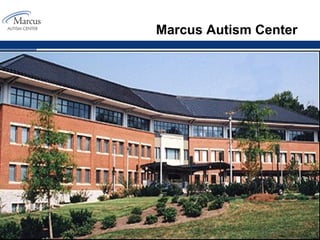
Marcus Autism Center
Marcus Autism Center Founded by Bernie & Billi Marcus in 1991 August 4, 2008, joined Children’s Healthcare of Atlanta
The Evolution of  a Telehealth Program  Collaboration with Ga. Partnership for Telehealth –Began in April 2009  In November 2010- Marcus Telemedicine Program becomes a part of the Children’s Healthcare of Atlanta Telemedicine Program
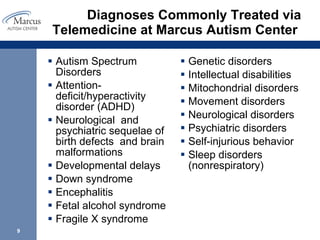
Diagnoses Commonly Treated via Telemedicine at Marcus Autism Center  Autism Spectrum Disorders Attention-deficit/hyperactivity disorder (ADHD) Neurological  and psychiatric sequelae of birth defects  and brain malformations Developmental delays Down syndrome Encephalitis Fetal alcohol syndrome  Fragile X syndrome Genetic disorders Intellectual disabilities Mitochondrial disorders Movement disorders Neurological disorders Psychiatric disorders Self-injurious behavior Sleep disorders (nonrespiratory)
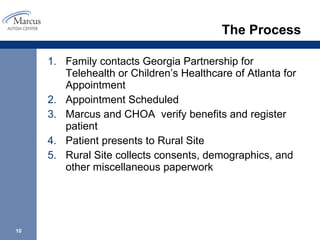
The Process Family contacts Georgia Partnership for Telehealth or Children’s Healthcare of Atlanta for Appointment Appointment Scheduled  Marcus and CHOA  verify benefits and register patient Patient presents to Rural Site  Rural Site collects consents, demographics, and other miscellaneous paperwork
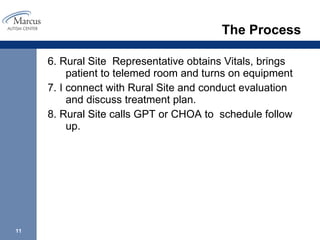
The Process 6. Rural Site  Representative obtains Vitals, brings patient to telemed room and turns on equipment 7. I connect with Rural Site and conduct evaluation and discuss treatment plan. 8. Rural Site calls GPT or CHOA to  schedule follow up.
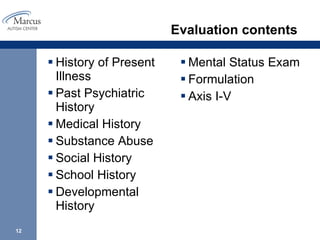
Evaluation contents  History of Present Illness Past Psychiatric History Medical History Substance Abuse Social History  School History  Developmental History  Mental Status Exam Formulation Axis I-V
Benefits Patient Less travel Less expensive Opportunity to see specialist Less time spent in car  Fewer missed work / school hours Easier for certain patients to connect with clinician Clinician  Less travel Fewer incidental expenses Less time away from family Seamless transition from one patient to next Ability to see patients throughout state
Benefits Patient Fast transmission speed now makes it equal to in person communication  Clinician Fast transmission speed now makes it equal to in person communication
Down Side Patient Harder to schedule emergency appointments Longer time to receive prescriptions Some families miss in person connection Problems at rural sites  with scheduling or equipment Clinician Insurance reimbursement varies No shows Harder to make  connection to children and families  Sharing bad news over telemedicine is hard
Down side Patient  Clinician  Increased paperwork  Mailing out  or calling in prescriptions Mailing out screening tools  Receiving relevant paperwork Lack of other specialists to refer patients to Speech and occupational  therapists  Psychotherapists. Behavioral specialists
The Future Research Quality of care / patient satisfaction Accuracy of diagnosis  by telemed vs. in office Designing systems to  evaluate children for developmental disorders  More specialties doing Telemedicine Streamlining process and simplifying logistics  Behavior Treatment  via Telemedicine  Teaching Social skills via telemedicine or interactive computer games
Questions??? Felissa Goldstein, M.D. The Marcus Autism Center 1920 Briarcliff Road  Atlanta, GA 30329 (404) 785-9405 [email_address]
References Autism Spectrum Disorders. National Institute of Mental Health., 41 pages with Jan. 2007 Addendum. http://www.nimh.nih.gov/health/publications/autism/complete-publication.shtml. Cheng, Keith and Myers, Kathleen.  Child and Adolescent Psychiatry The Essentials . Lippincott, Williams and Wilkins, 2005.  Facts for Families –American Academy of Child and Adolescent Psychiatry  Filipek, Pauline, Steinberg-Epstein, Robin, and Book, Teri. Interventions for Autistic Spectrum Disorders.  NeuroRX , 3:207-216, 2006. Hollander, Eric and Evdokia Anagnostou.  Clinical Manual for the Treatment of Autism . American Psychiatric Publishing Inc., 2007. http://www.cdc.gov/ncbddd/autism/data.html http://www.dana-farber.org/can/dictionary http://www.dsmivtr.org/index.cfm http://www.merck.com/mmhe/sec23/ch285/ch285a.html   King, Bryan and Bostic, Jeff. An Update on Pharmacologic Treatments for Autistic Spectrum Disorders.  Child and Adolescent Psychiatric Clinics of North America . 15(1) 161-175, 2006.  Johnson, Chris Plauche and Scott M. Myers. The Identification and Evaluation of Children with Autism Spectrum Disorders. Pediatrics. 120 (5) .1183-1215, 2007
References Myers, Scott, and Johnson, Chris Plauche. The Management of Children with Autism Spectrum Disorders.  Pediatrics , 120 (5)1162-1182, 2007.  Prevalence of Autism Spectrum Disorders --- Autism and Developmental Disabilities Monitoring Network, United States, 2006, MMWR, 12/18/2009, 58(SS10);1-20. Terry, Mark, Telemedicine and Autism: Researchers and clinicians are just starting to consider Telemedicine Applications for  the Diagnosis and Treatment of Autism,  Telemedicine and e-Health , 416-419, 2009

Tele psychiatry

  • 1.
    TelePsychiatry: Seamless Integration intothe Full Spectrum of Mental Health Services Felissa P. Goldstein, M.D. Board Certified Adult, Child and Adolescent Psychiatrist March 17 th , 2011
  • 2.
    What are theAutism Spectrum Disorders (ASD)? A series of neurodevelopmental disorders Have deficits in social impairment and verbal and nonverbal communication. Includes repetitive behaviors, restricted interests and rigidity. Lack basic skills in social relationships, play and communication.
  • 3.
    Why Design aTelehealth Program for Children on the Autism Spectrum ? “ I think autism is a good illness in some respects to use telemedicine for. The kids actually interact well with technology and more naturally than they do if you’re in the room. They’re not good with social relationships and they may find it easier to find someone talking to them from a television than they do face-to-face, which might make them more anxious.” (Peter Yellowlees at UC Davis, in Terry 2009)
  • 4.
    Why Design a Telehealth Program for Children on the Autism Spectrum ? Estimated 1 in 110 children in the United States have an ASD ASDs occur across all racial, ethnic, and socioeconomic groups 4 to 5 times more likely to occur in boys If 4 million children are born in the United States annually, approximately 36,500 children will be diagnosed with an ASD. 
  • 5.
    Why Design aTelehealth Program for Children on the Autism Spectrum ? Increasing access to specialist care. Improving how quickly children can get care. Earlier identification and treatment of Autism Spectrum Disorders Educating community doctors about developmental disabilities.
  • 6.
  • 7.
    Marcus Autism CenterFounded by Bernie & Billi Marcus in 1991 August 4, 2008, joined Children’s Healthcare of Atlanta
  • 8.
    The Evolution of a Telehealth Program Collaboration with Ga. Partnership for Telehealth –Began in April 2009 In November 2010- Marcus Telemedicine Program becomes a part of the Children’s Healthcare of Atlanta Telemedicine Program
  • 9.
    Diagnoses Commonly Treatedvia Telemedicine at Marcus Autism Center Autism Spectrum Disorders Attention-deficit/hyperactivity disorder (ADHD) Neurological and psychiatric sequelae of birth defects and brain malformations Developmental delays Down syndrome Encephalitis Fetal alcohol syndrome Fragile X syndrome Genetic disorders Intellectual disabilities Mitochondrial disorders Movement disorders Neurological disorders Psychiatric disorders Self-injurious behavior Sleep disorders (nonrespiratory)
  • 10.
    The Process Familycontacts Georgia Partnership for Telehealth or Children’s Healthcare of Atlanta for Appointment Appointment Scheduled Marcus and CHOA verify benefits and register patient Patient presents to Rural Site Rural Site collects consents, demographics, and other miscellaneous paperwork
  • 11.
    The Process 6.Rural Site Representative obtains Vitals, brings patient to telemed room and turns on equipment 7. I connect with Rural Site and conduct evaluation and discuss treatment plan. 8. Rural Site calls GPT or CHOA to schedule follow up.
  • 12.
    Evaluation contents History of Present Illness Past Psychiatric History Medical History Substance Abuse Social History School History Developmental History Mental Status Exam Formulation Axis I-V
  • 13.
    Benefits Patient Lesstravel Less expensive Opportunity to see specialist Less time spent in car Fewer missed work / school hours Easier for certain patients to connect with clinician Clinician Less travel Fewer incidental expenses Less time away from family Seamless transition from one patient to next Ability to see patients throughout state
  • 14.
    Benefits Patient Fasttransmission speed now makes it equal to in person communication Clinician Fast transmission speed now makes it equal to in person communication
  • 15.
    Down Side PatientHarder to schedule emergency appointments Longer time to receive prescriptions Some families miss in person connection Problems at rural sites with scheduling or equipment Clinician Insurance reimbursement varies No shows Harder to make connection to children and families Sharing bad news over telemedicine is hard
  • 16.
    Down side Patient Clinician Increased paperwork Mailing out or calling in prescriptions Mailing out screening tools Receiving relevant paperwork Lack of other specialists to refer patients to Speech and occupational therapists Psychotherapists. Behavioral specialists
  • 17.
    The Future ResearchQuality of care / patient satisfaction Accuracy of diagnosis by telemed vs. in office Designing systems to evaluate children for developmental disorders More specialties doing Telemedicine Streamlining process and simplifying logistics Behavior Treatment via Telemedicine Teaching Social skills via telemedicine or interactive computer games
  • 18.
    Questions??? Felissa Goldstein,M.D. The Marcus Autism Center 1920 Briarcliff Road Atlanta, GA 30329 (404) 785-9405 [email_address]
  • 19.
    References Autism SpectrumDisorders. National Institute of Mental Health., 41 pages with Jan. 2007 Addendum. http://www.nimh.nih.gov/health/publications/autism/complete-publication.shtml. Cheng, Keith and Myers, Kathleen. Child and Adolescent Psychiatry The Essentials . Lippincott, Williams and Wilkins, 2005. Facts for Families –American Academy of Child and Adolescent Psychiatry Filipek, Pauline, Steinberg-Epstein, Robin, and Book, Teri. Interventions for Autistic Spectrum Disorders. NeuroRX , 3:207-216, 2006. Hollander, Eric and Evdokia Anagnostou. Clinical Manual for the Treatment of Autism . American Psychiatric Publishing Inc., 2007. http://www.cdc.gov/ncbddd/autism/data.html http://www.dana-farber.org/can/dictionary http://www.dsmivtr.org/index.cfm http://www.merck.com/mmhe/sec23/ch285/ch285a.html King, Bryan and Bostic, Jeff. An Update on Pharmacologic Treatments for Autistic Spectrum Disorders. Child and Adolescent Psychiatric Clinics of North America . 15(1) 161-175, 2006. Johnson, Chris Plauche and Scott M. Myers. The Identification and Evaluation of Children with Autism Spectrum Disorders. Pediatrics. 120 (5) .1183-1215, 2007
  • 20.
    References Myers, Scott,and Johnson, Chris Plauche. The Management of Children with Autism Spectrum Disorders. Pediatrics , 120 (5)1162-1182, 2007. Prevalence of Autism Spectrum Disorders --- Autism and Developmental Disabilities Monitoring Network, United States, 2006, MMWR, 12/18/2009, 58(SS10);1-20. Terry, Mark, Telemedicine and Autism: Researchers and clinicians are just starting to consider Telemedicine Applications for the Diagnosis and Treatment of Autism, Telemedicine and e-Health , 416-419, 2009