REMOTE PATIENT MONITORING
ROI: The Business Case
Georgia Partnership for Telehealth
6th Annual Spring Conference
March 2015
Joseph Ebberwein
Longitudinal Health
REMOTE PATIENT MONITORING
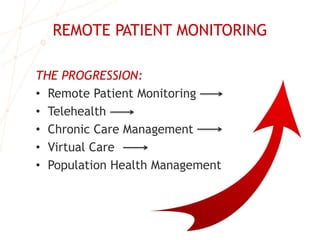
THE PROGRESSION:
• Remote Patient Monitoring
• Telehealth
• Chronic Care Management
• Virtual Care
• Population Health Management
VOLUME TO VALUE
HEALTHCARE TRANSFORMATION
NEW CARE DELIVERY MODELS:
• Accountable Care Organizations (ACOs)
• Medical Homes (PCMHs)
• Medicare/Medicaid Dual Eligible State Demonstration Projects
• Bundled Payments:
— Medicare Bundled Payment Care Initiatives (BPIC)
— Insurer (Payer) Initiatives
• Self-Insured Employers
• Other Emerging Models:
— Shared Risk
— Shared Savings
— Capitated/Episodic Payment
IN HOME TECHNOLOGIES
• BODY
o Vital Sign Monitors
o Activity Monitors
o Sleep Monitors
o Mobile PERS with GPS
o Medication Adherence
Monitors
o Medication Dispensers
o Urine Analyzer
• HOME
o Fall Detection
o Video Monitoring
o Environment Sensors
o Passive Monitoring Sensors
• COMMUNITY
o Social Network
o Social Communication
o Physical & Cognitive Gaming
o Social Networking
o Gaming Technologies
• CAREGIVING
o Caregiving Portals
o Caregiving Coordination
Platforms
Source: Center for Technology and Aging, The New Era of Connected Aging: A Framework for
Understanding Technologies that Support Older Adults in Aging in Place, 2014.
VIRTUAL CARE
VIRTUAL CARE ELEMENTS:
• Remote Biometric Monitoring
• IVR:
— Patient Reporting/Bluetooth
• Telephony:
— Health Coach Prescribed Calls
— SN Intervention Calls
• Bi-directional Video Visits (MD,
RN & Patient)
• ADL Monitoring
• Medication Adherence/Reminders
• 24/7 RN Triage
VIRTUAL CARE TEAM:
• Nurse Care Coordinators
• Triage Nurses
• Specialty Nurses
— Cardiology
— Endocrinology/Nephrology
— Neurology
— Oncology
— Pulmonology
— Geriatric
— Wound/Ostomy
• Pharmacists
• Health Coaches
• Behavioral Specialists
• Dieticians
THE RETURN ON INVESTMENT
RETURN ON INVESTMENT
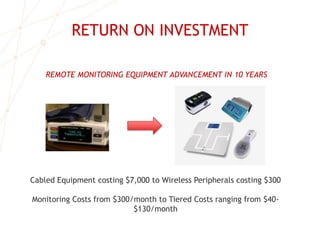
REMOTE MONITORING EQUIPMENT ADVANCEMENT IN 10 YEARS
Cabled Equipment costing $7,000 to Wireless Peripherals costing $300
Monitoring Costs from $300/month to Tiered Costs ranging from $40-
$130/month
RETURN ON INVESTMENT
TELEHEALTH PRODUCES ROI:
 HOSPITALS:
Current: Reduction in Readmission Penalties
Future: Bundled Reimbursement
 HOME HEALTH AGENCIES:
Current: Increase in Staff Capacity (Caseload)
Reduction in SN Visits/Episode
Future: Bundled Reimbursement
Penalties for Readmissions
 SKILLED NURSING FACILITY:
Current: Reduction in Wound Care Costs
Future: Bundled Reimbursement
Readmission Penalties
RETURN ON INVESTMENT
• TELEHEALTH:
– Increases Provider’s Care Team Capacity
– Increases Quality Outcomes
– Reduces Expenses of High Risk/High Cost Patients
– Decreases Days in Skilled Nursing Facilities
– Virtual Wound Care
– Reduction in PMPM Cost (SNF, HHA, Hospice)
– Reduction in Provider Liability for Wound Mgt.
– Higher Reimbursement Rates from Commercial Payers
– Decreases PMPM Spend by Reducing Acute Care Hospital
Admissions & Readmissions Rates
– Increases Commercial Payer Contract Reimbursement
RESULTS
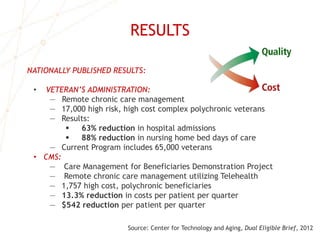
NATIONALLY PUBLISHED RESULTS:
• VETERAN’S ADMINISTRATION:
— Remote chronic care management
— 17,000 high risk, high cost complex polychronic veterans
— Results:
 63% reduction in hospital admissions
 88% reduction in nursing home bed days of care
— Current Program includes 65,000 veterans
• CMS:
— Care Management for Beneficiaries Demonstration Project
— Remote chronic care management utilizing Telehealth
— 1,757 high cost, polychronic beneficiaries
— 13.3% reduction in costs per patient per quarter
— $542 reduction per patient per quarter
Source: Center for Technology and Aging, Dual Eligible Brief, 2012
RESULTS
Source: Advanced Telehealth Solutions
CHF STUDY:
• 83 heart patients
• 4-5 chronic diseases
• 6 month study
RESULTS
Source: Advanced Telehealth Solutions
Reduced Hospitalizations for Multiple Co-morbidities
Telehealth Intervention:
• Post Hospital Discharge Program
• Polychronic Disease Patients
• 30 Day Program
• Telephonic Intervention
STATE MEDICAID
TELEHEALTH RESULTS
OVERALL RESULTS *:
• Hospitalization Rate:
— 65% Reduction in Hospitalizations
• ER Visit Rate:
— 68% Reduction in ER Visits
RESULTS BY CHRONIC DISEASE *:
• CHF- 59% Reduction in Hospitalizations
• COPD- 63% Reduction in Hospitalizations
• Diabetes- 63% Reduction in Hospitalizations
• Hypertension- 69% Reduction in Hospitalizations
Source: Advanced Telehealth Solutions* Per 1000 Days
OPPORTUNITIES
PROVIDER OPPORTUNITIES
• HOSPITALS:
– Reduce Preventable 30 Day Readmissions for CMS Designated
Diagnoses with Associated Penalties (CHF, AMI, Pneumonia,
COPD, Hip & Knee Replacements)
• PHYSICIANS:
– Reimbursement for Medicare Care Management Fees
 Chronic Care Management Fee (2015)
 Medicare Transitional Care Management Fee
 Medicare ESRD Care Management Fee
– Managed Care Contracts (Medicare Advantage, Medicaid,
Commercial Payers)
 Chronic Care Management Fees
 Incentive Based Contracts
• POST ACUTE:
– Increases Staff Capacity, Lowers Cost Of Care
– Increases Quality Outcomes
– Reduces 30 Day Hospital Readmissions & ER Visits
– Care Transitions to Home
Joseph F. Ebberwein
Longitudinal Health
Joseph.Ebberwein@LongitudinalHealth.com
(888) 670-6787
www.LongitudinalHealth.com

Joseph ebberwein 2015 gpt conference

  • 1.
    REMOTE PATIENT MONITORING ROI:The Business Case Georgia Partnership for Telehealth 6th Annual Spring Conference March 2015 Joseph Ebberwein Longitudinal Health
  • 2.
    REMOTE PATIENT MONITORING THEPROGRESSION: • Remote Patient Monitoring • Telehealth • Chronic Care Management • Virtual Care • Population Health Management
  • 3.
    VOLUME TO VALUE HEALTHCARETRANSFORMATION NEW CARE DELIVERY MODELS: • Accountable Care Organizations (ACOs) • Medical Homes (PCMHs) • Medicare/Medicaid Dual Eligible State Demonstration Projects • Bundled Payments: — Medicare Bundled Payment Care Initiatives (BPIC) — Insurer (Payer) Initiatives • Self-Insured Employers • Other Emerging Models: — Shared Risk — Shared Savings — Capitated/Episodic Payment
  • 4.
    IN HOME TECHNOLOGIES •BODY o Vital Sign Monitors o Activity Monitors o Sleep Monitors o Mobile PERS with GPS o Medication Adherence Monitors o Medication Dispensers o Urine Analyzer • HOME o Fall Detection o Video Monitoring o Environment Sensors o Passive Monitoring Sensors • COMMUNITY o Social Network o Social Communication o Physical & Cognitive Gaming o Social Networking o Gaming Technologies • CAREGIVING o Caregiving Portals o Caregiving Coordination Platforms Source: Center for Technology and Aging, The New Era of Connected Aging: A Framework for Understanding Technologies that Support Older Adults in Aging in Place, 2014.
  • 5.
    VIRTUAL CARE VIRTUAL CAREELEMENTS: • Remote Biometric Monitoring • IVR: — Patient Reporting/Bluetooth • Telephony: — Health Coach Prescribed Calls — SN Intervention Calls • Bi-directional Video Visits (MD, RN & Patient) • ADL Monitoring • Medication Adherence/Reminders • 24/7 RN Triage VIRTUAL CARE TEAM: • Nurse Care Coordinators • Triage Nurses • Specialty Nurses — Cardiology — Endocrinology/Nephrology — Neurology — Oncology — Pulmonology — Geriatric — Wound/Ostomy • Pharmacists • Health Coaches • Behavioral Specialists • Dieticians
  • 6.
    THE RETURN ONINVESTMENT
  • 7.
    RETURN ON INVESTMENT REMOTEMONITORING EQUIPMENT ADVANCEMENT IN 10 YEARS Cabled Equipment costing $7,000 to Wireless Peripherals costing $300 Monitoring Costs from $300/month to Tiered Costs ranging from $40- $130/month
  • 8.
    RETURN ON INVESTMENT TELEHEALTHPRODUCES ROI:  HOSPITALS: Current: Reduction in Readmission Penalties Future: Bundled Reimbursement  HOME HEALTH AGENCIES: Current: Increase in Staff Capacity (Caseload) Reduction in SN Visits/Episode Future: Bundled Reimbursement Penalties for Readmissions  SKILLED NURSING FACILITY: Current: Reduction in Wound Care Costs Future: Bundled Reimbursement Readmission Penalties
  • 9.
    RETURN ON INVESTMENT •TELEHEALTH: – Increases Provider’s Care Team Capacity – Increases Quality Outcomes – Reduces Expenses of High Risk/High Cost Patients – Decreases Days in Skilled Nursing Facilities – Virtual Wound Care – Reduction in PMPM Cost (SNF, HHA, Hospice) – Reduction in Provider Liability for Wound Mgt. – Higher Reimbursement Rates from Commercial Payers – Decreases PMPM Spend by Reducing Acute Care Hospital Admissions & Readmissions Rates – Increases Commercial Payer Contract Reimbursement
  • 10.
    RESULTS NATIONALLY PUBLISHED RESULTS: •VETERAN’S ADMINISTRATION: — Remote chronic care management — 17,000 high risk, high cost complex polychronic veterans — Results:  63% reduction in hospital admissions  88% reduction in nursing home bed days of care — Current Program includes 65,000 veterans • CMS: — Care Management for Beneficiaries Demonstration Project — Remote chronic care management utilizing Telehealth — 1,757 high cost, polychronic beneficiaries — 13.3% reduction in costs per patient per quarter — $542 reduction per patient per quarter Source: Center for Technology and Aging, Dual Eligible Brief, 2012
  • 11.
    RESULTS Source: Advanced TelehealthSolutions CHF STUDY: • 83 heart patients • 4-5 chronic diseases • 6 month study
  • 12.
    RESULTS Source: Advanced TelehealthSolutions Reduced Hospitalizations for Multiple Co-morbidities Telehealth Intervention: • Post Hospital Discharge Program • Polychronic Disease Patients • 30 Day Program • Telephonic Intervention
  • 13.
    STATE MEDICAID TELEHEALTH RESULTS OVERALLRESULTS *: • Hospitalization Rate: — 65% Reduction in Hospitalizations • ER Visit Rate: — 68% Reduction in ER Visits RESULTS BY CHRONIC DISEASE *: • CHF- 59% Reduction in Hospitalizations • COPD- 63% Reduction in Hospitalizations • Diabetes- 63% Reduction in Hospitalizations • Hypertension- 69% Reduction in Hospitalizations Source: Advanced Telehealth Solutions* Per 1000 Days
  • 14.
  • 15.
    PROVIDER OPPORTUNITIES • HOSPITALS: –Reduce Preventable 30 Day Readmissions for CMS Designated Diagnoses with Associated Penalties (CHF, AMI, Pneumonia, COPD, Hip & Knee Replacements) • PHYSICIANS: – Reimbursement for Medicare Care Management Fees  Chronic Care Management Fee (2015)  Medicare Transitional Care Management Fee  Medicare ESRD Care Management Fee – Managed Care Contracts (Medicare Advantage, Medicaid, Commercial Payers)  Chronic Care Management Fees  Incentive Based Contracts • POST ACUTE: – Increases Staff Capacity, Lowers Cost Of Care – Increases Quality Outcomes – Reduces 30 Day Hospital Readmissions & ER Visits – Care Transitions to Home
  • 16.
    Joseph F. Ebberwein LongitudinalHealth Joseph.Ebberwein@LongitudinalHealth.com (888) 670-6787 www.LongitudinalHealth.com