Clinical Decision Support Consortium Blackford Middleton, MD, MPH, MSc Lana Tsurikova, MSc, MA Adam Wright, PhD Brigham & Women’s Hospital Partners Healthcare Harvard Medical School
Agenda AHRQ Goals Background Key research questions Teams compositions Review of projects Timelines Discussion
AHRQ’s Goals for Advancing Clinical Decision Support _______________________________________________ To facilitate the development, adoption, implementation and evaluation of best practices using CDS.  To further enhance the nation's efforts to make evidence-based clinical knowledge more readily available to health care providers.
CDS Demonstration Projects _______________________________________________   Objective  To develop, implement, and evaluate projects that advance the understanding of how best to incorporate CDS into health care delivery. Overall goal Explore how the translation of clinical knowledge into CDS can be routinized in practice and taken to scale in order to improve the quality of healthcare delivery in the U.S.  Funding $1.25 million per project per year for two years
Other Key Demonstration Goals _______________________________________________ Incorporate CDS into EHRs certified by the Certification Commission for Health IT (CCHIT). Demonstrate cross-platform utility. Establish lessons learned for CDS implementation across the health IT vendor community. Assess potential benefits and drawbacks of CDS. Evaluate methods for creating, storing, and replicating CDS elements across multiple clinical sites and ambulatory practices.  Translate clinical guidelines and outcomes related to preventive health care and treatment of patients with chronic illnesses.
CDS Consortium Members Partners Healthcare Regenstrief Institute Veteran’s Health Administration Kaiser/NWRC Siemens/NextGen GE Masspro
Background Clinical decision support has been applied to  increase quality and patient safety improve adherence to guidelines for prevention and treatment avoid medication errors Systematic reviews have shown that CDS can be useful across a variety of clinical purposes and topics Current adoption of advanced clinical decision support is limited due to a variety of reasons, including: Limited implementation of EMR, CPOE, PHR, etc.  Difficulty developing clinical practice guidelines A lack of standards  Absence of a central repository or knowledge resource Poor support for CDS in commercial EHRs Challenges in integrating CDS into the clinical workflow A limited understanding of organizational, and cultural issues relating to clinical decision support
Significance The CDS Consortium will carry out a program of research and development activities to improve our knowledge about clinical decision support, with the ultimate goal of supporting and enabling widespread sharing and adoption of clinical decision support in diverse record systems.
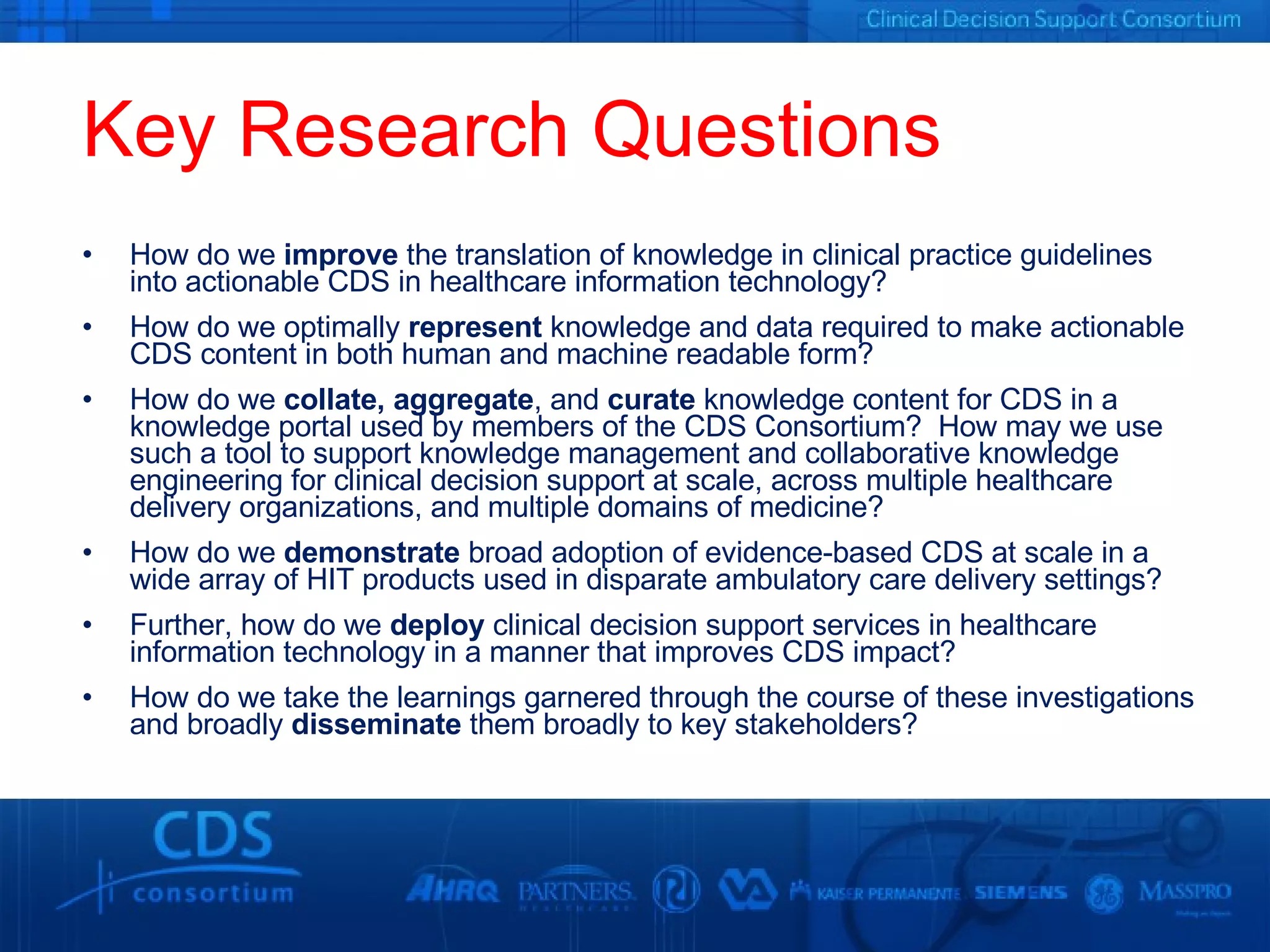
Key Research Questions How do we  improve  the translation of knowledge in clinical practice guidelines into actionable CDS in healthcare information technology? How do we optimally  represent  knowledge and data required to make actionable CDS content in both human and machine readable form? How do we  collate, aggregate , and  curate  knowledge content for CDS in a knowledge portal used by members of the CDS Consortium?  How may we use such a tool to support knowledge management and collaborative knowledge engineering for clinical decision support at scale, across multiple healthcare delivery organizations, and multiple domains of medicine? How do we  demonstrate  broad adoption of evidence-based CDS at scale in a wide array of HIT products used in disparate ambulatory care delivery settings?  Further, how do we  deploy  clinical decision support services in healthcare information technology in a manner that improves CDS impact? How do we take the learnings garnered through the course of these investigations and broadly  disseminate  them broadly to key stakeholders?
CDS Consortium Goal To  assess, define, demonstrate,  and  evaluate  best practices for knowledge management and clinical decision support in healthcare information technology at scale – across multiple ambulatory care settings and EHR technology platforms.
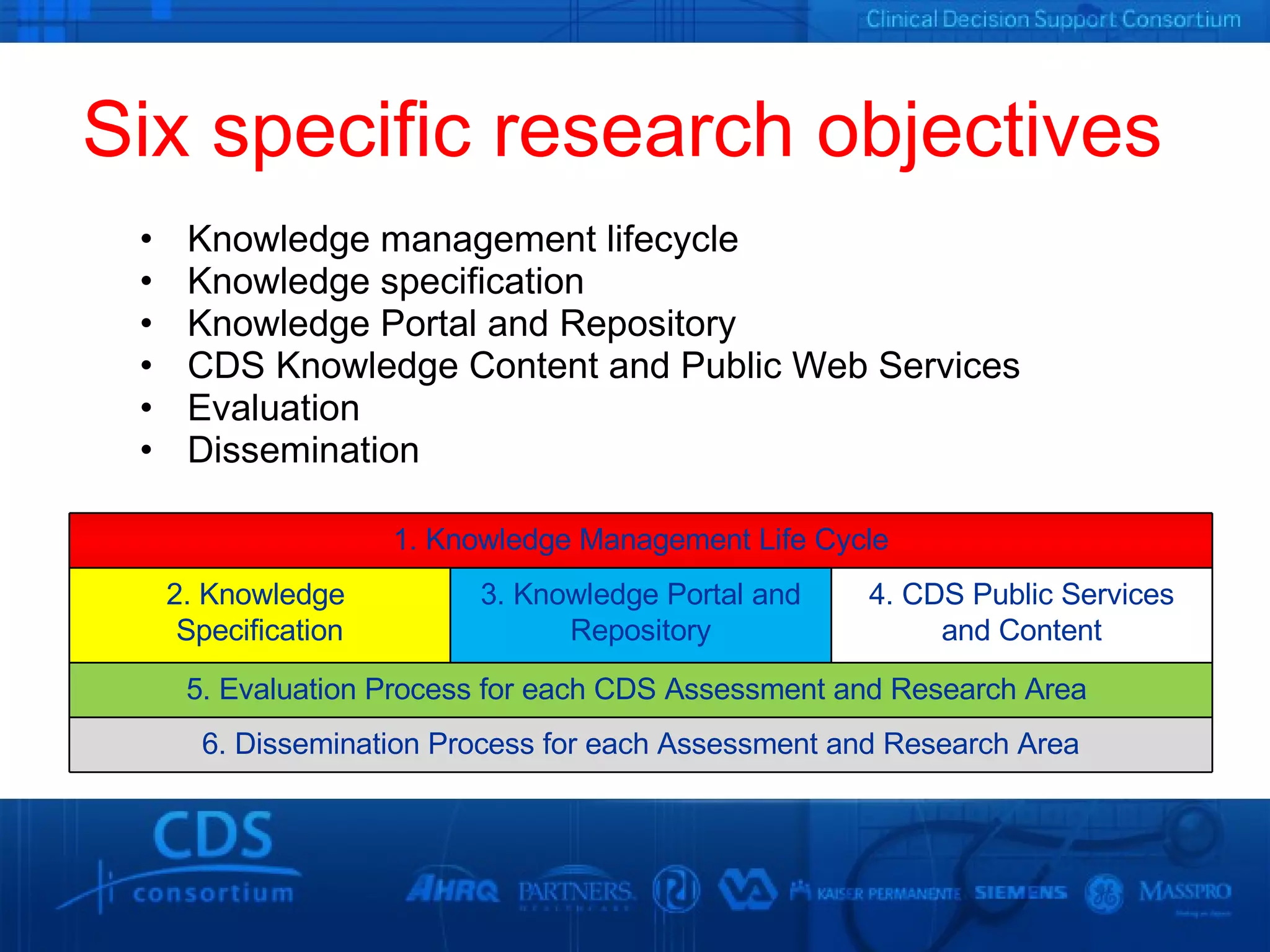
Six specific research objectives Knowledge management lifecycle Knowledge specification Knowledge Portal and Repository CDS Knowledge Content and Public Web Services  Evaluation Dissemination 1. Knowledge Management Life Cycle 2. Knowledge  Specification 3. Knowledge Portal and Repository 4. CDS Public Services and Content 5. Evaluation Process for each CDS Assessment and Research Area  6. Dissemination Process for each Assessment and Research Area
Guidelines To Implement Diabetes Mellitus 2007 Diabetes Management Standards of Care from the Clinical Practice Recommendations of the American Diabetes Association. Coronary Artery Disease  American College of Cardiology’s guideline on Antiplatelet Therapy Prescribed for Patients with Coronary Artery Disease U.S. Preventive Services Task Force recommendation on Aspirin for the Primary Prevention of Cardiovascular Events Hypertension U.S. Preventive Services Task Force recommendations on Screening for High Blood Pressure
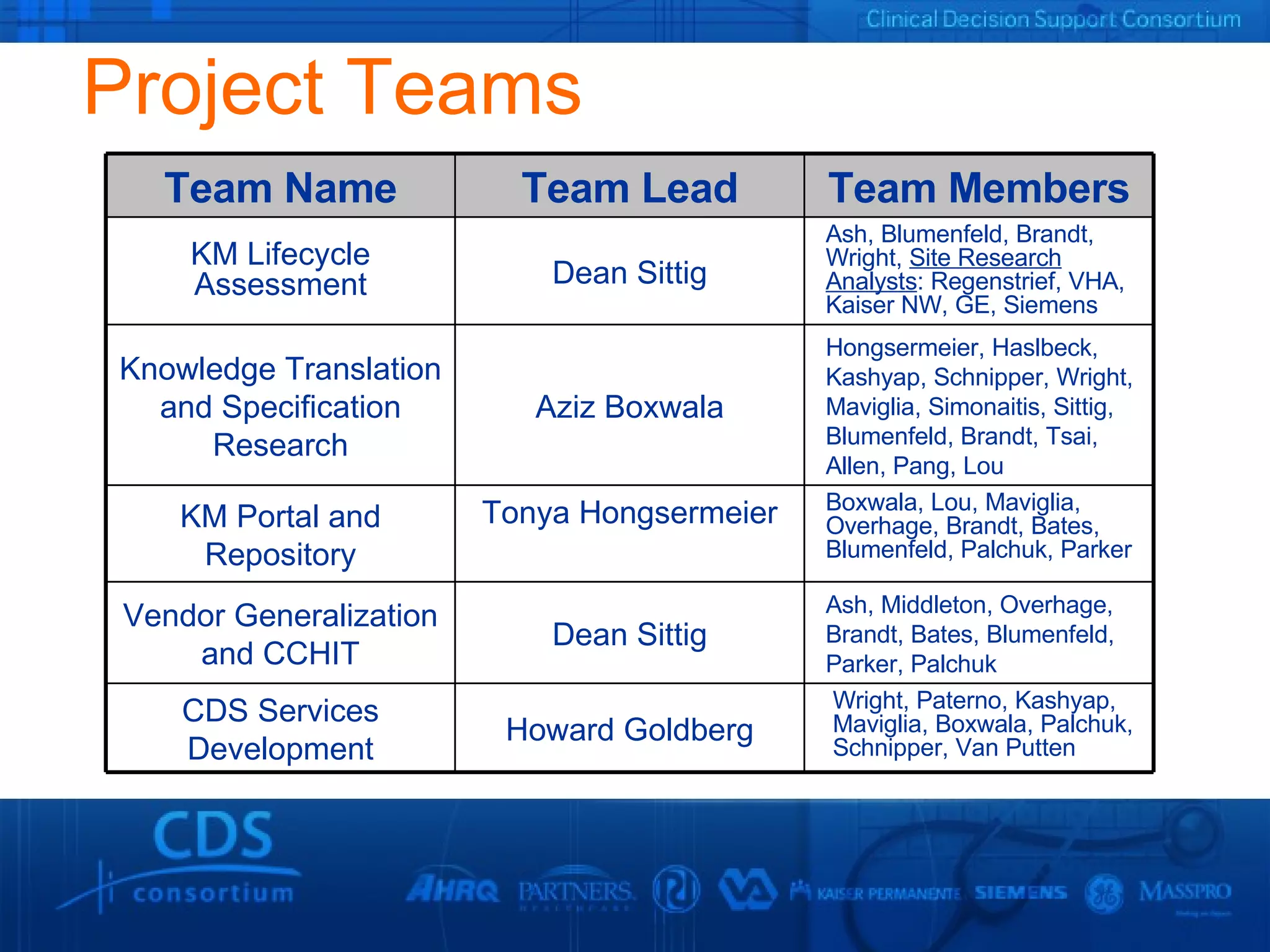
Project Teams Team Name Team Lead Team Members KM Lifecycle Assessment Dean Sittig Ash, Blumenfeld, Brandt, Wright,  Site Research Analysts : Regenstrief, VHA, Kaiser NW, GE, Siemens Knowledge Translation and Specification Research Aziz Boxwala Hongsermeier, Haslbeck, Kashyap, Schnipper, Wright, Maviglia, Simonaitis, Sittig, Blumenfeld, Brandt, Tsai, Allen, Pang, Lou KM Portal and Repository Tonya  Hongsermeier Boxwala, Lou, Maviglia, Overhage, Brandt, Bates, Blumenfeld, Palchuk, Parker Vendor Generalization and CCHIT Dean Sittig Ash, Middleton, Overhage,  Brandt, Bates, Blumenfeld, Parker, Palchuk CDS Services Development Howard Goldberg Wright, Paterno, Kashyap, Maviglia, Boxwala, Palchuk, Schnipper, Van Putten
Project Teams, Cont. Team Name Team Lead Team Members CDS Demonstrations Site leads:  Palchuk, Overhage, Doebbeling, Brandt, Blumenfeld Site Analysts CDS Dashboards Jonathan Einbinder Site Leads, and analysts CDS Evaluation David Bates Site Leads, and analysts Masspro Dissemination Ken LaBresh Parker, Kimker Joint Information Modeling Working Team Cheryl Van Putten Boxwala, Goldberg, Kashyap, Maviglia, Palchuk, Paterno, Wright, Tsurikova
Consortium Personnel Structure AHRQ Program Officer Teresa Zayas-Caban Steering Committee Middleton (Chair), Members: Bates, Brandt, Savage Doebbeling, Overhage, Sittig, LaBresh, Boxwala, Hongsermeier, Einbinder, Goldberg, Wright Principal Investigator Blackford Middleton Program Management Lana Tsurikova Financial Management Ellen Rosenblatt Project Teams Project Teams
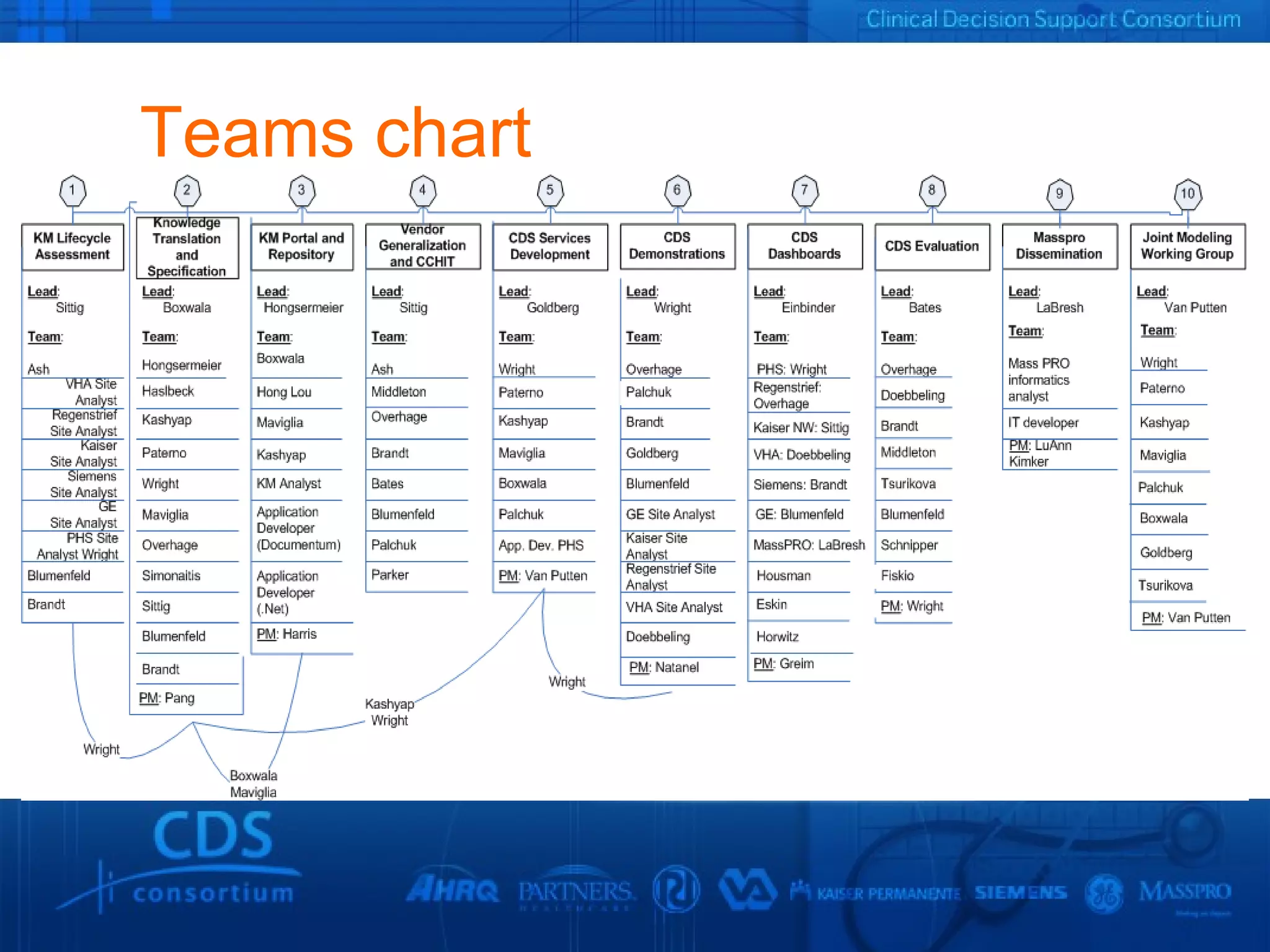
Teams chart
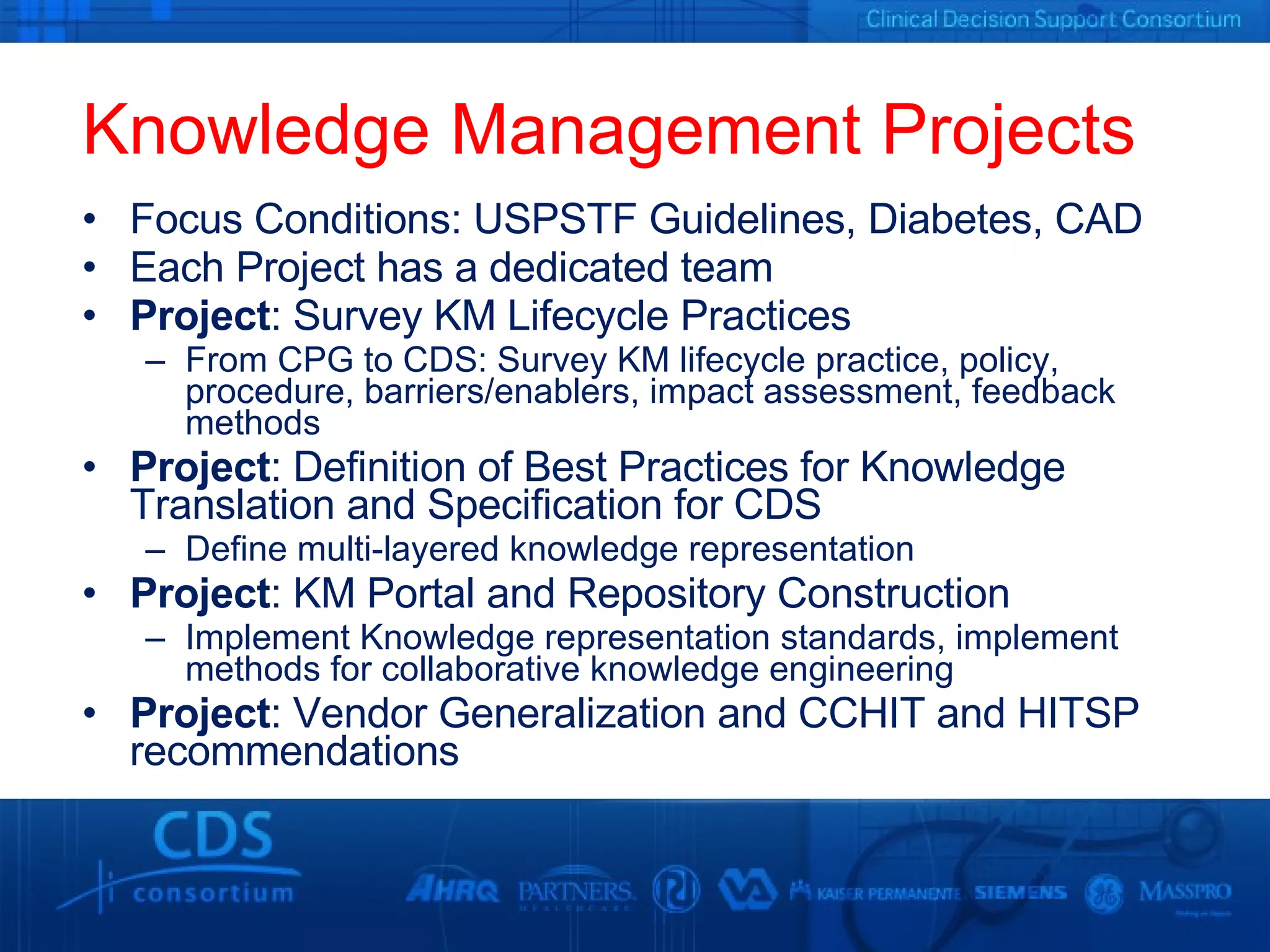
Knowledge Management Projects Focus Conditions: USPSTF Guidelines, Diabetes, CAD Each Project has a dedicated team  Project : Survey KM Lifecycle Practices From CPG to CDS: Survey KM lifecycle practice, policy, procedure, barriers/enablers, impact assessment, feedback methods Project : Definition of Best Practices for Knowledge Translation and Specification for CDS Define multi-layered knowledge representation Project : KM Portal and Repository Construction Implement Knowledge representation standards, implement methods for collaborative knowledge engineering Project : Vendor Generalization and CCHIT and HITSP recommendations
CDS Knowledge Content and  Public Web Services Projects Project : Incorporating knowledge-based web services for CDS Build CDS Web Services for focus conditions Project : Demonstration: KM Portal and Repository for CDS Knowledge Content and Collaboration Demonstrate Collaborative KE methods to arrive at consensus opinion of CDS for USPSTF guidelines, DM, and CAD Store consensus defined knowledge artifacts for USPSTF guidelines, DM, and CAD in KM Repository
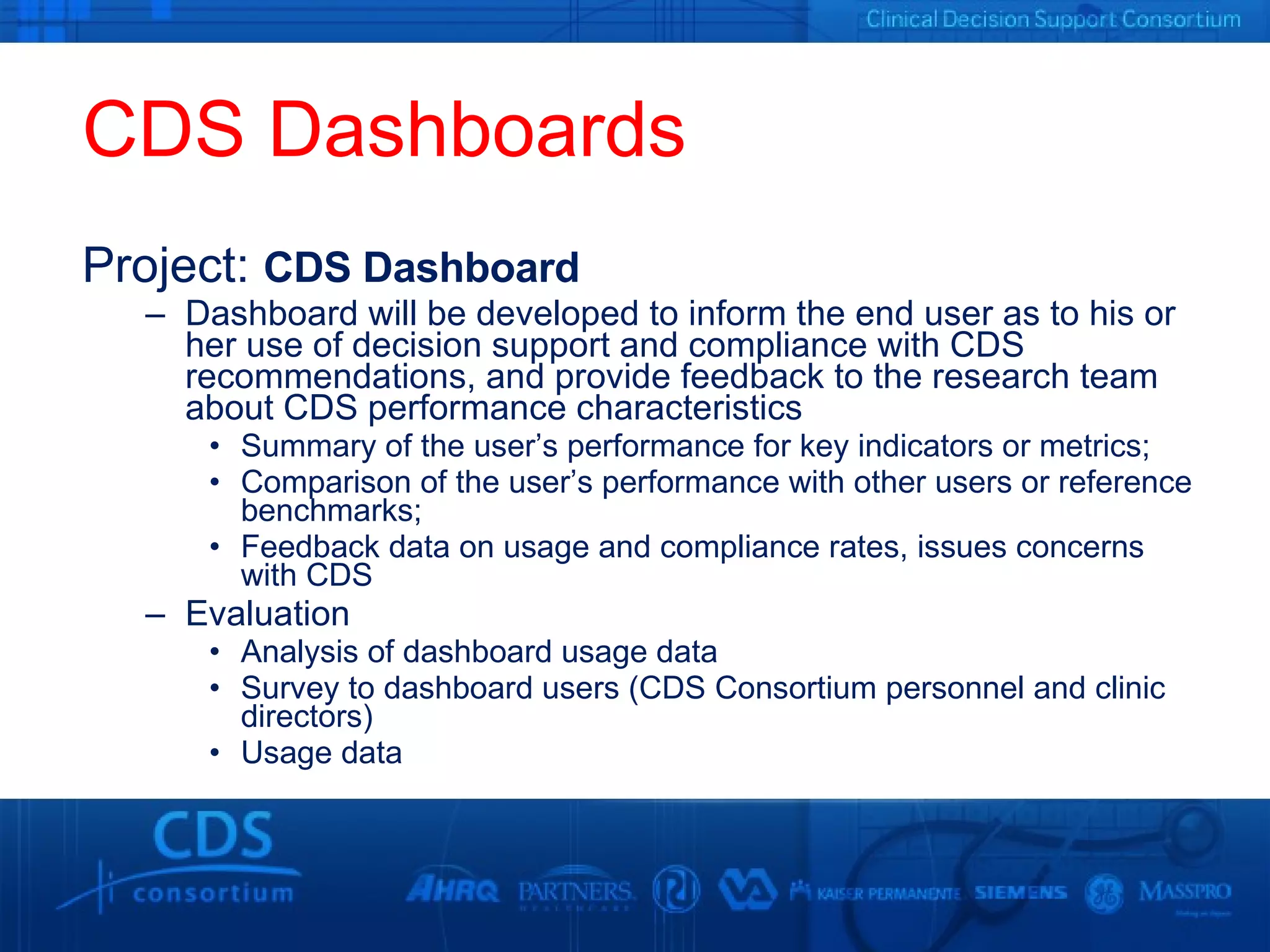
CDS Dashboards Project:  CDS Dashboard   Dashboard will be developed to inform the end user as to his or her use of decision support and compliance with CDS recommendations, and provide feedback to the research team about CDS performance characteristics  Summary of the user’s performance for key indicators or metrics; Comparison of the user’s performance with other users or reference benchmarks; Feedback data on usage and compliance rates, issues concerns with CDS Evaluation Analysis of dashboard usage data  Survey to dashboard users (CDS Consortium personnel and clinic directors) Usage data
Demonstrations Project:  Phase 1 CDS for Preventive Care Services Demonstration at one site Partners LMR:  Implementation of improved USPSTF Guidelines in LMR Implementation of CDS Dashboard for Preventive Care Team CDS Services Development Team CDS Services Development Project:  Phase 1 CDS for Chronic Care Demonstration at one Site Partners LMR:  DM and CAD guidelines in KM Portal and Repository Implementation of improved CAD/DM Guidelines in LMR Smart Forms II in one site Implementation of CDS Dashboard for CAD/DM Chronic Care Team CDS Services Development Evaluation of both projects above Team: Partners Evaluation Team
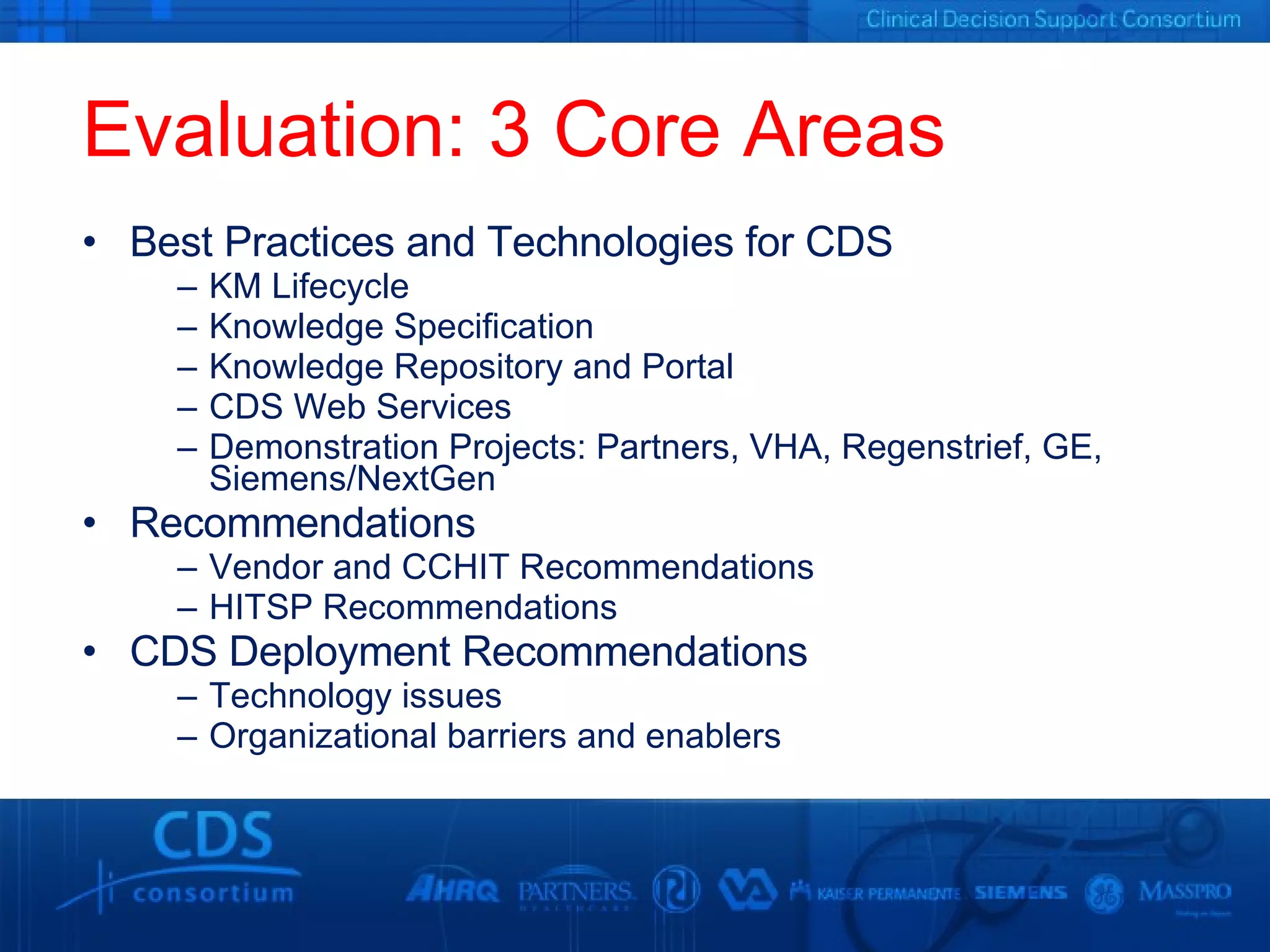
Evaluation: 3 Core Areas Best Practices and Technologies for CDS KM Lifecycle Knowledge Specification Knowledge Repository and Portal CDS Web Services Demonstration Projects: Partners, VHA, Regenstrief, GE, Siemens/NextGen Recommendations Vendor and CCHIT Recommendations HITSP Recommendations CDS Deployment Recommendations Technology issues Organizational barriers and enablers
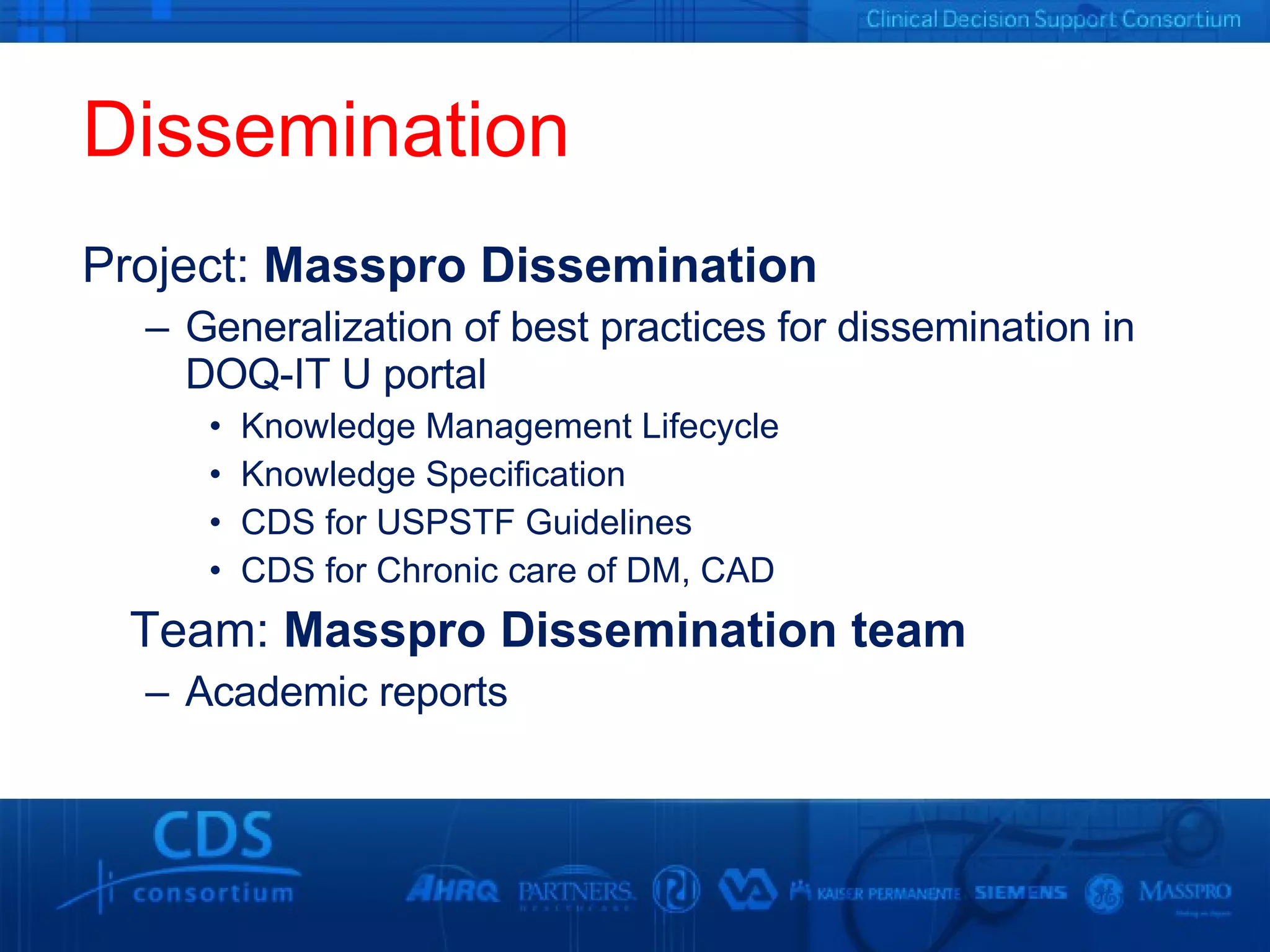
Dissemination Project:  Masspro Dissemination  Generalization of best practices for dissemination in DOQ-IT U portal Knowledge Management Lifecycle Knowledge Specification CDS for USPSTF Guidelines  CDS for Chronic care of DM, CAD Team:  Masspro Dissemination team Academic reports
Timeline Overview
Discussion Thank you! Blackford Middleton, MD [email_address] Lana Tsurikova, MA, MSc [email_address] Adam Wright, PhD [email_address]

Public.Cdsc.Middleton

  • 1.
    Clinical Decision SupportConsortium Blackford Middleton, MD, MPH, MSc Lana Tsurikova, MSc, MA Adam Wright, PhD Brigham & Women’s Hospital Partners Healthcare Harvard Medical School
  • 2.
    Agenda AHRQ GoalsBackground Key research questions Teams compositions Review of projects Timelines Discussion
  • 3.
    AHRQ’s Goals forAdvancing Clinical Decision Support _______________________________________________ To facilitate the development, adoption, implementation and evaluation of best practices using CDS. To further enhance the nation's efforts to make evidence-based clinical knowledge more readily available to health care providers.
  • 4.
    CDS Demonstration Projects_______________________________________________ Objective To develop, implement, and evaluate projects that advance the understanding of how best to incorporate CDS into health care delivery. Overall goal Explore how the translation of clinical knowledge into CDS can be routinized in practice and taken to scale in order to improve the quality of healthcare delivery in the U.S. Funding $1.25 million per project per year for two years
  • 5.
    Other Key DemonstrationGoals _______________________________________________ Incorporate CDS into EHRs certified by the Certification Commission for Health IT (CCHIT). Demonstrate cross-platform utility. Establish lessons learned for CDS implementation across the health IT vendor community. Assess potential benefits and drawbacks of CDS. Evaluate methods for creating, storing, and replicating CDS elements across multiple clinical sites and ambulatory practices. Translate clinical guidelines and outcomes related to preventive health care and treatment of patients with chronic illnesses.
  • 6.
    CDS Consortium MembersPartners Healthcare Regenstrief Institute Veteran’s Health Administration Kaiser/NWRC Siemens/NextGen GE Masspro
  • 7.
    Background Clinical decisionsupport has been applied to increase quality and patient safety improve adherence to guidelines for prevention and treatment avoid medication errors Systematic reviews have shown that CDS can be useful across a variety of clinical purposes and topics Current adoption of advanced clinical decision support is limited due to a variety of reasons, including: Limited implementation of EMR, CPOE, PHR, etc. Difficulty developing clinical practice guidelines A lack of standards Absence of a central repository or knowledge resource Poor support for CDS in commercial EHRs Challenges in integrating CDS into the clinical workflow A limited understanding of organizational, and cultural issues relating to clinical decision support
  • 8.
    Significance The CDSConsortium will carry out a program of research and development activities to improve our knowledge about clinical decision support, with the ultimate goal of supporting and enabling widespread sharing and adoption of clinical decision support in diverse record systems.
  • 9.
    Key Research QuestionsHow do we improve the translation of knowledge in clinical practice guidelines into actionable CDS in healthcare information technology? How do we optimally represent knowledge and data required to make actionable CDS content in both human and machine readable form? How do we collate, aggregate , and curate knowledge content for CDS in a knowledge portal used by members of the CDS Consortium? How may we use such a tool to support knowledge management and collaborative knowledge engineering for clinical decision support at scale, across multiple healthcare delivery organizations, and multiple domains of medicine? How do we demonstrate broad adoption of evidence-based CDS at scale in a wide array of HIT products used in disparate ambulatory care delivery settings? Further, how do we deploy clinical decision support services in healthcare information technology in a manner that improves CDS impact? How do we take the learnings garnered through the course of these investigations and broadly disseminate them broadly to key stakeholders?
  • 10.
    CDS Consortium GoalTo assess, define, demonstrate, and evaluate best practices for knowledge management and clinical decision support in healthcare information technology at scale – across multiple ambulatory care settings and EHR technology platforms.
  • 11.
    Six specific researchobjectives Knowledge management lifecycle Knowledge specification Knowledge Portal and Repository CDS Knowledge Content and Public Web Services Evaluation Dissemination 1. Knowledge Management Life Cycle 2. Knowledge Specification 3. Knowledge Portal and Repository 4. CDS Public Services and Content 5. Evaluation Process for each CDS Assessment and Research Area 6. Dissemination Process for each Assessment and Research Area
  • 12.
    Guidelines To ImplementDiabetes Mellitus 2007 Diabetes Management Standards of Care from the Clinical Practice Recommendations of the American Diabetes Association. Coronary Artery Disease American College of Cardiology’s guideline on Antiplatelet Therapy Prescribed for Patients with Coronary Artery Disease U.S. Preventive Services Task Force recommendation on Aspirin for the Primary Prevention of Cardiovascular Events Hypertension U.S. Preventive Services Task Force recommendations on Screening for High Blood Pressure
  • 13.
    Project Teams TeamName Team Lead Team Members KM Lifecycle Assessment Dean Sittig Ash, Blumenfeld, Brandt, Wright, Site Research Analysts : Regenstrief, VHA, Kaiser NW, GE, Siemens Knowledge Translation and Specification Research Aziz Boxwala Hongsermeier, Haslbeck, Kashyap, Schnipper, Wright, Maviglia, Simonaitis, Sittig, Blumenfeld, Brandt, Tsai, Allen, Pang, Lou KM Portal and Repository Tonya Hongsermeier Boxwala, Lou, Maviglia, Overhage, Brandt, Bates, Blumenfeld, Palchuk, Parker Vendor Generalization and CCHIT Dean Sittig Ash, Middleton, Overhage, Brandt, Bates, Blumenfeld, Parker, Palchuk CDS Services Development Howard Goldberg Wright, Paterno, Kashyap, Maviglia, Boxwala, Palchuk, Schnipper, Van Putten
  • 14.
    Project Teams, Cont.Team Name Team Lead Team Members CDS Demonstrations Site leads: Palchuk, Overhage, Doebbeling, Brandt, Blumenfeld Site Analysts CDS Dashboards Jonathan Einbinder Site Leads, and analysts CDS Evaluation David Bates Site Leads, and analysts Masspro Dissemination Ken LaBresh Parker, Kimker Joint Information Modeling Working Team Cheryl Van Putten Boxwala, Goldberg, Kashyap, Maviglia, Palchuk, Paterno, Wright, Tsurikova
  • 15.
    Consortium Personnel StructureAHRQ Program Officer Teresa Zayas-Caban Steering Committee Middleton (Chair), Members: Bates, Brandt, Savage Doebbeling, Overhage, Sittig, LaBresh, Boxwala, Hongsermeier, Einbinder, Goldberg, Wright Principal Investigator Blackford Middleton Program Management Lana Tsurikova Financial Management Ellen Rosenblatt Project Teams Project Teams
  • 16.
  • 17.
    Knowledge Management ProjectsFocus Conditions: USPSTF Guidelines, Diabetes, CAD Each Project has a dedicated team Project : Survey KM Lifecycle Practices From CPG to CDS: Survey KM lifecycle practice, policy, procedure, barriers/enablers, impact assessment, feedback methods Project : Definition of Best Practices for Knowledge Translation and Specification for CDS Define multi-layered knowledge representation Project : KM Portal and Repository Construction Implement Knowledge representation standards, implement methods for collaborative knowledge engineering Project : Vendor Generalization and CCHIT and HITSP recommendations
  • 18.
    CDS Knowledge Contentand Public Web Services Projects Project : Incorporating knowledge-based web services for CDS Build CDS Web Services for focus conditions Project : Demonstration: KM Portal and Repository for CDS Knowledge Content and Collaboration Demonstrate Collaborative KE methods to arrive at consensus opinion of CDS for USPSTF guidelines, DM, and CAD Store consensus defined knowledge artifacts for USPSTF guidelines, DM, and CAD in KM Repository
  • 19.
    CDS Dashboards Project: CDS Dashboard Dashboard will be developed to inform the end user as to his or her use of decision support and compliance with CDS recommendations, and provide feedback to the research team about CDS performance characteristics Summary of the user’s performance for key indicators or metrics; Comparison of the user’s performance with other users or reference benchmarks; Feedback data on usage and compliance rates, issues concerns with CDS Evaluation Analysis of dashboard usage data Survey to dashboard users (CDS Consortium personnel and clinic directors) Usage data
  • 20.
    Demonstrations Project: Phase 1 CDS for Preventive Care Services Demonstration at one site Partners LMR: Implementation of improved USPSTF Guidelines in LMR Implementation of CDS Dashboard for Preventive Care Team CDS Services Development Team CDS Services Development Project: Phase 1 CDS for Chronic Care Demonstration at one Site Partners LMR: DM and CAD guidelines in KM Portal and Repository Implementation of improved CAD/DM Guidelines in LMR Smart Forms II in one site Implementation of CDS Dashboard for CAD/DM Chronic Care Team CDS Services Development Evaluation of both projects above Team: Partners Evaluation Team
  • 21.
    Evaluation: 3 CoreAreas Best Practices and Technologies for CDS KM Lifecycle Knowledge Specification Knowledge Repository and Portal CDS Web Services Demonstration Projects: Partners, VHA, Regenstrief, GE, Siemens/NextGen Recommendations Vendor and CCHIT Recommendations HITSP Recommendations CDS Deployment Recommendations Technology issues Organizational barriers and enablers
  • 22.
    Dissemination Project: Masspro Dissemination Generalization of best practices for dissemination in DOQ-IT U portal Knowledge Management Lifecycle Knowledge Specification CDS for USPSTF Guidelines CDS for Chronic care of DM, CAD Team: Masspro Dissemination team Academic reports
  • 23.
  • 24.
    Discussion Thank you!Blackford Middleton, MD [email_address] Lana Tsurikova, MA, MSc [email_address] Adam Wright, PhD [email_address]