TRANSESOPHAGEAL ECHO
ABHISHEK KUMAR TIWARI
DM CARDIO RESIDENT, CMCH
COIMBATORE
TEE is an alternative method to obtain ultrasound
images of the heart. The imaging can be performed at
the bedside, but with a higher-frequency transducer
and from a position that is posterior and closer to the
heart than can be achieved with TTE.
Why TEE is successful?
1)The close proximity of the esophagus to the posterior
wall of the heart.
2)The closeness and absence of intervening tissues, such
as bone or lung, allow the use of highfrequency
transducers and ensure high-quality imaging.
3) The ability to position the transducer in the
esophagus or stomach for extended periods provides
an opportunity to monitor the heart over time, such
as during cardiac surgery.
4) The technique has proven to be extremely safe and
well tolerated so that it can be performed in critically
ill patients and very small infants.
UNIQUE DATA FROM TRANSESOPHAGEAL
ECHOCARDIOGRAPHY
Atrial thrombi/masses
Left atrial appendage clot
 Left atrial appendage spontaneous contrast
 Clot in body of left atrium
 Right atrial thrombus
 Thrombus/mass on pacemaker wire or indwelling
catheter
A) Transesophageal echocardiogram shows new thrombus
formation in the left atrium (arrow) . B) Left atrial thrombus was
not seen in transthoracic echocardiogram
Mitral valve
 Precise mechanism of mitral regurgitation
 Refined suitability for valvotomy in severe mitral
stenosis
 Define eccentric jets
Function of prosthetic valves
Paravalvar regurgitation
Two dimensional color Doppler image showing the mitral
bioprosthetic valve (yellow arrow) and a turbulent jet of mitral
paravalvular regurgitation (PVL, dashed red arrow). The para
valvular origin of the jet is clearly depicted (M)
Aorta
Detection/characterization of dissection
Detection of atheroma
Transesophageal echocardiography in the mid-esophageal
view, showing a linear dissection flap in the non-coronary
sinus of Valsalva LA, Left atrium
Aortic trauma/transection
Short axis view of descending aorta showing the location
of the aortic transection.
Chambers
 Refinement of patent foramen ovale characteristics
Transesophageal echocardiography. A patent foramen ovale
(PFO) with a left-to-right shunt is shown at the level of the
interatrial septum.
Online monitoring
Intraoperative left ventricular size/function
Monitoring interventional procedures
Atrial septostomy
Balloon valvotomy
Pulmonary vein/left atrial interventions
Percutaneous aortic and mitral valve replacement
or repair
Atrial septostomy. An image of an atrial septal puncture is shown using
TEE. Using a specialized catheter and fluoroscopy, an atrial septal
puncture is made in the region of the fossa ovalis and balloon dilation
is performed. The catheter (*asterix) can be seen traversing the
septum from the right atrium into the left atrium.
Endocarditis
Detect aortic abscess
Identify smaller vegetations
Detect valve perforation
Detect endocarditis of prosthetic valves
Mitral prosthetic valve endocarditis with prosthetic obstruction
(transoesophageal echocardiography). (A) Large vegetation
prolapsing into the mitral mechanical prosthetic valve (arrow). (B)
Central regurgitation associated with the absence of the
physiological regurgitant jets (arrow).
PREPARATION OF THE PATIENT
 First, Informed consent should be obtained.
The patient should fast for at least 4 to 6 hours before
undergoing TEE.
Any history of dysphagia or other forms of esophageal
abnormalities should be sought and evaluated.
All patients should have IV access and both
supplemental O2 and suction should be available.
 Before intubation, the use of a topical anesthetic to
numb the posterior pharynx is recommended.
Either lidocaine or Cetacaine is typically used for this
purpose
Although safe, rare cases of toxic methemoglobinemia
have been reported and should be considered whenever
significant O2 desaturation complicates the procedure.
Rx of this condition is IV methylene blue, usually given in a
dose of 1 mg/kg as a 1% solution over 5 minutes.
Conscious sedation, for pain prevention, and as an
anxiolytic
 The combination of midazolam and fentanyl is popular
in many laboratories.
Bacteremia induced by upper endoscopy during TEE is
very rare.
The routine use of antibiotic prophylaxis has generally
been abandoned.
THE PROCEDURE
The head of the bed is elevated approximately 30 degrees
to improve comfort and help avoid aspiration.
If the patient has dentures, these should be removed,
and in most patients, a bite block is placed
. After the probe has been lubricated with surgical jelly,
it is introduced into the oropharynx and gradually
advanced while the patient is urged to “swallow” to
facilitate intubation.
Once the probe has passed into the esophagus, a
completeexamination can usually be performed in 10 to
30 minutes
Special attention should be paid to the patient BP, heart
rate and rhythm, and O2 saturation.
Suctioning of the oropharynx is often required, and
additional intravenous medications may be needed to
maintain the proper level of conscious sedation and
comfort.
 Early TEE transducers were capable of imaging from only
in the transverse orientation and were called MONOPLANE
DEVICES.
The 2ND -generation instruments has BIPLANE capability
and are able to record images in both the transverse and
longitudinal orientations
All current-generation transesophageal
echocardiographic transducers have multiplane
capability
The image is rotated, either electronically or
mechanically, around a 180-degree arc to yield an infinite
number of possible imaging planes.
The availability of multiplane imaging effectively
provides a 360-degree “panoramic” reconstruction of the
heart and great vessels.
The probes operate at multiple frequencies, typically 3.5
to 7.0 MHz.
Pediatric probes are smaller in diameter (5 to 7 mm) and
operate at higher frequencies (5 to 10 MHz).
Transesophageal probes capable of realtime 3D imaging
have also been developed.
TRANSESOPHAGEAL ECHOCARDIOGRAPHIC VIEWS
 TEE does not lend itself to standardization of views as
readily as TTE.
The targeted nature of the test, together with the
constraints imposed by the esophagus and its relation to
the heart, limit our ability to define and describe standard
views using this modality.
TERMINOLOGY USED TO DESCRIBE THE MANIPULATION OF THE
PROBE AND TRANSDUCER DURING IMAGE ACQUISITION.
A useful starting point is the four-chamber view, which
is recorded with-
The transducer positioned immediately superior and
posterior to the left atrium and flexed in a way to provide
a long-axis plane through all 4 chambers
By adjusting the degree of flexion, variations on the
four-chamber views are recorded
The transthoracic four-chamber view places the left
ventricular apex in the near field and is ideally suited to
detect apical thrombi.
In contrast, the transesophageal four-chamber view
places the left atrium in the near field and is ideally suited
for assessing left atrial and mitral valve pathology.
By anteflexing the probe tip, the long-axis orientation
can be gradually converted into a more short-axis view
for the evaluation of the left ventricular outflow tract
and aortic valve
By gently flexing and relaxing the probe, the aortic root,
aortic valve, and LVOT can be thoroughly assessed
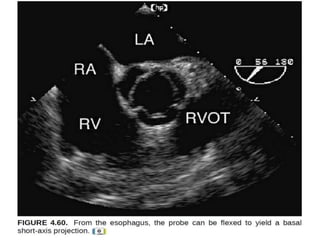
Four of the short-axis views that can be obtained with
the
horizontal probe in the upper esophagus.
By rotating the array angle from 0 degrees (transverse) to
approximately 90 degrees, a two-chamber view can be
obtained
Further angle rotation, to approximately 135 degrees,
will approximate a left ventricular long-axis view
This plane is closely aligned to the long axis of the heart
and provides an excellent assessment of the aortic valve
and aortic root.
Rotation of the probe clockwise will sweep the imaging
plane toward the right heart, eventually recording the
bicaval view in which the right atrium, and IVC & SVC are
visualized.
This view also provides assessment of the atrial septum
and is helpful to interrogate the superior portion of the
atrial septum for sinus venosus defects.
By slight angulation, the right atrial appendage can also be
examined from
this approach
Because the appendage is often
multilobed and varies considerably in size and shape, it
should be assessed
from multiple angles to ensure complete interrogation
5 views of the LAA are recorded at
various angles of rotation of the scan
plane. Note how the appearance of the
appendage varies in the different views.
The relationship of the appendage to the
left upper pulmonary vein (*) is also
demonstrated.
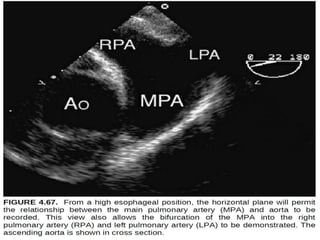
By
withdrawing the probe slightly and adjusting to a more
horizontal plane
(approximately 0 degrees), the bifurcation of the main
pulmonary artery can
be visualized adjacent to the ascending aorta
The thoracic aorta, IS uniquely suited to TEE inspection,
lies in close proximity to the esophagus and on the
opposite side from the heart.
With the array angle at 0 degrees, the transducer itself
is rotated 180 degrees to view the aorta in short axis.
Beginning distally, gradual withdrawal of the transducer
will follow the descending aorta in a retrograde manner
up toward the arch
The descending aorta is recorded in a series of short-axis views at
various levels by withdrawing the transducer from the level of the
diaphragm to the distal arch (panels A–D).
At the level of the aortic arch, the origin of the branch
vessels can be recorded
Then, by rotating the transducer and gradually
advancing the probe further into the esophagus, a portion
of the AA can be recorded.
Because of the interposition of the trachea, some
portion of the ascending aorta will not be seen.
These series of views provide an excellent opportunity
to detect aortic aneurysm, dissection, and atherosclerosis.
To record the left pulmonary veins, the transducer angle
is adjusted to approximately 100 degrees and the
transducer is rotated to the far leftward plane
(counterclockwise rotation of the probe).
Color flow imaging can be used to assist in locating the
mouth of the veins.
The two left veins drain into the left atrium in close
proximity to each other, and the left upper pulmonary
vein is often recorded adjacent to the left atrial
appendage
To record the right pulmonary veins, adjust the
transducer angle from 50 to 60 degrees and rotate the
probe to the patient’s far right.
Again, the two veins appear to originate together,
sometimes as a bifurcation.
The transducer can also be advanced into the patient’s
stomach to provide a family of views
Beginning from the transverse plane (0 degrees), extreme
anteflexion and gradual withdrawal of the probe will bring
the transducer in contact with the superior portion of the
stomach, with the ultrasound beam directed upward
toward the heart.
A series of short-axis views of the ventricles can then be
recorded by sequential anteflexion and retroflexion to
visualize the various levels of short-axis planes
By increasing the array angle to a more vertical plane, a
long-axis view is recorded, often providing excellent
visualization of the LVOT and aortic valve.
RISKS AND CONTRAINDICATIONS FOR TRANSESOPHAGEAL
ECHOCARDIOGRAPHY
Topical anesthesia
Allergic reactions
Toxic methemoglobinemia
Conscious sedation
Respiratory compromise/hypoxia
Hypotension
Paradoxical hypertension
Paradoxical agitation
Idiosyncratic reactions
Probe insertion: immediate
Oral trauma
Dental trauma
Esophageal perforation
Vagal reaction
Probe insertion: delayed
Aspiration
Tachycardia
Paroxysmal supraventricular
tachycardia
Ventricular tachycardia
Contradictions
Absolute
Recent esophageal trauma/surgery
Recent esophageal bleed
Relative
Poorly cooperative patient
Remote esophageal procedures
TEE may also cause bleeding (0.02% to 1.0%) from direct
abrasion of the mucosa, esophageal varices, or tumor.
The overall risk for major adverse events with TEE is
0.2% to 0.5% in the nonsurgical setting, and the overall
mortality rate is exceedingly low (0.0004%).
THANK YOU
1) Feigenbaum’s echocardiography EIGHTH EDITION
2) BRAUNWALD’S HEART DISEASE
3) Textbook of Clinical Echocardiography, 6th Edition

TEE Dr Abhishek - Copy.pptx

  • 1.
    TRANSESOPHAGEAL ECHO ABHISHEK KUMARTIWARI DM CARDIO RESIDENT, CMCH COIMBATORE
  • 2.
    TEE is analternative method to obtain ultrasound images of the heart. The imaging can be performed at the bedside, but with a higher-frequency transducer and from a position that is posterior and closer to the heart than can be achieved with TTE.
  • 3.
    Why TEE issuccessful? 1)The close proximity of the esophagus to the posterior wall of the heart. 2)The closeness and absence of intervening tissues, such as bone or lung, allow the use of highfrequency transducers and ensure high-quality imaging.
  • 4.
    3) The abilityto position the transducer in the esophagus or stomach for extended periods provides an opportunity to monitor the heart over time, such as during cardiac surgery. 4) The technique has proven to be extremely safe and well tolerated so that it can be performed in critically ill patients and very small infants.
  • 5.
    UNIQUE DATA FROMTRANSESOPHAGEAL ECHOCARDIOGRAPHY Atrial thrombi/masses Left atrial appendage clot  Left atrial appendage spontaneous contrast  Clot in body of left atrium  Right atrial thrombus  Thrombus/mass on pacemaker wire or indwelling catheter
  • 6.
    A) Transesophageal echocardiogramshows new thrombus formation in the left atrium (arrow) . B) Left atrial thrombus was not seen in transthoracic echocardiogram
  • 7.
    Mitral valve  Precisemechanism of mitral regurgitation  Refined suitability for valvotomy in severe mitral stenosis  Define eccentric jets Function of prosthetic valves Paravalvar regurgitation
  • 8.
    Two dimensional colorDoppler image showing the mitral bioprosthetic valve (yellow arrow) and a turbulent jet of mitral paravalvular regurgitation (PVL, dashed red arrow). The para valvular origin of the jet is clearly depicted (M)
  • 9.
  • 10.
    Transesophageal echocardiography inthe mid-esophageal view, showing a linear dissection flap in the non-coronary sinus of Valsalva LA, Left atrium
  • 11.
  • 12.
    Short axis viewof descending aorta showing the location of the aortic transection.
  • 13.
    Chambers  Refinement ofpatent foramen ovale characteristics
  • 14.
    Transesophageal echocardiography. Apatent foramen ovale (PFO) with a left-to-right shunt is shown at the level of the interatrial septum.
  • 15.
    Online monitoring Intraoperative leftventricular size/function Monitoring interventional procedures Atrial septostomy Balloon valvotomy Pulmonary vein/left atrial interventions Percutaneous aortic and mitral valve replacement or repair
  • 16.
    Atrial septostomy. Animage of an atrial septal puncture is shown using TEE. Using a specialized catheter and fluoroscopy, an atrial septal puncture is made in the region of the fossa ovalis and balloon dilation is performed. The catheter (*asterix) can be seen traversing the septum from the right atrium into the left atrium.
  • 17.
    Endocarditis Detect aortic abscess Identifysmaller vegetations Detect valve perforation Detect endocarditis of prosthetic valves
  • 18.
    Mitral prosthetic valveendocarditis with prosthetic obstruction (transoesophageal echocardiography). (A) Large vegetation prolapsing into the mitral mechanical prosthetic valve (arrow). (B) Central regurgitation associated with the absence of the physiological regurgitant jets (arrow).
  • 19.
    PREPARATION OF THEPATIENT  First, Informed consent should be obtained. The patient should fast for at least 4 to 6 hours before undergoing TEE. Any history of dysphagia or other forms of esophageal abnormalities should be sought and evaluated.
  • 20.
    All patients shouldhave IV access and both supplemental O2 and suction should be available.  Before intubation, the use of a topical anesthetic to numb the posterior pharynx is recommended. Either lidocaine or Cetacaine is typically used for this purpose
  • 21.
    Although safe, rarecases of toxic methemoglobinemia have been reported and should be considered whenever significant O2 desaturation complicates the procedure. Rx of this condition is IV methylene blue, usually given in a dose of 1 mg/kg as a 1% solution over 5 minutes. Conscious sedation, for pain prevention, and as an anxiolytic
  • 22.
     The combinationof midazolam and fentanyl is popular in many laboratories. Bacteremia induced by upper endoscopy during TEE is very rare. The routine use of antibiotic prophylaxis has generally been abandoned.
  • 23.
    THE PROCEDURE The headof the bed is elevated approximately 30 degrees to improve comfort and help avoid aspiration. If the patient has dentures, these should be removed, and in most patients, a bite block is placed
  • 25.
    . After theprobe has been lubricated with surgical jelly, it is introduced into the oropharynx and gradually advanced while the patient is urged to “swallow” to facilitate intubation. Once the probe has passed into the esophagus, a completeexamination can usually be performed in 10 to 30 minutes
  • 26.
    Special attention shouldbe paid to the patient BP, heart rate and rhythm, and O2 saturation. Suctioning of the oropharynx is often required, and additional intravenous medications may be needed to maintain the proper level of conscious sedation and comfort.
  • 27.
     Early TEEtransducers were capable of imaging from only in the transverse orientation and were called MONOPLANE DEVICES. The 2ND -generation instruments has BIPLANE capability and are able to record images in both the transverse and longitudinal orientations
  • 29.
    All current-generation transesophageal echocardiographictransducers have multiplane capability
  • 31.
    The image isrotated, either electronically or mechanically, around a 180-degree arc to yield an infinite number of possible imaging planes. The availability of multiplane imaging effectively provides a 360-degree “panoramic” reconstruction of the heart and great vessels.
  • 32.
    The probes operateat multiple frequencies, typically 3.5 to 7.0 MHz. Pediatric probes are smaller in diameter (5 to 7 mm) and operate at higher frequencies (5 to 10 MHz). Transesophageal probes capable of realtime 3D imaging have also been developed.
  • 33.
    TRANSESOPHAGEAL ECHOCARDIOGRAPHIC VIEWS TEE does not lend itself to standardization of views as readily as TTE. The targeted nature of the test, together with the constraints imposed by the esophagus and its relation to the heart, limit our ability to define and describe standard views using this modality.
  • 34.
    TERMINOLOGY USED TODESCRIBE THE MANIPULATION OF THE PROBE AND TRANSDUCER DURING IMAGE ACQUISITION.
  • 35.
    A useful startingpoint is the four-chamber view, which is recorded with- The transducer positioned immediately superior and posterior to the left atrium and flexed in a way to provide a long-axis plane through all 4 chambers
  • 37.
    By adjusting thedegree of flexion, variations on the four-chamber views are recorded
  • 39.
    The transthoracic four-chamberview places the left ventricular apex in the near field and is ideally suited to detect apical thrombi. In contrast, the transesophageal four-chamber view places the left atrium in the near field and is ideally suited for assessing left atrial and mitral valve pathology.
  • 40.
    By anteflexing theprobe tip, the long-axis orientation can be gradually converted into a more short-axis view for the evaluation of the left ventricular outflow tract and aortic valve
  • 42.
    By gently flexingand relaxing the probe, the aortic root, aortic valve, and LVOT can be thoroughly assessed
  • 43.
    Four of theshort-axis views that can be obtained with the horizontal probe in the upper esophagus.
  • 44.
    By rotating thearray angle from 0 degrees (transverse) to approximately 90 degrees, a two-chamber view can be obtained
  • 46.
    Further angle rotation,to approximately 135 degrees, will approximate a left ventricular long-axis view This plane is closely aligned to the long axis of the heart and provides an excellent assessment of the aortic valve and aortic root.
  • 48.
    Rotation of theprobe clockwise will sweep the imaging plane toward the right heart, eventually recording the bicaval view in which the right atrium, and IVC & SVC are visualized. This view also provides assessment of the atrial septum and is helpful to interrogate the superior portion of the atrial septum for sinus venosus defects.
  • 50.
    By slight angulation,the right atrial appendage can also be examined from this approach
  • 52.
    Because the appendageis often multilobed and varies considerably in size and shape, it should be assessed from multiple angles to ensure complete interrogation
  • 53.
    5 views ofthe LAA are recorded at various angles of rotation of the scan plane. Note how the appearance of the appendage varies in the different views. The relationship of the appendage to the left upper pulmonary vein (*) is also demonstrated.
  • 54.
    By withdrawing the probeslightly and adjusting to a more horizontal plane (approximately 0 degrees), the bifurcation of the main pulmonary artery can be visualized adjacent to the ascending aorta
  • 56.
    The thoracic aorta,IS uniquely suited to TEE inspection, lies in close proximity to the esophagus and on the opposite side from the heart. With the array angle at 0 degrees, the transducer itself is rotated 180 degrees to view the aorta in short axis. Beginning distally, gradual withdrawal of the transducer will follow the descending aorta in a retrograde manner up toward the arch
  • 57.
    The descending aortais recorded in a series of short-axis views at various levels by withdrawing the transducer from the level of the diaphragm to the distal arch (panels A–D).
  • 58.
    At the levelof the aortic arch, the origin of the branch vessels can be recorded
  • 60.
    Then, by rotatingthe transducer and gradually advancing the probe further into the esophagus, a portion of the AA can be recorded. Because of the interposition of the trachea, some portion of the ascending aorta will not be seen. These series of views provide an excellent opportunity to detect aortic aneurysm, dissection, and atherosclerosis.
  • 61.
    To record theleft pulmonary veins, the transducer angle is adjusted to approximately 100 degrees and the transducer is rotated to the far leftward plane (counterclockwise rotation of the probe). Color flow imaging can be used to assist in locating the mouth of the veins. The two left veins drain into the left atrium in close proximity to each other, and the left upper pulmonary vein is often recorded adjacent to the left atrial appendage
  • 63.
    To record theright pulmonary veins, adjust the transducer angle from 50 to 60 degrees and rotate the probe to the patient’s far right. Again, the two veins appear to originate together, sometimes as a bifurcation.
  • 64.
    The transducer canalso be advanced into the patient’s stomach to provide a family of views Beginning from the transverse plane (0 degrees), extreme anteflexion and gradual withdrawal of the probe will bring the transducer in contact with the superior portion of the stomach, with the ultrasound beam directed upward toward the heart.
  • 65.
    A series ofshort-axis views of the ventricles can then be recorded by sequential anteflexion and retroflexion to visualize the various levels of short-axis planes
  • 67.
    By increasing thearray angle to a more vertical plane, a long-axis view is recorded, often providing excellent visualization of the LVOT and aortic valve.
  • 68.
    RISKS AND CONTRAINDICATIONSFOR TRANSESOPHAGEAL ECHOCARDIOGRAPHY Topical anesthesia Allergic reactions Toxic methemoglobinemia
  • 69.
    Conscious sedation Respiratory compromise/hypoxia Hypotension Paradoxicalhypertension Paradoxical agitation Idiosyncratic reactions
  • 70.
    Probe insertion: immediate Oraltrauma Dental trauma Esophageal perforation Vagal reaction
  • 71.
    Probe insertion: delayed Aspiration Tachycardia Paroxysmalsupraventricular tachycardia Ventricular tachycardia
  • 72.
    Contradictions Absolute Recent esophageal trauma/surgery Recentesophageal bleed Relative Poorly cooperative patient Remote esophageal procedures
  • 79.
    TEE may alsocause bleeding (0.02% to 1.0%) from direct abrasion of the mucosa, esophageal varices, or tumor.
  • 80.
    The overall riskfor major adverse events with TEE is 0.2% to 0.5% in the nonsurgical setting, and the overall mortality rate is exceedingly low (0.0004%).
  • 81.
  • 82.
    1) Feigenbaum’s echocardiographyEIGHTH EDITION 2) BRAUNWALD’S HEART DISEASE 3) Textbook of Clinical Echocardiography, 6th Edition