PeterYeboah, Executive Director-CHAG
13th July 2017, CCIH Conference, Johns Hopkins
University, Baltimore- MD
HEALTH SYSTEMS RESILIENCE
THE ROLE OF CHAG IN THE GHANAIAN HEALTH SYSTEM
Outline
1. CHAG; Nature, Mission, Collaborators
2. The CHAG HSS Model: Health Financing for UHC in focus
3. Achievements & Challenges
4. Lessons Learnt
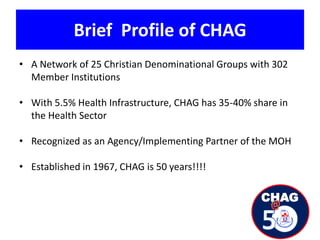
Brief Profile of CHAG
• A Network of 25 Christian Denominational Groups with 302
Member Institutions
• With 5.5% Health Infrastructure, CHAG has 35-40% share in
the Health Sector
• Recognized as an Agency/Implementing Partner of the MOH
• Established in 1967, CHAG is 50 years!!!!
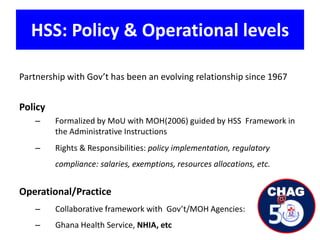
HSS: Policy & Operational levels
Partnership with Gov’t has been an evolving relationship since 1967
Policy
– Formalized by MoU with MOH(2006) guided by HSS Framework in
the Administrative Instructions
– Rights & Responsibilities: policy implementation, regulatory
compliance: salaries, exemptions, resources allocations, etc.
Operational/Practice
– Collaborative framework with Gov’t/MOH Agencies:
– Ghana Health Service, NHIA, etc
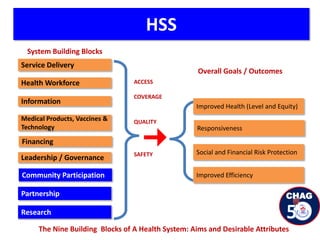
HSS
Service Delivery
Health Workforce
Information
Medical Products, Vaccines &
Technology
Financing
Leadership / Governance
Community Participation
Partnership
Research
ACCESS
COVERAGE
QUALITY
SAFETY
Improved Health (Level and Equity)
Responsiveness
Social and Financial Risk Protection
Improved Efficiency
System Building Blocks
Overall Goals / Outcomes
The Nine Building Blocks of A Health System: Aims and Desirable Attributes
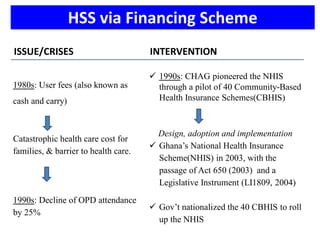
HSS via Financing Scheme
ISSUE/CRISES INTERVENTION
1980s: User fees (also known as
cash and carry)
Catastrophic health care cost for
families, & barrier to health care.
1990s: Decline of OPD attendance
by 25%
 1990s: CHAG pioneered the NHIS
through a pilot of 40 Community-Based
Health Insurance Schemes(CBHIS)
Design, adoption and implementation
 Ghana’s National Health Insurance
Scheme(NHIS) in 2003, with the
passage of Act 650 (2003) and a
Legislative Instrument (LI1809, 2004)
 Gov’t nationalized the 40 CBHIS to roll
up the NHIS
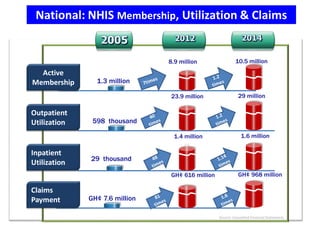
National: NHIS Membership, Utilization & Claims
1.3 million
8.9 million
598 thousand
23.9 million
29 thousand
GH¢ 7.6 million
GH¢ 616 million
1.4 million
Active
Membership
Outpatient
Utilization
Inpatient
Utilization
Claims
Payment
Source: Unaudited Financial Statements
10.5 million
29 million
GH¢ 968 million
1.6 million
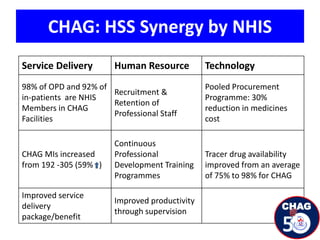
CHAG: HSS Synergy by NHIS
Service Delivery Human Resource Technology
98% of OPD and 92% of
in-patients are NHIS
Members in CHAG
Facilities
Recruitment &
Retention of
Professional Staff
Pooled Procurement
Programme: 30%
reduction in medicines
cost
CHAG MIs increased
from 192 -305 (59% )
Continuous
Professional
Development Training
Programmes
Tracer drug availability
improved from an average
of 75% to 98% for CHAG
Improved service
delivery
package/benefit
Improved productivity
through supervision
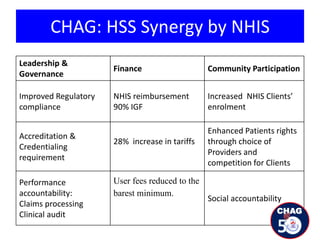
CHAG: HSS Synergy by NHIS
Leadership &
Governance
Finance Community Participation
Improved Regulatory
compliance
NHIS reimbursement
90% IGF
Increased NHIS Clients’
enrolment
Accreditation &
Credentialing
requirement
28% increase in tariffs
Enhanced Patients rights
through choice of
Providers and
competition for Clients
Performance
accountability:
Claims processing
Clinical audit
User fees reduced to the
barest minimum.
Social accountability
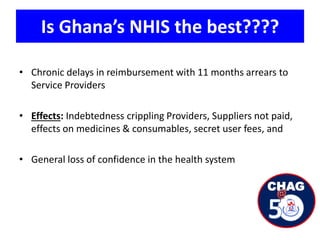
Is Ghana’s NHIS the best????
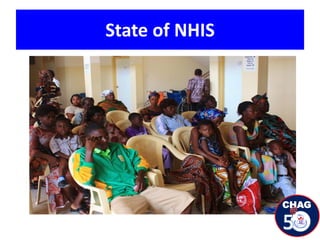
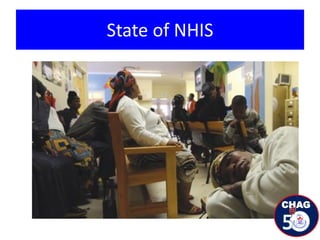
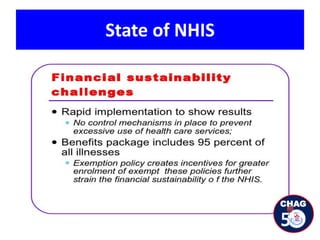
• Chronic delays in reimbursement with 11 months arrears to
Service Providers
• Effects: Indebtedness crippling Providers, Suppliers not paid,
effects on medicines & consumables, secret user fees, and
• General loss of confidence in the health system
State of NHIS
State of NHIS
State of NHIS
Partnership with Government for Sustainability
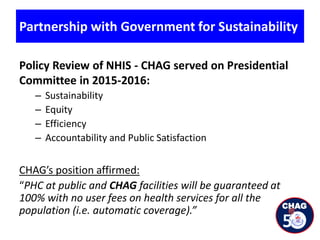
Policy Review of NHIS - CHAG served on Presidential
Committee in 2015-2016:
– Sustainability
– Equity
– Efficiency
– Accountability and Public Satisfaction
CHAG’s position affirmed:
“PHC at public and CHAG facilities will be guaranteed at
100% with no user fees on health services for all the
population (i.e. automatic coverage).”
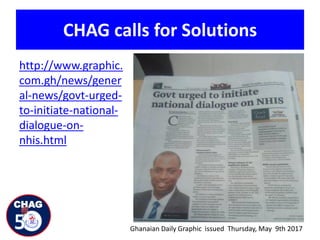
CHAG calls for Solutions
http://www.graphic.
com.gh/news/gener
al-news/govt-urged-
to-initiate-national-
dialogue-on-
nhis.html
Ghanaian Daily Graphic issued Thursday, May 9th 2017
Challenges
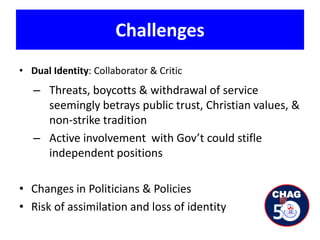
• Dual Identity: Collaborator & Critic
– Threats, boycotts & withdrawal of service
seemingly betrays public trust, Christian values, &
non-strike tradition
– Active involvement with Gov’t could stifle
independent positions
• Changes in Politicians & Policies
• Risk of assimilation and loss of identity
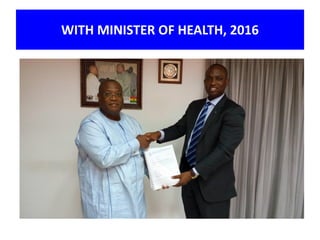
WITH MINISTER OF HEALTH, 2016
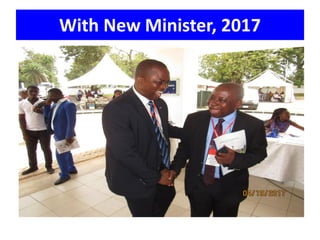
With New Minister, 2017
With CEO, NHIA, 2017
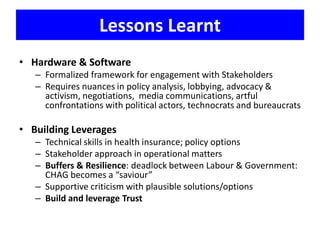
Lessons Learnt
• Hardware & Software
– Formalized framework for engagement with Stakeholders
– Requires nuances in policy analysis, lobbying, advocacy &
activism, negotiations, media communications, artful
confrontations with political actors, technocrats and bureaucrats
• Building Leverages
– Technical skills in health insurance; policy options
– Stakeholder approach in operational matters
– Buffers & Resilience: deadlock between Labour & Government:
CHAG becomes a “saviour”
– Supportive criticism with plausible solutions/options
– Build and leverage Trust
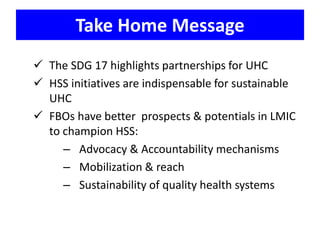
Take Home Message
 The SDG 17 highlights partnerships for UHC
 HSS initiatives are indispensable for sustainable
UHC
 FBOs have better prospects & potentials in LMIC
to champion HSS:
– Advocacy & Accountability mechanisms
– Mobilization & reach
– Sustainability of quality health systems
Peter-Yeboah-Plenary-1-CCIH-2017

Peter-Yeboah-Plenary-1-CCIH-2017

  • 1.
    PeterYeboah, Executive Director-CHAG 13thJuly 2017, CCIH Conference, Johns Hopkins University, Baltimore- MD HEALTH SYSTEMS RESILIENCE THE ROLE OF CHAG IN THE GHANAIAN HEALTH SYSTEM
  • 2.
    Outline 1. CHAG; Nature,Mission, Collaborators 2. The CHAG HSS Model: Health Financing for UHC in focus 3. Achievements & Challenges 4. Lessons Learnt
  • 3.
    Brief Profile ofCHAG • A Network of 25 Christian Denominational Groups with 302 Member Institutions • With 5.5% Health Infrastructure, CHAG has 35-40% share in the Health Sector • Recognized as an Agency/Implementing Partner of the MOH • Established in 1967, CHAG is 50 years!!!!
  • 4.
    HSS: Policy &Operational levels Partnership with Gov’t has been an evolving relationship since 1967 Policy – Formalized by MoU with MOH(2006) guided by HSS Framework in the Administrative Instructions – Rights & Responsibilities: policy implementation, regulatory compliance: salaries, exemptions, resources allocations, etc. Operational/Practice – Collaborative framework with Gov’t/MOH Agencies: – Ghana Health Service, NHIA, etc
  • 5.
    HSS Service Delivery Health Workforce Information MedicalProducts, Vaccines & Technology Financing Leadership / Governance Community Participation Partnership Research ACCESS COVERAGE QUALITY SAFETY Improved Health (Level and Equity) Responsiveness Social and Financial Risk Protection Improved Efficiency System Building Blocks Overall Goals / Outcomes The Nine Building Blocks of A Health System: Aims and Desirable Attributes
  • 6.
    HSS via FinancingScheme ISSUE/CRISES INTERVENTION 1980s: User fees (also known as cash and carry) Catastrophic health care cost for families, & barrier to health care. 1990s: Decline of OPD attendance by 25%  1990s: CHAG pioneered the NHIS through a pilot of 40 Community-Based Health Insurance Schemes(CBHIS) Design, adoption and implementation  Ghana’s National Health Insurance Scheme(NHIS) in 2003, with the passage of Act 650 (2003) and a Legislative Instrument (LI1809, 2004)  Gov’t nationalized the 40 CBHIS to roll up the NHIS
  • 7.
    National: NHIS Membership,Utilization & Claims 1.3 million 8.9 million 598 thousand 23.9 million 29 thousand GH¢ 7.6 million GH¢ 616 million 1.4 million Active Membership Outpatient Utilization Inpatient Utilization Claims Payment Source: Unaudited Financial Statements 10.5 million 29 million GH¢ 968 million 1.6 million
  • 8.
    CHAG: HSS Synergyby NHIS Service Delivery Human Resource Technology 98% of OPD and 92% of in-patients are NHIS Members in CHAG Facilities Recruitment & Retention of Professional Staff Pooled Procurement Programme: 30% reduction in medicines cost CHAG MIs increased from 192 -305 (59% ) Continuous Professional Development Training Programmes Tracer drug availability improved from an average of 75% to 98% for CHAG Improved service delivery package/benefit Improved productivity through supervision
  • 9.
    CHAG: HSS Synergyby NHIS Leadership & Governance Finance Community Participation Improved Regulatory compliance NHIS reimbursement 90% IGF Increased NHIS Clients’ enrolment Accreditation & Credentialing requirement 28% increase in tariffs Enhanced Patients rights through choice of Providers and competition for Clients Performance accountability: Claims processing Clinical audit User fees reduced to the barest minimum. Social accountability
  • 10.
    Is Ghana’s NHISthe best???? • Chronic delays in reimbursement with 11 months arrears to Service Providers • Effects: Indebtedness crippling Providers, Suppliers not paid, effects on medicines & consumables, secret user fees, and • General loss of confidence in the health system
  • 11.
  • 12.
  • 13.
  • 14.
    Partnership with Governmentfor Sustainability Policy Review of NHIS - CHAG served on Presidential Committee in 2015-2016: – Sustainability – Equity – Efficiency – Accountability and Public Satisfaction CHAG’s position affirmed: “PHC at public and CHAG facilities will be guaranteed at 100% with no user fees on health services for all the population (i.e. automatic coverage).”
  • 15.
    CHAG calls forSolutions http://www.graphic. com.gh/news/gener al-news/govt-urged- to-initiate-national- dialogue-on- nhis.html Ghanaian Daily Graphic issued Thursday, May 9th 2017
  • 16.
    Challenges • Dual Identity:Collaborator & Critic – Threats, boycotts & withdrawal of service seemingly betrays public trust, Christian values, & non-strike tradition – Active involvement with Gov’t could stifle independent positions • Changes in Politicians & Policies • Risk of assimilation and loss of identity
  • 17.
    WITH MINISTER OFHEALTH, 2016
  • 18.
  • 19.
  • 20.
    Lessons Learnt • Hardware& Software – Formalized framework for engagement with Stakeholders – Requires nuances in policy analysis, lobbying, advocacy & activism, negotiations, media communications, artful confrontations with political actors, technocrats and bureaucrats • Building Leverages – Technical skills in health insurance; policy options – Stakeholder approach in operational matters – Buffers & Resilience: deadlock between Labour & Government: CHAG becomes a “saviour” – Supportive criticism with plausible solutions/options – Build and leverage Trust
  • 21.
    Take Home Message The SDG 17 highlights partnerships for UHC  HSS initiatives are indispensable for sustainable UHC  FBOs have better prospects & potentials in LMIC to champion HSS: – Advocacy & Accountability mechanisms – Mobilization & reach – Sustainability of quality health systems