Telenursing in the Intensive Care Unit
Chief Nursing Officer, OUH
Merja Meriläinen, RN, PhD
merja.merilainen@ppshp.fi
Northern Ostrobothnia Hospital
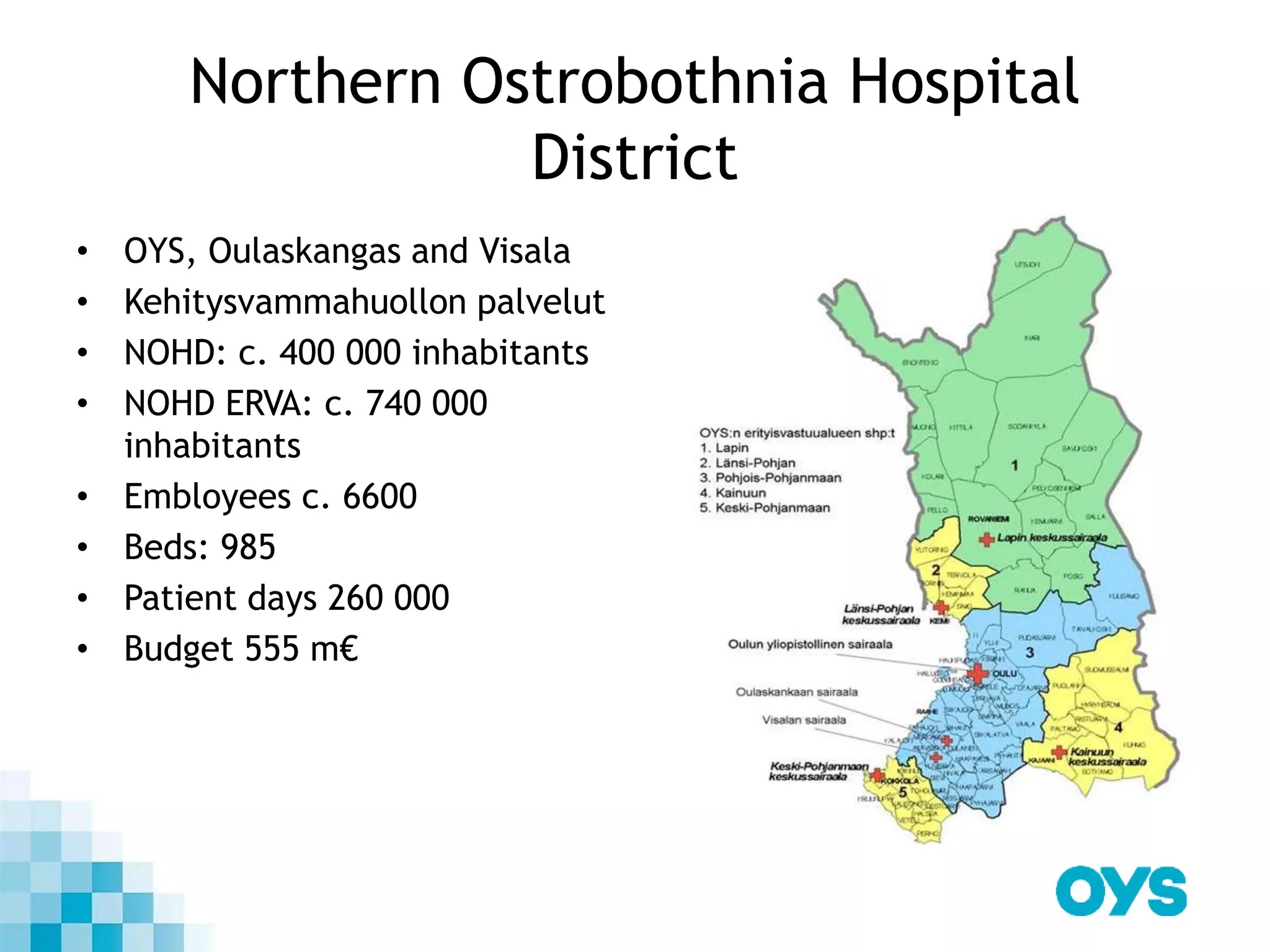
District
• OYS, Oulaskangas and Visala
• Kehitysvammahuollon palvelut
• NOHD: c. 400 000 inhabitants
• NOHD ERVA: c. 740 000
inhabitants
• Embloyees c. 6600
• Beds: 985
• Patient days 260 000
• Budget 555 m€
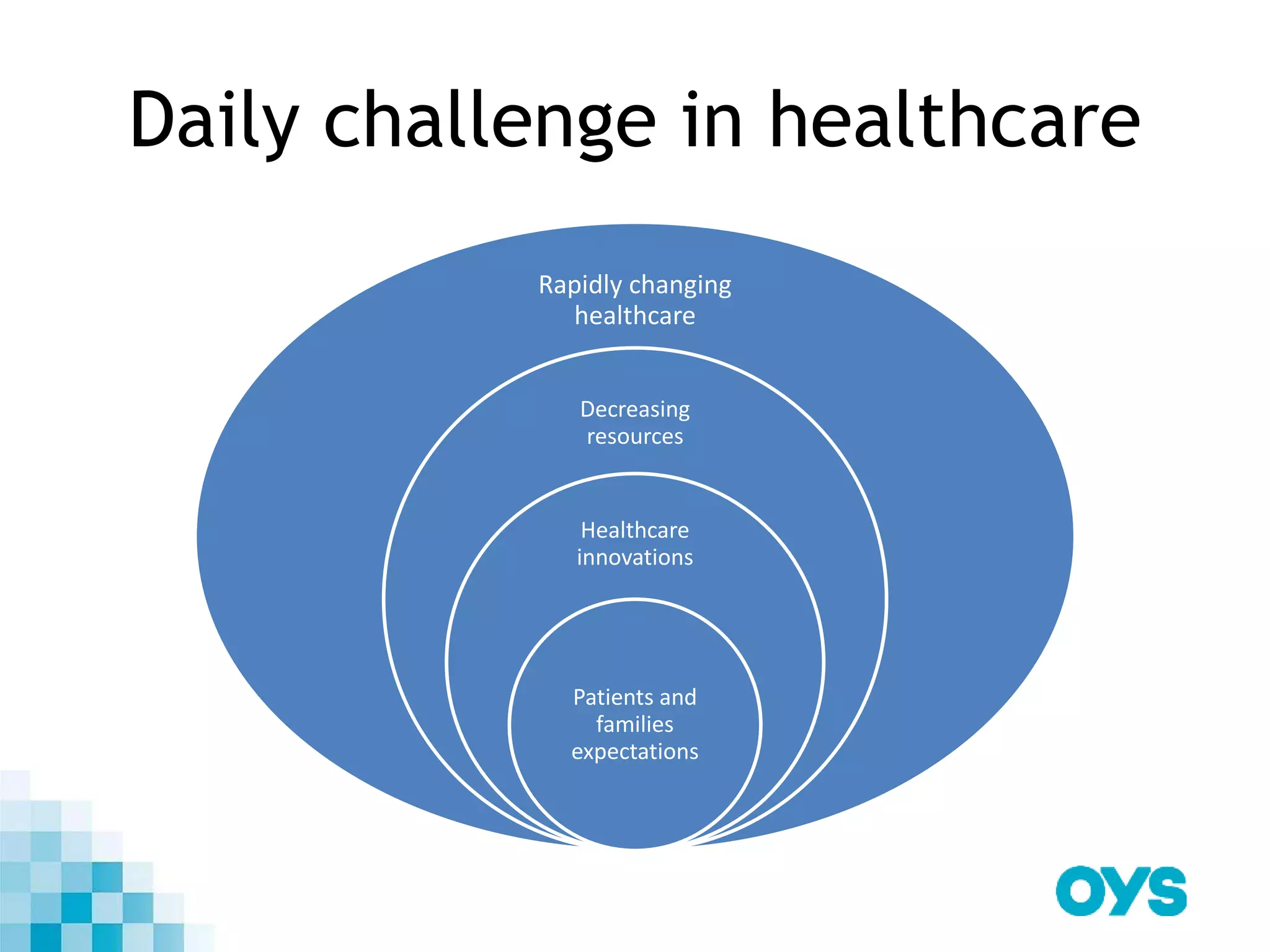
Daily challenge in healthcare
Rapidly changing
healthcare
Decreasing
resources
Healthcare
innovations
Patients and
families
expectations
Current and future challenges in
ICU
•Number of patients needing critical care are increasing
–Ageing population and increasing life expectancy
–Increasing healthcare expectations
–Advancing cancer treatment, transplantation and high risk surgery for the elderly
population
–Pandemics
•Financial burden and decreasing ability to pay
–Skilled specialists for decision making to target the critical care resources to
those most likely to benefit and to achieve best outcomes
•Increasing need for critical care services faces decreasing physician and nursing workforce
–Critical care patients need specialized care takers with high competence level
–Critical care is a human resource intensive therapy (P/N 1:1)
–Already today limited intensivist coverage in smaller hospitals and rural regions
•Critical care services are increasingly needed outside the ICU walls
–Patients with critical illness may be found throughout the hospitals
–Need for remote monitoring techniques to identify those at risk earlier
(Ala-Kokko T. THALEA Round table meeting 30.10.2014 OUH)
Tele-ICU
• Is the arena where informatics and
telecommunication technology, coupled with
telemedicine and telenursing, are bought
together to affect the care of critically ill
patients
• It provides expert-driven, evidence-based,
cutting-edge services for the monitoring and
treatment of critically ill patients
• It supports the bedside health care team through
collaborations between the tele-ICU nurse and
the bedside team
(www.americantelemed.org., Stafford et al. Working in an eICU unit: Life
in the box. Crit Care Nurs Clin 2008; 20.)
Outcomes
• Reductions in ICU mortality
• Shorter stays in the ICU and the hospital
• Increased compliance with evidence-based
best practice (e.g. screening for sepsis)
• Experienced ICU nurses and intensivist
physicians help to monitor and treat
critically ill patients and provide an
additional layer of safety
• Decreased cost of patient care
(Kohl et al. 2007, Zwada et al. 2009, Dickhaus et.al. 2006, King et al. )
The role of the tele-ICU nurse
• Make rounds via camera and patient
database
• Assess patients via database
– Verification of continuous infusions
– Follow-up of laboratory values
• Video assessment of patients´ physical
appearance
• Equipment safety check
• Verbal interactions with patients, their
families and bedside staff
• Acts as a resource for the bedside nurses
(second set of eyes and ears)
• Ensures that best practice is adhered to
• Responds to questions and requests from
bedside staff
• Teleintensivist and telenurses can educate
bedside novice physicians and nurses by
walking them through unfamiliar procedures
(Williams et al. 2012, Reis M 2009)
Tele-ICU nursing interventions
• Williams et al. 2012
– N=594
– 477 (80%) independent nursing interventions
• Assistance
• Brainstorming
• Overall collaboration
• Rescue interventions
• Prevention
 Increased patient safety
Tele-ICU nursing: what is it not?
• It does not replace bedside nursing or the
bedside team
• It does not replace direct patient contact
• It is not a way of decreasing staff
numbers
What hopes do we have for
telenursing?
• Online, real time communication
between ICU experts
• Shared knowledge
• Expert-driven, evidence-based treatment
for critically ill patients
What does tele-ICU nursing
require?
• Clarity in roles between bedside team and
tele nursing team
• Functional and easy-to-use system
• Monitor view that provides an easy-to-
understand holistic picture of a patient’s
situation
• Interoperable, a user friendly and intelligent
global decision supporting system that can
be customized for local needs
What next?
• More interactive?
• Higher speed?
• More intelligent solutions?
• Extra staff?
• Do we really understand what we could
request from these solutions?
• Can we move from crisis management and
problem-solving to real innovations?
THALEA®
European Demand of a ...
• Telemonitoring and Telemedicine System for the
demand of
• Hospitals need in Early Warning and Detection of
Severe Infections
• Assisted by innovative ICT (effective management)
for
• Life saving co-morbid patients in
• Europe
• As part of a Patient personalised care programme of
the EU
The 8 THALEA partners:
1. University Hospital Aachen (coordination) (Germany)
2. German Ministry of Innovation, Science and Research
(Germany)
3. Maastricht University Medical Centre+ (Netherlands)
4. NL, Agency, Ministry of Economic Affairs
(Netherlands)
5. ParcTauli Sabadell University Hospital (Spain)
6. Catalan Agency for Health Information, Assessment
and Quality (Spain)
7. Hospital East Limburg (Belgium)
8. Northern Ostrobothnia Hospital District (Finland)
THALEA®
• THALEA enables Intensive Care Units to
improve the care for acutely live-threatened
patients by telemedicine and telemonitoring
• Within the Thalea project, an ICU
telemedicine system is developed using pre-
commercial procurement(PCP); an
oppertunity to develop new solutions and to
introduce new technologies and products in
cooperation between suppliers and hospitals
• The THALEA Project aims to follow ICU
patients in various hospitals from a
central 'cockpit' location
• In this cockpit, a team of ICU experts will
continuously monitor different values,
such as blood pressure, insulin levels,
dehydration, medication and dozens of
other indicators, procedures and
guidelines
• Tender process, which involves extensive
research on the actual procurement
expected in the future, consists of three
phases:
– preparing the public tender
– a pre-commercial procurement phase
– a public European tender that should
ultimately lead to the marketability of
concrete software products
PCP process
Supplier B
Supplier C
Supplier D
Phase 1
Solution design
Phase 2
Prototype
development
Phase 3
Original development
of limited volume
of first test products /
servicesSupplier A
Supplier B
Supplier C
Supplier D
Supplier B
R&D / Pre-commercial Procurement (PCP)
Phase 4
Deployment of commercial
end-products
Diffusion of newly developed
products / services
Supplier D
Supplier(s)
A,B,C,D
and/or X
European Commission: COM (2007)799
More information
• http://www.thalea-pcp.eu/
• OUH/Thalea team:
– Project Manager Timo Alalääkkölä,
timo.alalaakkola@ppshp.fi
– Professor Tero Ala-Kokko,
tero.ala-kokko@ppshp.fi
– Chief Nursing Officer Merja Meriläinen,
merja.merilainen@ppshp.fi
– Intensivist Janne Liisanantti,
janne.liisanantti@ppshp.fi
Thank you!

HealthSPA Oulu Merja Merilainen Telenursing in the Intensive Care Unit

  • 1.
    Telenursing in theIntensive Care Unit Chief Nursing Officer, OUH Merja Meriläinen, RN, PhD merja.merilainen@ppshp.fi
  • 2.
    Northern Ostrobothnia Hospital District •OYS, Oulaskangas and Visala • Kehitysvammahuollon palvelut • NOHD: c. 400 000 inhabitants • NOHD ERVA: c. 740 000 inhabitants • Embloyees c. 6600 • Beds: 985 • Patient days 260 000 • Budget 555 m€
  • 3.
    Daily challenge inhealthcare Rapidly changing healthcare Decreasing resources Healthcare innovations Patients and families expectations
  • 4.
    Current and futurechallenges in ICU •Number of patients needing critical care are increasing –Ageing population and increasing life expectancy –Increasing healthcare expectations –Advancing cancer treatment, transplantation and high risk surgery for the elderly population –Pandemics •Financial burden and decreasing ability to pay –Skilled specialists for decision making to target the critical care resources to those most likely to benefit and to achieve best outcomes •Increasing need for critical care services faces decreasing physician and nursing workforce –Critical care patients need specialized care takers with high competence level –Critical care is a human resource intensive therapy (P/N 1:1) –Already today limited intensivist coverage in smaller hospitals and rural regions •Critical care services are increasingly needed outside the ICU walls –Patients with critical illness may be found throughout the hospitals –Need for remote monitoring techniques to identify those at risk earlier (Ala-Kokko T. THALEA Round table meeting 30.10.2014 OUH)
  • 5.
    Tele-ICU • Is thearena where informatics and telecommunication technology, coupled with telemedicine and telenursing, are bought together to affect the care of critically ill patients • It provides expert-driven, evidence-based, cutting-edge services for the monitoring and treatment of critically ill patients • It supports the bedside health care team through collaborations between the tele-ICU nurse and the bedside team (www.americantelemed.org., Stafford et al. Working in an eICU unit: Life in the box. Crit Care Nurs Clin 2008; 20.)
  • 6.
    Outcomes • Reductions inICU mortality • Shorter stays in the ICU and the hospital • Increased compliance with evidence-based best practice (e.g. screening for sepsis) • Experienced ICU nurses and intensivist physicians help to monitor and treat critically ill patients and provide an additional layer of safety • Decreased cost of patient care (Kohl et al. 2007, Zwada et al. 2009, Dickhaus et.al. 2006, King et al. )
  • 7.
    The role ofthe tele-ICU nurse • Make rounds via camera and patient database • Assess patients via database – Verification of continuous infusions – Follow-up of laboratory values • Video assessment of patients´ physical appearance • Equipment safety check • Verbal interactions with patients, their families and bedside staff
  • 8.
    • Acts asa resource for the bedside nurses (second set of eyes and ears) • Ensures that best practice is adhered to • Responds to questions and requests from bedside staff • Teleintensivist and telenurses can educate bedside novice physicians and nurses by walking them through unfamiliar procedures (Williams et al. 2012, Reis M 2009)
  • 9.
    Tele-ICU nursing interventions •Williams et al. 2012 – N=594 – 477 (80%) independent nursing interventions • Assistance • Brainstorming • Overall collaboration • Rescue interventions • Prevention  Increased patient safety
  • 10.
    Tele-ICU nursing: whatis it not? • It does not replace bedside nursing or the bedside team • It does not replace direct patient contact • It is not a way of decreasing staff numbers
  • 11.
    What hopes dowe have for telenursing? • Online, real time communication between ICU experts • Shared knowledge • Expert-driven, evidence-based treatment for critically ill patients
  • 12.
    What does tele-ICUnursing require? • Clarity in roles between bedside team and tele nursing team • Functional and easy-to-use system • Monitor view that provides an easy-to- understand holistic picture of a patient’s situation • Interoperable, a user friendly and intelligent global decision supporting system that can be customized for local needs
  • 13.
    What next? • Moreinteractive? • Higher speed? • More intelligent solutions? • Extra staff? • Do we really understand what we could request from these solutions? • Can we move from crisis management and problem-solving to real innovations?
  • 14.
    THALEA® European Demand ofa ... • Telemonitoring and Telemedicine System for the demand of • Hospitals need in Early Warning and Detection of Severe Infections • Assisted by innovative ICT (effective management) for • Life saving co-morbid patients in • Europe • As part of a Patient personalised care programme of the EU
  • 15.
    The 8 THALEApartners: 1. University Hospital Aachen (coordination) (Germany) 2. German Ministry of Innovation, Science and Research (Germany) 3. Maastricht University Medical Centre+ (Netherlands) 4. NL, Agency, Ministry of Economic Affairs (Netherlands) 5. ParcTauli Sabadell University Hospital (Spain) 6. Catalan Agency for Health Information, Assessment and Quality (Spain) 7. Hospital East Limburg (Belgium) 8. Northern Ostrobothnia Hospital District (Finland)
  • 16.
    THALEA® • THALEA enablesIntensive Care Units to improve the care for acutely live-threatened patients by telemedicine and telemonitoring • Within the Thalea project, an ICU telemedicine system is developed using pre- commercial procurement(PCP); an oppertunity to develop new solutions and to introduce new technologies and products in cooperation between suppliers and hospitals
  • 17.
    • The THALEAProject aims to follow ICU patients in various hospitals from a central 'cockpit' location • In this cockpit, a team of ICU experts will continuously monitor different values, such as blood pressure, insulin levels, dehydration, medication and dozens of other indicators, procedures and guidelines
  • 18.
    • Tender process,which involves extensive research on the actual procurement expected in the future, consists of three phases: – preparing the public tender – a pre-commercial procurement phase – a public European tender that should ultimately lead to the marketability of concrete software products
  • 19.
    PCP process Supplier B SupplierC Supplier D Phase 1 Solution design Phase 2 Prototype development Phase 3 Original development of limited volume of first test products / servicesSupplier A Supplier B Supplier C Supplier D Supplier B R&D / Pre-commercial Procurement (PCP) Phase 4 Deployment of commercial end-products Diffusion of newly developed products / services Supplier D Supplier(s) A,B,C,D and/or X European Commission: COM (2007)799
  • 20.
    More information • http://www.thalea-pcp.eu/ •OUH/Thalea team: – Project Manager Timo Alalääkkölä, timo.alalaakkola@ppshp.fi – Professor Tero Ala-Kokko, tero.ala-kokko@ppshp.fi – Chief Nursing Officer Merja Meriläinen, merja.merilainen@ppshp.fi – Intensivist Janne Liisanantti, janne.liisanantti@ppshp.fi
  • 21.