6G Technology: The
Futureof Wireless
Communication
A Presentation on Emerging Wireless Network
--By AMITH KUMAR
2.
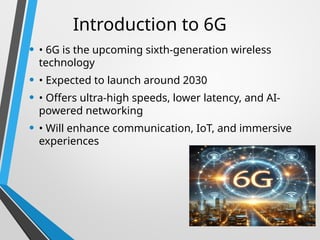
Introduction to 6G
•• 6G is the upcoming sixth-generation wireless
technology
• • Expected to launch around 2030
• • Offers ultra-high speeds, lower latency, and AI-
powered networking
• • Will enhance communication, IoT, and immersive
experiences
3.
Key Features of6G
• • Terahertz (THz) frequency bands for ultra-fast
speeds
• • Latency reduced to less than 0.1 ms
• • AI-driven smart networking for efficiency
• • Energy-efficient and eco-friendly technology
• • Supports holographic communication and
immersive XR (Extended Reality)
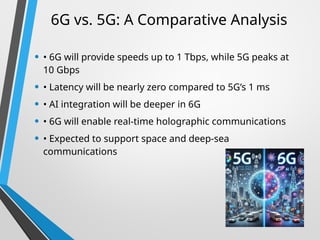
6G vs. 5G:A Comparative Analysis
• • 6G will provide speeds up to 1 Tbps, while 5G peaks at
10 Gbps
• • Latency will be nearly zero compared to 5G’s 1 ms
• • AI integration will be deeper in 6G
• • 6G will enable real-time holographic communications
• • Expected to support space and deep-sea
communications
6.
Applications of 6GTechnology
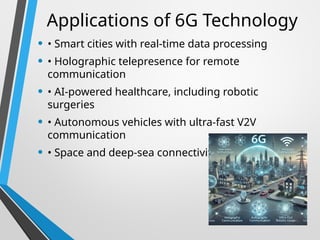
• • Smart cities with real-time data processing
• • Holographic telepresence for remote
communication
• • AI-powered healthcare, including robotic
surgeries
• • Autonomous vehicles with ultra-fast V2V
communication
• • Space and deep-sea connectivity
7.
Challenges in Implementing6G
• • High infrastructure costs and complex
deployment
• • Energy consumption and sustainability concerns
• • Security risks, including quantum hacking
• • Need for advanced hardware (THz antennas, AI
chips, etc.)
• • Global standardization and regulatory
challenges
8.
Role of AIin 6G Networks
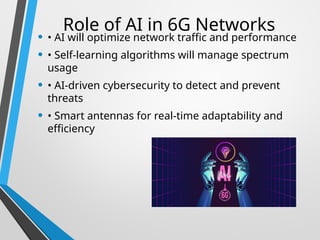
• • AI will optimize network traffic and performance
• • Self-learning algorithms will manage spectrum
usage
• • AI-driven cybersecurity to detect and prevent
threats
• • Smart antennas for real-time adaptability and
efficiency
9.
Security and Privacyin 6G
• • Quantum-resistant encryption to prevent
hacking
• • AI-based real-time threat detection
• • Blockchain for decentralized security solutions
• • Enhanced user privacy with advanced
authentication
10.
Future of 6GTechnology
• • Expected commercialization by 2030
• • Research by major tech companies (Samsung,
Nokia, etc.)
• • Potential use in deep-space exploration and
satellite internet
• • Integration with AI, quantum computing, and
bio-digital convergence
11.
Conclusion
• • 6Gwill revolutionize wireless communication
• • It will offer ultra-fast speeds, AI-driven networks,
and real-time connectivity
• • Challenges exist, but ongoing research aims to
overcome them
• • Expected to transform industries like healthcare,
transportation, and smart cities