A talk at
ISTE approved One Week STTP
on
“Future Trends in 5G and 6G: Challenges, Architecture
and Applications”
Next Generation 5G & 6G: Shaping
the Future of Connectivity
Presented by
Suhas Kakade
17/08/2023
Outline
• Introduction
• Evolution of Wireless Communication
• 5G Technology
• 6G Technology
• AI and 6G
• Holographic communication
• Ethical and Social Considerations
• Future Implications and Impacts
• Conclusion
Evolution from 1G to 5G
1G
2G
3G
4G
5G
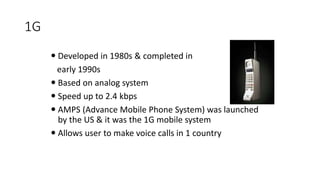
1G
 Developed in 1980s & completed in
early 1990s
 Based on analog system
 Speed up to 2.4 kbps
 AMPS (Advance Mobile Phone System) was launched
by the US & it was the 1G mobile system
 Allows user to make voice calls in 1 country
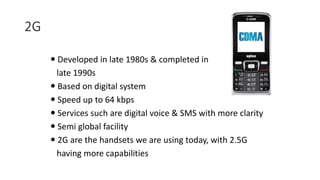
2G
 Developed in late 1980s & completed in
late 1990s
 Based on digital system
 Speed up to 64 kbps
 Services such are digital voice & SMS with more clarity
 Semi global facility
 2G are the handsets we are using today, with 2.5G
having more capabilities
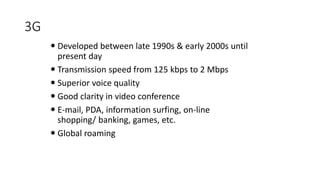
3G
 Developed between late 1990s & early 2000s until
present day
 Transmission speed from 125 kbps to 2 Mbps
 Superior voice quality
 Good clarity in video conference
 E-mail, PDA, information surfing, on-line
shopping/ banking, games, etc.
 Global roaming
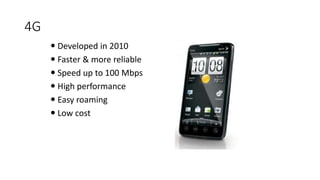
4G
 Developed in 2010
 Faster & more reliable
 Speed up to 100 Mbps
 High performance
 Easy roaming
 Low cost
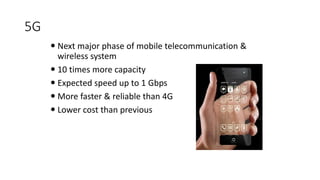
5G
 Next major phase of mobile telecommunication &
wireless system
 10 times more capacity others
 Expected speed up to 1 Gbps
 More faster & reliable than 4G
 Lower cost than previous generations
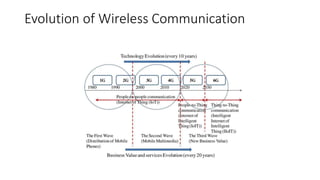
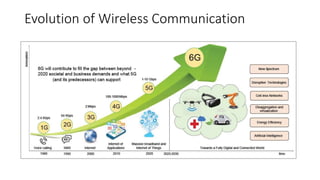
Evolution of Wireless Communication
What is 5G?
• 5G Wireless: 5th generation wireless technology.
• Complete wireless communication with almost no
limitations.
• Can be called REAL wireless world.
• Has incredible transmission speed.
• Concept is only theory not real.
What does it offer?
• Worldwide cellular phones
• Extraordinary data capabilities
• High connectivity
• More power & features in hand held phones
• Large phone memory, more dialing speed, more clarity
in audio & video
Key concepts
 Real wireless world with no more limitations with
access & zone issues
 Wearable devices
 IPv6, where a visiting care of mobile IP address is
assigned according to location & connected network
 One unified global standard
 Smart radio
 The user can simultaneously be connected with several
wireless access technology
 Multiple concurrent data transfer path
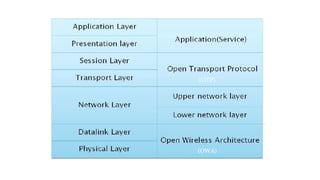
(OTP)
(OWA)
Open Wireless Architecture (OWA)
• OSI layer 1 & OSI layer 2 define the wireless technology
• For these two layers the 5G mobile network is likely to
be based on Open Wireless Architecture (OWA)
• Physical layer + Data link layer = OWA
Network Layer
 All mobile networks will use mobile IP
 Each mobile terminal will be FA (Foreign Agent)
 A mobile can be attached to several mobiles or wireless
networks at the same time
 The fixed IPv6 will be implemented in the mobile
phones
 Separation of network layer into two sub-layers:
(i) Lower network layer (for each interface)
(ii) Upper network layer (for the mobile terminal)
Open Transport Protocol (OTP)
• Wireless network differs from wired network regarding
the transport layer
• In all TCP versions the assumption is that lost segments
are due to network congestion
• In wireless, the loss is due to higher bit error ratio in the
radio interface
• 5G mobile terminals have transport layer that is
possible to be downloaded & installed – Open
Transport Protocol (OTP)
• Transport layer + Session layer = OTP
Application (service) Layer
• Provides intelligent QoS (Quality of Service)
management over variety of networks
• Provides possibility for service quality testing & storage
of measurement information in information database in
the mobile terminal
• Select the best wireless connection for given services
• QoS parameters, such as, delay, losses, BW, reliability,
will be stored in DB of 5G mobile
• Presentation layer + Application layer = Application
Hardware & Software of 5G
5G Hardware:
• Uses UWB (Ultra Wide
Band) networks with
higher BW at low energy
levels
• BW is of 4000 Mbps,
which is 400 times faster
than today’s wireless
networks
• Uses smart antenna
• Uses CDMA (Code Division
Multiple Access)
5G Software:
• 5G will be single unified
standard of different
wireless networks,
including LAN
technologies, LAN/WAN,
WWWW- World Wide
Wireless Web, unified IP &
seamless combination of
broadband
• Software defined radio,
encryption, flexibility,
Anti-Virus
Features of 5G
• High resolution for crazy cell phone users
• Bi-directional large BW
• Less traffic
• 25 Mbps connectivity speed
• Enhanced & available connectivity just about the world
• Uploading & Downloading speed of 5G touching the
peak (up to 1 Gbps)
• Better & fast solution
Features (Conti…)
 High quality service based on policy to avoid error
 Support virtual private networks
 More attractive & effective
 Provides subscriber supervision tools for fast action
Advantages of 5G
• Data BW of 1 Gbps or higher
• Globally accessible
• Dynamic information access
• Available at low cost
Applications of 5G
 Wearable devices with AI (Artificial Intelligence)
capabilities
 Pervasive (Global) networks
 Media independent handover
 Radio resource management
 VoIP (Voice over IP) enabled devices
 With 6th sense technology
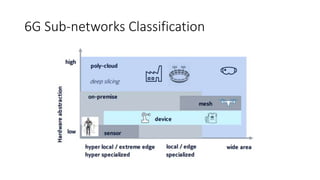
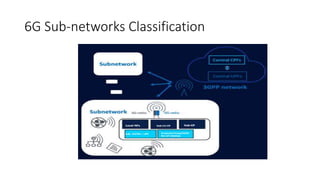
6G Sub-networks Classification
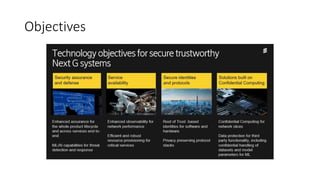
Objectives
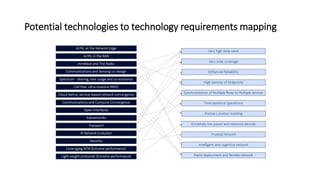
Potential technologies to technology requirements mapping
Why 6G?
•Today- 5G is a strong technology intensively developed; however it has limitations w.r.t. future needs
• 6G Vision for 2030: the society will be data driven, served by near instant, unlimited wireless connectivity
• 6G goals:
• meet novel network demands (e.g., ultra-high reliability, high capacity and efficiency, and low latency) in a holistic
fashion, answering the new needs of economic, social, technological, and environmental context of the 2030 era
• integration of the space, aerial, terrestrial, and maritime communications into a robust network
• large range of applications and services:
• AR/VR, Holographic tele-presence (teleportation), eHealth, pervasive connectivity, Industry 4.0 and robotics,
unmanned mobility, new devices replacing smart phones
• Telepresence -high resolution imaging and sensing, wearable displays, mobile robots and drones, specialized
processors, distributed AI, haptic communication
• Autonomous connected vehicles , massive URLLC (mURLLC), human-centric services, bio-Internet of things (B-
IoT), nano-Internet of things (N-IoT), mobile broadband reliable and low-latency communication
• Open research issues related to 6G networking and connectivity :
- what candidate architecture and technologies : lower layer (physical, L2, L3 ) and also higher layers?
28
NexComm Congress 18-22 April 2021, Porto, Portugal
6G networking and connectivity
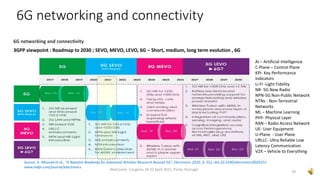
3GPP viewpoint : Roadmap to 2030 ; SEVO, MEVO, LEVO, 6G – Short, medium, long term evolution , 6G
29
NexComm Congress 18-22 April 2021, Porto, Portugal
6G networking and connectivity
Source: A. Mourad et al., "A Baseline Roadmap for Advanced Wireless Research Beyond 5G“, Electronics 2020, 9, 351; doi:10.3390/electronics9020351
www.mdpi.com/journal/electronics
AI – Artificial Intelligence
C-Plane – Control Plane
KPI- Key Performance
Indicators
Li-Fi -Light Fidelity
NR- 5G New Radio
NPN-5G Non-Public Network
NTNs - Non-Terrestrial
Networks
ML – Machine Learning
PHY- Physical Layer
RAN – Radio Access Network
UE- User Equipment
U-Plane - User Plane
URLLC- Ultra Reliable Low
Latency Communication
V2X – Vehicle to Everything
6G networking and connectivity
30
NexComm Congress 18-22 April 2021, Porto, Portugal
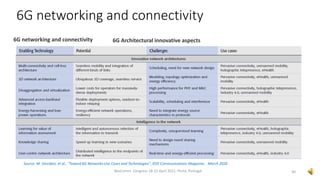
Source: M. Giordani, et al., "Toward 6G Networks:Use Cases and Technologies", IEEE Communications Magazine , March 2020
6G proposes significant
innovative architectures
versus 5G
6G Architectural innovative aspects
6G networking and connectivity
6G networking and
connectivity
31
NexComm Congress 18-22 April 2021, Porto, Portugal
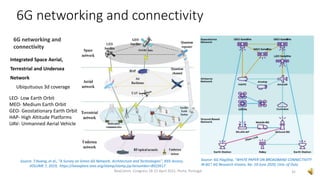
Source: T.Huang, et al., "A Survey on Green 6G Network: Architecture and Technologies", IEEE Access,
VOLUME 7, 2019, https://ieeexplore.ieee.org/stamp/stamp.jsp?arnumber=8922617
Integrated Space Aerial,
Terrestrial and Undersea
Network
Ubiquituous 3d coverage
LEO- Low Earth Orbit
MEO- Medium Earth Orbit
GEO- Geostationary Earth Orbit
HAP- High Altitude Platforms
UAV- Unmanned Aerial Vehicle
Source: 6G FlagShip, "WHITE PAPER ON BROADBAND CONNECTIVITY
IN 6G“, 6G Research Visions, No. 10 June 2020, Univ. of Oulu
6G networking and connectivity
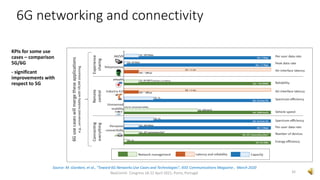
KPIs for some use
cases – comparison
5G/6G
- significant
improvements with
respect to 5G
32
NexComm Congress 18-22 April 2021, Porto, Portugal
Source: M. Giordani, et al., "Toward 6G Networks:Use Cases and Technologies", IEEE Communications Magazine , March 2020
6G networking and connectivity
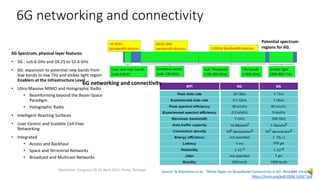
6G Spectrum, physical layer features
• 5G : sub-6 GHz and 24.25 to 52.6 GHz
• 6G: expansion to potential new bands from
low-bands to low THz and visible light region
Enablers at the Infrastructure Level
• Ultra-Massive MIMO and Holographic Radio
• Beamforming beyond the Beam-Space
Paradigm
• Holographic Radio
• Intelligent Reacting Surfaces
• User-Centric and Scalable Cell-Free
Networking
• Integrated
• Access and Backhaul
• Space and Terrestrial Networks
• Broadcast and Multicast Networks
.
33
NexComm Congress 18-22 April 2021, Porto, Portugal Source: N.Rajatheva et al., "White Paper on Broadband Connectivity in 6G- Research Visions",
https://arxiv.org/pdf/2004.14247.pdf
Potential spectrum
regions for 6G.
6G networking and connectivity
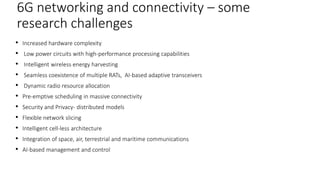
• Increased hardware complexity
• Low power circuits with high-performance processing capabilities
• Intelligent wireless energy harvesting
• Seamless coexistence of multiple RATs, AI-based adaptive transceivers
• Dynamic radio resource allocation
• Pre-emptive scheduling in massive connectivity
• Security and Privacy- distributed models
• Flexible network slicing
• Intelligent cell-less architecture
• Integration of space, air, terrestrial and maritime communications
• AI-based management and control
34
6G networking and connectivity – some
research challenges
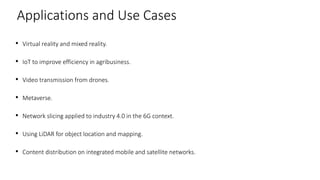
• Virtual reality and mixed reality.
• IoT to improve efficiency in agribusiness.
• Video transmission from drones.
• Metaverse.
• Network slicing applied to industry 4.0 in the 6G context.
• Using LiDAR for object location and mapping.
• Content distribution on integrated mobile and satellite networks.
35
Applications and Use Cases
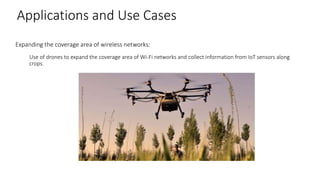
Expanding the coverage area of wireless networks:
Use of drones to expand the coverage area of Wi-Fi networks and collect information from IoT sensors along
crops.
36
Applications and Use Cases
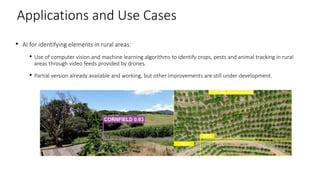
• AI for identifying elements in rural areas:
• Use of computer vision and machine learning algorithms to identify crops, pests and animal tracking in rural
areas through video feeds provided by drones.
• Partial version already available and working, but other improvements are still under development.
37
Applications and Use Cases
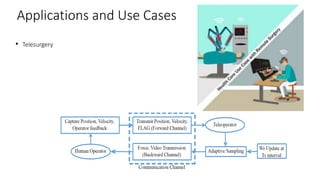
• Telesurgery
38
Applications and Use Cases
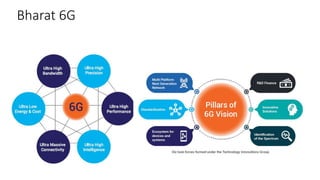
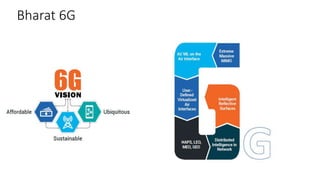
Bharat 6G
Bharat 6G
Conclusion
 3G- Operator Centric,
4G- Service Centric whereas
5G- User Centric
 We have proposed 5G wireless concept designed as an
open platform on different layers
 The new coming 5G technology will be available in the
market at affordable rates, high peak future & much
reliability than preceding technologies
• The 6G network will go beyond communication, integrating a set of features never
seen in previous generations.
• With new demands, new challenges and opportunities arise.
• The Brasil 6G transceiver will address complex and defying use cases not covered by
the current 5G network.
• Our transceiver will integrate disruptive technologies in a unique framework for 6G
testbeding.
• Training of researchers/professionals able to collaborate with the development of
6G Networks.
42
Conclusion
References
1. M. Giordani,et al., "Toward 6G Networks:Use Cases and Technologies", IEEE Communications Magazine, March 2020
2. A. Mourad et al., "A Baseline Roadmap for Advanced Wireless Research Beyond 5G“, Electronics 2020, 9, 351;
doi:10.3390/electronics9020351 www.mdpi.com/journal/electronics
3. N.Rajatheva et al., "White Paper on Broadband Connectivity in 6G- Research Visions",
https://arxiv.org/pdf/2004.14247.pdf
4. T.Huang, et al., "A Survey on Green 6G Network: Architecture and Technologies", IEEE Access, VOLUME 7, 2019,
https://ieeexplore.ieee.org/stamp/stamp.jsp?arnumber=8922617
5. Y.Zhao, et al., A Comprehensive Survey of 6G Wireless Communications INTERNET OF THINGS JOURNAL, 2020,
arXiv:2101.12475v1 [cs.NI] 29 Jan 2021
6. Matti Latva-aho, Kari Leppänen, "KEY DRIVERSAND RESEARCH CHALLENGES FOR 6G UBIQUITOUS WIRELESS
INTELLIGENCE", 2019, http://jultika.oulu.fi/files/isbn9789526223544.pdf
7. M.H. Alsharif et al., "Sixth Generation (6G)Wireless Networks:Vision, Research Activities, Challenges and Potential
Solutions", https://www.mdpi.com/2073-8994/12/4/676
8. K.B. Letaief, et al., "The Roadmap to 6G:AI Empowered Wireless Networks", IEEE Communications Magazine , August
2019
9. B.Aazhang, P.Ahokangas, et al., "Key drivers and research challenges for 6G ubiquitous wireless intelligence (white
paper)",
https://www.researchgate.net/publication/336000008_Key_drivers_and_research_challenges_for_6G_ubiquitous_wirel
ess_intelligence_white_paper
THANK YOU !

Presentation1.pptx

  • 1.
    A talk at ISTEapproved One Week STTP on “Future Trends in 5G and 6G: Challenges, Architecture and Applications” Next Generation 5G & 6G: Shaping the Future of Connectivity Presented by Suhas Kakade 17/08/2023
  • 2.
    Outline • Introduction • Evolutionof Wireless Communication • 5G Technology • 6G Technology • AI and 6G • Holographic communication • Ethical and Social Considerations • Future Implications and Impacts • Conclusion
  • 3.
    Evolution from 1Gto 5G 1G 2G 3G 4G 5G
  • 4.
    1G  Developed in1980s & completed in early 1990s  Based on analog system  Speed up to 2.4 kbps  AMPS (Advance Mobile Phone System) was launched by the US & it was the 1G mobile system  Allows user to make voice calls in 1 country
  • 5.
    2G  Developed inlate 1980s & completed in late 1990s  Based on digital system  Speed up to 64 kbps  Services such are digital voice & SMS with more clarity  Semi global facility  2G are the handsets we are using today, with 2.5G having more capabilities
  • 6.
    3G  Developed betweenlate 1990s & early 2000s until present day  Transmission speed from 125 kbps to 2 Mbps  Superior voice quality  Good clarity in video conference  E-mail, PDA, information surfing, on-line shopping/ banking, games, etc.  Global roaming
  • 7.
    4G  Developed in2010  Faster & more reliable  Speed up to 100 Mbps  High performance  Easy roaming  Low cost
  • 8.
    5G  Next majorphase of mobile telecommunication & wireless system  10 times more capacity others  Expected speed up to 1 Gbps  More faster & reliable than 4G  Lower cost than previous generations
  • 9.
    Evolution of WirelessCommunication
  • 10.
    Evolution of WirelessCommunication
  • 11.
    What is 5G? •5G Wireless: 5th generation wireless technology. • Complete wireless communication with almost no limitations. • Can be called REAL wireless world. • Has incredible transmission speed. • Concept is only theory not real.
  • 12.
    What does itoffer? • Worldwide cellular phones • Extraordinary data capabilities • High connectivity • More power & features in hand held phones • Large phone memory, more dialing speed, more clarity in audio & video
  • 13.
    Key concepts  Realwireless world with no more limitations with access & zone issues  Wearable devices  IPv6, where a visiting care of mobile IP address is assigned according to location & connected network  One unified global standard  Smart radio  The user can simultaneously be connected with several wireless access technology  Multiple concurrent data transfer path
  • 14.
  • 15.
    Open Wireless Architecture(OWA) • OSI layer 1 & OSI layer 2 define the wireless technology • For these two layers the 5G mobile network is likely to be based on Open Wireless Architecture (OWA) • Physical layer + Data link layer = OWA
  • 16.
    Network Layer  Allmobile networks will use mobile IP  Each mobile terminal will be FA (Foreign Agent)  A mobile can be attached to several mobiles or wireless networks at the same time  The fixed IPv6 will be implemented in the mobile phones  Separation of network layer into two sub-layers: (i) Lower network layer (for each interface) (ii) Upper network layer (for the mobile terminal)
  • 17.
    Open Transport Protocol(OTP) • Wireless network differs from wired network regarding the transport layer • In all TCP versions the assumption is that lost segments are due to network congestion • In wireless, the loss is due to higher bit error ratio in the radio interface • 5G mobile terminals have transport layer that is possible to be downloaded & installed – Open Transport Protocol (OTP) • Transport layer + Session layer = OTP
  • 18.
    Application (service) Layer •Provides intelligent QoS (Quality of Service) management over variety of networks • Provides possibility for service quality testing & storage of measurement information in information database in the mobile terminal • Select the best wireless connection for given services • QoS parameters, such as, delay, losses, BW, reliability, will be stored in DB of 5G mobile • Presentation layer + Application layer = Application
  • 19.
    Hardware & Softwareof 5G 5G Hardware: • Uses UWB (Ultra Wide Band) networks with higher BW at low energy levels • BW is of 4000 Mbps, which is 400 times faster than today’s wireless networks • Uses smart antenna • Uses CDMA (Code Division Multiple Access) 5G Software: • 5G will be single unified standard of different wireless networks, including LAN technologies, LAN/WAN, WWWW- World Wide Wireless Web, unified IP & seamless combination of broadband • Software defined radio, encryption, flexibility, Anti-Virus
  • 20.
    Features of 5G •High resolution for crazy cell phone users • Bi-directional large BW • Less traffic • 25 Mbps connectivity speed • Enhanced & available connectivity just about the world • Uploading & Downloading speed of 5G touching the peak (up to 1 Gbps) • Better & fast solution
  • 21.
    Features (Conti…)  Highquality service based on policy to avoid error  Support virtual private networks  More attractive & effective  Provides subscriber supervision tools for fast action
  • 22.
    Advantages of 5G •Data BW of 1 Gbps or higher • Globally accessible • Dynamic information access • Available at low cost
  • 23.
    Applications of 5G Wearable devices with AI (Artificial Intelligence) capabilities  Pervasive (Global) networks  Media independent handover  Radio resource management  VoIP (Voice over IP) enabled devices  With 6th sense technology
  • 24.
  • 25.
  • 26.
  • 27.
    Potential technologies totechnology requirements mapping
  • 28.
    Why 6G? •Today- 5Gis a strong technology intensively developed; however it has limitations w.r.t. future needs • 6G Vision for 2030: the society will be data driven, served by near instant, unlimited wireless connectivity • 6G goals: • meet novel network demands (e.g., ultra-high reliability, high capacity and efficiency, and low latency) in a holistic fashion, answering the new needs of economic, social, technological, and environmental context of the 2030 era • integration of the space, aerial, terrestrial, and maritime communications into a robust network • large range of applications and services: • AR/VR, Holographic tele-presence (teleportation), eHealth, pervasive connectivity, Industry 4.0 and robotics, unmanned mobility, new devices replacing smart phones • Telepresence -high resolution imaging and sensing, wearable displays, mobile robots and drones, specialized processors, distributed AI, haptic communication • Autonomous connected vehicles , massive URLLC (mURLLC), human-centric services, bio-Internet of things (B- IoT), nano-Internet of things (N-IoT), mobile broadband reliable and low-latency communication • Open research issues related to 6G networking and connectivity : - what candidate architecture and technologies : lower layer (physical, L2, L3 ) and also higher layers? 28 NexComm Congress 18-22 April 2021, Porto, Portugal 6G networking and connectivity
  • 29.
    3GPP viewpoint :Roadmap to 2030 ; SEVO, MEVO, LEVO, 6G – Short, medium, long term evolution , 6G 29 NexComm Congress 18-22 April 2021, Porto, Portugal 6G networking and connectivity Source: A. Mourad et al., "A Baseline Roadmap for Advanced Wireless Research Beyond 5G“, Electronics 2020, 9, 351; doi:10.3390/electronics9020351 www.mdpi.com/journal/electronics AI – Artificial Intelligence C-Plane – Control Plane KPI- Key Performance Indicators Li-Fi -Light Fidelity NR- 5G New Radio NPN-5G Non-Public Network NTNs - Non-Terrestrial Networks ML – Machine Learning PHY- Physical Layer RAN – Radio Access Network UE- User Equipment U-Plane - User Plane URLLC- Ultra Reliable Low Latency Communication V2X – Vehicle to Everything 6G networking and connectivity
  • 30.
    6G networking andconnectivity 30 NexComm Congress 18-22 April 2021, Porto, Portugal Source: M. Giordani, et al., "Toward 6G Networks:Use Cases and Technologies", IEEE Communications Magazine , March 2020 6G proposes significant innovative architectures versus 5G 6G Architectural innovative aspects 6G networking and connectivity
  • 31.
    6G networking and connectivity 31 NexCommCongress 18-22 April 2021, Porto, Portugal Source: T.Huang, et al., "A Survey on Green 6G Network: Architecture and Technologies", IEEE Access, VOLUME 7, 2019, https://ieeexplore.ieee.org/stamp/stamp.jsp?arnumber=8922617 Integrated Space Aerial, Terrestrial and Undersea Network Ubiquituous 3d coverage LEO- Low Earth Orbit MEO- Medium Earth Orbit GEO- Geostationary Earth Orbit HAP- High Altitude Platforms UAV- Unmanned Aerial Vehicle Source: 6G FlagShip, "WHITE PAPER ON BROADBAND CONNECTIVITY IN 6G“, 6G Research Visions, No. 10 June 2020, Univ. of Oulu 6G networking and connectivity
  • 32.
    KPIs for someuse cases – comparison 5G/6G - significant improvements with respect to 5G 32 NexComm Congress 18-22 April 2021, Porto, Portugal Source: M. Giordani, et al., "Toward 6G Networks:Use Cases and Technologies", IEEE Communications Magazine , March 2020 6G networking and connectivity
  • 33.
    6G Spectrum, physicallayer features • 5G : sub-6 GHz and 24.25 to 52.6 GHz • 6G: expansion to potential new bands from low-bands to low THz and visible light region Enablers at the Infrastructure Level • Ultra-Massive MIMO and Holographic Radio • Beamforming beyond the Beam-Space Paradigm • Holographic Radio • Intelligent Reacting Surfaces • User-Centric and Scalable Cell-Free Networking • Integrated • Access and Backhaul • Space and Terrestrial Networks • Broadcast and Multicast Networks . 33 NexComm Congress 18-22 April 2021, Porto, Portugal Source: N.Rajatheva et al., "White Paper on Broadband Connectivity in 6G- Research Visions", https://arxiv.org/pdf/2004.14247.pdf Potential spectrum regions for 6G. 6G networking and connectivity 6G networking and connectivity
  • 34.
    • Increased hardwarecomplexity • Low power circuits with high-performance processing capabilities • Intelligent wireless energy harvesting • Seamless coexistence of multiple RATs, AI-based adaptive transceivers • Dynamic radio resource allocation • Pre-emptive scheduling in massive connectivity • Security and Privacy- distributed models • Flexible network slicing • Intelligent cell-less architecture • Integration of space, air, terrestrial and maritime communications • AI-based management and control 34 6G networking and connectivity – some research challenges
  • 35.
    • Virtual realityand mixed reality. • IoT to improve efficiency in agribusiness. • Video transmission from drones. • Metaverse. • Network slicing applied to industry 4.0 in the 6G context. • Using LiDAR for object location and mapping. • Content distribution on integrated mobile and satellite networks. 35 Applications and Use Cases
  • 36.
    Expanding the coveragearea of wireless networks: Use of drones to expand the coverage area of Wi-Fi networks and collect information from IoT sensors along crops. 36 Applications and Use Cases
  • 37.
    • AI foridentifying elements in rural areas: • Use of computer vision and machine learning algorithms to identify crops, pests and animal tracking in rural areas through video feeds provided by drones. • Partial version already available and working, but other improvements are still under development. 37 Applications and Use Cases
  • 38.
  • 39.
  • 40.
  • 41.
    Conclusion  3G- OperatorCentric, 4G- Service Centric whereas 5G- User Centric  We have proposed 5G wireless concept designed as an open platform on different layers  The new coming 5G technology will be available in the market at affordable rates, high peak future & much reliability than preceding technologies
  • 42.
    • The 6Gnetwork will go beyond communication, integrating a set of features never seen in previous generations. • With new demands, new challenges and opportunities arise. • The Brasil 6G transceiver will address complex and defying use cases not covered by the current 5G network. • Our transceiver will integrate disruptive technologies in a unique framework for 6G testbeding. • Training of researchers/professionals able to collaborate with the development of 6G Networks. 42 Conclusion
  • 43.
    References 1. M. Giordani,etal., "Toward 6G Networks:Use Cases and Technologies", IEEE Communications Magazine, March 2020 2. A. Mourad et al., "A Baseline Roadmap for Advanced Wireless Research Beyond 5G“, Electronics 2020, 9, 351; doi:10.3390/electronics9020351 www.mdpi.com/journal/electronics 3. N.Rajatheva et al., "White Paper on Broadband Connectivity in 6G- Research Visions", https://arxiv.org/pdf/2004.14247.pdf 4. T.Huang, et al., "A Survey on Green 6G Network: Architecture and Technologies", IEEE Access, VOLUME 7, 2019, https://ieeexplore.ieee.org/stamp/stamp.jsp?arnumber=8922617 5. Y.Zhao, et al., A Comprehensive Survey of 6G Wireless Communications INTERNET OF THINGS JOURNAL, 2020, arXiv:2101.12475v1 [cs.NI] 29 Jan 2021 6. Matti Latva-aho, Kari Leppänen, "KEY DRIVERSAND RESEARCH CHALLENGES FOR 6G UBIQUITOUS WIRELESS INTELLIGENCE", 2019, http://jultika.oulu.fi/files/isbn9789526223544.pdf 7. M.H. Alsharif et al., "Sixth Generation (6G)Wireless Networks:Vision, Research Activities, Challenges and Potential Solutions", https://www.mdpi.com/2073-8994/12/4/676 8. K.B. Letaief, et al., "The Roadmap to 6G:AI Empowered Wireless Networks", IEEE Communications Magazine , August 2019 9. B.Aazhang, P.Ahokangas, et al., "Key drivers and research challenges for 6G ubiquitous wireless intelligence (white paper)", https://www.researchgate.net/publication/336000008_Key_drivers_and_research_challenges_for_6G_ubiquitous_wirel ess_intelligence_white_paper
  • 44.