The cGMP commercial purification of a Monoclonal Antibody
direct from unclarified broth using
expanded bed chromatography with
PAT Control using Ultrasound.
Martin Hofmann
Managing Director
Biotechflow Ltd
Mobile +44 (0) 7980 74 77 30
Website biotechflow.com
Email martin@biotechflow.com
Copyright ©Biotechflow 2018
2Martin Hofmann. Copyright ©Biotechflow 2018
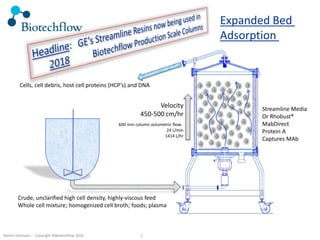
Expanded Bed
Adsorption
Crude, unclarified high cell density, highly-viscous feed
Whole cell mixture; homogenized cell broth; foods; plasma
Streamline Media
Or Rhobust®
MabDirect
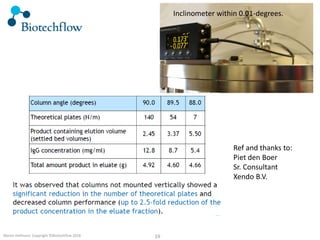
Protein A
Captures MAb
Velocity
450-500 cm/hr
600 mm column volumetric flow:
24 L/min
1414 L/hr
Cells, cell debris, host cell proteins (HCP’s) and DNA
3Martin Hofmann Copyright ©Biotechflow 2018
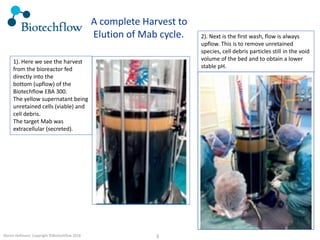
1). Here we see the harvest
from the bioreactor fed
directly into the
bottom (upflow) of the
Biotechflow EBA 300.
The yellow supernatant being
unretained cells (viable) and
cell debris.
The target Mab was
extracellular (secreted).
2). Next is the first wash, flow is always
upflow. This is to remove unretained
species, cell debris particles still in the void
volume of the bed and to obtain a lower
stable pH.
A complete Harvest to
Elution of Mab cycle.
4Martin Hofmann Copyright ©Biotechflow 2018
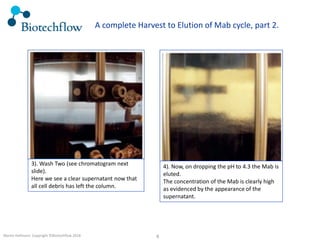
3). Wash Two (see chromatogram next
slide).
Here we see a clear supernatant now that
all cell debris has left the column.
4). Now, on dropping the pH to 4.3 the Mab is
eluted.
The concentration of the Mab is clearly high
as evidenced by the appearance of the
supernatant.
A complete Harvest to Elution of Mab cycle, part 2.
5Martin Hofmann Copyright ©Biotechflow 2018
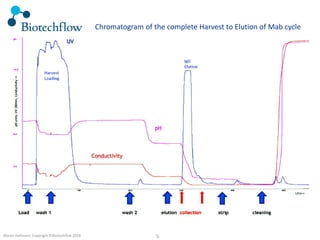
Chromatogram of the complete Harvest to Elution of Mab cycle
6Martin Hofmann Copyright © Biotechflow 2018
PISTON DESIGN
Martin Hofmann. Copyright ©Biotechflow 2018 7
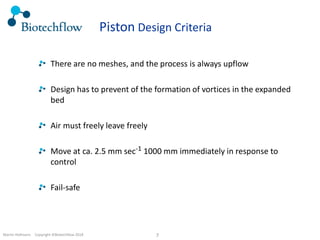
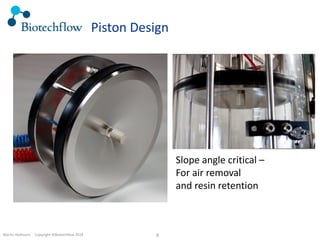
Piston Design Criteria
There are no meshes, and the process is always upflow
Design has to prevent of the formation of vortices in the expanded
bed
Air must freely leave freely
Move at ca. 2.5 mm sec-1 1000 mm immediately in response to
control
Fail-safe
Martin Hofmann. Copyright ©Biotechflow 2018 8
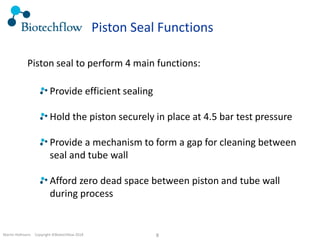
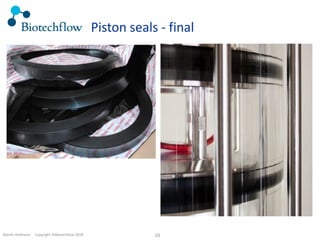
Piston Seal Functions
Piston seal to perform 4 main functions:
Provide efficient sealing
Hold the piston securely in place at 4.5 bar test pressure
Provide a mechanism to form a gap for cleaning between
seal and tube wall
Afford zero dead space between piston and tube wall
during process
Martin Hofmann. Copyright ©Biotechflow 2018 9
Piston Design
Slope angle critical –
For air removal
and resin retention
Martin Hofmann. Copyright ©Biotechflow 2018 10
Piston seals - final
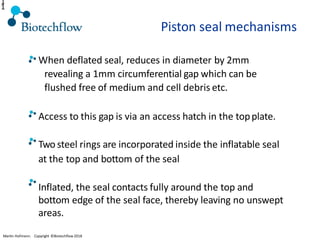
Piston seal mechanisms
When deflated seal, reduces in diameter by 2mm
revealing a 1mm circumferential gap which can be
flushed free of medium and cell debris etc.
Access to this gap is via an access hatch in the topplate.
Two steel rings are incorporated inside the inflatable seal
at the top and bottom of the seal
Inflated, the seal contacts fully around the top and
bottom edge of the seal face, thereby leaving no unswept
areas.
1
1
Martin Hofmann. Copyright ©Biotechflow 2018
12Martin Hofmann Copyright © Biotechflow 2018
ANTIVORTEX DESIGN
Martin Hofmann. Copyright ©Biotechflow 2018 13
Anti-jet Top MP outlet
PROBLEM: Resin leaving the column via a vortex
The critical parameters were:-
Veins
(Kiviniemi, 2009 and Rindels, 1983)
Outlet holes
Anti-jet rod
Cone
Martin Hofmann. Copyright ©Biotechflow 2018 14
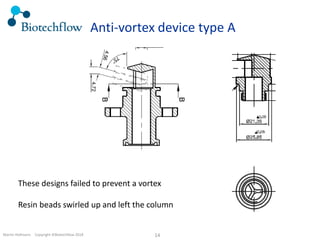
Anti-vortex device type A
These designs failed to prevent a vortex
Resin beads swirled up and left the column
Piston seal mechanisms
It was found, by experiment that the critical parameters were:-
The number and angle of ‘veins’
(Kiviniemi, 2009 and Rindels, 1983)
The dimensions of the outlet holes
The length of the anti-jet rod
The angle of the cone of the piston
1
5
Martin Hofmann. Copyright ©Biotechflow 2018
Martin Hofmann. Copyright ©Biotechflow 2018 16
Anti-vortex device final design
120-degree angle
Three veins
Anti-jet rod extends beyond cone
Sacrificial and disposable
Martin Hofmann. Copyright ©Biotechflow 2018 17
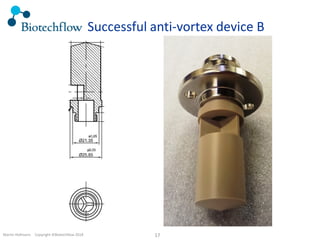
Successful anti-vortex device B
18Martin Hofmann Copyright © Biotechflow 2018
PERPENDICULARITY
19Martin Hofmann Copyright ©Biotechflow 2018
Inclinometer within 0.01-degrees.
Ref and thanks to:
Piet den Boer
Sr. Consultant
Xendo B.V.
20Martin Hofmann Copyright © Biotechflow2018
MANUFACTURING TIME
Martin Hofmann Copyright © Biotechflow 2018 21
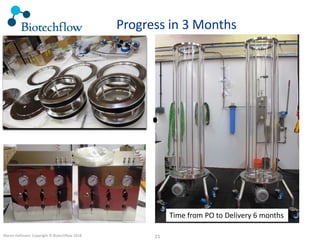
Progress in 3 Months
Time from PO to Delivery 6 months
22Martin Hofmann. Copyright ©Biotechflow 2018
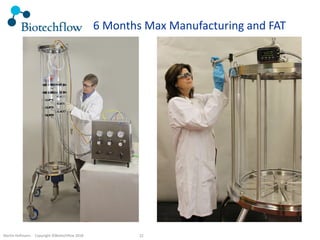
6 Months Max Manufacturing and FAT
23Martin Hofmann Copyright © Biotechflow 2018
FLOW RATE CONTROL
USING ULTRASOUND
Martin Hofmann. Copyright ©Biotechflow 2018 24
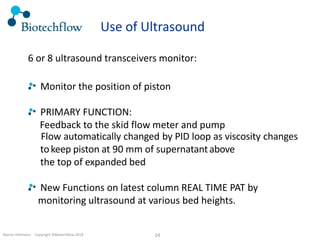
Use of Ultrasound
6 or 8 ultrasound transceivers monitor:
Monitor the position of piston
PRIMARY FUNCTION:
Feedback to the skid flow meter and pump
Flow automatically changed by PID loop as viscosity changes
tokeep piston at 90 mm of supernatantabove
the top of expanded bed
New Functions on latest column REAL TIME PAT by
monitoring ultrasound at various bed heights.
Martin Hofmann. Copyright ©Biotechflow 2018 25
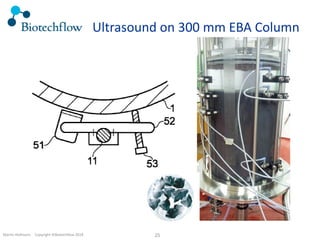
Ultrasound on 300 mm EBA Column
Martin Hofmann. Copyright ©Biotechflow 2018 26
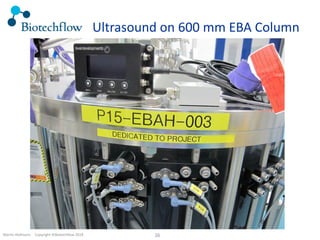
Ultrasound on 600 mm EBA Column
27Martin Hofmann Copyright © Biotechflow 2018
REAL TIME MONITORING
BY USING ULTRASOUND
Martin Hofmann. Copyright ©Biotechflow 2018 28
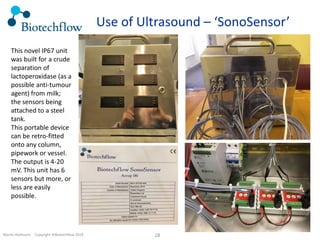
Use of Ultrasound – ‘SonoSensor’
This novel IP67 unit
was built for a crude
separation of
lactoperoxidase (as a
possible anti-tumour
agent) from milk;
the sensors being
attached to a steel
tank.
This portable device
can be retro-fitted
onto any column,
pipework or vessel.
The output is 4-20
mV. This unit has 6
sensors but more, or
less are easily
possible.
29Martin Hofmann Copyright ©Biotechflow 2018
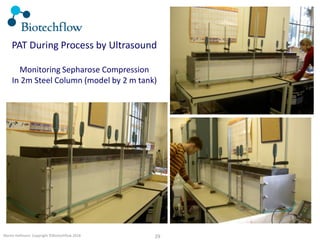
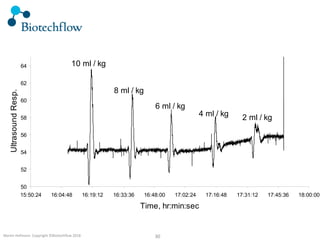
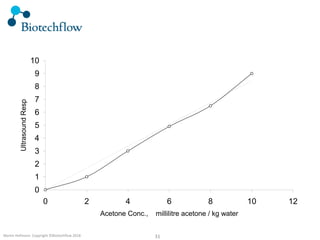
PAT During Process by Ultrasound
Monitoring Sepharose Compression
In 2m Steel Column (model by 2 m tank)
30Martin Hofmann Copyright ©Biotechflow 2018
50
52
54
56
58
60
62
64
15:50:24 16:04:48 16:19:12 16:33:36 16:48:00 17:02:24 17:16:48 17:31:12 17:45:36 18:00:00
Time, hr:min:sec
UltrasoundResp.
10 ml / kg
8 ml / kg
6 ml / kg
4 ml / kg 2 ml / kg
31Martin Hofmann Copyright ©Biotechflow 2018
0
1
2
3
4
5
6
7
8
9
10
0 2 4 6 8 10 12
Acetone Conc., millilitre acetone / kg water
UltrasoundResp
32Martin Hofmann Copyright ©Biotechflow 2018
0
10
20
30
40
50
60
70
80
90
100
8000 8500 9000 9500 10000 10500 11000 11500 12000
Time (secs)
-0.5
0
0.5
1
1.5
2
2.5
3
3.50
10
20
30
40
50
60
70
80
90
100
8000 8500 9000 9500 10000 10500 11000 11500 12000
Time (secs)
-0.5
0
0.5
1
1.5
2
2.5
3
3.5
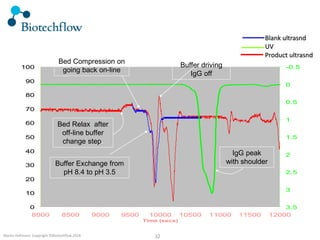
Bed Relax after
off-line buffer
change step.
Bed Compression on
going back on-line
Buffer driving
IgG off
IgG peak
with shoulderBuffer Exchange from
pH 8.4 to pH 3.5
Blank ultrasnd
UV
Product ultrasnd
33Martin Hofmann Copyright © Biotechflow 2018
cGMP Commercial EBA
Martin Hofmann. Copyright ©Biotechflow 2018 34
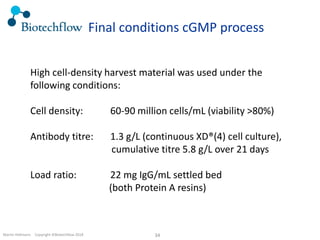
Final conditions cGMP process
High cell-density harvest material was used under the
following conditions:
Cell density: 60-90 million cells/mL (viability >80%)
Antibody titre: 1.3 g/L (continuous XD®(4) cell culture),
cumulative titre 5.8 g/L over 21 days
Load ratio: 22 mg IgG/mL settled bed
(both Protein A resins)
Martin Hofmann. Copyright ©Biotechflow 2018 35
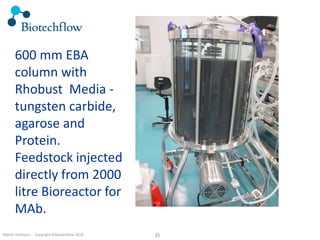
600 mm EBA
column with
Rhobust Media -
tungsten carbide,
agarose and
Protein.
Feedstock injected
directly from 2000
litre Bioreactor for
MAb.
36Martin Hofmann. Copyright ©Biotechflow 2018
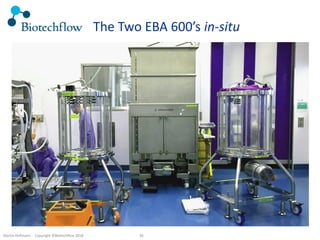
The Two EBA 600’s in-situ
Martin Hofmann. Copyright ©Biotechflow 2018 37
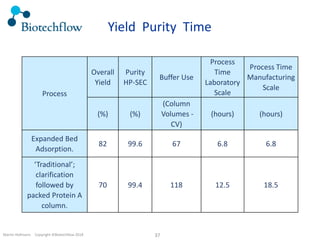
Process
Overall
Yield
Purity
HP-SEC
Buffer Use
Process
Time
Laboratory
Scale
Process Time
Manufacturing
Scale
(%) (%)
(Column
Volumes -
CV)
(hours) (hours)
Expanded Bed
Adsorption.
82 99.6 67 6.8 6.8
‘Traditional’;
clarification
followed by
packed Protein A
column.
70 99.4 118 12.5 18.5
Yield Purity Time
Martin Hofmann. Copyright ©Biotechflow 2018 38
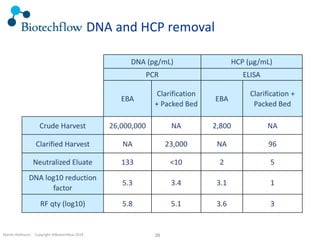
DNA and HCP removal
DNA (pg/mL) HCP (µg/mL)
PCR ELISA
EBA
Clarification
+ Packed Bed
EBA
Clarification +
Packed Bed
Crude Harvest 26,000,000 NA 2,800 NA
Clarified Harvest NA 23,000 NA 96
Neutralized Eluate 133 <10 2 5
DNA log10 reduction
factor
5.3 3.4 3.1 1
RF qty (log10) 5.8 5.1 3.6 3
Martin Hofmann. Copyright ©Biotechflow 2018 39
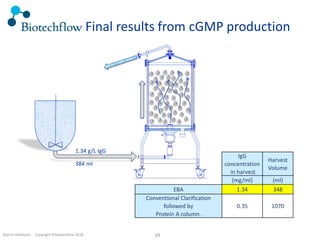
IgG
concentration
in harvest
Harvest
Volume
(mg/ml) (ml)
EBA 1.34 348
Conventional Clarification
followed by
Protein A column.
0.35 1070
Final results from cGMP production
1.34 g/L IgG
384 ml
Martin Hofmann. Copyright ©Biotechflow 2018 40
Conclusions
EBA column for Mab’s
43% decrease in buffer volume
Production-scale runs took 1/3 of the time necessary for traditional
Product purity was directly comparable
Product concentration was significantly increased,
from 0.35 (traditional) to 1.34 mg/ml (EBA)
EBA enabled higher throughputs and flow rates (450cm/hr)
EBA process more-effectively removed cell debris than traditional
600 mm ID x800 mm L 8x throughput, 2nd next year, 2019, 500 kg/year

Biotechflow expanded bed columns + streamline 2018

  • 1.
    The cGMP commercialpurification of a Monoclonal Antibody direct from unclarified broth using expanded bed chromatography with PAT Control using Ultrasound. Martin Hofmann Managing Director Biotechflow Ltd Mobile +44 (0) 7980 74 77 30 Website biotechflow.com Email martin@biotechflow.com Copyright ©Biotechflow 2018
  • 2.
    2Martin Hofmann. Copyright©Biotechflow 2018 Expanded Bed Adsorption Crude, unclarified high cell density, highly-viscous feed Whole cell mixture; homogenized cell broth; foods; plasma Streamline Media Or Rhobust® MabDirect Protein A Captures MAb Velocity 450-500 cm/hr 600 mm column volumetric flow: 24 L/min 1414 L/hr Cells, cell debris, host cell proteins (HCP’s) and DNA
  • 3.
    3Martin Hofmann Copyright©Biotechflow 2018 1). Here we see the harvest from the bioreactor fed directly into the bottom (upflow) of the Biotechflow EBA 300. The yellow supernatant being unretained cells (viable) and cell debris. The target Mab was extracellular (secreted). 2). Next is the first wash, flow is always upflow. This is to remove unretained species, cell debris particles still in the void volume of the bed and to obtain a lower stable pH. A complete Harvest to Elution of Mab cycle.
  • 4.
    4Martin Hofmann Copyright©Biotechflow 2018 3). Wash Two (see chromatogram next slide). Here we see a clear supernatant now that all cell debris has left the column. 4). Now, on dropping the pH to 4.3 the Mab is eluted. The concentration of the Mab is clearly high as evidenced by the appearance of the supernatant. A complete Harvest to Elution of Mab cycle, part 2.
  • 5.
    5Martin Hofmann Copyright©Biotechflow 2018 Chromatogram of the complete Harvest to Elution of Mab cycle
  • 6.
    6Martin Hofmann Copyright© Biotechflow 2018 PISTON DESIGN
  • 7.
    Martin Hofmann. Copyright©Biotechflow 2018 7 Piston Design Criteria There are no meshes, and the process is always upflow Design has to prevent of the formation of vortices in the expanded bed Air must freely leave freely Move at ca. 2.5 mm sec-1 1000 mm immediately in response to control Fail-safe
  • 8.
    Martin Hofmann. Copyright©Biotechflow 2018 8 Piston Seal Functions Piston seal to perform 4 main functions: Provide efficient sealing Hold the piston securely in place at 4.5 bar test pressure Provide a mechanism to form a gap for cleaning between seal and tube wall Afford zero dead space between piston and tube wall during process
  • 9.
    Martin Hofmann. Copyright©Biotechflow 2018 9 Piston Design Slope angle critical – For air removal and resin retention
  • 10.
    Martin Hofmann. Copyright©Biotechflow 2018 10 Piston seals - final
  • 11.
    Piston seal mechanisms Whendeflated seal, reduces in diameter by 2mm revealing a 1mm circumferential gap which can be flushed free of medium and cell debris etc. Access to this gap is via an access hatch in the topplate. Two steel rings are incorporated inside the inflatable seal at the top and bottom of the seal Inflated, the seal contacts fully around the top and bottom edge of the seal face, thereby leaving no unswept areas. 1 1 Martin Hofmann. Copyright ©Biotechflow 2018
  • 12.
    12Martin Hofmann Copyright© Biotechflow 2018 ANTIVORTEX DESIGN
  • 13.
    Martin Hofmann. Copyright©Biotechflow 2018 13 Anti-jet Top MP outlet PROBLEM: Resin leaving the column via a vortex The critical parameters were:- Veins (Kiviniemi, 2009 and Rindels, 1983) Outlet holes Anti-jet rod Cone
  • 14.
    Martin Hofmann. Copyright©Biotechflow 2018 14 Anti-vortex device type A These designs failed to prevent a vortex Resin beads swirled up and left the column
  • 15.
    Piston seal mechanisms Itwas found, by experiment that the critical parameters were:- The number and angle of ‘veins’ (Kiviniemi, 2009 and Rindels, 1983) The dimensions of the outlet holes The length of the anti-jet rod The angle of the cone of the piston 1 5 Martin Hofmann. Copyright ©Biotechflow 2018
  • 16.
    Martin Hofmann. Copyright©Biotechflow 2018 16 Anti-vortex device final design 120-degree angle Three veins Anti-jet rod extends beyond cone Sacrificial and disposable
  • 17.
    Martin Hofmann. Copyright©Biotechflow 2018 17 Successful anti-vortex device B
  • 18.
    18Martin Hofmann Copyright© Biotechflow 2018 PERPENDICULARITY
  • 19.
    19Martin Hofmann Copyright©Biotechflow 2018 Inclinometer within 0.01-degrees. Ref and thanks to: Piet den Boer Sr. Consultant Xendo B.V.
  • 20.
    20Martin Hofmann Copyright© Biotechflow2018 MANUFACTURING TIME
  • 21.
    Martin Hofmann Copyright© Biotechflow 2018 21 Progress in 3 Months Time from PO to Delivery 6 months
  • 22.
    22Martin Hofmann. Copyright©Biotechflow 2018 6 Months Max Manufacturing and FAT
  • 23.
    23Martin Hofmann Copyright© Biotechflow 2018 FLOW RATE CONTROL USING ULTRASOUND
  • 24.
    Martin Hofmann. Copyright©Biotechflow 2018 24 Use of Ultrasound 6 or 8 ultrasound transceivers monitor: Monitor the position of piston PRIMARY FUNCTION: Feedback to the skid flow meter and pump Flow automatically changed by PID loop as viscosity changes tokeep piston at 90 mm of supernatantabove the top of expanded bed New Functions on latest column REAL TIME PAT by monitoring ultrasound at various bed heights.
  • 25.
    Martin Hofmann. Copyright©Biotechflow 2018 25 Ultrasound on 300 mm EBA Column
  • 26.
    Martin Hofmann. Copyright©Biotechflow 2018 26 Ultrasound on 600 mm EBA Column
  • 27.
    27Martin Hofmann Copyright© Biotechflow 2018 REAL TIME MONITORING BY USING ULTRASOUND
  • 28.
    Martin Hofmann. Copyright©Biotechflow 2018 28 Use of Ultrasound – ‘SonoSensor’ This novel IP67 unit was built for a crude separation of lactoperoxidase (as a possible anti-tumour agent) from milk; the sensors being attached to a steel tank. This portable device can be retro-fitted onto any column, pipework or vessel. The output is 4-20 mV. This unit has 6 sensors but more, or less are easily possible.
  • 29.
    29Martin Hofmann Copyright©Biotechflow 2018 PAT During Process by Ultrasound Monitoring Sepharose Compression In 2m Steel Column (model by 2 m tank)
  • 30.
    30Martin Hofmann Copyright©Biotechflow 2018 50 52 54 56 58 60 62 64 15:50:24 16:04:48 16:19:12 16:33:36 16:48:00 17:02:24 17:16:48 17:31:12 17:45:36 18:00:00 Time, hr:min:sec UltrasoundResp. 10 ml / kg 8 ml / kg 6 ml / kg 4 ml / kg 2 ml / kg
  • 31.
    31Martin Hofmann Copyright©Biotechflow 2018 0 1 2 3 4 5 6 7 8 9 10 0 2 4 6 8 10 12 Acetone Conc., millilitre acetone / kg water UltrasoundResp
  • 32.
    32Martin Hofmann Copyright©Biotechflow 2018 0 10 20 30 40 50 60 70 80 90 100 8000 8500 9000 9500 10000 10500 11000 11500 12000 Time (secs) -0.5 0 0.5 1 1.5 2 2.5 3 3.50 10 20 30 40 50 60 70 80 90 100 8000 8500 9000 9500 10000 10500 11000 11500 12000 Time (secs) -0.5 0 0.5 1 1.5 2 2.5 3 3.5 Bed Relax after off-line buffer change step. Bed Compression on going back on-line Buffer driving IgG off IgG peak with shoulderBuffer Exchange from pH 8.4 to pH 3.5 Blank ultrasnd UV Product ultrasnd
  • 33.
    33Martin Hofmann Copyright© Biotechflow 2018 cGMP Commercial EBA
  • 34.
    Martin Hofmann. Copyright©Biotechflow 2018 34 Final conditions cGMP process High cell-density harvest material was used under the following conditions: Cell density: 60-90 million cells/mL (viability >80%) Antibody titre: 1.3 g/L (continuous XD®(4) cell culture), cumulative titre 5.8 g/L over 21 days Load ratio: 22 mg IgG/mL settled bed (both Protein A resins)
  • 35.
    Martin Hofmann. Copyright©Biotechflow 2018 35 600 mm EBA column with Rhobust Media - tungsten carbide, agarose and Protein. Feedstock injected directly from 2000 litre Bioreactor for MAb.
  • 36.
    36Martin Hofmann. Copyright©Biotechflow 2018 The Two EBA 600’s in-situ
  • 37.
    Martin Hofmann. Copyright©Biotechflow 2018 37 Process Overall Yield Purity HP-SEC Buffer Use Process Time Laboratory Scale Process Time Manufacturing Scale (%) (%) (Column Volumes - CV) (hours) (hours) Expanded Bed Adsorption. 82 99.6 67 6.8 6.8 ‘Traditional’; clarification followed by packed Protein A column. 70 99.4 118 12.5 18.5 Yield Purity Time
  • 38.
    Martin Hofmann. Copyright©Biotechflow 2018 38 DNA and HCP removal DNA (pg/mL) HCP (µg/mL) PCR ELISA EBA Clarification + Packed Bed EBA Clarification + Packed Bed Crude Harvest 26,000,000 NA 2,800 NA Clarified Harvest NA 23,000 NA 96 Neutralized Eluate 133 <10 2 5 DNA log10 reduction factor 5.3 3.4 3.1 1 RF qty (log10) 5.8 5.1 3.6 3
  • 39.
    Martin Hofmann. Copyright©Biotechflow 2018 39 IgG concentration in harvest Harvest Volume (mg/ml) (ml) EBA 1.34 348 Conventional Clarification followed by Protein A column. 0.35 1070 Final results from cGMP production 1.34 g/L IgG 384 ml
  • 40.
    Martin Hofmann. Copyright©Biotechflow 2018 40 Conclusions EBA column for Mab’s 43% decrease in buffer volume Production-scale runs took 1/3 of the time necessary for traditional Product purity was directly comparable Product concentration was significantly increased, from 0.35 (traditional) to 1.34 mg/ml (EBA) EBA enabled higher throughputs and flow rates (450cm/hr) EBA process more-effectively removed cell debris than traditional 600 mm ID x800 mm L 8x throughput, 2nd next year, 2019, 500 kg/year