Technology Forecast 2013:
  What State and Local
 Government Technology
  Programs Can Expect


   Doug Robinson, Executive Director
  National Association of State Chief Information Officers
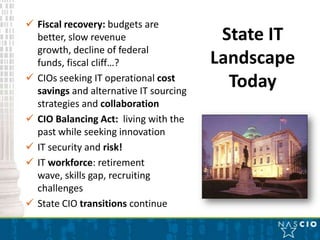
 Fiscal recovery: budgets are
  better, slow revenue                   State IT
  growth, decline of federal
  funds, fiscal cliff…?                 Landscape
 CIOs seeking IT operational cost
  savings and alternative IT sourcing
                                          Today
  strategies and collaboration
 CIO Balancing Act: living with the
  past while seeking innovation
 IT security and risk!
 IT workforce: retirement
  wave, skills gap, recruiting
  challenges
 State CIO transitions continue
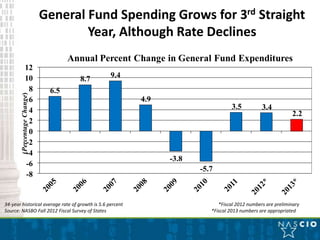
General Fund Spending Grows for 3rd Straight
                                      Year, Although Rate Declines
                                     Annual Percent Change in General Fund Expenditures
                12
                10                     8.7        9.4
                 8             6.5
        (Percentage Change)


                 6                                         4.9
                 4                                                                  3.5          3.4
                                                                                                              2.2
                 2
                 0
                -2
                -4
                                                                 -3.8
                -6
                                                                        -5.7
                -8


34-year historical average rate of growth is 5.6 percent                      *Fiscal 2012 numbers are preliminary
Source: NASBO Fall 2012 Fiscal Survey of States                            *Fiscal 2013 numbers are appropriated
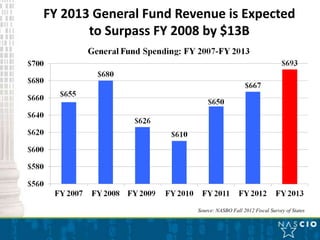
FY 2013 General Fund Revenue is Expected
       to Surpass FY 2008 by $13B


                        Source: NASBO Fall 2012 Fiscal Survey of States
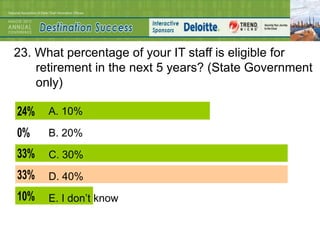
23. What percentage of your IT staff is eligible for
    retirement in the next 5 years? (State Government
    only)

24%   A. 10%

0%    B. 20%
33%   C. 30%
33%   D. 40%
10%   E. I don’t know
View from the
     State CIOs:
Balancing Legacy and
     Innovation
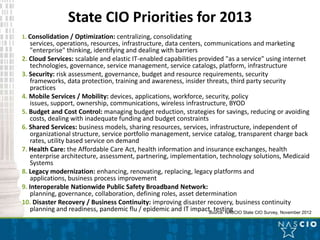
State CIO Priorities for 2013
1. Consolidation / Optimization: centralizing, consolidating
    services, operations, resources, infrastructure, data centers, communications and marketing
    "enterprise" thinking, identifying and dealing with barriers
2. Cloud Services: scalable and elastic IT-enabled capabilities provided "as a service" using internet
    technologies, governance, service management, service catalogs, platform, infrastructure
3. Security: risk assessment, governance, budget and resource requirements, security
    frameworks, data protection, training and awareness, insider threats, third party security
    practices
4. Mobile Services / Mobility: devices, applications, workforce, security, policy
    issues, support, ownership, communications, wireless infrastructure, BYOD
5. Budget and Cost Control: managing budget reduction, strategies for savings, reducing or avoiding
    costs, dealing with inadequate funding and budget constraints
6. Shared Services: business models, sharing resources, services, infrastructure, independent of
    organizational structure, service portfolio management, service catalog, transparent charge back
    rates, utility based service on demand
7. Health Care: the Affordable Care Act, health information and insurance exchanges, health
    enterprise architecture, assessment, partnering, implementation, technology solutions, Medicaid
    Systems
8. Legacy modernization: enhancing, renovating, replacing, legacy platforms and
    applications, business process improvement
9. Interoperable Nationwide Public Safety Broadband Network:
    planning, governance, collaboration, defining roles, asset determination
10. Disaster Recovery / Business Continuity: improving disaster recovery, business continuity
    planning and readiness, pandemic flu / epidemic and IT impact, testing State CIO Survey, November 2012
                                                                    Source: NASCIO
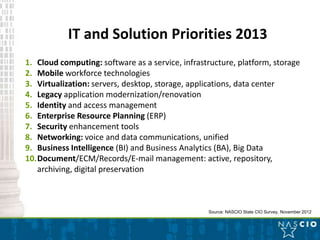
IT and Solution Priorities 2013
1. Cloud computing: software as a service, infrastructure, platform, storage
2. Mobile workforce technologies
3. Virtualization: servers, desktop, storage, applications, data center
4. Legacy application modernization/renovation
5. Identity and access management
6. Enterprise Resource Planning (ERP)
7. Security enhancement tools
8. Networking: voice and data communications, unified
9. Business Intelligence (BI) and Business Analytics (BA), Big Data
10.Document/ECM/Records/E-mail management:
   active, repository, archiving, digital preservation


                                                  Source: NASCIO State CIO Survey, November 2012
 Management of mobile
  devices and apps is fragmented
 The Cloud is more accepted
  and CIOs are moving services
 Social media has a growing role
  in state government
 Proper staffing is a challenge
  due to budget concerns
 Driving innovation across state
  business operations is often a
  CIO function
© Grant Thornton LLP. All rights reserved.
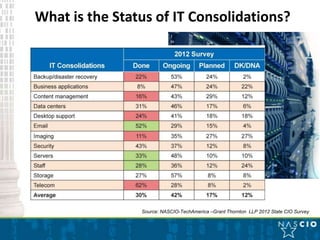
What is the Status of IT Consolidations?


                Source: NASCIO-TechAmerica –Grant Thornton LLP 2012 State CIO Survey
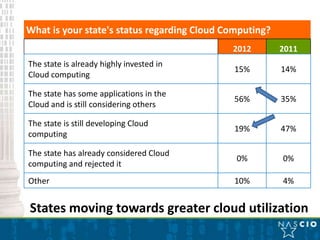
What is your state's status regarding Cloud Computing?
                                             2012        2011
The state is already highly invested in
                                             15%         14%
Cloud computing

The state has some applications in the
                                             56%         35%
Cloud and is still considering others

The state is still developing Cloud
                                             19%         47%
computing

The state has already considered Cloud
                                              0%         0%
computing and rejected it
Other                                        10%         4%


States moving towards greater cloud utilization
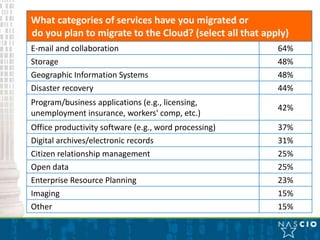
What categories of services have you migrated or
do you plan to migrate to the Cloud? (select all that apply)
E-mail and collaboration                                 64%
Storage                                                  48%
Geographic Information Systems                           48%
Disaster recovery                                        44%
Program/business applications (e.g., licensing,
                                                         42%
unemployment insurance, workers' comp, etc.)
Office productivity software (e.g., word processing)     37%
Digital archives/electronic records                      31%
Citizen relationship management                          25%
Open data                                                25%
Enterprise Resource Planning                             23%
Imaging                                                  15%
Other                                                    15%
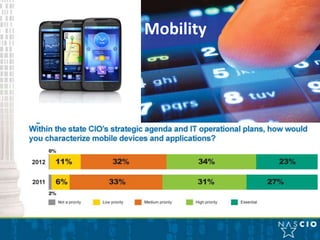
Mobility
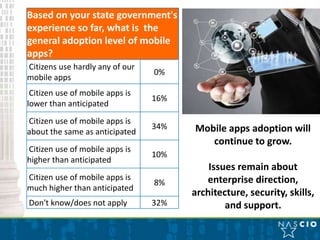
Based on your state government's
experience so far, what is the
general adoption level of mobile
apps?
Citizens use hardly any of our
                                 0%
mobile apps
 Citizen use of mobile apps is
                                 16%
lower than anticipated
Citizen use of mobile apps is
                                 34%   Mobile apps adoption will
about the same as anticipated
                                          continue to grow.
Citizen use of mobile apps is
                                 10%
higher than anticipated
                                           Issues remain about
Citizen use of mobile apps is             enterprise direction,
                                 8%
much higher than anticipated
                                       architecture, security, skills,
Don't know/does not apply        32%           and support.
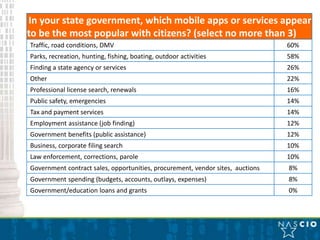
In your state government, which mobile apps or services appear
to be the most popular with citizens? (select no more than 3)
Traffic, road conditions, DMV                                                   60%
Parks, recreation, hunting, fishing, boating, outdoor activities                58%
Finding a state agency or services                                              26%
Other                                                                           22%
Professional license search, renewals                                           16%
Public safety, emergencies                                                      14%
Tax and payment services                                                        14%
Employment assistance (job finding)                                             12%
Government benefits (public assistance)                                         12%
Business, corporate filing search                                               10%
Law enforcement, corrections, parole                                            10%
Government contract sales, opportunities, procurement, vendor sites, auctions   8%
Government spending (budgets, accounts, outlays, expenses)                      8%
Government/education loans and grants                                           0%
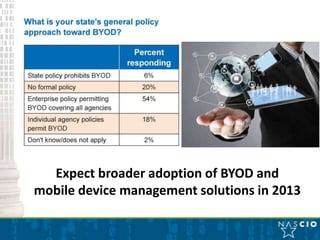
Expect broader adoption of BYOD and
mobile device management solutions in 2013
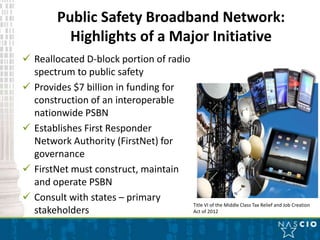
Public Safety Broadband Network:
             Highlights of a Major Initiative
 Reallocated D-block portion of radio
  spectrum to public safety
 Provides $7 billion in funding for
  construction of an interoperable
  nationwide PSBN
 Establishes First Responder
  Network Authority (FirstNet) for
  governance
 FirstNet must construct, maintain
  and operate PSBN
 Consult with states – primary
                                       Title VI of the Middle Class Tax Relief and Job Creation
  stakeholders                         Act of 2012
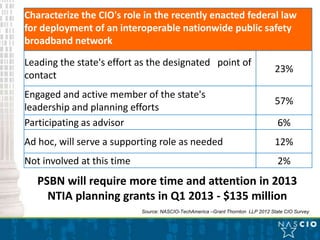
Characterize the CIO's role in the recently enacted federal law
for deployment of an interoperable nationwide public safety
broadband network

Leading the state's effort as the designated point of
                                                                                  23%
contact
Engaged and active member of the state's
                                                                                  57%
leadership and planning efforts
Participating as advisor                                                           6%
Ad hoc, will serve a supporting role as needed                                    12%
Not involved at this time                                                          2%
   PSBN will require more time and attention in 2013
     NTIA planning grants in Q1 2013 - $135 million
                            Source: NASCIO-TechAmerica –Grant Thornton LLP 2012 State CIO Survey
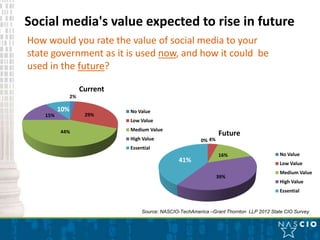
Social media's value expected to rise in future
How would you rate the value of social media to your
state government as it is used now, and how it could be
used in the future?

                     Current
                2%

          10%                  No Value
    15%               29%
                               Low Value

          44%                  Medium Value
                                                                    Future
                               High Value                   0% 4%
                               Essential
                                                                    16%                     No Value
                                                   41%                                      Low Value
                                                                                            Medium Value
                                                                    39%
                                                                                            High Value
                                                                                            Essential


                                    Source: NASCIO-TechAmerica –Grant Thornton LLP 2012 State CIO Survey
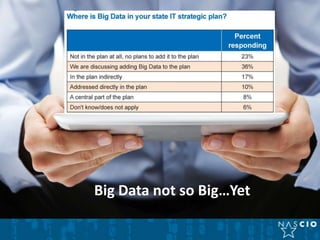
Big Data not so Big…Yet
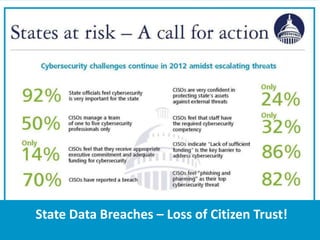
State Data Breaches – Loss of Citizen Trust!
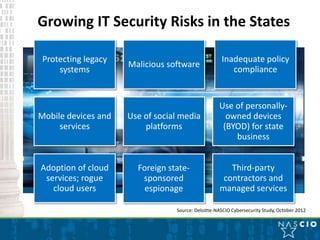
Growing IT Security Risks in the States

 Protecting legacy                                  Inadequate policy
                     Malicious software
     systems                                           compliance


                                                   Use of personally-
Mobile devices and   Use of social media             owned devices
     services            platforms                  (BYOD) for state
                                                       business


Adoption of cloud      Foreign state-                 Third-party
 services; rogue        sponsored                   contractors and
   cloud users          espionage                  managed services

                                 Source: Deloitte-NASCIO Cybersecurity Study, October 2012
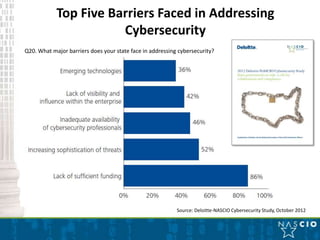
Top Five Barriers Faced in Addressing
                       Cybersecurity
Q20. What major barriers does your state face in addressing cybersecurity?


                                                           Source: Deloitte-NASCIO Cybersecurity Study, October 2012
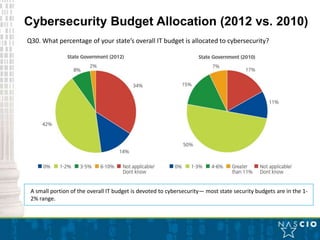
Cybersecurity Budget Allocation (2012 vs. 2010)
Q30. What percentage of your state’s overall IT budget is allocated to cybersecurity?


 A small portion of the overall IT budget is devoted to cybersecurity— most state security budgets are in the 1-
 2% range.
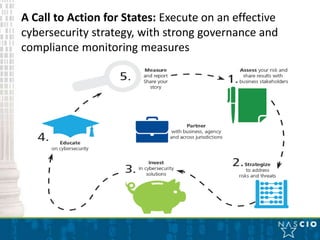
A Call to Action for States: Execute on an effective
cybersecurity strategy, with strong governance and
compliance monitoring measures
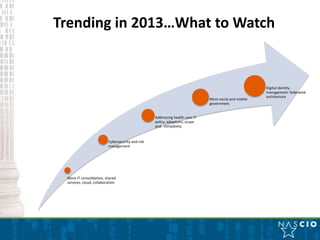
Trending in 2013…What to Watch


                                                                                                         Digital identity
                                                                                                         management: federated
                                                                                                         architecture
                                                                                More social and mobile
                                                                                government


                                                   Addressing health care IT:
                                                   policy, adoptions, scope
                                                   and complexity


                          Cybersecurity and risk
                          management


 More IT consolidation, shared
 services, cloud, collaboration

Technology Forecast 2013: What State and Local Government Technology Programs Can Expect

  • 1.
    Technology Forecast 2013: What State and Local Government Technology Programs Can Expect Doug Robinson, Executive Director National Association of State Chief Information Officers
  • 2.
     Fiscal recovery:budgets are better, slow revenue State IT growth, decline of federal funds, fiscal cliff…? Landscape  CIOs seeking IT operational cost savings and alternative IT sourcing Today strategies and collaboration  CIO Balancing Act: living with the past while seeking innovation  IT security and risk!  IT workforce: retirement wave, skills gap, recruiting challenges  State CIO transitions continue
  • 3.
    General Fund SpendingGrows for 3rd Straight Year, Although Rate Declines Annual Percent Change in General Fund Expenditures 12 10 8.7 9.4 8 6.5 (Percentage Change) 6 4.9 4 3.5 3.4 2.2 2 0 -2 -4 -3.8 -6 -5.7 -8 34-year historical average rate of growth is 5.6 percent *Fiscal 2012 numbers are preliminary Source: NASBO Fall 2012 Fiscal Survey of States *Fiscal 2013 numbers are appropriated
  • 4.
    FY 2013 GeneralFund Revenue is Expected to Surpass FY 2008 by $13B Source: NASBO Fall 2012 Fiscal Survey of States
  • 5.
    23. What percentageof your IT staff is eligible for retirement in the next 5 years? (State Government only) 24% A. 10% 0% B. 20% 33% C. 30% 33% D. 40% 10% E. I don’t know
  • 6.
    View from the State CIOs: Balancing Legacy and Innovation
  • 7.
    State CIO Prioritiesfor 2013 1. Consolidation / Optimization: centralizing, consolidating services, operations, resources, infrastructure, data centers, communications and marketing "enterprise" thinking, identifying and dealing with barriers 2. Cloud Services: scalable and elastic IT-enabled capabilities provided "as a service" using internet technologies, governance, service management, service catalogs, platform, infrastructure 3. Security: risk assessment, governance, budget and resource requirements, security frameworks, data protection, training and awareness, insider threats, third party security practices 4. Mobile Services / Mobility: devices, applications, workforce, security, policy issues, support, ownership, communications, wireless infrastructure, BYOD 5. Budget and Cost Control: managing budget reduction, strategies for savings, reducing or avoiding costs, dealing with inadequate funding and budget constraints 6. Shared Services: business models, sharing resources, services, infrastructure, independent of organizational structure, service portfolio management, service catalog, transparent charge back rates, utility based service on demand 7. Health Care: the Affordable Care Act, health information and insurance exchanges, health enterprise architecture, assessment, partnering, implementation, technology solutions, Medicaid Systems 8. Legacy modernization: enhancing, renovating, replacing, legacy platforms and applications, business process improvement 9. Interoperable Nationwide Public Safety Broadband Network: planning, governance, collaboration, defining roles, asset determination 10. Disaster Recovery / Business Continuity: improving disaster recovery, business continuity planning and readiness, pandemic flu / epidemic and IT impact, testing State CIO Survey, November 2012 Source: NASCIO
  • 8.
    IT and SolutionPriorities 2013 1. Cloud computing: software as a service, infrastructure, platform, storage 2. Mobile workforce technologies 3. Virtualization: servers, desktop, storage, applications, data center 4. Legacy application modernization/renovation 5. Identity and access management 6. Enterprise Resource Planning (ERP) 7. Security enhancement tools 8. Networking: voice and data communications, unified 9. Business Intelligence (BI) and Business Analytics (BA), Big Data 10.Document/ECM/Records/E-mail management: active, repository, archiving, digital preservation Source: NASCIO State CIO Survey, November 2012
  • 9.
     Management ofmobile devices and apps is fragmented  The Cloud is more accepted and CIOs are moving services  Social media has a growing role in state government  Proper staffing is a challenge due to budget concerns  Driving innovation across state business operations is often a CIO function © Grant Thornton LLP. All rights reserved.
  • 10.
    What is theStatus of IT Consolidations? Source: NASCIO-TechAmerica –Grant Thornton LLP 2012 State CIO Survey
  • 11.
    What is yourstate's status regarding Cloud Computing? 2012 2011 The state is already highly invested in 15% 14% Cloud computing The state has some applications in the 56% 35% Cloud and is still considering others The state is still developing Cloud 19% 47% computing The state has already considered Cloud 0% 0% computing and rejected it Other 10% 4% States moving towards greater cloud utilization
  • 12.
    What categories ofservices have you migrated or do you plan to migrate to the Cloud? (select all that apply) E-mail and collaboration 64% Storage 48% Geographic Information Systems 48% Disaster recovery 44% Program/business applications (e.g., licensing, 42% unemployment insurance, workers' comp, etc.) Office productivity software (e.g., word processing) 37% Digital archives/electronic records 31% Citizen relationship management 25% Open data 25% Enterprise Resource Planning 23% Imaging 15% Other 15%
  • 13.
  • 14.
    Based on yourstate government's experience so far, what is the general adoption level of mobile apps? Citizens use hardly any of our 0% mobile apps Citizen use of mobile apps is 16% lower than anticipated Citizen use of mobile apps is 34% Mobile apps adoption will about the same as anticipated continue to grow. Citizen use of mobile apps is 10% higher than anticipated Issues remain about Citizen use of mobile apps is enterprise direction, 8% much higher than anticipated architecture, security, skills, Don't know/does not apply 32% and support.
  • 15.
    In your stategovernment, which mobile apps or services appear to be the most popular with citizens? (select no more than 3) Traffic, road conditions, DMV 60% Parks, recreation, hunting, fishing, boating, outdoor activities 58% Finding a state agency or services 26% Other 22% Professional license search, renewals 16% Public safety, emergencies 14% Tax and payment services 14% Employment assistance (job finding) 12% Government benefits (public assistance) 12% Business, corporate filing search 10% Law enforcement, corrections, parole 10% Government contract sales, opportunities, procurement, vendor sites, auctions 8% Government spending (budgets, accounts, outlays, expenses) 8% Government/education loans and grants 0%
  • 16.
    Expect broader adoptionof BYOD and mobile device management solutions in 2013
  • 17.
    Public Safety BroadbandNetwork: Highlights of a Major Initiative  Reallocated D-block portion of radio spectrum to public safety  Provides $7 billion in funding for construction of an interoperable nationwide PSBN  Establishes First Responder Network Authority (FirstNet) for governance  FirstNet must construct, maintain and operate PSBN  Consult with states – primary Title VI of the Middle Class Tax Relief and Job Creation stakeholders Act of 2012
  • 18.
    Characterize the CIO'srole in the recently enacted federal law for deployment of an interoperable nationwide public safety broadband network Leading the state's effort as the designated point of 23% contact Engaged and active member of the state's 57% leadership and planning efforts Participating as advisor 6% Ad hoc, will serve a supporting role as needed 12% Not involved at this time 2% PSBN will require more time and attention in 2013 NTIA planning grants in Q1 2013 - $135 million Source: NASCIO-TechAmerica –Grant Thornton LLP 2012 State CIO Survey
  • 19.
    Social media's valueexpected to rise in future How would you rate the value of social media to your state government as it is used now, and how it could be used in the future? Current 2% 10% No Value 15% 29% Low Value 44% Medium Value Future High Value 0% 4% Essential 16% No Value 41% Low Value Medium Value 39% High Value Essential Source: NASCIO-TechAmerica –Grant Thornton LLP 2012 State CIO Survey
  • 20.
    Big Data notso Big…Yet
  • 21.
    State Data Breaches– Loss of Citizen Trust!
  • 22.
    Growing IT SecurityRisks in the States Protecting legacy Inadequate policy Malicious software systems compliance Use of personally- Mobile devices and Use of social media owned devices services platforms (BYOD) for state business Adoption of cloud Foreign state- Third-party services; rogue sponsored contractors and cloud users espionage managed services Source: Deloitte-NASCIO Cybersecurity Study, October 2012
  • 23.
    Top Five BarriersFaced in Addressing Cybersecurity Q20. What major barriers does your state face in addressing cybersecurity? Source: Deloitte-NASCIO Cybersecurity Study, October 2012
  • 24.
    Cybersecurity Budget Allocation(2012 vs. 2010) Q30. What percentage of your state’s overall IT budget is allocated to cybersecurity? A small portion of the overall IT budget is devoted to cybersecurity— most state security budgets are in the 1- 2% range.
  • 25.
    A Call toAction for States: Execute on an effective cybersecurity strategy, with strong governance and compliance monitoring measures
  • 26.
    Trending in 2013…Whatto Watch Digital identity management: federated architecture More social and mobile government Addressing health care IT: policy, adoptions, scope and complexity Cybersecurity and risk management More IT consolidation, shared services, cloud, collaboration