Bridging the gap:
cyber security skills
June 2021
Jayesh Navin Shah, Ipsos MORI
Sam Donaldson, Perspective Economics
SC Annual Digital Congress: bridging the gap | June 2021 | Version 1 | PUBLIC
2
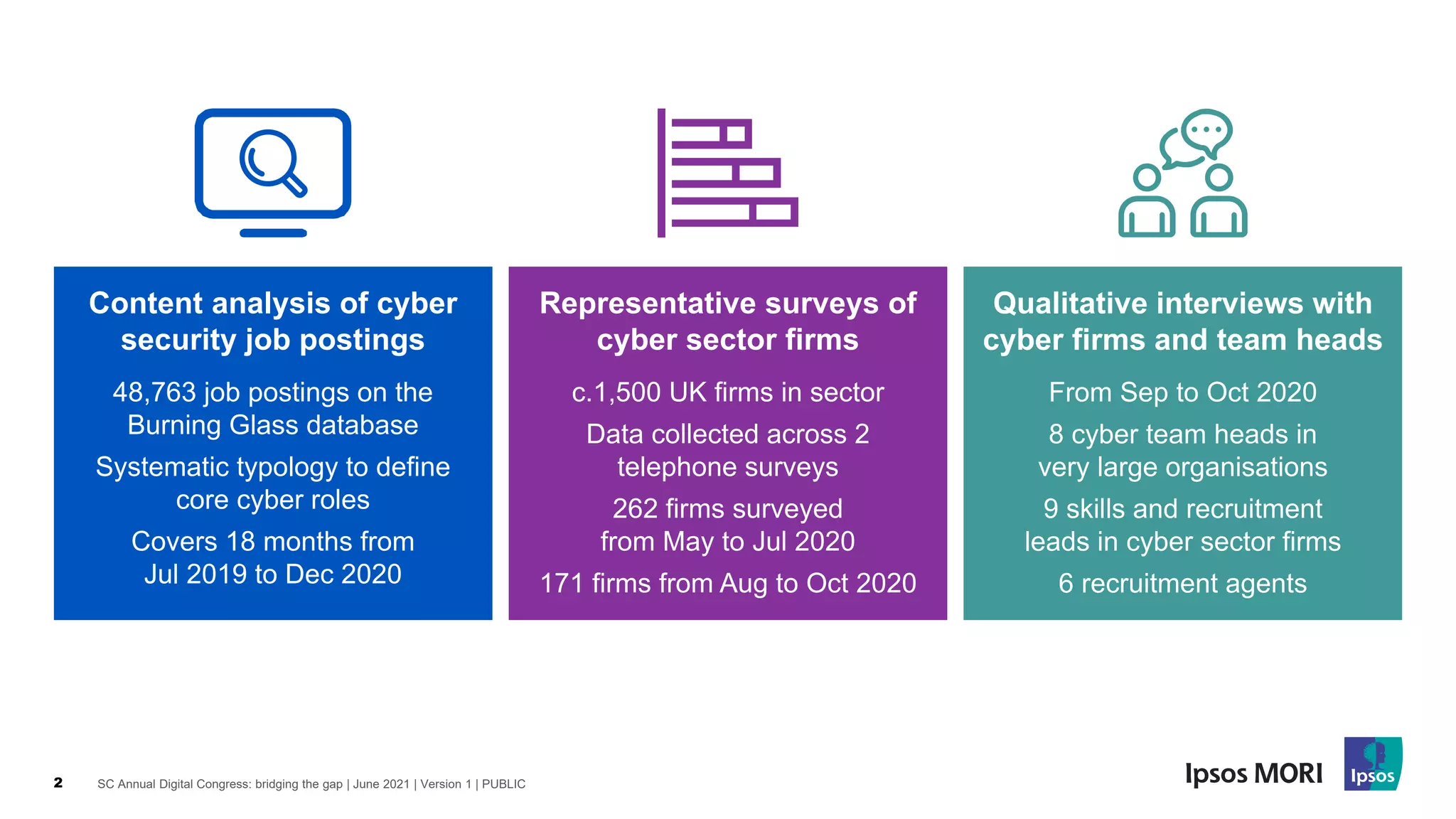
Content analysis of cyber
security job postings
48,763 job postings on the
Burning Glass database
Systematic typology to define
core cyber roles
Covers 18 months from
Jul 2019 to Dec 2020
Representative surveys of
cyber sector firms
c.1,500 UK firms in sector
Data collected across 2
telephone surveys
262 firms surveyed
from May to Jul 2020
171 firms from Aug to Oct 2020
Qualitative interviews with
cyber firms and team heads
From Sep to Oct 2020
8 cyber team heads in
very large organisations
9 skills and recruitment
leads in cyber sector firms
6 recruitment agents
SC Annual Digital Congress: bridging the gap | June 2021 |
Version 1 | PUBLIC
Changing
demands
SC Annual Digital Congress: bridging the gap | June 2021 | Version 1 | PUBLIC
4
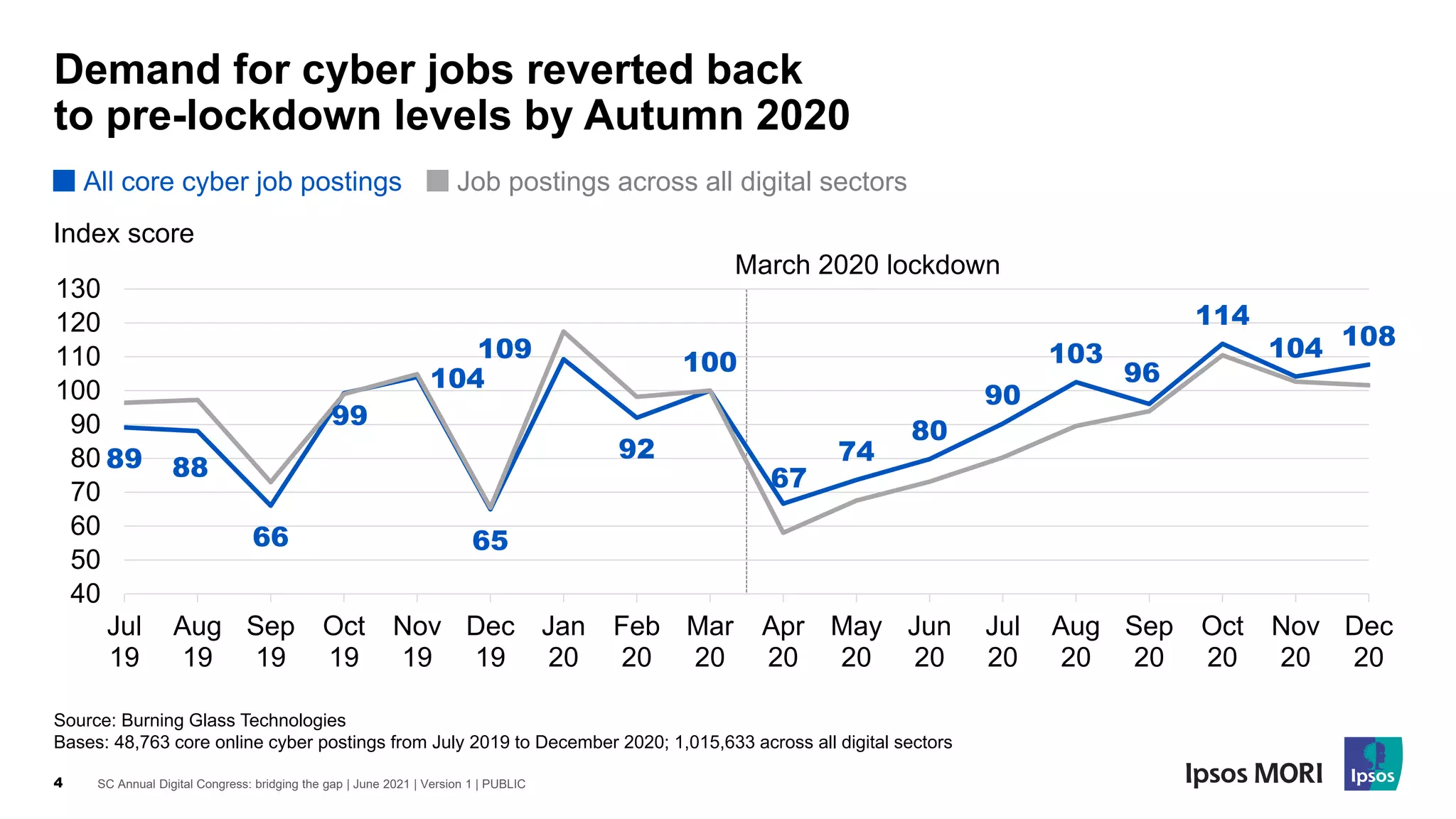
Demand for cyber jobs reverted back
to pre-lockdown levels by Autumn 2020
Source: Burning Glass Technologies
Bases: 48,763 core online cyber postings from July 2019 to December 2020; 1,015,633 across all digital sectors
89 88
66
99
104
65
109
92
100
67
74
80
90
103
96
114
104 108
40
50
60
70
80
90
100
110
120
130
Jul
19
Aug
19
Sep
19
Oct
19
Nov
19
Dec
19
Jan
20
Feb
20
Mar
20
Apr
20
May
20
Jun
20
Jul
20
Aug
20
Sep
20
Oct
20
Nov
20
Dec
20
Job postings across all digital sectors
Index score
All core cyber job postings
March 2020 lockdown
SC Annual Digital Congress: bridging the gap | June 2021 | Version 1 | PUBLIC
5
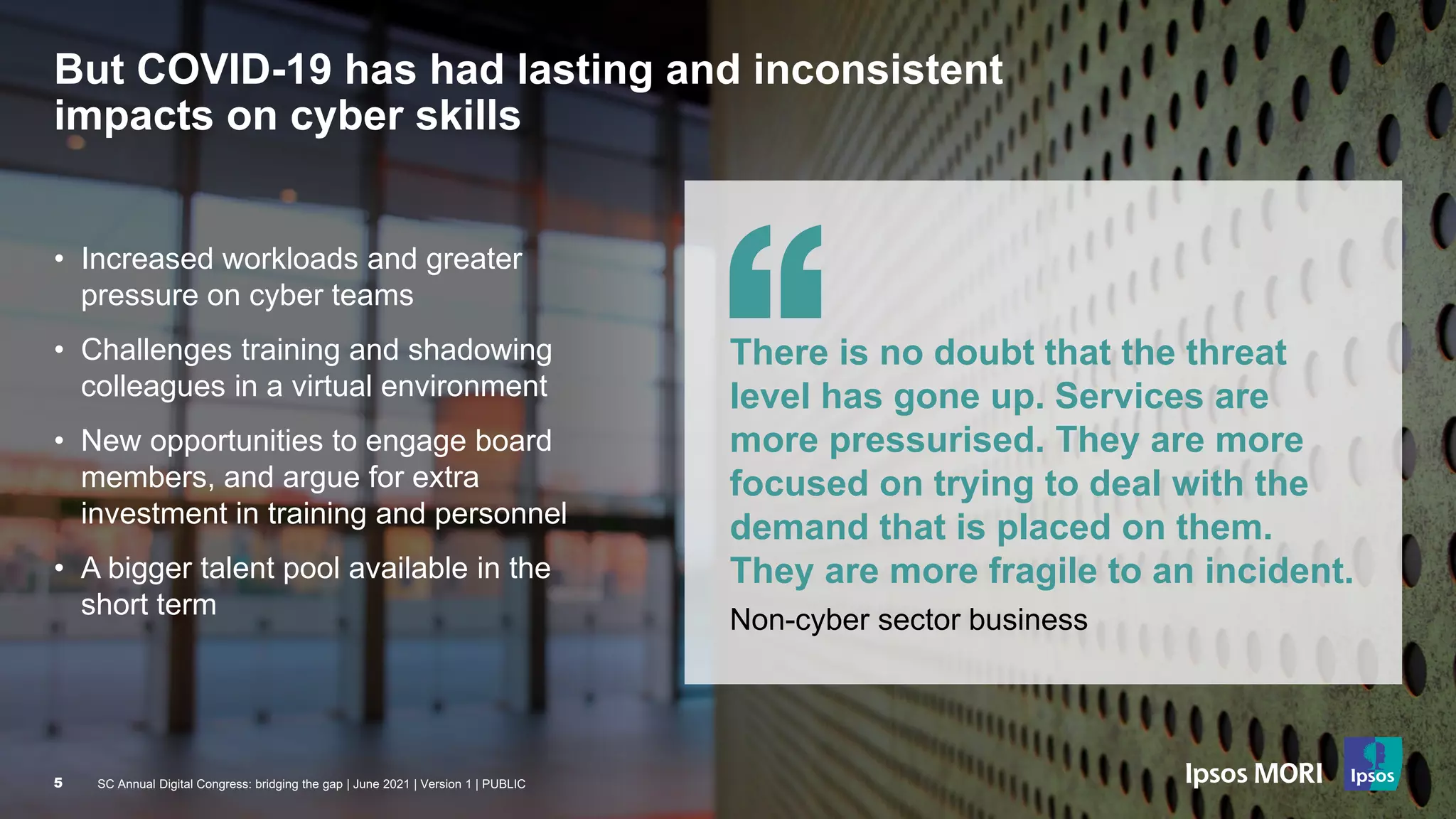
But COVID-19 has had lasting and inconsistent
impacts on cyber skills
• Increased workloads and greater
pressure on cyber teams
• Challenges training and shadowing
colleagues in a virtual environment
• New opportunities to engage board
members, and argue for extra
investment in training and personnel
• A bigger talent pool available in the
short term
There is no doubt that the threat
level has gone up. Services are
more pressurised. They are more
focused on trying to deal with the
demand that is placed on them.
They are more fragile to an incident.
Non-cyber sector business
SC Annual Digital Congress: bridging the gap | June 2021 | Version 1 | PUBLIC
5
SC Annual Digital Congress: bridging the gap | June 2021 | Version 1 | PUBLIC
6
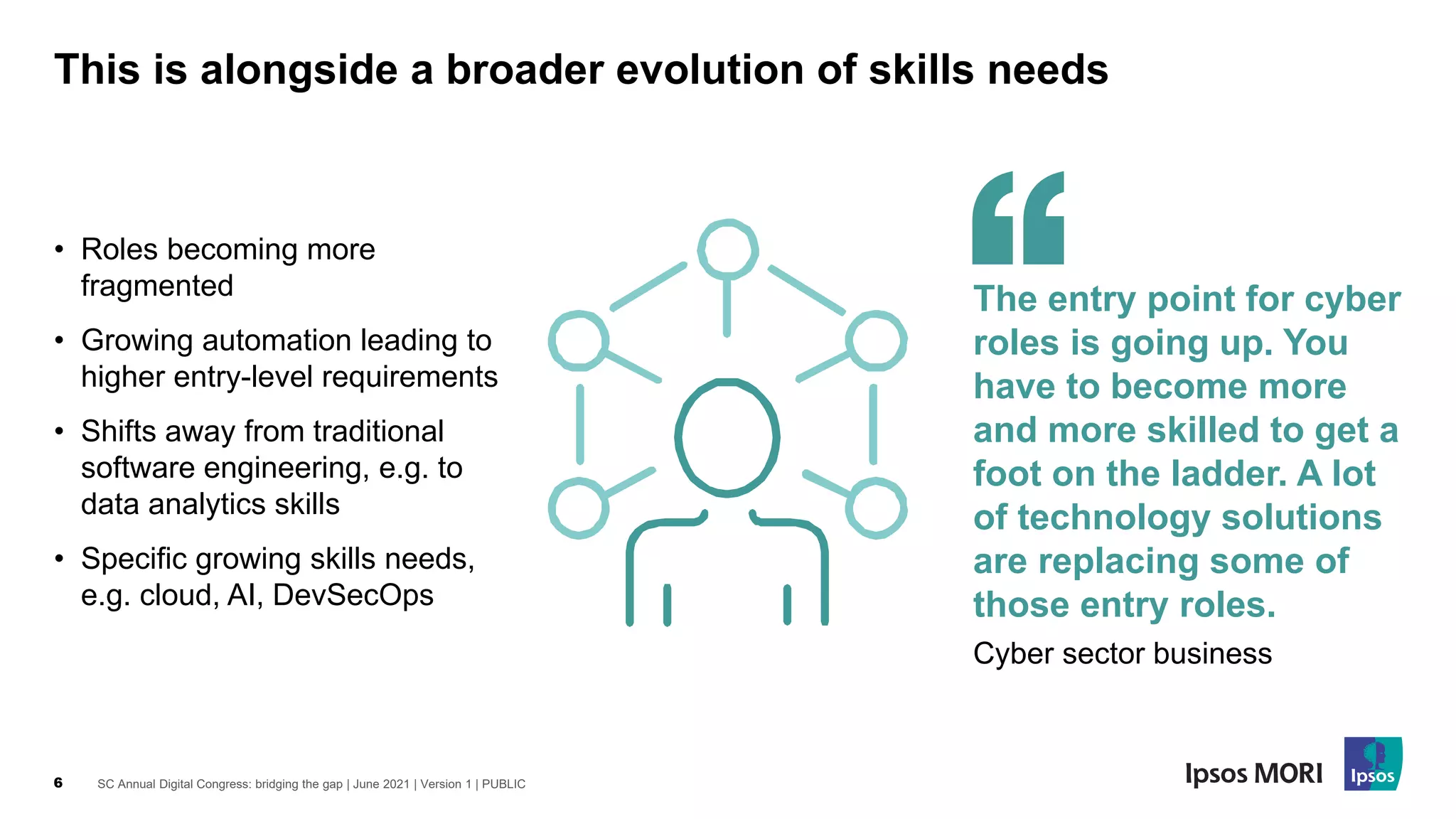
This is alongside a broader evolution of skills needs
The entry point for cyber
roles is going up. You
have to become more
and more skilled to get a
foot on the ladder. A lot
of technology solutions
are replacing some of
those entry roles.
Cyber sector business
• Roles becoming more
fragmented
• Growing automation leading to
higher entry-level requirements
• Shifts away from traditional
software engineering, e.g. to
data analytics skills
• Specific growing skills needs,
e.g. cloud, AI, DevSecOps
SC Annual Digital Congress: bridging the gap | June 2021 | Version 1 | PUBLIC
7
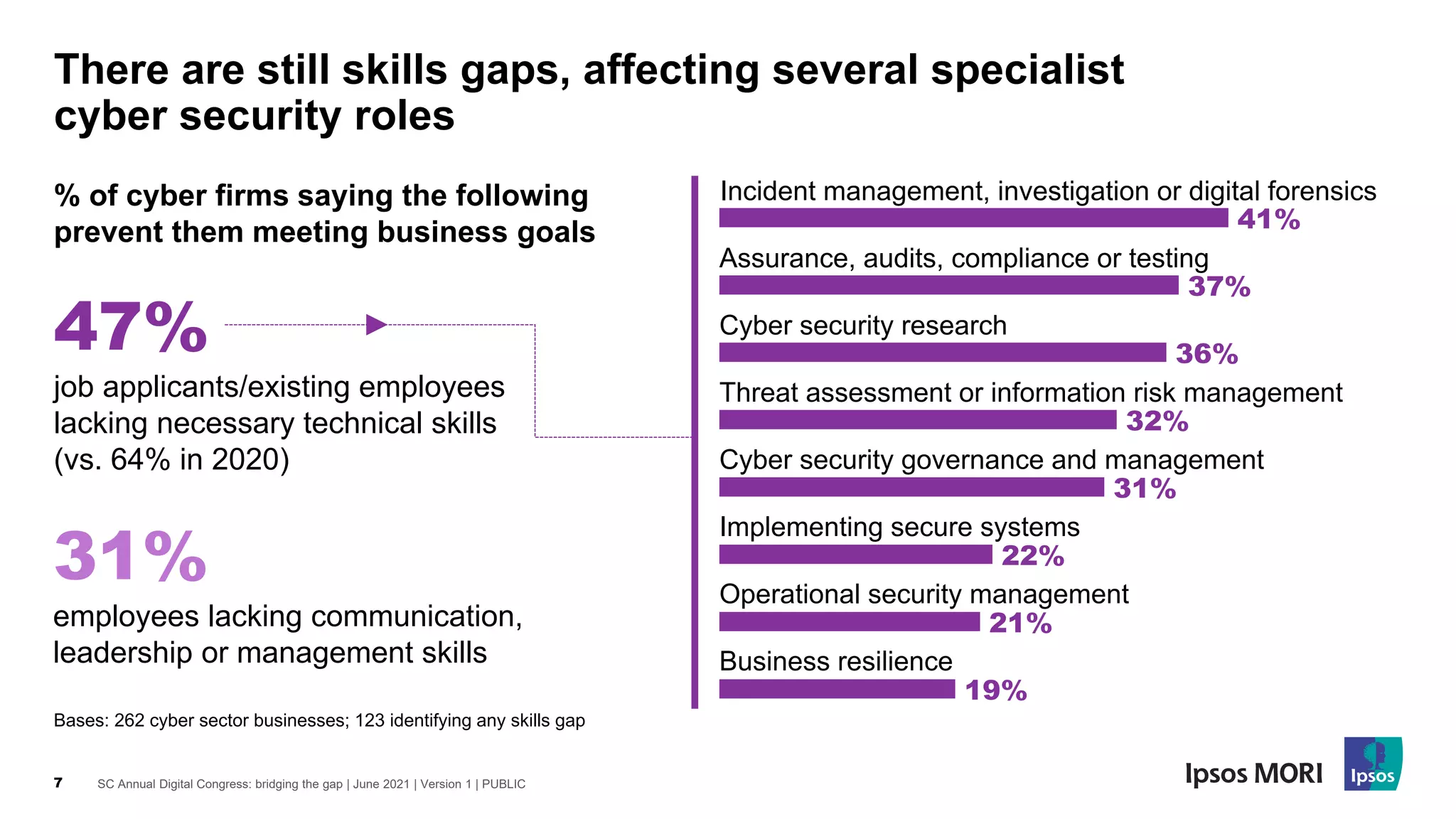
There are still skills gaps, affecting several specialist
cyber security roles
Bases: 262 cyber sector businesses; 123 identifying any skills gap
% of cyber firms saying the following
prevent them meeting business goals
47%
job applicants/existing employees
lacking necessary technical skills
(vs. 64% in 2020)
31%
employees lacking communication,
leadership or management skills
41%
37%
36%
32%
31%
22%
21%
19%
Business resilience
Assurance, audits, compliance or testing
Incident management, investigation or digital forensics
Cyber security research
Threat assessment or information risk management
Cyber security governance and management
Implementing secure systems
Operational security management
SC Annual Digital Congress: bridging the gap | June 2021 | Version 1 | PUBLIC
8
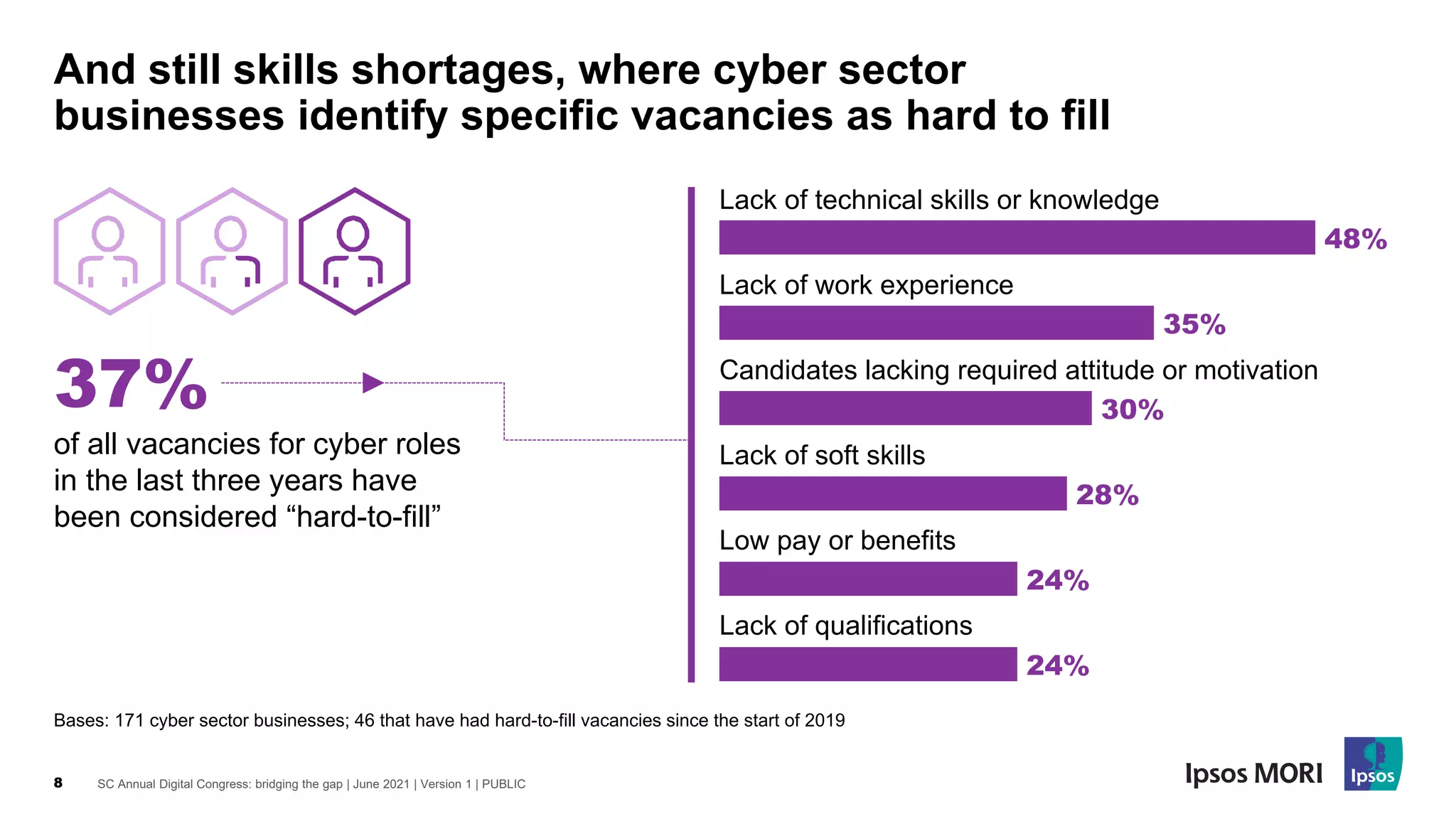
And still skills shortages, where cyber sector
businesses identify specific vacancies as hard to fill
Bases: 171 cyber sector businesses; 46 that have had hard-to-fill vacancies since the start of 2019
37%
of all vacancies for cyber roles
in the last three years have
been considered “hard-to-fill”
48%
35%
30%
28%
24%
24%
Lack of work experience
Lack of technical skills or knowledge
Candidates lacking required attitude or motivation
Lack of soft skills
Low pay or benefits
Lack of qualifications
SC Annual Digital Congress: bridging the gap | June 2021 |
Version 1 | PUBLIC
The
understanding
gap
SC Annual Digital Congress: bridging the gap | June 2021 | Version 1 | PUBLIC
10
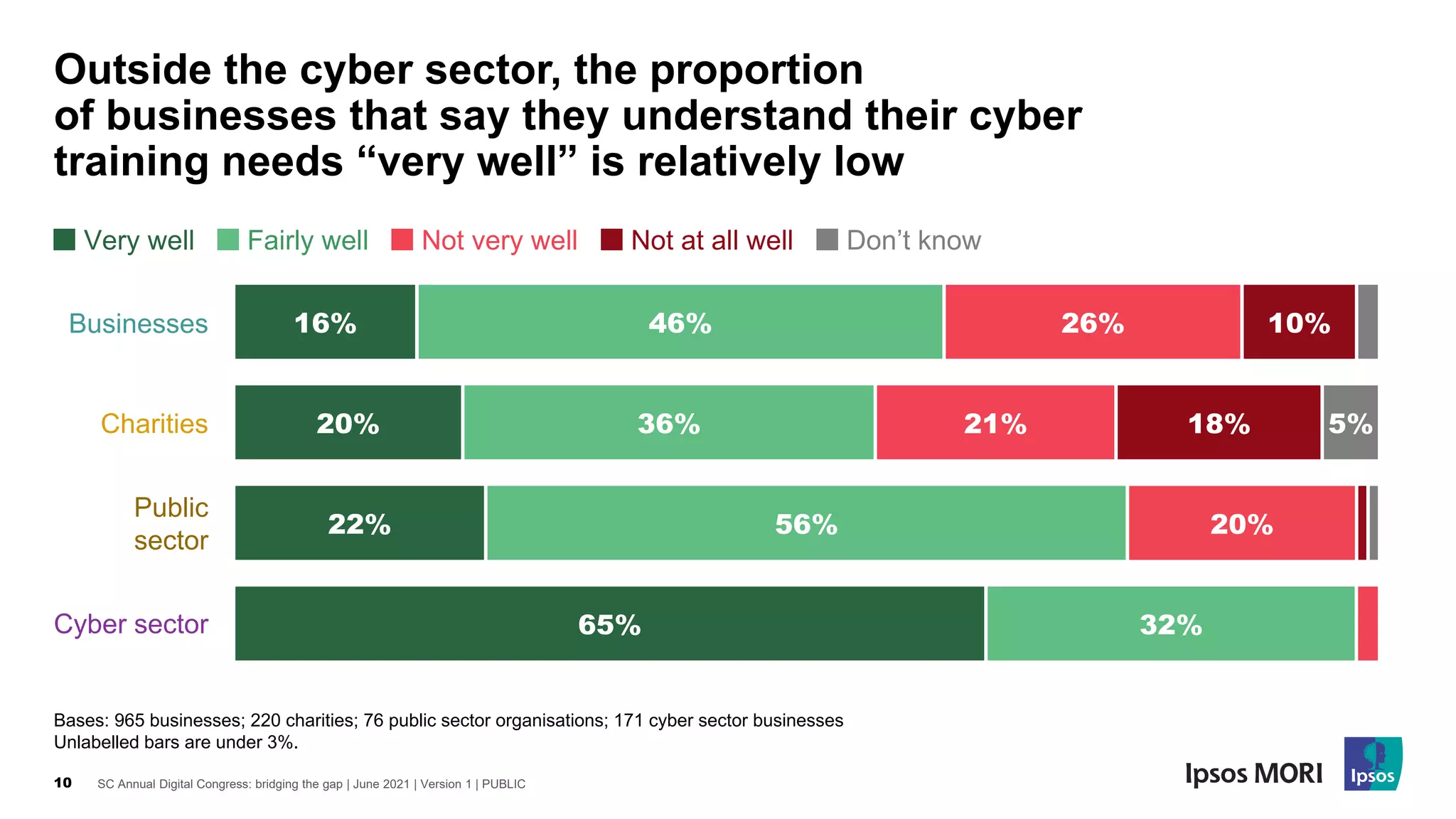
Outside the cyber sector, the proportion
of businesses that say they understand their cyber
training needs “very well” is relatively low
Bases: 965 businesses; 220 charities; 76 public sector organisations; 171 cyber sector businesses
Unlabelled bars are under 3%.
Businesses
Fairly well
Very well Not very well Not at all well Don’t know
Charities
Public
sector
Cyber sector 65%
22%
20%
16%
32%
56%
36%
46%
20%
21%
26%
18%
10%
5%
SC Annual Digital Congress: bridging the gap | June 2021 | Version 1 | PUBLIC
11
I don't know
what you do,
but I’ve been
told I need you.
SC Annual Digital Congress: bridging the gap | June 2021 | Version 1 | PUBLIC
11
SC Annual Digital Congress: bridging the gap | June 2021 | Version 1 | PUBLIC
12
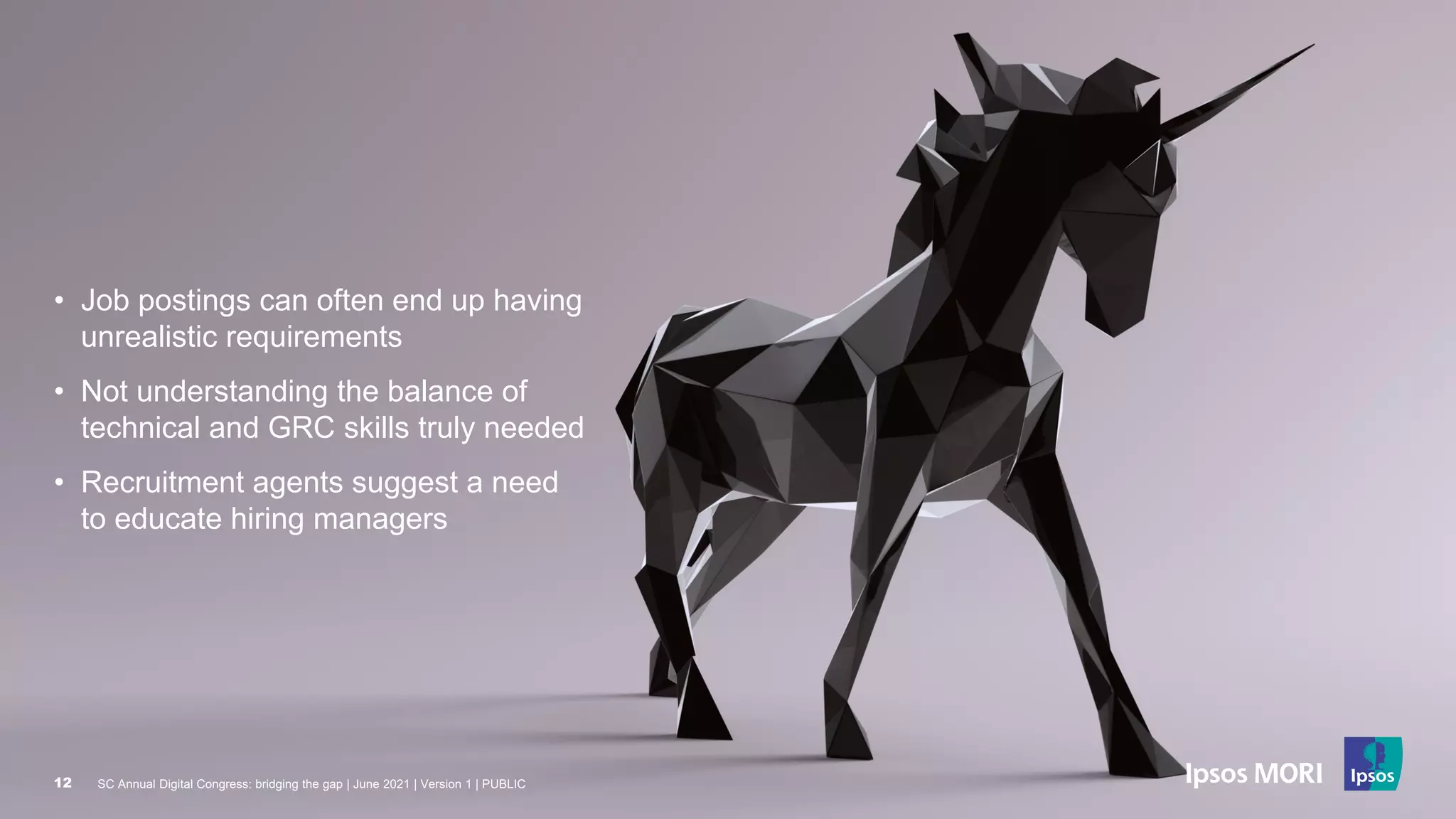
• Job postings can often end up having
unrealistic requirements
• Not understanding the balance of
technical and GRC skills truly needed
• Recruitment agents suggest a need
to educate hiring managers
SC Annual Digital Congress: bridging the gap | June 2021 | Version 1 | PUBLIC
12
SC Annual Digital Congress: bridging the gap | June 2021 | Version 1 | PUBLIC
13
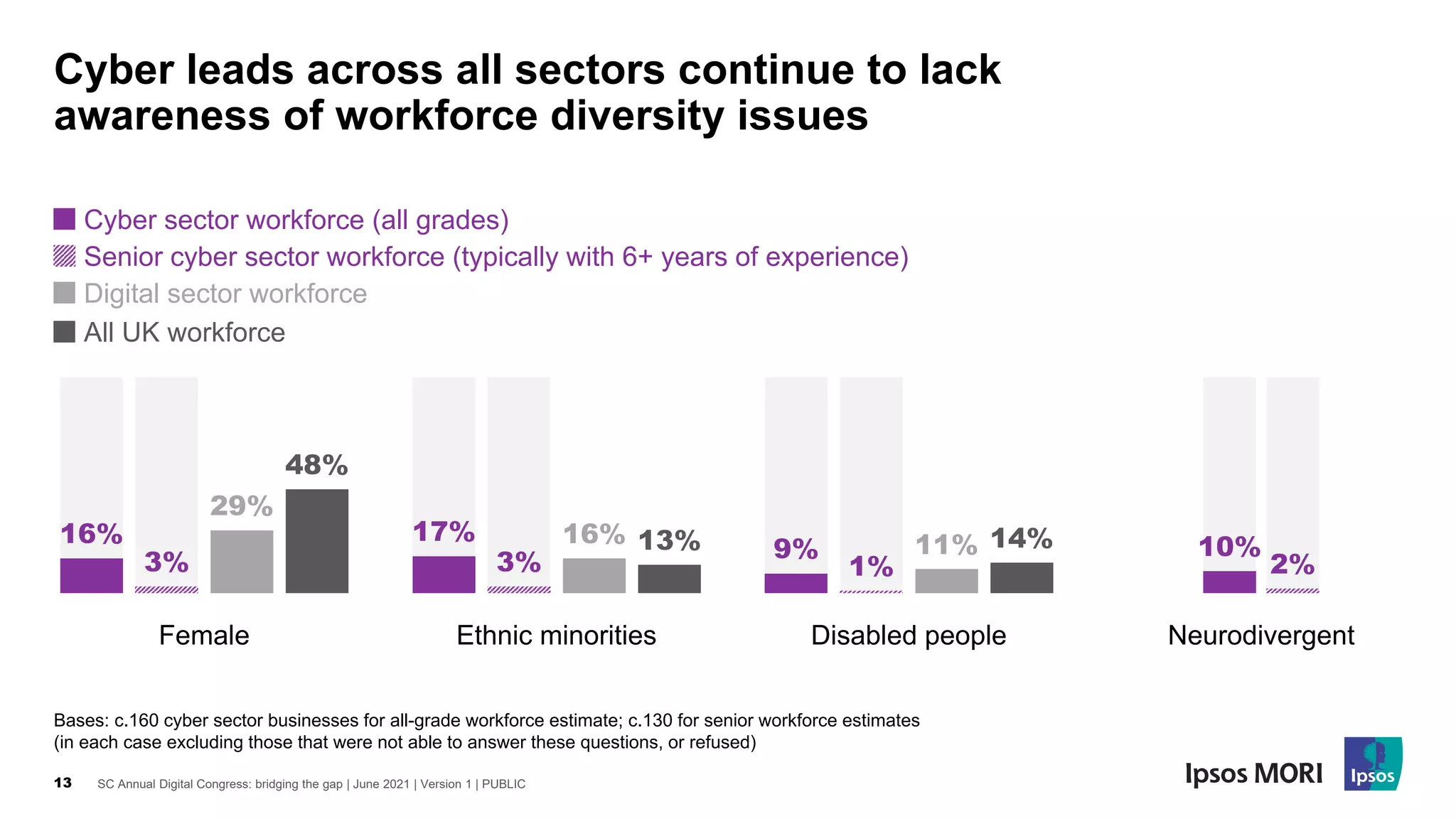
Cyber leads across all sectors continue to lack
awareness of workforce diversity issues
Bases: c.160 cyber sector businesses for all-grade workforce estimate; c.130 for senior workforce estimates
(in each case excluding those that were not able to answer these questions, or refused)
Senior cyber sector workforce (typically with 6+ years of experience)
Cyber sector workforce (all grades)
Digital sector workforce
All UK workforce
16%
3%
29%
48%
17%
3%
16% 13% 9%
1%
11% 14% 10%
2%
Female Ethnic minorities Disabled people Neurodivergent
SC Annual Digital Congress: bridging the gap | June 2021 |
Version 1 | PUBLIC
Making the
most of your
resources
SC Annual Digital Congress: bridging the gap | June 2021 | Version 1 | PUBLIC
15
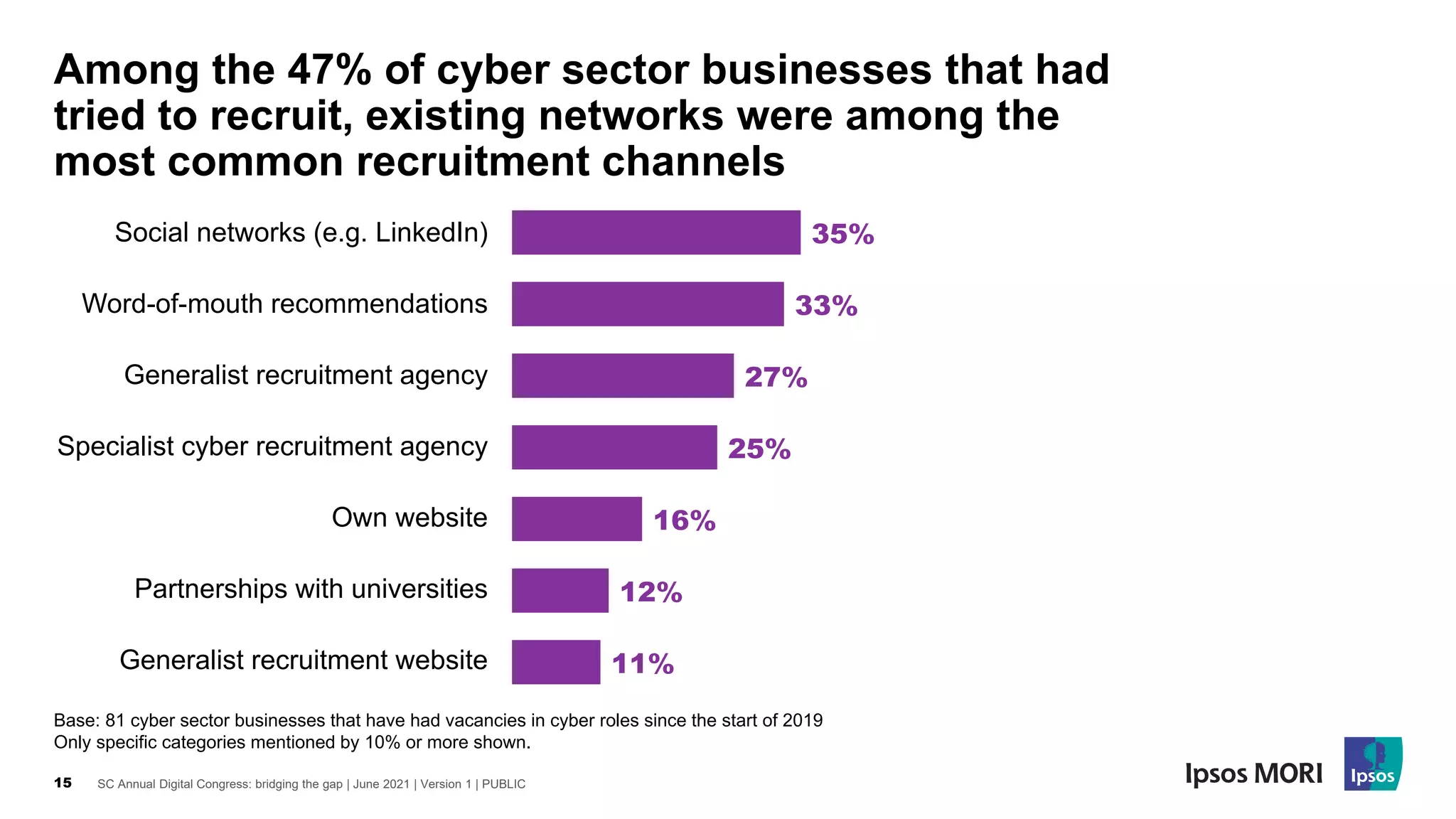
Among the 47% of cyber sector businesses that had
tried to recruit, existing networks were among the
most common recruitment channels
Base: 81 cyber sector businesses that have had vacancies in cyber roles since the start of 2019
Only specific categories mentioned by 10% or more shown.
35%
33%
27%
25%
16%
12%
11%
Generalist recruitment website
Generalist recruitment agency
Partnerships with universities
Own website
Social networks (e.g. LinkedIn)
Specialist cyber recruitment agency
Word-of-mouth recommendations
SC Annual Digital Congress: bridging the gap | June 2021 | Version 1 | PUBLIC
16
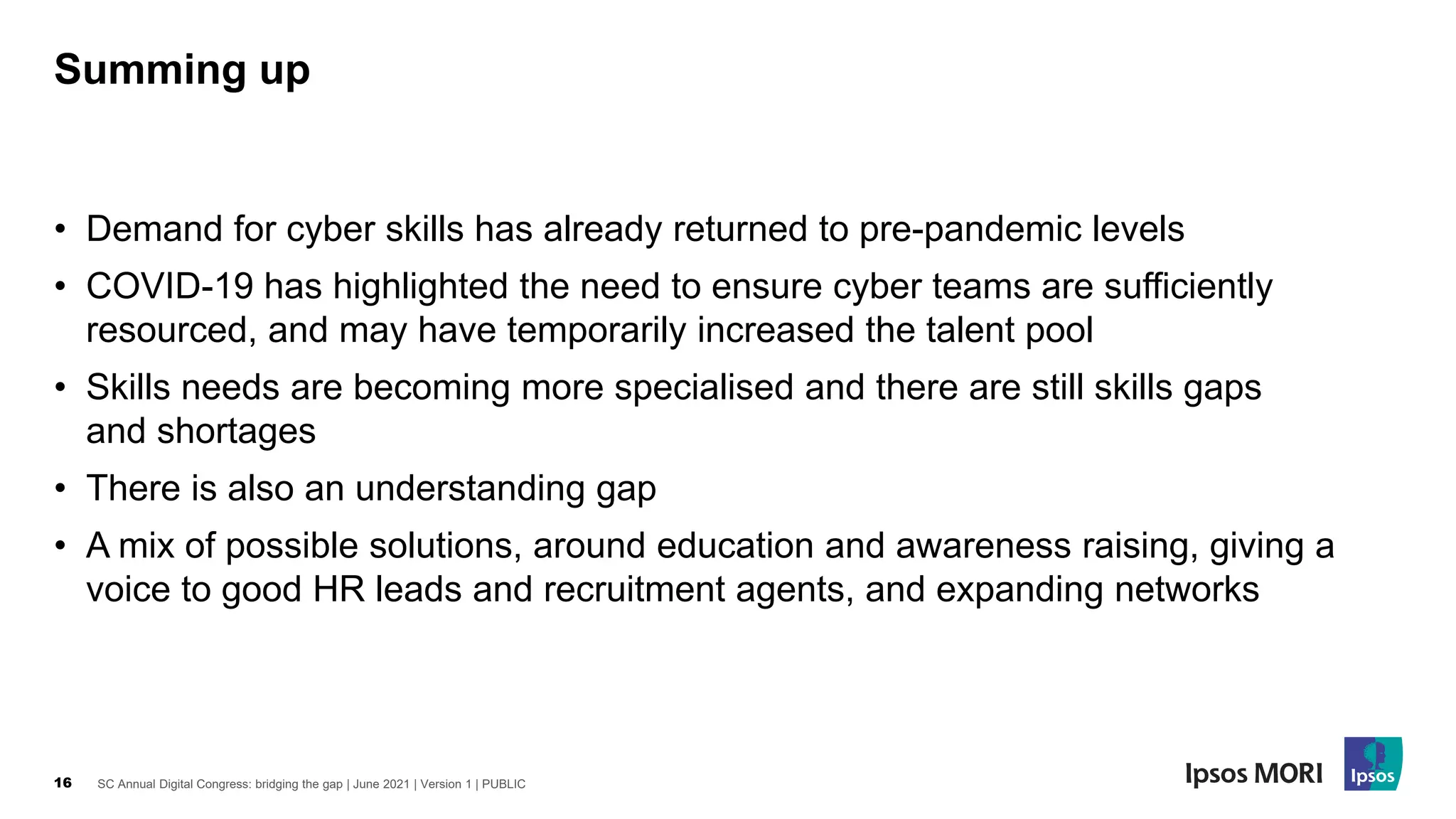
• Demand for cyber skills has already returned to pre-pandemic levels
• COVID-19 has highlighted the need to ensure cyber teams are sufficiently
resourced, and may have temporarily increased the talent pool
• Skills needs are becoming more specialised and there are still skills gaps
and shortages
• There is also an understanding gap
• A mix of possible solutions, around education and awareness raising, giving a
voice to good HR leads and recruitment agents, and expanding networks
Summing up
SC Annual Digital Congress: bridging the gap | June 2021 |
Version 1 | PUBLIC
Thank you
jayesh.shah@ipsos.com
sd@perspectiveeconomics.com

Bridging the gap: cyber security skills

  • 1.
    Bridging the gap: cybersecurity skills June 2021 Jayesh Navin Shah, Ipsos MORI Sam Donaldson, Perspective Economics
  • 2.
    SC Annual DigitalCongress: bridging the gap | June 2021 | Version 1 | PUBLIC 2 Content analysis of cyber security job postings 48,763 job postings on the Burning Glass database Systematic typology to define core cyber roles Covers 18 months from Jul 2019 to Dec 2020 Representative surveys of cyber sector firms c.1,500 UK firms in sector Data collected across 2 telephone surveys 262 firms surveyed from May to Jul 2020 171 firms from Aug to Oct 2020 Qualitative interviews with cyber firms and team heads From Sep to Oct 2020 8 cyber team heads in very large organisations 9 skills and recruitment leads in cyber sector firms 6 recruitment agents
  • 3.
    SC Annual DigitalCongress: bridging the gap | June 2021 | Version 1 | PUBLIC Changing demands
  • 4.
    SC Annual DigitalCongress: bridging the gap | June 2021 | Version 1 | PUBLIC 4 Demand for cyber jobs reverted back to pre-lockdown levels by Autumn 2020 Source: Burning Glass Technologies Bases: 48,763 core online cyber postings from July 2019 to December 2020; 1,015,633 across all digital sectors 89 88 66 99 104 65 109 92 100 67 74 80 90 103 96 114 104 108 40 50 60 70 80 90 100 110 120 130 Jul 19 Aug 19 Sep 19 Oct 19 Nov 19 Dec 19 Jan 20 Feb 20 Mar 20 Apr 20 May 20 Jun 20 Jul 20 Aug 20 Sep 20 Oct 20 Nov 20 Dec 20 Job postings across all digital sectors Index score All core cyber job postings March 2020 lockdown
  • 5.
    SC Annual DigitalCongress: bridging the gap | June 2021 | Version 1 | PUBLIC 5 But COVID-19 has had lasting and inconsistent impacts on cyber skills • Increased workloads and greater pressure on cyber teams • Challenges training and shadowing colleagues in a virtual environment • New opportunities to engage board members, and argue for extra investment in training and personnel • A bigger talent pool available in the short term There is no doubt that the threat level has gone up. Services are more pressurised. They are more focused on trying to deal with the demand that is placed on them. They are more fragile to an incident. Non-cyber sector business SC Annual Digital Congress: bridging the gap | June 2021 | Version 1 | PUBLIC 5
  • 6.
    SC Annual DigitalCongress: bridging the gap | June 2021 | Version 1 | PUBLIC 6 This is alongside a broader evolution of skills needs The entry point for cyber roles is going up. You have to become more and more skilled to get a foot on the ladder. A lot of technology solutions are replacing some of those entry roles. Cyber sector business • Roles becoming more fragmented • Growing automation leading to higher entry-level requirements • Shifts away from traditional software engineering, e.g. to data analytics skills • Specific growing skills needs, e.g. cloud, AI, DevSecOps
  • 7.
    SC Annual DigitalCongress: bridging the gap | June 2021 | Version 1 | PUBLIC 7 There are still skills gaps, affecting several specialist cyber security roles Bases: 262 cyber sector businesses; 123 identifying any skills gap % of cyber firms saying the following prevent them meeting business goals 47% job applicants/existing employees lacking necessary technical skills (vs. 64% in 2020) 31% employees lacking communication, leadership or management skills 41% 37% 36% 32% 31% 22% 21% 19% Business resilience Assurance, audits, compliance or testing Incident management, investigation or digital forensics Cyber security research Threat assessment or information risk management Cyber security governance and management Implementing secure systems Operational security management
  • 8.
    SC Annual DigitalCongress: bridging the gap | June 2021 | Version 1 | PUBLIC 8 And still skills shortages, where cyber sector businesses identify specific vacancies as hard to fill Bases: 171 cyber sector businesses; 46 that have had hard-to-fill vacancies since the start of 2019 37% of all vacancies for cyber roles in the last three years have been considered “hard-to-fill” 48% 35% 30% 28% 24% 24% Lack of work experience Lack of technical skills or knowledge Candidates lacking required attitude or motivation Lack of soft skills Low pay or benefits Lack of qualifications
  • 9.
    SC Annual DigitalCongress: bridging the gap | June 2021 | Version 1 | PUBLIC The understanding gap
  • 10.
    SC Annual DigitalCongress: bridging the gap | June 2021 | Version 1 | PUBLIC 10 Outside the cyber sector, the proportion of businesses that say they understand their cyber training needs “very well” is relatively low Bases: 965 businesses; 220 charities; 76 public sector organisations; 171 cyber sector businesses Unlabelled bars are under 3%. Businesses Fairly well Very well Not very well Not at all well Don’t know Charities Public sector Cyber sector 65% 22% 20% 16% 32% 56% 36% 46% 20% 21% 26% 18% 10% 5%
  • 11.
    SC Annual DigitalCongress: bridging the gap | June 2021 | Version 1 | PUBLIC 11 I don't know what you do, but I’ve been told I need you. SC Annual Digital Congress: bridging the gap | June 2021 | Version 1 | PUBLIC 11
  • 12.
    SC Annual DigitalCongress: bridging the gap | June 2021 | Version 1 | PUBLIC 12 • Job postings can often end up having unrealistic requirements • Not understanding the balance of technical and GRC skills truly needed • Recruitment agents suggest a need to educate hiring managers SC Annual Digital Congress: bridging the gap | June 2021 | Version 1 | PUBLIC 12
  • 13.
    SC Annual DigitalCongress: bridging the gap | June 2021 | Version 1 | PUBLIC 13 Cyber leads across all sectors continue to lack awareness of workforce diversity issues Bases: c.160 cyber sector businesses for all-grade workforce estimate; c.130 for senior workforce estimates (in each case excluding those that were not able to answer these questions, or refused) Senior cyber sector workforce (typically with 6+ years of experience) Cyber sector workforce (all grades) Digital sector workforce All UK workforce 16% 3% 29% 48% 17% 3% 16% 13% 9% 1% 11% 14% 10% 2% Female Ethnic minorities Disabled people Neurodivergent
  • 14.
    SC Annual DigitalCongress: bridging the gap | June 2021 | Version 1 | PUBLIC Making the most of your resources
  • 15.
    SC Annual DigitalCongress: bridging the gap | June 2021 | Version 1 | PUBLIC 15 Among the 47% of cyber sector businesses that had tried to recruit, existing networks were among the most common recruitment channels Base: 81 cyber sector businesses that have had vacancies in cyber roles since the start of 2019 Only specific categories mentioned by 10% or more shown. 35% 33% 27% 25% 16% 12% 11% Generalist recruitment website Generalist recruitment agency Partnerships with universities Own website Social networks (e.g. LinkedIn) Specialist cyber recruitment agency Word-of-mouth recommendations
  • 16.
    SC Annual DigitalCongress: bridging the gap | June 2021 | Version 1 | PUBLIC 16 • Demand for cyber skills has already returned to pre-pandemic levels • COVID-19 has highlighted the need to ensure cyber teams are sufficiently resourced, and may have temporarily increased the talent pool • Skills needs are becoming more specialised and there are still skills gaps and shortages • There is also an understanding gap • A mix of possible solutions, around education and awareness raising, giving a voice to good HR leads and recruitment agents, and expanding networks Summing up
  • 17.
    SC Annual DigitalCongress: bridging the gap | June 2021 | Version 1 | PUBLIC Thank you jayesh.shah@ipsos.com sd@perspectiveeconomics.com