

Technology and educational performance Comparative evidence Francesc Pedró
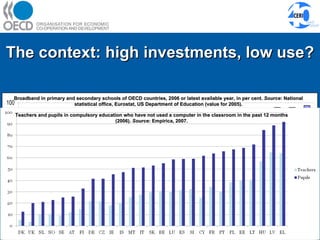
The context: high investments, low use? Broadband in primary and secondary schools of OECD countries, 2006 or latest available year, in per cent.  Source : National statistical office, Eurostat, US Department of Education (value for 2005). Teachers and pupils in compulsory education who have not used a computer in the classroom in the past 12 months (2006).  Source : Empirica, 2007.
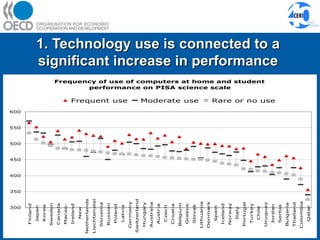
1. Technology use is connected to a significant increase in performance
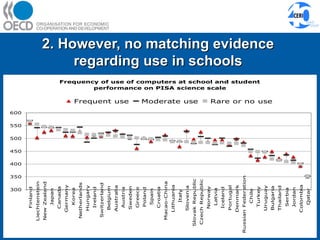
2. However, no matching evidence regarding use in schools
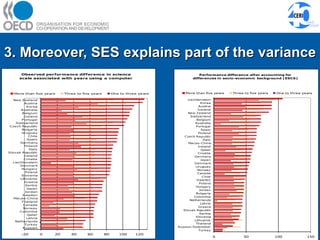
3. Moreover, SES explains part of the variance
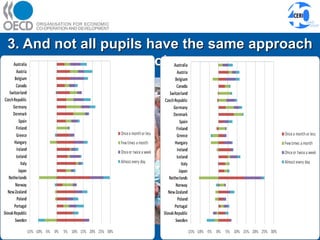
3. And not all pupils have the same approach to technology use
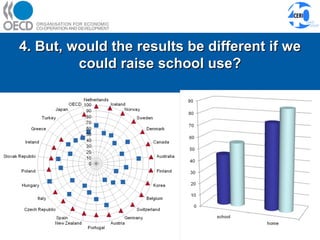
4. But, would the results be different if we could raise school use?
5. Is it worth raising school use? Does it pay off financially? Does it pay off in terms of equity?
Thank you [email_address]
Deputy Director General  Øystein Johannessen Norwegian Ministry of Education and Research Learning and Technology World Forum London 13 January 2009 In Search of Evidence: The Unbearable Hunt for Causality
My Agenda Barking up the right tree?  Multi-channeled knowledge base The Road Ahead
Barking up the right tree? Quality of learning is a very wide and complex concept. Need for  documentation and evidence , not anecdotes. The moving target Technological dynamic and diversity Methodological challenges Emergence of new digital skills Quality versus relevance Bottom line: The question is not if ICT improves learning, the question is HOW we can ensure that ICT adds value
Multi-channel knowledge base a necessity First order indicators: Monitor  access  development Second order indicators: Monitor  actual use  of ICT Benchmarking of digital learning resources. Looking to break new ground Third order indicators: Innovation, creativity Gender and SES differences should be object of further studies
Challenges on the road ahead It is the quality of ICT usage, rather than necessarily the quantity, that will determine the contribution that these technologies make to students outcome.  (OECD/PISA) Balancing Act: Need to know – manageable reporting and benchmarking systems How do we ensure a good mix of methods (quantitative/qualitative)? We need to facilitate Learner Voices
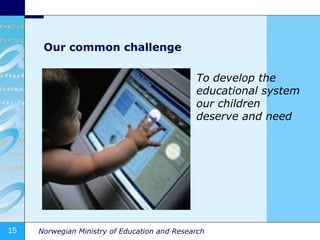
Our common challenge To develop the educational system our children deserve and need

Technology And Educational Performance

  • 1.
    Technology and educationalperformance Comparative evidence Francesc Pedró
  • 2.
    The context: highinvestments, low use? Broadband in primary and secondary schools of OECD countries, 2006 or latest available year, in per cent. Source : National statistical office, Eurostat, US Department of Education (value for 2005). Teachers and pupils in compulsory education who have not used a computer in the classroom in the past 12 months (2006). Source : Empirica, 2007.
  • 3.
    1. Technology useis connected to a significant increase in performance
  • 4.
    2. However, nomatching evidence regarding use in schools
  • 5.
    3. Moreover, SESexplains part of the variance
  • 6.
    3. And notall pupils have the same approach to technology use
  • 7.
    4. But, wouldthe results be different if we could raise school use?
  • 8.
    5. Is itworth raising school use? Does it pay off financially? Does it pay off in terms of equity?
  • 9.
  • 10.
    Deputy Director General Øystein Johannessen Norwegian Ministry of Education and Research Learning and Technology World Forum London 13 January 2009 In Search of Evidence: The Unbearable Hunt for Causality
  • 11.
    My Agenda Barkingup the right tree? Multi-channeled knowledge base The Road Ahead
  • 12.
    Barking up theright tree? Quality of learning is a very wide and complex concept. Need for documentation and evidence , not anecdotes. The moving target Technological dynamic and diversity Methodological challenges Emergence of new digital skills Quality versus relevance Bottom line: The question is not if ICT improves learning, the question is HOW we can ensure that ICT adds value
  • 13.
    Multi-channel knowledge basea necessity First order indicators: Monitor access development Second order indicators: Monitor actual use of ICT Benchmarking of digital learning resources. Looking to break new ground Third order indicators: Innovation, creativity Gender and SES differences should be object of further studies
  • 14.
    Challenges on theroad ahead It is the quality of ICT usage, rather than necessarily the quantity, that will determine the contribution that these technologies make to students outcome. (OECD/PISA) Balancing Act: Need to know – manageable reporting and benchmarking systems How do we ensure a good mix of methods (quantitative/qualitative)? We need to facilitate Learner Voices
  • 15.
    Our common challengeTo develop the educational system our children deserve and need