TECHNIQUES FOR TEACHING CULTURE By SIMOhamed Elmoussaoui
Cultural Islands From the first day of class teachers should have prepared a cultural island in their classrooms.  Posters, pictures, maps, sign s, and  realia  of many kinds are essential in helping students develop a mental image.  Assigning students foreign names  from the first day can heighten student interest
Mini–Dramas Mini–dramas always promote knowledge and understanding  Mini–dramas consist of three to five brief episodes The episodes are generally written to foster sympathy for the non–native of the culture
Audio–motor Units Audio–motor units consist of verbal instructions for actions by students which the students then carry out.  They work very well for any cultural routine which requires physical actions (e. g., eating with a knife and fork, shaking hands, listening actively, standing in line to buy a ticket, etc.).
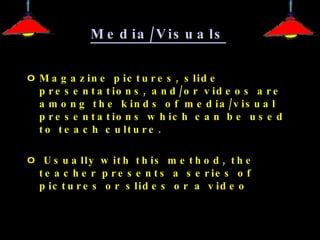
Media/Visuals   Magazine pictures, slide presentations, and/or videos are among the kinds of media/visual presentations which can be used to teach culture. Usually with this method, the teacher presents a series of pictures or slides or a video
To teach culture for understanding, teachers should  achieve the following   Goals:  (Seelye, 1984 & 1993)  Goal 1  =  Interest-  The student demonstrates  curiosity  about the target culture and empathy toward its people.  Goal 2  =  Who-  The student recognizes that role expectations and other social variables such as  age, sex, social class , ethnicity, and place of  residence  affect the way people speak and behave.
Goal 3  =  What-  The student realizes that effective communication requires discovering the culturally conditioned images that are evoked in the minds of people when they think, act, and react to the world around them.  Goal 4  =  Where and When-  The student recognizes that situational variables and convention shape behavior in important ways. (S/he needs to know how people in the target culture act in common mundane and crisis situations)
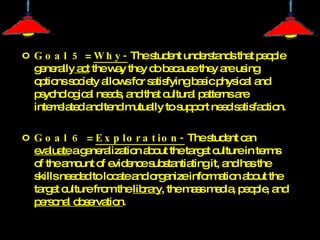
Goal 5  =  Why-  The student understands that people generally  act  the way they do because they are using options society allows for satisfying basic physical and psychological needs, and that cultural patterns are interrelated and tend mutually to support need satisfaction.  Goal 6  =  Exploration-  The student can  evaluate  a generalization about the target culture in terms of the amount of evidence substantiating it, and has the skills needed to locate and organize information about the target culture from the  library , the mass media, people, and  personal observation .
http://www.nadasisland.com/culture/#audio

Techniques for teaching culture

  • 1.
    TECHNIQUES FOR TEACHINGCULTURE By SIMOhamed Elmoussaoui
  • 2.
    Cultural Islands Fromthe first day of class teachers should have prepared a cultural island in their classrooms. Posters, pictures, maps, sign s, and realia of many kinds are essential in helping students develop a mental image. Assigning students foreign names from the first day can heighten student interest
  • 3.
    Mini–Dramas Mini–dramas alwayspromote knowledge and understanding Mini–dramas consist of three to five brief episodes The episodes are generally written to foster sympathy for the non–native of the culture
  • 4.
    Audio–motor Units Audio–motorunits consist of verbal instructions for actions by students which the students then carry out. They work very well for any cultural routine which requires physical actions (e. g., eating with a knife and fork, shaking hands, listening actively, standing in line to buy a ticket, etc.).
  • 5.
    Media/Visuals Magazine pictures, slide presentations, and/or videos are among the kinds of media/visual presentations which can be used to teach culture. Usually with this method, the teacher presents a series of pictures or slides or a video
  • 6.
    To teach culturefor understanding, teachers should achieve the following Goals: (Seelye, 1984 & 1993) Goal 1 = Interest- The student demonstrates curiosity about the target culture and empathy toward its people. Goal 2 = Who- The student recognizes that role expectations and other social variables such as age, sex, social class , ethnicity, and place of residence affect the way people speak and behave.
  • 7.
    Goal 3 = What- The student realizes that effective communication requires discovering the culturally conditioned images that are evoked in the minds of people when they think, act, and react to the world around them. Goal 4 = Where and When- The student recognizes that situational variables and convention shape behavior in important ways. (S/he needs to know how people in the target culture act in common mundane and crisis situations)
  • 8.
    Goal 5 = Why- The student understands that people generally act the way they do because they are using options society allows for satisfying basic physical and psychological needs, and that cultural patterns are interrelated and tend mutually to support need satisfaction. Goal 6 = Exploration- The student can evaluate a generalization about the target culture in terms of the amount of evidence substantiating it, and has the skills needed to locate and organize information about the target culture from the library , the mass media, people, and personal observation .
  • 9.