Technician Training: Safety Basics
Safety Basics
o General
o Electrical
o Mechanical
o Preventing Spills & Overfills
o Hazardous Electrical Power and Control
o Most of the projects where we participate have excellent jobsite
safety programs
o It is critical that you comply with all aspects of the safety program
 Jobsite specific safety training
 Possible drug test
 Hard hat, safety glasses, gloves, boots, vest, ear protection, &
fall protection over 6 feet
 Lockout & tag out procedures
 Weekly safety meetings
General
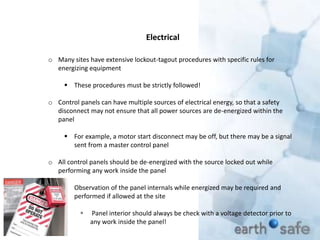
o Many sites have extensive lockout-tagout procedures with specific rules for
energizing equipment
 These procedures must be strictly followed!
o Control panels can have multiple sources of electrical energy, so that a safety
disconnect may not ensure that all power sources are de-energized within the
panel
 For example, a motor start disconnect may be off, but there may be a signal
sent from a master control panel
o All control panels should be de-energized with the source locked out while
performing any work inside the panel
 Observation of the panel internals while energized may be required and
performed if allowed at the site
 Panel interior should always be check with a voltage detector prior to
any work inside the panel!
Electrical
o When performing work on a pump system, a piping system,
or a filter system, confirm that:
 The pipe section or component is isolated by closed
valves
 Any pressure has been drained from the
pipe/equipment
• Fluid has been drained from the pipe/equipment
 Pumps have been locked out
 Proper tools are available
 Fluid cleanup supplies are available
Mechanical
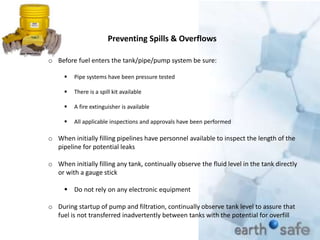
o Before fuel enters the tank/pipe/pump system be sure:
 Pipe systems have been pressure tested
 There is a spill kit available
 A fire extinguisher is available
 All applicable inspections and approvals have been performed
o When initially filling pipelines have personnel available to inspect the length of the
pipeline for potential leaks
o When initially filling any tank, continually observe the fluid level in the tank directly
or with a gauge stick
 Do not rely on any electronic equipment
o During startup of pump and filtration, continually observe tank level to assure that
fuel is not transferred inadvertently between tanks with the potential for overfill
Preventing Spills & Overflows
o Electrical systems for fuel transfer can be classified as hazardous electrical areas
 Gasoline used in service stations is always a hazardous electrical area
 Diesel fuel at ambient temperature is usually classified as ordinary area
 However diesel fuel when heated or confined within building spaces, may be
classified as hazardous by design or local code
o Electrical classifications for diesel fuel systems can be:
 Ordinary Area: No Risk of Explosion during Normal Operation
 Class 1 Division 2: Risk of Explosion during Upset Condition
 Class 1 Division 1: Risk of Explosion always Present
o Ordinary are systems allow the use of the most standard electrical components
Hazardous Electrical Power & Control
o Class 1 Division 2 systems usually exclude spark producing devices (standard
relays/contactors)
 Many PLCs and control components are rated for C1D2 environments, so with some
design medications control panels can meet these standards (motors will be
explosion proof)
o Class 1 Division 1 Systems will require explosion proof control enclosures, motors, and
most conduit accessories along with rigid conduit and conduit seals
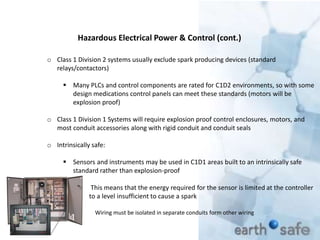
o Intrinsically safe:
 Sensors and instruments may be used in C1D1 areas built to an intrinsically safe
standard rather than explosion-proof
 This means that the energy required for the sensor is limited at the controller
to a level insufficient to cause a spark
Wiring must be isolated in separate conduits form other wiring
Hazardous Electrical Power & Control (cont.)

Technician Training: Safety basics

  • 1.
  • 2.
    Safety Basics o General oElectrical o Mechanical o Preventing Spills & Overfills o Hazardous Electrical Power and Control
  • 3.
    o Most ofthe projects where we participate have excellent jobsite safety programs o It is critical that you comply with all aspects of the safety program  Jobsite specific safety training  Possible drug test  Hard hat, safety glasses, gloves, boots, vest, ear protection, & fall protection over 6 feet  Lockout & tag out procedures  Weekly safety meetings General
  • 4.
    o Many siteshave extensive lockout-tagout procedures with specific rules for energizing equipment  These procedures must be strictly followed! o Control panels can have multiple sources of electrical energy, so that a safety disconnect may not ensure that all power sources are de-energized within the panel  For example, a motor start disconnect may be off, but there may be a signal sent from a master control panel o All control panels should be de-energized with the source locked out while performing any work inside the panel  Observation of the panel internals while energized may be required and performed if allowed at the site  Panel interior should always be check with a voltage detector prior to any work inside the panel! Electrical
  • 5.
    o When performingwork on a pump system, a piping system, or a filter system, confirm that:  The pipe section or component is isolated by closed valves  Any pressure has been drained from the pipe/equipment • Fluid has been drained from the pipe/equipment  Pumps have been locked out  Proper tools are available  Fluid cleanup supplies are available Mechanical
  • 6.
    o Before fuelenters the tank/pipe/pump system be sure:  Pipe systems have been pressure tested  There is a spill kit available  A fire extinguisher is available  All applicable inspections and approvals have been performed o When initially filling pipelines have personnel available to inspect the length of the pipeline for potential leaks o When initially filling any tank, continually observe the fluid level in the tank directly or with a gauge stick  Do not rely on any electronic equipment o During startup of pump and filtration, continually observe tank level to assure that fuel is not transferred inadvertently between tanks with the potential for overfill Preventing Spills & Overflows
  • 7.
    o Electrical systemsfor fuel transfer can be classified as hazardous electrical areas  Gasoline used in service stations is always a hazardous electrical area  Diesel fuel at ambient temperature is usually classified as ordinary area  However diesel fuel when heated or confined within building spaces, may be classified as hazardous by design or local code o Electrical classifications for diesel fuel systems can be:  Ordinary Area: No Risk of Explosion during Normal Operation  Class 1 Division 2: Risk of Explosion during Upset Condition  Class 1 Division 1: Risk of Explosion always Present o Ordinary are systems allow the use of the most standard electrical components Hazardous Electrical Power & Control
  • 8.
    o Class 1Division 2 systems usually exclude spark producing devices (standard relays/contactors)  Many PLCs and control components are rated for C1D2 environments, so with some design medications control panels can meet these standards (motors will be explosion proof) o Class 1 Division 1 Systems will require explosion proof control enclosures, motors, and most conduit accessories along with rigid conduit and conduit seals o Intrinsically safe:  Sensors and instruments may be used in C1D1 areas built to an intrinsically safe standard rather than explosion-proof  This means that the energy required for the sensor is limited at the controller to a level insufficient to cause a spark Wiring must be isolated in separate conduits form other wiring Hazardous Electrical Power & Control (cont.)