


Microservices & Spring REST
Building applications for the cloud
Tech Talks
Agenda
• What are Microservices?
• What are not Microservices?
• REST Services
• Build REST Services with Spring
• Questions and Answers
215 May 2015
What is for you
Microservices?
What is Microservices?
• It is an approach to developing a single application as a suite of
small services, each running in its own process and communicating
with lightweight mechanisms, often an HTTP resource API
• Fine-grained domain capability
• Independently deployable
• Independently releasable
• Language, data storage and technologies agnostic
• Designed for the Cloud
415 May 2015
What is not for you
microservices?
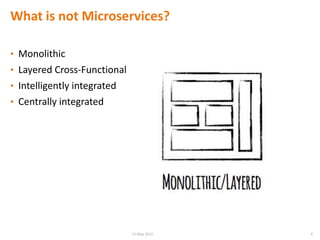
What is not Microservices?
• Monolithic
• Layered Cross-Functional
• Intelligently integrated
• Centrally integrated
615 May 2015
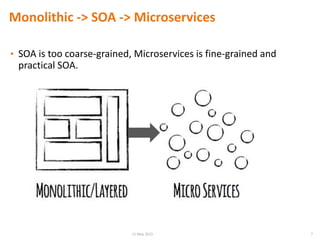
Monolithic -> SOA -> Microservices
• SOA is too coarse-grained, Microservices is fine-grained and
practical SOA.
715 May 2015
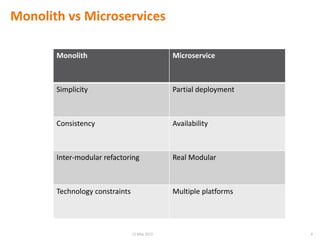
Monolith vs Microservices
Monolith Microservice
Simplicity Partial deployment
Consistency Availability
Inter-modular refactoring Real Modular
Technology constraints Multiple platforms
815 May 2015
Microservice Benefits
• Autonomy of the team
• Ownership
• Speed of change
• Scalability
• Elasticity
• Innovation
• Tech diversification
• Less code, more value
915 May 2015
Microservices Hidden Costs
• Network latency
• Network reliability
• Packet lost
• Bandwidth
• Security
• Testing is more complicated
• DevOps
1015 May 2015
Microservices Complexity
• Communication
– Better documentation
– Fan customer empathy
• Execution
– Continuous deployment and delivery
• Resilience
– Stateless Docker Containers
• Maintenance
– Backward compatibility
• Operational
– Easy usability
1115 May 2015
Microservices
Structural principles
• Resilient to failure
– Resiliency is designed into the application, rather than wrapped around it
after the fact. Failures in cloud infrastructure are handled fluidly without
interruption of service.
• Resilient to latency
– Applications adapt gracefully to latency rather than timing out/failing. High
• Secure
– Applications are based on secure lifecycle standards and include built-in
security
– Data at rest and in transit is encrypted. APIs are protected by authentication
and authorization.
1215 May 2015
• Location independent
– Applications discover services dynamically rather than relying on hard-coded
dependencies
• Elastically scalable
– Applications respond to demand levels, growing and shrinking as required, in
and among clouds
• SOA/Compose-ability
– Applications consume and expose web services with APIs discoverable at
runtime. The structure incorporates small, stateless components designed to
scale out
Microservices
Structural principles
1315 May 2015
• Designed for manageability
– Applications are instrumented and expose metrics and management
interfaces
• Infrastructure independent
– Applications make no assumptions about the underlying infrastructure, using
abstractions in relation to the operating system, file system, database, and so
on
• Defined tenancy
– Each application should have a deliberate, defined single tenancy or
multitenancy model
Microservices
Structural principles
1415 May 2015
Microservices
Structural principles
• Available end-user self-service
– Users should be able to register themselves to use the app through a self-
service registration interface, without entering an IT service request
• Bandwidth aware
– APIs and application protocols are designed to minimize bandwidth
consumption
• Cost and resource consumption aware
– Application architecture is designed to minimize costs due to bandwidth,
CPU, storage consumption, and I/O requests
1515 May 2015
Microservices
Operational strategies
• Ensure redundancy
– Applications are designed to be resilent to failure though the use of
redundancy. High
• Utilize caching
– Caching is used to improve performance, increase resiliency, and reduce
bandwidth costs. High
• Secure access to APIs
– API end points are protected via API Management gateways. High
• Stage deployments
– The risk of failure due to deployment is reduced by staging the introduction of
updates to components of an application. Medium
1615 May 2015
Microservices
Operational strategies
• 5 Plan for zone/ region failures
– Applications are deployed in a way that is resilient to disasters, such as entire
geographic zone or region failures
• Minimize inter-zone/ region latency
– Applications are deployed geographically to minimize network latency
• Locate high-bandwidth consumers externally
– High bandwidth consumers are hosted outside the cloud to reduce cloud
bandwidth utilization costs
• Abstract dependencies
– API abstractions are used to prevent lock-in with proprietary cloud services
1715 May 2015
Microservices
Patterns
• Very, very small
• Loosely coupled ( including flow)
• Versioning
• Backward compatibility
• Blue/Green deployments
• Toggle features
• Continuous delivery
• Convention over Configuration
• Service Discovery Service
• Monitoring
• Correlation IDs
1815 May 2015
Microservices
Patterns
• Fault tolerant, design for failure
• Abstraction layer
• One service at a time
• Health Check
• Stateless
1915 May 2015
Anti-Patterns
• Complex configuration
• Complicated dependencies
• Managed shared state
2015 May 2015
Microservices
Things to remember
• Prepare for failure
– Fail fast and cheap
• Every integration point will eventually fail in some way, and you
need to be prepared for that failure.
• Do defensive programming
– Defend with timeouts
– Defend from thread deadlocks
– Defend from resources bottleneck
• Be lazy for programming,
• Do not rely in others code
• Communicate
– Commits and early integration is the best way to communicate
• Stress interfaces
• Slow responses are not an option
2115 May 2015
• Keep in mind the SLAs and strict performance requirements
• Use data replication and sharding
• Put limits
– Pagination, timeouts, big request, etc
• Use queues and asynchronous for those flows that allow it
• Verify integration point early
• Use health checks
• Avoid mocks
• Learn, learn and learn
Microservices
Things to remember
2215 May 2015
Microservices
Things to remember
2315 May 2015
Componentization via
REST Services
REST Services
• REST has no hard and fast rules
• REST is an architectural style, not a standard
• REST uses Headers to describe requests & responses
• REST embraces HTTP verbs
2515 May 2015
Status codes
• 1xx: informational
• 2xx: success
• 3xx: redirection
• 4xx: client error
• 5xx: server error
2615 May 2015
REST Practices*
• Good HTTP Headers
• Idempotent
• Link and navigational
• JSON
• *For VCS poject
2715 May 2015
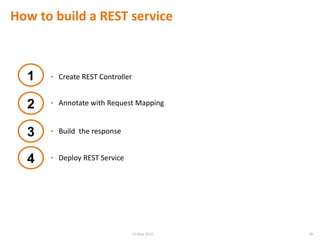
How to build a REST service
1
2
3
4
• Create REST Controller
• Annotate with Request Mapping
• Build the response
• Deploy REST Service
2815 May 2015
Demo
• Hello REST Service
• Monitoring Services
• Unit Test for REST Services
2915 May 2015
Resources
• OPEN DATA CENTER ALLIANCE Best Practices: Architecting Cloud-
Aware Applications Rev. 1.0
• http://www.infoq.com/presentations/Netflix-Architecture
• http://martinfowler.com/articles/microservices.html
• Release It!: Design and Deploy Production-Ready Software Book
• https://spring.io/guides/gs/rest-service/
• https://www.youtube.com/watch?v=wgdBVIX9ifA
3015 May 2015
Questions?
Thank you!

Tech Talks Microservices

  • 1.
    Microservices & SpringREST Building applications for the cloud Tech Talks
  • 2.
    Agenda • What areMicroservices? • What are not Microservices? • REST Services • Build REST Services with Spring • Questions and Answers 215 May 2015
  • 3.
    What is foryou Microservices?
  • 4.
    What is Microservices? •It is an approach to developing a single application as a suite of small services, each running in its own process and communicating with lightweight mechanisms, often an HTTP resource API • Fine-grained domain capability • Independently deployable • Independently releasable • Language, data storage and technologies agnostic • Designed for the Cloud 415 May 2015
  • 5.
    What is notfor you microservices?
  • 6.
    What is notMicroservices? • Monolithic • Layered Cross-Functional • Intelligently integrated • Centrally integrated 615 May 2015
  • 7.
    Monolithic -> SOA-> Microservices • SOA is too coarse-grained, Microservices is fine-grained and practical SOA. 715 May 2015
  • 8.
    Monolith vs Microservices MonolithMicroservice Simplicity Partial deployment Consistency Availability Inter-modular refactoring Real Modular Technology constraints Multiple platforms 815 May 2015
  • 9.
    Microservice Benefits • Autonomyof the team • Ownership • Speed of change • Scalability • Elasticity • Innovation • Tech diversification • Less code, more value 915 May 2015
  • 10.
    Microservices Hidden Costs •Network latency • Network reliability • Packet lost • Bandwidth • Security • Testing is more complicated • DevOps 1015 May 2015
  • 11.
    Microservices Complexity • Communication –Better documentation – Fan customer empathy • Execution – Continuous deployment and delivery • Resilience – Stateless Docker Containers • Maintenance – Backward compatibility • Operational – Easy usability 1115 May 2015
  • 12.
    Microservices Structural principles • Resilientto failure – Resiliency is designed into the application, rather than wrapped around it after the fact. Failures in cloud infrastructure are handled fluidly without interruption of service. • Resilient to latency – Applications adapt gracefully to latency rather than timing out/failing. High • Secure – Applications are based on secure lifecycle standards and include built-in security – Data at rest and in transit is encrypted. APIs are protected by authentication and authorization. 1215 May 2015
  • 13.
    • Location independent –Applications discover services dynamically rather than relying on hard-coded dependencies • Elastically scalable – Applications respond to demand levels, growing and shrinking as required, in and among clouds • SOA/Compose-ability – Applications consume and expose web services with APIs discoverable at runtime. The structure incorporates small, stateless components designed to scale out Microservices Structural principles 1315 May 2015
  • 14.
    • Designed formanageability – Applications are instrumented and expose metrics and management interfaces • Infrastructure independent – Applications make no assumptions about the underlying infrastructure, using abstractions in relation to the operating system, file system, database, and so on • Defined tenancy – Each application should have a deliberate, defined single tenancy or multitenancy model Microservices Structural principles 1415 May 2015
  • 15.
    Microservices Structural principles • Availableend-user self-service – Users should be able to register themselves to use the app through a self- service registration interface, without entering an IT service request • Bandwidth aware – APIs and application protocols are designed to minimize bandwidth consumption • Cost and resource consumption aware – Application architecture is designed to minimize costs due to bandwidth, CPU, storage consumption, and I/O requests 1515 May 2015
  • 16.
    Microservices Operational strategies • Ensureredundancy – Applications are designed to be resilent to failure though the use of redundancy. High • Utilize caching – Caching is used to improve performance, increase resiliency, and reduce bandwidth costs. High • Secure access to APIs – API end points are protected via API Management gateways. High • Stage deployments – The risk of failure due to deployment is reduced by staging the introduction of updates to components of an application. Medium 1615 May 2015
  • 17.
    Microservices Operational strategies • 5Plan for zone/ region failures – Applications are deployed in a way that is resilient to disasters, such as entire geographic zone or region failures • Minimize inter-zone/ region latency – Applications are deployed geographically to minimize network latency • Locate high-bandwidth consumers externally – High bandwidth consumers are hosted outside the cloud to reduce cloud bandwidth utilization costs • Abstract dependencies – API abstractions are used to prevent lock-in with proprietary cloud services 1715 May 2015
  • 18.
    Microservices Patterns • Very, verysmall • Loosely coupled ( including flow) • Versioning • Backward compatibility • Blue/Green deployments • Toggle features • Continuous delivery • Convention over Configuration • Service Discovery Service • Monitoring • Correlation IDs 1815 May 2015
  • 19.
    Microservices Patterns • Fault tolerant,design for failure • Abstraction layer • One service at a time • Health Check • Stateless 1915 May 2015
  • 20.
    Anti-Patterns • Complex configuration •Complicated dependencies • Managed shared state 2015 May 2015
  • 21.
    Microservices Things to remember •Prepare for failure – Fail fast and cheap • Every integration point will eventually fail in some way, and you need to be prepared for that failure. • Do defensive programming – Defend with timeouts – Defend from thread deadlocks – Defend from resources bottleneck • Be lazy for programming, • Do not rely in others code • Communicate – Commits and early integration is the best way to communicate • Stress interfaces • Slow responses are not an option 2115 May 2015
  • 22.
    • Keep inmind the SLAs and strict performance requirements • Use data replication and sharding • Put limits – Pagination, timeouts, big request, etc • Use queues and asynchronous for those flows that allow it • Verify integration point early • Use health checks • Avoid mocks • Learn, learn and learn Microservices Things to remember 2215 May 2015
  • 23.
  • 24.
  • 25.
    REST Services • RESThas no hard and fast rules • REST is an architectural style, not a standard • REST uses Headers to describe requests & responses • REST embraces HTTP verbs 2515 May 2015
  • 26.
    Status codes • 1xx:informational • 2xx: success • 3xx: redirection • 4xx: client error • 5xx: server error 2615 May 2015
  • 27.
    REST Practices* • GoodHTTP Headers • Idempotent • Link and navigational • JSON • *For VCS poject 2715 May 2015
  • 28.
    How to builda REST service 1 2 3 4 • Create REST Controller • Annotate with Request Mapping • Build the response • Deploy REST Service 2815 May 2015
  • 29.
    Demo • Hello RESTService • Monitoring Services • Unit Test for REST Services 2915 May 2015
  • 30.
    Resources • OPEN DATACENTER ALLIANCE Best Practices: Architecting Cloud- Aware Applications Rev. 1.0 • http://www.infoq.com/presentations/Netflix-Architecture • http://martinfowler.com/articles/microservices.html • Release It!: Design and Deploy Production-Ready Software Book • https://spring.io/guides/gs/rest-service/ • https://www.youtube.com/watch?v=wgdBVIX9ifA 3015 May 2015
  • 31.

Editor's Notes

  • #5 Who have heard about micro services? Tiny: lightweight, small footprint, follow SRP Uniform interface: RESTful. Decoupled, Scalable, Discoverable. OS services: self-contained, run with a single one-liner: “jar – jar”, grab port & listen. No more arcane app servers. Use existing OS process management tool
  • #20 Test with Chaos monkey