The Divorce Experience 
 
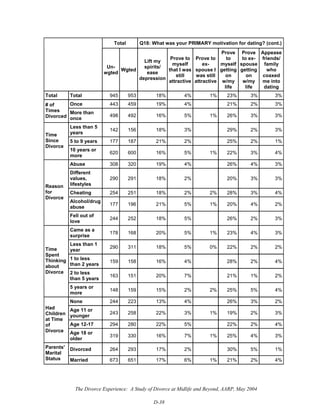
A Study of Divorce 
 at Midlife and Beyond 
 
Conducted For 
AARP The Magazine 
Report by
Xenia P. Montenegro, PhD
National Member Research, Knowledge Management
Survey conducted by
Knowledge Networks, Inc.
©Copyright 2004 AARP
Reprinting with permission only
601 E St. NW
Washington, D.C. 20049
www.aarp.org
May 2004
The Divorce Experience:  A Study of Divorce at Midlife and Beyond, AARP, May 2004 
  ‐ ii ‐ 
 
AARP is a nonprofit, nonpartisan membership organization dedicated to making life better for
people 50 and over. We provide information and resources; engage in legislative, regulatory
and legal advocacy; assist members in serving their communities; and offer a wide range of
unique benefits, special products, and services for our members. These include AARP The
Magazine, published bimonthly; AARP Bulletin, our monthly newspaper; Segunda Juventud,
our quarterly newspaper in Spanish; NRTA Live and Learn, our quarterly newsletter for 50+
educators; and our Web site, www.aarp.org. We have staffed offices in all 50 states, the
District of Columbia, Puerto Rico, and the U.S. Virgin Islands.
Acknowledgements
We would like to thank staff at Knowledge Networks, especially Shannon Schwartz, for their
work in conducting this survey.
Many AARP staff contributed to this project. From AARP The Magazine, the sponsor of the
survey, we want to thank Hugh Delehanty, Steven Slon, Ron Geraci, Karen Reyes, and Ed
Dwyer for their sponsorship and creative insights. Muriel Cooper of AARP Media Relations
also provided creative input.
Knowledge Management staff from various departments also contributed to the project. The
core team members from National Member Research are:
Xenia Montenegro, PhD, Project Manager
Sonya Gross, Research Analyst
Deirdre Campbell-Alston
Adel Dukes Stewart
Linda Fisher, Director, PhD, National Member Research
For additional information, contact Xenia P. Montenegro, PhD at 202-434-3538
The Divorce Experience:  A Study of Divorce at Midlife and Beyond, AARP, May 2004 
  ‐ 1 ‐ 
Contents 
EXECUTIVE SUMMARY ...............................................................................4
METHODOLOGY:  THE STUDY OF DIVORCE AT MIDLIFE AND 
BEYOND.........................................................................................................10
FINDINGS ......................................................................................................12
I.  RESPONDENT PROFILE:  DIVORCEES AGES 40 TO 79....................................................... 12
II. CIRCUMSTANCES SURROUNDING THE DIVORCE............................................................ 14
III. REASONS FOR DIVORCE  ................................................................................................ 20
IV. IMPACT OF DIVORCE...................................................................................................... 24
V. LIFE AFTER DIVORCE ...................................................................................................... 31
VI. SEXUALITY AMONG LATER LIFE DIVORCEES ................................................................ 39
VII.  DEMOGRAPHIC GROUPS.............................................................................................. 51
APPENDIX .....................................................................................................60
 
ANNOTATED QUESTIONNAIRE..........................................................................................A‐1
ADDITIONAL RESPONDENT DATA .....................................................................................B‐1
METHODOLOGY AND TECHNICAL NOTES ........................................................................ C‐1
STATISTICAL TABLES..........................................................................................................D‐1
The Divorce Experience:  A Study of Divorce at Midlife and Beyond, AARP, May 2004 
  ‐ 2 ‐ 
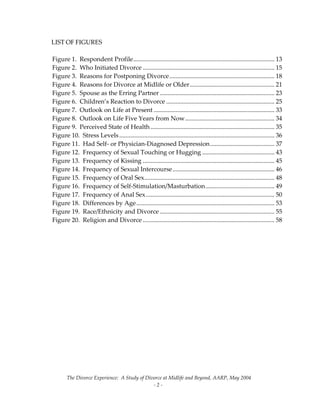
LIST OF FIGURES 
 
Figure 1.  Respondent Profile.......................................................................................... 13 
Figure 2.  Who Initiated Divorce .................................................................................... 15 
Figure 3.  Reasons for Postponing Divorce................................................................... 18 
Figure 4.  Reasons for Divorce at Midlife or Older...................................................... 21 
Figure 5.  Spouse as the Erring Partner ......................................................................... 23 
Figure 6.  Children’s Reaction to Divorce ..................................................................... 25 
Figure 7.  Outlook on Life at Present ............................................................................. 33 
Figure 8.  Outlook on Life Five Years from Now......................................................... 34 
Figure 9.  Perceived State of Health ............................................................................... 35 
Figure 10.  Stress Levels................................................................................................... 36 
Figure 11.  Had Self‐ or Physician‐Diagnosed Depression......................................... 37 
Figure 12.  Frequency of Sexual Touching or Hugging .............................................. 43 
Figure 13.  Frequency of Kissing .................................................................................... 45 
Figure 14.  Frequency of Sexual Intercourse................................................................. 46 
Figure 15.  Frequency of Oral Sex................................................................................... 48 
Figure 16.  Frequency of Self‐Stimulation/Masturbation............................................ 49 
Figure 17.  Frequency of Anal Sex.................................................................................. 50 
Figure 18.  Differences by Age........................................................................................ 53 
Figure 19.  Race/Ethnicity and Divorce ......................................................................... 55 
Figure 20.  Religion and Divorce .................................................................................... 58 
 
The Divorce Experience:  A Study of Divorce at Midlife and Beyond, AARP, May 2004 
  ‐ 3 ‐ 
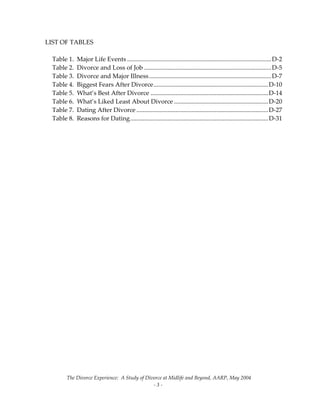
LIST OF TABLES 
 
Table 1.  Major Life Events ............................................................................................D‐2 
Table 2.  Divorce and Loss of Job .................................................................................D‐5 
Table 3.  Divorce and Major Illness..............................................................................D‐7 
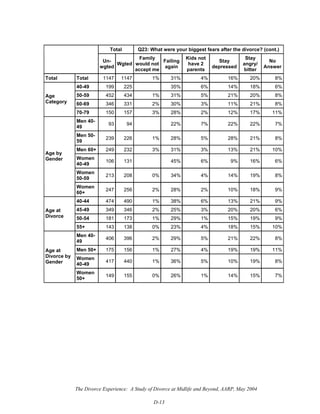
Table 4.  Biggest Fears After Divorce.........................................................................D‐10 
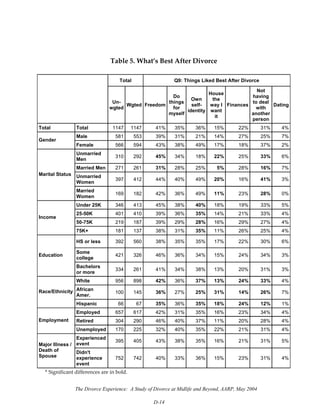
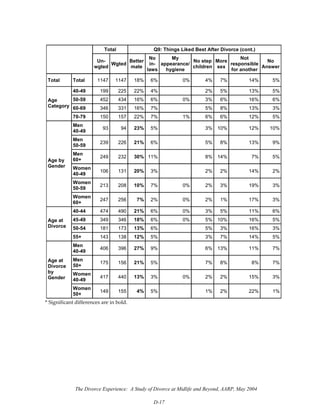
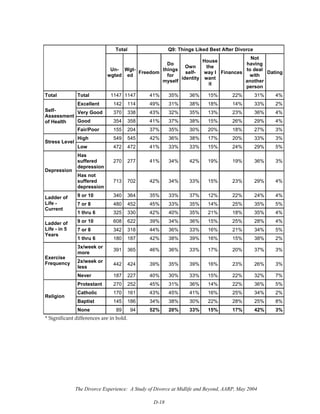
Table 5.  What’s Best After Divorce ...........................................................................D‐14 
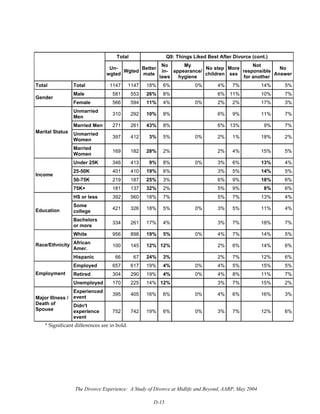
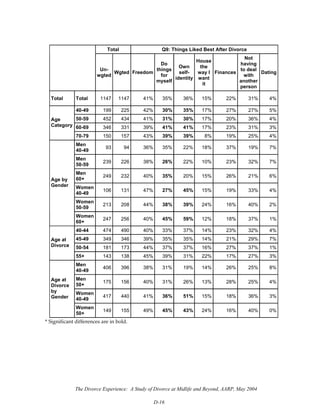
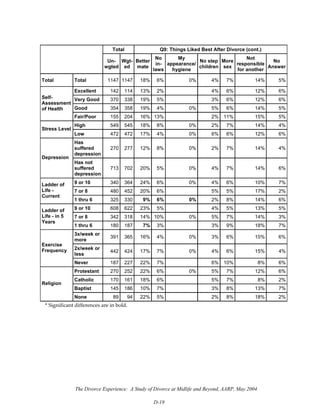
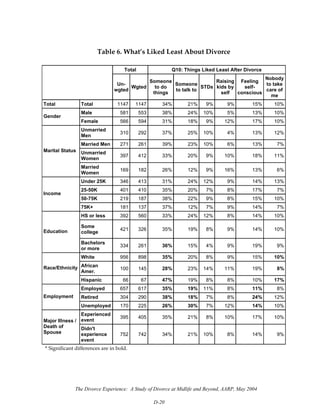
Table 6.  What’s Liked Least About Divorce ............................................................D‐20 
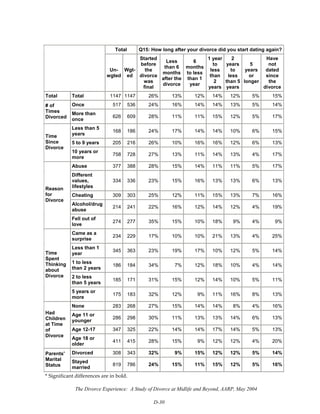
Table 7.  Dating After Divorce ....................................................................................D‐27 
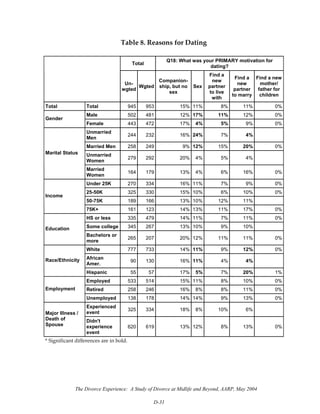
Table 8.  Reasons for Dating........................................................................................D‐31 
 
The Divorce Experience:  A Study of Divorce at Midlife and Beyond, AARP, May 2004 
  ‐ 4 ‐ 
EXECUTIVE SUMMARY 
 
 
  Many midlife events cause turmoil.  Children leave the nest, a major illness 
comes, a parent passes on.  For some, divorce ends a long marriage. 
 
  These and other events become common at a stage in life when people worry 
about getting older, reflect on their mortality, and ponder about what has been and 
could have been.  Experiencing one midlife event after another may lead to stress 
and feelings of devastation.  
 
  This groundbreaking study,  The Divorce Experience: A Study of Divorce at 
Midlife and Beyond, is the first of its kind to document what has become a common 
experience among midlifers and older people.  The study examines the circumstances 
surrounding divorce at midlife and its impact on men and women.  We also wanted 
to look at how people cope with life and their well‐being after divorce, as well as 
their sexuality. 
 
  The results are based on interviews with 1,147 respondents ‐‐ 581 men and 566 
women ages 40 to 79 who were divorced at least once during their 40s, 50s, or 60s.  
Some are still divorced, some have remarried, and a few are widowed.  Respondents 
represent divorcees and remarried divorcees in the United States population who 
divorced when they were between the ages of 40 and 69.   
 
 
The Impact of Divorce 
 
  Compared to other losses that may occur at midlife or older, people age 40 
and older generally feel that divorce is more emotionally devastating than losing a 
job, about equal to experiencing a major illness, and somewhat less devastating than 
a spouse’s death.  When two or more life‐churning events occur near the same time, 
one can only imagine the emotional devastation someone has to face. 
 
  Contrary to our expectations, we found that even at an older age, people think 
long and hard not only about how divorce may impact their future, but how it may 
impact the welfare of their children.  Staying married because of the children is by far 
the predominant reason some people take so long to decide about getting a divorce, 
The Divorce Experience:  A Study of Divorce at Midlife and Beyond, AARP, May 2004 
  ‐ 5 ‐ 
despite serious problems such as abusive spouses. Verbal, physical, or emotional 
abuse leads the list of causes for marital dissolution, followed by differences in 
values and lifestyles, cheating, and alcohol or drug abuse. 
 
  In addition, regardless of whether their divorce was more emotionally 
devastating in their 20s and 30s or in later life, those who experienced divorces both 
at a younger and older age gave concern for their children as the major reason one 
was more emotionally devastating than the other.  Women gave this reason more 
frequently than men although children are the top concern for both groups.  Men, 
being the non‐custodial parent most of the time, are especially concerned about their 
post‐divorce relationship with their children.   
 
  At the time of their divorce, 76 percent of people ages 40 to 79 who divorced 
later in life had children, the majority of whom were under 18 years old.  Although 
more than a third of those with children (37%) report that their children were 
supportive, and an additional 17 percent say that their children were “OK” with it, 28 
percent recall that their children were somewhat upset, and 18 percent say their 
children were very upset, about their divorce. 
 
  Along with emotional turmoil, people report other difficulties.  Foremost 
among these is dealing with uncertainty or not knowing what’s ahead, cited by 40 
percent.  Many suffer from loneliness or depression (29%), as well as feelings of 
desertion or betrayal (25%), a sense of failure (23%), feeling unloved (22%), and 
feelings of inadequacy (20%). 
 
  People also face many fears.  Greatest among them is the fear of being alone, 
named by almost half (45%).  Divorcees also fear failing again (31%), being 
financially destitute (28%), never finding someone to marry or live with (24%), 
staying angry/bitter for a long time (20%), staying depressed for a long time (16%), 
and not seeing their children as much (14%).  Women are especially vulnerable 
financially and are more likely than men to be troubled about becoming financially 
destitute.  Even with this greater vulnerability, women tend to have no choice, as 
they are more likely to fault their spouse, especially with abuse.  Thus women 
usually initiate divorce, many times surprising their spouses. 
 
 
The Divorce Experience:  A Study of Divorce at Midlife and Beyond, AARP, May 2004 
  ‐ 6 ‐ 
Coping with Life after Divorce 
 
  Despite the worry, torment, and fear they go through making the decision and 
going through the divorce process, divorcees cope fairly well with life after divorce.  
The majority feel they are on the top rungs of the ladder of life.  Their outlook is on a  
par with that of the general population age 45 or older, and better than that of singles 
ages 40 to 69.  Those who remarried give themselves a better current outlook on life 
than those who did not remarry, or those who are either separated or widowed.   
Three in four (76%) claim they made the right decision to dissolve their marriage.   
Indeed, their buzzwords are freedom, self‐identity, and fulfillment.  
 
  However, stress remains, although we cannot determine how much of this 
stems from the divorce.  About half (49%) say they suffer from more than the usual 
stress or greater.  More women than men (63% versus 44%) suffer highly from stress.   
Depression plagues some (28%), with no difference between those who remained 
divorced and those who remarried.  The rates of high stress and depression are 
similar to the rates among singles ages 40 to 69, reported in another AARP study in 
2003.  Again, women report depression more than men (35% women versus 21% 
men).   
 
 
Sexuality 
 
  After their divorce, people dated primarily to prove either to themselves or to 
their spouses that they were getting on with their lives.  About a third (32%) 
remarried.  Perhaps because of their long shared history, a few (6%) remarried the 
same person, or had sex with their spouse occasionally or often for several years after 
their divorce (4%). 
 
  The majority (56%) report sexual touching or hugging in varying degrees of 
frequency (daily to once or twice a month), while 38 percent of the total claim not 
doing any of these at all.  Many women, especially those who have not remarried 
(69%), do not touch or hug at all sexually.  An even larger majority of women who 
have not remarried do not engage in sexual intercourse (77% saying not at all), in 
comparison with about half of men (49%) who have not remarried. 
 
   
The Divorce Experience:  A Study of Divorce at Midlife and Beyond, AARP, May 2004 
  ‐ 7 ‐ 
  Age Differences 
 
  Sixty‐ and seventy‐year‐olds appreciate life after divorce most, saying that 
they like doing things for themselves and having their own identity.  However, what 
they hate most is not having someone to do things with.   
 
  Forty‐year‐olds’ major concern is their finances, but they are more likely than 
older divorcees to have dated after their divorce or even before their divorce became 
final.  They wanted to prove that they could get on with their lives. 
 
  Fifty‐year‐olds seem to have the most difficulty with divorce, evident in their 
greater likelihood to say that their divorce was more difficult than a major illness.   
This could be because, unlike forty‐year‐olds, they worry that they are not young 
enough to have a good chance at remarriage; and unlike sixty‐ or seventy‐year‐olds, 
they are more concerned about their future at a life stage when a midlife crisis 
commonly occurs.  Fifty‐year‐olds like best not having to deal with another person. 
 
 
Racial/Ethnic Differences 
 
  African Americans find divorce less emotionally devastating than suffering a 
major illness or even job loss.  African Americans are less fearful than whites of 
financial hardship, of failing again, and of not finding someone after their divorce.   
 
  While whites are more likely to think that finding their own self‐identity and 
not dealing with another person are pluses, African Americans are more apt to 
appreciate having the house the way they want it after their divorce. 
 
 
Religious Differences 
 
  Baptists (grouped separately from other Protestants because of their large 
number), Catholics, and Protestants other than Baptists differ in many respects from 
those with no religious affiliation.  Baptists and those with no religious affiliation 
often are on the ends of the spectrum:  Baptists found the most comfort in their 
religious faith or prayer while in the throes of divorce, while those with no religious 
The Divorce Experience:  A Study of Divorce at Midlife and Beyond, AARP, May 2004 
  ‐ 8 ‐ 
affiliation did not.  Baptists are the most likely to have the brightest outlook on life, 
and those with no religious affiliation the worst.  However, like those with no 
religious affiliation, Baptists have the least desire to remarry. 
 
  Those with no religious affiliation are the most likely to fear for their finances 
after divorce but most apt to appreciate their freedom.   
 
  These differences may be linked to other characteristics that are associated 
with one’s religious faith.  One of these characteristics may be age, because people 
may be more likely to become religious or spiritual as they get older.  In addition, the 
majority of African Americans are Baptists, while the majority of Hispanics are 
Catholics.  Whites most frequently report their religion as Protestant.  The sample did 
not allow analysis for groups affiliated with other religions. 
 
 
Implications 
 
  As life expectancies increase and baby boomers replace their more traditional 
elders as seniors, it is likely that the number of people going through divorce at 
midlife or older will increase.  Those who experience this event late in life are also 
likely to leave a long marriage.  Yet, there is little awareness and understanding of 
divorce in the latter stages of life and its impact on older persons.   
 
  Knowing what the greatest difficulties are, such as loneliness, depression, and 
feelings of betrayal and failure, support systems should develop services to ease 
them.  Knowing what the concerns are, especially relating to finances and children,  
legal and support systems should increase efforts to alleviate them.  Knowing what 
the greatest fears are, such as being alone, support systems should make information 
available to help deal with them. 
 
  While older divorcees may rely on friends, family, and religious faith for 
support, they do not go to organizations in the community, government agencies, 
and national organizations representing older persons.  This study is an effort to 
heighten awareness, advance the dialogue, and inspire more research.  More 
importantly, we hope that communities and institutions will be better able to help 
meet the needs of people who divorce at midlife or older.   
The Divorce Experience:  A Study of Divorce at Midlife and Beyond, AARP, May 2004 
  ‐ 9 ‐ 
 
INTRODUCTION 
 
AARP The Magazine, AARP’s bimonthly publication for its membership, 
sponsored this study on divorce to obtain a snapshot of the divorce experience at 
midlife and beyond, recognizing that divorce can profoundly affect people’s lives. 
The Divorce Experience:  A Study of Divorce at Midlife and Beyond, AARP, May 2004 
  ‐ 10 ‐ 
 
METHODOLOGY:  THE STUDY OF DIVORCE AT MIDLIFE AND 
BEYOND 
   
  AARP commissioned Knowledge Networks to conduct this survey using its 
web‐enabled consumer research panel, a randomly recruited and nationally 
representative sample of the U. S. population.   Knowledge Networks sent an email 
to a stratified random sample of their panel members between the ages of 40 and 79, 
inviting them to participate in the survey.  Only those who reported having been 
divorced between the ages of 40 and 69 were included in the study.  The final data 
were weighted to be representative of the divorcee population ages 40 to 79.   
 
  A benefit of this methodology is that it affords more privacy for respondents 
than a telephone survey, which is important when a study has sensitive questions, as 
this one does.  This methodology improves response rates and encourages honesty, 
since panelists are comfortable in completing the survey because their responses are 
provided anonymously.    
 
  A total of 1,148 40‐ to 79‐year‐olds who divorced in their 40s, 50s, or 60s 
completed the survey in December 2003.  The maximum margin of sampling error 
for this sample size is plus or minus 3.0 percentage points at the 95% level of 
confidence.  The technical notes in the appendix describe the sample methodology 
and the disposition of the sample in more detail. 
 
The Questionnaire 
 
AARP developed the survey questionnaire with the assistance of Knowledge 
Networks.  Study participants were asked about: 
 
• the circumstances at the time of their divorce 
• the reasons for their divorce 
• the impact of their divorce 
• their lives after divorce 
• their sexuality  
• personal and other variables that may relate to the divorce experience 
 
    
The Divorce Experience:  A Study of Divorce at Midlife and Beyond, AARP, May 2004 
  ‐ 11 ‐ 
  Panel member data obtained from respondents outside of the questionnaire 
were also used to analyze survey responses.  These respondent data include: 
 
• gender 
• age 
• marital status (widowed, separated, remarried) 
• education 
• employment 
• income 
• stress level 
• frequency of exercise 
• past depression 
 
Data Analysis 
 
Response frequencies to each question on the survey are reported in the 
annotated questionnaire in the appendix.  The appendix also includes additional 
respondent data.  Statistical tables and graphics are presented as well.  
 
  More detailed analyses of responses by attitudes, behavior, and demographic 
characteristics are available in a separate volume for those who are interested in a 
more in‐depth review of the results.  
The Divorce Experience:  A Study of Divorce at Midlife and Beyond, AARP, May 2004 
  ‐ 12 ‐ 
FINDINGS 
I. Respondent Profile: Divorcees Ages 40 to 79
 
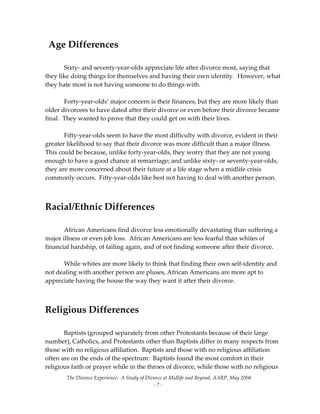
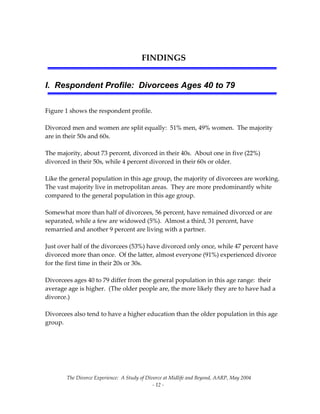
Figure 1 shows the respondent profile. 
 
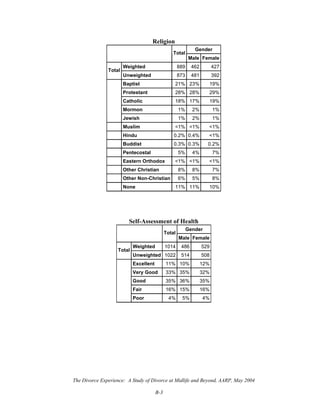
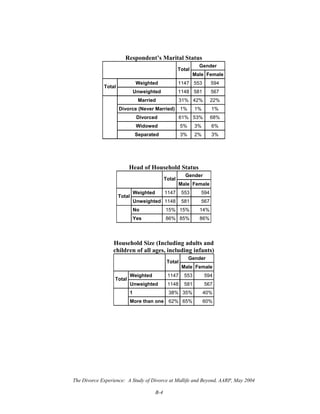
Divorced men and women are split equally:  51% men, 49% women.  The majority 
are in their 50s and 60s.    
 
The majority, about 73 percent, divorced in their 40s.  About one in five (22%) 
divorced in their 50s, while 4 percent divorced in their 60s or older.    
 
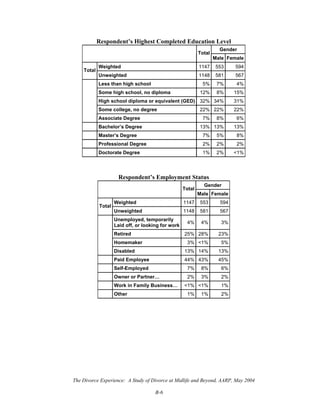
Like the general population in this age group, the majority of divorcees are working. 
The vast majority live in metropolitan areas.  They are more predominantly white 
compared to the general population in this age group. 
 
Somewhat more than half of divorcees, 56 percent, have remained divorced or are 
separated, while a few are widowed (5%).  Almost a third, 31 percent, have 
remarried and another 9 percent are living with a partner. 
 
Just over half of the divorcees (53%) have divorced only once, while 47 percent have  
divorced more than once.  Of the latter, almost everyone (91%) experienced divorce 
for the first time in their 20s or 30s. 
 
Divorcees ages 40 to 79 differ from the general population in this age range:  their 
average age is higher.  (The older people are, the more likely they are to have had a 
divorce.) 
 
Divorcees also tend to have a higher education than the older population in this age 
group. 


The Divorce Experience:  A Study of Divorce at Midlife and Beyond, AARP, May 2004 
  ‐ 13 ‐ 
  Figure 1.  Respondent Profile 
9%
31%
5%
56%
15%
85%
29%
37%
34%
2%
6%
9%
83%
57%
33%
4%
7%
15%
30%
43%
13%
30%
39%
17%
49%
51%
0% 20% 40% 60% 80% 100%
Living w/ partner
Remarried
Widowed
Divorced/Separated
Non metro
Metro
College degree +
Some college
HS or less
Other
Hispanic
Black
White
Working
Not working
60+
55-59
50-54
45-49
40-44
70-79
60-69
50-59
40-49
Female
Male
GENDER
AGE
AGE AT DIVORCE
WORK STATUS
RACE/ETHNICITY
EDUCATION
RESIDENCE
CURRENT STATUS
 
The Divorce Experience:  A Study of Divorce at Midlife and Beyond, AARP, May 2004 
  ‐ 14 ‐ 
II. Circumstances Surrounding the Divorce
 
Seldom do both parties jointly decide to have a divorce.  Women usually 
initiate the divorce.  Although they may have been contemplating action for a long 
time during a long marriage, women sometimes surprise their spouses when they 
finally ask for the divorce.  For both men and women, children are the major reason 
for delaying divorce, but economics is an equally powerful divorce deterrent for 
women.    
Who Asked 
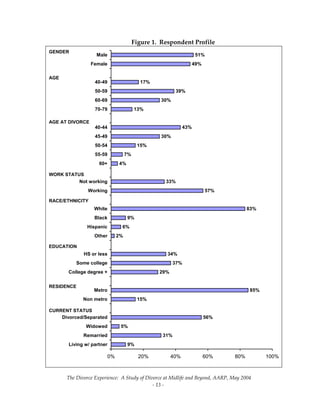
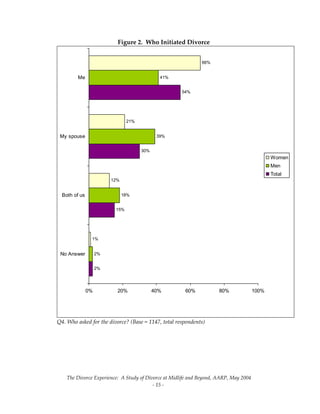
Among women, 66 percent report that they asked for the divorce, while only 
41 percent of men say they did.  Conversely, 39 percent of men say their spouses 
asked for the divorce, and 21 percent of women report the same.  A small minority, 
18 percent of men and 12 percent of women, state that both they and their spouses 
jointly decided on a divorce.  
 
  Victims of physical or verbal abuse, as well as alcohol or drug abuse, are much 
more apt to ask for the divorce themselves (73% and 70% asking for divorce versus 
54% of total).  They also tend to have spent less time thinking about having a divorce 
before asking for one. 
The Divorce Experience:  A Study of Divorce at Midlife and Beyond, AARP, May 2004 
  ‐ 15 ‐ 
Figure 2.  Who Initiated Divorce 
2%
15%
30%
54%
2%
18%
39%
41%
1%
12%
21%
66%
0% 20% 40% 60% 80% 100%
No Answer
Both of us
My spouse
Me
Women
Men
Total
Q4. Who asked for the divorce? (Base = 1147, total respondents)
 
The Divorce Experience:  A Study of Divorce at Midlife and Beyond, AARP, May 2004 
  ‐ 16 ‐ 
 
Length of Marriage 
 
  Since their divorce occurred when they were in their 40s or older, long‐term 
marriages among divorcees are the rule.  More than six in ten (64%) were married for 
ten years or longer when they divorced.  Almost a third (32%) were married for 20 
years or longer.  About a third (35%) were married less than ten years.   
 
  African Americans tend to have shorter marriages, averaging 11 years among 
divorcees in this age group, compared to 15 years for both whites and Hispanics. 
 
  Those who report having no religious affiliation divorced at a younger age, 
with 62 percent who say they divorced at ages 40 to 44, in contrast to 43 percent of 
the total sample who divorced at the same age. 
 
 
Deciding to Divorce 
 
  While their marriages were long term, divorcees 40 to 79 years old generally 
contemplated getting a divorce for a short time before deciding to take the plunge.  
This is partly because one in five of them were surprised by their spouses (20%).  
Wives surprised their husbands more often (26% versus 14%).  In addition to the 
surprise from spouses, an additional third (32%) contemplated their divorce for less 
than a year before taking action. 
 
Children a Major Factor in Divorce Decision, Plus Economics among 
Women 
 
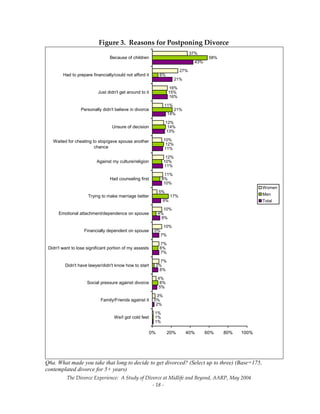
  Only 17 percent strung out their decision to divorce for five years or longer.    
Children were the major factor for the delay.  Of those who took five years or longer 
to decide, 43 percent of the total reported they stayed married because of the 
children, while the second reason was that they had to prepare financially or could 
not afford the divorce (21%).   
 
  Many more men than women say they stayed married because of the children 
(58% versus 37%).  Women, on the other hand, are several times more likely to say 
they had to prepare financially (27% women versus 6% men).  An additional ten 
percent more women (and less than 1% of men) say that their financial dependence 
The Divorce Experience:  A Study of Divorce at Midlife and Beyond, AARP, May 2004 
  ‐ 17 ‐ 
on their spouse was the reason.  Thus, a total of 37 percent of women divorcees 
mulled over having a divorce for five years or longer and postponed it for financial 
reasons.  This is equal to the percentage of women who postponed divorce because 
of their children. 
 
 
The Divorce Experience:  A Study of Divorce at Midlife and Beyond, AARP, May 2004 
  ‐ 18 ‐ 
Figure 3.  Reasons for Postponing Divorce 
1%
2%
5%
6%
7%
7%
8%
9%
10%
11%
11%
13%
14%
16%
21%
43%
1%
0%
6%
2%
6%
0%
4%
17%
8%
10%
12%
14%
21%
15%
6%
58%
1%
3%
4%
7%
7%
10%
10%
5%
11%
12%
10%
12%
11%
16%
27%
37%
0% 20% 40% 60% 80% 100%
We/I got cold feet
Family/Friends against it
Social pressure against divorce
Didn't have lawyer/didn't know how to start
Didn't want to lose significant portion of my assests
Financially dependent on spouse
Emotional attachment/dependence on spouse
Trying to make marriage better
Had counseling first
Against my culture/religion
Waited for cheating to stop/gave spouse another
chance
Unsure of decision
Personally didn't believe in divorce
Just didn't get around to it
Had to prepare financially/could not afford it
Because of children
Women
Men
Total
Q6a. What made you take that long to decide to get divorced? (Select up to three) (Base=175,
contemplated divorce for 5+ years)
The Divorce Experience:  A Study of Divorce at Midlife and Beyond, AARP, May 2004 
  ‐ 19 ‐ 
  Indeed, women are well aware of how dire their finances could become after a 
divorce.  Research studies have confirmed the impact of separation and divorce on 
the economic well‐being of women. 
  
 Children When Divorced 
 
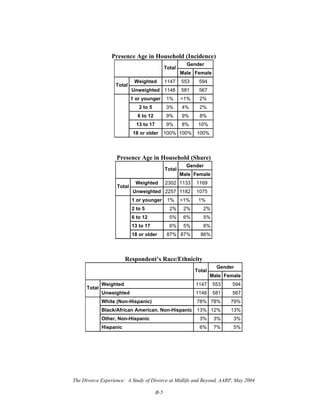
  At the time of their divorce, 23 percent had no children.  Twenty‐nine percent 
had children younger than 12 at the time of their divorce, 28 percent had children 
ages 12 to 17, and 36 percent had children 18 or older.  Some had both adult children 
and dependent children of various ages at the same time. 
  
Parents’ Marriage 
 
  It is apparent that divorce became more common among parents of baby 
boomer children, especially among divorcees in their 40s (39% have divorced 
parents) compared to the total sample (30% have divorced parents).  The attitudes or 
behavior of respondents generally are not associated with their parents’ divorce or 
staying married. 


The Divorce Experience:  A Study of Divorce at Midlife and Beyond, AARP, May 2004 
  ‐ 20 ‐ 
III. Reasons for Divorce
 
 
  Abuse, lifestyle or value differences, and cheating lead the reasons for divorce.  
Just as women usually initiate the divorce, they are more apt to put the husband at 
fault as well.  On the other hand, while men also tend to blame their ex‐wives, more 
of them admit to being at fault. 
 
Grounds for Divorce 
 
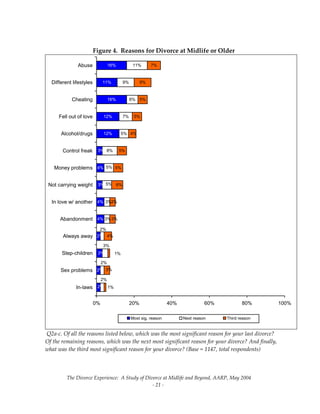
  Verbal, physical, or emotional abuse is the foremost reason for divorce.  Asked 
what the three major reasons are, three came out among the myriad grounds listed 
for respondents to mark:   
• verbal, physical, or emotional abuse (34%) 
• different values, lifestyles (29%) 
• cheating (27%) 
 
  However, one in four (24%) say they simply fell out of love or had no obvious 
problems.  Alcohol or drug abuse also caused disruption in the marriage of some.  
The following are other  grounds for divorce: 
• simply fell out of love/no obvious problems (24%) 
• alcohol or drug abuse (21%) 
• being a control freak (16%) 
• money problems (14%) 
• not carrying their weight in the marriage (14%) 
• fell in love with someone else (10%) 
• abandonment (10%) 
 
  Fewer (5‐8%) checked always being away, sexual problems, step‐children, and 
in‐laws as a reason.  Not having children, religious differences, cultural differences, 
age differences, declining physical health, and homosexuality were named by fewer 
still (less than 5%).  
 
The Divorce Experience:  A Study of Divorce at Midlife and Beyond, AARP, May 2004 
  ‐ 21 ‐ 
 
Figure 4.  Reasons for Divorce at Midlife or Older 
4%
4%
4%
12%
12%
16%
11%
16%
8%
5%
7%
6%
9%
11%
5%
5%
5%
5%
9%
7%
95%
93%
92%
90%
90%
86%
84%
79%
76%
73%
71%
66%
2%
3%
2%
3%
2%
3%
2%
2%
3%
2%
5%
5%
3%
3%
1%
3%
1%
4%
6%
3%
3%
4%
93%
86%
0% 20% 40% 60% 80% 100%
In-laws
Sex problems
Step-children
Always away
Abandonment
In love w/ another
Not carrying weight
Money problems
Control freak
Alcohol/drugs
Fell out of love
Cheating
Different lifestyles
Abuse
Most sig. reason Next reason Third reason
 Q2a‐c. Of all the reasons listed below, which was the most significant reason for your last divorce?  
Of the remaining reasons, which was the next most significant reason for your divorce? And finally, 
what was the third most significant reason for your divorce? (Base = 1147, total respondents)
The Divorce Experience:  A Study of Divorce at Midlife and Beyond, AARP, May 2004 
  ‐ 22 ‐ 
Spouse versus Self as the Erring Partner 
 
  Divorcees most often point to the former spouse as the erring partner.  The 
vast majority (86%) say it was their ex‐spouse who cheated, and about the same 
percentage say the ex‐spouse was the control freak (86%), or the ex‐spouse was not 
carrying his/her weight in the marriage (83%).  Large numbers also say that their 
spouse was physically, verbally, or emotionally abusive (78%), or used alcohol or 
drugs (77%).   (Only those respondents who gave these as particular reasons for the 
divorce were asked whether they or their spouses were responsible). 
 
  Men and women alike tend to fault their ex‐spouses.  However, women point 
to the other person in greater numbers than men, especially for alcohol or drug 
abuse.  Men are generally more likely than women to say that the reasons apply 
either to them or to both themselves and their spouses.   
 
  However, fewer men and women fault their spouses when it came to money 
as well as to different values and lifestyles, saying that it is they or both parties who 
caused these problems.  About half of the women (53%) say money problems caused 
by their ex‐husbands led to divorce, while 44 percent of men say the same of their ex‐
wives.  Fewer still say “different values and lifestyles” applied to the ex‐spouse (30% 
women, 28% men). 
 
The Divorce Experience:  A Study of Divorce at Midlife and Beyond, AARP, May 2004 
  ‐ 23 ‐ 
Figure 5.  Spouse as the Erring Partner 
(Percent Saying Reason Applied to Spouse) 
29%
49%
77%
78%
83%
86%
28%
44%
46%
60%
72%
75%
30%
53%
92%
86%
88%
91%
0% 20% 40% 60% 80% 100%
Different values,
lifestyles
Money problems
Alcohol or drug
abuse
Verbal, physical, or
emotional abuse
Not carrying weight
Control freak
Women
Men
Total
 Q3a‐g. For these top reasons, please indicate if the reason applied mostly to you, mostly to your 
spouse, or to both of you equally. [Applied mostly to spouse] (Base = 154 to 378, respondents who 
selected each reason.)
The Divorce Experience:  A Study of Divorce at Midlife and Beyond, AARP, May 2004 
  ‐ 24 ‐ 
 
IV. Impact of Divorce 
 
 
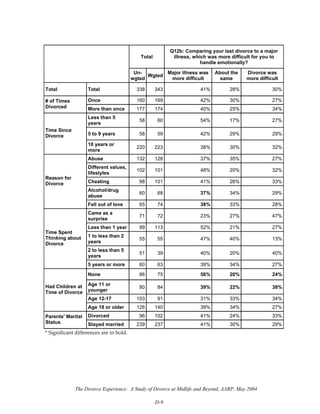
  Emotionally, divorce is generally worse than losing a job, about equal to 
experiencing a major illness, and somewhat less devastating than the death of a 
spouse.   Children may have been mostly sad but not necessarily devastated.  
Hardships and fears follow.  Yet most, especially women, have no regrets.  An 
uncertain future leads the difficulties that both men and women dealt with at the 
time of their divorce.  Being alone was the greatest fear among both sexes at that 
time.  Women report being terrified about becoming financially destitute.  Men were 
fearful about not seeing their children. 
 
Children and Divorce 
 
  At the time of their divorce, 76 percent had children, the majority of whom 
were under age 18.  More than a third (36%) of all divorcees had adult children while 
more than half (57%) had dependent children under 18 years old at the time they 
divorced.  Some of them had both adult children and children under age 18 at the 
same time. 
 
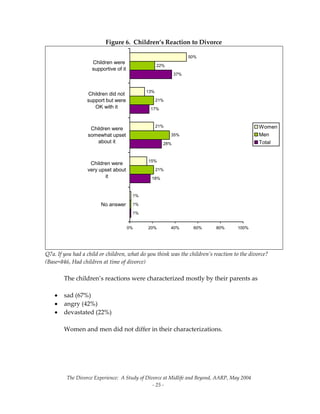
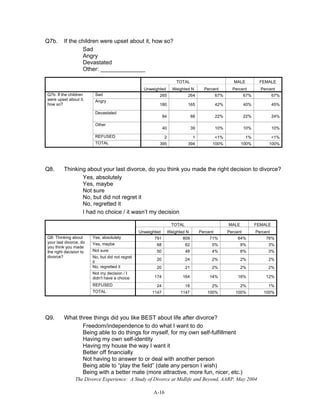
  Divorcees’ assessments of their children’s reactions to their divorce were 
almost evenly split: neutral or positive for some, and negative for others.  While 
slightly less than half say their children had a negative reaction (46%), more than a 
third who had children say that their children were supportive of their divorce (37%) 
and another 17 percent say that their children were “OK” with the divorce although 
they did not necessarily support it.  Those whose children had a negative reaction 
say that their children were somewhat upset (28%) or very upset (18%) about the 
divorce.  
 
  Women’s reports of their children’s reactions differ from those of men.  
Whereas women are more than twice as likely to say that their children were 
supportive of the divorce (50% versus 22% men), men are more likely to say that 
children did not support it but were OK with it (21% men versus 13% women), and 
also to say that children were either somewhat or very upset about it (56% men 
versus 36% women).   
The Divorce Experience:  A Study of Divorce at Midlife and Beyond, AARP, May 2004 
  ‐ 25 ‐ 
Figure 6.  Children’s Reaction to Divorce 
1%
18%
28%
17%
37%
1%
21%
35%
21%
22%
1%
15%
21%
13%
50%
0% 20% 40% 60% 80% 100%
No answer
Children were
very upset about
it
Children were
somewhat upset
about it
Children did not
support but were
OK with it
Children were
supportive of it
Women
Men
Total
Q7a. If you had a child or children, what do you think was the children’s reaction to the divorce? 
(Base=846, Had children at time of divorce)
 
  The children’s reactions were characterized mostly by their parents as  
 
• sad (67%) 
• angry (42%) 
• devastated (22%) 
 
  Women and men did not differ in their characterizations. 
 
 
The Divorce Experience:  A Study of Divorce at Midlife and Beyond, AARP, May 2004 
  ‐ 26 ‐ 
Divorce and Midlife Events 
 
  Many losses occur at midlife, and divorce can compound these losses. A 
divorce may not be quite as devastating as the death of a spouse or a major illness, 
but it is worse than the loss of a job.  More women than men recall that their divorce 
was more emotionally difficult to handle than the death of a spouse or a major 
illness.  
 
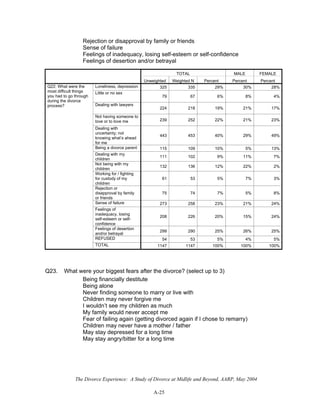
  Not knowing what’s ahead is the most difficult part of divorce, especially for 
women, followed by loneliness or depression.  Women also fear for their finances, 
while men suffer more from the loss of their children. 
 
Midlife Events Experienced 
 
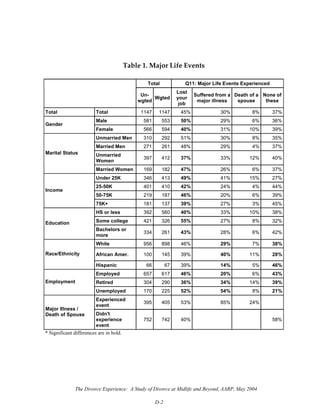
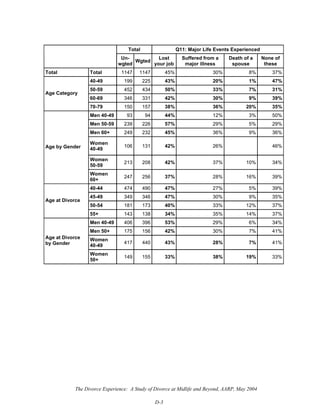
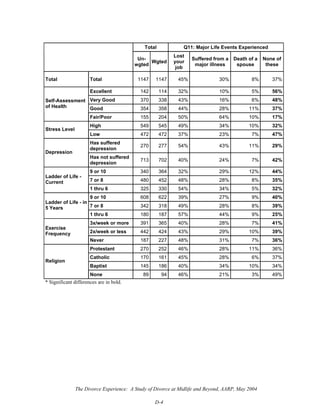
  In addition to divorce, almost half of the divorcees (45%) had also at some 
time experienced the loss of a job, while 30 percent had suffered a major illness, and 8 
percent had lost a spouse. 
 
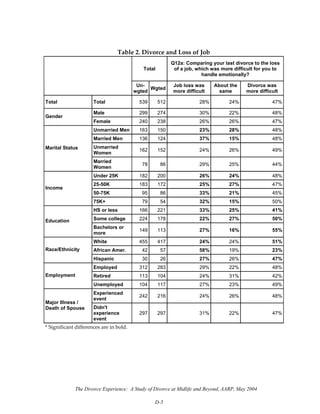
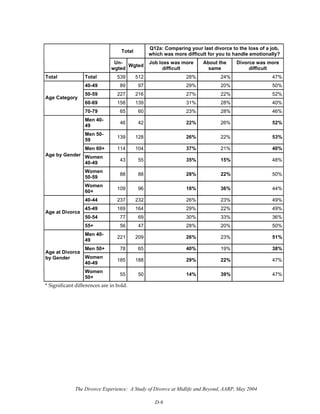
  Among those who experienced job loss, almost half say that divorce was more 
difficult (47%) while 28 percent say that job loss was more difficult.  There are no 
differences between men and women.  Older men, however, had more difficulty with 
job loss.  Men older than 60 are almost evenly split in saying job loss was more 
difficult (37%) and saying divorce was more difficult (40%), while the remainder say 
it was the same. 
 
  African Americans tend to have more difficulty with job loss than whites (58% 
versus 24% among whites).  As shown in Table 1 (page D‐2 in Appendix), there may 
be other differences, but the small bases preclude other conclusions. 
 
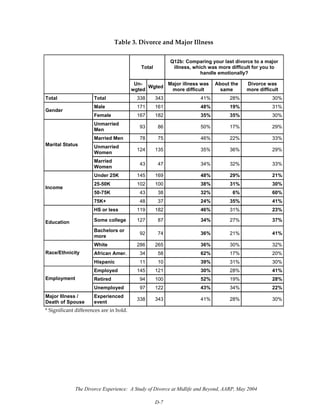
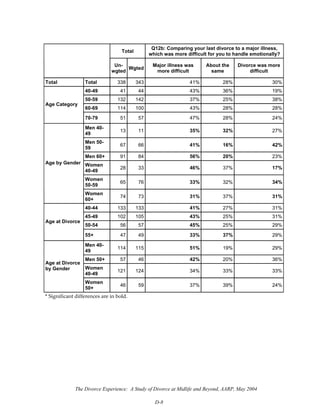
Among those who suffered a major illness, 30 percent say divorce was more 
difficult to handle emotionally, and 28 percent say it was the same, while 41 percent 
consider major illness more difficult.  More men than women had a tougher time 
with a major illness than divorce (48% versus 35%), while women are more likely to 
say that both events were about the same (35% of women versus 19% of men). See 
Table 2 (page D‐5 in Appendix). 
The Divorce Experience:  A Study of Divorce at Midlife and Beyond, AARP, May 2004 
  ‐ 27 ‐ 
 
  Among those who lost a spouse, 18 percent say that divorce was emotionally 
more difficult, while 65 percent say that a spouse’s death was more difficult.  Among 
women, 70 percent had more difficulty with spousal death and 23 percent had more 
difficulty with divorce, while among men 58 percent had more difficulty with 
spousal death and only 11 percent had more difficulty with divorce.  However, 
almost a third of men (32%) think both were equally difficult. 
 
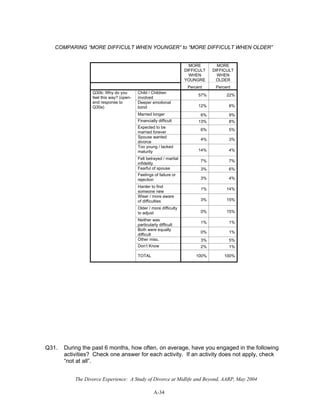
Divorce at a Younger Age versus Later in Life 
 
  Forty percent of divorcees who also experienced this life‐altering experience in 
their 20s or 30s say that divorce was much more difficult when they were younger, 
while 23 percent say that their later divorce was much more difficult.  This trend is 
true for men and women.   
   
  The angst that comes from concern for their children is the major reason for 
the greater emotional toll of divorce, whether in their 20s and 30s or in later life.  The 
majority, 57 percent, of those who say divorce was more difficult when they were 
younger wrote in response to an open ended question that their child or children is 
the reason they feel that was more difficult than their later life divorce.  In this 
concern women overshadowed men (65% versus 48%) although it is the top reason 
for both groups.  Some of their write‐in responses show what they went through: 
 
“My daughter was only 1 ½ years old, and I was extremely worried 
about her growing up without her father.” 
 
“It was hard raising four children by myself both financially and 
being the kind of parent my children needed and deserved.” 
 
“I had three children with my first husband and worried if I would 
be able to take care of them and not having their father around to 
do things with them.  It was hard on them because they did not 
understand why we had to get a divorce.” 
   
  Those who say divorce was more difficult in later life also mention their 
children as a reason more often than other reasons but to a lesser degree (22%) than 
those who find their previous divorce more difficult.  Fifteen percent say that with 
their later divorce they were “wiser” and more aware of difficulties.  Yet the same 
The Divorce Experience:  A Study of Divorce at Midlife and Beyond, AARP, May 2004 
  ‐ 28 ‐ 
percentage (15%) also say that their age made it more difficult to adjust and 14 
percent say that it is “harder to find someone new.”   
   
  “There is more pressure on a person when older; younger have more 
ways to cope… and better chance of remarrying and finding a new 
companion.” 
 
  “I had been married a few years then divorced, as opposed to the 26 
year marriage.” 
 
  “Felt betrayed by first husband.  Had kids to think about during the 
second divorce.  Upheaval and difficulties about equal but different.” 
 
“To tell the truth, when I was younger it did not bother me at all.” 
 
“Was better able to handle stress when younger.” 
 
“With age, wisdom should be foremost…and the second time 
around…nobody is prepared for failure or betrayal…I wasn’t!” 
 
“…older and set in my ways.  When you are older you have more 
baggage, harder to meet decent people who are not drunks, 
druggies, sluts, or just plain out mean.” 
 
“Neither is easy – when my first marriage ended I was okay, except 
for worrying about my children (which is huge).  When my second 
husband left me I thought that my life had ended.” 
 
“My first marriage was for convenience…my second was for 
love.…” 
 
  While the comparison between divorcing at a younger age and divorcing later 
in life was not posed to those who divorced only once, the fact that they were in 
long‐term marriages with no previous divorce experience may make their divorces a 
more life‐wrenching experience than divorces are for those who experienced one 
before. 
 
The Divorce Experience:  A Study of Divorce at Midlife and Beyond, AARP, May 2004 
  ‐ 29 ‐ 
Difficulties in Divorce 
 
  Along with the emotional turmoil that comes with divorce, there are other 
difficulties that people had to go through during the divorce process.  Foremost 
among these is dealing with uncertainty or not knowing what’s ahead, cited by 40 
percent, and more by women than men (49% women versus 29% men).  Dealing with 
lawyers seems to be an unwarranted burden for almost a fifth of divorcees.  Other 
difficulties include:  
 
• loneliness or depression (29%) 
• feelings of desertion or betrayal (25%) 
• sense of failure (23%) 
• not having someone to love or to love me (22%) 
• feelings of inadequacy, losing self‐esteem or self confidence (20%) 
• dealing with lawyers (19%) 
 
  Only 12 percent say that “not being with my children” was difficult, but many 
men missed their children, with 29 percent of those with children (22% of the total) 
saying that not being with their children was one of the most difficult things they 
endured.  With more women likely to get custody of their children or having more 
contact even among adult children, very few women (2%) say they had a difficult 
time not being with their children.   
 
Biggest Fears after Divorce 
 
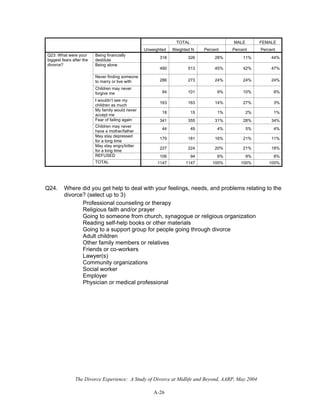
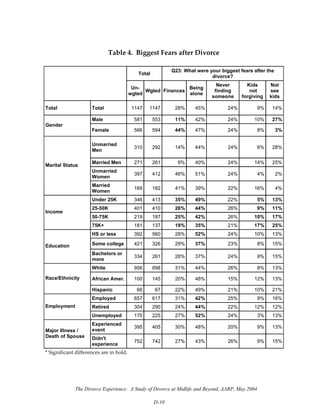
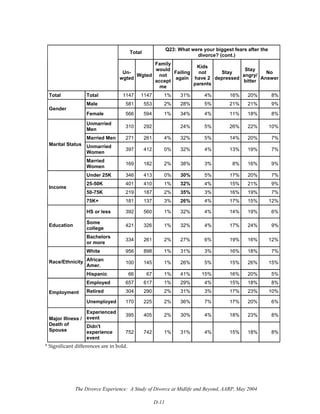
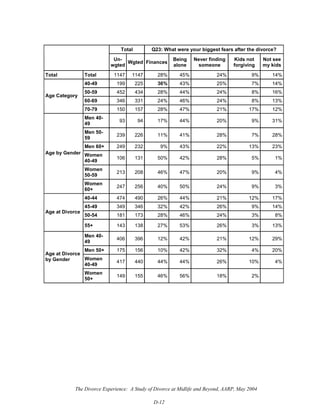
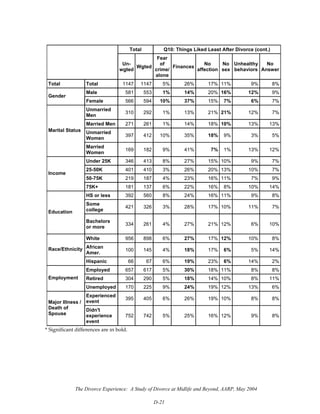
  Being alone is the biggest fear after divorce, named by almost half (45%), and 
almost equally mentioned as the topmost fear by men and women (42% and 47%).  
Their other fears at the time were: 
 
• failing again (31%) 
• being financially destitute (28%) 
• never finding someone to marry or live with (24%) 
• that they may stay angry/bitter for a long time (20%) 
• that they may stay depressed for a long time (16%) 
• that they wouldn’t see their children as much (14%) 
 
  Children and economics separate men and women.  Women are four times 
more apt to be afraid of being financially destitute (44% women versus 11% men), 
while men are many times more likely to be very fearful about not seeing as much of 
The Divorce Experience:  A Study of Divorce at Midlife and Beyond, AARP, May 2004 
  ‐ 30 ‐ 
their children (27% men versus 3% women).  Finances also drive some of the fear and 
are associated with income and being in their forties.  Those who have a bleaker 
future outlook than others fear failing again. 
 
Sources of Help 
 
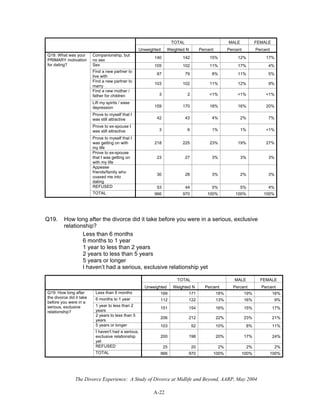
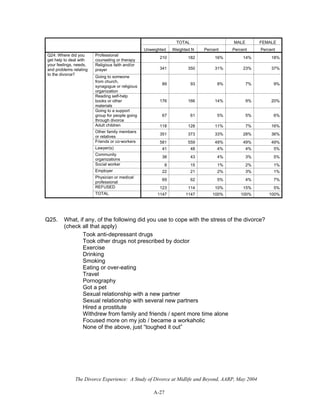
  To deal with the feelings, needs, and problems from their divorce, about half 
of divorcees (49%) frequently called upon friends and co‐workers.  A distant second  
source of help was family and relatives (33%), followed by religious faith and/or 
prayer (31%).  Although some sought professional counseling or therapy (16%), very 
few mention any group of professionals.  Only five percent used a support group.  
 
  There are no differences by gender, but the youngest divorcees are more apt 
than their older counterparts to get support from their friends and co‐workers (57% 
among 40‐ to 49‐year‐olds and 37% among 70‐ to 79‐year‐olds). 
The Divorce Experience:  A Study of Divorce at Midlife and Beyond, AARP, May 2004 
  ‐ 31 ‐ 
   
V. Life after Divorce 
 
  Freedom, self‐identity, and fulfillment are the buzzwords of a better life after 
divorce.  Being alone is the damper, but the experience shows divorcees’ resiliency.  
The majority stand on the upper rungs of the ladder of life, and look forward to 
climbing even higher. 
 
  While women appreciate their new‐found self‐identity, freedom, and 
independence, their finances pose hurdles after divorce.  Men also like their freedom 
and being able to do what they want and not having to answer to or deal with 
another person; however they are more than twice as likely to say that they like being 
with a better mate.  Although only one in ten men say it, they mention having more 
sex or different sexual experiences five times more than women as something they 
like best after divorce.  They also tend to be better off financially.  
 
  On the whole, life is good after divorce.  The majority feel they are on the top 
of the ladder of life, despite stresses that plague them to the same extent as the 
population in general, and bouts of depression among some.   In fact, the vast 
majority feel that they made the right decision in getting the divorce.  This is true 
among women regardless of whether they remarried or remained single.  Among 
men, those who remarried are more apt to say that they made the right decision.
 
Life after Divorce ‐ What’s Best 
 
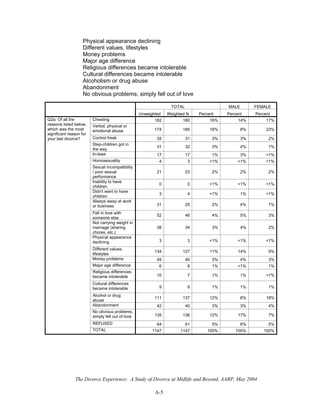
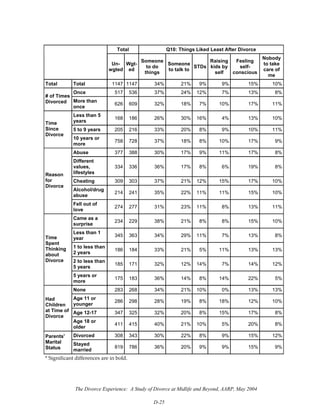
  The following were mentioned as one of the top three things people like about 
life after divorce: 
• Freedom/independence to do what I want to do (41%) 
• Having my own self‐identity (36%) 
• Being able to do things for myself, for my own self‐fulfillment (35%) 
• Not having to answer to or deal with another person (31%) 
• Better off financially (22%) 
• Being with a better mate (18%) 
• Having my house the way I want it (15%)  
• Not having to be responsible for or take care of someone (14%) 
 
  Women are more likely than men to appreciate having their own self‐identity, 
their new‐found freedom (also true for unmarried men), and not having to deal with 
another person (also true for unmarried men and women). 
The Divorce Experience:  A Study of Divorce at Midlife and Beyond, AARP, May 2004 
  ‐ 32 ‐ 
 
  Men are more apt to appreciate their better finances and having a better mate.   
More men ages 40 to 49, compared to men in other age groups, like being better off 
financially.   
 
  Whites are more likely than African Americans to appreciate their freedom 
and not having to deal with another person, while African Americans are more apt to 
appreciate having their homes the way they want them.   
 
  Larger incomes generally come with a better mate, while women age 60 and 
older appreciate most having their own self‐identity.  Those with no religious 
affiliation are more likely to appreciate their freedom and not having to deal with 
another person than are Protestants, Catholics, or Baptists. 
 
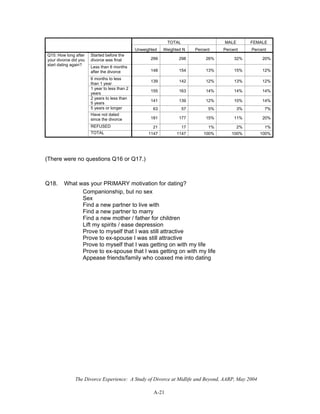
What’s Not Great 
 
  The following are the things people like least about life after divorce: 
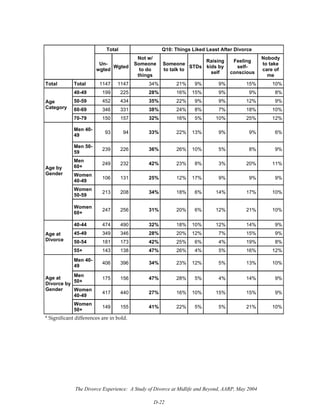
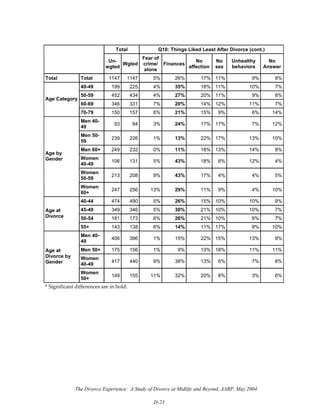
• not having someone around to do things with (34%) 
• financial problems/not having enough money (26%) 
• not having someone around to talk to (21%) 
 
  For women, an added concern is finances.   A small minority of men mention 
disliking not being in a sexual relationship (16%) and the tendency to do unhealthy 
things (12%).  Two or more times the percentage of men compared to women are 
concerned about missing a sexual relationship and doing unhealthy things (16% and 
12% of men versus 7% and 6% of women, respectively). 
The Divorce Experience:  A Study of Divorce at Midlife and Beyond, AARP, May 2004 
  ‐ 33 ‐ 
Well‐Being 
 
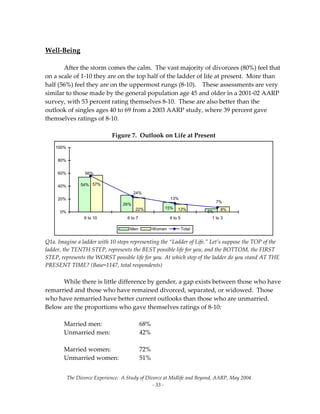
  After the storm comes the calm.  The vast majority of divorcees (80%) feel that 
on a scale of 1‐10 they are on the top half of the ladder of life at present.  More than 
half (56%) feel they are on the uppermost rungs (8‐10).    These assessments are very 
similar to those made by the general population age 45 and older in a 2001‐02 AARP 
survey, with 53 percent rating themselves 8‐10.  These are also better than the 
outlook of singles ages 40 to 69 from a 2003 AARP study, where 39 percent gave 
themselves ratings of 8‐10. 
   
Figure 7.  Outlook on Life at Present 
15%
26%
5%
54%
12% 8%
57%
22%
56%
13%
7%
24%
0%
20%
40%
60%
80%
100%
8 to 10 6 to 7 4 to 5 1 to 3
Men Women Total
 
Q1a. Imagine a ladder with 10 steps representing the “Ladder of Life.” Let’s suppose the TOP of the 
ladder, the TENTH STEP, represents the BEST possible life for you, and the BOTTOM, the FIRST 
STEP, represents the WORST possible life for you. At which step of the ladder do you stand AT THE 
PRESENT TIME? (Base=1147, total respondents) 
 
  While there is little difference by gender, a gap exists between those who have 
remarried and those who have remained divorced, separated, or widowed.  Those 
who have remarried have better current outlooks than those who are unmarried.   
Below are the proportions who gave themselves ratings of 8‐10: 
 
  Married men:    68% 
  Unmarried men:    42% 
 
  Married women:    72% 
  Unmarried women:   51% 
 
The Divorce Experience:  A Study of Divorce at Midlife and Beyond, AARP, May 2004 
  ‐ 34 ‐ 
Unmarried women are somewhat more likely to rate themselves higher than 
unmarried men.   
 
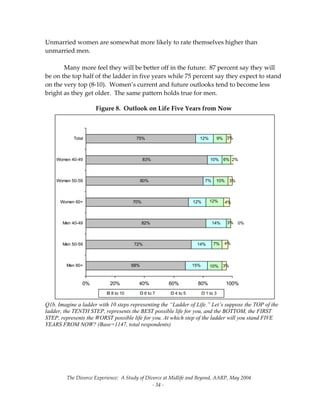
  Many more feel they will be better off in the future:  87 percent say they will 
be on the top half of the ladder in five years while 75 percent say they expect to stand 
on the very top (8‐10).  Women’s current and future outlooks tend to become less 
bright as they get older.  The same pattern holds true for men.  
Figure 8. Outlook on Life Five Years from Now
Q1b. Imagine a ladder with 10 steps representing the “Ladder of Life.” Let’s suppose the TOP of the
ladder, the TENTH STEP, represents the BEST possible life for you, and the BOTTOM, the FIRST
STEP, represents the WORST possible life for you. At which step of the ladder will you stand FIVE
YEARS FROM NOW? (Base=1147, total respondents) 
68%
72%
82%
70%
80%
83%
75%
15%
14%
14%
12%
7%
10%
12%
10%
6%
9%
3%
7%
12%
10%
3%
2%
3%
0%
4%
3%
4%
0% 20% 40% 60% 80% 100%
Men 60+
Men 50-59
Men 40-49
Women 60+
Women 50-59
Women 40-49
Total
8 to 10 6 to 7 4 to 5 1 to 3
The Divorce Experience:  A Study of Divorce at Midlife and Beyond, AARP, May 2004 
  ‐ 35 ‐ 
 
Perceived State of Health   
 
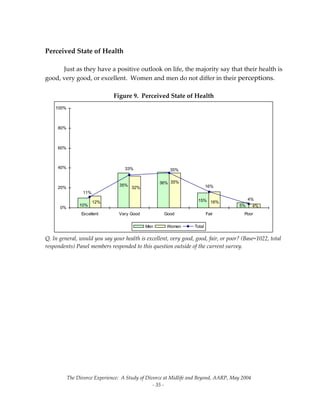
  Just as they have a positive outlook on life, the majority say that their health is 
good, very good, or excellent.  Women and men do not differ in their perceptions. 
 
Figure 9.  Perceived State of Health  
5%
36%
35%
15%
10% 4%
35%
16%12%
32%
4%
11%
35%
16%
33%
0%
20%
40%
60%
80%
100%
Excellent Very Good Good Fair Poor
Men Women Total
 
Q. In general, would you say your health is excellent, very good, good, fair, or poor? (Base=1022, total 
respondents) Panel members responded to this question outside of the current survey. 


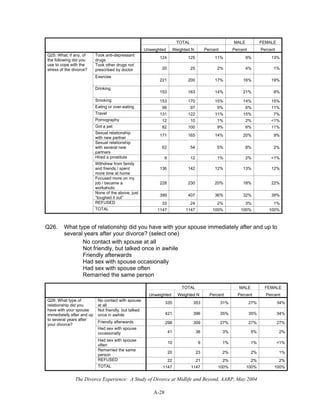
The Divorce Experience:  A Study of Divorce at Midlife and Beyond, AARP, May 2004 
  ‐ 36 ‐ 
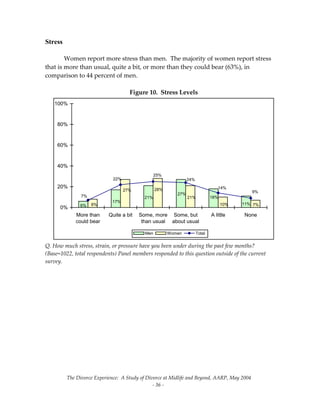
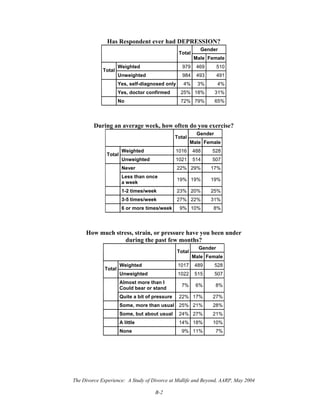
Stress
   
  Women report more stress than men.  The majority of women report stress 
that is more than usual, quite a bit, or more than they could bear (63%), in 
comparison to 44 percent of men.   
 
Figure 10.  Stress Levels 
6%
27%
17%
21% 18%
11%
27%
8%
21%
28%
10% 7%
22% 24%
25%
7%
14%
9%
0%
20%
40%
60%
80%
100%
More than
could bear
Quite a bit Some, more
than usual
Some, but
about usual
A little None
Men Women Total
 
Q. How much stress, strain, or pressure have you been under during the past few months? 
(Base=1022, total respondents) Panel members responded to this question outside of the current 
survey. 
The Divorce Experience:  A Study of Divorce at Midlife and Beyond, AARP, May 2004 
  ‐ 37 ‐ 
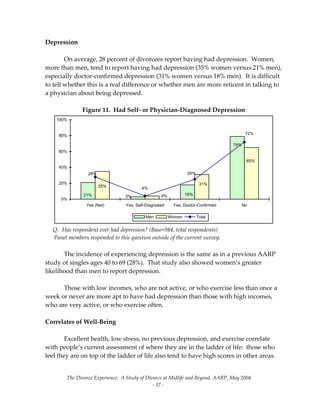
Depression 
 
  On average, 28 percent of divorcees report having had depression.  Women, 
more than men, tend to report having had depression (35% women versus 21% men), 
especially doctor‐confirmed depression (31% women versus 18% men).  It is difficult 
to tell whether this is a real difference or whether men are more reticent in talking to 
a physician about being depressed.   
 
Figure 11.  Had Self‐ or Physician‐Diagnosed Depression 
18%3%
79%
21%
31%
65%
35%
4%
28% 25%
72%
4%
0%
20%
40%
60%
80%
100%
Yes (Net) Yes, Self-Diagnosed Yes, Doctor-Confirmed No
Men Women Total
 
Q. Has respondent ever had depression? (Base=984, total respondents) 
 Panel members responded to this question outside of the current survey.  
 
  The incidence of experiencing depression is the same as in a previous AARP 
study of singles ages 40 to 69 (28%).  That study also showed women’s greater 
likelihood than men to report depression. 
  
  Those with low incomes, who are not active, or who exercise less than once a 
week or never are more apt to have had depression than those with high incomes, 
who are very active, or who exercise often. 
 
Correlates of Well‐Being 
 
  Excellent health, low stress, no previous depression, and exercise correlate 
with people’s current assessment of where they are in the ladder of life:  those who 
feel they are on top of the ladder of life also tend to have high scores in other areas. 
  
The Divorce Experience:  A Study of Divorce at Midlife and Beyond, AARP, May 2004 
  ‐ 38 ‐ 
  Religion appears to play a key role in perceptions of well‐being.  A greater 
proportion of Baptists (42%) say they are on the top two rungs of the ladder of life (9‐
10 on a scale of 1‐10), compared to 31 percent of Catholics and 31 percent of 
Protestants.  Those who report no religious affiliation are less likely to say they are 
on top of the ladder of life (16% on 9‐10), while about half of them are in the rungs 
just below (53% putting themselves at 7‐8).  Similar trends appear in relation to 
future outlook.  
 
 
Confidence in Decision to Divorce 
 
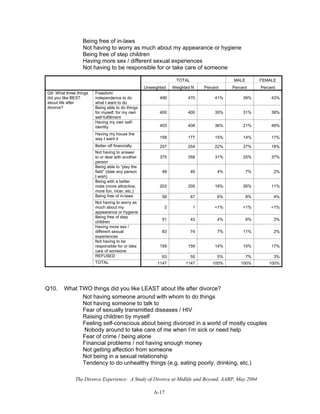
  Three in four (76%) feel that they made the right decision to divorce, with 71 
percent saying that they are absolutely sure.  However, more women are confident of 
their decision than men (76% versus 64% men).  Women are similarly sure of their 
decision regardless of whether they have remarried or remained single.  Men who 
have remarried or are living with a partner are more likely to be confident of their 
decision than men who are unmarried or separated (73 married/partnered men 
versus 57 percent of unmarried men).  
 
Remarriage 
 
  Remarriage occurred in almost a third of divorcees (32%).  In fact, the majority 
say that their current marriages are on solid ground (67%) and another 20 percent say 
their marriages are working pretty well.   However, those in their 50s, regardless of 
gender, are less likely to claim than those in their 40s or 60s that their marriages are 
on solid ground (57%). 
 
  Asked what they did differently in their subsequent remarriage, 42 percent 
report marrying someone with whom they have more in common, while about the 
same proportion (41%) say they married someone who “shares their values/beliefs.”   
 
  A fourth (26%) lived together before tying the knot, and the same percentage 
did the next closest thing, or “got to know the spouse longer.”    
 
   
The Divorce Experience:  A Study of Divorce at Midlife and Beyond, AARP, May 2004 
  ‐ 39 ‐ 
VI. SEXUALITY AMONG LATER LIFE DIVORCEES  
 
   
  Men and women got on with life by dating after divorce, with almost a third 
of men starting to date even before the divorce was final.  The majority of men 
remarried, but fewer women risked marriage again.  Those in their 40s, especially 
women, were more likely to date than those in their 50s or older. 
 
  From sexual touching or hugging to kissing, as well as intercourse, significant 
proportions of divorcees enjoy their sexuality.  The frequency of activity, however, 
diminishes from touching to intercourse.   Other forms of sexual activity such as self‐
stimulation or oral sex are not as common, and occur much less frequently if at all.   
 
  The occurrence and frequency of sexual activity is associated mostly with 
being married (or remarried), with the exception of self‐stimulation (which has a 
lower incidence), and anal sex (which is hardly done at all).  The majority of 
unmarried women do not have sexual intercourse at all. 
     
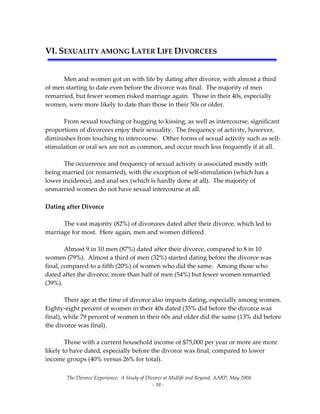
Dating after Divorce 
 
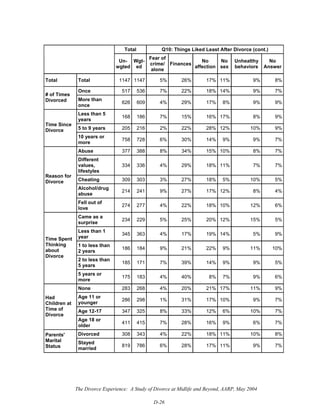
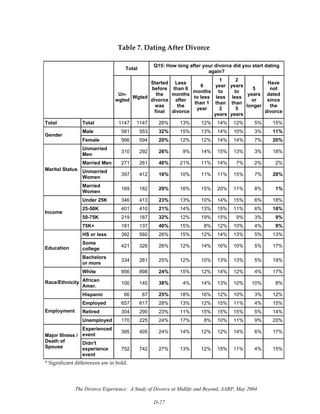
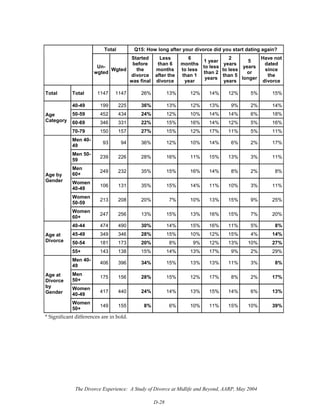
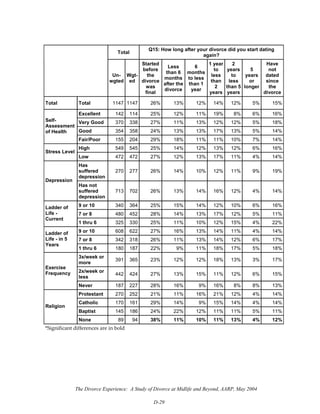
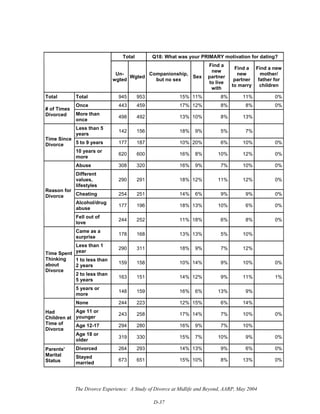
  The vast majority (82%) of divorcees dated after their divorce, which led to 
marriage for most.  Here again, men and women differed. 
  
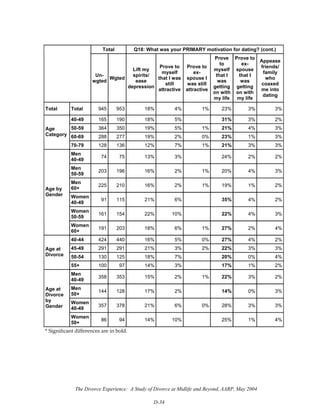
  Almost 9 in 10 men (87%) dated after their divorce, compared to 8 in 10 
women (79%).  Almost a third of men (32%) started dating before the divorce was 
final, compared to a fifth (20%) of women who did the same.  Among those who 
dated after the divorce, more than half of men (54%) but fewer women remarried 
(39%).     
 
  Their age at the time of divorce also impacts dating, especially among women.  
Eighty‐eight percent of women in their 40s dated (35% did before the divorce was 
final), while 79 percent of women in their 60s and older did the same (13% did before 
the divorce was final). 
 
  Those with a current household income of $75,000 per year or more are more 
likely to have dated, especially before the divorce was final, compared to lower 
income groups (40% versus 26% for total).   
 
The Divorce Experience:  A Study of Divorce at Midlife and Beyond, AARP, May 2004 
  ‐ 40 ‐ 
  African Americans are the most likely group to date (89% versus 82% of total), 
with many starting before the divorce was final (38% versus 26% of total). 
 
  Those with no religious affiliation are more apt to date than others before the 
divorce was final.  (See Table 7). 
    
  The proportion of those who have not dated since the divorce (15%) is not 
very different from the percentage who have not had a serious, exclusive relationship 
since the divorce (20%), suggesting that most of those who dated were successful in 
forging new relationships. 
 
 
 Why Date 
 
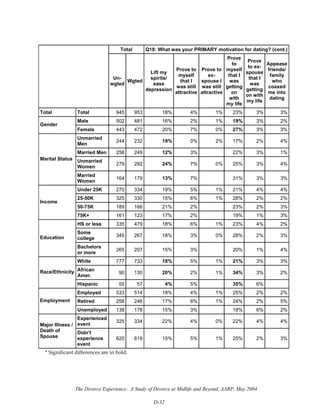
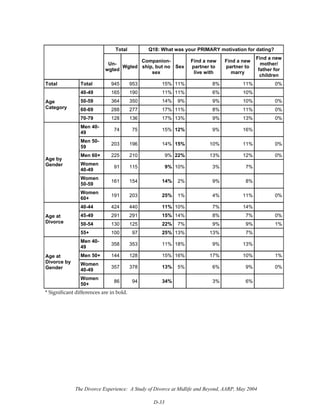
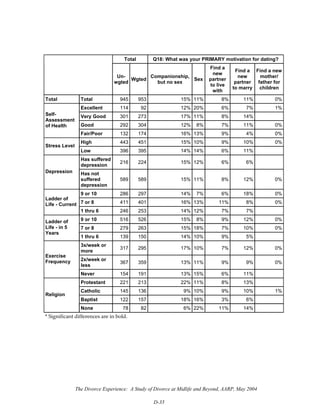
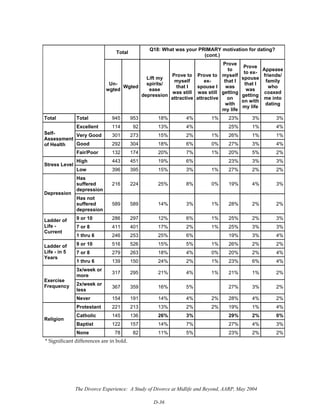
  Divorcees dated after their divorce primarily to prove something, especially 
proving to themselves that they are getting on with life.  Although generally this is 
the reason most often mentioned (23%), women are more likely to cite this reason 
than men (27% versus 19%); and African Americans and Hispanics (34% and 35%) 
are more apt to cite this reason than whites (21%).  This urge to prove themselves is 
also greater among those in their 40s (31%), especially among women in their 40s 
(35%).   
 
  Other related reasons, having to do with proving something are:  “proving to 
myself or ex‐ spouse that I was still attractive” (5%), and “proving to my ex‐spouse 
that I was getting on with my life” (3%). 
 
  Another reason for dating is to “lift my spirits/ease depression” (18%).   
Women and men differ little in this need.   
 
  The next group of reasons for dating revolves around companionship, 
marriage or cohabitation, and sex, as follows: 
• companionship, but no sex (15%) 
• sex (11%) 
• find a new partner to marry (11%) 
• find a new partner to live with (8%) 
 
  Men are several times more likely to mention sex than women (17% versus 
4%) and slightly more apt to mention finding a partner to live with (11% versus 5%). 
The Divorce Experience:  A Study of Divorce at Midlife and Beyond, AARP, May 2004 
  ‐ 41 ‐ 
Remarriage intentions are not the norm among older divorcees.  The majority 
either did not want to remarry (38%) or were reluctant (14%) to marry again.  
Marriage is more of a negative proposition among women than men (43% of women 
do not want to remarry versus 33% of men); especially among women who divorced 
in their 50s or older (43% versus 42% of women in their 40s).   
   
  Those who fear marriage blame their reluctance to remarry on “not wanting 
another bad marriage” (65%).  Other reasons include: 
 
• “too much work finding someone” (19%) 
•  “having too much fun” (16%) 
•  bitterness (14%) 
•  fear of failure (12%) 
•  lifestyle/work (12%)  
•  finances (10%) 
 
  Among those admitting to the lure of another marriage, their reasons relate to 
the desired characteristics of a mate, and stood out strongly over other possible 
reasons: 
 
• compatible personality (57%) 
• good character (57%) 
• good companion (54%) 
 
  Other reasons are to satisfy sexual needs (16%), “to take care of me” (11%), 
and more money (10%). 
 
Post‐Divorce Relationship with Ex‐Spouse 
  
  Divorcees may not have any contact with their ex‐spouses at all, true among 
almost a third (31%).  They may remarry the same person, but very rarely, as 
occurred among two percent.  A total of about one in twenty (6%) either remarry the 
same person (2%) or had sex with their spouse either occasionally (3%), or often (1%). 
 
  In addition, 27 percent were friendly afterwards while 35 percent were not 
friendly but talked once in a while.  There are no major differences by gender or 
other factors. 
 
The Divorce Experience:  A Study of Divorce at Midlife and Beyond, AARP, May 2004 
  ‐ 42 ‐ 
 
Sexual Activity 
The sexual activities of divorced men and women ages 40 to 79 commonly 
consist of sexual touching or  hugging, kissing, and sexual intercourse.  The majority 
(56%) report sexual touching or hugging in varying degrees of frequency (daily to 
once or twice a month), while 38 percent of the total claim not having any at all.  Six 
percent of the total did not respond to this question. 
 
  The majority of women, especially unmarried women (69%), do not touch or 
hug at all sexually. 
 
The Divorce Experience:  A Study of Divorce at Midlife and Beyond, AARP, May 2004 
  ‐ 43 ‐ 
Figure 12. Frequency of Sexual Touching or Hugging 
6%
38%
13%
8%
15%
20%
6%
39%
20%
13%
17%
5%
5%
69%
11%
4%
6%
4%
7%
7%
14%
6%
21%
45%
5%
10%
6%
9%
23%
47%
0% 20% 40% 60% 80% 100%
No answer
Not at all
Once or twice a month
About once a week
More than once a week
Daily
Women (Married/with partner)
Men (Married/with partner)
Women (Un-
Married/Separated/Widowed)
Men (Un-
Married/Separated/Widowed)
Total
Q31a‐f. During the past 6 months, how often, on average, have you engaged in [Sexual touching or 
hugging]? (Base=1147, total respondents)  
The Divorce Experience:  A Study of Divorce at Midlife and Beyond, AARP, May 2004 
  ‐ 44 ‐ 


  The majority report kissing (59%), and almost half report having sexual 
intercourse (47%) with some frequency. A large majority of unmarried women do not 
report kissing (67%) or sexual intercourse (77%).  
The Divorce Experience:  A Study of Divorce at Midlife and Beyond, AARP, May 2004 
  ‐ 45 ‐ 
Figure 13. Frequency of Kissing 
6%
35%
11%
5%
13%
30%
6%
39%
20%
5%
22%
8%
5%
67%
10%
5%
7%
6%
7%
2%
7%
3%
15%
67%
5%
3%
4%
8%
11%
69%
0% 20% 40% 60% 80% 100%
No answer
Not at all
Once or twice a month
About once a week
More than once a week
Daily
Women (Married/with partner)
Men (Married/with partner)
Women (Un-
Married/Separated/Widowed)
Men (Un-
Married/Separated/Widowed)
Total
Q31a‐f. During the past 6 months, how often, on average, have you engaged in [Kissing]? 
(Base=1147, total respondents) 
The Divorce Experience:  A Study of Divorce at Midlife and Beyond, AARP, May 2004 
  ‐ 46 ‐ 
Figure 14.  Frequency of Sexual Intercourse 
6%
46%
16%
15%
14%
2%
7%
49%
18%
13%
14%
0%
6%
77%
8%
2%
6%
1%
6%
16%
22%
29%
24%
4%
6%
17%
23%
25%
21%
8%
0% 20% 40% 60% 80% 100%
No answer
Not at all
Once or twice a month
About once a week
More than once a week
Daily
Women (Married/with partner)
Men (Married/with partner)
Women (Un-
Married/Separated/Widowed)
Men (Un-
Married/Separated/Widowed)
Total
Q31a‐f. During the past 6 months, how often, on average, have you engaged in [Sexual intercourse]? 
(Base=1147, Total respondents) 
The Divorce Experience:  A Study of Divorce at Midlife and Beyond, AARP, May 2004 
  ‐ 47 ‐ 
 
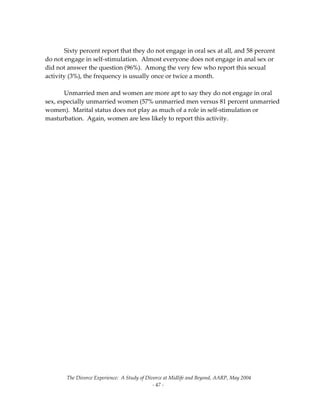
  Sixty percent report that they do not engage in oral sex at all, and 58 percent 
do not engage in self‐stimulation.  Almost everyone does not engage in anal sex or 
did not answer the question (96%).  Among the very few who report this sexual 
activity (3%), the frequency is usually once or twice a month.   
 
  Unmarried men and women are more apt to say they do not engage in oral 
sex, especially unmarried women (57% unmarried men versus 81 percent unmarried 
women).  Marital status does not play as much of a role in self‐stimulation or 
masturbation.  Again, women are less likely to report this activity. 
The Divorce Experience:  A Study of Divorce at Midlife and Beyond, AARP, May 2004 
  ‐ 48 ‐ 
Figure 15. Frequency of Oral Sex 
9%
60%
17%
8%
6%
2%
8%
57%
17%
10%
8%
0%
7%
81%
7%
2%
2%
1%
12%
41%
23%
14%
7%
3%
7%
42%
29%
8%
10%
4%
0% 20% 40% 60% 80% 100%
No answer
Not at all
Once or twice a month
About once a week
More than once a week
Daily
Women (Married/with partner)
Men (Married/with partner)
Women (Un-
Married/Separated/Widowed)
Men (Un-
Married/Separated/Widowed)
Total
Q31a‐f. During the past 6 months, how often, on average, have you engaged in [Oral sex]? 
(Base=1147, Total respondents) 
The Divorce Experience:  A Study of Divorce at Midlife and Beyond, AARP, May 2004 
  ‐ 49 ‐ 
Figure 16. Frequency of Self‐Stimulation/Masturbation 
10%
58%
19%
6%
6%
2%
11%
39%
22%
12%
13%
3%
7%
68%
18%
3%
3%
1%
13%
56%
17%
5%
6%
3%
7%
68%
18%
3%
4%
0%
0% 20% 40% 60% 80% 100%
No answer
Not at all
Once or twice a month
About once a week
More than once a week
Daily
Women (Married/with partner)
Men (Married/with partner)
Women (Un-
Married/Separated/Widowed)
Men (Un-
Married/Separated/Widowed)
Total
Q31a‐f. During the past 6 months, how often, on average, have you engaged in [Self‐
Stimulation/Masturbation]? (Base=1147, Total respondents)  
The Divorce Experience:  A Study of Divorce at Midlife and Beyond, AARP, May 2004 
  ‐ 50 ‐ 
Figure 17. Frequency of Anal Sex 
10%
86%
3%
0%
0%
0%
11%
83%
4%
1%
0%
0%
8%
90%
1%
0%
0%
1%
14%
83%
3%
0%
0%
0%
9%
85%
5%
1%
0%
0%
0% 20% 40% 60% 80% 100%
No answer
Not at all
Once or twice a month
About once a week
More than once a week
Daily
Women (Married/with partner)
Men (Married/with partner)
Women (Un-
Married/Separated/Widowed)
Men (Un-
Married/Separated/Widowed)
Total
Q31a‐f. During the past 6 months, how often, on average, have you engaged in [Anal sex]? 
(Base=1147, Total respondents)  
The Divorce Experience:  A Study of Divorce at Midlife and Beyond, AARP, May 2004 
  ‐ 51 ‐ 
VII.  Demographic Groups 
 
  People’s divorce experience could vary depending on their characteristics and 
attitudes.  The characteristics that are most strongly associated with divorce 
experience are gender, age, race or ethnicity, and religion. 
 
Gender Differences 
 
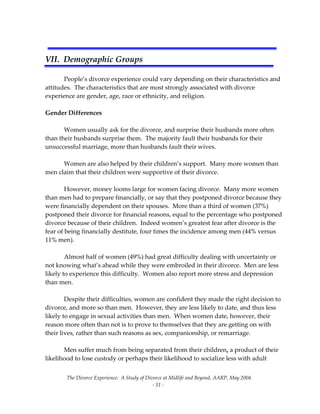
  Women usually ask for the divorce, and surprise their husbands more often 
than their husbands surprise them.  The majority fault their husbands for their 
unsuccessful marriage, more than husbands fault their wives. 
 
  Women are also helped by their children’s support.  Many more women than 
men claim that their children were supportive of their divorce. 
 
  However, money looms large for women facing divorce.  Many more women 
than men had to prepare financially, or say that they postponed divorce because they 
were financially dependent on their spouses.  More than a third of women (37%) 
postponed their divorce for financial reasons, equal to the percentage who postponed 
divorce because of their children.  Indeed women’s greatest fear after divorce is the 
fear of being financially destitute, four times the incidence among men (44% versus 
11% men). 
 
  Almost half of women (49%) had great difficulty dealing with uncertainty or 
not knowing what’s ahead while they were embroiled in their divorce.  Men are less 
likely to experience this difficulty.  Women also report more stress and depression 
than men.     
 
  Despite their difficulties, women are confident they made the right decision to 
divorce, and more so than men.  However, they are less likely to date, and thus less 
likely to engage in sexual activities than men.  When women date, however, their 
reason more often than not is to prove to themselves that they are getting on with 
their lives, rather than such reasons as sex, companionship, or remarriage. 
 
  Men suffer much from being separated from their children, a product of their 
likelihood to lose custody or perhaps their likelihood to socialize less with adult 
The Divorce Experience:  A Study of Divorce at Midlife and Beyond, AARP, May 2004 
  ‐ 52 ‐ 
children.  This is the major divorce deterrent for men.  In fact more men than women 
feel that their children were not supportive of their divorce. 
 
Differences by Age 
 
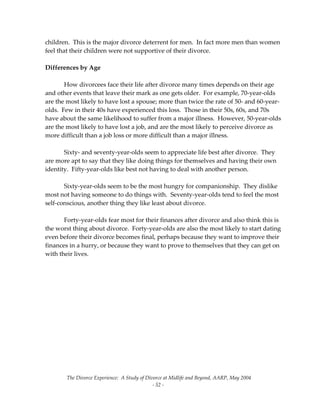
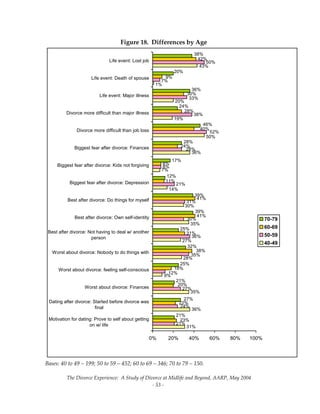
  How divorcees face their life after divorce many times depends on their age 
and other events that leave their mark as one gets older.  For example, 70‐year‐olds 
are the most likely to have lost a spouse; more than twice the rate of 50‐ and 60‐year‐
olds.  Few in their 40s have experienced this loss.  Those in their 50s, 60s, and 70s 
have about the same likelihood to suffer from a major illness.  However, 50‐year‐olds 
are the most likely to have lost a job, and are the most likely to perceive divorce as 
more difficult than a job loss or more difficult than a major illness.   
 
  Sixty‐ and seventy‐year‐olds seem to appreciate life best after divorce.  They 
are more apt to say that they like doing things for themselves and having their own 
identity.  Fifty‐year‐olds like best not having to deal with another person.   
 
  Sixty‐year‐olds seem to be the most hungry for companionship.  They dislike 
most not having someone to do things with.  Seventy‐year‐olds tend to feel the most 
self‐conscious, another thing they like least about divorce. 
 
  Forty‐year‐olds fear most for their finances after divorce and also think this is 
the worst thing about divorce.  Forty‐year‐olds are also the most likely to start dating 
even before their divorce becomes final, perhaps because they want to improve their 
finances in a hurry, or because they want to prove to themselves that they can get on 
with their lives. 
 
 
The Divorce Experience:  A Study of Divorce at Midlife and Beyond, AARP, May 2004 
  ‐ 53 ‐ 
Figure 18.  Differences by Age 
31%
36%
35%
7%
36%
21%
27%
36%
31%
21%
8%
38%
50%
31%
41%
41%
11%
8%
42%
39%
17%
9%
28%
27%
35%
30%
14%
50%
19%
20%
1%
43%
24%
12%
35%
30%
28%
52%
33%
7%
23%
22%
20%
18%
38%
24%
40%
28%
30%
9%
21%
27%
21%
25%
32%
25%
39%
12%
28%
46%
24%
36%
20%
38%
0% 20% 40% 60% 80% 100%
Motivation for dating: Prove to self about getting
on w/ life
Dating after divorce: Started before divorce was
final
Worst about divorce: Finances
Worst about divorce: feeling self-conscious
Worst about divorce: Nobody to do things with
Best after divorce: Not having to deal w/ another
person
Best after divorce: Own self-identity
Best after divorce: Do things for myself
Biggest fear after divorce: Depression
Biggest fear after divorce: Kids not forgiving
Biggest fear after divorce: Finances
Divorce more difficult than job loss
Divorce more difficult than major illness
Life event: Major illness
Life event: Death of spouse
Life event: Lost job
70-79
60-69
50-59
40-49
Bases: 40 to 49 – 199; 50 to 59 – 452; 60 to 69 – 346; 70 to 79 – 150. 
The Divorce Experience:  A Study of Divorce at Midlife and Beyond, AARP, May 2004 
  ‐ 54 ‐ 
Race/Ethnicity and Divorce 
 
  Racial differences play a part in people’s experiences and their perceptions of 
their divorce.  African Americans are the most likely to have experienced a major 
illness, but their job loss experience is on par with others (frequency of job loss was 
not asked).  
 
  African Americans seem to suffer the least emotionally from a divorce.  
Conversely, they are more apt to perceive that job loss was a more difficult emotional 
experience than divorce.  (African Americans in this study are more likely to be 
unemployed: 26% versus 20% among whites.)   
 
  Major illness was a more difficult experience as well for a larger proportion of 
African Americans whose lives were marred by these life events.  In fact, a larger 
proportion of African Americans than whites in the study rated their health as fair or 
poor (30% versus 20% of whites). 
 
  African Americans are also more apt to appreciate having the house the way 
they want it as a plus.   More of them dated even before their divorce was final.  They 
are more apt than whites to say that they dated to prove to themselves that they 
could get on with life. 
  
  Because the Hispanic sample was small, we can make only a few conclusions 
about how different Hispanics are from other groups.  Hispanics are the least likely 
group to have major illnesses.  It seems Hispanics want a spouse’s companionship 
more than other groups:  they are the least likely group to say that not dealing with 
another person is one of the best things in life after divorce;  and conversely, much 
more apt to claim that having nobody to do things with is one of the worst things in 
life after divorce.   
 
  Whites are more fearful than African Americans of reduced finances after their 
divorce.  They are more likely to think that finding their own self‐identity is a plus.   
 
These differences between whites and African Americans may be linked to 
other factors.  The research literature shows that the rates of separation and divorce 
among African Americans are higher than among whites, and the rate of joblessness 
is higher among African American men than white men. 
The Divorce Experience:  A Study of Divorce at Midlife and Beyond, AARP, May 2004 
  ‐ 55 ‐ 
Figure 19.  Race/Ethnicity and Divorce 
21%
24%
27%
35%
5%
19%
33%
24%
13%
37%
26%
31%
31%
32%
36%
51%
24%
29%
34%
38%
18%
28%
12%
12%
26%
14%
31%
25%
15%
26%
20%
20%
62%
23%
58%
40%
35%
25%
19%
47%
3%
24%
12%
24%
18%
35%
21%
41%
22%
30%
39%
47%
27%
14%
0% 20% 40% 60% 80% 100%
Reason for dating: Prove to self about getting on
w/ life
Dating: Dated before divorce was final
Worse after divorce: Finances
Worse after divorce: Nobody to do things with
Best after divorce: No in-laws
Best after divorce: Better mate
Best after divorce: Not dealing with another
Best after divorce: Finances
Best after divorce: House the way I want it
Best after divorce: Own self-identity
Biggest fear after divorce: Not finding someone
Biggest fear after divorce: Failing again
Biggest fear about divorce: Finances
Divorce more difficult than major illness
Major illness more difficult than divorce
Divorce more difficult than job loss
Job loss more difficult than divorce
Life event: Major illness
Hispanic
African American
White
Bases: White – 956; African American – 100; Hispanic – 66. 
The Divorce Experience:  A Study of Divorce at Midlife and Beyond, AARP, May 2004 
  ‐ 56 ‐ 
 Religion and Divorce 
 
  Using their self‐reported religious affiliations, differences were analyzed 
among the largest groups.  Baptists comprised a large proportion of the population 
and were grouped separately from other Protestants. 
 
  Protestants, Catholics, Baptists, and those with no designated religious 
affiliation make up the majority of divorcees.  Other religious groups are represented 
in small numbers, so data pertaining to them were not analyzed. 
 
  Protestants are most likely to fear being alone after divorce, followed by 
Baptists. 
 
  Catholics are the most apt to like doing things for themselves as the best part 
of life after divorce, followed by Baptists.  They also are most likely to date to lift 
their spirits.   
 
  However, Baptists and those with no religious affiliation most often are on the 
ends of the spectrum.  Baptists seem to be the most religious.  They found the most 
comfort in their religious faith or prayer while they were embroiled in this life event, 
while very few with no religious affiliation found comfort in prayer.  Perhaps their 
religious faith gives Baptists a boost in their outlook on life as well.  They are the 
most likely to put themselves on the uppermost rungs of the ladder of life (much 
more than those with no religious affiliation), while the majority of Baptists put 
themselves on top as well in their future outlook.  They are the most likely to not 
want remarriage, surprisingly putting them on the same side on this issue as those 
who have no religious affiliation.   
 
  Those with no religious affiliation are the most likely to fear for their finances 
after divorce and the most likely to appreciate their freedom.  Baptists are the least 
likely to fear for their finances and to appreciate their freedom.  Those with no 
religious affiliation are also the least likely to appreciate being able to do things for 
themselves after divorce.   
 
  In their future outlook, Protestants, Catholics, and those with no religious 
affiliation do not differ; but Baptists have the best future outlook on the ladder of life.   
 
The Divorce Experience:  A Study of Divorce at Midlife and Beyond, AARP, May 2004 
  ‐ 57 ‐ 
  People with no religious affiliation went to friends and co‐workers most, 
while others resorted to this to a lesser degree.  Prayer or religious faith also served 
Baptists, Protestants, and Catholics in dealing with divorce. 
 
The Divorce Experience:  A Study of Divorce at Midlife and Beyond, AARP, May 2004 
  ‐ 58 ‐ 
Figure 20.  Religion and Divorce 
56%
29%
35%
48%
31%
13%
21%
36%
31%
45%
50%
25%
50%
27%
32%
47%
31%
26%
29%
34%
45%
43%
36%
32%
42%
42%
47%
65%
42%
14%
24%
25%
38%
34%
43%
22%
60%
9%
45%
45%
16%
11%
38%
42%
20%
52%
31%
37%
0% 20% 40% 60% 80% 100%
Source of help: Friends / co-workers
Source of help: Religions, faith, or
prayer
After divorce: Did not want to
remarry
Future outlook on life: 9-10
Current ladder of life: 9-10
Reason for dating: Lift spirits
Dating started before divorce was
final
Best after divorce: Not having to
deal w/ another
Best after divorce: Do things for self
Best after divorce: Freedom
Fears after divorce: Being alone
Fears after divorce: Finances
No Religion
Baptist
Catholic
Protestant
Bases: Protestant‐ 270; Catholic‐170; Baptist‐145. 
The Divorce Experience:  A Study of Divorce at Midlife and Beyond, AARP, May 2004 
  ‐ 59 ‐ 
  
  The differences by religious affiliation may be influenced or confounded by 
other characteristics associated with one’s religious affiliation.  For example, persons 
are more likely to affiliate with a religion as they get older.  The majority of African 
Americans are Baptists, while the majority of Hispanics are Catholics.  Among 
whites, the most frequently cited religion is Protestant.
The Divorce Experience:  A Study of Divorce at Midlife and Beyond, AARP, May 2004 
  ‐ 60 ‐ 


APPENDIX 
 
Annotated Questionnaire 
Additional Respondent Data 
Methodology and Technical Notes 
Statistical Tables
The Divorce Experience: A Study of Divorce at Midlife and Beyond, AARP, May 2004
A-1
Annotated Questionnaire 
The Divorce Experience: A Study of Divorce at Midlife and Beyond, AARP, May 2004
A-2
AARP Divorce Survey
December 2003
S1. Which of these best describes your current marital status?
Divorce, never married
Divorce, divorced
Divorce, widow/widower
Married
Married but separated
Living with partner (not married or registered partnership)
Living with registered domestic partner
[IF NEVER MARRIED, TERMINATE. IF DIVORCED, SKIP TO S3. OTHERWISE CONTINUE TO S2.]
TOTAL MALE FEMALE
Unweighted Weighted N Percent Percent Percent
Divorce, never
married
0 0 0% 0% 0%
Divorce, divorced 644 636 55% 48% 62%
Divorce,
widow/widower
51 57 5% 3% 6%
Married 350 350 31% 40% 22%
Married but
separated
12 11 1% 1% 1%
Living with partner
(not married or
registered
partnership)
86 86 8% 6% 9%
Living with
registered domestic
partner
4 6 1% 1% <1%
S1: Which of these
best describes your
current marital
status?
TOTAL 1147 1147 100% 100% 100%
S2. Have you ever been divorced?
Yes [PROCEED TO S3]
No [TERMINATE]
TOTAL MALE FEMALE
Unweighted Weighted N Percent Percent Percent
Yes 503 511 100% 100% 100%
No 0 0 0% 0% 0%
S2: Have you
ever been
divorced?
TOTAL 503 511 100% 100% 100%
The Divorce Experience: A Study of Divorce at Midlife and Beyond, AARP, May 2004
A-3
S3. Have you been divorced more than once?
No, just once
Yes, more than once
TOTAL MALE FEMALE
Unweighted Weighted N Percent Percent Percent
No, just once 626 609 53% 54% 52%
Yes, more than
once
517 536 47% 46% 47%
REFUSED 4 2 <1% <1% <1%
S3: Have you been
divorced more than
once?
TOTAL 1147 1147 100% 100% 100%
S4. At what age did you [“MOST RECENTLY” IF MORE THAN ONCE IN S3] get divorced?
________
[S4 RESPONSE MUST BE 40 OR GREATER TO CONTINUE.]
TOTAL MALE FEMALE
Unweighted Weighted N Percent Percent Percent
40 to 44 474 490 43% 41% 45%
45 to 49 349 346 30% 31% 29%
50 to 54 181 173 15% 14% 16%
55 to 59 92 85 7% 8% 7%
60 to 69 47 49 4% 5% 3%
70 to 79 4 4 <1% 1% <1%
S4: Age
at last
divorce -
categories
TOTAL 1147 1147 100% 100% 100%
[MAIN SURVEY BEGINS HERE]
Imagine a ladder with 10 steps representing the “ladder of life.” Let’s suppose the top
of the ladder, the TENTH STEP, represents the BEST possible life for you, and the
bottom, the FIRST step, represents the WORST possible life for you.
At which step of the ladder do you stand AT THE PRESENT TIME, and where do you
think you still stand FIVE YEARS FROM NOW? Click on the number that best
represents where you think you stand on the ladder.
Q1a. Present Time
10
9
8
7
6
5
4
3
2
1
Q1b. 5 years from now
10
9
8
7
6
5
4
3
2
1
The Divorce Experience: A Study of Divorce at Midlife and Beyond, AARP, May 2004
A-4
TOTAL MALE FEMALE
Unweighted Weighted N Percent Percent Percent
10 203 226 20% 22% 18%
9 137 137 12% 9% 14%
8 279 280 24% 23% 25%
7 201 172 15% 16% 14%
6 102 99 9% 10% 8%
5 116 116 10% 11% 10%
4 44 38 3% 4% 2%
3 37 44 4% 4% 4%
2 17 14 1% 1% 1%
1 9 19 2% <1% 3%
REFUSED 2 2 <1% <1% <1%
Q1a:
Ladder of
Life,
Present
Time
TOTAL 1147 1147 100% 100% 100%
TOTAL MALE FEMALE
Unweighte
d Weighted N Percent Percent Percent
10 350 375 33% 31% 35%
9 258 248 22% 22% 22%
8 238 229 20% 20% 20%
7 104 90 8% 10% 6%
6 54 48 4% 4% 4%
5 59 67 6% 6% 6%
4 30 32 3% 2% 4%
3 14 14 1% 1% 1%
2 10 8 1% 1% 1%
1 13 17 1% 1% 2%
REFUSED 17 20 2% 3% 1%
Q1b:
Ladder of
Life, 5
years
from now
TOTAL 1147 1147 100% 100% 100%
We are conducting a survey of people’s experience in getting a divorce. If you have been
divorced more than once, please answer all questions as they pertain to your most recent
divorce.
Q2a. Of all the reasons listed below, which was the most significant reason for your last
divorce? (Reason may apply to you or to your spouse)
Cheating
Verbal, physical or emotional abuse
Control freak
Step-children got in the way
In-laws
Homosexuality
Sexual incompatibility / poor sexual performance
Inability to have children
Didn’t want to have children
Always away at work or business
Fell in love with someone else
Not carrying weight in marriage (sharing chores, etc.)
The Divorce Experience: A Study of Divorce at Midlife and Beyond, AARP, May 2004
A-5
Physical appearance declining
Different values, lifestyles
Money problems
Major age difference
Religious differences became intolerable
Cultural differences became intolerable
Alcoholism or drug abuse
Abandonment
No obvious problems, simply fell out of love
TOTAL MALE FEMALE
Unweighted Weighted N Percent Percent Percent
Cheating 182 180 16% 14% 17%
Verbal, physical or
emotional abuse 174 185 16% 8% 23%
Control freak 35 31 3% 3% 2%
Step-children got in
the way
31 32 3% 4% 1%
In-laws 17 17 1% 3% <1%
Homosexuality 4 3 <1% <1% <1%
Sexual incompatibility
/ poor sexual
performance
21 23 2% 2% 2%
Inability to have
children
0 0 <1% <1% <1%
Didn't want to have
children
3 4 <1% 1% <1%
Always away at work
or business 31 25 2% 4% 1%
Fell in love with
someone else
52 46 4% 5% 3%
Not carrying weight in
marriage (sharing
chores, etc.)
38 34 3% 4% 2%
Physical appearance
declining 3 3 <1% <1% <1%
Different values,
lifestyles
134 127 11% 14% 9%
Money problems 45 40 3% 4% 3%
Major age difference 6 8 1% <1% 1%
Religious differences
became intolerable 10 7 1% 1% <1%
Cultural differences
became intolerable 9 9 1% 1% 1%
Alcohol or drug
abuse
111 137 12% 6% 18%
Abandonment 42 40 3% 3% 4%
No obvious problems,
simply fell out of love 135 136 12% 17% 7%
REFUSED 64 61 5% 6% 5%
Q2a: Of all the
reasons listed below,
which was the most
significant reason for
your last divorce?
TOTAL 1147 1147 100% 100% 100%
The Divorce Experience: A Study of Divorce at Midlife and Beyond, AARP, May 2004
A-6
Q2b. Of the remaining reasons, which was the next most significant reason for your
divorce?
[SAME LIST EXCEPT FOR FIRST REASON CHOSEN]
No other reason
[IF ‘NO OTHER REASON’, SKIP TO Q3]
TOTAL MALE FEMALE
Unweighted Weighted N Percent Percent Percent
Cheating 73 68 6% 5% 6%
Verbal, physical or
emotional abuse 135 127 11% 7% 14%
Control freak 65 87 8% 5% 10%
Step-children got in
the way
37 33 3% 4% 2%
In-laws 12 21 2% 3% 1%
Homosexuality 5 5 <1% 1% <1%
Sexual incompatibility
/ poor sexual
performance
30 24 2% 2% 2%
Inability to have
children
3 4 <1% <1% 1%
Didn't want to have
children
4 6 1% 1% <1%
Always away at work
or business 28 28 2% 2% 2%
Fell in love with
someone else
34 31 3% 3% 2%
Not carrying weight in
marriage (sharing
chores, etc.)
56 54 5% 2% 7%
Physical appearance
declining 10 9 1% 1% 1%
Different values,
lifestyles
99 102 9% 9% 9%
Money problems 62 59 5% 6% 5%
Major age difference 13 14 1% 1% 1%
Religious differences
became intolerable 13 14 1% <1% 2%
Cultural differences
became intolerable 11 10 1% 1% <1%
Alcohol or drug
abuse
65 61 5% 4% 7%
Abandonment 25 40 3% 3% 4%
No obvious problems,
simply fell out of love 84 82 7% 9% 5%
No other reason 79 68 6% 7% 5%
REFUSED 5 5 <1% <1% 1%
Not asked 199 196 17% 23% 12%
Q2b: Of the
remaining reasons,
which was the next
most significant
reason for your
divorce?
TOTAL 1147 1147 100% 100% 100%
The Divorce Experience: A Study of Divorce at Midlife and Beyond, AARP, May 2004
A-7
Q2c. And finally, what was the third most significant reason for your divorce?
[SAME LIST EXCEPT FOR FIRST TWO REASONS CHOSEN]
TOTAL MALE FEMALE
Unweighted Weighted N Percent Percent Percent
Cheating 54 56 5% 3% 7%
Verbal, physical or
emotional abuse 68 76 7% 6% 7%
Control freak 54 53 5% 2% 7%
Step-children got in
the way
16 16 1% 1% 1%
In-laws 14 15 1% 1% 1%
Homosexuality 1 1 <1% <1% <1%
Sexual incompatibility
/ poor sexual
performance
36 34 3% 3% 3%
Inability to have
children
1 1 <1% <1% <1%
Didn't want to have
children
3 4 <1% <1% <1%
Always away at work
or business 39 42 4% 4% 3%
Fell in love with
someone else
29 33 3% 2% 3%
Not carrying weight in
marriage (sharing
chores, etc.)
60 69 6% 4% 8%
Physical appearance
declining 11 7 1% 1% 1%
Different values,
lifestyles
101 107 9% 7% 11%
Money problems 71 56 5% 4% 5%
Major age difference 13 12 1% 1% 1%
Religious differences
became intolerable 9 9 1% 1% 1%
Cultural differences
became intolerable 8 9 1% 1% <1%
Alcohol or drug
abuse
38 43 4% 4% 3%
Abandonment 29 32 3% 2% 4%
No obvious problems,
simply fell out of love 55 59 5% 6% 5%
No other reason 148 139 12% 13% 11%
REFUSED 6 6 1% 1% <1%
Not asked 283 269 23% 31% 17%
Q2c: And finally, what
was the third most
significant reason for
your divorce?
TOTAL 1147 1147 100% 100% 100%
The Divorce Experience: A Study of Divorce at Midlife and Beyond, AARP, May 2004
A-8
NET: ALL REASONS MENTIONED IN Q2a-Q2c
TOTAL MALE FEMALE
Unweighted Weighted N Percent Percent Percent
Cheating 309 303 28% 23% 32%
Verbal, physical or
emotional abuse 377 388 36% 24% 47%
Control freak 154 171 16% 11% 20%
Step-children got in
the way
84 80 7% 10% 5%
In-laws 43 52 5% 7% 2%
Homosexuality 10 9 1% 1% 1%
Sexual incompatibility
/ poor sexual
performance
87 81 7% 8% 7%
Inability to have
children
4 5 <1% <1% 1%
Didn't want to have
children
10 14 1% 2% 1%
Always away at work
or business 98 94 9% 11% 7%
Fell in love with
someone else
115 110 10% 12% 8%
Not carrying weight in
marriage (sharing
chores, etc.)
154 157 14% 10% 18%
Physical appearance
declining 24 19 2% 2% 2%
Different values,
lifestyles
334 336 31% 31% 31%
Money problems 178 155 14% 15% 13%
Major age difference 32 34 3% 3% 3%
Religious differences
became intolerable 32 30 3% 2% 3%
Cultural differences
became intolerable 28 28 3% 4% 2%
Alcohol or drug
abuse
214 241 22% 15% 29%
Abandonment 96 111 10% 7% 13%
No obvious problems,
simply fell out of love 274 277 25% 34% 18%
Q2a-Q2c: Net
Reasons for Last
Divorce
Total Responses 2657
Q3. For these top reasons, please indicate if the reason applied mostly to you, mostly to
your spouse, or to both of you equally.
Applied
mostly to
me
Applied
mostly to
spouse
Applied to
both of us
equally
[REASON 1]
[REASON 2]
[REASON 3]
The Divorce Experience: A Study of Divorce at Midlife and Beyond, AARP, May 2004
A-9
TOTAL MALE FEMALE
Unweighted Weighted N Percent Percent Percent
Applied mostly to me 21 22 7% 13% 4%
Applied mostly to spouse 268 259 86% 76% 92%
Applied to both of us equally 17 18 6% 11% 3%
REFUSED 3 4 1% <1% 2%
Q3: [Cheating]
TOTAL 309 303 100% 100% 100%
TOTAL MALE FEMALE
Unweighted Weighted N Percent Percent Percent
Applied mostly to me 46 47 12% 16% 10%
Applied mostly to spouse 295 303 78% 60% 86%
Applied to both of us equally 36 38 10% 24% 3%
REFUSED 0 0 <1% <1% <1%
Q3: [Verbal,
physical or
emotional abuse]
TOTAL 377 388 100% 100% 100%
TOTAL MALE FEMALE
Unweighted Weighted N Percent Percent Percent
Applied mostly to me 10 15 8% 21% 2%
Applied mostly to spouse 137 147 86% 75% 91%
Applied to both of us equally 7 10 6% 4% 7%
REFUSED 0 0 <1% <1% <1%
Q3: [Control
freak]
TOTAL 154 171 100% 100% 100%
TOTAL MALE FEMALE
Unweighted Weighted N Percent Percent Percent
Applied mostly to me 25 23 29% 31% 25%
Applied mostly to spouse 37 36 45% 44% 47%
Applied to both of us equally 19 16 20% 21% 19%
REFUSED 3 5 6% 4% 9%
Q3: [Step-
children got in the
way]
TOTAL 84 80 100% 100% 100%
TOTAL MALE FEMALE
Unweighted Weighted N Percent Percent Percent
Applied mostly to me 10 8 14% 17% 8%
Applied mostly to spouse 26 36 68% 64% 81%
Applied to both of us equally 6 8 16% 17% 11%
REFUSED 1 1 2% 2% <1%
Q3: [In-laws]
TOTAL 43 52 100% 100% 100%
TOTAL MALE FEMALE
Unweighted Weighted N Percent Percent Percent
Applied mostly to me 1 1 6% 18% <1%
Applied mostly to spouse 8 7 84% 82% 85%
Applied to both of us equally 0 0 <1% <1% <1%
REFUSED 1 1 10% <1% 15%
Q3:
[Homosexuality]
TOTAL 10 9 100% 100% 100%
The Divorce Experience: A Study of Divorce at Midlife and Beyond, AARP, May 2004
A-10
TOTAL MALE FEMALE
Unweighted Weighted N Percent Percent Percent
Applied mostly to me 14 13 16% 12% 20%
Applied mostly to spouse 56 51 64% 75% 52%
Applied to both of us equally 16 14 18% 13% 23%
REFUSED 1 2 2% <1% 5%
Q3: [Sexual
incompatibility /
poor sexual
performance]
TOTAL 87 81 100% 100% 100%
TOTAL MALE FEMALE
Unweighted Weighted N Percent Percent Percent
Applied mostly to me 0 0 <1% <1% <1%
Applied mostly to spouse 3 5 92% 100% 89%
Applied to both of us equally 1 0 8% <1% 11%
REFUSED 0 0 <1% <1% <1%
Q3: [Inability to
have children]
TOTAL 4 5 100% 100% 100%
TOTAL MALE FEMALE
Unweighted Weighted N Percent Percent Percent
Applied mostly to me 8 10 73% 100% <1%
Applied mostly to spouse 1 2 17% <1% 61%
Applied to both of us equally 0 0 <1% <1% <1%
REFUSED 1 2 11% <1% 39%
Q3: [Didn't want
to have children]
TOTAL 10 14 100% 100% 100%
TOTAL MALE FEMALE
Unweighted Weighted N Percent Percent Percent
Applied mostly to me 42 42 45% 68% 9%
Applied mostly to spouse 43 38 41% 20% 72%
Applied to both of us equally 12 14 14% 11% 20%
REFUSED 1 1 1% 1% <1%
Q3: [Always
away at work or
business]
TOTAL 98 94 100% 100% 100%
TOTAL MALE FEMALE
Unweighted Weighted N Percent Percent Percent
Applied mostly to me 52 48 44% 42% 46%
Applied mostly to spouse 58 57 52% 50% 54%
Applied to both of us equally 5 5 5% 8% <1%
REFUSED 0 0 <1% <1% <1%
Q3: [Fell in love
with someone
else]
TOTAL 115 110 100% 100% 100%
TOTAL MALE FEMALE
Unweighted Weighted N Percent Percent Percent
Applied mostly to me 20 19 12% 17% 10%
Applied mostly to spouse 123 130 83% 72% 88%
Applied to both of us equally 11 8 5% 11% 2%
REFUSED 0 0 <1% <1% <1%
Q3: [Not carrying
weight in
marriage
(sharing chores,
etc.)]
TOTAL
154 157 100% 100% 100%
The Divorce Experience: A Study of Divorce at Midlife and Beyond, AARP, May 2004
A-11
TOTAL MALE FEMALE
Unweighted Weighted N Percent Percent Percent
Applied mostly to me 2 1 4% <1% 10%
Applied mostly to spouse 18 15 80% 93% 65%
Applied to both of us equally 2 1 6% <1% 13%
REFUSED 2 2 9% 7% 12%
Q3: [Physical
appearance
declining]
TOTAL 24 19 100% 100% 100%
TOTAL MALE FEMALE
Unweighted Weighted N Percent Percent Percent
Applied mostly to me 59 63 19% 19% 19%
Applied mostly to spouse 96 98 29% 28% 30%
Applied to both of us equally 177 170 51% 53% 48%
REFUSED 2 5 1% <1% 3%
Q3: [Different
values, lifestyles]
TOTAL 334 336 100% 100% 100%
TOTAL MALE FEMALE
Unweighted Weighted N Percent Percent Percent
Applied mostly to me 21 20 13% 13% 14%
Applied mostly to spouse 97 75 48% 44% 53%
Applied to both of us equally 59 59 38% 42% 33%
REFUSED 1 1 1% 1% <1%
Q3: [Money
problems]
TOTAL 178 155 100% 100% 100%
TOTAL MALE FEMALE
Unweighted Weighted N Percent Percent Percent
Applied mostly to me 8 11 34% 28% 38%
Applied mostly to spouse 15 14 41% 32% 50%
Applied to both of us equally 9 8 25% 40% 12%
REFUSED 0 0 <1% <1% <1%
Q3: [Major age
difference]
TOTAL 32 34 100% 100% 100%
TOTAL MALE FEMALE
Unweighted Weighted N Percent Percent Percent
Applied mostly to me 13 11 39% 31% 44%
Applied mostly to spouse 13 10 33% 39% 28%
Applied to both of us equally 6 8 28% 29% 27%
REFUSED 0 0 <1% <1% <1%
Q3: [Religious
differences
became
intolerable]
TOTAL 32 30 100% 100% 100%
TOTAL MALE FEMALE
Unweighted Weighted N Percent Percent Percent
Applied mostly to me 7 5 19% 16% 26%
Applied mostly to spouse 8 10 37% 29% 54%
Applied to both of us equally 12 10 37% 45% 20%
REFUSED 1 2 7% 10% <1%
Q3: [Cultural
differences
became
intolerable]
TOTAL 28 28 100% 100% 100%
The Divorce Experience: A Study of Divorce at Midlife and Beyond, AARP, May 2004
A-12
TOTAL MALE FEMALE
Unweighted Weighted N Percent Percent Percent
Applied mostly to me 28 31 13% 33% 3%
Applied mostly to spouse 170 186 77% 46% 92%
Applied to both of us equally 15 21 9% 21% 3%
REFUSED 1 2 1% <1% 1%
Q3: [Alcohol or
drug abuse]
TOTAL 214 241 100% 100% 100%
TOTAL MALE FEMALE
Unweighted Weighted N Percent Percent Percent
Applied mostly to me 11 13 12% 26% 5%
Applied mostly to spouse 81 93 83% 70% 90%
Applied to both of us equally 4 5 5% 4% 5%
REFUSED 0 0 <1% <1% <1%
Q3:
[Abandonment]
TOTAL 96 111 100% 100% 100%
Q4. Who asked for the divorce?
Me
My spouse
Both of us jointly
TOTAL MALE FEMALE
Unweighted Weighted N Percent Percent Percent
Me 600 617 54% 41% 66%
My spouse 359 343 30% 39% 21%
Both of us
jointly
167 170 15% 18% 12%
REFUSED 21 17 1% 2% 1%
Q4: Who asked
for the divorce?
TOTAL 1147 1147 100% 100% 100%
Q5. How long were you married before you filed for divorce?
_____ Years
TOTAL MALE FEMALE
Unweighted Weighted N Percent Percent Percent
Less than 5
years
168 186 16% 16% 17%
5 to 9 years 205 216 19% 22% 16%
10 to 14 years 193 194 17% 18% 16%
15 to 19 years 170 167 15% 13% 16%
20 to 24 years 201 197 17% 16% 19%
25 to 29 years 128 108 9% 9% 10%
30 to 34 years 45 44 4% 4% 4%
35 years or
more
21 18 2% 1% 2%
REFUSED 16 17 1% 1% 2%
Q5: How long
were you
married before
you filed for
divorce?
(categories)
TOTAL 1147 1147 100% 100% 100%
The Divorce Experience: A Study of Divorce at Midlife and Beyond, AARP, May 2004
A-13
Q6 How long did you contemplate getting a divorce before finally deciding to do so?
Not my decision; came as a surprise from my spouse
Less than 1 month
1 month to less than 6 months
6 months to less than 1 year
1 year to less than 2 years
2 years to less than 5 years
5 years to less than 10 years
10 years to less than 15 years
15 years to less than 20 years
20 years or longer
TOTAL MALE FEMALE
Unweighted Weighted N Percent Percent Percent
Not my decision; came
as a surprise from my
spouse
234 229 20% 26% 14%
Less than 1 month 62 76 7% 6% 7%
1 month to less than 6
months
122 120 10% 12% 9%
6 months to less than 1
year
161 167 15% 16% 13%
1 year to less than 2
years
186 184 16% 14% 18%
2 years to less than 5
years
185 171 15% 13% 16%
5 years to less than 10
years
90 101 9% 7% 10%
10 years to less than 15
years
53 54 5% 2% 8%
15 years to less than 20
years
18 19 2% <1% 3%
20 years or longer 14 9 1% <1% 1%
REFUSED 22 17 2% 2% 1%
Q6: How long did you
contemplate getting a
divorce before finally
deciding to do so?
TOTAL 1147 1147 100% 100% 100%
[ASK Q6A ONLY IF 5 YEARS OR LONGER IN Q6]
Q6a. What made you take that long to decide to get divorced? (select up to three)
We had counseling first
Personally didn’t believe in divorce
We were trying to make the marriage better
We/I got cold feet
Waited for cheating to stop / gave spouse another chance
Unsure of decision
We stayed married because of children
Had to prepare financially; could not afford it
Just didn’t get around to it
Did not have a lawyer, didn’t know how to start
Family and friends were against it
Social pressure against divorce
Dependent on spouse financially
The Divorce Experience: A Study of Divorce at Midlife and Beyond, AARP, May 2004
A-14
Need spouse to take care of me physically
Emotional attachment/dependence on spouse
Didn’t want to lose significant portion of my assets
Against my culture or religion
TOTAL MALE FEMALE
Unweighted Weighted N Percent Percent Percent
We had counseling
first
22 19 10% 8% 11%
Personally didn’t
believe in divorce 29 26 14% 21% 11%
We were trying to
make the marriage
better
18 16 9% 17% 5%
We/I got cold feet 4 2 1% 1% 1%
Waited for cheating
to stop / gave spouse
another chance
16 19 11% 12% 10%
Unsure of decision 20 23 13% 14% 12%
We stayed married
because of children 85 78 43% 58% 37%
Had to prepare
financially; could not
afford it
41 39 21% 6% 27%
Just didn’t get around
to it
23 29 16% 15% 16%
Did not have a
lawyer, didn’t know
how to start
10 10 6% 2% 7%
Family and friends
were against it
2 4 2% <1% 3%
Social pressure
against divorce 11 9 5% 6% 4%
Dependent on
spouse financially 17 12 7% <1% 10%
Need spouse to take
care of me physically
0 0 <1% <1% <1%
Emotional attachment
/ dependence on
spouse
15 15 8% 4% 10%
Didn’t want to lose
significant portion of
my assets
12 12 7% 6% 7%
Against my culture or
religion 26 21 11% 10% 12%
Total Respondents 175 183 100% 100% 100%
Q6a: What made you
take that long to
decide to get
divorced?
Total Responses 351
Q7. How old were your children, if any, when you got a divorce? (check all that apply)
Had no children
Less than 2 years old
2 to 5 years old
5 to 11 years old
12 to 17 years old
18 years or older
[IF ‘HAD NO CHILDREN’, SKIP TO Q8]
The Divorce Experience: A Study of Divorce at Midlife and Beyond, AARP, May 2004
A-15
TOTAL MALE FEMALE
Unweighted Weighted N Percent Percent Percent
Had no children 283 268 23% 26% 21%
Less than 2 years old
21 31 3% 3% 2%
2 to 5 years old
80 85 7% 8% 7%
5 to 11 years old
216 215 19% 22% 15%
12 to 17 years old 347 325 28% 24% 32%
Q7: How old you’re
your children, if any,
when you got a
divorce?
18 years or older 411 415 36% 30% 42%
REFUSED 18 14 1% 2% 1%
TOTAL 1147 1147 100% 100% 100%
Q7a. What do you think was your children’s reaction to the divorce?
Children were supportive of it
Children did not support but were OK with it
Children were somewhat upset about it
Children were very upset about it
TOTAL MALE FEMALE
Unweighted Weighted N Percent Percent Percent
Children were
supportive of it
296 321 37% 21% 50%
Children did not
support but were OK
with it
149 146 17% 21% 13%
Children were
somewhat upset about
it
237 239 27% 34% 21%
Children were very
upset about it 158 154 18% 21% 15%
REFUSED 24 18 2% 3% 1%
Q7a: What do you
think was your
children's reaction to
the divorce?
TOTAL 864 879 100% 100% 100%
[ASK Q7B IF “SOMEWHAT UPSET” OR “VERY UPSET” IN Q7A]
The Divorce Experience: A Study of Divorce at Midlife and Beyond, AARP, May 2004
A-16
Q7b. If the children were upset about it, how so?
Sad
Angry
Devastated
Other: ______________
TOTAL MALE FEMALE
Unweighted Weighted N Percent Percent Percent
Sad 265 264 67% 67% 67%
Angry
180 165 42% 40% 45%
Devastated
84 88 22% 22% 24%
Other
40 39 10% 10% 10%
REFUSED 2 1 <1% 1% <1%
Q7b: If the children
were upset about it,
how so?
TOTAL 395 394 100% 100% 100%
Q8. Thinking about your last divorce, do you think you made the right decision to divorce?
Yes, absolutely
Yes, maybe
Not sure
No, but did not regret it
No, regretted it
I had no choice / it wasn’t my decision
TOTAL MALE FEMALE
Unweighted Weighted N Percent Percent Percent
Yes, absolutely 791 809 71% 64% 76%
Yes, maybe 68 62 5% 8% 3%
Not sure 50 48 4% 6% 3%
No, but did not regret
it
20 24 2% 2% 2%
No, regretted it 20 21 2% 2% 2%
Not my decision / I
didn't have a choice 174 164 14% 16% 12%
REFUSED 24 18 2% 2% 1%
Q8: Thinking about
your last divorce, do
you think you made
the right decision to
divorce?
TOTAL 1147 1147 100% 100% 100%
Q9. What three things did you like BEST about life after divorce?
Freedom/independence to do what I want to do
Being able to do things for myself, for my own self-fulfillment
Having my own self-identity
Having my house the way I want it
Better off financially
Not having to answer to or deal with another person
Being able to “play the field” (date any person I wish)
Being with a better mate (more attractive, more fun, nicer, etc.)
The Divorce Experience: A Study of Divorce at Midlife and Beyond, AARP, May 2004
A-17
Being free of in-laws
Not having to worry as much about my appearance or hygiene
Being free of step children
Having more sex / different sexual experiences
Not having to be responsible for or take care of someone
TOTAL MALE FEMALE
Unweighted Weighted N Percent Percent Percent
Freedom/
independence to do
what I want to do
499 470 41% 39% 43%
Being able to do things
for myself, for my own
self-fulfillment
400 400 35% 31% 38%
Having my own self-
identity 403 408 36% 21% 49%
Having my house the
way I want it 158 177 15% 14% 17%
Better off financially 257 254 22% 27% 18%
Not having to answer
to or deal with another
person
375 358 31% 25% 37%
Being able to “play the
field” (date any person
I wish)
48 49 4% 7% 2%
Being with a better
mate (more attractive,
more fun, nicer, etc.)
203 205 18% 26% 11%
Being free of in-laws 58 67 6% 8% 4%
Not having to worry as
much about my
appearance or hygiene
2 1 <1% <1% <1%
Being free of step
children
51 43 4% 6% 2%
Having more sex /
different sexual
experiences
83 74 7% 11% 2%
Not having to be
responsible for or take
care of someone
159 159 14% 10% 17%
REFUSED 63 55 5% 7% 3%
Q9: What three things
did you like BEST
about life after
divorce?
TOTAL 1147 1147 100% 100% 100%
Q10. What TWO things did you like LEAST about life after divorce?
Not having someone around with whom to do things
Not having someone to talk to
Fear of sexually transmitted diseases / HIV
Raising children by myself
Feeling self-conscious about being divorced in a world of mostly couples
Nobody around to take care of me when I’m sick or need help
Fear of crime / being alone
Financial problems / not having enough money
Not getting affection from someone
Not being in a sexual relationship
Tendency to do unhealthy things (e.g. eating poorly, drinking, etc.)
The Divorce Experience: A Study of Divorce at Midlife and Beyond, AARP, May 2004
A-18
TOTAL MALE FEMALE
Unweighted Weighted N Percent Percent Percent
Not having someone
around with whom to
do things
410 393 34 38 31
Not having someone to
talk to 216 238 21 24 18
Fear of sexually
transmitted diseases /
HIV
88 106 9 10 9
Raising children by
myself 108 100 9 5 12
Feeling self-conscious
about being divorced in
a world of mostly
couples
185 173 15 13 17
Nobody around to take
care of me when I’m
sick or need help
110 109 10 10 10
Fear of crime / being
alone
53 62 5 1 10
Financial problems /
not having enough
money
292 294 26 14 37
No getting affection
from someone
203 197 17 20 15
Not being in a sexual
relationship
120 125 11 16 7
Tendency to do
unhealthy things (e.g.
eating poorly, drinking,
etc.)
100 104 9 12 6
REFUSED 103 94 8 9 7
Q10: What TWO things
did you like LEAST
about life after
divorce?
TOTAL 1147 1147 100% 100% 100%
Q11. Have you ever experienced any of these major personal life events? (check all that
apply)
Lost your job
Suffered from a major illness
Death of a spouse
None of these
TOTAL MALE FEMALE
Unweighted Weighted N Percent Percent Percent
Lost your job 539 512 45% 50% 40%
Suffered from a major
illness 338 343 30% 29% 31%
Death of a spouse
91 96 8% 6% 10%
None of these
436 428 37% 36% 39%
REFUSED 19 18 2% 1% 2%
Q11: Have you ever
experienced any of
these major personal
life events?
TOTAL 1147 1147 100% 100% 100%
[ASK Q12A IF ‘LOST YOUR JOB’ SELECTED IN Q11]
The Divorce Experience: A Study of Divorce at Midlife and Beyond, AARP, May 2004
A-19
Q12a. Comparing your last divorce to the loss of a job, which was more difficult for you to
handle emotionally?
Job loss was more difficult
About the same
Divorce was more difficult
TOTAL MALE FEMALE
Unweighted Weighted N Percent Percent Percent
Job loss was more
difficult
138 142 28% 30% 26%
About the same 129 122 24% 22% 26%
Divorce was more
difficult
265 243 47% 48% 47%
REFUSED 7 5 1% 1% 2%
Q12a: Comparing your
last divorce to the loss of
a job, which was more
difficult for you to handle
emotionally?
TOTAL
539 512 100% 100% 100%
[ASK Q12B IF ‘SUFFERED FROM MAJOR ILLNESS’ IN Q11]
Q12b. Comparing your last divorce to a major illness, which was more difficult for you to
handle emotionally?
Major illness was more difficult
About the same
Divorce was more difficult
TOTAL MALE FEMALE
Unweighted Weighted N Percent Percent Percent
Major illness was more
difficult
131 141 41% 48% 35%
About the same 78 95 28% 19% 35%
Divorce was more
difficult
124 104 30% 31% 30%
REFUSED 5 3 1% 2% <1%
Q12b: Comparing your
last divorce to a major
illness, which was more
difficult for you to handle
emotionally?
TOTAL
338 343 100% 100% 100%
[ASK Q12C IF ‘DEATH OF A SPOUSE’ SELECTED IN Q11]
Q12c. Comparing your last divorce to the death of a spouse, which was more difficult for you
to handle emotionally?
Spouse’s death was more difficult
About the same
Divorce was more difficult
TOTAL MALE FEMALE
Unweighted Weighted N Percent Percent Percent
Spouse's death was
more difficult 55 63 65% 58% 70%
About the same 16 15 16% 32% 7%
Divorce was more
difficult
20 18 18% 11% 23%
REFUSED 0 0 <1% <1% <1%
Q12c: Comparing your
last divorce to the death
of a spouse, which was
more difficult for you to
handle emotionally?
TOTAL 91 96 100% 100% 100%
The Divorce Experience: A Study of Divorce at Midlife and Beyond, AARP, May 2004
A-20
Q13. Do you think having a happy marriage is a matter of luck, work in finding the right
person, hard work during marriage, or a combination of these?
Luck
Work in finding the right person
Hard work during marriage
Combination of luck and work
TOTAL MALE FEMALE
Unweighted Weighted N Percent Percent Percent
Luck 20 26 2% 3% 2%
Work in finding the right
person 188 212 18% 18% 19%
Hard work during
marriage
285 281 24% 23% 26%
Combination of luck and
work
634 612 53% 55% 52%
REFUSED 20 16 1% 2% 1%
Q13: Do you think having
a happy marriage is a
matter of luck, work in
finding the right person,
hard work during
marriage, or a
combination of these?
TOTAL
1147 1147 100% 100% 100%
Q14. Were your parents divorced, or did they stay married throughout their adult lives?
Parents divorced
Parents stayed married
TOTAL MALE FEMALE
Unweighted Weighted N Percent Percent Percent
Parents divorced 308 343 30% 29% 30%
Parents stayed married 819 786 69% 69% 68%
REFUSED 20 18 2% 2% 1%
Q14: Were your parents
divorced, or did they stay
married throughout their
adult lives?
TOTAL 1147 1147 100% 100% 100%
Q15. How long after your divorce did you start dating again?
Started before the divorce was final
Less than 6 months after the divorce
6 months to less than 1 year
1 year to less than 2 years
2 years to less than 5 years
5 years or longer
Have not dated since the divorce
[IF “HAVE NOT DATED” IN Q15, SKIP TO Q20]
The Divorce Experience: A Study of Divorce at Midlife and Beyond, AARP, May 2004
A-21
TOTAL MALE FEMALE
Unweighted Weighted N Percent Percent Percent
Started before the
divorce was final 299 298 26% 32% 20%
Less than 6 months
after the divorce 148 154 13% 15% 12%
6 months to less
than 1 year
139 142 12% 13% 12%
1 year to less than 2
years
155 163 14% 14% 14%
2 years to less than
5 years
141 139 12% 10% 14%
5 years or longer 63 57 5% 3% 7%
Have not dated
since the divorce 181 177 15% 11% 20%
REFUSED 21 17 1% 2% 1%
Q15: How long after
your divorce did you
start dating again?
TOTAL 1147 1147 100% 100% 100%
(There were no questions Q16 or Q17.)
Q18. What was your PRIMARY motivation for dating?
Companionship, but no sex
Sex
Find a new partner to live with
Find a new partner to marry
Find a new mother / father for children
Lift my spirits / ease depression
Prove to myself that I was still attractive
Prove to ex-spouse I was still attractive
Prove to myself that I was getting on with my life
Prove to ex-spouse that I was getting on with my life
Appease friends/family who coaxed me into dating
The Divorce Experience: A Study of Divorce at Midlife and Beyond, AARP, May 2004
A-22
TOTAL MALE FEMALE
Unweighted Weighted N Percent Percent Percent
Companionship, but
no sex
140 142 15% 12% 17%
Sex 105 102 11% 17% 4%
Find a new partner to
live with
87 79 8% 11% 5%
Find a new partner to
marry
103 102 11% 12% 9%
Find a new mother /
father for children 3 2 <1% <1% <1%
Lift my spirits / ease
depression 159 170 18% 16% 20%
Prove to myself that I
was still attractive 42 43 4% 2% 7%
Prove to ex-spouse I
was still attractive 3 6 1% 1% <1%
Prove to myself that I
was getting on with
my life
218 225 23% 19% 27%
Prove to ex-spouse
that I was getting on
with my life
23 27 3% 3% 3%
Appease
friends/family who
coaxed me into
dating
30 28 3% 2% 3%
REFUSED 53 44 5% 5% 4%
Q18: What was your
PRIMARY motivation
for dating?
TOTAL 966 970 100% 100% 100%
Q19. How long after the divorce did it take before you were in a serious, exclusive
relationship?
Less than 6 months
6 months to 1 year
1 year to less than 2 years
2 years to less than 5 years
5 years or longer
I haven’t had a serious, exclusive relationship yet
TOTAL MALE FEMALE
Unweighted Weighted N Percent Percent Percent
Less than 6 months 169 171 18% 19% 16%
6 months to 1 year 112 122 13% 16% 9%
1 year to less than 2
years
151 154 16% 15% 17%
2 years to less than 5
years
206 212 22% 23% 21%
5 years or longer 103 92 10% 8% 11%
I haven't had a serious,
exclusive relationship
yet
200 198 20% 17% 24%
REFUSED 25 20 2% 2% 2%
Q19: How long after
the divorce did it take
before you were in a
serious, exclusive
relationship?
TOTAL 966 970 100% 100% 100%
The Divorce Experience: A Study of Divorce at Midlife and Beyond, AARP, May 2004
A-23
Q20. After your divorce, how did you feel about re-marrying?
I wanted to remarry
I was reluctant to remarry
I did not want to remarry
I was not sure
TOTAL MALE FEMALE
Unweighted Weighted N Percent Percent Percent
I wanted to remarry 252 251 22% 27% 17%
I was reluctant to
remarry
167 156 14% 14% 13%
I did not want to
remarry
424 438 38% 33% 43%
I was not sure 281 285 25% 24% 26%
REFUSED 23 16 1% 2% 1%
Q20: After your
divorce, how did
you feel about re-
marrying?
TOTAL 1147 1147 100% 100% 100%
[ASK Q21A ONLY IF ‘WANTED TO REMARRY’ IN Q20]
Q21a. If you wanted to remarry, what were you looking for this time around? (select up to 3)
Someone who could satisfy my sexual needs
Someone who was more physically attractive
A personality compatible with mine
Someone with no baggage (previous relationships, spouse, children)
Someone to take care of me
Someone with good character, would be nice to me
Someone with more money, financially stable
Someone who will simply be a good companion
TOTAL MALE FEMALE
Unweighted Weighted N Percent Percent Percent
Someone who could
satisfy my sexual
needs
47 40 16% 19% 12%
Someone who was
more physically
attractive
19 21 8% 11% 4%
A personality
compatible with mine 151 142 57% 62% 49%
Someone with no
baggage (previous
relationships, spouse,
children)
21 18 7% 8% 6%
Someone to take care
of me
20 27 11% 7% 15%
Someone with good
character, would be
nice to me
143 142 57% 47% 47%
Someone with more
money, financially
stable
29 25 10% 4% 4%
Someone who will
simply be a good
companion
133 135 54% 57% 57%
REFUSED 2 2 1% 1% 1%
Q21a: If you wanted to
remarry, what were
you looking for this
time around?
TOTAL 252 251 100% 100% 100%
The Divorce Experience: A Study of Divorce at Midlife and Beyond, AARP, May 2004
A-24
[ASK Q21B ONLY IF ‘RELUCTANT’ OR ‘DID NOT WANT TO REMARRY’ IN Q17]
Q21b. If you were reluctant or didn’t want to marry, why not? (select up to 3)
Having too much fun being divorce
Did not want to have another bad marriage
Sexual orientation, can’t really get married
Feel bitter / didn’t want to have much to do with the opposite sex
I would not be able to make it work
Children were against it
It would be bad for my finances
It’s too much work finding someone
Lifestyle or work/career would make it difficult
Culture or religion does not allow remarriage if spouse is still alive
TOTAL MALE FEMALE
Unweighted Weighted N Percent Percent Percent
Having too much fun
being divorce
107 96 16% 19% 14%
Did not want to have
another bad marriage 378 386 65% 67% 63%
Sexual orientation,
can’t really get married 2 1 <1% <1% <1%
Feel bitter / didn’t want
to have much to do
with the opposite sex
78 82 14% 10% 17%
I would not be able to
make it work
69 70 12% 14% 10%
Children were against
it
25 29 5% 3% 7%
It would be bad for my
finances
57 58 10% 11% 9%
It’s too much work
finding someone
113 113 19% 18% 19%
Lifestyle or work/career
would make it difficult
73 71 12% 18% 8%
Culture or religion does
not allow remarriage if
spouse is still alive
31 26 4% 3% 5%
REFUSED 19 19 3% 2% 4%
Q21b: If you were
reluctant or didn’t want
to marry, why not?
TOTAL 591 595 100% 100% 100%
Q22. What were the most difficult things you had to go through during the divorce process?
(select up to 3)
Loneliness, depression
Little or no sex
Dealing with lawyers
Not having someone to love or to love me
Dealing with uncertainty, not knowing what’s ahead for me
Being a divorce parent
Dealing with my children
Not being with my children
Working for / fighting for custody of my children
The Divorce Experience: A Study of Divorce at Midlife and Beyond, AARP, May 2004
A-25
Rejection or disapproval by family or friends
Sense of failure
Feelings of inadequacy, losing self-esteem or self-confidence
Feelings of desertion and/or betrayal
TOTAL MALE FEMALE
Unweighted Weighted N Percent Percent Percent
Loneliness, depression 325 335 29% 30% 28%
Little or no sex
79 67 6% 8% 4%
Dealing with lawyers
224 218 19% 21% 17%
Not having someone to
love or to love me 239 252 22% 21% 23%
Dealing with
uncertainty; not
knowing what’s ahead
for me
443 453 40% 29% 49%
Being a divorce parent 115 109 10% 5% 13%
Dealing with my
children
111 102 9% 11% 7%
Not being with my
children
132 136 12% 22% 2%
Working for / fighting
for custody of my
children
61 53 5% 7% 3%
Rejection or
disapproval by family
or friends
75 74 7% 5% 8%
Sense of failure 273 258 23% 21% 24%
Feelings of
inadequacy, losing
self-esteem or self-
confidence
208 226 20% 15% 24%
Feelings of desertion
and/or betrayal
299 290 25% 26% 25%
REFUSED 54 53 5% 4% 5%
Q22: What were the
most difficult things
you had to go through
during the divorce
process?
TOTAL 1147 1147 100% 100% 100%
Q23. What were your biggest fears after the divorce? (select up to 3)
Being financially destitute
Being alone
Never finding someone to marry or live with
Children may never forgive me
I wouldn’t see my children as much
My family would never accept me
Fear of failing again (getting divorced again if I chose to remarry)
Children may never have a mother / father
May stay depressed for a long time
May stay angry/bitter for a long time
The Divorce Experience: A Study of Divorce at Midlife and Beyond, AARP, May 2004
A-26
TOTAL MALE FEMALE
Unweighted Weighted N Percent Percent Percent
Being financially
destitute
318 326 28% 11% 44%
Being alone
490 513 45% 42% 47%
Never finding someone
to marry or live with 286 273 24% 24% 24%
Children may never
forgive me 94 101 9% 10% 8%
I wouldn’t see my
children as much
163 163 14% 27% 3%
My family would never
accept me
18 15 1% 2% 1%
Fear of failing again 341 355 31% 28% 34%
Children may never
have a mother/father
44 49 4% 5% 4%
May stay depressed
for a long time
179 181 16% 21% 11%
May stay angry/bitter
for a long time
227 224 20% 21% 18%
REFUSED 106 94 8% 9% 8%
Q23: What were your
biggest fears after the
divorce?
TOTAL 1147 1147 100% 100% 100%
Q24. Where did you get help to deal with your feelings, needs, and problems relating to the
divorce? (select up to 3)
Professional counseling or therapy
Religious faith and/or prayer
Going to someone from church, synagogue or religious organization
Reading self-help books or other materials
Going to a support group for people going through divorce
Adult children
Other family members or relatives
Friends or co-workers
Lawyer(s)
Community organizations
Social worker
Employer
Physician or medical professional
The Divorce Experience: A Study of Divorce at Midlife and Beyond, AARP, May 2004
A-27
TOTAL MALE FEMALE
Unweighted Weighted N Percent Percent Percent
Professional
counseling or therapy
210 182 16% 14% 18%
Religious faith and/or
prayer 341 350 31% 23% 37%
Going to someone
from church,
synagogue or religious
organization
89 93 8% 7% 9%
Reading self-help
books or other
materials
176 166 14% 9% 20%
Going to a support
group for people going
through divorce
67 61 5% 5% 6%
Adult children 118 128 11% 7% 16%
Other family members
or relatives
351 373 33% 28% 36%
Friends or co-workers 581 559 49% 49% 49%
Lawyer(s) 41 48 4% 4% 5%
Community
organizations
38 43 4% 3% 5%
Social worker 8 15 1% 2% 1%
Employer 22 21 2% 3% 1%
Physician or medical
professional
69 62 5% 4% 7%
REFUSED 123 114 10% 15% 5%
Q24: Where did you
get help to deal with
your feelings, needs,
and problems relating
to the divorce?
TOTAL 1147 1147 100% 100% 100%
Q25. What, if any, of the following did you use to cope with the stress of the divorce?
(check all that apply)
Took anti-depressant drugs
Took other drugs not prescribed by doctor
Exercise
Drinking
Smoking
Eating or over-eating
Travel
Pornography
Got a pet
Sexual relationship with a new partner
Sexual relationship with several new partners
Hired a prostitute
Withdrew from family and friends / spent more time alone
Focused more on my job / became a workaholic
None of the above, just “toughed it out”
The Divorce Experience: A Study of Divorce at Midlife and Beyond, AARP, May 2004
A-28
TOTAL MALE FEMALE
Unweighted Weighted N Percent Percent Percent
Took anti-depressant
drugs
124 125 11% 9% 13%
Took other drugs not
prescribed by doctor 20 25 2% 4% 1%
Exercise
221 200 17% 16% 19%
Drinking
153 163 14% 21% 8%
Smoking 153 170 15% 14% 15%
Eating or over-eating 99 97 9% 6% 11%
Travel 131 122 11% 15% 7%
Pornography 12 10 1% 2% <1%
Got a pet 82 100 9% 6% 11%
Sexual relationship
with new partner
171 165 14% 20% 9%
Sexual relationship
with several new
partners
62 54 5% 8% 2%
Hired a prostitute 9 12 1% 2% <1%
Withdrew from family
and friends / spent
more time at home
136 142 12% 13% 12%
Focused more on my
job / became a
workaholic
228 230 20% 18% 22%
None of the above, just
“toughed it out”
399 407 36% 32% 39%
REFUSED 33 24 2% 3% 1%
Q25: What, if any, of
the following did you
use to cope with the
stress of the divorce?
TOTAL 1147 1147 100% 100% 100%
Q26. What type of relationship did you have with your spouse immediately after and up to
several years after your divorce? (select one)
No contact with spouse at all
Not friendly, but talked once in awhile
Friendly afterwards
Had sex with spouse occasionally
Had sex with spouse often
Remarried the same person
TOTAL MALE FEMALE
Unweighted Weighted N Percent Percent Percent
No contact with spouse
at all
335 353 31% 27% 34%
Not friendly, but talked
once in awhile 421 396 35% 35% 34%
Friendly afterwards 298 309 27% 27% 27%
Had sex with spouse
occasionally 41 36 3% 5% 2%
Had sex with spouse
often
10 9 1% 1% <1%
Remarried the same
person
20 23 2% 2% 1%
REFUSED 22 21 2% 2% 2%
Q26: What type of
relationship did you
have with your spouse
immediately after and up
to several years after
your divorce?
TOTAL 1147 1147 100% 100% 100%
The Divorce Experience: A Study of Divorce at Midlife and Beyond, AARP, May 2004
A-29
[ASK Q27-Q29 ONLY IF S3 = WIDOW/WIDOWER, MARRIED, OR MARRIED/SEPARATED. ELSE SKIP
TO Q30.]
Q27. If you remarried (to the same person or another person), what did you do THIS TIME
that you didn’t do LAST TIME? (select up to 3)
Lived together before marriage
Got to know spouse longer before getting married
Had pre-marital counseling
Married someone closer to my age
Married someone much younger
Married someone much older
Got a pre-nuptial agreement
Chose a partner with whom I had more in common
Chose a partner who shares my values / beliefs
Chose a partner who shared my political orientation
Chose a partner who shared my ethnicity
Chose a partner who was more fun / adventurous
Chose a partner that my family / children liked
TOTAL MALE FEMALE
Unweighted Weighted N Percent Percent Percent
Lived together before
marriage
107 108 26% 32% 18%
Got to know spouse
longer before getting
married
111 110 26% 27% 26%
Had pre-marital
counseling 20 20 5% 3% 8%
Married someone
closer to my age 31 32 8% 10% 4%
Married someone
much younger
60 59 14% 17% 10%
Married someone
much older
14 23 5% 2% 10%
Got a pre-nuptial
agreement
15 13 3% 3% 3%
Chose a partner with
whom I had more in
common
167 174 42% 43% 40%
Chose a partner who
shares my values/
beliefs
182 170 41% 39% 43%
Chose a partner who
shared my political
orientation
5 3 1% 1% 1%
Chose a partner who
shared my ethnicity
11 12 3% 3% 4%
Chose a partner who
was more fun /
adventurous
76 83 20% 21% 19%
Chose a partner that
my family/children liked
41 52 12% 8% 18%
REFUSED 51 51 12% 10% 15%
Q27: If you remarried
(to the same person or
another person), what
did you do THIS TIME
that you didn’t do
LAST TIME?
TOTAL 413 418 100% 100% 100%
The Divorce Experience: A Study of Divorce at Midlife and Beyond, AARP, May 2004
A-30
[SKIP Q28 IF WIDOW/WIDOWER IN S3]
Q28. If you remarried (to the same person or another person), what are you doing NOW to
prevent another divorce? Check no more than three.
Go to marital counseling
Don’t cheat on my spouse
Make more money
Handle finances better
Meet my spouse’s sexual needs
Put more effort into staying physically attractive
Be more affectionate day to day
Manage the home better
Have better relationship with in-laws
Give my spouse more freedom
Strike a better balance between work and home life
Not doing anything in particular
TOTAL MALE FEMALE
Unweighted Weighted N Percent Percent Percent
Go to marital
counseling
10 9 2% 3% 2%
Don’t cheat on my
spouse 53 55 15% 19% 9%
Make more money
10 12 3% 5% 1%
Handle finances better
36 39 11% 10% 13%
Meet my spouse’s
sexual needs
39 45 13% 10% 17%
Put more effort into
staying physically
attractive
20 22 6% 2% 12%
Be more affectionate
day to day
118 124 34% 38% 28%
Manage the home
better
36 42 12% 15% 7%
Have better
relationship with in-
laws
10 14 4% 5% 2%
Give my spouse more
freedom
35 39 11% 12% 9%
Strike a better balance
between work and
home life
64 62 17% 20% 12%
Not doing anything in
particular
131 119 33% 27% 43%
REFUSED 29 28 8% 7% 9%
Q28: If you remarried
(to the same person or
another person), what
are you doing NOW to
prevent another
divorce? Check no
more than three.
TOTAL 362 361 100% 100% 100%
[SKIP Q29 IF WIDOW/WIDOWER IN S3]
Q29. If remarried (to the same person or another person), what general feeling do you
have about your current marriage?
It’s on solid ground; I expect it to last all my life
It’s working pretty well, and I’m optimistic about the future
Overall, not much better or worse than my previous marriage
The Divorce Experience: A Study of Divorce at Midlife and Beyond, AARP, May 2004
A-31
It’s not working well, and I’m not optimistic about the future
I think this marriage may also end in divorce
TOTAL MALE FEMALE
Unweighted Weighted N Percent Percent Percent
It's on solid ground; I
expect it to last all my
life
232 241 67% 68% 65%
It's working pretty well,
and I'm optimistic
about the futur
80 74 20% 19% 23%
Overall, not much
better or worse than
my previous marriage
13 9 2% 3% 1%
It's not working well,
and I'm not optimistic
about the futu
4 4 1% 1% <1%
I think this marriage
may also end in
divorce
14 14 4% 3% 5%
REFUSED 19 20 5% 5% 6%
Q29: If remarried,
what general feeling
do you have about
your current
marriage?
TOTAL 362 361 100% 100% 100%
[ASK Q30 ONLY IF ‘YES’ IN S3]
Q30. While your last divorce was in your 40s or older, did you also experience a divorce
when you were younger, in your 20s or 30s?
Yes
No
TOTAL MALE FEMALE
Unweighted Weighted N Percent Percent Percent
Yes 462 486 91% 89% 92%
No 52 48 9% 10% 8%
REFUSED 3 2 <1% <1% <1%
Q30: While your last
divorce was in your
40s or older, did you
also experience a
divorce when you
were younger, in
your 20s or 30s?
TOTAL
517 536 100% 100% 100%
[ASK Q30A ONLY IF ‘YES’ IN Q30; ELSE SKIP TO Q31]
Q30a. Was it more difficult or devastating to divorce when you were younger (in your 20s or
30s) or when you were older (40 or older)?
Much more difficult when I was younger
Slightly more difficult when I was younger
About the same each time
Slightly more difficult when I was older
Much more difficult when I was older
The Divorce Experience: A Study of Divorce at Midlife and Beyond, AARP, May 2004
A-32
TOTAL MALE FEMALE
Unweighted Weighted N Percent Percent Percent
Much more difficult
when I was younger 192 194 40% 46% 35%
Slightly more difficult
when I was younger 27 33 7% 7% 7%
About the same each
time
82 100 21% 18% 23%
Slightly more difficult
when I was older 44 44 9% 7% 11%
Much more difficult
when I was older 114 112 23% 21% 24%
REFUSED 3 3 1% <1% 1%
Q30a: Was it more
difficult or devastating
to divorce when you
were younger or when
you were older?
TOTAL 462 486 100% 100% 100%
Q30b. Why do you feel this way? Please explain your reasons below.
FILTERED ON “MORE DIFFICULT WHEN YOUNGER” FROM Q30A
TOTAL MALE FEMALE
Unweighted Weighted N Percent Percent Percent
Child / Children
involved
106 112 57% 48% 65%
Deeper emotional
bond 21 24 12% 6% 18%
Married longer 13 12 6% 6% 6%
Financially difficult 21 25 13% 8% 17%
Expected to be
married forever
12 11 6% 8% 3%
Spouse wanted
divorce
8 8 4% 4% 5%
Too young / lacked
maturity 25 28 14% 15% 14%
Felt betrayed / marital
infidelity
13 13 7% 8% 6%
Fearful of spouse 7 6 3% 0% 5%
Feelings of failure or
rejection 8 5 3% 1% 4%
Harder to find
someone new
1 2 1% 0% 2%
Wiser / more aware
of difficulties 4 7 3% 3% 4%
Neither was
particularly difficult 1 1 1% 1% 0%
Other misc. 9 4 3% 4% 0%
Don’t Know 3 4 2% 4% 0%
TOTAL 189 198 100% 100% 100%
Q30b: Why do you
feel this way? (open-
end response to
Q30a)
[Base = those who
said divorce was
more difficult when
they were
YOUNGER]
The Divorce Experience: A Study of Divorce at Midlife and Beyond, AARP, May 2004
A-33
FILTERED ON “MORE DIFFICULT WHEN OLDER” FROM Q30A
TOTAL MALE FEMALE
Unweighted Weighted N Percent Percent Percent
Child / Children
involved
28 30 22% 25% 20%
Deeper emotional
bond 12 11 8% 14% 5%
Married longer 12 12 9% 5% 11%
Financially difficult 11 11 8% 2% 12%
Expected to be
married forever
9 7 5% 6% 5%
Spouse wanted
divorce
7 3 3% 4% 2%
Too young / lacked
maturity 5 5 4% 5% 3%
Felt betrayed / marital
infidelity
9 10 7% 1% 12%
Fearful of spouse 6 8 6% 0% 10%
Feelings of failure or
rejection 7 6 4% 8% 1%
Harder to find
someone new
23 19 14% 16% 12%
Wiser / more aware
of difficulties 16 20 15% 12% 16%
Older / more difficulty
to adjust 18 20 15% 15% 15%
Neither was
particularly difficult
1 1 1% 2% 0%
Both were equally
difficult
1 1 1% 1% 0%
Other misc. 8 7 5% 2% 8%
Don’t Know 1 1 1% 1% 0%
Q30b: Why do you
feel this way? (open-
end response to
Q30a)
[Base = those who
said divorce was
more difficult when
they were OLDER]
TOTAL
135 135 100% 100% 100%
The Divorce Experience: A Study of Divorce at Midlife and Beyond, AARP, May 2004
A-34
COMPARING “MORE DIFFICULT WHEN YOUNGER” to “MORE DIFFICULT WHEN OLDER”
MORE
DIFFICULT
WHEN
YOUNGRE
MORE
DIFFICULT
WHEN
OLDER
Percent Percent
Child / Children
involved
57% 22%
Deeper emotional
bond 12% 8%
Married longer 6% 9%
Financially difficult 13% 8%
Expected to be
married forever
6% 5%
Spouse wanted
divorce
4% 3%
Too young / lacked
maturity 14% 4%
Felt betrayed / marital
infidelity
7% 7%
Fearful of spouse 3% 6%
Feelings of failure or
rejection 3% 4%
Harder to find
someone new
1% 14%
Wiser / more aware
of difficulties 3% 15%
Older / more difficulty
to adjust 0% 15%
Neither was
particularly difficult
1% 1%
Both were equally
difficult
0% 1%
Other misc. 3% 5%
Don’t Know 2% 1%
Q30b: Why do you
feel this way? (open-
end response to
Q30a)
TOTAL 100% 100%
Q31. During the past 6 months, how often, on average, have you engaged in the following
activities? Check one answer for each activity. If an activity does not apply, check
“not at all”.
The Divorce Experience: A Study of Divorce at Midlife and Beyond, AARP, May 2004
A-35
Not at all
Once or
twice a
month
About
once a
week
More
than
once a
week Daily
Sexual touching or
hugging
Kissing
Sexual intercourse
Oral sex
Self-stimulation /
masturbation
Anal sex
TOTAL MALE FEMALE
Unweighted Weighted N Percent Percent Percent
Not at all 413 433 38% 23% 51%
Once or twice a month 161 152 13% 17% 10%
About once a week 88 88 8% 10% 6%
More than once a week 171 173 15% 19% 11%
Daily 241 234 20% 24% 17%
REFUSED 73 67 6% 7% 5%
Q31: During the past 6
months, how often, on
average, have you
engaged in [Sexual
touching or hugging]
TOTAL
1147 1147 100% 100% 100%
TOTAL MALE FEMALE
Unweighted Weighted N Percent Percent Percent
Not at all 381 401 35% 22% 47%
Once or twice a month 131 124 11% 14% 8%
About once a week 61 57 5% 4% 6%
More than once a week 158 152 13% 19% 8%
Daily 347 349 30% 36% 25%
REFUSED 69 64 6% 6% 5%
Q31: During the past 6
months, how often, on
average, have you
engaged in [Kissing]
TOTAL 1147 1147 100% 100% 100%
TOTAL MALE FEMALE
Unweighted Weighted N Percent Percent Percent
Not at all 522 532 46% 33% 59%
Once or twice a month 197 184 16% 19% 13%
About once a week 172 168 15% 21% 9%
More than once a
week
157 163 14% 18% 10%
Daily 18 27 2% 2% 3%
REFUSED 81 73 6% 6% 6%
Q31: During the past 6
months, how often, on
average, have you
engaged in [Sexual
intercourse]
TOTAL 1147 1147 100% 100% 100%
The Divorce Experience: A Study of Divorce at Midlife and Beyond, AARP, May 2004
A-36
TOTAL MALE FEMALE
Unweighted Weighted N Percent Percent Percent
Not at all 683 683 60% 49% 69%
Once or twice a month 187 189 17% 20% 14%
About once a week 97 91 8% 12% 4%
More than once a week 74 67 6% 7% 4%
Daily 11 19 2% 2% 2%
REFUSED 95 98 9% 10% 7%
Q31: During the past 6
months, how often, on
average, have you
engaged in [Oral sex]
TOTAL 1147 1147 100% 100% 100%
TOTAL MALE FEMALE
Unweighted Weighted N Percent Percent Percent
Not at all 620 663 58% 47% 68%
Once or twice a month 239 216 19% 20% 18%
About once a week 79 66 6% 9% 3%
More than once a week 77 71 6% 9% 3%
Daily 19 20 2% 3% 1%
REFUSED 113 111 10% 12% 7%
Q31: During the past 6
months, how often, on
average, have you
engaged in [Self-
stimulation /
masturbation]
TOTAL 1147 1147 100% 100% 100%
TOTAL MALE FEMALE
Unweighted Weighted N Percent Percent Percent
Not at all 993 985 86% 83% 89%
Once or twice a month 29 33 3% 4% 2%
About once a week 4 4 <1% <1% <1%
More than once a week 5 4 <1% <1% <1%
Daily 2 3 <1% <1% 1%
REFUSED 114 119 10% 12% 8%
Q31: During the past 6
months, how often, on
average, have you
engaged in [Anal sex]
TOTAL 1147 1147 100% 100% 100%
[END]
The Divorce Experience: A Study of Divorce at Midlife and Beyond, AARP, May 2004
B-1
ADDITIONAL RESPONDENT DATA 
 
The Divorce Experience: A Study of Divorce at Midlife and Beyond, AARP, May 2004
B-2
Has Respondent ever had DEPRESSION?
Gender
Total
Male Female
Weighted 979 469 510
Total
Unweighted 984 493 491
Yes, self-diagnosed only 4% 3% 4%
Yes, doctor confirmed 25% 18% 31%
No 72% 79% 65%
During an average week, how often do you exercise?
Gender
Total
Male Female
Weighted 1016 488 528
Total
Unweighted 1021 514 507
Never 22% 29% 17%
Less than once
a week
19% 19% 19%
1-2 times/week 23% 20% 25%
3-5 times/week 27% 22% 31%
6 or more times/week 9% 10% 8%
How much stress, strain, or pressure have you been under
during the past few months?
Gender
Total
Male Female
Weighted 1017 489 528
Total
Unweighted 1022 515 507
Almost more than I
Could bear or stand
7% 6% 8%
Quite a bit of pressure 22% 17% 27%
Some, more than usual 25% 21% 28%
Some, but about usual 24% 27% 21%
A little 14% 18% 10%
None 9% 11% 7%
The Divorce Experience: A Study of Divorce at Midlife and Beyond, AARP, May 2004
B-3
Religion
Gender
Total
Male Female
Weighted 889 462 427
Total
Unweighted 873 481 392
Baptist 21% 23% 19%
Protestant 28% 28% 29%
Catholic 18% 17% 19%
Mormon 1% 2% 1%
Jewish 1% 2% 1%
Muslim <1% <1% <1%
Hindu 0.2% 0.4% <1%
Buddist 0.3% 0.3% 0.2%
Pentecostal 5% 4% 7%
Eastern Orthodox <1% <1% <1%
Other Christian 8% 8% 7%
Other Non-Christian 6% 5% 8%
None 11% 11% 10%
Self-Assessment of Health
Gender
Total
Male Female
Weighted 1014 486 529
Total
Unweighted 1022 514 508
Excellent 11% 10% 12%
Very Good 33% 35% 32%
Good 35% 36% 35%
Fair 16% 15% 16%
Poor 4% 5% 4%
The Divorce Experience: A Study of Divorce at Midlife and Beyond, AARP, May 2004
B-4
Respondent’s Marital Status
Gender
Total
Male Female
Weighted 1147 553 594
Total
Unweighted 1148 581 567
Married 31% 42% 22%
Divorce (Never Married) 1% 1% 1%
Divorced 61% 53% 68%
Widowed 5% 3% 6%
Separated 3% 2% 3%
Head of Household Status
Gender
Total
Male Female
Weighted 1147 553 594
Total
Unweighted 1148 581 567
No 15% 15% 14%
Yes 86% 85% 86%
Household Size (Including adults and
children of all ages, including infants)
Gender
Total
Male Female
Weighted 1147 553 594
Total
Unweighted 1148 581 567
1 38% 35% 40%
More than one 62% 65% 60%
The Divorce Experience: A Study of Divorce at Midlife and Beyond, AARP, May 2004
B-5
Presence Age in Household (Incidence)
Gender
Total
Male Female
Weighted 1147 553 594
Total
Unweighted 1148 581 567
1 or younger 1% <1% 2%
2 to 5 3% 4% 2%
6 to 12 9% 9% 8%
13 to 17 9% 8% 10%
18 or older 100% 100% 100%
Presence Age in Household (Share)
Gender
Total
Male Female
Weighted 2302 1133 1169
Total
Unweighted 2257 1182 1075
1 or younger 1% <1% 1%
2 to 5 2% 2% 2%
6 to 12 5% 6% 5%
13 to 17 6% 5% 6%
18 or older 87% 87% 86%
Respondent’s Race/Ethnicity
Gender
Total
Male Female
Weighted 1147 553 594
Total
Unweighted 1148 581 567
White (Non-Hispanic) 78% 78% 79%
Black/African American, Non-Hispanic 13% 12% 13%
Other, Non-Hispanic 3% 3% 3%
Hispanic 6% 7% 5%
The Divorce Experience: A Study of Divorce at Midlife and Beyond, AARP, May 2004
B-6
Respondent’s Highest Completed Education Level
Gender
Total
Male Female
Weighted 1147 553 594
Total
Unweighted 1148 581 567
Less than high school 5% 7% 4%
Some high school, no diploma 12% 8% 15%
High school diploma or equivalent (GED) 32% 34% 31%
Some college, no degree 22% 22% 22%
Associate Degree 7% 8% 6%
Bachelor’s Degree 13% 13% 13%
Master’s Degree 7% 5% 8%
Professional Degree 2% 2% 2%
Doctorate Degree 1% 2% <1%
Respondent’s Employment Status
Gender
Total
Male Female
Weighted 1147 553 594
Total
Unweighted 1148 581 567
Unemployed, temporarily
Laid off, or looking for work
4% 4% 3%
Retired 25% 28% 23%
Homemaker 3% <1% 5%
Disabled 13% 14% 13%
Paid Employee 44% 43% 45%
Self-Employed 7% 8% 6%
Owner or Partner… 2% 3% 2%
Work in Family Business… <1% <1% 1%
Other 1% 1% 2%
The Divorce Experience: A Study of Divorce at Midlife and Beyond, AARP, May 2004
B-7
Past Year Household Income
Before taxes (Total Respondents)
Gender
Total
Male Female
Weighted 1147 553 594
Total
Unweighted 1148 581 567
Less than $35k 51% 44% 59%
$35k - $74k 37% 41% 33%
$75k or more 12% 16% 9%
$125k or more 3% 5% 2%
Household Dual Income Status
Gender
Total
Male Female
Weighted 1147 553 594
Total
Unweighted 1148 581 567
No 65% 61% 69%
Yes 35% 39% 31%
Household Ownership Status
Gender
Total
Male Female
Weighted 1147 553 594
Total
Unweighted 1148 581 567
Own 69% 71% 67%
Rent 26% 24% 28%
Do not pay for
housing
5% 5% 4%
The Divorce Experience: A Study of Divorce at Midlife and Beyond, AARP, May 2004
B-8
Type of Housing
Gender
Total
Male Female
Weighted 1147 553 594
Total
Unweighted 1148 581 567
Divorce family detached house 61% 64% 58%
Divorce family attached house 6% 5% 7%
Apartment 15% 12% 18%
Condominium or Co-op 4% 5% 4%
Manufactured or mobile home 11% 11% 11%
Other 3% 4% 3%
Region 4 (based on State of Residence)
Gender
Total
Male Female
Weighted 1147 553 594
Total
Unweighted 1148 581 567
Northeast 17% 17% 18%
Midwest 20% 20% 20%
South 39% 40% 39%
West 24% 24% 24%
Metro/Non-Metro (based on MSA)
Gender
Total
Male Female
Weighted 1147 553 594
Total
Unweighted 1148 581 567
Non-Metro 19% 16% 22%
Metro 81% 84% 78%
The Divorce Experience: A Study of Divorce at Midlife and Beyond, AARP, May 2004
C-1
METHODOLOGY AND TECHNICAL NOTES 
The Divorce Experience: A Study of Divorce at Midlife and Beyond, AARP, May 2004
C-2
 
Introduction 
 
AARP contracted with Knowledge Networks to conduct this survey using its 
research panel, designed to be representative of the entire U.S. population.  The panel 
is representative because it is recruited using high quality probability sampling 
techniques and is not limited to current Web users or computer owners. Knowledge 
Networks selects households using random digit dialing (RDD) and provides 
selected households with free hardware and Internet access.  This allows surveys to 
be administered using a Web browser and enables the inclusion of multimedia 
content.  Once persons are recruited to the panel, they can be contacted by email 
(instead of by phone or mail). This permits surveys to be fielded very quickly and 
economically.  In addition, this approach reduces the burden placed on respondents, 
since email notification is less obtrusive than telephone calls, and most respondents 
find answering Web questionnaires to be more interesting and engaging than being 
questioned by a telephone interviewer. 
Panel Recruitment Methodology 
 
  Knowledge Networks’ panel recruitment methodology uses the quality 
standards established by the best Random Digit Dialing (RDD) surveys conducted 
for the Federal Government. 
 
  Knowledge Networks utilizes list‐assisted RDD sampling techniques on the 
sample frame consisting of the entire U.S. telephone population.  The sample frame is 
updated quarterly.   Knowledge Networks excludes only those banks of telephone 
numbers (consisting of 100 telephone numbers) that have zero directory‐listed phone 
numbers.  Knowledge Networks’ telephone numbers are selected from the 1+ banks 
with equal probability of selection for each number.  Note that the sampling is done 
without replacement to ensure that numbers already fielded by Knowledge 
Networks do not get fielded again. 
 
  Having generated the initial list of telephone numbers, the sample preparation 
system excludes confirmed disconnected and non‐residential telephone numbers.  
Next, the sample is screened to exclude numbers that are not in the WebTV Internet 
Service Provider network. This process results in the exclusion of approximately six 
percent to eight percent of the U.S. population.  This percentage is diminishing 
steadily and as of July 2001, Knowledge Networks began to include a small sample 
The Divorce Experience: A Study of Divorce at Midlife and Beyond, AARP, May 2004
C-3
from the out of WebTV Internet Service Provider network in the panel to represent 
these areas and reduce coverage error. 
 
  Telephone numbers for which Knowledge Networks is able to recover a valid 
postal address (about 50%) are sent an advance mailing informing them that they 
have been selected to participate in the Knowledge Networks Panel.  In addition to 
information about the Knowledge Networks Panel, the advance mailing also 
contains a monetary incentive to encourage cooperation when the interviewer calls. 
 
  Following the mailing, the telephone recruitment process begins.  The 
numbers called by interviewers consist of all numbers sent an advance mailing, as 
well as 50 percent of the numbers not sent an advance mailing.  The resulting cost 
efficiency more than offsets the decrease in precision caused by the need for sample 
weights. Cases sent to telephone interviewers are dialed up to 90 days, with at least 
15 dial attempts on cases where no one answers the phone and 25 dial attempts on 
phone numbers known to be associated with households. Extensive refusal 
conversion is also performed.   
 
  Experienced interviewers conduct all recruitment interviews.  An interview, 
which typically requires about 10 minutes, begins with the interviewer informing the 
household member that they have been selected to join the Knowledge Networks 
Panel.  They are told that in return for completing a short survey weekly, the 
household will be given a WebTV set‐top box and free monthly Internet access.  All 
members in the household are then enumerated, and some initial demographic 
variables and background information of prior computer and Internet usage are 
collected.  
 
  To ensure consistent delivery of survey content, each household is provided 
with identical hardware, even if they currently own a computer or have Internet 
access. Microsoft’s WebTV is the hardware platform currently used by the 
Knowledge Networks panel. The device consists of a set‐top box that connects to a 
TV and the telephone.  It also includes a remote keyboard and pointing device. 
WebTV has a built‐in 56K modem that provides the household with a connection to 
the Internet. The base unit also has a small hard drive to accommodate large file 
downloads, including video files. File downloads do not require any user 
intervention and usually occur during off‐hours. 
 
  Prior to shipment, each unit is custom configured with individual email 
accounts, so that it is ready for immediate use by the household. Most households 
The Divorce Experience: A Study of Divorce at Midlife and Beyond, AARP, May 2004
C-4
are able to install the hardware without additional assistance, though Knowledge 
Networks maintains a telephone technical support line and will, when needed, 
provide on‐site installation. The Knowledge Networks Call Center also contacts 
household members who do not respond to email and attempts to restore contact 
and cooperation. 
 
  All new panel members are sent an initial survey to confirm equipment 
installation and familiarize them with the WebTV unit. Demographics such as 
gender, age, race, income, and education are collected for each participant to create a 
member profile. This information can be used to determine eligibility for specific 
studies and need not be gathered with each survey. 
 
Survey Administration 
 
  For client‐based surveys, a sample is drawn at random from active panel 
members who meet the screening criteria (if any) for the client’s study. The typical 
sample size is between 200 and 2000 persons, depending on the purpose of the study. 
Once selected, members can be sent an advance letter by mail several days prior to 
receiving the questionnaire through their WebTV appliance to notify them of an 
important, upcoming survey. 
 
  Once assigned to a survey, members receive a notification email on their 
WebTV letting them know there is a new survey available for them to take. The email 
notification contains a button to start the survey. No login name or password is 
required. The field period depends on the client’s needs, and can range anywhere 
from a few minutes to two weeks.  
 
  Email reminders are sent to uncooperative panel members. If email does not 
generate a response, a phone reminder is initiated. The usual protocol is to wait at 
least three days and to permit a weekend to pass before calling. Knowledge 
Networks also operates an ongoing incentive program to encourage participation 
and create member loyalty. To assist panel members with their survey taking, each 
individual has a personalized “home page” that lists all the surveys that were 
assigned to that member and have yet to be completed. 
The Divorce Experience: A Study of Divorce at Midlife and Beyond, AARP, May 2004
C-5
Survey Sampling from Panel 
 
  Once panel members are recruited and profiled, they become eligible for 
selection for specific surveys.  In most cases, the specific survey sample represents a 
simple random sample from the panel.  The sample is drawn from eligible members 
using an implicitly stratified systematic sample design.  Customized stratified 
random sampling based on profile data is also conducted, as required by specific 
studies. 
 
  The primary sampling rule is not to assign more than one survey per week to 
members.  In certain cases, a survey sample calls for pre‐screening, that is, members 
are drawn from a sub‐sample of the panel (e.g., females, Republicans).  In such cases, 
care is taken to ensure that all subsequent survey sample drawn that week are 
selected in such a way as to result in a sample that is representative of the panel 
distributions.  Furthermore, Panel Members are not assigned surveys on the same 
topic in a given three‐month period. 
 
Design Effects for AARP Divorces Survey 
 
  For estimates computed using the full sample, the design effect is 2.12.  The 
design effect should be used to adjust calculated sampling errors from the study to 
reflect the deviation of the sample design from a simple random sample design.  
 
  The design effect for the AARP Divorce Survey was computed as follows: 
 
 
deff = (3501*(7411))/(3501)2 
 
deff = 2.12 
 
  An example of how to use the design effect to adjust estimates of sampling 
variance is as follows.  The example describes the approach for calculating sampling 
error for estimated proportions.  The approach applies directly to calculation of 
sampling error for other estimates such as totals, means, regression estimators, etc. 
The Divorce Experience: A Study of Divorce at Midlife and Beyond, AARP, May 2004
C-6
  Assume you are calculating an estimate of sampling error from your study for 
estimate p.  The formula for calculating the standard error for an estimated 
proportion from a simple random sample is: 
 
  s.e.(p)srs = sqrt (p * (1‐p)/ n)     where n is the sample size. 
 
   For a study such as the AARP Divorce Survey that deviates from a simple 
random sample design (i.e., is considered complex), you include the design effect in 
the calculation of sampling error as follows:  
 
s.e.(p)complex = sqrt (Deff *p * (1‐p)/ n)      
 
where n is the sample size, and Deff is the design effect. 
 
A 90% confidence interval is calculated as 
 
    p  ±  1.645 * s.e.(p)complex.   
 
A 95% confidence interval is calculated as 
 
    p  ±  1.964 * s.e.(p)complex.   
 
 
EXAMPLE: 
If p = 50% is the proportion of people who stated they are presently 
dating in the AARP Divorce Survey sample, a confidence interval can be computed 
using the design effect of 2.12 and sample N of 3501.   
 
    s.e.(.50)complex = sqrt ( 2.12*(.5) * (1‐(.5))/ 3501) = .0123 or 1.23% 
 
    and a 95% confidence interval for p = 50% is 
 
    50%  ±  1.964 * (1.23%)      or      50% ± 2.41%. 
 
 
  The same approach should be used for calculating the sampling error for all 
other estimates or model parameters from the survey data.  Simply multiply the 
simple random sample variance estimate by the Deff. 
 
The Divorce Experience: A Study of Divorce at Midlife and Beyond, AARP, May 2004
C-7
Response Rate and Qualification/Incidence Rate 
 
  Readers and researchers are generally more familiar with the idea of response 
rates from random digit dial (RDD) surveys. When using panels for survey research, 
there are several stages where potential bias can be entered. First, people agree to 
become panel members. This is generally referred to as the panel acceptance rate.  
The panel acceptance rate is estimated to be 36%, calculated by standards established 
by the American Association for Public Opinion Research.   Second, panel members 
can attrite from the panel over time. Of the recruited sample, 31% of the recruited 
panel is estimated to have been active and available for selection at the time of 
selecting the sample for this study.1 
 
  Finally, there is the within‐survey completion rate or percentage of panel 
members who completed the questionnaire among all of those who were sent the 
questionnaire.   A total of 11,495 email invitations were sent to panel members aged 
40‐79.  Of that group, 8,070 people (70%) responded to the invitation.  Of those that 
responded, 1,147 (14%) qualified for the survey because they had experienced 
divorce at age 40 or beyond. 
Weighting for Non-Response Bias
Weighting is generally used in survey analysis to compensate for patterns of 
nonresponse that might bias results.  For the AARP Divorce Survey, the entire base 
of respondents (regardless of divorce experience) was weighted to match national 
parameters for gender, age, education, race/ethnicity, and region (U.S. Census 
definitions). These parameters came from a special analysis of the December 2002 
Current Population Survey (CPS).
1
The panel recruitment and retention rates listed above reflect the state of the KN panel as of
March, 2002.
The Divorce Experience: A Study of Divorce at Midlife and Beyond, AARP, May 2004
D-1
 
STATISTICAL TABLES  


The Divorce Experience: A Study of Divorce at Midlife and Beyond, AARP, May 2004
D-2
 
Table 1. Major Life Events 
 
Total Q11: Major Life Events Experienced
Un-
wgted
Wgted
Lost
your
job
Suffered from a
major illness
Death of a
spouse
None of
these
Total Total 1147 1147 45% 30% 8% 37%
Male 581 553 50% 29% 6% 36%
Gender
Female 566 594 40% 31% 10% 39%
Unmarried Men 310 292 51% 30% 8% 35%
Married Men 271 261 48% 29% 4% 37%
Unmarried
Women
397 412 37% 33% 12% 40%
Marital Status
Married Women 169 182 47% 26% 6% 37%
Under 25K 346 413 49% 41% 15% 27%
25-50K 401 410 42% 24% 4% 44%
50-75K 219 187 46% 20% 6% 39%
Income
75K+ 181 137 39% 27% 3% 45%
HS or less 392 560 40% 33% 10% 38%
Some college 421 326 55% 27% 8% 32%Education
Bachelors or
more
334 261 43% 28% 6% 42%
White 956 898 46% 29% 7% 38%
African Amer. 100 145 39% 40% 11% 28%Race/Ethnicity
Hispanic 66 67 39% 14% 5% 46%
Employed 657 617 46% 20% 6% 43%
Retired 304 290 36% 34% 14% 39%Employment
Unemployed 170 225 52% 54% 8% 21%
Experienced
event
395 405 53% 85% 24%
Major Illness /
Death of Spouse Didn't
experience
event
752 742 40% 58%
* Significant differences are in bold.
The Divorce Experience: A Study of Divorce at Midlife and Beyond, AARP, May 2004
D-3
Total Q11: Major Life Events Experienced
Un-
wgted
Wgted
Lost
your job
Suffered from a
major illness
Death of a
spouse
None of
these
Total Total 1147 1147 45% 30% 8% 37%
40-49 199 225 43% 20% 1% 47%
50-59 452 434 50% 33% 7% 31%
60-69 346 331 42% 30% 9% 39%
Age Category
70-79 150 157 38% 36% 20% 35%
Men 40-49 93 94 44% 12% 3% 50%
Men 50-59 239 226 57% 29% 5% 29%
Men 60+ 249 232 45% 36% 9% 36%
Women
40-49
106 131 42% 26% 46%
Women
50-59
213 208 42% 37% 10% 34%
Age by Gender
Women
60+
247 256 37% 28% 16% 39%
40-44 474 490 47% 27% 5% 39%
45-49 349 346 47% 30% 9% 35%
50-54 181 173 40% 33% 12% 37%
Age at Divorce
55+ 143 138 34% 35% 14% 37%
Men 40-49 406 396 53% 29% 6% 34%
Men 50+ 175 156 42% 30% 7% 41%
Women
40-49
417 440 43% 28% 7% 41%
Age at Divorce
by Gender
Women
50+
149 155 33% 38% 19% 33%
The Divorce Experience: A Study of Divorce at Midlife and Beyond, AARP, May 2004
D-4
Total Q11: Major Life Events Experienced
Un-
wgted
Wgted
Lost
your
job
Suffered from a
major illness
Death of a
spouse
None of
these
Total Total 1147 1147 45% 30% 8% 37%
Excellent 142 114 32% 10% 5% 56%
Very Good 370 338 43% 16% 6% 48%
Good 354 358 44% 28% 11% 37%
Self-Assessment
of Health
Fair/Poor 155 204 50% 64% 10% 17%
High 549 545 49% 34% 10% 32%
Stress Level
Low 472 472 37% 23% 7% 47%
Has suffered
depression
270 277 54% 43% 11% 29%
Depression
Has not suffered
depression
713 702 40% 24% 7% 42%
9 or 10 340 364 32% 29% 12% 44%
7 or 8 480 452 48% 28% 8% 35%
Ladder of Life -
Current
1 thru 6 325 330 54% 34% 5% 32%
9 or 10 608 622 39% 27% 9% 40%
7 or 8 342 318 49% 28% 8% 39%
Ladder of Life - in
5 Years
1 thru 6 180 187 57% 44% 9% 25%
3x/week or more 391 365 40% 28% 7% 41%
2x/week or less 442 424 43% 29% 10% 39%
Exercise
Frequency
Never 187 227 48% 31% 7% 36%
Protestant 270 252 46% 28% 11% 36%
Catholic 170 161 45% 28% 6% 37%
Baptist 145 186 40% 34% 10% 34%
Religion
None 89 94 46% 21% 3% 49%
* Significant differences are in bold.
The Divorce Experience: A Study of Divorce at Midlife and Beyond, AARP, May 2004
D-5
Table 2. Divorce and Loss of Job 
Total
Q12a: Comparing your last divorce to the loss
of a job, which was more difficult for you to
handle emotionally?
Un-
wgted
Wgted
Job loss was
more difficult
About the
same
Divorce was
more difficult
Total Total 539 512 28% 24% 47%
Male 299 274 30% 22% 48%
Gender
Female 240 238 26% 26% 47%
Unmarried Men 163 150 23% 28% 48%
Married Men 136 124 37% 15% 48%
Unmarried
Women
162 152 24% 26% 49%Marital Status
Married
Women
78 86 29% 25% 44%
Under 25K 182 200 26% 24% 48%
25-50K 183 172 25% 27% 47%
50-75K 95 86 33% 21% 45%
Income
75K+ 79 54 32% 15% 50%
HS or less 166 221 33% 25% 41%
Some college 224 178 22% 27% 50%Education
Bachelors or
more
149 113 27% 16% 55%
White 455 417 24% 24% 51%
African Amer. 42 57 58% 19% 23%Race/Ethnicity
Hispanic 30 26 27% 26% 47%
Employed 312 283 29% 22% 48%
Retired 113 104 24% 31% 42%Employment
Unemployed 104 117 27% 23% 49%
Experienced
event
242 216 24% 26% 48%
Major Illness /
Death of Spouse Didn't
experience
event
297 297 31% 22% 47%
* Significant differences are in bold.
The Divorce Experience: A Study of Divorce at Midlife and Beyond, AARP, May 2004
D-6
Total
Q12a: Comparing your last divorce to the loss of a job,
which was more difficult for you to handle emotionally?
Un-
wgted
Wgted
Job loss was more
difficult
About the
same
Divorce was more
difficult
Total Total 539 512 28% 24% 47%
40-49 89 97 29% 20% 50%
50-59 227 216 27% 22% 52%
60-69 158 139 31% 28% 40%
Age Category
70-79 65 60 23% 28% 46%
Men 40-
49
46 42 22% 26% 52%
Men 50-
59
139 128 26% 22% 53%
Men 60+ 114 104 37% 21% 40%
Women
40-49
43 55 35% 15% 48%
Women
50-59
88 88 28% 22% 50%
Age by Gender
Women
60+
109 96 18% 36% 44%
40-44 237 232 26% 23% 49%
45-49 169 164 29% 22% 49%
50-54 77 69 30% 33% 36%
Age at Divorce
55+ 56 47 28% 20% 50%
Men 40-
49
221 209 26% 23% 51%
Men 50+ 78 65 40% 19% 38%
Women
40-49
185 188 29% 22% 47%
Age at Divorce
by Gender
Women
50+
55 50 14% 39% 47%
* Significant differences are in bold. 
The Divorce Experience: A Study of Divorce at Midlife and Beyond, AARP, May 2004
D-7
Table 3. Divorce and Major Illness 
 
Total
Q12b: Comparing your last divorce to a major
illness, which was more difficult for you to
handle emotionally?
Un-
wgted
Wgted
Major illness was
more difficult
About the
same
Divorce was
more difficult
Total Total 338 343 41% 28% 30%
Male 171 161 48% 19% 31%
Gender
Female 167 182 35% 35% 30%
Unmarried
Men
93 86 50% 17% 29%
Married Men 78 75 46% 22% 33%
Unmarried
Women
124 135 35% 36% 29%
Marital Status
Married
Women
43 47 34% 32% 33%
Under 25K 145 169 48% 29% 21%
25-50K 102 100 38% 31% 30%
50-75K 43 38 32% 6% 60%
Income
75K+ 48 37 24% 35% 41%
HS or less 119 182 46% 31% 23%
Some college 127 87 34% 27% 37%Education
Bachelors or
more
92 74 36% 21% 41%
White 286 265 36% 30% 32%
African Amer. 34 58 62% 17% 20%Race/Ethnicity
Hispanic 11 10 39% 31% 30%
Employed 145 121 30% 28% 41%
Retired 94 100 52% 19% 28%Employment
Unemployed 97 122 43% 34% 22%
Major Illness /
Death of Spouse
Experienced
event
338 343 41% 28% 30%
* Significant differences are in bold.
The Divorce Experience: A Study of Divorce at Midlife and Beyond, AARP, May 2004
D-8
Total
Q12b: Comparing your last divorce to a major illness,
which was more difficult for you to handle emotionally?
Un-
wgted
Wgted
Major illness was
more difficult
About the
same
Divorce was more
difficult
Total Total 338 343 41% 28% 30%
40-49 41 44 43% 36% 19%
50-59 132 142 37% 25% 38%
60-69 114 100 43% 28% 28%
Age Category
70-79 51 57 47% 28% 24%
Men 40-
49
13 11 35% 32% 27%
Men 50-
59
67 66 41% 16% 42%
Men 60+ 91 84 56% 20% 23%
Women
40-49
28 33 46% 37% 17%
Women
50-59
65 76 33% 32% 34%
Age by Gender
Women
60+
74 73 31% 37% 31%
40-44 133 133 41% 27% 31%
45-49 102 105 43% 25% 31%
50-54 56 57 45% 25% 29%
Age at Divorce
55+ 47 49 33% 37% 29%
Men 40-
49
114 115 51% 19% 29%
Men 50+ 57 46 42% 20% 36%
Women
40-49
121 124 34% 33% 33%
Age at Divorce
by Gender
Women
50+
46 59 37% 39% 24%
* Significant differences are in bold. 
The Divorce Experience: A Study of Divorce at Midlife and Beyond, AARP, May 2004
D-9
Total
Q12b: Comparing your last divorce to a major
illness, which was more difficult for you to
handle emotionally?
Un-
wgted
Wgted
Major illness was
more difficult
About the
same
Divorce was
more difficult
Total Total 338 343 41% 28% 30%
Once 160 169 42% 30% 27%# of Times
Divorced More than once 177 174 40% 25% 34%
Less than 5
years
58 60 54% 17% 27%
5 to 9 years 58 59 42% 29% 29%
Time Since
Divorce
10 years or
more
220 223 38% 30% 32%
Abuse 132 128 37% 35% 27%
Different values,
lifestyles
102 101 48% 20% 32%
Cheating 98 101 41% 26% 33%
Alcohol/drug
abuse
60 68 37% 34% 29%
Reason for
Divorce
Fell out of love 65 74 38% 33% 28%
Came as a
surprise
71 72 23% 27% 47%
Less than 1 year 99 113 52% 21% 27%
1 to less than 2
years
55 55 47% 40% 13%
2 to less than 5
years
51 39 40% 20% 40%
Time Spent
Thinking about
Divorce
5 years or more 60 63 39% 34% 27%
None 86 75 56% 20% 24%
Age 11 or
younger
80 84 39% 22% 38%
Age 12-17 103 91 31% 33% 34%
Had Children at
Time of Divorce
Age 18 or older 126 140 39% 34% 27%
Divorced 96 102 41% 24% 33%Parents' Marital
Status Stayed married 239 237 41% 30% 29%
* Significant differences are in bold. 
The Divorce Experience: A Study of Divorce at Midlife and Beyond, AARP, May 2004
D-10
Table 4.  Biggest Fears after Divorce 
 
Total
Q23: What were your biggest fears after the
divorce?
Un-
wgted
Wgted Finances
Being
alone
Never
finding
someone
Kids
not
forgiving
Not
see
kids
Total Total 1147 1147 28% 45% 24% 9% 14%
Male 581 553 11% 42% 24% 10% 27%
Gender
Female 566 594 44% 47% 24% 8% 3%
Unmarried
Men
310 292 14% 44% 24% 6% 28%
Married Men 271 261 9% 40% 24% 14% 25%
Unmarried
Women
397 412 46% 51% 24% 4% 2%
Marital Status
Married
Women
169 182 41% 39% 22% 16% 4%
Under 25K 346 413 35% 49% 22% 5% 13%
25-50K 401 410 26% 44% 26% 9% 11%
50-75K 219 187 25% 42% 26% 10% 17%
Income
75K+ 181 137 19% 35% 21% 17% 25%
HS or less 392 560 28% 52% 24% 10% 13%
Some college 421 326 29% 37% 23% 8% 15%Education
Bachelors or
more
334 261 28% 37% 24% 9% 15%
White 956 898 31% 44% 26% 8% 13%
African Amer. 100 145 20% 48% 15% 12% 13%Race/Ethnicity
Hispanic 66 67 22% 49% 21% 10% 21%
Employed 657 617 31% 42% 25% 9% 16%
Retired 304 290 24% 44% 22% 12% 12%Employment
Unemployed 170 225 27% 52% 24% 3% 13%
Experienced
event
395 405 30% 48% 20% 9% 13%
Major Illness /
Death of Spouse Didn't
experience
752 742 27% 43% 26% 9% 15%
* Significant differences are in bold.
The Divorce Experience: A Study of Divorce at Midlife and Beyond, AARP, May 2004
D-11
Total
Q23: What were your biggest fears after the
divorce? (cont.)
Un-
wgted
Wgted
Family
would
not
accept
me
Failing
again
Kids
not
have 2
parents
Stay
depressed
Stay
angry/
bitter
No
Answer
Total Total 1147 1147 1% 31% 4% 16% 20% 8%
Male 581 553 2% 28% 5% 21% 21% 9%
Gender
Female 566 594 1% 34% 4% 11% 18% 8%
Unmarried
Men
310 292 24% 5% 26% 22% 10%
Married Men 271 261 4% 32% 5% 14% 20% 7%
Unmarried
Women
397 412 0% 32% 4% 13% 19% 7%
Marital Status
Married
Women
169 182 2% 38% 3% 8% 16% 9%
Under 25K 346 413 0% 30% 5% 17% 20% 7%
25-50K 401 410 1% 32% 4% 15% 21% 9%
50-75K 219 187 2% 35% 3% 16% 19% 7%
Income
75K+ 181 137 3% 26% 4% 17% 15% 12%
HS or less 392 560 1% 32% 4% 14% 19% 6%
Some
college
421 326 1% 32% 4% 17% 24% 9%Education
Bachelors
or more
334 261 2% 27% 6% 19% 16% 12%
White 956 898 1% 31% 3% 16% 18% 7%
African
Amer.
100 145 1% 26% 5% 15% 26% 15%Race/Ethnicity
Hispanic 66 67 1% 41% 15% 16% 20% 5%
Employed 657 617 1% 29% 4% 15% 18% 8%
Retired 304 290 2% 31% 3% 17% 23% 10%Employment
Unemployed 170 225 2% 36% 7% 17% 20% 6%
Experienced
event
395 405 2% 30% 4% 18% 23% 8%
Major Illness /
Death of
Spouse
Didn't
experience
event
752 742 1% 31% 4% 15% 18% 8%
* Significant differences are in bold.
The Divorce Experience: A Study of Divorce at Midlife and Beyond, AARP, May 2004
D-12
Total Q23: What were your biggest fears after the divorce?
Un-
wgted
Wgted Finances
Being
alone
Never finding
someone
Kids not
forgiving
Not see
my kids
Total Total 1147 1147 28% 45% 24% 9% 14%
40-49 199 225 36% 43% 25% 7% 14%
50-59 452 434 28% 44% 24% 8% 16%
60-69 346 331 24% 46% 24% 8% 13%
Age Category
70-79 150 157 28% 47% 21% 17% 12%
Men 40-
49
93 94 17% 44% 20% 9% 31%
Men 50-
59
239 226 11% 41% 28% 7% 28%
Men 60+ 249 232 9% 43% 22% 13% 23%
Women
40-49
106 131 50% 42% 28% 5% 1%
Women
50-59
213 208 46% 47% 20% 9% 4%
Age by Gender
Women
60+
247 256 40% 50% 24% 9% 3%
40-44 474 490 26% 44% 21% 12% 17%
45-49 349 346 32% 42% 26% 9% 14%
50-54 181 173 28% 46% 24% 3% 8%
Age at Divorce
55+ 143 138 27% 53% 26% 3% 13%
Men 40-
49
406 396 12% 42% 21% 12% 29%
Men 50+ 175 156 10% 42% 32% 4% 20%
Women
40-49
417 440 44% 44% 26% 10% 4%
Age at Divorce
by Gender
Women
50+
149 155 46% 56% 18% 2%
The Divorce Experience: A Study of Divorce at Midlife and Beyond, AARP, May 2004
D-13
Total Q23: What were your biggest fears after the divorce? (cont.)
Un-
wgted
Wgted
Family
would not
accept me
Failing
again
Kids not
have 2
parents
Stay
depressed
Stay
angry/
bitter
No
Answer
Total Total 1147 1147 1% 31% 4% 16% 20% 8%
40-49 199 225 35% 6% 14% 18% 6%
50-59 452 434 1% 31% 5% 21% 20% 8%
60-69 346 331 2% 30% 3% 11% 21% 8%
Age
Category
70-79 150 157 3% 28% 2% 12% 17% 11%
Men 40-
49
93 94 22% 7% 22% 22% 7%
Men 50-
59
239 226 1% 28% 5% 28% 21% 8%
Men 60+ 249 232 3% 31% 3% 13% 21% 10%
Women
40-49
106 131 45% 6% 9% 16% 6%
Women
50-59
213 208 0% 34% 4% 14% 19% 8%
Age by
Gender
Women
60+
247 256 2% 28% 2% 10% 18% 9%
40-44 474 490 1% 38% 6% 13% 21% 9%
45-49 349 346 2% 25% 3% 20% 20% 6%
50-54 181 173 1% 29% 1% 15% 19% 9%
Age at
Divorce
55+ 143 138 0% 23% 4% 18% 15% 10%
Men 40-
49
406 396 2% 29% 5% 21% 22% 8%
Men 50+ 175 156 1% 27% 4% 19% 19% 11%
Women
40-49
417 440 1% 36% 5% 10% 19% 8%
Age at
Divorce by
Gender
Women
50+
149 155 0% 26% 1% 14% 15% 7%


The Divorce Experience: A Study of Divorce at Midlife and Beyond, AARP, May 2004
D-14
 
 
Table 5. What’s Best After Divorce 
 
Total Q9: Things Liked Best After Divorce
Un-
wgted
Wgted Freedom
Do
things
for
myself
Own
self-
identity
House
the
way I
want
it
Finances
Not
having
to deal
with
another
person
Dating
Total Total 1147 1147 41% 35% 36% 15% 22% 31% 4%
Male 581 553 39% 31% 21% 14% 27% 25% 7%
Gender
Female 566 594 43% 38% 49% 17% 18% 37% 2%
Unmarried
Men
310 292 45% 34% 18% 22% 25% 33% 6%
Married Men 271 261 31% 28% 25% 5% 28% 16% 7%
Unmarried
Women
397 412 44% 40% 49% 20% 16% 41% 3%
Marital Status
Married
Women
169 182 42% 36% 49% 11% 23% 28% 0%
Under 25K 346 413 45% 38% 40% 18% 19% 33% 5%
25-50K 401 410 39% 36% 35% 14% 21% 33% 4%
50-75K 219 187 39% 29% 28% 16% 29% 27% 4%
Income
75K+ 181 137 38% 31% 35% 11% 26% 25% 4%
HS or less 392 560 38% 35% 35% 17% 22% 30% 6%
Some
college
421 326 46% 36% 34% 15% 24% 34% 3%Education
Bachelors
or more
334 261 41% 34% 38% 13% 20% 31% 3%
White 956 898 42% 36% 37% 13% 24% 33% 4%
African
Amer.
100 145 36% 27% 25% 31% 14% 26% 7%Race/Ethnicity
Hispanic 66 67 35% 36% 35% 18% 24% 12% 1%
Employed 657 617 42% 31% 35% 16% 23% 34% 4%
Retired 304 290 46% 40% 37% 11% 20% 28% 4%Employment
Unemployed 170 225 32% 40% 35% 22% 21% 31% 4%
Experienced
event
395 405 43% 38% 35% 16% 21% 31% 5%
Major Illness /
Death of
Spouse
Didn't
experience
event
752 742 40% 33% 36% 15% 23% 31% 4%
* Significant differences are in bold.
The Divorce Experience: A Study of Divorce at Midlife and Beyond, AARP, May 2004
D-15
Total Q9: Things Liked Best After Divorce (cont.)
Un-
wgted
Wgted
Better
mate
No
in-
laws
My
appearance/
hygiene
No step
children
More
sex
Not
responsible
for another
No
Answer
Total Total 1147 1147 18% 6% 0% 4% 7% 14% 5%
Male 581 553 26% 8% 6% 11% 10% 7%
Gender
Female 566 594 11% 4% 0% 2% 2% 17% 3%
Unmarried
Men
310 292 10% 8% 6% 9% 11% 7%
Married Men 271 261 43% 8% 6% 13% 9% 7%
Unmarried
Women
397 412 3% 5% 0% 2% 1% 18% 2%
Marital Status
Married
Women
169 182 28% 2% 2% 4% 15% 5%
Under 25K 346 413 9% 8% 0% 3% 6% 13% 4%
25-50K 401 410 19% 6% 3% 5% 14% 5%
50-75K 219 187 25% 3% 6% 9% 18% 6%
Income
75K+ 181 137 32% 2% 5% 9% 8% 6%
HS or less 392 560 18% 7% 5% 7% 13% 4%
Some
college
421 326 18% 5% 0% 3% 5% 11% 4%Education
Bachelors
or more
334 261 17% 4% 3% 7% 18% 7%
White 956 898 19% 5% 0% 4% 7% 14% 5%
African
Amer.
100 145 12% 12% 2% 6% 14% 6%Race/Ethnicity
Hispanic 66 67 24% 3% 2% 7% 12% 6%
Employed 657 617 19% 4% 0% 4% 5% 15% 5%
Retired 304 290 19% 4% 0% 4% 8% 11% 7%Employment
Unemployed 170 225 14% 12% 3% 7% 15% 2%
Experienced
event
395 405 16% 6% 0% 4% 6% 16% 3%
Major Illness /
Death of
Spouse
Didn't
experience
event
752 742 19% 6% 0% 3% 7% 12% 6%
* Significant differences are in bold.
 
The Divorce Experience: A Study of Divorce at Midlife and Beyond, AARP, May 2004
D-16
Total Q9: Things Liked Best After Divorce
Un-
wgted
Wgted Freedom
Do
things
for
myself
Own
self-
identity
House
the
way I
want
it
Finances
Not
having
to deal
with
another
person
Dating
Total Total 1147 1147 41% 35% 36% 15% 22% 31% 4%
40-49 199 225 42% 30% 35% 17% 27% 27% 5%
50-59 452 434 41% 31% 30% 17% 20% 36% 4%
60-69 346 331 39% 41% 41% 17% 23% 31% 3%
Age
Category
70-79 150 157 43% 39% 39% 8% 19% 25% 4%
Men
40-49
93 94 36% 35% 22% 18% 37% 19% 7%
Men
50-59
239 226 38% 26% 22% 10% 23% 32% 7%
Men
60+
249 232 40% 35% 20% 15% 26% 21% 6%
Women
40-49
106 131 47% 27% 45% 15% 19% 33% 4%
Women
50-59
213 208 44% 38% 39% 24% 16% 40% 2%
Age by
Gender
Women
60+
247 256 40% 45% 59% 12% 18% 37% 1%
40-44 474 490 40% 33% 37% 14% 23% 32% 4%
45-49 349 346 39% 35% 35% 14% 21% 29% 7%
50-54 181 173 44% 37% 37% 16% 27% 37% 1%
Age at
Divorce
55+ 143 138 45% 39% 31% 22% 17% 27% 3%
Men
40-49
406 396 38% 31% 19% 14% 26% 25% 8%
Men
50+
175 156 40% 31% 26% 13% 28% 25% 4%
Women
40-49
417 440 41% 36% 51% 15% 18% 36% 3%
Age at
Divorce
by
Gender
Women
50+
149 155 49% 45% 43% 24% 16% 40% 0%
* Significant differences are in bold.
The Divorce Experience: A Study of Divorce at Midlife and Beyond, AARP, May 2004
D-17
Total Q9: Things Liked Best After Divorce (cont.)
Un-
wgted
Wgted
Better
mate
No
in-
laws
My
appearance/
hygiene
No step
children
More
sex
Not
responsible
for another
No
Answer
Total Total 1147 1147 18% 6% 0% 4% 7% 14% 5%
40-49 199 225 22% 4% 2% 5% 13% 5%
50-59 452 434 16% 6% 0% 3% 6% 16% 6%
60-69 346 331 16% 7% 5% 8% 13% 3%
Age
Category
70-79 150 157 22% 7% 1% 6% 6% 12% 5%
Men
40-49
93 94 23% 5% 3% 10% 12% 10%
Men
50-59
239 226 21% 6% 5% 8% 13% 9%
Men
60+
249 232 30% 11% 8% 14% 7% 5%
Women
40-49
106 131 20% 3% 2% 2% 14% 2%
Women
50-59
213 208 10% 7% 0% 2% 3% 19% 3%
Age by
Gender
Women
60+
247 256 7% 2% 0% 2% 1% 17% 3%
40-44 474 490 21% 6% 0% 3% 5% 11% 6%
45-49 349 346 18% 6% 0% 5% 10% 16% 5%
50-54 181 173 13% 6% 5% 3% 16% 3%
Age at
Divorce
55+ 143 138 12% 5% 3% 7% 14% 5%
Men
40-49
406 396 27% 9% 6% 13% 11% 7%
Men
50+
175 156 21% 5% 7% 8% 8% 7%
Women
40-49
417 440 13% 3% 0% 2% 2% 15% 3%
Age at
Divorce
by
Gender
Women
50+
149 155 4% 5% 1% 2% 22% 1%
* Significant differences are in bold.
The Divorce Experience: A Study of Divorce at Midlife and Beyond, AARP, May 2004
D-18
Total Q9: Things Liked Best After Divorce
Un-
wgted
Wgt-
ed
Freedom
Do
things
for
myself
Own
self-
identity
House
the
way I
want
it
Finances
Not
having
to deal
with
another
person
Dating
Total Total 1147 1147 41% 35% 36% 15% 22% 31% 4%
Excellent 142 114 49% 31% 38% 18% 14% 33% 2%
Very Good 370 338 43% 32% 35% 13% 23% 36% 4%
Good 354 358 41% 37% 38% 15% 26% 29% 4%
Self-
Assessment
of Health
Fair/Poor 155 204 37% 35% 30% 20% 18% 27% 3%
High 549 545 42% 36% 38% 17% 20% 33% 3%
Stress Level
Low 472 472 41% 33% 33% 15% 24% 29% 5%
Has
suffered
depression
270 277 41% 34% 42% 19% 19% 36% 3%
Depression
Has not
suffered
depression
713 702 42% 34% 33% 15% 23% 29% 4%
9 or 10 340 364 35% 33% 37% 12% 22% 24% 4%
7 or 8 480 452 45% 33% 35% 14% 25% 35% 5%
Ladder of
Life -
Current
1 thru 6 325 330 42% 40% 35% 21% 18% 35% 4%
9 or 10 608 622 39% 34% 36% 15% 25% 28% 4%
7 or 8 342 318 44% 36% 33% 16% 21% 34% 5%
Ladder of
Life - in 5
Years
1 thru 6 180 187 42% 38% 39% 16% 15% 38% 2%
3x/week or
more
391 365 46% 36% 33% 17% 20% 37% 3%
2x/week or
less
442 424 39% 35% 39% 16% 23% 26% 3%
Exercise
Frequency
Never 187 227 40% 30% 33% 15% 22% 32% 7%
Protestant 270 252 45% 31% 36% 14% 22% 36% 5%
Catholic 170 161 43% 45% 41% 16% 25% 34% 2%
Baptist 145 186 34% 38% 30% 22% 28% 25% 8%
Religion
None 89 94 52% 20% 33% 15% 17% 42% 3%
* Significant differences are in bold.
The Divorce Experience: A Study of Divorce at Midlife and Beyond, AARP, May 2004
D-19
Total Q9: Things Liked Best After Divorce (cont.)
Un-
wgted
Wgt-
ed
Better
mate
No
in-
laws
My
appearance/
hygiene
No step
children
More
sex
Not
responsible
for another
No
Answer
Total Total 1147 1147 18% 6% 0% 4% 7% 14% 5%
Excellent 142 114 13% 2% 4% 6% 12% 6%
Very Good 370 338 19% 5% 3% 6% 12% 6%
Good 354 358 19% 4% 0% 5% 6% 14% 5%
Self-
Assessment
of Health
Fair/Poor 155 204 16% 13% 2% 11% 15% 5%
High 549 545 18% 8% 0% 2% 7% 14% 4%
Stress Level
Low 472 472 17% 4% 0% 6% 6% 12% 6%
Has
suffered
depression
270 277 12% 8% 0% 2% 7% 14% 4%
Depression
Has not
suffered
depression
713 702 20% 5% 0% 4% 7% 14% 6%
9 or 10 340 364 24% 6% 0% 4% 6% 10% 7%
7 or 8 480 452 20% 6% 5% 5% 17% 2%
Ladder of
Life -
Current
1 thru 6 325 330 9% 6% 0% 2% 8% 14% 6%
9 or 10 608 622 23% 5% 4% 5% 13% 5%
7 or 8 342 318 14% 10% 0% 5% 7% 14% 3%
Ladder of
Life - in 5
Years
1 thru 6 180 187 7% 3% 3% 9% 18% 7%
3x/week or
more
391 365 16% 4% 0% 3% 6% 15% 6%
2x/week or
less
442 424 17% 7% 0% 4% 6% 15% 4%
Exercise
Frequency
Never 187 227 22% 7% 6% 10% 8% 6%
Protestant 270 252 22% 6% 0% 5% 7% 12% 6%
Catholic 170 161 18% 6% 5% 7% 8% 2%
Baptist 145 186 10% 7% 3% 8% 13% 7%
Religion
None 89 94 22% 5% 2% 8% 18% 2%
* Significant differences are in bold.


The Divorce Experience: A Study of Divorce at Midlife and Beyond, AARP, May 2004
D-20
 
Table 6. What’s Liked Least About Divorce 
 
Total Q10: Things Liked Least After Divorce
Un-
wgted
Wgted
Someone
to do
things
Someone
to talk to
STDs
Raising
kids by
self
Feeling
self-
conscious
Nobody
to take
care of
me
Total Total 1147 1147 34% 21% 9% 9% 15% 10%
Male 581 553 38% 24% 10% 5% 13% 10%
Gender
Female 566 594 31% 18% 9% 12% 17% 10%
Unmarried
Men
310 292 37% 25% 10% 4% 13% 12%
Married Men 271 261 39% 23% 10% 6% 13% 7%
Unmarried
Women
397 412 33% 20% 9% 10% 18% 11%
Marital Status
Married
Women
169 182 26% 12% 9% 16% 13% 6%
Under 25K 346 413 31% 24% 12% 9% 14% 13%
25-50K 401 410 35% 20% 7% 8% 17% 7%
50-75K 219 187 38% 22% 9% 8% 15% 10%
Income
75K+ 181 137 37% 12% 7% 9% 14% 7%
HS or less 392 560 33% 24% 12% 8% 14% 10%
Some
college
421 326 35% 19% 8% 9% 14% 10%Education
Bachelors
or more
334 261 36% 15% 4% 9% 19% 9%
White 956 898 35% 20% 8% 9% 15% 10%
African
Amer.
100 145 28% 23% 14% 11% 19% 8%Race/Ethnicity
Hispanic 66 67 47% 19% 8% 8% 10% 17%
Employed 657 617 35% 19% 11% 8% 11% 8%
Retired 304 290 38% 18% 7% 8% 24% 12%Employment
Unemployed 170 225 26% 30% 7% 12% 14% 10%
Experienced
event
395 405 35% 21% 8% 10% 17% 10%
Major Illness /
Death of
Spouse
Didn't
experience
event
752 742 34% 21% 10% 8% 14% 9%
* Significant differences are in bold.
The Divorce Experience: A Study of Divorce at Midlife and Beyond, AARP, May 2004
D-21
Total Q10: Things Liked Least After Divorce (cont.)
Un-
wgted
Wgted
Fear
of
crime/
alone
Finances
No
affection
No
sex
Unhealthy
behaviors
No
Answer
Total Total 1147 1147 5% 26% 17% 11% 9% 8%
Male 581 553 1% 14% 20% 16% 12% 9%
Gender
Female 566 594 10% 37% 15% 7% 6% 7%
Unmarried
Men
310 292 1% 13% 21% 21% 12% 7%
Married Men 271 261 1% 14% 18% 10% 13% 13%
Unmarried
Women
397 412 10% 35% 18% 9% 3% 5%
Marital Status
Married
Women
169 182 9% 41% 7% 1% 13% 12%
Under 25K 346 413 8% 27% 15% 10% 9% 7%
25-50K 401 410 3% 26% 20% 13% 10% 7%
50-75K 219 187 4% 23% 16% 11% 7% 9%
Income
75K+ 181 137 6% 22% 16% 8% 10% 14%
HS or less 392 560 8% 24% 16% 11% 9% 8%
Some
college
421 326 3% 28% 17% 10% 11% 7%
Education
Bachelors
or more
334 261 4% 27% 21% 12% 6% 10%
White 956 898 6% 27% 17% 12% 10% 8%
African
Amer.
100 145 4% 18% 17% 6% 5% 14%Race/Ethnicity
Hispanic 66 67 6% 19% 23% 6% 14% 2%
Employed 657 617 5% 30% 18% 11% 8% 8%
Retired 304 290 5% 18% 14% 10% 8% 11%Employment
Unemployed 170 225 9% 24% 19% 12% 13% 6%
Experienced
event
395 405 6% 26% 19% 10% 8% 8%
Major Illness /
Death of
Spouse
Didn't
experience
event
752 742 5% 25% 16% 12% 9% 8%
* Significant differences are in bold.
The Divorce Experience: A Study of Divorce at Midlife and Beyond, AARP, May 2004
D-22
Total Q10: Things Liked Least After Divorce
Un-
wgted
Wgted
Not w/
Someone
to do
things
Someone
to talk to
STDs
Raising
kids by
self
Feeling
self-
conscious
Nobody
to take
care of
me
Total Total 1147 1147 34% 21% 9% 9% 15% 10%
40-49 199 225 28% 16% 15% 9% 9% 8%
50-59 452 434 35% 22% 9% 9% 12% 9%
60-69 346 331 38% 24% 8% 7% 18% 10%
Age
Category
70-79 150 157 32% 16% 5% 10% 25% 12%
Men 40-
49
93 94 33% 22% 13% 9% 9% 6%
Men 50-
59
239 226 36% 26% 10% 5% 8% 9%
Men
60+
249 232 42% 23% 8% 3% 20% 11%
Women
40-49
106 131 25% 12% 17% 9% 9% 9%
Women
50-59
213 208 34% 18% 6% 14% 17% 10%
Age by
Gender
Women
60+
247 256 31% 20% 6% 12% 21% 10%
40-44 474 490 32% 18% 10% 12% 14% 9%
45-49 349 346 28% 20% 12% 7% 15% 9%
50-54 181 173 42% 25% 6% 4% 19% 8%
Age at
Divorce
55+ 143 138 47% 26% 4% 5% 16% 12%
Men 40-
49
406 396 34% 23% 12% 5% 13% 10%
Men
50+
175 156 47% 28% 5% 4% 14% 9%
Women
40-49
417 440 27% 16% 10% 15% 15% 9%
Age at
Divorce by
Gender
Women
50+
149 155 41% 22% 5% 5% 21% 10%
* Significant differences are in bold.
The Divorce Experience: A Study of Divorce at Midlife and Beyond, AARP, May 2004
D-23
Total Q10: Things Liked Least After Divorce (cont.)
Un-
wgted
Wgted
Fear of
crime/
alone
Finances
No
affection
No
sex
Unhealthy
behaviors
No
Answer
Total Total 1147 1147 5% 26% 17% 11% 9% 8%
40-49 199 225 4% 35% 18% 11% 10% 7%
50-59 452 434 4% 27% 20% 11% 9% 8%
60-69 346 331 7% 20% 14% 12% 11% 7%
Age Category
70-79 150 157 6% 21% 15% 9% 6% 14%
Men 40-
49
93 94 3% 24% 17% 17% 7% 12%
Men 50-
59
239 226 1% 13% 22% 17% 13% 10%
Men 60+ 249 232 0% 11% 18% 13% 14% 8%
Women
40-49
106 131 5% 43% 18% 6% 12% 4%
Women
50-59
213 208 9% 43% 17% 4% 4% 5%
Age by
Gender
Women
60+
247 256 13% 29% 11% 9% 4% 10%
40-44 474 490 5% 26% 15% 10% 10% 9%
45-49 349 346 5% 30% 21% 10% 10% 7%
50-54 181 173 6% 26% 21% 10% 6% 7%
Age at
Divorce
55+ 143 138 6% 14% 11% 17% 8% 10%
Men 40-
49
406 396 1% 15% 22% 15% 13% 9%
Men 50+ 175 156 1% 9% 13% 18% 11% 11%
Women
40-49
417 440 9% 38% 13% 6% 7% 8%
Age at
Divorce by
Gender
Women
50+
149 155 11% 32% 20% 8% 3% 6%
* Significant differences are in bold.
The Divorce Experience: A Study of Divorce at Midlife and Beyond, AARP, May 2004
D-24
Total Q10: Things Liked Least After Divorce (cont.)
Un-
wgted
Wgt-
ed
Fear of
crime/
alone
Finances
No
affection
No
sex
Unhealthy
behaviors
No
Answer
Total Total 1147 1147 5% 26% 17% 11% 9% 8%
Excellent 142 114 3% 24% 18% 7% 6% 13%
Very Good 370 338 6% 23% 19% 13% 8% 7%
Good 354 358 6% 26% 14% 11% 11% 8%
Self-
Assessment
of Health
Fair/Poor 155 204 6% 23% 19% 7% 10% 7%
High 549 545 5% 27% 17% 11% 10% 7%
Stress Level
Low 472 472 6% 21% 17% 10% 8% 10%
Has suffered
depression
270 277 6% 30% 22% 12% 9% 4%
Depression Has not
suffered
depression
713 702 6% 21% 16% 10% 9% 10%
9 or 10 340 364 5% 23% 17% 8% 8% 14%
7 or 8 480 452 5% 23% 17% 13% 9% 5%
Ladder of Life
- Current
1 thru 6 325 330 7% 33% 19% 12% 11% 5%
9 or 10 608 622 6% 25% 15% 9% 9% 10%
7 or 8 342 318 3% 26% 23% 16% 10% 5%
Ladder of Life
- in 5 Years
1 thru 6 180 187 7% 28% 14% 7% 10% 6%
3x/week or
more
391 365 6% 24% 18% 13% 6% 10%
2x/week or
less
442 424 6% 26% 17% 7% 11% 8%
Exercise
Frequency
Never 187 227 4% 22% 17% 13% 11% 6%
Protestant 270 252 5% 23% 17% 15% 8% 9%
Catholic 170 161 10% 27% 17% 7% 8% 9%
Baptist 145 186 6% 19% 16% 4% 9% 12%
Religion
None 89 94 5% 35% 14% 18% 17% 6%
* Significant differences are in bold.
The Divorce Experience: A Study of Divorce at Midlife and Beyond, AARP, May 2004
D-25
Total Q10: Things Liked Least After Divorce
Un-
wgted
Wgt-
ed
Someone
to do
things
Someone
to talk to
STDs
Raising
kids by
self
Feeling
self-
conscious
Nobody
to take
care of
me
Total Total 1147 1147 34% 21% 9% 9% 15% 10%
Once 517 536 37% 24% 12% 7% 13% 8%
# of Times
Divorced More than
once
626 609 32% 18% 7% 10% 17% 11%
Less than 5
years
168 186 26% 30% 16% 4% 13% 10%
5 to 9 years 205 216 33% 20% 8% 9% 10% 11%
Time
Since
Divorce
10 years or
more
758 728 37% 18% 8% 10% 17% 9%
Abuse 377 388 30% 17% 9% 11% 17% 8%
Different
values,
lifestyles
334 336 36% 17% 8% 6% 19% 8%
Cheating 309 303 37% 21% 12% 15% 17% 10%
Alcohol/drug
abuse
214 241 35% 22% 11% 11% 15% 10%
Reason
for
Divorce
Fell out of
love
274 277 31% 23% 11% 8% 13% 11%
Came as a
surprise
234 229 38% 21% 8% 8% 15% 10%
Less than 1
year
345 363 34% 29% 11% 7% 13% 8%
1 to less than
2 years
186 184 33% 21% 5% 11% 13% 13%
2 to less than
5 years
185 171 32% 12% 14% 7% 14% 12%
Time
Spent
Thinking
about
Divorce
5 years or
more
175 183 36% 14% 8% 14% 22% 5%
None 283 268 34% 21% 10% 0% 13% 13%
Age 11 or
younger
286 298 28% 19% 8% 18% 12% 10%
Age 12-17 347 325 32% 20% 8% 15% 17% 8%
Had
Children
at Time of
Divorce
Age 18 or
older
411 415 40% 21% 10% 5% 20% 8%
Divorced 308 343 30% 22% 8% 9% 15% 12%Parents'
Marital
Status
Stayed
married
819 786 36% 20% 9% 9% 15% 9%
* Significant differences are in bold.
The Divorce Experience: A Study of Divorce at Midlife and Beyond, AARP, May 2004
D-26
Total Q10: Things Liked Least After Divorce (cont.)
Un-
wgted
Wgt-
ed
Fear of
crime/
alone
Finances
No
affection
No
sex
Unhealthy
behaviors
No
Answer
Total Total 1147 1147 5% 26% 17% 11% 9% 8%
Once 517 536 7% 22% 18% 14% 9% 7%
# of Times
Divorced More than
once
626 609 4% 29% 17% 8% 9% 9%
Less than 5
years
168 186 7% 15% 16% 17% 8% 9%
5 to 9 years 205 216 2% 22% 28% 12% 10% 9%
Time Since
Divorce
10 years or
more
758 728 6% 30% 14% 9% 9% 7%
Abuse 377 388 8% 34% 15% 10% 8% 7%
Different
values,
lifestyles
334 336 4% 29% 18% 11% 7% 7%
Cheating 309 303 3% 27% 18% 5% 10% 5%
Alcohol/drug
abuse
214 241 9% 27% 17% 12% 8% 4%
Reason for
Divorce
Fell out of
love
274 277 4% 22% 18% 10% 12% 6%
Came as a
surprise
234 229 5% 25% 20% 12% 15% 5%
Less than 1
year
345 363 4% 17% 19% 14% 5% 9%
1 to less than
2 years
186 184 9% 21% 22% 9% 11% 10%
2 to less than
5 years
185 171 7% 39% 14% 9% 9% 5%
Time Spent
Thinking
about
Divorce
5 years or
more
175 183 4% 40% 8% 7% 9% 6%
None 283 268 4% 20% 21% 17% 11% 9%
Age 11 or
younger
286 298 1% 31% 17% 10% 9% 7%
Age 12-17 347 325 8% 33% 12% 6% 10% 7%
Had
Children at
Time of
Divorce
Age 18 or
older
411 415 7% 28% 16% 9% 6% 7%
Divorced 308 343 4% 22% 18% 11% 10% 8%Parents'
Marital
Status
Stayed
married
819 786 6% 28% 17% 11% 9% 7%
The Divorce Experience: A Study of Divorce at Midlife and Beyond, AARP, May 2004
D-27
Table 7. Dating After Divorce 
 
Total
Q15: How long after your divorce did you start dating
again?
Un-
wgted
Wgted
Started
before
the
divorce
was
final
Less
than 6
months
after
the
divorce
6
months
to less
than 1
year
1
year
to
less
than
2
years
2
years
to
less
than
5
years
5
years
or
longer
Have
not
dated
since
the
divorce
Total Total 1147 1147 26% 13% 12% 14% 12% 5% 15%
Male 581 553 32% 15% 13% 14% 10% 3% 11%
Gender
Female 566 594 20% 12% 12% 14% 14% 7% 20%
Unmarried
Men
310 292 26% 9% 14% 15% 13% 3% 18%
Married Men 271 261 40% 21% 11% 14% 7% 2% 2%
Unmarried
Women
397 412 16% 10% 11% 11% 15% 7% 28%
Marital Status
Married
Women
169 182 29% 16% 15% 20% 11% 8% 1%
Under 25K 346 413 23% 13% 10% 14% 15% 6% 18%
25-50K 401 410 21% 14% 13% 15% 11% 6% 18%
50-75K 219 187 32% 12% 19% 15% 9% 3% 9%
Income
75K+ 181 137 40% 15% 8% 12% 10% 4% 9%
HS or less 392 560 26% 15% 12% 14% 13% 5% 13%
Some
college
421 326 26% 12% 14% 16% 10% 5% 17%Education
Bachelors
or more
334 261 25% 12% 10% 13% 13% 5% 19%
White 956 898 24% 15% 12% 14% 12% 4% 17%
African
Amer.
100 145 38% 4% 14% 13% 10% 10% 8%Race/Ethnicity
Hispanic 66 67 25% 18% 16% 12% 10% 3% 12%
Employed 657 617 28% 13% 12% 15% 11% 4% 15%
Retired 304 290 23% 11% 15% 15% 15% 5% 14%Employment
Unemployed 170 225 24% 17% 8% 10% 11% 9% 20%
Experienced
event
395 405 24% 14% 12% 12% 14% 6% 17%
Major Illness /
Death of
Spouse
Didn't
experience
event
752 742 27% 13% 12% 15% 11% 4% 15%
* Significant differences are in bold.
The Divorce Experience: A Study of Divorce at Midlife and Beyond, AARP, May 2004
D-28
Total Q15: How long after your divorce did you start dating again?
Un-
wgted
Wgted
Started
before
the
divorce
was final
Less
than 6
months
after the
divorce
6
months
to less
than 1
year
1 year
to less
than 2
years
2
years
to less
than 5
years
5
years
or
longer
Have not
dated
since
the
divorce
Total Total 1147 1147 26% 13% 12% 14% 12% 5% 15%
40-49 199 225 36% 13% 12% 13% 9% 2% 14%
50-59 452 434 24% 12% 10% 14% 14% 6% 18%
60-69 346 331 22% 15% 16% 14% 12% 5% 16%
Age
Category
70-79 150 157 27% 15% 12% 17% 11% 5% 11%
Men 40-
49
93 94 36% 12% 10% 14% 6% 2% 17%
Men 50-
59
239 226 28% 16% 11% 15% 13% 3% 11%
Men
60+
249 232 35% 15% 16% 14% 8% 2% 8%
Women
40-49
106 131 35% 15% 14% 11% 10% 3% 11%
Women
50-59
213 208 20% 7% 10% 13% 15% 9% 25%
Age by
Gender
Women
60+
247 256 13% 15% 13% 16% 15% 7% 20%
40-44 474 490 30% 14% 15% 16% 11% 5% 8%
45-49 349 346 28% 15% 10% 12% 15% 4% 14%
50-54 181 173 20% 8% 9% 12% 13% 10% 27%
Age at
Divorce
55+ 143 138 15% 14% 13% 17% 9% 2% 29%
Men 40-
49
406 396 34% 15% 13% 13% 11% 3% 8%
Men
50+
175 156 28% 15% 12% 17% 8% 2% 17%
Women
40-49
417 440 24% 14% 13% 15% 14% 6% 13%
Age at
Divorce
by
Gender
Women
50+
149 155 8% 6% 10% 11% 15% 10% 39%
* Significant differences are in bold.
The Divorce Experience: A Study of Divorce at Midlife and Beyond, AARP, May 2004
D-29
Total
Q15: How long after your divorce did you start dating
again?
Un-
wgted
Wgt-
ed
Started
before
the
divorce
was
final
Less
than 6
months
after the
divorce
6
months
to less
than 1
year
1 year
to
less
than
2
years
2
years
to
less
than 5
years
5
years
or
longer
Have
not
dated
since
the
divorce
Total Total 1147 1147 26% 13% 12% 14% 12% 5% 15%
Excellent 142 114 25% 12% 11% 19% 8% 6% 16%
Very Good 370 338 27% 11% 13% 12% 12% 5% 18%
Good 354 358 24% 13% 13% 17% 13% 5% 14%
Self-
Assessment
of Health
Fair/Poor 155 204 29% 18% 11% 11% 10% 7% 14%
High 549 545 25% 14% 12% 13% 12% 6% 16%
Stress Level
Low 472 472 27% 12% 13% 17% 11% 4% 14%
Has
suffered
depression
270 277 26% 14% 10% 12% 11% 9% 19%
Depression
Has not
suffered
depression
713 702 26% 13% 14% 16% 12% 4% 14%
9 or 10 340 364 25% 15% 14% 12% 10% 6% 16%
7 or 8 480 452 28% 14% 13% 17% 12% 5% 11%
Ladder of
Life -
Current
1 thru 6 325 330 25% 11% 10% 12% 15% 4% 22%
9 or 10 608 622 27% 16% 13% 14% 11% 4% 14%
7 or 8 342 318 26% 11% 13% 14% 12% 6% 17%
Ladder of
Life - in 5
Years
1 thru 6 180 187 22% 9% 11% 18% 17% 5% 18%
3x/week or
more
391 365 23% 12% 12% 18% 13% 3% 17%
2x/week or
less
442 424 27% 13% 15% 11% 12% 6% 15%
Exercise
Frequency
Never 187 227 28% 16% 9% 16% 8% 8% 13%
Protestant 270 252 21% 11% 16% 21% 12% 4% 14%
Catholic 170 161 29% 14% 9% 15% 14% 4% 14%
Baptist 145 186 24% 22% 12% 11% 11% 5% 11%
Religion
None 89 94 38% 11% 10% 11% 13% 4% 12%
*Significant differences are in bold 
The Divorce Experience: A Study of Divorce at Midlife and Beyond, AARP, May 2004
D-30
 
Total Q15: How long after your divorce did you start dating again?
Un-
wgted
Wgt-
ed
Started
before
the
divorce
was
final
Less
than 6
months
after the
divorce
6
months
to less
than 1
year
1 year
to
less
than
2
years
2
years
to
less
than 5
years
5
years
or
longer
Have
not
dated
since
the
divorce
Total Total 1147 1147 26% 13% 12% 14% 12% 5% 15%
Once 517 536 24% 16% 14% 14% 13% 5% 14%# of
Times
Divorced
More than
once
626 609 28% 11% 11% 15% 12% 5% 17%
Less than 5
years
168 186 24% 17% 14% 14% 10% 6% 15%
5 to 9 years 205 216 26% 10% 16% 16% 12% 6% 13%
Time
Since
Divorce
10 years or
more
758 728 27% 13% 11% 14% 13% 4% 17%
Abuse 377 388 28% 15% 14% 11% 11% 5% 17%
Different
values,
lifestyles
334 336 23% 15% 16% 13% 13% 6% 13%
Cheating 309 303 25% 12% 11% 15% 13% 7% 16%
Alcohol/drug
abuse
214 241 22% 16% 12% 14% 12% 4% 19%
Reason
for
Divorce
Fell out of
love
274 277 35% 15% 10% 18% 9% 4% 9%
Came as a
surprise
234 229 17% 10% 10% 21% 13% 4% 25%
Less than 1
year
345 363 23% 19% 17% 10% 12% 5% 14%
1 to less
than 2 years
186 184 34% 7% 12% 18% 10% 4% 14%
2 to less
than 5 years
185 171 31% 15% 12% 14% 10% 5% 11%
Time
Spent
Thinking
about
Divorce
5 years or
more
175 183 32% 12% 9% 11% 16% 8% 13%
None 283 268 27% 15% 14% 14% 8% 4% 16%
Age 11 or
younger
286 298 30% 11% 13% 13% 14% 6% 13%
Age 12-17 347 325 22% 14% 14% 17% 14% 5% 13%
Had
Children
at Time
of
Divorce
Age 18 or
older
411 415 28% 15% 9% 12% 12% 4% 20%
Divorced 308 343 32% 9% 15% 12% 12% 5% 14%Parents'
Marital
Status
Stayed
married
819 786 24% 15% 11% 15% 12% 5% 16%
* Significant differences are in bold.
The Divorce Experience: A Study of Divorce at Midlife and Beyond, AARP, May 2004
D-31
Table 8. Reasons for Dating 
 
Total
Q18: What was your PRIMARY motivation for
dating?
Un-
wgted
Wgted
Companion-
ship, but no
sex
Sex
Find a
new
partner
to live
with
Find a
new
partner
to marry
Find a new
mother/
father for
children
Total Total 945 953 15% 11% 8% 11% 0%
Male 502 481 12% 17% 11% 12% 0%
Gender
Female 443 472 17% 4% 5% 9% 0%
Unmarried
Men
244 232 16% 24% 7% 4%
Married Men 258 249 9% 12% 15% 20% 0%
Unmarried
Women
279 292 20% 4% 5% 4%
Marital Status
Married
Women
164 179 13% 4% 6% 16% 0%
Under 25K 270 334 16% 11% 7% 9% 0%
25-50K 325 330 15% 10% 6% 10% 0%
50-75K 189 166 13% 10% 12% 11%
Income
75K+ 161 123 14% 13% 11% 17% 0%
HS or less 335 479 14% 11% 7% 11% 0%
Some college 345 267 13% 10% 9% 10%Education
Bachelors or
more
265 207 20% 12% 11% 11% 0%
White 777 733 14% 11% 9% 12% 0%
African
Amer.
90 130 16% 11% 4% 4%Race/Ethnicity
Hispanic 55 57 17% 5% 7% 20% 1%
Employed 533 514 15% 11% 8% 10% 0%
Retired 258 246 16% 8% 8% 11% 0%Employment
Unemployed 138 178 14% 14% 9% 13% 0%
Experienced
event
325 334 18% 8% 10% 6%
Major Illness /
Death of
Spouse
Didn't
experience
event
620 619 13% 12% 8% 13% 0%
* Significant differences are in bold.
The Divorce Experience: A Study of Divorce at Midlife and Beyond, AARP, May 2004
D-32
Total Q18: What was your PRIMARY motivation for dating? (cont.)
Un-
wgted
Wgted
Lift my
spirits/
ease
depression
Prove to
myself
that I
was still
attractive
Prove to
ex-
spouse I
was still
attractive
Prove
to
myself
that I
was
getting
on
with
my life
Prove
to ex-
spouse
that I
was
getting
on with
my life
Appease
friends/
family
who
coaxed
me into
dating
Total Total 945 953 18% 4% 1% 23% 3% 3%
Male 502 481 16% 2% 1% 19% 3% 2%
Gender
Female 443 472 20% 7% 0% 27% 3% 3%
Unmarried
Men
244 232 19% 0% 2% 17% 2% 4%
Married Men 258 249 12% 3% 22% 3% 1%
Unmarried
Women
279 292 24% 7% 0% 25% 3% 4%
Marital Status
Married
Women
164 179 13% 7% 31% 3% 3%
Under 25K 270 334 19% 5% 1% 21% 4% 4%
25-50K 325 330 15% 6% 1% 28% 2% 2%
50-75K 189 166 21% 2% 23% 2% 3%
Income
75K+ 161 123 17% 2% 19% 1% 3%
HS or less 335 479 18% 6% 1% 23% 4% 2%
Some
college
345 267 18% 3% 0% 28% 2% 3%Education
Bachelors
or more
265 207 15% 3% 20% 1% 4%
White 777 733 18% 5% 1% 21% 3% 3%
African
Amer.
90 130 20% 2% 1% 34% 3% 2%Race/Ethnicity
Hispanic 55 57 4% 5% 35% 6%
Employed 533 514 18% 4% 1% 25% 2% 2%
Retired 258 246 17% 6% 1% 24% 2% 5%Employment
Unemployed 138 178 15% 3% 18% 6% 2%
Experienced
event
325 334 22% 4% 0% 22% 4% 4%
Major Illness /
Death of
Spouse
Didn't
experience
event
620 619 15% 5% 1% 25% 2% 3%
* Significant differences are in bold.
The Divorce Experience: A Study of Divorce at Midlife and Beyond, AARP, May 2004
D-33
Total Q18: What was your PRIMARY motivation for dating?
Un-
wgted
Wgted
Companion-
ship, but no
sex
Sex
Find a new
partner to
live with
Find a new
partner to
marry
Find a new
mother/
father for
children
Total Total 945 953 15% 11% 8% 11% 0%
40-49 165 190 11% 11% 6% 10%
50-59 364 350 14% 9% 9% 10% 0%
60-69 288 277 17% 11% 8% 11% 0%
Age
Category
70-79 128 136 17% 13% 9% 13% 0%
Men 40-
49
74 75 15% 12% 9% 16%
Men 50-
59
203 196 14% 15% 10% 11% 0%
Men 60+ 225 210 9% 22% 13% 12% 0%
Women
40-49
91 115 9% 10% 3% 7%
Women
50-59
161 154 14% 2% 9% 8%
Age by
Gender
Women
60+
191 203 25% 1% 4% 11% 0%
40-44 424 440 11% 10% 7% 14%
45-49 291 291 15% 14% 8% 7% 0%
50-54 130 125 22% 7% 9% 9% 1%
Age at
Divorce
55+ 100 97 25% 13% 13% 7%
Men 40-
49
358 353 11% 18% 9% 13%
Men 50+ 144 128 15% 16% 17% 10% 1%
Women
40-49
357 378 13% 5% 6% 9% 0%
Age at
Divorce by
Gender
Women
50+
86 94 34% 3% 6%
* Significant differences are in bold.
The Divorce Experience: A Study of Divorce at Midlife and Beyond, AARP, May 2004
D-34
Total Q18: What was your PRIMARY motivation for dating? (cont.)
Un-
wgted
Wgted
Lift my
spirits/
ease
depression
Prove to
myself
that I was
still
attractive
Prove to
ex-
spouse I
was still
attractive
Prove
to
myself
that I
was
getting
on with
my life
Prove to
ex-
spouse
that I
was
getting
on with
my life
Appease
friends/
family
who
coaxed
me into
dating
Total Total 945 953 18% 4% 1% 23% 3% 3%
40-49 165 190 18% 5% 31% 3% 2%
50-59 364 350 19% 5% 1% 21% 4% 3%
60-69 288 277 19% 2% 0% 23% 1% 3%
Age
Category
70-79 128 136 12% 7% 1% 21% 3% 3%
Men
40-49
74 75 13% 3% 24% 2% 2%
Men
50-59
203 196 16% 2% 1% 20% 4% 3%
Men
60+
225 210 16% 2% 1% 19% 1% 2%
Women
40-49
91 115 21% 6% 35% 4% 2%
Women
50-59
161 154 22% 10% 22% 4% 3%
Age by
Gender
Women
60+
191 203 18% 6% 1% 27% 2% 4%
40-44 424 440 16% 5% 0% 27% 4% 2%
45-49 291 291 21% 3% 2% 22% 3% 3%
50-54 130 125 18% 7% 20% 0% 4%
Age at
Divorce
55+ 100 97 14% 3% 17% 1% 2%
Men
40-49
358 353 15% 2% 1% 22% 3% 2%
Men
50+
144 128 17% 2% 14% 0% 3%
Women
40-49
357 378 21% 6% 0% 28% 3% 3%
Age at
Divorce
by
Gender
Women
50+
86 94 14% 10% 25% 1% 4%
* Significant differences are in bold.
The Divorce Experience: A Study of Divorce at Midlife and Beyond, AARP, May 2004
D-35
   
 
Total Q18: What was your PRIMARY motivation for dating?
Un-
wgted
Wgted
Companionship,
but no sex
Sex
Find a
new
partner
to live
with
Find a
new
partner
to marry
Find a new
mother/
father for
children
Total Total 945 953 15% 11% 8% 11% 0%
Excellent 114 92 12% 20% 6% 7% 1%
Very Good 301 273 17% 11% 8% 14%
Good 292 304 12% 8% 7% 11% 0%
Self-
Assessment
of Health
Fair/Poor 132 174 16% 13% 9% 4% 0%
High 443 451 15% 10% 9% 10% 0%
Stress Level
Low 396 395 14% 14% 6% 11%
Has suffered
depression
216 224 15% 12% 6% 6%
Depression Has not
suffered
depression
589 589 15% 11% 8% 12% 0%
9 or 10 286 297 14% 7% 6% 18% 0%
7 or 8 411 401 16% 13% 11% 8% 0%
Ladder of
Life - Current
1 thru 6 246 253 14% 12% 7% 7%
9 or 10 516 526 15% 8% 9% 12% 0%
7 or 8 279 263 15% 18% 7% 10% 0%
Ladder of
Life - in 5
Years
1 thru 6 139 150 14% 10% 9% 5%
3x/week or
more
317 295 17% 10% 7% 12% 0%
2x/week or
less
367 359 13% 11% 9% 9% 0%
Exercise
Frequency
Never 154 191 13% 15% 6% 11%
Protestant 221 213 22% 11% 8% 13%
Catholic 145 136 9% 10% 9% 10% 1%
Baptist 122 157 18% 16% 3% 6%
Religion
None 78 82 6% 22% 11% 14%
* Significant differences are in bold.
The Divorce Experience: A Study of Divorce at Midlife and Beyond, AARP, May 2004
D-36
Total
Q18: What was your PRIMARY motivation for dating?
(cont.)
Un-
wgted
Wgted
Lift my
spirits/
ease
depression
Prove to
myself
that I
was still
attractive
Prove to
ex-
spouse I
was still
attractive
Prove
to
myself
that I
was
getting
on
with
my life
Prove
to ex-
spouse
that I
was
getting
on with
my life
Appease
friends/
family
who
coaxed
me into
dating
Total Total 945 953 18% 4% 1% 23% 3% 3%
Excellent 114 92 13% 4% 25% 1% 4%
Very Good 301 273 15% 2% 1% 26% 1% 1%
Good 292 304 18% 6% 0% 27% 3% 4%
Self-
Assessment
of Health
Fair/Poor 132 174 20% 7% 1% 20% 5% 2%
High 443 451 19% 6% 23% 3% 3%
Stress Level
Low 396 395 15% 3% 1% 27% 2% 2%
Has
suffered
depression
216 224 25% 8% 0% 19% 4% 3%
Depression
Has not
suffered
depression
589 589 14% 3% 1% 28% 2% 2%
9 or 10 286 297 12% 6% 1% 25% 2% 3%
7 or 8 411 401 17% 2% 1% 25% 3% 3%
Ladder of
Life -
Current
1 thru 6 246 253 25% 6% 19% 3% 4%
9 or 10 516 526 15% 5% 1% 26% 2% 2%
7 or 8 279 263 18% 4% 0% 20% 2% 4%
Ladder of
Life - in 5
Years
1 thru 6 139 150 24% 2% 1% 23% 6% 4%
3x/week or
more
317 295 21% 4% 1% 21% 1% 2%
2x/week or
less
367 359 16% 5% 27% 3% 2%
Exercise
Frequency
Never 154 191 14% 4% 2% 28% 4% 2%
Protestant 221 213 13% 2% 2% 19% 1% 4%
Catholic 145 136 26% 3% 29% 2% 0%
Baptist 122 157 14% 7% 27% 4% 3%
Religion
None 78 82 11% 5% 23% 2% 2%
* Significant differences are in bold.
The Divorce Experience: A Study of Divorce at Midlife and Beyond, AARP, May 2004
D-37
Total Q18: What was your PRIMARY motivation for dating?
Un-
wgted
Wgted
Companionship,
but no sex
Sex
Find a
new
partner
to live
with
Find a
new
partner
to marry
Find a new
mother/
father for
children
Total Total 945 953 15% 11% 8% 11% 0%
Once 443 459 17% 12% 8% 8% 0%
# of Times
Divorced More than
once
498 492 13% 10% 8% 13%
Less than 5
years
142 156 18% 9% 5% 7%
5 to 9 years 177 187 10% 20% 6% 10% 0%
Time Since
Divorce
10 years or
more
620 600 16% 8% 10% 12% 0%
Abuse 308 320 16% 9% 7% 10% 0%
Different
values,
lifestyles
290 291 18% 12% 11% 12% 0%
Cheating 254 251 14% 6% 9% 9% 0%
Alcohol/drug
abuse
177 196 18% 13% 10% 6% 0%
Reason for
Divorce
Fell out of
love
244 252 11% 18% 6% 8% 0%
Came as a
surprise
178 168 13% 13% 5% 10%
Less than 1
year
290 311 18% 9% 7% 12%
1 to less than
2 years
159 158 10% 14% 9% 10% 0%
2 to less than
5 years
163 151 14% 12% 9% 11% 1%
Time Spent
Thinking
about
Divorce
5 years or
more
148 159 16% 6% 13% 9%
None 244 223 12% 15% 6% 14%
Age 11 or
younger
243 258 17% 14% 7% 10% 0%
Age 12-17 294 280 16% 9% 7% 10%
Had
Children at
Time of
Divorce
Age 18 or
older
319 330 15% 7% 10% 9% 0%
Divorced 264 293 14% 13% 9% 6% 0%Parents'
Marital
Status
Stayed
married
673 651 15% 10% 8% 13% 0%
The Divorce Experience: A Study of Divorce at Midlife and Beyond, AARP, May 2004
D-38
Total Q18: What was your PRIMARY motivation for dating? (cont.)
Un-
wgted
Wgted
Lift my
spirits/
ease
depression
Prove to
myself
that I was
still
attractive
Prove to
ex-
spouse I
was still
attractive
Prove
to
myself
getting
on
w/my
life
Prove
to ex-
spouse
getting
on
w/my
life
Appease
friends/
family
who
coaxed
me into
dating
Total Total 945 953 18% 4% 1% 23% 3% 3%
Once 443 459 19% 4% 21% 2% 3%# of
Times
Divorced
More than
once
498 492 16% 5% 1% 26% 3% 3%
Less than 5
years
142 156 18% 3% 29% 2% 3%
5 to 9 years 177 187 21% 2% 25% 2% 1%
Time
Since
Divorce
10 years or
more
620 600 16% 5% 1% 22% 3% 4%
Abuse 308 320 19% 4% 26% 4% 3%
Different
values,
lifestyles
290 291 18% 2% 20% 3% 3%
Cheating 254 251 18% 2% 2% 28% 3% 4%
Alcohol/drug
abuse
177 196 21% 5% 1% 20% 4% 2%
Reason
for
Divorce
Fell out of
love
244 252 18% 5% 26% 2% 3%
Came as a
surprise
178 168 20% 5% 1% 23% 4% 3%
Less than 1
year
290 311 18% 5% 0% 22% 2% 2%
1 to less
than 2 years
159 158 16% 4% 28% 2% 4%
2 to less
than 5 years
163 151 20% 7% 21% 1% 2%
Time
Spent
Thinking
about
Divorce
5 years or
more
148 159 15% 2% 2% 25% 5% 4%
None 244 223 13% 4% 26% 3% 2%
Age 11 or
younger
243 258 22% 3% 1% 19% 2% 3%
Age 12-17 294 280 22% 5% 22% 2% 4%
Had
Children
at Time
of
Divorce Age 18 or
older
319 330 16% 7% 1% 25% 4% 3%
Divorced 264 293 17% 2% 30% 5% 1%Parents'
Marital
Status Married 673 651 17% 6% 1% 21% 2% 4%
 
601 E Street, NW 
Washington, DC 20049 
800‐424‐3410 
www.aarp.org 


D18121 
 

Senior Divorce

  • 2.
                                 The Divorce Experience    A Study of Divorce   at Midlife and Beyond    Conducted For  AARP The Magazine  Report by Xenia P. Montenegro, PhD National Member Research, Knowledge Management Survey conducted by Knowledge Networks, Inc. ©Copyright 2004 AARP Reprinting with permission only 601 E St. NW Washington, D.C. 20049 www.aarp.org May 2004
  • 3.
    The Divorce Experience:  A Study of Divorce at Midlife and Beyond, AARP, May 2004    ‐ ii ‐    AARP isa nonprofit, nonpartisan membership organization dedicated to making life better for people 50 and over. We provide information and resources; engage in legislative, regulatory and legal advocacy; assist members in serving their communities; and offer a wide range of unique benefits, special products, and services for our members. These include AARP The Magazine, published bimonthly; AARP Bulletin, our monthly newspaper; Segunda Juventud, our quarterly newspaper in Spanish; NRTA Live and Learn, our quarterly newsletter for 50+ educators; and our Web site, www.aarp.org. We have staffed offices in all 50 states, the District of Columbia, Puerto Rico, and the U.S. Virgin Islands. Acknowledgements We would like to thank staff at Knowledge Networks, especially Shannon Schwartz, for their work in conducting this survey. Many AARP staff contributed to this project. From AARP The Magazine, the sponsor of the survey, we want to thank Hugh Delehanty, Steven Slon, Ron Geraci, Karen Reyes, and Ed Dwyer for their sponsorship and creative insights. Muriel Cooper of AARP Media Relations also provided creative input. Knowledge Management staff from various departments also contributed to the project. The core team members from National Member Research are: Xenia Montenegro, PhD, Project Manager Sonya Gross, Research Analyst Deirdre Campbell-Alston Adel Dukes Stewart Linda Fisher, Director, PhD, National Member Research For additional information, contact Xenia P. Montenegro, PhD at 202-434-3538
  • 4.
    The Divorce Experience:  A Study of Divorce at Midlife and Beyond, AARP, May 2004    ‐ 1 ‐  Contents  EXECUTIVE SUMMARY ...............................................................................4 METHODOLOGY:  THE STUDY OF DIVORCE AT MIDLIFE AND  BEYOND.........................................................................................................10 FINDINGS......................................................................................................12 I.  RESPONDENT PROFILE:  DIVORCEES AGES 40 TO 79....................................................... 12 II. CIRCUMSTANCES SURROUNDING THE DIVORCE............................................................ 14 III. REASONS FOR DIVORCE  ................................................................................................ 20 IV. IMPACT OF DIVORCE...................................................................................................... 24 V. LIFE AFTER DIVORCE ...................................................................................................... 31 VI. SEXUALITY AMONG LATER LIFE DIVORCEES ................................................................ 39 VII.  DEMOGRAPHIC GROUPS.............................................................................................. 51 APPENDIX .....................................................................................................60   ANNOTATED QUESTIONNAIRE..........................................................................................A‐1 ADDITIONAL RESPONDENT DATA .....................................................................................B‐1 METHODOLOGY AND TECHNICAL NOTES ........................................................................ C‐1 STATISTICAL TABLES..........................................................................................................D‐1
  • 5.
    The Divorce Experience:  A Study of Divorce at Midlife and Beyond, AARP, May 2004    ‐ 2 ‐  LIST OF FIGURES    Figure 1.  Respondent Profile.......................................................................................... 13  Figure 2.  Who Initiated Divorce.................................................................................... 15  Figure 3.  Reasons for Postponing Divorce................................................................... 18  Figure 4.  Reasons for Divorce at Midlife or Older...................................................... 21  Figure 5.  Spouse as the Erring Partner ......................................................................... 23  Figure 6.  Children’s Reaction to Divorce ..................................................................... 25  Figure 7.  Outlook on Life at Present ............................................................................. 33  Figure 8.  Outlook on Life Five Years from Now......................................................... 34  Figure 9.  Perceived State of Health ............................................................................... 35  Figure 10.  Stress Levels................................................................................................... 36  Figure 11.  Had Self‐ or Physician‐Diagnosed Depression......................................... 37  Figure 12.  Frequency of Sexual Touching or Hugging .............................................. 43  Figure 13.  Frequency of Kissing .................................................................................... 45  Figure 14.  Frequency of Sexual Intercourse................................................................. 46  Figure 15.  Frequency of Oral Sex................................................................................... 48  Figure 16.  Frequency of Self‐Stimulation/Masturbation............................................ 49  Figure 17.  Frequency of Anal Sex.................................................................................. 50  Figure 18.  Differences by Age........................................................................................ 53  Figure 19.  Race/Ethnicity and Divorce ......................................................................... 55  Figure 20.  Religion and Divorce .................................................................................... 58   
  • 6.
    The Divorce Experience:  A Study of Divorce at Midlife and Beyond, AARP, May 2004    ‐ 3 ‐  LIST OF TABLES    Table 1.  Major Life Events ............................................................................................D‐2  Table 2.  Divorce and Loss of Job.................................................................................D‐5  Table 3.  Divorce and Major Illness..............................................................................D‐7  Table 4.  Biggest Fears After Divorce.........................................................................D‐10  Table 5.  What’s Best After Divorce ...........................................................................D‐14  Table 6.  What’s Liked Least About Divorce ............................................................D‐20  Table 7.  Dating After Divorce ....................................................................................D‐27  Table 8.  Reasons for Dating........................................................................................D‐31   
  • 7.
    The Divorce Experience:  A Study of Divorce at Midlife and Beyond, AARP, May 2004    ‐ 4 ‐  EXECUTIVE SUMMARY        Many midlife events cause turmoil.  Children leave the nest, a major illness  comes, a parent passes on.  For some, divorce ends a long marriage.     These and other events become common at a stage in life when people worry  about getting older, reflect on their mortality, and ponder about what has been and  could have been.  Experiencing one midlife event after another may lead to stress  and feelings of devastation.       This groundbreaking study,  The Divorce Experience: A Study of Divorce at  Midlife and Beyond, is the first of its kind to document what has become a common  experience among midlifers and older people.  The study examines the circumstances  surrounding divorce at midlife and its impact on men and women.  We also wanted  to look at how people cope with life and their well‐being after divorce, as well as  their sexuality.      The results are based on interviews with 1,147 respondents ‐‐ 581 men and 566  women ages 40 to 79 who were divorced at least once during their 40s, 50s, or 60s.   Some are still divorced, some have remarried, and a few are widowed.  Respondents  represent divorcees and remarried divorcees in the United States population who  divorced when they were between the ages of 40 and 69.        The Impact of Divorce      Compared to other losses that may occur at midlife or older, people age 40  and older generally feel that divorce is more emotionally devastating than losing a  job, about equal to experiencing a major illness, and somewhat less devastating than  a spouse’s death.  When two or more life‐churning events occur near the same time,  one can only imagine the emotional devastation someone has to face.      Contrary to our expectations, we found that even at an older age, people think  long and hard not only about how divorce may impact their future, but how it may  impact the welfare of their children.  Staying married because of the children is by far  the predominant reason some people take so long to decide about getting a divorce, 
  • 8.
    The Divorce Experience:  A Study of Divorce at Midlife and Beyond, AARP, May 2004    ‐ 5 ‐  despite serious problems such as abusive spouses. Verbal, physical, or emotional  abuse leads the list of causes for marital dissolution, followed by differences in  values and lifestyles, cheating, and alcohol or drug abuse.      In addition, regardless of whether their divorce was more emotionally  devastating in their 20s and 30s or in later life, those who experienced divorces both  at a younger and older age gave concern for their children as the major reason one  was more emotionally devastating than the other.  Women gave this reason more  frequently than men although children are the top concern for both groups.  Men,  being the non‐custodial parent most of the time, are especially concerned about their  post‐divorce relationship with their children.       At the time of their divorce, 76 percent of people ages 40 to 79 who divorced  later in life had children, the majority of whom were under 18 years old.  Although  more than a third of those with children (37%) report that their children were  supportive, and an additional 17 percent say that their children were “OK” with it, 28  percent recall that their children were somewhat upset, and 18 percent say their  children were very upset, about their divorce.      Along with emotional turmoil, people report other difficulties.  Foremost  among these is dealing with uncertainty or not knowing what’s ahead, cited by 40  percent.  Many suffer from loneliness or depression (29%), as well as feelings of  desertion or betrayal (25%), a sense of failure (23%), feeling unloved (22%), and  feelings of inadequacy (20%).      People also face many fears.  Greatest among them is the fear of being alone,  named by almost half (45%).  Divorcees also fear failing again (31%), being  financially destitute (28%), never finding someone to marry or live with (24%),  staying angry/bitter for a long time (20%), staying depressed for a long time (16%),  and not seeing their children as much (14%).  Women are especially vulnerable  financially and are more likely than men to be troubled about becoming financially  destitute.  Even with this greater vulnerability, women tend to have no choice, as  they are more likely to fault their spouse, especially with abuse.  Thus women  usually initiate divorce, many times surprising their spouses.     
  • 9.
    The Divorce Experience:  A Study of Divorce at Midlife and Beyond, AARP, May 2004    ‐ 6 ‐  Coping with Life after Divorce      Despite the worry, torment, and fear they go through making the decision and  going through the divorce process, divorcees cope fairly well with life after divorce.   The majority feel they are on the top rungs of the ladder of life.  Their outlook is on a   par with that of the general population age 45 or older, and better than that of singles  ages 40 to 69.  Those who remarried give themselves a better current outlook on life  than those who did not remarry, or those who are either separated or widowed.    Three in four (76%) claim they made the right decision to dissolve their marriage.    Indeed, their buzzwords are freedom, self‐identity, and fulfillment.      However, stress remains, although we cannot determine how much of this  stems from the divorce.  About half (49%) say they suffer from more than the usual  stress or greater.  More women than men (63% versus 44%) suffer highly from stress.    Depression plagues some (28%), with no difference between those who remained  divorced and those who remarried.  The rates of high stress and depression are  similar to the rates among singles ages 40 to 69, reported in another AARP study in  2003.  Again, women report depression more than men (35% women versus 21%  men).        Sexuality      After their divorce, people dated primarily to prove either to themselves or to  their spouses that they were getting on with their lives.  About a third (32%)  remarried.  Perhaps because of their long shared history, a few (6%) remarried the  same person, or had sex with their spouse occasionally or often for several years after  their divorce (4%).      The majority (56%) report sexual touching or hugging in varying degrees of  frequency (daily to once or twice a month), while 38 percent of the total claim not  doing any of these at all.  Many women, especially those who have not remarried  (69%), do not touch or hug at all sexually.  An even larger majority of women who  have not remarried do not engage in sexual intercourse (77% saying not at all), in  comparison with about half of men (49%) who have not remarried.       
  • 10.
    The Divorce Experience:  A Study of Divorce at Midlife and Beyond, AARP, May 2004    ‐ 7 ‐    Age Differences      Sixty‐ and seventy‐year‐olds appreciate life after divorce most, saying that  they like doing things for themselves and having their own identity.  However, what  they hate most is not having someone to do things with.       Forty‐year‐olds’ major concern is their finances, but they are more likely than  older divorcees to have dated after their divorce or even before their divorce became  final.  They wanted to prove that they could get on with their lives.      Fifty‐year‐olds seem to have the most difficulty with divorce, evident in their  greater likelihood to say that their divorce was more difficult than a major illness.    This could be because, unlike forty‐year‐olds, they worry that they are not young  enough to have a good chance at remarriage; and unlike sixty‐ or seventy‐year‐olds,  they are more concerned about their future at a life stage when a midlife crisis  commonly occurs.  Fifty‐year‐olds like best not having to deal with another person.      Racial/Ethnic Differences      African Americans find divorce less emotionally devastating than suffering a  major illness or even job loss.  African Americans are less fearful than whites of  financial hardship, of failing again, and of not finding someone after their divorce.        While whites are more likely to think that finding their own self‐identity and  not dealing with another person are pluses, African Americans are more apt to  appreciate having the house the way they want it after their divorce.      Religious Differences      Baptists (grouped separately from other Protestants because of their large  number), Catholics, and Protestants other than Baptists differ in many respects from  those with no religious affiliation.  Baptists and those with no religious affiliation  often are on the ends of the spectrum:  Baptists found the most comfort in their  religious faith or prayer while in the throes of divorce, while those with no religious 
  • 11.
    The Divorce Experience:  A Study of Divorce at Midlife and Beyond, AARP, May 2004    ‐ 8 ‐  affiliation did not.  Baptists are the most likely to have the brightest outlook on life,  and those with no religious affiliation the worst.  However, like those with no  religious affiliation, Baptists have the least desire to remarry.      Those with no religious affiliation are the most likely to fear for their finances  after divorce but most apt to appreciate their freedom.       These differences may be linked to other characteristics that are associated  with one’s religious faith.  One of these characteristics may be age, because people  may be more likely to become religious or spiritual as they get older.  In addition, the  majority of African Americans are Baptists, while the majority of Hispanics are  Catholics.  Whites most frequently report their religion as Protestant.  The sample did  not allow analysis for groups affiliated with other religions.      Implications      As life expectancies increase and baby boomers replace their more traditional  elders as seniors, it is likely that the number of people going through divorce at  midlife or older will increase.  Those who experience this event late in life are also  likely to leave a long marriage.  Yet, there is little awareness and understanding of  divorce in the latter stages of life and its impact on older persons.        Knowing what the greatest difficulties are, such as loneliness, depression, and  feelings of betrayal and failure, support systems should develop services to ease  them.  Knowing what the concerns are, especially relating to finances and children,   legal and support systems should increase efforts to alleviate them.  Knowing what  the greatest fears are, such as being alone, support systems should make information  available to help deal with them.      While older divorcees may rely on friends, family, and religious faith for  support, they do not go to organizations in the community, government agencies,  and national organizations representing older persons.  This study is an effort to  heighten awareness, advance the dialogue, and inspire more research.  More  importantly, we hope that communities and institutions will be better able to help  meet the needs of people who divorce at midlife or older.   
  • 12.
  • 13.
    The Divorce Experience:  A Study of Divorce at Midlife and Beyond, AARP, May 2004    ‐ 10 ‐    METHODOLOGY:  THE STUDY OF DIVORCE AT MIDLIFE AND  BEYOND       AARP commissioned Knowledge Networks to conduct this survey using its  web‐enabled consumer research panel, a randomly recruited and nationally  representative sample of the U. S. population.   Knowledge Networks sent an email  to a stratified random sample of their panel members between the ages of 40 and 79,  inviting them to participate in the survey.  Only those who reported having been  divorced between the ages of 40 and 69 were included in the study.  The final data  were weighted to be representative of the divorcee population ages 40 to 79.        A benefit of this methodology is that it affords more privacy for respondents  than a telephone survey, which is important when a study has sensitive questions, as  this one does.  This methodology improves response rates and encourages honesty,  since panelists are comfortable in completing the survey because their responses are  provided anonymously.         A total of 1,148 40‐ to 79‐year‐olds who divorced in their 40s, 50s, or 60s  completed the survey in December 2003.  The maximum margin of sampling error  for this sample size is plus or minus 3.0 percentage points at the 95% level of  confidence.  The technical notes in the appendix describe the sample methodology  and the disposition of the sample in more detail.    The Questionnaire    AARP developed the survey questionnaire with the assistance of Knowledge  Networks.  Study participants were asked about:    • the circumstances at the time of their divorce  • the reasons for their divorce  • the impact of their divorce  • their lives after divorce  • their sexuality   • personal and other variables that may relate to the divorce experience        
  • 14.
    The Divorce Experience:  A Study of Divorce at Midlife and Beyond, AARP, May 2004    ‐ 11 ‐    Panel member data obtained from respondents outside of the questionnaire  were also used to analyze survey responses.  These respondent data include:    •gender  • age  • marital status (widowed, separated, remarried)  • education  • employment  • income  • stress level  • frequency of exercise  • past depression    Data Analysis    Response frequencies to each question on the survey are reported in the  annotated questionnaire in the appendix.  The appendix also includes additional  respondent data.  Statistical tables and graphics are presented as well.       More detailed analyses of responses by attitudes, behavior, and demographic  characteristics are available in a separate volume for those who are interested in a  more in‐depth review of the results.  
  • 15.
    The Divorce Experience:  A Study of Divorce at Midlife and Beyond, AARP, May 2004    ‐ 12 ‐  FINDINGS  I. RespondentProfile: Divorcees Ages 40 to 79   Figure 1 shows the respondent profile.    Divorced men and women are split equally:  51% men, 49% women.  The majority  are in their 50s and 60s.       The majority, about 73 percent, divorced in their 40s.  About one in five (22%)  divorced in their 50s, while 4 percent divorced in their 60s or older.       Like the general population in this age group, the majority of divorcees are working.  The vast majority live in metropolitan areas.  They are more predominantly white  compared to the general population in this age group.    Somewhat more than half of divorcees, 56 percent, have remained divorced or are  separated, while a few are widowed (5%).  Almost a third, 31 percent, have  remarried and another 9 percent are living with a partner.    Just over half of the divorcees (53%) have divorced only once, while 47 percent have   divorced more than once.  Of the latter, almost everyone (91%) experienced divorce  for the first time in their 20s or 30s.    Divorcees ages 40 to 79 differ from the general population in this age range:  their  average age is higher.  (The older people are, the more likely they are to have had a  divorce.)    Divorcees also tend to have a higher education than the older population in this age  group.       
  • 16.
    The Divorce Experience:  A Study of Divorce at Midlife and Beyond, AARP, May 2004    ‐ 13 ‐    Figure 1.  Respondent Profile  9% 31% 5% 56% 15% 85% 29% 37% 34% 2% 6% 9% 83% 57% 33% 4% 7% 15% 30% 43% 13% 30% 39% 17% 49% 51% 0%20% 40% 60% 80% 100% Living w/ partner Remarried Widowed Divorced/Separated Non metro Metro College degree + Some college HS or less Other Hispanic Black White Working Not working 60+ 55-59 50-54 45-49 40-44 70-79 60-69 50-59 40-49 Female Male GENDER AGE AGE AT DIVORCE WORK STATUS RACE/ETHNICITY EDUCATION RESIDENCE CURRENT STATUS  
  • 17.
    The Divorce Experience:  A Study of Divorce at Midlife and Beyond, AARP, May 2004    ‐ 14 ‐  II. CircumstancesSurrounding the Divorce   Seldom do both parties jointly decide to have a divorce.  Women usually  initiate the divorce.  Although they may have been contemplating action for a long  time during a long marriage, women sometimes surprise their spouses when they  finally ask for the divorce.  For both men and women, children are the major reason  for delaying divorce, but economics is an equally powerful divorce deterrent for  women.     Who Asked  Among women, 66 percent report that they asked for the divorce, while only  41 percent of men say they did.  Conversely, 39 percent of men say their spouses  asked for the divorce, and 21 percent of women report the same.  A small minority,  18 percent of men and 12 percent of women, state that both they and their spouses  jointly decided on a divorce.       Victims of physical or verbal abuse, as well as alcohol or drug abuse, are much  more apt to ask for the divorce themselves (73% and 70% asking for divorce versus  54% of total).  They also tend to have spent less time thinking about having a divorce  before asking for one. 
  • 18.
    The Divorce Experience:  A Study of Divorce at Midlife and Beyond, AARP, May 2004    ‐ 15 ‐  Figure 2.  Who Initiated Divorce  2% 15% 30% 54% 2% 18% 39% 41% 1% 12% 21% 66% 0% 20%40% 60% 80% 100% No Answer Both of us My spouse Me Women Men Total Q4. Who asked for the divorce? (Base = 1147, total respondents)  
  • 19.
    The Divorce Experience:  A Study of Divorce at Midlife and Beyond, AARP, May 2004    ‐ 16 ‐    Length of Marriage      Since their divorce occurred when they were in their 40s or older, long‐term  marriages among divorcees are the rule.  More than six in ten (64%) were married for  ten years or longer when they divorced.  Almost a third (32%) were married for 20  years or longer.  About a third (35%) were married less than ten years.       African Americans tend to have shorter marriages, averaging 11 years among  divorcees in this age group, compared to 15 years for both whites and Hispanics.      Those who report having no religious affiliation divorced at a younger age,  with 62 percent who say they divorced at ages 40 to 44, in contrast to 43 percent of  the total sample who divorced at the same age.      Deciding to Divorce      While their marriages were long term, divorcees 40 to 79 years old generally  contemplated getting a divorce for a short time before deciding to take the plunge.   This is partly because one in five of them were surprised by their spouses (20%).   Wives surprised their husbands more often (26% versus 14%).  In addition to the  surprise from spouses, an additional third (32%) contemplated their divorce for less  than a year before taking action.    Children a Major Factor in Divorce Decision, Plus Economics among  Women      Only 17 percent strung out their decision to divorce for five years or longer.     Children were the major factor for the delay.  Of those who took five years or longer  to decide, 43 percent of the total reported they stayed married because of the  children, while the second reason was that they had to prepare financially or could  not afford the divorce (21%).        Many more men than women say they stayed married because of the children  (58% versus 37%).  Women, on the other hand, are several times more likely to say  they had to prepare financially (27% women versus 6% men).  An additional ten  percent more women (and less than 1% of men) say that their financial dependence 
  • 20.
  • 21.
    The Divorce Experience:  A Study of Divorce at Midlife and Beyond, AARP, May 2004    ‐ 18 ‐  Figure 3.  Reasons for Postponing Divorce  1% 2% 5% 6% 7% 7% 8% 9% 10% 11% 11% 13% 14% 16% 21% 43% 1% 0% 6% 2% 6% 0% 4% 17% 8% 10% 12% 14% 21% 15% 6% 58% 1% 3% 4% 7% 7% 10% 10% 5% 11% 12% 10% 12% 11% 16% 27% 37% 0% 20%40% 60% 80% 100% We/I got cold feet Family/Friends against it Social pressure against divorce Didn't have lawyer/didn't know how to start Didn't want to lose significant portion of my assests Financially dependent on spouse Emotional attachment/dependence on spouse Trying to make marriage better Had counseling first Against my culture/religion Waited for cheating to stop/gave spouse another chance Unsure of decision Personally didn't believe in divorce Just didn't get around to it Had to prepare financially/could not afford it Because of children Women Men Total Q6a. What made you take that long to decide to get divorced? (Select up to three) (Base=175, contemplated divorce for 5+ years)
  • 22.
    The Divorce Experience:  A Study of Divorce at Midlife and Beyond, AARP, May 2004    ‐ 19 ‐    Indeed, women are well aware of how dire their finances could become after a  divorce.  Research studies have confirmed the impact of separation and divorce on  the economic well‐being of women.      Children When Divorced     At the time of their divorce, 23 percent had no children.  Twenty‐nine percent  had children younger than 12 at the time of their divorce, 28 percent had children  ages 12 to 17, and 36 percent had children 18 or older.  Some had both adult children  and dependent children of various ages at the same time.     Parents’ Marriage      It is apparent that divorce became more common among parents of baby  boomer children, especially among divorcees in their 40s (39% have divorced  parents) compared to the total sample (30% have divorced parents).  The attitudes or  behavior of respondents generally are not associated with their parents’ divorce or  staying married.              
  • 23.
    The Divorce Experience:  A Study of Divorce at Midlife and Beyond, AARP, May 2004    ‐ 20 ‐  III. Reasonsfor Divorce       Abuse, lifestyle or value differences, and cheating lead the reasons for divorce.   Just as women usually initiate the divorce, they are more apt to put the husband at  fault as well.  On the other hand, while men also tend to blame their ex‐wives, more  of them admit to being at fault.    Grounds for Divorce      Verbal, physical, or emotional abuse is the foremost reason for divorce.  Asked  what the three major reasons are, three came out among the myriad grounds listed  for respondents to mark:    • verbal, physical, or emotional abuse (34%)  • different values, lifestyles (29%)  • cheating (27%)      However, one in four (24%) say they simply fell out of love or had no obvious  problems.  Alcohol or drug abuse also caused disruption in the marriage of some.   The following are other  grounds for divorce:  • simply fell out of love/no obvious problems (24%)  • alcohol or drug abuse (21%)  • being a control freak (16%)  • money problems (14%)  • not carrying their weight in the marriage (14%)  • fell in love with someone else (10%)  • abandonment (10%)      Fewer (5‐8%) checked always being away, sexual problems, step‐children, and  in‐laws as a reason.  Not having children, religious differences, cultural differences,  age differences, declining physical health, and homosexuality were named by fewer  still (less than 5%).    
  • 24.
    The Divorce Experience:  A Study of Divorce at Midlife and Beyond, AARP, May 2004    ‐ 21 ‐    Figure 4.  Reasons for Divorce at Midlife or Older  4% 4% 4% 12% 12% 16% 11% 16% 8% 5% 7% 6% 9% 11% 5% 5% 5% 5% 9% 7% 95% 93% 92% 90% 90% 86% 84% 79% 76% 73% 71% 66% 2% 3% 2% 3% 2% 3% 2% 2% 3% 2% 5% 5% 3% 3% 1% 3% 1% 4% 6% 3% 3% 4% 93% 86% 0% 20%40% 60% 80% 100% In-laws Sex problems Step-children Always away Abandonment In love w/ another Not carrying weight Money problems Control freak Alcohol/drugs Fell out of love Cheating Different lifestyles Abuse Most sig. reason Next reason Third reason  Q2a‐c. Of all the reasons listed below, which was the most significant reason for your last divorce?   Of the remaining reasons, which was the next most significant reason for your divorce? And finally,  what was the third most significant reason for your divorce? (Base = 1147, total respondents)
  • 25.
    The Divorce Experience:  A Study of Divorce at Midlife and Beyond, AARP, May 2004    ‐ 22 ‐  Spouse versus Self as the Erring Partner      Divorcees most often point to the former spouse as the erring partner.  The  vast majority (86%) say it was their ex‐spouse who cheated, and about the same  percentage say the ex‐spouse was the control freak (86%), or the ex‐spouse was not  carrying his/her weight in the marriage (83%).  Large numbers also say that their  spouse was physically, verbally, or emotionally abusive (78%), or used alcohol or  drugs (77%).   (Only those respondents who gave these as particular reasons for the  divorce were asked whether they or their spouses were responsible).     Men and women alike tend to fault their ex‐spouses.  However, women point  to the other person in greater numbers than men, especially for alcohol or drug  abuse.  Men are generally more likely than women to say that the reasons apply  either to them or to both themselves and their spouses.        However, fewer men and women fault their spouses when it came to money  as well as to different values and lifestyles, saying that it is they or both parties who  caused these problems.  About half of the women (53%) say money problems caused  by their ex‐husbands led to divorce, while 44 percent of men say the same of their ex‐ wives.  Fewer still say “different values and lifestyles” applied to the ex‐spouse (30%  women, 28% men).   
  • 26.
    The Divorce Experience:  A Study of Divorce at Midlife and Beyond, AARP, May 2004    ‐ 23 ‐  Figure 5.  Spouse as the Erring Partner  (Percent Saying Reason Applied to Spouse)  29% 49% 77% 78% 83% 86% 28% 44% 46% 60% 72% 75% 30% 53% 92% 86% 88% 91% 0% 20%40% 60% 80% 100% Different values, lifestyles Money problems Alcohol or drug abuse Verbal, physical, or emotional abuse Not carrying weight Control freak Women Men Total  Q3a‐g. For these top reasons, please indicate if the reason applied mostly to you, mostly to your  spouse, or to both of you equally. [Applied mostly to spouse] (Base = 154 to 378, respondents who  selected each reason.)
  • 27.
    The Divorce Experience:  A Study of Divorce at Midlife and Beyond, AARP, May 2004    ‐ 24 ‐    IV. Impact of Divorce        Emotionally, divorce is generally worse than losing a job, about equal to  experiencing a major illness, and somewhat less devastating than the death of a  spouse.   Children may have been mostly sad but not necessarily devastated.   Hardships and fears follow.  Yet most, especially women, have no regrets.  An  uncertain future leads the difficulties that both men and women dealt with at the  time of their divorce.  Being alone was the greatest fear among both sexes at that  time.  Women report being terrified about becoming financially destitute.  Men were  fearful about not seeing their children.    Children and Divorce     At the time of their divorce, 76 percent had children, the majority of whom  were under age 18.  More than a third (36%) of all divorcees had adult children while  more than half (57%) had dependent children under 18 years old at the time they  divorced.  Some of them had both adult children and children under age 18 at the  same time.      Divorcees’ assessments of their children’s reactions to their divorce were  almost evenly split: neutral or positive for some, and negative for others.  While  slightly less than half say their children had a negative reaction (46%), more than a  third who had children say that their children were supportive of their divorce (37%)  and another 17 percent say that their children were “OK” with the divorce although  they did not necessarily support it.  Those whose children had a negative reaction  say that their children were somewhat upset (28%) or very upset (18%) about the  divorce.       Women’s reports of their children’s reactions differ from those of men.   Whereas women are more than twice as likely to say that their children were  supportive of the divorce (50% versus 22% men), men are more likely to say that  children did not support it but were OK with it (21% men versus 13% women), and  also to say that children were either somewhat or very upset about it (56% men  versus 36% women).   
  • 28.
    The Divorce Experience:  A Study of Divorce at Midlife and Beyond, AARP, May 2004    ‐ 25 ‐  Figure 6.  Children’s Reaction to Divorce  1% 18% 28% 17% 37% 1% 21% 35% 21% 22% 1% 15% 21% 13% 50% 0% 20%40% 60% 80% 100% No answer Children were very upset about it Children were somewhat upset about it Children did not support but were OK with it Children were supportive of it Women Men Total Q7a. If you had a child or children, what do you think was the children’s reaction to the divorce?  (Base=846, Had children at time of divorce)     The children’s reactions were characterized mostly by their parents as     • sad (67%)  • angry (42%)  • devastated (22%)      Women and men did not differ in their characterizations.     
  • 29.
    The Divorce Experience:  A Study of Divorce at Midlife and Beyond, AARP, May 2004    ‐ 26 ‐  Divorce and Midlife Events      Many losses occur at midlife, and divorce can compound these losses. A  divorce may not be quite as devastating as the death of a spouse or a major illness,  but it is worse than the loss of a job.  More women than men recall that their divorce  was more emotionally difficult to handle than the death of a spouse or a major  illness.      Not knowing what’s ahead is the most difficult part of divorce, especially for  women, followed by loneliness or depression.  Women also fear for their finances,  while men suffer more from the loss of their children.    Midlife Events Experienced      In addition to divorce, almost half of the divorcees (45%) had also at some  time experienced the loss of a job, while 30 percent had suffered a major illness, and 8  percent had lost a spouse.      Among those who experienced job loss, almost half say that divorce was more  difficult (47%) while 28 percent say that job loss was more difficult.  There are no  differences between men and women.  Older men, however, had more difficulty with  job loss.  Men older than 60 are almost evenly split in saying job loss was more  difficult (37%) and saying divorce was more difficult (40%), while the remainder say  it was the same.      African Americans tend to have more difficulty with job loss than whites (58%  versus 24% among whites).  As shown in Table 1 (page D‐2 in Appendix), there may  be other differences, but the small bases preclude other conclusions.    Among those who suffered a major illness, 30 percent say divorce was more  difficult to handle emotionally, and 28 percent say it was the same, while 41 percent  consider major illness more difficult.  More men than women had a tougher time  with a major illness than divorce (48% versus 35%), while women are more likely to  say that both events were about the same (35% of women versus 19% of men). See  Table 2 (page D‐5 in Appendix). 
  • 30.
    The Divorce Experience:  A Study of Divorce at Midlife and Beyond, AARP, May 2004    ‐ 27 ‐      Among those who lost a spouse, 18 percent say that divorce was emotionally  more difficult, while 65 percent say that a spouse’s death was more difficult.  Among  women, 70 percent had more difficulty with spousal death and 23 percent had more  difficulty with divorce, while among men 58 percent had more difficulty with  spousal death and only 11 percent had more difficulty with divorce.  However,  almost a third of men (32%) think both were equally difficult.    Divorce at a Younger Age versus Later in Life     Forty percent of divorcees who also experienced this life‐altering experience in  their 20s or 30s say that divorce was much more difficult when they were younger,  while 23 percent say that their later divorce was much more difficult.  This trend is  true for men and women.          The angst that comes from concern for their children is the major reason for  the greater emotional toll of divorce, whether in their 20s and 30s or in later life.  The  majority, 57 percent, of those who say divorce was more difficult when they were  younger wrote in response to an open ended question that their child or children is  the reason they feel that was more difficult than their later life divorce.  In this  concern women overshadowed men (65% versus 48%) although it is the top reason  for both groups.  Some of their write‐in responses show what they went through:    “My daughter was only 1 ½ years old, and I was extremely worried  about her growing up without her father.”    “It was hard raising four children by myself both financially and  being the kind of parent my children needed and deserved.”    “I had three children with my first husband and worried if I would  be able to take care of them and not having their father around to  do things with them.  It was hard on them because they did not  understand why we had to get a divorce.”        Those who say divorce was more difficult in later life also mention their  children as a reason more often than other reasons but to a lesser degree (22%) than  those who find their previous divorce more difficult.  Fifteen percent say that with  their later divorce they were “wiser” and more aware of difficulties.  Yet the same 
  • 31.
    The Divorce Experience:  A Study of Divorce at Midlife and Beyond, AARP, May 2004    ‐ 28 ‐  percentage (15%) also say that their age made it more difficult to adjust and 14  percent say that it is “harder to find someone new.”         “There is more pressure on a person when older; younger have more  ways to cope… and better chance of remarrying and finding a new  companion.”      “I had been married a few years then divorced, as opposed to the 26  year marriage.”      “Felt betrayed by first husband.  Had kids to think about during the  second divorce.  Upheaval and difficulties about equal but different.”    “To tell the truth, when I was younger it did not bother me at all.”    “Was better able to handle stress when younger.”    “With age, wisdom should be foremost…and the second time  around…nobody is prepared for failure or betrayal…I wasn’t!”    “…older and set in my ways.  When you are older you have more  baggage, harder to meet decent people who are not drunks,  druggies, sluts, or just plain out mean.”    “Neither is easy – when my first marriage ended I was okay, except  for worrying about my children (which is huge).  When my second  husband left me I thought that my life had ended.”    “My first marriage was for convenience…my second was for  love.…”      While the comparison between divorcing at a younger age and divorcing later  in life was not posed to those who divorced only once, the fact that they were in  long‐term marriages with no previous divorce experience may make their divorces a  more life‐wrenching experience than divorces are for those who experienced one  before.   
  • 32.
    The Divorce Experience:  A Study of Divorce at Midlife and Beyond, AARP, May 2004    ‐ 29 ‐  Difficulties in Divorce      Along with the emotional turmoil that comes with divorce, there are other  difficulties that people had to go through during the divorce process.  Foremost  among these is dealing with uncertainty or not knowing what’s ahead, cited by 40  percent, and more by women than men (49% women versus 29% men).  Dealing with  lawyers seems to be an unwarranted burden for almost a fifth of divorcees.  Other  difficulties include:     •loneliness or depression (29%)  • feelings of desertion or betrayal (25%)  • sense of failure (23%)  • not having someone to love or to love me (22%)  • feelings of inadequacy, losing self‐esteem or self confidence (20%)  • dealing with lawyers (19%)      Only 12 percent say that “not being with my children” was difficult, but many  men missed their children, with 29 percent of those with children (22% of the total)  saying that not being with their children was one of the most difficult things they  endured.  With more women likely to get custody of their children or having more  contact even among adult children, very few women (2%) say they had a difficult  time not being with their children.      Biggest Fears after Divorce      Being alone is the biggest fear after divorce, named by almost half (45%), and  almost equally mentioned as the topmost fear by men and women (42% and 47%).   Their other fears at the time were:    • failing again (31%)  • being financially destitute (28%)  • never finding someone to marry or live with (24%)  • that they may stay angry/bitter for a long time (20%)  • that they may stay depressed for a long time (16%)  • that they wouldn’t see their children as much (14%)      Children and economics separate men and women.  Women are four times  more apt to be afraid of being financially destitute (44% women versus 11% men),  while men are many times more likely to be very fearful about not seeing as much of 
  • 33.
    The Divorce Experience:  A Study of Divorce at Midlife and Beyond, AARP, May 2004    ‐ 30 ‐  their children (27% men versus 3% women).  Finances also drive some of the fear and  are associated with income and being in their forties.  Those who have a bleaker  future outlook than others fear failing again.    Sources of Help      To deal with the feelings, needs, and problems from their divorce, about half  of divorcees (49%) frequently called upon friends and co‐workers.  A distant second   source of help was family and relatives (33%), followed by religious faith and/or  prayer (31%).  Although some sought professional counseling or therapy (16%), very  few mention any group of professionals.  Only five percent used a support group.      There are no differences by gender, but the youngest divorcees are more apt  than their older counterparts to get support from their friends and co‐workers (57%  among 40‐ to 49‐year‐olds and 37% among 70‐ to 79‐year‐olds). 
  • 34.
    The Divorce Experience:  A Study of Divorce at Midlife and Beyond, AARP, May 2004    ‐ 31 ‐      V. Life after Divorce     Freedom, self‐identity, and fulfillment are the buzzwords of a better life after  divorce.  Being alone is the damper, but the experience shows divorcees’ resiliency.   The majority stand on the upper rungs of the ladder of life, and look forward to  climbing even higher.      While women appreciate their new‐found self‐identity, freedom, and  independence, their finances pose hurdles after divorce.  Men also like their freedom  and being able to do what they want and not having to answer to or deal with  another person; however they are more than twice as likely to say that they like being  with a better mate.  Although only one in ten men say it, they mention having more  sex or different sexual experiences five times more than women as something they  like best after divorce.  They also tend to be better off financially.       On the whole, life is good after divorce.  The majority feel they are on the top  of the ladder of life, despite stresses that plague them to the same extent as the  population in general, and bouts of depression among some.   In fact, the vast  majority feel that they made the right decision in getting the divorce.  This is true  among women regardless of whether they remarried or remained single.  Among  men, those who remarried are more apt to say that they made the right decision.   Life after Divorce ‐ What’s Best      The following were mentioned as one of the top three things people like about  life after divorce:  • Freedom/independence to do what I want to do (41%)  • Having my own self‐identity (36%)  • Being able to do things for myself, for my own self‐fulfillment (35%)  • Not having to answer to or deal with another person (31%)  • Better off financially (22%)  • Being with a better mate (18%)  • Having my house the way I want it (15%)   • Not having to be responsible for or take care of someone (14%)      Women are more likely than men to appreciate having their own self‐identity,  their new‐found freedom (also true for unmarried men), and not having to deal with  another person (also true for unmarried men and women). 
  • 35.
    The Divorce Experience:  A Study of Divorce at Midlife and Beyond, AARP, May 2004    ‐ 32 ‐      Men are more apt to appreciate their better finances and having a better mate.    More men ages 40 to 49, compared to men in other age groups, like being better off  financially.       Whites are more likely than African Americans to appreciate their freedom  and not having to deal with another person, while African Americans are more apt to  appreciate having their homes the way they want them.        Larger incomes generally come with a better mate, while women age 60 and  older appreciate most having their own self‐identity.  Those with no religious  affiliation are more likely to appreciate their freedom and not having to deal with  another person than are Protestants, Catholics, or Baptists.    What’s Not Great      The following are the things people like least about life after divorce:  • not having someone around to do things with (34%)  • financial problems/not having enough money (26%)  • not having someone around to talk to (21%)      For women, an added concern is finances.   A small minority of men mention  disliking not being in a sexual relationship (16%) and the tendency to do unhealthy  things (12%).  Two or more times the percentage of men compared to women are  concerned about missing a sexual relationship and doing unhealthy things (16% and  12% of men versus 7% and 6% of women, respectively). 
  • 36.
    The Divorce Experience:  A Study of Divorce at Midlife and Beyond, AARP, May 2004    ‐ 33 ‐  Well‐Being      After the storm comes the calm.  The vast majority of divorcees (80%) feel that  on a scale of 1‐10 they are on the top half of the ladder of life at present.  More than  half (56%) feel they are on the uppermost rungs (8‐10).    These assessments are very  similar to those made by the general population age 45 and older in a 2001‐02 AARP  survey, with 53 percent rating themselves 8‐10.  These are also better than the  outlook of singles ages 40 to 69 from a 2003 AARP study, where 39 percent gave  themselves ratings of 8‐10.     Figure 7.  Outlook on Life at Present  15% 26% 5% 54% 12% 8% 57% 22% 56% 13% 7% 24% 0% 20% 40% 60% 80% 100% 8 to 10 6 to 7 4 to 5 1 to 3 Men Women Total   Q1a. Imagine a ladder with 10 steps representing the “Ladder of Life.” Let’s suppose the TOP of the  ladder, the TENTH STEP, represents the BEST possible life for you, and the BOTTOM, the FIRST  STEP, represents the WORST possible life for you. At which step of the ladder do you stand AT THE  PRESENT TIME? (Base=1147, total respondents)      While there is little difference by gender, a gap exists between those who have  remarried and those who have remained divorced, separated, or widowed.  Those  who have remarried have better current outlooks than those who are unmarried.    Below are the proportions who gave themselves ratings of 8‐10:      Married men:    68%    Unmarried men:    42%      Married women:    72%    Unmarried women:   51%   
  • 37.
    The Divorce Experience:  A Study of Divorce at Midlife and Beyond, AARP, May 2004    ‐ 34 ‐  Unmarried women are somewhat more likely to rate themselves higher than  unmarried men.       Many more feel they will be better off in the future:  87 percent say they will  be on the top half of the ladder in five years while 75 percent say they expect to stand  on the very top (8‐10).  Women’s current and future outlooks tend to become less  bright as they get older.  The same pattern holds true for men.   Figure 8. Outlook on Life Five Years from Now Q1b. Imagine a ladder with 10 steps representing the “Ladder of Life.” Let’s suppose the TOP of the ladder, the TENTH STEP, represents the BEST possible life for you, and the BOTTOM, the FIRST STEP, represents the WORST possible life for you. At which step of the ladder will you stand FIVE YEARS FROM NOW? (Base=1147, total respondents)  68% 72% 82% 70% 80% 83% 75% 15% 14% 14% 12% 7% 10% 12% 10% 6% 9% 3% 7% 12% 10% 3% 2% 3% 0% 4% 3% 4% 0% 20% 40% 60% 80% 100% Men 60+ Men 50-59 Men 40-49 Women 60+ Women 50-59 Women 40-49 Total 8 to 10 6 to 7 4 to 5 1 to 3
  • 38.
    The Divorce Experience:  A Study of Divorce at Midlife and Beyond, AARP, May 2004    ‐ 35 ‐    Perceived State of Health        Just as they have a positive outlook on life, the majority say that their health is  good, very good, or excellent.  Women and men do not differ in their perceptions.    Figure 9.  Perceived State of Health   5% 36% 35% 15% 10%4% 35% 16%12% 32% 4% 11% 35% 16% 33% 0% 20% 40% 60% 80% 100% Excellent Very Good Good Fair Poor Men Women Total   Q. In general, would you say your health is excellent, very good, good, fair, or poor? (Base=1022, total  respondents) Panel members responded to this question outside of the current survey.         
  • 39.
    The Divorce Experience:  A Study of Divorce at Midlife and Beyond, AARP, May 2004    ‐ 36 ‐  Stress      Women report more stress than men.  The majority of women report stress  that is more than usual, quite a bit, or more than they could bear (63%), in  comparison to 44 percent of men.      Figure 10.  Stress Levels  6% 27% 17% 21% 18% 11% 27% 8% 21% 28% 10% 7% 22% 24% 25% 7% 14% 9% 0% 20% 40% 60% 80% 100% More than could bear Quite a bit Some, more than usual Some, but about usual A little None Men Women Total   Q. How much stress, strain, or pressure have you been under during the past few months?  (Base=1022, total respondents) Panel members responded to this question outside of the current  survey. 
  • 40.
    The Divorce Experience:  A Study of Divorce at Midlife and Beyond, AARP, May 2004    ‐ 37 ‐  Depression      On average, 28 percent of divorcees report having had depression.  Women,  more than men, tend to report having had depression (35% women versus 21% men),  especially doctor‐confirmed depression (31% women versus 18% men).  It is difficult  to tell whether this is a real difference or whether men are more reticent in talking to  a physician about being depressed.      Figure 11.  Had Self‐ or Physician‐Diagnosed Depression  18%3% 79% 21% 31% 65% 35% 4% 28%25% 72% 4% 0% 20% 40% 60% 80% 100% Yes (Net) Yes, Self-Diagnosed Yes, Doctor-Confirmed No Men Women Total   Q. Has respondent ever had depression? (Base=984, total respondents)   Panel members responded to this question outside of the current survey.       The incidence of experiencing depression is the same as in a previous AARP  study of singles ages 40 to 69 (28%).  That study also showed women’s greater  likelihood than men to report depression.       Those with low incomes, who are not active, or who exercise less than once a  week or never are more apt to have had depression than those with high incomes,  who are very active, or who exercise often.    Correlates of Well‐Being      Excellent health, low stress, no previous depression, and exercise correlate  with people’s current assessment of where they are in the ladder of life:  those who  feel they are on top of the ladder of life also tend to have high scores in other areas.    
  • 41.
    The Divorce Experience:  A Study of Divorce at Midlife and Beyond, AARP, May 2004    ‐ 38 ‐    Religion appears to play a key role in perceptions of well‐being.  A greater  proportion of Baptists (42%) say they are on the top two rungs of the ladder of life (9‐ 10 on a scale of 1‐10), compared to 31 percent of Catholics and 31 percent of  Protestants.  Those who report no religious affiliation are less likely to say they are  on top of the ladder of life (16% on 9‐10), while about half of them are in the rungs  just below (53% putting themselves at 7‐8).  Similar trends appear in relation to  future outlook.       Confidence in Decision to Divorce     Three in four (76%) feel that they made the right decision to divorce, with 71  percent saying that they are absolutely sure.  However, more women are confident of  their decision than men (76% versus 64% men).  Women are similarly sure of their  decision regardless of whether they have remarried or remained single.  Men who  have remarried or are living with a partner are more likely to be confident of their  decision than men who are unmarried or separated (73 married/partnered men  versus 57 percent of unmarried men).     Remarriage      Remarriage occurred in almost a third of divorcees (32%).  In fact, the majority  say that their current marriages are on solid ground (67%) and another 20 percent say  their marriages are working pretty well.   However, those in their 50s, regardless of  gender, are less likely to claim than those in their 40s or 60s that their marriages are  on solid ground (57%).      Asked what they did differently in their subsequent remarriage, 42 percent  report marrying someone with whom they have more in common, while about the  same proportion (41%) say they married someone who “shares their values/beliefs.”        A fourth (26%) lived together before tying the knot, and the same percentage  did the next closest thing, or “got to know the spouse longer.”          
  • 42.
    The Divorce Experience:  A Study of Divorce at Midlife and Beyond, AARP, May 2004    ‐ 39 ‐  VI. SEXUALITY AMONG LATER LIFE DIVORCEES          Men and women got on with life by dating after divorce, with almost a third  of men starting to date even before the divorce was final.  The majority of men  remarried, but fewer women risked marriage again.  Those in their 40s, especially  women, were more likely to date than those in their 50s or older.      From sexual touching or hugging to kissing, as well as intercourse, significant  proportions of divorcees enjoy their sexuality.  The frequency of activity, however,  diminishes from touching to intercourse.   Other forms of sexual activity such as self‐ stimulation or oral sex are not as common, and occur much less frequently if at all.        The occurrence and frequency of sexual activity is associated mostly with  being married (or remarried), with the exception of self‐stimulation (which has a  lower incidence), and anal sex (which is hardly done at all).  The majority of  unmarried women do not have sexual intercourse at all.        Dating after Divorce      The vast majority (82%) of divorcees dated after their divorce, which led to  marriage for most.  Here again, men and women differed.       Almost 9 in 10 men (87%) dated after their divorce, compared to 8 in 10  women (79%).  Almost a third of men (32%) started dating before the divorce was  final, compared to a fifth (20%) of women who did the same.  Among those who  dated after the divorce, more than half of men (54%) but fewer women remarried  (39%).          Their age at the time of divorce also impacts dating, especially among women.   Eighty‐eight percent of women in their 40s dated (35% did before the divorce was  final), while 79 percent of women in their 60s and older did the same (13% did before  the divorce was final).      Those with a current household income of $75,000 per year or more are more  likely to have dated, especially before the divorce was final, compared to lower  income groups (40% versus 26% for total).     
  • 43.
    The Divorce Experience:  A Study of Divorce at Midlife and Beyond, AARP, May 2004    ‐ 40 ‐    African Americans are the most likely group to date (89% versus 82% of total),  with many starting before the divorce was final (38% versus 26% of total).     Those with no religious affiliation are more apt to date than others before the  divorce was final.  (See Table 7).         The proportion of those who have not dated since the divorce (15%) is not  very different from the percentage who have not had a serious, exclusive relationship  since the divorce (20%), suggesting that most of those who dated were successful in  forging new relationships.       Why Date      Divorcees dated after their divorce primarily to prove something, especially  proving to themselves that they are getting on with life.  Although generally this is  the reason most often mentioned (23%), women are more likely to cite this reason  than men (27% versus 19%); and African Americans and Hispanics (34% and 35%)  are more apt to cite this reason than whites (21%).  This urge to prove themselves is  also greater among those in their 40s (31%), especially among women in their 40s  (35%).        Other related reasons, having to do with proving something are:  “proving to  myself or ex‐ spouse that I was still attractive” (5%), and “proving to my ex‐spouse  that I was getting on with my life” (3%).      Another reason for dating is to “lift my spirits/ease depression” (18%).    Women and men differ little in this need.        The next group of reasons for dating revolves around companionship,  marriage or cohabitation, and sex, as follows:  • companionship, but no sex (15%)  • sex (11%)  • find a new partner to marry (11%)  • find a new partner to live with (8%)      Men are several times more likely to mention sex than women (17% versus  4%) and slightly more apt to mention finding a partner to live with (11% versus 5%). 
  • 44.
    The Divorce Experience:  A Study of Divorce at Midlife and Beyond, AARP, May 2004    ‐ 41 ‐  Remarriage intentions are not the norm among older divorcees.  The majority  either did not want to remarry (38%) or were reluctant (14%) to marry again.   Marriage is more of a negative proposition among women than men (43% of women  do not want to remarry versus 33% of men); especially among women who divorced  in their 50s or older (43% versus 42% of women in their 40s).         Those who fear marriage blame their reluctance to remarry on “not wanting  another bad marriage” (65%).  Other reasons include:    • “too much work finding someone” (19%)  •  “having too much fun” (16%)  •  bitterness (14%)  •  fear of failure (12%)  •  lifestyle/work (12%)   •  finances (10%)      Among those admitting to the lure of another marriage, their reasons relate to  the desired characteristics of a mate, and stood out strongly over other possible  reasons:    • compatible personality (57%)  • good character (57%)  • good companion (54%)      Other reasons are to satisfy sexual needs (16%), “to take care of me” (11%),  and more money (10%).    Post‐Divorce Relationship with Ex‐Spouse       Divorcees may not have any contact with their ex‐spouses at all, true among  almost a third (31%).  They may remarry the same person, but very rarely, as  occurred among two percent.  A total of about one in twenty (6%) either remarry the  same person (2%) or had sex with their spouse either occasionally (3%), or often (1%).      In addition, 27 percent were friendly afterwards while 35 percent were not  friendly but talked once in a while.  There are no major differences by gender or  other factors.   
  • 45.
  • 46.
    The Divorce Experience:  A Study of Divorce at Midlife and Beyond, AARP, May 2004    ‐ 43 ‐  Figure 12. Frequency of Sexual Touching or Hugging  6% 38% 13% 8% 15% 20% 6% 39% 20% 13% 17% 5% 5% 69% 11% 4% 6% 4% 7% 7% 14% 6% 21% 45% 5% 10% 6% 9% 23% 47% 0% 20%40% 60% 80% 100% No answer Not at all Once or twice a month About once a week More than once a week Daily Women (Married/with partner) Men (Married/with partner) Women (Un- Married/Separated/Widowed) Men (Un- Married/Separated/Widowed) Total Q31a‐f. During the past 6 months, how often, on average, have you engaged in [Sexual touching or  hugging]? (Base=1147, total respondents)  
  • 47.
  • 48.
    The Divorce Experience:  A Study of Divorce at Midlife and Beyond, AARP, May 2004    ‐ 45 ‐  Figure 13. Frequency of Kissing  6% 35% 11% 5% 13% 30% 6% 39% 20% 5% 22% 8% 5% 67% 10% 5% 7% 6% 7% 2% 7% 3% 15% 67% 5% 3% 4% 8% 11% 69% 0% 20%40% 60% 80% 100% No answer Not at all Once or twice a month About once a week More than once a week Daily Women (Married/with partner) Men (Married/with partner) Women (Un- Married/Separated/Widowed) Men (Un- Married/Separated/Widowed) Total Q31a‐f. During the past 6 months, how often, on average, have you engaged in [Kissing]?  (Base=1147, total respondents) 
  • 49.
    The Divorce Experience:  A Study of Divorce at Midlife and Beyond, AARP, May 2004    ‐ 46 ‐  Figure 14.  Frequency of Sexual Intercourse  6% 46% 16% 15% 14% 2% 7% 49% 18% 13% 14% 0% 6% 77% 8% 2% 6% 1% 6% 16% 22% 29% 24% 4% 6% 17% 23% 25% 21% 8% 0% 20%40% 60% 80% 100% No answer Not at all Once or twice a month About once a week More than once a week Daily Women (Married/with partner) Men (Married/with partner) Women (Un- Married/Separated/Widowed) Men (Un- Married/Separated/Widowed) Total Q31a‐f. During the past 6 months, how often, on average, have you engaged in [Sexual intercourse]?  (Base=1147, Total respondents) 
  • 50.
    The Divorce Experience:  A Study of Divorce at Midlife and Beyond, AARP, May 2004    ‐ 47 ‐      Sixty percent report that they do not engage in oral sex at all, and 58 percent  do not engage in self‐stimulation.  Almost everyone does not engage in anal sex or  did not answer the question (96%).  Among the very few who report this sexual  activity (3%), the frequency is usually once or twice a month.       Unmarried men and women are more apt to say they do not engage in oral  sex, especially unmarried women (57% unmarried men versus 81 percent unmarried  women).  Marital status does not play as much of a role in self‐stimulation or  masturbation.  Again, women are less likely to report this activity. 
  • 51.
    The Divorce Experience:  A Study of Divorce at Midlife and Beyond, AARP, May 2004    ‐ 48 ‐  Figure 15. Frequency of Oral Sex  9% 60% 17% 8% 6% 2% 8% 57% 17% 10% 8% 0% 7% 81% 7% 2% 2% 1% 12% 41% 23% 14% 7% 3% 7% 42% 29% 8% 10% 4% 0% 20%40% 60% 80% 100% No answer Not at all Once or twice a month About once a week More than once a week Daily Women (Married/with partner) Men (Married/with partner) Women (Un- Married/Separated/Widowed) Men (Un- Married/Separated/Widowed) Total Q31a‐f. During the past 6 months, how often, on average, have you engaged in [Oral sex]?  (Base=1147, Total respondents) 
  • 52.
    The Divorce Experience:  A Study of Divorce at Midlife and Beyond, AARP, May 2004    ‐ 49 ‐  Figure 16. Frequency of Self‐Stimulation/Masturbation  10% 58% 19% 6% 6% 2% 11% 39% 22% 12% 13% 3% 7% 68% 18% 3% 3% 1% 13% 56% 17% 5% 6% 3% 7% 68% 18% 3% 4% 0% 0% 20%40% 60% 80% 100% No answer Not at all Once or twice a month About once a week More than once a week Daily Women (Married/with partner) Men (Married/with partner) Women (Un- Married/Separated/Widowed) Men (Un- Married/Separated/Widowed) Total Q31a‐f. During the past 6 months, how often, on average, have you engaged in [Self‐ Stimulation/Masturbation]? (Base=1147, Total respondents)  
  • 53.
    The Divorce Experience:  A Study of Divorce at Midlife and Beyond, AARP, May 2004    ‐ 50 ‐  Figure 17. Frequency of Anal Sex  10% 86% 3% 0% 0% 0% 11% 83% 4% 1% 0% 0% 8% 90% 1% 0% 0% 1% 14% 83% 3% 0% 0% 0% 9% 85% 5% 1% 0% 0% 0% 20%40% 60% 80% 100% No answer Not at all Once or twice a month About once a week More than once a week Daily Women (Married/with partner) Men (Married/with partner) Women (Un- Married/Separated/Widowed) Men (Un- Married/Separated/Widowed) Total Q31a‐f. During the past 6 months, how often, on average, have you engaged in [Anal sex]?  (Base=1147, Total respondents)  
  • 54.
    The Divorce Experience:  A Study of Divorce at Midlife and Beyond, AARP, May 2004    ‐ 51 ‐  VII.  Demographic Groups      People’s divorce experience could vary depending on their characteristics and  attitudes.  The characteristics that are most strongly associated with divorce  experience are gender, age, race or ethnicity, and religion.    Gender Differences     Women usually ask for the divorce, and surprise their husbands more often  than their husbands surprise them.  The majority fault their husbands for their  unsuccessful marriage, more than husbands fault their wives.      Women are also helped by their children’s support.  Many more women than  men claim that their children were supportive of their divorce.      However, money looms large for women facing divorce.  Many more women  than men had to prepare financially, or say that they postponed divorce because they  were financially dependent on their spouses.  More than a third of women (37%)  postponed their divorce for financial reasons, equal to the percentage who postponed  divorce because of their children.  Indeed women’s greatest fear after divorce is the  fear of being financially destitute, four times the incidence among men (44% versus  11% men).      Almost half of women (49%) had great difficulty dealing with uncertainty or  not knowing what’s ahead while they were embroiled in their divorce.  Men are less  likely to experience this difficulty.  Women also report more stress and depression  than men.          Despite their difficulties, women are confident they made the right decision to  divorce, and more so than men.  However, they are less likely to date, and thus less  likely to engage in sexual activities than men.  When women date, however, their  reason more often than not is to prove to themselves that they are getting on with  their lives, rather than such reasons as sex, companionship, or remarriage.      Men suffer much from being separated from their children, a product of their  likelihood to lose custody or perhaps their likelihood to socialize less with adult 
  • 55.
    The Divorce Experience:  A Study of Divorce at Midlife and Beyond, AARP, May 2004    ‐ 52 ‐  children.  This is the major divorce deterrent for men.  In fact more men than women  feel that their children were not supportive of their divorce.    Differences by Age      How divorcees face their life after divorce many times depends on their age  and other events that leave their mark as one gets older.  For example, 70‐year‐olds  are the most likely to have lost a spouse; more than twice the rate of 50‐ and 60‐year‐ olds.  Few in their 40s have experienced this loss.  Those in their 50s, 60s, and 70s  have about the same likelihood to suffer from a major illness.  However, 50‐year‐olds  are the most likely to have lost a job, and are the most likely to perceive divorce as  more difficult than a job loss or more difficult than a major illness.       Sixty‐ and seventy‐year‐olds seem to appreciate life best after divorce.  They  are more apt to say that they like doing things for themselves and having their own  identity.  Fifty‐year‐olds like best not having to deal with another person.        Sixty‐year‐olds seem to be the most hungry for companionship.  They dislike  most not having someone to do things with.  Seventy‐year‐olds tend to feel the most  self‐conscious, another thing they like least about divorce.      Forty‐year‐olds fear most for their finances after divorce and also think this is  the worst thing about divorce.  Forty‐year‐olds are also the most likely to start dating  even before their divorce becomes final, perhaps because they want to improve their  finances in a hurry, or because they want to prove to themselves that they can get on  with their lives.     
  • 56.
    The Divorce Experience:  A Study of Divorce at Midlife and Beyond, AARP, May 2004    ‐ 53 ‐  Figure 18.  Differences by Age  31% 36% 35% 7% 36% 21% 27% 36% 31% 21% 8% 38% 50% 31% 41% 41% 11% 8% 42% 39% 17% 9% 28% 27% 35% 30% 14% 50% 19% 20% 1% 43% 24% 12% 35% 30% 28% 52% 33% 7% 23% 22% 20% 18% 38% 24% 40% 28% 30% 9% 21% 27% 21% 25% 32% 25% 39% 12% 28% 46% 24% 36% 20% 38% 0% 20%40% 60% 80% 100% Motivation for dating: Prove to self about getting on w/ life Dating after divorce: Started before divorce was final Worst about divorce: Finances Worst about divorce: feeling self-conscious Worst about divorce: Nobody to do things with Best after divorce: Not having to deal w/ another person Best after divorce: Own self-identity Best after divorce: Do things for myself Biggest fear after divorce: Depression Biggest fear after divorce: Kids not forgiving Biggest fear after divorce: Finances Divorce more difficult than job loss Divorce more difficult than major illness Life event: Major illness Life event: Death of spouse Life event: Lost job 70-79 60-69 50-59 40-49 Bases: 40 to 49 – 199; 50 to 59 – 452; 60 to 69 – 346; 70 to 79 – 150. 
  • 57.
    The Divorce Experience:  A Study of Divorce at Midlife and Beyond, AARP, May 2004    ‐ 54 ‐  Race/Ethnicity and Divorce      Racial differences play a part in people’s experiences and their perceptions of  their divorce.  African Americans are the most likely to have experienced a major  illness, but their job loss experience is on par with others (frequency of job loss was  not asked).      African Americans seem to suffer the least emotionally from a divorce.   Conversely, they are more apt to perceive that job loss was a more difficult emotional  experience than divorce.  (African Americans in this study are more likely to be  unemployed: 26% versus 20% among whites.)        Major illness was a more difficult experience as well for a larger proportion of  African Americans whose lives were marred by these life events.  In fact, a larger  proportion of African Americans than whites in the study rated their health as fair or  poor (30% versus 20% of whites).      African Americans are also more apt to appreciate having the house the way  they want it as a plus.   More of them dated even before their divorce was final.  They  are more apt than whites to say that they dated to prove to themselves that they  could get on with life.       Because the Hispanic sample was small, we can make only a few conclusions  about how different Hispanics are from other groups.  Hispanics are the least likely  group to have major illnesses.  It seems Hispanics want a spouse’s companionship  more than other groups:  they are the least likely group to say that not dealing with  another person is one of the best things in life after divorce;  and conversely, much  more apt to claim that having nobody to do things with is one of the worst things in  life after divorce.        Whites are more fearful than African Americans of reduced finances after their  divorce.  They are more likely to think that finding their own self‐identity is a plus.      These differences between whites and African Americans may be linked to  other factors.  The research literature shows that the rates of separation and divorce  among African Americans are higher than among whites, and the rate of joblessness  is higher among African American men than white men. 
  • 58.
    The Divorce Experience:  A Study of Divorce at Midlife and Beyond, AARP, May 2004    ‐ 55 ‐  Figure 19.  Race/Ethnicity and Divorce  21% 24% 27% 35% 5% 19% 33% 24% 13% 37% 26% 31% 31% 32% 36% 51% 24% 29% 34% 38% 18% 28% 12% 12% 26% 14% 31% 25% 15% 26% 20% 20% 62% 23% 58% 40% 35% 25% 19% 47% 3% 24% 12% 24% 18% 35% 21% 41% 22% 30% 39% 47% 27% 14% 0% 20%40% 60% 80% 100% Reason for dating: Prove to self about getting on w/ life Dating: Dated before divorce was final Worse after divorce: Finances Worse after divorce: Nobody to do things with Best after divorce: No in-laws Best after divorce: Better mate Best after divorce: Not dealing with another Best after divorce: Finances Best after divorce: House the way I want it Best after divorce: Own self-identity Biggest fear after divorce: Not finding someone Biggest fear after divorce: Failing again Biggest fear about divorce: Finances Divorce more difficult than major illness Major illness more difficult than divorce Divorce more difficult than job loss Job loss more difficult than divorce Life event: Major illness Hispanic African American White Bases: White – 956; African American – 100; Hispanic – 66. 
  • 59.
    The Divorce Experience:  A Study of Divorce at Midlife and Beyond, AARP, May 2004    ‐ 56 ‐   Religion and Divorce      Using their self‐reported religious affiliations, differences were analyzed  among the largest groups.  Baptists comprised a large proportion of the population  and were grouped separately from other Protestants.     Protestants, Catholics, Baptists, and those with no designated religious  affiliation make up the majority of divorcees.  Other religious groups are represented  in small numbers, so data pertaining to them were not analyzed.      Protestants are most likely to fear being alone after divorce, followed by  Baptists.      Catholics are the most apt to like doing things for themselves as the best part  of life after divorce, followed by Baptists.  They also are most likely to date to lift  their spirits.        However, Baptists and those with no religious affiliation most often are on the  ends of the spectrum.  Baptists seem to be the most religious.  They found the most  comfort in their religious faith or prayer while they were embroiled in this life event,  while very few with no religious affiliation found comfort in prayer.  Perhaps their  religious faith gives Baptists a boost in their outlook on life as well.  They are the  most likely to put themselves on the uppermost rungs of the ladder of life (much  more than those with no religious affiliation), while the majority of Baptists put  themselves on top as well in their future outlook.  They are the most likely to not  want remarriage, surprisingly putting them on the same side on this issue as those  who have no religious affiliation.        Those with no religious affiliation are the most likely to fear for their finances  after divorce and the most likely to appreciate their freedom.  Baptists are the least  likely to fear for their finances and to appreciate their freedom.  Those with no  religious affiliation are also the least likely to appreciate being able to do things for  themselves after divorce.        In their future outlook, Protestants, Catholics, and those with no religious  affiliation do not differ; but Baptists have the best future outlook on the ladder of life.     
  • 60.
  • 61.
    The Divorce Experience:  A Study of Divorce at Midlife and Beyond, AARP, May 2004    ‐ 58 ‐  Figure 20.  Religion and Divorce  56% 29% 35% 48% 31% 13% 21% 36% 31% 45% 50% 25% 50% 27% 32% 47% 31% 26% 29% 34% 45% 43% 36% 32% 42% 42% 47% 65% 42% 14% 24% 25% 38% 34% 43% 22% 60% 9% 45% 45% 16% 11% 38% 42% 20% 52% 31% 37% 0% 20%40% 60% 80% 100% Source of help: Friends / co-workers Source of help: Religions, faith, or prayer After divorce: Did not want to remarry Future outlook on life: 9-10 Current ladder of life: 9-10 Reason for dating: Lift spirits Dating started before divorce was final Best after divorce: Not having to deal w/ another Best after divorce: Do things for self Best after divorce: Freedom Fears after divorce: Being alone Fears after divorce: Finances No Religion Baptist Catholic Protestant Bases: Protestant‐ 270; Catholic‐170; Baptist‐145. 
  • 62.
  • 63.
  • 64.
    The Divorce Experience:A Study of Divorce at Midlife and Beyond, AARP, May 2004 A-1 Annotated Questionnaire 
  • 65.
    The Divorce Experience:A Study of Divorce at Midlife and Beyond, AARP, May 2004 A-2 AARP Divorce Survey December 2003 S1. Which of these best describes your current marital status? Divorce, never married Divorce, divorced Divorce, widow/widower Married Married but separated Living with partner (not married or registered partnership) Living with registered domestic partner [IF NEVER MARRIED, TERMINATE. IF DIVORCED, SKIP TO S3. OTHERWISE CONTINUE TO S2.] TOTAL MALE FEMALE Unweighted Weighted N Percent Percent Percent Divorce, never married 0 0 0% 0% 0% Divorce, divorced 644 636 55% 48% 62% Divorce, widow/widower 51 57 5% 3% 6% Married 350 350 31% 40% 22% Married but separated 12 11 1% 1% 1% Living with partner (not married or registered partnership) 86 86 8% 6% 9% Living with registered domestic partner 4 6 1% 1% <1% S1: Which of these best describes your current marital status? TOTAL 1147 1147 100% 100% 100% S2. Have you ever been divorced? Yes [PROCEED TO S3] No [TERMINATE] TOTAL MALE FEMALE Unweighted Weighted N Percent Percent Percent Yes 503 511 100% 100% 100% No 0 0 0% 0% 0% S2: Have you ever been divorced? TOTAL 503 511 100% 100% 100%
  • 66.
    The Divorce Experience:A Study of Divorce at Midlife and Beyond, AARP, May 2004 A-3 S3. Have you been divorced more than once? No, just once Yes, more than once TOTAL MALE FEMALE Unweighted Weighted N Percent Percent Percent No, just once 626 609 53% 54% 52% Yes, more than once 517 536 47% 46% 47% REFUSED 4 2 <1% <1% <1% S3: Have you been divorced more than once? TOTAL 1147 1147 100% 100% 100% S4. At what age did you [“MOST RECENTLY” IF MORE THAN ONCE IN S3] get divorced? ________ [S4 RESPONSE MUST BE 40 OR GREATER TO CONTINUE.] TOTAL MALE FEMALE Unweighted Weighted N Percent Percent Percent 40 to 44 474 490 43% 41% 45% 45 to 49 349 346 30% 31% 29% 50 to 54 181 173 15% 14% 16% 55 to 59 92 85 7% 8% 7% 60 to 69 47 49 4% 5% 3% 70 to 79 4 4 <1% 1% <1% S4: Age at last divorce - categories TOTAL 1147 1147 100% 100% 100% [MAIN SURVEY BEGINS HERE] Imagine a ladder with 10 steps representing the “ladder of life.” Let’s suppose the top of the ladder, the TENTH STEP, represents the BEST possible life for you, and the bottom, the FIRST step, represents the WORST possible life for you. At which step of the ladder do you stand AT THE PRESENT TIME, and where do you think you still stand FIVE YEARS FROM NOW? Click on the number that best represents where you think you stand on the ladder. Q1a. Present Time 10 9 8 7 6 5 4 3 2 1 Q1b. 5 years from now 10 9 8 7 6 5 4 3 2 1
  • 67.
    The Divorce Experience:A Study of Divorce at Midlife and Beyond, AARP, May 2004 A-4 TOTAL MALE FEMALE Unweighted Weighted N Percent Percent Percent 10 203 226 20% 22% 18% 9 137 137 12% 9% 14% 8 279 280 24% 23% 25% 7 201 172 15% 16% 14% 6 102 99 9% 10% 8% 5 116 116 10% 11% 10% 4 44 38 3% 4% 2% 3 37 44 4% 4% 4% 2 17 14 1% 1% 1% 1 9 19 2% <1% 3% REFUSED 2 2 <1% <1% <1% Q1a: Ladder of Life, Present Time TOTAL 1147 1147 100% 100% 100% TOTAL MALE FEMALE Unweighte d Weighted N Percent Percent Percent 10 350 375 33% 31% 35% 9 258 248 22% 22% 22% 8 238 229 20% 20% 20% 7 104 90 8% 10% 6% 6 54 48 4% 4% 4% 5 59 67 6% 6% 6% 4 30 32 3% 2% 4% 3 14 14 1% 1% 1% 2 10 8 1% 1% 1% 1 13 17 1% 1% 2% REFUSED 17 20 2% 3% 1% Q1b: Ladder of Life, 5 years from now TOTAL 1147 1147 100% 100% 100% We are conducting a survey of people’s experience in getting a divorce. If you have been divorced more than once, please answer all questions as they pertain to your most recent divorce. Q2a. Of all the reasons listed below, which was the most significant reason for your last divorce? (Reason may apply to you or to your spouse) Cheating Verbal, physical or emotional abuse Control freak Step-children got in the way In-laws Homosexuality Sexual incompatibility / poor sexual performance Inability to have children Didn’t want to have children Always away at work or business Fell in love with someone else Not carrying weight in marriage (sharing chores, etc.)
  • 68.
    The Divorce Experience:A Study of Divorce at Midlife and Beyond, AARP, May 2004 A-5 Physical appearance declining Different values, lifestyles Money problems Major age difference Religious differences became intolerable Cultural differences became intolerable Alcoholism or drug abuse Abandonment No obvious problems, simply fell out of love TOTAL MALE FEMALE Unweighted Weighted N Percent Percent Percent Cheating 182 180 16% 14% 17% Verbal, physical or emotional abuse 174 185 16% 8% 23% Control freak 35 31 3% 3% 2% Step-children got in the way 31 32 3% 4% 1% In-laws 17 17 1% 3% <1% Homosexuality 4 3 <1% <1% <1% Sexual incompatibility / poor sexual performance 21 23 2% 2% 2% Inability to have children 0 0 <1% <1% <1% Didn't want to have children 3 4 <1% 1% <1% Always away at work or business 31 25 2% 4% 1% Fell in love with someone else 52 46 4% 5% 3% Not carrying weight in marriage (sharing chores, etc.) 38 34 3% 4% 2% Physical appearance declining 3 3 <1% <1% <1% Different values, lifestyles 134 127 11% 14% 9% Money problems 45 40 3% 4% 3% Major age difference 6 8 1% <1% 1% Religious differences became intolerable 10 7 1% 1% <1% Cultural differences became intolerable 9 9 1% 1% 1% Alcohol or drug abuse 111 137 12% 6% 18% Abandonment 42 40 3% 3% 4% No obvious problems, simply fell out of love 135 136 12% 17% 7% REFUSED 64 61 5% 6% 5% Q2a: Of all the reasons listed below, which was the most significant reason for your last divorce? TOTAL 1147 1147 100% 100% 100%
  • 69.
    The Divorce Experience:A Study of Divorce at Midlife and Beyond, AARP, May 2004 A-6 Q2b. Of the remaining reasons, which was the next most significant reason for your divorce? [SAME LIST EXCEPT FOR FIRST REASON CHOSEN] No other reason [IF ‘NO OTHER REASON’, SKIP TO Q3] TOTAL MALE FEMALE Unweighted Weighted N Percent Percent Percent Cheating 73 68 6% 5% 6% Verbal, physical or emotional abuse 135 127 11% 7% 14% Control freak 65 87 8% 5% 10% Step-children got in the way 37 33 3% 4% 2% In-laws 12 21 2% 3% 1% Homosexuality 5 5 <1% 1% <1% Sexual incompatibility / poor sexual performance 30 24 2% 2% 2% Inability to have children 3 4 <1% <1% 1% Didn't want to have children 4 6 1% 1% <1% Always away at work or business 28 28 2% 2% 2% Fell in love with someone else 34 31 3% 3% 2% Not carrying weight in marriage (sharing chores, etc.) 56 54 5% 2% 7% Physical appearance declining 10 9 1% 1% 1% Different values, lifestyles 99 102 9% 9% 9% Money problems 62 59 5% 6% 5% Major age difference 13 14 1% 1% 1% Religious differences became intolerable 13 14 1% <1% 2% Cultural differences became intolerable 11 10 1% 1% <1% Alcohol or drug abuse 65 61 5% 4% 7% Abandonment 25 40 3% 3% 4% No obvious problems, simply fell out of love 84 82 7% 9% 5% No other reason 79 68 6% 7% 5% REFUSED 5 5 <1% <1% 1% Not asked 199 196 17% 23% 12% Q2b: Of the remaining reasons, which was the next most significant reason for your divorce? TOTAL 1147 1147 100% 100% 100%
  • 70.
    The Divorce Experience:A Study of Divorce at Midlife and Beyond, AARP, May 2004 A-7 Q2c. And finally, what was the third most significant reason for your divorce? [SAME LIST EXCEPT FOR FIRST TWO REASONS CHOSEN] TOTAL MALE FEMALE Unweighted Weighted N Percent Percent Percent Cheating 54 56 5% 3% 7% Verbal, physical or emotional abuse 68 76 7% 6% 7% Control freak 54 53 5% 2% 7% Step-children got in the way 16 16 1% 1% 1% In-laws 14 15 1% 1% 1% Homosexuality 1 1 <1% <1% <1% Sexual incompatibility / poor sexual performance 36 34 3% 3% 3% Inability to have children 1 1 <1% <1% <1% Didn't want to have children 3 4 <1% <1% <1% Always away at work or business 39 42 4% 4% 3% Fell in love with someone else 29 33 3% 2% 3% Not carrying weight in marriage (sharing chores, etc.) 60 69 6% 4% 8% Physical appearance declining 11 7 1% 1% 1% Different values, lifestyles 101 107 9% 7% 11% Money problems 71 56 5% 4% 5% Major age difference 13 12 1% 1% 1% Religious differences became intolerable 9 9 1% 1% 1% Cultural differences became intolerable 8 9 1% 1% <1% Alcohol or drug abuse 38 43 4% 4% 3% Abandonment 29 32 3% 2% 4% No obvious problems, simply fell out of love 55 59 5% 6% 5% No other reason 148 139 12% 13% 11% REFUSED 6 6 1% 1% <1% Not asked 283 269 23% 31% 17% Q2c: And finally, what was the third most significant reason for your divorce? TOTAL 1147 1147 100% 100% 100%
  • 71.
    The Divorce Experience:A Study of Divorce at Midlife and Beyond, AARP, May 2004 A-8 NET: ALL REASONS MENTIONED IN Q2a-Q2c TOTAL MALE FEMALE Unweighted Weighted N Percent Percent Percent Cheating 309 303 28% 23% 32% Verbal, physical or emotional abuse 377 388 36% 24% 47% Control freak 154 171 16% 11% 20% Step-children got in the way 84 80 7% 10% 5% In-laws 43 52 5% 7% 2% Homosexuality 10 9 1% 1% 1% Sexual incompatibility / poor sexual performance 87 81 7% 8% 7% Inability to have children 4 5 <1% <1% 1% Didn't want to have children 10 14 1% 2% 1% Always away at work or business 98 94 9% 11% 7% Fell in love with someone else 115 110 10% 12% 8% Not carrying weight in marriage (sharing chores, etc.) 154 157 14% 10% 18% Physical appearance declining 24 19 2% 2% 2% Different values, lifestyles 334 336 31% 31% 31% Money problems 178 155 14% 15% 13% Major age difference 32 34 3% 3% 3% Religious differences became intolerable 32 30 3% 2% 3% Cultural differences became intolerable 28 28 3% 4% 2% Alcohol or drug abuse 214 241 22% 15% 29% Abandonment 96 111 10% 7% 13% No obvious problems, simply fell out of love 274 277 25% 34% 18% Q2a-Q2c: Net Reasons for Last Divorce Total Responses 2657 Q3. For these top reasons, please indicate if the reason applied mostly to you, mostly to your spouse, or to both of you equally. Applied mostly to me Applied mostly to spouse Applied to both of us equally [REASON 1] [REASON 2] [REASON 3]
  • 72.
    The Divorce Experience:A Study of Divorce at Midlife and Beyond, AARP, May 2004 A-9 TOTAL MALE FEMALE Unweighted Weighted N Percent Percent Percent Applied mostly to me 21 22 7% 13% 4% Applied mostly to spouse 268 259 86% 76% 92% Applied to both of us equally 17 18 6% 11% 3% REFUSED 3 4 1% <1% 2% Q3: [Cheating] TOTAL 309 303 100% 100% 100% TOTAL MALE FEMALE Unweighted Weighted N Percent Percent Percent Applied mostly to me 46 47 12% 16% 10% Applied mostly to spouse 295 303 78% 60% 86% Applied to both of us equally 36 38 10% 24% 3% REFUSED 0 0 <1% <1% <1% Q3: [Verbal, physical or emotional abuse] TOTAL 377 388 100% 100% 100% TOTAL MALE FEMALE Unweighted Weighted N Percent Percent Percent Applied mostly to me 10 15 8% 21% 2% Applied mostly to spouse 137 147 86% 75% 91% Applied to both of us equally 7 10 6% 4% 7% REFUSED 0 0 <1% <1% <1% Q3: [Control freak] TOTAL 154 171 100% 100% 100% TOTAL MALE FEMALE Unweighted Weighted N Percent Percent Percent Applied mostly to me 25 23 29% 31% 25% Applied mostly to spouse 37 36 45% 44% 47% Applied to both of us equally 19 16 20% 21% 19% REFUSED 3 5 6% 4% 9% Q3: [Step- children got in the way] TOTAL 84 80 100% 100% 100% TOTAL MALE FEMALE Unweighted Weighted N Percent Percent Percent Applied mostly to me 10 8 14% 17% 8% Applied mostly to spouse 26 36 68% 64% 81% Applied to both of us equally 6 8 16% 17% 11% REFUSED 1 1 2% 2% <1% Q3: [In-laws] TOTAL 43 52 100% 100% 100% TOTAL MALE FEMALE Unweighted Weighted N Percent Percent Percent Applied mostly to me 1 1 6% 18% <1% Applied mostly to spouse 8 7 84% 82% 85% Applied to both of us equally 0 0 <1% <1% <1% REFUSED 1 1 10% <1% 15% Q3: [Homosexuality] TOTAL 10 9 100% 100% 100%
  • 73.
    The Divorce Experience:A Study of Divorce at Midlife and Beyond, AARP, May 2004 A-10 TOTAL MALE FEMALE Unweighted Weighted N Percent Percent Percent Applied mostly to me 14 13 16% 12% 20% Applied mostly to spouse 56 51 64% 75% 52% Applied to both of us equally 16 14 18% 13% 23% REFUSED 1 2 2% <1% 5% Q3: [Sexual incompatibility / poor sexual performance] TOTAL 87 81 100% 100% 100% TOTAL MALE FEMALE Unweighted Weighted N Percent Percent Percent Applied mostly to me 0 0 <1% <1% <1% Applied mostly to spouse 3 5 92% 100% 89% Applied to both of us equally 1 0 8% <1% 11% REFUSED 0 0 <1% <1% <1% Q3: [Inability to have children] TOTAL 4 5 100% 100% 100% TOTAL MALE FEMALE Unweighted Weighted N Percent Percent Percent Applied mostly to me 8 10 73% 100% <1% Applied mostly to spouse 1 2 17% <1% 61% Applied to both of us equally 0 0 <1% <1% <1% REFUSED 1 2 11% <1% 39% Q3: [Didn't want to have children] TOTAL 10 14 100% 100% 100% TOTAL MALE FEMALE Unweighted Weighted N Percent Percent Percent Applied mostly to me 42 42 45% 68% 9% Applied mostly to spouse 43 38 41% 20% 72% Applied to both of us equally 12 14 14% 11% 20% REFUSED 1 1 1% 1% <1% Q3: [Always away at work or business] TOTAL 98 94 100% 100% 100% TOTAL MALE FEMALE Unweighted Weighted N Percent Percent Percent Applied mostly to me 52 48 44% 42% 46% Applied mostly to spouse 58 57 52% 50% 54% Applied to both of us equally 5 5 5% 8% <1% REFUSED 0 0 <1% <1% <1% Q3: [Fell in love with someone else] TOTAL 115 110 100% 100% 100% TOTAL MALE FEMALE Unweighted Weighted N Percent Percent Percent Applied mostly to me 20 19 12% 17% 10% Applied mostly to spouse 123 130 83% 72% 88% Applied to both of us equally 11 8 5% 11% 2% REFUSED 0 0 <1% <1% <1% Q3: [Not carrying weight in marriage (sharing chores, etc.)] TOTAL 154 157 100% 100% 100%
  • 74.
    The Divorce Experience:A Study of Divorce at Midlife and Beyond, AARP, May 2004 A-11 TOTAL MALE FEMALE Unweighted Weighted N Percent Percent Percent Applied mostly to me 2 1 4% <1% 10% Applied mostly to spouse 18 15 80% 93% 65% Applied to both of us equally 2 1 6% <1% 13% REFUSED 2 2 9% 7% 12% Q3: [Physical appearance declining] TOTAL 24 19 100% 100% 100% TOTAL MALE FEMALE Unweighted Weighted N Percent Percent Percent Applied mostly to me 59 63 19% 19% 19% Applied mostly to spouse 96 98 29% 28% 30% Applied to both of us equally 177 170 51% 53% 48% REFUSED 2 5 1% <1% 3% Q3: [Different values, lifestyles] TOTAL 334 336 100% 100% 100% TOTAL MALE FEMALE Unweighted Weighted N Percent Percent Percent Applied mostly to me 21 20 13% 13% 14% Applied mostly to spouse 97 75 48% 44% 53% Applied to both of us equally 59 59 38% 42% 33% REFUSED 1 1 1% 1% <1% Q3: [Money problems] TOTAL 178 155 100% 100% 100% TOTAL MALE FEMALE Unweighted Weighted N Percent Percent Percent Applied mostly to me 8 11 34% 28% 38% Applied mostly to spouse 15 14 41% 32% 50% Applied to both of us equally 9 8 25% 40% 12% REFUSED 0 0 <1% <1% <1% Q3: [Major age difference] TOTAL 32 34 100% 100% 100% TOTAL MALE FEMALE Unweighted Weighted N Percent Percent Percent Applied mostly to me 13 11 39% 31% 44% Applied mostly to spouse 13 10 33% 39% 28% Applied to both of us equally 6 8 28% 29% 27% REFUSED 0 0 <1% <1% <1% Q3: [Religious differences became intolerable] TOTAL 32 30 100% 100% 100% TOTAL MALE FEMALE Unweighted Weighted N Percent Percent Percent Applied mostly to me 7 5 19% 16% 26% Applied mostly to spouse 8 10 37% 29% 54% Applied to both of us equally 12 10 37% 45% 20% REFUSED 1 2 7% 10% <1% Q3: [Cultural differences became intolerable] TOTAL 28 28 100% 100% 100%
  • 75.
    The Divorce Experience:A Study of Divorce at Midlife and Beyond, AARP, May 2004 A-12 TOTAL MALE FEMALE Unweighted Weighted N Percent Percent Percent Applied mostly to me 28 31 13% 33% 3% Applied mostly to spouse 170 186 77% 46% 92% Applied to both of us equally 15 21 9% 21% 3% REFUSED 1 2 1% <1% 1% Q3: [Alcohol or drug abuse] TOTAL 214 241 100% 100% 100% TOTAL MALE FEMALE Unweighted Weighted N Percent Percent Percent Applied mostly to me 11 13 12% 26% 5% Applied mostly to spouse 81 93 83% 70% 90% Applied to both of us equally 4 5 5% 4% 5% REFUSED 0 0 <1% <1% <1% Q3: [Abandonment] TOTAL 96 111 100% 100% 100% Q4. Who asked for the divorce? Me My spouse Both of us jointly TOTAL MALE FEMALE Unweighted Weighted N Percent Percent Percent Me 600 617 54% 41% 66% My spouse 359 343 30% 39% 21% Both of us jointly 167 170 15% 18% 12% REFUSED 21 17 1% 2% 1% Q4: Who asked for the divorce? TOTAL 1147 1147 100% 100% 100% Q5. How long were you married before you filed for divorce? _____ Years TOTAL MALE FEMALE Unweighted Weighted N Percent Percent Percent Less than 5 years 168 186 16% 16% 17% 5 to 9 years 205 216 19% 22% 16% 10 to 14 years 193 194 17% 18% 16% 15 to 19 years 170 167 15% 13% 16% 20 to 24 years 201 197 17% 16% 19% 25 to 29 years 128 108 9% 9% 10% 30 to 34 years 45 44 4% 4% 4% 35 years or more 21 18 2% 1% 2% REFUSED 16 17 1% 1% 2% Q5: How long were you married before you filed for divorce? (categories) TOTAL 1147 1147 100% 100% 100%
  • 76.
    The Divorce Experience:A Study of Divorce at Midlife and Beyond, AARP, May 2004 A-13 Q6 How long did you contemplate getting a divorce before finally deciding to do so? Not my decision; came as a surprise from my spouse Less than 1 month 1 month to less than 6 months 6 months to less than 1 year 1 year to less than 2 years 2 years to less than 5 years 5 years to less than 10 years 10 years to less than 15 years 15 years to less than 20 years 20 years or longer TOTAL MALE FEMALE Unweighted Weighted N Percent Percent Percent Not my decision; came as a surprise from my spouse 234 229 20% 26% 14% Less than 1 month 62 76 7% 6% 7% 1 month to less than 6 months 122 120 10% 12% 9% 6 months to less than 1 year 161 167 15% 16% 13% 1 year to less than 2 years 186 184 16% 14% 18% 2 years to less than 5 years 185 171 15% 13% 16% 5 years to less than 10 years 90 101 9% 7% 10% 10 years to less than 15 years 53 54 5% 2% 8% 15 years to less than 20 years 18 19 2% <1% 3% 20 years or longer 14 9 1% <1% 1% REFUSED 22 17 2% 2% 1% Q6: How long did you contemplate getting a divorce before finally deciding to do so? TOTAL 1147 1147 100% 100% 100% [ASK Q6A ONLY IF 5 YEARS OR LONGER IN Q6] Q6a. What made you take that long to decide to get divorced? (select up to three) We had counseling first Personally didn’t believe in divorce We were trying to make the marriage better We/I got cold feet Waited for cheating to stop / gave spouse another chance Unsure of decision We stayed married because of children Had to prepare financially; could not afford it Just didn’t get around to it Did not have a lawyer, didn’t know how to start Family and friends were against it Social pressure against divorce Dependent on spouse financially
  • 77.
    The Divorce Experience:A Study of Divorce at Midlife and Beyond, AARP, May 2004 A-14 Need spouse to take care of me physically Emotional attachment/dependence on spouse Didn’t want to lose significant portion of my assets Against my culture or religion TOTAL MALE FEMALE Unweighted Weighted N Percent Percent Percent We had counseling first 22 19 10% 8% 11% Personally didn’t believe in divorce 29 26 14% 21% 11% We were trying to make the marriage better 18 16 9% 17% 5% We/I got cold feet 4 2 1% 1% 1% Waited for cheating to stop / gave spouse another chance 16 19 11% 12% 10% Unsure of decision 20 23 13% 14% 12% We stayed married because of children 85 78 43% 58% 37% Had to prepare financially; could not afford it 41 39 21% 6% 27% Just didn’t get around to it 23 29 16% 15% 16% Did not have a lawyer, didn’t know how to start 10 10 6% 2% 7% Family and friends were against it 2 4 2% <1% 3% Social pressure against divorce 11 9 5% 6% 4% Dependent on spouse financially 17 12 7% <1% 10% Need spouse to take care of me physically 0 0 <1% <1% <1% Emotional attachment / dependence on spouse 15 15 8% 4% 10% Didn’t want to lose significant portion of my assets 12 12 7% 6% 7% Against my culture or religion 26 21 11% 10% 12% Total Respondents 175 183 100% 100% 100% Q6a: What made you take that long to decide to get divorced? Total Responses 351 Q7. How old were your children, if any, when you got a divorce? (check all that apply) Had no children Less than 2 years old 2 to 5 years old 5 to 11 years old 12 to 17 years old 18 years or older [IF ‘HAD NO CHILDREN’, SKIP TO Q8]
  • 78.
    The Divorce Experience:A Study of Divorce at Midlife and Beyond, AARP, May 2004 A-15 TOTAL MALE FEMALE Unweighted Weighted N Percent Percent Percent Had no children 283 268 23% 26% 21% Less than 2 years old 21 31 3% 3% 2% 2 to 5 years old 80 85 7% 8% 7% 5 to 11 years old 216 215 19% 22% 15% 12 to 17 years old 347 325 28% 24% 32% Q7: How old you’re your children, if any, when you got a divorce? 18 years or older 411 415 36% 30% 42% REFUSED 18 14 1% 2% 1% TOTAL 1147 1147 100% 100% 100% Q7a. What do you think was your children’s reaction to the divorce? Children were supportive of it Children did not support but were OK with it Children were somewhat upset about it Children were very upset about it TOTAL MALE FEMALE Unweighted Weighted N Percent Percent Percent Children were supportive of it 296 321 37% 21% 50% Children did not support but were OK with it 149 146 17% 21% 13% Children were somewhat upset about it 237 239 27% 34% 21% Children were very upset about it 158 154 18% 21% 15% REFUSED 24 18 2% 3% 1% Q7a: What do you think was your children's reaction to the divorce? TOTAL 864 879 100% 100% 100% [ASK Q7B IF “SOMEWHAT UPSET” OR “VERY UPSET” IN Q7A]
  • 79.
    The Divorce Experience:A Study of Divorce at Midlife and Beyond, AARP, May 2004 A-16 Q7b. If the children were upset about it, how so? Sad Angry Devastated Other: ______________ TOTAL MALE FEMALE Unweighted Weighted N Percent Percent Percent Sad 265 264 67% 67% 67% Angry 180 165 42% 40% 45% Devastated 84 88 22% 22% 24% Other 40 39 10% 10% 10% REFUSED 2 1 <1% 1% <1% Q7b: If the children were upset about it, how so? TOTAL 395 394 100% 100% 100% Q8. Thinking about your last divorce, do you think you made the right decision to divorce? Yes, absolutely Yes, maybe Not sure No, but did not regret it No, regretted it I had no choice / it wasn’t my decision TOTAL MALE FEMALE Unweighted Weighted N Percent Percent Percent Yes, absolutely 791 809 71% 64% 76% Yes, maybe 68 62 5% 8% 3% Not sure 50 48 4% 6% 3% No, but did not regret it 20 24 2% 2% 2% No, regretted it 20 21 2% 2% 2% Not my decision / I didn't have a choice 174 164 14% 16% 12% REFUSED 24 18 2% 2% 1% Q8: Thinking about your last divorce, do you think you made the right decision to divorce? TOTAL 1147 1147 100% 100% 100% Q9. What three things did you like BEST about life after divorce? Freedom/independence to do what I want to do Being able to do things for myself, for my own self-fulfillment Having my own self-identity Having my house the way I want it Better off financially Not having to answer to or deal with another person Being able to “play the field” (date any person I wish) Being with a better mate (more attractive, more fun, nicer, etc.)
  • 80.
    The Divorce Experience:A Study of Divorce at Midlife and Beyond, AARP, May 2004 A-17 Being free of in-laws Not having to worry as much about my appearance or hygiene Being free of step children Having more sex / different sexual experiences Not having to be responsible for or take care of someone TOTAL MALE FEMALE Unweighted Weighted N Percent Percent Percent Freedom/ independence to do what I want to do 499 470 41% 39% 43% Being able to do things for myself, for my own self-fulfillment 400 400 35% 31% 38% Having my own self- identity 403 408 36% 21% 49% Having my house the way I want it 158 177 15% 14% 17% Better off financially 257 254 22% 27% 18% Not having to answer to or deal with another person 375 358 31% 25% 37% Being able to “play the field” (date any person I wish) 48 49 4% 7% 2% Being with a better mate (more attractive, more fun, nicer, etc.) 203 205 18% 26% 11% Being free of in-laws 58 67 6% 8% 4% Not having to worry as much about my appearance or hygiene 2 1 <1% <1% <1% Being free of step children 51 43 4% 6% 2% Having more sex / different sexual experiences 83 74 7% 11% 2% Not having to be responsible for or take care of someone 159 159 14% 10% 17% REFUSED 63 55 5% 7% 3% Q9: What three things did you like BEST about life after divorce? TOTAL 1147 1147 100% 100% 100% Q10. What TWO things did you like LEAST about life after divorce? Not having someone around with whom to do things Not having someone to talk to Fear of sexually transmitted diseases / HIV Raising children by myself Feeling self-conscious about being divorced in a world of mostly couples Nobody around to take care of me when I’m sick or need help Fear of crime / being alone Financial problems / not having enough money Not getting affection from someone Not being in a sexual relationship Tendency to do unhealthy things (e.g. eating poorly, drinking, etc.)
  • 81.
    The Divorce Experience:A Study of Divorce at Midlife and Beyond, AARP, May 2004 A-18 TOTAL MALE FEMALE Unweighted Weighted N Percent Percent Percent Not having someone around with whom to do things 410 393 34 38 31 Not having someone to talk to 216 238 21 24 18 Fear of sexually transmitted diseases / HIV 88 106 9 10 9 Raising children by myself 108 100 9 5 12 Feeling self-conscious about being divorced in a world of mostly couples 185 173 15 13 17 Nobody around to take care of me when I’m sick or need help 110 109 10 10 10 Fear of crime / being alone 53 62 5 1 10 Financial problems / not having enough money 292 294 26 14 37 No getting affection from someone 203 197 17 20 15 Not being in a sexual relationship 120 125 11 16 7 Tendency to do unhealthy things (e.g. eating poorly, drinking, etc.) 100 104 9 12 6 REFUSED 103 94 8 9 7 Q10: What TWO things did you like LEAST about life after divorce? TOTAL 1147 1147 100% 100% 100% Q11. Have you ever experienced any of these major personal life events? (check all that apply) Lost your job Suffered from a major illness Death of a spouse None of these TOTAL MALE FEMALE Unweighted Weighted N Percent Percent Percent Lost your job 539 512 45% 50% 40% Suffered from a major illness 338 343 30% 29% 31% Death of a spouse 91 96 8% 6% 10% None of these 436 428 37% 36% 39% REFUSED 19 18 2% 1% 2% Q11: Have you ever experienced any of these major personal life events? TOTAL 1147 1147 100% 100% 100% [ASK Q12A IF ‘LOST YOUR JOB’ SELECTED IN Q11]
  • 82.
    The Divorce Experience:A Study of Divorce at Midlife and Beyond, AARP, May 2004 A-19 Q12a. Comparing your last divorce to the loss of a job, which was more difficult for you to handle emotionally? Job loss was more difficult About the same Divorce was more difficult TOTAL MALE FEMALE Unweighted Weighted N Percent Percent Percent Job loss was more difficult 138 142 28% 30% 26% About the same 129 122 24% 22% 26% Divorce was more difficult 265 243 47% 48% 47% REFUSED 7 5 1% 1% 2% Q12a: Comparing your last divorce to the loss of a job, which was more difficult for you to handle emotionally? TOTAL 539 512 100% 100% 100% [ASK Q12B IF ‘SUFFERED FROM MAJOR ILLNESS’ IN Q11] Q12b. Comparing your last divorce to a major illness, which was more difficult for you to handle emotionally? Major illness was more difficult About the same Divorce was more difficult TOTAL MALE FEMALE Unweighted Weighted N Percent Percent Percent Major illness was more difficult 131 141 41% 48% 35% About the same 78 95 28% 19% 35% Divorce was more difficult 124 104 30% 31% 30% REFUSED 5 3 1% 2% <1% Q12b: Comparing your last divorce to a major illness, which was more difficult for you to handle emotionally? TOTAL 338 343 100% 100% 100% [ASK Q12C IF ‘DEATH OF A SPOUSE’ SELECTED IN Q11] Q12c. Comparing your last divorce to the death of a spouse, which was more difficult for you to handle emotionally? Spouse’s death was more difficult About the same Divorce was more difficult TOTAL MALE FEMALE Unweighted Weighted N Percent Percent Percent Spouse's death was more difficult 55 63 65% 58% 70% About the same 16 15 16% 32% 7% Divorce was more difficult 20 18 18% 11% 23% REFUSED 0 0 <1% <1% <1% Q12c: Comparing your last divorce to the death of a spouse, which was more difficult for you to handle emotionally? TOTAL 91 96 100% 100% 100%
  • 83.
    The Divorce Experience:A Study of Divorce at Midlife and Beyond, AARP, May 2004 A-20 Q13. Do you think having a happy marriage is a matter of luck, work in finding the right person, hard work during marriage, or a combination of these? Luck Work in finding the right person Hard work during marriage Combination of luck and work TOTAL MALE FEMALE Unweighted Weighted N Percent Percent Percent Luck 20 26 2% 3% 2% Work in finding the right person 188 212 18% 18% 19% Hard work during marriage 285 281 24% 23% 26% Combination of luck and work 634 612 53% 55% 52% REFUSED 20 16 1% 2% 1% Q13: Do you think having a happy marriage is a matter of luck, work in finding the right person, hard work during marriage, or a combination of these? TOTAL 1147 1147 100% 100% 100% Q14. Were your parents divorced, or did they stay married throughout their adult lives? Parents divorced Parents stayed married TOTAL MALE FEMALE Unweighted Weighted N Percent Percent Percent Parents divorced 308 343 30% 29% 30% Parents stayed married 819 786 69% 69% 68% REFUSED 20 18 2% 2% 1% Q14: Were your parents divorced, or did they stay married throughout their adult lives? TOTAL 1147 1147 100% 100% 100% Q15. How long after your divorce did you start dating again? Started before the divorce was final Less than 6 months after the divorce 6 months to less than 1 year 1 year to less than 2 years 2 years to less than 5 years 5 years or longer Have not dated since the divorce [IF “HAVE NOT DATED” IN Q15, SKIP TO Q20]
  • 84.
    The Divorce Experience:A Study of Divorce at Midlife and Beyond, AARP, May 2004 A-21 TOTAL MALE FEMALE Unweighted Weighted N Percent Percent Percent Started before the divorce was final 299 298 26% 32% 20% Less than 6 months after the divorce 148 154 13% 15% 12% 6 months to less than 1 year 139 142 12% 13% 12% 1 year to less than 2 years 155 163 14% 14% 14% 2 years to less than 5 years 141 139 12% 10% 14% 5 years or longer 63 57 5% 3% 7% Have not dated since the divorce 181 177 15% 11% 20% REFUSED 21 17 1% 2% 1% Q15: How long after your divorce did you start dating again? TOTAL 1147 1147 100% 100% 100% (There were no questions Q16 or Q17.) Q18. What was your PRIMARY motivation for dating? Companionship, but no sex Sex Find a new partner to live with Find a new partner to marry Find a new mother / father for children Lift my spirits / ease depression Prove to myself that I was still attractive Prove to ex-spouse I was still attractive Prove to myself that I was getting on with my life Prove to ex-spouse that I was getting on with my life Appease friends/family who coaxed me into dating
  • 85.
    The Divorce Experience:A Study of Divorce at Midlife and Beyond, AARP, May 2004 A-22 TOTAL MALE FEMALE Unweighted Weighted N Percent Percent Percent Companionship, but no sex 140 142 15% 12% 17% Sex 105 102 11% 17% 4% Find a new partner to live with 87 79 8% 11% 5% Find a new partner to marry 103 102 11% 12% 9% Find a new mother / father for children 3 2 <1% <1% <1% Lift my spirits / ease depression 159 170 18% 16% 20% Prove to myself that I was still attractive 42 43 4% 2% 7% Prove to ex-spouse I was still attractive 3 6 1% 1% <1% Prove to myself that I was getting on with my life 218 225 23% 19% 27% Prove to ex-spouse that I was getting on with my life 23 27 3% 3% 3% Appease friends/family who coaxed me into dating 30 28 3% 2% 3% REFUSED 53 44 5% 5% 4% Q18: What was your PRIMARY motivation for dating? TOTAL 966 970 100% 100% 100% Q19. How long after the divorce did it take before you were in a serious, exclusive relationship? Less than 6 months 6 months to 1 year 1 year to less than 2 years 2 years to less than 5 years 5 years or longer I haven’t had a serious, exclusive relationship yet TOTAL MALE FEMALE Unweighted Weighted N Percent Percent Percent Less than 6 months 169 171 18% 19% 16% 6 months to 1 year 112 122 13% 16% 9% 1 year to less than 2 years 151 154 16% 15% 17% 2 years to less than 5 years 206 212 22% 23% 21% 5 years or longer 103 92 10% 8% 11% I haven't had a serious, exclusive relationship yet 200 198 20% 17% 24% REFUSED 25 20 2% 2% 2% Q19: How long after the divorce did it take before you were in a serious, exclusive relationship? TOTAL 966 970 100% 100% 100%
  • 86.
    The Divorce Experience:A Study of Divorce at Midlife and Beyond, AARP, May 2004 A-23 Q20. After your divorce, how did you feel about re-marrying? I wanted to remarry I was reluctant to remarry I did not want to remarry I was not sure TOTAL MALE FEMALE Unweighted Weighted N Percent Percent Percent I wanted to remarry 252 251 22% 27% 17% I was reluctant to remarry 167 156 14% 14% 13% I did not want to remarry 424 438 38% 33% 43% I was not sure 281 285 25% 24% 26% REFUSED 23 16 1% 2% 1% Q20: After your divorce, how did you feel about re- marrying? TOTAL 1147 1147 100% 100% 100% [ASK Q21A ONLY IF ‘WANTED TO REMARRY’ IN Q20] Q21a. If you wanted to remarry, what were you looking for this time around? (select up to 3) Someone who could satisfy my sexual needs Someone who was more physically attractive A personality compatible with mine Someone with no baggage (previous relationships, spouse, children) Someone to take care of me Someone with good character, would be nice to me Someone with more money, financially stable Someone who will simply be a good companion TOTAL MALE FEMALE Unweighted Weighted N Percent Percent Percent Someone who could satisfy my sexual needs 47 40 16% 19% 12% Someone who was more physically attractive 19 21 8% 11% 4% A personality compatible with mine 151 142 57% 62% 49% Someone with no baggage (previous relationships, spouse, children) 21 18 7% 8% 6% Someone to take care of me 20 27 11% 7% 15% Someone with good character, would be nice to me 143 142 57% 47% 47% Someone with more money, financially stable 29 25 10% 4% 4% Someone who will simply be a good companion 133 135 54% 57% 57% REFUSED 2 2 1% 1% 1% Q21a: If you wanted to remarry, what were you looking for this time around? TOTAL 252 251 100% 100% 100%
  • 87.
    The Divorce Experience:A Study of Divorce at Midlife and Beyond, AARP, May 2004 A-24 [ASK Q21B ONLY IF ‘RELUCTANT’ OR ‘DID NOT WANT TO REMARRY’ IN Q17] Q21b. If you were reluctant or didn’t want to marry, why not? (select up to 3) Having too much fun being divorce Did not want to have another bad marriage Sexual orientation, can’t really get married Feel bitter / didn’t want to have much to do with the opposite sex I would not be able to make it work Children were against it It would be bad for my finances It’s too much work finding someone Lifestyle or work/career would make it difficult Culture or religion does not allow remarriage if spouse is still alive TOTAL MALE FEMALE Unweighted Weighted N Percent Percent Percent Having too much fun being divorce 107 96 16% 19% 14% Did not want to have another bad marriage 378 386 65% 67% 63% Sexual orientation, can’t really get married 2 1 <1% <1% <1% Feel bitter / didn’t want to have much to do with the opposite sex 78 82 14% 10% 17% I would not be able to make it work 69 70 12% 14% 10% Children were against it 25 29 5% 3% 7% It would be bad for my finances 57 58 10% 11% 9% It’s too much work finding someone 113 113 19% 18% 19% Lifestyle or work/career would make it difficult 73 71 12% 18% 8% Culture or religion does not allow remarriage if spouse is still alive 31 26 4% 3% 5% REFUSED 19 19 3% 2% 4% Q21b: If you were reluctant or didn’t want to marry, why not? TOTAL 591 595 100% 100% 100% Q22. What were the most difficult things you had to go through during the divorce process? (select up to 3) Loneliness, depression Little or no sex Dealing with lawyers Not having someone to love or to love me Dealing with uncertainty, not knowing what’s ahead for me Being a divorce parent Dealing with my children Not being with my children Working for / fighting for custody of my children
  • 88.
    The Divorce Experience:A Study of Divorce at Midlife and Beyond, AARP, May 2004 A-25 Rejection or disapproval by family or friends Sense of failure Feelings of inadequacy, losing self-esteem or self-confidence Feelings of desertion and/or betrayal TOTAL MALE FEMALE Unweighted Weighted N Percent Percent Percent Loneliness, depression 325 335 29% 30% 28% Little or no sex 79 67 6% 8% 4% Dealing with lawyers 224 218 19% 21% 17% Not having someone to love or to love me 239 252 22% 21% 23% Dealing with uncertainty; not knowing what’s ahead for me 443 453 40% 29% 49% Being a divorce parent 115 109 10% 5% 13% Dealing with my children 111 102 9% 11% 7% Not being with my children 132 136 12% 22% 2% Working for / fighting for custody of my children 61 53 5% 7% 3% Rejection or disapproval by family or friends 75 74 7% 5% 8% Sense of failure 273 258 23% 21% 24% Feelings of inadequacy, losing self-esteem or self- confidence 208 226 20% 15% 24% Feelings of desertion and/or betrayal 299 290 25% 26% 25% REFUSED 54 53 5% 4% 5% Q22: What were the most difficult things you had to go through during the divorce process? TOTAL 1147 1147 100% 100% 100% Q23. What were your biggest fears after the divorce? (select up to 3) Being financially destitute Being alone Never finding someone to marry or live with Children may never forgive me I wouldn’t see my children as much My family would never accept me Fear of failing again (getting divorced again if I chose to remarry) Children may never have a mother / father May stay depressed for a long time May stay angry/bitter for a long time
  • 89.
    The Divorce Experience:A Study of Divorce at Midlife and Beyond, AARP, May 2004 A-26 TOTAL MALE FEMALE Unweighted Weighted N Percent Percent Percent Being financially destitute 318 326 28% 11% 44% Being alone 490 513 45% 42% 47% Never finding someone to marry or live with 286 273 24% 24% 24% Children may never forgive me 94 101 9% 10% 8% I wouldn’t see my children as much 163 163 14% 27% 3% My family would never accept me 18 15 1% 2% 1% Fear of failing again 341 355 31% 28% 34% Children may never have a mother/father 44 49 4% 5% 4% May stay depressed for a long time 179 181 16% 21% 11% May stay angry/bitter for a long time 227 224 20% 21% 18% REFUSED 106 94 8% 9% 8% Q23: What were your biggest fears after the divorce? TOTAL 1147 1147 100% 100% 100% Q24. Where did you get help to deal with your feelings, needs, and problems relating to the divorce? (select up to 3) Professional counseling or therapy Religious faith and/or prayer Going to someone from church, synagogue or religious organization Reading self-help books or other materials Going to a support group for people going through divorce Adult children Other family members or relatives Friends or co-workers Lawyer(s) Community organizations Social worker Employer Physician or medical professional
  • 90.
    The Divorce Experience:A Study of Divorce at Midlife and Beyond, AARP, May 2004 A-27 TOTAL MALE FEMALE Unweighted Weighted N Percent Percent Percent Professional counseling or therapy 210 182 16% 14% 18% Religious faith and/or prayer 341 350 31% 23% 37% Going to someone from church, synagogue or religious organization 89 93 8% 7% 9% Reading self-help books or other materials 176 166 14% 9% 20% Going to a support group for people going through divorce 67 61 5% 5% 6% Adult children 118 128 11% 7% 16% Other family members or relatives 351 373 33% 28% 36% Friends or co-workers 581 559 49% 49% 49% Lawyer(s) 41 48 4% 4% 5% Community organizations 38 43 4% 3% 5% Social worker 8 15 1% 2% 1% Employer 22 21 2% 3% 1% Physician or medical professional 69 62 5% 4% 7% REFUSED 123 114 10% 15% 5% Q24: Where did you get help to deal with your feelings, needs, and problems relating to the divorce? TOTAL 1147 1147 100% 100% 100% Q25. What, if any, of the following did you use to cope with the stress of the divorce? (check all that apply) Took anti-depressant drugs Took other drugs not prescribed by doctor Exercise Drinking Smoking Eating or over-eating Travel Pornography Got a pet Sexual relationship with a new partner Sexual relationship with several new partners Hired a prostitute Withdrew from family and friends / spent more time alone Focused more on my job / became a workaholic None of the above, just “toughed it out”
  • 91.
    The Divorce Experience:A Study of Divorce at Midlife and Beyond, AARP, May 2004 A-28 TOTAL MALE FEMALE Unweighted Weighted N Percent Percent Percent Took anti-depressant drugs 124 125 11% 9% 13% Took other drugs not prescribed by doctor 20 25 2% 4% 1% Exercise 221 200 17% 16% 19% Drinking 153 163 14% 21% 8% Smoking 153 170 15% 14% 15% Eating or over-eating 99 97 9% 6% 11% Travel 131 122 11% 15% 7% Pornography 12 10 1% 2% <1% Got a pet 82 100 9% 6% 11% Sexual relationship with new partner 171 165 14% 20% 9% Sexual relationship with several new partners 62 54 5% 8% 2% Hired a prostitute 9 12 1% 2% <1% Withdrew from family and friends / spent more time at home 136 142 12% 13% 12% Focused more on my job / became a workaholic 228 230 20% 18% 22% None of the above, just “toughed it out” 399 407 36% 32% 39% REFUSED 33 24 2% 3% 1% Q25: What, if any, of the following did you use to cope with the stress of the divorce? TOTAL 1147 1147 100% 100% 100% Q26. What type of relationship did you have with your spouse immediately after and up to several years after your divorce? (select one) No contact with spouse at all Not friendly, but talked once in awhile Friendly afterwards Had sex with spouse occasionally Had sex with spouse often Remarried the same person TOTAL MALE FEMALE Unweighted Weighted N Percent Percent Percent No contact with spouse at all 335 353 31% 27% 34% Not friendly, but talked once in awhile 421 396 35% 35% 34% Friendly afterwards 298 309 27% 27% 27% Had sex with spouse occasionally 41 36 3% 5% 2% Had sex with spouse often 10 9 1% 1% <1% Remarried the same person 20 23 2% 2% 1% REFUSED 22 21 2% 2% 2% Q26: What type of relationship did you have with your spouse immediately after and up to several years after your divorce? TOTAL 1147 1147 100% 100% 100%
  • 92.
    The Divorce Experience:A Study of Divorce at Midlife and Beyond, AARP, May 2004 A-29 [ASK Q27-Q29 ONLY IF S3 = WIDOW/WIDOWER, MARRIED, OR MARRIED/SEPARATED. ELSE SKIP TO Q30.] Q27. If you remarried (to the same person or another person), what did you do THIS TIME that you didn’t do LAST TIME? (select up to 3) Lived together before marriage Got to know spouse longer before getting married Had pre-marital counseling Married someone closer to my age Married someone much younger Married someone much older Got a pre-nuptial agreement Chose a partner with whom I had more in common Chose a partner who shares my values / beliefs Chose a partner who shared my political orientation Chose a partner who shared my ethnicity Chose a partner who was more fun / adventurous Chose a partner that my family / children liked TOTAL MALE FEMALE Unweighted Weighted N Percent Percent Percent Lived together before marriage 107 108 26% 32% 18% Got to know spouse longer before getting married 111 110 26% 27% 26% Had pre-marital counseling 20 20 5% 3% 8% Married someone closer to my age 31 32 8% 10% 4% Married someone much younger 60 59 14% 17% 10% Married someone much older 14 23 5% 2% 10% Got a pre-nuptial agreement 15 13 3% 3% 3% Chose a partner with whom I had more in common 167 174 42% 43% 40% Chose a partner who shares my values/ beliefs 182 170 41% 39% 43% Chose a partner who shared my political orientation 5 3 1% 1% 1% Chose a partner who shared my ethnicity 11 12 3% 3% 4% Chose a partner who was more fun / adventurous 76 83 20% 21% 19% Chose a partner that my family/children liked 41 52 12% 8% 18% REFUSED 51 51 12% 10% 15% Q27: If you remarried (to the same person or another person), what did you do THIS TIME that you didn’t do LAST TIME? TOTAL 413 418 100% 100% 100%
  • 93.
    The Divorce Experience:A Study of Divorce at Midlife and Beyond, AARP, May 2004 A-30 [SKIP Q28 IF WIDOW/WIDOWER IN S3] Q28. If you remarried (to the same person or another person), what are you doing NOW to prevent another divorce? Check no more than three. Go to marital counseling Don’t cheat on my spouse Make more money Handle finances better Meet my spouse’s sexual needs Put more effort into staying physically attractive Be more affectionate day to day Manage the home better Have better relationship with in-laws Give my spouse more freedom Strike a better balance between work and home life Not doing anything in particular TOTAL MALE FEMALE Unweighted Weighted N Percent Percent Percent Go to marital counseling 10 9 2% 3% 2% Don’t cheat on my spouse 53 55 15% 19% 9% Make more money 10 12 3% 5% 1% Handle finances better 36 39 11% 10% 13% Meet my spouse’s sexual needs 39 45 13% 10% 17% Put more effort into staying physically attractive 20 22 6% 2% 12% Be more affectionate day to day 118 124 34% 38% 28% Manage the home better 36 42 12% 15% 7% Have better relationship with in- laws 10 14 4% 5% 2% Give my spouse more freedom 35 39 11% 12% 9% Strike a better balance between work and home life 64 62 17% 20% 12% Not doing anything in particular 131 119 33% 27% 43% REFUSED 29 28 8% 7% 9% Q28: If you remarried (to the same person or another person), what are you doing NOW to prevent another divorce? Check no more than three. TOTAL 362 361 100% 100% 100% [SKIP Q29 IF WIDOW/WIDOWER IN S3] Q29. If remarried (to the same person or another person), what general feeling do you have about your current marriage? It’s on solid ground; I expect it to last all my life It’s working pretty well, and I’m optimistic about the future Overall, not much better or worse than my previous marriage
  • 94.
    The Divorce Experience:A Study of Divorce at Midlife and Beyond, AARP, May 2004 A-31 It’s not working well, and I’m not optimistic about the future I think this marriage may also end in divorce TOTAL MALE FEMALE Unweighted Weighted N Percent Percent Percent It's on solid ground; I expect it to last all my life 232 241 67% 68% 65% It's working pretty well, and I'm optimistic about the futur 80 74 20% 19% 23% Overall, not much better or worse than my previous marriage 13 9 2% 3% 1% It's not working well, and I'm not optimistic about the futu 4 4 1% 1% <1% I think this marriage may also end in divorce 14 14 4% 3% 5% REFUSED 19 20 5% 5% 6% Q29: If remarried, what general feeling do you have about your current marriage? TOTAL 362 361 100% 100% 100% [ASK Q30 ONLY IF ‘YES’ IN S3] Q30. While your last divorce was in your 40s or older, did you also experience a divorce when you were younger, in your 20s or 30s? Yes No TOTAL MALE FEMALE Unweighted Weighted N Percent Percent Percent Yes 462 486 91% 89% 92% No 52 48 9% 10% 8% REFUSED 3 2 <1% <1% <1% Q30: While your last divorce was in your 40s or older, did you also experience a divorce when you were younger, in your 20s or 30s? TOTAL 517 536 100% 100% 100% [ASK Q30A ONLY IF ‘YES’ IN Q30; ELSE SKIP TO Q31] Q30a. Was it more difficult or devastating to divorce when you were younger (in your 20s or 30s) or when you were older (40 or older)? Much more difficult when I was younger Slightly more difficult when I was younger About the same each time Slightly more difficult when I was older Much more difficult when I was older
  • 95.
    The Divorce Experience:A Study of Divorce at Midlife and Beyond, AARP, May 2004 A-32 TOTAL MALE FEMALE Unweighted Weighted N Percent Percent Percent Much more difficult when I was younger 192 194 40% 46% 35% Slightly more difficult when I was younger 27 33 7% 7% 7% About the same each time 82 100 21% 18% 23% Slightly more difficult when I was older 44 44 9% 7% 11% Much more difficult when I was older 114 112 23% 21% 24% REFUSED 3 3 1% <1% 1% Q30a: Was it more difficult or devastating to divorce when you were younger or when you were older? TOTAL 462 486 100% 100% 100% Q30b. Why do you feel this way? Please explain your reasons below. FILTERED ON “MORE DIFFICULT WHEN YOUNGER” FROM Q30A TOTAL MALE FEMALE Unweighted Weighted N Percent Percent Percent Child / Children involved 106 112 57% 48% 65% Deeper emotional bond 21 24 12% 6% 18% Married longer 13 12 6% 6% 6% Financially difficult 21 25 13% 8% 17% Expected to be married forever 12 11 6% 8% 3% Spouse wanted divorce 8 8 4% 4% 5% Too young / lacked maturity 25 28 14% 15% 14% Felt betrayed / marital infidelity 13 13 7% 8% 6% Fearful of spouse 7 6 3% 0% 5% Feelings of failure or rejection 8 5 3% 1% 4% Harder to find someone new 1 2 1% 0% 2% Wiser / more aware of difficulties 4 7 3% 3% 4% Neither was particularly difficult 1 1 1% 1% 0% Other misc. 9 4 3% 4% 0% Don’t Know 3 4 2% 4% 0% TOTAL 189 198 100% 100% 100% Q30b: Why do you feel this way? (open- end response to Q30a) [Base = those who said divorce was more difficult when they were YOUNGER]
  • 96.
    The Divorce Experience:A Study of Divorce at Midlife and Beyond, AARP, May 2004 A-33 FILTERED ON “MORE DIFFICULT WHEN OLDER” FROM Q30A TOTAL MALE FEMALE Unweighted Weighted N Percent Percent Percent Child / Children involved 28 30 22% 25% 20% Deeper emotional bond 12 11 8% 14% 5% Married longer 12 12 9% 5% 11% Financially difficult 11 11 8% 2% 12% Expected to be married forever 9 7 5% 6% 5% Spouse wanted divorce 7 3 3% 4% 2% Too young / lacked maturity 5 5 4% 5% 3% Felt betrayed / marital infidelity 9 10 7% 1% 12% Fearful of spouse 6 8 6% 0% 10% Feelings of failure or rejection 7 6 4% 8% 1% Harder to find someone new 23 19 14% 16% 12% Wiser / more aware of difficulties 16 20 15% 12% 16% Older / more difficulty to adjust 18 20 15% 15% 15% Neither was particularly difficult 1 1 1% 2% 0% Both were equally difficult 1 1 1% 1% 0% Other misc. 8 7 5% 2% 8% Don’t Know 1 1 1% 1% 0% Q30b: Why do you feel this way? (open- end response to Q30a) [Base = those who said divorce was more difficult when they were OLDER] TOTAL 135 135 100% 100% 100%
  • 97.
    The Divorce Experience:A Study of Divorce at Midlife and Beyond, AARP, May 2004 A-34 COMPARING “MORE DIFFICULT WHEN YOUNGER” to “MORE DIFFICULT WHEN OLDER” MORE DIFFICULT WHEN YOUNGRE MORE DIFFICULT WHEN OLDER Percent Percent Child / Children involved 57% 22% Deeper emotional bond 12% 8% Married longer 6% 9% Financially difficult 13% 8% Expected to be married forever 6% 5% Spouse wanted divorce 4% 3% Too young / lacked maturity 14% 4% Felt betrayed / marital infidelity 7% 7% Fearful of spouse 3% 6% Feelings of failure or rejection 3% 4% Harder to find someone new 1% 14% Wiser / more aware of difficulties 3% 15% Older / more difficulty to adjust 0% 15% Neither was particularly difficult 1% 1% Both were equally difficult 0% 1% Other misc. 3% 5% Don’t Know 2% 1% Q30b: Why do you feel this way? (open- end response to Q30a) TOTAL 100% 100% Q31. During the past 6 months, how often, on average, have you engaged in the following activities? Check one answer for each activity. If an activity does not apply, check “not at all”.
  • 98.
    The Divorce Experience:A Study of Divorce at Midlife and Beyond, AARP, May 2004 A-35 Not at all Once or twice a month About once a week More than once a week Daily Sexual touching or hugging Kissing Sexual intercourse Oral sex Self-stimulation / masturbation Anal sex TOTAL MALE FEMALE Unweighted Weighted N Percent Percent Percent Not at all 413 433 38% 23% 51% Once or twice a month 161 152 13% 17% 10% About once a week 88 88 8% 10% 6% More than once a week 171 173 15% 19% 11% Daily 241 234 20% 24% 17% REFUSED 73 67 6% 7% 5% Q31: During the past 6 months, how often, on average, have you engaged in [Sexual touching or hugging] TOTAL 1147 1147 100% 100% 100% TOTAL MALE FEMALE Unweighted Weighted N Percent Percent Percent Not at all 381 401 35% 22% 47% Once or twice a month 131 124 11% 14% 8% About once a week 61 57 5% 4% 6% More than once a week 158 152 13% 19% 8% Daily 347 349 30% 36% 25% REFUSED 69 64 6% 6% 5% Q31: During the past 6 months, how often, on average, have you engaged in [Kissing] TOTAL 1147 1147 100% 100% 100% TOTAL MALE FEMALE Unweighted Weighted N Percent Percent Percent Not at all 522 532 46% 33% 59% Once or twice a month 197 184 16% 19% 13% About once a week 172 168 15% 21% 9% More than once a week 157 163 14% 18% 10% Daily 18 27 2% 2% 3% REFUSED 81 73 6% 6% 6% Q31: During the past 6 months, how often, on average, have you engaged in [Sexual intercourse] TOTAL 1147 1147 100% 100% 100%
  • 99.
    The Divorce Experience:A Study of Divorce at Midlife and Beyond, AARP, May 2004 A-36 TOTAL MALE FEMALE Unweighted Weighted N Percent Percent Percent Not at all 683 683 60% 49% 69% Once or twice a month 187 189 17% 20% 14% About once a week 97 91 8% 12% 4% More than once a week 74 67 6% 7% 4% Daily 11 19 2% 2% 2% REFUSED 95 98 9% 10% 7% Q31: During the past 6 months, how often, on average, have you engaged in [Oral sex] TOTAL 1147 1147 100% 100% 100% TOTAL MALE FEMALE Unweighted Weighted N Percent Percent Percent Not at all 620 663 58% 47% 68% Once or twice a month 239 216 19% 20% 18% About once a week 79 66 6% 9% 3% More than once a week 77 71 6% 9% 3% Daily 19 20 2% 3% 1% REFUSED 113 111 10% 12% 7% Q31: During the past 6 months, how often, on average, have you engaged in [Self- stimulation / masturbation] TOTAL 1147 1147 100% 100% 100% TOTAL MALE FEMALE Unweighted Weighted N Percent Percent Percent Not at all 993 985 86% 83% 89% Once or twice a month 29 33 3% 4% 2% About once a week 4 4 <1% <1% <1% More than once a week 5 4 <1% <1% <1% Daily 2 3 <1% <1% 1% REFUSED 114 119 10% 12% 8% Q31: During the past 6 months, how often, on average, have you engaged in [Anal sex] TOTAL 1147 1147 100% 100% 100% [END]
  • 100.
    The Divorce Experience:A Study of Divorce at Midlife and Beyond, AARP, May 2004 B-1 ADDITIONAL RESPONDENT DATA   
  • 101.
    The Divorce Experience:A Study of Divorce at Midlife and Beyond, AARP, May 2004 B-2 Has Respondent ever had DEPRESSION? Gender Total Male Female Weighted 979 469 510 Total Unweighted 984 493 491 Yes, self-diagnosed only 4% 3% 4% Yes, doctor confirmed 25% 18% 31% No 72% 79% 65% During an average week, how often do you exercise? Gender Total Male Female Weighted 1016 488 528 Total Unweighted 1021 514 507 Never 22% 29% 17% Less than once a week 19% 19% 19% 1-2 times/week 23% 20% 25% 3-5 times/week 27% 22% 31% 6 or more times/week 9% 10% 8% How much stress, strain, or pressure have you been under during the past few months? Gender Total Male Female Weighted 1017 489 528 Total Unweighted 1022 515 507 Almost more than I Could bear or stand 7% 6% 8% Quite a bit of pressure 22% 17% 27% Some, more than usual 25% 21% 28% Some, but about usual 24% 27% 21% A little 14% 18% 10% None 9% 11% 7%
  • 102.
    The Divorce Experience:A Study of Divorce at Midlife and Beyond, AARP, May 2004 B-3 Religion Gender Total Male Female Weighted 889 462 427 Total Unweighted 873 481 392 Baptist 21% 23% 19% Protestant 28% 28% 29% Catholic 18% 17% 19% Mormon 1% 2% 1% Jewish 1% 2% 1% Muslim <1% <1% <1% Hindu 0.2% 0.4% <1% Buddist 0.3% 0.3% 0.2% Pentecostal 5% 4% 7% Eastern Orthodox <1% <1% <1% Other Christian 8% 8% 7% Other Non-Christian 6% 5% 8% None 11% 11% 10% Self-Assessment of Health Gender Total Male Female Weighted 1014 486 529 Total Unweighted 1022 514 508 Excellent 11% 10% 12% Very Good 33% 35% 32% Good 35% 36% 35% Fair 16% 15% 16% Poor 4% 5% 4%
  • 103.
    The Divorce Experience:A Study of Divorce at Midlife and Beyond, AARP, May 2004 B-4 Respondent’s Marital Status Gender Total Male Female Weighted 1147 553 594 Total Unweighted 1148 581 567 Married 31% 42% 22% Divorce (Never Married) 1% 1% 1% Divorced 61% 53% 68% Widowed 5% 3% 6% Separated 3% 2% 3% Head of Household Status Gender Total Male Female Weighted 1147 553 594 Total Unweighted 1148 581 567 No 15% 15% 14% Yes 86% 85% 86% Household Size (Including adults and children of all ages, including infants) Gender Total Male Female Weighted 1147 553 594 Total Unweighted 1148 581 567 1 38% 35% 40% More than one 62% 65% 60%
  • 104.
    The Divorce Experience:A Study of Divorce at Midlife and Beyond, AARP, May 2004 B-5 Presence Age in Household (Incidence) Gender Total Male Female Weighted 1147 553 594 Total Unweighted 1148 581 567 1 or younger 1% <1% 2% 2 to 5 3% 4% 2% 6 to 12 9% 9% 8% 13 to 17 9% 8% 10% 18 or older 100% 100% 100% Presence Age in Household (Share) Gender Total Male Female Weighted 2302 1133 1169 Total Unweighted 2257 1182 1075 1 or younger 1% <1% 1% 2 to 5 2% 2% 2% 6 to 12 5% 6% 5% 13 to 17 6% 5% 6% 18 or older 87% 87% 86% Respondent’s Race/Ethnicity Gender Total Male Female Weighted 1147 553 594 Total Unweighted 1148 581 567 White (Non-Hispanic) 78% 78% 79% Black/African American, Non-Hispanic 13% 12% 13% Other, Non-Hispanic 3% 3% 3% Hispanic 6% 7% 5%
  • 105.
    The Divorce Experience:A Study of Divorce at Midlife and Beyond, AARP, May 2004 B-6 Respondent’s Highest Completed Education Level Gender Total Male Female Weighted 1147 553 594 Total Unweighted 1148 581 567 Less than high school 5% 7% 4% Some high school, no diploma 12% 8% 15% High school diploma or equivalent (GED) 32% 34% 31% Some college, no degree 22% 22% 22% Associate Degree 7% 8% 6% Bachelor’s Degree 13% 13% 13% Master’s Degree 7% 5% 8% Professional Degree 2% 2% 2% Doctorate Degree 1% 2% <1% Respondent’s Employment Status Gender Total Male Female Weighted 1147 553 594 Total Unweighted 1148 581 567 Unemployed, temporarily Laid off, or looking for work 4% 4% 3% Retired 25% 28% 23% Homemaker 3% <1% 5% Disabled 13% 14% 13% Paid Employee 44% 43% 45% Self-Employed 7% 8% 6% Owner or Partner… 2% 3% 2% Work in Family Business… <1% <1% 1% Other 1% 1% 2%
  • 106.
    The Divorce Experience:A Study of Divorce at Midlife and Beyond, AARP, May 2004 B-7 Past Year Household Income Before taxes (Total Respondents) Gender Total Male Female Weighted 1147 553 594 Total Unweighted 1148 581 567 Less than $35k 51% 44% 59% $35k - $74k 37% 41% 33% $75k or more 12% 16% 9% $125k or more 3% 5% 2% Household Dual Income Status Gender Total Male Female Weighted 1147 553 594 Total Unweighted 1148 581 567 No 65% 61% 69% Yes 35% 39% 31% Household Ownership Status Gender Total Male Female Weighted 1147 553 594 Total Unweighted 1148 581 567 Own 69% 71% 67% Rent 26% 24% 28% Do not pay for housing 5% 5% 4%
  • 107.
    The Divorce Experience:A Study of Divorce at Midlife and Beyond, AARP, May 2004 B-8 Type of Housing Gender Total Male Female Weighted 1147 553 594 Total Unweighted 1148 581 567 Divorce family detached house 61% 64% 58% Divorce family attached house 6% 5% 7% Apartment 15% 12% 18% Condominium or Co-op 4% 5% 4% Manufactured or mobile home 11% 11% 11% Other 3% 4% 3% Region 4 (based on State of Residence) Gender Total Male Female Weighted 1147 553 594 Total Unweighted 1148 581 567 Northeast 17% 17% 18% Midwest 20% 20% 20% South 39% 40% 39% West 24% 24% 24% Metro/Non-Metro (based on MSA) Gender Total Male Female Weighted 1147 553 594 Total Unweighted 1148 581 567 Non-Metro 19% 16% 22% Metro 81% 84% 78%
  • 108.
    The Divorce Experience:A Study of Divorce at Midlife and Beyond, AARP, May 2004 C-1 METHODOLOGY AND TECHNICAL NOTES 
  • 109.
    The Divorce Experience:A Study of Divorce at Midlife and Beyond, AARP, May 2004 C-2   Introduction    AARP contracted with Knowledge Networks to conduct this survey using its  research panel, designed to be representative of the entire U.S. population.  The panel  is representative because it is recruited using high quality probability sampling  techniques and is not limited to current Web users or computer owners. Knowledge  Networks selects households using random digit dialing (RDD) and provides  selected households with free hardware and Internet access.  This allows surveys to  be administered using a Web browser and enables the inclusion of multimedia  content.  Once persons are recruited to the panel, they can be contacted by email  (instead of by phone or mail). This permits surveys to be fielded very quickly and  economically.  In addition, this approach reduces the burden placed on respondents,  since email notification is less obtrusive than telephone calls, and most respondents  find answering Web questionnaires to be more interesting and engaging than being  questioned by a telephone interviewer.  Panel Recruitment Methodology      Knowledge Networks’ panel recruitment methodology uses the quality  standards established by the best Random Digit Dialing (RDD) surveys conducted  for the Federal Government.      Knowledge Networks utilizes list‐assisted RDD sampling techniques on the  sample frame consisting of the entire U.S. telephone population.  The sample frame is  updated quarterly.   Knowledge Networks excludes only those banks of telephone  numbers (consisting of 100 telephone numbers) that have zero directory‐listed phone  numbers.  Knowledge Networks’ telephone numbers are selected from the 1+ banks  with equal probability of selection for each number.  Note that the sampling is done  without replacement to ensure that numbers already fielded by Knowledge  Networks do not get fielded again.      Having generated the initial list of telephone numbers, the sample preparation  system excludes confirmed disconnected and non‐residential telephone numbers.   Next, the sample is screened to exclude numbers that are not in the WebTV Internet  Service Provider network. This process results in the exclusion of approximately six  percent to eight percent of the U.S. population.  This percentage is diminishing  steadily and as of July 2001, Knowledge Networks began to include a small sample 
  • 110.
    The Divorce Experience:A Study of Divorce at Midlife and Beyond, AARP, May 2004 C-3 from the out of WebTV Internet Service Provider network in the panel to represent  these areas and reduce coverage error.      Telephone numbers for which Knowledge Networks is able to recover a valid  postal address (about 50%) are sent an advance mailing informing them that they  have been selected to participate in the Knowledge Networks Panel.  In addition to  information about the Knowledge Networks Panel, the advance mailing also  contains a monetary incentive to encourage cooperation when the interviewer calls.      Following the mailing, the telephone recruitment process begins.  The  numbers called by interviewers consist of all numbers sent an advance mailing, as  well as 50 percent of the numbers not sent an advance mailing.  The resulting cost  efficiency more than offsets the decrease in precision caused by the need for sample  weights. Cases sent to telephone interviewers are dialed up to 90 days, with at least  15 dial attempts on cases where no one answers the phone and 25 dial attempts on  phone numbers known to be associated with households. Extensive refusal  conversion is also performed.        Experienced interviewers conduct all recruitment interviews.  An interview,  which typically requires about 10 minutes, begins with the interviewer informing the  household member that they have been selected to join the Knowledge Networks  Panel.  They are told that in return for completing a short survey weekly, the  household will be given a WebTV set‐top box and free monthly Internet access.  All  members in the household are then enumerated, and some initial demographic  variables and background information of prior computer and Internet usage are  collected.       To ensure consistent delivery of survey content, each household is provided  with identical hardware, even if they currently own a computer or have Internet  access. Microsoft’s WebTV is the hardware platform currently used by the  Knowledge Networks panel. The device consists of a set‐top box that connects to a  TV and the telephone.  It also includes a remote keyboard and pointing device.  WebTV has a built‐in 56K modem that provides the household with a connection to  the Internet. The base unit also has a small hard drive to accommodate large file  downloads, including video files. File downloads do not require any user  intervention and usually occur during off‐hours.      Prior to shipment, each unit is custom configured with individual email  accounts, so that it is ready for immediate use by the household. Most households 
  • 111.
    The Divorce Experience:A Study of Divorce at Midlife and Beyond, AARP, May 2004 C-4 are able to install the hardware without additional assistance, though Knowledge  Networks maintains a telephone technical support line and will, when needed,  provide on‐site installation. The Knowledge Networks Call Center also contacts  household members who do not respond to email and attempts to restore contact  and cooperation.      All new panel members are sent an initial survey to confirm equipment  installation and familiarize them with the WebTV unit. Demographics such as  gender, age, race, income, and education are collected for each participant to create a  member profile. This information can be used to determine eligibility for specific  studies and need not be gathered with each survey.    Survey Administration      For client‐based surveys, a sample is drawn at random from active panel  members who meet the screening criteria (if any) for the client’s study. The typical  sample size is between 200 and 2000 persons, depending on the purpose of the study.  Once selected, members can be sent an advance letter by mail several days prior to  receiving the questionnaire through their WebTV appliance to notify them of an  important, upcoming survey.      Once assigned to a survey, members receive a notification email on their  WebTV letting them know there is a new survey available for them to take. The email  notification contains a button to start the survey. No login name or password is  required. The field period depends on the client’s needs, and can range anywhere  from a few minutes to two weeks.       Email reminders are sent to uncooperative panel members. If email does not  generate a response, a phone reminder is initiated. The usual protocol is to wait at  least three days and to permit a weekend to pass before calling. Knowledge  Networks also operates an ongoing incentive program to encourage participation  and create member loyalty. To assist panel members with their survey taking, each  individual has a personalized “home page” that lists all the surveys that were  assigned to that member and have yet to be completed. 
  • 112.
    The Divorce Experience:A Study of Divorce at Midlife and Beyond, AARP, May 2004 C-5 Survey Sampling from Panel      Once panel members are recruited and profiled, they become eligible for  selection for specific surveys.  In most cases, the specific survey sample represents a  simple random sample from the panel.  The sample is drawn from eligible members  using an implicitly stratified systematic sample design.  Customized stratified  random sampling based on profile data is also conducted, as required by specific  studies.      The primary sampling rule is not to assign more than one survey per week to  members.  In certain cases, a survey sample calls for pre‐screening, that is, members  are drawn from a sub‐sample of the panel (e.g., females, Republicans).  In such cases,  care is taken to ensure that all subsequent survey sample drawn that week are  selected in such a way as to result in a sample that is representative of the panel  distributions.  Furthermore, Panel Members are not assigned surveys on the same  topic in a given three‐month period.    Design Effects for AARP Divorces Survey      For estimates computed using the full sample, the design effect is 2.12.  The  design effect should be used to adjust calculated sampling errors from the study to  reflect the deviation of the sample design from a simple random sample design.       The design effect for the AARP Divorce Survey was computed as follows:      deff = (3501*(7411))/(3501)2    deff = 2.12      An example of how to use the design effect to adjust estimates of sampling  variance is as follows.  The example describes the approach for calculating sampling  error for estimated proportions.  The approach applies directly to calculation of  sampling error for other estimates such as totals, means, regression estimators, etc. 
  • 113.
    The Divorce Experience:A Study of Divorce at Midlife and Beyond, AARP, May 2004 C-6   Assume you are calculating an estimate of sampling error from your study for  estimate p.  The formula for calculating the standard error for an estimated  proportion from a simple random sample is:      s.e.(p)srs = sqrt (p * (1‐p)/ n)     where n is the sample size.       For a study such as the AARP Divorce Survey that deviates from a simple  random sample design (i.e., is considered complex), you include the design effect in  the calculation of sampling error as follows:     s.e.(p)complex = sqrt (Deff *p * (1‐p)/ n)         where n is the sample size, and Deff is the design effect.    A 90% confidence interval is calculated as        p  ±  1.645 * s.e.(p)complex.      A 95% confidence interval is calculated as        p  ±  1.964 * s.e.(p)complex.        EXAMPLE:  If p = 50% is the proportion of people who stated they are presently  dating in the AARP Divorce Survey sample, a confidence interval can be computed  using the design effect of 2.12 and sample N of 3501.          s.e.(.50)complex = sqrt ( 2.12*(.5) * (1‐(.5))/ 3501) = .0123 or 1.23%        and a 95% confidence interval for p = 50% is        50%  ±  1.964 * (1.23%)      or      50% ± 2.41%.        The same approach should be used for calculating the sampling error for all  other estimates or model parameters from the survey data.  Simply multiply the  simple random sample variance estimate by the Deff.   
  • 114.
    The Divorce Experience:A Study of Divorce at Midlife and Beyond, AARP, May 2004 C-7 Response Rate and Qualification/Incidence Rate      Readers and researchers are generally more familiar with the idea of response  rates from random digit dial (RDD) surveys. When using panels for survey research,  there are several stages where potential bias can be entered. First, people agree to  become panel members. This is generally referred to as the panel acceptance rate.   The panel acceptance rate is estimated to be 36%, calculated by standards established  by the American Association for Public Opinion Research.   Second, panel members  can attrite from the panel over time. Of the recruited sample, 31% of the recruited  panel is estimated to have been active and available for selection at the time of  selecting the sample for this study.1      Finally, there is the within‐survey completion rate or percentage of panel  members who completed the questionnaire among all of those who were sent the  questionnaire.   A total of 11,495 email invitations were sent to panel members aged  40‐79.  Of that group, 8,070 people (70%) responded to the invitation.  Of those that  responded, 1,147 (14%) qualified for the survey because they had experienced  divorce at age 40 or beyond.  Weighting for Non-Response Bias Weighting is generally used in survey analysis to compensate for patterns of  nonresponse that might bias results.  For the AARP Divorce Survey, the entire base  of respondents (regardless of divorce experience) was weighted to match national  parameters for gender, age, education, race/ethnicity, and region (U.S. Census  definitions). These parameters came from a special analysis of the December 2002  Current Population Survey (CPS). 1 The panel recruitment and retention rates listed above reflect the state of the KN panel as of March, 2002.
  • 115.
    The Divorce Experience:A Study of Divorce at Midlife and Beyond, AARP, May 2004 D-1   STATISTICAL TABLES        
  • 116.
    The Divorce Experience:A Study of Divorce at Midlife and Beyond, AARP, May 2004 D-2   Table 1. Major Life Events    Total Q11: Major Life Events Experienced Un- wgted Wgted Lost your job Suffered from a major illness Death of a spouse None of these Total Total 1147 1147 45% 30% 8% 37% Male 581 553 50% 29% 6% 36% Gender Female 566 594 40% 31% 10% 39% Unmarried Men 310 292 51% 30% 8% 35% Married Men 271 261 48% 29% 4% 37% Unmarried Women 397 412 37% 33% 12% 40% Marital Status Married Women 169 182 47% 26% 6% 37% Under 25K 346 413 49% 41% 15% 27% 25-50K 401 410 42% 24% 4% 44% 50-75K 219 187 46% 20% 6% 39% Income 75K+ 181 137 39% 27% 3% 45% HS or less 392 560 40% 33% 10% 38% Some college 421 326 55% 27% 8% 32%Education Bachelors or more 334 261 43% 28% 6% 42% White 956 898 46% 29% 7% 38% African Amer. 100 145 39% 40% 11% 28%Race/Ethnicity Hispanic 66 67 39% 14% 5% 46% Employed 657 617 46% 20% 6% 43% Retired 304 290 36% 34% 14% 39%Employment Unemployed 170 225 52% 54% 8% 21% Experienced event 395 405 53% 85% 24% Major Illness / Death of Spouse Didn't experience event 752 742 40% 58% * Significant differences are in bold.
  • 117.
    The Divorce Experience:A Study of Divorce at Midlife and Beyond, AARP, May 2004 D-3 Total Q11: Major Life Events Experienced Un- wgted Wgted Lost your job Suffered from a major illness Death of a spouse None of these Total Total 1147 1147 45% 30% 8% 37% 40-49 199 225 43% 20% 1% 47% 50-59 452 434 50% 33% 7% 31% 60-69 346 331 42% 30% 9% 39% Age Category 70-79 150 157 38% 36% 20% 35% Men 40-49 93 94 44% 12% 3% 50% Men 50-59 239 226 57% 29% 5% 29% Men 60+ 249 232 45% 36% 9% 36% Women 40-49 106 131 42% 26% 46% Women 50-59 213 208 42% 37% 10% 34% Age by Gender Women 60+ 247 256 37% 28% 16% 39% 40-44 474 490 47% 27% 5% 39% 45-49 349 346 47% 30% 9% 35% 50-54 181 173 40% 33% 12% 37% Age at Divorce 55+ 143 138 34% 35% 14% 37% Men 40-49 406 396 53% 29% 6% 34% Men 50+ 175 156 42% 30% 7% 41% Women 40-49 417 440 43% 28% 7% 41% Age at Divorce by Gender Women 50+ 149 155 33% 38% 19% 33%
  • 118.
    The Divorce Experience:A Study of Divorce at Midlife and Beyond, AARP, May 2004 D-4 Total Q11: Major Life Events Experienced Un- wgted Wgted Lost your job Suffered from a major illness Death of a spouse None of these Total Total 1147 1147 45% 30% 8% 37% Excellent 142 114 32% 10% 5% 56% Very Good 370 338 43% 16% 6% 48% Good 354 358 44% 28% 11% 37% Self-Assessment of Health Fair/Poor 155 204 50% 64% 10% 17% High 549 545 49% 34% 10% 32% Stress Level Low 472 472 37% 23% 7% 47% Has suffered depression 270 277 54% 43% 11% 29% Depression Has not suffered depression 713 702 40% 24% 7% 42% 9 or 10 340 364 32% 29% 12% 44% 7 or 8 480 452 48% 28% 8% 35% Ladder of Life - Current 1 thru 6 325 330 54% 34% 5% 32% 9 or 10 608 622 39% 27% 9% 40% 7 or 8 342 318 49% 28% 8% 39% Ladder of Life - in 5 Years 1 thru 6 180 187 57% 44% 9% 25% 3x/week or more 391 365 40% 28% 7% 41% 2x/week or less 442 424 43% 29% 10% 39% Exercise Frequency Never 187 227 48% 31% 7% 36% Protestant 270 252 46% 28% 11% 36% Catholic 170 161 45% 28% 6% 37% Baptist 145 186 40% 34% 10% 34% Religion None 89 94 46% 21% 3% 49% * Significant differences are in bold.
  • 119.
    The Divorce Experience:A Study of Divorce at Midlife and Beyond, AARP, May 2004 D-5 Table 2. Divorce and Loss of Job  Total Q12a: Comparing your last divorce to the loss of a job, which was more difficult for you to handle emotionally? Un- wgted Wgted Job loss was more difficult About the same Divorce was more difficult Total Total 539 512 28% 24% 47% Male 299 274 30% 22% 48% Gender Female 240 238 26% 26% 47% Unmarried Men 163 150 23% 28% 48% Married Men 136 124 37% 15% 48% Unmarried Women 162 152 24% 26% 49%Marital Status Married Women 78 86 29% 25% 44% Under 25K 182 200 26% 24% 48% 25-50K 183 172 25% 27% 47% 50-75K 95 86 33% 21% 45% Income 75K+ 79 54 32% 15% 50% HS or less 166 221 33% 25% 41% Some college 224 178 22% 27% 50%Education Bachelors or more 149 113 27% 16% 55% White 455 417 24% 24% 51% African Amer. 42 57 58% 19% 23%Race/Ethnicity Hispanic 30 26 27% 26% 47% Employed 312 283 29% 22% 48% Retired 113 104 24% 31% 42%Employment Unemployed 104 117 27% 23% 49% Experienced event 242 216 24% 26% 48% Major Illness / Death of Spouse Didn't experience event 297 297 31% 22% 47% * Significant differences are in bold.
  • 120.
    The Divorce Experience:A Study of Divorce at Midlife and Beyond, AARP, May 2004 D-6 Total Q12a: Comparing your last divorce to the loss of a job, which was more difficult for you to handle emotionally? Un- wgted Wgted Job loss was more difficult About the same Divorce was more difficult Total Total 539 512 28% 24% 47% 40-49 89 97 29% 20% 50% 50-59 227 216 27% 22% 52% 60-69 158 139 31% 28% 40% Age Category 70-79 65 60 23% 28% 46% Men 40- 49 46 42 22% 26% 52% Men 50- 59 139 128 26% 22% 53% Men 60+ 114 104 37% 21% 40% Women 40-49 43 55 35% 15% 48% Women 50-59 88 88 28% 22% 50% Age by Gender Women 60+ 109 96 18% 36% 44% 40-44 237 232 26% 23% 49% 45-49 169 164 29% 22% 49% 50-54 77 69 30% 33% 36% Age at Divorce 55+ 56 47 28% 20% 50% Men 40- 49 221 209 26% 23% 51% Men 50+ 78 65 40% 19% 38% Women 40-49 185 188 29% 22% 47% Age at Divorce by Gender Women 50+ 55 50 14% 39% 47% * Significant differences are in bold. 
  • 121.
    The Divorce Experience:A Study of Divorce at Midlife and Beyond, AARP, May 2004 D-7 Table 3. Divorce and Major Illness    Total Q12b: Comparing your last divorce to a major illness, which was more difficult for you to handle emotionally? Un- wgted Wgted Major illness was more difficult About the same Divorce was more difficult Total Total 338 343 41% 28% 30% Male 171 161 48% 19% 31% Gender Female 167 182 35% 35% 30% Unmarried Men 93 86 50% 17% 29% Married Men 78 75 46% 22% 33% Unmarried Women 124 135 35% 36% 29% Marital Status Married Women 43 47 34% 32% 33% Under 25K 145 169 48% 29% 21% 25-50K 102 100 38% 31% 30% 50-75K 43 38 32% 6% 60% Income 75K+ 48 37 24% 35% 41% HS or less 119 182 46% 31% 23% Some college 127 87 34% 27% 37%Education Bachelors or more 92 74 36% 21% 41% White 286 265 36% 30% 32% African Amer. 34 58 62% 17% 20%Race/Ethnicity Hispanic 11 10 39% 31% 30% Employed 145 121 30% 28% 41% Retired 94 100 52% 19% 28%Employment Unemployed 97 122 43% 34% 22% Major Illness / Death of Spouse Experienced event 338 343 41% 28% 30% * Significant differences are in bold.
  • 122.
    The Divorce Experience:A Study of Divorce at Midlife and Beyond, AARP, May 2004 D-8 Total Q12b: Comparing your last divorce to a major illness, which was more difficult for you to handle emotionally? Un- wgted Wgted Major illness was more difficult About the same Divorce was more difficult Total Total 338 343 41% 28% 30% 40-49 41 44 43% 36% 19% 50-59 132 142 37% 25% 38% 60-69 114 100 43% 28% 28% Age Category 70-79 51 57 47% 28% 24% Men 40- 49 13 11 35% 32% 27% Men 50- 59 67 66 41% 16% 42% Men 60+ 91 84 56% 20% 23% Women 40-49 28 33 46% 37% 17% Women 50-59 65 76 33% 32% 34% Age by Gender Women 60+ 74 73 31% 37% 31% 40-44 133 133 41% 27% 31% 45-49 102 105 43% 25% 31% 50-54 56 57 45% 25% 29% Age at Divorce 55+ 47 49 33% 37% 29% Men 40- 49 114 115 51% 19% 29% Men 50+ 57 46 42% 20% 36% Women 40-49 121 124 34% 33% 33% Age at Divorce by Gender Women 50+ 46 59 37% 39% 24% * Significant differences are in bold. 
  • 123.
    The Divorce Experience:A Study of Divorce at Midlife and Beyond, AARP, May 2004 D-9 Total Q12b: Comparing your last divorce to a major illness, which was more difficult for you to handle emotionally? Un- wgted Wgted Major illness was more difficult About the same Divorce was more difficult Total Total 338 343 41% 28% 30% Once 160 169 42% 30% 27%# of Times Divorced More than once 177 174 40% 25% 34% Less than 5 years 58 60 54% 17% 27% 5 to 9 years 58 59 42% 29% 29% Time Since Divorce 10 years or more 220 223 38% 30% 32% Abuse 132 128 37% 35% 27% Different values, lifestyles 102 101 48% 20% 32% Cheating 98 101 41% 26% 33% Alcohol/drug abuse 60 68 37% 34% 29% Reason for Divorce Fell out of love 65 74 38% 33% 28% Came as a surprise 71 72 23% 27% 47% Less than 1 year 99 113 52% 21% 27% 1 to less than 2 years 55 55 47% 40% 13% 2 to less than 5 years 51 39 40% 20% 40% Time Spent Thinking about Divorce 5 years or more 60 63 39% 34% 27% None 86 75 56% 20% 24% Age 11 or younger 80 84 39% 22% 38% Age 12-17 103 91 31% 33% 34% Had Children at Time of Divorce Age 18 or older 126 140 39% 34% 27% Divorced 96 102 41% 24% 33%Parents' Marital Status Stayed married 239 237 41% 30% 29% * Significant differences are in bold. 
  • 124.
    The Divorce Experience:A Study of Divorce at Midlife and Beyond, AARP, May 2004 D-10 Table 4.  Biggest Fears after Divorce    Total Q23: What were your biggest fears after the divorce? Un- wgted Wgted Finances Being alone Never finding someone Kids not forgiving Not see kids Total Total 1147 1147 28% 45% 24% 9% 14% Male 581 553 11% 42% 24% 10% 27% Gender Female 566 594 44% 47% 24% 8% 3% Unmarried Men 310 292 14% 44% 24% 6% 28% Married Men 271 261 9% 40% 24% 14% 25% Unmarried Women 397 412 46% 51% 24% 4% 2% Marital Status Married Women 169 182 41% 39% 22% 16% 4% Under 25K 346 413 35% 49% 22% 5% 13% 25-50K 401 410 26% 44% 26% 9% 11% 50-75K 219 187 25% 42% 26% 10% 17% Income 75K+ 181 137 19% 35% 21% 17% 25% HS or less 392 560 28% 52% 24% 10% 13% Some college 421 326 29% 37% 23% 8% 15%Education Bachelors or more 334 261 28% 37% 24% 9% 15% White 956 898 31% 44% 26% 8% 13% African Amer. 100 145 20% 48% 15% 12% 13%Race/Ethnicity Hispanic 66 67 22% 49% 21% 10% 21% Employed 657 617 31% 42% 25% 9% 16% Retired 304 290 24% 44% 22% 12% 12%Employment Unemployed 170 225 27% 52% 24% 3% 13% Experienced event 395 405 30% 48% 20% 9% 13% Major Illness / Death of Spouse Didn't experience 752 742 27% 43% 26% 9% 15% * Significant differences are in bold.
  • 125.
    The Divorce Experience:A Study of Divorce at Midlife and Beyond, AARP, May 2004 D-11 Total Q23: What were your biggest fears after the divorce? (cont.) Un- wgted Wgted Family would not accept me Failing again Kids not have 2 parents Stay depressed Stay angry/ bitter No Answer Total Total 1147 1147 1% 31% 4% 16% 20% 8% Male 581 553 2% 28% 5% 21% 21% 9% Gender Female 566 594 1% 34% 4% 11% 18% 8% Unmarried Men 310 292 24% 5% 26% 22% 10% Married Men 271 261 4% 32% 5% 14% 20% 7% Unmarried Women 397 412 0% 32% 4% 13% 19% 7% Marital Status Married Women 169 182 2% 38% 3% 8% 16% 9% Under 25K 346 413 0% 30% 5% 17% 20% 7% 25-50K 401 410 1% 32% 4% 15% 21% 9% 50-75K 219 187 2% 35% 3% 16% 19% 7% Income 75K+ 181 137 3% 26% 4% 17% 15% 12% HS or less 392 560 1% 32% 4% 14% 19% 6% Some college 421 326 1% 32% 4% 17% 24% 9%Education Bachelors or more 334 261 2% 27% 6% 19% 16% 12% White 956 898 1% 31% 3% 16% 18% 7% African Amer. 100 145 1% 26% 5% 15% 26% 15%Race/Ethnicity Hispanic 66 67 1% 41% 15% 16% 20% 5% Employed 657 617 1% 29% 4% 15% 18% 8% Retired 304 290 2% 31% 3% 17% 23% 10%Employment Unemployed 170 225 2% 36% 7% 17% 20% 6% Experienced event 395 405 2% 30% 4% 18% 23% 8% Major Illness / Death of Spouse Didn't experience event 752 742 1% 31% 4% 15% 18% 8% * Significant differences are in bold.
  • 126.
    The Divorce Experience:A Study of Divorce at Midlife and Beyond, AARP, May 2004 D-12 Total Q23: What were your biggest fears after the divorce? Un- wgted Wgted Finances Being alone Never finding someone Kids not forgiving Not see my kids Total Total 1147 1147 28% 45% 24% 9% 14% 40-49 199 225 36% 43% 25% 7% 14% 50-59 452 434 28% 44% 24% 8% 16% 60-69 346 331 24% 46% 24% 8% 13% Age Category 70-79 150 157 28% 47% 21% 17% 12% Men 40- 49 93 94 17% 44% 20% 9% 31% Men 50- 59 239 226 11% 41% 28% 7% 28% Men 60+ 249 232 9% 43% 22% 13% 23% Women 40-49 106 131 50% 42% 28% 5% 1% Women 50-59 213 208 46% 47% 20% 9% 4% Age by Gender Women 60+ 247 256 40% 50% 24% 9% 3% 40-44 474 490 26% 44% 21% 12% 17% 45-49 349 346 32% 42% 26% 9% 14% 50-54 181 173 28% 46% 24% 3% 8% Age at Divorce 55+ 143 138 27% 53% 26% 3% 13% Men 40- 49 406 396 12% 42% 21% 12% 29% Men 50+ 175 156 10% 42% 32% 4% 20% Women 40-49 417 440 44% 44% 26% 10% 4% Age at Divorce by Gender Women 50+ 149 155 46% 56% 18% 2%
  • 127.
    The Divorce Experience:A Study of Divorce at Midlife and Beyond, AARP, May 2004 D-13 Total Q23: What were your biggest fears after the divorce? (cont.) Un- wgted Wgted Family would not accept me Failing again Kids not have 2 parents Stay depressed Stay angry/ bitter No Answer Total Total 1147 1147 1% 31% 4% 16% 20% 8% 40-49 199 225 35% 6% 14% 18% 6% 50-59 452 434 1% 31% 5% 21% 20% 8% 60-69 346 331 2% 30% 3% 11% 21% 8% Age Category 70-79 150 157 3% 28% 2% 12% 17% 11% Men 40- 49 93 94 22% 7% 22% 22% 7% Men 50- 59 239 226 1% 28% 5% 28% 21% 8% Men 60+ 249 232 3% 31% 3% 13% 21% 10% Women 40-49 106 131 45% 6% 9% 16% 6% Women 50-59 213 208 0% 34% 4% 14% 19% 8% Age by Gender Women 60+ 247 256 2% 28% 2% 10% 18% 9% 40-44 474 490 1% 38% 6% 13% 21% 9% 45-49 349 346 2% 25% 3% 20% 20% 6% 50-54 181 173 1% 29% 1% 15% 19% 9% Age at Divorce 55+ 143 138 0% 23% 4% 18% 15% 10% Men 40- 49 406 396 2% 29% 5% 21% 22% 8% Men 50+ 175 156 1% 27% 4% 19% 19% 11% Women 40-49 417 440 1% 36% 5% 10% 19% 8% Age at Divorce by Gender Women 50+ 149 155 0% 26% 1% 14% 15% 7%        
  • 128.
    The Divorce Experience:A Study of Divorce at Midlife and Beyond, AARP, May 2004 D-14     Table 5. What’s Best After Divorce    Total Q9: Things Liked Best After Divorce Un- wgted Wgted Freedom Do things for myself Own self- identity House the way I want it Finances Not having to deal with another person Dating Total Total 1147 1147 41% 35% 36% 15% 22% 31% 4% Male 581 553 39% 31% 21% 14% 27% 25% 7% Gender Female 566 594 43% 38% 49% 17% 18% 37% 2% Unmarried Men 310 292 45% 34% 18% 22% 25% 33% 6% Married Men 271 261 31% 28% 25% 5% 28% 16% 7% Unmarried Women 397 412 44% 40% 49% 20% 16% 41% 3% Marital Status Married Women 169 182 42% 36% 49% 11% 23% 28% 0% Under 25K 346 413 45% 38% 40% 18% 19% 33% 5% 25-50K 401 410 39% 36% 35% 14% 21% 33% 4% 50-75K 219 187 39% 29% 28% 16% 29% 27% 4% Income 75K+ 181 137 38% 31% 35% 11% 26% 25% 4% HS or less 392 560 38% 35% 35% 17% 22% 30% 6% Some college 421 326 46% 36% 34% 15% 24% 34% 3%Education Bachelors or more 334 261 41% 34% 38% 13% 20% 31% 3% White 956 898 42% 36% 37% 13% 24% 33% 4% African Amer. 100 145 36% 27% 25% 31% 14% 26% 7%Race/Ethnicity Hispanic 66 67 35% 36% 35% 18% 24% 12% 1% Employed 657 617 42% 31% 35% 16% 23% 34% 4% Retired 304 290 46% 40% 37% 11% 20% 28% 4%Employment Unemployed 170 225 32% 40% 35% 22% 21% 31% 4% Experienced event 395 405 43% 38% 35% 16% 21% 31% 5% Major Illness / Death of Spouse Didn't experience event 752 742 40% 33% 36% 15% 23% 31% 4% * Significant differences are in bold.
  • 129.
    The Divorce Experience:A Study of Divorce at Midlife and Beyond, AARP, May 2004 D-15 Total Q9: Things Liked Best After Divorce (cont.) Un- wgted Wgted Better mate No in- laws My appearance/ hygiene No step children More sex Not responsible for another No Answer Total Total 1147 1147 18% 6% 0% 4% 7% 14% 5% Male 581 553 26% 8% 6% 11% 10% 7% Gender Female 566 594 11% 4% 0% 2% 2% 17% 3% Unmarried Men 310 292 10% 8% 6% 9% 11% 7% Married Men 271 261 43% 8% 6% 13% 9% 7% Unmarried Women 397 412 3% 5% 0% 2% 1% 18% 2% Marital Status Married Women 169 182 28% 2% 2% 4% 15% 5% Under 25K 346 413 9% 8% 0% 3% 6% 13% 4% 25-50K 401 410 19% 6% 3% 5% 14% 5% 50-75K 219 187 25% 3% 6% 9% 18% 6% Income 75K+ 181 137 32% 2% 5% 9% 8% 6% HS or less 392 560 18% 7% 5% 7% 13% 4% Some college 421 326 18% 5% 0% 3% 5% 11% 4%Education Bachelors or more 334 261 17% 4% 3% 7% 18% 7% White 956 898 19% 5% 0% 4% 7% 14% 5% African Amer. 100 145 12% 12% 2% 6% 14% 6%Race/Ethnicity Hispanic 66 67 24% 3% 2% 7% 12% 6% Employed 657 617 19% 4% 0% 4% 5% 15% 5% Retired 304 290 19% 4% 0% 4% 8% 11% 7%Employment Unemployed 170 225 14% 12% 3% 7% 15% 2% Experienced event 395 405 16% 6% 0% 4% 6% 16% 3% Major Illness / Death of Spouse Didn't experience event 752 742 19% 6% 0% 3% 7% 12% 6% * Significant differences are in bold.  
  • 130.
    The Divorce Experience:A Study of Divorce at Midlife and Beyond, AARP, May 2004 D-16 Total Q9: Things Liked Best After Divorce Un- wgted Wgted Freedom Do things for myself Own self- identity House the way I want it Finances Not having to deal with another person Dating Total Total 1147 1147 41% 35% 36% 15% 22% 31% 4% 40-49 199 225 42% 30% 35% 17% 27% 27% 5% 50-59 452 434 41% 31% 30% 17% 20% 36% 4% 60-69 346 331 39% 41% 41% 17% 23% 31% 3% Age Category 70-79 150 157 43% 39% 39% 8% 19% 25% 4% Men 40-49 93 94 36% 35% 22% 18% 37% 19% 7% Men 50-59 239 226 38% 26% 22% 10% 23% 32% 7% Men 60+ 249 232 40% 35% 20% 15% 26% 21% 6% Women 40-49 106 131 47% 27% 45% 15% 19% 33% 4% Women 50-59 213 208 44% 38% 39% 24% 16% 40% 2% Age by Gender Women 60+ 247 256 40% 45% 59% 12% 18% 37% 1% 40-44 474 490 40% 33% 37% 14% 23% 32% 4% 45-49 349 346 39% 35% 35% 14% 21% 29% 7% 50-54 181 173 44% 37% 37% 16% 27% 37% 1% Age at Divorce 55+ 143 138 45% 39% 31% 22% 17% 27% 3% Men 40-49 406 396 38% 31% 19% 14% 26% 25% 8% Men 50+ 175 156 40% 31% 26% 13% 28% 25% 4% Women 40-49 417 440 41% 36% 51% 15% 18% 36% 3% Age at Divorce by Gender Women 50+ 149 155 49% 45% 43% 24% 16% 40% 0% * Significant differences are in bold.
  • 131.
    The Divorce Experience:A Study of Divorce at Midlife and Beyond, AARP, May 2004 D-17 Total Q9: Things Liked Best After Divorce (cont.) Un- wgted Wgted Better mate No in- laws My appearance/ hygiene No step children More sex Not responsible for another No Answer Total Total 1147 1147 18% 6% 0% 4% 7% 14% 5% 40-49 199 225 22% 4% 2% 5% 13% 5% 50-59 452 434 16% 6% 0% 3% 6% 16% 6% 60-69 346 331 16% 7% 5% 8% 13% 3% Age Category 70-79 150 157 22% 7% 1% 6% 6% 12% 5% Men 40-49 93 94 23% 5% 3% 10% 12% 10% Men 50-59 239 226 21% 6% 5% 8% 13% 9% Men 60+ 249 232 30% 11% 8% 14% 7% 5% Women 40-49 106 131 20% 3% 2% 2% 14% 2% Women 50-59 213 208 10% 7% 0% 2% 3% 19% 3% Age by Gender Women 60+ 247 256 7% 2% 0% 2% 1% 17% 3% 40-44 474 490 21% 6% 0% 3% 5% 11% 6% 45-49 349 346 18% 6% 0% 5% 10% 16% 5% 50-54 181 173 13% 6% 5% 3% 16% 3% Age at Divorce 55+ 143 138 12% 5% 3% 7% 14% 5% Men 40-49 406 396 27% 9% 6% 13% 11% 7% Men 50+ 175 156 21% 5% 7% 8% 8% 7% Women 40-49 417 440 13% 3% 0% 2% 2% 15% 3% Age at Divorce by Gender Women 50+ 149 155 4% 5% 1% 2% 22% 1% * Significant differences are in bold.
  • 132.
    The Divorce Experience:A Study of Divorce at Midlife and Beyond, AARP, May 2004 D-18 Total Q9: Things Liked Best After Divorce Un- wgted Wgt- ed Freedom Do things for myself Own self- identity House the way I want it Finances Not having to deal with another person Dating Total Total 1147 1147 41% 35% 36% 15% 22% 31% 4% Excellent 142 114 49% 31% 38% 18% 14% 33% 2% Very Good 370 338 43% 32% 35% 13% 23% 36% 4% Good 354 358 41% 37% 38% 15% 26% 29% 4% Self- Assessment of Health Fair/Poor 155 204 37% 35% 30% 20% 18% 27% 3% High 549 545 42% 36% 38% 17% 20% 33% 3% Stress Level Low 472 472 41% 33% 33% 15% 24% 29% 5% Has suffered depression 270 277 41% 34% 42% 19% 19% 36% 3% Depression Has not suffered depression 713 702 42% 34% 33% 15% 23% 29% 4% 9 or 10 340 364 35% 33% 37% 12% 22% 24% 4% 7 or 8 480 452 45% 33% 35% 14% 25% 35% 5% Ladder of Life - Current 1 thru 6 325 330 42% 40% 35% 21% 18% 35% 4% 9 or 10 608 622 39% 34% 36% 15% 25% 28% 4% 7 or 8 342 318 44% 36% 33% 16% 21% 34% 5% Ladder of Life - in 5 Years 1 thru 6 180 187 42% 38% 39% 16% 15% 38% 2% 3x/week or more 391 365 46% 36% 33% 17% 20% 37% 3% 2x/week or less 442 424 39% 35% 39% 16% 23% 26% 3% Exercise Frequency Never 187 227 40% 30% 33% 15% 22% 32% 7% Protestant 270 252 45% 31% 36% 14% 22% 36% 5% Catholic 170 161 43% 45% 41% 16% 25% 34% 2% Baptist 145 186 34% 38% 30% 22% 28% 25% 8% Religion None 89 94 52% 20% 33% 15% 17% 42% 3% * Significant differences are in bold.
  • 133.
    The Divorce Experience:A Study of Divorce at Midlife and Beyond, AARP, May 2004 D-19 Total Q9: Things Liked Best After Divorce (cont.) Un- wgted Wgt- ed Better mate No in- laws My appearance/ hygiene No step children More sex Not responsible for another No Answer Total Total 1147 1147 18% 6% 0% 4% 7% 14% 5% Excellent 142 114 13% 2% 4% 6% 12% 6% Very Good 370 338 19% 5% 3% 6% 12% 6% Good 354 358 19% 4% 0% 5% 6% 14% 5% Self- Assessment of Health Fair/Poor 155 204 16% 13% 2% 11% 15% 5% High 549 545 18% 8% 0% 2% 7% 14% 4% Stress Level Low 472 472 17% 4% 0% 6% 6% 12% 6% Has suffered depression 270 277 12% 8% 0% 2% 7% 14% 4% Depression Has not suffered depression 713 702 20% 5% 0% 4% 7% 14% 6% 9 or 10 340 364 24% 6% 0% 4% 6% 10% 7% 7 or 8 480 452 20% 6% 5% 5% 17% 2% Ladder of Life - Current 1 thru 6 325 330 9% 6% 0% 2% 8% 14% 6% 9 or 10 608 622 23% 5% 4% 5% 13% 5% 7 or 8 342 318 14% 10% 0% 5% 7% 14% 3% Ladder of Life - in 5 Years 1 thru 6 180 187 7% 3% 3% 9% 18% 7% 3x/week or more 391 365 16% 4% 0% 3% 6% 15% 6% 2x/week or less 442 424 17% 7% 0% 4% 6% 15% 4% Exercise Frequency Never 187 227 22% 7% 6% 10% 8% 6% Protestant 270 252 22% 6% 0% 5% 7% 12% 6% Catholic 170 161 18% 6% 5% 7% 8% 2% Baptist 145 186 10% 7% 3% 8% 13% 7% Religion None 89 94 22% 5% 2% 8% 18% 2% * Significant differences are in bold.        
  • 134.
    The Divorce Experience:A Study of Divorce at Midlife and Beyond, AARP, May 2004 D-20   Table 6. What’s Liked Least About Divorce    Total Q10: Things Liked Least After Divorce Un- wgted Wgted Someone to do things Someone to talk to STDs Raising kids by self Feeling self- conscious Nobody to take care of me Total Total 1147 1147 34% 21% 9% 9% 15% 10% Male 581 553 38% 24% 10% 5% 13% 10% Gender Female 566 594 31% 18% 9% 12% 17% 10% Unmarried Men 310 292 37% 25% 10% 4% 13% 12% Married Men 271 261 39% 23% 10% 6% 13% 7% Unmarried Women 397 412 33% 20% 9% 10% 18% 11% Marital Status Married Women 169 182 26% 12% 9% 16% 13% 6% Under 25K 346 413 31% 24% 12% 9% 14% 13% 25-50K 401 410 35% 20% 7% 8% 17% 7% 50-75K 219 187 38% 22% 9% 8% 15% 10% Income 75K+ 181 137 37% 12% 7% 9% 14% 7% HS or less 392 560 33% 24% 12% 8% 14% 10% Some college 421 326 35% 19% 8% 9% 14% 10%Education Bachelors or more 334 261 36% 15% 4% 9% 19% 9% White 956 898 35% 20% 8% 9% 15% 10% African Amer. 100 145 28% 23% 14% 11% 19% 8%Race/Ethnicity Hispanic 66 67 47% 19% 8% 8% 10% 17% Employed 657 617 35% 19% 11% 8% 11% 8% Retired 304 290 38% 18% 7% 8% 24% 12%Employment Unemployed 170 225 26% 30% 7% 12% 14% 10% Experienced event 395 405 35% 21% 8% 10% 17% 10% Major Illness / Death of Spouse Didn't experience event 752 742 34% 21% 10% 8% 14% 9% * Significant differences are in bold.
  • 135.
    The Divorce Experience:A Study of Divorce at Midlife and Beyond, AARP, May 2004 D-21 Total Q10: Things Liked Least After Divorce (cont.) Un- wgted Wgted Fear of crime/ alone Finances No affection No sex Unhealthy behaviors No Answer Total Total 1147 1147 5% 26% 17% 11% 9% 8% Male 581 553 1% 14% 20% 16% 12% 9% Gender Female 566 594 10% 37% 15% 7% 6% 7% Unmarried Men 310 292 1% 13% 21% 21% 12% 7% Married Men 271 261 1% 14% 18% 10% 13% 13% Unmarried Women 397 412 10% 35% 18% 9% 3% 5% Marital Status Married Women 169 182 9% 41% 7% 1% 13% 12% Under 25K 346 413 8% 27% 15% 10% 9% 7% 25-50K 401 410 3% 26% 20% 13% 10% 7% 50-75K 219 187 4% 23% 16% 11% 7% 9% Income 75K+ 181 137 6% 22% 16% 8% 10% 14% HS or less 392 560 8% 24% 16% 11% 9% 8% Some college 421 326 3% 28% 17% 10% 11% 7% Education Bachelors or more 334 261 4% 27% 21% 12% 6% 10% White 956 898 6% 27% 17% 12% 10% 8% African Amer. 100 145 4% 18% 17% 6% 5% 14%Race/Ethnicity Hispanic 66 67 6% 19% 23% 6% 14% 2% Employed 657 617 5% 30% 18% 11% 8% 8% Retired 304 290 5% 18% 14% 10% 8% 11%Employment Unemployed 170 225 9% 24% 19% 12% 13% 6% Experienced event 395 405 6% 26% 19% 10% 8% 8% Major Illness / Death of Spouse Didn't experience event 752 742 5% 25% 16% 12% 9% 8% * Significant differences are in bold.
  • 136.
    The Divorce Experience:A Study of Divorce at Midlife and Beyond, AARP, May 2004 D-22 Total Q10: Things Liked Least After Divorce Un- wgted Wgted Not w/ Someone to do things Someone to talk to STDs Raising kids by self Feeling self- conscious Nobody to take care of me Total Total 1147 1147 34% 21% 9% 9% 15% 10% 40-49 199 225 28% 16% 15% 9% 9% 8% 50-59 452 434 35% 22% 9% 9% 12% 9% 60-69 346 331 38% 24% 8% 7% 18% 10% Age Category 70-79 150 157 32% 16% 5% 10% 25% 12% Men 40- 49 93 94 33% 22% 13% 9% 9% 6% Men 50- 59 239 226 36% 26% 10% 5% 8% 9% Men 60+ 249 232 42% 23% 8% 3% 20% 11% Women 40-49 106 131 25% 12% 17% 9% 9% 9% Women 50-59 213 208 34% 18% 6% 14% 17% 10% Age by Gender Women 60+ 247 256 31% 20% 6% 12% 21% 10% 40-44 474 490 32% 18% 10% 12% 14% 9% 45-49 349 346 28% 20% 12% 7% 15% 9% 50-54 181 173 42% 25% 6% 4% 19% 8% Age at Divorce 55+ 143 138 47% 26% 4% 5% 16% 12% Men 40- 49 406 396 34% 23% 12% 5% 13% 10% Men 50+ 175 156 47% 28% 5% 4% 14% 9% Women 40-49 417 440 27% 16% 10% 15% 15% 9% Age at Divorce by Gender Women 50+ 149 155 41% 22% 5% 5% 21% 10% * Significant differences are in bold.
  • 137.
    The Divorce Experience:A Study of Divorce at Midlife and Beyond, AARP, May 2004 D-23 Total Q10: Things Liked Least After Divorce (cont.) Un- wgted Wgted Fear of crime/ alone Finances No affection No sex Unhealthy behaviors No Answer Total Total 1147 1147 5% 26% 17% 11% 9% 8% 40-49 199 225 4% 35% 18% 11% 10% 7% 50-59 452 434 4% 27% 20% 11% 9% 8% 60-69 346 331 7% 20% 14% 12% 11% 7% Age Category 70-79 150 157 6% 21% 15% 9% 6% 14% Men 40- 49 93 94 3% 24% 17% 17% 7% 12% Men 50- 59 239 226 1% 13% 22% 17% 13% 10% Men 60+ 249 232 0% 11% 18% 13% 14% 8% Women 40-49 106 131 5% 43% 18% 6% 12% 4% Women 50-59 213 208 9% 43% 17% 4% 4% 5% Age by Gender Women 60+ 247 256 13% 29% 11% 9% 4% 10% 40-44 474 490 5% 26% 15% 10% 10% 9% 45-49 349 346 5% 30% 21% 10% 10% 7% 50-54 181 173 6% 26% 21% 10% 6% 7% Age at Divorce 55+ 143 138 6% 14% 11% 17% 8% 10% Men 40- 49 406 396 1% 15% 22% 15% 13% 9% Men 50+ 175 156 1% 9% 13% 18% 11% 11% Women 40-49 417 440 9% 38% 13% 6% 7% 8% Age at Divorce by Gender Women 50+ 149 155 11% 32% 20% 8% 3% 6% * Significant differences are in bold.
  • 138.
    The Divorce Experience:A Study of Divorce at Midlife and Beyond, AARP, May 2004 D-24 Total Q10: Things Liked Least After Divorce (cont.) Un- wgted Wgt- ed Fear of crime/ alone Finances No affection No sex Unhealthy behaviors No Answer Total Total 1147 1147 5% 26% 17% 11% 9% 8% Excellent 142 114 3% 24% 18% 7% 6% 13% Very Good 370 338 6% 23% 19% 13% 8% 7% Good 354 358 6% 26% 14% 11% 11% 8% Self- Assessment of Health Fair/Poor 155 204 6% 23% 19% 7% 10% 7% High 549 545 5% 27% 17% 11% 10% 7% Stress Level Low 472 472 6% 21% 17% 10% 8% 10% Has suffered depression 270 277 6% 30% 22% 12% 9% 4% Depression Has not suffered depression 713 702 6% 21% 16% 10% 9% 10% 9 or 10 340 364 5% 23% 17% 8% 8% 14% 7 or 8 480 452 5% 23% 17% 13% 9% 5% Ladder of Life - Current 1 thru 6 325 330 7% 33% 19% 12% 11% 5% 9 or 10 608 622 6% 25% 15% 9% 9% 10% 7 or 8 342 318 3% 26% 23% 16% 10% 5% Ladder of Life - in 5 Years 1 thru 6 180 187 7% 28% 14% 7% 10% 6% 3x/week or more 391 365 6% 24% 18% 13% 6% 10% 2x/week or less 442 424 6% 26% 17% 7% 11% 8% Exercise Frequency Never 187 227 4% 22% 17% 13% 11% 6% Protestant 270 252 5% 23% 17% 15% 8% 9% Catholic 170 161 10% 27% 17% 7% 8% 9% Baptist 145 186 6% 19% 16% 4% 9% 12% Religion None 89 94 5% 35% 14% 18% 17% 6% * Significant differences are in bold.
  • 139.
    The Divorce Experience:A Study of Divorce at Midlife and Beyond, AARP, May 2004 D-25 Total Q10: Things Liked Least After Divorce Un- wgted Wgt- ed Someone to do things Someone to talk to STDs Raising kids by self Feeling self- conscious Nobody to take care of me Total Total 1147 1147 34% 21% 9% 9% 15% 10% Once 517 536 37% 24% 12% 7% 13% 8% # of Times Divorced More than once 626 609 32% 18% 7% 10% 17% 11% Less than 5 years 168 186 26% 30% 16% 4% 13% 10% 5 to 9 years 205 216 33% 20% 8% 9% 10% 11% Time Since Divorce 10 years or more 758 728 37% 18% 8% 10% 17% 9% Abuse 377 388 30% 17% 9% 11% 17% 8% Different values, lifestyles 334 336 36% 17% 8% 6% 19% 8% Cheating 309 303 37% 21% 12% 15% 17% 10% Alcohol/drug abuse 214 241 35% 22% 11% 11% 15% 10% Reason for Divorce Fell out of love 274 277 31% 23% 11% 8% 13% 11% Came as a surprise 234 229 38% 21% 8% 8% 15% 10% Less than 1 year 345 363 34% 29% 11% 7% 13% 8% 1 to less than 2 years 186 184 33% 21% 5% 11% 13% 13% 2 to less than 5 years 185 171 32% 12% 14% 7% 14% 12% Time Spent Thinking about Divorce 5 years or more 175 183 36% 14% 8% 14% 22% 5% None 283 268 34% 21% 10% 0% 13% 13% Age 11 or younger 286 298 28% 19% 8% 18% 12% 10% Age 12-17 347 325 32% 20% 8% 15% 17% 8% Had Children at Time of Divorce Age 18 or older 411 415 40% 21% 10% 5% 20% 8% Divorced 308 343 30% 22% 8% 9% 15% 12%Parents' Marital Status Stayed married 819 786 36% 20% 9% 9% 15% 9% * Significant differences are in bold.
  • 140.
    The Divorce Experience:A Study of Divorce at Midlife and Beyond, AARP, May 2004 D-26 Total Q10: Things Liked Least After Divorce (cont.) Un- wgted Wgt- ed Fear of crime/ alone Finances No affection No sex Unhealthy behaviors No Answer Total Total 1147 1147 5% 26% 17% 11% 9% 8% Once 517 536 7% 22% 18% 14% 9% 7% # of Times Divorced More than once 626 609 4% 29% 17% 8% 9% 9% Less than 5 years 168 186 7% 15% 16% 17% 8% 9% 5 to 9 years 205 216 2% 22% 28% 12% 10% 9% Time Since Divorce 10 years or more 758 728 6% 30% 14% 9% 9% 7% Abuse 377 388 8% 34% 15% 10% 8% 7% Different values, lifestyles 334 336 4% 29% 18% 11% 7% 7% Cheating 309 303 3% 27% 18% 5% 10% 5% Alcohol/drug abuse 214 241 9% 27% 17% 12% 8% 4% Reason for Divorce Fell out of love 274 277 4% 22% 18% 10% 12% 6% Came as a surprise 234 229 5% 25% 20% 12% 15% 5% Less than 1 year 345 363 4% 17% 19% 14% 5% 9% 1 to less than 2 years 186 184 9% 21% 22% 9% 11% 10% 2 to less than 5 years 185 171 7% 39% 14% 9% 9% 5% Time Spent Thinking about Divorce 5 years or more 175 183 4% 40% 8% 7% 9% 6% None 283 268 4% 20% 21% 17% 11% 9% Age 11 or younger 286 298 1% 31% 17% 10% 9% 7% Age 12-17 347 325 8% 33% 12% 6% 10% 7% Had Children at Time of Divorce Age 18 or older 411 415 7% 28% 16% 9% 6% 7% Divorced 308 343 4% 22% 18% 11% 10% 8%Parents' Marital Status Stayed married 819 786 6% 28% 17% 11% 9% 7%
  • 141.
    The Divorce Experience:A Study of Divorce at Midlife and Beyond, AARP, May 2004 D-27 Table 7. Dating After Divorce    Total Q15: How long after your divorce did you start dating again? Un- wgted Wgted Started before the divorce was final Less than 6 months after the divorce 6 months to less than 1 year 1 year to less than 2 years 2 years to less than 5 years 5 years or longer Have not dated since the divorce Total Total 1147 1147 26% 13% 12% 14% 12% 5% 15% Male 581 553 32% 15% 13% 14% 10% 3% 11% Gender Female 566 594 20% 12% 12% 14% 14% 7% 20% Unmarried Men 310 292 26% 9% 14% 15% 13% 3% 18% Married Men 271 261 40% 21% 11% 14% 7% 2% 2% Unmarried Women 397 412 16% 10% 11% 11% 15% 7% 28% Marital Status Married Women 169 182 29% 16% 15% 20% 11% 8% 1% Under 25K 346 413 23% 13% 10% 14% 15% 6% 18% 25-50K 401 410 21% 14% 13% 15% 11% 6% 18% 50-75K 219 187 32% 12% 19% 15% 9% 3% 9% Income 75K+ 181 137 40% 15% 8% 12% 10% 4% 9% HS or less 392 560 26% 15% 12% 14% 13% 5% 13% Some college 421 326 26% 12% 14% 16% 10% 5% 17%Education Bachelors or more 334 261 25% 12% 10% 13% 13% 5% 19% White 956 898 24% 15% 12% 14% 12% 4% 17% African Amer. 100 145 38% 4% 14% 13% 10% 10% 8%Race/Ethnicity Hispanic 66 67 25% 18% 16% 12% 10% 3% 12% Employed 657 617 28% 13% 12% 15% 11% 4% 15% Retired 304 290 23% 11% 15% 15% 15% 5% 14%Employment Unemployed 170 225 24% 17% 8% 10% 11% 9% 20% Experienced event 395 405 24% 14% 12% 12% 14% 6% 17% Major Illness / Death of Spouse Didn't experience event 752 742 27% 13% 12% 15% 11% 4% 15% * Significant differences are in bold.
  • 142.
    The Divorce Experience:A Study of Divorce at Midlife and Beyond, AARP, May 2004 D-28 Total Q15: How long after your divorce did you start dating again? Un- wgted Wgted Started before the divorce was final Less than 6 months after the divorce 6 months to less than 1 year 1 year to less than 2 years 2 years to less than 5 years 5 years or longer Have not dated since the divorce Total Total 1147 1147 26% 13% 12% 14% 12% 5% 15% 40-49 199 225 36% 13% 12% 13% 9% 2% 14% 50-59 452 434 24% 12% 10% 14% 14% 6% 18% 60-69 346 331 22% 15% 16% 14% 12% 5% 16% Age Category 70-79 150 157 27% 15% 12% 17% 11% 5% 11% Men 40- 49 93 94 36% 12% 10% 14% 6% 2% 17% Men 50- 59 239 226 28% 16% 11% 15% 13% 3% 11% Men 60+ 249 232 35% 15% 16% 14% 8% 2% 8% Women 40-49 106 131 35% 15% 14% 11% 10% 3% 11% Women 50-59 213 208 20% 7% 10% 13% 15% 9% 25% Age by Gender Women 60+ 247 256 13% 15% 13% 16% 15% 7% 20% 40-44 474 490 30% 14% 15% 16% 11% 5% 8% 45-49 349 346 28% 15% 10% 12% 15% 4% 14% 50-54 181 173 20% 8% 9% 12% 13% 10% 27% Age at Divorce 55+ 143 138 15% 14% 13% 17% 9% 2% 29% Men 40- 49 406 396 34% 15% 13% 13% 11% 3% 8% Men 50+ 175 156 28% 15% 12% 17% 8% 2% 17% Women 40-49 417 440 24% 14% 13% 15% 14% 6% 13% Age at Divorce by Gender Women 50+ 149 155 8% 6% 10% 11% 15% 10% 39% * Significant differences are in bold.
  • 143.
    The Divorce Experience:A Study of Divorce at Midlife and Beyond, AARP, May 2004 D-29 Total Q15: How long after your divorce did you start dating again? Un- wgted Wgt- ed Started before the divorce was final Less than 6 months after the divorce 6 months to less than 1 year 1 year to less than 2 years 2 years to less than 5 years 5 years or longer Have not dated since the divorce Total Total 1147 1147 26% 13% 12% 14% 12% 5% 15% Excellent 142 114 25% 12% 11% 19% 8% 6% 16% Very Good 370 338 27% 11% 13% 12% 12% 5% 18% Good 354 358 24% 13% 13% 17% 13% 5% 14% Self- Assessment of Health Fair/Poor 155 204 29% 18% 11% 11% 10% 7% 14% High 549 545 25% 14% 12% 13% 12% 6% 16% Stress Level Low 472 472 27% 12% 13% 17% 11% 4% 14% Has suffered depression 270 277 26% 14% 10% 12% 11% 9% 19% Depression Has not suffered depression 713 702 26% 13% 14% 16% 12% 4% 14% 9 or 10 340 364 25% 15% 14% 12% 10% 6% 16% 7 or 8 480 452 28% 14% 13% 17% 12% 5% 11% Ladder of Life - Current 1 thru 6 325 330 25% 11% 10% 12% 15% 4% 22% 9 or 10 608 622 27% 16% 13% 14% 11% 4% 14% 7 or 8 342 318 26% 11% 13% 14% 12% 6% 17% Ladder of Life - in 5 Years 1 thru 6 180 187 22% 9% 11% 18% 17% 5% 18% 3x/week or more 391 365 23% 12% 12% 18% 13% 3% 17% 2x/week or less 442 424 27% 13% 15% 11% 12% 6% 15% Exercise Frequency Never 187 227 28% 16% 9% 16% 8% 8% 13% Protestant 270 252 21% 11% 16% 21% 12% 4% 14% Catholic 170 161 29% 14% 9% 15% 14% 4% 14% Baptist 145 186 24% 22% 12% 11% 11% 5% 11% Religion None 89 94 38% 11% 10% 11% 13% 4% 12% *Significant differences are in bold 
  • 144.
    The Divorce Experience:A Study of Divorce at Midlife and Beyond, AARP, May 2004 D-30   Total Q15: How long after your divorce did you start dating again? Un- wgted Wgt- ed Started before the divorce was final Less than 6 months after the divorce 6 months to less than 1 year 1 year to less than 2 years 2 years to less than 5 years 5 years or longer Have not dated since the divorce Total Total 1147 1147 26% 13% 12% 14% 12% 5% 15% Once 517 536 24% 16% 14% 14% 13% 5% 14%# of Times Divorced More than once 626 609 28% 11% 11% 15% 12% 5% 17% Less than 5 years 168 186 24% 17% 14% 14% 10% 6% 15% 5 to 9 years 205 216 26% 10% 16% 16% 12% 6% 13% Time Since Divorce 10 years or more 758 728 27% 13% 11% 14% 13% 4% 17% Abuse 377 388 28% 15% 14% 11% 11% 5% 17% Different values, lifestyles 334 336 23% 15% 16% 13% 13% 6% 13% Cheating 309 303 25% 12% 11% 15% 13% 7% 16% Alcohol/drug abuse 214 241 22% 16% 12% 14% 12% 4% 19% Reason for Divorce Fell out of love 274 277 35% 15% 10% 18% 9% 4% 9% Came as a surprise 234 229 17% 10% 10% 21% 13% 4% 25% Less than 1 year 345 363 23% 19% 17% 10% 12% 5% 14% 1 to less than 2 years 186 184 34% 7% 12% 18% 10% 4% 14% 2 to less than 5 years 185 171 31% 15% 12% 14% 10% 5% 11% Time Spent Thinking about Divorce 5 years or more 175 183 32% 12% 9% 11% 16% 8% 13% None 283 268 27% 15% 14% 14% 8% 4% 16% Age 11 or younger 286 298 30% 11% 13% 13% 14% 6% 13% Age 12-17 347 325 22% 14% 14% 17% 14% 5% 13% Had Children at Time of Divorce Age 18 or older 411 415 28% 15% 9% 12% 12% 4% 20% Divorced 308 343 32% 9% 15% 12% 12% 5% 14%Parents' Marital Status Stayed married 819 786 24% 15% 11% 15% 12% 5% 16% * Significant differences are in bold.
  • 145.
    The Divorce Experience:A Study of Divorce at Midlife and Beyond, AARP, May 2004 D-31 Table 8. Reasons for Dating    Total Q18: What was your PRIMARY motivation for dating? Un- wgted Wgted Companion- ship, but no sex Sex Find a new partner to live with Find a new partner to marry Find a new mother/ father for children Total Total 945 953 15% 11% 8% 11% 0% Male 502 481 12% 17% 11% 12% 0% Gender Female 443 472 17% 4% 5% 9% 0% Unmarried Men 244 232 16% 24% 7% 4% Married Men 258 249 9% 12% 15% 20% 0% Unmarried Women 279 292 20% 4% 5% 4% Marital Status Married Women 164 179 13% 4% 6% 16% 0% Under 25K 270 334 16% 11% 7% 9% 0% 25-50K 325 330 15% 10% 6% 10% 0% 50-75K 189 166 13% 10% 12% 11% Income 75K+ 161 123 14% 13% 11% 17% 0% HS or less 335 479 14% 11% 7% 11% 0% Some college 345 267 13% 10% 9% 10%Education Bachelors or more 265 207 20% 12% 11% 11% 0% White 777 733 14% 11% 9% 12% 0% African Amer. 90 130 16% 11% 4% 4%Race/Ethnicity Hispanic 55 57 17% 5% 7% 20% 1% Employed 533 514 15% 11% 8% 10% 0% Retired 258 246 16% 8% 8% 11% 0%Employment Unemployed 138 178 14% 14% 9% 13% 0% Experienced event 325 334 18% 8% 10% 6% Major Illness / Death of Spouse Didn't experience event 620 619 13% 12% 8% 13% 0% * Significant differences are in bold.
  • 146.
    The Divorce Experience:A Study of Divorce at Midlife and Beyond, AARP, May 2004 D-32 Total Q18: What was your PRIMARY motivation for dating? (cont.) Un- wgted Wgted Lift my spirits/ ease depression Prove to myself that I was still attractive Prove to ex- spouse I was still attractive Prove to myself that I was getting on with my life Prove to ex- spouse that I was getting on with my life Appease friends/ family who coaxed me into dating Total Total 945 953 18% 4% 1% 23% 3% 3% Male 502 481 16% 2% 1% 19% 3% 2% Gender Female 443 472 20% 7% 0% 27% 3% 3% Unmarried Men 244 232 19% 0% 2% 17% 2% 4% Married Men 258 249 12% 3% 22% 3% 1% Unmarried Women 279 292 24% 7% 0% 25% 3% 4% Marital Status Married Women 164 179 13% 7% 31% 3% 3% Under 25K 270 334 19% 5% 1% 21% 4% 4% 25-50K 325 330 15% 6% 1% 28% 2% 2% 50-75K 189 166 21% 2% 23% 2% 3% Income 75K+ 161 123 17% 2% 19% 1% 3% HS or less 335 479 18% 6% 1% 23% 4% 2% Some college 345 267 18% 3% 0% 28% 2% 3%Education Bachelors or more 265 207 15% 3% 20% 1% 4% White 777 733 18% 5% 1% 21% 3% 3% African Amer. 90 130 20% 2% 1% 34% 3% 2%Race/Ethnicity Hispanic 55 57 4% 5% 35% 6% Employed 533 514 18% 4% 1% 25% 2% 2% Retired 258 246 17% 6% 1% 24% 2% 5%Employment Unemployed 138 178 15% 3% 18% 6% 2% Experienced event 325 334 22% 4% 0% 22% 4% 4% Major Illness / Death of Spouse Didn't experience event 620 619 15% 5% 1% 25% 2% 3% * Significant differences are in bold.
  • 147.
    The Divorce Experience:A Study of Divorce at Midlife and Beyond, AARP, May 2004 D-33 Total Q18: What was your PRIMARY motivation for dating? Un- wgted Wgted Companion- ship, but no sex Sex Find a new partner to live with Find a new partner to marry Find a new mother/ father for children Total Total 945 953 15% 11% 8% 11% 0% 40-49 165 190 11% 11% 6% 10% 50-59 364 350 14% 9% 9% 10% 0% 60-69 288 277 17% 11% 8% 11% 0% Age Category 70-79 128 136 17% 13% 9% 13% 0% Men 40- 49 74 75 15% 12% 9% 16% Men 50- 59 203 196 14% 15% 10% 11% 0% Men 60+ 225 210 9% 22% 13% 12% 0% Women 40-49 91 115 9% 10% 3% 7% Women 50-59 161 154 14% 2% 9% 8% Age by Gender Women 60+ 191 203 25% 1% 4% 11% 0% 40-44 424 440 11% 10% 7% 14% 45-49 291 291 15% 14% 8% 7% 0% 50-54 130 125 22% 7% 9% 9% 1% Age at Divorce 55+ 100 97 25% 13% 13% 7% Men 40- 49 358 353 11% 18% 9% 13% Men 50+ 144 128 15% 16% 17% 10% 1% Women 40-49 357 378 13% 5% 6% 9% 0% Age at Divorce by Gender Women 50+ 86 94 34% 3% 6% * Significant differences are in bold.
  • 148.
    The Divorce Experience:A Study of Divorce at Midlife and Beyond, AARP, May 2004 D-34 Total Q18: What was your PRIMARY motivation for dating? (cont.) Un- wgted Wgted Lift my spirits/ ease depression Prove to myself that I was still attractive Prove to ex- spouse I was still attractive Prove to myself that I was getting on with my life Prove to ex- spouse that I was getting on with my life Appease friends/ family who coaxed me into dating Total Total 945 953 18% 4% 1% 23% 3% 3% 40-49 165 190 18% 5% 31% 3% 2% 50-59 364 350 19% 5% 1% 21% 4% 3% 60-69 288 277 19% 2% 0% 23% 1% 3% Age Category 70-79 128 136 12% 7% 1% 21% 3% 3% Men 40-49 74 75 13% 3% 24% 2% 2% Men 50-59 203 196 16% 2% 1% 20% 4% 3% Men 60+ 225 210 16% 2% 1% 19% 1% 2% Women 40-49 91 115 21% 6% 35% 4% 2% Women 50-59 161 154 22% 10% 22% 4% 3% Age by Gender Women 60+ 191 203 18% 6% 1% 27% 2% 4% 40-44 424 440 16% 5% 0% 27% 4% 2% 45-49 291 291 21% 3% 2% 22% 3% 3% 50-54 130 125 18% 7% 20% 0% 4% Age at Divorce 55+ 100 97 14% 3% 17% 1% 2% Men 40-49 358 353 15% 2% 1% 22% 3% 2% Men 50+ 144 128 17% 2% 14% 0% 3% Women 40-49 357 378 21% 6% 0% 28% 3% 3% Age at Divorce by Gender Women 50+ 86 94 14% 10% 25% 1% 4% * Significant differences are in bold.
  • 149.
    The Divorce Experience:A Study of Divorce at Midlife and Beyond, AARP, May 2004 D-35       Total Q18: What was your PRIMARY motivation for dating? Un- wgted Wgted Companionship, but no sex Sex Find a new partner to live with Find a new partner to marry Find a new mother/ father for children Total Total 945 953 15% 11% 8% 11% 0% Excellent 114 92 12% 20% 6% 7% 1% Very Good 301 273 17% 11% 8% 14% Good 292 304 12% 8% 7% 11% 0% Self- Assessment of Health Fair/Poor 132 174 16% 13% 9% 4% 0% High 443 451 15% 10% 9% 10% 0% Stress Level Low 396 395 14% 14% 6% 11% Has suffered depression 216 224 15% 12% 6% 6% Depression Has not suffered depression 589 589 15% 11% 8% 12% 0% 9 or 10 286 297 14% 7% 6% 18% 0% 7 or 8 411 401 16% 13% 11% 8% 0% Ladder of Life - Current 1 thru 6 246 253 14% 12% 7% 7% 9 or 10 516 526 15% 8% 9% 12% 0% 7 or 8 279 263 15% 18% 7% 10% 0% Ladder of Life - in 5 Years 1 thru 6 139 150 14% 10% 9% 5% 3x/week or more 317 295 17% 10% 7% 12% 0% 2x/week or less 367 359 13% 11% 9% 9% 0% Exercise Frequency Never 154 191 13% 15% 6% 11% Protestant 221 213 22% 11% 8% 13% Catholic 145 136 9% 10% 9% 10% 1% Baptist 122 157 18% 16% 3% 6% Religion None 78 82 6% 22% 11% 14% * Significant differences are in bold.
  • 150.
    The Divorce Experience:A Study of Divorce at Midlife and Beyond, AARP, May 2004 D-36 Total Q18: What was your PRIMARY motivation for dating? (cont.) Un- wgted Wgted Lift my spirits/ ease depression Prove to myself that I was still attractive Prove to ex- spouse I was still attractive Prove to myself that I was getting on with my life Prove to ex- spouse that I was getting on with my life Appease friends/ family who coaxed me into dating Total Total 945 953 18% 4% 1% 23% 3% 3% Excellent 114 92 13% 4% 25% 1% 4% Very Good 301 273 15% 2% 1% 26% 1% 1% Good 292 304 18% 6% 0% 27% 3% 4% Self- Assessment of Health Fair/Poor 132 174 20% 7% 1% 20% 5% 2% High 443 451 19% 6% 23% 3% 3% Stress Level Low 396 395 15% 3% 1% 27% 2% 2% Has suffered depression 216 224 25% 8% 0% 19% 4% 3% Depression Has not suffered depression 589 589 14% 3% 1% 28% 2% 2% 9 or 10 286 297 12% 6% 1% 25% 2% 3% 7 or 8 411 401 17% 2% 1% 25% 3% 3% Ladder of Life - Current 1 thru 6 246 253 25% 6% 19% 3% 4% 9 or 10 516 526 15% 5% 1% 26% 2% 2% 7 or 8 279 263 18% 4% 0% 20% 2% 4% Ladder of Life - in 5 Years 1 thru 6 139 150 24% 2% 1% 23% 6% 4% 3x/week or more 317 295 21% 4% 1% 21% 1% 2% 2x/week or less 367 359 16% 5% 27% 3% 2% Exercise Frequency Never 154 191 14% 4% 2% 28% 4% 2% Protestant 221 213 13% 2% 2% 19% 1% 4% Catholic 145 136 26% 3% 29% 2% 0% Baptist 122 157 14% 7% 27% 4% 3% Religion None 78 82 11% 5% 23% 2% 2% * Significant differences are in bold.
  • 151.
    The Divorce Experience:A Study of Divorce at Midlife and Beyond, AARP, May 2004 D-37 Total Q18: What was your PRIMARY motivation for dating? Un- wgted Wgted Companionship, but no sex Sex Find a new partner to live with Find a new partner to marry Find a new mother/ father for children Total Total 945 953 15% 11% 8% 11% 0% Once 443 459 17% 12% 8% 8% 0% # of Times Divorced More than once 498 492 13% 10% 8% 13% Less than 5 years 142 156 18% 9% 5% 7% 5 to 9 years 177 187 10% 20% 6% 10% 0% Time Since Divorce 10 years or more 620 600 16% 8% 10% 12% 0% Abuse 308 320 16% 9% 7% 10% 0% Different values, lifestyles 290 291 18% 12% 11% 12% 0% Cheating 254 251 14% 6% 9% 9% 0% Alcohol/drug abuse 177 196 18% 13% 10% 6% 0% Reason for Divorce Fell out of love 244 252 11% 18% 6% 8% 0% Came as a surprise 178 168 13% 13% 5% 10% Less than 1 year 290 311 18% 9% 7% 12% 1 to less than 2 years 159 158 10% 14% 9% 10% 0% 2 to less than 5 years 163 151 14% 12% 9% 11% 1% Time Spent Thinking about Divorce 5 years or more 148 159 16% 6% 13% 9% None 244 223 12% 15% 6% 14% Age 11 or younger 243 258 17% 14% 7% 10% 0% Age 12-17 294 280 16% 9% 7% 10% Had Children at Time of Divorce Age 18 or older 319 330 15% 7% 10% 9% 0% Divorced 264 293 14% 13% 9% 6% 0%Parents' Marital Status Stayed married 673 651 15% 10% 8% 13% 0%
  • 152.
    The Divorce Experience:A Study of Divorce at Midlife and Beyond, AARP, May 2004 D-38 Total Q18: What was your PRIMARY motivation for dating? (cont.) Un- wgted Wgted Lift my spirits/ ease depression Prove to myself that I was still attractive Prove to ex- spouse I was still attractive Prove to myself getting on w/my life Prove to ex- spouse getting on w/my life Appease friends/ family who coaxed me into dating Total Total 945 953 18% 4% 1% 23% 3% 3% Once 443 459 19% 4% 21% 2% 3%# of Times Divorced More than once 498 492 16% 5% 1% 26% 3% 3% Less than 5 years 142 156 18% 3% 29% 2% 3% 5 to 9 years 177 187 21% 2% 25% 2% 1% Time Since Divorce 10 years or more 620 600 16% 5% 1% 22% 3% 4% Abuse 308 320 19% 4% 26% 4% 3% Different values, lifestyles 290 291 18% 2% 20% 3% 3% Cheating 254 251 18% 2% 2% 28% 3% 4% Alcohol/drug abuse 177 196 21% 5% 1% 20% 4% 2% Reason for Divorce Fell out of love 244 252 18% 5% 26% 2% 3% Came as a surprise 178 168 20% 5% 1% 23% 4% 3% Less than 1 year 290 311 18% 5% 0% 22% 2% 2% 1 to less than 2 years 159 158 16% 4% 28% 2% 4% 2 to less than 5 years 163 151 20% 7% 21% 1% 2% Time Spent Thinking about Divorce 5 years or more 148 159 15% 2% 2% 25% 5% 4% None 244 223 13% 4% 26% 3% 2% Age 11 or younger 243 258 22% 3% 1% 19% 2% 3% Age 12-17 294 280 22% 5% 22% 2% 4% Had Children at Time of Divorce Age 18 or older 319 330 16% 7% 1% 25% 4% 3% Divorced 264 293 17% 2% 30% 5% 1%Parents' Marital Status Married 673 651 17% 6% 1% 21% 2% 4%
  • 153.