1


                   VRMC
                   9565 Waples Street, Suite 200
                   San Diego, CA 92121
                   Tel: (858) 642-0267


Effectiveness of Haptics in Combat Medic Virtual
Reality Video Game (VRVG)
Team VRMC: Kenneth Gao, Dr. Mark Wiederhold, Lingjun Kong, Dr. Brenda Wiederhold,
Phase I Submission for Robert Wood Johnson Foundation: Games to Generate Data
Date: February 22, 2013

Part 1: Identification and significance of the innovation
Team VRMC proposes adding a new element to its Combat Medic Virtual Reality Video Game (VRVG): haptics or
tactile feedback features that will add an increased element of realism to training and increase players’
competence in performing specific life-saving emergency procedures. Combat Medic teaches military medics to
respond to battlefield crises with life-saving interventions such as checking the pulse, checking the respiration,
controlling bleeding, and inserting an IV in a victim while taking hostile fire. The addition of force feedback will
allow the medic to feel the pulse of a casualty, sense resistance when tying a tourniquet, and be subjected to
other tactile experiences that research shows stimulate recall and long-term memory. Research on the application
of force feedback to virtual reality training tools is consistent with the NSF goal to support high quality projects on
important scientific, engineering or science and engineering education problems and opportunities that could lead
to significant commercial and public benefit.

Military and civilian organizations are investing millions of dollars in the training of emergency medical personnel.
Traditional approaches such as classroom/textbook instruction, life-size virtual environments or simulations,
computer-based training, and “on the job” real-world training activities may not prepare first-responders for the
variety of demanding experiences they might encounter in the catastrophic battlefield situations that will confront
them. The addition of Virtual Reality Video Games (VRVG) to the repertoire of available techniques has increased
the ability to consistently train large numbers of participants any time, any place and to customize learning
environments to individual styles and circumstances.

The use of video games in training is not a new idea. But VRMC’s design and implementation approach to the
development of virtual reality training platforms is new. VRMC has created an immersive video game finely tuned
to particular medical circumstances found in the battlefield in which a limited number of focused procedures can
yield great dividends in the saving of human lives.

VRMC has developed and tested its low-cost, portable virtual reality video game, demonstrating that it prepares
combat medics to perform more expertly in real-world situations than those trained by other available methods.
Previous testing done by VRMC in a Phase II Defense Advanced Research Projects Agency (DARPA) project for
soldiers demonstrated that skills learned through virtual reality video games transfer more effectively than training
conducted using more traditional methods. Combat Medic uses audio and visual feedback and a scoring system
to reinforce learning.

1.1. Learning Styles
Communication research demonstrates that people tend to remember 20 percent of what they hear, 30 percent of
what they see, 50 percent of what they hear and see, and 80 percent of what they hear, see, and do. These
statistics are often referenced when encouraging speakers to integrate interactive exercises and processes into
their presentations in order to engage listeners. As an audience member, either in a classroom or with a group of
friends conversing, people recall more about their listening experiences when the speaker appeals to more than
just their sense of hearing.
2


It's now fairly common knowledge that each person
learns in a different way. Some are strongly visual:
they learn best by "seeing" color pictures,
videotapes or graphics. Others like to hear
information – and might be able to learn best while
listening to music. And a large percentage of the
population is kinesthetic. They learn best through
physical movement.

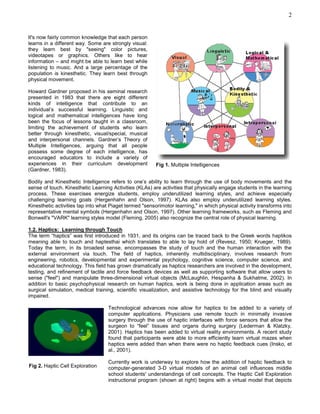
Howard Gardner proposed in his seminal research
presented in 1983 that there are eight different
kinds of intelligence that contribute to an
individual’s successful learning. Linguistic and
logical and mathematical intelligences have long
been the focus of lessons taught in a classroom,
limiting the achievement of students who learn
better through kinesthetic, visual/special, musical
and interpersonal channels. Gardner’s Theory of
Multiple Intelligences, arguing that all people
possess some degree of each intelligence, has
encouraged educators to include a variety of
experiences in their curriculum development              Fig 1. Multiple Intelligences
(Gardner, 1983).

Bodily and Kinesthetic Intelligence refers to one’s ability to learn through the use of body movements and the
sense of touch. Kinesthetic Learning Activities (KLAs) are activities that physically engage students in the learning
process. These exercises energize students, employ underutilized learning styles, and achieve especially
challenging learning goals (Hergenhahn and Olson, 1997). KLAs also employ underutilized learning styles.
Kinesthetic activities tap into what Piaget termed "sensorimotor learning," in which physical activity transforms into
representative mental symbols (Hergenhahn and Olson, 1997). Other learning frameworks, such as Fleming and
Bonwell's "VARK" learning styles model (Fleming, 2005) also recognize the central role of physical learning.

1.2. Haptics: Learning through Touch
The term “haptics” was first introduced in 1931, and its origins can be traced back to the Greek words haptikos
meaning able to touch and haptesthai which translates to able to lay hold of (Revesz, 1950; Krueger, 1989).
Today the term, in its broadest sense, encompasses the study of touch and the human interaction with the
external environment via touch. The field of haptics, inherently multidisciplinary, involves research from
engineering, robotics, developmental and experimental psychology, cognitive science, computer science, and
educational technology. This field has grown dramatically as haptics researchers are involved in the development,
testing, and refinement of tactile and force feedback devices as well as supporting software that allow users to
sense ("feel") and manipulate three-dimensional virtual objects (McLaughlin, Hespanha & Sukhatme, 2002). In
addition to basic psychophysical research on human haptics, work is being done in application areas such as
surgical simulation, medical training, scientific visualization, and assistive technology for the blind and visually
impaired.

                                   Technological advances now allow for haptics to be added to a variety of
                                   computer applications. Physicians use remote touch in minimally invasive
                                   surgery through the use of haptic interfaces with force sensors that allow the
                                   surgeon to “feel” tissues and organs during surgery (Lederman & Klatzky,
                                   2001). Haptics has been added to virtual reality environments. A recent study
                                   found that participants were able to more efficiently learn virtual mazes when
                                   haptics were added than when there were no haptic feedback cues (Insko, et
                                   al., 2001).

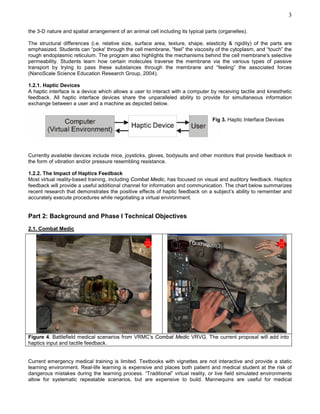
                                   Currently work is underway to explore how the addition of haptic feedback to
Fig 2. Haptic Cell Exploration     computer-generated 3-D virtual models of an animal cell influences middle
                                   school students' understandings of cell concepts. The Haptic Cell Exploration
                                   instructional program (shown at right) begins with a virtual model that depicts
3

the 3-D nature and spatial arrangement of an animal cell including its typical parts (organelles).

The structural differences (i.e. relative size, surface area, texture, shape, elasticity & rigidity) of the parts are
emphasized. Students can “poke' through the cell membrane, “feel” the viscosity of the cytoplasm, and “touch” the
rough endoplasmic reticulum. The program also highlights the mechanisms behind the cell membrane's selective
permeability. Students learn how certain molecules traverse the membrane via the various types of passive
transport by trying to pass these substances through the membrane and “feeling” the associated forces
(NanoScale Science Education Research Group, 2004).

1.2.1. Haptic Devices
A haptic interface is a device which allows a user to interact with a computer by receiving tactile and kinesthetic
feedback. All haptic interface devices share the unparalleled ability to provide for simultaneous information
exchange between a user and a machine as depicted below.


                                                                                  Fig 3. Haptic Interface Devices


Currently available devices include mice, joysticks, gloves, bodysuits and other monitors that provide feedback in
the form of vibration and/or pressure resembling resistance.

1.2.2. The Impact of Haptics Feedback
Most virtual reality-based training, including Combat Medic, has focused on visual and auditory feedback. Haptics
feedback will provide a useful additional channel for information and communication. The chart below summarizes
recent research that demonstrates the positive effects of haptic feedback on a subject’s ability to remember and
accurately execute procedures while negotiating a virtual environment.


Part 2: Background and Phase I Technical Objectives
2.1. Combat Medic


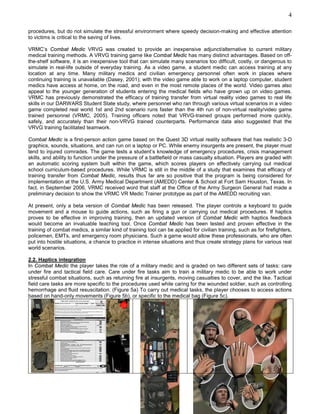
Figure 4. Battlefield medical scenarios from VRMC’s Combat Medic VRVG. The current proposal will add into
haptics input and tactile feedback.


Current emergency medical training is limited. Textbooks with vignettes are not interactive and provide a static
learning environment. Real-life learning is expensive and places both patient and medical student at the risk of
dangerous mistakes during the learning process. “Traditional” virtual reality, or live field simulated environments
allow for systematic repeatable scenarios, but are expensive to build. Mannequins are useful for medical
4

procedures, but do not simulate the stressful environment where speedy decision-making and effective attention
to victims is critical to the saving of lives.

VRMC’s Combat Medic VRVG was created to provide an inexpensive adjunct/alternative to current military
medical training methods. A VRVG training game like Combat Medic has many distinct advantages. Based on off-
the-shelf software, it is an inexpensive tool that can simulate many scenarios too difficult, costly, or dangerous to
simulate in real-life outside of everyday training. As a video game, a student medic can access training at any
location at any time. Many military medics and civilian emergency personnel often work in places where
continuing training is unavailable (Dasey, 2001); with the video game able to work on a laptop computer, student
medics have access at home, on the road, and even in the most remote places of the world. Video games also
appeal to the younger generation of students entering the medical fields who have grown up on video games.
VRMC has previously demonstrated the efficacy of training transfer from virtual reality video games to real life
skills in our DARWARS Student State study, where personnel who ran through various virtual scenarios in a video
game completed real world 1st and 2nd scenario runs faster than the 4th run of non-virtual reality/video game
trained personnel (VRMC, 2005). Training officers noted that VRVG-trained groups performed more quickly,
safely, and accurately than their non-VRVG trained counterparts. Performance data also suggested that the
VRVG training facilitated teamwork.

Combat Medic is a first-person action game based on the Quest 3D virtual reality software that has realistic 3-D
graphics, sounds, situations, and can run on a laptop or PC. While enemy insurgents are present, the player must
tend to injured comrades. The game tests a student’s knowledge of emergency procedures, crisis management
skills, and ability to function under the pressure of a battlefield or mass casualty situation. Players are graded with
an automatic scoring system built within the game, which scores players on effectively carrying out medical
school curriculum-based procedures. While VRMC is still in the middle of a study that examines that efficacy of
training transfer from Combat Medic, results thus far are so positive that the program is being considered for
implementation at the U.S. Army Medical Department (AMEDD) Center & School at Fort Sam Houston, Texas. In
fact, in September 2006, VRMC received word that staff at the Office of the Army Surgeon General had made a
preliminary decision to show the VRMC VR Medic Trainer prototype as part of the AMEDD recruiting van.

At present, only a beta version of Combat Medic has been released. The player controls a keyboard to guide
movement and a mouse to guide actions, such as firing a gun or carrying out medical procedures. If haptics
proves to be effective in improving training, then an updated version of Combat Medic with haptics feedback
would become an invaluable teaching tool. Once Combat Medic has been tested and proven effective in the
training of combat medics, a similar kind of training tool can be applied for civilian training, such as for firefighters,
policemen, EMTs, and emergency room physicians. Such a game would allow these professionals, who are often
put into hostile situations, a chance to practice in intense situations and thus create strategy plans for various real
world scenarios.

2.2. Haptics integration
In Combat Medic the player takes the role of a military medic and is graded on two different sets of tasks: care
under fire and tactical field care. Care under fire tasks aim to train a military medic to be able to work under
stressful combat situations, such as returning fire at insurgents, moving casualties to cover, and the like. Tactical
field care tasks are more specific to the procedures used while caring for the wounded soldier, such as controlling
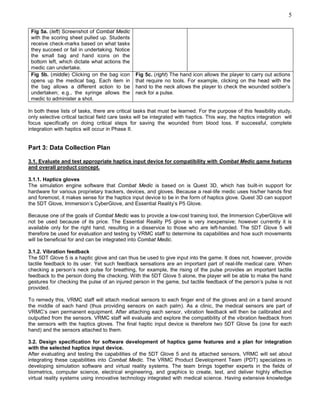
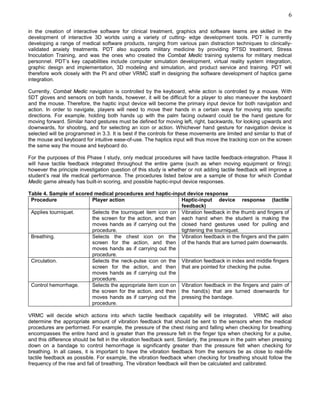
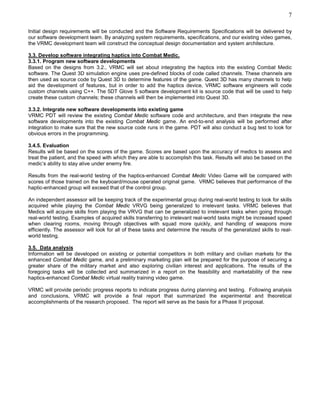
hemorrhage and fluid resuscitation. (Figure 5a) To carry out medical tasks, the player chooses to access actions
based on hand-only movements (Figure 5b), or specific to the medical bag (Figure 5c).
5

 Fig 5a. (left) Screenshot of Combat Medic
 with the scoring sheet pulled up. Students
 receive check-marks based on what tasks
 they succeed or fail in undertaking. Notice
 the small bag and hand icons on the
 bottom left, which dictate what actions the
 medic can undertake.
 Fig 5b. (middle) Clicking on the bag icon       Fig 5c. (right) The hand icon allows the player to carry out actions
 opens up the medical bag. Each item in          that require no tools. For example, clicking on the head with the
 the bag allows a different action to be         hand to the neck allows the player to check the wounded soldier’s
 undertaken; e.g., the syringe allows the        neck for a pulse.
 medic to administer a shot.

In both these lists of tasks, there are critical tasks that must be learned. For the purpose of this feasibility study,
only selective critical tactical field care tasks will be integrated with haptics. This way, the haptics integration will
focus specifically on doing critical steps for saving the wounded from blood loss. If successful, complete
integration with haptics will occur in Phase II.


Part 3: Data Collection Plan

3.1. Evaluate and test appropriate haptics input device for compatibility with Combat Medic game features
and overall product concept.

3.1.1. Haptics gloves
The simulation engine software that Combat Medic is based on is Quest 3D, which has built-in support for
hardware for various proprietary trackers, devices, and gloves. Because a real-life medic uses his/her hands first
and foremost, it makes sense for the haptics input device to be in the form of haptics glove. Quest 3D can support
the 5DT Glove, Immersion’s CyberGlove, and Essential Reality’s P5 Glove.

Because one of the goals of Combat Medic was to provide a low-cost training tool, the Immersion CyberGlove will
not be used because of its price. The Essential Reality P5 glove is very inexpensive; however currently it is
available only for the right hand, resulting in a disservice to those who are left-handed. The 5DT Glove 5 will
therefore be used for evaluation and testing by VRMC staff to determine its capabilities and how such movements
will be beneficial for and can be integrated into Combat Medic.

3.1.2. Vibration feedback
The 5DT Glove 5 is a haptic glove and can thus be used to give input into the game. It does not, however, provide
tactile feedback to its user. Yet such feedback sensations are an important part of real-life medical care. When
checking a person’s neck pulse for breathing, for example, the rising of the pulse provides an important tactile
feedback to the person doing the checking. With the 5DT Glove 5 alone, the player will be able to make the hand
gestures for checking the pulse of an injured person in the game, but tactile feedback of the person’s pulse is not
provided.

To remedy this, VRMC staff will attach medical sensors to each finger end of the gloves and on a band around
the middle of each hand (thus providing sensors on each palm). As a clinic, the medical sensors are part of
VRMC’s own permanent equipment. After attaching each sensor, vibration feedback will then be calibrated and
outputted from the sensors. VRMC staff will evaluate and explore the compatibility of the vibration feedback from
the sensors with the haptics gloves. The final haptic input device is therefore two 5DT Glove 5s (one for each
hand) and the sensors attached to them.

3.2. Design specification for software development of haptics game features and a plan for integration
with the selected haptics input device.
After evaluating and testing the capabilities of the 5DT Glove 5 and its attached sensors, VRMC will set about
integrating these capabilities into Combat Medic. The VRMC Product Development Team (PDT) specializes in
developing simulation software and virtual reality systems. The team brings together experts in the fields of
biometrics, computer science, electrical engineering, and graphics to create, test, and deliver highly effective
virtual reality systems using innovative technology integrated with medical science. Having extensive knowledge
6

in the creation of interactive software for clinical treatment, graphics and software teams are skilled in the
development of interactive 3D worlds using a variety of cutting- edge development tools. PDT is currently
developing a range of medical software products, ranging from various pain distraction techniques to clinically-
validated anxiety treatments. PDT also supports military medicine by providing PTSD treatment, Stress
Inoculation Training, and was the ones who created the Combat Medic training systems for military medical
personnel. PDT’s key capabilities include computer simulation development, virtual reality system integration,
graphic design and implementation, 3D modeling and simulation, and product service and training. PDT will
therefore work closely with the PI and other VRMC staff in designing the software development of haptics game
integration.

Currently, Combat Medic navigation is controlled by the keyboard, while action is controlled by a mouse. With
5DT gloves and sensors on both hands, however, it will be difficult for a player to also maneuver the keyboard
and the mouse. Therefore, the haptic input device will become the primary input device for both navigation and
action. In order to navigate, players will need to move their hands in a certain ways for moving into specific
directions. For example, holding both hands up with the palm facing outward could be the hand gesture for
moving forward. Similar hand gestures must be defined for moving left, right, backwards, for looking upwards and
downwards, for shooting, and for selecting an icon or action. Whichever hand gesture for navigation device is
selected will be programmed in 3.3. It is best if the controls for these movements are limited and similar to that of
the mouse and keyboard for intuitive ease-of-use. The haptics input will thus move the tracking icon on the screen
the same way the mouse and keyboard do.

For the purposes of this Phase I study, only medical procedures will have tactile feedback-integration. Phase II
will have tactile feedback integrated throughout the entire game (such as when moving equipment or firing);
however the principle investigation question of this study is whether or not adding tactile feedback will improve a
student’s real life medical performance. The procedures listed below are a sample of those for which Combat
Medic game already has built-in scoring, and possible haptic-input device responses.

Table 4. Sample of scored medical procedures and haptic-input device response
 Procedure               Player action                        Haptic-input device response (tactile
                                                              feedback)
 Applies tourniquet.     Selects the tourniquet item icon on Vibration feedback in the thumb and fingers of
                         the screen for the action, and then each hand when the student is making the
                         moves hands as if carrying out the closed hand gestures used for pulling and
                         procedure.                           tightening the tourniquet.
 Breathing.              Selects the chest icon on the Vibration feedback in the fingers and the palm
                         screen for the action, and then of the hands that are turned palm downwards.
                         moves hands as if carrying out the
                         procedure.
 Circulation.            Selects the neck-pulse icon on the Vibration feedback in index and middle fingers
                         screen for the action, and then that are pointed for checking the pulse.
                         moves hands as if carrying out the
                         procedure.
 Control hemorrhage.     Selects the appropriate item icon on Vibration feedback in the fingers and palm of
                         the screen for the action, and then the hand(s) that are turned downwards for
                         moves hands as if carrying out the pressing the bandage.
                         procedure.

VRMC will decide which actions into which tactile feedback capability will be integrated. VRMC will also
determine the appropriate amount of vibration feedback that should be sent to the sensors when the medical
procedures are performed. For example, the pressure of the chest rising and falling when checking for breathing
encompasses the entire hand and is greater than the pressure felt in the finger tips when checking for a pulse,
and this difference should be felt in the vibration feedback sent. Similarly, the pressure in the palm when pressing
down on a bandage to control hemorrhage is significantly greater than the pressure felt when checking for
breathing. In all cases, it is important to have the vibration feedback from the sensors be as close to real-life
tactile feedback as possible. For example, the vibration feedback when checking for breathing should follow the
frequency of the rise and fall of breathing. The vibration feedback will then be calculated and calibrated.
7

Initial design requirements will be conducted and the Software Requirements Specifications will be delivered by
our software development team. By analyzing system requirements, specifications, and our existing video games,
the VRMC development team will construct the conceptual design documentation and system architecture.

3.3. Develop software integrating haptics into Combat Medic.
3.3.1. Program new software developments
Based on the designs from 3.2., VRMC will set about integrating the haptics into the existing Combat Medic
software. The Quest 3D simulation engine uses pre-defined blocks of code called channels. These channels are
then used as source code by Quest 3D to determine features of the game. Quest 3D has many channels to help
aid the development of features, but in order to add the haptics device, VRMC software engineers will code
custom channels using C++. The 5DT Glove 5 software development kit is source code that will be used to help
create these custom channels; these channels will then be implemented into Quest 3D.

3.3.2. Integrate new software developments into existing game
VRMC PDT will review the existing Combat Medic software code and architecture, and then integrate the new
software developments into the existing Combat Medic game. An end-to-end analysis will be performed after
integration to make sure that the new source code runs in the game. PDT will also conduct a bug test to look for
obvious errors in the programming.

3.4.5. Evaluation
Results will be based on the scores of the game. Scores are based upon the accuracy of medics to assess and
treat the patient, and the speed with which they are able to accomplish this task. Results will also be based on the
medic’s ability to stay alive under enemy fire.

Results from the real-world testing of the haptics-enhanced Combat Medic Video Game will be compared with
scores of those trained on the keyboard/mouse operated original game. VRMC believes that performance of the
haptic-enhanced group will exceed that of the control group.

An independent assessor will be keeping track of the experimental group during real-world testing to look for skills
acquired while playing the Combat Medic VRVG being generalized to irrelevant tasks. VRMC believes that
Medics will acquire skills from playing the VRVG that can be generalized to irrelevant tasks when going through
real-world testing. Examples of acquired skills transferring to irrelevant real-world tasks might be increased speed
when clearing rooms, moving through objectives with squad more quickly, and handling of weapons more
efficiently. The assessor will look for all of these tasks and determine the results of the generalized skills to real-
world testing.

3.5. Data analysis
Information will be developed on existing or potential competitors in both military and civilian markets for the
enhanced Combat Medic game, and a preliminary marketing plan will be prepared for the purpose of securing a
greater share of the military market and also exploring civilian interest and applications. The results of the
foregoing tasks will be collected and summarized in a report on the feasibility and marketability of the new
haptics-enhanced Combat Medic virtual reality training video game.

VRMC will provide periodic progress reports to indicate progress during planning and testing. Following analysis
and conclusions, VRMC will provide a final report that summarized the experimental and theoretical
accomplishments of the research proposed. The report will serve as the basis for a Phase II proposal.

Team vrmc rwjf

  • 1.
    1 VRMC 9565 Waples Street, Suite 200 San Diego, CA 92121 Tel: (858) 642-0267 Effectiveness of Haptics in Combat Medic Virtual Reality Video Game (VRVG) Team VRMC: Kenneth Gao, Dr. Mark Wiederhold, Lingjun Kong, Dr. Brenda Wiederhold, Phase I Submission for Robert Wood Johnson Foundation: Games to Generate Data Date: February 22, 2013 Part 1: Identification and significance of the innovation Team VRMC proposes adding a new element to its Combat Medic Virtual Reality Video Game (VRVG): haptics or tactile feedback features that will add an increased element of realism to training and increase players’ competence in performing specific life-saving emergency procedures. Combat Medic teaches military medics to respond to battlefield crises with life-saving interventions such as checking the pulse, checking the respiration, controlling bleeding, and inserting an IV in a victim while taking hostile fire. The addition of force feedback will allow the medic to feel the pulse of a casualty, sense resistance when tying a tourniquet, and be subjected to other tactile experiences that research shows stimulate recall and long-term memory. Research on the application of force feedback to virtual reality training tools is consistent with the NSF goal to support high quality projects on important scientific, engineering or science and engineering education problems and opportunities that could lead to significant commercial and public benefit. Military and civilian organizations are investing millions of dollars in the training of emergency medical personnel. Traditional approaches such as classroom/textbook instruction, life-size virtual environments or simulations, computer-based training, and “on the job” real-world training activities may not prepare first-responders for the variety of demanding experiences they might encounter in the catastrophic battlefield situations that will confront them. The addition of Virtual Reality Video Games (VRVG) to the repertoire of available techniques has increased the ability to consistently train large numbers of participants any time, any place and to customize learning environments to individual styles and circumstances. The use of video games in training is not a new idea. But VRMC’s design and implementation approach to the development of virtual reality training platforms is new. VRMC has created an immersive video game finely tuned to particular medical circumstances found in the battlefield in which a limited number of focused procedures can yield great dividends in the saving of human lives. VRMC has developed and tested its low-cost, portable virtual reality video game, demonstrating that it prepares combat medics to perform more expertly in real-world situations than those trained by other available methods. Previous testing done by VRMC in a Phase II Defense Advanced Research Projects Agency (DARPA) project for soldiers demonstrated that skills learned through virtual reality video games transfer more effectively than training conducted using more traditional methods. Combat Medic uses audio and visual feedback and a scoring system to reinforce learning. 1.1. Learning Styles Communication research demonstrates that people tend to remember 20 percent of what they hear, 30 percent of what they see, 50 percent of what they hear and see, and 80 percent of what they hear, see, and do. These statistics are often referenced when encouraging speakers to integrate interactive exercises and processes into their presentations in order to engage listeners. As an audience member, either in a classroom or with a group of friends conversing, people recall more about their listening experiences when the speaker appeals to more than just their sense of hearing.
  • 2.
    2 It's now fairlycommon knowledge that each person learns in a different way. Some are strongly visual: they learn best by "seeing" color pictures, videotapes or graphics. Others like to hear information – and might be able to learn best while listening to music. And a large percentage of the population is kinesthetic. They learn best through physical movement. Howard Gardner proposed in his seminal research presented in 1983 that there are eight different kinds of intelligence that contribute to an individual’s successful learning. Linguistic and logical and mathematical intelligences have long been the focus of lessons taught in a classroom, limiting the achievement of students who learn better through kinesthetic, visual/special, musical and interpersonal channels. Gardner’s Theory of Multiple Intelligences, arguing that all people possess some degree of each intelligence, has encouraged educators to include a variety of experiences in their curriculum development Fig 1. Multiple Intelligences (Gardner, 1983). Bodily and Kinesthetic Intelligence refers to one’s ability to learn through the use of body movements and the sense of touch. Kinesthetic Learning Activities (KLAs) are activities that physically engage students in the learning process. These exercises energize students, employ underutilized learning styles, and achieve especially challenging learning goals (Hergenhahn and Olson, 1997). KLAs also employ underutilized learning styles. Kinesthetic activities tap into what Piaget termed "sensorimotor learning," in which physical activity transforms into representative mental symbols (Hergenhahn and Olson, 1997). Other learning frameworks, such as Fleming and Bonwell's "VARK" learning styles model (Fleming, 2005) also recognize the central role of physical learning. 1.2. Haptics: Learning through Touch The term “haptics” was first introduced in 1931, and its origins can be traced back to the Greek words haptikos meaning able to touch and haptesthai which translates to able to lay hold of (Revesz, 1950; Krueger, 1989). Today the term, in its broadest sense, encompasses the study of touch and the human interaction with the external environment via touch. The field of haptics, inherently multidisciplinary, involves research from engineering, robotics, developmental and experimental psychology, cognitive science, computer science, and educational technology. This field has grown dramatically as haptics researchers are involved in the development, testing, and refinement of tactile and force feedback devices as well as supporting software that allow users to sense ("feel") and manipulate three-dimensional virtual objects (McLaughlin, Hespanha & Sukhatme, 2002). In addition to basic psychophysical research on human haptics, work is being done in application areas such as surgical simulation, medical training, scientific visualization, and assistive technology for the blind and visually impaired. Technological advances now allow for haptics to be added to a variety of computer applications. Physicians use remote touch in minimally invasive surgery through the use of haptic interfaces with force sensors that allow the surgeon to “feel” tissues and organs during surgery (Lederman & Klatzky, 2001). Haptics has been added to virtual reality environments. A recent study found that participants were able to more efficiently learn virtual mazes when haptics were added than when there were no haptic feedback cues (Insko, et al., 2001). Currently work is underway to explore how the addition of haptic feedback to Fig 2. Haptic Cell Exploration computer-generated 3-D virtual models of an animal cell influences middle school students' understandings of cell concepts. The Haptic Cell Exploration instructional program (shown at right) begins with a virtual model that depicts
  • 3.
    3 the 3-D natureand spatial arrangement of an animal cell including its typical parts (organelles). The structural differences (i.e. relative size, surface area, texture, shape, elasticity & rigidity) of the parts are emphasized. Students can “poke' through the cell membrane, “feel” the viscosity of the cytoplasm, and “touch” the rough endoplasmic reticulum. The program also highlights the mechanisms behind the cell membrane's selective permeability. Students learn how certain molecules traverse the membrane via the various types of passive transport by trying to pass these substances through the membrane and “feeling” the associated forces (NanoScale Science Education Research Group, 2004). 1.2.1. Haptic Devices A haptic interface is a device which allows a user to interact with a computer by receiving tactile and kinesthetic feedback. All haptic interface devices share the unparalleled ability to provide for simultaneous information exchange between a user and a machine as depicted below. Fig 3. Haptic Interface Devices Currently available devices include mice, joysticks, gloves, bodysuits and other monitors that provide feedback in the form of vibration and/or pressure resembling resistance. 1.2.2. The Impact of Haptics Feedback Most virtual reality-based training, including Combat Medic, has focused on visual and auditory feedback. Haptics feedback will provide a useful additional channel for information and communication. The chart below summarizes recent research that demonstrates the positive effects of haptic feedback on a subject’s ability to remember and accurately execute procedures while negotiating a virtual environment. Part 2: Background and Phase I Technical Objectives 2.1. Combat Medic Figure 4. Battlefield medical scenarios from VRMC’s Combat Medic VRVG. The current proposal will add into haptics input and tactile feedback. Current emergency medical training is limited. Textbooks with vignettes are not interactive and provide a static learning environment. Real-life learning is expensive and places both patient and medical student at the risk of dangerous mistakes during the learning process. “Traditional” virtual reality, or live field simulated environments allow for systematic repeatable scenarios, but are expensive to build. Mannequins are useful for medical
  • 4.
    4 procedures, but donot simulate the stressful environment where speedy decision-making and effective attention to victims is critical to the saving of lives. VRMC’s Combat Medic VRVG was created to provide an inexpensive adjunct/alternative to current military medical training methods. A VRVG training game like Combat Medic has many distinct advantages. Based on off- the-shelf software, it is an inexpensive tool that can simulate many scenarios too difficult, costly, or dangerous to simulate in real-life outside of everyday training. As a video game, a student medic can access training at any location at any time. Many military medics and civilian emergency personnel often work in places where continuing training is unavailable (Dasey, 2001); with the video game able to work on a laptop computer, student medics have access at home, on the road, and even in the most remote places of the world. Video games also appeal to the younger generation of students entering the medical fields who have grown up on video games. VRMC has previously demonstrated the efficacy of training transfer from virtual reality video games to real life skills in our DARWARS Student State study, where personnel who ran through various virtual scenarios in a video game completed real world 1st and 2nd scenario runs faster than the 4th run of non-virtual reality/video game trained personnel (VRMC, 2005). Training officers noted that VRVG-trained groups performed more quickly, safely, and accurately than their non-VRVG trained counterparts. Performance data also suggested that the VRVG training facilitated teamwork. Combat Medic is a first-person action game based on the Quest 3D virtual reality software that has realistic 3-D graphics, sounds, situations, and can run on a laptop or PC. While enemy insurgents are present, the player must tend to injured comrades. The game tests a student’s knowledge of emergency procedures, crisis management skills, and ability to function under the pressure of a battlefield or mass casualty situation. Players are graded with an automatic scoring system built within the game, which scores players on effectively carrying out medical school curriculum-based procedures. While VRMC is still in the middle of a study that examines that efficacy of training transfer from Combat Medic, results thus far are so positive that the program is being considered for implementation at the U.S. Army Medical Department (AMEDD) Center & School at Fort Sam Houston, Texas. In fact, in September 2006, VRMC received word that staff at the Office of the Army Surgeon General had made a preliminary decision to show the VRMC VR Medic Trainer prototype as part of the AMEDD recruiting van. At present, only a beta version of Combat Medic has been released. The player controls a keyboard to guide movement and a mouse to guide actions, such as firing a gun or carrying out medical procedures. If haptics proves to be effective in improving training, then an updated version of Combat Medic with haptics feedback would become an invaluable teaching tool. Once Combat Medic has been tested and proven effective in the training of combat medics, a similar kind of training tool can be applied for civilian training, such as for firefighters, policemen, EMTs, and emergency room physicians. Such a game would allow these professionals, who are often put into hostile situations, a chance to practice in intense situations and thus create strategy plans for various real world scenarios. 2.2. Haptics integration In Combat Medic the player takes the role of a military medic and is graded on two different sets of tasks: care under fire and tactical field care. Care under fire tasks aim to train a military medic to be able to work under stressful combat situations, such as returning fire at insurgents, moving casualties to cover, and the like. Tactical field care tasks are more specific to the procedures used while caring for the wounded soldier, such as controlling hemorrhage and fluid resuscitation. (Figure 5a) To carry out medical tasks, the player chooses to access actions based on hand-only movements (Figure 5b), or specific to the medical bag (Figure 5c).
  • 5.
    5 Fig 5a.(left) Screenshot of Combat Medic with the scoring sheet pulled up. Students receive check-marks based on what tasks they succeed or fail in undertaking. Notice the small bag and hand icons on the bottom left, which dictate what actions the medic can undertake. Fig 5b. (middle) Clicking on the bag icon Fig 5c. (right) The hand icon allows the player to carry out actions opens up the medical bag. Each item in that require no tools. For example, clicking on the head with the the bag allows a different action to be hand to the neck allows the player to check the wounded soldier’s undertaken; e.g., the syringe allows the neck for a pulse. medic to administer a shot. In both these lists of tasks, there are critical tasks that must be learned. For the purpose of this feasibility study, only selective critical tactical field care tasks will be integrated with haptics. This way, the haptics integration will focus specifically on doing critical steps for saving the wounded from blood loss. If successful, complete integration with haptics will occur in Phase II. Part 3: Data Collection Plan 3.1. Evaluate and test appropriate haptics input device for compatibility with Combat Medic game features and overall product concept. 3.1.1. Haptics gloves The simulation engine software that Combat Medic is based on is Quest 3D, which has built-in support for hardware for various proprietary trackers, devices, and gloves. Because a real-life medic uses his/her hands first and foremost, it makes sense for the haptics input device to be in the form of haptics glove. Quest 3D can support the 5DT Glove, Immersion’s CyberGlove, and Essential Reality’s P5 Glove. Because one of the goals of Combat Medic was to provide a low-cost training tool, the Immersion CyberGlove will not be used because of its price. The Essential Reality P5 glove is very inexpensive; however currently it is available only for the right hand, resulting in a disservice to those who are left-handed. The 5DT Glove 5 will therefore be used for evaluation and testing by VRMC staff to determine its capabilities and how such movements will be beneficial for and can be integrated into Combat Medic. 3.1.2. Vibration feedback The 5DT Glove 5 is a haptic glove and can thus be used to give input into the game. It does not, however, provide tactile feedback to its user. Yet such feedback sensations are an important part of real-life medical care. When checking a person’s neck pulse for breathing, for example, the rising of the pulse provides an important tactile feedback to the person doing the checking. With the 5DT Glove 5 alone, the player will be able to make the hand gestures for checking the pulse of an injured person in the game, but tactile feedback of the person’s pulse is not provided. To remedy this, VRMC staff will attach medical sensors to each finger end of the gloves and on a band around the middle of each hand (thus providing sensors on each palm). As a clinic, the medical sensors are part of VRMC’s own permanent equipment. After attaching each sensor, vibration feedback will then be calibrated and outputted from the sensors. VRMC staff will evaluate and explore the compatibility of the vibration feedback from the sensors with the haptics gloves. The final haptic input device is therefore two 5DT Glove 5s (one for each hand) and the sensors attached to them. 3.2. Design specification for software development of haptics game features and a plan for integration with the selected haptics input device. After evaluating and testing the capabilities of the 5DT Glove 5 and its attached sensors, VRMC will set about integrating these capabilities into Combat Medic. The VRMC Product Development Team (PDT) specializes in developing simulation software and virtual reality systems. The team brings together experts in the fields of biometrics, computer science, electrical engineering, and graphics to create, test, and deliver highly effective virtual reality systems using innovative technology integrated with medical science. Having extensive knowledge
  • 6.
    6 in the creationof interactive software for clinical treatment, graphics and software teams are skilled in the development of interactive 3D worlds using a variety of cutting- edge development tools. PDT is currently developing a range of medical software products, ranging from various pain distraction techniques to clinically- validated anxiety treatments. PDT also supports military medicine by providing PTSD treatment, Stress Inoculation Training, and was the ones who created the Combat Medic training systems for military medical personnel. PDT’s key capabilities include computer simulation development, virtual reality system integration, graphic design and implementation, 3D modeling and simulation, and product service and training. PDT will therefore work closely with the PI and other VRMC staff in designing the software development of haptics game integration. Currently, Combat Medic navigation is controlled by the keyboard, while action is controlled by a mouse. With 5DT gloves and sensors on both hands, however, it will be difficult for a player to also maneuver the keyboard and the mouse. Therefore, the haptic input device will become the primary input device for both navigation and action. In order to navigate, players will need to move their hands in a certain ways for moving into specific directions. For example, holding both hands up with the palm facing outward could be the hand gesture for moving forward. Similar hand gestures must be defined for moving left, right, backwards, for looking upwards and downwards, for shooting, and for selecting an icon or action. Whichever hand gesture for navigation device is selected will be programmed in 3.3. It is best if the controls for these movements are limited and similar to that of the mouse and keyboard for intuitive ease-of-use. The haptics input will thus move the tracking icon on the screen the same way the mouse and keyboard do. For the purposes of this Phase I study, only medical procedures will have tactile feedback-integration. Phase II will have tactile feedback integrated throughout the entire game (such as when moving equipment or firing); however the principle investigation question of this study is whether or not adding tactile feedback will improve a student’s real life medical performance. The procedures listed below are a sample of those for which Combat Medic game already has built-in scoring, and possible haptic-input device responses. Table 4. Sample of scored medical procedures and haptic-input device response Procedure Player action Haptic-input device response (tactile feedback) Applies tourniquet. Selects the tourniquet item icon on Vibration feedback in the thumb and fingers of the screen for the action, and then each hand when the student is making the moves hands as if carrying out the closed hand gestures used for pulling and procedure. tightening the tourniquet. Breathing. Selects the chest icon on the Vibration feedback in the fingers and the palm screen for the action, and then of the hands that are turned palm downwards. moves hands as if carrying out the procedure. Circulation. Selects the neck-pulse icon on the Vibration feedback in index and middle fingers screen for the action, and then that are pointed for checking the pulse. moves hands as if carrying out the procedure. Control hemorrhage. Selects the appropriate item icon on Vibration feedback in the fingers and palm of the screen for the action, and then the hand(s) that are turned downwards for moves hands as if carrying out the pressing the bandage. procedure. VRMC will decide which actions into which tactile feedback capability will be integrated. VRMC will also determine the appropriate amount of vibration feedback that should be sent to the sensors when the medical procedures are performed. For example, the pressure of the chest rising and falling when checking for breathing encompasses the entire hand and is greater than the pressure felt in the finger tips when checking for a pulse, and this difference should be felt in the vibration feedback sent. Similarly, the pressure in the palm when pressing down on a bandage to control hemorrhage is significantly greater than the pressure felt when checking for breathing. In all cases, it is important to have the vibration feedback from the sensors be as close to real-life tactile feedback as possible. For example, the vibration feedback when checking for breathing should follow the frequency of the rise and fall of breathing. The vibration feedback will then be calculated and calibrated.
  • 7.
    7 Initial design requirementswill be conducted and the Software Requirements Specifications will be delivered by our software development team. By analyzing system requirements, specifications, and our existing video games, the VRMC development team will construct the conceptual design documentation and system architecture. 3.3. Develop software integrating haptics into Combat Medic. 3.3.1. Program new software developments Based on the designs from 3.2., VRMC will set about integrating the haptics into the existing Combat Medic software. The Quest 3D simulation engine uses pre-defined blocks of code called channels. These channels are then used as source code by Quest 3D to determine features of the game. Quest 3D has many channels to help aid the development of features, but in order to add the haptics device, VRMC software engineers will code custom channels using C++. The 5DT Glove 5 software development kit is source code that will be used to help create these custom channels; these channels will then be implemented into Quest 3D. 3.3.2. Integrate new software developments into existing game VRMC PDT will review the existing Combat Medic software code and architecture, and then integrate the new software developments into the existing Combat Medic game. An end-to-end analysis will be performed after integration to make sure that the new source code runs in the game. PDT will also conduct a bug test to look for obvious errors in the programming. 3.4.5. Evaluation Results will be based on the scores of the game. Scores are based upon the accuracy of medics to assess and treat the patient, and the speed with which they are able to accomplish this task. Results will also be based on the medic’s ability to stay alive under enemy fire. Results from the real-world testing of the haptics-enhanced Combat Medic Video Game will be compared with scores of those trained on the keyboard/mouse operated original game. VRMC believes that performance of the haptic-enhanced group will exceed that of the control group. An independent assessor will be keeping track of the experimental group during real-world testing to look for skills acquired while playing the Combat Medic VRVG being generalized to irrelevant tasks. VRMC believes that Medics will acquire skills from playing the VRVG that can be generalized to irrelevant tasks when going through real-world testing. Examples of acquired skills transferring to irrelevant real-world tasks might be increased speed when clearing rooms, moving through objectives with squad more quickly, and handling of weapons more efficiently. The assessor will look for all of these tasks and determine the results of the generalized skills to real- world testing. 3.5. Data analysis Information will be developed on existing or potential competitors in both military and civilian markets for the enhanced Combat Medic game, and a preliminary marketing plan will be prepared for the purpose of securing a greater share of the military market and also exploring civilian interest and applications. The results of the foregoing tasks will be collected and summarized in a report on the feasibility and marketability of the new haptics-enhanced Combat Medic virtual reality training video game. VRMC will provide periodic progress reports to indicate progress during planning and testing. Following analysis and conclusions, VRMC will provide a final report that summarized the experimental and theoretical accomplishments of the research proposed. The report will serve as the basis for a Phase II proposal.