Measuring users’ experiences
                       or, the memory of them?


Trajectory reminders    EmoSnaps       Footprint tracker

                 Evangelos Karapanos

                                                     Newcastle, 8 March 2011
Nuno	
  Nunes          Vassilis	
  Kostakos                 Monchu	
  Chen


                                                  Laura Rodríguez              Gonçalo	
  Gouveia              Néstor	
  Catano


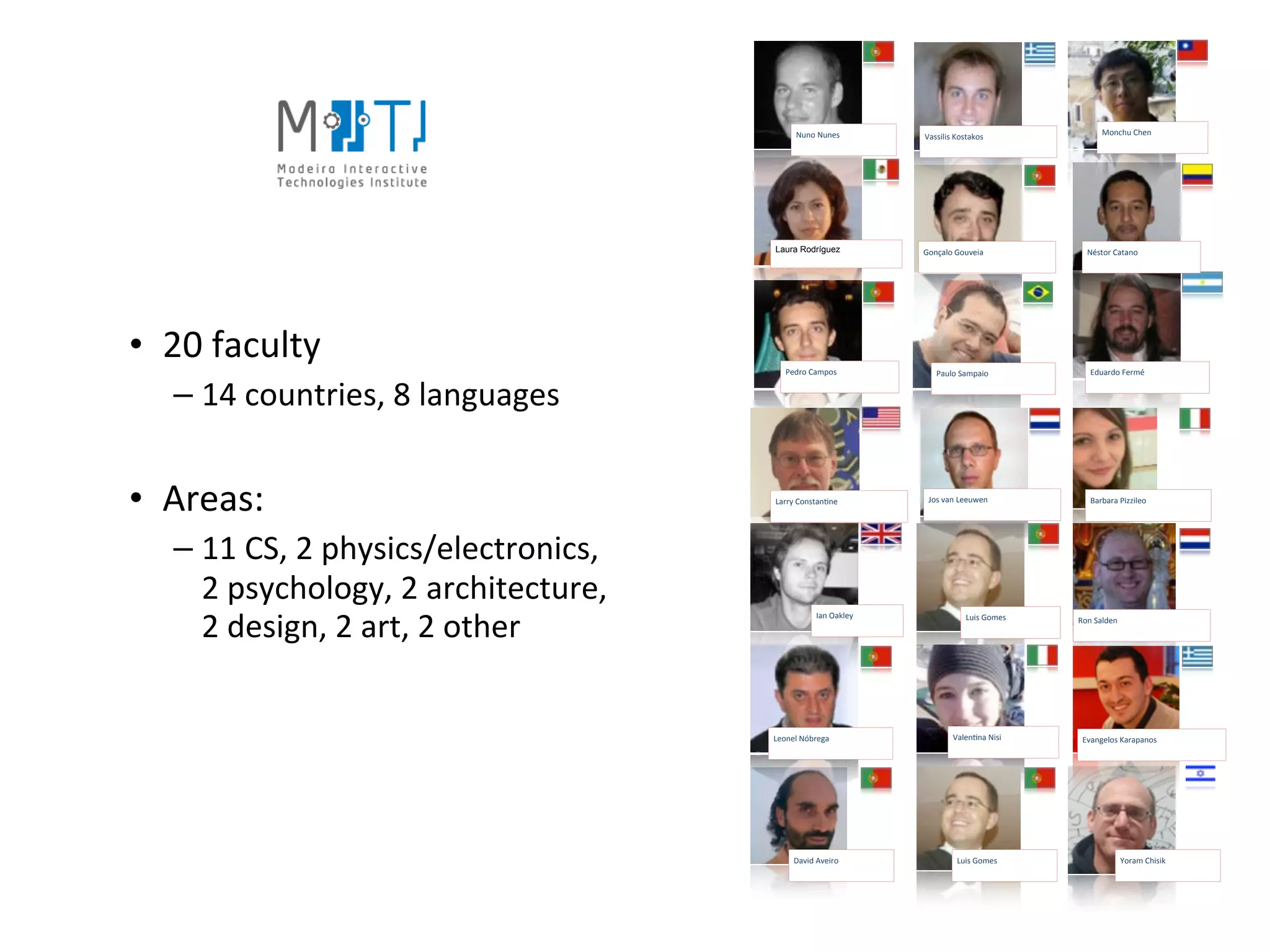
• 20	
  faculty                                      Pedro	
  Campos              Paulo	
  Sampaio               Eduardo	
  Fermé


   – 14	
  countries,	
  8	
  languages


• Areas:                                          Larry	
  ConstanHne           Jos	
  van	
  Leeuwen            Barbara	
  Pizzileo


   – 11	
  CS,	
  2	
  physics/electronics,	
  
     2	
  psychology,	
  2	
  architecture,	
  
     2	
  design,	
  2	
  art,	
  2	
  other
                                                               Ian	
  Oakley                 Luis	
  Gomes   Ron	
  Salden


                                                  Leonel	
  Nóbrega                     ValenHna	
  Nisi      Evangelos	
  Karapanos


                                                        David	
  Aveiro                   Luis	
  Gomes                      Yoram	
  Chisik
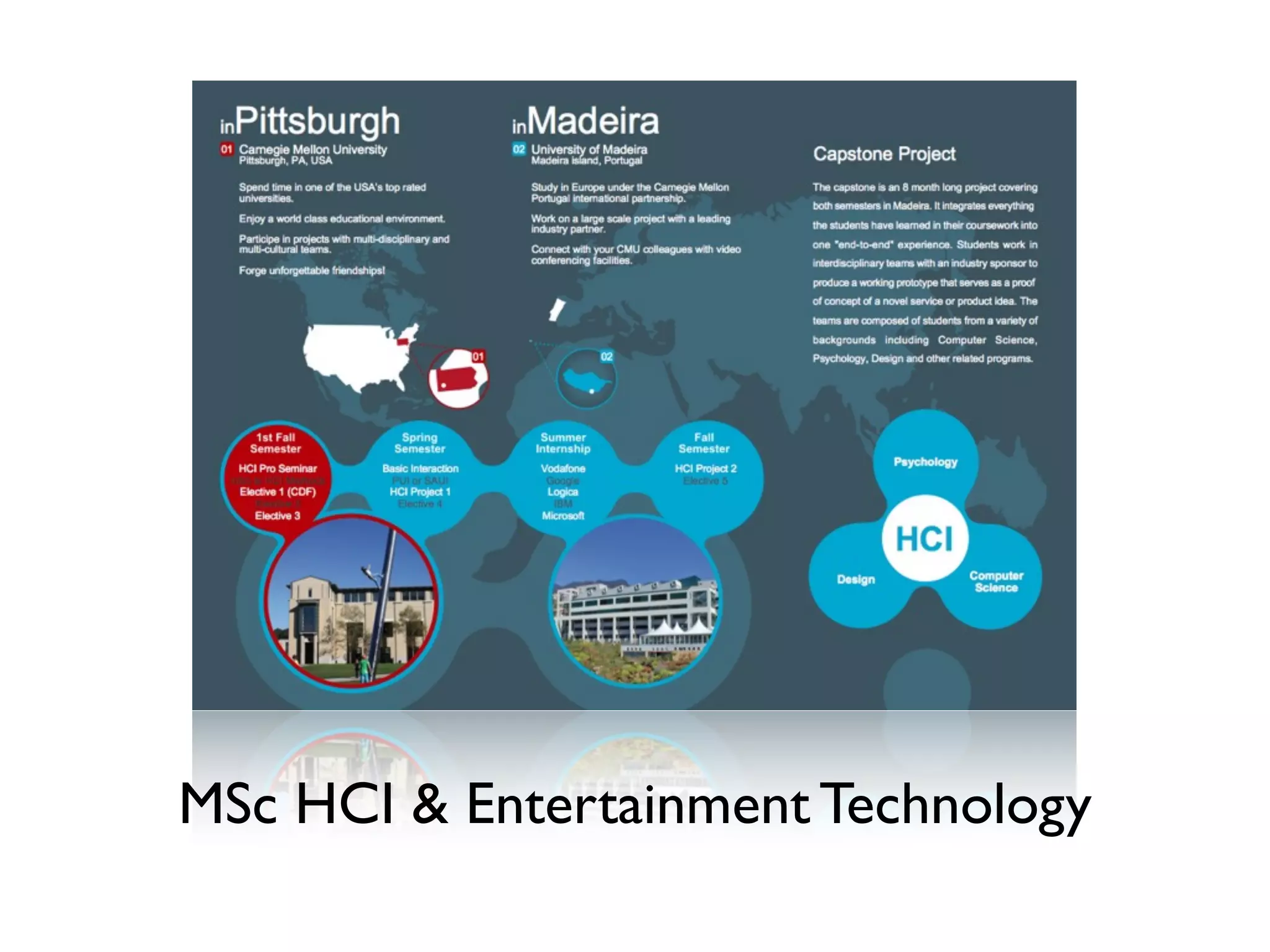
MSc HCI & Entertainment Technology
Industry Involvement
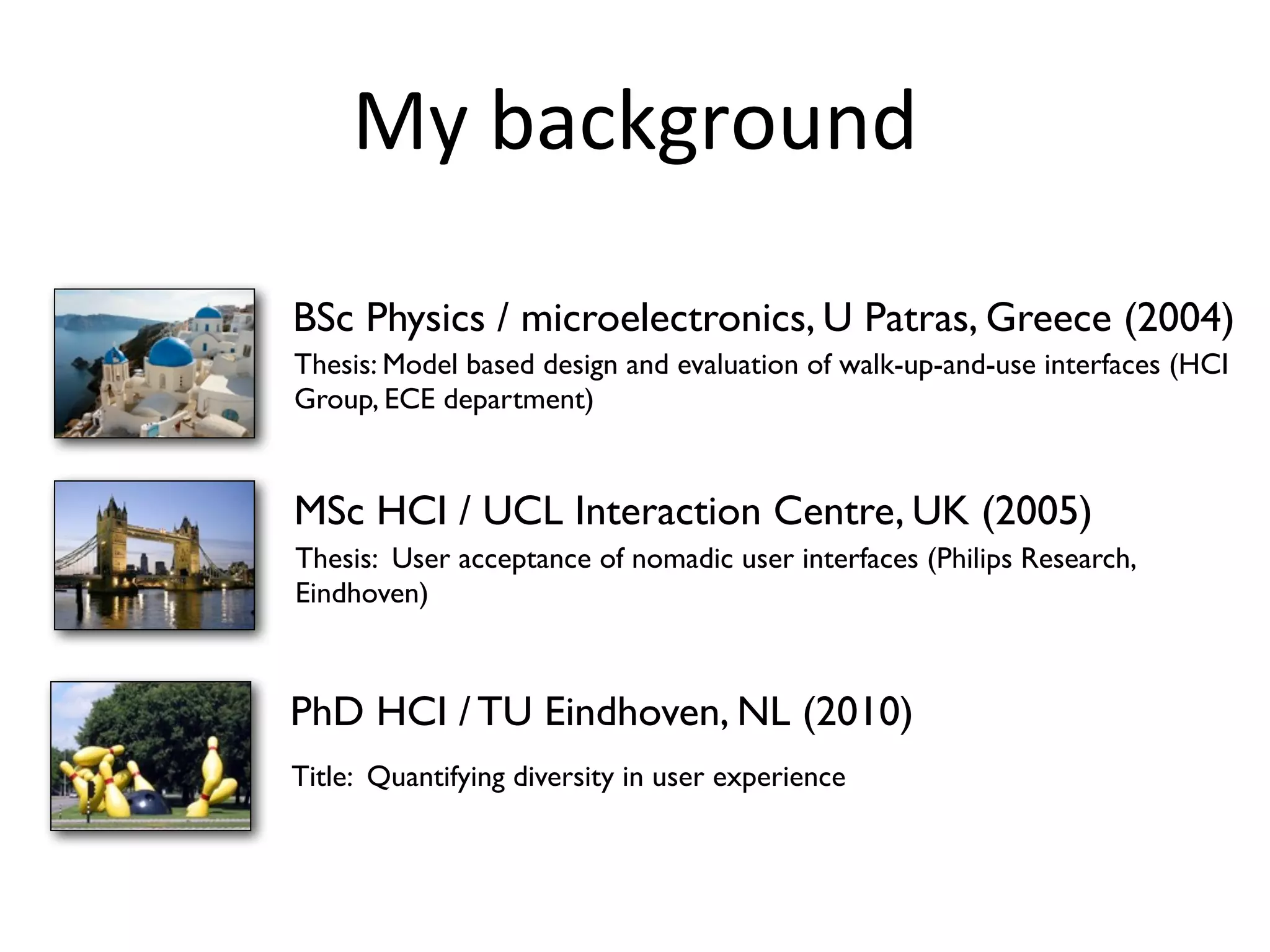
My	
  background

BSc Physics / microelectronics, U Patras, Greece (2004)
Thesis: Model based design and evaluation of walk-up-and-use interfaces (HCI
Group, ECE department)


MSc HCI / UCL Interaction Centre, UK (2005)
Thesis: User acceptance of nomadic user interfaces (Philips Research,
Eindhoven)


PhD HCI / TU Eindhoven, NL (2010)
Title: Quantifying diversity in user experience
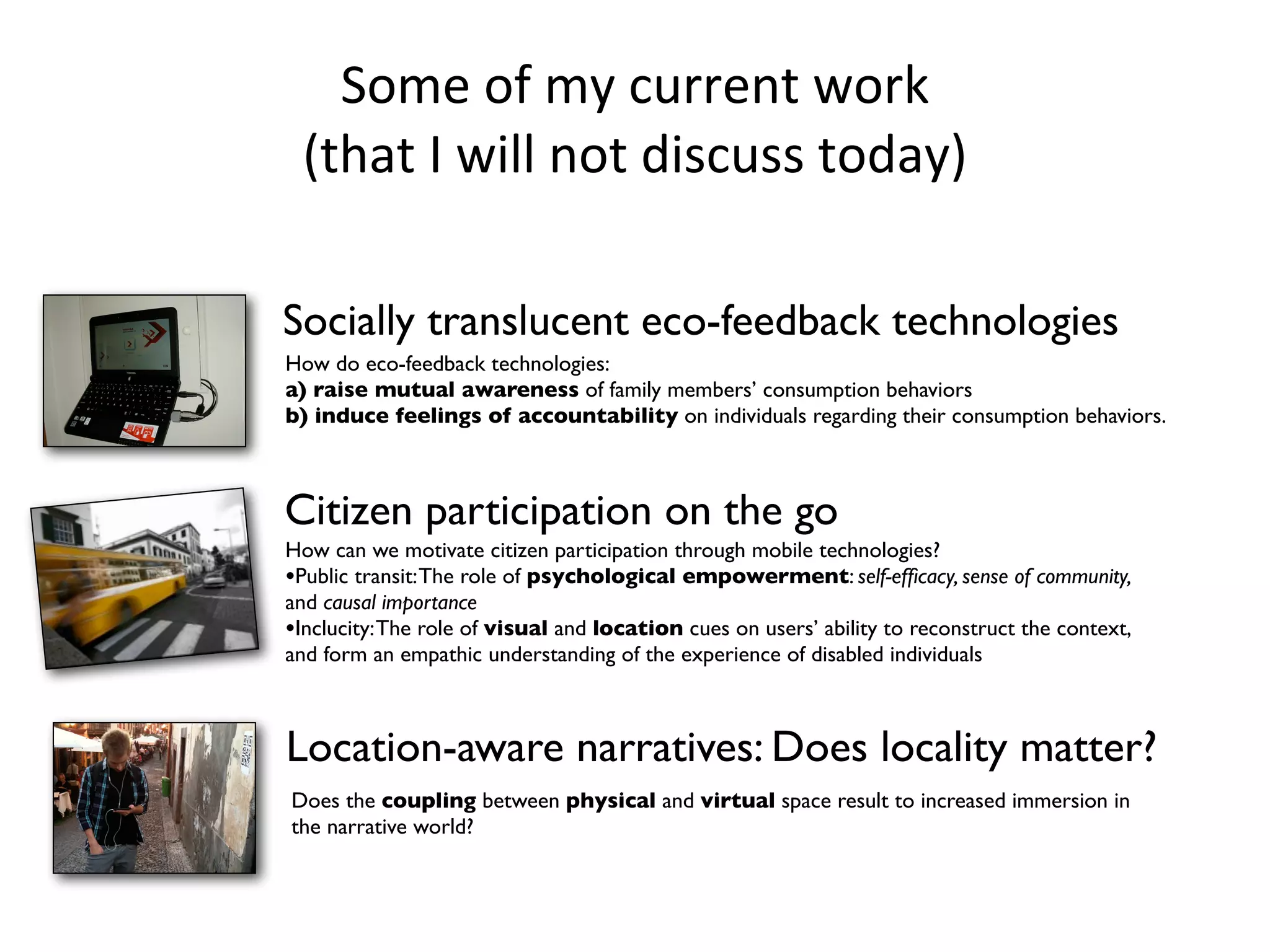
Some	
  of	
  my	
  current	
  work	
  
     (that	
  I	
  will	
  not	
  discuss	
  today)

    Socially translucent eco-feedback technologies
    How do eco-feedback technologies:
    a) raise mutual awareness of family members’ consumption behaviors
    b) induce feelings of accountability on individuals regarding their consumption behaviors.
!

    Citizen participation on the go
    How can we motivate citizen participation through mobile technologies?
    •Public transit: The role of psychological empowerment: self-efficacy, sense of community,
    and causal importance
    •Inclucity: The role of visual and location cues on users’ ability to reconstruct the context,
    and form an empathic understanding of the experience of disabled individuals


    Location-aware narratives: Does locality matter?
    Does the coupling between physical and virtual space result to increased immersion in
    the narrative world?
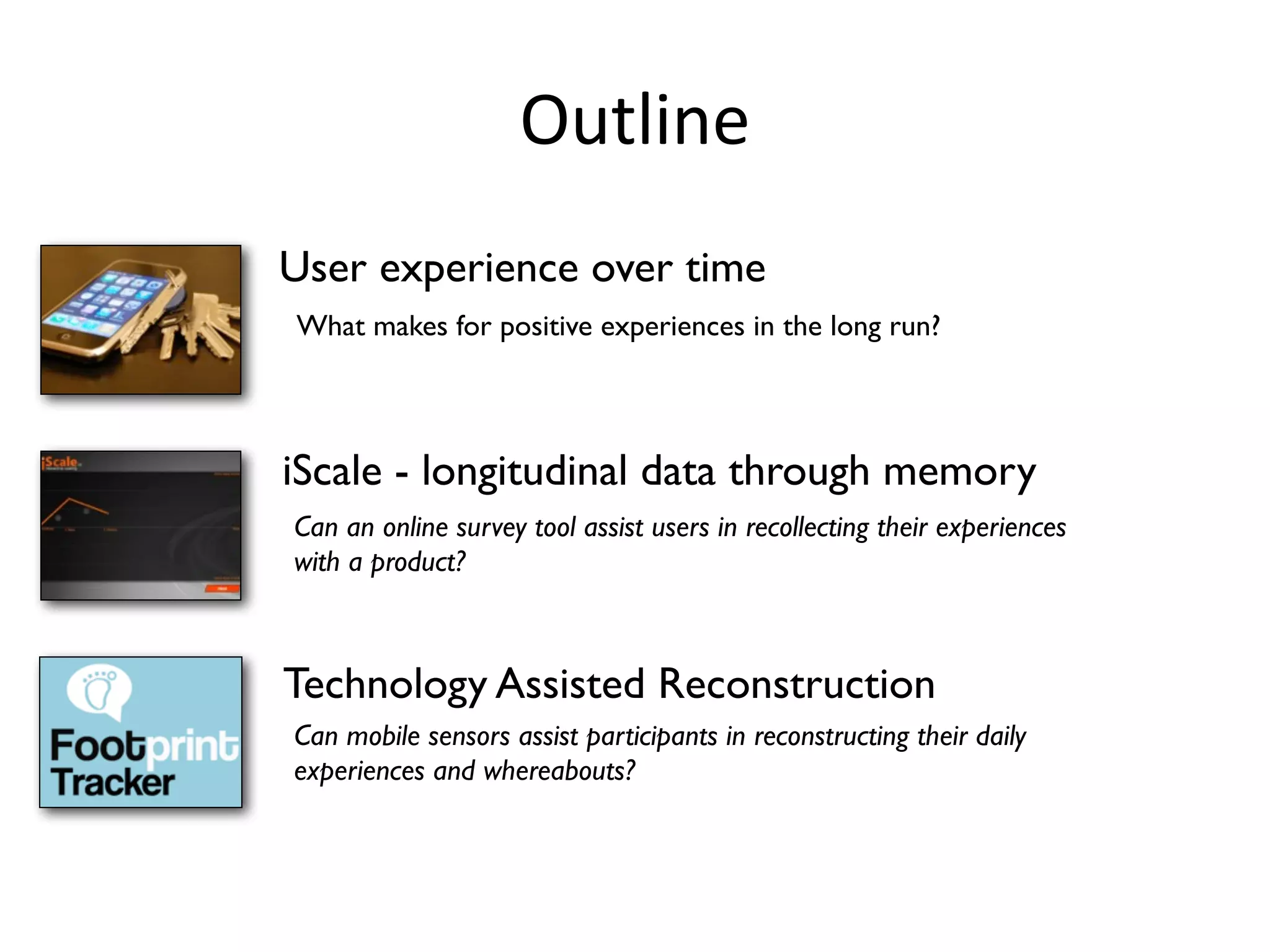
Outline
User experience over time
What makes for positive experiences in the long run?


iScale - longitudinal data through memory
Can an online survey tool assist users in recollecting their experiences
with a product?


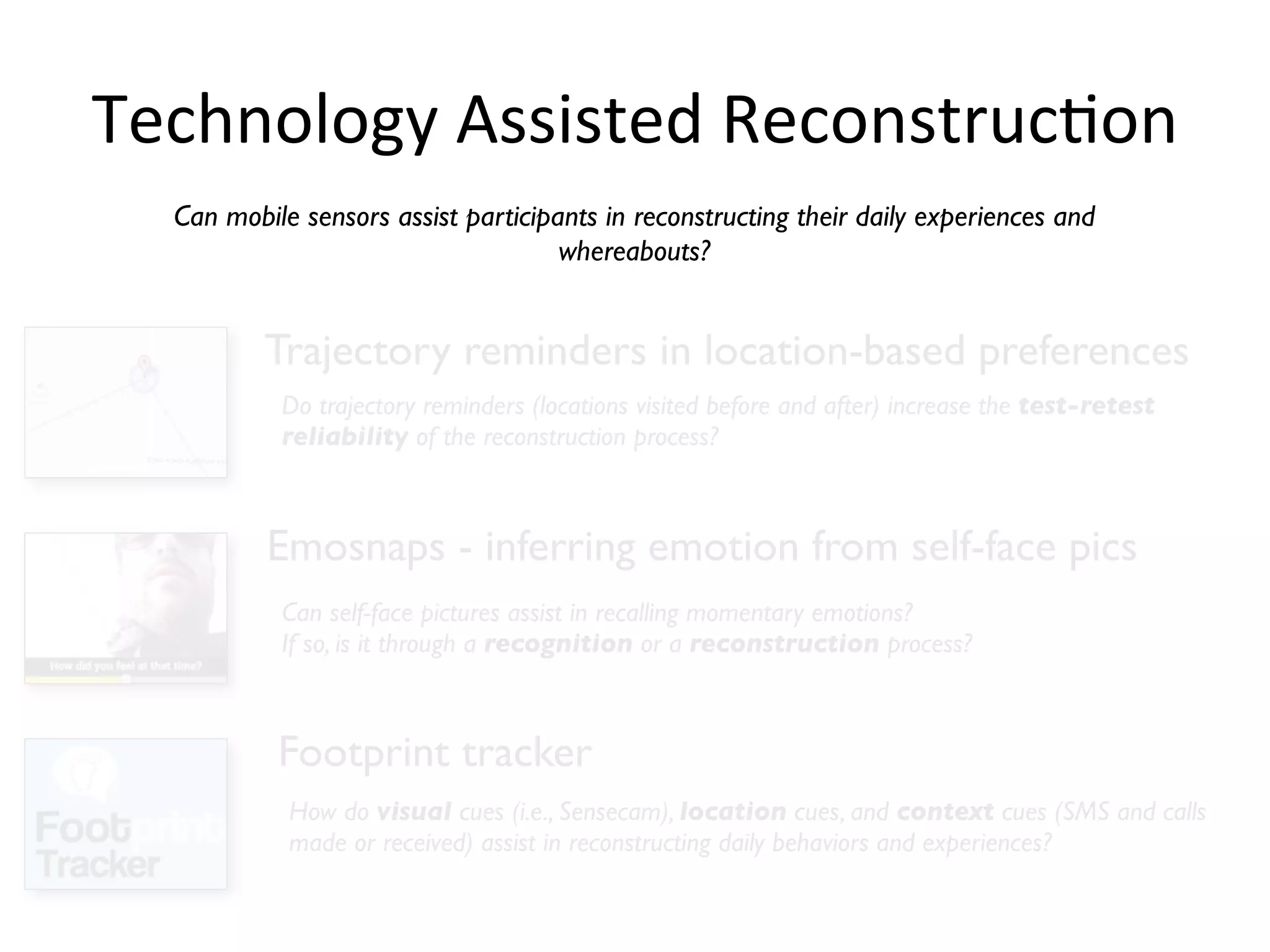
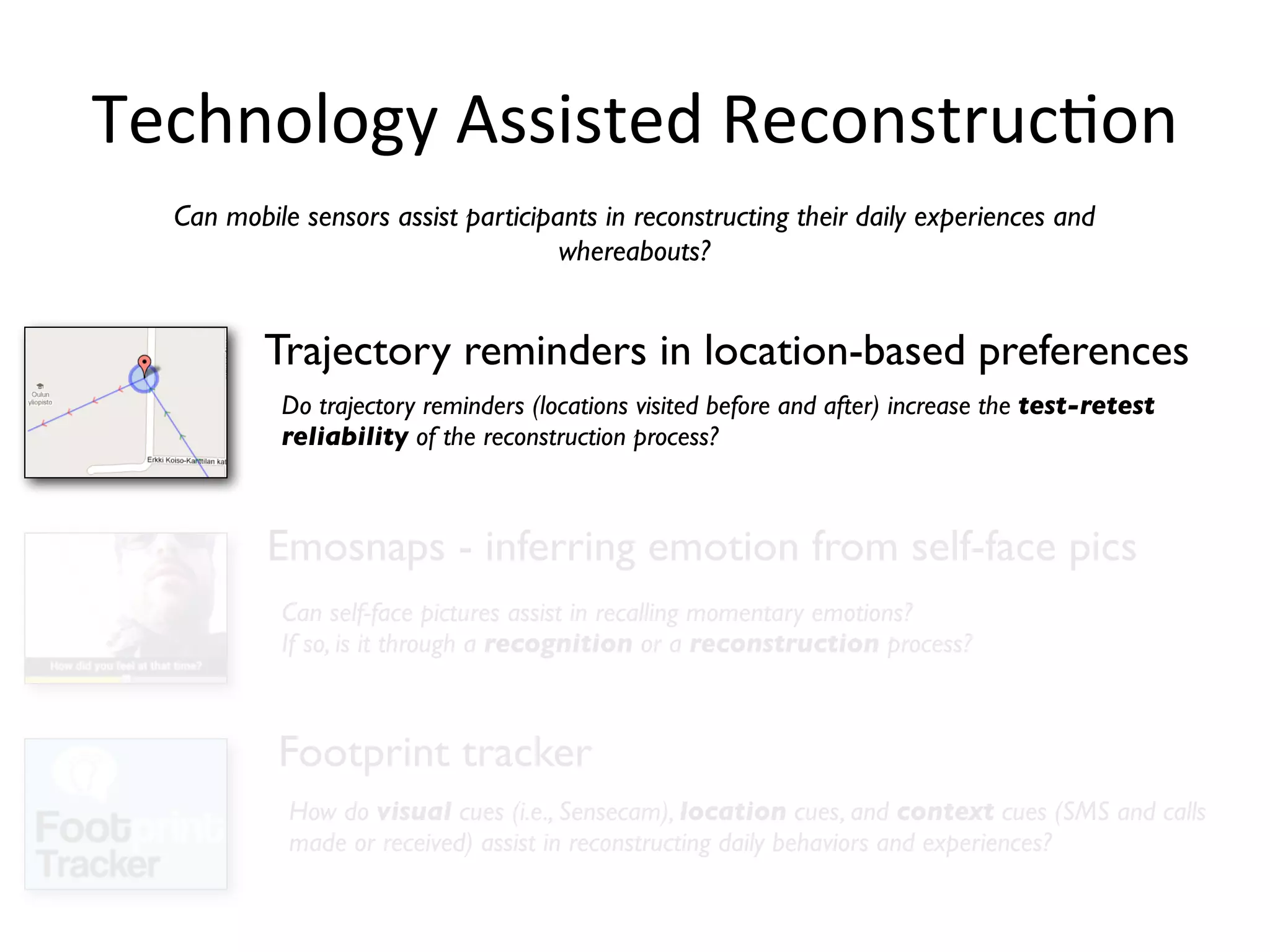
Technology Assisted Reconstruction
Can mobile sensors assist participants in reconstructing their daily
experiences and whereabouts?
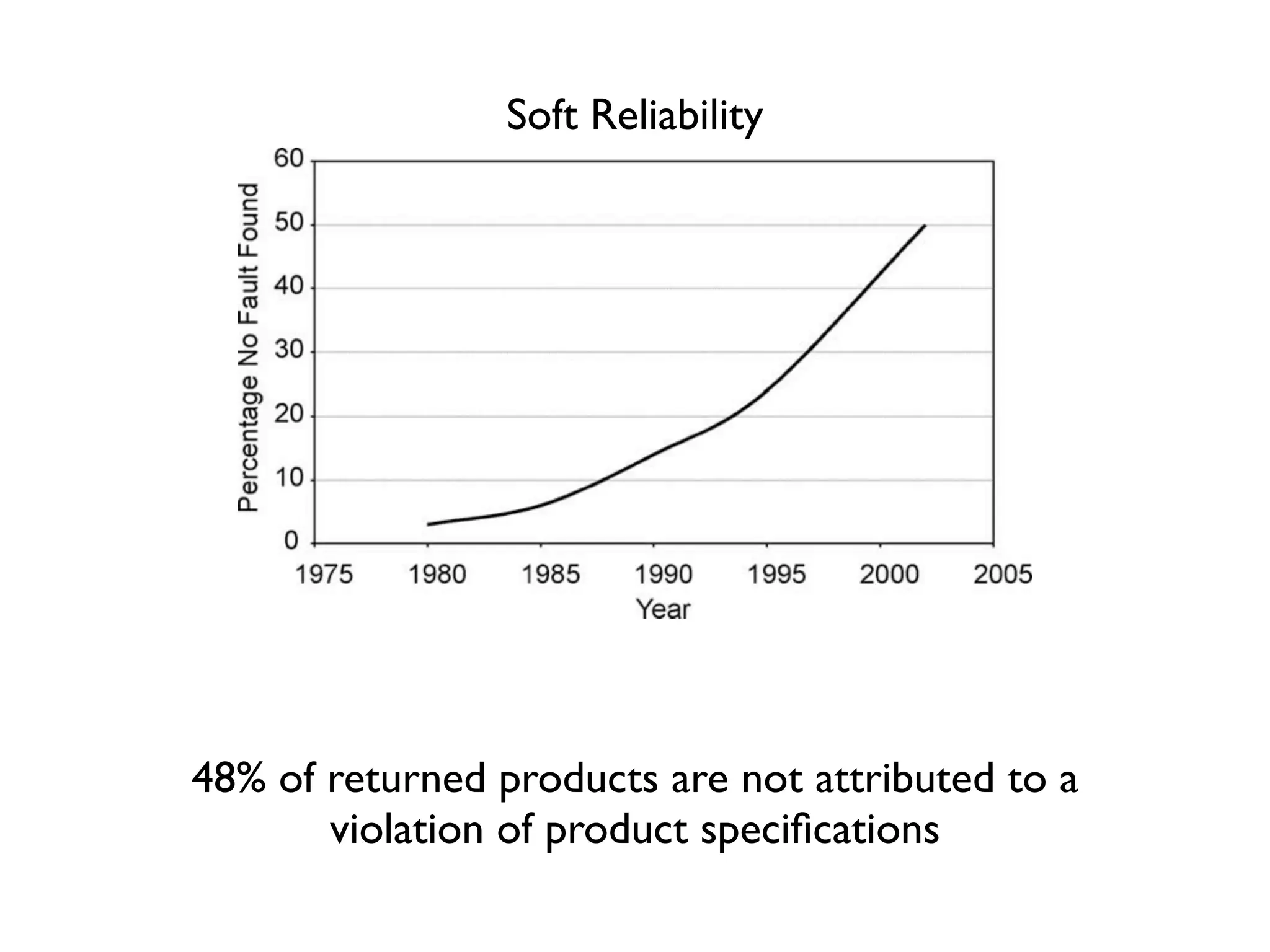
Soft Reliability


48% of returned products are not attributed to a
       violation of product specifications
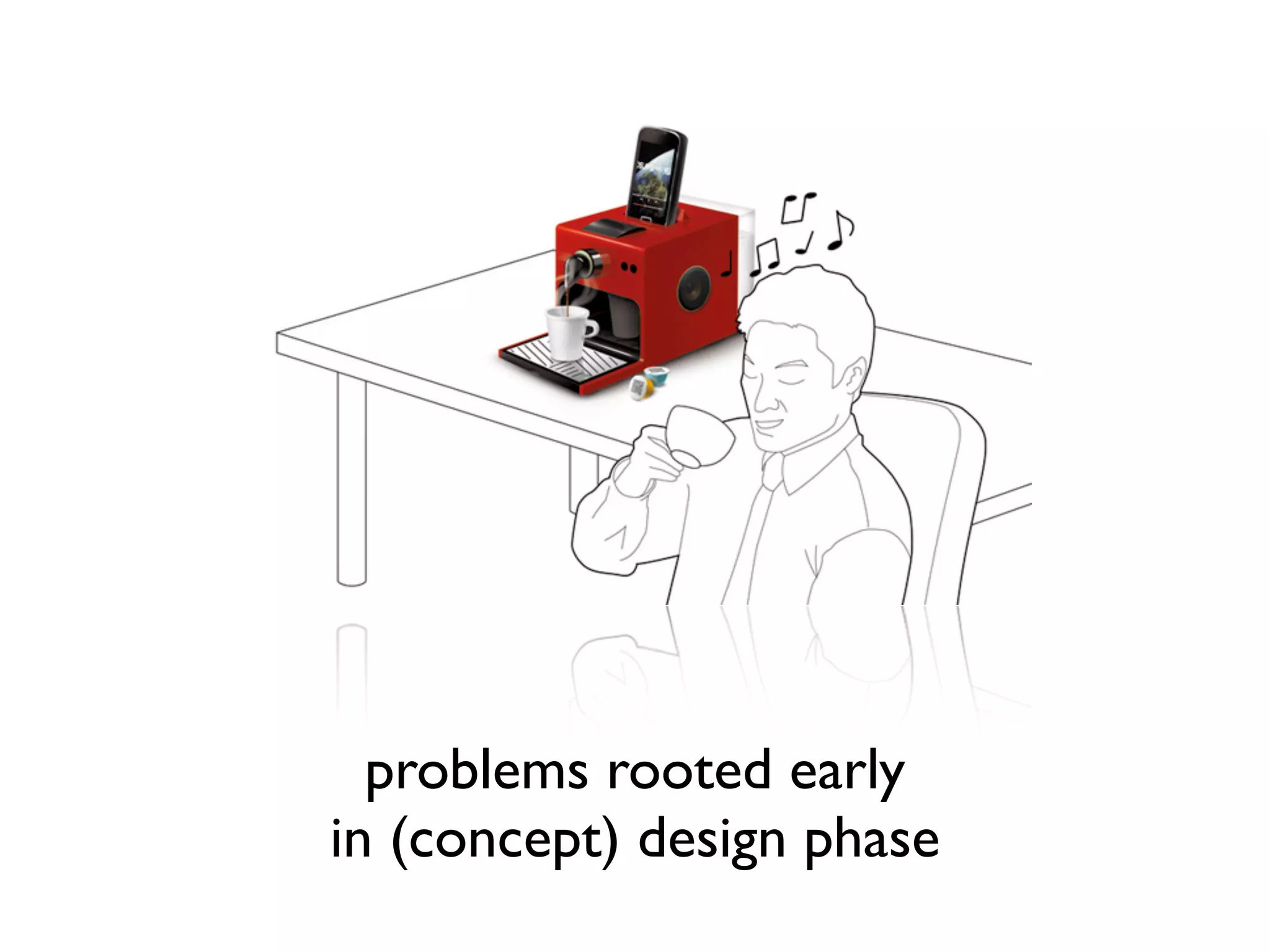
problems rooted early
in (concept) design phase
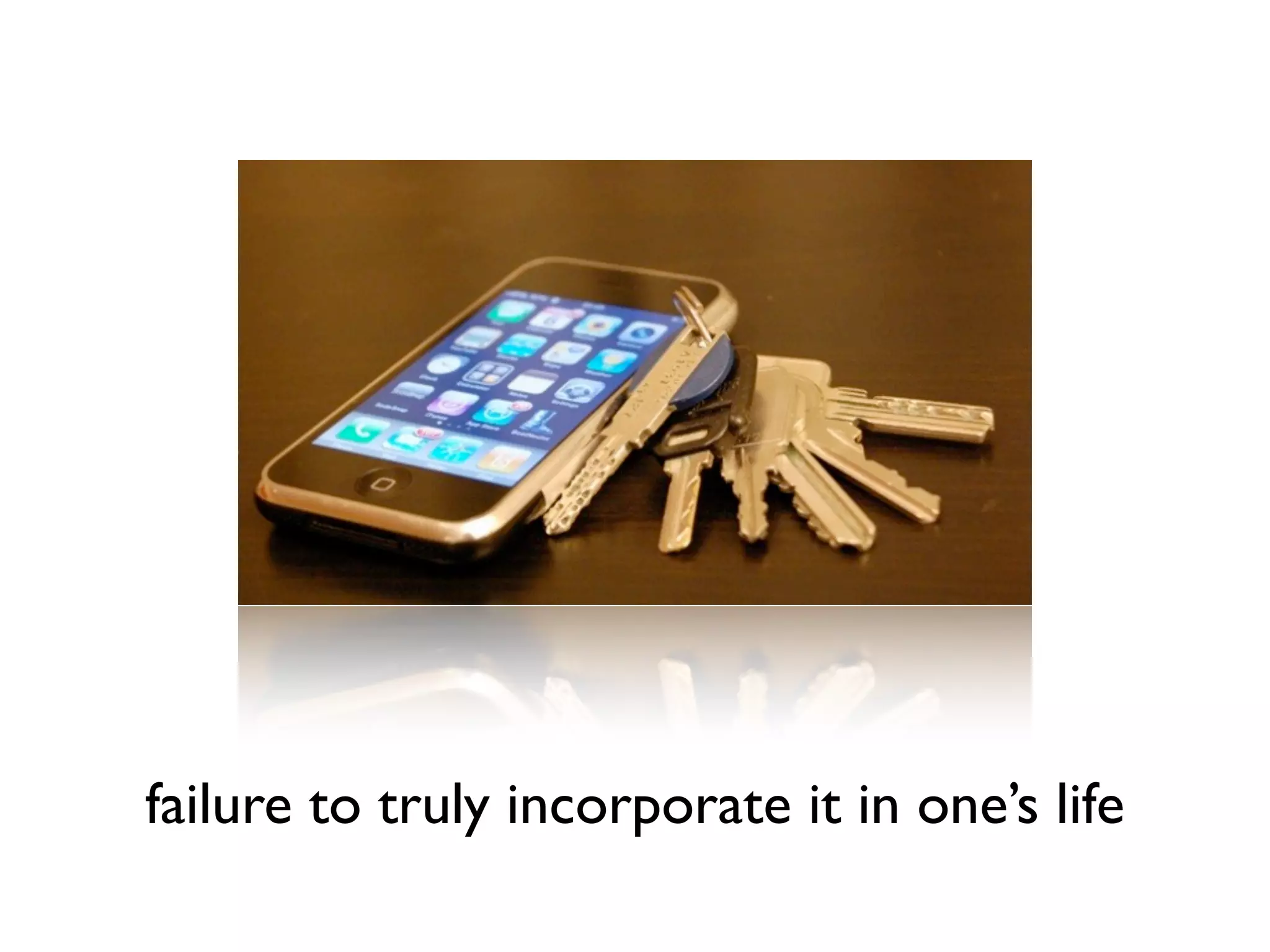
failure to truly incorporate it in one’s life
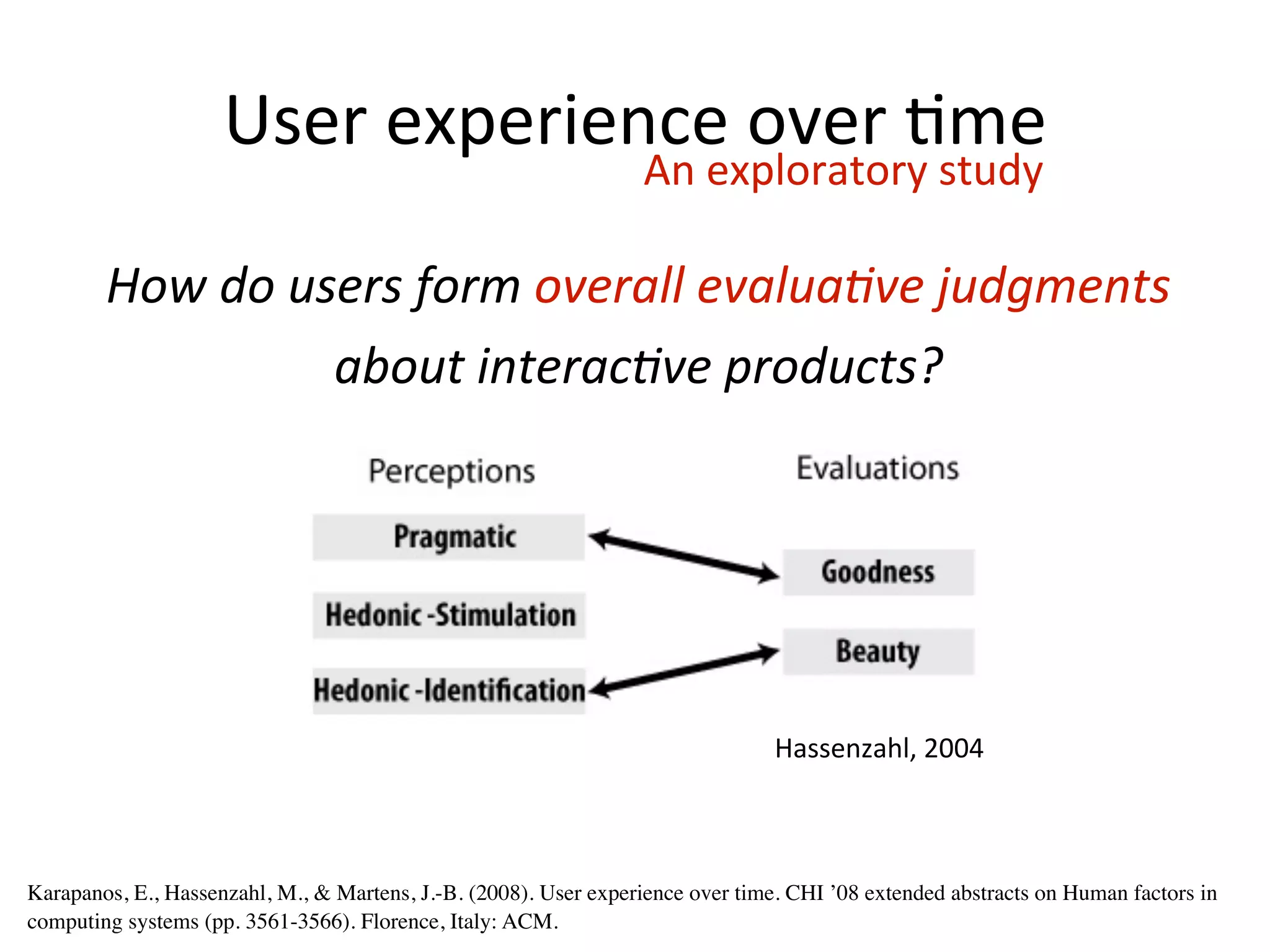
User	
  experience	
  over	
  Hme
                                                                  An	
  exploratory	
  study

        How	
  do	
  users	
  form	
  overall	
  evalua/ve	
  judgments	
  
                       about	
  interac/ve	
  products?


                                                                                Hassenzahl,	
  2004


Karapanos, E., Hassenzahl, M., & Martens, J.-B. (2008). User experience over time. CHI ’08 extended abstracts on Human factors in
computing systems (pp. 3561-3566). Florence, Italy: ACM.
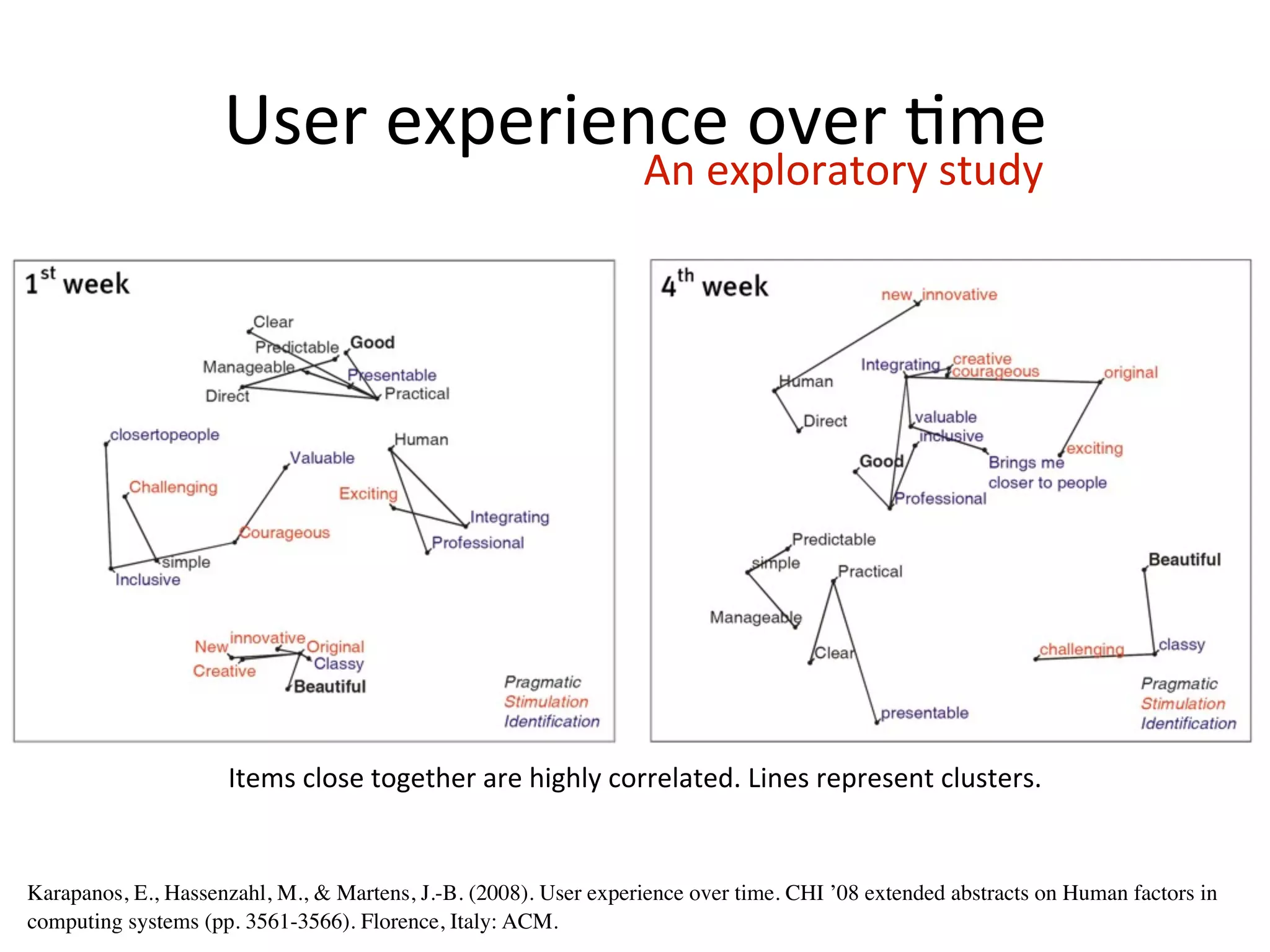
User	
  experience	
  over	
  Hme
                                                                    An	
  exploratory	
  study


                     Items	
  close	
  together	
  are	
  highly	
  correlated.	
  Lines	
  represent	
  clusters.


Karapanos, E., Hassenzahl, M., & Martens, J.-B. (2008). User experience over time. CHI ’08 extended abstracts on Human factors in
computing systems (pp. 3561-3566). Florence, Italy: ACM.
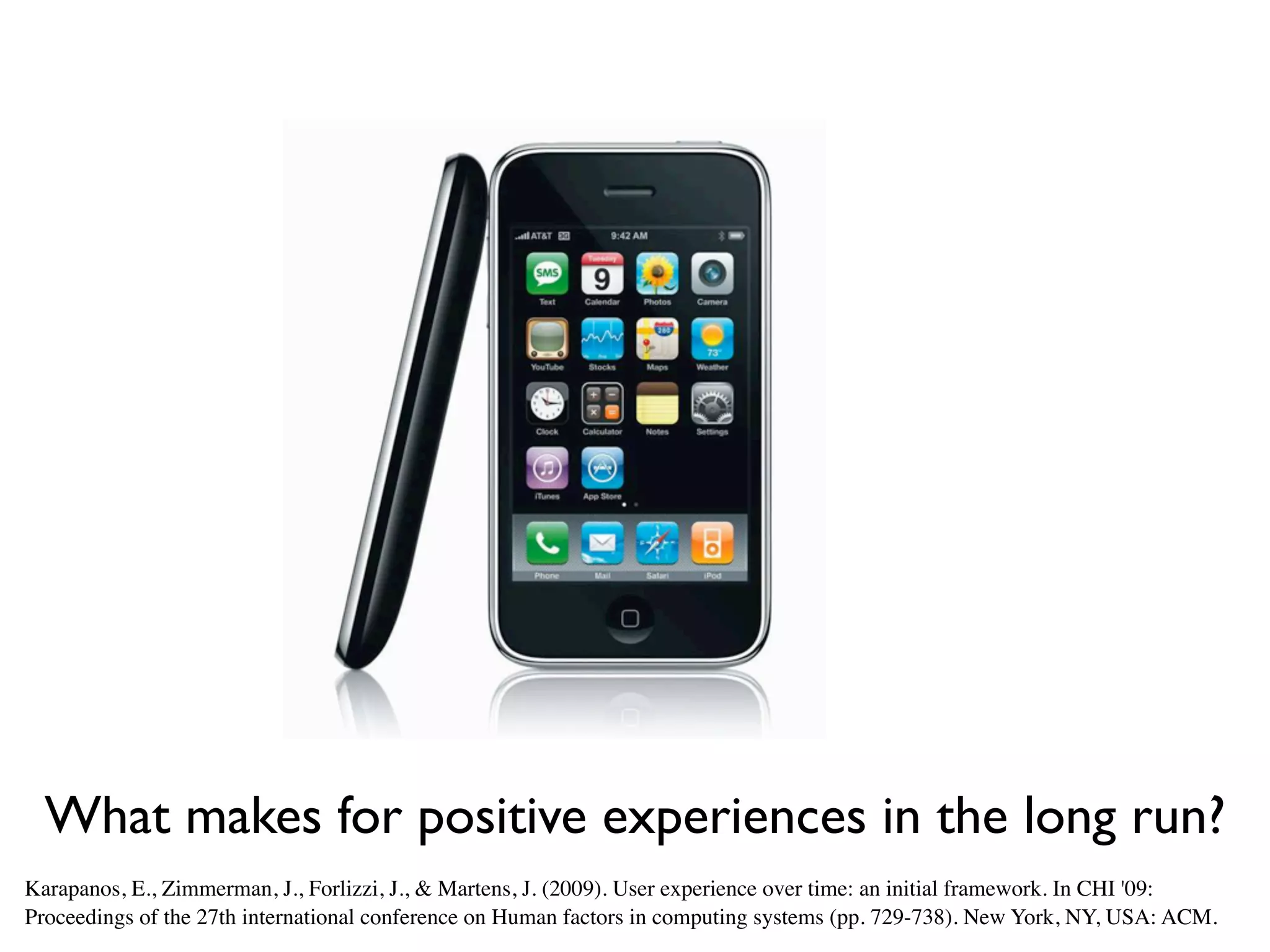
What makes for positive experiences in the long run?
Karapanos, E., Zimmerman, J., Forlizzi, J., & Martens, J. (2009). User experience over time: an initial framework. In CHI '09:
Proceedings of the 27th international conference on Human factors in computing systems (pp. 729-738). New York, NY, USA: ACM.
Now	
  think	
  of	
  the	
  three	
  experiences	
  that	
  were	
  for	
  you	
  personally	
  most	
  
             sa.sfying	
  or	
  unsa.sfying	
  experiences	
  of	
  today.	
  Please,	
  use	
  your	
  
             own	
  feeling	
  or	
  a	
  defini.on	
  of	
  what	
  “sa.sfying”	
  and	
  
             “unsa.sfying	
  experience”	
  means.	
  Take	
  a	
  couple	
  of	
  minutes	
  to	
  be	
  
             sure	
  to	
  come	
  up	
  with	
  three	
  most	
  crucial	
  experiences;	
  you	
  may	
  also	
  want	
  to	
  write	
  
             them	
  down	
  for	
  yourself.	
  We	
  want	
  you	
  to	
  be	
  open	
  as	
  to	
  which	
  experiences	
  to	
  
             report.


Karapanos, E., Zimmerman, J., Forlizzi, J., & Martens, J. (2009). User experience over time: an initial framework. In CHI '09:
Proceedings of the 27th international conference on Human factors in computing systems (pp. 729-738). New York, NY, USA: ACM.
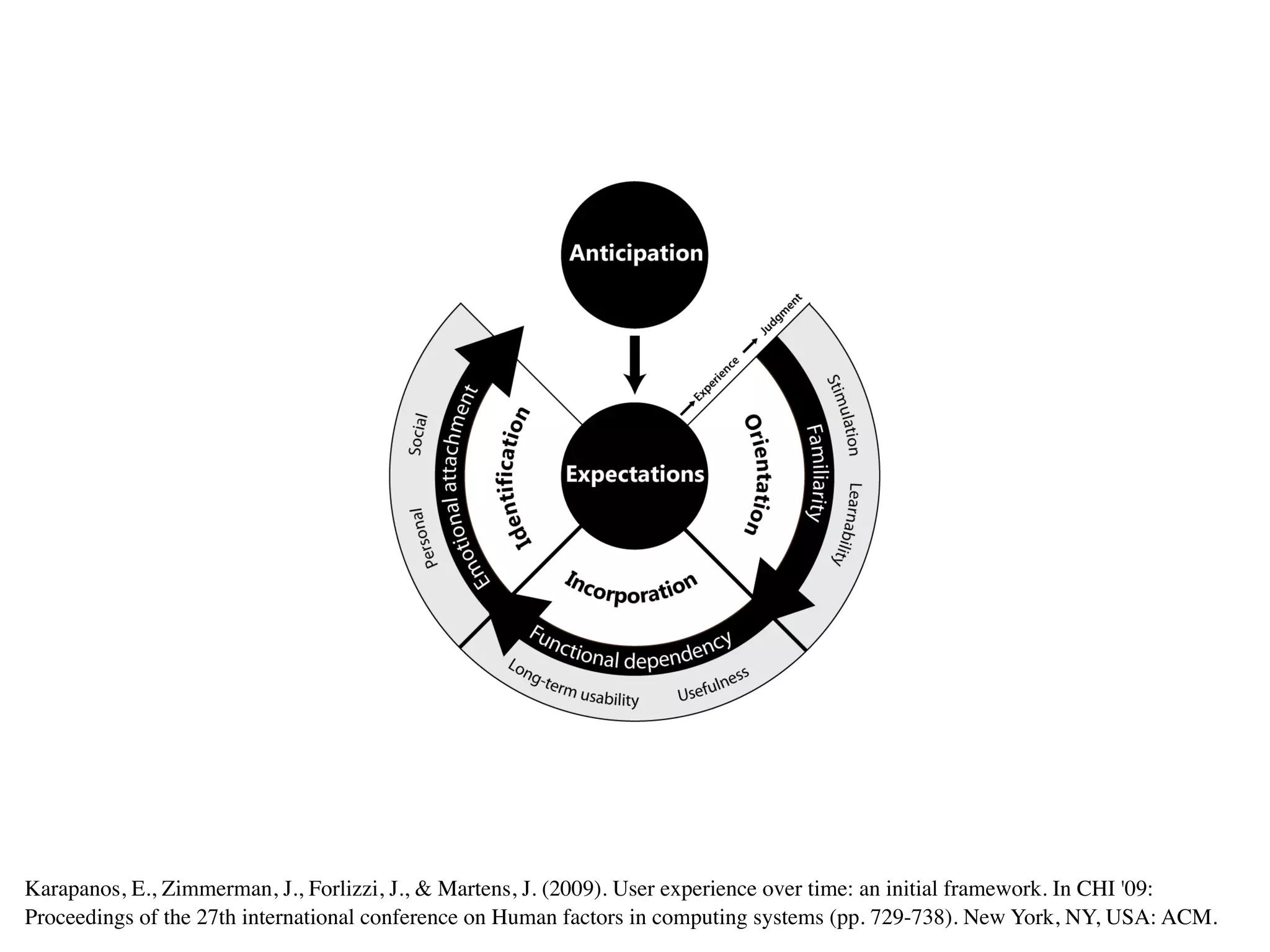
Karapanos, E., Zimmerman, J., Forlizzi, J., & Martens, J. (2009). User experience over time: an initial framework. In CHI '09:
Proceedings of the 27th international conference on Human factors in computing systems (pp. 729-738). New York, NY, USA: ACM.
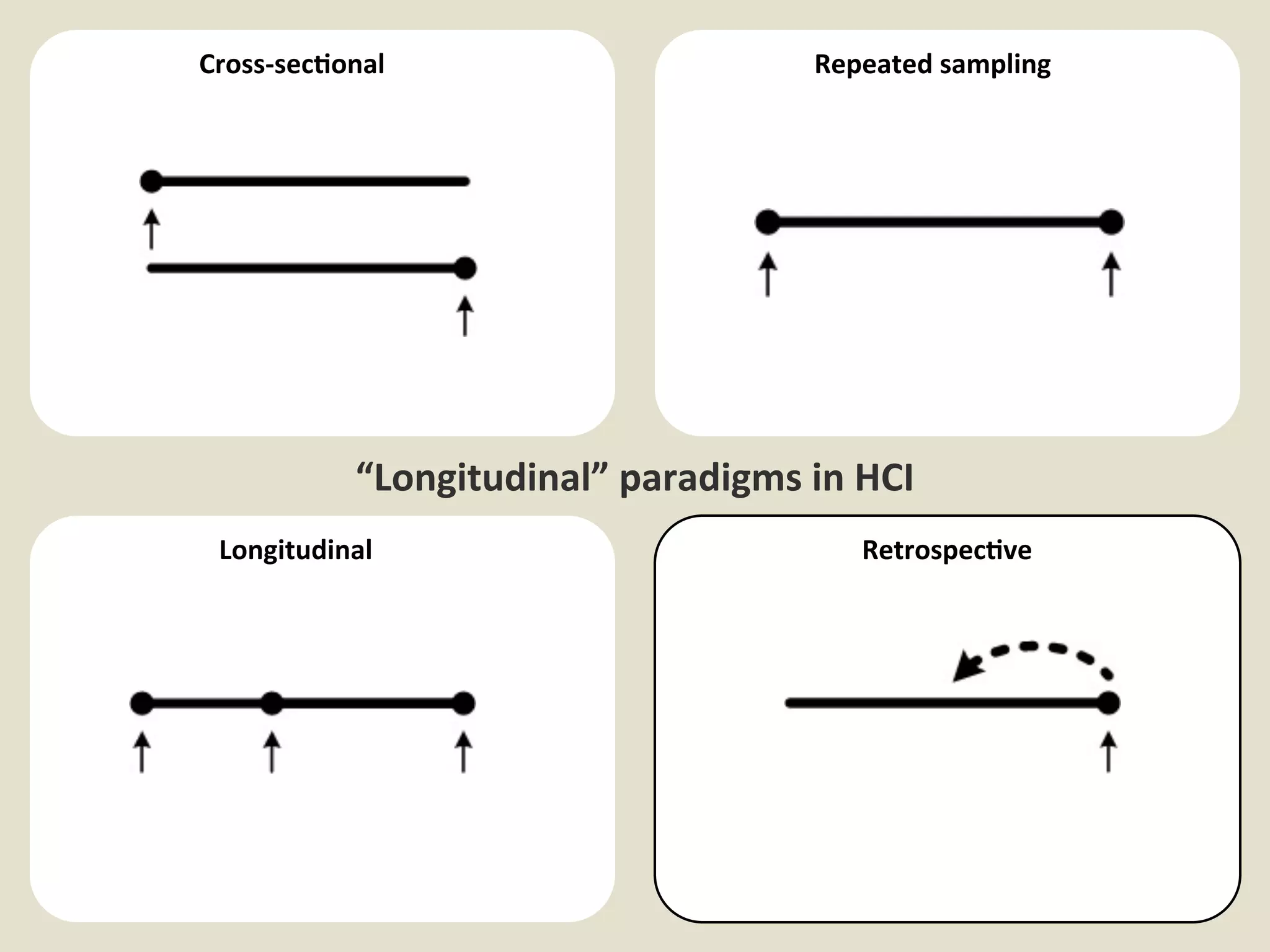
Cross-­‐sec8onal                             Repeated	
  sampling


             “Longitudinal”	
  paradigms	
  in	
  HCI
 Longitudinal                                    Retrospec8ve
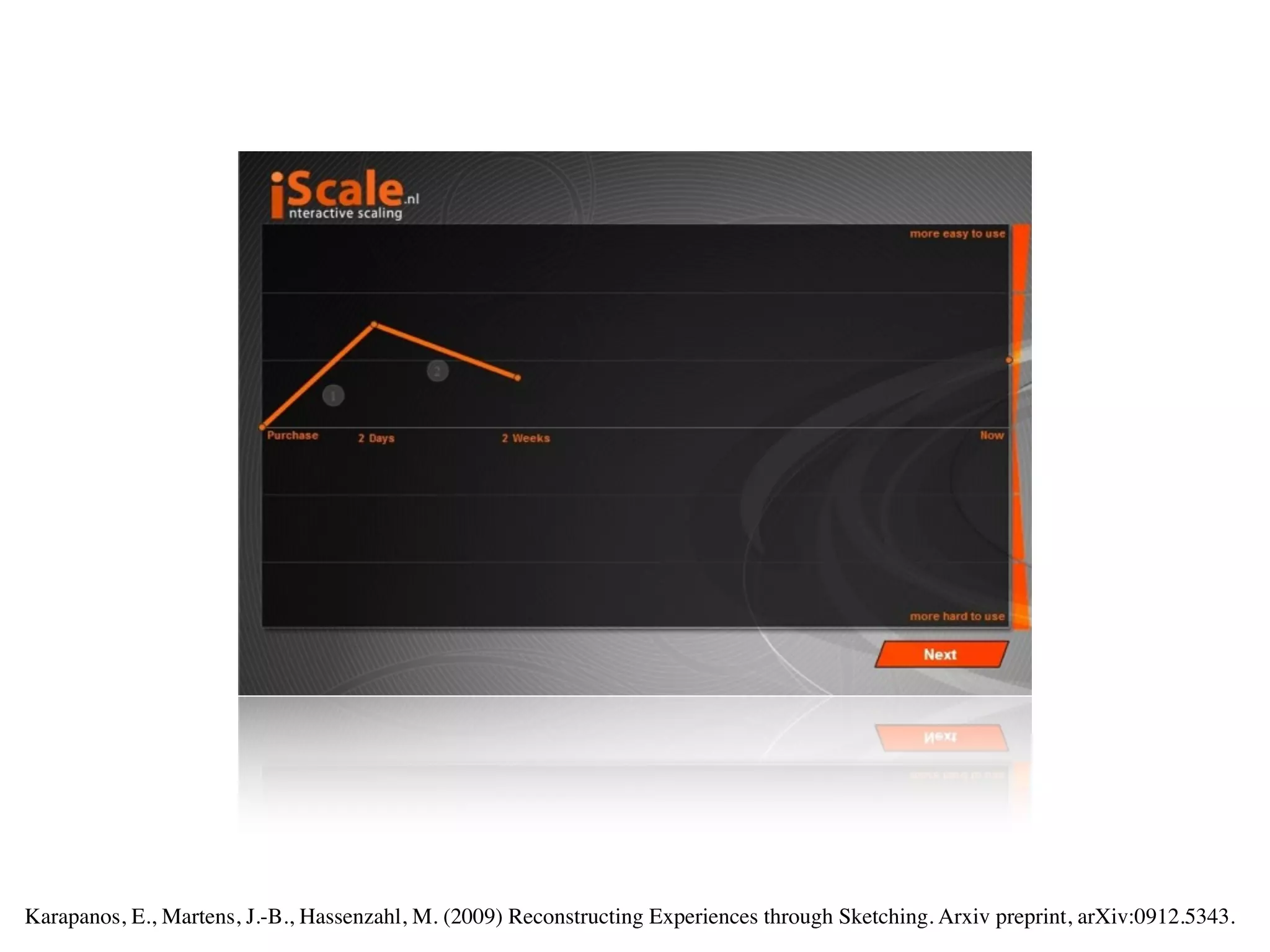
Karapanos, E., Martens, J.-B., Hassenzahl, M. (2009) Reconstructing Experiences through Sketching. Arxiv preprint, arXiv:0912.5343.
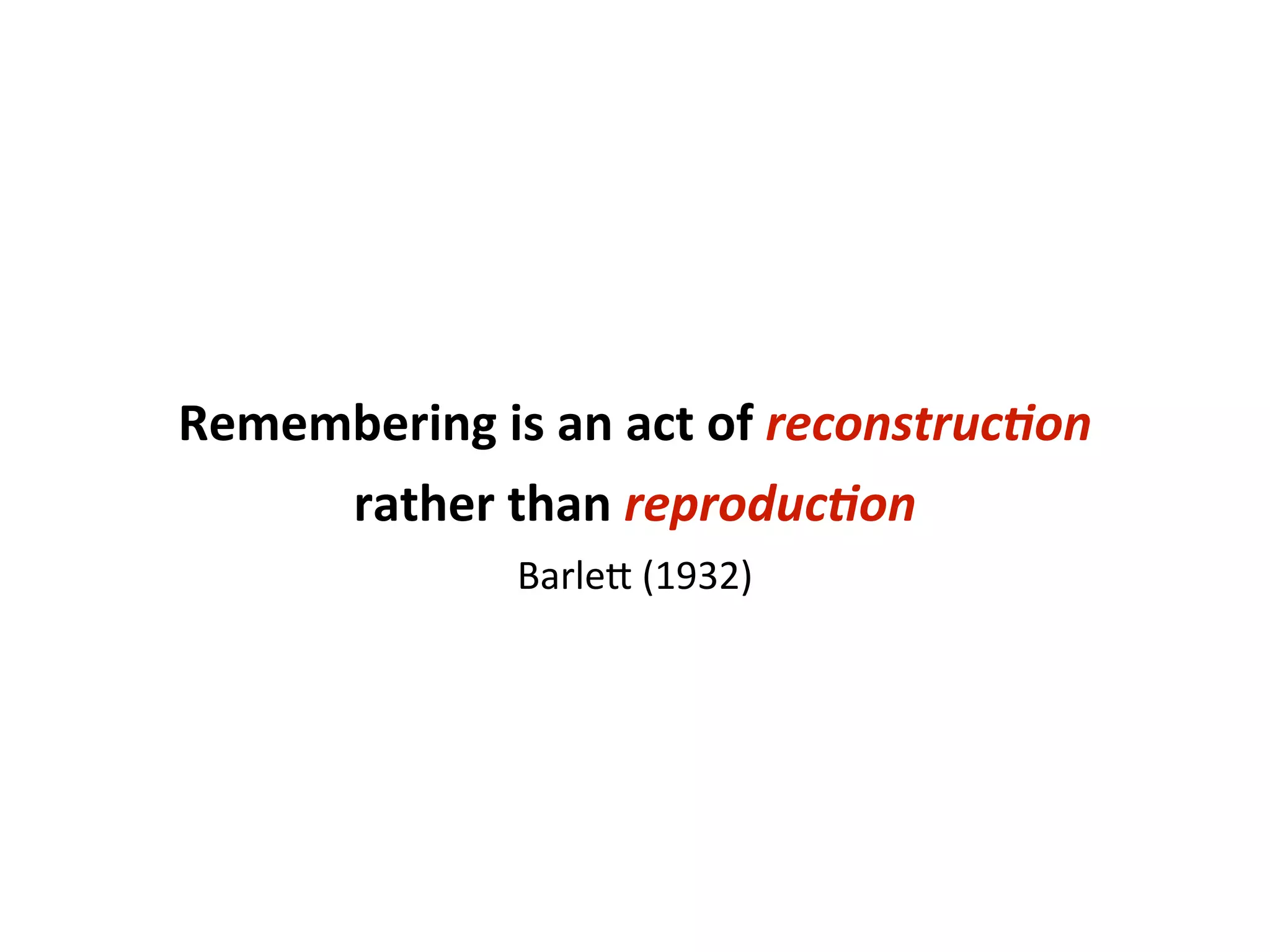
Remembering	
  is	
  an	
  act	
  of	
  reconstruc.on	
  
     rather	
  than	
  reproduc.on
                    Barlea	
  (1932)
How do we recall experiences?

• Validity? i.e. do memories reflect what we really
  experienced?

• Reliability? i.e. in a second trial, will we recall
  the same experiences?


      Can we assist people in recalling - more
    reliably - their experiences with a product?
How do we recall emotional
         experiences?

Two schools of thought
  - The Constructive approach
  - The Value-Account approach
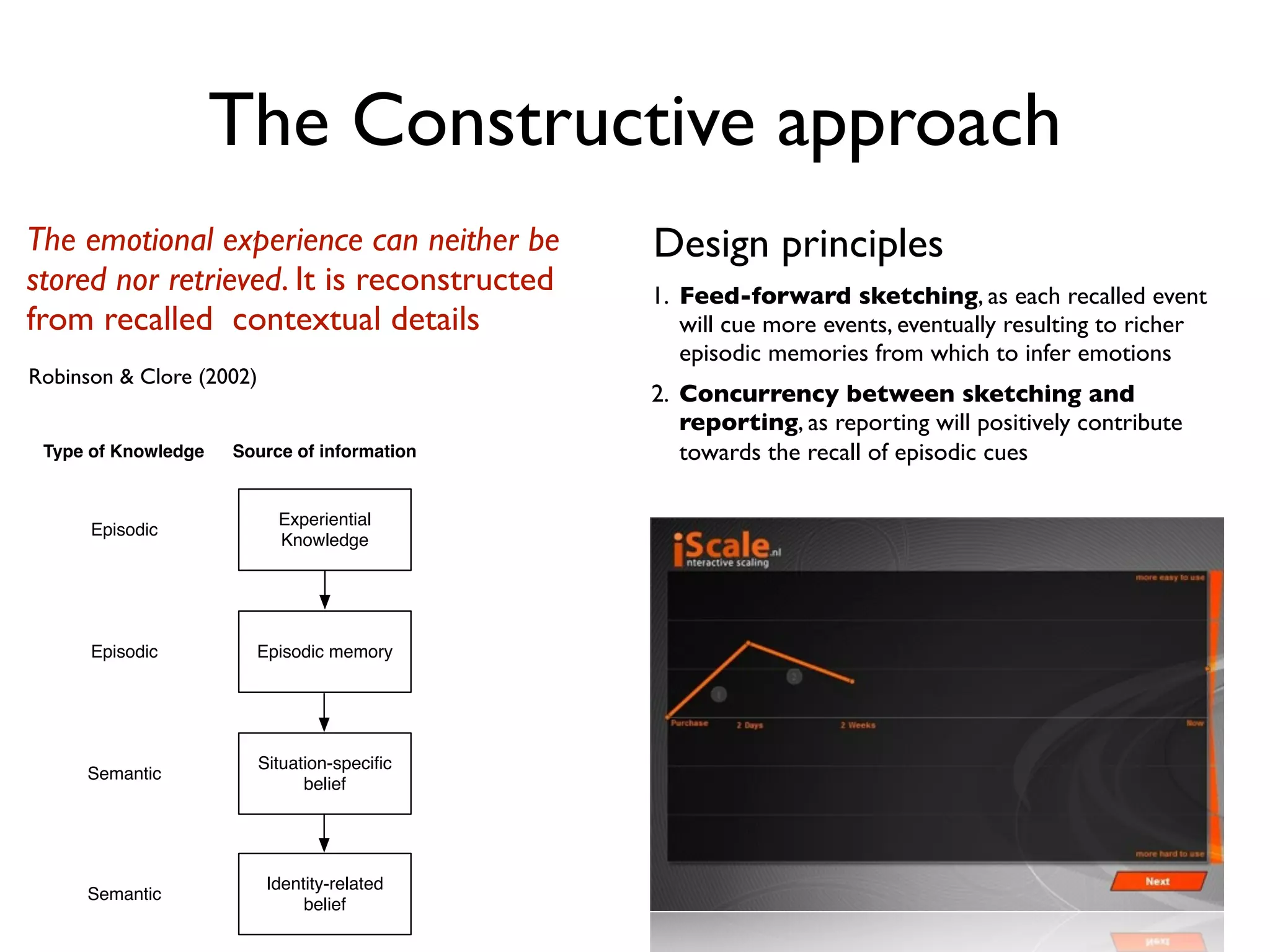
The Constructive approach
The emotional experience can neither be                              Design principles
stored nor retrieved. It is reconstructed                            1. Feed-forward sketching, as each recalled event
from recalled contextual details                                        will cue more events, eventually resulting to richer
                                                                        episodic memories from which to infer emotions
Robinson & Clore (2002)
                                                                     2. Concurrency between sketching and
                                                                        reporting, as reporting will positively contribute
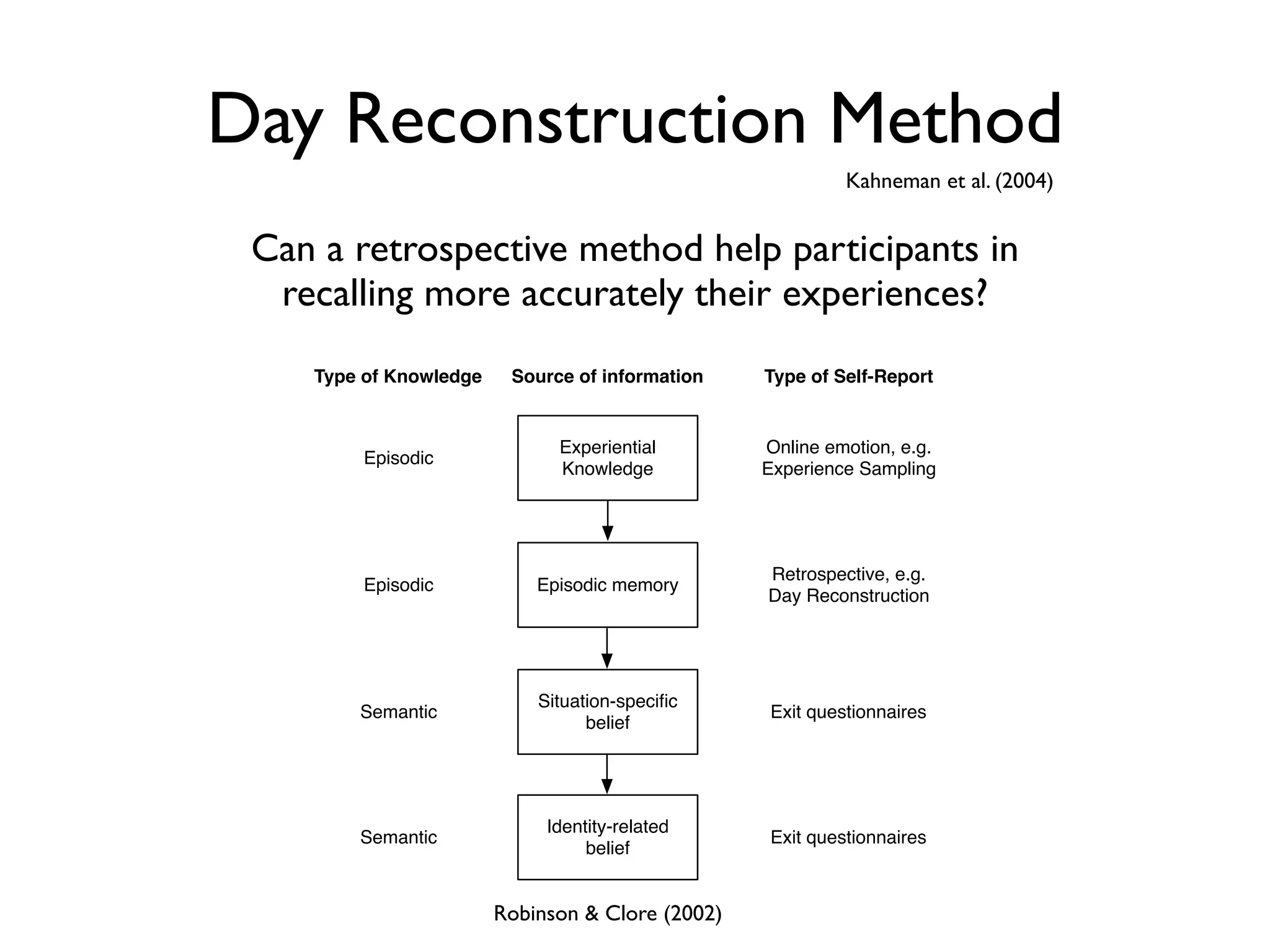
 Type of Knowledge   Source of information    Type of Self-Report       towards the recall of episodic cues

                            Experiential      Online emotion, e.g.
      Episodic
                            Knowledge         Experience Sampling


                                              Retrospective, e.g.
      Episodic         Episodic memory
                                              Day Reconstruction


                          Situation-specific
     Semantic                                  Exit questionnaires
                                belief


                           Identity-related
     Semantic                                  Exit questionnaires
                                belief
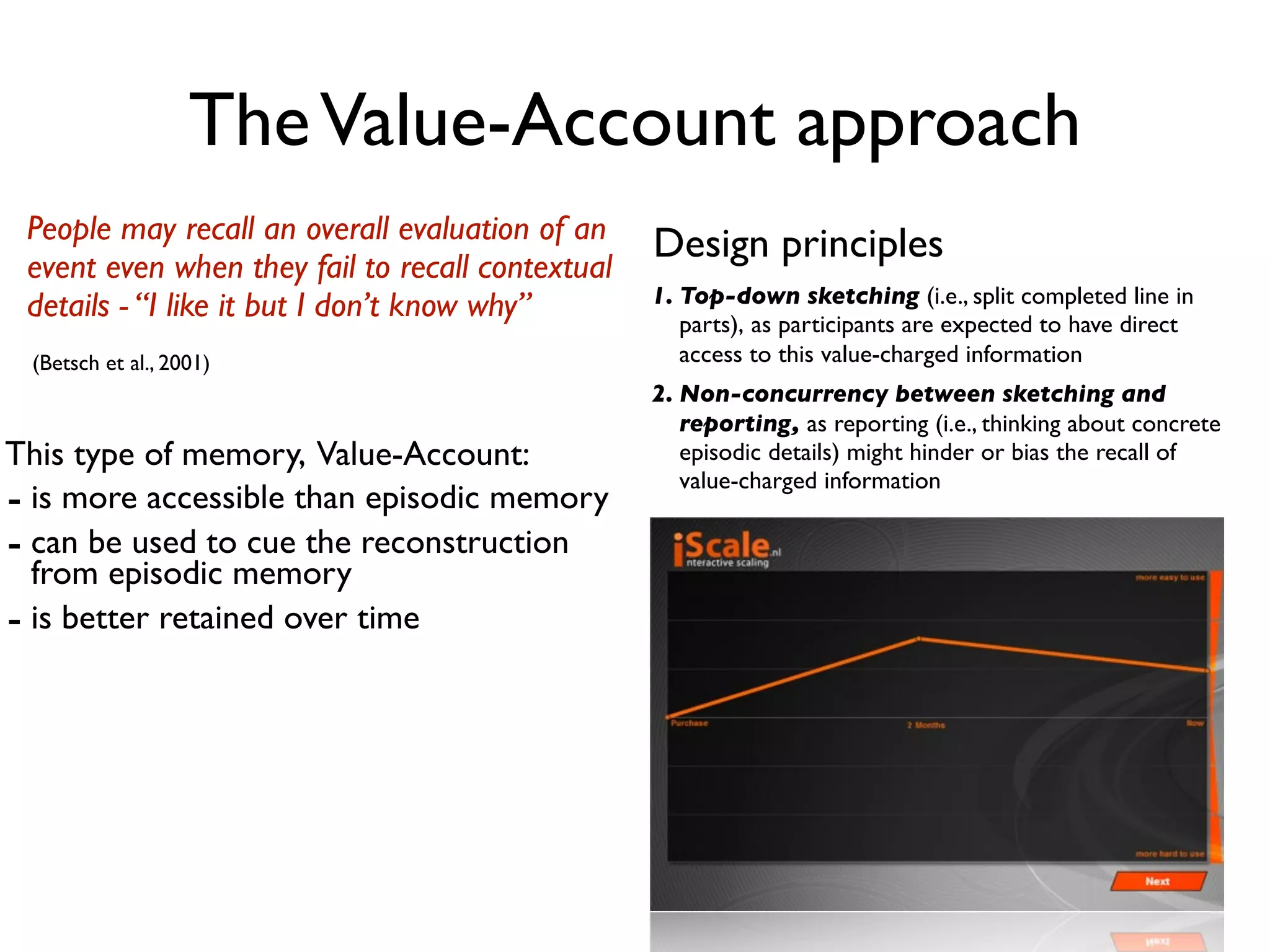
The Value-Account approach
 People may recall an overall evaluation of an    Design principles
 event even when they fail to recall contextual
                                                  1. Top-down sketching (i.e., split completed line in
 details - “I like it but I don’t know why”          parts), as participants are expected to have direct
 (Betsch et al., 2001)                               access to this value-charged information
                                                  2. Non-concurrency between sketching and
                                                     reporting, as reporting (i.e., thinking about concrete
This type of memory, Value-Account:                  episodic details) might hinder or bias the recall of
                                                     value-charged information
- is more accessible than episodic memory
- can be used to cue the reconstruction
  from episodic memory
- is better retained over time
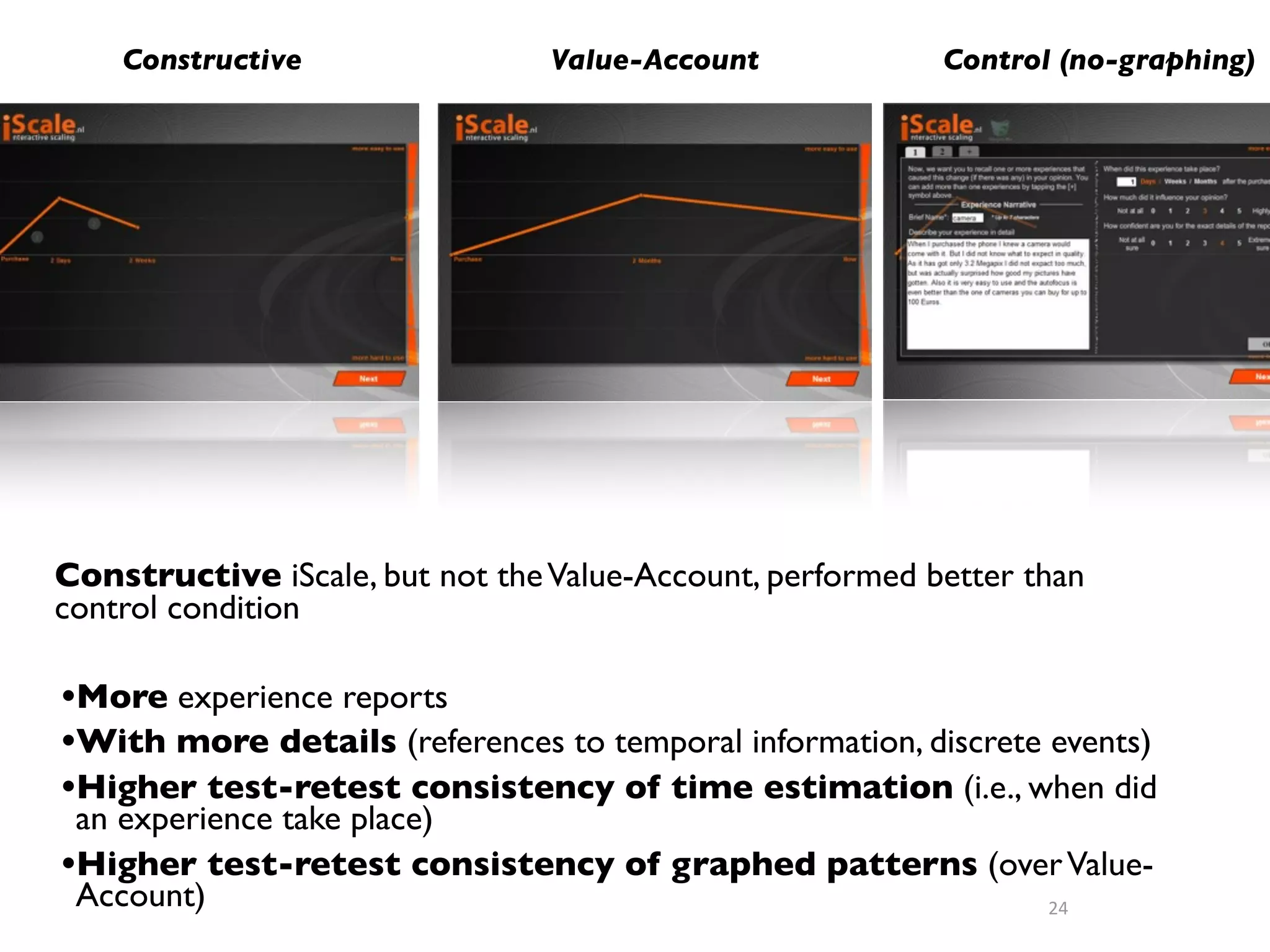
Constructive                 Value-Account             Control (no-graphing)


Constructive iScale, but not the Value-Account, performed better than
control condition

•More experience reports
•With more details (references to temporal information, discrete events)
•Higher test-retest consistency of time estimation (i.e., when did
 an experience take place)
•Higher test-retest consistency of graphed patterns (over Value-
 Account)                                               24
Technology Assisted Reconstruction


Trajectory reminders   Emosnaps   Footprint tracker


                                                Newcastle, 8 March 2011
Experience Sampling Method
                     What variables do ES studies measure?
                     We distinguish below between self-reported measures of
                     behavior and experience (see Table 1). This distinction is
                                                                                     sampling method. Two of these provided no justifications
                                                                                     for their choice. Analyzing the remaining 19 papers resulted
                                                                                     to a total of 11 reasons for choosing alternative methods to
                     relevant as their reconstruction follows a different process    ESM (see table 2).
                     whereas behavioral information may be directly accessible
                     through episodic memory while experiential information            Table 2. Reasons for not selecting the Experience Sampling
Prompts at random, or computationally
                     has to be further inferred from recalled episodic cues [63].      Method along with frequency of occurence (No of papers).

                   to self-report on ongoing
estimated times,measures of of ES studies eliciting or both.
             Table 1. Number
                             behavior, experience,
                                                    self-reported                                             Reason                         No

behaviors and experiences.                                                            Disrupts the activity                                   6
                             Type of measures that studies elicit          No
                                                                                      Imposes high burden to participants                     3
– Where areSelf-reported measures of behavior
              you?                                                          5
                                                                                      Requires high effort from researchers                   3
– What are you doing? of experience
            Self-reported measures                                         22
– How far isSelf-reported measures phone?& experience
             your mobile of behavior                                       18
                                                                                      Inappropriate for eliciting rich qualitative data       3

– How do you feel?                                                                    Misses rare and brief events                            3
                    Behavioral measures related most frequently to the activity
    a few relevant venues would still miss a substantial number method while following a user-initiated diary approach.
    of studies. We instead used the ACM Guide towas engaged with prior to of the remaining 49 user should be reported
                    (n=18) that the participant Computing       The analysis being       The studies is being in control of when, what and    2
    Literature querying for the term “experience duration (n=2) (e.g. [35]), the
                    interrupted (e.g. [30]), its      sampling” below.                   how often to report
                 No of papers referring to
    without constraining to particular venues. This query
                    participant’s current physical location (n=15) length, sampling frequency, and response rate
    returned 284 papers, published in more than fifty venues.    Study
                                                                       (e.g. [17])
                    Experience Sampling
                    and the social context (n=10), e.g. the number or nature of of the studies had a duration of several
                                                                The majority (80%)       Limits sample size                                   2
         60
                    relationship of people that are in close proximity or
                                                                days up to one month with 14 studies (34%) lasting
                    participate with in a conversation (e.g. [34]). Other seven days (see figure 3). Only two
                                                                between four and         Depends on participants’ ability to articulate       2
         45         measures of behavior related to mode studies had a duration of more than a month.
                                                                 of transit [25],     ongoing experience
                     participants’ current physical engagement [18] and mode of
                                                                  15
                     convrersation (e.g. f2f, fixed/mobile phone etc.) [32].
         30                                                                           Poses privacy concerns                                  2
                     Experiential measures related to:
         15
                                                                  10
                     • Attitudes towards behaviors or events (n=15) such as           Limits number of measured variables                     1
          0            being interrupted (e.g. [55]), disclosing information to
              2001    2003 2005 2007 2009 2011being video recorded (e.g.
                       relevant others (e.g. [17]), or                                Technology limitations                                  1
                                                                   5
                       [58]).
     Figure 2. 243 papers referring to experience sampling over a
Day Reconstruction Method
                                                                               Kahneman et al. (2004)


                    Can a retrospective method help participants in
                     recalling more accurately their experiences?

 ry attempt to         Type of Knowledge    Source of information    Type of Self-Report

ntation of the
an unfamiliar               Episodic
                                                 Experiential
                                                 Knowledge
                                                                     Online emotion, e.g.
                                                                     Experience Sampling
 called stories
 tails, altering
  in applying                                                        Retrospective, e.g.
                            Episodic           Episodic memory
 riginal story.                                                      Day Reconstruction

  h repeated
                                               Situation-specific
                           Semantic                                   Exit questionnaires
econstruction                                        belief

 e support. At
 ion between
                                                Identity-related
hile episodic              Semantic
                                                     belief
                                                                      Exit questionnaires
 om the past,
lar event but                              Robinson & Clore (2002)
Technology	
  Assisted	
  ReconstrucHon
  Can mobile sensors assist participants in reconstructing their daily experiences and
                                     whereabouts?


          Trajectory reminders in location-based preferences
           Do trajectory reminders (locations visited before and after) increase the test-retest
           reliability of the reconstruction process?


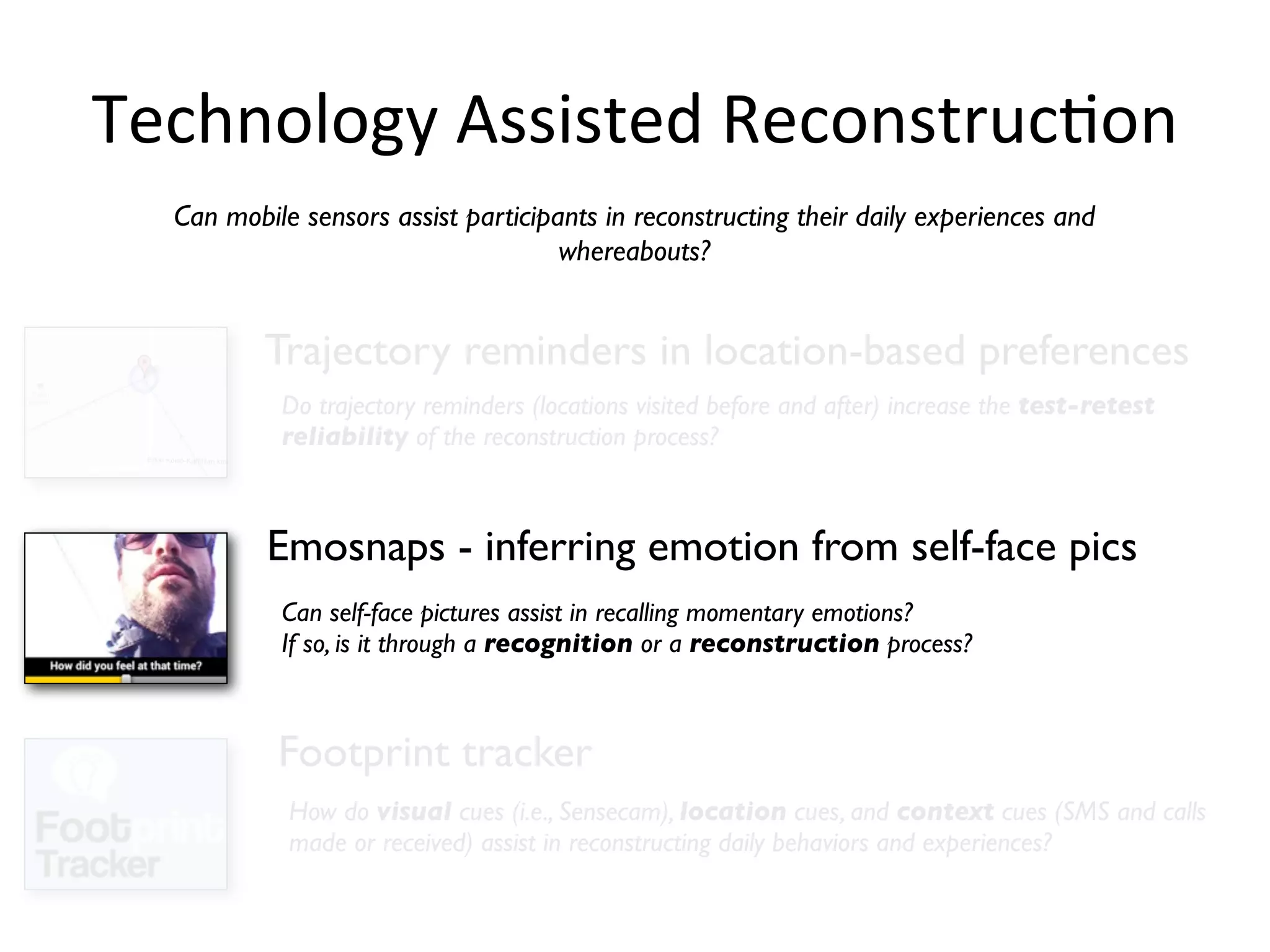
          Emosnaps - inferring emotion from self-face pics
           Can self-face pictures assist in recalling momentary emotions?
           If so, is it through a recognition or a reconstruction process?


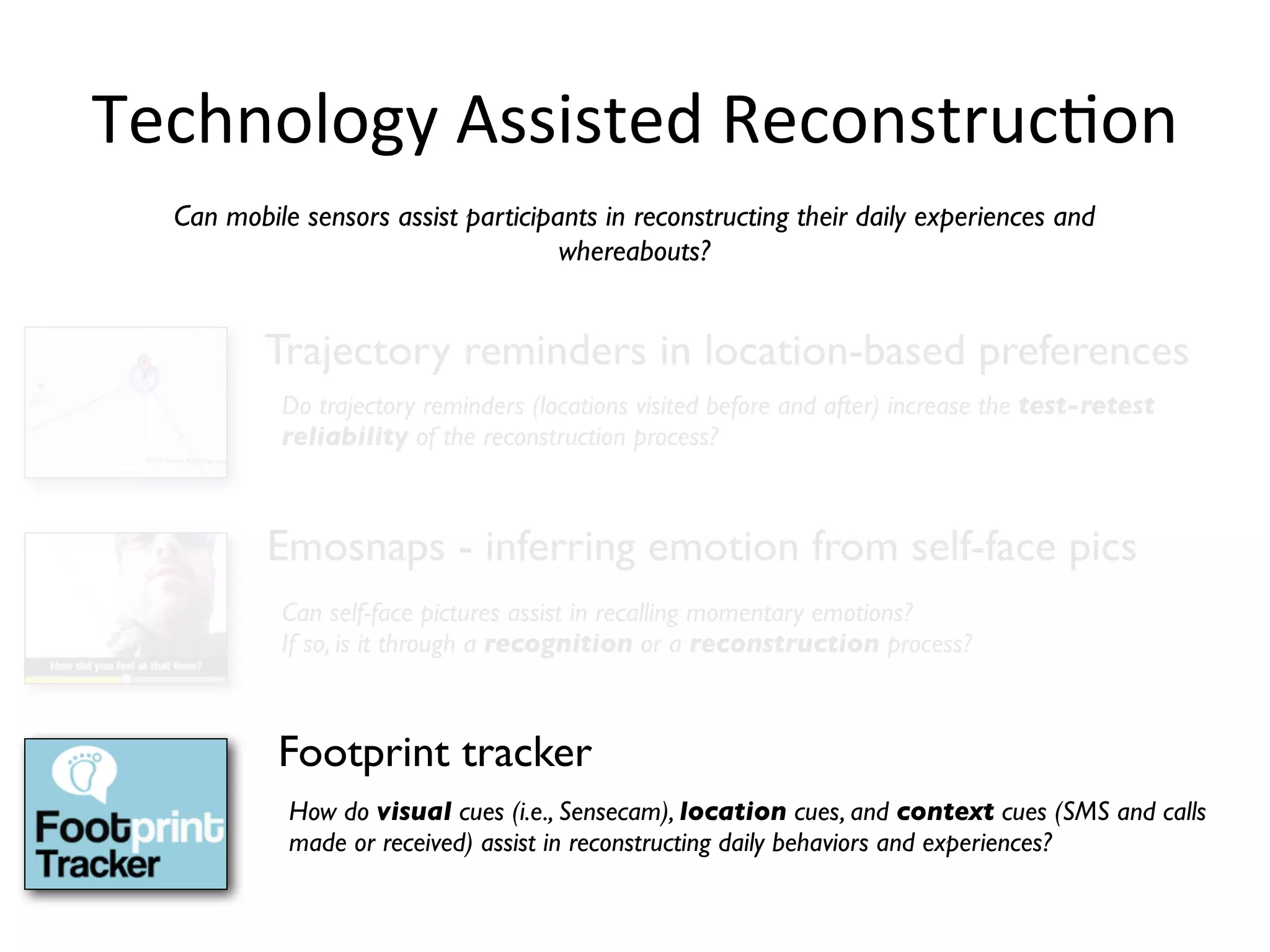
           Footprint tracker
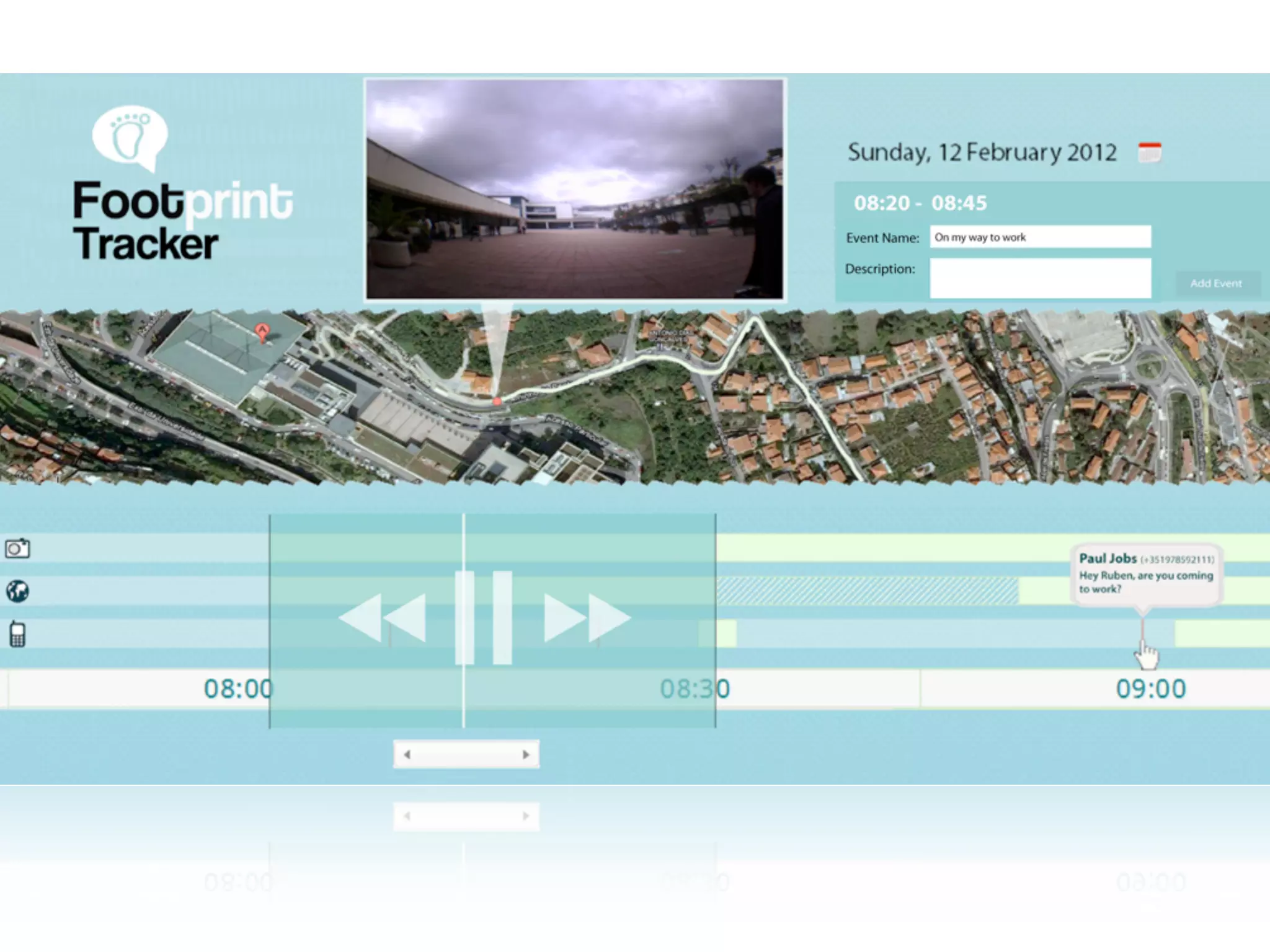
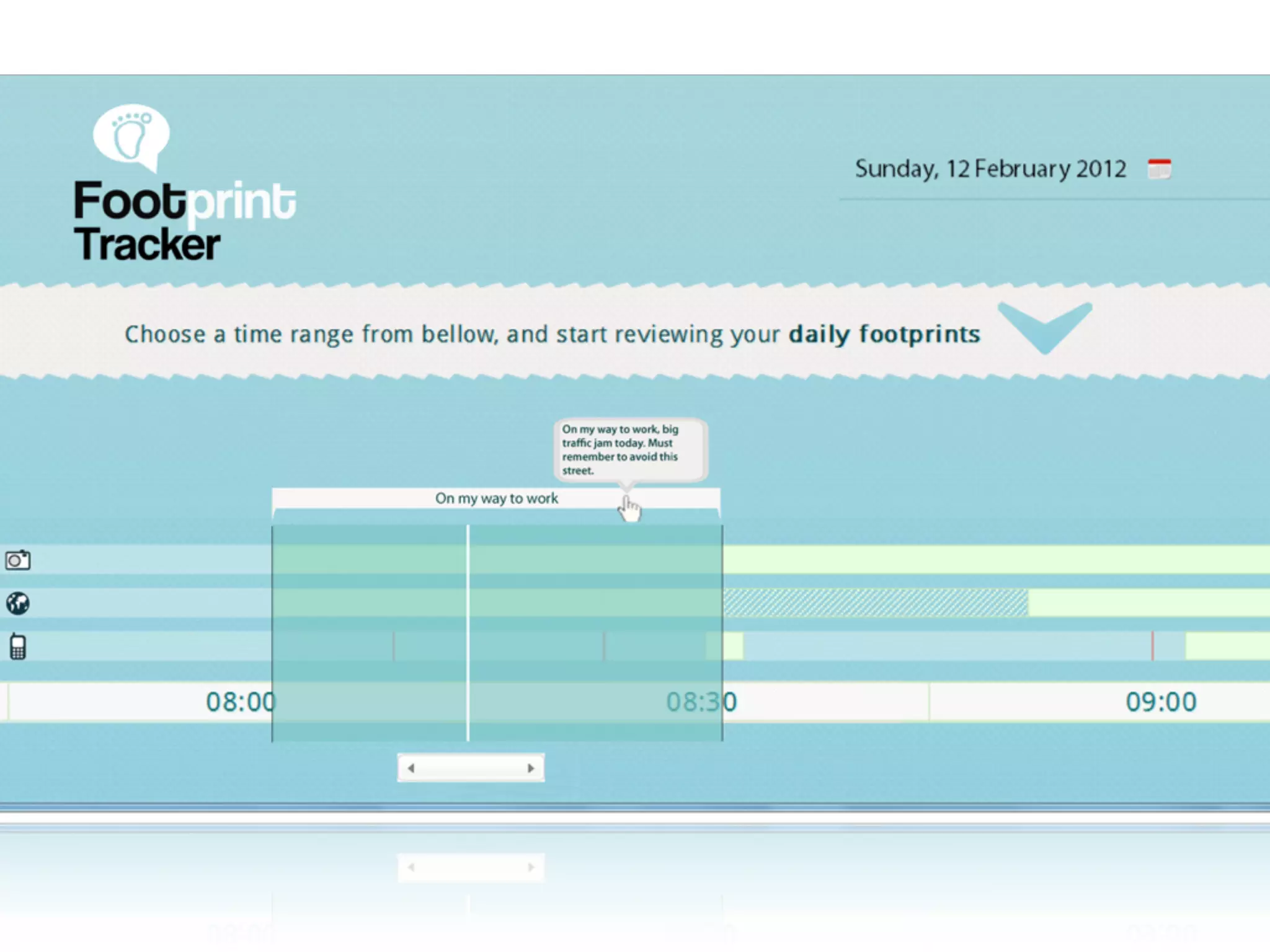
            How do visual cues (i.e., Sensecam), location cues, and context cues (SMS and calls
            made or received) assist in reconstructing daily behaviors and experiences?
Technology	
  Assisted	
  ReconstrucHon
  Can mobile sensors assist participants in reconstructing their daily experiences and
                                     whereabouts?


          Trajectory reminders in location-based preferences
           Do trajectory reminders (locations visited before and after) increase the test-retest
           reliability of the reconstruction process?


          Emosnaps - inferring emotion from self-face pics
           Can self-face pictures assist in recalling momentary emotions?
           If so, is it through a recognition or a reconstruction process?


           Footprint tracker
            How do visual cues (i.e., Sensecam), location cues, and context cues (SMS and calls
            made or received) assist in reconstructing daily behaviors and experiences?
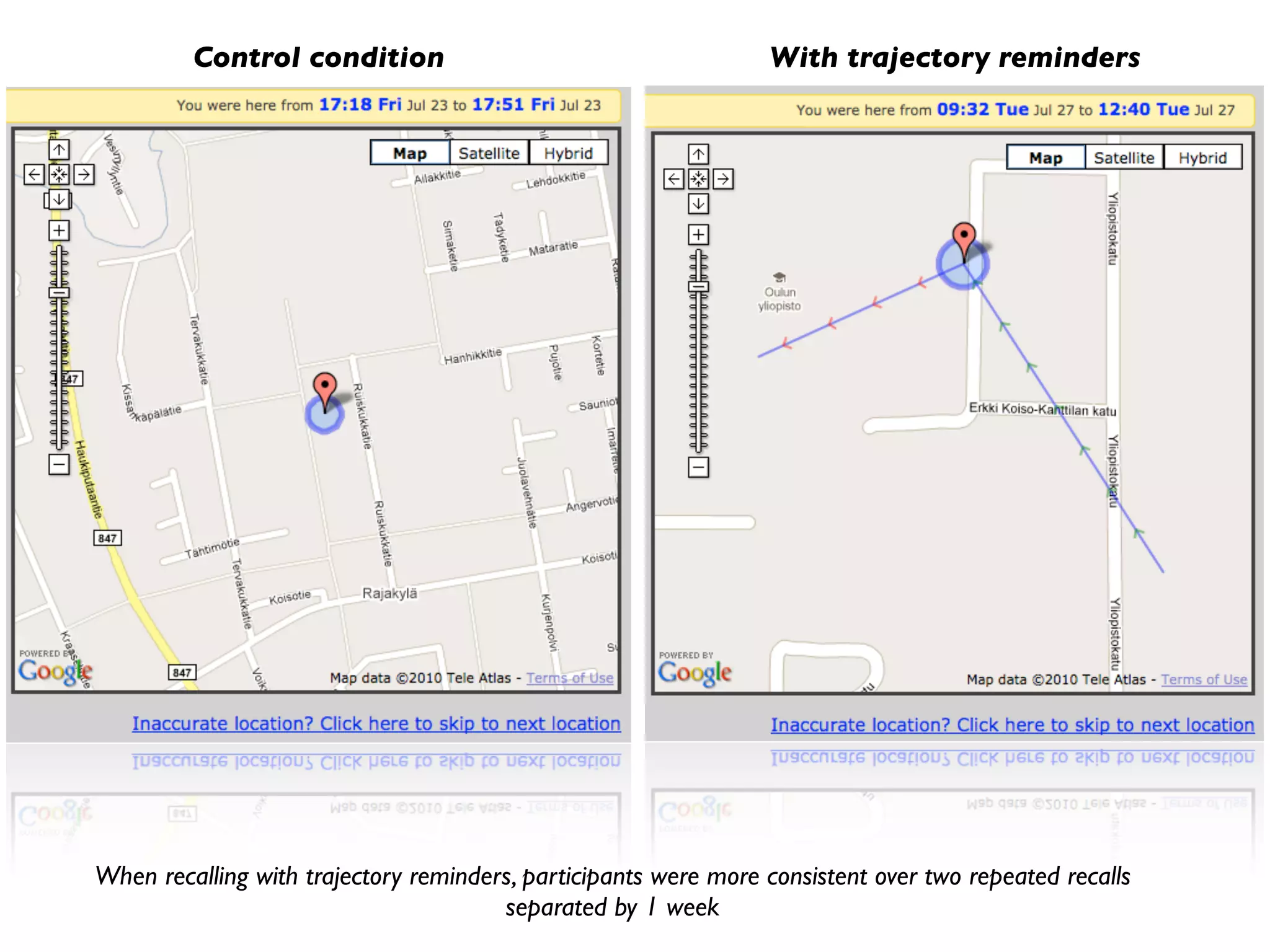
Control condition                                       With trajectory reminders


                                                    !                                                   !


When recalling with trajectory reminders, participants were more consistent over two repeated recalls
                                       separated by 1 week
Technology	
  Assisted	
  ReconstrucHon
  Can mobile sensors assist participants in reconstructing their daily experiences and
                                     whereabouts?


          Trajectory reminders in location-based preferences
           Do trajectory reminders (locations visited before and after) increase the test-retest
           reliability of the reconstruction process?


          Emosnaps - inferring emotion from self-face pics
           Can self-face pictures assist in recalling momentary emotions?
           If so, is it through a recognition or a reconstruction process?


           Footprint tracker
            How do visual cues (i.e., Sensecam), location cues, and context cues (SMS and calls
            made or received) assist in reconstructing daily behaviors and experiences?
Measuring	
  emoHons	
  in	
  mobile	
  contexts
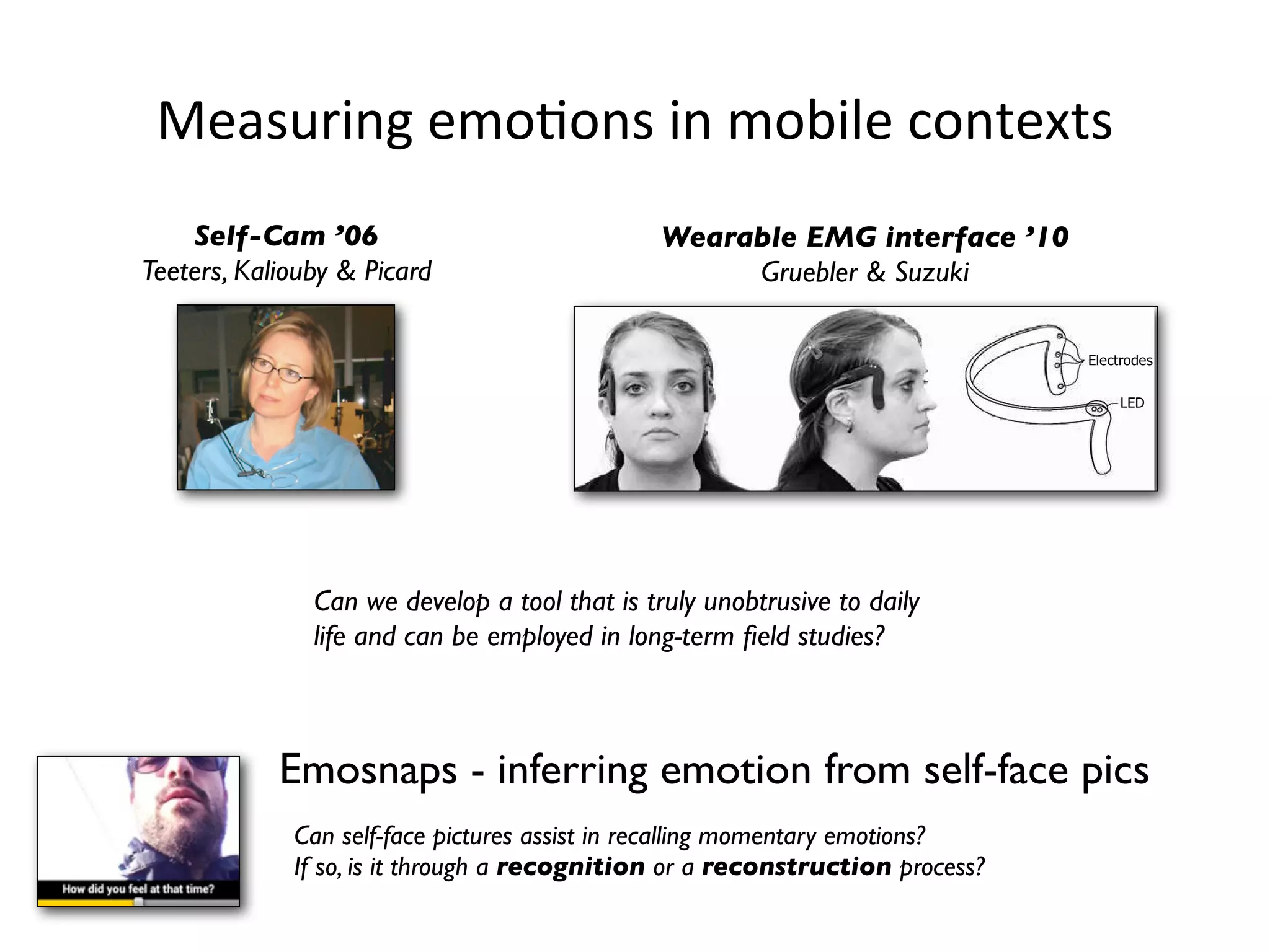
    Self-Cam ’06                               Wearable EMG interface ’10
Teeters, Kaliouby & Picard                          Gruebler & Suzuki


               Can we develop a tool that is truly unobtrusive to daily
               life and can be employed in long-term field studies?


            Emosnaps - inferring emotion from self-face pics
             Can self-face pictures assist in recalling momentary emotions?
             If so, is it through a recognition or a reconstruction process?
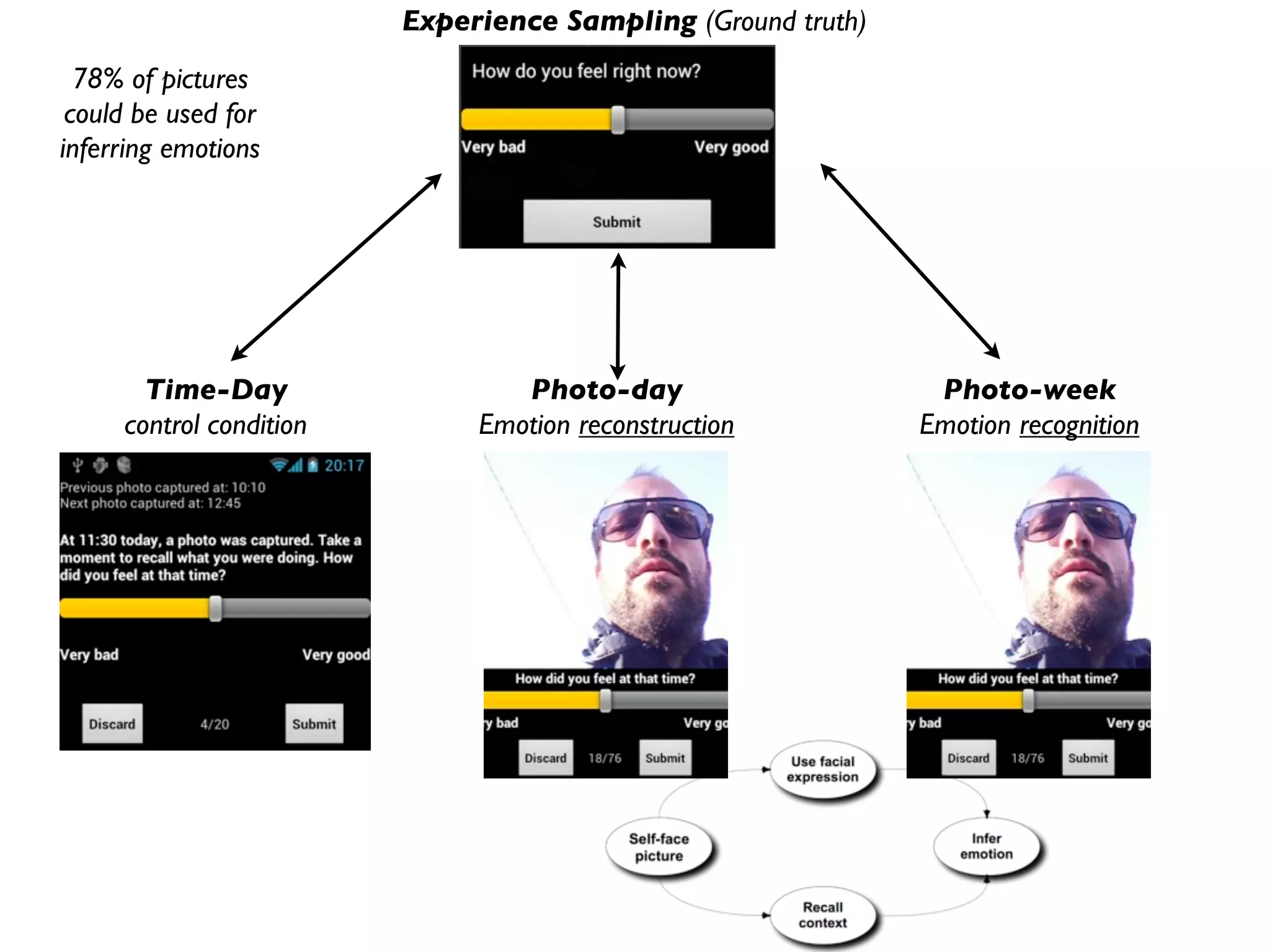
Experience Sampling (Ground truth)
  78% of pictures
 could be used for
inferring emotions


       Time-Day                  Photo-day                     Photo-week
     control condition        Emotion reconstruction          Emotion recognition
Technology	
  Assisted	
  ReconstrucHon
  Can mobile sensors assist participants in reconstructing their daily experiences and
                                     whereabouts?


          Trajectory reminders in location-based preferences
           Do trajectory reminders (locations visited before and after) increase the test-retest
           reliability of the reconstruction process?


          Emosnaps - inferring emotion from self-face pics
           Can self-face pictures assist in recalling momentary emotions?
           If so, is it through a recognition or a reconstruction process?


           Footprint tracker
            How do visual cues (i.e., Sensecam), location cues, and context cues (SMS and calls
            made or received) assist in reconstructing daily behaviors and experiences?
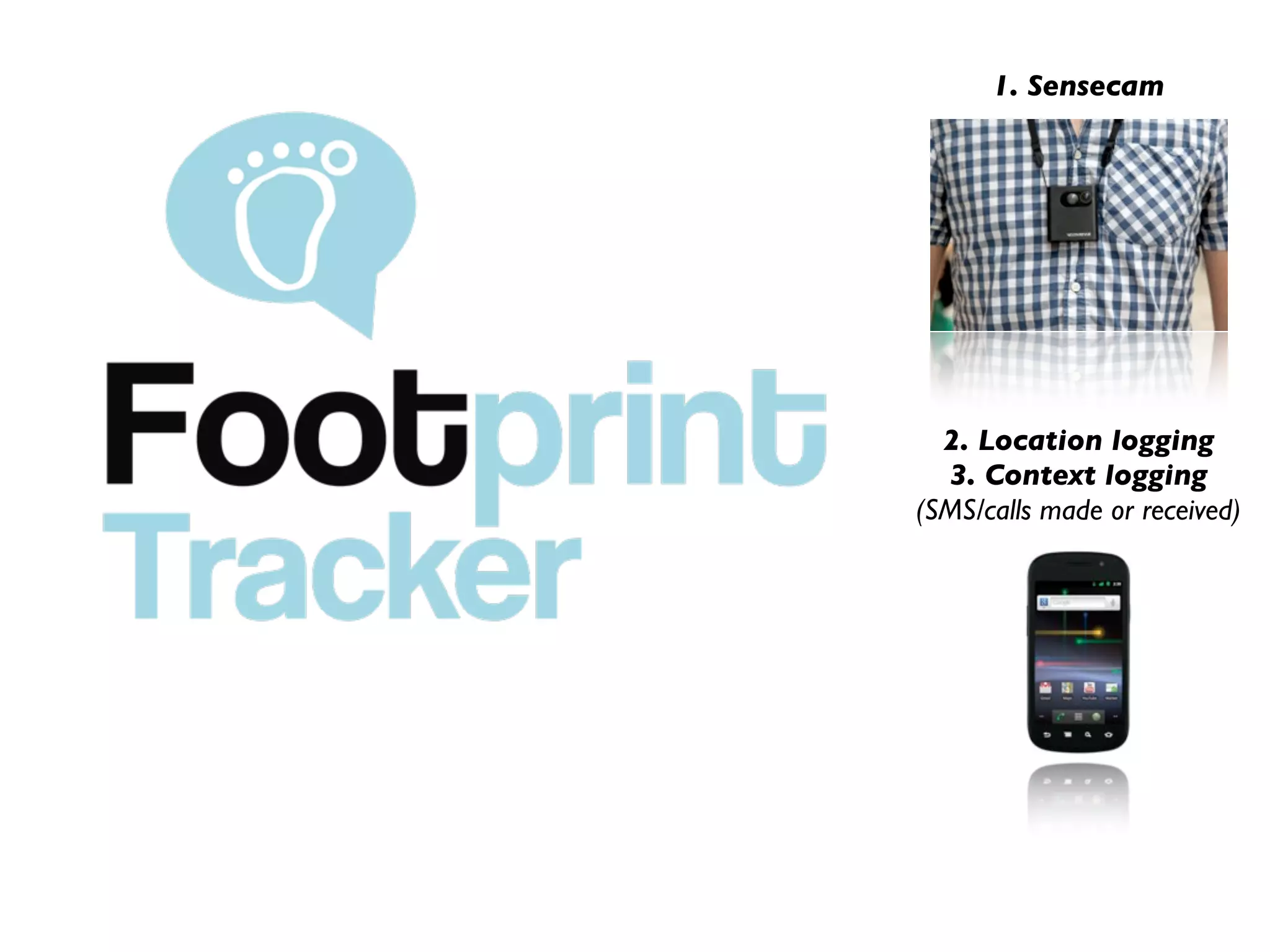
1. Sensecam


  2. Location logging
  3. Context logging
(SMS/calls made or received)
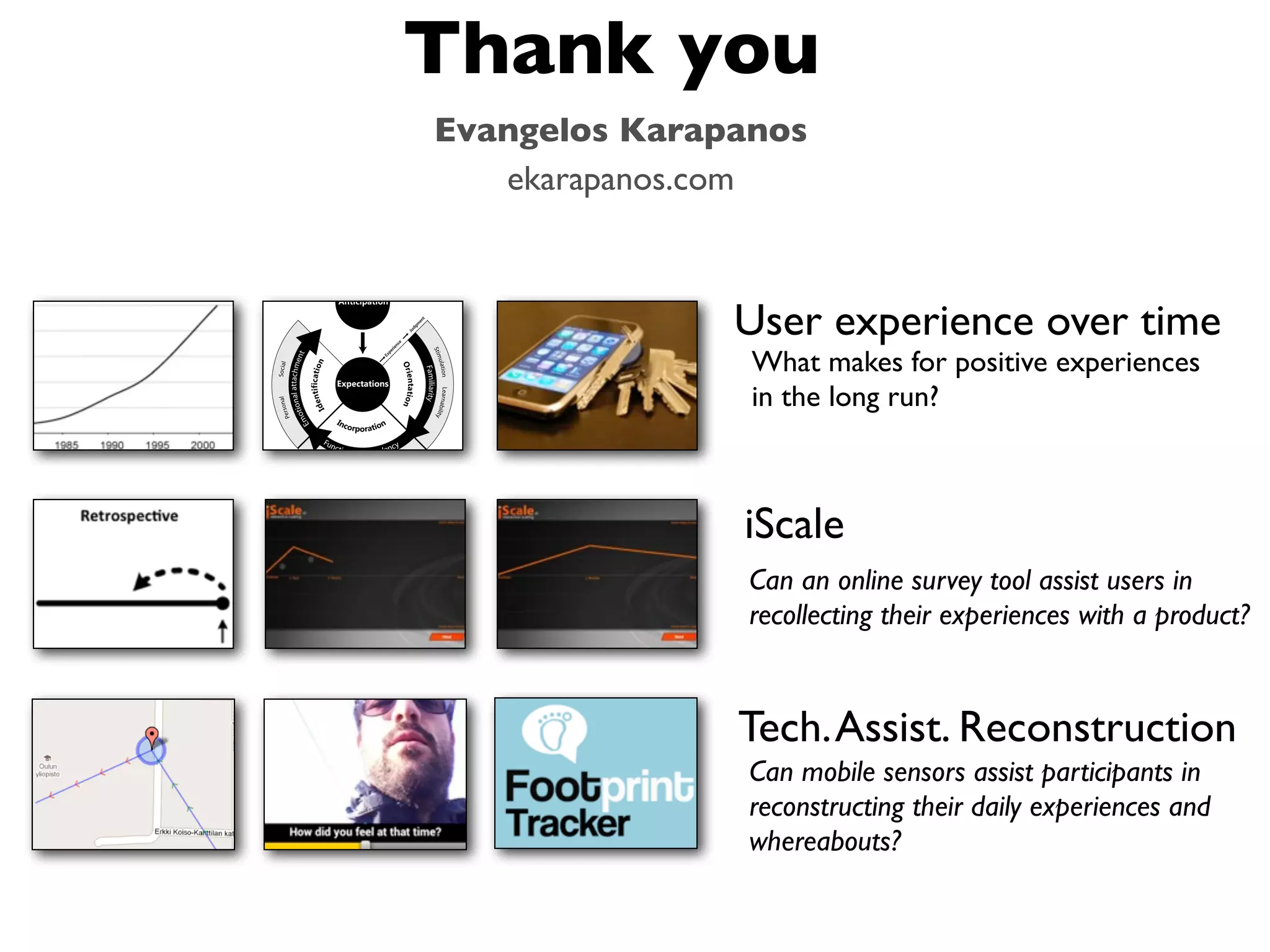
Thank you
Evangelos Karapanos
   ekarapanos.com


               User experience over time
                What makes for positive experiences
                in the long run?


               iScale
                Can an online survey tool assist users in
                recollecting their experiences with a product?


               Tech. Assist. Reconstruction
                Can mobile sensors assist participants in
                reconstructing their daily experiences and
                whereabouts?

Measuring users' experience - or, the memory of them?

  • 1.
    Measuring users’ experiences or, the memory of them? Trajectory reminders EmoSnaps Footprint tracker Evangelos Karapanos Newcastle, 8 March 2011
  • 3.
    Nuno  Nunes Vassilis  Kostakos Monchu  Chen Laura Rodríguez Gonçalo  Gouveia Néstor  Catano • 20  faculty Pedro  Campos Paulo  Sampaio Eduardo  Fermé – 14  countries,  8  languages • Areas: Larry  ConstanHne Jos  van  Leeuwen Barbara  Pizzileo – 11  CS,  2  physics/electronics,   2  psychology,  2  architecture,   2  design,  2  art,  2  other Ian  Oakley Luis  Gomes Ron  Salden Leonel  Nóbrega ValenHna  Nisi Evangelos  Karapanos David  Aveiro Luis  Gomes Yoram  Chisik
  • 4.
    MSc HCI &Entertainment Technology
  • 5.
  • 6.
    My  background BSc Physics/ microelectronics, U Patras, Greece (2004) Thesis: Model based design and evaluation of walk-up-and-use interfaces (HCI Group, ECE department) MSc HCI / UCL Interaction Centre, UK (2005) Thesis: User acceptance of nomadic user interfaces (Philips Research, Eindhoven) PhD HCI / TU Eindhoven, NL (2010) Title: Quantifying diversity in user experience
  • 7.
    Some  of  my  current  work   (that  I  will  not  discuss  today) Socially translucent eco-feedback technologies How do eco-feedback technologies: a) raise mutual awareness of family members’ consumption behaviors b) induce feelings of accountability on individuals regarding their consumption behaviors. ! Citizen participation on the go How can we motivate citizen participation through mobile technologies? •Public transit: The role of psychological empowerment: self-efficacy, sense of community, and causal importance •Inclucity: The role of visual and location cues on users’ ability to reconstruct the context, and form an empathic understanding of the experience of disabled individuals Location-aware narratives: Does locality matter? Does the coupling between physical and virtual space result to increased immersion in the narrative world?
  • 8.
    Outline User experience overtime What makes for positive experiences in the long run? iScale - longitudinal data through memory Can an online survey tool assist users in recollecting their experiences with a product? Technology Assisted Reconstruction Can mobile sensors assist participants in reconstructing their daily experiences and whereabouts?
  • 9.
    Soft Reliability 48% ofreturned products are not attributed to a violation of product specifications
  • 10.
    problems rooted early in(concept) design phase
  • 11.
    failure to trulyincorporate it in one’s life
  • 12.
    User  experience  over  Hme An  exploratory  study How  do  users  form  overall  evalua/ve  judgments   about  interac/ve  products? Hassenzahl,  2004 Karapanos, E., Hassenzahl, M., & Martens, J.-B. (2008). User experience over time. CHI ’08 extended abstracts on Human factors in computing systems (pp. 3561-3566). Florence, Italy: ACM.
  • 13.
    User  experience  over  Hme An  exploratory  study Items  close  together  are  highly  correlated.  Lines  represent  clusters. Karapanos, E., Hassenzahl, M., & Martens, J.-B. (2008). User experience over time. CHI ’08 extended abstracts on Human factors in computing systems (pp. 3561-3566). Florence, Italy: ACM.
  • 14.
    What makes forpositive experiences in the long run? Karapanos, E., Zimmerman, J., Forlizzi, J., & Martens, J. (2009). User experience over time: an initial framework. In CHI '09: Proceedings of the 27th international conference on Human factors in computing systems (pp. 729-738). New York, NY, USA: ACM.
  • 15.
    Now  think  of  the  three  experiences  that  were  for  you  personally  most   sa.sfying  or  unsa.sfying  experiences  of  today.  Please,  use  your   own  feeling  or  a  defini.on  of  what  “sa.sfying”  and   “unsa.sfying  experience”  means.  Take  a  couple  of  minutes  to  be   sure  to  come  up  with  three  most  crucial  experiences;  you  may  also  want  to  write   them  down  for  yourself.  We  want  you  to  be  open  as  to  which  experiences  to   report. Karapanos, E., Zimmerman, J., Forlizzi, J., & Martens, J. (2009). User experience over time: an initial framework. In CHI '09: Proceedings of the 27th international conference on Human factors in computing systems (pp. 729-738). New York, NY, USA: ACM.
  • 16.
    Karapanos, E., Zimmerman,J., Forlizzi, J., & Martens, J. (2009). User experience over time: an initial framework. In CHI '09: Proceedings of the 27th international conference on Human factors in computing systems (pp. 729-738). New York, NY, USA: ACM.
  • 17.
    Cross-­‐sec8onal Repeated  sampling “Longitudinal”  paradigms  in  HCI Longitudinal Retrospec8ve
  • 18.
    Karapanos, E., Martens,J.-B., Hassenzahl, M. (2009) Reconstructing Experiences through Sketching. Arxiv preprint, arXiv:0912.5343.
  • 19.
    Remembering  is  an  act  of  reconstruc.on   rather  than  reproduc.on Barlea  (1932)
  • 20.
    How do werecall experiences? • Validity? i.e. do memories reflect what we really experienced? • Reliability? i.e. in a second trial, will we recall the same experiences? Can we assist people in recalling - more reliably - their experiences with a product?
  • 21.
    How do werecall emotional experiences? Two schools of thought - The Constructive approach - The Value-Account approach
  • 22.
    The Constructive approach Theemotional experience can neither be Design principles stored nor retrieved. It is reconstructed 1. Feed-forward sketching, as each recalled event from recalled contextual details will cue more events, eventually resulting to richer episodic memories from which to infer emotions Robinson & Clore (2002) 2. Concurrency between sketching and reporting, as reporting will positively contribute Type of Knowledge Source of information Type of Self-Report towards the recall of episodic cues Experiential Online emotion, e.g. Episodic Knowledge Experience Sampling Retrospective, e.g. Episodic Episodic memory Day Reconstruction Situation-specific Semantic Exit questionnaires belief Identity-related Semantic Exit questionnaires belief
  • 23.
    The Value-Account approach People may recall an overall evaluation of an Design principles event even when they fail to recall contextual 1. Top-down sketching (i.e., split completed line in details - “I like it but I don’t know why” parts), as participants are expected to have direct (Betsch et al., 2001) access to this value-charged information 2. Non-concurrency between sketching and reporting, as reporting (i.e., thinking about concrete This type of memory, Value-Account: episodic details) might hinder or bias the recall of value-charged information - is more accessible than episodic memory - can be used to cue the reconstruction from episodic memory - is better retained over time
  • 24.
    Constructive Value-Account Control (no-graphing) Constructive iScale, but not the Value-Account, performed better than control condition •More experience reports •With more details (references to temporal information, discrete events) •Higher test-retest consistency of time estimation (i.e., when did an experience take place) •Higher test-retest consistency of graphed patterns (over Value- Account) 24
  • 25.
    Technology Assisted Reconstruction Trajectoryreminders Emosnaps Footprint tracker Newcastle, 8 March 2011
  • 26.
    Experience Sampling Method What variables do ES studies measure? We distinguish below between self-reported measures of behavior and experience (see Table 1). This distinction is sampling method. Two of these provided no justifications for their choice. Analyzing the remaining 19 papers resulted to a total of 11 reasons for choosing alternative methods to relevant as their reconstruction follows a different process ESM (see table 2). whereas behavioral information may be directly accessible through episodic memory while experiential information Table 2. Reasons for not selecting the Experience Sampling Prompts at random, or computationally has to be further inferred from recalled episodic cues [63]. Method along with frequency of occurence (No of papers). to self-report on ongoing estimated times,measures of of ES studies eliciting or both. Table 1. Number behavior, experience, self-reported Reason No behaviors and experiences. Disrupts the activity 6 Type of measures that studies elicit No Imposes high burden to participants 3 – Where areSelf-reported measures of behavior you? 5 Requires high effort from researchers 3 – What are you doing? of experience Self-reported measures 22 – How far isSelf-reported measures phone?& experience your mobile of behavior 18 Inappropriate for eliciting rich qualitative data 3 – How do you feel? Misses rare and brief events 3 Behavioral measures related most frequently to the activity a few relevant venues would still miss a substantial number method while following a user-initiated diary approach. of studies. We instead used the ACM Guide towas engaged with prior to of the remaining 49 user should be reported (n=18) that the participant Computing The analysis being The studies is being in control of when, what and 2 Literature querying for the term “experience duration (n=2) (e.g. [35]), the interrupted (e.g. [30]), its sampling” below. how often to report No of papers referring to without constraining to particular venues. This query participant’s current physical location (n=15) length, sampling frequency, and response rate returned 284 papers, published in more than fifty venues. Study (e.g. [17]) Experience Sampling and the social context (n=10), e.g. the number or nature of of the studies had a duration of several The majority (80%) Limits sample size 2 60 relationship of people that are in close proximity or days up to one month with 14 studies (34%) lasting participate with in a conversation (e.g. [34]). Other seven days (see figure 3). Only two between four and Depends on participants’ ability to articulate 2 45 measures of behavior related to mode studies had a duration of more than a month. of transit [25], ongoing experience participants’ current physical engagement [18] and mode of 15 convrersation (e.g. f2f, fixed/mobile phone etc.) [32]. 30 Poses privacy concerns 2 Experiential measures related to: 15 10 • Attitudes towards behaviors or events (n=15) such as Limits number of measured variables 1 0 being interrupted (e.g. [55]), disclosing information to 2001 2003 2005 2007 2009 2011being video recorded (e.g. relevant others (e.g. [17]), or Technology limitations 1 5 [58]). Figure 2. 243 papers referring to experience sampling over a
  • 27.
    Day Reconstruction Method Kahneman et al. (2004) Can a retrospective method help participants in recalling more accurately their experiences? ry attempt to Type of Knowledge Source of information Type of Self-Report ntation of the an unfamiliar Episodic Experiential Knowledge Online emotion, e.g. Experience Sampling called stories tails, altering in applying Retrospective, e.g. Episodic Episodic memory riginal story. Day Reconstruction h repeated Situation-specific Semantic Exit questionnaires econstruction belief e support. At ion between Identity-related hile episodic Semantic belief Exit questionnaires om the past, lar event but Robinson & Clore (2002)
  • 28.
    Technology  Assisted  ReconstrucHon Can mobile sensors assist participants in reconstructing their daily experiences and whereabouts? Trajectory reminders in location-based preferences Do trajectory reminders (locations visited before and after) increase the test-retest reliability of the reconstruction process? Emosnaps - inferring emotion from self-face pics Can self-face pictures assist in recalling momentary emotions? If so, is it through a recognition or a reconstruction process? Footprint tracker How do visual cues (i.e., Sensecam), location cues, and context cues (SMS and calls made or received) assist in reconstructing daily behaviors and experiences?
  • 29.
    Technology  Assisted  ReconstrucHon Can mobile sensors assist participants in reconstructing their daily experiences and whereabouts? Trajectory reminders in location-based preferences Do trajectory reminders (locations visited before and after) increase the test-retest reliability of the reconstruction process? Emosnaps - inferring emotion from self-face pics Can self-face pictures assist in recalling momentary emotions? If so, is it through a recognition or a reconstruction process? Footprint tracker How do visual cues (i.e., Sensecam), location cues, and context cues (SMS and calls made or received) assist in reconstructing daily behaviors and experiences?
  • 30.
    Control condition With trajectory reminders ! ! When recalling with trajectory reminders, participants were more consistent over two repeated recalls separated by 1 week
  • 31.
    Technology  Assisted  ReconstrucHon Can mobile sensors assist participants in reconstructing their daily experiences and whereabouts? Trajectory reminders in location-based preferences Do trajectory reminders (locations visited before and after) increase the test-retest reliability of the reconstruction process? Emosnaps - inferring emotion from self-face pics Can self-face pictures assist in recalling momentary emotions? If so, is it through a recognition or a reconstruction process? Footprint tracker How do visual cues (i.e., Sensecam), location cues, and context cues (SMS and calls made or received) assist in reconstructing daily behaviors and experiences?
  • 32.
    Measuring  emoHons  in  mobile  contexts Self-Cam ’06 Wearable EMG interface ’10 Teeters, Kaliouby & Picard Gruebler & Suzuki Can we develop a tool that is truly unobtrusive to daily life and can be employed in long-term field studies? Emosnaps - inferring emotion from self-face pics Can self-face pictures assist in recalling momentary emotions? If so, is it through a recognition or a reconstruction process?
  • 33.
    Experience Sampling (Groundtruth) 78% of pictures could be used for inferring emotions Time-Day Photo-day Photo-week control condition Emotion reconstruction Emotion recognition
  • 34.
    Technology  Assisted  ReconstrucHon Can mobile sensors assist participants in reconstructing their daily experiences and whereabouts? Trajectory reminders in location-based preferences Do trajectory reminders (locations visited before and after) increase the test-retest reliability of the reconstruction process? Emosnaps - inferring emotion from self-face pics Can self-face pictures assist in recalling momentary emotions? If so, is it through a recognition or a reconstruction process? Footprint tracker How do visual cues (i.e., Sensecam), location cues, and context cues (SMS and calls made or received) assist in reconstructing daily behaviors and experiences?
  • 35.
    1. Sensecam 2. Location logging 3. Context logging (SMS/calls made or received)
  • 38.
    Thank you Evangelos Karapanos ekarapanos.com User experience over time What makes for positive experiences in the long run? iScale Can an online survey tool assist users in recollecting their experiences with a product? Tech. Assist. Reconstruction Can mobile sensors assist participants in reconstructing their daily experiences and whereabouts?