Management: Team Meetings
How team meetings are managed can play a vital part in
the overall efficiency and communication within a team.
The ability to manage meetings so that they are
structured and productive is an essential skill of any good
leader...
Here are some key points to keep in mind when
managing a team meeting...
Outline Your Meeting’s Purpose
Give all those invited to the meeting a clear understanding
of the intended objectives of the meeting in advance, so
that they know how to prepare for it.
For example, if your meeting is to set an outline for an
upcoming project, or to make a decision on a specific
matter, you should make this clear beforehand in any
emails or calls to schedule the meeting.
Creating a written agenda that can be emailed to all
attendees is a great way to ensure that everyone knows
exactly what they’ll need to be ready to discuss.
Delegate Leadership (When Appropriate)
If the meeting is covering
a subject that another
member of your team is
directly responsible for,
or is more
knowledgeable about, it
makes sense to delegate
the leadership of the
meeting to them.
By allowing the appropriate
member of your team to lead the
meeting, you can ensure that they
cover the most relevant topics in
relation to the meeting’s
objectives.
Additionally, by allowing a team member to lead the meeting, you are
showing your confidence in their abilities to do so, and their expertise in
the topics that the meeting is covering.
Encourage Open Discussion
As the manager you
should be prepared to
lead a team meeting,
however you should
ensure that you do not
dominate discussion.
Invite opinions and
input from all
members of your
team. Keep in mind
that some of the
people in your
meeting may be shyer
about sharing their
ideas than others, and
be ready to ask
questions when
addressing the topics
that your meeting is
covering.
You should ensure
that you give all team
members the
opportunity to speak
and to contribute.
Keep The Discussion On Track
In any team working environment, there will invariably be plenty of
different topics that are relevant for discussion whenever the team
comes together for a meeting;
for this reason it is vital that you are prepared to interject if the
discussion starts to wander too far from the meeting’s agenda.
Arrive at Action Points
When a topic or item on your meeting’s agenda has been
discussed in full, you should make sure that everyone is
clear on what the next step – or action point – is.
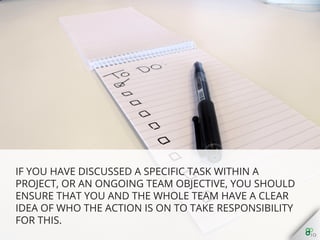
If you have discussed a specific task within a project, or an
ongoing team objective, you should ensure that you and the
whole team have a clear idea of who the action is on to take
responsibility for this.
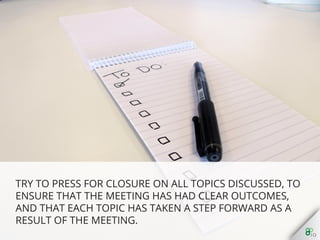
Try to press for closure on all topics discussed, to ensure
that the meeting has had clear outcomes, and that each
topic has taken a step forward as a result of the meeting.
Keep It On Record
If you are holding a regular
team meeting, it is a great
idea to allow your team
members to take turns in
keeping the minutes each
time you meet. Alternatively,
it may be appropriate to
ensure that one of your team
members is keeping note of
every topic discussed, to later
be circulated in an email to all
attendees of the meeting.
This ensures that the
outcomes of your meeting
are made completely clear. In
a long meeting it is easy to
lose track of who said what,
and more importantly – who
committed to what. For this
reason it is a great idea to
ensure everyone has a record
of everything in writing!
Connect
For more tips on professional development and to see all of our latest opportunities,
connect with the InterQuest Group
InterQuest Group plc is an award-winning, specialist recruitment organisation
providing contract and permanent services within niche disciplines globally.
The Group is divided into specialist businesses, with each one aligned to one of the
following market sectors, Finance, Retail, Public Sector, Not for Profit or in an area of
technology such as testing, analytics, ERP or digital. These are augmented by other
businesses specialising in services which span the various vertical niches - such as
recruitment outsourcing or executive search and selection.
As specialists in contract, permanent IT and analytics recruitment, the InterQuest
Group trades as distinctly branded, individual, specialist recruitment businesses.

Management: Team Meetings

  • 1.
  • 2.
    How team meetingsare managed can play a vital part in the overall efficiency and communication within a team.
  • 3.
    The ability tomanage meetings so that they are structured and productive is an essential skill of any good leader...
  • 4.
    Here are somekey points to keep in mind when managing a team meeting...
  • 5.
  • 6.
    Give all thoseinvited to the meeting a clear understanding of the intended objectives of the meeting in advance, so that they know how to prepare for it.
  • 7.
    For example, ifyour meeting is to set an outline for an upcoming project, or to make a decision on a specific matter, you should make this clear beforehand in any emails or calls to schedule the meeting.
  • 8.
    Creating a writtenagenda that can be emailed to all attendees is a great way to ensure that everyone knows exactly what they’ll need to be ready to discuss.
  • 9.
  • 10.
    If the meetingis covering a subject that another member of your team is directly responsible for, or is more knowledgeable about, it makes sense to delegate the leadership of the meeting to them.
  • 11.
    By allowing theappropriate member of your team to lead the meeting, you can ensure that they cover the most relevant topics in relation to the meeting’s objectives.
  • 12.
    Additionally, by allowinga team member to lead the meeting, you are showing your confidence in their abilities to do so, and their expertise in the topics that the meeting is covering.
  • 13.
  • 15.
    As the manageryou should be prepared to lead a team meeting, however you should ensure that you do not dominate discussion.
  • 16.
    Invite opinions and inputfrom all members of your team. Keep in mind that some of the people in your meeting may be shyer about sharing their ideas than others, and be ready to ask questions when addressing the topics that your meeting is covering.
  • 17.
    You should ensure thatyou give all team members the opportunity to speak and to contribute.
  • 18.
  • 19.
    In any teamworking environment, there will invariably be plenty of different topics that are relevant for discussion whenever the team comes together for a meeting;
  • 20.
    for this reasonit is vital that you are prepared to interject if the discussion starts to wander too far from the meeting’s agenda.
  • 21.
  • 22.
    When a topicor item on your meeting’s agenda has been discussed in full, you should make sure that everyone is clear on what the next step – or action point – is.
  • 23.
    If you havediscussed a specific task within a project, or an ongoing team objective, you should ensure that you and the whole team have a clear idea of who the action is on to take responsibility for this.
  • 24.
    Try to pressfor closure on all topics discussed, to ensure that the meeting has had clear outcomes, and that each topic has taken a step forward as a result of the meeting.
  • 25.
    Keep It OnRecord
  • 26.
    If you areholding a regular team meeting, it is a great idea to allow your team members to take turns in keeping the minutes each time you meet. Alternatively, it may be appropriate to ensure that one of your team members is keeping note of every topic discussed, to later be circulated in an email to all attendees of the meeting.
  • 27.
    This ensures thatthe outcomes of your meeting are made completely clear. In a long meeting it is easy to lose track of who said what, and more importantly – who committed to what. For this reason it is a great idea to ensure everyone has a record of everything in writing!
  • 28.
    Connect For more tipson professional development and to see all of our latest opportunities, connect with the InterQuest Group InterQuest Group plc is an award-winning, specialist recruitment organisation providing contract and permanent services within niche disciplines globally. The Group is divided into specialist businesses, with each one aligned to one of the following market sectors, Finance, Retail, Public Sector, Not for Profit or in an area of technology such as testing, analytics, ERP or digital. These are augmented by other businesses specialising in services which span the various vertical niches - such as recruitment outsourcing or executive search and selection. As specialists in contract, permanent IT and analytics recruitment, the InterQuest Group trades as distinctly branded, individual, specialist recruitment businesses.