Teaching English to Young
Learners (TEYL)
Who do we consider to be Young
Learners?
Depending on the country and context.
A child that’s within the first 6 years of formal education (6 to 12
years).
Pre-school 3-5 (very young learners)
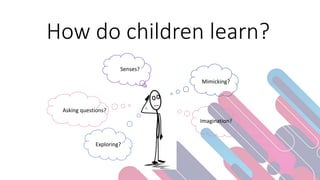
How do children learn?
Senses?
Imagination?
Asking questions?
Mimicking?
Exploring?
Language Development Theories
Piaget.
one of the first psychologist to conduct a systematic study of cognitive
development. His theory is that the child is seen as continually interacting
with the world around him/her, solving problems that are presented by
the environment, it is through taking action to solve problems that
learning occurs.
Vygotsky.
A psychologist known for his work on psychological development in
children. His theory is that development and learning take place in a
social context, i.e in a world full of people, who interact with the child
from birth onwards.
He used the idea of (Zone Proximal Development) ZPD to give
intelligence a new meaning and instead measure intelligence not by
what a child can do but rather what a child can do with skilled help.
This highlights what the teacher can do to support learning, this has
applications in both lesson planning and in how the teachers talk to
pupils minute by minute.
Bruner.
An American psychologist who made significant contributions to human cognitive
psychology and cognitive learning theory in educational psychology. His theory is
that language is the most important tool for cognitive growth, talk as a means of
helping a child carry out an activity. In other words - scaffolding
- Make the child interested in the task
- Simplify the task, breaking into simple steps
- Keep the child on task by reminding them what the goal is.
- Point out what is important to do or show the child how to do certain parts of the
task.
- Demonstrate an idealised version of the task.
Bruner also provided another useful idea for language teaching, which is the notions
of format and routine. These are features of events that allow for scaffolding to take
place. And combine the security of the familiar with the excitement of the new.
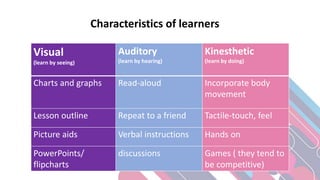
Characteristics of learners
Visual
(learn by seeing)
Auditory
(learn by hearing)
Kinesthetic
(learn by doing)
Charts and graphs Read-aloud Incorporate body
movement
Lesson outline Repeat to a friend Tactile-touch, feel
Picture aids Verbal instructions Hands on
PowerPoints/
flipcharts
discussions Games ( they tend to
be competitive)
Motor skills development
Researchers suggested that the neural infrastructure that is
built during motor development has an impact on cognitive
development and specific types of learning (Grissmer et al.,
2010)
So, Yes! Its not language. But it facilitates language learning.
Challenges that face YL learners
• Inability to express themselves or how they are feeling.
• Not understanding their learning needs / aims / styles
• Get bored easily – short attention span - 5 minutes.
• Not enough opportunity to practice what they’re learning outside the
classroom.
Challenges that face YL teachers
• Preparation.
• Energy.
• Wide range of learning styles.
• Dealing with highly emotional students ‘due to their age/ family
relationships’.
• Large number of classes, they can exceed 20 students
• Time management.
• Safeguarding measures must be adhered to.
• Lack of parental support.
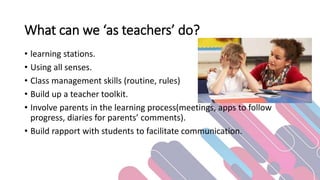
What can we ‘as teachers’ do?
• learning stations.
• Using all senses.
• Class management skills (routine, rules)
• Build up a teacher toolkit.
• Involve parents in the learning process(meetings, apps to follow
progress, diaries for parents’ comments).
• Build rapport with students to facilitate communication.
FamilyID=Office_ArchiveTorn
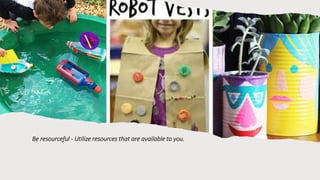
Be resourceful - Utilize resources that are available to you.
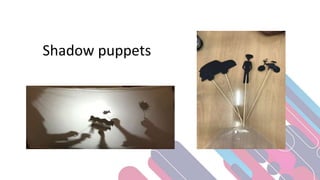
Shadow puppets
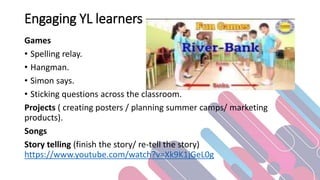
Engaging YL learners
Games
• Spelling relay.
• Hangman.
• Simon says.
• Sticking questions across the classroom.
Projects ( creating posters / planning summer camps/ marketing
products).
Songs
Story telling (finish the story/ re-tell the story)
https://www.youtube.com/watch?v=Xk9K1jGeL0g
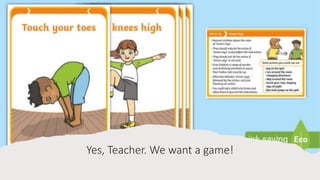
Yes, Teacher. We want a game!
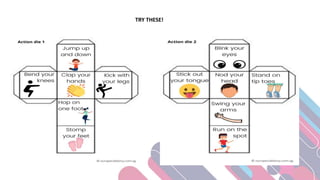
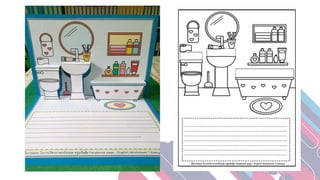
TRY THESE!
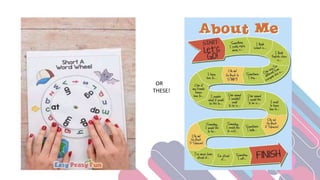
OR
THESE!
Thank you
Q & A?

Teaching Young Learners - ELT Forum.pptx

  • 2.
    Teaching English toYoung Learners (TEYL)
  • 3.
    Who do weconsider to be Young Learners? Depending on the country and context. A child that’s within the first 6 years of formal education (6 to 12 years). Pre-school 3-5 (very young learners)
  • 4.
    How do childrenlearn? Senses? Imagination? Asking questions? Mimicking? Exploring?
  • 5.
    Language Development Theories Piaget. oneof the first psychologist to conduct a systematic study of cognitive development. His theory is that the child is seen as continually interacting with the world around him/her, solving problems that are presented by the environment, it is through taking action to solve problems that learning occurs.
  • 6.
    Vygotsky. A psychologist knownfor his work on psychological development in children. His theory is that development and learning take place in a social context, i.e in a world full of people, who interact with the child from birth onwards. He used the idea of (Zone Proximal Development) ZPD to give intelligence a new meaning and instead measure intelligence not by what a child can do but rather what a child can do with skilled help. This highlights what the teacher can do to support learning, this has applications in both lesson planning and in how the teachers talk to pupils minute by minute.
  • 7.
    Bruner. An American psychologistwho made significant contributions to human cognitive psychology and cognitive learning theory in educational psychology. His theory is that language is the most important tool for cognitive growth, talk as a means of helping a child carry out an activity. In other words - scaffolding - Make the child interested in the task - Simplify the task, breaking into simple steps - Keep the child on task by reminding them what the goal is. - Point out what is important to do or show the child how to do certain parts of the task. - Demonstrate an idealised version of the task. Bruner also provided another useful idea for language teaching, which is the notions of format and routine. These are features of events that allow for scaffolding to take place. And combine the security of the familiar with the excitement of the new.
  • 8.
    Characteristics of learners Visual (learnby seeing) Auditory (learn by hearing) Kinesthetic (learn by doing) Charts and graphs Read-aloud Incorporate body movement Lesson outline Repeat to a friend Tactile-touch, feel Picture aids Verbal instructions Hands on PowerPoints/ flipcharts discussions Games ( they tend to be competitive)
  • 9.
    Motor skills development Researcherssuggested that the neural infrastructure that is built during motor development has an impact on cognitive development and specific types of learning (Grissmer et al., 2010) So, Yes! Its not language. But it facilitates language learning.
  • 10.
    Challenges that faceYL learners • Inability to express themselves or how they are feeling. • Not understanding their learning needs / aims / styles • Get bored easily – short attention span - 5 minutes. • Not enough opportunity to practice what they’re learning outside the classroom.
  • 11.
    Challenges that faceYL teachers • Preparation. • Energy. • Wide range of learning styles. • Dealing with highly emotional students ‘due to their age/ family relationships’. • Large number of classes, they can exceed 20 students • Time management. • Safeguarding measures must be adhered to. • Lack of parental support.
  • 12.
    What can we‘as teachers’ do? • learning stations. • Using all senses. • Class management skills (routine, rules) • Build up a teacher toolkit. • Involve parents in the learning process(meetings, apps to follow progress, diaries for parents’ comments). • Build rapport with students to facilitate communication.
  • 13.
    FamilyID=Office_ArchiveTorn Be resourceful -Utilize resources that are available to you.
  • 14.
  • 15.
    Engaging YL learners Games •Spelling relay. • Hangman. • Simon says. • Sticking questions across the classroom. Projects ( creating posters / planning summer camps/ marketing products). Songs Story telling (finish the story/ re-tell the story) https://www.youtube.com/watch?v=Xk9K1jGeL0g
  • 16.
    Yes, Teacher. Wewant a game!
  • 17.
  • 19.
  • 20.
  • 21.