SPEECH RHYTHM PRODUCTION IN
A MULTILINGUAL SETTING
Amel ALOUACHE
Department of Arts and the English Language
Mentouri Brothers University, Constantine
A Suggested Syllabus for
Teaching Speech Rhythm
Algerian learners majoring in English as a third
language have already been exposed to a second
standard language, French, early in their learning
curriculum, in addition to their mother tongue,
dialectal Arabic. A fact that has been proved to
affect different aspects of English phonetics and
phonology, especially in the realm of speech
rhythm.
INTRODUCTION
Since the aim behind teaching a foreign language is
to understand and to be understood, more focus should
be given to the teaching of suprasegmentals, notably
speech rhythm as it can lead to communication
breakdown on the part of the listener as well as on the
part of the speaker.
Despite its importance, EFL teachers, generally
speaking, tend to neglect the necessity of teaching
speech rhythm mostly because it is regarded as
something that comes naturally with the language
and, therefore, cannot be acquired. Such a view comes
from the belief that speech rhythm is related to
longer units of speech i.e. thought groups
RATIONALE
 Speech rhythm is related to longer units of speech
(thought groups: sentences, clauses or phrases)
and its teaching is believed to be best considered
from a holistic perspective, hence approached by a
top-down scheme that is based mostly on
suprasegmental features: thought group, focus
word, stressed syllable and the nucleus However,
longer units of speech are combinations of smaller
constituents that make, by definition, the teaching of
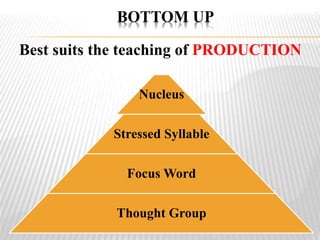
speech rhythm approachable from a bottom-up
scheme as well: Vowels (nucleus)
Thought Group
Focus Word
Stressed Syllable
Nucleus
TOP DOWN
Best suits the teaching of PERCEPTION
Nucleus
Stressed Syllable
Focus Word
Thought Group
BOTTOM UP
Best suits the teaching of PRODUCTION
 With this in mind, there should be no inclination
towards one approach over another in the
teaching of speech rhythm as the latter brings
together segmental and suprasegmental features.
 Therefore, the appropriate syllabus to better teach
speech rhythm to EFL learners is the one geared
towards a balanced segmental-suprasegmental
instruction in the sense that both of them affect
in a way or another intelligibility, in terms of
perception, and fluency, in terms of production.
 Speech rhythm should be taught over two
modules: ‘Phonetics and Phonology’ and ‘Oral
Expression’ for both of them are concerned with
the speaking skill.
A SUGGESTED SYLLABUS FOR
TEACHING SPEECH RHYTHM
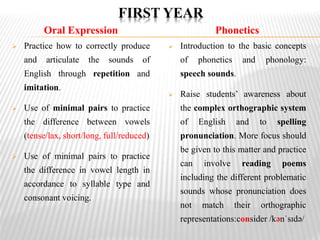
FIRST YEAR
Oral Expression
 Practice how to correctly produce
and articulate the sounds of
English through repetition and
imitation.
 Use of minimal pairs to practice
the difference between vowels
(tense/lax, short/long, full/reduced)
 Use of minimal pairs to practice
the difference in vowel length in
accordance to syllable type and
consonant voicing.
Phonetics
 Introduction to the basic concepts
of phonetics and phonology:
speech sounds.
 Raise students’ awareness about
the complex orthographic system
of English and to spelling
pronunciation. More focus should
be given to this matter and practice
can involve reading poems
including the different problematic
sounds whose pronunciation does
not match their orthographic
representations:consider /kǝnˈsɪdǝ/
SECOND YEAR
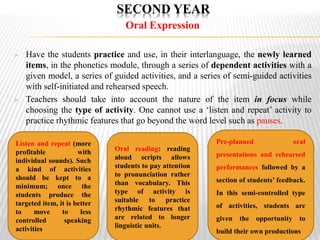
Oral Expression
 Have the students practice and use, in their interlanguage, the newly learned
items, in the phonetics module, through a series of dependent activities with a
given model, a series of guided activities, and a series of semi-guided activities
with self-initiated and rehearsed speech.
 Teachers should take into account the nature of the item in focus while
choosing the type of activity. One cannot use a ‘listen and repeat’ activity to
practice rhythmic features that go beyond the word level such as pauses.
Listen and repeat (more
profitable with
individual sounds). Such
a kind of activities
should be kept to a
minimum; once the
students produce the
targeted item, it is better
to move to less
controlled speaking
activities
Oral reading: reading
aloud scripts allows
students to pay attention
to pronunciation rather
than vocabulary. This
type of activity is
suitable to practice
rhythmic features that
are related to longer
linguistic units.
Pre-planned oral
presentations and rehearsed
performances followed by a
section of students’ feedback.
In this semi-controlled type
of activities, students are
given the opportunity to
build their own productions
SECOND YEAR
PHONETICS
 Dictation of words/passages featuring the item in focus + targeted activities
 Listening to authentic audio featuring the item in focus + targeted activities
Vowel reduction + ed past suffix +
syllabic consonants
 Objective 1: raise the students’
awareness about the importance of
making one syllable more prominent
than the other, to give the alternation
between stressed vs. unstressed
syllables: /kǝnˈfes/, /ˈdi:mǝn/
 Objective 2: raise the students’
awareness about pronouncing correctly
the suffix ‘ed’ and syllabic consonants
([ṇ] and [ḷ]) in maintaining the correct
number of syllables, and thereby the
correct placement of stress: /ræpt/ vs.
/ræpəd/ , /kǝnˈfes/ vs. /ˈkɒnfəs/
Aspects of connected speech
 Objective 1: introduce the
different aspects of connected
speech and how sounds change or
disappear as a result of their
environment. Explanation follows
once the students succeed to
recognize the item in focus.
 Objective 2: sensitize students to
the characteristics of rhythmic
groups (pause, pitch change, etc.)
and raise their awareness to the
correct segmentation in speech.
THIRD YEAR
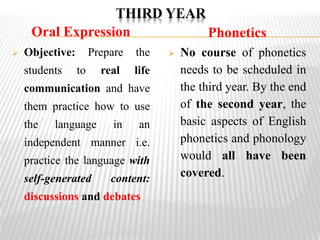
Oral Expression
 Objective: Prepare the
students to real life
communication and have
them practice how to use
the language in an
independent manner i.e.
practice the language with
self-generated content:
discussions and debates
Phonetics
 No course of phonetics
needs to be scheduled in
the third year. By the end
of the second year, the
basic aspects of English
phonetics and phonology
would all have been
covered.
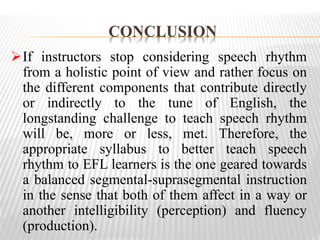
CONCLUSION
If instructors stop considering speech rhythm
from a holistic point of view and rather focus on
the different components that contribute directly
or indirectly to the tune of English, the
longstanding challenge to teach speech rhythm
will be, more or less, met. Therefore, the
appropriate syllabus to better teach speech
rhythm to EFL learners is the one geared towards
a balanced segmental-suprasegmental instruction
in the sense that both of them affect in a way or
another intelligibility (perception) and fluency
(production).
Thank You

Teaching Speech Rhythm.pptx

  • 1.
    SPEECH RHYTHM PRODUCTIONIN A MULTILINGUAL SETTING Amel ALOUACHE Department of Arts and the English Language Mentouri Brothers University, Constantine A Suggested Syllabus for Teaching Speech Rhythm
  • 2.
    Algerian learners majoringin English as a third language have already been exposed to a second standard language, French, early in their learning curriculum, in addition to their mother tongue, dialectal Arabic. A fact that has been proved to affect different aspects of English phonetics and phonology, especially in the realm of speech rhythm. INTRODUCTION
  • 3.
    Since the aimbehind teaching a foreign language is to understand and to be understood, more focus should be given to the teaching of suprasegmentals, notably speech rhythm as it can lead to communication breakdown on the part of the listener as well as on the part of the speaker. Despite its importance, EFL teachers, generally speaking, tend to neglect the necessity of teaching speech rhythm mostly because it is regarded as something that comes naturally with the language and, therefore, cannot be acquired. Such a view comes from the belief that speech rhythm is related to longer units of speech i.e. thought groups RATIONALE
  • 4.
     Speech rhythmis related to longer units of speech (thought groups: sentences, clauses or phrases) and its teaching is believed to be best considered from a holistic perspective, hence approached by a top-down scheme that is based mostly on suprasegmental features: thought group, focus word, stressed syllable and the nucleus However, longer units of speech are combinations of smaller constituents that make, by definition, the teaching of speech rhythm approachable from a bottom-up scheme as well: Vowels (nucleus)
  • 5.
    Thought Group Focus Word StressedSyllable Nucleus TOP DOWN Best suits the teaching of PERCEPTION
  • 6.
    Nucleus Stressed Syllable Focus Word ThoughtGroup BOTTOM UP Best suits the teaching of PRODUCTION
  • 7.
     With thisin mind, there should be no inclination towards one approach over another in the teaching of speech rhythm as the latter brings together segmental and suprasegmental features.  Therefore, the appropriate syllabus to better teach speech rhythm to EFL learners is the one geared towards a balanced segmental-suprasegmental instruction in the sense that both of them affect in a way or another intelligibility, in terms of perception, and fluency, in terms of production.
  • 8.
     Speech rhythmshould be taught over two modules: ‘Phonetics and Phonology’ and ‘Oral Expression’ for both of them are concerned with the speaking skill. A SUGGESTED SYLLABUS FOR TEACHING SPEECH RHYTHM
  • 9.
    FIRST YEAR Oral Expression Practice how to correctly produce and articulate the sounds of English through repetition and imitation.  Use of minimal pairs to practice the difference between vowels (tense/lax, short/long, full/reduced)  Use of minimal pairs to practice the difference in vowel length in accordance to syllable type and consonant voicing. Phonetics  Introduction to the basic concepts of phonetics and phonology: speech sounds.  Raise students’ awareness about the complex orthographic system of English and to spelling pronunciation. More focus should be given to this matter and practice can involve reading poems including the different problematic sounds whose pronunciation does not match their orthographic representations:consider /kǝnˈsɪdǝ/
  • 10.
    SECOND YEAR Oral Expression Have the students practice and use, in their interlanguage, the newly learned items, in the phonetics module, through a series of dependent activities with a given model, a series of guided activities, and a series of semi-guided activities with self-initiated and rehearsed speech.  Teachers should take into account the nature of the item in focus while choosing the type of activity. One cannot use a ‘listen and repeat’ activity to practice rhythmic features that go beyond the word level such as pauses. Listen and repeat (more profitable with individual sounds). Such a kind of activities should be kept to a minimum; once the students produce the targeted item, it is better to move to less controlled speaking activities Oral reading: reading aloud scripts allows students to pay attention to pronunciation rather than vocabulary. This type of activity is suitable to practice rhythmic features that are related to longer linguistic units. Pre-planned oral presentations and rehearsed performances followed by a section of students’ feedback. In this semi-controlled type of activities, students are given the opportunity to build their own productions
  • 11.
    SECOND YEAR PHONETICS  Dictationof words/passages featuring the item in focus + targeted activities  Listening to authentic audio featuring the item in focus + targeted activities Vowel reduction + ed past suffix + syllabic consonants  Objective 1: raise the students’ awareness about the importance of making one syllable more prominent than the other, to give the alternation between stressed vs. unstressed syllables: /kǝnˈfes/, /ˈdi:mǝn/  Objective 2: raise the students’ awareness about pronouncing correctly the suffix ‘ed’ and syllabic consonants ([ṇ] and [ḷ]) in maintaining the correct number of syllables, and thereby the correct placement of stress: /ræpt/ vs. /ræpəd/ , /kǝnˈfes/ vs. /ˈkɒnfəs/ Aspects of connected speech  Objective 1: introduce the different aspects of connected speech and how sounds change or disappear as a result of their environment. Explanation follows once the students succeed to recognize the item in focus.  Objective 2: sensitize students to the characteristics of rhythmic groups (pause, pitch change, etc.) and raise their awareness to the correct segmentation in speech.
  • 12.
    THIRD YEAR Oral Expression Objective: Prepare the students to real life communication and have them practice how to use the language in an independent manner i.e. practice the language with self-generated content: discussions and debates Phonetics  No course of phonetics needs to be scheduled in the third year. By the end of the second year, the basic aspects of English phonetics and phonology would all have been covered.
  • 13.
    CONCLUSION If instructors stopconsidering speech rhythm from a holistic point of view and rather focus on the different components that contribute directly or indirectly to the tune of English, the longstanding challenge to teach speech rhythm will be, more or less, met. Therefore, the appropriate syllabus to better teach speech rhythm to EFL learners is the one geared towards a balanced segmental-suprasegmental instruction in the sense that both of them affect in a way or another intelligibility (perception) and fluency (production).
  • 14.