





ADUF
Adaptable Design Up Front
Hayim Makabee
http://EffectiveSoftwareDesign.com
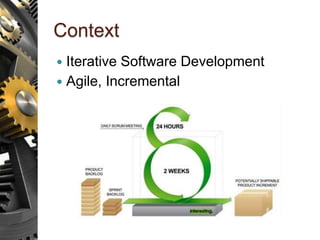
Context
 Iterative Software Development
 Agile, Incremental
Question
 How much design should be done up
front?
 Up front = Before starting the
implementation (coding).
Big Design Up Front
 BDUF = Do detailed design before
starting to code.
 Problems:
◦ Requirements are incomplete.
◦ Requirements may change.
◦ “The Scrum product backlog is allowed to
grow and change as more is learned
about the product and its customers.”
Emergent Design
 “With emergent design, a
development organization starts
delivering functionality and lets the
design emerge.”
 First iteration:
◦ Implement initial features.
 Next iterations:
◦ Implement additional features.
◦ Refactor.
Just Enough Design
 “Just enough sits somewhere in the
chasm between big design up front's
analysis paralysis and emergent
design's refactor distractor.” – Simon
Brown
 Question: How much design is “just
enough”?
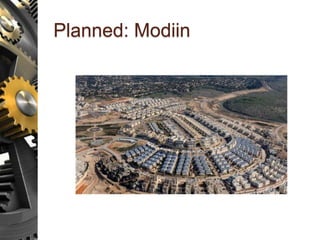
Planned: Modiin
Emergent: Jerusalem Old City
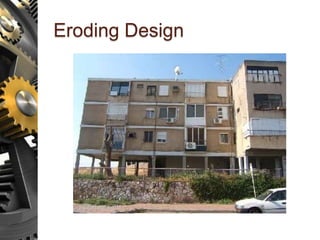
Eroding Design
Eroding Design
 “The biggest risk associated with
Piecemeal Growth is that it will
gradually erode the overall
structure of the system, and
inexorably turn it into a Big Ball of
Mud.” - Brian Foote and Joseph Yoder
– “Big Ball of Mud”
Software Entropy
 Entropy is a measure of the number of
specific ways in which a system may
be arranged (a measure of disorder).
 The entropy of an isolated system
never decreases.
Lehman Laws
 A computer program that is used will
be modified.
 When a program is modified, its
complexity will increase, provided that
one does not actively work against
this.
Conclusions so far…
 In summary:
◦ We must design up front.
◦ BDUF does not support change.
◦ Emergent design works at low-level.
◦ Just Enough DUF is not clear.
 We need:
◦ The design must support change.
Adaptability
 “A system that can cope readily with
a wide range of
requirements, will, all other things
being equal, have an advantage over
one that cannot. Such a system can
allow unexpected requirements to
be met with little or no
reengineering, and allow its more
skilled customers to rapidly address
novel challenges.” - Brian Foote and
Joseph Yoder – “Big Ball of Mud”
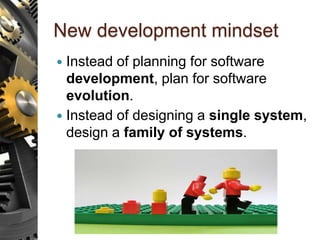
New development mindset
 Instead of planning for software
development, plan for software
evolution.
 Instead of designing a single system,
design a family of systems.
Family of Systems
 Software Product Line: “A set of
software-intensive systems that share
a common, managed set of features
satisfying the specific needs of a
particular market segment or mission
and that are developed from a
common set of core assets in a
prescribed way.” – Software
Engineering Institute
Adaptable Design
 Adaptable Software Design: A generic
software design for a family of
systems which does not need to be
changed to accommodate new
requirements.
 ADUF = Adaptable Design Up Front!
Open/Closed Principle
 “Software entities (classes, modules,
functions, etc.) should be open for
extension, but closed for modification.”
- Bertrand Meyer
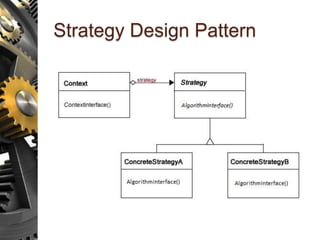
Strategy Design Pattern
Adaptable Design Up Front and
the Open/Closed Principle
 ADUF focuses on the early definition
of the “closed” aspects of the design
while at the same time allows easy
evolution by making this design open
to extensions.
 Closed: Captures essential entities
and relationships.
 Open: Provides mechanisms for
extensibility.
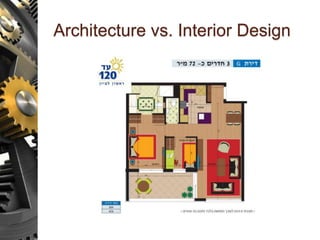
Architecture vs. Interior Design
Common Errors
 Too much design up front
 Not enough design up front
 Too much openness
 Not enough openness
Too much design up front
 Capturing aspects that are not
essential as if they were such.
 The design may need to change (thus
it is not really “closed”).
 Examples:
◦ Specific details are not generalized.
◦ Designing for a specific system instead of
designing for a family of systems.
Not enough design up front
 Leaving away some of the essential
aspects of the system.
 These aspects will need to be added
to the design when other parts of the
system are already implemented.
 Example:
◦ Adding relationships to new entities may
cause changes to existing interfaces.
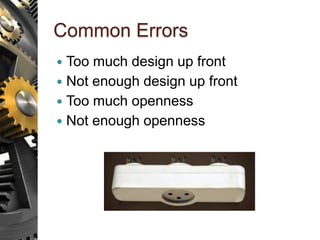
Too much openness
 The design is over
engineered, resulting in complexity not
really necessary.
 Example:
◦ It is always possible to reduce coupling
through additional layers of indirection.
◦ With many layers, it is difficult to locate
where the business logic is implemented.
Not enough openness
 The design captures all essential
aspects, but there are not
mechanisms that allow this design to
be easily extended.
 Example:
◦ If there are Interfaces for the main
entities, there should also be Factories to
instantiate concrete subclasses.
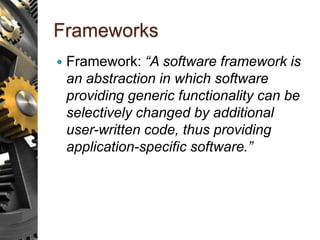
Extensible Designs
Main alternatives for extensible designs:
 Frameworks
◦ Plug-ins
 Platforms
Frameworks
 Framework: “A software framework is
an abstraction in which software
providing generic functionality can be
selectively changed by additional
user-written code, thus providing
application-specific software.”
Plug-ins
 Plug-in: “A plug-in is a software
component that adds a specific
feature to an existing software
application. When an application
supports plug-ins, it enables
customization.”
Pluggable Components
Versioning
 Traditional:
◦ Version = modifications + additions.
◦ After n iterations: n versions.
 Component-based:
◦ Version = combination of new
implementations of components.
◦ System with m components, after n
iterations: nm versions.
Platforms
 Platform: “Technology that enables the
creation of products and processes
that support present or future
development.”
 Software platforms provide services
that are used by several applications.
 Platforms and applications may evolve
independently of each other.
Question 1
 How do you identify the components
in your framework or the services in
your platform?
Domain Modeling
 “A domain model is a conceptual
model of all the topics related to a
specific problem. It describes the
various entities, their attributes, roles,
and relationships, plus the constraints
that govern the problem domain.”
Question 2
 How do you decouple the components
in your framework?
Design Patterns
 Reduce coupling using Design
Patterns.
 Most patterns avoid direct links
between concrete classes, using
interfaces and abstract classes.
 Example: Use Observer when several
types of objects must react to the
same event.
Example: Recommender System
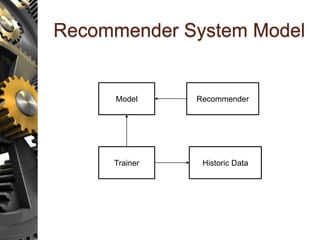
Recommender System Model
Model Recommender
Trainer Historic Data
Recommender System
Framework
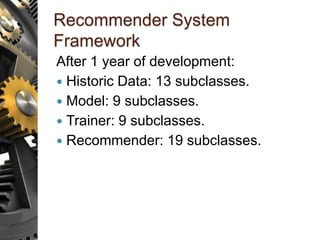
After 1 year of development:
 Historic Data: 13 subclasses.
 Model: 9 subclasses.
 Trainer: 9 subclasses.
 Recommender: 19 subclasses.
What about YAGNI?
 YAGNI = You aren't gonna need it.
 A principle of extreme programming
(XP) that states that a programmer
should not add functionality until
deemed necessary.
 “Always implement things when you
actually need them, never when you
just foresee that you need them.” -
Ron Jeffries
YAGNI vs. ADUF
 YAGNI tells us to avoid doing what we
are not sure we will need.
 ADUF tells us:
◦ Define the things you are sure you will
need in any case.
◦ Prepare for the things that you may need
in the future (adaptability).
◦ NIAGNI: “No, I am gonna need it!”
Conclusions
 Software systems must evolve over time.
 This evolution should be planned and
supported trough Adaptable Software
Designs.
 Domain Modeling: Identify the entities
and relationships that form the “closed”
part of the design.
 Framework Design: Design a framework
that represents the model and add
mechanisms for extensibility, making it
“open”.
Related Work
 Software Engineering Institute:
◦ Software Product Lines
 Alistair Cockburn:
◦ Walking Skeleton
◦ Incremental Rearchitecture
 Neal Ford:
◦ Emergent Design
◦ Evolutionary Architecture
 Simon Brown:
◦ Just Enough Design Up Front
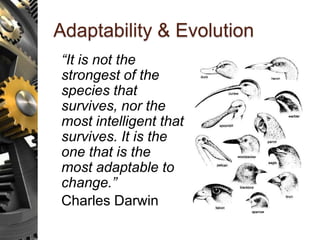
Adaptability & Evolution
“It is not the
strongest of the
species that
survives, nor the
most intelligent that
survives. It is the
one that is the
most adaptable to
change.”
Charles Darwin
Thanks!
Q&A
http://EffectiveSoftwareDesign.com

ADUF - Adaptable Design Up Front

  • 1.
    ADUF Adaptable Design UpFront Hayim Makabee http://EffectiveSoftwareDesign.com
  • 2.
    Context  Iterative SoftwareDevelopment  Agile, Incremental
  • 3.
    Question  How muchdesign should be done up front?  Up front = Before starting the implementation (coding).
  • 4.
    Big Design UpFront  BDUF = Do detailed design before starting to code.  Problems: ◦ Requirements are incomplete. ◦ Requirements may change. ◦ “The Scrum product backlog is allowed to grow and change as more is learned about the product and its customers.”
  • 5.
    Emergent Design  “Withemergent design, a development organization starts delivering functionality and lets the design emerge.”  First iteration: ◦ Implement initial features.  Next iterations: ◦ Implement additional features. ◦ Refactor.
  • 6.
    Just Enough Design “Just enough sits somewhere in the chasm between big design up front's analysis paralysis and emergent design's refactor distractor.” – Simon Brown  Question: How much design is “just enough”?
  • 7.
  • 8.
  • 9.
  • 10.
    Eroding Design  “Thebiggest risk associated with Piecemeal Growth is that it will gradually erode the overall structure of the system, and inexorably turn it into a Big Ball of Mud.” - Brian Foote and Joseph Yoder – “Big Ball of Mud”
  • 11.
    Software Entropy  Entropyis a measure of the number of specific ways in which a system may be arranged (a measure of disorder).  The entropy of an isolated system never decreases.
  • 12.
    Lehman Laws  Acomputer program that is used will be modified.  When a program is modified, its complexity will increase, provided that one does not actively work against this.
  • 13.
    Conclusions so far… In summary: ◦ We must design up front. ◦ BDUF does not support change. ◦ Emergent design works at low-level. ◦ Just Enough DUF is not clear.  We need: ◦ The design must support change.
  • 14.
    Adaptability  “A systemthat can cope readily with a wide range of requirements, will, all other things being equal, have an advantage over one that cannot. Such a system can allow unexpected requirements to be met with little or no reengineering, and allow its more skilled customers to rapidly address novel challenges.” - Brian Foote and Joseph Yoder – “Big Ball of Mud”
  • 15.
    New development mindset Instead of planning for software development, plan for software evolution.  Instead of designing a single system, design a family of systems.
  • 16.
    Family of Systems Software Product Line: “A set of software-intensive systems that share a common, managed set of features satisfying the specific needs of a particular market segment or mission and that are developed from a common set of core assets in a prescribed way.” – Software Engineering Institute
  • 17.
    Adaptable Design  AdaptableSoftware Design: A generic software design for a family of systems which does not need to be changed to accommodate new requirements.  ADUF = Adaptable Design Up Front!
  • 18.
    Open/Closed Principle  “Softwareentities (classes, modules, functions, etc.) should be open for extension, but closed for modification.” - Bertrand Meyer
  • 19.
  • 20.
    Adaptable Design UpFront and the Open/Closed Principle  ADUF focuses on the early definition of the “closed” aspects of the design while at the same time allows easy evolution by making this design open to extensions.  Closed: Captures essential entities and relationships.  Open: Provides mechanisms for extensibility.
  • 21.
  • 22.
    Common Errors  Toomuch design up front  Not enough design up front  Too much openness  Not enough openness
  • 23.
    Too much designup front  Capturing aspects that are not essential as if they were such.  The design may need to change (thus it is not really “closed”).  Examples: ◦ Specific details are not generalized. ◦ Designing for a specific system instead of designing for a family of systems.
  • 24.
    Not enough designup front  Leaving away some of the essential aspects of the system.  These aspects will need to be added to the design when other parts of the system are already implemented.  Example: ◦ Adding relationships to new entities may cause changes to existing interfaces.
  • 25.
    Too much openness The design is over engineered, resulting in complexity not really necessary.  Example: ◦ It is always possible to reduce coupling through additional layers of indirection. ◦ With many layers, it is difficult to locate where the business logic is implemented.
  • 26.
    Not enough openness The design captures all essential aspects, but there are not mechanisms that allow this design to be easily extended.  Example: ◦ If there are Interfaces for the main entities, there should also be Factories to instantiate concrete subclasses.
  • 27.
    Extensible Designs Main alternativesfor extensible designs:  Frameworks ◦ Plug-ins  Platforms
  • 28.
    Frameworks  Framework: “Asoftware framework is an abstraction in which software providing generic functionality can be selectively changed by additional user-written code, thus providing application-specific software.”
  • 29.
    Plug-ins  Plug-in: “Aplug-in is a software component that adds a specific feature to an existing software application. When an application supports plug-ins, it enables customization.”
  • 30.
  • 31.
    Versioning  Traditional: ◦ Version= modifications + additions. ◦ After n iterations: n versions.  Component-based: ◦ Version = combination of new implementations of components. ◦ System with m components, after n iterations: nm versions.
  • 32.
    Platforms  Platform: “Technologythat enables the creation of products and processes that support present or future development.”  Software platforms provide services that are used by several applications.  Platforms and applications may evolve independently of each other.
  • 33.
    Question 1  Howdo you identify the components in your framework or the services in your platform?
  • 34.
    Domain Modeling  “Adomain model is a conceptual model of all the topics related to a specific problem. It describes the various entities, their attributes, roles, and relationships, plus the constraints that govern the problem domain.”
  • 35.
    Question 2  Howdo you decouple the components in your framework?
  • 36.
    Design Patterns  Reducecoupling using Design Patterns.  Most patterns avoid direct links between concrete classes, using interfaces and abstract classes.  Example: Use Observer when several types of objects must react to the same event.
  • 37.
  • 38.
    Recommender System Model ModelRecommender Trainer Historic Data
  • 39.
    Recommender System Framework After 1year of development:  Historic Data: 13 subclasses.  Model: 9 subclasses.  Trainer: 9 subclasses.  Recommender: 19 subclasses.
  • 40.
    What about YAGNI? YAGNI = You aren't gonna need it.  A principle of extreme programming (XP) that states that a programmer should not add functionality until deemed necessary.  “Always implement things when you actually need them, never when you just foresee that you need them.” - Ron Jeffries
  • 41.
    YAGNI vs. ADUF YAGNI tells us to avoid doing what we are not sure we will need.  ADUF tells us: ◦ Define the things you are sure you will need in any case. ◦ Prepare for the things that you may need in the future (adaptability). ◦ NIAGNI: “No, I am gonna need it!”
  • 42.
    Conclusions  Software systemsmust evolve over time.  This evolution should be planned and supported trough Adaptable Software Designs.  Domain Modeling: Identify the entities and relationships that form the “closed” part of the design.  Framework Design: Design a framework that represents the model and add mechanisms for extensibility, making it “open”.
  • 43.
    Related Work  SoftwareEngineering Institute: ◦ Software Product Lines  Alistair Cockburn: ◦ Walking Skeleton ◦ Incremental Rearchitecture  Neal Ford: ◦ Emergent Design ◦ Evolutionary Architecture  Simon Brown: ◦ Just Enough Design Up Front
  • 44.
    Adaptability & Evolution “Itis not the strongest of the species that survives, nor the most intelligent that survives. It is the one that is the most adaptable to change.” Charles Darwin
  • 45.