Teaching Parents How to Use
Positive Reinforcement
Melisa Trent
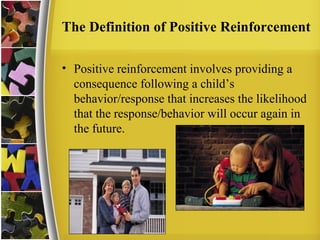
The Definition of Positive Reinforcement
• Positive reinforcement involves providing a
consequence following a child’s
behavior/response that increases the likelihood
that the response/behavior will occur again in
the future.
What is Positive Reinforcement?
• Positive reinforcement is anything that the
child wants/obtains to gain.
• Examples:
• 1. Favorite food.
• 2. Attention: spending time with a parent or
friend.
• 3. Activities: going to the park, playing
games or watching a movie, etc.
• 4. Praise: “good job” or “way to go,” etc.
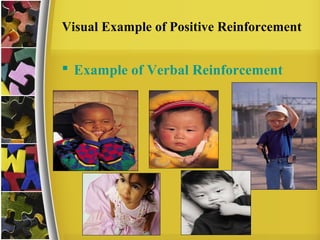
Visual Example of Positive Reinforcement
 Example of Verbal Reinforcement
What behavior do you want to positively reinforce?
• List the behavior/task in which you want to
reinforce on the front of a 3x5 card (provided).
• On the back of that same card list steps to
achieve/master this behavior/task listed above.
• On another 3x5 card (provided) list the top 5
reinforcers for your child. (Ex. Food, attention,
activity or praise)
• List the behavior/task in which you want to
reinforce on the front of a 3x5 card (provided).
• On the back of that same card list steps to
achieve/master this behavior/task listed above.
• On another 3x5 card (provided) list the top 5
reinforcers for your child. (Ex. Food, attention,
activity or praise)
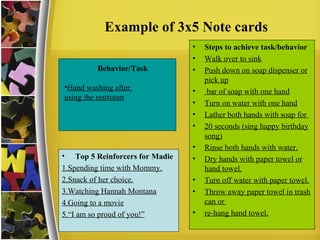
Example of 3x5 Note cards
Behavior/Task
•Hand washing after
using the restroom
• Steps to achieve task/behavior
• Walk over to sink
• Push down on soap dispenser or
pick up
• bar of soap with one hand
• Turn on water with one hand
• Lather both hands with soap for
• 20 seconds (sing happy birthday
song)
• Rinse both hands with water.
• Dry hands with paper towel or
hand towel.
• Turn off water with paper towel.
• Throw away paper towel in trash
can or
• re-hang hand towel.
• Top 5 Reinforcers for Madie
1.Spending time with Mommy.
2.Snack of her choice.
3.Watching Hannah Montana
4.Going to a movie
5.“I am so proud of you!”
Keep Your Tool Box Close!
• I suggest to put all of the 3x5 cards either in a
recipe
box or on a portable key ring.
• List behaviors on one tab and reinforcers on the
other tab, to keep them separate.
• Accessibility, portability and simplicity are
key for success with this teaching tool.
• The more tools you have access too, the
simpler your job will be.
Recommended Reading
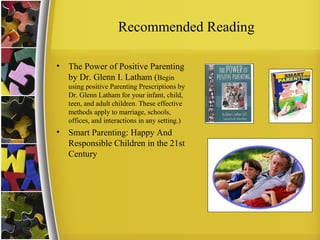
• The Power of Positive Parenting
by Dr. Glenn I. Latham (Begin
using positive Parenting Prescriptions by
Dr. Glenn Latham for your infant, child,
teen, and adult children. These effective
methods apply to marriage, schools,
offices, and interactions in any setting.)
• Smart Parenting: Happy And
Responsible Children in the 21st
Century
Other Resources
• Parenting Prescriptions: www.parentrx.com
• www.parentsconnect.com
• www.parents.com
• www.kidsmakingchange.com
References
• Cooper, J.O. Heron, T.E., Heward, W.L., (2007).
Applied Behavior Analysis 2nd
Edition. Upper
Saddle, N.J.: Pearson Education, Inc.

Teaching parents how to use puzzle temp

  • 1.
    Teaching Parents Howto Use Positive Reinforcement Melisa Trent
  • 2.
    The Definition ofPositive Reinforcement • Positive reinforcement involves providing a consequence following a child’s behavior/response that increases the likelihood that the response/behavior will occur again in the future.
  • 3.
    What is PositiveReinforcement? • Positive reinforcement is anything that the child wants/obtains to gain. • Examples: • 1. Favorite food. • 2. Attention: spending time with a parent or friend. • 3. Activities: going to the park, playing games or watching a movie, etc. • 4. Praise: “good job” or “way to go,” etc.
  • 4.
    Visual Example ofPositive Reinforcement  Example of Verbal Reinforcement
  • 5.
    What behavior doyou want to positively reinforce? • List the behavior/task in which you want to reinforce on the front of a 3x5 card (provided). • On the back of that same card list steps to achieve/master this behavior/task listed above. • On another 3x5 card (provided) list the top 5 reinforcers for your child. (Ex. Food, attention, activity or praise) • List the behavior/task in which you want to reinforce on the front of a 3x5 card (provided). • On the back of that same card list steps to achieve/master this behavior/task listed above. • On another 3x5 card (provided) list the top 5 reinforcers for your child. (Ex. Food, attention, activity or praise)
  • 6.
    Example of 3x5Note cards Behavior/Task •Hand washing after using the restroom • Steps to achieve task/behavior • Walk over to sink • Push down on soap dispenser or pick up • bar of soap with one hand • Turn on water with one hand • Lather both hands with soap for • 20 seconds (sing happy birthday song) • Rinse both hands with water. • Dry hands with paper towel or hand towel. • Turn off water with paper towel. • Throw away paper towel in trash can or • re-hang hand towel. • Top 5 Reinforcers for Madie 1.Spending time with Mommy. 2.Snack of her choice. 3.Watching Hannah Montana 4.Going to a movie 5.“I am so proud of you!”
  • 7.
    Keep Your ToolBox Close! • I suggest to put all of the 3x5 cards either in a recipe box or on a portable key ring. • List behaviors on one tab and reinforcers on the other tab, to keep them separate. • Accessibility, portability and simplicity are key for success with this teaching tool. • The more tools you have access too, the simpler your job will be.
  • 8.
    Recommended Reading • ThePower of Positive Parenting by Dr. Glenn I. Latham (Begin using positive Parenting Prescriptions by Dr. Glenn Latham for your infant, child, teen, and adult children. These effective methods apply to marriage, schools, offices, and interactions in any setting.) • Smart Parenting: Happy And Responsible Children in the 21st Century
  • 9.
    Other Resources • ParentingPrescriptions: www.parentrx.com • www.parentsconnect.com • www.parents.com • www.kidsmakingchange.com
  • 10.
    References • Cooper, J.O.Heron, T.E., Heward, W.L., (2007). Applied Behavior Analysis 2nd Edition. Upper Saddle, N.J.: Pearson Education, Inc.