Teaching a Hybrid Course
    with Desire2Learn
  Learning Environment
     Philip A. Thompsen, Ph.D.
     Department of Communication Studies
     West Chester University of Pennsylvania
Preview
Why hybrid?
What we did
How we did it
What we’ve learned
Why hybrid?
Why hybrid?
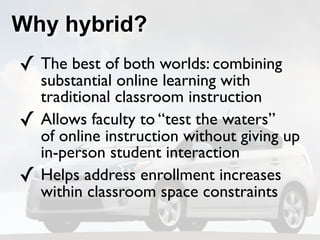
✓ The best of both worlds: combining
    substantial online learning with
    traditional classroom instruction
✓   Allows faculty to “test the waters”
    of online instruction without giving up
    in-person student interaction
✓   Helps address enrollment increases
    within classroom space constraints
✓ Last year, we began
                  developing course
What we did       content and adding
                  it to a Desire2Learn


 √
                  course website
              ✓   This past spring, we
                  offered two sections
                  of our intercultural
                  communication
                  course in the hybrid
                  format, with class
                  once a week and
                  weekly online units.
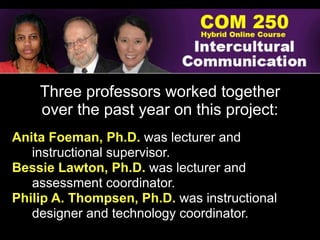
Three professors worked together
    over the past year on this project:
Anita Foeman, Ph.D. was lecturer and
   instructional supervisor.
Bessie Lawton, Ph.D. was lecturer and
   assessment coordinator.
Philip A. Thompsen, Ph.D. was instructional
   designer and technology coordinator.
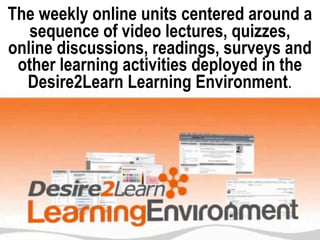
The weekly online units centered around a
   sequence of video lectures, quizzes,
online discussions, readings, surveys and
 other learning activities deployed in the
  Desire2Learn Learning Environment.
How   we did it
How     we did it


       Keynote
  Presentation software
How      we did it


       Camtasia
  Screencasting software
How       we did it


 Podcast Producer 2
 Media encoding and hosting
How     we did it


      Flowplayer
 Open source Flash player
How       we did it


     Desire 2 Learn
 Learning Management System
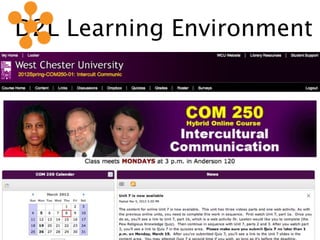
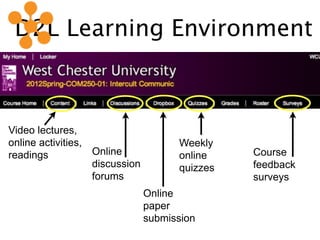
D2L Learning Environment


Video lectures,
online activities,                    Weekly
readings           Online             online    Course
                   discussion         quizzes   feedback
                   forums                       surveys
                                Online
                                paper
                                submission
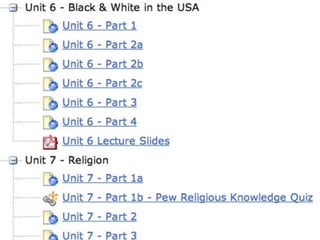
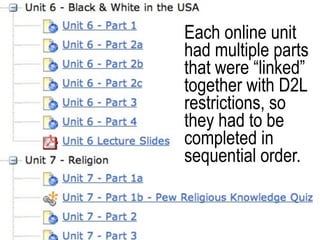
Each online unit
had multiple parts
that were “linked”
together with D2L
restrictions, so
they had to be
completed in
sequential order.
What we’ve learned
• Create content that’s flexible and reusable.
• Provide alternative video players.
• Design for small screens.
• Short videos are best.
• Be sensitive to audio when
  recording and editing videos.
• Use D2L to enforce a disciplined
  approach and to monitor progress.
• Take advantage of the hybrid format
  to “flip” the traditional classroom.
Questions? Comments?
    Philip A. Thompsen, Ph.D.
         email: pthompsen@wcupa.edu
         web: communication.wcupa.edu
         blog: drthompsen.com
         twitter: pthompsen

Teaching a Hybrid Course with Desire2Learn Learning Environment

  • 1.
    Teaching a HybridCourse with Desire2Learn Learning Environment Philip A. Thompsen, Ph.D. Department of Communication Studies West Chester University of Pennsylvania
  • 2.
    Preview Why hybrid? What wedid How we did it What we’ve learned
  • 3.
  • 4.
    Why hybrid? ✓ Thebest of both worlds: combining substantial online learning with traditional classroom instruction ✓ Allows faculty to “test the waters” of online instruction without giving up in-person student interaction ✓ Helps address enrollment increases within classroom space constraints
  • 5.
    ✓ Last year,we began developing course What we did content and adding it to a Desire2Learn √ course website ✓ This past spring, we offered two sections of our intercultural communication course in the hybrid format, with class once a week and weekly online units.
  • 6.
    Three professors workedtogether over the past year on this project: Anita Foeman, Ph.D. was lecturer and instructional supervisor. Bessie Lawton, Ph.D. was lecturer and assessment coordinator. Philip A. Thompsen, Ph.D. was instructional designer and technology coordinator.
  • 7.
    The weekly onlineunits centered around a sequence of video lectures, quizzes, online discussions, readings, surveys and other learning activities deployed in the Desire2Learn Learning Environment.
  • 8.
    How we did it
  • 9.
    How we did it Keynote Presentation software
  • 10.
    How we did it Camtasia Screencasting software
  • 11.
    How we did it Podcast Producer 2 Media encoding and hosting
  • 12.
    How we did it Flowplayer Open source Flash player
  • 13.
    How we did it Desire 2 Learn Learning Management System
  • 14.
  • 15.
    D2L Learning Environment Videolectures, online activities, Weekly readings Online online Course discussion quizzes feedback forums surveys Online paper submission
  • 17.
    Each online unit hadmultiple parts that were “linked” together with D2L restrictions, so they had to be completed in sequential order.
  • 18.
    What we’ve learned •Create content that’s flexible and reusable. • Provide alternative video players. • Design for small screens. • Short videos are best. • Be sensitive to audio when recording and editing videos. • Use D2L to enforce a disciplined approach and to monitor progress. • Take advantage of the hybrid format to “flip” the traditional classroom.
  • 19.
    Questions? Comments? Philip A. Thompsen, Ph.D. email: pthompsen@wcupa.edu web: communication.wcupa.edu blog: drthompsen.com twitter: pthompsen