KEMENTERIAN PELAJARAN MALAYSIA
Kurikulum Standard Sekolah Rendah
THE TEACHER'S
GUIDE BOOK
ENGLISH
Terbitan
Bahagian Pembangunan Kurikulum
2013
Cetakan Pertama 2013
© Kementerian Pelajaran Malaysia
Hak Cipta Terpelihara. Tidak dibenarkan mengeluar ulang mana-mana bahagian
artikel, ilustrasi dan isi kandungan buku ini dalam apa-apa juga bentuk dan dengan
cara apa-apa jua sama ada secara elektronik, fotokopi, mekanik, rakaman atau cara
lain sebelum mendapat kebenaran bertulis daripada Pengarah, Bahagian
Pembangunan Kurikulum, Kementerian Pelajaran Malaysia, Aras 4-8, Blok E9,
Parcel E, Kompleks Pentadbiran Kerajaan Persekutuan, 62604 Putrajaya.
iii
C O N T E N T
Section 1
Preface vii
Overview of the English Language Curriculum viii
Content and Learning Standards for Year 4 1
Section 2
Sample Lesson 3Rs 8
Sample Lesson A Splashing Time 26
Sample Lesson Asian Folk Tales 45
Sample Lesson Save the Earth 68
Sample Lesson The Magic of Shopping 87
Sample Lesson Green Car 110
Sample Lesson The Magic of Respect 121
Sample Lesson The Twins 136
Sample Lesson Money 163
Sample Lesson The Three Brothers 192
Sample Lesson Safe and Sound 233
Sample Lesson Looking Good 256
Section 3
Grammar Notes 224
Acknowledgement 250
Using the guide book
Year 4 curriculum
vii
PP R E F A C E
Using the Guide Book
This guide book is divided into three sections; Section 1, 2 and 3.
Section 1 takes teachers through a quick tour of the entire English Language
Curriculum for primary schools and details the modularity of focus as well as
the principles and educational emphases in the new curriculum. Here,
English Language Curriculum for Year 4 pupils are detailed.
Section 2 contains sample lessons which cover the learning standards that
must be achieved in the Year 4 classroom. These lessons serve as a
resource and guide to teachers when planning their lessons. However, the
sample lessons are by no means totally comprehensive nor exhaustive as
they do not constitute lessons for the entire year. Instead, they are provided to
show how teachers can carry out a full week’s lessons comprising listening &
speaking, reading, writing, language arts and grammar in a cohesive and
integrative manner, following the modular configuration. Thus, teachers will
be able to observe how a week’s lessons can be planned and executed
progressively and developmentally.
Section 3 includes grammar notes and helpful suggestions which are useful
for teachers. The grammar notes are meant for teachers only.
All the sample lessons and materials in this guide book are adaptable and
teachers should feel free to modify them to suit the learning needs of their
pupils. Teachers should incorporate the contemporary literature/children’s
literature in their daily lessons. As teachers are the best people to decide
what works best for their pupils, they should use their pedagogical expertise
and experience in adapting and modifying ideas from this book. Since there is
no single ‘best way’ in classroom practices, teachers are encouraged to be
creative and innovative so that interesting, meaningful, purposeful and fun
lessons can be carried out to help pupils learn better.
OVERVIEW OF THE ENGLISH LANGUAGE CURRICULUM
The Standard-Based English Language Curriculum for Malaysian National Primary Schools is
designed to provide pupils with a strong foundation in the English language. Teachers should
use Standard British English as a reference and model for teaching the language. It should be
used as a reference for spelling and grammar as well as pronunciation for standardisation.
Primary education is divided into two stages: Stage One refers to Years 1, 2 and 3 and Stage
Two, Years 4, 5 and 6.
In Year 1 and 2, the English language curriculum emphasises the development of basic
language skills so that pupils will have a strong foundation to build their proficiency in the
language. In this stage, there are four modules;
Module One : Listening and Speaking
Module Two : Reading
Module Three : Writing
Module Four : Language Arts
In Years 3 - 6, where pupils build on the skills they have acquired in Year 1 and 2, a fifth
module, Grammar is added to the above four modules. Therefore, the modules are:
Module One : Listening and Speaking
Module Two : Reading
Module Three : Writing
Module Four : Language Arts
Module Five : Grammar
English is the second language for pupils in schools. Thus, it is believed prudent and
pedagogically sound to defer the learning of grammar to a later stage. Pupils should be given
the opportunity to develop an awareness of grammar in their first language and this awareness
may then be exploited when English grammar is introduced in Year 3. This approach will reduce
the load and stress of learning in the early years where the emphasis is on learning through fun
and play.
A MODULAR CURRICULUM
The modularity of the Standard-based English Language Curriculum is of a modular structure. .
This modular approach does not exclude integration of skills. However, skills integration is
exploited strategically to enhance pupils’ development of specific language skills as described in
the content and learning standards in a module. on of the content and learning standards.
In order to make learning more meaningful and purposeful, language input is presented under
themes and topics which are appropriate for pupils. Three broad themes have been identified in
the curriculum.
World of Self, Family and Friends;
World of Stories and
World of Knowledge.
viii
The following diagram shows the conceptual framework of the curriculum model.
THE MODULAR CONFIGURATION
UNDERLYING PEDAGOGICAL PRINCIPLES OF THE CURRICULUM
The approach adopted in the Standard-based curriculum is underpinned by the following
principles:
i. Back to basics where the emphasis is on basic literacy skills in order to build a strong
foundation of language skills. The strategy of phonics is introduced in order to help pupils begin
to read and a good foundation in penmanship will help pupils acquire good handwriting.
ii. Learning is fun, meaningful and purposeful. Lessons, which emphasise meaningful
contexts and the integration of language skills, allow pupils to learn by doing in fun-filled
activities. Contextualised as well as purposeful activities will promote the fun element in
language learning.
iii. Teaching is learner-centred so teaching approaches, lessons and curriculum materials
must suit the differing needs and abilities of pupils. It is important that appropriate activities and
LISTENING AND SPEAKING MODULE
READING MODULE
WRITING MODULE
LANGUAGE ARTS MODULE
GRAMMAR MODULE
YEAR 6YEAR 4YEAR 3 YEAR 5YEAR 2YEAR 1
STAGE TWO
(YEARS 4 – 6)
STAGE ONE
(YEARS 1 – 3)
ix
materials are used with pupils of different learning capabilities so that their full potential can be
realised.
iv. Integration of salient new technologies in line with growing globalisation. Technology is
used extensively in our daily communication. Information available on the internet and other
electronic media will be vital for knowledge acquisition. Networking facilities will be useful for
pupils to communicate and share knowledge.
v. Assessment for learning includes continuous assessment as an integral part of learning
which enables teachers to assess whether pupils have acquired the learning standards taught.
Formative assessment is conducted as an on-going process, while summative assessment is
conducted at the end of a particular unit or term.
vi. Character-building is an important principle which needs to be inculcated through the
curriculum to infuse character building. Lessons based on values have to be incorporated in
teaching and learning in order to impart the importance of good values for the wholesome
development of individuals.
EDUCATIONAL EMPHASES
The Educational Emphases reflect current developments in education. These emphases are
infused and woven into classroom lessons to prepare pupils for the challenges of the real world.
I
Thinking Skills
Critical and creative thinking skills are incorporated in the learning standards to enable pupils to
solve simple problems, make decisions, and express themselves creatively in simple language.
Mastery Learning
Mastery Learning will ensure that all pupils master the learning standards stipulated in the
Standard Based Curriculum. Mastery Learning requires quality teaching and learning in the
classroom and teachers need to ensure that pupils master a learning standard before
proceeding to the next learning standard.
Information and Communication Technology Skills (ICT)
Information and Communication Technology Skills (ICT) include the use of multimedia
resources such as TV documentaries and the Internet as well as the use of computer-related
activities such as e-mail activities, networking and interacting with electronic courseware.
Multiple Intelligences
The theory of Multiple Intelligences encompasses eight different intelligences human beings
posses. These intelligences are essential in order to maximise teaching and learning in the
classroom.
x
Constructivism
Constructivism will enable pupils to build new knowledge and concepts based on existing
knowledge or schema that they have. The teacher assists pupils to acquire new knowledge and
solve problems through pupil-centred active learning.
Contextual Learning
Contextual Learning is an approach to learning which connects the contents being learnt to the
pupils’ daily lives, the community around them and the working world. Learning takes place
when a pupil is able to relate the new knowledge acquired in a meaningful manner in their lives.
Learning How to Learn Skills
Learning How to Learn Skills are integrated in the learning standards and aim to enable pupils
to take responsibility for their own learning. These skills incorporate study skills and information
skills to equip them to become independent life-long learners.
Values and Citizenship
The values contained in the Standard Based Curriculum for Moral is incorporated into the
English language lessons. Elements of patriotism and citizenship is also emphasised in lessons
in order to cultivate a love for the nation and produce patriotic citizens.
Knowledge Acquisition
In teaching the language, content is drawn from subject disciplines such as science, geography,
and environmental studies. Content is also drawn from daily news items as well as current
affairs.
Creativity & Innovation
Creativity is the ability to produce something new in an imaginative and fun-filled way. Pupils in
level two will display interest, confidence and self-esteem through performance and producing
simple creative works. Innovation is the process of idea generation and utilising the creative
idea in relevant contexts.
Entrepreneurship
Fostering entrepreneurial mindset among pupils at their young age is essential in this new
world. Some of the elements that are linked with entrepreneurship are creativity, innovation and
initiative, which are also attributes for personal fulfilment and success. In level two, elements of
entrepreneurship are incorporated in lessons through activities.
xi
1
CONTENT & LEARNING STANDARDS FOR YEAR 4
By the end of Year 4, pupils should be able to:
Listening and Speaking
CONTENT STANDARDS LEARNING STANDARDS
1.1 By the end of the 6-year
primary schooling,
pupils will be able to
pronounce words and
speak confidently with
the correct stress, rhythm
and intonation.
1.1.1 Able to speak with correct word stress.
1. 1.2 Able to listen to and enjoy stories.
1.1.3 Able to listen to and recite poems, tongue twisters,
and sing songs paying attention to pronunciation,
rhythm and intonation.
1.1.4 Able to talk about related topics with guidance.
1.2 By the end of the 6-year
primary schooling, pupils
will be able to listen and
respond appropriately in
formal and informal
situations for a variety of
purposes.
1.2.1 Able to participate in daily conversations:
(a) extend an invitation
(b) accept an invitation
(c) decline an invitation
(d) express sympathy
1.2.2 Able to listen to, follow, and give instructions.
1.2.3 Able to listen to, follow and give directions around
the neighbourhood.
1.2.4 Able to participate in guided conversations with
peers.
1.3 By the end of the 6-year
primary schooling, pupils
will be able to understand
and respond to oral texts
in a variety of contexts.
1.3.1 Able to listen to and demonstrate understanding of
oral texts by:
(a) asking and answering questions
(b) sequencing
(c) predicting
with guidance
2
READING
CONTENT STANDARDS LEARNING STANDARDS
2.2 By the end of the 6-year
primary schooling, pupils
will be able to
demonstrate
understanding of a
variety of linear and non-
linear texts in the form of
print and non-print
materials using a
range of strategies to
construct meaning.
2.2.1 Able to apply word attack skills by identifying:
(a) homographs
(b) homophones
2.2.2 Able to read and understand phrases and sentences
from:
(a) linear texts
(b) non-linear texts
2.2.3 Able to read and demonstrate understanding of texts
by:
(a) sequencing
(b) predicting with guidance
2.2.4 Able to apply dictionary skills.
(a) locate words,
(b) meaning of base word
2.3 By the end of the 6-year
primary schooling, pupils
will be able to read
independently
for information and
enjoyment.
2.3.1 Able to read for information and enjoyment with
guidance:
(a) fiction
(b) non- fiction
3
WRITING
CONTENT STANDARDS LEARNING STANDARDS
3.1 By the end of the 6-year
primary schooling,
pupils will be able to
form letters and
words in neat legible
print including cursive
writing.
3.1.1 Able to write in neat legible print with correct
spelling:
(a) phrases
(b) sentences
(c) numerals in word form
3.1.2 Able to write in neat cursive writing with correct
spelling:
(a) words
(b) phrases
(c) numerals in word form
3.2 By the end of the 6 year
primary schooling,
pupils will be able to
write using appropriate
language, form and style
for a range of purposes.
3.2.1 Able to transfer information with guidance to
complete:
(a) linear texts
(b) non-linear texts
3.2.2 Able to write with guidance:
(a) labels
(b) notices
(c) messages
3.2.3 Able to punctuate correctly:
(a) apostrophe
(b) speech markers
3.2.4 Able to spell words by applying spelling rules.
3.3. By the end of the 6-year
primary schooling,
pupils will be able to
write and present
ideas through a variety of
media using appropriate
language, form and style.
3.3.1 Able to create simple texts using a variety of media
with guidance :
(a) non-linear
(b)linear
4
Language Arts
CONTENT STANDARDS LEARNING STANDARDS
4.1 By the end of the 6-year
primary schooling,
pupils will be able to
enjoy and appreciate
rhymes, poems and
songs.
4.1.1 Able to enjoy jazz chants, poems and songs
through non-verbal response.
4.1.2 Able to sing songs and recite jazz chants and
poems with correct stress pronunciation, rhythm and
intonation.
4.2 By the end of the 6-year
primary schooling pupils
will be able to express
personal response to
literary texts.
4.2.1 Able to respond to literary texts:
(a) characters
(b) place and time
(c) values
4.3. By the end of the 6-year
primary schooling,
pupils will be able to
plan, organize and
produce creative works
for enjoyment.
4.3.1 Able to plan, produce and display creative works
based on literary texts using a variety of media with
guidance.
4.3.2 Able to plan, prepare and participate in a performance
with guidance based on literary works.
5
Grammar
CONTENT STANDARDS LEARNING STANDARDS
5.1 By the end of the 6- year
primary schooling, pupils will
be able to use different word
classes correctly and
appropriately.
5.1.1 Able to use nouns correctly and appropriately:
(a) common nouns
(b) singular nouns
(c) plural nouns
(d) countable nouns
(e) uncountable nouns
5.1.2 Able to use pronouns correctly and
appropriately:
(a) possessive
(b) interrogative
5.1.3 Able to use verbs correctly and appropriately:
(a) irregular verbs
(b) verbs that do not change form
(c) present continuous tense
(d) past continuous tense
5.1.4 Able to use conjunctions correctly and
appropriately:
(a) because
(b) so
5.1.5 Able to use prepositions correctly and
appropriately:
(a) above
(b) below
(c) beside
(d) next to
(e) between
(f) near
5.1.6 Able to use adjectives correctly and
appropriately:
(a) comparative
(b) superlative
6
5.1.7 Able to use articles correctly and appropriately:
(a) the
(b) zero article (-)
5.1.8 Able to use adverbs correctly and appropriately:
(a) manner
(b) time
(c) place
5.2 By the end of the 6 – year
primary schooling, pupils will
be able to construct various
sentence types correctly.
5.2.1 Able to construct interrogative sentences
correctly..
8
Theme: World of Knowledge
Topic: 3R's (Reduce, Reuse, Recycle)
Learning Standards: 1.1.4, 1.2.4
Objectives: By the end of the lesson, pupils should be able to:
(i) listen to a song and complete the song lyrics.
(ii) discuss the ways to reduce, reuse and recycle.
(iii) categorise items into those that can be reused
and recycled.
Time: 60 minutes
Teaching Aids: Audio clip (3R's), Task Sheet 1, Handout 1, Task
Sheet 2 (enlarge to A3 or manila card size)
CCE/EE: Multiple Intelligences, Contextualism
Steps:
Pre-Listening
Bring a few items (e.g., old newspapers, drink cartons, paper) and scatter them
around the classroom, or throw them into the rubbish bin.
1. Get pupils to respond to your actions by asking them questions.
Sample questions:
Was what I did right?
Is it good to throw away old newspapers?
What could I have done with the paper instead?
2. Introduce and explain the 3R concept. Provide examples of how to reduce,
reuse and recycle.
While-Listening & Speaking
1. Distribute Task Sheet 1. Play the song. While listening, pupils fill in the blanks
in the task sheet.
2. Play the song again and pupils check their answers.
Post-Listening
1. In preparation for the next activity, provide some practice on asking and
answering questions about the 3R's.
Sample questions:
1. What can we do with old newspapers?
9
2. Can we recycle newspapers?
3. What else can we do with the newspapers?
2. Divide pupils into groups. Distribute Handout 1 and Task Sheet 2 to each
group.
3. In their groups, pupils must discuss and decide where to place each picture in
Handout 1 in the Venn diagram in Task Sheet 2, and why.
4. Pupils cut the pictures in Handout 1 and paste them in Task Sheet 2. All the
groups put up their completed Venn diagrams around the classroom.
5. The groups take turns to present their answers, and explain the reason why
they put each picture in its place.
6. Give feedback to pupils. Do not correct pupils' answers. Focus more on
helping them give appropriate reasons for their decisions.
10
Task Sheet 1
THE THREE R'S SONG
Instructions: Listen to the song and fill in the blanks with these words.
clothes reuse trash reduce bags recycle three
Three. It's a magic number.
Yes it is. It's a magic number.
Because two times (1) _________ is six.
And three times six is eighteen.
And the eighteenth letter in the alphabet is R.
We've got (2) ____________ R's we're going to talk about today.
We've got to learn to
(3) _____________ (4) _____________ (5) ____________
Reduce, Reuse, Recycle
(6) _____________ (7) _____________ (8) ____________
Reduce, Reuse, Recycle
If you're going to the market to buy some juice,
you've got to bring your own (9)_____________
and you learn to (10) ____________ your waste.
And if your brother or your sister's got some cool (11) ____________,
you could try them on before you buy some more of those.
Reuse: we've got to learn to (12) _________________.
And if the first two R's don't work out.
And if you've got to make some (13) ____________, don't throw it out.
Recycle: we've got to learn to (14) _________________.
We've got to learn to
Reduce, Reuse, Recycle
(15) ____________ (16) ____________ (17) ____________
Reduce, Reuse, Recycle
(18) ____________ (19) ____________ (20) ____________
Because three-- it's a magic number.
Yes it is. It's a magic number.
3, 3, 3
3, 6, 9, 12, 15, 18, 21, 24, 27, 30, 33, 36
33, 30, 27, 24, 21, 18, 15, 12, 9, 6, and
3. It's a magic number.
Source: http://www.themlc.org/sites/9290fbae-86dc-4ed1-9fc8-7bfabe4766ba/
uploads/The_Three_Rs_Song_Cloze_Activity.pdf
The Three R’s Song Lyrics
Three. It's a magic number.
Yes it is. It's a magic number.
Because two times three is six.
And three times six is eighteen.
And the eighteenth letter in the alphabet is R.
We've got three R's we're going to talk about today.
We've got to learn to
Reduce, Reuse, Recycle
11
If you're going to the market to buy some juice,
you've got to bring your own bags and you learn to reduce your waste.
And if your brother or your sister's got some cool clothes,
you could try them on before you buy some more of those.
Reuse: we've got to learn to reuse.
And if the first two R's don't work out.
And if you've got to make some trash,
don't throw it out.
Recycle: we've got to learn to recycle.
We've got to learn to
Reduce, Reuse, Recycle
Because three-- it's a magic number.
Yes it is. It's a magic number.
3, 3, 3
3, 6, 9, 12, 15, 18, 21, 24, 27, 30, 33, 36
33, 30, 27, 24, 21, 18, 15, 12, 9, 6, and
3. It's a magic number.
12
Handout 1
13
Task Sheet 2
Cut out the pictures in Handout 1 and paste them in the most suitable group.
14
Theme: World of Knowledge
Topic: 3R's (Reduce, Reuse, Recycle)
Learning Standards: 2.2.2 (a), 2.2.3 (b)
Objectives: By the end of the lesson, pupils should be able to:
(i) predict the meaning of three phrases in a story.
(ii) read a story and predict the events and
outcomes.
Time: 60 minutes
Teaching Aids: Power Point (Mr. Rat and Mr. Owl), Handout 1
(Story text)
Added Values: Thinking Skills, Constructivism
Steps:
Pre-Reading
1. Put up the phrases below on the board:
in a dilemma
make the most of the things
save the earth's precious resources
2. Pupils predict the meaning of the phrases (in context). Discuss the meaning
of the phrases with pupils.
While-Reading
1. Introduce the story Mr. Rat and Mr. Owl.
2. Get pupils to read the story (on the Power Point slides), paragraph by
paragraph.
3. Pause after each paragraph to ask pupils to predict the next event.
4. After the story has been completed, distribute Handout 1 (story text).
5. Pupils identify and underline the three phrases in Pre-Reading step 1. They
replace the phrases with their meaning as discussed earlier. Help pupils form
grammatically correct sentences. Example:
Mr. Rat was in a dilemma.
Mr. Rat did not know what to do.
15
Post-Reading
1. Divide pupils into groups. In their groups, they discuss ideas for Mr. Rat's
recycling project (how Mr. Rat can get started, what he can do, who can help
him, etc.).
2. The groups take turns to present their suggestions to the class.
16
Handout 1
Mr. Rat and Mr. Owl
One sunny day, Mr. Rat was sitting in a park drinking a can of lemonade.
When he finished his drink, he threw the empty can into the bin. However, the bin
was full and overflowing with rubbish. Some of it had even spilled out onto the
ground. Mr. Rat was in a dilemma.
At that moment, his friend, Mr. Owl appeared and he looked annoyed. Mr.
Owl said, “Why is rubbish everywhere? Don’t people know how to reuse and
recycle?” Mr. Rat asked, “Hello, my friend, what does reuse and recycle mean?”
“Oh, to reuse is to make the most of the things that you have. To recycle is
simply to turn used items from rubbish into new things. By reusing and recycling, we
can help reduce the amount of rubbish we discard every day,” answered Mr. Owl.
Mr. Rat was getting excited about the new idea. He remarked, “That's great,
we really need to recycle the rubbish we throw so less rubbish will go to dumpsites.
Less rubbish means fewer dumpsites. We can save the earth’s precious resources. I
like the idea of recycling.” Mr. Owl said, “Yes, my friend, let’s start a project together.”
17
Theme: World of Knowledge
Topic: 3R's (Reduce, Reuse, Recycle)
Learning Standards: 3.1.1 (a), (b), 3.2.1 (b)
Objectives: By the end of the lesson, pupils should be able to:
(i) use information from the 3R's video clip to
complete three non-linear texts.
(ii) write a simple paragraph about how to reduce,
reuse or recycle.
Time: 60 minutes
Teaching Aids: 3R's audio and video clips, Task Sheet 1
Added Values: Constructivism, Values and Citizenship
Steps:
Pre-Writing
1. Distribute the 3R's song lyrics.
2. Play the 3R's audio clip. Pupils sing the song with actions.
Writing
1. Tell pupils that they are going to watch the 3R's video clip. While watching,
they need to jot down the key words that they see (e.g., lights, old clothes,
paper).
2. Pupils form phrases using the words they identified (e.g., turn off the lights,
reuse old clothes, recycle old paper).
3. Distribute Task Sheet 1. Pupils complete the task sheet by writing the phrases
they formed in step (2) in the correct category (reduce, reuse or recycle).
They can also add more information of their own.
4. Give pupils the following scenario:
They are members of the school's Nature Society. Their society is launching
a 3R's campaign to educate all the pupils and teachers about the benefits of
reducing, reusing and recycling. To help with the campaign, they need to
write a paragraph to be put into a pamphlet to inform their friends and
teachers about how they can reduce, reuse and recycle.
5. Give pupils an example of a simple paragraph about how to reduce, reuse or
recycle. Example:
18
Reduce
To reduce, we must turn off the lights when we leave a room. We should
also turn off taps when we are not using them. We can take short showers
so that we do not waste water.
6. Distribute coloured A4 paper. Pupils choose which of the 3R's they want to
write about, and write a simple paragraph about how to do it.
Feedback
1. When pupils have finished writing, they paste their work around the
classroom.
2. Read pupils' work and give feedback on their pieces of paper. Other pupils
can do the same for their friends' work.
19
Task Sheet 1
Example:
Reduce
_______________________
_______________________
_______________________
_______________________
_______________________
_______________________
_______________________
Recycle
_______________________
_______________________
_______________________
_______________________
Reuse
__________________________________
__________________________________
20
Sample answers for Task Sheet 1
Reduce
turn the lights off
turn off taps
use rechargeable batteries
take short showers
turn off the television
start a garden
Recycle
recycle old paper and cardboard
recycle old juice, milk and soda
containers
recycle old computers, cameras and
cell phones
compost old food
Reuse
use old newspapers and magazines as wrapping paper
donate old clothes
21
Theme: World of Knowledge
Topic: 3R's (Reduce, Reuse, Recycle)
Learning Standards: 5.1.4
Objectives: By the end of the lesson, pupils should be able to:
(i) match sentence parts using the conjunctions
'so' and 'because'.
(ii) construct sentences using those conjunctions.
Time: 60 minutes
Teaching Aids: Substitution table (on manila card or mahjong
paper), Sentence strips, Task Sheet 1
Added Value: Thinking Skills
Steps:
Presentation
1. Recap the story 'Mr. Rat and Mr. Owl' by asking pupils what Mr. Rat did with
his empty can of lemonade, and what happened to it (answer: he threw his
can into a garbage bin, but it was overflowing with rubbish so the can fell on
the ground).
2. Help pupils see the relationship between cause and effect and construct
sentences orally using the conjunctions 'because' and 'so'.
effect conjunction cause
The can fell on the ground because the garbage bin was
overflowing with rubbish.
cause conjunction effect
The garbage bin was
overflowing with rubbish
so the can fell on the ground.
3. Repeat steps 1 and 2 for the next part of the story.
effect conjunction cause
Mr. Owl told Mr. Rat to recycle because Mr. Rat was littering.
cause conjunction effect
Mr. Rat was littering so Mr. Owl told Mr. Rat to
recycle.
22
Practice
1. Display the substitution table. Help pupils form sentences using the
conjunctions.
We want to reduce
so
we turn the lights off when we leave the
room.We want to reuse
We want to recycle
we use old newspapers as wrapping paper.
we donate old clothes.
we use rechargeable batteries.
we recycle old paper and cardboard.
we recycle old juice and milk containers.
we recycle old electronics like computers.
We turn the lights off when we leave the
room
because
we want to reduce waste.
we want to reuse.
we want to recycle.
We use old newspapers as wrapping
paper
We donate old clothes
We recycle old paper and cardboard
We recycle old juice and milk containers
We recycle old electronics like computers
2. Divide pupils into groups. Each group receives the sentence strips (cut out
and jumbled up).
3. Working in their groups, they rearrange the strips to form complete sentences
using the conjunctions.
4. Reveal the correct sentences. Pupils check their answers.
Production
1. Distribute Task Sheet 1.
2. Individually, pupils write one sentence using 'so' and one sentence using
'because' for each pair of phrases provided in the task sheet.
3. Pupils compare their sentences in pairs. Show pupils the answers.
23
Sentence Strips
I donate old clothes because I want to help the poor.
I use rechargeable
batteries
because I want to save money.
I am hungry so I eat a burger.
I am sick so I take medicine.
I am cold so I wear a sweater.
I want to save water so I take short showers.
I like my teacher because she is kind.
I like Manchester United because they play very well.
I want to visit Greece because it is a beautiful country.
I am feeling cold so I am having a hot drink.
24
Task Sheet 1
For each pair of phrases given, write one sentence using so and one sentence using
because.
1. woke up late - missed the bus
a. ________________________________________________
b. ________________________________________________
2. studied hard - scored A's
a. ________________________________________________
b. ________________________________________________
3. broke the window pane - teacher punished
a. ________________________________________________
b. ________________________________________________
4. stomach ache - ate too much
a. ________________________________________________
b. ________________________________________________
5. fell into the drain - hurt my ankle
a. ________________________________________________
b. ________________________________________________
Example: hungry - ate two burgers
a. He was hungry so he ate two burgers.
b. He ate two burgers because he was hungry.
25
POWER POINT SLIDES
MR. RAT AND MR. OWL
One sunny day, Mr. Rat was
sitting in a park drinking a can
of lemonade.
What do you think Mr. Rat did after he
finished his lemonade?
When he finished his drink, he threw
the empty can into the bin. However, the
bin was full and overflowing with
rubbish. Some of it had even spilled out
onto the ground. Mr. Rat was in a
dilemma.
At that moment, his friend, Mr Owl,
appeared and he looked annoyed.
Why do you think Mr. Owl was annoyed?
What did Mr. Owl say to his friend?
Mr. Owl said, “ Why is rubbish everywhere?
Don’t people know how to reuse and recycle?”
Mr. Rat asked, “ Hello, my friend, what does
reuse and recycle mean?
“Oh, to reuse is to make the most of the things
that you have. To recycle is simply to turn used
items from rubbish into new things. By reusing
and recycling, we can help reduce the amount of
rubbish we discard everyday,” answered Mr. Owl.
Do you think Mr Rat liked the idea of reusing and
recycling?
Mr. Rat was getting excited about the
new idea.
He remarked, “ That’s great, we really
need to recycle the rubbish we throw so
less rubbish will go to dumpsites.”
“Less rubbish means fewer dumpsites.
We can save the earth’s precious
resources. I think I must start recycling
from now on,” he added.
Mr. Owl said, “ Yes, my friend, let’s
start a recycling project together.”
Can you predict what the project will be?
26
Theme: World of Self, Family and Friends
Topic: A Splashing Time
Learning Standards: 1.1.4, 1.2.4
Objectives: By the end of the lesson, pupils should be able to:
(i) describe what they see in a picture.
(ii) use information from a dialogue heard to
complete a matching activity.
Time: 60 minutes
Teaching Aids: Power Point (Lesson 1), audio recording of a
dialogue (Libat's Holidays), map (Lost World of
Tambun), number cards (1-6)
Added Values: Multiple Intelligences, Constructivism
Steps:
Pre-Listening
1. Show pupils one of the pictures in the Power Point slides (or
alternatively, a print-out of the picture) and ask them to guess where it
is located (e.g., Sunway Lagoon, Genting Highlands, etc.).
2. Reveal the answer (The Lost World of Tambun – Slide 1). Ask pupils
questions about the place to elicit their responses.
Prompt questions: Have you been there?
Why do people go there?
What can you do there?
While-Listening
1. Pupils are divided into groups of six (home groups). Each pupil calls
out a number (1-6). According to their numbers, they regroup (expert
groups). Each group is given a print-out of one of the pictures in the
Power Point (slides 2-7). Each picture must be numbered (1-6).
*If the class is small, pupils may be divided into groups of 3-4, and
each group is given two pictures.
2. In their expert groups, pupils discuss what they see in their picture
(what the activity is, what the children are doing, what attractions are in
the picture, etc.).
27
3. Pupils get back into their original home groups. Each group is given a
map of the Lost World of Tambun and one set of number cards (1-6).
They match the numbers to the attractions on the map (according to
the numbers on the pictures in Step 2).
4. Pupils then listen to the dialogue (Libat's Holiday) twice. Show the
Power Point slides simultaneously so that the pupils see what pictures
are being described. While they listen, they write down the names of
the attractions on the map (Tube Raiders, Hot Springs, etc.).
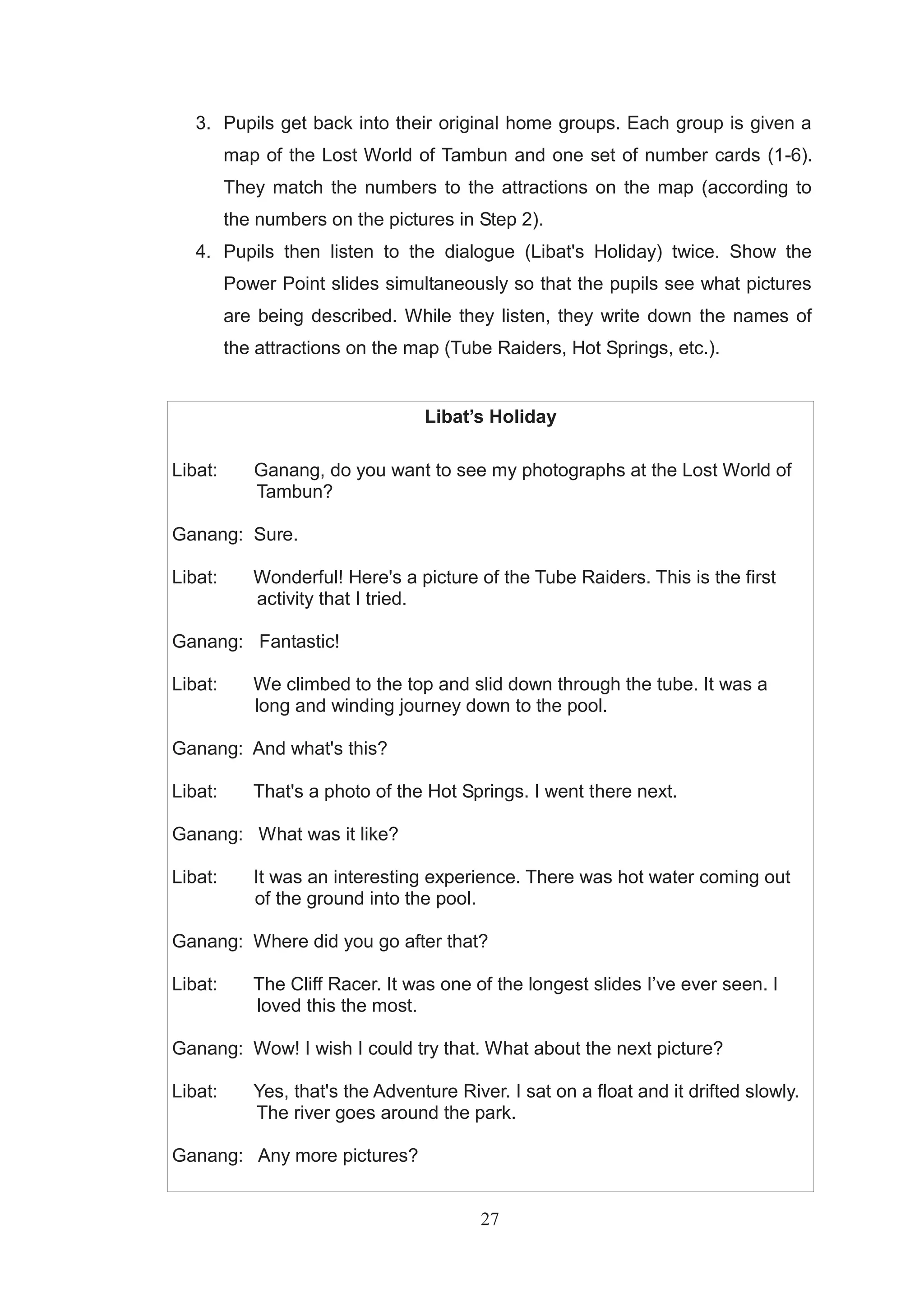
Libat’s Holiday
Libat: Ganang, do you want to see my photographs at the Lost World of
Tambun?
Ganang: Sure.
Libat: Wonderful! Here's a picture of the Tube Raiders. This is the first
activity that I tried.
Ganang: Fantastic!
Libat: We climbed to the top and slid down through the tube. It was a
long and winding journey down to the pool.
Ganang: And what's this?
Libat: That's a photo of the Hot Springs. I went there next.
Ganang: What was it like?
Libat: It was an interesting experience. There was hot water coming out
of the ground into the pool.
Ganang: Where did you go after that?
Libat: The Cliff Racer. It was one of the longest slides I’ve ever seen. I
loved this the most.
Ganang: Wow! I wish I could try that. What about the next picture?
Libat: Yes, that's the Adventure River. I sat on a float and it drifted slowly.
The river goes around the park.
Ganang: Any more pictures?
28
Libat: Ah, yes, this is the Kid’s Explorer Bay. My brother and I enjoyed
ourselves running around the playground in the water.
Ganang: Did you have a wonderful time there?
Libat: Yes. We finally landed ourselves in the Jungle Wave Pool. It has
real waves just like the sea.
Ganang: I wish I had gone too!
Post-Listening (Speaking)
1. Pupils write their answers (the names of the attractions) in a grid on the
board and give reasons for them. Example:
Attraction
Group
1 2 3 4 5 6
A
B
C
D
E
F
G
Answers
2. Reveal the correct answers in the last row of the grid. The pupils
compare their answers with the right ones.
29
Libat’s Holiday
Libat: Ganang, do you want to see my photographs at the Lost World of
Tambun?
Ganang: Sure.
Libat: Wonderful! Here's a picture of the Tube Raiders. This is the first
activity that I tried.
Ganang: Fantastic!
Libat: We climbed to the top and slid down through the tube. It was a
long and winding journey down to the pool.
Ganang: And what's this?
Libat: That's a photo of the Hot Springs. I went there next.
Ganang: What was it like?
Libat: It was an interesting experience. There was hot water coming out
of the ground into the pool.
Ganang: Where did you go after that?
Libat: The Cliff Racer. It was one of the longest slides I’ve ever seen. I
loved this the most.
Ganang: Wow! I wish I could try that. What about the next picture?
Libat: Yes, that's the Adventure River. I sat on a float and it drifted slowly.
The river goes around the park.
Ganang: Any more pictures?
Libat: Ah, yes, this is the Kid’s Explorer Bay. My brother and I enjoyed
ourselves running around the playground in the water.
Ganang: Did you have a wonderful time there?
Libat: Yes. We finally landed ourselves in the Jungle Wave Pool. It has
real waves just like the sea.
Ganang: I wish I had gone too!
30
Theme: World of Self, Family and Friends
Topic: A Splashing Time
Learning Standards: 2.2.2 (a), 2.2.4 (a), (b)
Objectives: By the end of the lesson, pupils should be able to:
(i) look up the meanings of eight words in the
dictionary.
(ii) complete sentences using those words.
Time: 60 minutes
Teaching Aids: Flashcards, Music Box with sentence strips inside,
Task sheet 1
Added Value: Contextualism
Steps:
Pre-Reading
1. Prior to the lesson, put up eight flashcards of the words below around
the classroom. All the flashcards should be covered by another piece of
paper or cloth.
fantastic winding journey slides
float drifted landed waves
2. Divide pupils into groups. One pupil in each group becomes a
'messenger'. The messenger goes to any one of the flashcards around
the classroom and memorizes the word on it quickly.
3. The messenger then goes back to his/her group and tells them that
word. They write it down on a piece of paper.
4. The other pupils in the group take turns to become messengers until all
eight words have been written down.
5. A representative from each group writes the group's eight words on the
board. The group with all their answers correct may receive a prize.
While-Reading
1. Teach pupils how to arrange the eight words in alphabetical order and
identify their root words. In their groups, the pupils look up the meaning
of those words in the dictionary and write the meaning on the piece of
paper. Check their answers, and help them understand all the words.
31
2. Musical Box game (whole-class):
(i) Music is played as the Music Box is passed around.
(ii) When the music stops, the pupil holding the box draws one
sentence strip from the box and reads it out.
(iii)The pupil has to complete the sentence with one of the eight words
learned earlier. The rest of the class can help if the pupil is unsure.
(iv)The game continues until all the eight sentences have been
completed correctly.
3. Write the sentences on the board (or on mahjong paper/manila card).
Pupils read the sentences. Go through the answers again.
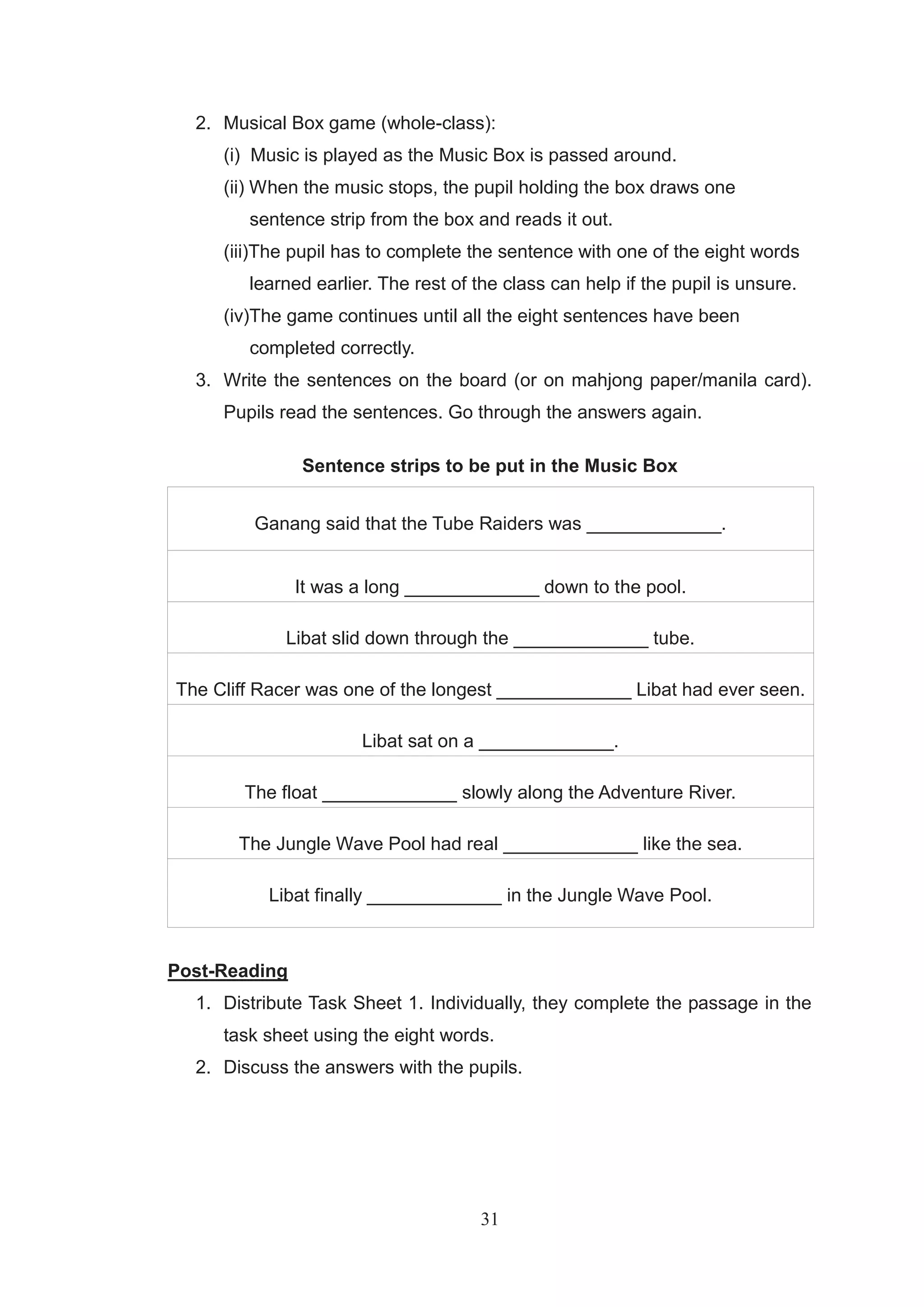
Sentence strips to be put in the Music Box
Ganang said that the Tube Raiders was _____________.
It was a long _____________ down to the pool.
Libat slid down through the _____________ tube.
The Cliff Racer was one of the longest _____________ Libat had ever seen.
Libat sat on a _____________.
The float _____________ slowly along the Adventure River.
The Jungle Wave Pool had real _____________ like the sea.
Libat finally _____________ in the Jungle Wave Pool.
Post-Reading
1. Distribute Task Sheet 1. Individually, they complete the passage in the
task sheet using the eight words.
2. Discuss the answers with the pupils.
32
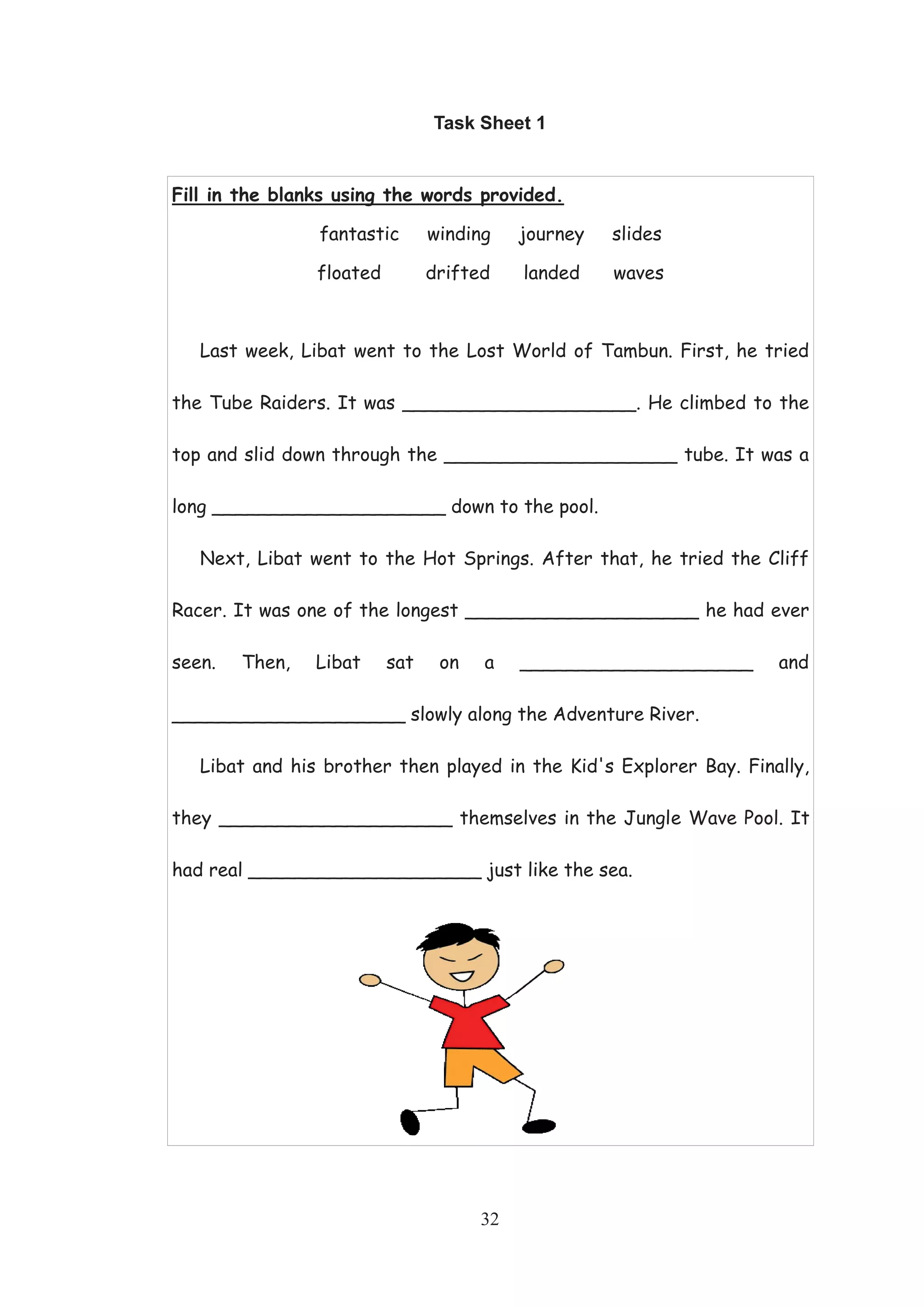
Task Sheet 1
Fill in the blanks using the words provided.
fantastic winding journey slides
floated drifted landed waves
Last week, Libat went to the Lost World of Tambun. First, he tried
the Tube Raiders. It was ____________________. He climbed to the
top and slid down through the ____________________ tube. It was a
long ____________________ down to the pool.
Next, Libat went to the Hot Springs. After that, he tried the Cliff
Racer. It was one of the longest ____________________ he had ever
seen. Then, Libat sat on a ____________________ and
____________________ slowly along the Adventure River.
Libat and his brother then played in the Kid's Explorer Bay. Finally,
they ____________________ themselves in the Jungle Wave Pool. It
had real ____________________ just like the sea.
33
Theme: World of Self, Family and Friends
Topic: A Splashing Time
Learning Standards: 3.2.1 (a), (b), 3.2.2 (c)
Objectives: By the end of the lesson, pupils should be able to:
(i) complete an e-mail based on information from a
dialogue.
(ii) write a short message.
Time: 60 minutes
Teaching Aids: Task sheet 1, Task sheet 2, message cards
Added Values: Contextualism, ICT
Steps:
Pre-Writing
1. Distribute the dialogue (Libat's Holiday).
2. Pupils recap the details in the dialogue by completing Task Sheet 1.
34
Task Sheet 1
Arrived at the
Lost World of
Tambun.
____________:
Climbed to the top
and slid down
through the tube.
Hot Springs:
____________
coming out of
the ground.
___________ :
One of the
longest slides
I’ve ever seen.
Jungle Wave Pool:
_____________
just like the sea.
____________: We
ran around the
playground in the
water.
Adventure River:
______________
afloat and it
drifted slowly.
35
Writing
1. Distribute Task Sheet 2.
2. Pupils complete the activity using the information in the dialogue and in
Task Sheet 1.
*For pupils of lower proficiency, simplify the passage, or provide
words/phrases for them to choose from.
36
Task Sheet 2
Read the dialogue and complete the e-mail below.
Hi Johanis,
Hi! Guess where I went last week ? I went to (1) ______________. It is a
water theme park. The first place we went to was (2)__________________. We
(3)____________________ and slid down through a tube.
Next, we went to (4) ____________________ and soaked ourselves in
the (5)_____________________. After that, I tried (6)
_____________________. It was the (7)_______________________ I’ve
ever seen. I screamed all the way down!
To recover, I floated in a tube down the (8)___________________
.Next, I joined my brother in the Kid’s Explorer Bay. We enjoyed ourselves
(9)_______________ in the water.
Finally, we went to (10)_________________ . It has (11)
_____________. We had such a (12) _____________________ there. I want
to go there again during the school holidays in November. Would you and your
cousin, Johan like to come with us? Hope to hear from you soon!
Your friend,
Libat
37
Answers for Task Sheet 1:
1. the Lost World of Tambun
2. the Tube Raiders
3. climbed to the top
4. the Hot Springs
5. hot water
6. the Cliff Racer
7. longest slide
8. Adventure River
9. running around the playground
10. the Jungle Wave Pool
11. real waves just like the sea
12. great/ wonderful/ enjoyable/ exciting time
3. If computers are available in the school, the pupils can type the
message and email it to you, or print it out.
4. Tell pupils that Johanis wants to leave a message for Johan regarding
Libat's invitation for the holidays.
5. Pupils give examples of what Johanis can write in the message.
6. Distribute message cards to the pupils. They complete them with
guidance. See example on next page.
Feedback
1. Pupils get into pairs.
2. They share their messages with one another and give each other
feedback ('pair and share').
38
Sample message card:
Completed message card:
*Provide pupils with some guiding words:
invited
Lost World of Tambun
21st
.
From : ______________________________________________
To : ______________________________________________
Message
_____________________________________
______________________________________
______________________________________
______________________________________
From : ______________________________________________
To : ______________________________________________
Message
_____________________________________
______________________________________
______________________________________
______________________________________
Johanis
Johan
Libat invited us to the Lost World of
Tambun on 21st
November. Would you like
to go with him?
39
Theme: World of Self, Family and Friends
Topic: A Splashing Time
Learning Standard: 5.81 (a)
Objectives: By the end of the lesson, pupils should be able to
(i) identify adverbs of manner based on actions.
(ii) complete sentences with the correct adverbs of
manner.
Time: 60 minutes
Teaching Aids: Power Point (Adverbs), Task sheet 1, Task sheet 2
(enrichment activity), Box of Adverbs (contains
strips of paper with adverbs written on them)
Added Values: Multiple Intelligences, Contextualism
Steps:
Presentation
1. Show Slide 1 of the Power Point presentation (the picture and verb
'driving' only). Get pupils to talk about how their
parents/siblings/relatives normally drive (e.g., slowly, carefully).
2. Show the rest of Slide 1, and Slide 2. Ask pupils if they know what all
the words on the slides are called.
3. Introduce adverbs of manner and explain what they are used for as
well as how they are formed (Slide 3). Elicit more examples of adverbs
from the pupils.
4. Show pupils Slides 4-7. Pupils can act out or do actions for any of the
adverbs they see in the slides.
Practice
1. One pupil comes up and picks an adverbs from the Box of Adverbs.
He/she has to perform an action to demonstrate the meaning of the
adverb.
2. The other pupils have to guess what adverb their friend is acting out
(e.g., walking slowly). Then, they form a sentence using the name of
their friend, the verb and the adverb (e.g., Shalini is walking slowly).
3. This game goes on until many adverbs have been identified correctly,
40
and complete sentences have been formed using the adverbs.
Production
1. Distribute Task Sheet 1. Pupils complete it using any of the adverbs
they learned earlier, and share their answers with their friends.
*Enrichment: Pupils complete the puzzle in Task Sheet 2
Task Sheet 1
Crossword Puzzle
Complete Libat's diary entry using suitable adverbs.
30th
August
Today, we went to the Lost World of Tambun. Father drove there very
______________. On the way, Johan and I sang _______________.
When we were tired, we slept ____________________. When we
finally reached the place, I was very happy so I danced
_______________. Johan ran ________________ towards the
entrance but mum and dad told him to walk ________________. We
had such a great time there. At the end of our day, we were all
laughing ________________.
41
Task Sheet 2 (Enrichment)
Source:
http://simpleesl.com/wpcontent/uploads/2011/08/CPAM2_150x150_p1.jpg
Answers:
1. beautifully 5. well 9. healthily 13. noisily
2. lazily 6. gently 10. carefully
3. slowly 7. easily 11. greedily
42
4. wide 8. shyly 12. hard
Power Point Slides
45
Theme: World Of Stories
Topic: Asian Folk Tales
Learning Standards: 1.1.2, 1.1.4, 1.3.1 (a), (c)
Objectives: By the end of the lesson, pupils should be able to:
i) listen and complete a task sheet using information found in a
story.
ii) respond to the story by expressing their own opinions.
iii) predict the development of the story.
iv) ask and answer questions based on the story.
Time : 60 minutes
Teaching Aids : Task sheets, audio clip (The Little Fish and The Big Fat Bean)
Added Values : Thinking Skills and Multiple Intelligences
Steps:
Pre-Listening
1. Ask pupils to name stories they have heard before.
2. Tell pupils that they will be listening to a story from Vietnam and start by showing the
location of Vietnam on a map.
3. Explain Task Sheet 1 to the pupils.
While-Listening
4. Play Part 1 of the story and pause the clip to give time for pupils to work on Task Sheet 1.
Part 1
THE LITTLE FISH AND THE BIG FAT BEAN
BY
NGUYEN THI LA
46
One day, a little fish was out swimming in the river with her mother. The
water was clear and warm, but the little fish wanted to swim faster and go farther.
So the little fish swam on and on till she reached the riverbank. She looked, and
there, growing on the bank, she saw a large bean stalk and on the bean stalk, a big,
fat bean. The little fish thought that she had never seen anything so funny.
“Hello, Fatso,” she called to the bean.
“Hello, Midge,” the bean called back.
The little fish felt very hurt that she should be called that. She burst into tears
and hurried off to complain to her mother about it.
Pause Recording Here
5. Pupils listen to the audio clip and complete Task Sheet 1.
Task sheet 1
A) Complete the task below.
Characters : 1) A little fish 2) ___________ 3) The mother fish
Nicknames : 1) __________ 2) Fatso
Place : 1) __________________
B) Sketch the location of the fish and the bean stalk in the box below.
47
6. Replay Part 1 for pupils to check their answers.
7. Ask questions to encourage pupils to think critically and creatively.
Examples:
a) Describe the little fish.
b) Do you think it’s safe to swim away on your own? Why?
c) What do you think happened after this?
8. Play Part 2 of the story.
9. Pupils listen to Part 2 of the story and check their predictions.
Part 2
“Oh, mother!” she wailed. “That big fat bean called me Midge, of all
things! I’m not as tiny as that, am I? I even have a tail.”
“Perhaps you hurt the bean’s feelings yourself in some way,” said the
mother fish.
“Oh, no mother dear, I didn’t!”
“Well, let’s swim back to the bank again and I’ll ask the bean what
made him say such a thing.”
And the two of them, mother and daughter, made for the bank.
“Good morning, Mr. Bean!” the mother fish called.
“Good morning to you, Mrs. Fish!” the bean called back.
“Tell me Mr. Bean, what made you hurt my little daughter’s feelings?
Why did you call her Midge?”
“She only got what she deserved. She called me Fatso, so I called
her Midge in return!”
48
10. Talk about the story. Ask questions.
11. Get pupils to form groups. Each group is given word cards. Pupils rearrange the cards to
form a complete question.
Examples:
What was the fish’s nickname ?
Where did the bean live ?
Who did the fish complain To ?
Why did the fish cry ?
12. Each group reads out their completed question. The other groups answer the
question.
Post-Listening(Speaking)
13. Get pupils to act out parts of the story.
49
Theme: World of Stories
Topic: Asian Folk Tales
Learning Standards: 2.2.2(a), 2.2.3 (b), 2.2.4 (a) (b)
Objectives: By the end of the lesson, pupils should be able to:
(i) locate words and their meaning in the dictionary.
(ii) read the story silently and predict the development of the
story.
(iii) predict the outcome of the story with guidance.
Time: 60 minutes
Teaching Aids: Picture of a well, story excerpts on PowerPoint slides
Added Value: Thinking Skills
Steps:
Pre-Reading
1. Introduce a picture of a well and guide pupils to talk about it.
2. Introduce new or difficult words in the story. Guide pupils to locate the words and their
meaning in the dictionary.
Example:
While-Reading
3. Show Excerpt 1 on PowerPoint. Get pupils to read the text silently and pose Question 1 to
elicit pupils’ responses. Encourage pupils to think of as many possible answers as they
can.
dwindled sprouted well kingdom
barren vain disaster icicles
50
4. Repeat the step above with Excerpts II-V.
EXCERPT I
There was once a small kingdom around a lake. One very hot summer, it did
not rain and the lake dried up. People grew anxious and went to the king.
“It has not rained for so long. Our fields are barren!” said the farmers.
“There’s no fish to catch. How shall we earn a living?” asked the fishermen.
“Save us from disaster, good king,” urged the women as the children cried with thirst.
EXCERPT II
The king sent his four generals to search for water in all directions. The first
general went east, towards the sunrise, the second general to the south, to dust and
heat. The third to the west where the sun sets, and the fourth, followed the North Star.
They searched day and night, night and day, high and low they searched everywhere but
in vain. Three of the generals returned empty handed. But the general who has gone
north determined, not to fail his king, finally reached a cold mountain village.
Question 2: What do you think the general who went north will find in the cold
mountain village?
EXCERPT III
As he sat at the foot of the mountain, an old woman came by and sat next to him.
The general pointed at the horizon and said, “I belong to a beautiful kingdom, where it
has not rained for a whole year. Can you help me find water?” The woman motioned the
general follow her up the mountain and into a cave.
“We have no water in our country either,” she said. Then, pointing to the icicles in
the cave, she continued, “We call this ice. Take some and your kingdom will never go
thirsty again.”
Question 3: What do you think will happen to the icicles on the journey? What will
the general do?
Question 4: In your opinion, why do you think the old woman told the general to
take some icicles back to his kingdom?
51
5. After Question 6 is discussed, show pupils the final Excerpt (Excerpt VI)
6. Encourage pupils to give opinions about the story.
Examples:
Do you like the story? Why?
What can you learn from the story?
EXCERPT IV
The general broke off a huge piece, loaded it onto his horse-cart and rushed back
home. By the time he reached the court, the enormous icicle had melted into a small
lump of ice. Nobody in the court had ever seen ice, so everybody gazed at it with wonder.
“This must be a water-seed,” one of the ministers exclaimed.
Suddenly, the king ordered the water-seed to be sowed immediately. While the
farmers dug the hole, the lump dwindled in the sun. They swiftly placed the seed in the
hole but before they could cover it, it had vanished.
Question 5: What do you think happened to the seed? What will the farmers do?
EXCERPT V
The farmers there got confused and worried. They dug the earth deeper and
deeper into the night, looking for the mysterious seed. After the break of dawn, the king
found the farmers fast asleep around a hole. Curiously he peeped in and cried out in
amazement.
Question 6: Why did the king cry out? What had happened?
EXCERPT VI
“Wake up my worthy men, the water-seed had sprouted! There’s water in the hole.”
This is how the first well was created.
52
Post-Reading
7. Ask pupils to work in pairs to pick a character from the story and write about him or her.
Guide pupils to write simple sentences.
.
We like ………………………….. because ……………………………................
…………………………………………………………………………………………
…………………………………………………………………………………………
53
THE FIRST WELL
There once was a small kingdom around a lake. One very hot summer, it did not rain
and the lake dried up. People grew anxious and went to the king.
“It has not rained for so long. Our fields are barren!” said the farmers.
“There’s no fish to catch. How shall we earn a living?” asked the fishermen.
“Save us from disaster, good king,” urged the women as the children cried with
thirst.
The king sent his four generals to search for water in all directions. The first
general went east, towards the sun rise, the second general to the south, to dust and heat.
The third to the west where the sun sets, and the fourth, followed the North Star.
They searched day and night, night and day, high and low they searched everywhere
but in vain. Three of the generals returned empty handed. But the general who has gone
north determined, not to fail his king, finally reached a cold mountain village.
As he sat at the foot of the mountain, an old woman came by and sat next to him.
The general pointed at the horizon and said, “I belong to a beautiful kingdom, where it has
not rained for a whole year, can you help me find water?” The woman motioned the general
to follow her up the mountain and inside a cave.
“We have no water in our country either,” she said. Then, pointing to the icicles in
the cave, she continued, “We call this ice. Take some and your kingdom will never go
thirsty again.” The general broke off a huge piece, loaded it onto his horse-cart and
rushed back home. By the time he reached the court, the enormous icicle had melted into a
small lump of ice. Nobody in the court had ever seen ice, so everybody gazed at it with
wonder.
“This must be a water-seed,” one of the ministers exclaimed.
Suddenly, the king ordered the water-seed to be sowed immediately. While the
farmers dug the hole, the lump dwindled in the sun. They swiftly placed the seed in the
hole but before they could cover it, it had vanished. The farmers there got confused and
worried. They dug the earth deeper and deeper into the night, looking for the mysterious
54
seed. After the break of dawn, the king found the farmers fast asleep around a hole.
Curiously he peeped in and cried out in amazement.
“Wake up my worthy men, the water-seed had sprouted! There’s water in the
hole.” This is how the first well was created.
55
Theme: World Of Stories
Topic: Asian Folk Tales
Learning Standards: 3.1.1 (a) (b), 3.2.3 (a) (b)
Objectives: By the end of the lesson, pupils should be able to
(i) write phrases and sentences in neat legible print.
(ii) write simple sentences based on visual stimuli taken from
the story.
(iii) write sentences with correct punctuation such as
apostrophe, comma, exclamation and speech markers
/quotation marks.
Time: 60 minutes
Teaching Aids: Task sheets 1-6, video clip (The First Well), story excerpts
Added Value: Contextualism
Steps:
Pre-Writing
1. Play the video clip of the story. Ask questions to help pupils to recall the story.
2. Display Excerpt 1. Draw pupils’ attention to the punctuation used.
*The different punctuation marks are differentiated by colours.
3. Explain the use of the apostrophe and speech markers in the story. (Refer to the notes
below.)
Examples:
“It has not rained for so long. Our fields are barren!” said the farmers. (speech markets)
“There’s no fish to catch. How shall we earn a living?” asked the fishermen. (apostrophe)
“Save us from disaster, good king,” urged the women as the children cried with thirst. (speech
markers)
56
Writing
4. Divide pupils into groups.
5. Distribute Task Sheets 1, 4 and 5 and the related excerpts to each group. Guide pupils to
complete the task.
Task Sheet 1 and Excerpt 1
Task Sheet 4 and Excerpt 6
Task Sheet 5 and Excerpt 3
6. Guide pupils to complete the speech bubbles in Task Sheets 2 and 3.
Note:
Tell pupils that speech markers (quotation marks) are only used when writing direct
speech/quoted structure.
When they are written inside speech bubbles, the speech markers are omitted.
57
TASK SHEET I ( Excerpt 1)
Complete the speech bubbles. Rewrite and punctuate correctly.
What’s wrong, my
people?
The king asked, “What’s wrong, my people?”
………………………………………………………………………………………..
………………………………………………………………………………………..
………………………………………………………………………………………..
………………………………………………………………………………………...
58
TASK SHEET 2 (Excerpt 4)
Complete the speech bubbles. Rewrite and punctuate correctly.
……………………………………………………………………………………………………………………………………………………
……………………………………………………………………………………………………………………………………………………
……………………………………………………………………………………………………………………………………………………
59
TASK SHEET 3 (Excerpt 2)
Complete the speech bubbles. Rewrite and punctuate correctly.
…………………………………………………………………………………………………………………………………………………….
…………………………………………………………………………………………………………………………………………………….
…………………………………………………………………………………………………………………………………………………….
……………………………………………………………………………………………………………………………………………….……
60
TASK SHEET 4 (Excerpt 6)
Complete the speech bubbles. Rewrite and punctuate correctly.
…………………………………………………………………………………………………………………………………………………..
…………………………………………………………………………………………………………………………………………………..
61
TASK SHEET 5 (Excerpt 3)
Complete the speech bubbles. Rewrite and punctuate correctly.
…………………………………………………………………………………………………………………………………………………
…………………………………………..…………………………………………………………………………………………………….
……………………………………………………………………………………………………………………………………………..…
62
Feedback
7. Distribute Task Sheet 6.
8. Ask pupils to work individually on Task sheet 6. Guide them when necessary.
9. Display the answers on PowerPoint. Ask pupils to check their answers.
63
TASK SHEET 6
Insert the apostrophe and speech markers in the correct places in the story
below.
The Little Fish And The Big Fat Bean
Hello, Fatso, she called to the bean.
Hello, Midge, the bean called back.
The little fish felt very hurt that she should be called that. She burst into
tears and hurried off to complain to her mother about it.
Oh, mother! She wailed. That big fat bean called me Midge, of all things! I m
not as tiny as that, am I? I even have a tail.
Perhaps you hurt the beans feelings yourself in some way, said the mother fish.
Oh, no mother dear, I didnt!
Well, let s swim back to the bank again and I ll ask the bean what made him say
such a thing.
And the two of them, mother and daughter, made for the bank.
Good morning, Mr. Bean! the mother fish called.
Good morning to you, Mrs. Fish! the bean called back.
Tell me Mr. Bean, what made you hurt my little daughter s feelings why did you
call her Midge?
She only got what she deserved. She called me Fatso, so I called her Midge in
return!
64
Theme: World Of Stories
Topic: Adjectives
Learning Standards: 5.1.6 (a) (b)
Objectives: Pupils should be able to
(i) identify adjectives in the story.
(ii) write simple sentences containing adjectives
(iii) make sentences with comparatives and superlatives
Time: 60 minutes
Teaching Aids: Text of the story
Added Values: Multiple Intelligences
Steps:
Presentation
1. Get pupils to give examples of adjectives.
Notes:
Adjectives describe the objects, people and animals and they always come immediately
before the noun they are describing.
Examples: A red balloon, a beautiful baby, a fast horse, a big, white house,
an Indian restaurant
Also used as a complement and they come immediately after the verb.
Examples: The house is big. The horse is tame.
65
2. Distribute the story ‘The Little Fish and the Big Fat Bean’ to the pupils.
3. Get pupils to underline the adjectives found in the story.
The Little Fish And The Big Fat Bean
By
Nguyen Thi La
One day, a little fish was out swimming in the river with her mother. The water was clear
and warm, but the little fish wanted to swim faster and go farther. So the little fish swam
on and on till she reached the riverbank. She looked, and there, growing on the bank, she
saw a large bean stalk and on the bean stalk, a big, fat bean. The little fish thought that
she had never seen anything so funny.
“Hello, Fatso,” she called to the bean.
“Hello, Midge,” the bean called back.
The little fish felt very hurt that she should be called that. She burst into tears and
hurried off to complain to her mother about it.
“Oh, mother!” she wailed. “That big fat bean called me Midge, of all things! I’m not as
tiny as that, am I? I even have a tail.”
“Perhaps you hurt the bean’s feelings yourself in some way,” said the mother fish.
“Oh, no mother dear, I didn’t!”
“Well, let’s swim back to the bank again and I’ll ask the bean what made him say such a
thing.”
And the two of them, mother and daughter, made for the bank.
“Good morning, Mr. Bean!” the mother fish called.
“Good morning to you, Mrs. Fish!” the bean called back.
“Tell me Mr. Bean, what made you hurt my little daughter’s feelings? Why did you call
her Midge?”
“She only got what she deserved. She called me Fatso, so I called her Midge
in return!”
66
4. Explains the comparative and superlative forms of the adjectives (regular forms only).
Examples: big, bigger, biggest, small, smaller, smallest
5. Divide pupils into three groups. Get the first group to call out an adjective, the second group
to say the comparative form and the third group to say the superlative form. Repeat the
activity.
Production
6. Jumbled up the cards. Distribute one card to each pupil. Get pupils to form appropriate sets
of adjectives.
Examples: tall taller tallest small smaller smallest
7. Get the groups of 3 to construct three sentences and present them to the class.
Examples: (a) The mango tree is tall.
(b) The banana tree is taller.
(c) The coconut tree is the tallest.
Note:
Prior to the lesson, prepare sets of word cards. Each set has three word cards. (an adjective, its
comparative, its superlative)
Example:
67
SAMPLE PARTS THAT CAN BE ACTED OUT
68
69
68
Theme: World of Knowledge
Topic: Save the Earth
Learning Standards: 1.1.3, 1.1.4
Objectives: By the end of the lesson, pupils will be able to
(i) listen to a song and identify the words heard correctly.
(ii) talk about how they can save the earth based on the video
Time: 60 minutes
Teaching Aids: video clip, ’Save the Earth’, song, ‘Earth Song, song lyrics, Task
Sheet 1.
Added Values: Values and Citizenship
Steps:
Pre-Listening
1. Show pupils the music video for the ‘Earth Song’ (muted).
2. Pupils talk about what they see happening to the earth in the video.
While-Listening
3. Pupils listen to the ‘Earth Song’ and answer the questions on Task Sheet 1
Task Sheet 1
Earth Song By Michael Jackson
What about sunrise?
What about rain?
What about all the things?
That you said we were to gain...
What about killing fields?
Is there a time?
What about all the things?
That you said was yours and mine
Did you ever stop to notice?
All the blood we shed before
Did you ever stop to notice
This crying Earth these weeping shores
Aaaaaaaaaaaa ooooooooooo
69
Task Sheet 1
Name: ______________________ Class: Year 4 __________
Listen to the song and tick the correct answers.
5. Teacher plays the song again and pupils check their answers.
Earth Song By Michael Jackson
What about (1) ?
What about (2) ?
What about all the (3) ?
That you said we were to gain
What about killing (4) ?
Is there a (5) ?
What about all the things?
That you said was yours and (6)
Did you ever stop to notice?
All the (7) we shed before
Did you ever stop to notice
This crying Earth these weeping (8)
Aaaaaaaaaaaaaaaaa Ooooooooooo
sunrise
fun fries
rain
pain
thinks
things
yields
fields
lime
time
fine
mine
blood
flood
shores
chores
70
Post-Listening(Speaking)
4. Pupils watch another video-clip: ‘Save the Earth’.
(www.youtube.com/watch?v=TBUkGR+Vq1A)
5. Draw a mind-map on the board and pupils brainstorm the questions below based on
the video clip.
(a) What’s happening to our earth?
(b) What can we do to save our earth?
Save the
Earth
What’s
happening to
our earth?
- forests on fire
- hot climate
- animals dying
How do we save
our earth?
- reduce
- reuse
- recycle
71
Theme: World of Knowledge
Topic: Save the Earth
Learning Standards: 2.3.1(b)
Objectives: By the end of the lesson, pupils will be able to:
(i) skim and scan a text, circle the key vocabulary given.
(ii) infer the meaning of these words using contextual
clues (i.e. a strategy for looking at words or clues
before and after the new word).
(iii) arrange sentence parts to form complete and
meaningful sentences.
Time: 60 minutes
Teaching Aids: ‘Save the Earth’ text, sentence strips, word cards.
Added Values: Thinking skills, Multiple Intelligences
Steps:
Pre-Reading
1. Pupils recap what they have learned in the previous lesson.
2. Pupils recall some of the strategies on how to save the earth that they came up with.
While-Reading
Activity 1
3. Pupils read the text silently(available on Power Point slides) and write down the
difficult words
Save the Earth
In this century, many animals and plants are dying due to climate
change around the world. Many animal and plant species have become
extinct and have lost their habitat. In Malaysia, World Wildlife Federation
(WWF)-Malaysia helps us reduce greenhouse gas emissions in the environment.
Firstly, they help protect our forests. Secondly, they help us save marine life that
absorbs carbon dioxide to reduce greenhouse effect. Finally, awareness
campaigns and activities are carried out in schools and in local communities
throughout Malaysia.
72
4. Read the text and introduce the new words below.
Wall Chart for “Save The Earth”
climate habitat protect forests
earth greenhouse emissions environment
5. Get pupils to repeat the new words
6. Distribute the text and ask pupils to skim and scan the text. Pupils circle the 8
words above.
(Notes: To skim is to look quickly over a section of text to get a general idea of the
meaning; to scan is to look quickly over the text looking for a specific word(s) or meaning.
[http://www.englishpracticeonline.com/resources/reading/skimming_and_scanning.html])
7. Ask pupils to infer the meaning of the words using contextual clues. Show the
word cards with their meanings.
Word Cards
climate
a weather condition
habitat
a place where a plant or animal is
found
protect
to make sure somebody/something is
not harmed
forests
a large area of land covered with trees
earth
world or planet
greenhouse
rise in temperature on the earth
emissions
sending out
environment
the natural world which we live
Oxford Advanced Learner’s Dictionary (8
th
Edition) 2010
Activity 2
8. Get pupils to practice reading aloud the text individually and in groups.
9. In groups of four or five, pupils are given an envelope that has phrase strips (more
depending on their level of proficiency). Ask pupils to read and arrange the phrase strips
to form complete and meaningful sentences.
73
In this century,
many animals and plants are dying
due to climate change around the world.
Many animal and plant species
have become extinct
and have lost their habitat.
In Malaysia, WWF-Malaysia
helps us reduce greenhouse gas emissions
in the environment.
Firstly,
they help protect
our forests.
Secondly, they help us
save marine life that absorb carbon dioxide
to reduce greenhouse effect.
Finally, awareness campaigns and activities
are carried out in schools and
in local communities throughout Malaysia.
74
10. Pupils paste their answers on the board.
11. In groups, pupils read aloud their answers. Give feedback.
Post-Reading
12. Get pupils to fill in the missing letters by reading the meaning provided.
Example:
a) ___ ___ _r_ ___ ___ _t_ ___
b) ___ _m_ ___ ___ ___ ___ _o_ ___ ___
c) ___ ___ _e_ ___ ___ ___ ___ _o_ ___ ___
a large area of land
covered with trees
sending out
rise in temperature
on the earth
75
Theme: World of Knowledge
Topic: Save the Earth
Learning Standards: 3.2.2(c)
Objectives: By the end of the lesson, pupils will be able to:
write messages about saving the earth to be put on a
wishing tree.
Time: 60 minutes
Teaching Aids: a wishing tree (a dried branch of a tree or a cut out from
cardboard)
Added Values: Creativity and Innovation, Multiple Intelligences
Steps:
Pre-Writing
1. Show pupils pictures with phrases on environmental awareness.
Examples:
(Picture source: http://www.pixics.com/175-651-large/i-love-green-wall-decal.jpg)
(Picture source: http://www.burnbarrel.org/graphics/Stop_Burn_Save_Earth.JPG)
76
(Picture Source:
http://fc03.deviantart.net/fs18/f/2007/215/c/2/poster__Save_Our_Forest_by_environment.jpg)
(Picture source: http://rlv.zcache.com/stop_pollution_save_earth_button-
p145452188039416352t5sj_400.jpg)
77
2. Pupils read the captions/messages from the pictures.
Writing
3. Give pupils some examples of how to write messages to save the earth. Also give
them some useful words and phrases they can use.
Examples:
I want my
world to be
clean and
beautiful.
From,
Jan.
Please
save our
planet for
our future
children.
From,
Ken.
78
4. Distribute small pieces of manila card to pupils. They cut the card into the shape of a
leaf.
5. Get each pupil to write his/her own message. (their wishes for the earth)
Feedback
6. Ask pupils to present their messages to their friends. (higher proficiency pupils may
present theirs in the form of a poem or jazz chant).
7. Pupils stick or hang their messages on a wishing tree.
79
Theme: World of Knowledge
Topic: Save the Earth
Learning Standards: 5.1.1(b)(c)
Objectives: By the end of the lesson, pupils will be able to
(i) write the plural form of nouns.
(ii) rewrite sentences using the plural form of the nouns.
Time: 60 minutes
Teaching Aids: Task sheet, picture cards
Added Values: Values and Citizenship
Steps:
Presentation
1. Show pupils pictures of singular nouns and plural nouns, i.e. a book, two books, a toy
car, three toy cars. Pupils answer a few questions regarding the pictures. Eg: How many
trees are there?
2. Introduce the concept of singular and plural nouns to the pupils. Explain the rules by
giving them some examples and sentences.
Examples:
Singular Noun Plural Noun
book books
watch watches
baby babies
leaf leaves
mango mangoes
child children
ox oxen
80
Practice
3. Give pupils Task Sheet 1 to write the plural form of the nouns given.
4. Discuss the answers with the pupils.
Production
5. Give pupils Task Sheet 2. They rewrite sentences by changing the singular nouns to
their plural forms.
81
Task Sheet 1
Singular and Plural Nouns
Name: ______________________ Class: Year 4 _______
Write the plural form of the words below.
1. forest -____________ 2. animal - ____________
3. plant - ____________ 4. activity - __________
5. campaign - _________ 6. community - _________
7. field - ____________ 8. message - ___________
9. child - ____________ 10. leaf - ______________
11. house - ____________ 12. school - ____________
82
Task Sheet 2
Singular and Plural Nouns
Name: _______________________Class: Year 4 _______
Rewrite these sentences in the plural form.
Example: The animal is dying.
The animals are dying.
(Note the change in the verb-to-be form from ‘is’ to ‘are’.)
1. We must protect the forest.
_________________________________________
2. We must grow a plant.
_________________________________________
3. We must have an awareness campaign.
_________________________________________
4. We should not pluck the leaf.
_________________________________________
5. We can carry out an activity in school to save the earth.
_________________________________________
83
POWERPOINT SLIDES
WHILE READING
1
2
Save the Earth
In this century,
many animals and
plants are dying
due to climate
change around the
world.
Many animal
and plant
species have
become
extinct and
have lost their
habitat.
84
3
4
In Malaysia, WWF-
Malaysia helps us
reduce
greenhouse gas
emissions in the
environment.
Firstly, they help
protect our
forests.
85
5
6
Secondly, they
help us save
marine life that
absorb carbon
dioxide to reduce
greenhouse
effect.
Finally, awareness
campaigns and
activities are carried
out in schools and in
local communities
throughout
Malaysia.
86
7
8
The end
32 kids plant trees to mark World Earth Day. A gotong-royong and tree-planting campaign was held at
Pullman Putrajaya Lakeside to commemorate World Earth Day recently.
(The Star Online, Wednesday May 11, 2011)
Picture source:
Slide 1:
http://www.cosmosmagazine.com/files/imagecache/news/files/20070419_climate.jpg
http://beust.com/pics/extinct.gif
Slide 2:
http://www.socialistrevolution.org/wp-content/uploads/2010/07/climate-
change_1509200c.jpg
http://minerals.usgs.gov/east/environment/Snowbankfire.jpg
Slide 3:
http://www.myclimatechange.net/UserImage/3/Definition/GreenhouseEffect.jpg
http://www.treehugger.com/20100428-melting-arctic%20ice.jpg
Slide 4:
http://seagrant.uaf.edu/news/02ASJ/images/fire2.jpg
http://cdn.onlineshop.wwf.org.au/media//WWF-LYF-Right-Hand-Side-Logo.png
Slide 5:
http://www.csrdigest.com/wp-content/uploads/2011/04/50th-anni-WWF-marine.jpg
http://www.worldwildlife.org/what/wherewework/WWFImgFullitem7933.jpg
Slide 6:
http://www.pixics.com/175-651-large/i-love-green-wall-decal.jpg
http://fc03.deviantart.net/fs18/f/2007/215/c/2/poster__Save_Our_Forest_by_environment.jpg
Slide 7:
http://thestar.com.my/archives/2011/5/11/central/m_pg21franck.jpg
87
Theme: World of Self, Family and Friends
Topic: The Magic of Shopping
Learning Standard: 1.3.1 (a) (c)
Objectives : Pupils should be able to
i) answer WH questions based on the dialogue
ii) to predict outcomes of a situation.
Time: 60 minutes
Teaching Aids: Dialogue (pre-taped), floor plan of a shopping complex,
Task Sheet 1.
Added Values: Values and Citizenship, Thinking Skills, Entrepreneurship
Steps :
Pre-Listening
1. Show the floor plan of a shopping complex on the PowerPoint slide or chart.
Floor plan of a supermarket
Metro Complex
Shoes
Point
Eagles
Book
Store
Toyland
Mama Pastries
Kiddy
Wear
Swatch
Watches
Cold
Storage
Kelly
Jeans
Geez
Music
Kitchen
Wares
E
N
T
R
A
N
C
E
88
2. Ask the class to talk about the different stores they can see in the floor plan.
3. Encourage pupils to talk about their own shopping experiences.
While-Listening
4. Distribute Task Sheet 1 and explain what pupils have to do.
5. Get pupils to listen to a dialogue and complete Task Sheet 1.
89
The Magic of Shopping
Last Sunday, Mr and Mrs Chan took Jo Soon shopping at the Metro Complex.
First, they walked into Shoes Point. There was a 50% discount on sports shoes. Then,
they stopped by Eagles Book Store. Finally, they walked into Toyland.
Joshua looked at his father and thought for a while.
Finally, Joshua bought a good pair of shoes at 50% discount. He had RM20 left.
What a magical shopping day it was! The day that changed Joshua’s heart.
Happy birthday, son. Here’s RM50.
You can buy a gift for yourself.
Thanks dad.
Look dad ! A red sports car.
I like that. Oh ! RM70. But l have only
RM50.
Do you really need that red sports car?
Think Joshua. What do you really need ?
No, dad. I don’t really need that red
sports car. l need a pair of sports shoes . My
old ones have worn out.
That ‘s very good thinking Joshua. I am very
proud of you. Let’s go back to Shoes Points.
Well, there’s a charity drive in school for
Shafiq. He had an accident. Maybe I’ll
give him the money.
So son, what are you going to do with your RM20?
That’s a good idea. Maybe you and your friends
could also make some sandwiches and sell them to
raise funds for Shafiq.
Yes, Mum. I’ll do that.
90
6. Ask Wh-questions and guide pupils to answer orally.
Examples:
Who are the people in the dialogue?
Where did they go?
Why did they go to the supermarket?
How much did his father give him?
What did he want to buy?
How did his father advise him?
What did he buy?
What did Joshua learn on his shopping trip?
Task Sheet 1
1. ________________
2. __________________
3.__________________
Happy Birthday , son. Here’s RM50.
You can buy a gift for yourself.
Look, dad! A red sports car. I like
that. Oh! RM70. But I have only
RM50.
That’s very good thinking Joshua. I
am very proud of you. Let’s go back
to Shoes Point.
91
Note:
You may use STAD questioning technique by following the steps below.
(i) Number the pupils in each group
(ii) Call out a number at random.
(iii) Pupils with that number answer the questions.
(iv) Group leader assists if pupils are unsure of the answer.
(v) Give points to each group.
For more information on STAD, refer to attachment.
Post-Listening (Speaking)
7. Divide pupils into groups. Give each group a question. Get them to discuss the
possible answers in their groups.
8. Encourage pupils to share their responses.
1. What do you think would have happened if Joshua had bought the
red sports car?
2. If you were Joshua, how would you have spent your last RM20?
3. What other ways could Joshua raise funds for Shafiq or help him?
92
Notes :
A. STAD group workout
1. What is STAD learning style?
STAD means Students Team Achievement Development – a learning process that
brings out maximum participation of all the pupils including the weaker ones.
Focus :
1.1 Every pupil is important and is given opportunities to participate orally, actively
and meaningfully.
1.2 Every pupil learns to appreciate each other‘s weakness, strength, views and
talents.
1.3 Each pupil is given repetitive drills as they learn to work in a team. No one is
to be left out, so the remedial and weakest groups will have meaningful and
real learning inside and outside of the classroom.
2. How is STAD being carried out in the school ?
2.1 Teacher must know his/her pupils and able to identify each child’s level and
characters.
2.2 Each group consists of different levels of pupils.
2.3 Choose a capable group leader that would be able to breathe life into the
group.
2.4 Select a group assistant from the weaker groups to develop Leadership Skills
2.5 Each member of the group is given a number.
2.6 Group to brainstorm and name their groups respectively.
3. What happens during teaching and learning process?
3.1 Each time an oral response is needed from the class, the teacher will call out
a number.
Example: Number 3, please listen and answer the question.
93
3.2 Number 3 of each group will stand and be ready to respond.
3.3 The first pupil of number 3 raises his/ her hand gets to answer.
3.4 10 marks is given to the first group for each correct response.
3.5 If the pupil fails, the group leader can help.
3.6 3 marks is given when group members help.
3.7 At the end of three months, the group with the most marks gets a reward.
B. Pupils’ Reflection
1. Why Pupils’ Reflection?
1.1 We are aware that children today :
a) have less opportunities to really talk to their parents, grandparents and
teachers.
b) spend more time in front of computers or televisions and sending text on
the hand phones.
1.2 Therefore, meaningful lessons in school need to provide platforms or
situations for them to share their thoughts or feelings that would develop the
inner values of the children.
2. How is Pupils’ Reflection being carried out in class ?
2.1 Five minutes before the lesson ends, the pupils are encouraged to :
2.1.1 share and talk about how they feel/ like or dislike in their STAD groups
after L/S/R lessons
2.1.2 write a few sentences individually onto their exercise books at the end
of the writing lesson
2.1.3 draw a smiley or write a simple phrase ( remedial pupils)
94
3. What are outcomes ?
3.1 There are real positive changes of characters and mindset among the pupils.
3.2 Teachers learn to understand and know the pupils better, enabling them to
develop real learning in class.
95
Theme : World of Self, Family and Friends
Topic: The Magic of Shopping
Learning Standards: 2.2.2 (a)(b), 2.2.3 (a)
Objectives : Pupils should be able to
i) read and understand a dialogue by sequencing
events.
Time : 60 minutes
Teaching Aids: Dialogue (The Magic of Shopping), floor plan of a shopping
complex, number stickers (1-6), sentence strips
Added Values : Thinking Skills, Entrepreneurship
Steps:
Pre-Reading
1. Show the floor plan of a shopping complex on PowerPoint.
2. Get pupils to identify and read out the names of the stores in the floor plan.
While- Reading
3. Divide pupils into groups of 4.
4. Distribute the dialogue (make print outs of the dialogue ‘The Magic of Shopping’
that can be found in the L&S lesson plan).
5. Give each group a floor plan of the shopping complex (Handout 1).
6. Give pupils number stickers.
7. Get pupils to read the dialogue and paste the numbers onto the floor plan
according to the sequence of events. Check pupils’ answers.
96
8. Give sentence strips each group.
Example:
Joshua went shopping with his parents at Metro Complex.
First, he went to Shoes Points but he did not buy any pair of shoes.
Then, he went to Eagles Book Store but he did not buy any book.
Later, he went to Toyland and he wanted to buy a red sports car.
His father advised him.
Finally, he went to Shoes Points and bought a pair of sports shoes.
9. Get pupils to arrange the sentence strips according to sequence and read their
answers to the class.
10. Assign each group a character (Father/Mother/Joshua/Narrator) and get pupils to
read the dialogue aloud.
Post-Reading
11. Get pupils to share what they would do if they were given RM50.
97
Handout 1
Floor plan of Metro Complex
Metro Complex
Notes :
Teachers need to modify the size of the floor plan for group work according to their
pupils’ need and activities.
Shoes
Point
Eagles
Book
Store
Toyland
Mama
Pastries
Kiddy
Wear
Swatch
Watches
Cold
Storage
Kelly
Jeans
Geez
Music
Kitchen
Wares
E
N
T
R
A
N
C
E
98
Theme: World of Self, Family and Friends
Topic: The Magic of Shopping
Learning Standards: 3.1.1 (a) (b) (c), 3.3.1(a)
Objectives: By the end of the lesson, pupils should be able to:
(i) complete phrases and sentences correctly
(ii) write a simple recipe
Time: 60 minutes
Teaching Aids : Task Sheets 1 & 2, egg sandwich recipe
Added Values: Creativity and Innovation
Steps :
Pre-Writing
1. Get pupils to recap the dialogue.
2. Discuss Joshua’s mum’s suggestion that he and his friends make egg
sandwiches.
3. Get pupils to talk about whether they like egg sandwiches and if they know how
to make them.
Writing
4. Pupils read the recipe aloud.
5. Teach pupils how to write a simple recipe. Introduce the elements of a recipe.
Title
Ingredients
Method
6. Get pupils to complete Task Sheet 1 and 2.
99
7. Ask the pupils to write a simple recipe in groups.
Example:
Tuna sandwich
Chicken sandwich
Feedback
8. Allow pupils to present their recipes in a Gallery Walk.
9. Allow other pupils to give comments or feedbacks on the recipes.
Enrichment:
Get pupils to brainstorm and write suggestions on how to sell the sandwiches in terms of
packaging and price in their groups.
Egg Sandwich Recipe (To make 40 sandwiches)
Ingredients
80 slices of bread
30 hard-boiled eggs
250g of butter
4 medium-sized cucumbers
Salt and pepper to taste
Methods
1. Mash the eggs in a big mixing bowl.
2. Add a pinch of salt and pepper into the mixture.
3. Slice the cucumber thinly.
4. Spread some butter evenly on the bread.
5. Spread the egg mixture evenly on the bread.
6. Add the sliced cucumbers thinly.
7. Cut the sandwiches into triangles.
8. Pack the sandwiches.
100
Task sheet 1
Name: _________________ Class: ______
A. Complete the chart with information from the recipe.
Recipe for making ____________________________________
80 ______________
30 ______________
250g ____________
4 _______________
_________________
to taste
1. _____________________
in a big mixing bowl.
2. _____________________
into the mixture.
3. _____________________
thinly and evenly.
4. _____________________
on the bread.
5. Add the sliced cucumbers.
6. ________ and __________
the sandwiches.
Ingredients Methods
101
Task sheet 2
Name: _________________ Class: ________
Fill in the blanks with information from the recipe and Task Sheet 1.
Joshua and his classmates are going to prepare egg sandwiches in class.
Mrs. Phang, their class teacher, is going to help them. How are they going to
prepare the egg sandwiches?
First, __________________________________________________
_________________________________________________________.
Then, add _________________________________________________.
Cover the bowl and put it aside. _________________________________
with a sharp knife.
Next, ______________________________ on the bread. Scoop the
egg mixture with a tablespoon, and _____________________________.
Add ______________________ and finally cut ___________________
__________________________________.
102
Theme: World of Self, Family and Friends
Topic: The Magic of Shopping
Learning Standards: 5.1.1(a) (b) (c) (d) ( e)
Objectives: By the end of the lesson, pupils should be able to
(i) categorise countable and uncountable nouns
(ii) complete sentences with singular and plural nouns
Time: 60 minutes
Teaching Aids: Task Sheets 1-4, word cards
Added Values : Contextualism
Steps:
Presentation
1. Draw a two column table on the board.
2. Give instructions to pupils to form groups and distribute sets of word cards
(countable/uncountable nouns) to each group. Each group is given a different
set of cards.
Examples:
Note:
Use other nouns that have introduced in the dialogue and recipe for egg sandwiches.
3. Ask pupils to paste their word cards in the two column table.
4. Guide pupils to the understanding of countable and uncountable nouns.
toy book salt pepper
butter shoe shirt egg
bread cucumber watch bowl
103
5. Draw pupils attention to countable nouns in their singular or plural forms in the
dialogue or recipe for egg sandwiches.
Practice
6. Get pupils to complete Task Sheet 1.
7. Guide pupils to write the plural forms of the countable nouns in Task Sheet 1
8. Teach the Twinkle Clap drill. Use the words learnt above.
How to clap
1. Clap twice on the thigh
2. Clap your hands once
(Follow the rhythm)
“We will. We will rock you” in slower motion.
Twinkle Twinkle Llittle Star
Twinkle twinkle little star
How l wonder what you are
Up above the world so high
Like a diamond in the sky
( Teacher ) I say – box
( Pupils ) We say – boxes
( Teacher ) I say – fox
( Pupils ) We say – foxes
( Teacher ) I say – class
( Pupils ) We say – classes
( Teacher ) I say – glass
( Pupils ) We say – glasses
Twinkle twinkle little star
How l wonder what you are
Up above the world so high
Like a diamond in the sky
104
Production
10. Get pupils to complete Task Sheet 2.
Enrichment:
Guide pupils to complete Task Sheet 3 & 4.
Remedial:
Guide pupils to cut out singular and plural nouns from newspaper headings and paste
the words in the vocabulary folio.
105
Task sheet 1
Name: ________________________ Class: _________
Let’s group the words accordingly.
_________________________ ________________________
_________________________ ________________________
_________________________ ________________________
_________________________ ________________________
_________________________ ________________________
_________________________ ________________________
_________________________ ________________________
_________________________ ________________________
_________________________ ________________________
cap
Countable Nouns Uncountable Nouns
robot soup blouse net
ink soap salt eraser
noodles
racquet vinegar butter dictionary
rice
T-shirt
brush
106
Task sheet 2
Name: _________________ Class: ________
A. Complete the sentences with the correct form of the nouns (singular or
plural)
1. There were many _______ (toy) in Toyland and Joshua wanted to
buy a ________ (toy car).
2. Mrs. Phang keeps a dozen of ______(egg) in two big _________
(basket).
3. The __________(customer) were looking for some ________(shirt)
in the shop.
4. Puan Su who is a ____________(housewife) took her three
__________(child) shopping.
5. The two _______(chef) cooked the delicious _________(noodle) for
the guests.
6. There were several _______(box) of erasers and ______________
(sharpener) on the table.
7. Two ________(salesgirl) help the customer to look for a
________(shirt).
8. Mrs. Rosy bought some ________(flour) and a bunch of red
_________(flower).
107
9. We need a little _______(salt) and some ______(pepper) in the soup.
10. The pupils brought some _______(brush) to paint those
_______(desk) outside.
11. Some ______(man) carried the new ___________(furniture) into
the living room.
12. Those ______(lady)usually have tea with their _______(friend) once
a month.
13. We saw fresh __________(tomato) and vegetables beside the
frozen food.
14. Cik Maria needs some ________(envelope) to send those
________(letter).
108
Task sheet 3
Name: _________________ Class: ________
A. Identify and correct the error in each sentence. Rewrite the sentences.
1. Mrs. Ruby has some lovely dress for formal function.
______________________________________________
2. Some of the guest arrived early last night.
_______________________________________________
3. Two rows of shophouses were destroyed in the fire.
_______________________________________________
4. The dentist extracted two bad tooth and the patient was in pain.
_______________________________________________
5. Both the shepherd led the flock of sheeps along the river.
_______________________________________________
6. The butchers chops the thick meat with a sharp knives every morning.
___________________________________________________
7. Madam Goh has many short story to tell her four grandchild.
____________________________________________________
8. There were fresh apple, orange , pear and green vegetable at the
stall.
____________________________________________________
109
Task Sheet 4
Rewrite this passage, changing the words in bold into the plural form. Make
sure your sentences are grammatically correct.
Shafiq was resting in the ward. The doctor and nurse were busy helping
the patient. There were a bottle of medicine, a glass of water and a cup on the
tray.
Half an hour later, Joshua and his friend arrived. Shafiq smiled and
sat up on the bed. Mrs. June brought an apple and a starfruit.
Joshua handed a cheque to him. There was a tear in his eye.
It was a memorable day for everyone.
__________________________________________________________
__________________________________________________________
__________________________________________________________
__________________________________________________________
__________________________________________________________
__________________________________________________________
__________________________________________________________
__________________________________________________________
_________________________________________________________
Well done!
I am proud of you.
110
Theme: World of Knowledge
Topic: Green Car
Learning Standards: 1.1.4, 1.3.1 (a)
Objectives: By the end of the lesson, pupils should be able to:
(i) talk about the features, functions and benefits
of the Green Car.
(ii) listen to sentences about the different types of
Green Cars and state whether they are true or
false.
Time: 60 minutes
Teaching Aids: Power Point (Green Car)
Added Value: Thinking Skills
Steps:
Pre-Listening
1. Show pupils pictures of three cars (one Green Car and two traditional
cars, all unlabelled).
2. Ask pupils whether they have seen all those cars, and which one
stands out. Bring their attention to the Green Car and elicit their initial
ideas about it by asking them questions.
Sample questions:
Have you seen this car before?
What do you think it is called?
What makes it different from the other cars?
While-Listening
1. Introduce the Green Car and help the pupils understand its features,
functions and benefits by asking and helping them answer these
questions:
What is a Green Car?
What kind of energy does a Green Car use?
Is the Green Car environmentally friendly?
How does the Green Car help protect our environment?
*See attached information about Green Cars.
111
2. Introduce and explain the five types of Green Cars using the pictures
and notes in the Power Point slides.
3. Read aloud the sentences below to the class. Pupils listen and write
'True' or 'False' for each statement on a piece of paper.
(a) The Green Car is environmentally friendly.
(b) The Green Car harms our environment.
(c) The Green Car uses less petrol.
(d) The Green Car causes acid rain.
(e) There are only three types of Green Cars.
(f) The Hybrid car has an electric motor.
(g) The Electric Car uses electricity.
(h) The Hydrogen Car uses oxygen.
(i) The Biodiesel Car uses electricity.
(j) The Cell Car is bad for the environment.
4. Discuss the answers with the pupils.
Post-Listening
Divide pupils into groups. Give them the following scenario:
Their parents are planning on buying a new car. They want to
convince their parents to buy a Green Car instead of a traditional car.
1. In their groups, pupils come up with a simple presentation to promote
the Green Car to their parents. Points to include in their presentation:
what a Green Car is
features of the Green Car
how the Green Car operates
benefits of Green Cars.
2. The groups take turns to present a simple summary of their points to
the class.
112
Information about the Green Car
1. It is an environmentally friendly car.
2. It uses less petrol.
3. It uses renewable energy sources.
4. It does not have to rely on expensive imported petrol.
5. It decreases air pollution.
6. It reduces the smog in the air.
7. It reduces the risk of health problems.
8. It does not contribute to acid rain.
9. It does not threaten animals and plants.
10. It reduces global warming.
Power Point Slides
Topic: Green Car
What is a Green Car?
An environmentally
friendly car
Helps protect the
environment
Uses less petrol
Uses renewable energy
TYPES OF
GREEN CARS
Hybrid Car
Electric Car
Biodiesel Car
Hydrogen Car
Hybrid Car - Uses a gas
engine with an electric motor
Electric Car - Uses an electric-
powered motor and a battery
Biodiesel Car - Uses
biodegradable fuel
Hydrogen Car - Uses
hydrogen
Benefits of Green Cars
1. Reduces air pollution
2. Cheaper to run
3. Reduces smog in the air
Benefits of Green Cars
4. Reduces health problems
5. Does not cause acid rain.
6. Does not harm plants and
animals
7. Reduces global warming
113
Theme: World of Knowledge
Topic: Green Car
Learning Standards: 2.2.2 (b), 2.3.1 (b)
Objective: By the end of the lesson, pupils should be able to
complete an advertisement about the Green Car
using information from a passage read.
Time: 60 minutes
Teaching Aids: Reading handout (Green Car), Task Sheet 1
Added Value: Thinking Skills
Steps:
Pre-Reading
1. Display the picture of the Green Car on Power Point.
2. Help pupils recap the information about the features and benefits of the
Green Car, and the five types of Green Cars they learned about in the
previous lesson.
While-Reading
1. Distribute the reading handout (or alternatively, show the passage on a
Power Point slide or poster). Pupils read the passage individually.
2. Pupils get into groups. Distribute Task Sheet 1 to each group. Pupils
use the information from the passage to complete the advertisement.
Post-Reading
1. When all the groups are done, they take turns to present their
completed advertisements to the class.
2. Check their answers and provide feedback.
Reading Handout
The Green Car is an environmentally friendly car. It uses less petrol. It is
powered by renewable energy. The Green Car is cheaper to run and
maintain. It reduces smog and global warming. It also reduces the risk of
health problems. You can get the Green Car at an affordable price. This car
is certainly a car for the future.
114
Task Sheet 1
Use the information from the passage you have read to complete this
advertisement about the Green Car.
Save our World!
Buy the Green Car!
______________ Friendly
Uses less ______________
Powered by ______________ energy
______________ to run and maintain
Reduces ______________
Reduces global ______________
Reduces risk of ___________ problems
Affordable ________!
Call now for test drive
New!!
A Car for the
______!!
115
Theme: World of Knowledge
Topic: Green Car
Learning Standards: 3.1.1 (b), 3.2.1 (b)
Objectives: By the end of the lesson, pupils should be able to:
(i) transfer information about two types of cars
from a linear to a non-linear text.
(ii) write sentences about the Green Car.
Time: 60 minutes
Teaching Aids: Reading handout (Traditional Car vs. Electric Car),
Task Sheet 1, Task Sheet 2
Added Value: Thinking Skills
Steps:
Pre-Writing
1. Display one of the completed advertisements from the previous lesson.
2. Guided by the advertisements, pupils recall the information about the
Green Car, and the five types of Green Cars.
Writing
1. Divide pupils into groups. Distribute the reading handout and Task
Sheet 1.
2. Pupils use the information about the Electric Car (one type of Green
Car) in the reading handout to complete Task Sheet 1.
3. Tell pupils to imagine that their parents are planning on buying a new
car. Ask pupils which car they think their parents should buy, and why.
Lead the discussion towards the benefits of the Electric Car over the
traditional car.
4. Distribute Task Sheet 2. In pairs, pupils write a simple paragraph about
why their parents should buy the Electric Car.
Feedback
1. Each pair joins up with another pair and they take turns to present their
work to one another.
2. Encourage pupils to give each other peer feedback. Comment on their
work and give them suggestions for improvement.
116
Reading Handout
Traditional Car vs. Electric Car
The traditional car is quite
affordable. It is powered by
petrol. So, it is expensive in the
long run. As the car emits smoke,
it can cause air pollution. Besides
that, it can contribute to noise
pollution because the engine is
noisy.
The electric car is an
environmentally friendly car. It
is powered by electricity
stored in a battery. It does not
emit any smoke and can be
recharged at any time. The
engine is silent so there is no
noise pollution.
Task Sheet 1
Type of Car Powered by Advantages Disadvantages
Traditional Car
Electric Car
117
Task Sheet 2
Your parents are planning to buy a car. Write a few sentences about why
they should buy an Electric Car. Use the information from Task Sheet 1.
My parents should buy the Electric Car because __________________
______________________________________________________
______________________________________________________
______________________________________________________
______________________________________________________
______________________________________________________
______________________________________________________
______________________________________________________
______________________________________________________.
118
Theme: World of Knowledge
Topic: Green Car
Learning Standard: 5.3.1 (c)
Objectives: By the end of the lesson, pupils should be able to:
(i) form sentences using verbs in the present
continuous tense.
(ii) complete sentences using verbs in the present
continuous tense.
Time: 60 minutes
Teaching Aids: Video (Car Wash), Substitution table (on poster),
Task Sheet 1
Added Value: Constructivism
Steps:
Presentation
1. Ask pupils if they have ever helped their parents wash a car, and what
were the steps involved.
2. Play the first five seconds of the video (Car Wash 0:00-0:05). Pause
the video and ask the pupils to describe what the man in the video was
doing (eg. spraying water on the car). Write the verb on the board
(spraying), and help pupils form a complete sentence using it (The man
is spraying water onto his car).
3. Play the next ten seconds of the video (0:05-0:15). Pause the video
and ask the pupils what the man was doing next (eg. wiping the
bonnet). Write the verb on the board (wiping), and help pupils form a
complete sentence using it (The man is wiping the car bonnet).
4. Tell the pupils that as they watch the next part of the video, they are to
jot down on a piece of paper all the man's actions. Play the video till the
end.
5. When the video ends, pupils call out their words. Write the correct ones
on the board (in the form of verbs in the present continuous tense).
Pupils form complete sentences using a few of those verbs.
6. Play the whole video again. This time, pupils write sentences to
describe what the man is doing (eg. Now, he is washing the wheels).
7. When the video ends, write the pupils' sentences on the board.
119
8. Underline all the verbs in the present continuous tense and ask pupils
what those words are called. Introduce the present continuous tense
and explain its form and function.
Practice
1. Put up the substitution table on the board. Demonstrate how to form
sentences using the table.
2. Pupils practise forming sentences using one or two of the verbs orally.
3. Pupils construct sentences using the rest of the verbs on a piece of
paper. Provide guidance and check their answers.
Substitution Table
I am
washing
cleaning
wiping
waxing
the Green Car.
He
She
Johan
is
We
They
My mum and I
The boys
are
Production
1. Distribute Task Sheet 1.
2. Pupils complete the sentences with the correct present continuous
tense verbs, with guidance.
120
Task Sheet 1
Complete the sentences below.
1.
Mr Dali _____________ the windscreen
of his hybrid car.
2.
Miss Rose ____________ sponge and soap
to wash her electric car.
3.
The boys ___________ the hydrogen car.
4.
I ___________ the roof of my biodiesel
car using a piece of rag cloth.
5.
Mr Lim and his wife ____________ their
cell car.
6.
Mr Laban __________ some water onto
his green car.
121
Theme: World of stories
Topic: The Magic of Respect
Learning Standards: 1.1.2, 1.3.1(a)
Objectives: Pupils should be able to
(i) listen to a recorded story and answer questions
about the story orally.
(ii) ask and answer questions based on the
story heard.
(iii) predict alternative outcomes of the story.
Time: 60 minutes
Teaching Aids: Recording of the story, figurines/puppets
Added Values: Creativity & Innovation, Thinking Skills
Steps:
Pre-Listening
1. Show pupils the figurine of the young man and beggar.
2. Ask questions about the young man and beggar to elicit pupils’ responses.
Example: (i) Who is this man? (ii) What is the beggar doing?
(iii) What is the young man like?
While-Listening
3. Pupils listen to a recording of the story ‘The Magic of Respect’.
Once upon a time in Thailand, a beggar was asking for
food. A young man felt sorry for him. He shared his food with the
beggar.
The beggar was grateful and thanked the young man. He
wanted to give him a gift. So, he taught the young man a magic
spell. Nevertheless, the beggar told the young man that he must
respect him all his life.
During the drought, a queen wanted to eat a mango. The
young man used the magic spell to give her the mango. The King
was happy. He wanted to find out who taught the young man the
magic spell. The young man was ashamed to tell the truth. At
that moment he lost his magic powers.
Adapted from: Spagnoli, Cathy. (2007). The world of Asian stories – a teaching resource.
Tulika Publishers: India (pp101 – 102)
The Magic Of Respect
122
4. Pupils answer the questions posed by the teacher based on the story heard.
Examples :
Where did the beggar live?
Who shared his food with the beggar?
What did the beggar teach the young man?
Why didn’t the magic spell work?
5. Pupils listen to the recorded text for the second time.
Note: Pupils should be allowed to listen to the text again, if needed.
6. Put up the figurines/puppets of the characters in the story – the beggar, the
young man, the king and the queen.
123
7. Divide pupils into 4 groups. Each group takes on a character.
8. Pupils form questions they want to ask other characters.
Note: Guide pupils to formulate questions, based on their level of proficiency.
Examples:
A To the beggar
-Why were you begging?
-Who taught you the magic spell?
B To the young man
-How did you feel when you got the magic spell?
9. Pupils take turns to ask other groups their questions, and also answer
questions asked by other groups about their character.
Post-Listening(Speaking)
10. Put up this question on the board.
What do you think would have happened if the young man had told the King
the name of the beggar?
Pupils discuss their answers in groups and share them with the class.
Enrichment:
Ask pupil to draw smiley next to the characters (see Task Sheet) and share
how they feel about the characters.
124
Task Sheet
Children, do you like these people?
Draw a smiley face for each of them.
Tell your teacher how you feel.
125
Theme: World of Stories
Topic: The Magic of Respect
Learning Standards: 2.2.2 (a) (b), 2.2.4(a), 2.3.1(a)
Objectives: By the end of the lesson, pupils should be able to:
(i) read a story and locate key words in a
dictionary.
(ii) write the meaning of the key words in a
dictionary folio.
(iii) complete sentences with words.
Time: 60 minutes
Teaching Aids: Reading text (The Magic of Respect), sentence strips
Added Values: Contextualism, Values & Citizenship
Steps:
Pre-Reading
1. Recap the story The Magic of Respect with the pupils.
While-Reading
2. Get pupils to read the story silently.
Note: Teacher can show the dialogue on PowerPoint.
126
The Magic of Respect
Once there lived a beggar in Thailand. One day, he was begging for food.
So, the beggar taught the young man a magic spell.
With this wonderful magic, the young man earned many rewards.
During a drought…
So, the King was very happy. He asked the young man who taught him the magic
spell. The young man was silent. He was ashamed of the beggar. Then, he lied.
He told the King that he learned it from a sage in the forest.
Then, the King asked for another mango. The young man tried to
perform the magic spell but it didn’t work. He had lost his magic powers
because he did not respect the beggar.
Can you give
me some food?
Here, you can
have mine.
Here, you can have
mine
Thank you. I will give
you a gift.
Thank you. I will not forget..
Say the magic word. Take some
water. Blow on it. Don’t forget.
Thank you very much
The Queen wants to eat
mangoes. Can anybody get
it for her?
I can help
her.
Here are some fruits for
the Queen.
What’s wrong?
Oh no! What
happened?
127
3. Discuss with the pupils the importance of respecting others and keeping
promises.
4. Ask pupils to use the dictionary to find the meanings of the words underlined.
5. Guide pupils to write the meaning of the underlined words in their dictionary
folio. (See the example below.)
6. Go through the meanings of the difficult words with the pupils.
Post-Reading
7. Make stories available in the classroom. Ask pupils to read the stories in
groups. Guide pupils to talk about how magic is used in the stories. They talk
about the story in groups.
Example of books:
1. Beauty and the Beast
2. Sleeping Beauty
3. Pied Piper of Hamelin
4. Peter Pan
5. Harry Potter series
Date: ______________
Words I have learnt today.
Word Meaning
1. __________________________________________
__________________________________________
2. __________________________________________
__________________________________________
3. __________________________________________
__________________________________________
Note:
Teach the pupils how to use the dictionary to locate the required words.
Guide the weaker pupils.
128
Theme: World of Stories
Topic: The Magic of Respect
Learning Standards: 3.1.1 (a), 3.2.2(c)
Objectives: By the end of the lesson, pupils should be able to
(i) write phrases to describe characters in a story.
(ii) create messages based on the story.
Time: 60 minutes
Teaching Aids: Figurines/puppets/pictures, Task Sheet
Added Values: Creativity & Innovation, Multiple Intelligences
Steps:
Pre-Writing
1. Show pictures of figurines/puppets of the main characters in the story, ‘The
Magic of Respect’.
2. Get pupils to describe each character.
Writing
Activity 1
3. Guide pupils to use the descriptions they came up with earlier to form phrases
about each character.
(Example: old an old beggar)
4. Ask pupils to complete the Task Sheet below.
129
Task Sheet
Write a phrase about each of these people.
130
Activity 2
5. Divide pupils into groups. Distribute drawing paper and marker pens.
6. Assign each group to write a message to the following characters:
(a) Group 1: Write to the young man telling him to be more respectful and
keep his promises.
(b) Group 2: Write to the beggar asking him to forgive the young man and
give him his magic power back.
(c) Group 3: Write to the king asking him to forgive the young man.
(d) Group 4: Write to the queen asking her to convince the king not to
punish the young man.
Suggested pupils output:
Feedback
7. Get pupils to present their message to their friends. Ask for feedback from
their friends.
8. Ask pupils to write the messages in their exercise books.
Enrichment:
Story chain.
Gather pupils in a group. Select a leader. Start the first line of the story and pupils
complete the story. Ask pupils to complete the story with their own words creatively.
Pupils write the story in their exercise books.
Dear King,
You are wise and kind. You are a good King.
Please forgive the young man.
Yours sincerely,
Khalid, Ramu and Chee Seng
131
Theme: World of Stories
Topic: Conjunctions
Learning Standards: 5.1.4(a), (b)
Objectives: Pupils should be able to
(i) use ‘because’ or ‘ so’ to join two sentences.
(ii) construct sentences using the conjunctions
`because’ and `so’.
Time: 60 minutes
Teaching Aids: Sentence strips, Task Sheets 1 & 2
Added Value: Thinking Skills
Steps:
Presentation:
1. Ask pupils to name their favourite character in the story, ‘The Magic of
Respect’.
2. Ask pupils to give their reasons.
My favourite character is ____________because _________________.
3. Introduce the conjunctions ‘because’ and ‘so’ by giving examples from the
story read.
Example:
The young man was silent because he was ashamed.
The queen wanted some mangoes so the young man used the magic spell to
grant her wish.
4. Guide pupils to construct other sentences using ‘because’ and ‘so’.
Practice:
5. Put up the phrases below on the board.
6. Allow pupils to practise combining the sentences orally with guidance.
(a) The beggar was hungry. The young man gave him food.
132
The beggar was hungry so the young man gave him food.
(b)
There was a drought so there were no mangoes.
(c)
The young man could not perform the magic spell because he lied.
(d)
The King was angry because the young man could not perform the spell.
Production
7. Ask pupils to complete Task Sheet 1 and 2.
There was a drought. There were no mangoes.
The young man could not perform
the magic spell.
The young man lied.
The King was angry. The young man could not perform
the spell.
Note:
Remind the pupils to drop the full stop of the first sentence and the capital letter
of the second sentence.
133
Task Sheet 1
Join these sentences using the appropriate conjunctions.
a)
________________________________________________________
b)
________________________________________________________
c)
________________________________________________________
d)
________________________________________________________
e)
________________________________________________________
The young man was kind. He shared his food.
She did not go to school. She was sick.
The box was heavy. He could not carry it.
Alan ran fast. He won the race.
They went for a picnic. It was a holiday.
134
boy - holding – an umbrella – it –raining
___________________________________
girl – has an exam – studies
hard_____ _________________________________
___________________________________
grandfather – walks slowly - tired
______________________________
___________________________________
Task Sheet 2
Write ONE sentence for each picture.
baby – hungry – he – crying
_______________________________
___________________________________
135
Enrichment:
1. Introduce the mind map below and guide the pupils to construct sentences
using the word ‘because’.
2. Introduce the following table and guide the pupils to construct sentences
using the word ‘so’.
1. I did not complete my homework
2. It is raining
3. Siti studied very hard
4. Rosli was early
I get scolded from teacher.
I use an umbrella.
_______________
_______________
Remedial:
Help the pupils to match the sentence parts correctly.
The baby is crying
I am late
Hetty is happy
because
I missed the bus.
she is hungry.
she passed her exam.
I was hungry
Her room was dirty
The boy is friendly
so
she cleaned it.
they like him.
I ate a bun.
Activities I enjoy
doing
library
picnicplay football
go to the
cinema
136
Theme: World of Stories
Topic: ‘The Twins’
Learning Standards: 1.1.2, 1.3.1(c), 1.1.4
Objectives: By the end of the lesson, pupils will be able to:
(i) talk about the similarities and differences
between Rory and Callum as heard in an
excerpt from the story ‘The Twins.’
(ii) predict what happens in the next part of the story.
Time: 60 minutes
Teaching Aids: Audio script of ‘The Twins’, task sheet
Added Values: Contextualism
Steps:
Pre-Listening
Show pupils a picture of two boys (twins).
1. Pupils talk about the twins in the picture, and discuss their characteristics, similarities
and differences (eg. height, facial features).
While-Listening
(Activity 1)
1. Introduce the story ‘The Twins’ and ask pupils what they think the story might be
about and who the main characters might be.
137
2. Play Excerpt 1 of the story while pupils listen.
Story excerpt 1
The Twins
Adapted from ‘No Change’ by Jonathan Meres
Callum and Rory were twins. They looked the same. They both had
brown hair and blue eyes. They were both tall and thin. They both had
sharp noses. If you didn’t know them, it would be very difficult to see
how they were different.
But their mum and dad could tell them apart. They knew that Callum
had a small mole on his chin and that Rory had a big front tooth. Rory
was also the talkative one. He was very playful and had a new hobby
every week. He could never focus on more than one thing at a time.
Callum was more shy and serious. He was called ‘The Quiet One’. He
was clever and hardworking. He loved reading books and was always
studying on his computer.
Note for the teacher:
Use an audio recording of the script for higher proficiency pupils. To cater for
lower proficiency pupils, the teacher can read the story, breaking up the text
into smaller chunks.
Use pictures or stick puppets of the two characters to tell the story (see
attachment).
138
3. Pupils are given the task sheet below and the teacher explains as they listen to the
story again and complete the table.
Sample Task Sheet
Item Roy Callum
hair
height
nose
eyes
personality
brown
playful
brown
quiet
*Alternatively, the story can be read/played twice. The first time, the pupils jot down
the similarities and the second time, the differences
4. Pupils compare their answers in pairs. Then, pupils talk about the similarities and
differences between Rory and Callum with the rest of the class.
139
While-Listening
(Activity 2)
1. Excerpt 2 of the story read or played while pupils listen.
Story excerpt 2
2. Ask these questions and get pupils to respond to them.
(i) Who came to visit Rory and Callum?
(ii) How much did she give each of them?
(iii) Where did Rory’s mum think he was going?
Post-Listening (Speaking)
1. Pupils predict what Rory is planning to do with the money given to him by
grandmother (cue questions: Do you think Rory will spend all his money? Where
do you think he is going? What do you think he wants to buy?)
One day, Callum and Rory’s grandma came to visit them. She gave each of them
one ringgit as she always did. “Thanks, Gran,” said Callum. But Rory said nothing.
Gran smiled. “Don’t spend it all right away, boys,” she said. There was a
mischievous grin on Rory’s face. The twins’ mum knew that Rory was up to
something. He was easily excited, especially when anyone gave him any money.
As soon as Gran left, Rory headed for the door and Callum followed behind
him. Callum asked him, “Where are we going, Rory?” Cory didn’t reply. Mum knew
exactly where they were going. “Rory must be going to the shop to spend the
money he had just been given,” she told Dad. Just a few minutes later, Rory got
off his bicycle and said, “Cal, do you still have your money?” Callum answered,
“Of course! Why?”
140
2. Explain that they will find out what happens in the next lesson.
Note:
Cut out, colour and paste a stick behind the picture to make a stick puppet.
141
Callum
142
Rory
143
Theme : World of Stories
Topic : The Twins
Learning Standards : 2.2.2 (a), 2.2.3 (b), 2.3.1 (a)
Objectives : By the end of the lesson, pupils would be able to:
(i) read and understand phrases and sentences from
linear text and answer questions orally;
(ii) read and demonstrate understanding of text by
predicting outcomes with guidance;
(iii) read for information and enjoyment with guidance the
story given and complete a table showing cause and
effects relationship.
Time: 60 minutes
Teaching Aids : Reading texts (Excerpts), task sheets
Added Values: Thinking skills
Steps:
Pre-reading
1. Lead pupils to talk about Rory and Callum (the main characters in the story The
Twins they heard in the previous lesson).
Cue questions:
Who are Rory and Callum?
Are they identical twins?
How are they different?
What do you think Callum is up to after getting the
RM1.00 from his grandmother?
2. Tell pupils that they are going to find out more about Rory and Callum today.
While-reading
3. Project the first excerpt from the story on Power point slide using the LCD onto
a screen.
4. Pupils read silently. Teacher then reads the excerpt aloud, emphasizing on
details that will lead pupils to the prediction.
144
5. Pupils are encouraged to make relevant prediction based on information from
the excerpt (Powerpoint slides)
6. Repeat step 3 to 5 for the other excerpts. (Excerpt 2 – 7 – Powerpoint slides)
7. Recap all important information before moving on.
Excerpt I
Rory and Callum were outside a store.
Rory got off his bicycle and said, “Callum,
do you still have your money?”
“Of course! Why?” Callum
answered
“Lend me your money then,” said
Rory.
“No way! Spend your own money,”
Callum replied.
“Come on, I want to buy a football
sticker. It’s RM2.00 each. I need more
money,” pleaded Rory.
Why do you think Callum would not lend Rory his money?
Post-reading
8. Pupils work in groups.
9. Each group is given a task sheet.
145
Task Sheet
What if the following happened in the story? Complete the table to show the effect
of each change on the story The Twins.
What if…
Then…
Callum would… Rory would…
…Callum agreed to lend
Rory his money?
…not be able to save up
his money to buy the
skateboard.
…be very happy and
continue to spend money
as freely.
10. Pupils are to discuss the outcomes of each situation in the table.
11. Teacher facilitates from group to group.
12. One group will be selected to present their outcomes for one situation. Others
are encouraged to comment.
13. Teacher facilitates the presentation.
Closing
14. Lead a discussion on how each outcome would change the ending of the story.
146
Task Sheet 1
What if the following happened in the story? Complete* the table to show the effect of
each change has on the story “The Twins”.
What if…
Then…
Callum / Mum would… Rory would…
…Callum agreed to lend
Rory his money?
Callum would not be able to
save up his money to buy
the skateboard.
…be very happy and buy the
football stickers. He would
also continue to spend money
freely.
…Rory decided to save up
enough money to buy what
he wanted?
Callum would…
…Callum felt that he
needed a new pair of
sports shoes too?
Mum would…
…the twins’ mother did not
feel that she has to buy
the same things for both
of them all the time?
Mum would…
…Callum did not wear his
shoes to bed?
Callum would…
…Rory was more careful in
drawing his mole that
morning?
Mum would…
147
* Task Sheet (2) can be given to lower proficiency students to guide them in completing this task.
Task Sheet 2
*The emphasis in this lesson is reading. Therefore it is alright if pupils write their
responses in points form. With low proficiency pupils, elicit responses from them orally
and give the following sentences for them to choose to complete the table.
…not need to worry about Rory’s
tricks. He also would not have to
wear his shoes to sleep.
…learn the value of money and
only buy what he needed.
…make Rory very happy!
…be able to get what he wanted
and pleased with his brother.
…not have asked Callum if he
needed the new shoes. And it
would not cost as much to buy
the new pair of shoes for Rory.
…get his new sports shoes
though Callum said he did not
need a pair.
…not need to worry about Rory’s
tricks. He also would not have to
wear his shoes to sleep.
…learn the value of money and
only buy what he needed.
…find holes in his shoes the next
morning when he woke up.
…be happily cutting holes in
Callum shoes. He would then tell
his Mum that they both needed
new shoes.
…not have realized it was Rory
playing the tricks.
…be successful in getting his
Mum to buy them the new shoes.
148
Theme: World of Stories
Topic: ‘The Twins’
Learning Standards: 3.2.1(a), 3.2.3(a),(b)
Objectives: By the end of the lesson, pupils will be able to write a
diary entry from the viewpoint of one of the main
characters in the story ‘The Twins’ with correct
punctuation.
Time: 60 minutes
Teaching Aids: Two diary excerpts, picture of the shoe incident,
Callum’s complete diary entry
Added Values: Thinking Skills & Multiple Intelligences
Steps:
Pre-Writing
1. Show pupils two excerpts from Rory’s and Callum’s diary entries.
2. Pupils guess which entry was written by which boy, and explain why.
3. Explain to pupils what a diary is used for and what some of its main features
normally are (eg. has a date, written in the first person ie: ‘I’)
Writing
1. Put up a picture of the shoe incident on the board and the pupils recall what
happened.
2. Ask the pupils how each of the boys would have felt and what they may have thought
before the incident (cue questions: How did Rory feel when Mum said no? Was
16 March
9.30 a.m.
Grandma came to visit us
today! I was so excited!
She gave me one ringgit. I
put it into my saving box.
16.03.11
Grandma came. I got one
ringgit. So happy!
Bought football
stickers.
149
Callum upset with his brother?). Pupils write their ideas on the board around the
picture.
3. Help pupils to develop their ideas (eg. ‘angry with everyone’ can be developed
further - ‘He’s feeling angry because he did not get what he really wanted.’)
4. Explain that they are going to help Rory and Callum write their diary entries about the
shoe incident. The teacher puts up three prompting questions and cue words on the
board to guide them in their task.
Rory
1. What happened today?
football shoes - 100 ringgit-
Mum did not allow
2. How did you feel about it?
angry - fed up of everyone
saying no
3. What are you going to do now?
planning - cut shoes
Callum
1. What happened today?
Mum asked about new shoes –
did not need them - Rory angry
2. How did you feel about it?
upset with Rory – curious
about what he is up to
3. What are you going to do now?
stop Rory – wear shoes to bed
Callum:
-want to
teach Rory a
lesson.
-going to hide
shoes
Rory:
-angry with
everyone
-want the shoes
-going to cut
Callum’s shoes
150
5. Pupils get into groups of 4 and each group is given a piece of mahjong paper. They
are assigned to be either Rory or Callum and write a short diary entry, guided by the
questions and word prompts. Example (Callum’s diary entry):
*Alternative tasks for pupils of lower proficiency attached in the next page.
Feedback
A ‘gallery walk’ is held – When each group is done, they put up their work on the
wall/board nearest to them. The teacher leads the class from group to group, and after
reading the diary entries of each group, pupils give their comments and suggestions for
improvement.
(The purpose of the gallery walk is to encourage pupils to edit each other’s work through
peer feedback, with an emphasis on language accuracy).
16 March
9.00 p.m.
Mum asked me if I wanted new football shoes. I said no
because my old ones are still fine. Rory was angry with me.
I was upset with Rory. I wish he would save his money. He
looks like he is planning something. I know what he is
going to do.
I’m going to stop Rory from taking my shoes. I will wear
them when I go to bed. Rory won’t know where they are.
151
Alternative writing task: 1. Rearranging sentence parts and punctuate the
sentences correctly.
mum asked me new football shoes. if i wanted
_______________________________________________________
are still fine i said no because my old ones
_______________________________________________________
with me Rory was angry
_______________________________________________________
i was Rory upset with
_______________________________________________________
his money. i wish he would save
_______________________________________________________
he is planning something he looks like
_______________________________________________________
what he is i know going to do.
_______________________________________________________
i’m going to taking my shoes stop Rory from
_______________________________________________________
wear them i will when i go to bed
_______________________________________________________
152
2.Rebus writing (substituting pictures for words/phrases)
Get the information from the text to complete the task.
16 March
Mum asked me if I wanted ___________________. I said no because my
(1)
old shoes are still _____________. Rory was very ___________ .
(2) (3)
I was upset with Rory. I wish he would _________________. He looks
(4)
like he is ____________________. I think I know what he is going to do.
(5)
Suggested Answer:
1. new shoes / shoes
2. fine / new / in good condition
3. upset / angry / mad
4. save some money / save
5. up to something / thinking of something / thinking
153
Theme: World of Stories
Topic: ‘The Twins’
Learning Standards: 5.1.6 (a)
Objectives: By the end of the lesson, pupils would be able:
(i) to identify the adjectives used to describe Rory and Callum
(ii) write the comparative forms of those adjectives.
Time: 60 minutes
Teaching Aids: Flashcards of 10 adjectives from the story
Flashcards of 10 comparative adjectives
‘The Twins’, Task sheet, a big ball
Added Values : Values and Citizenship
Steps :
Presentation
1. Recap with pupils the characteristics of Rory and Callum
(example: Rory – shy, clever, etc. Callum – noisy, playful, etc.).
2. Put the flashcards of adjectives from the story on the board. Pupils sort the
flashcards into two categories that describe Rory and Callum.
Rory Callum talkative mischievous
excited playful
noisy smart
shy quiet
hardworking serious
154
Practice
3. The pupils learn the comparative forms of the adjectives in Step 1 through a passing
ball game
(i) Prepare a set of flashcards with each comparative adjective in the same colour
as its base form (if ‘talkative’ is in green, then ‘more talkative’ should be in
green also).
(ii) Place the comparative adjectives around a big ball.
(iii) Call out an adjective on the board (eg. noisy), and throws the ball to one pupil.
(iv) That pupil has to call out the comparative form of the adjective (eg. noisier) by
looking for it on the ball.
(v) The game continues with that pupil calling out an adjective and throwing the ball
to his/her friend.
Flashcards of comparative adjective
4. Pupils are then given the task sheet below, and write the correct comparative forms
of all the adjectives in the task sheet, with the teacher’s guidance.
more talkative more mischievous
more excited more playful
noisier smarter
more shy more quiet
more hardworking more serious
155
Task Sheet
Adjectives Comparative adjectives
1. talkative more talkative
2. noisy noisier
3. playful
4. shy
5. serious
6. hardworking
7. quiet
8. smart
9. mischievous
10. excited
*The teacher can then introduce the concept of regular and irregular adjectives.
Production
5. Ask pupils to choose two of their favourite actors/singers/cartoon characters/etc. and
think about the similarities and differences between them.
6. On a piece of paper, pupils use any of the adjectives and comparative adjectives
learnt to describe those two people.
Example:
Shah Rukh Khan Salman Khan
handsome
short
funny
more handsome
shorter
funnier
7. Point out that everyone has different characteristics and talents. Emphasise the
importance of accepting and loving our family members and friends.
156
FULL STORY
The Twins
(adapted from ‘No Change’ by Jonathan Meres)
Callum and Rory were twins. They looked the same. They both
had brown hair and blue eyes. They were both tall and thin. They
both had sharp noses. If you didn’t know them, it would be very
difficult to see how they were different.
But their mum and dad could tell them apart. They knew that
Callum had a small mole on his chin and that Rory had a big front
tooth. Rory was also the noisy and talkative one. He was very
playful and had a new hobby every week. He could never focus on
more than one thing at a time. Callum was more shy and serious.
He was called ‘The Quiet One’. He was smart and hardworking. He
loved reading books, collecting foreign currency, and studying on
his computer.
1
157
One day, Callum and Rory’s grandma gave each of them one
ringgit. “Thanks, Gran,” said Callum. But Rory said nothing. He was
already thinking what he was going to buy with the money. Gran
smiled. “Don’t spend it all right away, boys,” she said. There was a
mischievous grin on Rory’s face. The twins’ mum knew that Rory
was up to something. He was easily excited, especially by money.
As soon as Gran left, Rory headed for the door. Callum asked
him, “Where are we going, Rory?” Cory didn’t reply. He had
already gone. Mum knew exactly where they were going. Rory was
going to the shop to spend the money he had just been given by
Grandma. Callum was going with him. As it turned out, Mum was
right. Just a few minutes later, Rory got off his bicycle and said,
“Callum, do you still have your money?” Callum answered, “Of
course! Why?”
2
“Lend me your money then,” said Rory.
”No way! Spend your own money,” Callum replied.
“Come on, I want to buy a football sticker. It’s RM 2 each. I
need more money,” pleaded Rory.
Callum was upset with his brother. “No, Rory. I’m saving my
money to buy a skateboard,” he said.
Rory was surprised. “A skateboard? Whoa! They’re so
expensive! You don’t have enough money!”
“Ya, I know,” said Callum. “That’s why I’m saving up!”
Rory looked puzzled. He didn’t understand why Callum liked to
158
save up. But then, Callum always seemed to have money. Rory
never had any money for long. They both had the same pocket
money every week. Callum always saved his, but Rory liked to
spend his money as soon as possible.
“So I can’t have your money?” he asked.
“Sorry, but no,” Callum said. Rory walked home angrily.
3
The next day, Rory asked his mother, “Can I have some new
football shoes, please, Mum?”
“New shoes? But what for?” Mum replied.
“Ya! They’re silver with these blue stripes down the side and
these amazing yellow laces! I saw them on TV! They’re so cool! And
they are only 100 ringgit! I want them, Mum!”
“If I get the shoes for you, I have to get them for Callum as
well. That would be 200 ringgit, Rory,” said Mum.
Rory groaned. He’d forgotten that his mum and dad always
bought the same things for him and Callum.
“Would you like some new shoes too, Callum” asked Mum.
Rory looked at his brother, hoping he would say yes.
“Erm…not really,” said Callum. The ones I have got are still fine.
I can still use them, thanks, Mum.”
“That’s your answer, Rory. I’m afraid you can’t have them yet,”
Mum said to Rory.
“What? So I can’t have them just because of Callum??”
“Sorry, my dear, but you don’t actually need them. You just want
them,” Mum said while looking at Rory kindly.
Rory was fed up of everyone saying no to him. Why couldn’t they
159
just give him what he wanted?
“I’ll buy the new shoes for you when your old shoes start to
have holes in them, Rory,” Mum added.
Hmmm, thought Rory. Very interesting. Callum looked at his
brother. Rory was up to something! But what?
4
That night, when Callum was asleep, Rory got out of his bed
quietly and went to the living room. He had a plan. He was going to
make holes in Callum’s shoes so that his parents would have to buy
new ones for the both of them!
Rory walked to the porch. Dad’s, Mum’s, Callum’s and Rory’s
shoes were all there. But where were Callum’s shoes? Maybe
Callum had put his shoes in the cupboard in their room. Rory went
to the kitchen and took a big, sharp pair of scissors. He walked
back to his room and opened the cupboard, but there were no
shoes there. Suddenly, the room light went on, and Callum said
while laughing, “Looking for these, Ror?” Rory saw that Callum was
wearing his shoes in bed. “Aaaaaaaaghhhhh!!!” Rory screamed. He
went back to bed and started to think of a new plan.
5
The next morning, Rory stood in front of the mirror and drew a
mole on his chin with a magic pen. He was going to pretend to be
Callum and ask his parents for the new shoes. He went downstairs
and said good morning to his dad. “Good morning, Callum,” Dad
replied with a grin. Yeeessss, Dad thought he was Callum! “Dad,
can I have some new football shoes, please? I’ve changed my
160
mind,” Rory said to his dad. “Hmmm,” said Dad.
But at that moment, the door opened and in walked Mum.
“Callum here has changed his mind,” said Dad to Mum.
“Oh yeah? How interesting. That’s not the only thing he’s
changed,” Mum replied.
“What do you mean?” said Rory.
“The mole on your chin has changed! It used to be on the right,
now it’s on the left. Amazing!” said Mum laughing.
Callum walked in laughing. “Nice try, Rory!”
6
The next week, as the twins were getting dressed for school,
Rory handed Callum something.
“What’s this?” said Callum.
“The 50 cents I borrowed from you last week,” said Rory.
“Wow, really? Why all of a sudden, Ror?”
“Well, Mum won’t still get me that new pair of football shoes. I
realized that maybe I should just save up for them myself,”
answered Rory.
“Whoa! That’s great, Ror! But where did you get the 50 cents
from?” asked Callum.
Rory grinned. “Where do you think I got it from? From our
banker, of course!”
“From Dad?? Rory!” Callum said.
“Where else was I supposed to get it? But I’ll pay Dad back
when I get more money.”
There was a knock at the door. Mum and Dad walked in. They
didn’t look very happy.
“Dad and I have been thinking,” said Mum.
161
“Really? What about?” said Rory, nervously.
“Those shoes you want,” said Mum.
“Ah, but Mum, I’ve changed my mind…” began Rory.
But Mum didn’t let him finish.
“Rory, if you stop spending all your pocket money so fast, and if
you save some of your money, even about RM20...”
Mum paused.
7
“We’ll give you the rest of the money!” Mum and Dad said with
big smiles.
“Do you hear that, Rory?” said Dad. “You can get the new shoes
you want if you start saving up for it. What do you think?”
“That’s very kind, Mum and Dad. But I don’t want the shoes
anymore.”
“What?” said Mum.
“What?” said Dad.
“I’ve changed my mind. Now I want a skateboard!”
“A skateboard??” said Mum.
The twins looked at each other and smiled.
“Copycat,” said Callum.
Mum and Dad laughed.
-The End-
8
163
Theme: World of Knowledge
Topic: Money (Local and Foreign Currency)
Learning Standards: 1.1.4, 1.2.4
Objectives: By the end of the lesson, pupils will be able to:
(i) Listen to a dialogue and talk about the various
currencies mentioned in the dialogue.
(ii) Complete a dialogue and role play it.
Time: 60 minutes
Teaching Aids: Notes, coins and picture of notes from other
countries, task sheets, Power Point (pictures of
foreign currencies.
Added Values: Multiple Intelligences
Steps:
Pre-Listening
1. Show pupils money of different value using samples (on Power Point / pictures / real
money)
1 Ringgit 50 sen 20 sen 10 sen 5 sen
2. Ask pupils what other currencies they know about or have seen in their daily lives.
e.g Malaysia – Ringgit Malaysia
Singapore – Singapore Dollar
Indonesia - Rupiah
*More examples on the next page. Pictures provided in the Power Point file.
164
Examples (also available on Powerpoint)
Brunei - Dollar China - Renminbi
Indonesia -Rupiah India - Rupees
Malaysia - Ringgit Philippines - Peso
Singapore - Dollar Thailand - Baht
SAMPLE SAMPLE
SAMPLE SAMPLE
SAMPLE SAMPLE
SAMPLE SAMPLE
165
While-Listening
Ask pupils if they remember what Callum’s hobbies were. Then, ask them to listen to the
following dialogue.
Callum is showing the various currencies from his money box to Rory.
Rory : Wow! Look at all the money. I didn’t know that you collect
currencies from other countries too.
Callum : Yes. I have currencies from Singapore, Indonesia, Brunei and
Thailand.
Rory : Wow! Singapore - Dollar, Brunei - Dollar. Indonesia – Rupiah,
Thailand - Baht?, I thought that all the countries in the world use
‘Dollar’ as their currency?
Callum : No! Different countries use different currencies. Look at these. I
even have the currencies of Philippines and India.
Rory : Amazing! Let me see, Philippines uses Peso and India – Rupees.
Where do you get all these from?
Callum : Remember Uncle Jim, the sailor? He always gives me the
currencies of all the countries he visits.
Rory : Fantastic! Remind him to get some for me too.
Callum : Sure!
*If the audio recording is unavailable, the teacher can read this to the pupils.
1. Pupils are given the task sheet below and the teacher explains that as they listen to
the recording again, they should write the currency (example below).
Task Sheet 1
Country Currency
Malaysia Ringgit
Indonesia Rupiah
Singapore Dollar
Brunei Dollar
Thailand
Philippines
India
2. Teacher gives pupils Task sheet 2. Pupils label the notes of different countries.
166
Task Sheet 2
Brunei - Dollar _India__-______________
China -_______________ Indonesia -_____________
Singapore -____________ Malaysia -_____________
Philippines -____________ Thailand -______________
SAMPLE SAMPLE
SAMPLE
SAMPLE
SAMPLE SAMPLE
SAMPLE
SAMPLE
167
Post-Listening
(Activity 1)
3. Pupils listen to another dialogue.
*If the audio recording is unavailable, the teacher can read this to the pupils.
4. Teach the jazz chant to the pupils.
Jazz Chant
I’m going on a holiday!
On a holiday? On a holiday!
Where are you going?
To Malaysia! To Malaysia? To Malaysia!
What do you need?
What do I need? What do you need?
I need some money!
Ringgit, ringgit, ringgit.
The next week, Uncle Jim came for a visit. The boys were excited to see him.
Callum & Rory : Hi, Uncle Jim!
Uncle Jim : Hi, boys! How are you?
Callum & Rory : We are fine. Which country have you been visiting?
Uncle Jim : Oh, I just came back from China. Guess what I got you,
Callum?
Callum : Money from China! Cool!
Rory : What about me? I’ve started collecting too! May I have some as
well?
Uncle Jim : That’s good Rory. Of course I have some for you. Here you go!
Callum : Uncle Jim, what is China’s money called?
Uncle Jim : It’s ‘Renminbi’
Rory : What symbol do they use?
Uncle Jim : It’s RMB.
Callum & Rory : Thank you, Uncle Jim.
Uncle Jim : You’re welcome boys! Now, I am going to teach you a chant.
Callum & Rory : Oh, sure!
168
5. The pupils then repeat the chant, each time using the name of a different country
and currency.
i. Singapore – dollar
Example:
Jazz Chant
I’m going on a holiday!
On a holiday? On a holiday!
Where are you going?
To Singapore! To Singapore? To Singapore!
What do you need?
What do I need? What do you need?
I need some money!
Dollar, dollar, dollar.
ii. Thailand – baht
iii. Indonesia – rupiah
iv. India – rupees
v. Philippines – peso
vi. Brunei - dollar
Post Listening(Speaking)
Activity 2
6. Divide pupils into groups and give them Task Sheet 3. Each group is allowed to
choose any three countries they like.
7. Pupils discuss and complete the dialogue in the task sheet given.
8. Pupils role play the completed dialogue.
169
Task sheet 3
A sample of the completed dialogue
Sample Answer
Pupil 1 : I am going on a holiday.
Pupil 2 : Where _______ _______ ________ ?
Pupil 1 : I _______ ________ ________ __________ .
Pupil 2 : Oh! Then you will need some ___________ .
Pupil 1 : Are you going anywhere?
Pupil 2 : Yes. I _______ _________ __________ ________ .
Pupil 3 : And I am _______ ________ ___________ .
Pupil 2 : I will need ________ __________ .
Pupil 3 : And I will need ______________ .
Pupil 1 : I am going on a holiday.
Pupil 2 : Where are you going?
Pupil 1 : I am going to Indonesia.
Pupil 2 : Oh! Then you will need some rupiah.
Pupil 1 : Are you going anywhere?
Pupil 2 : Yes. I am going to Thailand.
Pupil 3 : And I am going to India.
Pupil 2 : I will need some bahts.
Pupil 3 : And I will need some rupees.
170
POWERPOINT SLIDES FOR LISTENING & SPEAKING
Local & Foreign Currency
Malaysia - Ringgit
Brunei - Dollar
SAMPLE
SAM PLE
171
China - Renminbi
Indonesia – Rupiah
India - Rupees
SAMPLE
SAMPLE
SAMPLE
172
Philippines - Peso
Singapore - Dollar
Thailand - Baht
SAMPLE
SAMPLE
SAMPLE
173
Theme: World of Knowledge
Topic: Money (Saving in a bank)
Learning Standard: 2.2.2 (a), 2.3.1 (b)
Objectives: By the end of the lesson, pupils should be able to:
i) read and understand sentences from linear texts and
complete related comprehension tasks;
ii) design a leaflet on “Saving in a Bank” based on
information obtained from the linear text read.
Time: 90 minutes
Teaching Aids: Facts Sheet (for jigsaw reading), task sheets, picture cards
Added Values: Contextualism
Steps:
Pre-reading:
1. Ask pupils what they remember about Callum’s hobby (collecting foreign currency).
Then, ask pupils if they have a bank account.
2. Introduce vocabulary. (use picture cards provided)
money box bank account cash machine debit card interest
Picture Cards
174
3. Vocabulary game: in pairs (A and B), pupils will match the meaning of each
word/phrase to its meaning.
The game:
a) Put word/phrase cards (face down) and sentence strips with the meaning of
the word/phrase randomly on the table.
b) Pupil A will pick up a word/phrase card and match it to the sentence strip
that gives its meaning.
c) Pupil B will check the answer by looking at the back of the sentence strips.
d) If the answer is wrong, Pupil A will be given another chance.
e) Then Pupil B will pick the word/phrase card. The game continues until all
five word/phrase cards are correctly matched.
money box bank account cash machine debit card interests
Sentence Strips (front)
A small box with a slot to put money in. It can be in different shapes.
At a bank, you open an account to keep money.
A bank machine to take out money.
A bank card to pay for purchases or withdraw money from a cash machine.
An amount of money given for the money you save in the bank.
…I’ll get
RM 100…
In three
months you
will get…
175
Back of Sentence Strips
Money box
Bank account
Cash machine
Debit card
Interests
While-reading:
4. Pupils form groups (HOME group, four in a group maximum). Each pupil is assigned
a number (1, 2, 3 and 4).
5. All the pupils with the same number will gather as the EXPERT group.
6. In these EXPERT groups, pupils will be given a text (Fact Sheet I – IV).
7. Each group then works on their text. They will have to complete a task sheet (Task
Sheet 1- 4).
8. Teacher facilitates and checks from group to group.
Post-reading:
9. Pupils get back into their HOME group to design a poster/leaflet based on the
factsheets (I – IV), for the theme SAVING IN A BANK.
10. They need to share information obtained in their EXPERT group to complete the task
assigned.
11. Exhibit pupils’ works on walls in the classroom. Teacher and pupils have a gallery
walk* around.
12. Encourage pupils to give feedback on each others’ work.
*gallery walk – teacher and pupils walk around the classroom looking at the exhibits and
make comments. This is a good strategy to lead pupils to give review and check on
language accuracy.
176
Picture Cards
Word/Phrase Cards
money
box
bank
account
cash
machine
debit
card
interests
Sentence Strips (front)
A small box with a slot to put money in. It can be in
different shapes.
At a bank, you open an account to keep money.
A bank machine to take out money.
A bank card to pay for purchases or withdraw money
from a cash machine.
An amount of money given for the money you save in
the bank.
…I’ll get
RM 100…
In three
months you
will get…
177
Back of Sentence Strips
Money box
Bank account
Cash machine
Debit card
Interests
178
Fact Sheet I
The Advantages of Having A Bank Account
Your money box at home can be stolen by thieves,
but your money in the bank cannot be stolen
because the bank takes care of it.
A bank account can help you save money. When you save
your money in a money box at home, the money will just
stay there. But when you put it in a bank, you’re actually
lending them money – so they have to pay you for it –
you get interests!
When someone wants to give you money, they don’t have to
post it or come all the way to your house. They can put it in
your account instead.
When your parents have bills to pay, they don’t have to travel very
far. All they have to do is ask the bank to pay it for them using the
money they have in their account.
When you’re not at home, and suddenly need some
extra money, you can take out money using your bank
card, anytime and anywhere.
179
Fact Sheet II
Opening A Bank Account
Who can have an account with a bank?
Anyone! There are many types of
accounts that you can choose from:
saving, fixed deposit, or current
accounts. Different people may prefer
different types of accounts. So, once
you have chosen the bank you would like to
use, you need to find out which account
will be best for you!
Do you need to pay to open an account? No,
you don’t. But normally when you open an account, you will
have to put in a little bit of money to get
started. Different banks have different rules
about how much money you should put in.
How old do you need to be to start your
account? In many banks, you can have an
account even when you’re a baby! This is
called the ‘children savings account’. In
other banks, you can open a ‘student
banking account’ as soon as you are twelve
years old.
180
Fact Sheet III
Using A Cash Machine (ATM)
A cash machine or ATM lets you
take out money from your
account using a card called the
‘debit card’. You can also use this
machine to check how much
money you have saved in your account. In some banks, there are also different
types of cash machines that let you put money into someone else’s account.
You can find cash machines in many places. Normally, they can be found outside
banks, in shopping centres, and in busy places like train stations and airports.
If you are going to use a cash machine, make sure your parents are with you. Before
putting the card in, you must always look around to see if there is anybody watching
you. If there is anything on the machine that looks unusual, don’t use it. Many
thieves do things to cash machines so that they can steal the information on your
bank card. So, always be careful.
181
Fact Sheet IV
How to save more money
to put in your account
Whenever you go to a shop, remember that they
will try and get you to buy more things so that
they can make more money for themselves. That
is their job. There are many different ways the
supermarket will try to make you spend more
money. Many things will look very fun, exciting
and colourful to you. Just remember that you
don’t need all of those things. Ask yourself first
if you really, really need something before you
buy it.
There are many banks which give you
more money, or an ‘interest’, when you
have an account in their bank.
However, some banks will give you
more interest than other banks. So,
look for the bank which will help you the most. Put RM 10 into your account, and
soon, you could have RM 100!
Always try something out before you buy it. Many times, you really think you want
something. But after you buy it, you will be
surprised to find out that it’s not as fun as you
thought it was going to be. So if you are
interested in buying a book, read a little bit of it
first to see if you really like it. Or if you want a
game or CD, make sure you try it out in the shop
first before spending too much money and
buying it.
182
Task Sheet 1
(Fact Sheet I)
Answer these questions:
1. What can happen to money that you keep in a money box at home?
_______________________________________________________________
_______________________________________________________________
2. How does the bank pay you for lending them the money?
_______________________________________________________________
_______________________________________________________________
3. Your uncle wants to give you some money but he lives in another state. How can
he do it?
_______________________________________________________________
_______________________________________________________________
4. What is the easiest way for your parents to pay their bills?
_______________________________________________________________
_______________________________________________________________
5. How is a bank account more useful when you suddenly needed some extra cash?
_______________________________________________________________
_______________________________________________________________
183
Task Sheet 2
(Fact Sheet II)
State if the following statements about opening a bank account is
true (T) or false (F).
No. Statements T / F
1. Only some people can have a bank account.
2. All banks have different types of accounts for you to choose from.
3. Before you open a bank account, you need to find out which type of
account is most suitable for you.
4. There is no fee for opening an account.
5. The bank will pay you some money to start your account.
6. There is a fixed amount to start an account with in all banks.
7. Your parents can save money for you even when you are just a baby.
8. Once you have obtained your identity card you can have an individual
bank account.
9. Having a student banking account shows that you are at least twenty-
one years old.
10. If you have a bank card, you can take out money from your account
any time.
184
Task Sheet 3
(Facts Sheet III)
Complete the graphic organizer below about using an ATM .
ATM
What?
At
the
Where?
Before putting in
the card …
Don’t use it ….
Make sure…
185
Task Sheet 4
(Fact Sheet IV)
Complete the table below about the DO’S and
DON’TS when you want to save more money.
Do’s Don’ts
1.
2.
3.
4.
5.
6.
DO
186
Theme: World of Knowledge
Topic: Money (Want or Need?)
Learning Standards: 3.3.1(a)
Objectives: By the end of the lesson, pupils should be able to produce
a poster (non-linear) about one item that Rory needs and
give reasons for why he needs it.
Time: 60 minutes
Teaching Aids: Picture cards, School Bag Poster (see below)
Added Value: Entrepreneurship
Steps:
Pre-Writing
1. Ask the pupils if they remember what Rory wanted his parents to get him in the story
‘The Twins’ (answer: the new football shoes).
2. Pose this question: “Did Rory want or need the shoes?” and encourages pupils to
give reasons for their answers.
*Pupils can look up the meanings of ‘want’ and ‘need’ in their dictionaries to get a
clearer idea of the difference.
Writing
3. Pupils are then shown the picture cards (see attachment).
4. In pairs, they put the different items into two categories: What Rory Wants and What
Rory Needs.
Example:
What Rory Wants What Rory Needs
elephant
toy aeroplane
jacket
English activity book
5. Pupils then get into groups of 4. Each group chooses one item that Rory needs.
Working in their groups, they are to make a ‘proposal’ poster to give to Rory’s
187
parents explaining why he needs that particular item and how he plans to save up for
it. Example to be provided by the teacher:
Old school bag
Very old and dirty
Zip is broken
Many holes
Cannot fit all my books
No wheels, heavy to carry
New school bag
Very bright and nice
Many compartments
Strong handle and wheels
Free story book
Only RM 15
How I plan to save up for the new bag:
1. Save 40 cents every day for 4 weeks RM 8
2. Sell old newspapers for recycling RM 2
3. Use my ‘ang pau’ from Grandpa RM 3
4. Wash and wipe dad’s car RM 2
Total money I will have in 1 month RM 15
Feedback
1. The groups take turns to present their posters to the class.
2. After presenting, their friends and the teacher give them feedback.
188
Picture Cards:
Bicycle (RM 100)
Rory does not have a
bicycle yet. He can use the
bicycle to get to school
every day.
Car (RM 5,000)
Rory’s father just bought a
new Proton Saga but Rory
does not like it. He likes the
Honda instead.
Swimming Class (RM 50)
Rory has never been to
swimming lessons. If he
learns to swim, he can join
the school swimming club.
Fishing Boat (RM 9,000)
Rory saw a movie about
fishermen. He would like to
buy his own boat so he can
go on fishing holidays.
Toy Aeroplane (RM 80)
Rory has 10 toy
aeroplanes. But there’s a
new plane in the shop that
he badly wants.
Activity Book (RM 10)
Rory got a B in his English
exam. He needs more
activity books to help him
improve his English.
Elephant (RM 50,000)
Rory does not have a pet.
He thinks having a pet
elephant would be really
cool!
School Bag (RM 15)
Rory has used his old
school bag for 5 years. It’s
very old and has got many
holes in it.
Jacket (RM 40)
Rory is going on a school
trip to Cameron Highlands.
It will be very cold there. He
does not have a jacket.
*Pictures taken from ‘Now and Then’ by Linda Gan, iIlustrated by Paul Yong
189
Theme: World of Knowledge
Topic: Money (Letter To The Bank)
Learning Standards: 5.2.1
Objectives: By the end of the lesson, pupils should be able to construct
interrogative sentences.
Time: 60 minutes
Teaching Aids: Letter from Rory (or a recording of ‘Rory’ speaking),
Flashcards (What, Where, Why, When, Who, How)
Added Values: Constructivism
Steps:
Presentation
1. The teacher tells pupils that they have received a letter from Rory.
The teacher reads out the letter to them (or plays the recording).
Rory
2. Tell pupils that in order to help Rory, they will first need to think of
some information Rory might want from the bank. Teacher encourages pupils to
think of the information they gathered from the previous Reading lesson texts.
Dear Pupils of ______,
Hello! Hope you are all doing well! Mum, Dad and Callum have been
telling me all about the benefits of saving up. They say it would be an
awesome idea for me to open a bank account for myself. I think I might
try this. But I’m still not very sure about how banks work. You see, I’ve
never been inside a bank before! I have a plan, though. I’m going to
write a letter to the bank, and I’m going to need your help. Could you
please think of some questions I should ask the bank in my letter? I
would really appreciate all your help! Thanks, guys and girls!
190
3. Write the pupils’ suggestions on the board. Example:
1. The advantages of having an
account
2. How to open an account
3. More about cash machines
4. What is ‘interest’
5. How to save more money
4. Introduce the Wh-question words using the flashcards, explains
what each is used for, and provides examples.
WH-question words Function
what To identify animals/objects
where To identify places
why To explain a reason
when To indicate time
who To identify people
how To explain ways/means of doing things
Practice
5. Pupils are divided into groups of 4-5 (this is their ‘home group’). Each pupil in this
group is assigned a number. The pupils break up again into different groups (‘expert
group’) according to their numbers (all the 1’s together, etc.)
6. Each group is assigned one question word and given a piece of mahjong paper.
They brainstorm questions Rory might ask the bank using that particular question
word, with the teacher’s guidance. Example:
What 1. What is a bank account?
2. What is ‘interest’?
3. What is a debit card?
Where 1. Where is the nearest bank?
2. Where can I find an ATM?
3. Where does my money go?
Why 1. Why should I have an account?
2. Why do I need a debit card?
3. Why should I save my money?
When 1. When can I take out money?
2. When can I go to the bank?
3. When does the interest come in?
191
Who 1. Who can have an account?
2. Who needs to come with me to the bank?
3. Who will help me to open the account?
How 1. How do I open an account?
2. How do I use a cash machine?
3. How do I use a debit card?
Production
7. Pupils get back into their original home groups.
8. Explain their task. In their home groups, they are to work together to write a letter to
Rory giving him ideas of questions to ask the bank. In their letters, they need to
include questions using all 6 different questions words. Example:
9. Pupils present their letters to the class and the groups give feedback to each other.
Dear Rory,
We are so happy to hear that you are going to open an
account. Here are some questions you can ask the bank.
1. Why do I need a bank account?
2. What is a bank account?
3. How do I open an account?
4. Where is the nearest bank I can go to?
5. When does the bank open?
6. Who needs to come with me to the bank?
We hope that this helps you. All the best!
Yours sincerely,
Group 1
192
Theme: World of Stories
Topic: Three Brothers
Learning Standards: 1.1.2, 1.3.1 (c)
Objectives: By the end of the lesson, pupils should be able to:
(i) listen to the story of the ‘Three Brothers’ and predict the
ending.
(ii) listen to the story and complete a character map.
(iii) respond orally to ‘True’ or ‘False’ statements based on
the story.
Time: 60 minutes
Teaching Aids: Story text (Three Brothers) map, Task Sheets 1, 2, pictures
Added Values: Thinking skills.
Steps:
Pre-Listening
1. Show pupils pictures 1,2 & 3.
2. Talk about the characteristics of the brothers (based on the pictures)
While-Listening
3. Pupils look at the pictures and listen to paragraph 1.
4. Introduce a character map to map out the personalities of the characters.
5. Get the pupils to complete the character map in Task Sheet 1 in groups of four.
Three Brothers (Paragraph 1)
Once there were three brothers who lived near a forest. The eldest, John was
very tall and was always angry. The youngest, Jim was very short and was
usually unhappy. The middle one, Jack was always calm and cheerful.
Picture 1 Picture 2 Picture 3
193
Task Sheet 1
Group: ____________________ Year 4
_________
Complete the character map of the story “Three Brothers”.
Eldest
Brother
………………
………………
………………
………………
Three
Brothers
Middle
Brother
………………
………………
………………
………………
Youngest
Brother
………………
………………
………………
………………
194
6. Read the rest of the story (paragraphs 2 & 3) using the pictures.
7. Get pupils to complete Task sheet 2 individually.
Three Brothers (Paragraph 2)
One day, they decided to go on a journey. A friend in a far-away was getting
married and they wanted to attend the wedding feast. They travelled through
the forest. Suddenly, they came to a log blocking the path.
Teacher’s Note: the ending of the story – “If the three of us just work together, we
can move the log. Come on!!”
Three Brothers (Paragraph 3)
“Just look at that!” said the eldest brother angrily. “Someone has put it there to block
the path. Some people are so thoughtless. We’ll have to turn back now.”
“No, no!” began Jack but Jim stopped him.
“Now we can’t go on,” he sighed. “To go around the long way through Silver City takes too
long and we will arrive too late for the wedding. We might as well go home.”
“No! No!” said Jack thoughtfully.
(Source: Burgess, T., Bryan, L. Teacher’s Manuel – Reading for Literacy. Nightingale Software Pty Ltd.
195
Task Sheet 2
Name : ______________________
Year : 4 _______
Listen and underline the correct answers.
1. Once upon a time there were (one, two, three) brothers.
2. The (youngest, middle, eldest) was very tall and was always angry.
3. The (youngest, middle, eldest) was very short and was usually miserable.
4. (John, Jack, Jim) was always calm and cheerful.
5. They wanted to attend a (wedding, funeral) feast.
6. They travelled through the forest. Suddenly, they came to a(rock, log,
dog) blocking the path.
Read statements about the story and pupils say whether they are
True/false
1. John was the eldest. _________
2. Jim was always angry. _________
3. Jack was always calm. _________
4. John thought the log was put there to block the path. _________
5. John was always unhappy. _________
6. Jack wanted to go home. _________
196
Post-Listening(Speaking)
7. Show pupils three pictures of different endings
(a) The three brothers going home.
(b) The three brothers taking another road to the wedding feast.
(c) The three brothers worked together to move the log.
8. In groups, pupils choose one of the endings and explain why they chose it.
Prompt questions: ‘Is that a good ending?’, ‘Who do you think suggested that?’ etc.
(a) (b) (c)
197
Theme: World of Stories
Topic: Three Brothers
Learning Standards: 2.3.1, 2.2.3 (a), 2.2.4(a)
Objectives: By the end of the lesson, pupils should be able to
(i) read and enjoy the story (shared reading).
(ii) read the story with correct stress, rhythm and intonation.
(iii) locate the meanings of the words from dictionary and
complete the table.
(iv) rearrange sentence strips in the correct story sequence.
Time: 60 minutes
Teaching Aids: Dictionary, story text, sentence strips
Added Values: Thinking skills
Steps:
Pre-Reading:
1. Teacher recaps what was taught in the previous lesson.
2. Teacher or pupil reads the story ‘Three Brothers’ aloud.
While-Reading:
Activity 1
3. Get pupils to read the story independently.
4. In Tasksheet 1, find the meaning of the adjectives in their dictionaries and match
them to the characters.
5. Give feedback and check on pupils’ pronunciation of words.
Activity 2
6. Get pupils into groups of 4 to rearrange the sentence strips in the correct sequence.
(Tasksheet 2)
7. Pupils present their answers in front of the class.
Post-Reading
8. In groups, get pupils to choose one character from the story and write sentences about
him using adjectives learned in Activity 1.
9. Get pupils to present their work to the class.
198
Task Sheet 1
Three Brothers
Name: ___________________ Year 4 __________
Match the adjectives to the characters. You may use a dictionary to help you.
Answers for Task sheet 1
John Jack Jim
furious pleasant miserable
pessimistic wise impatient
______________
______________
______________
______________
______________
______________
______________
______________
______________
______________
______________
______________
______________
______________
______________
______________
______________
______________
John Jack Jim
pleasant miserable furious
impatient wise pessimistic
199
*Note to teachers: Copy and cut out the sentence strips and put them in an envelope
for each group.
Task Sheet 2
Once, there were three brothers who lived near a forest.
John was very tall and angry. The youngest, Jim was
short and miserable. The middle one, Jack was always
calm and cheerful.
One day, the three brothers decided to go on a journey to
attend a wedding feast.
They travelled through the forest. Suddenly they came to
a log blocking the path.
“Look at that! Someone has put it there to block the path.
Some people are so thoughtless. We’ll have to turn back
now.”
“No, no!” began Jack but Jim stopped him.
“Now we can’t go on,” the youngest brother sighed. “To go
around the long way through Silver City takes too long and
we will arrive late for the wedding. We might as well go
home.”
Then the middle brother Jack, suggested, “If the three
of us just work together, we can move the log. Come on!!”
4
3
5
7
2
6
1
200
Theme: World of Stories
Topic: Three Brothers
Learning Standards: 3.3.1(b)
Objectives: By the end of the lesson, pupils should be able to
(i) write a few sentences about their friend, using adjectives.
Time: 60 minutes
Teaching Aids: Picture cards, task sheets 1 & 2, pictures of the
three brothers
Added Values: Constructivism
Steps:
Pre-writing:
1. Recap the story ‘The Three Brother’ with the pupils.
2. Show some adjectives using picture cards to the pupils:
angry miserable
tall short
201
4. Give them some examples of how to form phrases using the adjectives:
- a hardworking boy
- a miserable brother
- a tall man
5. Carry out a substitution drill.
Teacher’s Note: Adjectives are used to describe a noun. It can come after a
Verb to-be. (BE + adjectives)
Ali
Ah Chong
Raju
is
smart.
hardworking.
tall and handsome.
Adjectives can also come BEFORE a noun. (adjectives + noun)
Ali
Ah Chong
Raju
is a
smart
hardworking
tall and handsome
boy.
man.
hardworking smart
202
Writing:
6. Get pupils, in pairs, to write sentences to describe the picture in Task Sheet 1.
7. Distribute Task Sheet 2 to individual pupils and they write two sentences to describe
their friend. Before pupils start, they practice the substitution drill again, using the
names and characteristics of their friends.
Feedback:
8. Guide them in their writing and then correct their sentences accordingly.
203
Task Sheet 1
Three Brothers
Name: ____________________ Year 4 _________
Write a sentence to describe the picture. You may use the given
words to help you.
1. eldest brother – tall –
angry
………………………………………………………………
………………………………………………………………
………………………………………………………………
………………………………………………………………
2. middle brother – happy – calm
………………………………………………………………
………………………………………………………………
………………………………………………………………
………………………………………………………………
3. youngest brother – short –
miserable
………………………………………………………………
………………………………………………………………
………………………………………………………………
………………………………………………………………
204
Task Sheet 2
Name: ________________________
Year 4 __________
Draw a picture of your friend. Write 2 or 3 sentences to describe them.
Use the given words to help you write.
thin tall smart hardworking
205
Notes to teachers:
Make 1 copy for each group.
Pupils colour the faces and cut them out. Then, they tape the faces to the ice cream
sticks or rulers.
Materials needed: coloured pencils/crayons, masking tape, ice-cream sticks/rulers,
scissors
The script of the story – Three Brothers
Characters: - Narrator
Youngest brother,
Jim
Eldest brother,
John
Middle brother,
Jack
206
- John
- Jack
- Jim
Three Brothers
Narrator: Once, there were three brothers who lived near a forest. The
eldest, John was very tall and always angry.
John : Grrrrrrr (showing angry face).
Narrator: The youngest was very short and miserable.
Jim : Sighhhhh (showing sad face).
Narrator: The middle one Jack, was always calm and cheerful.
Jack : (showing happy face)
Narrator: One day, they decided to go on a journey. A friend in a far-away
town was getting married and they wanted to attend the wedding
feast. They travelled through the forest. Suddenly, they came
to a log blocking the path.
John : Look at that! (showing angry face) Someone has put it there to
block the path. Some people are so thoughtless. We’ll have to
turn back now.
Jack : No! No! We must not turn back.
Jim : We can’t go on (showing sad face). To go around the long way
through Silver City takes too long and we will arrive too late for
the wedding. We might as well go home.
Jack : No! No! If the three of us just work together, we can move the
log. Come on!!
207
Theme: World of Stories
Topic: Three Brothers
Learning Standards: 5.1.3 (a), (b)
Objectives: By the end of the lesson, pupils will be able to
(i) locate all the simple past tense verbs from the story. (action
verbs)
(ii) differentiate regular verbs from irregular verbs.
(iii) rewrite sentences in the Simple Past Tense.
Time: 60 minutes
Teaching Aids: Word cards (Simple Present and Simple Past Tense), Task Sheet
Added Values: Contextualism
Steps:
Presentation
1. Recap the story, ‘Three Brothers’.
2. Distribute the story text to the pupils. In pairs, pupils underline all the verbs used in the
story with guidance from the teacher (Task sheet 1).
3. Write all the simple past tense verbs identified on the board (or in a power point slide).
4. Categorise the verbs into two sections (regular and irregular)
5. Explain the differences between regular and irregular verbs using examples.
Regular Verbs Irregular Verbs
Boys play. Birds fly.
Boys played. Birds flew.
Practice
6. Pupils are divided into two groups.
7. One group says out a verb in the simple present tense and the group replies in the past
tense (This can also be done in pairs).
Production
8. Pupils are given Task Sheet 2. They match the verbs to their simple past tense form.
9. Pupils then rewrite sentences in the simple present tense to the simple past tense.
10. Check their answers.
208
Task Sheet 1
Name: __________________ Year 4______________
Locate the verbs and underline them.
Answers: 1. wanted 2.travelled 3.came 4.came 5.began 6.sighed
Three Brothers
Once, there were three brothers who lived near a forest. The eldest
was very tall and was always angry. The youngest, Jim was very short and was
usually unhappy. The middle one, Jack was always calm and cheerful.
One day, they decided to go on a journey. A friend in a far-away town
was getting married and they wanted to attend the wedding feast. They
travelled through the forest. Suddenly, they came to a log blocking the path.
“Just look at that!” the eldest brother said angrily. “Someone has put it
there to block the path. Some people are so thoughtless. We’ll have to turn
back now.”
“No, no!” began Jack but Jim stopped him.
“Now we can’t go on,” he sighed. “To go around the long way through
Silver City takes too long and we will arrive too late for the wedding. We
might as well go home.”
“No! No!” said Jack thoughtfully. “If the three of us just work together,
we can move the log. Come on!!”
(Source: Burgess, T., Bryan, L. Teacher’s Manuel – Reading for Literacy. Nightingale Software Pty Ltd.
Australia)
209
Task Sheet 2
Name: _______________________
Year: 4 __________
Exercise A - Match and categorise the verbs into regular or irregular
verbs.
Exercise B - Rewrite the sentences using the Simple Past Tense
1. They want to attend a wedding feast.
______________________________________________
2. They travel through a forest.
_____________________________________________
3. They come to a log blocking their path.
______________________________________________
4. “No, no!” begins Jack but Jim stops him.
______________________________________________
5. “Now we can’t go on,” he sighs.
______________________________________________
sighs / sighed
want / wanted
travel / travelled
come / came
begin / began
stop / stopped
Regular
Verbs
Irregular
Verbs
take / took go / went
209
Theme: World of Self, Family and Friends
Topic: Safe and Sound
Learning Standards: 1.1.4, 1.3.1 (a)
Objectives: Pupils should be able to:
(i) respond to questions pertaining to pictures orally;
(ii) talk confidently about the topic.
Time: 60 minutes
Teaching Aids: Pictures, worksheets, PowerPoint
Added Values: Values and Citizenship
Steps:
Pre- listening:
1. Ask some questions pertaining to general safety measures.
Cue questions
While-Listening:
2. Pupils watch a video clip on ‘How to Stay Safe’ (SafetyTips_Listening.ppt) and complete
Task Sheet 1.
3. Discuss and confirm answers with pupils.
4. Organise pupils into two groups.
5. Watch Clip 1 (SafetyTips_Clip 1.wmv). Get pupils to talk about the safety measures
highlighted.
Group 1 (Ask): What is the safety tip mentioned?
Group 2 (Answer): Always tell an adult where you are going and call them when you get
there.
Note: Groups 1 and 2 can take turns to ask and answer.
Cue questions
What is your home address?
How do you contact your parents in case of emergency?
How do you take care of yourself?
Is it safe for you to walk alone? Why?
Would you talk strangers? Why?
What would you do if you were separated from your parents in a shopping complex?
210
6. Repeat Step 5 for Clip 2 to Clip 6 (SafetyTips_Clip 2.wmv to SafetyTips_Clip 6.wmv).
7. Distribute Task Sheet 1 to pupils.
8. Pupils complete exercise individually.
Answers:
1. an adult 2. where you are at all times 3. take a friend
4. safe areas 5. Trust your feelings 6. Strangers
Post-Listening (Speaking)
9. Ask pupils to work in pairs.
10. Distribute cue cards to them.
11. Ask pupils to role play the situation.
Card 1
Stranger: Hello, little girl.
Alicia : (keeps quiet)
Stranger: Hello, sweet little
girl. Why aren’t
you talking?
Alicia : My mother says I
should never talk
to strangers.
(walks away from the
stranger)
Card 2
Kumar : Excuse me,
Uncle, please
help me! (crying)
Guard : Sure, no problem.
How can I help
you?
Kumar : I am looking for
my mom.
Card 3
Friend : Hi Eunice, let’s go
for a movie.
Eunice: I would like to but
I must first ask my
parents.
Friend : Ok.
Task sheet 1
Complete these sentences on how to stay safe.
1. Always tell __________ where you are going.
2. Make sure someone you trust knows ___________________________________.
3. Always _________________________.
4. Pick out _______________ on your way in case you need to use one.
5. ___________________ and turn back to a more familiar route.
6. You should never talk to _________________.
211
Task Sheet
Complete these sentences on how to stay safe.
1. Always tell ________________________ where you are going.
2. Make sure someone you trust knows ________________________________.
3. Always __________________________________________.
4. Pick out _______________________ on your way in case you need to use one.
5. ______________________________ and turn back to a more familiar route.
6. You should never talk to _________________________________________.
212
CueCards
Card1
Stranger:Hello,littlegirl.
Alicia:(keepsquiet)
Stranger:Hello,sweetlittle
girl.Whyaren’tyou
talking?
Alicia:MymothersaysI
shouldnevertalkto
strangers.
(walkawayfromstrangers)
Card2
Kumar:Excuseme,Uncle,
pleasehelpme!
(crying)
Policeman:Sure,noproblem.
HowcanIhelpyou?
Kumar:Iamlookingformy
mom.
(gotothepolicemenforhelp)
Card3
Friend:HiEunice,let’sgofora
movie.
Eunice:IwouldliketobutI
mustfirstaskmy
parents.
Friend:Ok.
(alwaystellanadultwhereyou
aregoing)
213
Theme: World of Self, Family and Friends
Topic: Safe and Sound
Learning Standards: 2.2.2 (a), 2.3.1
Objectives: Pupils should be able to:
(i) identify features of an email and complete a flow chart;
(ii) read and understand an email and answer comprehension
questions.
Time: 60 minutes
Teaching Aids: An email/PowerPoint slides, worksheets
Added Values: ICT skills
Steps:
Pre- Reading
1. Revise with pupils the previous lesson on ‘Safety Tips’.
2. Pupils recall what they have learned by stating the steps on safety.
While-Reading
Activity 1
3. Show an authentic email to the pupils (use PowerPoint slides provided – email.ppt).
Note: Teacher can display the email using PowerPoint or through internet to show the
actual email.
4. Discuss and explain the features of an email.
5. Pupils complete Task Sheet 1.
Answers: Tabs – what’s new, inbox, contacts, updates, new email, compose message, send,
cancel, save as draft
Task Sheet 1
Features of an email
Address
________________
Subject
____________________
Tabs
214
Activity 2
6. Pupils read the email and answer comprehension questions (Task Sheet 2).
7. Check and discuss answers with pupils.
Task Sheet 2
Circle the correct answer.
1. Who is the sender?
A. Amri
B. Maryanne
C. Minah
D. Tina
2. Who received the email?
A. Maryanne
B. Minah
C. Tina
D. Amri
3. What is the email about?
A. Where I live
B. Buddy system
C. Safety tips
D. Do not talk to strangers
4. What should you do when you are lost in a
public place?
A. Open the attachment in the e-mail.
B. Go to the information counter to get help.
C. Wonder around the neighbourhood
alone.
D. Talk to strangers.
5. Keep them informed. Who is ‘them’ referred
to?
A. Children
B. Friends
C. Parents
D. Strangers
Post-Reading
6. Distribute blank email template to pupils. Pupils write an email to a friend (or to you).
Note: Emphasize on the email addresses, sender and receiver.
Alternatively if the internet is available, get pupils to send an email to you.
215
E-mail Text
Dear Minah,
I just received these safety tips from my friend and I am forwarding it to
you because I think It will be helpful. Please share with your friends.
Maryanne.
Safety Tips for Children
1. WHO AM I AND WHERE DO I LIVE : Learn your full name, birth date,
address, parents’ full names and phone numbers.
2. WHAT DO I DO IF I CAN’T FIND MY PARENTS : If you are lost in a
public place, go to the information counter to get help.
3. KEEP THEM INFORMED: Always inform your parents your whereabouts.
4. USE THE BUDDY SYSTEM : Do not wander around the neighbourhood
alone.
5. RUN : If someone follows you, run to a place where there are many
people.
6. DO NOT TALK TO STRANGERS.
216
Tabs
Completetheflowchartonthefeaturesinanemail.
AddressSubject
TaskSheet1
217
Task Sheet 2
Circle the correct answer.
1. Who is the sender?
A Amri
B Maryanne
C Minah
D Tina
2. Who received the email?
A Maryanne
B Minah
C Tina
D Amri
3. What is the email about?
A Where I live
B Buddy system
C Safety tips
D Do not talk to strangers
4. What should you do when you are
lost in a public place?
A Open the attachment in the
email.
B Go to the information counter
to get help.
C Wonder around the
neighbourhood alone.
D Talk to strangers.
5. Keep them informed. Who is ‘them’
referred to?
A Children
B Friends
C Parents
D Strangers
218
EmailAccountSignUpTemplate
FillintheparticularstosignupforaJetmailaccount.
243
Theme: World of Self, Family and Friends
Topic: Safe and Sound
Learning Standards: 3.2.2(c)
Objectives: Pupils should be able to reply an email with guidance.
Time: 60 minutes
Teaching Aids: Worksheets
Added Value: ICT skills
Steps:
Pre - Writing
1. Pupils read the email from the previous lesson.
2. Lead pupils to talk about the contents of the email.
Cue questions:
1. Who send the email?
2. What is the email address?
3. What do you write for the SUBJECT?
4. How should you send a file online?
Email Text
TO:
CC:
SUBJECT:
Dear Minah
I just received these safety tips from my friend and I am forwarding it to you because I think It will be
helpful. Please open the attachment for further details.
Maryanne.
Safety Tips for Children
1. WHO AM I AND WHERE DO I LIVE: Learn your full name, birth date, address, parents’ full names
and phone numbers.
2. WHAT DO I DO IF I CAN’T FIND MY PARENTS: If you are lost in a public place, go to the
information counter to get help.
3. KEEP THEM INFORMED: Always inform your parents your whereabouts.
4. USE THE BUDDY SYSTEM: Do not wander around the neighbourhood alone.
5. RUN: If someone follows you, run to a place where there are many people.
6. DO NOT TALK TO STRANGER.
244
Writing
Activity 1
3. Pupils reply the email online (if the internet and an ICT lab is available) or use the template
(Handout 1) provided.
Note: Lesson may be carried out in the ICT lab.
Note: Provide pupils with words to fill in the blanks if your pupils need guidance.
Minah pictures email because scrapbook
project received attachment helpful Safety Tips
4. Check and confirm answers with pupils.
Handout 1
Fill in the blanks to reply the email.
TO:
CC:
SUBJECT:
Dear Maryanne,
Thank you for your ________________________ on ______________________. It
is very ________________ to my friends and I. It came just in time ______________
my teacher has just asked my class to make a _______________ on Safety Tips for
children. I was delighted when I _________________ the email from you because I can
use the ________________ you sent through ________________ to complete my
__________________ .
Thank you,
__________________
Re:Safety tips
Maryanne@.zeemail.com
245
Activity 2
5. Pupils work in groups.
6. Distribute a piece of mahjong paper to each group.
7. Assign a situation to each group.
8. Pupils write a short note on safety tips for the situations assigned to them.
Feedback
9. Display pupils’ work on the board or around the classroom.
10. Invite group leaders present their written notes.
11. Lead pupils to edit the notes. (emphasise on language accuracy)
Situation
Lost in a shopping complex
Going to a park
Going to the cinema
Home alone
246
Email Text
TO:
CC:
SUBJECT:
Dear Minah
I just received these safety tips from my friend and I am forwarding it to you
because I think It will be helpful. Please open the attachment for further details.
Maryanne.
Safety Tips for Children
1. WHO AM I AND WHERE DO I LIVE: Learn your full name, birth date, address,
parents’ full names and phone numbers.
2. WHAT DO I DO IF I CAN’T FIND MY PARENTS: If you are lost in a public
place, go to the information counter to get help.
3. KEEP THEM INFORMED: Always inform your parents your whereabouts.
4. USE THE BUDDY SYSTEM: Do not wander around the neighbourhood alone.
5. RUN: If someone follows you, run to a place where there are many people.
6. DO NOT TALK TO STRANGER.
247
Handout 1
Fill in the blanks to reply the email.
TO:
CC:
SUBJECT:
Dear Maryanne,
Thank you for your ________________________ on ____________________.
It is very __________________________ to my friends and I. It came just in
time _______________________ my teacher has just asked my class to make a
______________________ on Safety Tips for children. I was delighted when
I _______________________________ the email from you because I can use
the _______________________ you sent through ______________________
to complete my ________________________________.
Thank you.
__________________
Safety tips
Maryanne@zeemail.com
248
Theme: World of Self, Family and Friends
Topic: Safe and Sound
Learning Standards: 5.1.4 (a) & (b)
Objectives: Pupils should be able to use conjunctions (because, so)
correctly.
Time: 60 minutes
Teaching Aids: Task sheets
Added Value: Thinking skills
Steps:
Presentation
1. Show pupils Picture 1.
Picture 1
2. Lead pupils to talk about the picture.
3. Teacher explains the use of the two conjunctions ‘so’ and ‘because’.
Grammar Item:
because provides the reason for an action, and
so gives the result of or response to an action
Cue questions
1. What was the boy doing? (running)
2. What were the two men doing? (chasing him)
3. Why was the boy running?
249
Example:
4. Repeat step 1 to 3 using Picture 2
Picture 2
Practice:
5. Pupils make sentences from the substitution table.
1. Ali wanted to go out
2. The robot batteries told ages to
charge up
so
he asked his mother for permission.
I had to wait for ages before I could
use it
3. Ali asked his mother’s permission
4. I had to wait before I could use
the robot
because
he wanted to go out.
its batteries took ages to charge up.
The boy ran towards his house because the men were
chasing him.
The boys asked the police for help because they were lost.
The men were chasing the boy so he ran towards his
house.
The boys were lost so they asked the police for help.
250
Production:
4. Distribute task sheet to pupils.
5. Pupils complete the task individually.
6. Check and confirm answers with pupils.
Task Sheet
Fill in the blanks with so or because.
1. Arni was crying __________ she could not find her mother in the shopping mall.
2. You should not talk to strangers __________ it is very dangerous.
3. Puan Maria is giving some safety tips to her pupils __________ they are listening
attentively.
4. Badrul’s mother scolded him __________ he went to the playground all by
himself.
5. Karim ran to his mother ___________ a stranger was following him.
6. The little boy was crying __________ the security guard helped him.
7. My mother said that I must not go out alone ___________ it is dangerous.
8. A stranger is at the door____________ Muthu calls for his father.
251
Picture 1
252
Picture 2
253
Task Sheet
Fill in the blanks with so or because.
1. Arni was crying __________ she could not find her mother in the shopping
mall.
2. You should not talk to strangers __________ it is very dangerous.
3. Puan Maria is giving some safety tips to her pupils ___________ they are
listening attentively.
4. Badrul’s mother scolded him __________ he went to the playground all by
himself.
5. Karim ran to his mother __________ a stranger was following him.
6. The little boy was crying __________ the security guard helped him.
7. My mother said that I must not go out alone __________ it is dangerous.
8. A stranger is at the door__________ Muthu calls for his father.
256
Theme: World of Self Family and Friends
Topic: Looking Good (Clothing)
Learning Standards: 1.1.3, 1.2.1 (a) & (b), 1.2.4
Objectives: By the end of the lesson, pupils should be able to
(i) listen to and recite a poem;
(ii) extend and accept an invitation;
(iii) complete a table based on responses given.
Time: 60 minutes
Teaching Aids: pictures, video clip (fashionshow.wmv), poem (PowerPoint),
question cards
Added Values: ICT skills, Multiple Intelligences
Steps:
Pre-listening:
1. Pupils watch a video clip (FashionShow.wmw) on a children’s fashion show and talk about
it. (Source: http://www.youtube.com/watch?v=m_RvSmDvjp4)
2. Pupils identify and talk about the clothing with teacher’s guidance.
Cue questions:
What are the three girls wearing?
What do they have on their feet?
Which girl is wearing a pair of black shoes?
(Teacher may replay the video while discussing)
What does the boy wear on his head?
While-Listening
3. Distribute Task Sheet 1 to pupils.
257
4. Teacher recites poem.
5. Pupils listen and complete Task Sheet 1.
6. Teacher checks answers with pupils.
7. Pupils recite poems paying attention to pronunciation, rhythm and intonation.
Post-Listening (Speaking
8. In groups, pupils talk about the clothes that they wear daily and on special occasions.
9. Pupils complete Task Sheet 2.
Task Sheet 2
What do you wear?
Daily
Special Occasions
10. Role play
Get pupils to role-play: An invitation to a birthday party. Demonstrate and explain to pupils
using the following skeleton dialogue.
Task Sheet 1
Fill in the blanks with the correct word.
Ali looks smart and handsome in his 1. _____________
with matching 2. __________ and a 3. ____________.
Then comes Kumari
in her striking maroon 4. _______________ .
Juliana is a Kadazan girl.
She looks stunning in her black 5. ___________ costume.
Next is Mei Ling in a pink 6. ______________.
and a pair of black 7. ___________.
She also has a matching pink 8. _____________.
Patik is an Iban girl.
She wears a blue top and a 9. ________________ .
dancing gracefully to the tune of 10. _________________.
Answers:
1. baju Melayu
2. samping
3. songkok
4. sari
5. costume
6. cheongsam
7. shoes
8. fan
9. sarung
10.Lenggang Kangkung
258
Skeleton dialogue
Pupil A: Hi, _____. I’m having a ____________ and I would like to invite you.
Pupil B: Oh! I would love to come. When is the _______?
Pupil A: This _________ at _____ at my house.
Pupil B: Good. I’ll be wearing my ______________________.
Pupil A: That’s a good idea.
Pupil B: See you on _____________.
Pupil A: See you.
Task Sheet 1
For Advanced pupils
Teachers may use the web. Google for ‘DVolver’ programme to create a movie dialogue.
259
Task Sheet 1
Complete the table.
What do you wear?
Daily
Special Occasions
260
Task Sheet 2
Fill in the blanks with the correct word.
Ali looks smart and handsome in his ____________________
with matching ____________ and a black _______________.
Then comes Kumari in her striking maroon _____________.
Juliana is a Kadazan girl.
She looks stunning in her black __________________.
Next is Mei Ling in a pink _____________________
and a pair of black _______________________.
She also has a matching pink ________________.
Patik is an Iban girl.
She wears a blue top and a _____________________
dancing gracefully to the tune of ______________________.
210
Theme: World of Self Family and Friends
Topic: Looking Good (Clothing)
Learning Standards: 2.2.3 (a), 2.2.2. 3 (b)
Objectives: By the end of the lesson, pupils should be able to:
(i) predict responses with teacher’s responses.
(ii) sequence sentence strips to form a meaningful paragraph.
Time: 60 minutes
Teaching Aids: Sentence strips, flyers
Added Values: Entrepreneurship
Steps:
Pre-Reading
1. Show pupils pictures of clothing.
Alternatively put on slide show clothing.ppt.
2. Pupils form groups of five.
3. In groups, pupils discuss and decide two pieces of the clothes they would like to buy.
4. Pupils must justify their choices.
While-Reading
5. Distribute Reading Text (dialogue) to pupils.
6. Pupils read aloud the dialogue using correct stress and intonation.
7. Pause and lead pupils to predict the responses from the mother.
Cue question: What will Mom’s response be?
8. Give the correct responses and pupils copy it to complete their reading text.
Reading Text (Dialogue - Prediction)
Mary: Mom, the boutique near our house is having a sale. Children’s clothes are sold at a discounted
price. Can we go shopping, please?
Mom: ______________________________________________________________________
Mary: Most of them do not fit me anymore. Can I put them away?
Mom: ______________________________________________________________________
Mary: Mom, if I give them to Ruth, would you buy me some skirts, blouses and T-shirts?
Mom: Mary, why do you need all of those? ________________________________________
Mary: But mom…
Mom: I’m sorry, Mary. ________________________________________________________
- Party dress (special occasions)
- Jeans, T-shirt (casual)
211
Reading Text (Dialogue – Complete)
Mary: Mom, the boutique near our house is having a sale. Children’s clothes are sold at a discounted
price. Can we go shopping, please?
Mom: [Mary, your old clothes are still in good condition.]
Mary: Most of them do not fit me anymore. Can I put them away?
Mom: [If they do not fit you anymore, give them to your sister.]
Mary: Mom, if I give them to Ruth, would you buy me some skirts, blouses and T-shirts?
Mom: Mary, why do you need all of those? [You should not be spending money on things that you
don’t really need.]
Mary: But mom…
Mom: I’m sorry, Mary. [You should learn to be thrifty and spend wisely.]
Post-Reading
8. Pupils sequence the sentence strips to form a story.
Sentence Strips
The boutique near Mary’s house is having a sale.
Children’s clothes are sold at big discounted price.
Mary is eager and requested her mother to go shopping there.
Her mother disagreed as her old clothes are still in good conditions.
Mary felt dejected.
Her mother suggested that Mary gives her clothes to her sister.
If I give them to Ruth, would you buy me some skirts, blouses and T-shirts?
Her mother was still firm in her decision.
Mary learnt a lesson that ‘A penny saved is a penny gained.’
212
Reading Text
Mary: Mom, the boutique near our house is having a sale. Children’s clothes are
sold at a discounted price. Can we go shopping, please?
Mom: _______________________________________________________
_______________________________________________________
Mary: Most of them do not fit me anymore. Can I put them away?
Mom: _______________________________________________________
_______________________________________________________
Mary: Mom, if I give them to Ruth, would you buy me some skirts, blouses and T-
shirts?
Mom: Mary, why do you need all of those? ____________________________
_______________________________________________________
Mary: But mom…
Mom: I’m sorry, Mary. __________________________________________
_______________________________________________________
213
Sentence Strips
Arrange these sentences to retell the dialogue between Mom and
Mary.
The boutique near Mary’s house is having a sale.
Children’s clothes are sold at big discounted price.
Mary is eager and requested her mother to go shopping there.
Her mother disagreed as her old clothes are still in good conditions.
Mary felt dejected.
Her mother suggested that Mary gives her clothes to her sister.
If I give them to Ruth, would you buy me some skirts, blouses and T-shirts?
Her mother was still firm in her decision.
Mary learnt a lesson that ‘A penny saved is a penny gained.’
214
Theme: World of Self Family and Friends
Topic: Looking Good (Clothing)
Learning Standards: 3.1.1 (a) & (b), 3.2.2 (b)
Objectives: By the end of the lesson, pupils should be able to:
(i) complete sentences;
(ii) write a short paragraph on clothing.
Time: 60 minutes
Teaching Aids: Realia, manila cards, worksheets
Added Values: ICT skills, Thinking Skills
Steps:
Pre- Writing
1. Teacher shows pictures of clothing and pupils name them orally.
2. Teacher pastes pictures of the clothes on the board and pupils label them using word cards.
(or use PowerPoint slides clothes.ppt)
Suggested Clothing:
Traditional costume Casual wear Sports wear
baju kurung T-shirt bandana
baju melayu a pair of trousers cap
sari blouse tracksuit
cheongsam skirt a pair of shorts
scarf T-shirt
a pair of sneakers
a pair of socks
Writing
3. Pupils form two groups.
4. Each group is given a template.
5. Using the template, pupils create their jumble sales
notices.
215
Feedback
6. Collect pupils’ notices. Display them on the board.
7. Pupils explain their notices. (Each group can select a representative to do so)
8. Teacher leads pupils to make comments and edit any language errors.
216
Poster Template
217
Theme: World of Self Family and Friends
Topic : Looking Good (Clothing)
Learning Standards: 5.1.5 (a), (b), (c), (d) and (e)
Objectives: By the end of the lesson, pupils would be able to
(i) use the clues given to find the hidden object;
(ii) fill in the blanks correctly with prepositions.
Time: 60 minutes
Teaching Aids: a composite picture, task sheet
Added Values: Thinking Skills
Steps:
Presentation
1. Introduce the prepositions using Picture 1.
- The butterfly is above the clouds.
- The rabbit is beside the house.
- The airplane is below the clouds.
- The airplane is between the helicopter
and the butterfly.
Practice
Activity 1
2. Show pupils a composite picture (or use PowerPoint slide CompositePicture.ppt provided).
3. Lead pupils to talk about the picture using the prepositions.
4. Write down all sentences on the board.
Composite Picture
Source: http://www.englishexercises.org/
Source: http://www.clipartoday.com/
Picture 1
218
Sample sentences:
The towel is hanging on the door above above the shirt.
The sport shoes are on the floor between the bed and the chests.
The shirt is hanging on the door knot below the towel.
The picture is hanging on the wall beside the chests.
Activity 2
5. Distribute task sheet. Pupils fill in the blanks based on the picture clues to solve the puzzle.
Task Sheet
1 2, 4 3
5
1. The star is __________ the earth.
2. The girl is standing __________ the flowers.
3. The cat is looking at the fish ____________ him in the bowl.
4. The foal is _________ the mare.
5. The number ‘4’ is __________ the number ‘5’ and ‘6’.
6. Check and confirm answers with pupils.
1 2 53 4
219
Production
7. Play a game – ‘Seek Me Out’.
(a) Put Picture 2 on the board (or use PowerPoint slide picture_2.ppt provided).
(b) In groups, pupils write as many sentences as they can based on the picture using the
prepositions ‘above’, ‘below’, ‘between’ and ‘beside’.
Note: Guide pupils with name of objects in the house. The emphasis of this exercise is
the prepositions.
(c) Give a time limit to make it more fun.
8. Check and conform answer with pupils.
Sample sentences:
The stairs are beside the bathroom.
The washing machine is beside the dryer.
The dresser is below the mirror.
The picture is above the television.
The hammer is between the saw and the pliers.
Picture 2
Source: http://www.englishexercises.org
220
Picture 1
Source: http://www.englishexercises.org/
221
Composite Picture
Source: http://www.clipartoday.com/
222
Picture 2
Source: http://www.englishexercises.org
223
Task Sheet
1 2, 4 3
5
Fill in the blanks.
1. The star is __________ the earth.
2. The girl is standing __________ the flowers.
3. The cat is looking at the fish ____________ him in the bowl.
4. The foal is _________ the mare.
5. The number ‘4’ is __________ the number ‘5’ and ‘6’.
1 2 53 4
Grammar Notes
276
224
ARTICLES
Definition:
(A) Infinite Article ‘a’
The simplest and shortest form of one.
(i) ‘a’ is used before a consonant
Examples:
a book
a pencil
(ii) ‘a’ is also used before a vowel when the vowel is sounded as /j/
Examples:.
a university a unicorn
a uniform union
a ewe unit
a useful book united family
(B) Infinite Article ‘an’
The simplest and shortest form of one.
(i) ’an’ is used before a vowel
Examples:
an apple an elephant
an orange an ice cream
an umbrella
(ii) ’an” is used before the silent ‘h’. As the "h" hasn't any phonetic representation
and has no audible sound, the sound that follows the article is a vowel;
consequently, "an" is used.
an hour an honest boy
an heir an honourable judge
225
(C) Zero Article
There are a lot of rules about when we don't use articles. Here are four of them:
We don't use an article:
1. to talk about plural and uncountable nouns or when talking about things in
general:
I am terrified of rats.
I hate cheese.
2. before countries, towns, streets, languages and single mountains:
I am from China.
I have climbed Mount Everest.
She speaks French.
3. Before some places and with some forms of transport:
I live at home with my parents.
I came here by car.
He goes to work by bus.
4. In exclamations with what + uncountable noun:
What beautiful weather!
What loud music!
What disgusting food!
226
NOUNS
Nouns are words that name objects, places, people, animals, actions and feelings.
Adapted from:
Learning English Grammar & Language
The Essential Guide To Good English
Milon Nandy
Examples of countable nouns:
Objects pens, pencils, books, erasers, clocks
People man, woman, child, pupil, father, mother
Animals cats, cows, ducks, horses, buffaloes
Insects ants, bees, butterflies, beetles, grasshoppers
Examples of uncountable nouns.
Food bread, rice, noodles, cereal, porridge
Beverages tea, coffee, milo, milk
Natural
elements
air, water, sand, soil, carbon dioxide
Nouns
Common Nouns Proper Nouns
Abstract
Nouns
Collective
Nouns
a name given to any object,
people, country, animal, or
feelings
the name of a particular
person,
place or thing.
names of an action, a
quality of thing, a thought,
an idea or a feeling.
a group or collection of smaller
units regarded as forming a
complete whole
Countable and Uncountable Nouns
227
SINGULAR AND PLURAL NOUNS
Singular and Plural Nouns
A noun that shows only one person (e.g. a girl), thing (e.g. pencil), animal (e.g. tiger) or place
(e.g. market) is called a singular noun).
A noun that shows more than one person (e.g. girls), thing (e.g. pencils), animal (e.g. tigers) or
place (e.g. markets) is called a plural noun.
How plural nouns are formed.
By adding –s.
airport airports architect architects
classroom classrooms taxi taxis
doughnut doughnuts highway highways
By adding ‘es’ to nouns ending in –ch, –s, –sh and –x.
beach beaches peach peaches
branch branches speech speeches
ditch ditches watch watches
boss bosses glass glasses
bus buses lens lenses
chorus choruses pass passes
brush brushes fish fishes
bush bushes lash lashes
dish dishes wish wishes
box boxes hoax hoaxes
fax faxes six sixes
228
fox foxes tax taxes
By adding ‘es’ to nouns ending in –o.
buffalo buffaloes potato potatoes
cargo cargoes mosquito mosquitoes
echo echoes tomato tomatoes
By adding ‘s’ to nouns ending in –o.
banjo banjos patio patios
bamboo bamboos photo photos
radio radios video videos
By replacing ‘y’ with –ies.
baby babies lorry lorries
fly flies navy navies
hobby hobbies puppy puppies
By adding ‘s’ to nouns ending in –y.
boy boys key keys
day days toy toys
donkey donkeys turkey turkeys
By replaying ‘f’ or ‘fe’ with –ves.
calf calves loaf loaves
half halves self selves
life lives wife wives
By adding ‘s’ to nouns ending in –f or –fe.
chief chiefs hoof hoofs
dwarf dwarfs reef reef
gulf gulfs roof roofs
229
Note: This chart can be taught IN separate lessons throughout Year 4.
By changing vowels.
foot feet louse lice
goose geese tooth teeth
mouse mice woman women
Some nouns have same words for plural and singular.
aircraft aircraft music music
crossroads crossroads series series
furniture furniture sheep sheep
Exceptional plural.
child children ox oxen
crisis crises passer-by passers-by
mouse mice radius radii
230
Pronouns
A pronoun is used in place of a noun or nouns. Common pronouns include her, I, him, me, it,
them, we, she, he, they and us. Here are some examples:
INSTEAD OF: Lana is a good athlete.
She is a good athlete. (The pronoun she replaces Lana.)
INSTEAD OF: The beans and tomatoes are fresh-picked.
They are fresh-picked. (The pronoun they replaces the beans and tomatoes.)
Often a pronoun takes the place of a particular noun. This noun is known as the antecedent. A
pronoun "refers to," or directs your thoughts toward, its antecedent.
Let's call Lana and ask her to join the team. (Her is a pronoun; Lana is its antecedent.)
To find a pronoun's antecedent, ask yourself what that pronoun refers to. What does her refer to
in the sentence above—that is, who is the her? The her in the sentence is Lana; therefore, Lana
is the antecedent.
Possessive Pronouns
A possessive pronoun tells you who owns something. The possessive pronouns are hers, his,
its, mine, ours, theirs, and yours.
The red basket is mine. Yours is on the coffee table.
Interrogative Pronouns
An interrogative pronoun is used in a question. It helps to ask about something. The
interrogative pronouns are what, which, who, whom, and compound words ending in "ever,"
such as whatever, whichever, whoever, and whomever.
What on earth is that? Who ate the last Fig Newton?
An interrogative pronoun may look like an interrogative adjective, but it is used differently in a
sentence: it acts as a pronoun, taking the place of a noun.
231
ADJECTIVES
Adjectives are words that describe nouns. They give you more information about a noun, for
example, its size, age, shape, colour, material, or origin. We can use adjectives to describe
people, animals, clothes, food, places, and other objects. Here are some examples of
adjectives:
tall slim happy fluffy colourful big
expensive long pink sweet healthy delicious
hot busy beautiful new round pretty
Adjectives also describe attributes of noun, for example:
cold weather
large windows
violent storms
Some adjectives can be identified by their endings. Typical adjective endings include:
-able/-ible achievable, capable, illegible, remarkable
-al biographical, functional, internal, logical
-ful beautiful, careful, grateful, harmful
-ic cubic, manic, rustic, terrific
-ive attractive, dismissive, inventive, persuasive
-less breathless, careless, groundless, restless
-ous courageous, dangerous, disastrous, fabulous
232
However, a large number of very common adjectives cannot be identified in this way. They do
not have typical adjectival form, for example:
bad
bright
clever
cold
common
complete
dark
deep
difficult
distant
elementary
good
great
honest
hot
main
morose
old
quiet
real
red
silent
simple
strange
wicked
wide
young
As this list shows, adjectives are formally very diverse. However, they have a number of
characteristics which we can use to identify them.
When there are two or more adjectives in a sentence, they usually go in this order:
size age shape colour origin material noun
This is a big old rectangular black Malaysian wooden table.
That is a small new round purple Indian glass vase.
When we are comparing two or more things, we use adjectives of comparison. Here are
examples of those adjectives.
big bigger biggest
The lowest point on the scale is known as the ABSOLUTE form, the middle point is known as
the COMPARATIVE form, and the highest point is known as the SUPERLATIVE form. Here are
some more examples:
heavy heavier heaviest
233
Absolute Comparative Superlative
dark darker darkest
new newer newest
old older oldest
young younger youngest
There are two forms of adjectives of comparison – regular and irregular. This is how the regular
comparative and superlative adjectives are formed.
Adjectives: Positive
(1 thing)
Comparative
(2 things)
Superlative
(3 or more things)
of one syllable long
tall
longer (than)
taller (than)
the longest (of/in)
the tallest (of/in)
of two syllables ending
in:
–er, -y, -ly
heavy
friendly
heavier (than)
friendlier (than)
the heaviest (of/in)
the friendliest (of/in)
of two or more
syllables
delicious
beautiful
more delicious (than)
more beautiful (than)
the most delicious (of/in)
the most beautiful (of/in)
With one stressed
vowel between two
consonants
big
hot
bigger (than)
hotter (than)
the biggest (of/in)
the hottest (of/in)
Repeat the consonant before adding the ‘er’/’est’
Some adjectives form the comparative and superlative using more and most respectively:
Absolute Comparative Superlative
important more important most important
miserable more miserable most miserable
recent more recent most recent
Sometimes a noun can be used as an adjective.
e.g. Stacey bought a necklace. It is made of silver. She bought a silver necklace.
delicious more delicious most delicious
234
Comparatives and Superlatives
*Notes adapted from ‘Round Up 4’ by Virginia Evans
*Pictures from ‘Up Close 2’ by Anna Uhl Chamot, Isobel Rainey de Diaz, Joan Baker-Gonzalez, Deborah Gordan
and Nina Weinstein
An English-Zone.Com Page
235
VERBS
(REGULAR, IRREGULAR & THOSE WITH NO CHANGE IN FORM)
Simple Past and Present tenses of Regular and Irregular Verbs
to be (irregular)
I am we are I was we were
you are you are you were you were
he, she, it is they are he, she, it was they were
to have (irregular)
I have we have I had we had
you have you have you had you had
he, she, it has they have he, she, it had they had
to play (regular)
I play we play I played we played
you play you play you played you played
he, she, it plays they play he, she, it played they played
to cut (verbs that do not change form)
I cut we cut I cut we cut
you cut you cut you cut we cut
he, she it cuts they cut he, she, it cut they cut
Past and Past Participles for Irregular Verbs
Infinitive Simple Past Past Participle
awake awoke
awaked or
awakened
bear bore borne
beat beat beaten or beat
become became become
begin began begun
bite bit bitten or bit
bleed bled bled
blow blew blown
break broke broken
bring brought brought
236
build built built
buy bought bought
catch caught caught
choose chose chosen
come came come
dig dug dug
do did done
draw drew drawn
drink drank drunk
drive drove driven
eat ate eaten
fall fell fallen
fight fought fought
fly flew flown
forbid forbade forbidden
forget forgot forgotten or forgot
freeze froze frozen
get got got or gotten
give gave given
go went gone
grow grew grown
hang hung hung
hang hanged (executed) hanged (executed)
have had had
hide hid hidden or hid
hurt hurt hurt
know knew known
lay laid laid
lead led led
leave left left
lend lent lent
lie lay lain
make made made
237
pay paid paid
put put put
ride rode ridden
ring rang rung
rise rose risen
run ran run
say said said
see saw seen
seek sought sought
sell sold sold
set set set
shake shook shaken
shrink shrank or shrunk shrunk or shrunken
sing sang sung
sink sank sunk
sit sat sat
slay slew slain
speak spoke spoken
spin spun spun
spring sprang sprung
steal stole stolen
sting stung stung
strike struck struck
swear swore sworn
swim swam swum
swing swung swung
take took taken
teach taught taught
tear tore torn
think thought thought
throw threw thrown
wear wore worn
write wrote written
238
Past and Past Participles for Verbs
that do not change form
put put put
cast cast cast
spread spread spread
shut shut shut
lit lit lit
let let let
239
TENSES
1.0 Present Tense
1.1. Simple Present
The Simple Present Tense is formed in this manner:
Subject + main verb (with or without ‘s’ depending on the subject)
OR
Subject + auxiliary verb do + main verb (base form)
Sentence
Form
Subject Auxiliary VerbDo
Main Verb
(base form)
Affirmative
I, You, We, They drink
wine.
He, She, It drinks
Negative
I, You, We, They do
not
drink
He, She, It does drink
Question
Do I, you, we, they
drink wine?
Does he, she, it
The Simple Present Tense does not normally refer to actions taking place at the moment as
the sentence is spoken. We use this tense only when discussing existing situations or actions
as shown in the table below:
We use the simple present tense to: Examples
1.Describe things that are always true, or
situations that exist now and, as far as we
know, will go on indefinitely.
1. The earth rotates on its axis.
2. Lions roar and elephants trumpet.
2. Talk about habits or things that happen on a
regular basis.
1. We leave for school at 7.00 a.m.
2. Each winter, it always snows in the Alps.
3.Describe things which are true now but may
not be true in the future.
1. The Tans live in Taiping.
2. The Thai unit of currency is the baht.
4.Give instructions, directions and orders. 1. Raise your hand if you know the answer.
2. At the end of the block, turn left.
5.Express opinions and feelings. 1. Simon doesn’t read very well.
2. I think it is difficult to play the violin.
6.Report sports commentaries and
demonstrations such as experiments or
1. Rooney passes the ball to Beckham
outside the box. He shoots and scores!
240
cooking demonstrations, etc. at the time they
are happening.
2. I break five eggs and beat them until the
mixture turns white.
7.Discuss what happens in a play, film or
book.
1. In the movie, Daniel Radcliff plays the
central character of Harry Potter.
2. In chapter 4, the hero pretends to fall ill.
9. Express scheduled future actions 1. The plane to Tokyo departs at 11.45 p.m.
2. The piano recital begins at half past eight.
10.Report newspaper headlines 1. Man caught for stealing.
2. Fiji gets new President.
Most of the time, we do not need to use an adjunct of time or other time expression with present
tense. However, we can add them in order to emphasise the immediate present or general
present, or to contrast the present with the past or future.
Look at the sentences below:
Don’t worry, Sam. The children are currently in a safe place.
Nowadays, it is common to see people exercising at the park.
Some common adjunct of time are : at present, at this moment, today, this year, presently, in
this day and age, these days, now, etc.
Reminder: ‘Now’ and ‘today’ can also be used with other tenses like present continuous.
We can also use adverbs to reinforce or weaken a general truth statement or add adjuncts of
frequency to be more specific about how often the actions occur.
Look at the sentences below:
Cherry blossoms always bloom in early spring.
Terry never swims in the open sea.
The Brownies meet monthly.
Some common adverbs are: often, usually, normally, generally, traditionally, mainly, etc.
Other examples of adjunct of frequency are: from time to time, sometimes, constantly, all the
time, a lot, frequently, hardly ever, periodically, occasionally, rarely, intermittently, continuously,
etc.
1.2 Present Continuous
The structure of Present Continuous Tense is:
subject + auxiliary verb be + main verb (base form + ing)/ present participle
241
Look at these examples:
Sentence Form Subject Auxiliary verb
Be
Main Verb
(base form+ ing)
Affirmative I am kicking the ball.
Affirmative You are eating this burger.
Negative He is not sleeping here.
Negative They are not watching the movie.
Question Is she knitting in her room?
Question Are we travelling by train?
The Present Continuous form of the verb is used when we see the events as happening within a
limited period of time. The use of this form gives us some ideas of the duration and here time is
an important factor.
Look at the table below:
Functions Examples
Talk about actions that have
begun but have not ended at
the time of speaking.
1. They are participating in an essay-writing competition.
2. Rita is doing her laundry in the backyard.
Describe repeated actions that
are happening at or around the
time of speaking.
1. I am hearing a lot of bad reports about your work lately.
2. Why areyou pacing up and down in the hall?
Indicate that a situation is or
may be temporary.
1. Abby is spending winter in Melbourne.
2. I am working as a cashier at Seven11 store..
Talk about changes, progress,
developments and trends.
1. Kenneth’s cooking skill is improving.
2. The growing number of divers is damaging the coral
reefs.
Emphasise activities that are
done repeatedly
(used with adverbs like always,
constantly, continually, forever)
1. My neighbours are constantly quarrelling.
2. That furniture store is always holding sales.
Talk about actions that are
taking place currently but not
necessarily at the time of
speaking.
1. Carolyn is reading a book by J.K. Rowling.
2. Patty is writing a movie review for a newspaper.
242
2.0 Past Tense
2.1 Simple Past
The Simple Past Tense is formed in this manner:
Subject + Main verb (past form) OR
Subject + Auxiliary verb did + main verb (base form)
Sentence
Form
Subject Auxiliary Verb Did
Main
Verb
(Base
Form)
Main Verb
(Past Form)
Affirmative
I, You, We, They walked to work.
He, She, It enjoyed swimming.
Negative
I, You, We, They did not eat anything.
He, She, It did not break the glass.
Question
Did I, you, we, they open the safe?
Did he, she, it kick the ball?
Let’s take a look at someof the examples of the base form and past form for regular verbs and
irregular verbs before we discuss how the simple past form of the verb is used to indicate
events or to describe actions or states in the past.
V1
base
form
V2
past
form
V3
past participle form
regular
verbs
wait
jump
dance
trick
annoy
waited
jumped
danced
tricked
annoyed
waited
jumped
danced
tricked
annoyed
The past form for all
regular verbs ends in
-ed.
irregular
verbs
go
eat
break
cut
went
ate
broke
cut
gone
eaten
broken
cut
The past form for
irregular verbs is
variable. You need to
learn it by heart.
243
beat beat beaten
Reminder: Most regular verbs have
similar past form and past participle
form. The past participle form is
needed to make the perfect tense.
When we speak or write about events, actions or states that happened in past time and when
there is a focus on the time or a specific time is given, we use the Simple Past form. The three
basic functions to explain the usage of Simple Past tense are as shown below:
Functions Examples
1.For completed actions with or
without mentioning a specific time
1. Linal arrived at the train station at 8 ‘clock this
morning.
2. The burglars broke into several houses.
2. To indicate a past habit 1. When I was younger, I wore braces.
2. Gina’s parents never allowed her to take the
bus herself.
3. For situations that existed for a
period of time in the past, but not now
1. The last emperor ruled China for only a short
period of time.
2. The Egyptians were the first to use perfume
on their bodies.
4.For stating a wish 1. I wish I had many siblings.
2. The old man wishes he could live for another
six months.
When talking about the past, an adjunct of time or adverbials of time, frequency or duration can
be added to sentences expressing past event to specify the time of the action, event or state.
Look at the examples below:
Kelly planted some hibiscus shrubs in the garden last week.
Professor Lincoln worked on his research continually for five years.
The players practised extremely hard every day for three hours.
2.2 Past Continuous
The structure of Past Continuous Tense is:
subject + auxiliary verb be +
was/were
main verb (base form + ing)/ present participle
244
Look at these examples:
Sentence Form Subject
Auxiliary Verb
Be
Main Verb
(Base Form+
Ing)
Affirmative I was washing the car.
Affirmative You were hitting the cat.
Negative He was not singing on the stage.
Negative They were not jogging in the park.
Question Was she mopping the floor?
Question Were we repairing the machine?
The Past Continuous form of the verb is used when we talk about continued states or repeated
actions which happened over a period of time in the past.
The Past Continuous form performs the following functions as shown in the table below:
Adapted from:
LANGUAGE DESCRIPTION I
(SiriPendidikan Guru)
Oxford FajarSdn. Bhd
Written by: Yong Lee Choo&Norhazianbt.
Mat Sapian
Functions Examples
1. For actions that were in
progress at some time in the
past
1. Last Sunday, Jenny was baking some cakes.
2. Were you frying fish just now?
2.For action that were going
on when a second one took
place
1. Yong was shakingwith anger as she ran out the house.
2. Wendy fell while she was shopping in the mall.
3.To show to actions
happening simultaneously in
the past
1. Gabriel was watching the television while his wife was
doing the dishes.
2. My father was workingin Saudi Arabia when I was still
studying in college.
4.To indicate gradual
development without a time
expression
1. Ken’s teeth were aching.
2. It was getting dark.
5.To express a past habitual
action with adverbs like
always, often, constantly, etc.
1. They were often working past midnight.
2. My daughter was constantly surfing the Internet.
245
CONJUNCTIONS
What are conjunctions?
A conjunction is a joiner, a word that connects parts of a sentence.
Here are some examples of conjunctions:
Coordinating Conjunctions Subordinating Conjunctions
and, but, or, nor, for, yet, so although, because, since, unless
Coordinating conjunctions are conjunctions which connect two equal parts of a sentence. The
most common ones are and, or, but, and so which are used in the following ways:
and is used to join or add words together in the sentence. They ate and drank.
or is used to show choice or possibilities as in the sentence. He will be here on Monday
or Tuesday.
but is used to show opposite or conflicting ideas as in the sentence. She is small but
strong.
so is used to show result as in the sentence. I was tired so I went to sleep.
We can consider conjunctions from three aspects.
Form
Conjunctions have three basic forms:
Single Word
for example: and, but, because, although
Compound (often ending with as or that)
for example: provided that, as long as, in order that
Correlative (surrounding an adverb or adjective)
for example: so...that
Function
Conjunctions have two basic functions or "jobs":
Coordinating conjunctions are used to join two parts of a sentence that are
grammatically equal. The two parts may be single words or clauses, for example:
- Jack and Jill went up the hill.
- The water was warm, but I didn't go swimming.
Subordinating conjunctions are used to join a subordinate dependent clause to a
main clause, for example:
- I went swimming although it was cold.
246
Position:
Coordinating conjunctions always come between the words or clauses
that they join.
Subordinating conjunctions usually come at the beginning of the
subordinate clause
247
PREPOSITIONS
A preposition is a word governing, and usually coming in front of, a noun or pronoun and
expressing a relation to another word or element
There is one very simple rule about prepositions. And, unlike most rules, this rule has no
exceptions.
Rule
A preposition is followed by a "noun". It is never followed by a verb.
e.g.
by, next to,
beside
left or right of somebody or
something
Jane is standing by / next to /
beside the car.
above higher than something else, but not
directly over it
There is a path above the lake.
below lower than something else but
above ground
The fish are below the surface.
near In a very distance between two
objects or people
The church is near the school.
between An object, a person or place is
located in the middle of another
two.
Ali is standing between Raju
and Meng Wai.
248
Interrogatives
Question
word
Function Example
what asking for information about something What is your mother’s name?
What were you doing just now?
when asking about time When is the party?
When did you arrive?
where asking in or at what place or position Where is your house?
Where did you put your watch?
which asking about choice Which dress do you want?
Which pencil do you want?
who asking what or which person or people
(subject)
Who gave you the pencil?
Who is that man at the gate?
whom asking what or which person or people
(object)
Whom did you meet yesterday?
Whom did you give the money to?
whose asking about ownership Whose shoes are these?
Whose house is this?
why asking for reason, asking what...for Why are you late?
Why did you cry just now?
Adapted from: http://www.englishclub.com/vocabulary/wh-question-words.htm
Who, Whose, What, When, Where, How, How much/How many
Where do you live?
How old are you?
Who is your favourite
person?
What do you like?
When is your birthday?
I live in Botanical Gardens.
I like to read books.
My favourite person is
my mother.
I am 27 years old.
My birthday is on 28
August.Why did you become a
doctor?
I like to treat sick people.
Whose stethoscope is that?
It is my stethoscope.
When do we use the interrogatives?
249
ADVERBS
Adverbs are words that modify
a verb (He drove slowly. — How did he drive?)
an adjective (He drove a very fast car. — How fast was his car?)
another adverb (She walked quite slowly down the road. — How slowly did she
walk?)
Adverbs often tell when, where, why, or under what conditions something happens or
happened. Adverbs frequently end in –ly. However, there are many words and phrases which
do not end in -ly but serve an adverbial function. So, an -ly ending is not a guarantee that a
word is an adverb. The words lovely, lonely, motherly, friendly, neighbourly, for instance, are
adjectives:
That lovely woman lives in a friendly neighborhood.
KINDS OF ADVERBS
Adverbs of Manner
She moved slowly and spoke quietly.
Adverbs of Place
She has lived on the island all her life.
She still lives there now.
Adverbs of Time
She tries to get back before dark.
It's starting to get dark now.
She finished her tea first.
She left early.
THE GENERAL ORDER OF ADVERBS
Verb Manner Place Frequency Time Purpose
Suma
swims
enthusiastically
in the
pool
every morning
before
dawn
to keep in shape.
Dad walks impatiently into town
every
afternoon
before
supper
to get a
newspaper.
Adapted from - http://grammar.ccc.commnet.edu/grammar/adverbs.htm
250
ACKNOWLEDGEMENT
AAdvisors : Y. Bhg. Dato’ Ibrahim bin Mohamad
Hajah Mokolus K. Rowther
Ho Wooi Cheng
Diana Fatimah Ahmad Sahani
Writers/Editors/Contributors /Coordinators from BPK: Cik Ewe Choy Choo
En. Rosdy Wahid
Pn Jagdeesh Kaur Gill
Writers: CCik Grace Chang Siew Yeng, IPG Kampus Ilmu Khas, Kuala Lumpur
Pn Lee Lay See, IPG Kampus Tuanku Bainum, Bukit Mertajam, Pulau Pinang
PPn Yong Lee Choo, IPG Kampus Pendidikan Guru, Kuala Lumpur
PPn Vasanthi a/p Subramaniam, IPG Kampus Keningau, Sabah
PPn Niza bt Abdul Wahab, SK Bukit Jalil Golf Resort, Kuala Lumpur
PPn Nirmala Ruth a/p David, SJKT Sithambaram Pillay, Teluk Intan, Perak
PPn Teoh Leok Pui, SK Demit 1, Kota Bharu, Kelantan
PPn Tan Ah Lay, SK St. Mark Perai, Seberang Perai.
CCik Ooi Choon Peng, SK Seri Intan, Teluk Intan, Perak
EEn Nicholas Andrew Ling Neng Cheng, SK Sg Sepiring, Sibu, Sarawak
PPn EErnie Aida bt Hadi Darsono, SK Bandar Tasik Kesuma, Beranang
PPn Usha Rani a/p Reginald, SK Bukit Raya, Cheras, Selangor
EEn Toh Eng Khoon, SJKC Chung Shan, Pulau Pinang
EEn Lai Pak Siong, SK Katholik, Melaka
PPn Azizon bt Ab Aziz, SK Gaal, Pasir Puteh, Kelantan
PPn Sim Seng Tou, SK Seberang Jaya II, Perai
PPn Baleswari a/p Balasubramaniam, SK Pusat, Kemaman, Trengganu
CCik Suen Sau Chun, SJKC Ave Maria Convent, Ipoh
CCik Shakina Crystal Rajendram, SKJT Sungai Renggam, Shah Alam
PPn Jayanthi a/p Kalimuty, SK Guru Kalgidhar, Ipoh
Pn Hemalatha a/p Govindasamy, SK Perwira, Teluk Intan, Perak
CCik Marlene a/p P. Fernando, SK Permatang Badar, Kuantan, Pahang
PPn Wong Swee Fang, SK Alam Damai, Cheras, Kuala Lumpur
PPn Pushpalatha a/p Rajamanickam, SJKT Jalan Bangsar, Kuala Lumpur
PPn Chong Oi Len@Janet, SK Sri Tanjung Papat 1, Sandakan, Sabah
PPn Rajespare a/p Rengasamy, SK Shah Alam, Shah Alam
PPn Roszana bt Abd Mutalib, SK Convent Muar, Johor
PPn Cecilir Yeo Chye Wah, SK Wangsa Melawati, Kuala Lumpur
PPn Azizon bt Ab. Aziz, SK Gaal, Pasir Puteh, Kelantan
Editors: Cik Grace Chang Siew Yeng, IPG Kampus Ilmu Khas, Kuala Lumpur
CCik Yeoh Hee Hee, PG Kampus Tuanku Bainun, Bukit Mertajam, Pulau Pinang
EEn Basil Jude Surin, IPG Kampus Sultan Abdul Halim, Sg. Petani, Kedah
PPn Caroline Marimuthu, IPG Kampus Bahasa Antarabangsa, Kuala Lumpur
Cik Antoinette Gerardine Maria Raj, SK Petaling Jaya, Petaling Jaya
CCik Marlene a/p Fernando, SK Permatang Badar, Kuantan, Pahang
EEn Toh Eng Khoon, SJKC Chung Shan, Pulau Pinang
PPn Subashini a/p Menon, Sk La Salle (2), Brickfields, Kuala Lumpur
PPn Nurul Akmal Farid, SK Taman Kosas 3/9, Ampang, Selangor
CCik Shakina Crystal Rajendram, SKJT Sungai Renggam, Shah Alam
251
PPn Wong Swee Fang, SK Alam Damai, Cheras, Kuala Lumpur
PPn Niza bt Abdul Wahab, SK Bukit Jalil Golf Resort, Kuala Lumpur
PPn Nirmala Ruth a/p David, SJKT Sithambaram Pillay, Teluk Intan, Perak
PPn Teoh Leok Pui, SK Demit 1, Kota Bharu, Kelantan
CCik Ooi Choon Peng, SK Seri Intan, Teluk Intan, Perak
PPn Rosmawati bt Shamsuddin, SK Batu 8, Changlung, Kedah
PPn Chan Ai Lay, SK Sg Ular, Kulim, Kedah
PPn Foo Wei Ning, SK Simpang Empat, Perlis
EEn Choong Chin Yui, SJKC Bagan Pasir Laut, Selekoh, Perak
PPn Nora bt Baharom, SK Pokok Sena, Kepala Batas, Pulau Pinang
PPn Juniah @ Newiew bt Kangau, SK Kampong Selamat, Pulau Pinang
EEn Barathidasan a/l Muniandy, SK Kebun Sireh, Bukit Mertajam
EEn Ravi Kumar a/l Govinda Poduval, SJKT Sg Tok Pawang, Bedong, Kedah
EEn Amarjit Singh a/l Dushan Singh, SK Perlok, Sungkai, Perak
PPn Yeap Chew Kim, SK Padang Tembak, Pulau Pinang
PPn Muthuletchumy a/p Suppiah, SK Permai Indah, Bukit Mertajam
PPn Chin Da a/p Bun Tiang, SJKC Yeok Chee, Baling, Kedah
PPn Chitradevi a/p Silatori @ Dorai, SJKT Mahajothi, Sg Petani, Kedah
EEn Muhammad Nishan b Baharum, SK Desa Petaling, Kuala Lumpur
En Ooi Aun Dee, SK Jalan Hang Tuah (2), Kuala Lumpur
Cik Dorcas Chia Loo Shean, SJKC Kuen Cheng (I), Kuala Lumpur
Pn Puah Chiew Loon, SJKC Jalan Davidson, Kuala Lumpur
En A. Jesudass, SJKC Alor Gajah, Melaka
EEn John Ayavu, SK Melekek, Melaka
Pn Sharon Savarimuthu, SK Seri Selangor, Subang Jaya
Pn Dewi Isma Madzlan, SK Menunggui, WDT 209, Kota Belud, Sabah
Pn NNor Aziah bt Ahmad, PPD Seberang Perai Utara, Kepala Batas, Pulau Pinang
English teachers guide book year 4

English teachers guide book year 4

  • 3.
    KEMENTERIAN PELAJARAN MALAYSIA KurikulumStandard Sekolah Rendah THE TEACHER'S GUIDE BOOK ENGLISH Terbitan Bahagian Pembangunan Kurikulum 2013
  • 4.
    Cetakan Pertama 2013 ©Kementerian Pelajaran Malaysia Hak Cipta Terpelihara. Tidak dibenarkan mengeluar ulang mana-mana bahagian artikel, ilustrasi dan isi kandungan buku ini dalam apa-apa juga bentuk dan dengan cara apa-apa jua sama ada secara elektronik, fotokopi, mekanik, rakaman atau cara lain sebelum mendapat kebenaran bertulis daripada Pengarah, Bahagian Pembangunan Kurikulum, Kementerian Pelajaran Malaysia, Aras 4-8, Blok E9, Parcel E, Kompleks Pentadbiran Kerajaan Persekutuan, 62604 Putrajaya.
  • 5.
    iii C O NT E N T Section 1 Preface vii Overview of the English Language Curriculum viii Content and Learning Standards for Year 4 1 Section 2 Sample Lesson 3Rs 8 Sample Lesson A Splashing Time 26 Sample Lesson Asian Folk Tales 45 Sample Lesson Save the Earth 68 Sample Lesson The Magic of Shopping 87 Sample Lesson Green Car 110 Sample Lesson The Magic of Respect 121 Sample Lesson The Twins 136 Sample Lesson Money 163 Sample Lesson The Three Brothers 192 Sample Lesson Safe and Sound 233 Sample Lesson Looking Good 256 Section 3 Grammar Notes 224 Acknowledgement 250
  • 7.
    Using the guidebook Year 4 curriculum
  • 9.
    vii PP R EF A C E Using the Guide Book This guide book is divided into three sections; Section 1, 2 and 3. Section 1 takes teachers through a quick tour of the entire English Language Curriculum for primary schools and details the modularity of focus as well as the principles and educational emphases in the new curriculum. Here, English Language Curriculum for Year 4 pupils are detailed. Section 2 contains sample lessons which cover the learning standards that must be achieved in the Year 4 classroom. These lessons serve as a resource and guide to teachers when planning their lessons. However, the sample lessons are by no means totally comprehensive nor exhaustive as they do not constitute lessons for the entire year. Instead, they are provided to show how teachers can carry out a full week’s lessons comprising listening & speaking, reading, writing, language arts and grammar in a cohesive and integrative manner, following the modular configuration. Thus, teachers will be able to observe how a week’s lessons can be planned and executed progressively and developmentally. Section 3 includes grammar notes and helpful suggestions which are useful for teachers. The grammar notes are meant for teachers only. All the sample lessons and materials in this guide book are adaptable and teachers should feel free to modify them to suit the learning needs of their pupils. Teachers should incorporate the contemporary literature/children’s literature in their daily lessons. As teachers are the best people to decide what works best for their pupils, they should use their pedagogical expertise and experience in adapting and modifying ideas from this book. Since there is no single ‘best way’ in classroom practices, teachers are encouraged to be creative and innovative so that interesting, meaningful, purposeful and fun lessons can be carried out to help pupils learn better.
  • 10.
    OVERVIEW OF THEENGLISH LANGUAGE CURRICULUM The Standard-Based English Language Curriculum for Malaysian National Primary Schools is designed to provide pupils with a strong foundation in the English language. Teachers should use Standard British English as a reference and model for teaching the language. It should be used as a reference for spelling and grammar as well as pronunciation for standardisation. Primary education is divided into two stages: Stage One refers to Years 1, 2 and 3 and Stage Two, Years 4, 5 and 6. In Year 1 and 2, the English language curriculum emphasises the development of basic language skills so that pupils will have a strong foundation to build their proficiency in the language. In this stage, there are four modules; Module One : Listening and Speaking Module Two : Reading Module Three : Writing Module Four : Language Arts In Years 3 - 6, where pupils build on the skills they have acquired in Year 1 and 2, a fifth module, Grammar is added to the above four modules. Therefore, the modules are: Module One : Listening and Speaking Module Two : Reading Module Three : Writing Module Four : Language Arts Module Five : Grammar English is the second language for pupils in schools. Thus, it is believed prudent and pedagogically sound to defer the learning of grammar to a later stage. Pupils should be given the opportunity to develop an awareness of grammar in their first language and this awareness may then be exploited when English grammar is introduced in Year 3. This approach will reduce the load and stress of learning in the early years where the emphasis is on learning through fun and play. A MODULAR CURRICULUM The modularity of the Standard-based English Language Curriculum is of a modular structure. . This modular approach does not exclude integration of skills. However, skills integration is exploited strategically to enhance pupils’ development of specific language skills as described in the content and learning standards in a module. on of the content and learning standards. In order to make learning more meaningful and purposeful, language input is presented under themes and topics which are appropriate for pupils. Three broad themes have been identified in the curriculum. World of Self, Family and Friends; World of Stories and World of Knowledge. viii
  • 11.
    The following diagramshows the conceptual framework of the curriculum model. THE MODULAR CONFIGURATION UNDERLYING PEDAGOGICAL PRINCIPLES OF THE CURRICULUM The approach adopted in the Standard-based curriculum is underpinned by the following principles: i. Back to basics where the emphasis is on basic literacy skills in order to build a strong foundation of language skills. The strategy of phonics is introduced in order to help pupils begin to read and a good foundation in penmanship will help pupils acquire good handwriting. ii. Learning is fun, meaningful and purposeful. Lessons, which emphasise meaningful contexts and the integration of language skills, allow pupils to learn by doing in fun-filled activities. Contextualised as well as purposeful activities will promote the fun element in language learning. iii. Teaching is learner-centred so teaching approaches, lessons and curriculum materials must suit the differing needs and abilities of pupils. It is important that appropriate activities and LISTENING AND SPEAKING MODULE READING MODULE WRITING MODULE LANGUAGE ARTS MODULE GRAMMAR MODULE YEAR 6YEAR 4YEAR 3 YEAR 5YEAR 2YEAR 1 STAGE TWO (YEARS 4 – 6) STAGE ONE (YEARS 1 – 3) ix
  • 12.
    materials are usedwith pupils of different learning capabilities so that their full potential can be realised. iv. Integration of salient new technologies in line with growing globalisation. Technology is used extensively in our daily communication. Information available on the internet and other electronic media will be vital for knowledge acquisition. Networking facilities will be useful for pupils to communicate and share knowledge. v. Assessment for learning includes continuous assessment as an integral part of learning which enables teachers to assess whether pupils have acquired the learning standards taught. Formative assessment is conducted as an on-going process, while summative assessment is conducted at the end of a particular unit or term. vi. Character-building is an important principle which needs to be inculcated through the curriculum to infuse character building. Lessons based on values have to be incorporated in teaching and learning in order to impart the importance of good values for the wholesome development of individuals. EDUCATIONAL EMPHASES The Educational Emphases reflect current developments in education. These emphases are infused and woven into classroom lessons to prepare pupils for the challenges of the real world. I Thinking Skills Critical and creative thinking skills are incorporated in the learning standards to enable pupils to solve simple problems, make decisions, and express themselves creatively in simple language. Mastery Learning Mastery Learning will ensure that all pupils master the learning standards stipulated in the Standard Based Curriculum. Mastery Learning requires quality teaching and learning in the classroom and teachers need to ensure that pupils master a learning standard before proceeding to the next learning standard. Information and Communication Technology Skills (ICT) Information and Communication Technology Skills (ICT) include the use of multimedia resources such as TV documentaries and the Internet as well as the use of computer-related activities such as e-mail activities, networking and interacting with electronic courseware. Multiple Intelligences The theory of Multiple Intelligences encompasses eight different intelligences human beings posses. These intelligences are essential in order to maximise teaching and learning in the classroom. x
  • 13.
    Constructivism Constructivism will enablepupils to build new knowledge and concepts based on existing knowledge or schema that they have. The teacher assists pupils to acquire new knowledge and solve problems through pupil-centred active learning. Contextual Learning Contextual Learning is an approach to learning which connects the contents being learnt to the pupils’ daily lives, the community around them and the working world. Learning takes place when a pupil is able to relate the new knowledge acquired in a meaningful manner in their lives. Learning How to Learn Skills Learning How to Learn Skills are integrated in the learning standards and aim to enable pupils to take responsibility for their own learning. These skills incorporate study skills and information skills to equip them to become independent life-long learners. Values and Citizenship The values contained in the Standard Based Curriculum for Moral is incorporated into the English language lessons. Elements of patriotism and citizenship is also emphasised in lessons in order to cultivate a love for the nation and produce patriotic citizens. Knowledge Acquisition In teaching the language, content is drawn from subject disciplines such as science, geography, and environmental studies. Content is also drawn from daily news items as well as current affairs. Creativity & Innovation Creativity is the ability to produce something new in an imaginative and fun-filled way. Pupils in level two will display interest, confidence and self-esteem through performance and producing simple creative works. Innovation is the process of idea generation and utilising the creative idea in relevant contexts. Entrepreneurship Fostering entrepreneurial mindset among pupils at their young age is essential in this new world. Some of the elements that are linked with entrepreneurship are creativity, innovation and initiative, which are also attributes for personal fulfilment and success. In level two, elements of entrepreneurship are incorporated in lessons through activities. xi
  • 15.
    1 CONTENT & LEARNINGSTANDARDS FOR YEAR 4 By the end of Year 4, pupils should be able to: Listening and Speaking CONTENT STANDARDS LEARNING STANDARDS 1.1 By the end of the 6-year primary schooling, pupils will be able to pronounce words and speak confidently with the correct stress, rhythm and intonation. 1.1.1 Able to speak with correct word stress. 1. 1.2 Able to listen to and enjoy stories. 1.1.3 Able to listen to and recite poems, tongue twisters, and sing songs paying attention to pronunciation, rhythm and intonation. 1.1.4 Able to talk about related topics with guidance. 1.2 By the end of the 6-year primary schooling, pupils will be able to listen and respond appropriately in formal and informal situations for a variety of purposes. 1.2.1 Able to participate in daily conversations: (a) extend an invitation (b) accept an invitation (c) decline an invitation (d) express sympathy 1.2.2 Able to listen to, follow, and give instructions. 1.2.3 Able to listen to, follow and give directions around the neighbourhood. 1.2.4 Able to participate in guided conversations with peers. 1.3 By the end of the 6-year primary schooling, pupils will be able to understand and respond to oral texts in a variety of contexts. 1.3.1 Able to listen to and demonstrate understanding of oral texts by: (a) asking and answering questions (b) sequencing (c) predicting with guidance
  • 16.
    2 READING CONTENT STANDARDS LEARNINGSTANDARDS 2.2 By the end of the 6-year primary schooling, pupils will be able to demonstrate understanding of a variety of linear and non- linear texts in the form of print and non-print materials using a range of strategies to construct meaning. 2.2.1 Able to apply word attack skills by identifying: (a) homographs (b) homophones 2.2.2 Able to read and understand phrases and sentences from: (a) linear texts (b) non-linear texts 2.2.3 Able to read and demonstrate understanding of texts by: (a) sequencing (b) predicting with guidance 2.2.4 Able to apply dictionary skills. (a) locate words, (b) meaning of base word 2.3 By the end of the 6-year primary schooling, pupils will be able to read independently for information and enjoyment. 2.3.1 Able to read for information and enjoyment with guidance: (a) fiction (b) non- fiction
  • 17.
    3 WRITING CONTENT STANDARDS LEARNINGSTANDARDS 3.1 By the end of the 6-year primary schooling, pupils will be able to form letters and words in neat legible print including cursive writing. 3.1.1 Able to write in neat legible print with correct spelling: (a) phrases (b) sentences (c) numerals in word form 3.1.2 Able to write in neat cursive writing with correct spelling: (a) words (b) phrases (c) numerals in word form 3.2 By the end of the 6 year primary schooling, pupils will be able to write using appropriate language, form and style for a range of purposes. 3.2.1 Able to transfer information with guidance to complete: (a) linear texts (b) non-linear texts 3.2.2 Able to write with guidance: (a) labels (b) notices (c) messages 3.2.3 Able to punctuate correctly: (a) apostrophe (b) speech markers 3.2.4 Able to spell words by applying spelling rules. 3.3. By the end of the 6-year primary schooling, pupils will be able to write and present ideas through a variety of media using appropriate language, form and style. 3.3.1 Able to create simple texts using a variety of media with guidance : (a) non-linear (b)linear
  • 18.
    4 Language Arts CONTENT STANDARDSLEARNING STANDARDS 4.1 By the end of the 6-year primary schooling, pupils will be able to enjoy and appreciate rhymes, poems and songs. 4.1.1 Able to enjoy jazz chants, poems and songs through non-verbal response. 4.1.2 Able to sing songs and recite jazz chants and poems with correct stress pronunciation, rhythm and intonation. 4.2 By the end of the 6-year primary schooling pupils will be able to express personal response to literary texts. 4.2.1 Able to respond to literary texts: (a) characters (b) place and time (c) values 4.3. By the end of the 6-year primary schooling, pupils will be able to plan, organize and produce creative works for enjoyment. 4.3.1 Able to plan, produce and display creative works based on literary texts using a variety of media with guidance. 4.3.2 Able to plan, prepare and participate in a performance with guidance based on literary works.
  • 19.
    5 Grammar CONTENT STANDARDS LEARNINGSTANDARDS 5.1 By the end of the 6- year primary schooling, pupils will be able to use different word classes correctly and appropriately. 5.1.1 Able to use nouns correctly and appropriately: (a) common nouns (b) singular nouns (c) plural nouns (d) countable nouns (e) uncountable nouns 5.1.2 Able to use pronouns correctly and appropriately: (a) possessive (b) interrogative 5.1.3 Able to use verbs correctly and appropriately: (a) irregular verbs (b) verbs that do not change form (c) present continuous tense (d) past continuous tense 5.1.4 Able to use conjunctions correctly and appropriately: (a) because (b) so 5.1.5 Able to use prepositions correctly and appropriately: (a) above (b) below (c) beside (d) next to (e) between (f) near 5.1.6 Able to use adjectives correctly and appropriately: (a) comparative (b) superlative
  • 20.
    6 5.1.7 Able touse articles correctly and appropriately: (a) the (b) zero article (-) 5.1.8 Able to use adverbs correctly and appropriately: (a) manner (b) time (c) place 5.2 By the end of the 6 – year primary schooling, pupils will be able to construct various sentence types correctly. 5.2.1 Able to construct interrogative sentences correctly..
  • 22.
    8 Theme: World ofKnowledge Topic: 3R's (Reduce, Reuse, Recycle) Learning Standards: 1.1.4, 1.2.4 Objectives: By the end of the lesson, pupils should be able to: (i) listen to a song and complete the song lyrics. (ii) discuss the ways to reduce, reuse and recycle. (iii) categorise items into those that can be reused and recycled. Time: 60 minutes Teaching Aids: Audio clip (3R's), Task Sheet 1, Handout 1, Task Sheet 2 (enlarge to A3 or manila card size) CCE/EE: Multiple Intelligences, Contextualism Steps: Pre-Listening Bring a few items (e.g., old newspapers, drink cartons, paper) and scatter them around the classroom, or throw them into the rubbish bin. 1. Get pupils to respond to your actions by asking them questions. Sample questions: Was what I did right? Is it good to throw away old newspapers? What could I have done with the paper instead? 2. Introduce and explain the 3R concept. Provide examples of how to reduce, reuse and recycle. While-Listening & Speaking 1. Distribute Task Sheet 1. Play the song. While listening, pupils fill in the blanks in the task sheet. 2. Play the song again and pupils check their answers. Post-Listening 1. In preparation for the next activity, provide some practice on asking and answering questions about the 3R's. Sample questions: 1. What can we do with old newspapers?
  • 23.
    9 2. Can werecycle newspapers? 3. What else can we do with the newspapers? 2. Divide pupils into groups. Distribute Handout 1 and Task Sheet 2 to each group. 3. In their groups, pupils must discuss and decide where to place each picture in Handout 1 in the Venn diagram in Task Sheet 2, and why. 4. Pupils cut the pictures in Handout 1 and paste them in Task Sheet 2. All the groups put up their completed Venn diagrams around the classroom. 5. The groups take turns to present their answers, and explain the reason why they put each picture in its place. 6. Give feedback to pupils. Do not correct pupils' answers. Focus more on helping them give appropriate reasons for their decisions.
  • 24.
    10 Task Sheet 1 THETHREE R'S SONG Instructions: Listen to the song and fill in the blanks with these words. clothes reuse trash reduce bags recycle three Three. It's a magic number. Yes it is. It's a magic number. Because two times (1) _________ is six. And three times six is eighteen. And the eighteenth letter in the alphabet is R. We've got (2) ____________ R's we're going to talk about today. We've got to learn to (3) _____________ (4) _____________ (5) ____________ Reduce, Reuse, Recycle (6) _____________ (7) _____________ (8) ____________ Reduce, Reuse, Recycle If you're going to the market to buy some juice, you've got to bring your own (9)_____________ and you learn to (10) ____________ your waste. And if your brother or your sister's got some cool (11) ____________, you could try them on before you buy some more of those. Reuse: we've got to learn to (12) _________________. And if the first two R's don't work out. And if you've got to make some (13) ____________, don't throw it out. Recycle: we've got to learn to (14) _________________. We've got to learn to Reduce, Reuse, Recycle (15) ____________ (16) ____________ (17) ____________ Reduce, Reuse, Recycle (18) ____________ (19) ____________ (20) ____________ Because three-- it's a magic number. Yes it is. It's a magic number. 3, 3, 3 3, 6, 9, 12, 15, 18, 21, 24, 27, 30, 33, 36 33, 30, 27, 24, 21, 18, 15, 12, 9, 6, and 3. It's a magic number. Source: http://www.themlc.org/sites/9290fbae-86dc-4ed1-9fc8-7bfabe4766ba/ uploads/The_Three_Rs_Song_Cloze_Activity.pdf The Three R’s Song Lyrics Three. It's a magic number. Yes it is. It's a magic number. Because two times three is six. And three times six is eighteen. And the eighteenth letter in the alphabet is R. We've got three R's we're going to talk about today. We've got to learn to Reduce, Reuse, Recycle Reduce, Reuse, Recycle Reduce, Reuse, Recycle Reduce, Reuse, Recycle
  • 25.
    11 If you're goingto the market to buy some juice, you've got to bring your own bags and you learn to reduce your waste. And if your brother or your sister's got some cool clothes, you could try them on before you buy some more of those. Reuse: we've got to learn to reuse. And if the first two R's don't work out. And if you've got to make some trash, don't throw it out. Recycle: we've got to learn to recycle. We've got to learn to Reduce, Reuse, Recycle Reduce, Reuse, Recycle Reduce, Reuse, Recycle Reduce, Reuse, Recycle Because three-- it's a magic number. Yes it is. It's a magic number. 3, 3, 3 3, 6, 9, 12, 15, 18, 21, 24, 27, 30, 33, 36 33, 30, 27, 24, 21, 18, 15, 12, 9, 6, and 3. It's a magic number.
  • 26.
  • 27.
    13 Task Sheet 2 Cutout the pictures in Handout 1 and paste them in the most suitable group.
  • 28.
    14 Theme: World ofKnowledge Topic: 3R's (Reduce, Reuse, Recycle) Learning Standards: 2.2.2 (a), 2.2.3 (b) Objectives: By the end of the lesson, pupils should be able to: (i) predict the meaning of three phrases in a story. (ii) read a story and predict the events and outcomes. Time: 60 minutes Teaching Aids: Power Point (Mr. Rat and Mr. Owl), Handout 1 (Story text) Added Values: Thinking Skills, Constructivism Steps: Pre-Reading 1. Put up the phrases below on the board: in a dilemma make the most of the things save the earth's precious resources 2. Pupils predict the meaning of the phrases (in context). Discuss the meaning of the phrases with pupils. While-Reading 1. Introduce the story Mr. Rat and Mr. Owl. 2. Get pupils to read the story (on the Power Point slides), paragraph by paragraph. 3. Pause after each paragraph to ask pupils to predict the next event. 4. After the story has been completed, distribute Handout 1 (story text). 5. Pupils identify and underline the three phrases in Pre-Reading step 1. They replace the phrases with their meaning as discussed earlier. Help pupils form grammatically correct sentences. Example: Mr. Rat was in a dilemma. Mr. Rat did not know what to do.
  • 29.
    15 Post-Reading 1. Divide pupilsinto groups. In their groups, they discuss ideas for Mr. Rat's recycling project (how Mr. Rat can get started, what he can do, who can help him, etc.). 2. The groups take turns to present their suggestions to the class.
  • 30.
    16 Handout 1 Mr. Ratand Mr. Owl One sunny day, Mr. Rat was sitting in a park drinking a can of lemonade. When he finished his drink, he threw the empty can into the bin. However, the bin was full and overflowing with rubbish. Some of it had even spilled out onto the ground. Mr. Rat was in a dilemma. At that moment, his friend, Mr. Owl appeared and he looked annoyed. Mr. Owl said, “Why is rubbish everywhere? Don’t people know how to reuse and recycle?” Mr. Rat asked, “Hello, my friend, what does reuse and recycle mean?” “Oh, to reuse is to make the most of the things that you have. To recycle is simply to turn used items from rubbish into new things. By reusing and recycling, we can help reduce the amount of rubbish we discard every day,” answered Mr. Owl. Mr. Rat was getting excited about the new idea. He remarked, “That's great, we really need to recycle the rubbish we throw so less rubbish will go to dumpsites. Less rubbish means fewer dumpsites. We can save the earth’s precious resources. I like the idea of recycling.” Mr. Owl said, “Yes, my friend, let’s start a project together.”
  • 31.
    17 Theme: World ofKnowledge Topic: 3R's (Reduce, Reuse, Recycle) Learning Standards: 3.1.1 (a), (b), 3.2.1 (b) Objectives: By the end of the lesson, pupils should be able to: (i) use information from the 3R's video clip to complete three non-linear texts. (ii) write a simple paragraph about how to reduce, reuse or recycle. Time: 60 minutes Teaching Aids: 3R's audio and video clips, Task Sheet 1 Added Values: Constructivism, Values and Citizenship Steps: Pre-Writing 1. Distribute the 3R's song lyrics. 2. Play the 3R's audio clip. Pupils sing the song with actions. Writing 1. Tell pupils that they are going to watch the 3R's video clip. While watching, they need to jot down the key words that they see (e.g., lights, old clothes, paper). 2. Pupils form phrases using the words they identified (e.g., turn off the lights, reuse old clothes, recycle old paper). 3. Distribute Task Sheet 1. Pupils complete the task sheet by writing the phrases they formed in step (2) in the correct category (reduce, reuse or recycle). They can also add more information of their own. 4. Give pupils the following scenario: They are members of the school's Nature Society. Their society is launching a 3R's campaign to educate all the pupils and teachers about the benefits of reducing, reusing and recycling. To help with the campaign, they need to write a paragraph to be put into a pamphlet to inform their friends and teachers about how they can reduce, reuse and recycle. 5. Give pupils an example of a simple paragraph about how to reduce, reuse or recycle. Example:
  • 32.
    18 Reduce To reduce, wemust turn off the lights when we leave a room. We should also turn off taps when we are not using them. We can take short showers so that we do not waste water. 6. Distribute coloured A4 paper. Pupils choose which of the 3R's they want to write about, and write a simple paragraph about how to do it. Feedback 1. When pupils have finished writing, they paste their work around the classroom. 2. Read pupils' work and give feedback on their pieces of paper. Other pupils can do the same for their friends' work.
  • 33.
  • 34.
    20 Sample answers forTask Sheet 1 Reduce turn the lights off turn off taps use rechargeable batteries take short showers turn off the television start a garden Recycle recycle old paper and cardboard recycle old juice, milk and soda containers recycle old computers, cameras and cell phones compost old food Reuse use old newspapers and magazines as wrapping paper donate old clothes
  • 35.
    21 Theme: World ofKnowledge Topic: 3R's (Reduce, Reuse, Recycle) Learning Standards: 5.1.4 Objectives: By the end of the lesson, pupils should be able to: (i) match sentence parts using the conjunctions 'so' and 'because'. (ii) construct sentences using those conjunctions. Time: 60 minutes Teaching Aids: Substitution table (on manila card or mahjong paper), Sentence strips, Task Sheet 1 Added Value: Thinking Skills Steps: Presentation 1. Recap the story 'Mr. Rat and Mr. Owl' by asking pupils what Mr. Rat did with his empty can of lemonade, and what happened to it (answer: he threw his can into a garbage bin, but it was overflowing with rubbish so the can fell on the ground). 2. Help pupils see the relationship between cause and effect and construct sentences orally using the conjunctions 'because' and 'so'. effect conjunction cause The can fell on the ground because the garbage bin was overflowing with rubbish. cause conjunction effect The garbage bin was overflowing with rubbish so the can fell on the ground. 3. Repeat steps 1 and 2 for the next part of the story. effect conjunction cause Mr. Owl told Mr. Rat to recycle because Mr. Rat was littering. cause conjunction effect Mr. Rat was littering so Mr. Owl told Mr. Rat to recycle.
  • 36.
    22 Practice 1. Display thesubstitution table. Help pupils form sentences using the conjunctions. We want to reduce so we turn the lights off when we leave the room.We want to reuse We want to recycle we use old newspapers as wrapping paper. we donate old clothes. we use rechargeable batteries. we recycle old paper and cardboard. we recycle old juice and milk containers. we recycle old electronics like computers. We turn the lights off when we leave the room because we want to reduce waste. we want to reuse. we want to recycle. We use old newspapers as wrapping paper We donate old clothes We recycle old paper and cardboard We recycle old juice and milk containers We recycle old electronics like computers 2. Divide pupils into groups. Each group receives the sentence strips (cut out and jumbled up). 3. Working in their groups, they rearrange the strips to form complete sentences using the conjunctions. 4. Reveal the correct sentences. Pupils check their answers. Production 1. Distribute Task Sheet 1. 2. Individually, pupils write one sentence using 'so' and one sentence using 'because' for each pair of phrases provided in the task sheet. 3. Pupils compare their sentences in pairs. Show pupils the answers.
  • 37.
    23 Sentence Strips I donateold clothes because I want to help the poor. I use rechargeable batteries because I want to save money. I am hungry so I eat a burger. I am sick so I take medicine. I am cold so I wear a sweater. I want to save water so I take short showers. I like my teacher because she is kind. I like Manchester United because they play very well. I want to visit Greece because it is a beautiful country. I am feeling cold so I am having a hot drink.
  • 38.
    24 Task Sheet 1 Foreach pair of phrases given, write one sentence using so and one sentence using because. 1. woke up late - missed the bus a. ________________________________________________ b. ________________________________________________ 2. studied hard - scored A's a. ________________________________________________ b. ________________________________________________ 3. broke the window pane - teacher punished a. ________________________________________________ b. ________________________________________________ 4. stomach ache - ate too much a. ________________________________________________ b. ________________________________________________ 5. fell into the drain - hurt my ankle a. ________________________________________________ b. ________________________________________________ Example: hungry - ate two burgers a. He was hungry so he ate two burgers. b. He ate two burgers because he was hungry.
  • 39.
    25 POWER POINT SLIDES MR.RAT AND MR. OWL One sunny day, Mr. Rat was sitting in a park drinking a can of lemonade. What do you think Mr. Rat did after he finished his lemonade? When he finished his drink, he threw the empty can into the bin. However, the bin was full and overflowing with rubbish. Some of it had even spilled out onto the ground. Mr. Rat was in a dilemma. At that moment, his friend, Mr Owl, appeared and he looked annoyed. Why do you think Mr. Owl was annoyed? What did Mr. Owl say to his friend? Mr. Owl said, “ Why is rubbish everywhere? Don’t people know how to reuse and recycle?” Mr. Rat asked, “ Hello, my friend, what does reuse and recycle mean? “Oh, to reuse is to make the most of the things that you have. To recycle is simply to turn used items from rubbish into new things. By reusing and recycling, we can help reduce the amount of rubbish we discard everyday,” answered Mr. Owl. Do you think Mr Rat liked the idea of reusing and recycling? Mr. Rat was getting excited about the new idea. He remarked, “ That’s great, we really need to recycle the rubbish we throw so less rubbish will go to dumpsites.” “Less rubbish means fewer dumpsites. We can save the earth’s precious resources. I think I must start recycling from now on,” he added. Mr. Owl said, “ Yes, my friend, let’s start a recycling project together.” Can you predict what the project will be?
  • 40.
    26 Theme: World ofSelf, Family and Friends Topic: A Splashing Time Learning Standards: 1.1.4, 1.2.4 Objectives: By the end of the lesson, pupils should be able to: (i) describe what they see in a picture. (ii) use information from a dialogue heard to complete a matching activity. Time: 60 minutes Teaching Aids: Power Point (Lesson 1), audio recording of a dialogue (Libat's Holidays), map (Lost World of Tambun), number cards (1-6) Added Values: Multiple Intelligences, Constructivism Steps: Pre-Listening 1. Show pupils one of the pictures in the Power Point slides (or alternatively, a print-out of the picture) and ask them to guess where it is located (e.g., Sunway Lagoon, Genting Highlands, etc.). 2. Reveal the answer (The Lost World of Tambun – Slide 1). Ask pupils questions about the place to elicit their responses. Prompt questions: Have you been there? Why do people go there? What can you do there? While-Listening 1. Pupils are divided into groups of six (home groups). Each pupil calls out a number (1-6). According to their numbers, they regroup (expert groups). Each group is given a print-out of one of the pictures in the Power Point (slides 2-7). Each picture must be numbered (1-6). *If the class is small, pupils may be divided into groups of 3-4, and each group is given two pictures. 2. In their expert groups, pupils discuss what they see in their picture (what the activity is, what the children are doing, what attractions are in the picture, etc.).
  • 41.
    27 3. Pupils getback into their original home groups. Each group is given a map of the Lost World of Tambun and one set of number cards (1-6). They match the numbers to the attractions on the map (according to the numbers on the pictures in Step 2). 4. Pupils then listen to the dialogue (Libat's Holiday) twice. Show the Power Point slides simultaneously so that the pupils see what pictures are being described. While they listen, they write down the names of the attractions on the map (Tube Raiders, Hot Springs, etc.). Libat’s Holiday Libat: Ganang, do you want to see my photographs at the Lost World of Tambun? Ganang: Sure. Libat: Wonderful! Here's a picture of the Tube Raiders. This is the first activity that I tried. Ganang: Fantastic! Libat: We climbed to the top and slid down through the tube. It was a long and winding journey down to the pool. Ganang: And what's this? Libat: That's a photo of the Hot Springs. I went there next. Ganang: What was it like? Libat: It was an interesting experience. There was hot water coming out of the ground into the pool. Ganang: Where did you go after that? Libat: The Cliff Racer. It was one of the longest slides I’ve ever seen. I loved this the most. Ganang: Wow! I wish I could try that. What about the next picture? Libat: Yes, that's the Adventure River. I sat on a float and it drifted slowly. The river goes around the park. Ganang: Any more pictures?
  • 42.
    28 Libat: Ah, yes,this is the Kid’s Explorer Bay. My brother and I enjoyed ourselves running around the playground in the water. Ganang: Did you have a wonderful time there? Libat: Yes. We finally landed ourselves in the Jungle Wave Pool. It has real waves just like the sea. Ganang: I wish I had gone too! Post-Listening (Speaking) 1. Pupils write their answers (the names of the attractions) in a grid on the board and give reasons for them. Example: Attraction Group 1 2 3 4 5 6 A B C D E F G Answers 2. Reveal the correct answers in the last row of the grid. The pupils compare their answers with the right ones.
  • 43.
    29 Libat’s Holiday Libat: Ganang,do you want to see my photographs at the Lost World of Tambun? Ganang: Sure. Libat: Wonderful! Here's a picture of the Tube Raiders. This is the first activity that I tried. Ganang: Fantastic! Libat: We climbed to the top and slid down through the tube. It was a long and winding journey down to the pool. Ganang: And what's this? Libat: That's a photo of the Hot Springs. I went there next. Ganang: What was it like? Libat: It was an interesting experience. There was hot water coming out of the ground into the pool. Ganang: Where did you go after that? Libat: The Cliff Racer. It was one of the longest slides I’ve ever seen. I loved this the most. Ganang: Wow! I wish I could try that. What about the next picture? Libat: Yes, that's the Adventure River. I sat on a float and it drifted slowly. The river goes around the park. Ganang: Any more pictures? Libat: Ah, yes, this is the Kid’s Explorer Bay. My brother and I enjoyed ourselves running around the playground in the water. Ganang: Did you have a wonderful time there? Libat: Yes. We finally landed ourselves in the Jungle Wave Pool. It has real waves just like the sea. Ganang: I wish I had gone too!
  • 44.
    30 Theme: World ofSelf, Family and Friends Topic: A Splashing Time Learning Standards: 2.2.2 (a), 2.2.4 (a), (b) Objectives: By the end of the lesson, pupils should be able to: (i) look up the meanings of eight words in the dictionary. (ii) complete sentences using those words. Time: 60 minutes Teaching Aids: Flashcards, Music Box with sentence strips inside, Task sheet 1 Added Value: Contextualism Steps: Pre-Reading 1. Prior to the lesson, put up eight flashcards of the words below around the classroom. All the flashcards should be covered by another piece of paper or cloth. fantastic winding journey slides float drifted landed waves 2. Divide pupils into groups. One pupil in each group becomes a 'messenger'. The messenger goes to any one of the flashcards around the classroom and memorizes the word on it quickly. 3. The messenger then goes back to his/her group and tells them that word. They write it down on a piece of paper. 4. The other pupils in the group take turns to become messengers until all eight words have been written down. 5. A representative from each group writes the group's eight words on the board. The group with all their answers correct may receive a prize. While-Reading 1. Teach pupils how to arrange the eight words in alphabetical order and identify their root words. In their groups, the pupils look up the meaning of those words in the dictionary and write the meaning on the piece of paper. Check their answers, and help them understand all the words.
  • 45.
    31 2. Musical Boxgame (whole-class): (i) Music is played as the Music Box is passed around. (ii) When the music stops, the pupil holding the box draws one sentence strip from the box and reads it out. (iii)The pupil has to complete the sentence with one of the eight words learned earlier. The rest of the class can help if the pupil is unsure. (iv)The game continues until all the eight sentences have been completed correctly. 3. Write the sentences on the board (or on mahjong paper/manila card). Pupils read the sentences. Go through the answers again. Sentence strips to be put in the Music Box Ganang said that the Tube Raiders was _____________. It was a long _____________ down to the pool. Libat slid down through the _____________ tube. The Cliff Racer was one of the longest _____________ Libat had ever seen. Libat sat on a _____________. The float _____________ slowly along the Adventure River. The Jungle Wave Pool had real _____________ like the sea. Libat finally _____________ in the Jungle Wave Pool. Post-Reading 1. Distribute Task Sheet 1. Individually, they complete the passage in the task sheet using the eight words. 2. Discuss the answers with the pupils.
  • 46.
    32 Task Sheet 1 Fillin the blanks using the words provided. fantastic winding journey slides floated drifted landed waves Last week, Libat went to the Lost World of Tambun. First, he tried the Tube Raiders. It was ____________________. He climbed to the top and slid down through the ____________________ tube. It was a long ____________________ down to the pool. Next, Libat went to the Hot Springs. After that, he tried the Cliff Racer. It was one of the longest ____________________ he had ever seen. Then, Libat sat on a ____________________ and ____________________ slowly along the Adventure River. Libat and his brother then played in the Kid's Explorer Bay. Finally, they ____________________ themselves in the Jungle Wave Pool. It had real ____________________ just like the sea.
  • 47.
    33 Theme: World ofSelf, Family and Friends Topic: A Splashing Time Learning Standards: 3.2.1 (a), (b), 3.2.2 (c) Objectives: By the end of the lesson, pupils should be able to: (i) complete an e-mail based on information from a dialogue. (ii) write a short message. Time: 60 minutes Teaching Aids: Task sheet 1, Task sheet 2, message cards Added Values: Contextualism, ICT Steps: Pre-Writing 1. Distribute the dialogue (Libat's Holiday). 2. Pupils recap the details in the dialogue by completing Task Sheet 1.
  • 48.
    34 Task Sheet 1 Arrivedat the Lost World of Tambun. ____________: Climbed to the top and slid down through the tube. Hot Springs: ____________ coming out of the ground. ___________ : One of the longest slides I’ve ever seen. Jungle Wave Pool: _____________ just like the sea. ____________: We ran around the playground in the water. Adventure River: ______________ afloat and it drifted slowly.
  • 49.
    35 Writing 1. Distribute TaskSheet 2. 2. Pupils complete the activity using the information in the dialogue and in Task Sheet 1. *For pupils of lower proficiency, simplify the passage, or provide words/phrases for them to choose from.
  • 50.
    36 Task Sheet 2 Readthe dialogue and complete the e-mail below. Hi Johanis, Hi! Guess where I went last week ? I went to (1) ______________. It is a water theme park. The first place we went to was (2)__________________. We (3)____________________ and slid down through a tube. Next, we went to (4) ____________________ and soaked ourselves in the (5)_____________________. After that, I tried (6) _____________________. It was the (7)_______________________ I’ve ever seen. I screamed all the way down! To recover, I floated in a tube down the (8)___________________ .Next, I joined my brother in the Kid’s Explorer Bay. We enjoyed ourselves (9)_______________ in the water. Finally, we went to (10)_________________ . It has (11) _____________. We had such a (12) _____________________ there. I want to go there again during the school holidays in November. Would you and your cousin, Johan like to come with us? Hope to hear from you soon! Your friend, Libat
  • 51.
    37 Answers for TaskSheet 1: 1. the Lost World of Tambun 2. the Tube Raiders 3. climbed to the top 4. the Hot Springs 5. hot water 6. the Cliff Racer 7. longest slide 8. Adventure River 9. running around the playground 10. the Jungle Wave Pool 11. real waves just like the sea 12. great/ wonderful/ enjoyable/ exciting time 3. If computers are available in the school, the pupils can type the message and email it to you, or print it out. 4. Tell pupils that Johanis wants to leave a message for Johan regarding Libat's invitation for the holidays. 5. Pupils give examples of what Johanis can write in the message. 6. Distribute message cards to the pupils. They complete them with guidance. See example on next page. Feedback 1. Pupils get into pairs. 2. They share their messages with one another and give each other feedback ('pair and share').
  • 52.
    38 Sample message card: Completedmessage card: *Provide pupils with some guiding words: invited Lost World of Tambun 21st . From : ______________________________________________ To : ______________________________________________ Message _____________________________________ ______________________________________ ______________________________________ ______________________________________ From : ______________________________________________ To : ______________________________________________ Message _____________________________________ ______________________________________ ______________________________________ ______________________________________ Johanis Johan Libat invited us to the Lost World of Tambun on 21st November. Would you like to go with him?
  • 53.
    39 Theme: World ofSelf, Family and Friends Topic: A Splashing Time Learning Standard: 5.81 (a) Objectives: By the end of the lesson, pupils should be able to (i) identify adverbs of manner based on actions. (ii) complete sentences with the correct adverbs of manner. Time: 60 minutes Teaching Aids: Power Point (Adverbs), Task sheet 1, Task sheet 2 (enrichment activity), Box of Adverbs (contains strips of paper with adverbs written on them) Added Values: Multiple Intelligences, Contextualism Steps: Presentation 1. Show Slide 1 of the Power Point presentation (the picture and verb 'driving' only). Get pupils to talk about how their parents/siblings/relatives normally drive (e.g., slowly, carefully). 2. Show the rest of Slide 1, and Slide 2. Ask pupils if they know what all the words on the slides are called. 3. Introduce adverbs of manner and explain what they are used for as well as how they are formed (Slide 3). Elicit more examples of adverbs from the pupils. 4. Show pupils Slides 4-7. Pupils can act out or do actions for any of the adverbs they see in the slides. Practice 1. One pupil comes up and picks an adverbs from the Box of Adverbs. He/she has to perform an action to demonstrate the meaning of the adverb. 2. The other pupils have to guess what adverb their friend is acting out (e.g., walking slowly). Then, they form a sentence using the name of their friend, the verb and the adverb (e.g., Shalini is walking slowly). 3. This game goes on until many adverbs have been identified correctly,
  • 54.
    40 and complete sentenceshave been formed using the adverbs. Production 1. Distribute Task Sheet 1. Pupils complete it using any of the adverbs they learned earlier, and share their answers with their friends. *Enrichment: Pupils complete the puzzle in Task Sheet 2 Task Sheet 1 Crossword Puzzle Complete Libat's diary entry using suitable adverbs. 30th August Today, we went to the Lost World of Tambun. Father drove there very ______________. On the way, Johan and I sang _______________. When we were tired, we slept ____________________. When we finally reached the place, I was very happy so I danced _______________. Johan ran ________________ towards the entrance but mum and dad told him to walk ________________. We had such a great time there. At the end of our day, we were all laughing ________________.
  • 55.
    41 Task Sheet 2(Enrichment) Source: http://simpleesl.com/wpcontent/uploads/2011/08/CPAM2_150x150_p1.jpg Answers: 1. beautifully 5. well 9. healthily 13. noisily 2. lazily 6. gently 10. carefully 3. slowly 7. easily 11. greedily
  • 56.
    42 4. wide 8.shyly 12. hard Power Point Slides
  • 57.
    45 Theme: World OfStories Topic: Asian Folk Tales Learning Standards: 1.1.2, 1.1.4, 1.3.1 (a), (c) Objectives: By the end of the lesson, pupils should be able to: i) listen and complete a task sheet using information found in a story. ii) respond to the story by expressing their own opinions. iii) predict the development of the story. iv) ask and answer questions based on the story. Time : 60 minutes Teaching Aids : Task sheets, audio clip (The Little Fish and The Big Fat Bean) Added Values : Thinking Skills and Multiple Intelligences Steps: Pre-Listening 1. Ask pupils to name stories they have heard before. 2. Tell pupils that they will be listening to a story from Vietnam and start by showing the location of Vietnam on a map. 3. Explain Task Sheet 1 to the pupils. While-Listening 4. Play Part 1 of the story and pause the clip to give time for pupils to work on Task Sheet 1. Part 1 THE LITTLE FISH AND THE BIG FAT BEAN BY NGUYEN THI LA
  • 58.
    46 One day, alittle fish was out swimming in the river with her mother. The water was clear and warm, but the little fish wanted to swim faster and go farther. So the little fish swam on and on till she reached the riverbank. She looked, and there, growing on the bank, she saw a large bean stalk and on the bean stalk, a big, fat bean. The little fish thought that she had never seen anything so funny. “Hello, Fatso,” she called to the bean. “Hello, Midge,” the bean called back. The little fish felt very hurt that she should be called that. She burst into tears and hurried off to complain to her mother about it. Pause Recording Here 5. Pupils listen to the audio clip and complete Task Sheet 1. Task sheet 1 A) Complete the task below. Characters : 1) A little fish 2) ___________ 3) The mother fish Nicknames : 1) __________ 2) Fatso Place : 1) __________________ B) Sketch the location of the fish and the bean stalk in the box below.
  • 59.
    47 6. Replay Part1 for pupils to check their answers. 7. Ask questions to encourage pupils to think critically and creatively. Examples: a) Describe the little fish. b) Do you think it’s safe to swim away on your own? Why? c) What do you think happened after this? 8. Play Part 2 of the story. 9. Pupils listen to Part 2 of the story and check their predictions. Part 2 “Oh, mother!” she wailed. “That big fat bean called me Midge, of all things! I’m not as tiny as that, am I? I even have a tail.” “Perhaps you hurt the bean’s feelings yourself in some way,” said the mother fish. “Oh, no mother dear, I didn’t!” “Well, let’s swim back to the bank again and I’ll ask the bean what made him say such a thing.” And the two of them, mother and daughter, made for the bank. “Good morning, Mr. Bean!” the mother fish called. “Good morning to you, Mrs. Fish!” the bean called back. “Tell me Mr. Bean, what made you hurt my little daughter’s feelings? Why did you call her Midge?” “She only got what she deserved. She called me Fatso, so I called her Midge in return!”
  • 60.
    48 10. Talk aboutthe story. Ask questions. 11. Get pupils to form groups. Each group is given word cards. Pupils rearrange the cards to form a complete question. Examples: What was the fish’s nickname ? Where did the bean live ? Who did the fish complain To ? Why did the fish cry ? 12. Each group reads out their completed question. The other groups answer the question. Post-Listening(Speaking) 13. Get pupils to act out parts of the story.
  • 61.
    49 Theme: World ofStories Topic: Asian Folk Tales Learning Standards: 2.2.2(a), 2.2.3 (b), 2.2.4 (a) (b) Objectives: By the end of the lesson, pupils should be able to: (i) locate words and their meaning in the dictionary. (ii) read the story silently and predict the development of the story. (iii) predict the outcome of the story with guidance. Time: 60 minutes Teaching Aids: Picture of a well, story excerpts on PowerPoint slides Added Value: Thinking Skills Steps: Pre-Reading 1. Introduce a picture of a well and guide pupils to talk about it. 2. Introduce new or difficult words in the story. Guide pupils to locate the words and their meaning in the dictionary. Example: While-Reading 3. Show Excerpt 1 on PowerPoint. Get pupils to read the text silently and pose Question 1 to elicit pupils’ responses. Encourage pupils to think of as many possible answers as they can. dwindled sprouted well kingdom barren vain disaster icicles
  • 62.
    50 4. Repeat thestep above with Excerpts II-V. EXCERPT I There was once a small kingdom around a lake. One very hot summer, it did not rain and the lake dried up. People grew anxious and went to the king. “It has not rained for so long. Our fields are barren!” said the farmers. “There’s no fish to catch. How shall we earn a living?” asked the fishermen. “Save us from disaster, good king,” urged the women as the children cried with thirst. EXCERPT II The king sent his four generals to search for water in all directions. The first general went east, towards the sunrise, the second general to the south, to dust and heat. The third to the west where the sun sets, and the fourth, followed the North Star. They searched day and night, night and day, high and low they searched everywhere but in vain. Three of the generals returned empty handed. But the general who has gone north determined, not to fail his king, finally reached a cold mountain village. Question 2: What do you think the general who went north will find in the cold mountain village? EXCERPT III As he sat at the foot of the mountain, an old woman came by and sat next to him. The general pointed at the horizon and said, “I belong to a beautiful kingdom, where it has not rained for a whole year. Can you help me find water?” The woman motioned the general follow her up the mountain and into a cave. “We have no water in our country either,” she said. Then, pointing to the icicles in the cave, she continued, “We call this ice. Take some and your kingdom will never go thirsty again.” Question 3: What do you think will happen to the icicles on the journey? What will the general do? Question 4: In your opinion, why do you think the old woman told the general to take some icicles back to his kingdom?
  • 63.
    51 5. After Question6 is discussed, show pupils the final Excerpt (Excerpt VI) 6. Encourage pupils to give opinions about the story. Examples: Do you like the story? Why? What can you learn from the story? EXCERPT IV The general broke off a huge piece, loaded it onto his horse-cart and rushed back home. By the time he reached the court, the enormous icicle had melted into a small lump of ice. Nobody in the court had ever seen ice, so everybody gazed at it with wonder. “This must be a water-seed,” one of the ministers exclaimed. Suddenly, the king ordered the water-seed to be sowed immediately. While the farmers dug the hole, the lump dwindled in the sun. They swiftly placed the seed in the hole but before they could cover it, it had vanished. Question 5: What do you think happened to the seed? What will the farmers do? EXCERPT V The farmers there got confused and worried. They dug the earth deeper and deeper into the night, looking for the mysterious seed. After the break of dawn, the king found the farmers fast asleep around a hole. Curiously he peeped in and cried out in amazement. Question 6: Why did the king cry out? What had happened? EXCERPT VI “Wake up my worthy men, the water-seed had sprouted! There’s water in the hole.” This is how the first well was created.
  • 64.
    52 Post-Reading 7. Ask pupilsto work in pairs to pick a character from the story and write about him or her. Guide pupils to write simple sentences. . We like ………………………….. because ……………………………................ ………………………………………………………………………………………… …………………………………………………………………………………………
  • 65.
    53 THE FIRST WELL Thereonce was a small kingdom around a lake. One very hot summer, it did not rain and the lake dried up. People grew anxious and went to the king. “It has not rained for so long. Our fields are barren!” said the farmers. “There’s no fish to catch. How shall we earn a living?” asked the fishermen. “Save us from disaster, good king,” urged the women as the children cried with thirst. The king sent his four generals to search for water in all directions. The first general went east, towards the sun rise, the second general to the south, to dust and heat. The third to the west where the sun sets, and the fourth, followed the North Star. They searched day and night, night and day, high and low they searched everywhere but in vain. Three of the generals returned empty handed. But the general who has gone north determined, not to fail his king, finally reached a cold mountain village. As he sat at the foot of the mountain, an old woman came by and sat next to him. The general pointed at the horizon and said, “I belong to a beautiful kingdom, where it has not rained for a whole year, can you help me find water?” The woman motioned the general to follow her up the mountain and inside a cave. “We have no water in our country either,” she said. Then, pointing to the icicles in the cave, she continued, “We call this ice. Take some and your kingdom will never go thirsty again.” The general broke off a huge piece, loaded it onto his horse-cart and rushed back home. By the time he reached the court, the enormous icicle had melted into a small lump of ice. Nobody in the court had ever seen ice, so everybody gazed at it with wonder. “This must be a water-seed,” one of the ministers exclaimed. Suddenly, the king ordered the water-seed to be sowed immediately. While the farmers dug the hole, the lump dwindled in the sun. They swiftly placed the seed in the hole but before they could cover it, it had vanished. The farmers there got confused and worried. They dug the earth deeper and deeper into the night, looking for the mysterious
  • 66.
    54 seed. After thebreak of dawn, the king found the farmers fast asleep around a hole. Curiously he peeped in and cried out in amazement. “Wake up my worthy men, the water-seed had sprouted! There’s water in the hole.” This is how the first well was created.
  • 67.
    55 Theme: World OfStories Topic: Asian Folk Tales Learning Standards: 3.1.1 (a) (b), 3.2.3 (a) (b) Objectives: By the end of the lesson, pupils should be able to (i) write phrases and sentences in neat legible print. (ii) write simple sentences based on visual stimuli taken from the story. (iii) write sentences with correct punctuation such as apostrophe, comma, exclamation and speech markers /quotation marks. Time: 60 minutes Teaching Aids: Task sheets 1-6, video clip (The First Well), story excerpts Added Value: Contextualism Steps: Pre-Writing 1. Play the video clip of the story. Ask questions to help pupils to recall the story. 2. Display Excerpt 1. Draw pupils’ attention to the punctuation used. *The different punctuation marks are differentiated by colours. 3. Explain the use of the apostrophe and speech markers in the story. (Refer to the notes below.) Examples: “It has not rained for so long. Our fields are barren!” said the farmers. (speech markets) “There’s no fish to catch. How shall we earn a living?” asked the fishermen. (apostrophe) “Save us from disaster, good king,” urged the women as the children cried with thirst. (speech markers)
  • 68.
    56 Writing 4. Divide pupilsinto groups. 5. Distribute Task Sheets 1, 4 and 5 and the related excerpts to each group. Guide pupils to complete the task. Task Sheet 1 and Excerpt 1 Task Sheet 4 and Excerpt 6 Task Sheet 5 and Excerpt 3 6. Guide pupils to complete the speech bubbles in Task Sheets 2 and 3. Note: Tell pupils that speech markers (quotation marks) are only used when writing direct speech/quoted structure. When they are written inside speech bubbles, the speech markers are omitted.
  • 69.
    57 TASK SHEET I( Excerpt 1) Complete the speech bubbles. Rewrite and punctuate correctly. What’s wrong, my people? The king asked, “What’s wrong, my people?” ……………………………………………………………………………………….. ……………………………………………………………………………………….. ……………………………………………………………………………………….. ………………………………………………………………………………………...
  • 70.
    58 TASK SHEET 2(Excerpt 4) Complete the speech bubbles. Rewrite and punctuate correctly. …………………………………………………………………………………………………………………………………………………… …………………………………………………………………………………………………………………………………………………… ……………………………………………………………………………………………………………………………………………………
  • 71.
    59 TASK SHEET 3(Excerpt 2) Complete the speech bubbles. Rewrite and punctuate correctly. ……………………………………………………………………………………………………………………………………………………. ……………………………………………………………………………………………………………………………………………………. ……………………………………………………………………………………………………………………………………………………. ……………………………………………………………………………………………………………………………………………….……
  • 72.
    60 TASK SHEET 4(Excerpt 6) Complete the speech bubbles. Rewrite and punctuate correctly. ………………………………………………………………………………………………………………………………………………….. …………………………………………………………………………………………………………………………………………………..
  • 73.
    61 TASK SHEET 5(Excerpt 3) Complete the speech bubbles. Rewrite and punctuate correctly. ………………………………………………………………………………………………………………………………………………… …………………………………………..……………………………………………………………………………………………………. ……………………………………………………………………………………………………………………………………………..…
  • 74.
    62 Feedback 7. Distribute TaskSheet 6. 8. Ask pupils to work individually on Task sheet 6. Guide them when necessary. 9. Display the answers on PowerPoint. Ask pupils to check their answers.
  • 75.
    63 TASK SHEET 6 Insertthe apostrophe and speech markers in the correct places in the story below. The Little Fish And The Big Fat Bean Hello, Fatso, she called to the bean. Hello, Midge, the bean called back. The little fish felt very hurt that she should be called that. She burst into tears and hurried off to complain to her mother about it. Oh, mother! She wailed. That big fat bean called me Midge, of all things! I m not as tiny as that, am I? I even have a tail. Perhaps you hurt the beans feelings yourself in some way, said the mother fish. Oh, no mother dear, I didnt! Well, let s swim back to the bank again and I ll ask the bean what made him say such a thing. And the two of them, mother and daughter, made for the bank. Good morning, Mr. Bean! the mother fish called. Good morning to you, Mrs. Fish! the bean called back. Tell me Mr. Bean, what made you hurt my little daughter s feelings why did you call her Midge? She only got what she deserved. She called me Fatso, so I called her Midge in return!
  • 76.
    64 Theme: World OfStories Topic: Adjectives Learning Standards: 5.1.6 (a) (b) Objectives: Pupils should be able to (i) identify adjectives in the story. (ii) write simple sentences containing adjectives (iii) make sentences with comparatives and superlatives Time: 60 minutes Teaching Aids: Text of the story Added Values: Multiple Intelligences Steps: Presentation 1. Get pupils to give examples of adjectives. Notes: Adjectives describe the objects, people and animals and they always come immediately before the noun they are describing. Examples: A red balloon, a beautiful baby, a fast horse, a big, white house, an Indian restaurant Also used as a complement and they come immediately after the verb. Examples: The house is big. The horse is tame.
  • 77.
    65 2. Distribute thestory ‘The Little Fish and the Big Fat Bean’ to the pupils. 3. Get pupils to underline the adjectives found in the story. The Little Fish And The Big Fat Bean By Nguyen Thi La One day, a little fish was out swimming in the river with her mother. The water was clear and warm, but the little fish wanted to swim faster and go farther. So the little fish swam on and on till she reached the riverbank. She looked, and there, growing on the bank, she saw a large bean stalk and on the bean stalk, a big, fat bean. The little fish thought that she had never seen anything so funny. “Hello, Fatso,” she called to the bean. “Hello, Midge,” the bean called back. The little fish felt very hurt that she should be called that. She burst into tears and hurried off to complain to her mother about it. “Oh, mother!” she wailed. “That big fat bean called me Midge, of all things! I’m not as tiny as that, am I? I even have a tail.” “Perhaps you hurt the bean’s feelings yourself in some way,” said the mother fish. “Oh, no mother dear, I didn’t!” “Well, let’s swim back to the bank again and I’ll ask the bean what made him say such a thing.” And the two of them, mother and daughter, made for the bank. “Good morning, Mr. Bean!” the mother fish called. “Good morning to you, Mrs. Fish!” the bean called back. “Tell me Mr. Bean, what made you hurt my little daughter’s feelings? Why did you call her Midge?” “She only got what she deserved. She called me Fatso, so I called her Midge in return!”
  • 78.
    66 4. Explains thecomparative and superlative forms of the adjectives (regular forms only). Examples: big, bigger, biggest, small, smaller, smallest 5. Divide pupils into three groups. Get the first group to call out an adjective, the second group to say the comparative form and the third group to say the superlative form. Repeat the activity. Production 6. Jumbled up the cards. Distribute one card to each pupil. Get pupils to form appropriate sets of adjectives. Examples: tall taller tallest small smaller smallest 7. Get the groups of 3 to construct three sentences and present them to the class. Examples: (a) The mango tree is tall. (b) The banana tree is taller. (c) The coconut tree is the tallest. Note: Prior to the lesson, prepare sets of word cards. Each set has three word cards. (an adjective, its comparative, its superlative) Example:
  • 79.
    67 SAMPLE PARTS THATCAN BE ACTED OUT
  • 80.
  • 81.
  • 82.
    68 Theme: World ofKnowledge Topic: Save the Earth Learning Standards: 1.1.3, 1.1.4 Objectives: By the end of the lesson, pupils will be able to (i) listen to a song and identify the words heard correctly. (ii) talk about how they can save the earth based on the video Time: 60 minutes Teaching Aids: video clip, ’Save the Earth’, song, ‘Earth Song, song lyrics, Task Sheet 1. Added Values: Values and Citizenship Steps: Pre-Listening 1. Show pupils the music video for the ‘Earth Song’ (muted). 2. Pupils talk about what they see happening to the earth in the video. While-Listening 3. Pupils listen to the ‘Earth Song’ and answer the questions on Task Sheet 1 Task Sheet 1 Earth Song By Michael Jackson What about sunrise? What about rain? What about all the things? That you said we were to gain... What about killing fields? Is there a time? What about all the things? That you said was yours and mine Did you ever stop to notice? All the blood we shed before Did you ever stop to notice This crying Earth these weeping shores Aaaaaaaaaaaa ooooooooooo
  • 83.
    69 Task Sheet 1 Name:______________________ Class: Year 4 __________ Listen to the song and tick the correct answers. 5. Teacher plays the song again and pupils check their answers. Earth Song By Michael Jackson What about (1) ? What about (2) ? What about all the (3) ? That you said we were to gain What about killing (4) ? Is there a (5) ? What about all the things? That you said was yours and (6) Did you ever stop to notice? All the (7) we shed before Did you ever stop to notice This crying Earth these weeping (8) Aaaaaaaaaaaaaaaaa Ooooooooooo sunrise fun fries rain pain thinks things yields fields lime time fine mine blood flood shores chores
  • 84.
    70 Post-Listening(Speaking) 4. Pupils watchanother video-clip: ‘Save the Earth’. (www.youtube.com/watch?v=TBUkGR+Vq1A) 5. Draw a mind-map on the board and pupils brainstorm the questions below based on the video clip. (a) What’s happening to our earth? (b) What can we do to save our earth? Save the Earth What’s happening to our earth? - forests on fire - hot climate - animals dying How do we save our earth? - reduce - reuse - recycle
  • 85.
    71 Theme: World ofKnowledge Topic: Save the Earth Learning Standards: 2.3.1(b) Objectives: By the end of the lesson, pupils will be able to: (i) skim and scan a text, circle the key vocabulary given. (ii) infer the meaning of these words using contextual clues (i.e. a strategy for looking at words or clues before and after the new word). (iii) arrange sentence parts to form complete and meaningful sentences. Time: 60 minutes Teaching Aids: ‘Save the Earth’ text, sentence strips, word cards. Added Values: Thinking skills, Multiple Intelligences Steps: Pre-Reading 1. Pupils recap what they have learned in the previous lesson. 2. Pupils recall some of the strategies on how to save the earth that they came up with. While-Reading Activity 1 3. Pupils read the text silently(available on Power Point slides) and write down the difficult words Save the Earth In this century, many animals and plants are dying due to climate change around the world. Many animal and plant species have become extinct and have lost their habitat. In Malaysia, World Wildlife Federation (WWF)-Malaysia helps us reduce greenhouse gas emissions in the environment. Firstly, they help protect our forests. Secondly, they help us save marine life that absorbs carbon dioxide to reduce greenhouse effect. Finally, awareness campaigns and activities are carried out in schools and in local communities throughout Malaysia.
  • 86.
    72 4. Read thetext and introduce the new words below. Wall Chart for “Save The Earth” climate habitat protect forests earth greenhouse emissions environment 5. Get pupils to repeat the new words 6. Distribute the text and ask pupils to skim and scan the text. Pupils circle the 8 words above. (Notes: To skim is to look quickly over a section of text to get a general idea of the meaning; to scan is to look quickly over the text looking for a specific word(s) or meaning. [http://www.englishpracticeonline.com/resources/reading/skimming_and_scanning.html]) 7. Ask pupils to infer the meaning of the words using contextual clues. Show the word cards with their meanings. Word Cards climate a weather condition habitat a place where a plant or animal is found protect to make sure somebody/something is not harmed forests a large area of land covered with trees earth world or planet greenhouse rise in temperature on the earth emissions sending out environment the natural world which we live Oxford Advanced Learner’s Dictionary (8 th Edition) 2010 Activity 2 8. Get pupils to practice reading aloud the text individually and in groups. 9. In groups of four or five, pupils are given an envelope that has phrase strips (more depending on their level of proficiency). Ask pupils to read and arrange the phrase strips to form complete and meaningful sentences.
  • 87.
    73 In this century, manyanimals and plants are dying due to climate change around the world. Many animal and plant species have become extinct and have lost their habitat. In Malaysia, WWF-Malaysia helps us reduce greenhouse gas emissions in the environment. Firstly, they help protect our forests. Secondly, they help us save marine life that absorb carbon dioxide to reduce greenhouse effect. Finally, awareness campaigns and activities are carried out in schools and in local communities throughout Malaysia.
  • 88.
    74 10. Pupils pastetheir answers on the board. 11. In groups, pupils read aloud their answers. Give feedback. Post-Reading 12. Get pupils to fill in the missing letters by reading the meaning provided. Example: a) ___ ___ _r_ ___ ___ _t_ ___ b) ___ _m_ ___ ___ ___ ___ _o_ ___ ___ c) ___ ___ _e_ ___ ___ ___ ___ _o_ ___ ___ a large area of land covered with trees sending out rise in temperature on the earth
  • 89.
    75 Theme: World ofKnowledge Topic: Save the Earth Learning Standards: 3.2.2(c) Objectives: By the end of the lesson, pupils will be able to: write messages about saving the earth to be put on a wishing tree. Time: 60 minutes Teaching Aids: a wishing tree (a dried branch of a tree or a cut out from cardboard) Added Values: Creativity and Innovation, Multiple Intelligences Steps: Pre-Writing 1. Show pupils pictures with phrases on environmental awareness. Examples: (Picture source: http://www.pixics.com/175-651-large/i-love-green-wall-decal.jpg) (Picture source: http://www.burnbarrel.org/graphics/Stop_Burn_Save_Earth.JPG)
  • 90.
    76 (Picture Source: http://fc03.deviantart.net/fs18/f/2007/215/c/2/poster__Save_Our_Forest_by_environment.jpg) (Picture source:http://rlv.zcache.com/stop_pollution_save_earth_button- p145452188039416352t5sj_400.jpg)
  • 91.
    77 2. Pupils readthe captions/messages from the pictures. Writing 3. Give pupils some examples of how to write messages to save the earth. Also give them some useful words and phrases they can use. Examples: I want my world to be clean and beautiful. From, Jan. Please save our planet for our future children. From, Ken.
  • 92.
    78 4. Distribute smallpieces of manila card to pupils. They cut the card into the shape of a leaf. 5. Get each pupil to write his/her own message. (their wishes for the earth) Feedback 6. Ask pupils to present their messages to their friends. (higher proficiency pupils may present theirs in the form of a poem or jazz chant). 7. Pupils stick or hang their messages on a wishing tree.
  • 93.
    79 Theme: World ofKnowledge Topic: Save the Earth Learning Standards: 5.1.1(b)(c) Objectives: By the end of the lesson, pupils will be able to (i) write the plural form of nouns. (ii) rewrite sentences using the plural form of the nouns. Time: 60 minutes Teaching Aids: Task sheet, picture cards Added Values: Values and Citizenship Steps: Presentation 1. Show pupils pictures of singular nouns and plural nouns, i.e. a book, two books, a toy car, three toy cars. Pupils answer a few questions regarding the pictures. Eg: How many trees are there? 2. Introduce the concept of singular and plural nouns to the pupils. Explain the rules by giving them some examples and sentences. Examples: Singular Noun Plural Noun book books watch watches baby babies leaf leaves mango mangoes child children ox oxen
  • 94.
    80 Practice 3. Give pupilsTask Sheet 1 to write the plural form of the nouns given. 4. Discuss the answers with the pupils. Production 5. Give pupils Task Sheet 2. They rewrite sentences by changing the singular nouns to their plural forms.
  • 95.
    81 Task Sheet 1 Singularand Plural Nouns Name: ______________________ Class: Year 4 _______ Write the plural form of the words below. 1. forest -____________ 2. animal - ____________ 3. plant - ____________ 4. activity - __________ 5. campaign - _________ 6. community - _________ 7. field - ____________ 8. message - ___________ 9. child - ____________ 10. leaf - ______________ 11. house - ____________ 12. school - ____________
  • 96.
    82 Task Sheet 2 Singularand Plural Nouns Name: _______________________Class: Year 4 _______ Rewrite these sentences in the plural form. Example: The animal is dying. The animals are dying. (Note the change in the verb-to-be form from ‘is’ to ‘are’.) 1. We must protect the forest. _________________________________________ 2. We must grow a plant. _________________________________________ 3. We must have an awareness campaign. _________________________________________ 4. We should not pluck the leaf. _________________________________________ 5. We can carry out an activity in school to save the earth. _________________________________________
  • 97.
    83 POWERPOINT SLIDES WHILE READING 1 2 Savethe Earth In this century, many animals and plants are dying due to climate change around the world. Many animal and plant species have become extinct and have lost their habitat.
  • 98.
    84 3 4 In Malaysia, WWF- Malaysiahelps us reduce greenhouse gas emissions in the environment. Firstly, they help protect our forests.
  • 99.
    85 5 6 Secondly, they help ussave marine life that absorb carbon dioxide to reduce greenhouse effect. Finally, awareness campaigns and activities are carried out in schools and in local communities throughout Malaysia.
  • 100.
    86 7 8 The end 32 kidsplant trees to mark World Earth Day. A gotong-royong and tree-planting campaign was held at Pullman Putrajaya Lakeside to commemorate World Earth Day recently. (The Star Online, Wednesday May 11, 2011) Picture source: Slide 1: http://www.cosmosmagazine.com/files/imagecache/news/files/20070419_climate.jpg http://beust.com/pics/extinct.gif Slide 2: http://www.socialistrevolution.org/wp-content/uploads/2010/07/climate- change_1509200c.jpg http://minerals.usgs.gov/east/environment/Snowbankfire.jpg Slide 3: http://www.myclimatechange.net/UserImage/3/Definition/GreenhouseEffect.jpg http://www.treehugger.com/20100428-melting-arctic%20ice.jpg Slide 4: http://seagrant.uaf.edu/news/02ASJ/images/fire2.jpg http://cdn.onlineshop.wwf.org.au/media//WWF-LYF-Right-Hand-Side-Logo.png Slide 5: http://www.csrdigest.com/wp-content/uploads/2011/04/50th-anni-WWF-marine.jpg http://www.worldwildlife.org/what/wherewework/WWFImgFullitem7933.jpg Slide 6: http://www.pixics.com/175-651-large/i-love-green-wall-decal.jpg http://fc03.deviantart.net/fs18/f/2007/215/c/2/poster__Save_Our_Forest_by_environment.jpg Slide 7: http://thestar.com.my/archives/2011/5/11/central/m_pg21franck.jpg
  • 101.
    87 Theme: World ofSelf, Family and Friends Topic: The Magic of Shopping Learning Standard: 1.3.1 (a) (c) Objectives : Pupils should be able to i) answer WH questions based on the dialogue ii) to predict outcomes of a situation. Time: 60 minutes Teaching Aids: Dialogue (pre-taped), floor plan of a shopping complex, Task Sheet 1. Added Values: Values and Citizenship, Thinking Skills, Entrepreneurship Steps : Pre-Listening 1. Show the floor plan of a shopping complex on the PowerPoint slide or chart. Floor plan of a supermarket Metro Complex Shoes Point Eagles Book Store Toyland Mama Pastries Kiddy Wear Swatch Watches Cold Storage Kelly Jeans Geez Music Kitchen Wares E N T R A N C E
  • 102.
    88 2. Ask theclass to talk about the different stores they can see in the floor plan. 3. Encourage pupils to talk about their own shopping experiences. While-Listening 4. Distribute Task Sheet 1 and explain what pupils have to do. 5. Get pupils to listen to a dialogue and complete Task Sheet 1.
  • 103.
    89 The Magic ofShopping Last Sunday, Mr and Mrs Chan took Jo Soon shopping at the Metro Complex. First, they walked into Shoes Point. There was a 50% discount on sports shoes. Then, they stopped by Eagles Book Store. Finally, they walked into Toyland. Joshua looked at his father and thought for a while. Finally, Joshua bought a good pair of shoes at 50% discount. He had RM20 left. What a magical shopping day it was! The day that changed Joshua’s heart. Happy birthday, son. Here’s RM50. You can buy a gift for yourself. Thanks dad. Look dad ! A red sports car. I like that. Oh ! RM70. But l have only RM50. Do you really need that red sports car? Think Joshua. What do you really need ? No, dad. I don’t really need that red sports car. l need a pair of sports shoes . My old ones have worn out. That ‘s very good thinking Joshua. I am very proud of you. Let’s go back to Shoes Points. Well, there’s a charity drive in school for Shafiq. He had an accident. Maybe I’ll give him the money. So son, what are you going to do with your RM20? That’s a good idea. Maybe you and your friends could also make some sandwiches and sell them to raise funds for Shafiq. Yes, Mum. I’ll do that.
  • 104.
    90 6. Ask Wh-questionsand guide pupils to answer orally. Examples: Who are the people in the dialogue? Where did they go? Why did they go to the supermarket? How much did his father give him? What did he want to buy? How did his father advise him? What did he buy? What did Joshua learn on his shopping trip? Task Sheet 1 1. ________________ 2. __________________ 3.__________________ Happy Birthday , son. Here’s RM50. You can buy a gift for yourself. Look, dad! A red sports car. I like that. Oh! RM70. But I have only RM50. That’s very good thinking Joshua. I am very proud of you. Let’s go back to Shoes Point.
  • 105.
    91 Note: You may useSTAD questioning technique by following the steps below. (i) Number the pupils in each group (ii) Call out a number at random. (iii) Pupils with that number answer the questions. (iv) Group leader assists if pupils are unsure of the answer. (v) Give points to each group. For more information on STAD, refer to attachment. Post-Listening (Speaking) 7. Divide pupils into groups. Give each group a question. Get them to discuss the possible answers in their groups. 8. Encourage pupils to share their responses. 1. What do you think would have happened if Joshua had bought the red sports car? 2. If you were Joshua, how would you have spent your last RM20? 3. What other ways could Joshua raise funds for Shafiq or help him?
  • 106.
    92 Notes : A. STADgroup workout 1. What is STAD learning style? STAD means Students Team Achievement Development – a learning process that brings out maximum participation of all the pupils including the weaker ones. Focus : 1.1 Every pupil is important and is given opportunities to participate orally, actively and meaningfully. 1.2 Every pupil learns to appreciate each other‘s weakness, strength, views and talents. 1.3 Each pupil is given repetitive drills as they learn to work in a team. No one is to be left out, so the remedial and weakest groups will have meaningful and real learning inside and outside of the classroom. 2. How is STAD being carried out in the school ? 2.1 Teacher must know his/her pupils and able to identify each child’s level and characters. 2.2 Each group consists of different levels of pupils. 2.3 Choose a capable group leader that would be able to breathe life into the group. 2.4 Select a group assistant from the weaker groups to develop Leadership Skills 2.5 Each member of the group is given a number. 2.6 Group to brainstorm and name their groups respectively. 3. What happens during teaching and learning process? 3.1 Each time an oral response is needed from the class, the teacher will call out a number. Example: Number 3, please listen and answer the question.
  • 107.
    93 3.2 Number 3of each group will stand and be ready to respond. 3.3 The first pupil of number 3 raises his/ her hand gets to answer. 3.4 10 marks is given to the first group for each correct response. 3.5 If the pupil fails, the group leader can help. 3.6 3 marks is given when group members help. 3.7 At the end of three months, the group with the most marks gets a reward. B. Pupils’ Reflection 1. Why Pupils’ Reflection? 1.1 We are aware that children today : a) have less opportunities to really talk to their parents, grandparents and teachers. b) spend more time in front of computers or televisions and sending text on the hand phones. 1.2 Therefore, meaningful lessons in school need to provide platforms or situations for them to share their thoughts or feelings that would develop the inner values of the children. 2. How is Pupils’ Reflection being carried out in class ? 2.1 Five minutes before the lesson ends, the pupils are encouraged to : 2.1.1 share and talk about how they feel/ like or dislike in their STAD groups after L/S/R lessons 2.1.2 write a few sentences individually onto their exercise books at the end of the writing lesson 2.1.3 draw a smiley or write a simple phrase ( remedial pupils)
  • 108.
    94 3. What areoutcomes ? 3.1 There are real positive changes of characters and mindset among the pupils. 3.2 Teachers learn to understand and know the pupils better, enabling them to develop real learning in class.
  • 109.
    95 Theme : Worldof Self, Family and Friends Topic: The Magic of Shopping Learning Standards: 2.2.2 (a)(b), 2.2.3 (a) Objectives : Pupils should be able to i) read and understand a dialogue by sequencing events. Time : 60 minutes Teaching Aids: Dialogue (The Magic of Shopping), floor plan of a shopping complex, number stickers (1-6), sentence strips Added Values : Thinking Skills, Entrepreneurship Steps: Pre-Reading 1. Show the floor plan of a shopping complex on PowerPoint. 2. Get pupils to identify and read out the names of the stores in the floor plan. While- Reading 3. Divide pupils into groups of 4. 4. Distribute the dialogue (make print outs of the dialogue ‘The Magic of Shopping’ that can be found in the L&S lesson plan). 5. Give each group a floor plan of the shopping complex (Handout 1). 6. Give pupils number stickers. 7. Get pupils to read the dialogue and paste the numbers onto the floor plan according to the sequence of events. Check pupils’ answers.
  • 110.
    96 8. Give sentencestrips each group. Example: Joshua went shopping with his parents at Metro Complex. First, he went to Shoes Points but he did not buy any pair of shoes. Then, he went to Eagles Book Store but he did not buy any book. Later, he went to Toyland and he wanted to buy a red sports car. His father advised him. Finally, he went to Shoes Points and bought a pair of sports shoes. 9. Get pupils to arrange the sentence strips according to sequence and read their answers to the class. 10. Assign each group a character (Father/Mother/Joshua/Narrator) and get pupils to read the dialogue aloud. Post-Reading 11. Get pupils to share what they would do if they were given RM50.
  • 111.
    97 Handout 1 Floor planof Metro Complex Metro Complex Notes : Teachers need to modify the size of the floor plan for group work according to their pupils’ need and activities. Shoes Point Eagles Book Store Toyland Mama Pastries Kiddy Wear Swatch Watches Cold Storage Kelly Jeans Geez Music Kitchen Wares E N T R A N C E
  • 112.
    98 Theme: World ofSelf, Family and Friends Topic: The Magic of Shopping Learning Standards: 3.1.1 (a) (b) (c), 3.3.1(a) Objectives: By the end of the lesson, pupils should be able to: (i) complete phrases and sentences correctly (ii) write a simple recipe Time: 60 minutes Teaching Aids : Task Sheets 1 & 2, egg sandwich recipe Added Values: Creativity and Innovation Steps : Pre-Writing 1. Get pupils to recap the dialogue. 2. Discuss Joshua’s mum’s suggestion that he and his friends make egg sandwiches. 3. Get pupils to talk about whether they like egg sandwiches and if they know how to make them. Writing 4. Pupils read the recipe aloud. 5. Teach pupils how to write a simple recipe. Introduce the elements of a recipe. Title Ingredients Method 6. Get pupils to complete Task Sheet 1 and 2.
  • 113.
    99 7. Ask thepupils to write a simple recipe in groups. Example: Tuna sandwich Chicken sandwich Feedback 8. Allow pupils to present their recipes in a Gallery Walk. 9. Allow other pupils to give comments or feedbacks on the recipes. Enrichment: Get pupils to brainstorm and write suggestions on how to sell the sandwiches in terms of packaging and price in their groups. Egg Sandwich Recipe (To make 40 sandwiches) Ingredients 80 slices of bread 30 hard-boiled eggs 250g of butter 4 medium-sized cucumbers Salt and pepper to taste Methods 1. Mash the eggs in a big mixing bowl. 2. Add a pinch of salt and pepper into the mixture. 3. Slice the cucumber thinly. 4. Spread some butter evenly on the bread. 5. Spread the egg mixture evenly on the bread. 6. Add the sliced cucumbers thinly. 7. Cut the sandwiches into triangles. 8. Pack the sandwiches.
  • 114.
    100 Task sheet 1 Name:_________________ Class: ______ A. Complete the chart with information from the recipe. Recipe for making ____________________________________ 80 ______________ 30 ______________ 250g ____________ 4 _______________ _________________ to taste 1. _____________________ in a big mixing bowl. 2. _____________________ into the mixture. 3. _____________________ thinly and evenly. 4. _____________________ on the bread. 5. Add the sliced cucumbers. 6. ________ and __________ the sandwiches. Ingredients Methods
  • 115.
    101 Task sheet 2 Name:_________________ Class: ________ Fill in the blanks with information from the recipe and Task Sheet 1. Joshua and his classmates are going to prepare egg sandwiches in class. Mrs. Phang, their class teacher, is going to help them. How are they going to prepare the egg sandwiches? First, __________________________________________________ _________________________________________________________. Then, add _________________________________________________. Cover the bowl and put it aside. _________________________________ with a sharp knife. Next, ______________________________ on the bread. Scoop the egg mixture with a tablespoon, and _____________________________. Add ______________________ and finally cut ___________________ __________________________________.
  • 116.
    102 Theme: World ofSelf, Family and Friends Topic: The Magic of Shopping Learning Standards: 5.1.1(a) (b) (c) (d) ( e) Objectives: By the end of the lesson, pupils should be able to (i) categorise countable and uncountable nouns (ii) complete sentences with singular and plural nouns Time: 60 minutes Teaching Aids: Task Sheets 1-4, word cards Added Values : Contextualism Steps: Presentation 1. Draw a two column table on the board. 2. Give instructions to pupils to form groups and distribute sets of word cards (countable/uncountable nouns) to each group. Each group is given a different set of cards. Examples: Note: Use other nouns that have introduced in the dialogue and recipe for egg sandwiches. 3. Ask pupils to paste their word cards in the two column table. 4. Guide pupils to the understanding of countable and uncountable nouns. toy book salt pepper butter shoe shirt egg bread cucumber watch bowl
  • 117.
    103 5. Draw pupilsattention to countable nouns in their singular or plural forms in the dialogue or recipe for egg sandwiches. Practice 6. Get pupils to complete Task Sheet 1. 7. Guide pupils to write the plural forms of the countable nouns in Task Sheet 1 8. Teach the Twinkle Clap drill. Use the words learnt above. How to clap 1. Clap twice on the thigh 2. Clap your hands once (Follow the rhythm) “We will. We will rock you” in slower motion. Twinkle Twinkle Llittle Star Twinkle twinkle little star How l wonder what you are Up above the world so high Like a diamond in the sky ( Teacher ) I say – box ( Pupils ) We say – boxes ( Teacher ) I say – fox ( Pupils ) We say – foxes ( Teacher ) I say – class ( Pupils ) We say – classes ( Teacher ) I say – glass ( Pupils ) We say – glasses Twinkle twinkle little star How l wonder what you are Up above the world so high Like a diamond in the sky
  • 118.
    104 Production 10. Get pupilsto complete Task Sheet 2. Enrichment: Guide pupils to complete Task Sheet 3 & 4. Remedial: Guide pupils to cut out singular and plural nouns from newspaper headings and paste the words in the vocabulary folio.
  • 119.
    105 Task sheet 1 Name:________________________ Class: _________ Let’s group the words accordingly. _________________________ ________________________ _________________________ ________________________ _________________________ ________________________ _________________________ ________________________ _________________________ ________________________ _________________________ ________________________ _________________________ ________________________ _________________________ ________________________ _________________________ ________________________ cap Countable Nouns Uncountable Nouns robot soup blouse net ink soap salt eraser noodles racquet vinegar butter dictionary rice T-shirt brush
  • 120.
    106 Task sheet 2 Name:_________________ Class: ________ A. Complete the sentences with the correct form of the nouns (singular or plural) 1. There were many _______ (toy) in Toyland and Joshua wanted to buy a ________ (toy car). 2. Mrs. Phang keeps a dozen of ______(egg) in two big _________ (basket). 3. The __________(customer) were looking for some ________(shirt) in the shop. 4. Puan Su who is a ____________(housewife) took her three __________(child) shopping. 5. The two _______(chef) cooked the delicious _________(noodle) for the guests. 6. There were several _______(box) of erasers and ______________ (sharpener) on the table. 7. Two ________(salesgirl) help the customer to look for a ________(shirt). 8. Mrs. Rosy bought some ________(flour) and a bunch of red _________(flower).
  • 121.
    107 9. We needa little _______(salt) and some ______(pepper) in the soup. 10. The pupils brought some _______(brush) to paint those _______(desk) outside. 11. Some ______(man) carried the new ___________(furniture) into the living room. 12. Those ______(lady)usually have tea with their _______(friend) once a month. 13. We saw fresh __________(tomato) and vegetables beside the frozen food. 14. Cik Maria needs some ________(envelope) to send those ________(letter).
  • 122.
    108 Task sheet 3 Name:_________________ Class: ________ A. Identify and correct the error in each sentence. Rewrite the sentences. 1. Mrs. Ruby has some lovely dress for formal function. ______________________________________________ 2. Some of the guest arrived early last night. _______________________________________________ 3. Two rows of shophouses were destroyed in the fire. _______________________________________________ 4. The dentist extracted two bad tooth and the patient was in pain. _______________________________________________ 5. Both the shepherd led the flock of sheeps along the river. _______________________________________________ 6. The butchers chops the thick meat with a sharp knives every morning. ___________________________________________________ 7. Madam Goh has many short story to tell her four grandchild. ____________________________________________________ 8. There were fresh apple, orange , pear and green vegetable at the stall. ____________________________________________________
  • 123.
    109 Task Sheet 4 Rewritethis passage, changing the words in bold into the plural form. Make sure your sentences are grammatically correct. Shafiq was resting in the ward. The doctor and nurse were busy helping the patient. There were a bottle of medicine, a glass of water and a cup on the tray. Half an hour later, Joshua and his friend arrived. Shafiq smiled and sat up on the bed. Mrs. June brought an apple and a starfruit. Joshua handed a cheque to him. There was a tear in his eye. It was a memorable day for everyone. __________________________________________________________ __________________________________________________________ __________________________________________________________ __________________________________________________________ __________________________________________________________ __________________________________________________________ __________________________________________________________ __________________________________________________________ _________________________________________________________ Well done! I am proud of you.
  • 124.
    110 Theme: World ofKnowledge Topic: Green Car Learning Standards: 1.1.4, 1.3.1 (a) Objectives: By the end of the lesson, pupils should be able to: (i) talk about the features, functions and benefits of the Green Car. (ii) listen to sentences about the different types of Green Cars and state whether they are true or false. Time: 60 minutes Teaching Aids: Power Point (Green Car) Added Value: Thinking Skills Steps: Pre-Listening 1. Show pupils pictures of three cars (one Green Car and two traditional cars, all unlabelled). 2. Ask pupils whether they have seen all those cars, and which one stands out. Bring their attention to the Green Car and elicit their initial ideas about it by asking them questions. Sample questions: Have you seen this car before? What do you think it is called? What makes it different from the other cars? While-Listening 1. Introduce the Green Car and help the pupils understand its features, functions and benefits by asking and helping them answer these questions: What is a Green Car? What kind of energy does a Green Car use? Is the Green Car environmentally friendly? How does the Green Car help protect our environment? *See attached information about Green Cars.
  • 125.
    111 2. Introduce andexplain the five types of Green Cars using the pictures and notes in the Power Point slides. 3. Read aloud the sentences below to the class. Pupils listen and write 'True' or 'False' for each statement on a piece of paper. (a) The Green Car is environmentally friendly. (b) The Green Car harms our environment. (c) The Green Car uses less petrol. (d) The Green Car causes acid rain. (e) There are only three types of Green Cars. (f) The Hybrid car has an electric motor. (g) The Electric Car uses electricity. (h) The Hydrogen Car uses oxygen. (i) The Biodiesel Car uses electricity. (j) The Cell Car is bad for the environment. 4. Discuss the answers with the pupils. Post-Listening Divide pupils into groups. Give them the following scenario: Their parents are planning on buying a new car. They want to convince their parents to buy a Green Car instead of a traditional car. 1. In their groups, pupils come up with a simple presentation to promote the Green Car to their parents. Points to include in their presentation: what a Green Car is features of the Green Car how the Green Car operates benefits of Green Cars. 2. The groups take turns to present a simple summary of their points to the class.
  • 126.
    112 Information about theGreen Car 1. It is an environmentally friendly car. 2. It uses less petrol. 3. It uses renewable energy sources. 4. It does not have to rely on expensive imported petrol. 5. It decreases air pollution. 6. It reduces the smog in the air. 7. It reduces the risk of health problems. 8. It does not contribute to acid rain. 9. It does not threaten animals and plants. 10. It reduces global warming. Power Point Slides Topic: Green Car What is a Green Car? An environmentally friendly car Helps protect the environment Uses less petrol Uses renewable energy TYPES OF GREEN CARS Hybrid Car Electric Car Biodiesel Car Hydrogen Car Hybrid Car - Uses a gas engine with an electric motor Electric Car - Uses an electric- powered motor and a battery Biodiesel Car - Uses biodegradable fuel Hydrogen Car - Uses hydrogen Benefits of Green Cars 1. Reduces air pollution 2. Cheaper to run 3. Reduces smog in the air Benefits of Green Cars 4. Reduces health problems 5. Does not cause acid rain. 6. Does not harm plants and animals 7. Reduces global warming
  • 127.
    113 Theme: World ofKnowledge Topic: Green Car Learning Standards: 2.2.2 (b), 2.3.1 (b) Objective: By the end of the lesson, pupils should be able to complete an advertisement about the Green Car using information from a passage read. Time: 60 minutes Teaching Aids: Reading handout (Green Car), Task Sheet 1 Added Value: Thinking Skills Steps: Pre-Reading 1. Display the picture of the Green Car on Power Point. 2. Help pupils recap the information about the features and benefits of the Green Car, and the five types of Green Cars they learned about in the previous lesson. While-Reading 1. Distribute the reading handout (or alternatively, show the passage on a Power Point slide or poster). Pupils read the passage individually. 2. Pupils get into groups. Distribute Task Sheet 1 to each group. Pupils use the information from the passage to complete the advertisement. Post-Reading 1. When all the groups are done, they take turns to present their completed advertisements to the class. 2. Check their answers and provide feedback. Reading Handout The Green Car is an environmentally friendly car. It uses less petrol. It is powered by renewable energy. The Green Car is cheaper to run and maintain. It reduces smog and global warming. It also reduces the risk of health problems. You can get the Green Car at an affordable price. This car is certainly a car for the future.
  • 128.
    114 Task Sheet 1 Usethe information from the passage you have read to complete this advertisement about the Green Car. Save our World! Buy the Green Car! ______________ Friendly Uses less ______________ Powered by ______________ energy ______________ to run and maintain Reduces ______________ Reduces global ______________ Reduces risk of ___________ problems Affordable ________! Call now for test drive New!! A Car for the ______!!
  • 129.
    115 Theme: World ofKnowledge Topic: Green Car Learning Standards: 3.1.1 (b), 3.2.1 (b) Objectives: By the end of the lesson, pupils should be able to: (i) transfer information about two types of cars from a linear to a non-linear text. (ii) write sentences about the Green Car. Time: 60 minutes Teaching Aids: Reading handout (Traditional Car vs. Electric Car), Task Sheet 1, Task Sheet 2 Added Value: Thinking Skills Steps: Pre-Writing 1. Display one of the completed advertisements from the previous lesson. 2. Guided by the advertisements, pupils recall the information about the Green Car, and the five types of Green Cars. Writing 1. Divide pupils into groups. Distribute the reading handout and Task Sheet 1. 2. Pupils use the information about the Electric Car (one type of Green Car) in the reading handout to complete Task Sheet 1. 3. Tell pupils to imagine that their parents are planning on buying a new car. Ask pupils which car they think their parents should buy, and why. Lead the discussion towards the benefits of the Electric Car over the traditional car. 4. Distribute Task Sheet 2. In pairs, pupils write a simple paragraph about why their parents should buy the Electric Car. Feedback 1. Each pair joins up with another pair and they take turns to present their work to one another. 2. Encourage pupils to give each other peer feedback. Comment on their work and give them suggestions for improvement.
  • 130.
    116 Reading Handout Traditional Carvs. Electric Car The traditional car is quite affordable. It is powered by petrol. So, it is expensive in the long run. As the car emits smoke, it can cause air pollution. Besides that, it can contribute to noise pollution because the engine is noisy. The electric car is an environmentally friendly car. It is powered by electricity stored in a battery. It does not emit any smoke and can be recharged at any time. The engine is silent so there is no noise pollution. Task Sheet 1 Type of Car Powered by Advantages Disadvantages Traditional Car Electric Car
  • 131.
    117 Task Sheet 2 Yourparents are planning to buy a car. Write a few sentences about why they should buy an Electric Car. Use the information from Task Sheet 1. My parents should buy the Electric Car because __________________ ______________________________________________________ ______________________________________________________ ______________________________________________________ ______________________________________________________ ______________________________________________________ ______________________________________________________ ______________________________________________________ ______________________________________________________.
  • 132.
    118 Theme: World ofKnowledge Topic: Green Car Learning Standard: 5.3.1 (c) Objectives: By the end of the lesson, pupils should be able to: (i) form sentences using verbs in the present continuous tense. (ii) complete sentences using verbs in the present continuous tense. Time: 60 minutes Teaching Aids: Video (Car Wash), Substitution table (on poster), Task Sheet 1 Added Value: Constructivism Steps: Presentation 1. Ask pupils if they have ever helped their parents wash a car, and what were the steps involved. 2. Play the first five seconds of the video (Car Wash 0:00-0:05). Pause the video and ask the pupils to describe what the man in the video was doing (eg. spraying water on the car). Write the verb on the board (spraying), and help pupils form a complete sentence using it (The man is spraying water onto his car). 3. Play the next ten seconds of the video (0:05-0:15). Pause the video and ask the pupils what the man was doing next (eg. wiping the bonnet). Write the verb on the board (wiping), and help pupils form a complete sentence using it (The man is wiping the car bonnet). 4. Tell the pupils that as they watch the next part of the video, they are to jot down on a piece of paper all the man's actions. Play the video till the end. 5. When the video ends, pupils call out their words. Write the correct ones on the board (in the form of verbs in the present continuous tense). Pupils form complete sentences using a few of those verbs. 6. Play the whole video again. This time, pupils write sentences to describe what the man is doing (eg. Now, he is washing the wheels). 7. When the video ends, write the pupils' sentences on the board.
  • 133.
    119 8. Underline allthe verbs in the present continuous tense and ask pupils what those words are called. Introduce the present continuous tense and explain its form and function. Practice 1. Put up the substitution table on the board. Demonstrate how to form sentences using the table. 2. Pupils practise forming sentences using one or two of the verbs orally. 3. Pupils construct sentences using the rest of the verbs on a piece of paper. Provide guidance and check their answers. Substitution Table I am washing cleaning wiping waxing the Green Car. He She Johan is We They My mum and I The boys are Production 1. Distribute Task Sheet 1. 2. Pupils complete the sentences with the correct present continuous tense verbs, with guidance.
  • 134.
    120 Task Sheet 1 Completethe sentences below. 1. Mr Dali _____________ the windscreen of his hybrid car. 2. Miss Rose ____________ sponge and soap to wash her electric car. 3. The boys ___________ the hydrogen car. 4. I ___________ the roof of my biodiesel car using a piece of rag cloth. 5. Mr Lim and his wife ____________ their cell car. 6. Mr Laban __________ some water onto his green car.
  • 135.
    121 Theme: World ofstories Topic: The Magic of Respect Learning Standards: 1.1.2, 1.3.1(a) Objectives: Pupils should be able to (i) listen to a recorded story and answer questions about the story orally. (ii) ask and answer questions based on the story heard. (iii) predict alternative outcomes of the story. Time: 60 minutes Teaching Aids: Recording of the story, figurines/puppets Added Values: Creativity & Innovation, Thinking Skills Steps: Pre-Listening 1. Show pupils the figurine of the young man and beggar. 2. Ask questions about the young man and beggar to elicit pupils’ responses. Example: (i) Who is this man? (ii) What is the beggar doing? (iii) What is the young man like? While-Listening 3. Pupils listen to a recording of the story ‘The Magic of Respect’. Once upon a time in Thailand, a beggar was asking for food. A young man felt sorry for him. He shared his food with the beggar. The beggar was grateful and thanked the young man. He wanted to give him a gift. So, he taught the young man a magic spell. Nevertheless, the beggar told the young man that he must respect him all his life. During the drought, a queen wanted to eat a mango. The young man used the magic spell to give her the mango. The King was happy. He wanted to find out who taught the young man the magic spell. The young man was ashamed to tell the truth. At that moment he lost his magic powers. Adapted from: Spagnoli, Cathy. (2007). The world of Asian stories – a teaching resource. Tulika Publishers: India (pp101 – 102) The Magic Of Respect
  • 136.
    122 4. Pupils answerthe questions posed by the teacher based on the story heard. Examples : Where did the beggar live? Who shared his food with the beggar? What did the beggar teach the young man? Why didn’t the magic spell work? 5. Pupils listen to the recorded text for the second time. Note: Pupils should be allowed to listen to the text again, if needed. 6. Put up the figurines/puppets of the characters in the story – the beggar, the young man, the king and the queen.
  • 137.
    123 7. Divide pupilsinto 4 groups. Each group takes on a character. 8. Pupils form questions they want to ask other characters. Note: Guide pupils to formulate questions, based on their level of proficiency. Examples: A To the beggar -Why were you begging? -Who taught you the magic spell? B To the young man -How did you feel when you got the magic spell? 9. Pupils take turns to ask other groups their questions, and also answer questions asked by other groups about their character. Post-Listening(Speaking) 10. Put up this question on the board. What do you think would have happened if the young man had told the King the name of the beggar? Pupils discuss their answers in groups and share them with the class. Enrichment: Ask pupil to draw smiley next to the characters (see Task Sheet) and share how they feel about the characters.
  • 138.
    124 Task Sheet Children, doyou like these people? Draw a smiley face for each of them. Tell your teacher how you feel.
  • 139.
    125 Theme: World ofStories Topic: The Magic of Respect Learning Standards: 2.2.2 (a) (b), 2.2.4(a), 2.3.1(a) Objectives: By the end of the lesson, pupils should be able to: (i) read a story and locate key words in a dictionary. (ii) write the meaning of the key words in a dictionary folio. (iii) complete sentences with words. Time: 60 minutes Teaching Aids: Reading text (The Magic of Respect), sentence strips Added Values: Contextualism, Values & Citizenship Steps: Pre-Reading 1. Recap the story The Magic of Respect with the pupils. While-Reading 2. Get pupils to read the story silently. Note: Teacher can show the dialogue on PowerPoint.
  • 140.
    126 The Magic ofRespect Once there lived a beggar in Thailand. One day, he was begging for food. So, the beggar taught the young man a magic spell. With this wonderful magic, the young man earned many rewards. During a drought… So, the King was very happy. He asked the young man who taught him the magic spell. The young man was silent. He was ashamed of the beggar. Then, he lied. He told the King that he learned it from a sage in the forest. Then, the King asked for another mango. The young man tried to perform the magic spell but it didn’t work. He had lost his magic powers because he did not respect the beggar. Can you give me some food? Here, you can have mine. Here, you can have mine Thank you. I will give you a gift. Thank you. I will not forget.. Say the magic word. Take some water. Blow on it. Don’t forget. Thank you very much The Queen wants to eat mangoes. Can anybody get it for her? I can help her. Here are some fruits for the Queen. What’s wrong? Oh no! What happened?
  • 141.
    127 3. Discuss withthe pupils the importance of respecting others and keeping promises. 4. Ask pupils to use the dictionary to find the meanings of the words underlined. 5. Guide pupils to write the meaning of the underlined words in their dictionary folio. (See the example below.) 6. Go through the meanings of the difficult words with the pupils. Post-Reading 7. Make stories available in the classroom. Ask pupils to read the stories in groups. Guide pupils to talk about how magic is used in the stories. They talk about the story in groups. Example of books: 1. Beauty and the Beast 2. Sleeping Beauty 3. Pied Piper of Hamelin 4. Peter Pan 5. Harry Potter series Date: ______________ Words I have learnt today. Word Meaning 1. __________________________________________ __________________________________________ 2. __________________________________________ __________________________________________ 3. __________________________________________ __________________________________________ Note: Teach the pupils how to use the dictionary to locate the required words. Guide the weaker pupils.
  • 142.
    128 Theme: World ofStories Topic: The Magic of Respect Learning Standards: 3.1.1 (a), 3.2.2(c) Objectives: By the end of the lesson, pupils should be able to (i) write phrases to describe characters in a story. (ii) create messages based on the story. Time: 60 minutes Teaching Aids: Figurines/puppets/pictures, Task Sheet Added Values: Creativity & Innovation, Multiple Intelligences Steps: Pre-Writing 1. Show pictures of figurines/puppets of the main characters in the story, ‘The Magic of Respect’. 2. Get pupils to describe each character. Writing Activity 1 3. Guide pupils to use the descriptions they came up with earlier to form phrases about each character. (Example: old an old beggar) 4. Ask pupils to complete the Task Sheet below.
  • 143.
    129 Task Sheet Write aphrase about each of these people.
  • 144.
    130 Activity 2 5. Dividepupils into groups. Distribute drawing paper and marker pens. 6. Assign each group to write a message to the following characters: (a) Group 1: Write to the young man telling him to be more respectful and keep his promises. (b) Group 2: Write to the beggar asking him to forgive the young man and give him his magic power back. (c) Group 3: Write to the king asking him to forgive the young man. (d) Group 4: Write to the queen asking her to convince the king not to punish the young man. Suggested pupils output: Feedback 7. Get pupils to present their message to their friends. Ask for feedback from their friends. 8. Ask pupils to write the messages in their exercise books. Enrichment: Story chain. Gather pupils in a group. Select a leader. Start the first line of the story and pupils complete the story. Ask pupils to complete the story with their own words creatively. Pupils write the story in their exercise books. Dear King, You are wise and kind. You are a good King. Please forgive the young man. Yours sincerely, Khalid, Ramu and Chee Seng
  • 145.
    131 Theme: World ofStories Topic: Conjunctions Learning Standards: 5.1.4(a), (b) Objectives: Pupils should be able to (i) use ‘because’ or ‘ so’ to join two sentences. (ii) construct sentences using the conjunctions `because’ and `so’. Time: 60 minutes Teaching Aids: Sentence strips, Task Sheets 1 & 2 Added Value: Thinking Skills Steps: Presentation: 1. Ask pupils to name their favourite character in the story, ‘The Magic of Respect’. 2. Ask pupils to give their reasons. My favourite character is ____________because _________________. 3. Introduce the conjunctions ‘because’ and ‘so’ by giving examples from the story read. Example: The young man was silent because he was ashamed. The queen wanted some mangoes so the young man used the magic spell to grant her wish. 4. Guide pupils to construct other sentences using ‘because’ and ‘so’. Practice: 5. Put up the phrases below on the board. 6. Allow pupils to practise combining the sentences orally with guidance. (a) The beggar was hungry. The young man gave him food.
  • 146.
    132 The beggar washungry so the young man gave him food. (b) There was a drought so there were no mangoes. (c) The young man could not perform the magic spell because he lied. (d) The King was angry because the young man could not perform the spell. Production 7. Ask pupils to complete Task Sheet 1 and 2. There was a drought. There were no mangoes. The young man could not perform the magic spell. The young man lied. The King was angry. The young man could not perform the spell. Note: Remind the pupils to drop the full stop of the first sentence and the capital letter of the second sentence.
  • 147.
    133 Task Sheet 1 Jointhese sentences using the appropriate conjunctions. a) ________________________________________________________ b) ________________________________________________________ c) ________________________________________________________ d) ________________________________________________________ e) ________________________________________________________ The young man was kind. He shared his food. She did not go to school. She was sick. The box was heavy. He could not carry it. Alan ran fast. He won the race. They went for a picnic. It was a holiday.
  • 148.
    134 boy - holding– an umbrella – it –raining ___________________________________ girl – has an exam – studies hard_____ _________________________________ ___________________________________ grandfather – walks slowly - tired ______________________________ ___________________________________ Task Sheet 2 Write ONE sentence for each picture. baby – hungry – he – crying _______________________________ ___________________________________
  • 149.
    135 Enrichment: 1. Introduce themind map below and guide the pupils to construct sentences using the word ‘because’. 2. Introduce the following table and guide the pupils to construct sentences using the word ‘so’. 1. I did not complete my homework 2. It is raining 3. Siti studied very hard 4. Rosli was early I get scolded from teacher. I use an umbrella. _______________ _______________ Remedial: Help the pupils to match the sentence parts correctly. The baby is crying I am late Hetty is happy because I missed the bus. she is hungry. she passed her exam. I was hungry Her room was dirty The boy is friendly so she cleaned it. they like him. I ate a bun. Activities I enjoy doing library picnicplay football go to the cinema
  • 150.
    136 Theme: World ofStories Topic: ‘The Twins’ Learning Standards: 1.1.2, 1.3.1(c), 1.1.4 Objectives: By the end of the lesson, pupils will be able to: (i) talk about the similarities and differences between Rory and Callum as heard in an excerpt from the story ‘The Twins.’ (ii) predict what happens in the next part of the story. Time: 60 minutes Teaching Aids: Audio script of ‘The Twins’, task sheet Added Values: Contextualism Steps: Pre-Listening Show pupils a picture of two boys (twins). 1. Pupils talk about the twins in the picture, and discuss their characteristics, similarities and differences (eg. height, facial features). While-Listening (Activity 1) 1. Introduce the story ‘The Twins’ and ask pupils what they think the story might be about and who the main characters might be.
  • 151.
    137 2. Play Excerpt1 of the story while pupils listen. Story excerpt 1 The Twins Adapted from ‘No Change’ by Jonathan Meres Callum and Rory were twins. They looked the same. They both had brown hair and blue eyes. They were both tall and thin. They both had sharp noses. If you didn’t know them, it would be very difficult to see how they were different. But their mum and dad could tell them apart. They knew that Callum had a small mole on his chin and that Rory had a big front tooth. Rory was also the talkative one. He was very playful and had a new hobby every week. He could never focus on more than one thing at a time. Callum was more shy and serious. He was called ‘The Quiet One’. He was clever and hardworking. He loved reading books and was always studying on his computer. Note for the teacher: Use an audio recording of the script for higher proficiency pupils. To cater for lower proficiency pupils, the teacher can read the story, breaking up the text into smaller chunks. Use pictures or stick puppets of the two characters to tell the story (see attachment).
  • 152.
    138 3. Pupils aregiven the task sheet below and the teacher explains as they listen to the story again and complete the table. Sample Task Sheet Item Roy Callum hair height nose eyes personality brown playful brown quiet *Alternatively, the story can be read/played twice. The first time, the pupils jot down the similarities and the second time, the differences 4. Pupils compare their answers in pairs. Then, pupils talk about the similarities and differences between Rory and Callum with the rest of the class.
  • 153.
    139 While-Listening (Activity 2) 1. Excerpt2 of the story read or played while pupils listen. Story excerpt 2 2. Ask these questions and get pupils to respond to them. (i) Who came to visit Rory and Callum? (ii) How much did she give each of them? (iii) Where did Rory’s mum think he was going? Post-Listening (Speaking) 1. Pupils predict what Rory is planning to do with the money given to him by grandmother (cue questions: Do you think Rory will spend all his money? Where do you think he is going? What do you think he wants to buy?) One day, Callum and Rory’s grandma came to visit them. She gave each of them one ringgit as she always did. “Thanks, Gran,” said Callum. But Rory said nothing. Gran smiled. “Don’t spend it all right away, boys,” she said. There was a mischievous grin on Rory’s face. The twins’ mum knew that Rory was up to something. He was easily excited, especially when anyone gave him any money. As soon as Gran left, Rory headed for the door and Callum followed behind him. Callum asked him, “Where are we going, Rory?” Cory didn’t reply. Mum knew exactly where they were going. “Rory must be going to the shop to spend the money he had just been given,” she told Dad. Just a few minutes later, Rory got off his bicycle and said, “Cal, do you still have your money?” Callum answered, “Of course! Why?”
  • 154.
    140 2. Explain thatthey will find out what happens in the next lesson. Note: Cut out, colour and paste a stick behind the picture to make a stick puppet.
  • 155.
  • 156.
  • 157.
    143 Theme : Worldof Stories Topic : The Twins Learning Standards : 2.2.2 (a), 2.2.3 (b), 2.3.1 (a) Objectives : By the end of the lesson, pupils would be able to: (i) read and understand phrases and sentences from linear text and answer questions orally; (ii) read and demonstrate understanding of text by predicting outcomes with guidance; (iii) read for information and enjoyment with guidance the story given and complete a table showing cause and effects relationship. Time: 60 minutes Teaching Aids : Reading texts (Excerpts), task sheets Added Values: Thinking skills Steps: Pre-reading 1. Lead pupils to talk about Rory and Callum (the main characters in the story The Twins they heard in the previous lesson). Cue questions: Who are Rory and Callum? Are they identical twins? How are they different? What do you think Callum is up to after getting the RM1.00 from his grandmother? 2. Tell pupils that they are going to find out more about Rory and Callum today. While-reading 3. Project the first excerpt from the story on Power point slide using the LCD onto a screen. 4. Pupils read silently. Teacher then reads the excerpt aloud, emphasizing on details that will lead pupils to the prediction.
  • 158.
    144 5. Pupils areencouraged to make relevant prediction based on information from the excerpt (Powerpoint slides) 6. Repeat step 3 to 5 for the other excerpts. (Excerpt 2 – 7 – Powerpoint slides) 7. Recap all important information before moving on. Excerpt I Rory and Callum were outside a store. Rory got off his bicycle and said, “Callum, do you still have your money?” “Of course! Why?” Callum answered “Lend me your money then,” said Rory. “No way! Spend your own money,” Callum replied. “Come on, I want to buy a football sticker. It’s RM2.00 each. I need more money,” pleaded Rory. Why do you think Callum would not lend Rory his money? Post-reading 8. Pupils work in groups. 9. Each group is given a task sheet.
  • 159.
    145 Task Sheet What ifthe following happened in the story? Complete the table to show the effect of each change on the story The Twins. What if… Then… Callum would… Rory would… …Callum agreed to lend Rory his money? …not be able to save up his money to buy the skateboard. …be very happy and continue to spend money as freely. 10. Pupils are to discuss the outcomes of each situation in the table. 11. Teacher facilitates from group to group. 12. One group will be selected to present their outcomes for one situation. Others are encouraged to comment. 13. Teacher facilitates the presentation. Closing 14. Lead a discussion on how each outcome would change the ending of the story.
  • 160.
    146 Task Sheet 1 Whatif the following happened in the story? Complete* the table to show the effect of each change has on the story “The Twins”. What if… Then… Callum / Mum would… Rory would… …Callum agreed to lend Rory his money? Callum would not be able to save up his money to buy the skateboard. …be very happy and buy the football stickers. He would also continue to spend money freely. …Rory decided to save up enough money to buy what he wanted? Callum would… …Callum felt that he needed a new pair of sports shoes too? Mum would… …the twins’ mother did not feel that she has to buy the same things for both of them all the time? Mum would… …Callum did not wear his shoes to bed? Callum would… …Rory was more careful in drawing his mole that morning? Mum would…
  • 161.
    147 * Task Sheet(2) can be given to lower proficiency students to guide them in completing this task. Task Sheet 2 *The emphasis in this lesson is reading. Therefore it is alright if pupils write their responses in points form. With low proficiency pupils, elicit responses from them orally and give the following sentences for them to choose to complete the table. …not need to worry about Rory’s tricks. He also would not have to wear his shoes to sleep. …learn the value of money and only buy what he needed. …make Rory very happy! …be able to get what he wanted and pleased with his brother. …not have asked Callum if he needed the new shoes. And it would not cost as much to buy the new pair of shoes for Rory. …get his new sports shoes though Callum said he did not need a pair. …not need to worry about Rory’s tricks. He also would not have to wear his shoes to sleep. …learn the value of money and only buy what he needed. …find holes in his shoes the next morning when he woke up. …be happily cutting holes in Callum shoes. He would then tell his Mum that they both needed new shoes. …not have realized it was Rory playing the tricks. …be successful in getting his Mum to buy them the new shoes.
  • 162.
    148 Theme: World ofStories Topic: ‘The Twins’ Learning Standards: 3.2.1(a), 3.2.3(a),(b) Objectives: By the end of the lesson, pupils will be able to write a diary entry from the viewpoint of one of the main characters in the story ‘The Twins’ with correct punctuation. Time: 60 minutes Teaching Aids: Two diary excerpts, picture of the shoe incident, Callum’s complete diary entry Added Values: Thinking Skills & Multiple Intelligences Steps: Pre-Writing 1. Show pupils two excerpts from Rory’s and Callum’s diary entries. 2. Pupils guess which entry was written by which boy, and explain why. 3. Explain to pupils what a diary is used for and what some of its main features normally are (eg. has a date, written in the first person ie: ‘I’) Writing 1. Put up a picture of the shoe incident on the board and the pupils recall what happened. 2. Ask the pupils how each of the boys would have felt and what they may have thought before the incident (cue questions: How did Rory feel when Mum said no? Was 16 March 9.30 a.m. Grandma came to visit us today! I was so excited! She gave me one ringgit. I put it into my saving box. 16.03.11 Grandma came. I got one ringgit. So happy! Bought football stickers.
  • 163.
    149 Callum upset withhis brother?). Pupils write their ideas on the board around the picture. 3. Help pupils to develop their ideas (eg. ‘angry with everyone’ can be developed further - ‘He’s feeling angry because he did not get what he really wanted.’) 4. Explain that they are going to help Rory and Callum write their diary entries about the shoe incident. The teacher puts up three prompting questions and cue words on the board to guide them in their task. Rory 1. What happened today? football shoes - 100 ringgit- Mum did not allow 2. How did you feel about it? angry - fed up of everyone saying no 3. What are you going to do now? planning - cut shoes Callum 1. What happened today? Mum asked about new shoes – did not need them - Rory angry 2. How did you feel about it? upset with Rory – curious about what he is up to 3. What are you going to do now? stop Rory – wear shoes to bed Callum: -want to teach Rory a lesson. -going to hide shoes Rory: -angry with everyone -want the shoes -going to cut Callum’s shoes
  • 164.
    150 5. Pupils getinto groups of 4 and each group is given a piece of mahjong paper. They are assigned to be either Rory or Callum and write a short diary entry, guided by the questions and word prompts. Example (Callum’s diary entry): *Alternative tasks for pupils of lower proficiency attached in the next page. Feedback A ‘gallery walk’ is held – When each group is done, they put up their work on the wall/board nearest to them. The teacher leads the class from group to group, and after reading the diary entries of each group, pupils give their comments and suggestions for improvement. (The purpose of the gallery walk is to encourage pupils to edit each other’s work through peer feedback, with an emphasis on language accuracy). 16 March 9.00 p.m. Mum asked me if I wanted new football shoes. I said no because my old ones are still fine. Rory was angry with me. I was upset with Rory. I wish he would save his money. He looks like he is planning something. I know what he is going to do. I’m going to stop Rory from taking my shoes. I will wear them when I go to bed. Rory won’t know where they are.
  • 165.
    151 Alternative writing task:1. Rearranging sentence parts and punctuate the sentences correctly. mum asked me new football shoes. if i wanted _______________________________________________________ are still fine i said no because my old ones _______________________________________________________ with me Rory was angry _______________________________________________________ i was Rory upset with _______________________________________________________ his money. i wish he would save _______________________________________________________ he is planning something he looks like _______________________________________________________ what he is i know going to do. _______________________________________________________ i’m going to taking my shoes stop Rory from _______________________________________________________ wear them i will when i go to bed _______________________________________________________
  • 166.
    152 2.Rebus writing (substitutingpictures for words/phrases) Get the information from the text to complete the task. 16 March Mum asked me if I wanted ___________________. I said no because my (1) old shoes are still _____________. Rory was very ___________ . (2) (3) I was upset with Rory. I wish he would _________________. He looks (4) like he is ____________________. I think I know what he is going to do. (5) Suggested Answer: 1. new shoes / shoes 2. fine / new / in good condition 3. upset / angry / mad 4. save some money / save 5. up to something / thinking of something / thinking
  • 167.
    153 Theme: World ofStories Topic: ‘The Twins’ Learning Standards: 5.1.6 (a) Objectives: By the end of the lesson, pupils would be able: (i) to identify the adjectives used to describe Rory and Callum (ii) write the comparative forms of those adjectives. Time: 60 minutes Teaching Aids: Flashcards of 10 adjectives from the story Flashcards of 10 comparative adjectives ‘The Twins’, Task sheet, a big ball Added Values : Values and Citizenship Steps : Presentation 1. Recap with pupils the characteristics of Rory and Callum (example: Rory – shy, clever, etc. Callum – noisy, playful, etc.). 2. Put the flashcards of adjectives from the story on the board. Pupils sort the flashcards into two categories that describe Rory and Callum. Rory Callum talkative mischievous excited playful noisy smart shy quiet hardworking serious
  • 168.
    154 Practice 3. The pupilslearn the comparative forms of the adjectives in Step 1 through a passing ball game (i) Prepare a set of flashcards with each comparative adjective in the same colour as its base form (if ‘talkative’ is in green, then ‘more talkative’ should be in green also). (ii) Place the comparative adjectives around a big ball. (iii) Call out an adjective on the board (eg. noisy), and throws the ball to one pupil. (iv) That pupil has to call out the comparative form of the adjective (eg. noisier) by looking for it on the ball. (v) The game continues with that pupil calling out an adjective and throwing the ball to his/her friend. Flashcards of comparative adjective 4. Pupils are then given the task sheet below, and write the correct comparative forms of all the adjectives in the task sheet, with the teacher’s guidance. more talkative more mischievous more excited more playful noisier smarter more shy more quiet more hardworking more serious
  • 169.
    155 Task Sheet Adjectives Comparativeadjectives 1. talkative more talkative 2. noisy noisier 3. playful 4. shy 5. serious 6. hardworking 7. quiet 8. smart 9. mischievous 10. excited *The teacher can then introduce the concept of regular and irregular adjectives. Production 5. Ask pupils to choose two of their favourite actors/singers/cartoon characters/etc. and think about the similarities and differences between them. 6. On a piece of paper, pupils use any of the adjectives and comparative adjectives learnt to describe those two people. Example: Shah Rukh Khan Salman Khan handsome short funny more handsome shorter funnier 7. Point out that everyone has different characteristics and talents. Emphasise the importance of accepting and loving our family members and friends.
  • 170.
    156 FULL STORY The Twins (adaptedfrom ‘No Change’ by Jonathan Meres) Callum and Rory were twins. They looked the same. They both had brown hair and blue eyes. They were both tall and thin. They both had sharp noses. If you didn’t know them, it would be very difficult to see how they were different. But their mum and dad could tell them apart. They knew that Callum had a small mole on his chin and that Rory had a big front tooth. Rory was also the noisy and talkative one. He was very playful and had a new hobby every week. He could never focus on more than one thing at a time. Callum was more shy and serious. He was called ‘The Quiet One’. He was smart and hardworking. He loved reading books, collecting foreign currency, and studying on his computer. 1
  • 171.
    157 One day, Callumand Rory’s grandma gave each of them one ringgit. “Thanks, Gran,” said Callum. But Rory said nothing. He was already thinking what he was going to buy with the money. Gran smiled. “Don’t spend it all right away, boys,” she said. There was a mischievous grin on Rory’s face. The twins’ mum knew that Rory was up to something. He was easily excited, especially by money. As soon as Gran left, Rory headed for the door. Callum asked him, “Where are we going, Rory?” Cory didn’t reply. He had already gone. Mum knew exactly where they were going. Rory was going to the shop to spend the money he had just been given by Grandma. Callum was going with him. As it turned out, Mum was right. Just a few minutes later, Rory got off his bicycle and said, “Callum, do you still have your money?” Callum answered, “Of course! Why?” 2 “Lend me your money then,” said Rory. ”No way! Spend your own money,” Callum replied. “Come on, I want to buy a football sticker. It’s RM 2 each. I need more money,” pleaded Rory. Callum was upset with his brother. “No, Rory. I’m saving my money to buy a skateboard,” he said. Rory was surprised. “A skateboard? Whoa! They’re so expensive! You don’t have enough money!” “Ya, I know,” said Callum. “That’s why I’m saving up!” Rory looked puzzled. He didn’t understand why Callum liked to
  • 172.
    158 save up. Butthen, Callum always seemed to have money. Rory never had any money for long. They both had the same pocket money every week. Callum always saved his, but Rory liked to spend his money as soon as possible. “So I can’t have your money?” he asked. “Sorry, but no,” Callum said. Rory walked home angrily. 3 The next day, Rory asked his mother, “Can I have some new football shoes, please, Mum?” “New shoes? But what for?” Mum replied. “Ya! They’re silver with these blue stripes down the side and these amazing yellow laces! I saw them on TV! They’re so cool! And they are only 100 ringgit! I want them, Mum!” “If I get the shoes for you, I have to get them for Callum as well. That would be 200 ringgit, Rory,” said Mum. Rory groaned. He’d forgotten that his mum and dad always bought the same things for him and Callum. “Would you like some new shoes too, Callum” asked Mum. Rory looked at his brother, hoping he would say yes. “Erm…not really,” said Callum. The ones I have got are still fine. I can still use them, thanks, Mum.” “That’s your answer, Rory. I’m afraid you can’t have them yet,” Mum said to Rory. “What? So I can’t have them just because of Callum??” “Sorry, my dear, but you don’t actually need them. You just want them,” Mum said while looking at Rory kindly. Rory was fed up of everyone saying no to him. Why couldn’t they
  • 173.
    159 just give himwhat he wanted? “I’ll buy the new shoes for you when your old shoes start to have holes in them, Rory,” Mum added. Hmmm, thought Rory. Very interesting. Callum looked at his brother. Rory was up to something! But what? 4 That night, when Callum was asleep, Rory got out of his bed quietly and went to the living room. He had a plan. He was going to make holes in Callum’s shoes so that his parents would have to buy new ones for the both of them! Rory walked to the porch. Dad’s, Mum’s, Callum’s and Rory’s shoes were all there. But where were Callum’s shoes? Maybe Callum had put his shoes in the cupboard in their room. Rory went to the kitchen and took a big, sharp pair of scissors. He walked back to his room and opened the cupboard, but there were no shoes there. Suddenly, the room light went on, and Callum said while laughing, “Looking for these, Ror?” Rory saw that Callum was wearing his shoes in bed. “Aaaaaaaaghhhhh!!!” Rory screamed. He went back to bed and started to think of a new plan. 5 The next morning, Rory stood in front of the mirror and drew a mole on his chin with a magic pen. He was going to pretend to be Callum and ask his parents for the new shoes. He went downstairs and said good morning to his dad. “Good morning, Callum,” Dad replied with a grin. Yeeessss, Dad thought he was Callum! “Dad, can I have some new football shoes, please? I’ve changed my
  • 174.
    160 mind,” Rory saidto his dad. “Hmmm,” said Dad. But at that moment, the door opened and in walked Mum. “Callum here has changed his mind,” said Dad to Mum. “Oh yeah? How interesting. That’s not the only thing he’s changed,” Mum replied. “What do you mean?” said Rory. “The mole on your chin has changed! It used to be on the right, now it’s on the left. Amazing!” said Mum laughing. Callum walked in laughing. “Nice try, Rory!” 6 The next week, as the twins were getting dressed for school, Rory handed Callum something. “What’s this?” said Callum. “The 50 cents I borrowed from you last week,” said Rory. “Wow, really? Why all of a sudden, Ror?” “Well, Mum won’t still get me that new pair of football shoes. I realized that maybe I should just save up for them myself,” answered Rory. “Whoa! That’s great, Ror! But where did you get the 50 cents from?” asked Callum. Rory grinned. “Where do you think I got it from? From our banker, of course!” “From Dad?? Rory!” Callum said. “Where else was I supposed to get it? But I’ll pay Dad back when I get more money.” There was a knock at the door. Mum and Dad walked in. They didn’t look very happy. “Dad and I have been thinking,” said Mum.
  • 175.
    161 “Really? What about?”said Rory, nervously. “Those shoes you want,” said Mum. “Ah, but Mum, I’ve changed my mind…” began Rory. But Mum didn’t let him finish. “Rory, if you stop spending all your pocket money so fast, and if you save some of your money, even about RM20...” Mum paused. 7 “We’ll give you the rest of the money!” Mum and Dad said with big smiles. “Do you hear that, Rory?” said Dad. “You can get the new shoes you want if you start saving up for it. What do you think?” “That’s very kind, Mum and Dad. But I don’t want the shoes anymore.” “What?” said Mum. “What?” said Dad. “I’ve changed my mind. Now I want a skateboard!” “A skateboard??” said Mum. The twins looked at each other and smiled. “Copycat,” said Callum. Mum and Dad laughed. -The End- 8
  • 176.
    163 Theme: World ofKnowledge Topic: Money (Local and Foreign Currency) Learning Standards: 1.1.4, 1.2.4 Objectives: By the end of the lesson, pupils will be able to: (i) Listen to a dialogue and talk about the various currencies mentioned in the dialogue. (ii) Complete a dialogue and role play it. Time: 60 minutes Teaching Aids: Notes, coins and picture of notes from other countries, task sheets, Power Point (pictures of foreign currencies. Added Values: Multiple Intelligences Steps: Pre-Listening 1. Show pupils money of different value using samples (on Power Point / pictures / real money) 1 Ringgit 50 sen 20 sen 10 sen 5 sen 2. Ask pupils what other currencies they know about or have seen in their daily lives. e.g Malaysia – Ringgit Malaysia Singapore – Singapore Dollar Indonesia - Rupiah *More examples on the next page. Pictures provided in the Power Point file.
  • 177.
    164 Examples (also availableon Powerpoint) Brunei - Dollar China - Renminbi Indonesia -Rupiah India - Rupees Malaysia - Ringgit Philippines - Peso Singapore - Dollar Thailand - Baht SAMPLE SAMPLE SAMPLE SAMPLE SAMPLE SAMPLE SAMPLE SAMPLE
  • 178.
    165 While-Listening Ask pupils ifthey remember what Callum’s hobbies were. Then, ask them to listen to the following dialogue. Callum is showing the various currencies from his money box to Rory. Rory : Wow! Look at all the money. I didn’t know that you collect currencies from other countries too. Callum : Yes. I have currencies from Singapore, Indonesia, Brunei and Thailand. Rory : Wow! Singapore - Dollar, Brunei - Dollar. Indonesia – Rupiah, Thailand - Baht?, I thought that all the countries in the world use ‘Dollar’ as their currency? Callum : No! Different countries use different currencies. Look at these. I even have the currencies of Philippines and India. Rory : Amazing! Let me see, Philippines uses Peso and India – Rupees. Where do you get all these from? Callum : Remember Uncle Jim, the sailor? He always gives me the currencies of all the countries he visits. Rory : Fantastic! Remind him to get some for me too. Callum : Sure! *If the audio recording is unavailable, the teacher can read this to the pupils. 1. Pupils are given the task sheet below and the teacher explains that as they listen to the recording again, they should write the currency (example below). Task Sheet 1 Country Currency Malaysia Ringgit Indonesia Rupiah Singapore Dollar Brunei Dollar Thailand Philippines India 2. Teacher gives pupils Task sheet 2. Pupils label the notes of different countries.
  • 179.
    166 Task Sheet 2 Brunei- Dollar _India__-______________ China -_______________ Indonesia -_____________ Singapore -____________ Malaysia -_____________ Philippines -____________ Thailand -______________ SAMPLE SAMPLE SAMPLE SAMPLE SAMPLE SAMPLE SAMPLE SAMPLE
  • 180.
    167 Post-Listening (Activity 1) 3. Pupilslisten to another dialogue. *If the audio recording is unavailable, the teacher can read this to the pupils. 4. Teach the jazz chant to the pupils. Jazz Chant I’m going on a holiday! On a holiday? On a holiday! Where are you going? To Malaysia! To Malaysia? To Malaysia! What do you need? What do I need? What do you need? I need some money! Ringgit, ringgit, ringgit. The next week, Uncle Jim came for a visit. The boys were excited to see him. Callum & Rory : Hi, Uncle Jim! Uncle Jim : Hi, boys! How are you? Callum & Rory : We are fine. Which country have you been visiting? Uncle Jim : Oh, I just came back from China. Guess what I got you, Callum? Callum : Money from China! Cool! Rory : What about me? I’ve started collecting too! May I have some as well? Uncle Jim : That’s good Rory. Of course I have some for you. Here you go! Callum : Uncle Jim, what is China’s money called? Uncle Jim : It’s ‘Renminbi’ Rory : What symbol do they use? Uncle Jim : It’s RMB. Callum & Rory : Thank you, Uncle Jim. Uncle Jim : You’re welcome boys! Now, I am going to teach you a chant. Callum & Rory : Oh, sure!
  • 181.
    168 5. The pupilsthen repeat the chant, each time using the name of a different country and currency. i. Singapore – dollar Example: Jazz Chant I’m going on a holiday! On a holiday? On a holiday! Where are you going? To Singapore! To Singapore? To Singapore! What do you need? What do I need? What do you need? I need some money! Dollar, dollar, dollar. ii. Thailand – baht iii. Indonesia – rupiah iv. India – rupees v. Philippines – peso vi. Brunei - dollar Post Listening(Speaking) Activity 2 6. Divide pupils into groups and give them Task Sheet 3. Each group is allowed to choose any three countries they like. 7. Pupils discuss and complete the dialogue in the task sheet given. 8. Pupils role play the completed dialogue.
  • 182.
    169 Task sheet 3 Asample of the completed dialogue Sample Answer Pupil 1 : I am going on a holiday. Pupil 2 : Where _______ _______ ________ ? Pupil 1 : I _______ ________ ________ __________ . Pupil 2 : Oh! Then you will need some ___________ . Pupil 1 : Are you going anywhere? Pupil 2 : Yes. I _______ _________ __________ ________ . Pupil 3 : And I am _______ ________ ___________ . Pupil 2 : I will need ________ __________ . Pupil 3 : And I will need ______________ . Pupil 1 : I am going on a holiday. Pupil 2 : Where are you going? Pupil 1 : I am going to Indonesia. Pupil 2 : Oh! Then you will need some rupiah. Pupil 1 : Are you going anywhere? Pupil 2 : Yes. I am going to Thailand. Pupil 3 : And I am going to India. Pupil 2 : I will need some bahts. Pupil 3 : And I will need some rupees.
  • 183.
    170 POWERPOINT SLIDES FORLISTENING & SPEAKING Local & Foreign Currency Malaysia - Ringgit Brunei - Dollar SAMPLE SAM PLE
  • 184.
    171 China - Renminbi Indonesia– Rupiah India - Rupees SAMPLE SAMPLE SAMPLE
  • 185.
    172 Philippines - Peso Singapore- Dollar Thailand - Baht SAMPLE SAMPLE SAMPLE
  • 186.
    173 Theme: World ofKnowledge Topic: Money (Saving in a bank) Learning Standard: 2.2.2 (a), 2.3.1 (b) Objectives: By the end of the lesson, pupils should be able to: i) read and understand sentences from linear texts and complete related comprehension tasks; ii) design a leaflet on “Saving in a Bank” based on information obtained from the linear text read. Time: 90 minutes Teaching Aids: Facts Sheet (for jigsaw reading), task sheets, picture cards Added Values: Contextualism Steps: Pre-reading: 1. Ask pupils what they remember about Callum’s hobby (collecting foreign currency). Then, ask pupils if they have a bank account. 2. Introduce vocabulary. (use picture cards provided) money box bank account cash machine debit card interest Picture Cards
  • 187.
    174 3. Vocabulary game:in pairs (A and B), pupils will match the meaning of each word/phrase to its meaning. The game: a) Put word/phrase cards (face down) and sentence strips with the meaning of the word/phrase randomly on the table. b) Pupil A will pick up a word/phrase card and match it to the sentence strip that gives its meaning. c) Pupil B will check the answer by looking at the back of the sentence strips. d) If the answer is wrong, Pupil A will be given another chance. e) Then Pupil B will pick the word/phrase card. The game continues until all five word/phrase cards are correctly matched. money box bank account cash machine debit card interests Sentence Strips (front) A small box with a slot to put money in. It can be in different shapes. At a bank, you open an account to keep money. A bank machine to take out money. A bank card to pay for purchases or withdraw money from a cash machine. An amount of money given for the money you save in the bank. …I’ll get RM 100… In three months you will get…
  • 188.
    175 Back of SentenceStrips Money box Bank account Cash machine Debit card Interests While-reading: 4. Pupils form groups (HOME group, four in a group maximum). Each pupil is assigned a number (1, 2, 3 and 4). 5. All the pupils with the same number will gather as the EXPERT group. 6. In these EXPERT groups, pupils will be given a text (Fact Sheet I – IV). 7. Each group then works on their text. They will have to complete a task sheet (Task Sheet 1- 4). 8. Teacher facilitates and checks from group to group. Post-reading: 9. Pupils get back into their HOME group to design a poster/leaflet based on the factsheets (I – IV), for the theme SAVING IN A BANK. 10. They need to share information obtained in their EXPERT group to complete the task assigned. 11. Exhibit pupils’ works on walls in the classroom. Teacher and pupils have a gallery walk* around. 12. Encourage pupils to give feedback on each others’ work. *gallery walk – teacher and pupils walk around the classroom looking at the exhibits and make comments. This is a good strategy to lead pupils to give review and check on language accuracy.
  • 189.
    176 Picture Cards Word/Phrase Cards money box bank account cash machine debit card interests SentenceStrips (front) A small box with a slot to put money in. It can be in different shapes. At a bank, you open an account to keep money. A bank machine to take out money. A bank card to pay for purchases or withdraw money from a cash machine. An amount of money given for the money you save in the bank. …I’ll get RM 100… In three months you will get…
  • 190.
    177 Back of SentenceStrips Money box Bank account Cash machine Debit card Interests
  • 191.
    178 Fact Sheet I TheAdvantages of Having A Bank Account Your money box at home can be stolen by thieves, but your money in the bank cannot be stolen because the bank takes care of it. A bank account can help you save money. When you save your money in a money box at home, the money will just stay there. But when you put it in a bank, you’re actually lending them money – so they have to pay you for it – you get interests! When someone wants to give you money, they don’t have to post it or come all the way to your house. They can put it in your account instead. When your parents have bills to pay, they don’t have to travel very far. All they have to do is ask the bank to pay it for them using the money they have in their account. When you’re not at home, and suddenly need some extra money, you can take out money using your bank card, anytime and anywhere.
  • 192.
    179 Fact Sheet II OpeningA Bank Account Who can have an account with a bank? Anyone! There are many types of accounts that you can choose from: saving, fixed deposit, or current accounts. Different people may prefer different types of accounts. So, once you have chosen the bank you would like to use, you need to find out which account will be best for you! Do you need to pay to open an account? No, you don’t. But normally when you open an account, you will have to put in a little bit of money to get started. Different banks have different rules about how much money you should put in. How old do you need to be to start your account? In many banks, you can have an account even when you’re a baby! This is called the ‘children savings account’. In other banks, you can open a ‘student banking account’ as soon as you are twelve years old.
  • 193.
    180 Fact Sheet III UsingA Cash Machine (ATM) A cash machine or ATM lets you take out money from your account using a card called the ‘debit card’. You can also use this machine to check how much money you have saved in your account. In some banks, there are also different types of cash machines that let you put money into someone else’s account. You can find cash machines in many places. Normally, they can be found outside banks, in shopping centres, and in busy places like train stations and airports. If you are going to use a cash machine, make sure your parents are with you. Before putting the card in, you must always look around to see if there is anybody watching you. If there is anything on the machine that looks unusual, don’t use it. Many thieves do things to cash machines so that they can steal the information on your bank card. So, always be careful.
  • 194.
    181 Fact Sheet IV Howto save more money to put in your account Whenever you go to a shop, remember that they will try and get you to buy more things so that they can make more money for themselves. That is their job. There are many different ways the supermarket will try to make you spend more money. Many things will look very fun, exciting and colourful to you. Just remember that you don’t need all of those things. Ask yourself first if you really, really need something before you buy it. There are many banks which give you more money, or an ‘interest’, when you have an account in their bank. However, some banks will give you more interest than other banks. So, look for the bank which will help you the most. Put RM 10 into your account, and soon, you could have RM 100! Always try something out before you buy it. Many times, you really think you want something. But after you buy it, you will be surprised to find out that it’s not as fun as you thought it was going to be. So if you are interested in buying a book, read a little bit of it first to see if you really like it. Or if you want a game or CD, make sure you try it out in the shop first before spending too much money and buying it.
  • 195.
    182 Task Sheet 1 (FactSheet I) Answer these questions: 1. What can happen to money that you keep in a money box at home? _______________________________________________________________ _______________________________________________________________ 2. How does the bank pay you for lending them the money? _______________________________________________________________ _______________________________________________________________ 3. Your uncle wants to give you some money but he lives in another state. How can he do it? _______________________________________________________________ _______________________________________________________________ 4. What is the easiest way for your parents to pay their bills? _______________________________________________________________ _______________________________________________________________ 5. How is a bank account more useful when you suddenly needed some extra cash? _______________________________________________________________ _______________________________________________________________
  • 196.
    183 Task Sheet 2 (FactSheet II) State if the following statements about opening a bank account is true (T) or false (F). No. Statements T / F 1. Only some people can have a bank account. 2. All banks have different types of accounts for you to choose from. 3. Before you open a bank account, you need to find out which type of account is most suitable for you. 4. There is no fee for opening an account. 5. The bank will pay you some money to start your account. 6. There is a fixed amount to start an account with in all banks. 7. Your parents can save money for you even when you are just a baby. 8. Once you have obtained your identity card you can have an individual bank account. 9. Having a student banking account shows that you are at least twenty- one years old. 10. If you have a bank card, you can take out money from your account any time.
  • 197.
    184 Task Sheet 3 (FactsSheet III) Complete the graphic organizer below about using an ATM . ATM What? At the Where? Before putting in the card … Don’t use it …. Make sure…
  • 198.
    185 Task Sheet 4 (FactSheet IV) Complete the table below about the DO’S and DON’TS when you want to save more money. Do’s Don’ts 1. 2. 3. 4. 5. 6. DO
  • 199.
    186 Theme: World ofKnowledge Topic: Money (Want or Need?) Learning Standards: 3.3.1(a) Objectives: By the end of the lesson, pupils should be able to produce a poster (non-linear) about one item that Rory needs and give reasons for why he needs it. Time: 60 minutes Teaching Aids: Picture cards, School Bag Poster (see below) Added Value: Entrepreneurship Steps: Pre-Writing 1. Ask the pupils if they remember what Rory wanted his parents to get him in the story ‘The Twins’ (answer: the new football shoes). 2. Pose this question: “Did Rory want or need the shoes?” and encourages pupils to give reasons for their answers. *Pupils can look up the meanings of ‘want’ and ‘need’ in their dictionaries to get a clearer idea of the difference. Writing 3. Pupils are then shown the picture cards (see attachment). 4. In pairs, they put the different items into two categories: What Rory Wants and What Rory Needs. Example: What Rory Wants What Rory Needs elephant toy aeroplane jacket English activity book 5. Pupils then get into groups of 4. Each group chooses one item that Rory needs. Working in their groups, they are to make a ‘proposal’ poster to give to Rory’s
  • 200.
    187 parents explaining whyhe needs that particular item and how he plans to save up for it. Example to be provided by the teacher: Old school bag Very old and dirty Zip is broken Many holes Cannot fit all my books No wheels, heavy to carry New school bag Very bright and nice Many compartments Strong handle and wheels Free story book Only RM 15 How I plan to save up for the new bag: 1. Save 40 cents every day for 4 weeks RM 8 2. Sell old newspapers for recycling RM 2 3. Use my ‘ang pau’ from Grandpa RM 3 4. Wash and wipe dad’s car RM 2 Total money I will have in 1 month RM 15 Feedback 1. The groups take turns to present their posters to the class. 2. After presenting, their friends and the teacher give them feedback.
  • 201.
    188 Picture Cards: Bicycle (RM100) Rory does not have a bicycle yet. He can use the bicycle to get to school every day. Car (RM 5,000) Rory’s father just bought a new Proton Saga but Rory does not like it. He likes the Honda instead. Swimming Class (RM 50) Rory has never been to swimming lessons. If he learns to swim, he can join the school swimming club. Fishing Boat (RM 9,000) Rory saw a movie about fishermen. He would like to buy his own boat so he can go on fishing holidays. Toy Aeroplane (RM 80) Rory has 10 toy aeroplanes. But there’s a new plane in the shop that he badly wants. Activity Book (RM 10) Rory got a B in his English exam. He needs more activity books to help him improve his English. Elephant (RM 50,000) Rory does not have a pet. He thinks having a pet elephant would be really cool! School Bag (RM 15) Rory has used his old school bag for 5 years. It’s very old and has got many holes in it. Jacket (RM 40) Rory is going on a school trip to Cameron Highlands. It will be very cold there. He does not have a jacket. *Pictures taken from ‘Now and Then’ by Linda Gan, iIlustrated by Paul Yong
  • 202.
    189 Theme: World ofKnowledge Topic: Money (Letter To The Bank) Learning Standards: 5.2.1 Objectives: By the end of the lesson, pupils should be able to construct interrogative sentences. Time: 60 minutes Teaching Aids: Letter from Rory (or a recording of ‘Rory’ speaking), Flashcards (What, Where, Why, When, Who, How) Added Values: Constructivism Steps: Presentation 1. The teacher tells pupils that they have received a letter from Rory. The teacher reads out the letter to them (or plays the recording). Rory 2. Tell pupils that in order to help Rory, they will first need to think of some information Rory might want from the bank. Teacher encourages pupils to think of the information they gathered from the previous Reading lesson texts. Dear Pupils of ______, Hello! Hope you are all doing well! Mum, Dad and Callum have been telling me all about the benefits of saving up. They say it would be an awesome idea for me to open a bank account for myself. I think I might try this. But I’m still not very sure about how banks work. You see, I’ve never been inside a bank before! I have a plan, though. I’m going to write a letter to the bank, and I’m going to need your help. Could you please think of some questions I should ask the bank in my letter? I would really appreciate all your help! Thanks, guys and girls!
  • 203.
    190 3. Write thepupils’ suggestions on the board. Example: 1. The advantages of having an account 2. How to open an account 3. More about cash machines 4. What is ‘interest’ 5. How to save more money 4. Introduce the Wh-question words using the flashcards, explains what each is used for, and provides examples. WH-question words Function what To identify animals/objects where To identify places why To explain a reason when To indicate time who To identify people how To explain ways/means of doing things Practice 5. Pupils are divided into groups of 4-5 (this is their ‘home group’). Each pupil in this group is assigned a number. The pupils break up again into different groups (‘expert group’) according to their numbers (all the 1’s together, etc.) 6. Each group is assigned one question word and given a piece of mahjong paper. They brainstorm questions Rory might ask the bank using that particular question word, with the teacher’s guidance. Example: What 1. What is a bank account? 2. What is ‘interest’? 3. What is a debit card? Where 1. Where is the nearest bank? 2. Where can I find an ATM? 3. Where does my money go? Why 1. Why should I have an account? 2. Why do I need a debit card? 3. Why should I save my money? When 1. When can I take out money? 2. When can I go to the bank? 3. When does the interest come in?
  • 204.
    191 Who 1. Whocan have an account? 2. Who needs to come with me to the bank? 3. Who will help me to open the account? How 1. How do I open an account? 2. How do I use a cash machine? 3. How do I use a debit card? Production 7. Pupils get back into their original home groups. 8. Explain their task. In their home groups, they are to work together to write a letter to Rory giving him ideas of questions to ask the bank. In their letters, they need to include questions using all 6 different questions words. Example: 9. Pupils present their letters to the class and the groups give feedback to each other. Dear Rory, We are so happy to hear that you are going to open an account. Here are some questions you can ask the bank. 1. Why do I need a bank account? 2. What is a bank account? 3. How do I open an account? 4. Where is the nearest bank I can go to? 5. When does the bank open? 6. Who needs to come with me to the bank? We hope that this helps you. All the best! Yours sincerely, Group 1
  • 205.
    192 Theme: World ofStories Topic: Three Brothers Learning Standards: 1.1.2, 1.3.1 (c) Objectives: By the end of the lesson, pupils should be able to: (i) listen to the story of the ‘Three Brothers’ and predict the ending. (ii) listen to the story and complete a character map. (iii) respond orally to ‘True’ or ‘False’ statements based on the story. Time: 60 minutes Teaching Aids: Story text (Three Brothers) map, Task Sheets 1, 2, pictures Added Values: Thinking skills. Steps: Pre-Listening 1. Show pupils pictures 1,2 & 3. 2. Talk about the characteristics of the brothers (based on the pictures) While-Listening 3. Pupils look at the pictures and listen to paragraph 1. 4. Introduce a character map to map out the personalities of the characters. 5. Get the pupils to complete the character map in Task Sheet 1 in groups of four. Three Brothers (Paragraph 1) Once there were three brothers who lived near a forest. The eldest, John was very tall and was always angry. The youngest, Jim was very short and was usually unhappy. The middle one, Jack was always calm and cheerful. Picture 1 Picture 2 Picture 3
  • 206.
    193 Task Sheet 1 Group:____________________ Year 4 _________ Complete the character map of the story “Three Brothers”. Eldest Brother ……………… ……………… ……………… ……………… Three Brothers Middle Brother ……………… ……………… ……………… ……………… Youngest Brother ……………… ……………… ……………… ………………
  • 207.
    194 6. Read therest of the story (paragraphs 2 & 3) using the pictures. 7. Get pupils to complete Task sheet 2 individually. Three Brothers (Paragraph 2) One day, they decided to go on a journey. A friend in a far-away was getting married and they wanted to attend the wedding feast. They travelled through the forest. Suddenly, they came to a log blocking the path. Teacher’s Note: the ending of the story – “If the three of us just work together, we can move the log. Come on!!” Three Brothers (Paragraph 3) “Just look at that!” said the eldest brother angrily. “Someone has put it there to block the path. Some people are so thoughtless. We’ll have to turn back now.” “No, no!” began Jack but Jim stopped him. “Now we can’t go on,” he sighed. “To go around the long way through Silver City takes too long and we will arrive too late for the wedding. We might as well go home.” “No! No!” said Jack thoughtfully. (Source: Burgess, T., Bryan, L. Teacher’s Manuel – Reading for Literacy. Nightingale Software Pty Ltd.
  • 208.
    195 Task Sheet 2 Name: ______________________ Year : 4 _______ Listen and underline the correct answers. 1. Once upon a time there were (one, two, three) brothers. 2. The (youngest, middle, eldest) was very tall and was always angry. 3. The (youngest, middle, eldest) was very short and was usually miserable. 4. (John, Jack, Jim) was always calm and cheerful. 5. They wanted to attend a (wedding, funeral) feast. 6. They travelled through the forest. Suddenly, they came to a(rock, log, dog) blocking the path. Read statements about the story and pupils say whether they are True/false 1. John was the eldest. _________ 2. Jim was always angry. _________ 3. Jack was always calm. _________ 4. John thought the log was put there to block the path. _________ 5. John was always unhappy. _________ 6. Jack wanted to go home. _________
  • 209.
    196 Post-Listening(Speaking) 7. Show pupilsthree pictures of different endings (a) The three brothers going home. (b) The three brothers taking another road to the wedding feast. (c) The three brothers worked together to move the log. 8. In groups, pupils choose one of the endings and explain why they chose it. Prompt questions: ‘Is that a good ending?’, ‘Who do you think suggested that?’ etc. (a) (b) (c)
  • 210.
    197 Theme: World ofStories Topic: Three Brothers Learning Standards: 2.3.1, 2.2.3 (a), 2.2.4(a) Objectives: By the end of the lesson, pupils should be able to (i) read and enjoy the story (shared reading). (ii) read the story with correct stress, rhythm and intonation. (iii) locate the meanings of the words from dictionary and complete the table. (iv) rearrange sentence strips in the correct story sequence. Time: 60 minutes Teaching Aids: Dictionary, story text, sentence strips Added Values: Thinking skills Steps: Pre-Reading: 1. Teacher recaps what was taught in the previous lesson. 2. Teacher or pupil reads the story ‘Three Brothers’ aloud. While-Reading: Activity 1 3. Get pupils to read the story independently. 4. In Tasksheet 1, find the meaning of the adjectives in their dictionaries and match them to the characters. 5. Give feedback and check on pupils’ pronunciation of words. Activity 2 6. Get pupils into groups of 4 to rearrange the sentence strips in the correct sequence. (Tasksheet 2) 7. Pupils present their answers in front of the class. Post-Reading 8. In groups, get pupils to choose one character from the story and write sentences about him using adjectives learned in Activity 1. 9. Get pupils to present their work to the class.
  • 211.
    198 Task Sheet 1 ThreeBrothers Name: ___________________ Year 4 __________ Match the adjectives to the characters. You may use a dictionary to help you. Answers for Task sheet 1 John Jack Jim furious pleasant miserable pessimistic wise impatient ______________ ______________ ______________ ______________ ______________ ______________ ______________ ______________ ______________ ______________ ______________ ______________ ______________ ______________ ______________ ______________ ______________ ______________ John Jack Jim pleasant miserable furious impatient wise pessimistic
  • 212.
    199 *Note to teachers:Copy and cut out the sentence strips and put them in an envelope for each group. Task Sheet 2 Once, there were three brothers who lived near a forest. John was very tall and angry. The youngest, Jim was short and miserable. The middle one, Jack was always calm and cheerful. One day, the three brothers decided to go on a journey to attend a wedding feast. They travelled through the forest. Suddenly they came to a log blocking the path. “Look at that! Someone has put it there to block the path. Some people are so thoughtless. We’ll have to turn back now.” “No, no!” began Jack but Jim stopped him. “Now we can’t go on,” the youngest brother sighed. “To go around the long way through Silver City takes too long and we will arrive late for the wedding. We might as well go home.” Then the middle brother Jack, suggested, “If the three of us just work together, we can move the log. Come on!!” 4 3 5 7 2 6 1
  • 213.
    200 Theme: World ofStories Topic: Three Brothers Learning Standards: 3.3.1(b) Objectives: By the end of the lesson, pupils should be able to (i) write a few sentences about their friend, using adjectives. Time: 60 minutes Teaching Aids: Picture cards, task sheets 1 & 2, pictures of the three brothers Added Values: Constructivism Steps: Pre-writing: 1. Recap the story ‘The Three Brother’ with the pupils. 2. Show some adjectives using picture cards to the pupils: angry miserable tall short
  • 214.
    201 4. Give themsome examples of how to form phrases using the adjectives: - a hardworking boy - a miserable brother - a tall man 5. Carry out a substitution drill. Teacher’s Note: Adjectives are used to describe a noun. It can come after a Verb to-be. (BE + adjectives) Ali Ah Chong Raju is smart. hardworking. tall and handsome. Adjectives can also come BEFORE a noun. (adjectives + noun) Ali Ah Chong Raju is a smart hardworking tall and handsome boy. man. hardworking smart
  • 215.
    202 Writing: 6. Get pupils,in pairs, to write sentences to describe the picture in Task Sheet 1. 7. Distribute Task Sheet 2 to individual pupils and they write two sentences to describe their friend. Before pupils start, they practice the substitution drill again, using the names and characteristics of their friends. Feedback: 8. Guide them in their writing and then correct their sentences accordingly.
  • 216.
    203 Task Sheet 1 ThreeBrothers Name: ____________________ Year 4 _________ Write a sentence to describe the picture. You may use the given words to help you. 1. eldest brother – tall – angry ……………………………………………………………… ……………………………………………………………… ……………………………………………………………… ……………………………………………………………… 2. middle brother – happy – calm ……………………………………………………………… ……………………………………………………………… ……………………………………………………………… ……………………………………………………………… 3. youngest brother – short – miserable ……………………………………………………………… ……………………………………………………………… ……………………………………………………………… ………………………………………………………………
  • 217.
    204 Task Sheet 2 Name:________________________ Year 4 __________ Draw a picture of your friend. Write 2 or 3 sentences to describe them. Use the given words to help you write. thin tall smart hardworking
  • 218.
    205 Notes to teachers: Make1 copy for each group. Pupils colour the faces and cut them out. Then, they tape the faces to the ice cream sticks or rulers. Materials needed: coloured pencils/crayons, masking tape, ice-cream sticks/rulers, scissors The script of the story – Three Brothers Characters: - Narrator Youngest brother, Jim Eldest brother, John Middle brother, Jack
  • 219.
    206 - John - Jack -Jim Three Brothers Narrator: Once, there were three brothers who lived near a forest. The eldest, John was very tall and always angry. John : Grrrrrrr (showing angry face). Narrator: The youngest was very short and miserable. Jim : Sighhhhh (showing sad face). Narrator: The middle one Jack, was always calm and cheerful. Jack : (showing happy face) Narrator: One day, they decided to go on a journey. A friend in a far-away town was getting married and they wanted to attend the wedding feast. They travelled through the forest. Suddenly, they came to a log blocking the path. John : Look at that! (showing angry face) Someone has put it there to block the path. Some people are so thoughtless. We’ll have to turn back now. Jack : No! No! We must not turn back. Jim : We can’t go on (showing sad face). To go around the long way through Silver City takes too long and we will arrive too late for the wedding. We might as well go home. Jack : No! No! If the three of us just work together, we can move the log. Come on!!
  • 220.
    207 Theme: World ofStories Topic: Three Brothers Learning Standards: 5.1.3 (a), (b) Objectives: By the end of the lesson, pupils will be able to (i) locate all the simple past tense verbs from the story. (action verbs) (ii) differentiate regular verbs from irregular verbs. (iii) rewrite sentences in the Simple Past Tense. Time: 60 minutes Teaching Aids: Word cards (Simple Present and Simple Past Tense), Task Sheet Added Values: Contextualism Steps: Presentation 1. Recap the story, ‘Three Brothers’. 2. Distribute the story text to the pupils. In pairs, pupils underline all the verbs used in the story with guidance from the teacher (Task sheet 1). 3. Write all the simple past tense verbs identified on the board (or in a power point slide). 4. Categorise the verbs into two sections (regular and irregular) 5. Explain the differences between regular and irregular verbs using examples. Regular Verbs Irregular Verbs Boys play. Birds fly. Boys played. Birds flew. Practice 6. Pupils are divided into two groups. 7. One group says out a verb in the simple present tense and the group replies in the past tense (This can also be done in pairs). Production 8. Pupils are given Task Sheet 2. They match the verbs to their simple past tense form. 9. Pupils then rewrite sentences in the simple present tense to the simple past tense. 10. Check their answers.
  • 221.
    208 Task Sheet 1 Name:__________________ Year 4______________ Locate the verbs and underline them. Answers: 1. wanted 2.travelled 3.came 4.came 5.began 6.sighed Three Brothers Once, there were three brothers who lived near a forest. The eldest was very tall and was always angry. The youngest, Jim was very short and was usually unhappy. The middle one, Jack was always calm and cheerful. One day, they decided to go on a journey. A friend in a far-away town was getting married and they wanted to attend the wedding feast. They travelled through the forest. Suddenly, they came to a log blocking the path. “Just look at that!” the eldest brother said angrily. “Someone has put it there to block the path. Some people are so thoughtless. We’ll have to turn back now.” “No, no!” began Jack but Jim stopped him. “Now we can’t go on,” he sighed. “To go around the long way through Silver City takes too long and we will arrive too late for the wedding. We might as well go home.” “No! No!” said Jack thoughtfully. “If the three of us just work together, we can move the log. Come on!!” (Source: Burgess, T., Bryan, L. Teacher’s Manuel – Reading for Literacy. Nightingale Software Pty Ltd. Australia)
  • 222.
    209 Task Sheet 2 Name:_______________________ Year: 4 __________ Exercise A - Match and categorise the verbs into regular or irregular verbs. Exercise B - Rewrite the sentences using the Simple Past Tense 1. They want to attend a wedding feast. ______________________________________________ 2. They travel through a forest. _____________________________________________ 3. They come to a log blocking their path. ______________________________________________ 4. “No, no!” begins Jack but Jim stops him. ______________________________________________ 5. “Now we can’t go on,” he sighs. ______________________________________________ sighs / sighed want / wanted travel / travelled come / came begin / began stop / stopped Regular Verbs Irregular Verbs take / took go / went
  • 223.
    209 Theme: World ofSelf, Family and Friends Topic: Safe and Sound Learning Standards: 1.1.4, 1.3.1 (a) Objectives: Pupils should be able to: (i) respond to questions pertaining to pictures orally; (ii) talk confidently about the topic. Time: 60 minutes Teaching Aids: Pictures, worksheets, PowerPoint Added Values: Values and Citizenship Steps: Pre- listening: 1. Ask some questions pertaining to general safety measures. Cue questions While-Listening: 2. Pupils watch a video clip on ‘How to Stay Safe’ (SafetyTips_Listening.ppt) and complete Task Sheet 1. 3. Discuss and confirm answers with pupils. 4. Organise pupils into two groups. 5. Watch Clip 1 (SafetyTips_Clip 1.wmv). Get pupils to talk about the safety measures highlighted. Group 1 (Ask): What is the safety tip mentioned? Group 2 (Answer): Always tell an adult where you are going and call them when you get there. Note: Groups 1 and 2 can take turns to ask and answer. Cue questions What is your home address? How do you contact your parents in case of emergency? How do you take care of yourself? Is it safe for you to walk alone? Why? Would you talk strangers? Why? What would you do if you were separated from your parents in a shopping complex?
  • 224.
    210 6. Repeat Step5 for Clip 2 to Clip 6 (SafetyTips_Clip 2.wmv to SafetyTips_Clip 6.wmv). 7. Distribute Task Sheet 1 to pupils. 8. Pupils complete exercise individually. Answers: 1. an adult 2. where you are at all times 3. take a friend 4. safe areas 5. Trust your feelings 6. Strangers Post-Listening (Speaking) 9. Ask pupils to work in pairs. 10. Distribute cue cards to them. 11. Ask pupils to role play the situation. Card 1 Stranger: Hello, little girl. Alicia : (keeps quiet) Stranger: Hello, sweet little girl. Why aren’t you talking? Alicia : My mother says I should never talk to strangers. (walks away from the stranger) Card 2 Kumar : Excuse me, Uncle, please help me! (crying) Guard : Sure, no problem. How can I help you? Kumar : I am looking for my mom. Card 3 Friend : Hi Eunice, let’s go for a movie. Eunice: I would like to but I must first ask my parents. Friend : Ok. Task sheet 1 Complete these sentences on how to stay safe. 1. Always tell __________ where you are going. 2. Make sure someone you trust knows ___________________________________. 3. Always _________________________. 4. Pick out _______________ on your way in case you need to use one. 5. ___________________ and turn back to a more familiar route. 6. You should never talk to _________________.
  • 225.
    211 Task Sheet Complete thesesentences on how to stay safe. 1. Always tell ________________________ where you are going. 2. Make sure someone you trust knows ________________________________. 3. Always __________________________________________. 4. Pick out _______________________ on your way in case you need to use one. 5. ______________________________ and turn back to a more familiar route. 6. You should never talk to _________________________________________.
  • 226.
  • 227.
    213 Theme: World ofSelf, Family and Friends Topic: Safe and Sound Learning Standards: 2.2.2 (a), 2.3.1 Objectives: Pupils should be able to: (i) identify features of an email and complete a flow chart; (ii) read and understand an email and answer comprehension questions. Time: 60 minutes Teaching Aids: An email/PowerPoint slides, worksheets Added Values: ICT skills Steps: Pre- Reading 1. Revise with pupils the previous lesson on ‘Safety Tips’. 2. Pupils recall what they have learned by stating the steps on safety. While-Reading Activity 1 3. Show an authentic email to the pupils (use PowerPoint slides provided – email.ppt). Note: Teacher can display the email using PowerPoint or through internet to show the actual email. 4. Discuss and explain the features of an email. 5. Pupils complete Task Sheet 1. Answers: Tabs – what’s new, inbox, contacts, updates, new email, compose message, send, cancel, save as draft Task Sheet 1 Features of an email Address ________________ Subject ____________________ Tabs
  • 228.
    214 Activity 2 6. Pupilsread the email and answer comprehension questions (Task Sheet 2). 7. Check and discuss answers with pupils. Task Sheet 2 Circle the correct answer. 1. Who is the sender? A. Amri B. Maryanne C. Minah D. Tina 2. Who received the email? A. Maryanne B. Minah C. Tina D. Amri 3. What is the email about? A. Where I live B. Buddy system C. Safety tips D. Do not talk to strangers 4. What should you do when you are lost in a public place? A. Open the attachment in the e-mail. B. Go to the information counter to get help. C. Wonder around the neighbourhood alone. D. Talk to strangers. 5. Keep them informed. Who is ‘them’ referred to? A. Children B. Friends C. Parents D. Strangers Post-Reading 6. Distribute blank email template to pupils. Pupils write an email to a friend (or to you). Note: Emphasize on the email addresses, sender and receiver. Alternatively if the internet is available, get pupils to send an email to you.
  • 229.
    215 E-mail Text Dear Minah, Ijust received these safety tips from my friend and I am forwarding it to you because I think It will be helpful. Please share with your friends. Maryanne. Safety Tips for Children 1. WHO AM I AND WHERE DO I LIVE : Learn your full name, birth date, address, parents’ full names and phone numbers. 2. WHAT DO I DO IF I CAN’T FIND MY PARENTS : If you are lost in a public place, go to the information counter to get help. 3. KEEP THEM INFORMED: Always inform your parents your whereabouts. 4. USE THE BUDDY SYSTEM : Do not wander around the neighbourhood alone. 5. RUN : If someone follows you, run to a place where there are many people. 6. DO NOT TALK TO STRANGERS.
  • 230.
  • 231.
    217 Task Sheet 2 Circlethe correct answer. 1. Who is the sender? A Amri B Maryanne C Minah D Tina 2. Who received the email? A Maryanne B Minah C Tina D Amri 3. What is the email about? A Where I live B Buddy system C Safety tips D Do not talk to strangers 4. What should you do when you are lost in a public place? A Open the attachment in the email. B Go to the information counter to get help. C Wonder around the neighbourhood alone. D Talk to strangers. 5. Keep them informed. Who is ‘them’ referred to? A Children B Friends C Parents D Strangers
  • 232.
  • 233.
    243 Theme: World ofSelf, Family and Friends Topic: Safe and Sound Learning Standards: 3.2.2(c) Objectives: Pupils should be able to reply an email with guidance. Time: 60 minutes Teaching Aids: Worksheets Added Value: ICT skills Steps: Pre - Writing 1. Pupils read the email from the previous lesson. 2. Lead pupils to talk about the contents of the email. Cue questions: 1. Who send the email? 2. What is the email address? 3. What do you write for the SUBJECT? 4. How should you send a file online? Email Text TO: CC: SUBJECT: Dear Minah I just received these safety tips from my friend and I am forwarding it to you because I think It will be helpful. Please open the attachment for further details. Maryanne. Safety Tips for Children 1. WHO AM I AND WHERE DO I LIVE: Learn your full name, birth date, address, parents’ full names and phone numbers. 2. WHAT DO I DO IF I CAN’T FIND MY PARENTS: If you are lost in a public place, go to the information counter to get help. 3. KEEP THEM INFORMED: Always inform your parents your whereabouts. 4. USE THE BUDDY SYSTEM: Do not wander around the neighbourhood alone. 5. RUN: If someone follows you, run to a place where there are many people. 6. DO NOT TALK TO STRANGER.
  • 234.
    244 Writing Activity 1 3. Pupilsreply the email online (if the internet and an ICT lab is available) or use the template (Handout 1) provided. Note: Lesson may be carried out in the ICT lab. Note: Provide pupils with words to fill in the blanks if your pupils need guidance. Minah pictures email because scrapbook project received attachment helpful Safety Tips 4. Check and confirm answers with pupils. Handout 1 Fill in the blanks to reply the email. TO: CC: SUBJECT: Dear Maryanne, Thank you for your ________________________ on ______________________. It is very ________________ to my friends and I. It came just in time ______________ my teacher has just asked my class to make a _______________ on Safety Tips for children. I was delighted when I _________________ the email from you because I can use the ________________ you sent through ________________ to complete my __________________ . Thank you, __________________ Re:Safety tips Maryanne@.zeemail.com
  • 235.
    245 Activity 2 5. Pupilswork in groups. 6. Distribute a piece of mahjong paper to each group. 7. Assign a situation to each group. 8. Pupils write a short note on safety tips for the situations assigned to them. Feedback 9. Display pupils’ work on the board or around the classroom. 10. Invite group leaders present their written notes. 11. Lead pupils to edit the notes. (emphasise on language accuracy) Situation Lost in a shopping complex Going to a park Going to the cinema Home alone
  • 236.
    246 Email Text TO: CC: SUBJECT: Dear Minah Ijust received these safety tips from my friend and I am forwarding it to you because I think It will be helpful. Please open the attachment for further details. Maryanne. Safety Tips for Children 1. WHO AM I AND WHERE DO I LIVE: Learn your full name, birth date, address, parents’ full names and phone numbers. 2. WHAT DO I DO IF I CAN’T FIND MY PARENTS: If you are lost in a public place, go to the information counter to get help. 3. KEEP THEM INFORMED: Always inform your parents your whereabouts. 4. USE THE BUDDY SYSTEM: Do not wander around the neighbourhood alone. 5. RUN: If someone follows you, run to a place where there are many people. 6. DO NOT TALK TO STRANGER.
  • 237.
    247 Handout 1 Fill inthe blanks to reply the email. TO: CC: SUBJECT: Dear Maryanne, Thank you for your ________________________ on ____________________. It is very __________________________ to my friends and I. It came just in time _______________________ my teacher has just asked my class to make a ______________________ on Safety Tips for children. I was delighted when I _______________________________ the email from you because I can use the _______________________ you sent through ______________________ to complete my ________________________________. Thank you. __________________ Safety tips Maryanne@zeemail.com
  • 238.
    248 Theme: World ofSelf, Family and Friends Topic: Safe and Sound Learning Standards: 5.1.4 (a) & (b) Objectives: Pupils should be able to use conjunctions (because, so) correctly. Time: 60 minutes Teaching Aids: Task sheets Added Value: Thinking skills Steps: Presentation 1. Show pupils Picture 1. Picture 1 2. Lead pupils to talk about the picture. 3. Teacher explains the use of the two conjunctions ‘so’ and ‘because’. Grammar Item: because provides the reason for an action, and so gives the result of or response to an action Cue questions 1. What was the boy doing? (running) 2. What were the two men doing? (chasing him) 3. Why was the boy running?
  • 239.
    249 Example: 4. Repeat step1 to 3 using Picture 2 Picture 2 Practice: 5. Pupils make sentences from the substitution table. 1. Ali wanted to go out 2. The robot batteries told ages to charge up so he asked his mother for permission. I had to wait for ages before I could use it 3. Ali asked his mother’s permission 4. I had to wait before I could use the robot because he wanted to go out. its batteries took ages to charge up. The boy ran towards his house because the men were chasing him. The boys asked the police for help because they were lost. The men were chasing the boy so he ran towards his house. The boys were lost so they asked the police for help.
  • 240.
    250 Production: 4. Distribute tasksheet to pupils. 5. Pupils complete the task individually. 6. Check and confirm answers with pupils. Task Sheet Fill in the blanks with so or because. 1. Arni was crying __________ she could not find her mother in the shopping mall. 2. You should not talk to strangers __________ it is very dangerous. 3. Puan Maria is giving some safety tips to her pupils __________ they are listening attentively. 4. Badrul’s mother scolded him __________ he went to the playground all by himself. 5. Karim ran to his mother ___________ a stranger was following him. 6. The little boy was crying __________ the security guard helped him. 7. My mother said that I must not go out alone ___________ it is dangerous. 8. A stranger is at the door____________ Muthu calls for his father.
  • 241.
  • 242.
  • 243.
    253 Task Sheet Fill inthe blanks with so or because. 1. Arni was crying __________ she could not find her mother in the shopping mall. 2. You should not talk to strangers __________ it is very dangerous. 3. Puan Maria is giving some safety tips to her pupils ___________ they are listening attentively. 4. Badrul’s mother scolded him __________ he went to the playground all by himself. 5. Karim ran to his mother __________ a stranger was following him. 6. The little boy was crying __________ the security guard helped him. 7. My mother said that I must not go out alone __________ it is dangerous. 8. A stranger is at the door__________ Muthu calls for his father.
  • 244.
    256 Theme: World ofSelf Family and Friends Topic: Looking Good (Clothing) Learning Standards: 1.1.3, 1.2.1 (a) & (b), 1.2.4 Objectives: By the end of the lesson, pupils should be able to (i) listen to and recite a poem; (ii) extend and accept an invitation; (iii) complete a table based on responses given. Time: 60 minutes Teaching Aids: pictures, video clip (fashionshow.wmv), poem (PowerPoint), question cards Added Values: ICT skills, Multiple Intelligences Steps: Pre-listening: 1. Pupils watch a video clip (FashionShow.wmw) on a children’s fashion show and talk about it. (Source: http://www.youtube.com/watch?v=m_RvSmDvjp4) 2. Pupils identify and talk about the clothing with teacher’s guidance. Cue questions: What are the three girls wearing? What do they have on their feet? Which girl is wearing a pair of black shoes? (Teacher may replay the video while discussing) What does the boy wear on his head? While-Listening 3. Distribute Task Sheet 1 to pupils.
  • 245.
    257 4. Teacher recitespoem. 5. Pupils listen and complete Task Sheet 1. 6. Teacher checks answers with pupils. 7. Pupils recite poems paying attention to pronunciation, rhythm and intonation. Post-Listening (Speaking 8. In groups, pupils talk about the clothes that they wear daily and on special occasions. 9. Pupils complete Task Sheet 2. Task Sheet 2 What do you wear? Daily Special Occasions 10. Role play Get pupils to role-play: An invitation to a birthday party. Demonstrate and explain to pupils using the following skeleton dialogue. Task Sheet 1 Fill in the blanks with the correct word. Ali looks smart and handsome in his 1. _____________ with matching 2. __________ and a 3. ____________. Then comes Kumari in her striking maroon 4. _______________ . Juliana is a Kadazan girl. She looks stunning in her black 5. ___________ costume. Next is Mei Ling in a pink 6. ______________. and a pair of black 7. ___________. She also has a matching pink 8. _____________. Patik is an Iban girl. She wears a blue top and a 9. ________________ . dancing gracefully to the tune of 10. _________________. Answers: 1. baju Melayu 2. samping 3. songkok 4. sari 5. costume 6. cheongsam 7. shoes 8. fan 9. sarung 10.Lenggang Kangkung
  • 246.
    258 Skeleton dialogue Pupil A:Hi, _____. I’m having a ____________ and I would like to invite you. Pupil B: Oh! I would love to come. When is the _______? Pupil A: This _________ at _____ at my house. Pupil B: Good. I’ll be wearing my ______________________. Pupil A: That’s a good idea. Pupil B: See you on _____________. Pupil A: See you. Task Sheet 1 For Advanced pupils Teachers may use the web. Google for ‘DVolver’ programme to create a movie dialogue.
  • 247.
    259 Task Sheet 1 Completethe table. What do you wear? Daily Special Occasions
  • 248.
    260 Task Sheet 2 Fillin the blanks with the correct word. Ali looks smart and handsome in his ____________________ with matching ____________ and a black _______________. Then comes Kumari in her striking maroon _____________. Juliana is a Kadazan girl. She looks stunning in her black __________________. Next is Mei Ling in a pink _____________________ and a pair of black _______________________. She also has a matching pink ________________. Patik is an Iban girl. She wears a blue top and a _____________________ dancing gracefully to the tune of ______________________.
  • 249.
    210 Theme: World ofSelf Family and Friends Topic: Looking Good (Clothing) Learning Standards: 2.2.3 (a), 2.2.2. 3 (b) Objectives: By the end of the lesson, pupils should be able to: (i) predict responses with teacher’s responses. (ii) sequence sentence strips to form a meaningful paragraph. Time: 60 minutes Teaching Aids: Sentence strips, flyers Added Values: Entrepreneurship Steps: Pre-Reading 1. Show pupils pictures of clothing. Alternatively put on slide show clothing.ppt. 2. Pupils form groups of five. 3. In groups, pupils discuss and decide two pieces of the clothes they would like to buy. 4. Pupils must justify their choices. While-Reading 5. Distribute Reading Text (dialogue) to pupils. 6. Pupils read aloud the dialogue using correct stress and intonation. 7. Pause and lead pupils to predict the responses from the mother. Cue question: What will Mom’s response be? 8. Give the correct responses and pupils copy it to complete their reading text. Reading Text (Dialogue - Prediction) Mary: Mom, the boutique near our house is having a sale. Children’s clothes are sold at a discounted price. Can we go shopping, please? Mom: ______________________________________________________________________ Mary: Most of them do not fit me anymore. Can I put them away? Mom: ______________________________________________________________________ Mary: Mom, if I give them to Ruth, would you buy me some skirts, blouses and T-shirts? Mom: Mary, why do you need all of those? ________________________________________ Mary: But mom… Mom: I’m sorry, Mary. ________________________________________________________ - Party dress (special occasions) - Jeans, T-shirt (casual)
  • 250.
    211 Reading Text (Dialogue– Complete) Mary: Mom, the boutique near our house is having a sale. Children’s clothes are sold at a discounted price. Can we go shopping, please? Mom: [Mary, your old clothes are still in good condition.] Mary: Most of them do not fit me anymore. Can I put them away? Mom: [If they do not fit you anymore, give them to your sister.] Mary: Mom, if I give them to Ruth, would you buy me some skirts, blouses and T-shirts? Mom: Mary, why do you need all of those? [You should not be spending money on things that you don’t really need.] Mary: But mom… Mom: I’m sorry, Mary. [You should learn to be thrifty and spend wisely.] Post-Reading 8. Pupils sequence the sentence strips to form a story. Sentence Strips The boutique near Mary’s house is having a sale. Children’s clothes are sold at big discounted price. Mary is eager and requested her mother to go shopping there. Her mother disagreed as her old clothes are still in good conditions. Mary felt dejected. Her mother suggested that Mary gives her clothes to her sister. If I give them to Ruth, would you buy me some skirts, blouses and T-shirts? Her mother was still firm in her decision. Mary learnt a lesson that ‘A penny saved is a penny gained.’
  • 251.
    212 Reading Text Mary: Mom,the boutique near our house is having a sale. Children’s clothes are sold at a discounted price. Can we go shopping, please? Mom: _______________________________________________________ _______________________________________________________ Mary: Most of them do not fit me anymore. Can I put them away? Mom: _______________________________________________________ _______________________________________________________ Mary: Mom, if I give them to Ruth, would you buy me some skirts, blouses and T- shirts? Mom: Mary, why do you need all of those? ____________________________ _______________________________________________________ Mary: But mom… Mom: I’m sorry, Mary. __________________________________________ _______________________________________________________
  • 252.
    213 Sentence Strips Arrange thesesentences to retell the dialogue between Mom and Mary. The boutique near Mary’s house is having a sale. Children’s clothes are sold at big discounted price. Mary is eager and requested her mother to go shopping there. Her mother disagreed as her old clothes are still in good conditions. Mary felt dejected. Her mother suggested that Mary gives her clothes to her sister. If I give them to Ruth, would you buy me some skirts, blouses and T-shirts? Her mother was still firm in her decision. Mary learnt a lesson that ‘A penny saved is a penny gained.’
  • 253.
    214 Theme: World ofSelf Family and Friends Topic: Looking Good (Clothing) Learning Standards: 3.1.1 (a) & (b), 3.2.2 (b) Objectives: By the end of the lesson, pupils should be able to: (i) complete sentences; (ii) write a short paragraph on clothing. Time: 60 minutes Teaching Aids: Realia, manila cards, worksheets Added Values: ICT skills, Thinking Skills Steps: Pre- Writing 1. Teacher shows pictures of clothing and pupils name them orally. 2. Teacher pastes pictures of the clothes on the board and pupils label them using word cards. (or use PowerPoint slides clothes.ppt) Suggested Clothing: Traditional costume Casual wear Sports wear baju kurung T-shirt bandana baju melayu a pair of trousers cap sari blouse tracksuit cheongsam skirt a pair of shorts scarf T-shirt a pair of sneakers a pair of socks Writing 3. Pupils form two groups. 4. Each group is given a template. 5. Using the template, pupils create their jumble sales notices.
  • 254.
    215 Feedback 6. Collect pupils’notices. Display them on the board. 7. Pupils explain their notices. (Each group can select a representative to do so) 8. Teacher leads pupils to make comments and edit any language errors.
  • 255.
  • 256.
    217 Theme: World ofSelf Family and Friends Topic : Looking Good (Clothing) Learning Standards: 5.1.5 (a), (b), (c), (d) and (e) Objectives: By the end of the lesson, pupils would be able to (i) use the clues given to find the hidden object; (ii) fill in the blanks correctly with prepositions. Time: 60 minutes Teaching Aids: a composite picture, task sheet Added Values: Thinking Skills Steps: Presentation 1. Introduce the prepositions using Picture 1. - The butterfly is above the clouds. - The rabbit is beside the house. - The airplane is below the clouds. - The airplane is between the helicopter and the butterfly. Practice Activity 1 2. Show pupils a composite picture (or use PowerPoint slide CompositePicture.ppt provided). 3. Lead pupils to talk about the picture using the prepositions. 4. Write down all sentences on the board. Composite Picture Source: http://www.englishexercises.org/ Source: http://www.clipartoday.com/ Picture 1
  • 257.
    218 Sample sentences: The towelis hanging on the door above above the shirt. The sport shoes are on the floor between the bed and the chests. The shirt is hanging on the door knot below the towel. The picture is hanging on the wall beside the chests. Activity 2 5. Distribute task sheet. Pupils fill in the blanks based on the picture clues to solve the puzzle. Task Sheet 1 2, 4 3 5 1. The star is __________ the earth. 2. The girl is standing __________ the flowers. 3. The cat is looking at the fish ____________ him in the bowl. 4. The foal is _________ the mare. 5. The number ‘4’ is __________ the number ‘5’ and ‘6’. 6. Check and confirm answers with pupils. 1 2 53 4
  • 258.
    219 Production 7. Play agame – ‘Seek Me Out’. (a) Put Picture 2 on the board (or use PowerPoint slide picture_2.ppt provided). (b) In groups, pupils write as many sentences as they can based on the picture using the prepositions ‘above’, ‘below’, ‘between’ and ‘beside’. Note: Guide pupils with name of objects in the house. The emphasis of this exercise is the prepositions. (c) Give a time limit to make it more fun. 8. Check and conform answer with pupils. Sample sentences: The stairs are beside the bathroom. The washing machine is beside the dryer. The dresser is below the mirror. The picture is above the television. The hammer is between the saw and the pliers. Picture 2 Source: http://www.englishexercises.org
  • 259.
  • 260.
  • 261.
  • 262.
    223 Task Sheet 1 2,4 3 5 Fill in the blanks. 1. The star is __________ the earth. 2. The girl is standing __________ the flowers. 3. The cat is looking at the fish ____________ him in the bowl. 4. The foal is _________ the mare. 5. The number ‘4’ is __________ the number ‘5’ and ‘6’. 1 2 53 4
  • 263.
  • 264.
    224 ARTICLES Definition: (A) Infinite Article‘a’ The simplest and shortest form of one. (i) ‘a’ is used before a consonant Examples: a book a pencil (ii) ‘a’ is also used before a vowel when the vowel is sounded as /j/ Examples:. a university a unicorn a uniform union a ewe unit a useful book united family (B) Infinite Article ‘an’ The simplest and shortest form of one. (i) ’an’ is used before a vowel Examples: an apple an elephant an orange an ice cream an umbrella (ii) ’an” is used before the silent ‘h’. As the "h" hasn't any phonetic representation and has no audible sound, the sound that follows the article is a vowel; consequently, "an" is used. an hour an honest boy an heir an honourable judge
  • 265.
    225 (C) Zero Article Thereare a lot of rules about when we don't use articles. Here are four of them: We don't use an article: 1. to talk about plural and uncountable nouns or when talking about things in general: I am terrified of rats. I hate cheese. 2. before countries, towns, streets, languages and single mountains: I am from China. I have climbed Mount Everest. She speaks French. 3. Before some places and with some forms of transport: I live at home with my parents. I came here by car. He goes to work by bus. 4. In exclamations with what + uncountable noun: What beautiful weather! What loud music! What disgusting food!
  • 266.
    226 NOUNS Nouns are wordsthat name objects, places, people, animals, actions and feelings. Adapted from: Learning English Grammar & Language The Essential Guide To Good English Milon Nandy Examples of countable nouns: Objects pens, pencils, books, erasers, clocks People man, woman, child, pupil, father, mother Animals cats, cows, ducks, horses, buffaloes Insects ants, bees, butterflies, beetles, grasshoppers Examples of uncountable nouns. Food bread, rice, noodles, cereal, porridge Beverages tea, coffee, milo, milk Natural elements air, water, sand, soil, carbon dioxide Nouns Common Nouns Proper Nouns Abstract Nouns Collective Nouns a name given to any object, people, country, animal, or feelings the name of a particular person, place or thing. names of an action, a quality of thing, a thought, an idea or a feeling. a group or collection of smaller units regarded as forming a complete whole Countable and Uncountable Nouns
  • 267.
    227 SINGULAR AND PLURALNOUNS Singular and Plural Nouns A noun that shows only one person (e.g. a girl), thing (e.g. pencil), animal (e.g. tiger) or place (e.g. market) is called a singular noun). A noun that shows more than one person (e.g. girls), thing (e.g. pencils), animal (e.g. tigers) or place (e.g. markets) is called a plural noun. How plural nouns are formed. By adding –s. airport airports architect architects classroom classrooms taxi taxis doughnut doughnuts highway highways By adding ‘es’ to nouns ending in –ch, –s, –sh and –x. beach beaches peach peaches branch branches speech speeches ditch ditches watch watches boss bosses glass glasses bus buses lens lenses chorus choruses pass passes brush brushes fish fishes bush bushes lash lashes dish dishes wish wishes box boxes hoax hoaxes fax faxes six sixes
  • 268.
    228 fox foxes taxtaxes By adding ‘es’ to nouns ending in –o. buffalo buffaloes potato potatoes cargo cargoes mosquito mosquitoes echo echoes tomato tomatoes By adding ‘s’ to nouns ending in –o. banjo banjos patio patios bamboo bamboos photo photos radio radios video videos By replacing ‘y’ with –ies. baby babies lorry lorries fly flies navy navies hobby hobbies puppy puppies By adding ‘s’ to nouns ending in –y. boy boys key keys day days toy toys donkey donkeys turkey turkeys By replaying ‘f’ or ‘fe’ with –ves. calf calves loaf loaves half halves self selves life lives wife wives By adding ‘s’ to nouns ending in –f or –fe. chief chiefs hoof hoofs dwarf dwarfs reef reef gulf gulfs roof roofs
  • 269.
    229 Note: This chartcan be taught IN separate lessons throughout Year 4. By changing vowels. foot feet louse lice goose geese tooth teeth mouse mice woman women Some nouns have same words for plural and singular. aircraft aircraft music music crossroads crossroads series series furniture furniture sheep sheep Exceptional plural. child children ox oxen crisis crises passer-by passers-by mouse mice radius radii
  • 270.
    230 Pronouns A pronoun isused in place of a noun or nouns. Common pronouns include her, I, him, me, it, them, we, she, he, they and us. Here are some examples: INSTEAD OF: Lana is a good athlete. She is a good athlete. (The pronoun she replaces Lana.) INSTEAD OF: The beans and tomatoes are fresh-picked. They are fresh-picked. (The pronoun they replaces the beans and tomatoes.) Often a pronoun takes the place of a particular noun. This noun is known as the antecedent. A pronoun "refers to," or directs your thoughts toward, its antecedent. Let's call Lana and ask her to join the team. (Her is a pronoun; Lana is its antecedent.) To find a pronoun's antecedent, ask yourself what that pronoun refers to. What does her refer to in the sentence above—that is, who is the her? The her in the sentence is Lana; therefore, Lana is the antecedent. Possessive Pronouns A possessive pronoun tells you who owns something. The possessive pronouns are hers, his, its, mine, ours, theirs, and yours. The red basket is mine. Yours is on the coffee table. Interrogative Pronouns An interrogative pronoun is used in a question. It helps to ask about something. The interrogative pronouns are what, which, who, whom, and compound words ending in "ever," such as whatever, whichever, whoever, and whomever. What on earth is that? Who ate the last Fig Newton? An interrogative pronoun may look like an interrogative adjective, but it is used differently in a sentence: it acts as a pronoun, taking the place of a noun.
  • 271.
    231 ADJECTIVES Adjectives are wordsthat describe nouns. They give you more information about a noun, for example, its size, age, shape, colour, material, or origin. We can use adjectives to describe people, animals, clothes, food, places, and other objects. Here are some examples of adjectives: tall slim happy fluffy colourful big expensive long pink sweet healthy delicious hot busy beautiful new round pretty Adjectives also describe attributes of noun, for example: cold weather large windows violent storms Some adjectives can be identified by their endings. Typical adjective endings include: -able/-ible achievable, capable, illegible, remarkable -al biographical, functional, internal, logical -ful beautiful, careful, grateful, harmful -ic cubic, manic, rustic, terrific -ive attractive, dismissive, inventive, persuasive -less breathless, careless, groundless, restless -ous courageous, dangerous, disastrous, fabulous
  • 272.
    232 However, a largenumber of very common adjectives cannot be identified in this way. They do not have typical adjectival form, for example: bad bright clever cold common complete dark deep difficult distant elementary good great honest hot main morose old quiet real red silent simple strange wicked wide young As this list shows, adjectives are formally very diverse. However, they have a number of characteristics which we can use to identify them. When there are two or more adjectives in a sentence, they usually go in this order: size age shape colour origin material noun This is a big old rectangular black Malaysian wooden table. That is a small new round purple Indian glass vase. When we are comparing two or more things, we use adjectives of comparison. Here are examples of those adjectives. big bigger biggest The lowest point on the scale is known as the ABSOLUTE form, the middle point is known as the COMPARATIVE form, and the highest point is known as the SUPERLATIVE form. Here are some more examples: heavy heavier heaviest
  • 273.
    233 Absolute Comparative Superlative darkdarker darkest new newer newest old older oldest young younger youngest There are two forms of adjectives of comparison – regular and irregular. This is how the regular comparative and superlative adjectives are formed. Adjectives: Positive (1 thing) Comparative (2 things) Superlative (3 or more things) of one syllable long tall longer (than) taller (than) the longest (of/in) the tallest (of/in) of two syllables ending in: –er, -y, -ly heavy friendly heavier (than) friendlier (than) the heaviest (of/in) the friendliest (of/in) of two or more syllables delicious beautiful more delicious (than) more beautiful (than) the most delicious (of/in) the most beautiful (of/in) With one stressed vowel between two consonants big hot bigger (than) hotter (than) the biggest (of/in) the hottest (of/in) Repeat the consonant before adding the ‘er’/’est’ Some adjectives form the comparative and superlative using more and most respectively: Absolute Comparative Superlative important more important most important miserable more miserable most miserable recent more recent most recent Sometimes a noun can be used as an adjective. e.g. Stacey bought a necklace. It is made of silver. She bought a silver necklace. delicious more delicious most delicious
  • 274.
    234 Comparatives and Superlatives *Notesadapted from ‘Round Up 4’ by Virginia Evans *Pictures from ‘Up Close 2’ by Anna Uhl Chamot, Isobel Rainey de Diaz, Joan Baker-Gonzalez, Deborah Gordan and Nina Weinstein An English-Zone.Com Page
  • 275.
    235 VERBS (REGULAR, IRREGULAR &THOSE WITH NO CHANGE IN FORM) Simple Past and Present tenses of Regular and Irregular Verbs to be (irregular) I am we are I was we were you are you are you were you were he, she, it is they are he, she, it was they were to have (irregular) I have we have I had we had you have you have you had you had he, she, it has they have he, she, it had they had to play (regular) I play we play I played we played you play you play you played you played he, she, it plays they play he, she, it played they played to cut (verbs that do not change form) I cut we cut I cut we cut you cut you cut you cut we cut he, she it cuts they cut he, she, it cut they cut Past and Past Participles for Irregular Verbs Infinitive Simple Past Past Participle awake awoke awaked or awakened bear bore borne beat beat beaten or beat become became become begin began begun bite bit bitten or bit bleed bled bled blow blew blown break broke broken bring brought brought
  • 276.
    236 build built built buybought bought catch caught caught choose chose chosen come came come dig dug dug do did done draw drew drawn drink drank drunk drive drove driven eat ate eaten fall fell fallen fight fought fought fly flew flown forbid forbade forbidden forget forgot forgotten or forgot freeze froze frozen get got got or gotten give gave given go went gone grow grew grown hang hung hung hang hanged (executed) hanged (executed) have had had hide hid hidden or hid hurt hurt hurt know knew known lay laid laid lead led led leave left left lend lent lent lie lay lain make made made
  • 277.
    237 pay paid paid putput put ride rode ridden ring rang rung rise rose risen run ran run say said said see saw seen seek sought sought sell sold sold set set set shake shook shaken shrink shrank or shrunk shrunk or shrunken sing sang sung sink sank sunk sit sat sat slay slew slain speak spoke spoken spin spun spun spring sprang sprung steal stole stolen sting stung stung strike struck struck swear swore sworn swim swam swum swing swung swung take took taken teach taught taught tear tore torn think thought thought throw threw thrown wear wore worn write wrote written
  • 278.
    238 Past and PastParticiples for Verbs that do not change form put put put cast cast cast spread spread spread shut shut shut lit lit lit let let let
  • 279.
    239 TENSES 1.0 Present Tense 1.1.Simple Present The Simple Present Tense is formed in this manner: Subject + main verb (with or without ‘s’ depending on the subject) OR Subject + auxiliary verb do + main verb (base form) Sentence Form Subject Auxiliary VerbDo Main Verb (base form) Affirmative I, You, We, They drink wine. He, She, It drinks Negative I, You, We, They do not drink He, She, It does drink Question Do I, you, we, they drink wine? Does he, she, it The Simple Present Tense does not normally refer to actions taking place at the moment as the sentence is spoken. We use this tense only when discussing existing situations or actions as shown in the table below: We use the simple present tense to: Examples 1.Describe things that are always true, or situations that exist now and, as far as we know, will go on indefinitely. 1. The earth rotates on its axis. 2. Lions roar and elephants trumpet. 2. Talk about habits or things that happen on a regular basis. 1. We leave for school at 7.00 a.m. 2. Each winter, it always snows in the Alps. 3.Describe things which are true now but may not be true in the future. 1. The Tans live in Taiping. 2. The Thai unit of currency is the baht. 4.Give instructions, directions and orders. 1. Raise your hand if you know the answer. 2. At the end of the block, turn left. 5.Express opinions and feelings. 1. Simon doesn’t read very well. 2. I think it is difficult to play the violin. 6.Report sports commentaries and demonstrations such as experiments or 1. Rooney passes the ball to Beckham outside the box. He shoots and scores!
  • 280.
    240 cooking demonstrations, etc.at the time they are happening. 2. I break five eggs and beat them until the mixture turns white. 7.Discuss what happens in a play, film or book. 1. In the movie, Daniel Radcliff plays the central character of Harry Potter. 2. In chapter 4, the hero pretends to fall ill. 9. Express scheduled future actions 1. The plane to Tokyo departs at 11.45 p.m. 2. The piano recital begins at half past eight. 10.Report newspaper headlines 1. Man caught for stealing. 2. Fiji gets new President. Most of the time, we do not need to use an adjunct of time or other time expression with present tense. However, we can add them in order to emphasise the immediate present or general present, or to contrast the present with the past or future. Look at the sentences below: Don’t worry, Sam. The children are currently in a safe place. Nowadays, it is common to see people exercising at the park. Some common adjunct of time are : at present, at this moment, today, this year, presently, in this day and age, these days, now, etc. Reminder: ‘Now’ and ‘today’ can also be used with other tenses like present continuous. We can also use adverbs to reinforce or weaken a general truth statement or add adjuncts of frequency to be more specific about how often the actions occur. Look at the sentences below: Cherry blossoms always bloom in early spring. Terry never swims in the open sea. The Brownies meet monthly. Some common adverbs are: often, usually, normally, generally, traditionally, mainly, etc. Other examples of adjunct of frequency are: from time to time, sometimes, constantly, all the time, a lot, frequently, hardly ever, periodically, occasionally, rarely, intermittently, continuously, etc. 1.2 Present Continuous The structure of Present Continuous Tense is: subject + auxiliary verb be + main verb (base form + ing)/ present participle
  • 281.
    241 Look at theseexamples: Sentence Form Subject Auxiliary verb Be Main Verb (base form+ ing) Affirmative I am kicking the ball. Affirmative You are eating this burger. Negative He is not sleeping here. Negative They are not watching the movie. Question Is she knitting in her room? Question Are we travelling by train? The Present Continuous form of the verb is used when we see the events as happening within a limited period of time. The use of this form gives us some ideas of the duration and here time is an important factor. Look at the table below: Functions Examples Talk about actions that have begun but have not ended at the time of speaking. 1. They are participating in an essay-writing competition. 2. Rita is doing her laundry in the backyard. Describe repeated actions that are happening at or around the time of speaking. 1. I am hearing a lot of bad reports about your work lately. 2. Why areyou pacing up and down in the hall? Indicate that a situation is or may be temporary. 1. Abby is spending winter in Melbourne. 2. I am working as a cashier at Seven11 store.. Talk about changes, progress, developments and trends. 1. Kenneth’s cooking skill is improving. 2. The growing number of divers is damaging the coral reefs. Emphasise activities that are done repeatedly (used with adverbs like always, constantly, continually, forever) 1. My neighbours are constantly quarrelling. 2. That furniture store is always holding sales. Talk about actions that are taking place currently but not necessarily at the time of speaking. 1. Carolyn is reading a book by J.K. Rowling. 2. Patty is writing a movie review for a newspaper.
  • 282.
    242 2.0 Past Tense 2.1Simple Past The Simple Past Tense is formed in this manner: Subject + Main verb (past form) OR Subject + Auxiliary verb did + main verb (base form) Sentence Form Subject Auxiliary Verb Did Main Verb (Base Form) Main Verb (Past Form) Affirmative I, You, We, They walked to work. He, She, It enjoyed swimming. Negative I, You, We, They did not eat anything. He, She, It did not break the glass. Question Did I, you, we, they open the safe? Did he, she, it kick the ball? Let’s take a look at someof the examples of the base form and past form for regular verbs and irregular verbs before we discuss how the simple past form of the verb is used to indicate events or to describe actions or states in the past. V1 base form V2 past form V3 past participle form regular verbs wait jump dance trick annoy waited jumped danced tricked annoyed waited jumped danced tricked annoyed The past form for all regular verbs ends in -ed. irregular verbs go eat break cut went ate broke cut gone eaten broken cut The past form for irregular verbs is variable. You need to learn it by heart.
  • 283.
    243 beat beat beaten Reminder:Most regular verbs have similar past form and past participle form. The past participle form is needed to make the perfect tense. When we speak or write about events, actions or states that happened in past time and when there is a focus on the time or a specific time is given, we use the Simple Past form. The three basic functions to explain the usage of Simple Past tense are as shown below: Functions Examples 1.For completed actions with or without mentioning a specific time 1. Linal arrived at the train station at 8 ‘clock this morning. 2. The burglars broke into several houses. 2. To indicate a past habit 1. When I was younger, I wore braces. 2. Gina’s parents never allowed her to take the bus herself. 3. For situations that existed for a period of time in the past, but not now 1. The last emperor ruled China for only a short period of time. 2. The Egyptians were the first to use perfume on their bodies. 4.For stating a wish 1. I wish I had many siblings. 2. The old man wishes he could live for another six months. When talking about the past, an adjunct of time or adverbials of time, frequency or duration can be added to sentences expressing past event to specify the time of the action, event or state. Look at the examples below: Kelly planted some hibiscus shrubs in the garden last week. Professor Lincoln worked on his research continually for five years. The players practised extremely hard every day for three hours. 2.2 Past Continuous The structure of Past Continuous Tense is: subject + auxiliary verb be + was/were main verb (base form + ing)/ present participle
  • 284.
    244 Look at theseexamples: Sentence Form Subject Auxiliary Verb Be Main Verb (Base Form+ Ing) Affirmative I was washing the car. Affirmative You were hitting the cat. Negative He was not singing on the stage. Negative They were not jogging in the park. Question Was she mopping the floor? Question Were we repairing the machine? The Past Continuous form of the verb is used when we talk about continued states or repeated actions which happened over a period of time in the past. The Past Continuous form performs the following functions as shown in the table below: Adapted from: LANGUAGE DESCRIPTION I (SiriPendidikan Guru) Oxford FajarSdn. Bhd Written by: Yong Lee Choo&Norhazianbt. Mat Sapian Functions Examples 1. For actions that were in progress at some time in the past 1. Last Sunday, Jenny was baking some cakes. 2. Were you frying fish just now? 2.For action that were going on when a second one took place 1. Yong was shakingwith anger as she ran out the house. 2. Wendy fell while she was shopping in the mall. 3.To show to actions happening simultaneously in the past 1. Gabriel was watching the television while his wife was doing the dishes. 2. My father was workingin Saudi Arabia when I was still studying in college. 4.To indicate gradual development without a time expression 1. Ken’s teeth were aching. 2. It was getting dark. 5.To express a past habitual action with adverbs like always, often, constantly, etc. 1. They were often working past midnight. 2. My daughter was constantly surfing the Internet.
  • 285.
    245 CONJUNCTIONS What are conjunctions? Aconjunction is a joiner, a word that connects parts of a sentence. Here are some examples of conjunctions: Coordinating Conjunctions Subordinating Conjunctions and, but, or, nor, for, yet, so although, because, since, unless Coordinating conjunctions are conjunctions which connect two equal parts of a sentence. The most common ones are and, or, but, and so which are used in the following ways: and is used to join or add words together in the sentence. They ate and drank. or is used to show choice or possibilities as in the sentence. He will be here on Monday or Tuesday. but is used to show opposite or conflicting ideas as in the sentence. She is small but strong. so is used to show result as in the sentence. I was tired so I went to sleep. We can consider conjunctions from three aspects. Form Conjunctions have three basic forms: Single Word for example: and, but, because, although Compound (often ending with as or that) for example: provided that, as long as, in order that Correlative (surrounding an adverb or adjective) for example: so...that Function Conjunctions have two basic functions or "jobs": Coordinating conjunctions are used to join two parts of a sentence that are grammatically equal. The two parts may be single words or clauses, for example: - Jack and Jill went up the hill. - The water was warm, but I didn't go swimming. Subordinating conjunctions are used to join a subordinate dependent clause to a main clause, for example: - I went swimming although it was cold.
  • 286.
    246 Position: Coordinating conjunctions alwayscome between the words or clauses that they join. Subordinating conjunctions usually come at the beginning of the subordinate clause
  • 287.
    247 PREPOSITIONS A preposition isa word governing, and usually coming in front of, a noun or pronoun and expressing a relation to another word or element There is one very simple rule about prepositions. And, unlike most rules, this rule has no exceptions. Rule A preposition is followed by a "noun". It is never followed by a verb. e.g. by, next to, beside left or right of somebody or something Jane is standing by / next to / beside the car. above higher than something else, but not directly over it There is a path above the lake. below lower than something else but above ground The fish are below the surface. near In a very distance between two objects or people The church is near the school. between An object, a person or place is located in the middle of another two. Ali is standing between Raju and Meng Wai.
  • 288.
    248 Interrogatives Question word Function Example what askingfor information about something What is your mother’s name? What were you doing just now? when asking about time When is the party? When did you arrive? where asking in or at what place or position Where is your house? Where did you put your watch? which asking about choice Which dress do you want? Which pencil do you want? who asking what or which person or people (subject) Who gave you the pencil? Who is that man at the gate? whom asking what or which person or people (object) Whom did you meet yesterday? Whom did you give the money to? whose asking about ownership Whose shoes are these? Whose house is this? why asking for reason, asking what...for Why are you late? Why did you cry just now? Adapted from: http://www.englishclub.com/vocabulary/wh-question-words.htm Who, Whose, What, When, Where, How, How much/How many Where do you live? How old are you? Who is your favourite person? What do you like? When is your birthday? I live in Botanical Gardens. I like to read books. My favourite person is my mother. I am 27 years old. My birthday is on 28 August.Why did you become a doctor? I like to treat sick people. Whose stethoscope is that? It is my stethoscope. When do we use the interrogatives?
  • 289.
    249 ADVERBS Adverbs are wordsthat modify a verb (He drove slowly. — How did he drive?) an adjective (He drove a very fast car. — How fast was his car?) another adverb (She walked quite slowly down the road. — How slowly did she walk?) Adverbs often tell when, where, why, or under what conditions something happens or happened. Adverbs frequently end in –ly. However, there are many words and phrases which do not end in -ly but serve an adverbial function. So, an -ly ending is not a guarantee that a word is an adverb. The words lovely, lonely, motherly, friendly, neighbourly, for instance, are adjectives: That lovely woman lives in a friendly neighborhood. KINDS OF ADVERBS Adverbs of Manner She moved slowly and spoke quietly. Adverbs of Place She has lived on the island all her life. She still lives there now. Adverbs of Time She tries to get back before dark. It's starting to get dark now. She finished her tea first. She left early. THE GENERAL ORDER OF ADVERBS Verb Manner Place Frequency Time Purpose Suma swims enthusiastically in the pool every morning before dawn to keep in shape. Dad walks impatiently into town every afternoon before supper to get a newspaper. Adapted from - http://grammar.ccc.commnet.edu/grammar/adverbs.htm
  • 290.
    250 ACKNOWLEDGEMENT AAdvisors : Y.Bhg. Dato’ Ibrahim bin Mohamad Hajah Mokolus K. Rowther Ho Wooi Cheng Diana Fatimah Ahmad Sahani Writers/Editors/Contributors /Coordinators from BPK: Cik Ewe Choy Choo En. Rosdy Wahid Pn Jagdeesh Kaur Gill Writers: CCik Grace Chang Siew Yeng, IPG Kampus Ilmu Khas, Kuala Lumpur Pn Lee Lay See, IPG Kampus Tuanku Bainum, Bukit Mertajam, Pulau Pinang PPn Yong Lee Choo, IPG Kampus Pendidikan Guru, Kuala Lumpur PPn Vasanthi a/p Subramaniam, IPG Kampus Keningau, Sabah PPn Niza bt Abdul Wahab, SK Bukit Jalil Golf Resort, Kuala Lumpur PPn Nirmala Ruth a/p David, SJKT Sithambaram Pillay, Teluk Intan, Perak PPn Teoh Leok Pui, SK Demit 1, Kota Bharu, Kelantan PPn Tan Ah Lay, SK St. Mark Perai, Seberang Perai. CCik Ooi Choon Peng, SK Seri Intan, Teluk Intan, Perak EEn Nicholas Andrew Ling Neng Cheng, SK Sg Sepiring, Sibu, Sarawak PPn EErnie Aida bt Hadi Darsono, SK Bandar Tasik Kesuma, Beranang PPn Usha Rani a/p Reginald, SK Bukit Raya, Cheras, Selangor EEn Toh Eng Khoon, SJKC Chung Shan, Pulau Pinang EEn Lai Pak Siong, SK Katholik, Melaka PPn Azizon bt Ab Aziz, SK Gaal, Pasir Puteh, Kelantan PPn Sim Seng Tou, SK Seberang Jaya II, Perai PPn Baleswari a/p Balasubramaniam, SK Pusat, Kemaman, Trengganu CCik Suen Sau Chun, SJKC Ave Maria Convent, Ipoh CCik Shakina Crystal Rajendram, SKJT Sungai Renggam, Shah Alam PPn Jayanthi a/p Kalimuty, SK Guru Kalgidhar, Ipoh Pn Hemalatha a/p Govindasamy, SK Perwira, Teluk Intan, Perak CCik Marlene a/p P. Fernando, SK Permatang Badar, Kuantan, Pahang PPn Wong Swee Fang, SK Alam Damai, Cheras, Kuala Lumpur PPn Pushpalatha a/p Rajamanickam, SJKT Jalan Bangsar, Kuala Lumpur PPn Chong Oi Len@Janet, SK Sri Tanjung Papat 1, Sandakan, Sabah PPn Rajespare a/p Rengasamy, SK Shah Alam, Shah Alam PPn Roszana bt Abd Mutalib, SK Convent Muar, Johor PPn Cecilir Yeo Chye Wah, SK Wangsa Melawati, Kuala Lumpur PPn Azizon bt Ab. Aziz, SK Gaal, Pasir Puteh, Kelantan Editors: Cik Grace Chang Siew Yeng, IPG Kampus Ilmu Khas, Kuala Lumpur CCik Yeoh Hee Hee, PG Kampus Tuanku Bainun, Bukit Mertajam, Pulau Pinang EEn Basil Jude Surin, IPG Kampus Sultan Abdul Halim, Sg. Petani, Kedah PPn Caroline Marimuthu, IPG Kampus Bahasa Antarabangsa, Kuala Lumpur Cik Antoinette Gerardine Maria Raj, SK Petaling Jaya, Petaling Jaya CCik Marlene a/p Fernando, SK Permatang Badar, Kuantan, Pahang EEn Toh Eng Khoon, SJKC Chung Shan, Pulau Pinang PPn Subashini a/p Menon, Sk La Salle (2), Brickfields, Kuala Lumpur PPn Nurul Akmal Farid, SK Taman Kosas 3/9, Ampang, Selangor CCik Shakina Crystal Rajendram, SKJT Sungai Renggam, Shah Alam
  • 291.
    251 PPn Wong SweeFang, SK Alam Damai, Cheras, Kuala Lumpur PPn Niza bt Abdul Wahab, SK Bukit Jalil Golf Resort, Kuala Lumpur PPn Nirmala Ruth a/p David, SJKT Sithambaram Pillay, Teluk Intan, Perak PPn Teoh Leok Pui, SK Demit 1, Kota Bharu, Kelantan CCik Ooi Choon Peng, SK Seri Intan, Teluk Intan, Perak PPn Rosmawati bt Shamsuddin, SK Batu 8, Changlung, Kedah PPn Chan Ai Lay, SK Sg Ular, Kulim, Kedah PPn Foo Wei Ning, SK Simpang Empat, Perlis EEn Choong Chin Yui, SJKC Bagan Pasir Laut, Selekoh, Perak PPn Nora bt Baharom, SK Pokok Sena, Kepala Batas, Pulau Pinang PPn Juniah @ Newiew bt Kangau, SK Kampong Selamat, Pulau Pinang EEn Barathidasan a/l Muniandy, SK Kebun Sireh, Bukit Mertajam EEn Ravi Kumar a/l Govinda Poduval, SJKT Sg Tok Pawang, Bedong, Kedah EEn Amarjit Singh a/l Dushan Singh, SK Perlok, Sungkai, Perak PPn Yeap Chew Kim, SK Padang Tembak, Pulau Pinang PPn Muthuletchumy a/p Suppiah, SK Permai Indah, Bukit Mertajam PPn Chin Da a/p Bun Tiang, SJKC Yeok Chee, Baling, Kedah PPn Chitradevi a/p Silatori @ Dorai, SJKT Mahajothi, Sg Petani, Kedah EEn Muhammad Nishan b Baharum, SK Desa Petaling, Kuala Lumpur En Ooi Aun Dee, SK Jalan Hang Tuah (2), Kuala Lumpur Cik Dorcas Chia Loo Shean, SJKC Kuen Cheng (I), Kuala Lumpur Pn Puah Chiew Loon, SJKC Jalan Davidson, Kuala Lumpur En A. Jesudass, SJKC Alor Gajah, Melaka EEn John Ayavu, SK Melekek, Melaka Pn Sharon Savarimuthu, SK Seri Selangor, Subang Jaya Pn Dewi Isma Madzlan, SK Menunggui, WDT 209, Kota Belud, Sabah Pn NNor Aziah bt Ahmad, PPD Seberang Perai Utara, Kepala Batas, Pulau Pinang