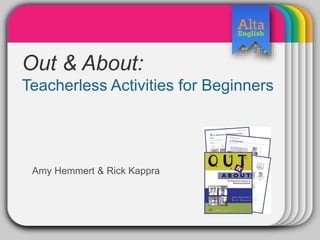
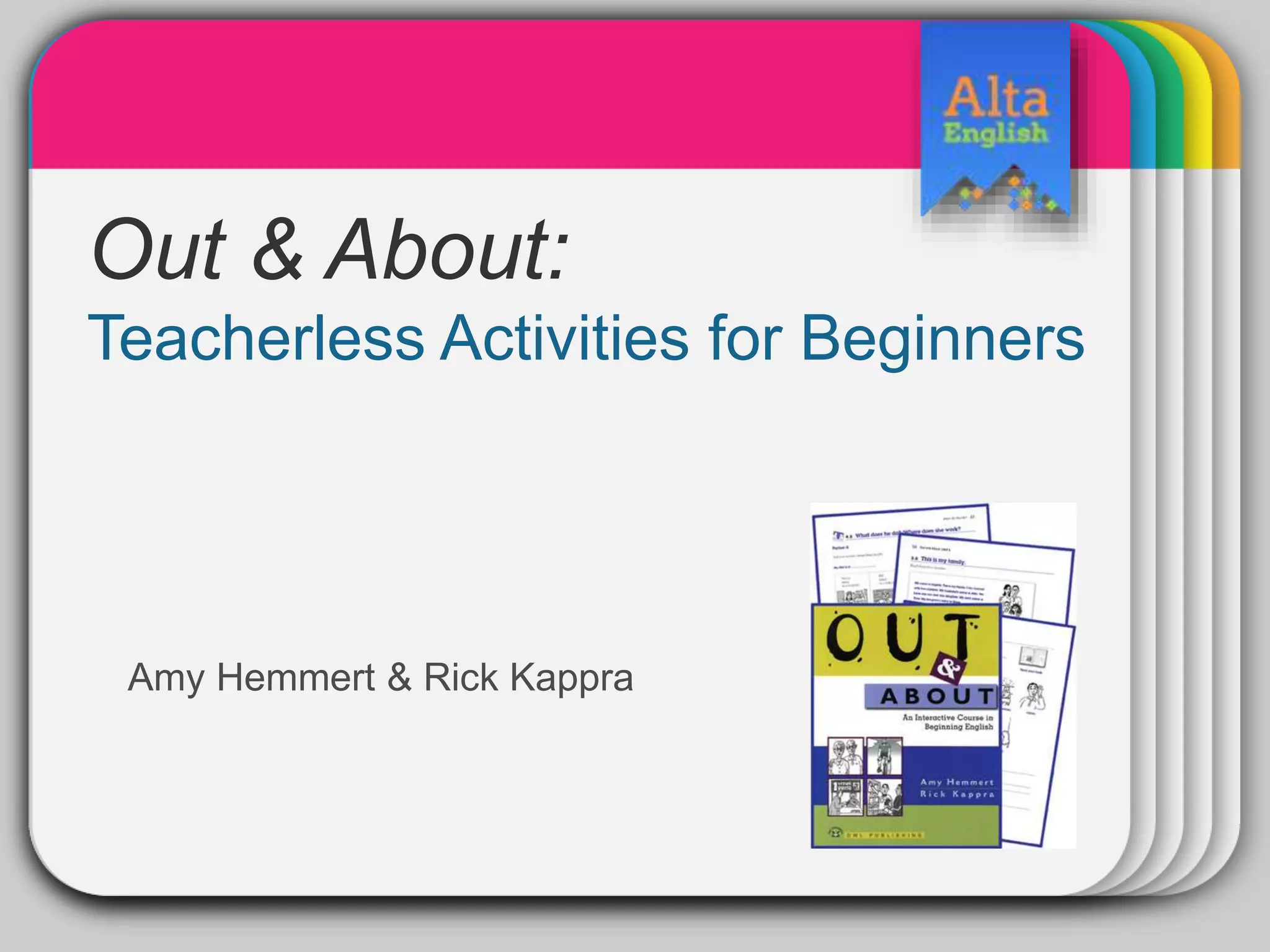

WINTERTemplateOut & About:
Teacherless Activities for Beginners
Amy Hemmert & Rick Kappra
Language Learning Assumptions
• Based on your experience as teachers and
learners, what conditions are necessary for
learning to take place in a language
classroom?
Brainstorm and list your ideas.
Time: 5 minutes
Joys and Challenges
What are some of the joys of teaching low levels?
What are some of the challenges?
Brainstorm and list your ideas.
Time: 5 minutes
What are teacherless activities?
A teacherless activity can loosely be defined
as an activity that involves:
• students turning to one another for knowledge or
information
• opportunities to practice the target language
A teacherless activity is NOT:
• teacher-fronted
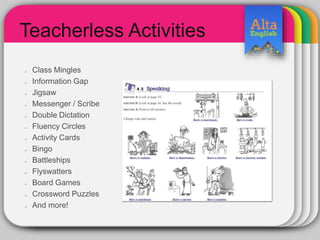
Teacherless Activities
Class Mingles
Information Gap
Jigsaw
Messenger / Scribe
Double Dictation
Fluency Circles
Activity Cards
Bingo
Battleships
Flyswatters
Board Games
Crossword Puzzles
And more!
Why “teacherless activities”?
They’re highly interactive with students at the center.
There’s lots of built-in repetition.
They provide opportunities for meaningful conversation.
The lively classroom helps reduce stress.
Students can control the pace.
Students can practice negotiating meaning.
They encourage students to cooperate with one another.
They’re great for the multi-level classroom.
They help build community.
They’re student friendly.
They’re teacher friendly.
They’re highly interactive and FUN!
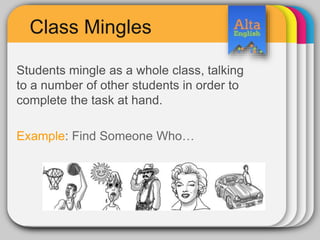
Class Mingles
Students mingle as a whole class, talking
to a number of other students in order to
complete the task at hand.
Example: Find Someone Who…
Students ask and answer questions to
obtain missing information.
Examples: picture grid, bus schedule,
TV guide
Information Gap
Fluency Circles
Students work in a large concentric
circle, repeating the same response at
least three times to gain fluency through
repetition.
Example: personal information,
food, transportation, jobs
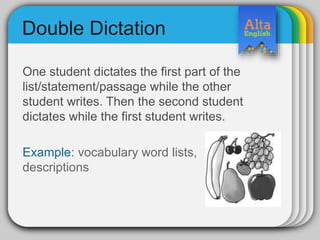
Double Dictation
One student dictates the first part of the
list/statement/passage while the other
student writes. Then the second student
dictates while the first student writes.
Example: vocabulary word lists,
descriptions
Template
Messenger / Scribe
Students work in pairs with one student
obtaining information from another
location. He/she must remember the
information or return to the source again.
Examples: vocabulary review,
practice statements
Bingo
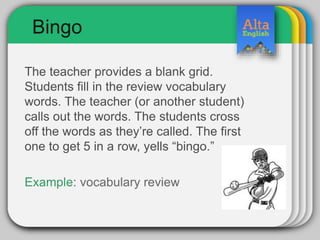
The teacher provides a blank grid.
Students fill in the review vocabulary
words. The teacher (or another student)
calls out the words. The students cross
off the words as they’re called. The first
one to get 5 in a row, yells “bingo.”
Example: vocabulary review
Battleships
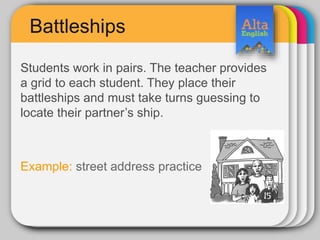
Students work in pairs. The teacher provides
a grid to each student. They place their
battleships and must take turns guessing to
locate their partner’s ship.
Example: street address practice
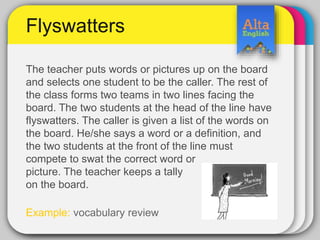
The teacher puts words or pictures up on the board
and selects one student to be the caller. The rest of
the class forms two teams in two lines facing the
board. The two students at the head of the line have
flyswatters. The caller is given a list of the words on
the board. He/she says a word or a definition, and
the two students at the front of the line must
compete to swat the correct word or
picture. The teacher keeps a tally
on the board.
Example: vocabulary review
Flyswatters
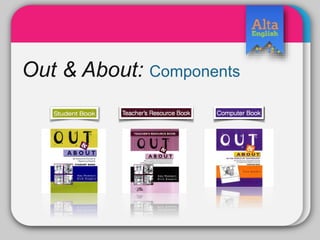
TemplateOut & About: Components
Contact Information
• Amy Hemmert
Kirby School, Santa Cruz
amyhemmert@gmail.com
• Rick Kappra
CCSF
rkappra@earthlink.net
ALTA English Publishers
www.altaenglishpublishers.com
Copyright 2015

Teacherless activities ccsf esl colloquium 2015

  • 1.
    WINTERTemplateOut & About: TeacherlessActivities for Beginners Amy Hemmert & Rick Kappra
  • 2.
    Language Learning Assumptions •Based on your experience as teachers and learners, what conditions are necessary for learning to take place in a language classroom? Brainstorm and list your ideas. Time: 5 minutes
  • 3.
    Joys and Challenges Whatare some of the joys of teaching low levels? What are some of the challenges? Brainstorm and list your ideas. Time: 5 minutes
  • 4.
    What are teacherlessactivities? A teacherless activity can loosely be defined as an activity that involves: • students turning to one another for knowledge or information • opportunities to practice the target language A teacherless activity is NOT: • teacher-fronted
  • 5.
    Teacherless Activities Class Mingles InformationGap Jigsaw Messenger / Scribe Double Dictation Fluency Circles Activity Cards Bingo Battleships Flyswatters Board Games Crossword Puzzles And more!
  • 6.
    Why “teacherless activities”? They’rehighly interactive with students at the center. There’s lots of built-in repetition. They provide opportunities for meaningful conversation. The lively classroom helps reduce stress. Students can control the pace. Students can practice negotiating meaning. They encourage students to cooperate with one another. They’re great for the multi-level classroom. They help build community. They’re student friendly. They’re teacher friendly. They’re highly interactive and FUN!
  • 7.
    Class Mingles Students mingleas a whole class, talking to a number of other students in order to complete the task at hand. Example: Find Someone Who…
  • 8.
    Students ask andanswer questions to obtain missing information. Examples: picture grid, bus schedule, TV guide Information Gap
  • 9.
    Fluency Circles Students workin a large concentric circle, repeating the same response at least three times to gain fluency through repetition. Example: personal information, food, transportation, jobs
  • 10.
    Double Dictation One studentdictates the first part of the list/statement/passage while the other student writes. Then the second student dictates while the first student writes. Example: vocabulary word lists, descriptions
  • 11.
    Template Messenger / Scribe Studentswork in pairs with one student obtaining information from another location. He/she must remember the information or return to the source again. Examples: vocabulary review, practice statements
  • 12.
    Bingo The teacher providesa blank grid. Students fill in the review vocabulary words. The teacher (or another student) calls out the words. The students cross off the words as they’re called. The first one to get 5 in a row, yells “bingo.” Example: vocabulary review
  • 13.
    Battleships Students work inpairs. The teacher provides a grid to each student. They place their battleships and must take turns guessing to locate their partner’s ship. Example: street address practice
  • 14.
    The teacher putswords or pictures up on the board and selects one student to be the caller. The rest of the class forms two teams in two lines facing the board. The two students at the head of the line have flyswatters. The caller is given a list of the words on the board. He/she says a word or a definition, and the two students at the front of the line must compete to swat the correct word or picture. The teacher keeps a tally on the board. Example: vocabulary review Flyswatters
  • 15.
  • 16.
    Contact Information • AmyHemmert Kirby School, Santa Cruz amyhemmert@gmail.com • Rick Kappra CCSF rkappra@earthlink.net
  • 17.