Teacher Motivation in Crisis-affected Contexts
9th International Policy Dialogue Forum
International Task Force on Teachers
6th December – Siem Reap, Cambodia
Outline
1. Global displacement – the big picture
2. Rationale: Education 2030, teachers and displaced populations
3. What we know: EiE & protracted crises – the challenges
4. What we know: Learner Profiles
5. What we know: Teacher profiles
6. Recommendations: How can we better support teachers in crises?
7. What is INEE? (Network Functions, Network Spaces, What do we do?)
8. INEE Minimum Standards For Education: Preparedness, Response &
Recovery
9. INEE and other tools on teacher training and CPD
Global Statistics on Displacement
• 65.3 million people forcibly displaced (UNHCR, 2015)
• 40.8 million IDPs
• 21.3 million refugees
• 3.2 million stateless persons
• 51% refugees under 18
• 41% refugees living in protracted settings
• 20 years average duration of displacement
• 86% refugees hosted in developing countries
• 60% refugees living in urban areas
• Refugees under 18 5x more likely to be out-of-school
Education 2030, teachers & displaced populations
• SDG4: “Ensure inclusive and quality education for all and promote lifelong learning”.  75
M children aged 3-18 currently OOSC in 35 crisis-affected countries
• Incheon declaration, ¶11: commitment to “developing more inclusive, responsive and
resilient education systems to meet the needs of children, youth and adults in these
contexts, including internally displaced persons and refugees”
• Framework for Action, ¶25-27: that “countries must (…) institute measures to develop
inclusive, responsive and resilient education systems to meet the needs of children, youth
and adults in crisis contexts, including internally displaced persons and refugees”
• Direct link made between quality education and teaching
Education in Crises: Challenges
System-wide:
• Host countries: teachers in short supply; school places in short supply.
• Country in crisis: schools destroyed, military use, medical use; attacked/targeted;
teachers have fled / are injured, even killed, traumatized.
• 20,000 more teachers + 12,000 additional classrooms needed each year to cope with the
growing refugee school-age population globally
• Lack of financing for EiE (receives 2% of humanitarian aid).
• Lack of sustainable interventions – assumed short duration of crisis [av. 20 years]
• Access difficult, dangerous.
In-classroom:
• Overcrowded;
• Little to no resources;
• Mixed populations (refugee, host, IDPs, ethnicities).
Learner Profiles
• Missed on average 3-4 years of schooling;
• May not speak-read-write language of instruction;
• Living in temporary shelters and/or low-resource environments;
• Families are under stress: lack of employment or livelihoods opportunities (parents);
• Assisting with household, younger siblings and income generation;
• Lack of clarity of future (return, remain, resettle?);
• Psychosocial needs, physical disabilities;
• SGBV survivors, former child soldiers;
• Illness, hunger  nutritional needs & impact on brain development, concentration
Teacher profiles
• Host country or refugee
• Depends on the country, location, crisis, etc. but in many places:
• Few years of schooling (primary graduates);
• Low levels of teacher training;
• Low, inconsistent pay or “incentives” for refugee teachers;
• Unprepared for specific challenges of education in crisis:
• languages
• diverse classrooms
• psychological needs of children
• physical disabilities
• different types of learning needed (life-saving, health education, sexual &
reproductive health, de-mining, ‘de-radicalization’) etc.
• Lack of incentives to work in refugee-hosting areas;
• Affected by war, conflict, violence, natural disasters.
 Solutions adapted to low-resource, rapidly-changing contexts 
• Remuneration: reliable, reasonable pay (prevent ‘moonlighting’, attrition);
• Non-salary incentives;
• Recognition, status  related to host country and country of origin (disparities?)
• Training and CPD, and must be context-specific;
• Support from school senior management;
• Peer to peer learning;
• Opportunity to engage with MoEs and express challenges & responses;
• Tools and resources e.g. lesson plans / ideas, SEL, language etc.
• Staff support: teaching assistants, PSS referral, health workers, special needs
assistants, etc.
How can we better support teachers in crisis?
What is INEE?
• Inter-agency Network for Education in Emergencies (INEE);
• Fast-growing, global network, open to all;
• Founded in 2000 by UN agencies, NGOs to enhance inter-agency collaboration,
information-sharing and advocacy for EiE.
• 12,700 members in 190 countries. 3-5 members joining daily;
• Members: UN, NGOs, MoEs, donor agencies, academic institutions, teachers, individuals;
“Working together
to ensure all persons the right
to quality, relevant and safe
education in emergencies and
post-crisis recovery”
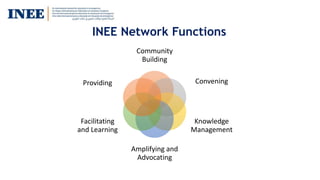
INEE Network Functions
Community
Building
Convening
Knowledge
Management
Amplifying and
Advocating
Facilitating
and Learning
Providing
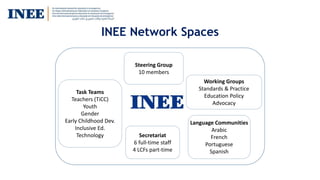
INEE Network Spaces
Steering Group
10 members
Language Communities
Arabic
French
Portuguese
Spanish
Working Groups
Standards & Practice
Education Policy
Advocacy
Task Teams
Teachers (TiCC)
Youth
Gender
Early Childhood Dev.
Inclusive Ed.
Technology Secretariat
6 full-time staff
4 LCFs part-time
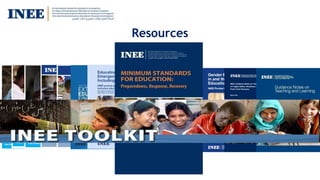
Resources
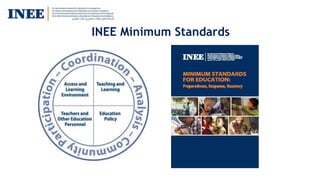
INEE Minimum Standards
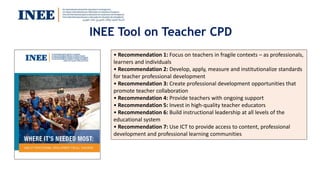
INEE Tool on Teacher CPD
• Recommendation 1: Focus on teachers in fragile contexts – as professionals,
learners and individuals
• Recommendation 2: Develop, apply, measure and institutionalize standards
for teacher professional development
• Recommendation 3: Create professional development opportunities that
promote teacher collaboration
• Recommendation 4: Provide teachers with ongoing support
• Recommendation 5: Invest in high-quality teacher educators
• Recommendation 6: Build instructional leadership at all levels of the
educational system
• Recommendation 7: Use ICT to provide access to content, professional
development and professional learning communities
Inter-agency Tool on Primary Teacher Training
THANK YOU!
Please visit ineesite.org
and
toolkit.ineesite.org
…and many more!

Teacher Motivation in Crisis-affected Contexts

  • 1.
    Teacher Motivation inCrisis-affected Contexts 9th International Policy Dialogue Forum International Task Force on Teachers 6th December – Siem Reap, Cambodia
  • 2.
    Outline 1. Global displacement– the big picture 2. Rationale: Education 2030, teachers and displaced populations 3. What we know: EiE & protracted crises – the challenges 4. What we know: Learner Profiles 5. What we know: Teacher profiles 6. Recommendations: How can we better support teachers in crises? 7. What is INEE? (Network Functions, Network Spaces, What do we do?) 8. INEE Minimum Standards For Education: Preparedness, Response & Recovery 9. INEE and other tools on teacher training and CPD
  • 3.
    Global Statistics onDisplacement • 65.3 million people forcibly displaced (UNHCR, 2015) • 40.8 million IDPs • 21.3 million refugees • 3.2 million stateless persons • 51% refugees under 18 • 41% refugees living in protracted settings • 20 years average duration of displacement • 86% refugees hosted in developing countries • 60% refugees living in urban areas • Refugees under 18 5x more likely to be out-of-school
  • 4.
    Education 2030, teachers& displaced populations • SDG4: “Ensure inclusive and quality education for all and promote lifelong learning”.  75 M children aged 3-18 currently OOSC in 35 crisis-affected countries • Incheon declaration, ¶11: commitment to “developing more inclusive, responsive and resilient education systems to meet the needs of children, youth and adults in these contexts, including internally displaced persons and refugees” • Framework for Action, ¶25-27: that “countries must (…) institute measures to develop inclusive, responsive and resilient education systems to meet the needs of children, youth and adults in crisis contexts, including internally displaced persons and refugees” • Direct link made between quality education and teaching
  • 5.
    Education in Crises:Challenges System-wide: • Host countries: teachers in short supply; school places in short supply. • Country in crisis: schools destroyed, military use, medical use; attacked/targeted; teachers have fled / are injured, even killed, traumatized. • 20,000 more teachers + 12,000 additional classrooms needed each year to cope with the growing refugee school-age population globally • Lack of financing for EiE (receives 2% of humanitarian aid). • Lack of sustainable interventions – assumed short duration of crisis [av. 20 years] • Access difficult, dangerous. In-classroom: • Overcrowded; • Little to no resources; • Mixed populations (refugee, host, IDPs, ethnicities).
  • 6.
    Learner Profiles • Missedon average 3-4 years of schooling; • May not speak-read-write language of instruction; • Living in temporary shelters and/or low-resource environments; • Families are under stress: lack of employment or livelihoods opportunities (parents); • Assisting with household, younger siblings and income generation; • Lack of clarity of future (return, remain, resettle?); • Psychosocial needs, physical disabilities; • SGBV survivors, former child soldiers; • Illness, hunger  nutritional needs & impact on brain development, concentration
  • 7.
    Teacher profiles • Hostcountry or refugee • Depends on the country, location, crisis, etc. but in many places: • Few years of schooling (primary graduates); • Low levels of teacher training; • Low, inconsistent pay or “incentives” for refugee teachers; • Unprepared for specific challenges of education in crisis: • languages • diverse classrooms • psychological needs of children • physical disabilities • different types of learning needed (life-saving, health education, sexual & reproductive health, de-mining, ‘de-radicalization’) etc. • Lack of incentives to work in refugee-hosting areas; • Affected by war, conflict, violence, natural disasters.
  • 8.
     Solutions adaptedto low-resource, rapidly-changing contexts  • Remuneration: reliable, reasonable pay (prevent ‘moonlighting’, attrition); • Non-salary incentives; • Recognition, status  related to host country and country of origin (disparities?) • Training and CPD, and must be context-specific; • Support from school senior management; • Peer to peer learning; • Opportunity to engage with MoEs and express challenges & responses; • Tools and resources e.g. lesson plans / ideas, SEL, language etc. • Staff support: teaching assistants, PSS referral, health workers, special needs assistants, etc. How can we better support teachers in crisis?
  • 9.
    What is INEE? •Inter-agency Network for Education in Emergencies (INEE); • Fast-growing, global network, open to all; • Founded in 2000 by UN agencies, NGOs to enhance inter-agency collaboration, information-sharing and advocacy for EiE. • 12,700 members in 190 countries. 3-5 members joining daily; • Members: UN, NGOs, MoEs, donor agencies, academic institutions, teachers, individuals; “Working together to ensure all persons the right to quality, relevant and safe education in emergencies and post-crisis recovery”
  • 10.
  • 11.
    INEE Network Spaces SteeringGroup 10 members Language Communities Arabic French Portuguese Spanish Working Groups Standards & Practice Education Policy Advocacy Task Teams Teachers (TiCC) Youth Gender Early Childhood Dev. Inclusive Ed. Technology Secretariat 6 full-time staff 4 LCFs part-time
  • 12.
  • 13.
  • 15.
    INEE Tool onTeacher CPD • Recommendation 1: Focus on teachers in fragile contexts – as professionals, learners and individuals • Recommendation 2: Develop, apply, measure and institutionalize standards for teacher professional development • Recommendation 3: Create professional development opportunities that promote teacher collaboration • Recommendation 4: Provide teachers with ongoing support • Recommendation 5: Invest in high-quality teacher educators • Recommendation 6: Build instructional leadership at all levels of the educational system • Recommendation 7: Use ICT to provide access to content, professional development and professional learning communities
  • 16.
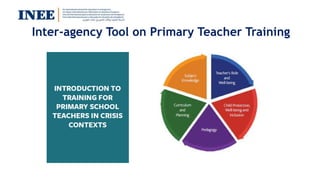
    Inter-agency Tool onPrimary Teacher Training
  • 17.
    THANK YOU! Please visitineesite.org and toolkit.ineesite.org …and many more!

Editor's Notes

  • #2 Good morning everyone. My name is Laura Davison and I work for the INEE – Inter-agency Network for Education in Emergencies. This morning I am going to talk to you about the challenges surrounding teaching and teacher motivation in crisis-affected contexts. What I mean by crisis-affected contexts is places that are being or have been affected by war, conflict, urban violence, natural disasters, and epidemics. These types of crises can disrupt education systems and have a huge impact on teachers and learners.
  • #3 Quick overview of my presentation: Take a brief look at the big picture of global displacement Why are we talking about education in emergencies Challenges that teachers are facing in emergencies Learner profiles in emergency or protracted situations Teacher profiles in these contexts Teacher motivation in relation to those aspects Recommendations – how we can better support teachers I will spend a few minutes telling you what INEE is and what we do, since we are well known within the EiE world but not necessarily beyond that. INEE Minimum Standards – cornerstone tool that we’ve developed
  • #4 -Largest number of displaced people recorded in history -IDPs -Refugees – sought refuge in another country -Protracted situations: long-standing, intractable situation 20 years – more than an entire school cycle - 86% in developing countries: More than half of the world’s out-of-school refugee children are located in just seven countries: Chad, Democratic Republic of the Congo, Ethiopia, Kenya, Lebanon, Pakistan and Turkey. -Refugee children are five times more likely to be out of school than non-refugee children.
  • #5 - SDG 4 demands governments to “Ensure inclusive and quality education for all and promote lifelong learning”. This goal will not be achieved unless the needs of displaced populations are taken into account. An estimated 75 million children and young people (aged 3-18) are currently out of school in 35 crisis-affected countries (Education Cannot Wait, 2016). The Education 2030 Incheon Declaration explicitly expresses political commitment to supporting education in conflict and crisis, including for forcibly displaced persons: paragraph 11 recognizes that a large proportion of the world’s out-of-school population lives in conflict-affected areas, and makes a commitment to “developing more inclusive, responsive and resilient education systems to meet the needs of children, youth and adults in these contexts, including internally displaced persons and refugees” (Education 2030 Incheon Declaration). -The Education 2030 Framework for Action also states that “countries must (…) institute measures to develop inclusive, responsive and resilient education systems to meet the needs of children, youth and adults in crisis contexts, including internally displaced persons and refugees” (Education 2030 Framework for Action, paragraphs 25-27). - WHY ARE WE TALKING ABOUT TEACHERS in relation to SDG4? With increasing global focus on improving the quality of education, teachers are frequently cited as key agents in that process. One of the SDG 4 targets is to increase the supply of qualified teachers by 2030. Moreover, the Incheon Declaration links quality education directly to teachers. Quality education is described in the Incheon Declaration as “fostering creativity and knowledge,” ensuring the “acquisition of (…) skills” as well as “problem-solving and other high-level cognitive, interpersonal and social skills” (Education 2030 Incheon Declaration, paragraph 9). “We commit to quality education and to improving learning outcomes, which requires strengthening inputs, processes and evaluation of outcomes and mechanisms to measure progress. We will ensure that teachers and educators are empowered, adequately recruited, well-trained, professionally qualified, motivated and supported within well-resourced, efficient and effectively governed systems. Quality education fosters creativity and knowledge, and ensures the acquisition of the foundational skills of literacy and numeracy as well as analytical, problem solving and other high-level cognitive, interpersonal and social skills. It also develops the skills, values and attitudes that enable citizens to lead healthy and fulfilled lives, make informed decisions, and respond to local and global challenges through education for sustainable development (ESD) and global citizenship education (GCED).” (Education 2030 Incheon Declaration, paragraph 9). -Recent developments such as the creation of Education Cannot Wait, a new global fund that aims to provide children and youth affected by crisis with free access to high-quality education, are encouraging. The fund brings together private and public partners to raise $3.85 billion in the next five years, enabling partners to reach 13.6 million children living in crisis situations such as conflict, natural disaster, and disease outbreaks. The Education Cannot Wait fund ultimately aspires to reach 75 million children living in crisis by 2030 (INEE, 2016). Even still, whilst the political will to support education in emergencies exists, how do these international commitments translate to improving access to and quality of education provided to forcibly displaced children and young people?
  • #6 -However, teachers working in crisis-affected contexts face particular challenges which may limit their agency to enable such learning amongst displaced children and adolescents. -In host countries: Teachers are generally in short supply when there is an influx of refugees. Governments face the challenge of finding additional school places, trained teachers and learning materials for thousands (sometimes hundreds of thousands) of newcomers (UNHCR, 2016). - Countries in crisis: face a shortage of scools:
  • #7 -We’ve looked at big picture challenges -Now we’re going to look at learner profiles – this session looks specifically at how learner profiles and teacher profiles affect teacher motivation - -SPEND TIME ON HOW THIS AFFECTS MOTIVATION
  • #8 -SPEND TIME ON HOW THIS AFFECTS MOTIVATION
  • #9 -Some suggestions / recommendations that we can discuss later in discussion
  • #11 -What are our functions as a global network? -What do we do? -We are not an implementing agency. We do not implement education programmes in emergency contexts. We do not have staff working in those contexts. -Our functions are to build a community of EiE practitioners, to convene stakeholders on these global level policy issues related to EiE. -We amplify knowledge and advocate for EiE support at the highest levels through our members. -We facilitate learning on EiE – webinars, trainings etc. -We provide resources, information, publications, events.
  • #13 -INEE is one of the go-to places for resources on education in emergencies -We produce resources on many different aspects related to EiE, including guidance on gender equality, inclusive education, education financing, safer school construction, conflict-sensitive education, and we have resources on teacher compensation, guidance notes on teacher and learning (articulates good practices relating to curriculum adaptation, and development, teacher training, professional development, assessment of learning outcomes) -All of our tools together are known as the INEE toolkit.
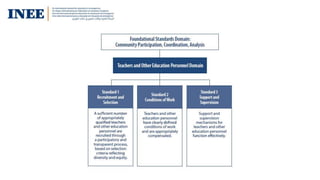
  • #14 -Cornerstone publication. Most well-known of our resources. INEE Minimum Standards for Education: Preparedness, Response, Recovery. -The creation of the INEE MS handbook was prioritized by early members of the network who felt there was a need for a global tool that would articulate a common framework for quality education. The Standards aim to enhance the quality of education policy and programming, increase access to safe and relevant learning opportunities and ensure accountability in providing these services in all stages of emergency response. The Handbook was developed through a highly collaborative process with over 3,500 education professionals from over 52 countries. So the reason that the standards carry so much weight is because they represent rights, lessons learned, and collective thinking of the global community. The handbook provides guidance on how to prepare for and respond to acute emergencies in ways that reduce risk, improve future preparedness and lay a solid foundation for accessible and quality education. Available in 28 languages. Foundational Standards: these have been revised and expanded to include coordination as well as community participation and analysis. These standards should be applied across all domains to promote a holistic, quality response. These standards give particular attention to the need for good diagnosis at all stages of the project cycle, in order to better understand the context and apply more appropriately the standards in the domains that follow
  • #15 -Draw attention that one of our 5 foundational standards is on teachers and other education personnel. -Standards on recruitment and selection, conditions of work, support and supervision  standards exist but we need to implement them. Governments and UN orgs and NGOs need to be held accountable for implementing these standards. -What are the mechanisms we can put in place to ensure adherence to those standards?
  • #16 - The publication highlights the need to improve the planning, implementation, and sustainability of teacher professional development in crisis situations. This particular topic remains under-theorized and under-researched, further perpetuating the cycle of poor teacher professional development and, consequently, poor overall education delivery in humanitarian and development contexts. This guide aims to redress this omission by outlining a set of good practices in high-quality professional development for teachers who work in such contexts. The publication draws upon the rich information produced by the INEE-hosted online forum Teacher Professional Development in Crisis and accompanies the annotated bibliography on the same topic, available here.  Recommendations - The publication is currently available only in English. RATIONALE: In many parts of the globe, teachers consistently receive professional development that they do not value, that they believe has little impact (OECD, 2008; Burns, 2007) and that research shows does not meet the threshold needed to produce strong effects on their practice or on student learning (Darling-Hammond & Bransford, 2005). - In many parts of the globe, a majority of the world’s teachers, despite the diversity of their professional contexts, participate in a remarkably uniform model of professional development – the workshop or “training” – despite research showing that such a model is unlikely to influence teacher practice or student achievement (Wei, Darling-Hammond, & Adamson, 2010). - In many parts of the globe – particularly in the world’s poorest and most fragile contexts where the need for quality teaching is greatest – the frequency of professional development is episodic, its quality variable, its duration limited and support or follow-up for teachers almost non-existent.
  • #17 - The training materials in this pack were developed by members of the Teachers in Crisis Contexts Working Group (TICCWG; originally known as the Refugee Teacher Working Group), consultants and colleagues, representing a diverse group of individuals from international NGOs, universities, and UN agencies. The materials are a product of a unique collaboration between global and regional education experts, teacher training experts, graduate students, field practitioners and teachers. This inter-agency, open source training pack is available for anyone to use. The pack builds basic teaching competencies for unqualified or under-qualified teachers often recruited to teach in emergency settings (e.g. refugee/IDP camps, conflict-affected areas, post-natural disasters, and/or with highly vulnerable populations). The materials can be used with qualified teachers who require refresher training or who would benefit from additional support in critical areas like child protection. The materials can also be used by teachers who either find themselves teaching in crisis-affected environments or in host community schools that are integrating children/youth from displaced populations. -The pack is comprised of an Introductory Training Pack and four core modules, developed around a set of 28 teacher competencies. The pack has undergone systematic review where it was field-tested in Iraq and Kenya, externally reviewed by a range of EiE specialists, and finalized in March 2016 -The TICCWG agencies contributed Finn Church Aid; International Rescue Committee (IRC); Norwegian Refugee; Save the Children USA; Teachers College, Columbia University; UNHCR, UNICEF - Francesca Bonomo, Caroline Keenan. Inter-Agency Network for Education in Emergencies (INEE) provided support throughout the process.