






TERMINOLOGY
Tips and tricks to boost your
terminology work
Laura Ramírez
Polo
University of Illinois
@kleinelaura
Terminology & Translation 2
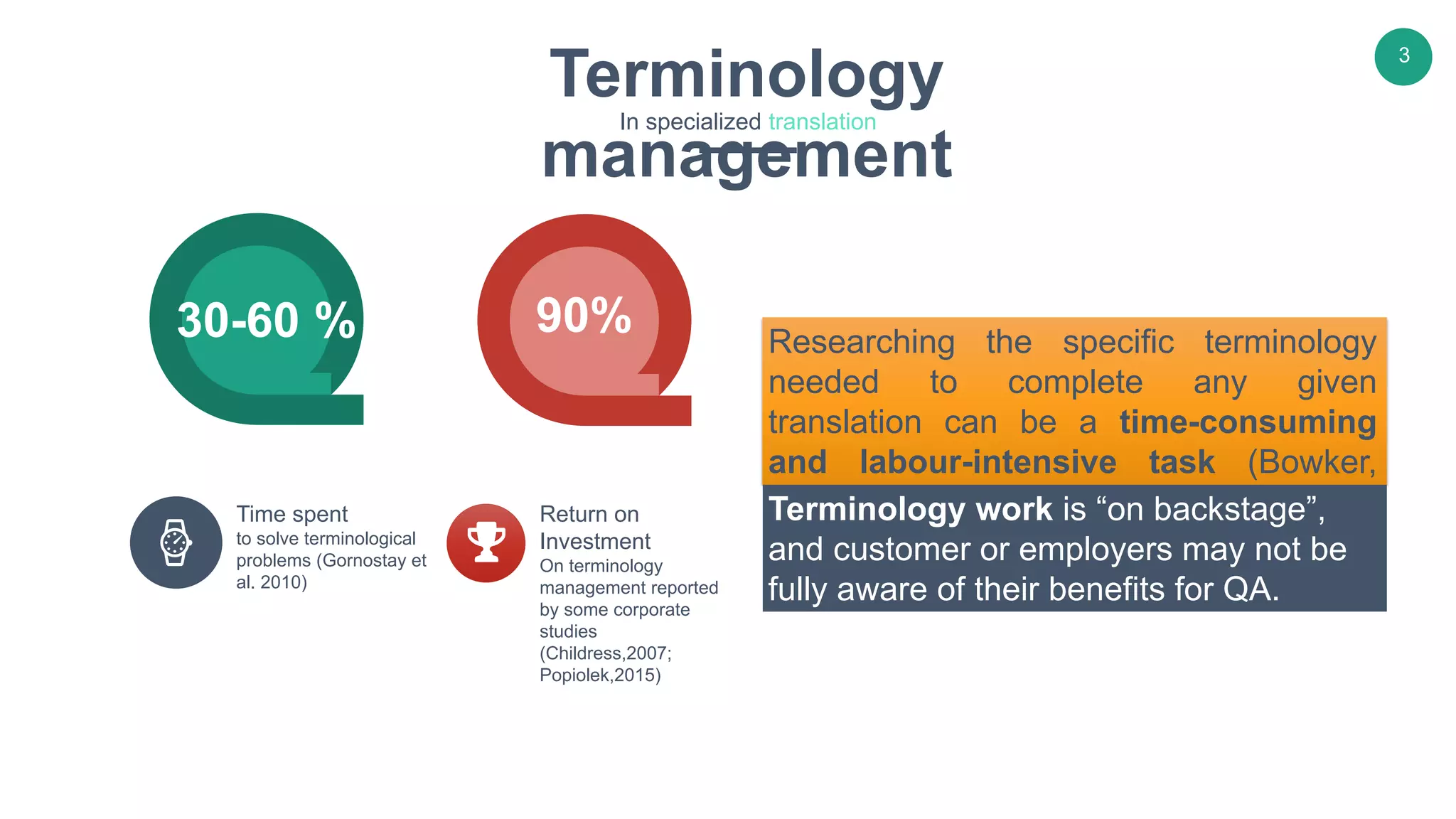
30-60 % 90%
Time spent
to solve terminological
problems (Gornostay et
al. 2010)
Return on
Investment
On terminology
management reported
by some corporate
studies
(Childress,2007;
Popiolek,2015)
Terminology
management
In specialized translation
Researching the specific terminology
needed to complete any given
translation can be a time-consuming
and labour-intensive task (Bowker,
2014)Terminology work is “on backstage”,
and customer or employers may not be
fully aware of their benefits for QA.
3
Terminology is the discipline
concerned with the collection,
processing, description and
presentation of terms, which are
lexical items belonging to a
specialized subject field (e.g.
medicine, law, engineering,
library science or art history).
Bower (2014)
What is terminology?
From the point of view of the translation and localization industry practitioners,
terminology management can be more practically defined as the activity of
systematically collecting, processing, classifying and consistently applying
vocabulary that has specific meaning in a given subject field or context (terms)
according to some governing methodology–
Popiolek (2014)
4
Stages in the Terminology
Process
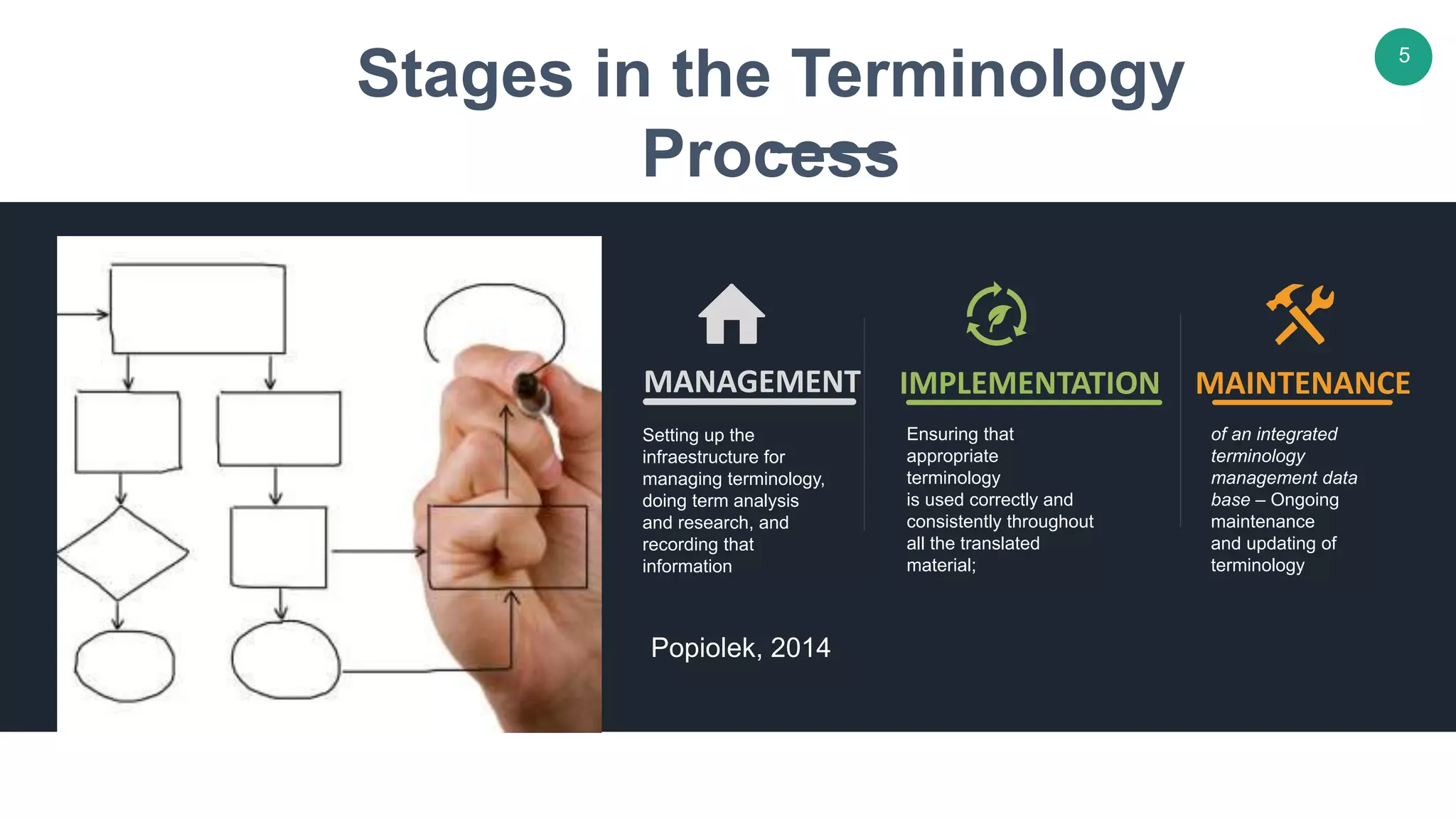
Setting up the
infraestructure for
managing terminology,
doing term analysis
and research, and
recording that
information
MANAGEMENT
Ensuring that
appropriate
terminology
is used correctly and
consistently throughout
all the translated
material;
IMPLEMENTATION
of an integrated
terminology
management data
base – Ongoing
maintenance
and updating of
terminology
MAINTENANCE
5
Popiolek, 2014
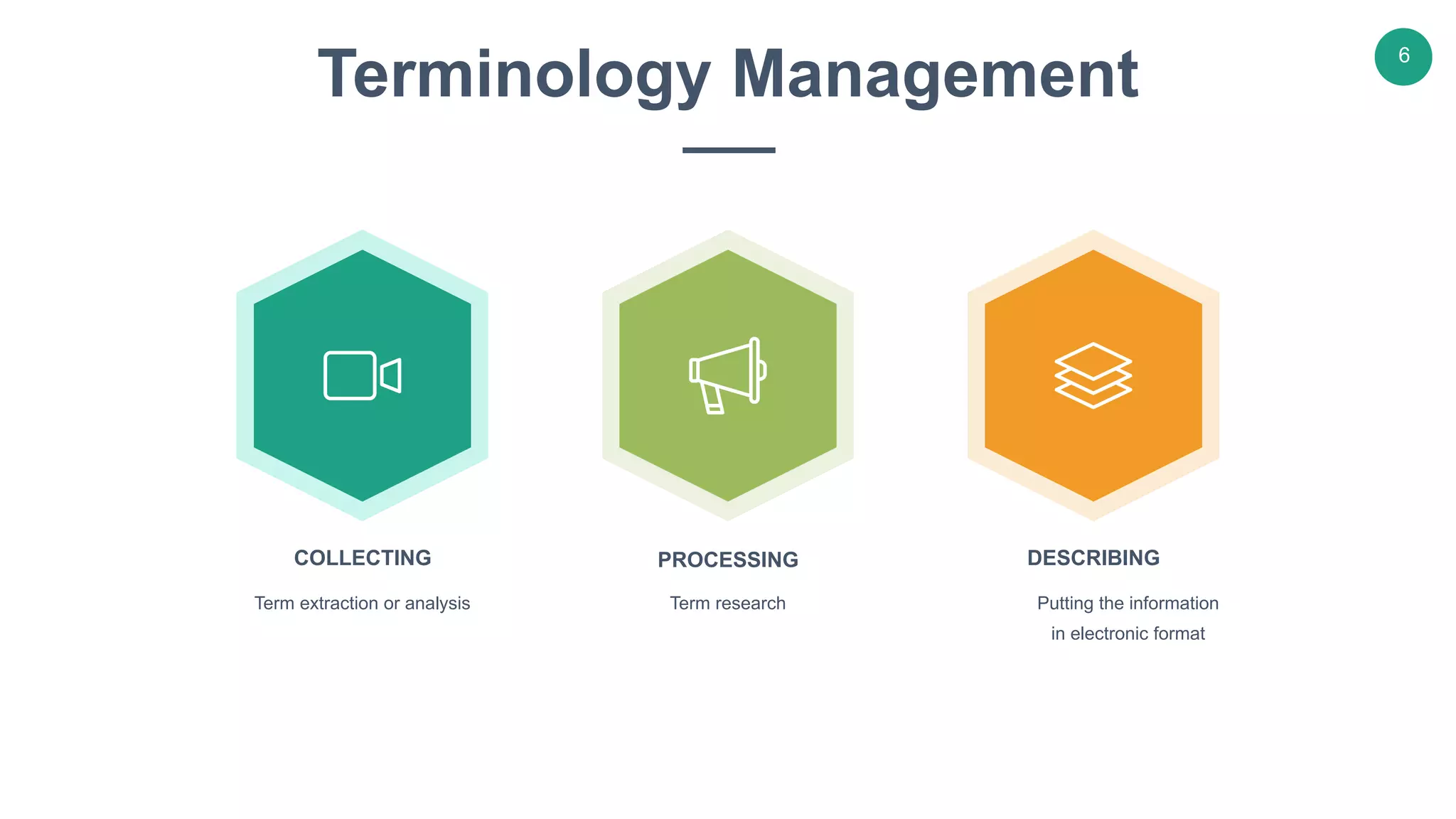
PROCESSING DESCRIBINGCOLLECTING
Putting the information
in electronic format
Term researchTerm extraction or analysis
Terminology Management
6
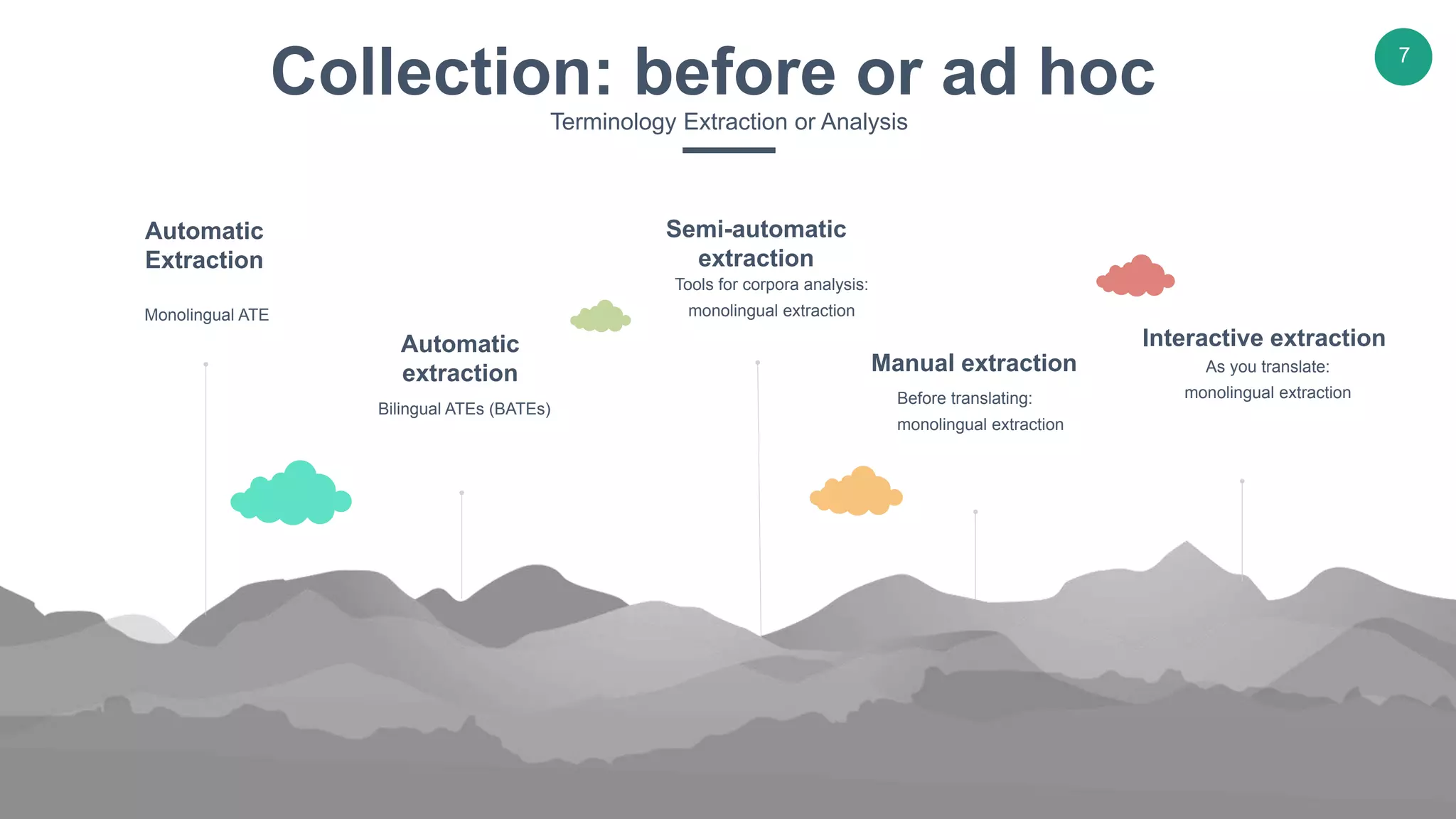
Automatic
Extraction
Monolingual ATE
Automatic
extraction
Bilingual ATEs (BATEs)
Semi-automatic
extraction
Interactive extraction
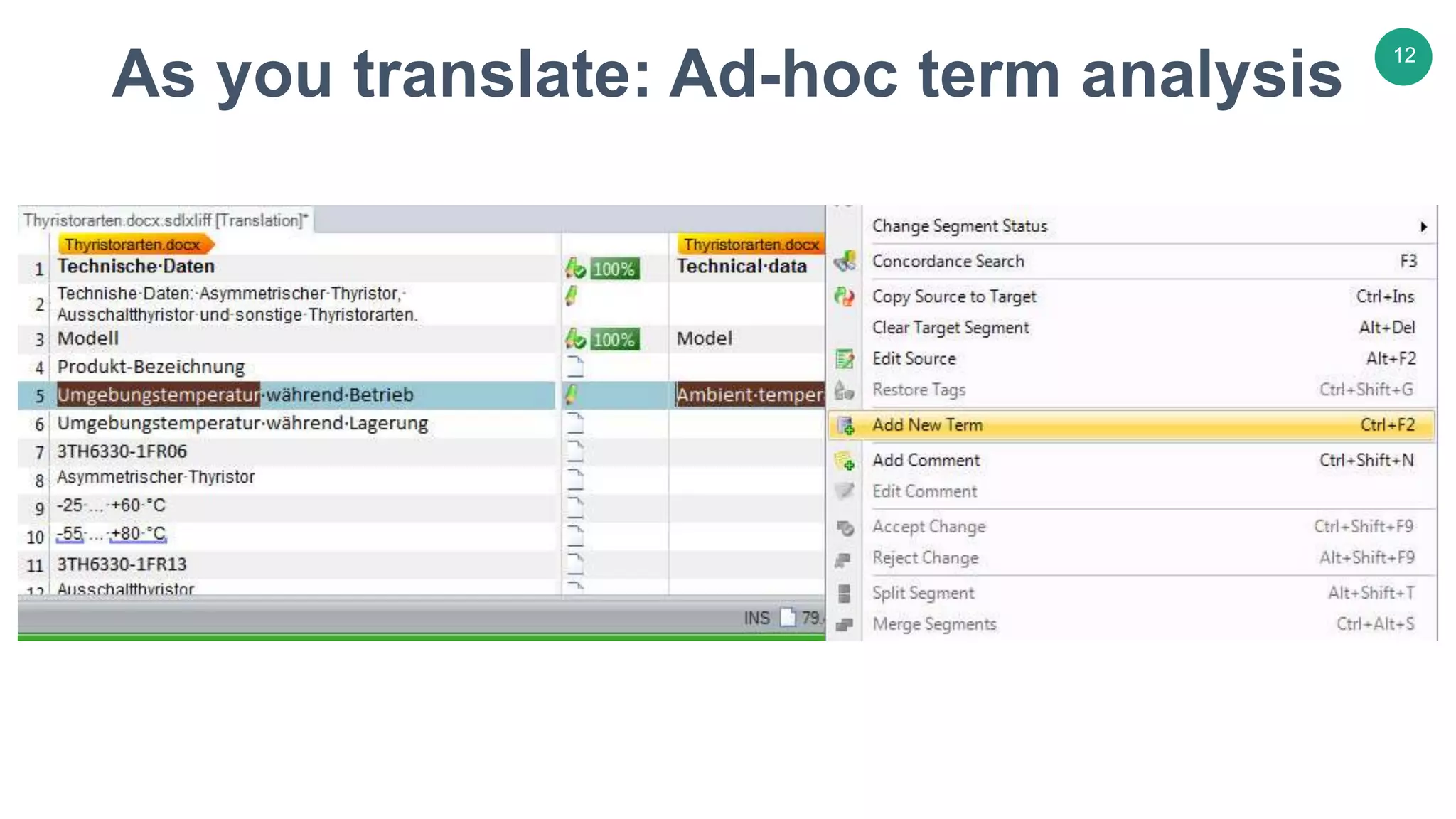
As you translate:
monolingual extraction
Manual extraction
Collection: before or ad hoc
Terminology Extraction or Analysis
Before translating:
monolingual extraction
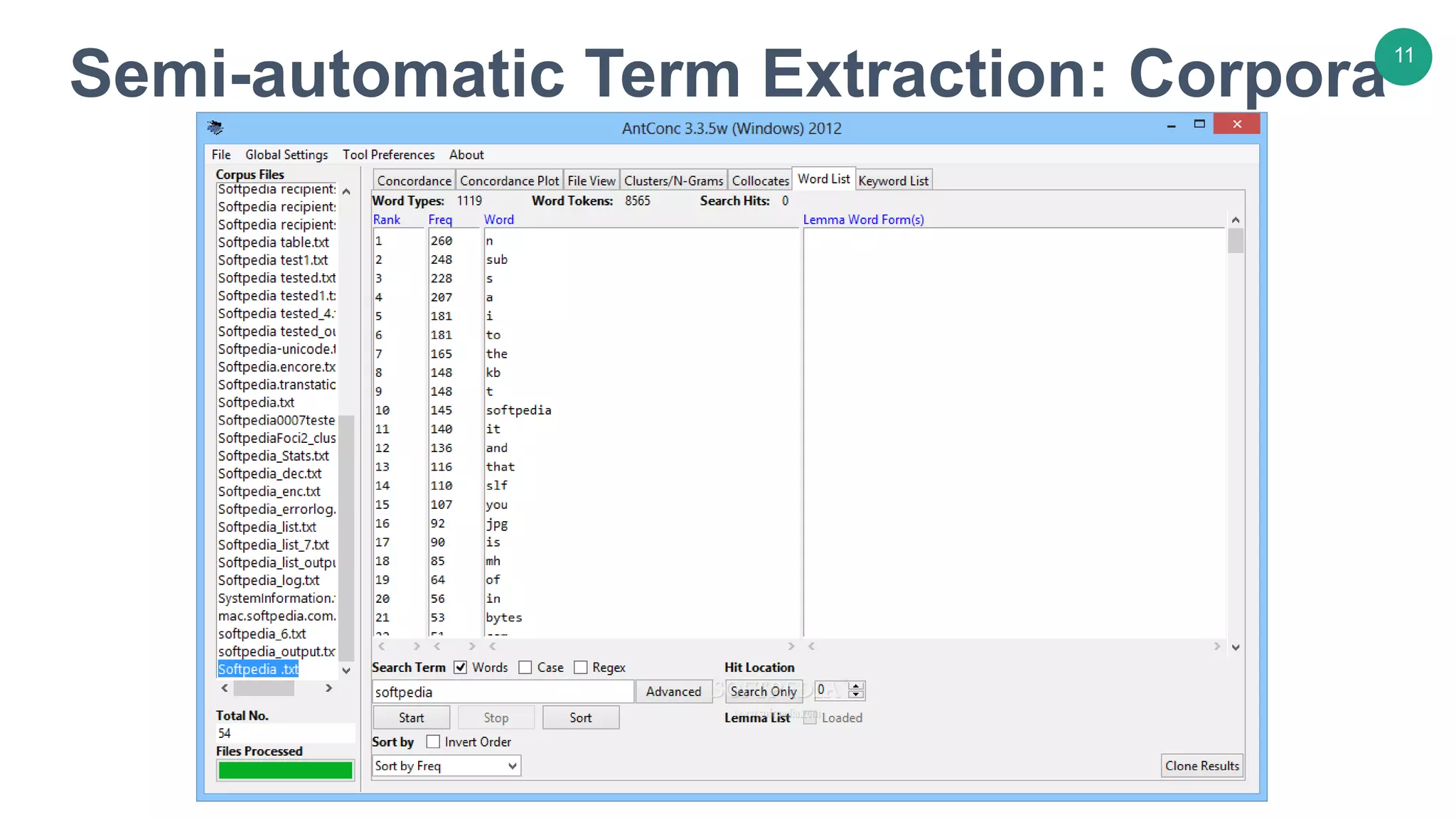
Tools for corpora analysis:
monolingual extraction
7
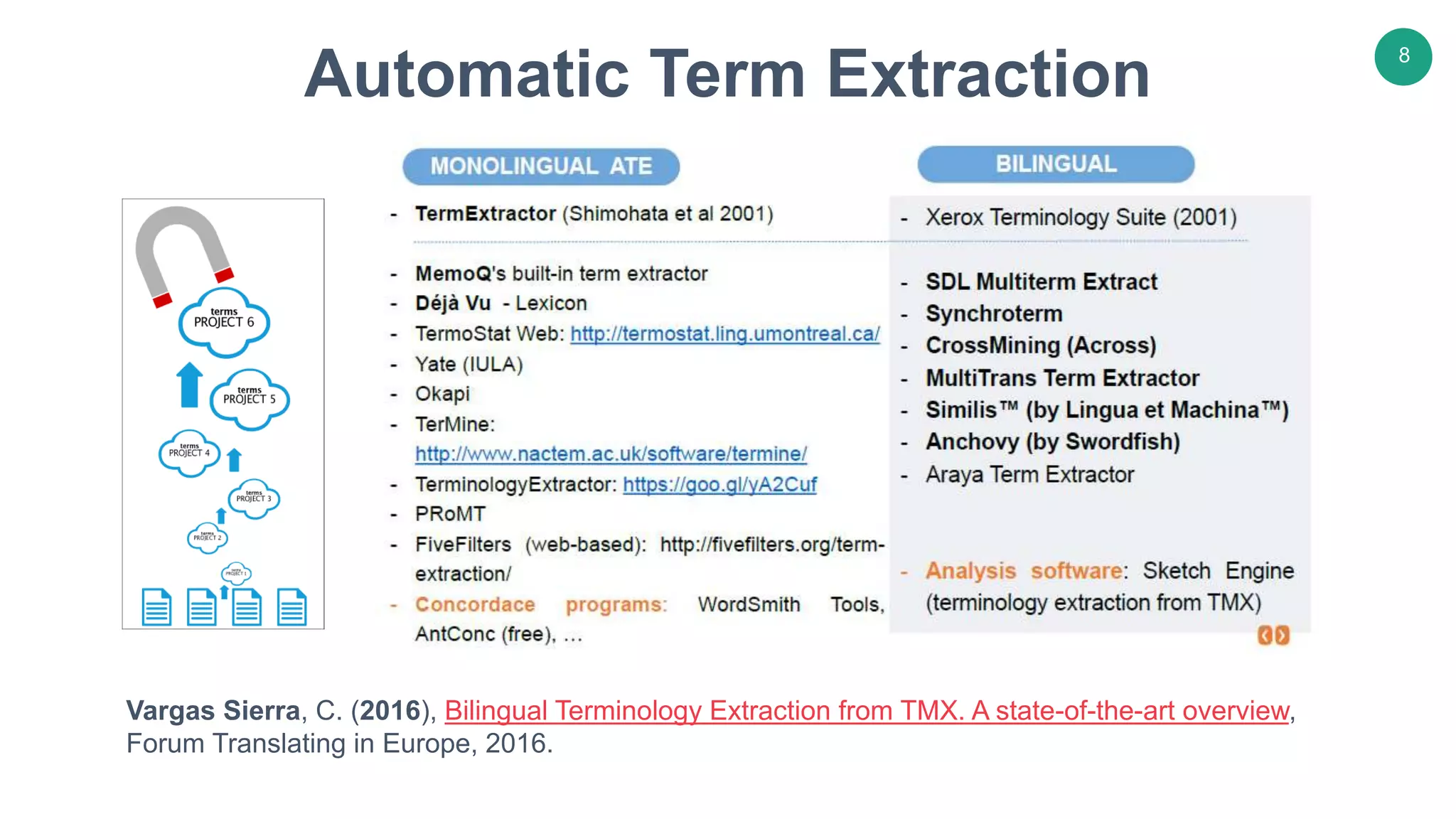
Automatic Term Extraction
8
Vargas Sierra, C. (2016), Bilingual Terminology Extraction from TMX. A state-of-the-art overview,
Forum Translating in Europe, 2016.
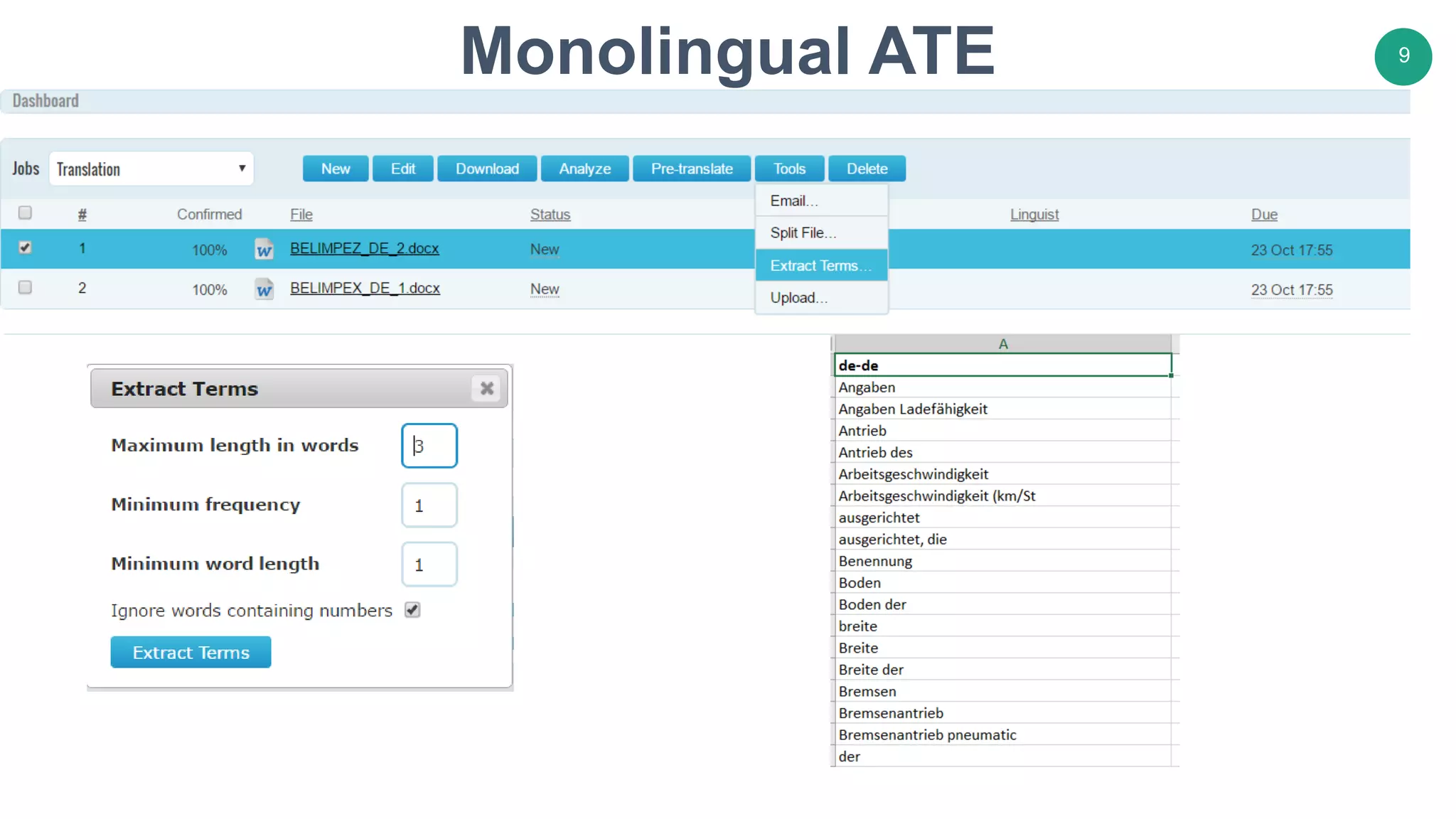
Monolingual ATE 9
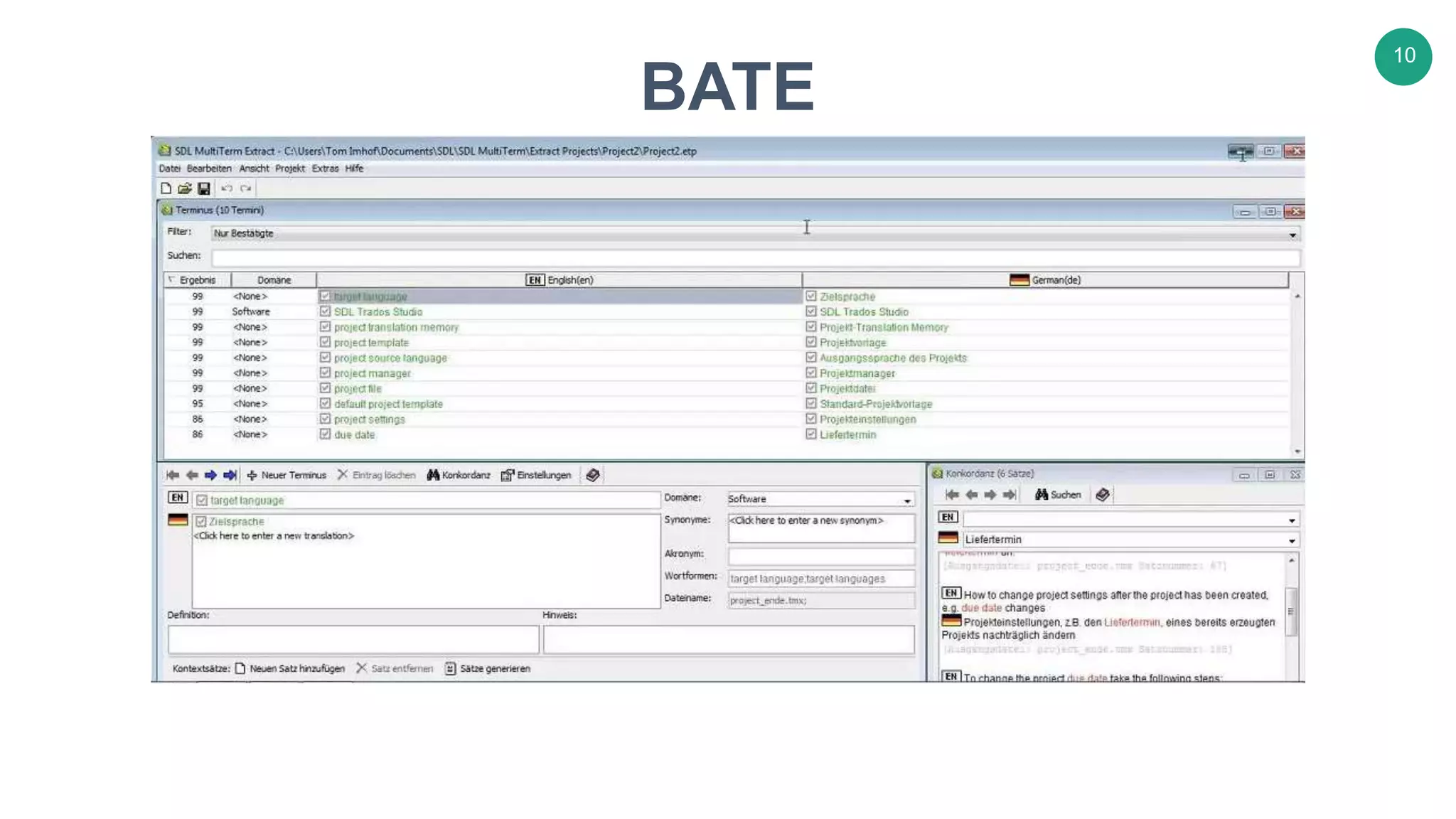
BATE
10
Semi-automatic Term Extraction: Corpora
11
As you translate: Ad-hoc term analysis
12
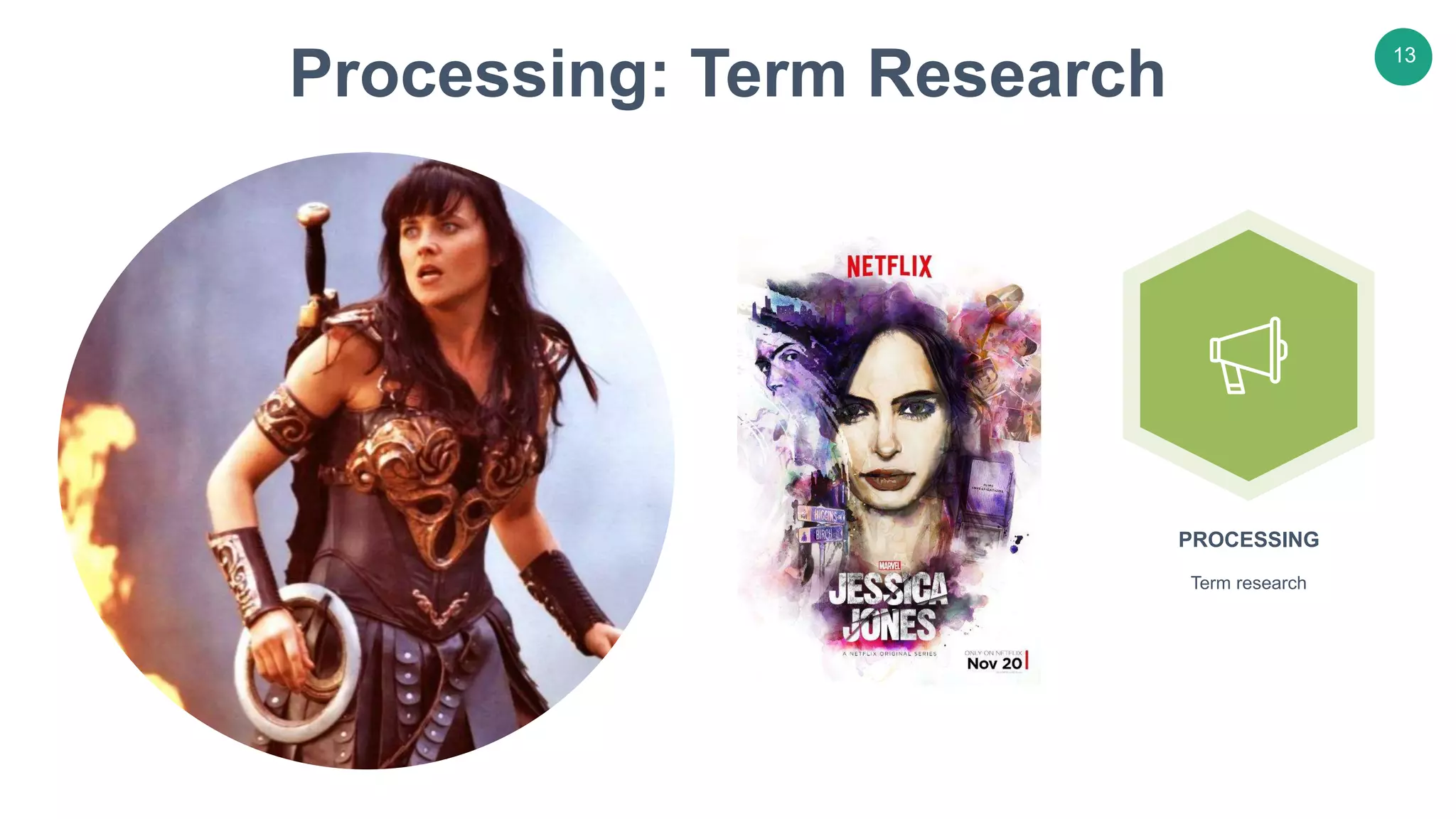
Processing: Term Research
13
PROCESSING
Term research
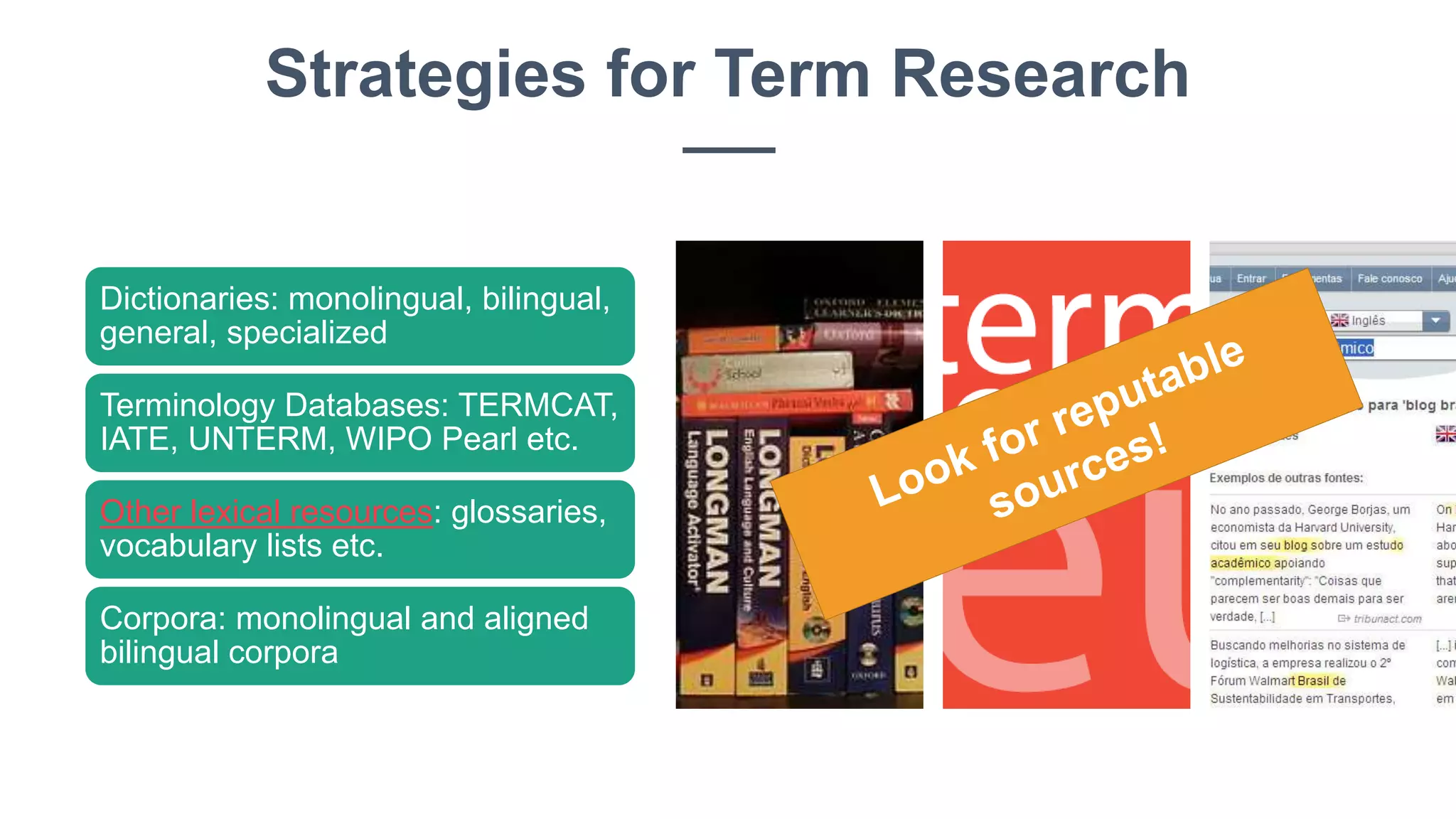
Dictionaries: monolingual, bilingual,
general, specialized
Terminology Databases: TERMCAT,
IATE, UNTERM, WIPO Pearl etc.
Other lexical resources: glossaries,
vocabulary lists etc.
Corpora: monolingual and aligned
bilingual corpora
Strategies for Term Research
15
JAMES BOND
CEO & FOUNDER
Hi Everyone, we are Motagua Corp
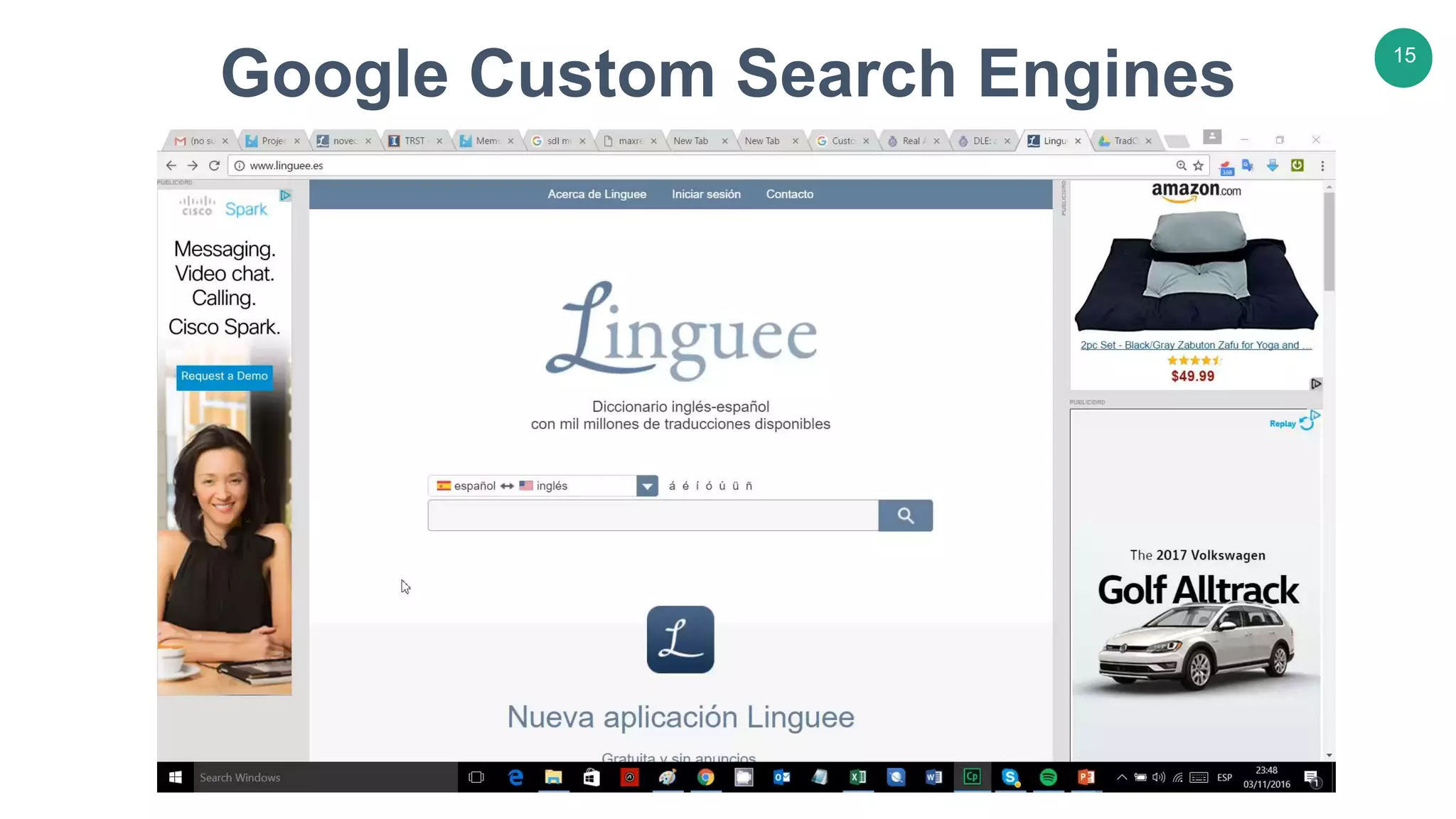
Google Custom Search Engines
15
16
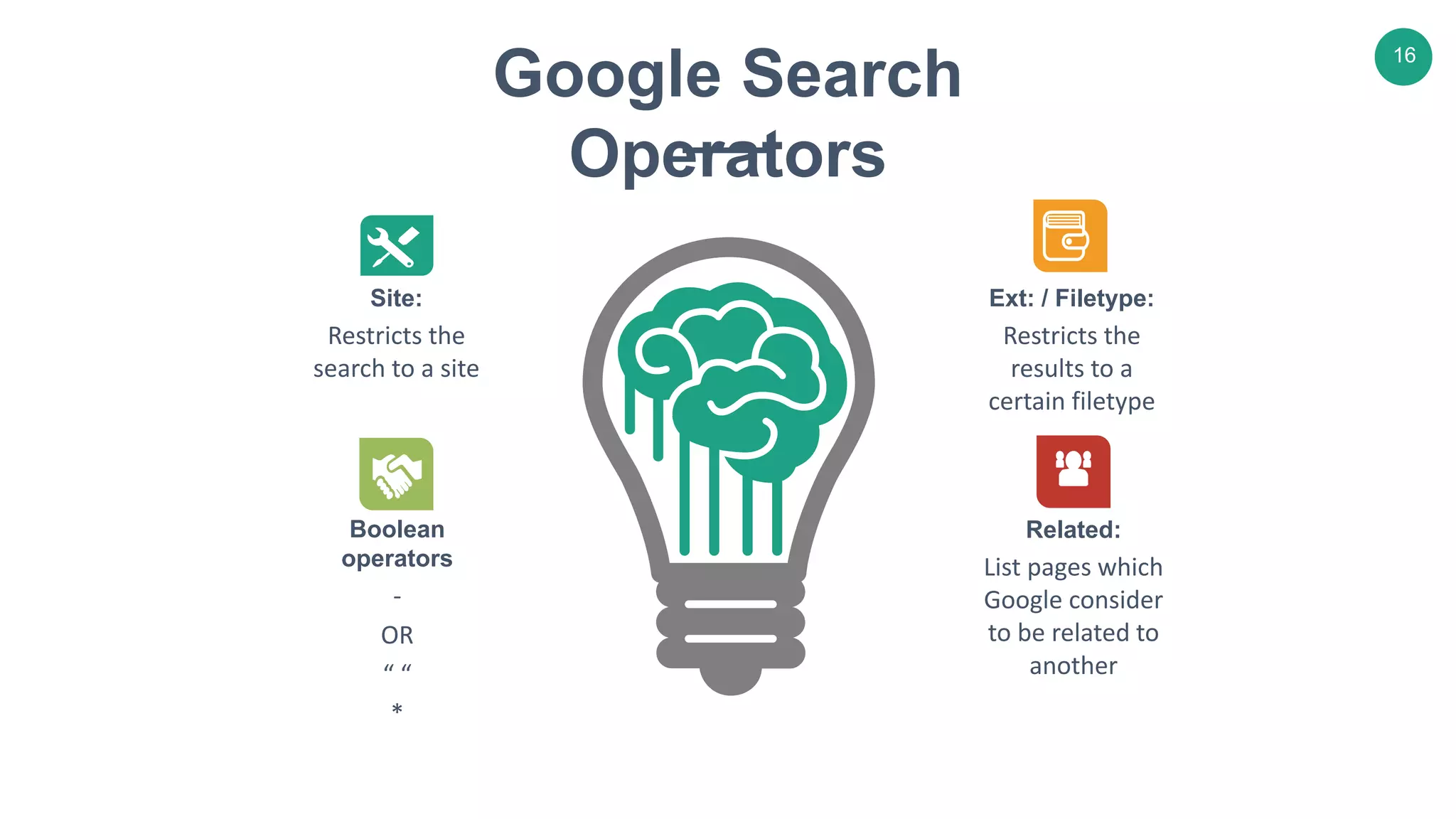
Site:
Restricts the
search to a site
Boolean
operators
-
OR
“ “
*
Related:
List pages which
Google consider
to be related to
another
Ext: / Filetype:
Restricts the
results to a
certain filetype
Google Search
Operators
17
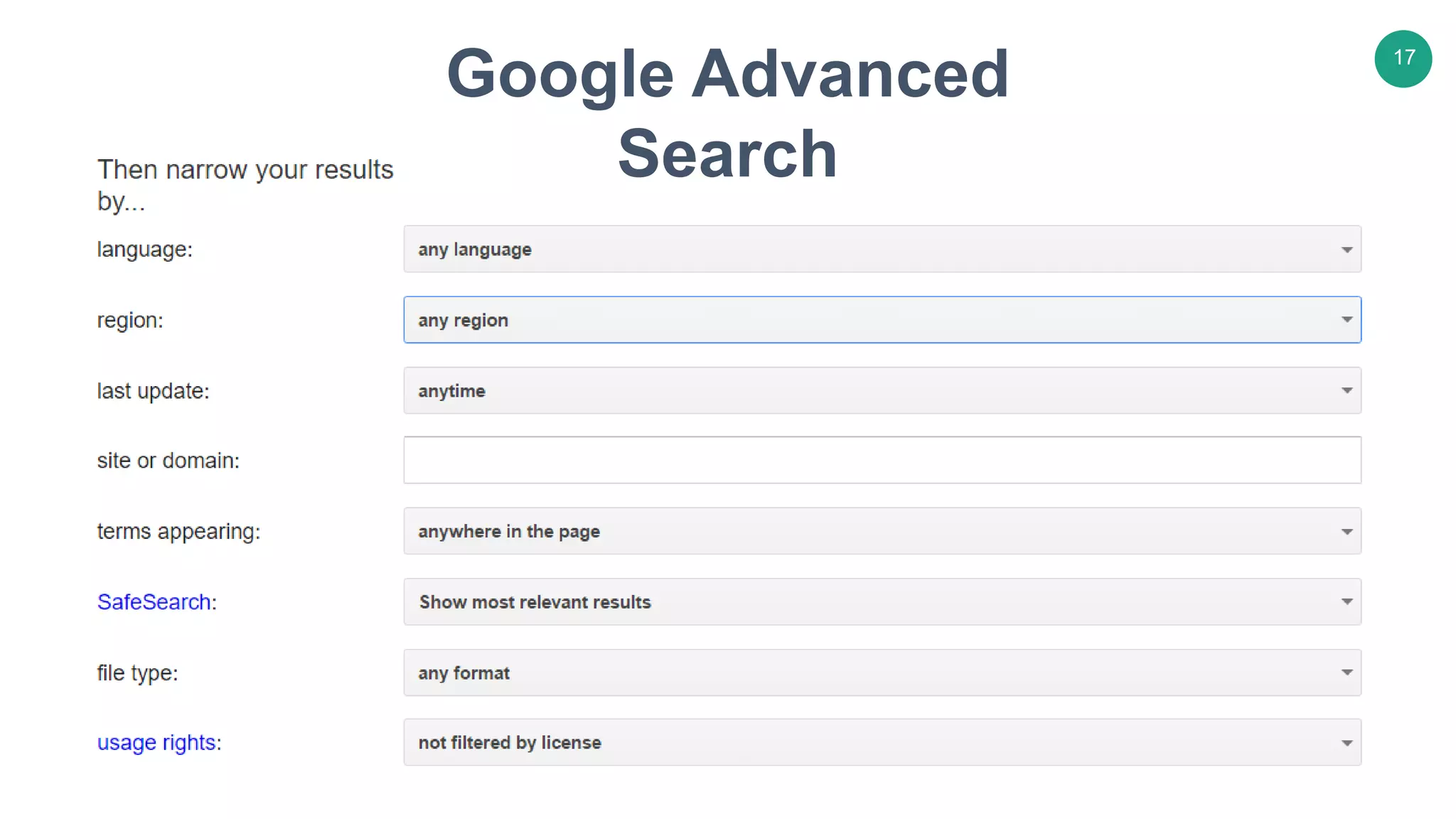
Google Advanced
Search
18
To search for…
Other lexical and
terminological
resources
Texts!
19
Texts?
20
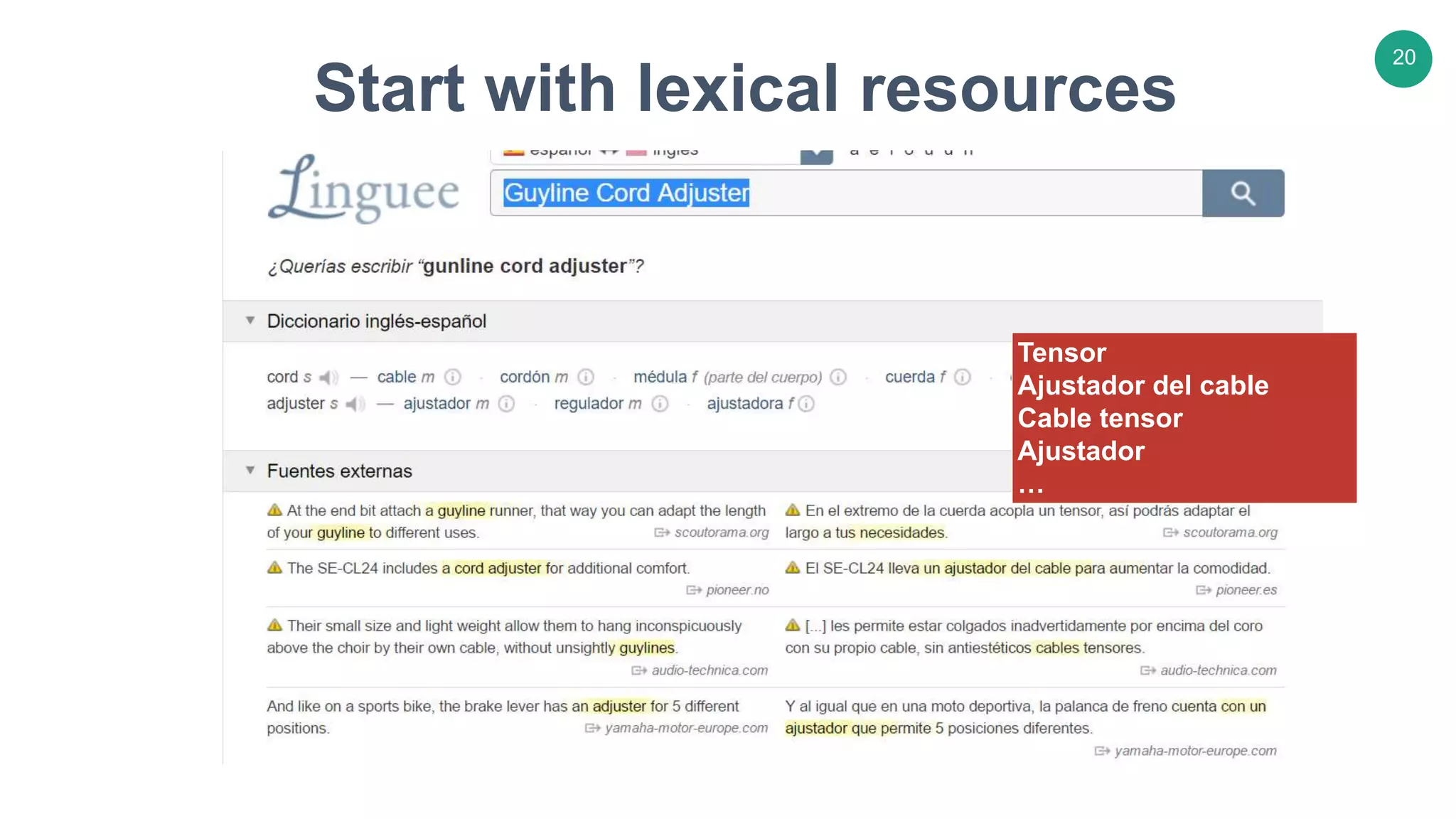
Start with lexical resources
Tensor
Ajustador del cable
Cable tensor
Ajustador
…
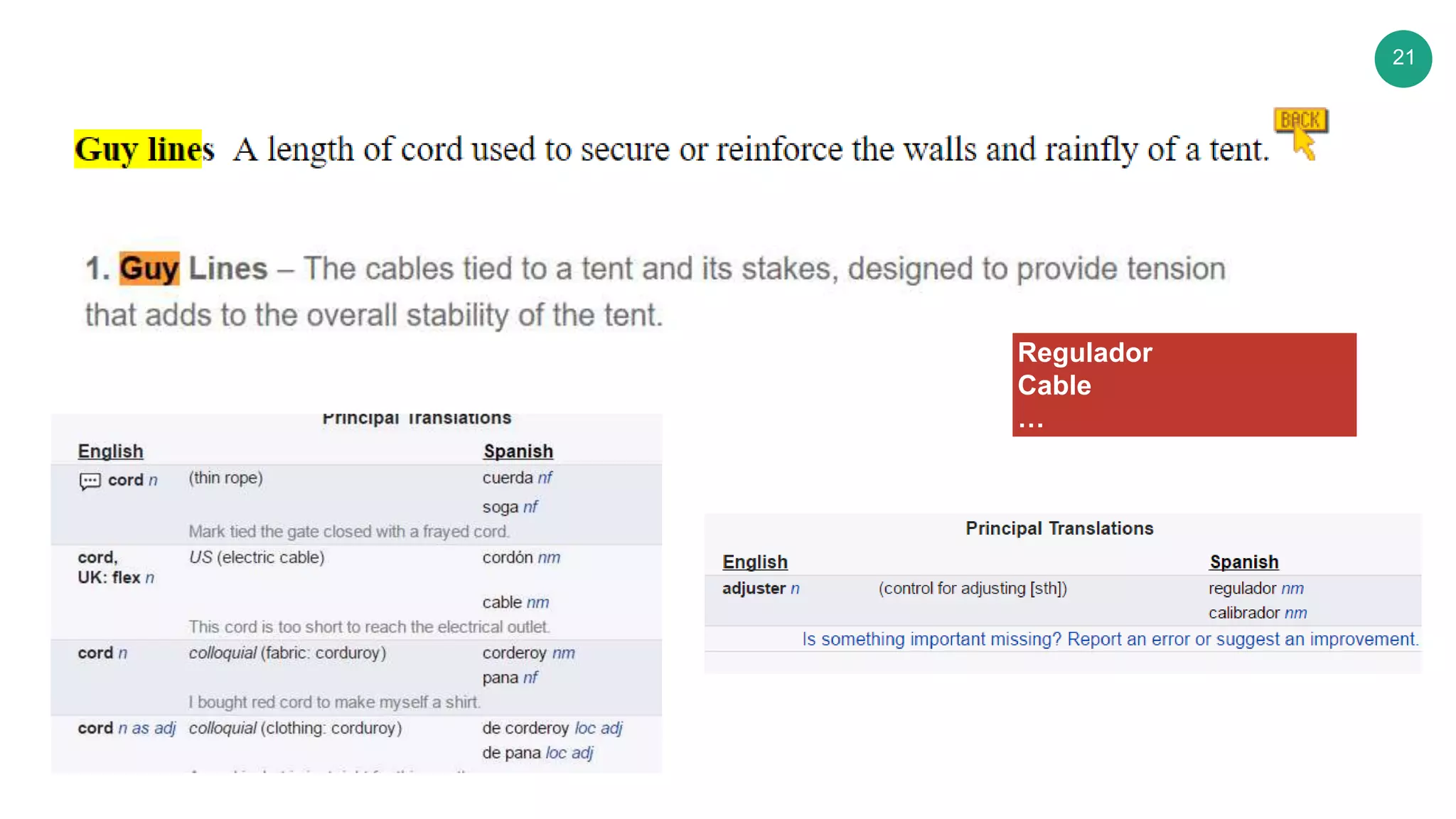
21
Regulador
Cable
…
22
Is this enough?
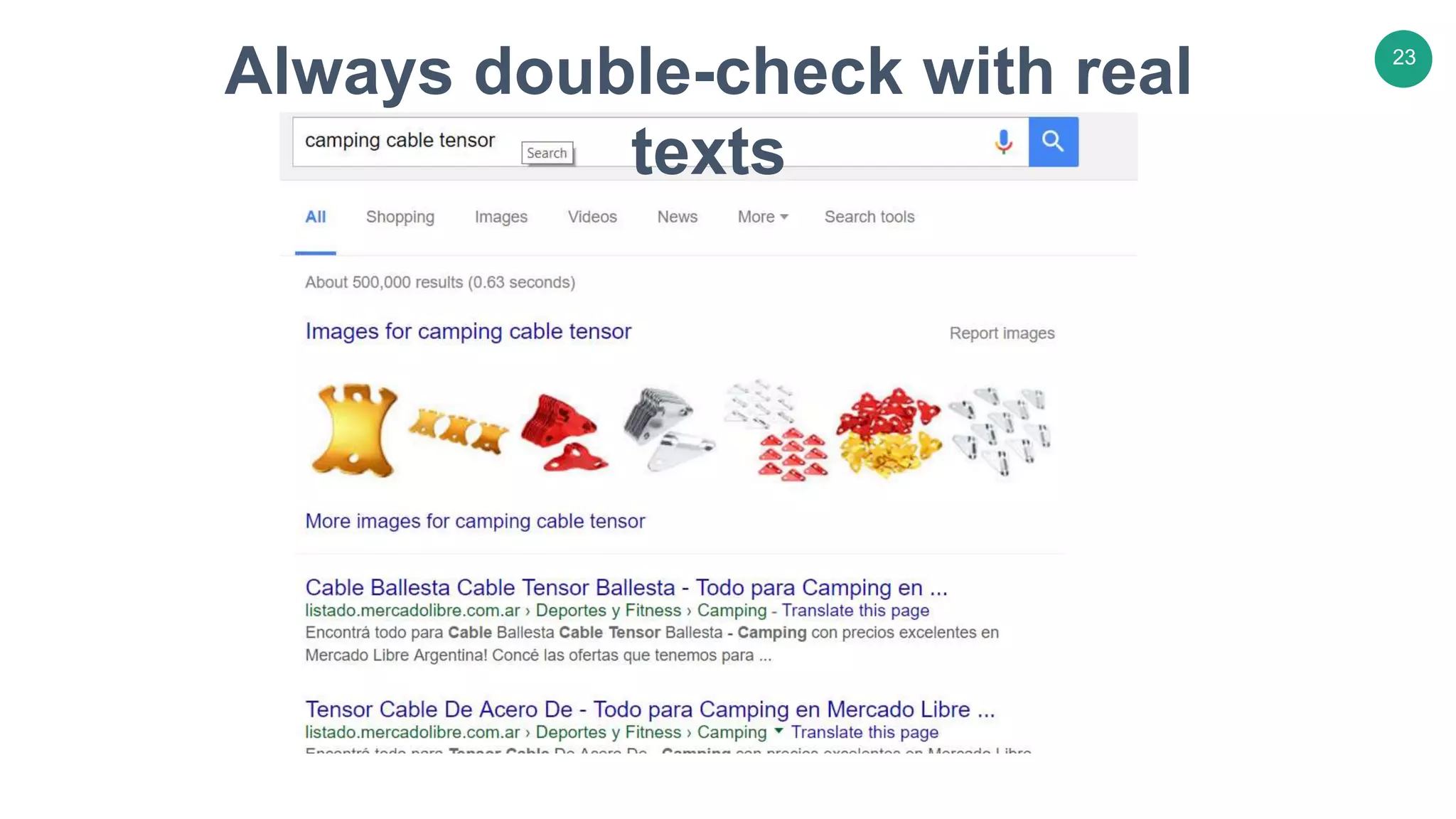
23
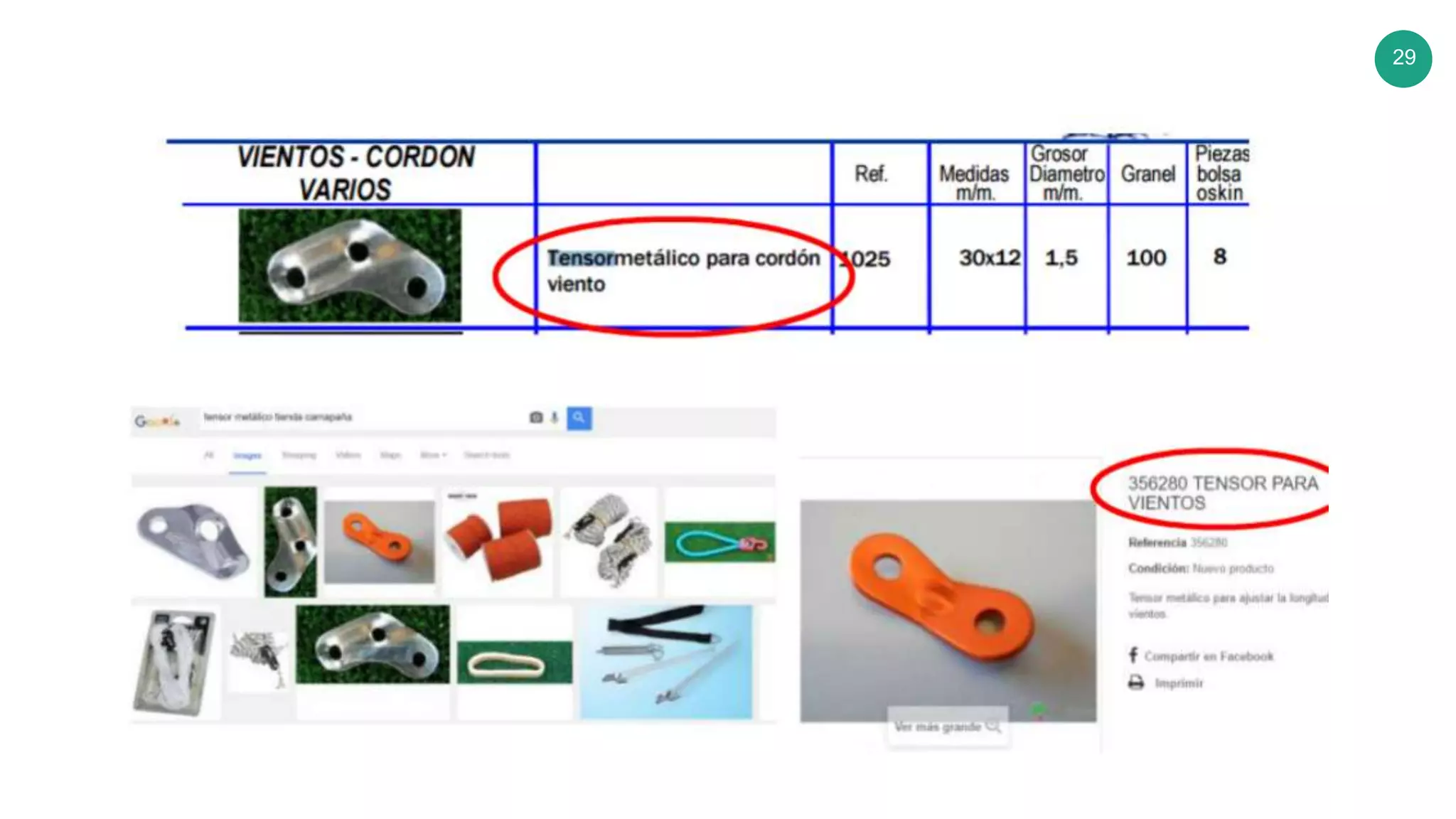
Always double-check with real
texts
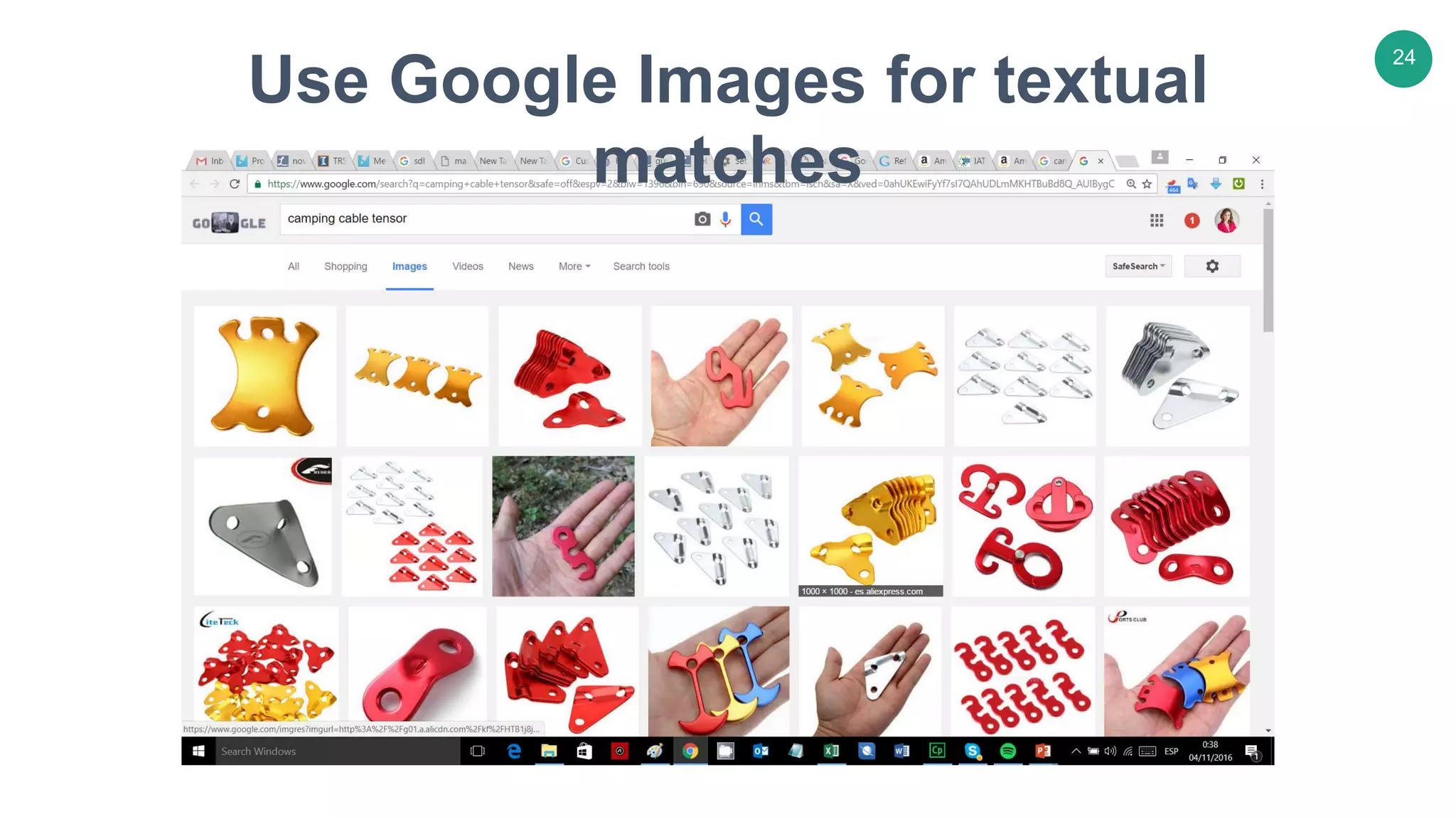
24
Use Google Images for textual
matches
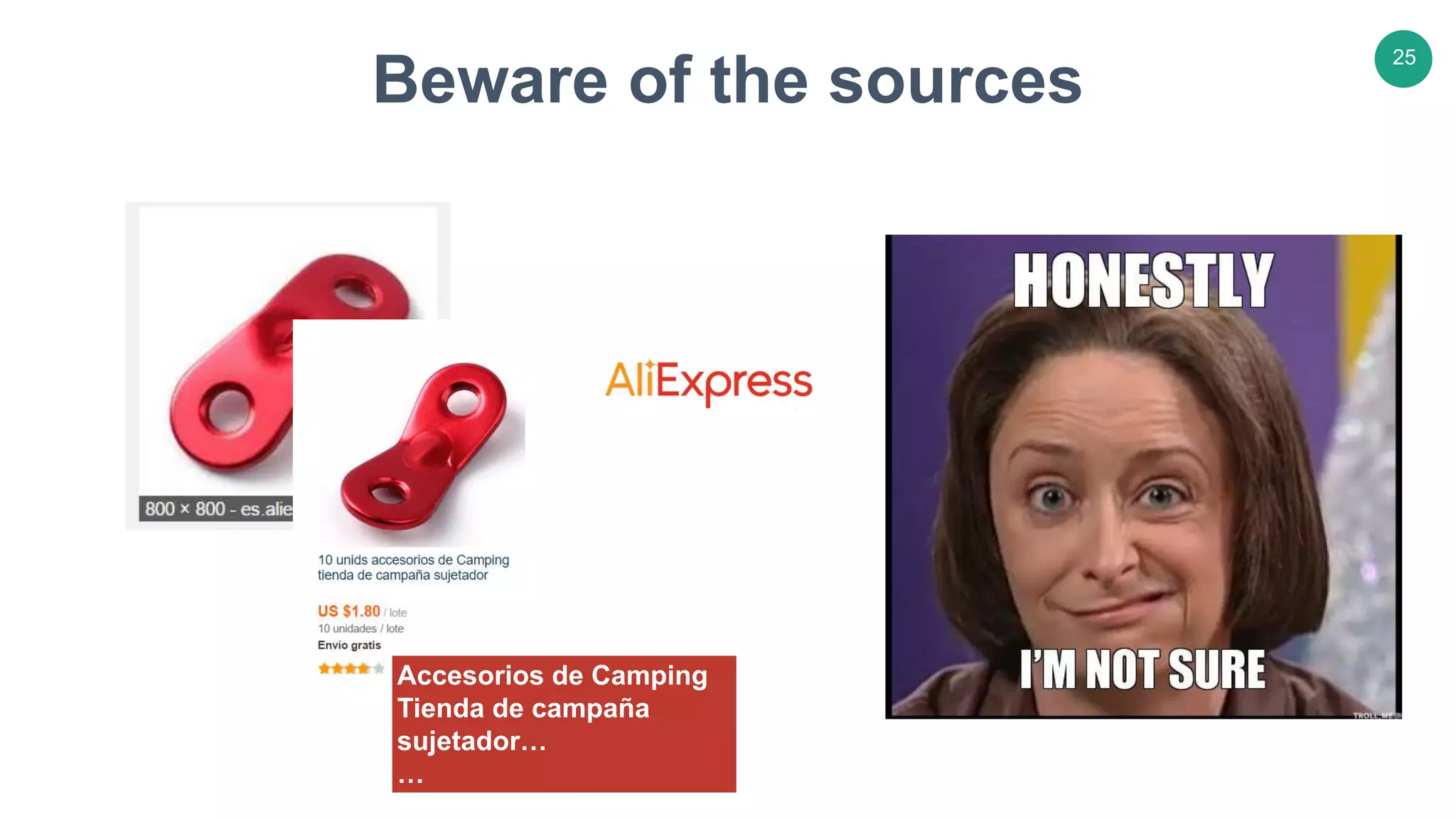
25
Beware of the sources
Accesorios de Camping
Tienda de campaña
sujetador…
…
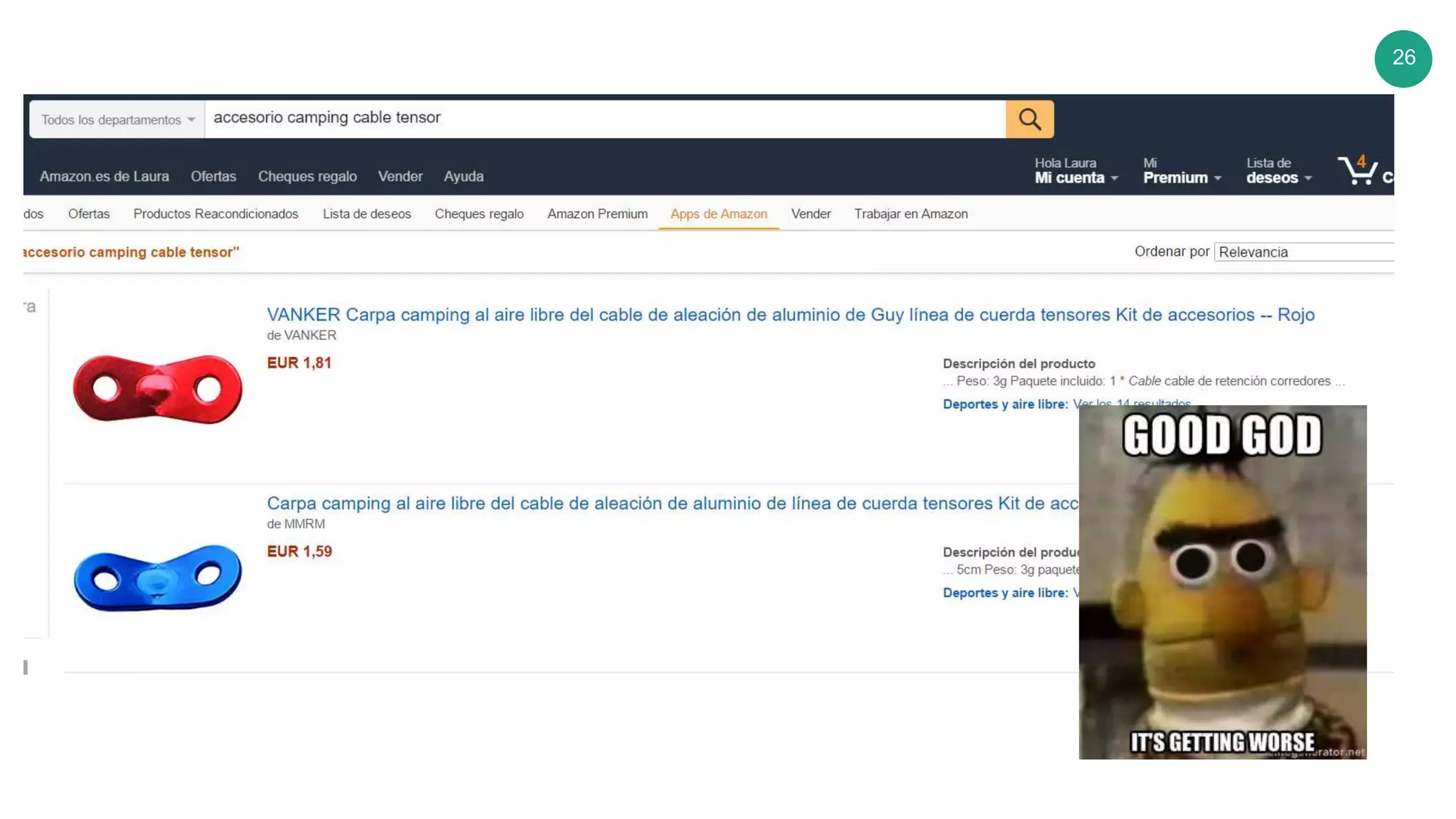
26
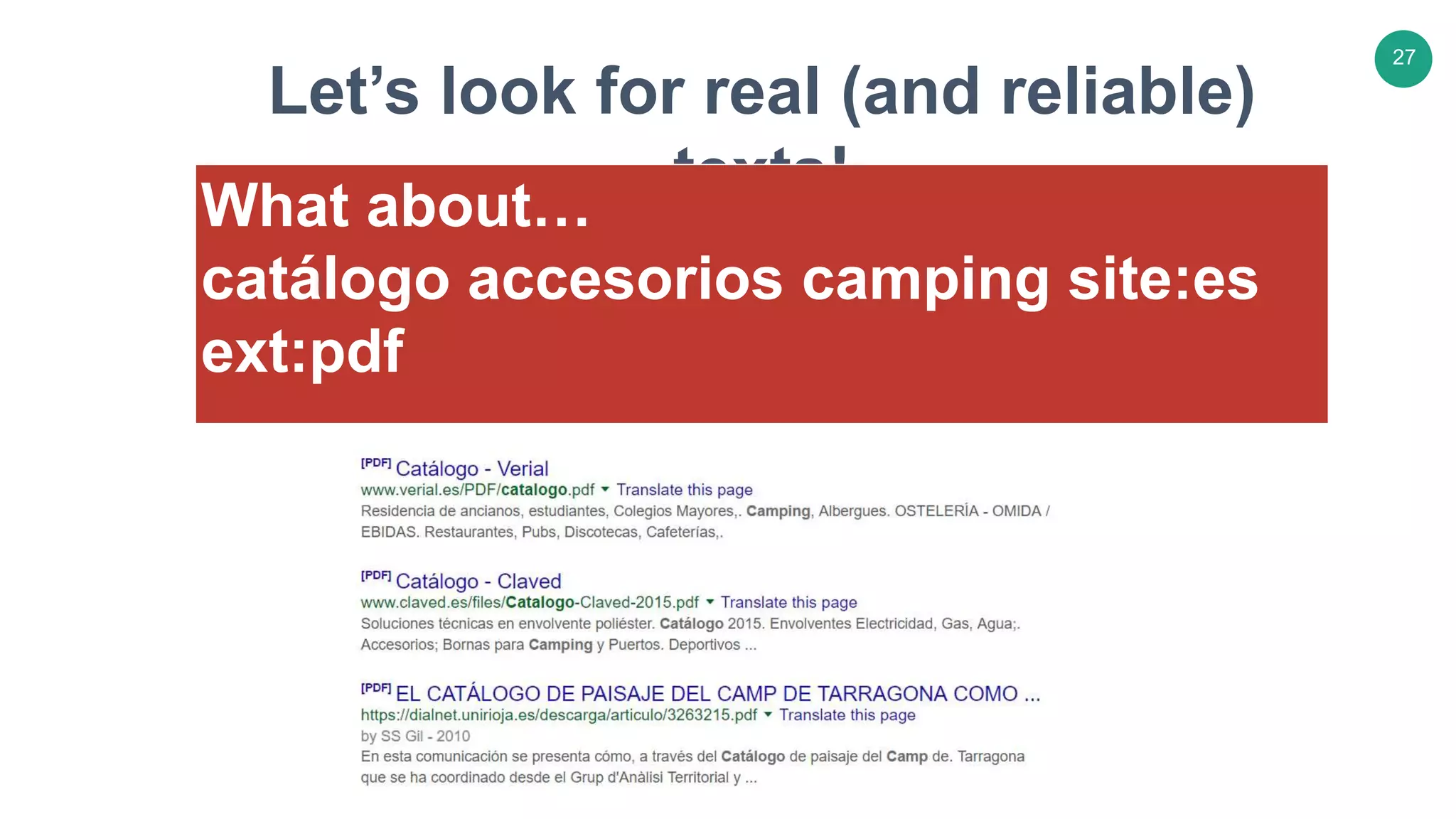
27
Let’s look for real (and reliable)
texts!What about…
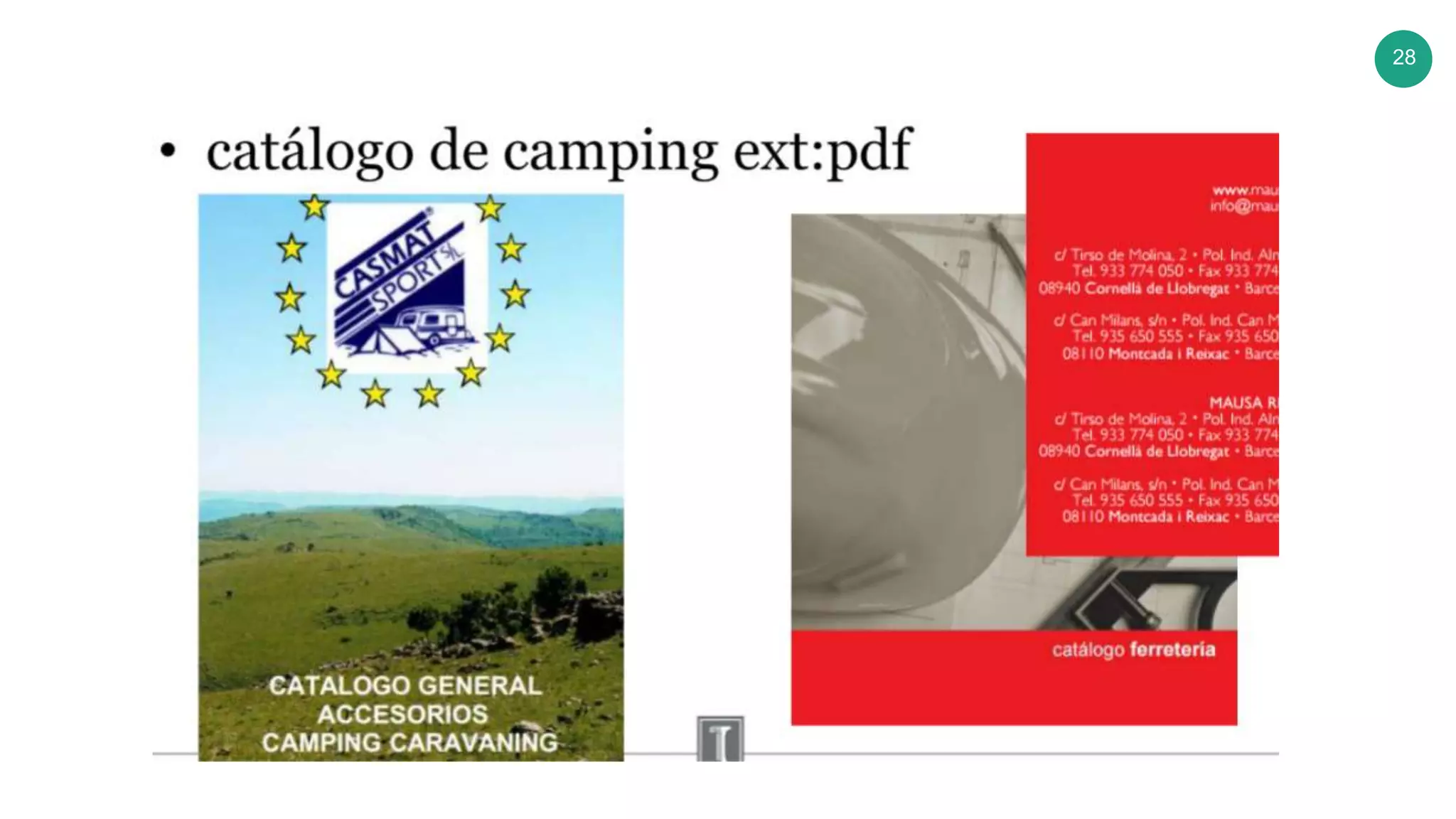
catálogo accesorios camping site:es
ext:pdf
…
28
29
30
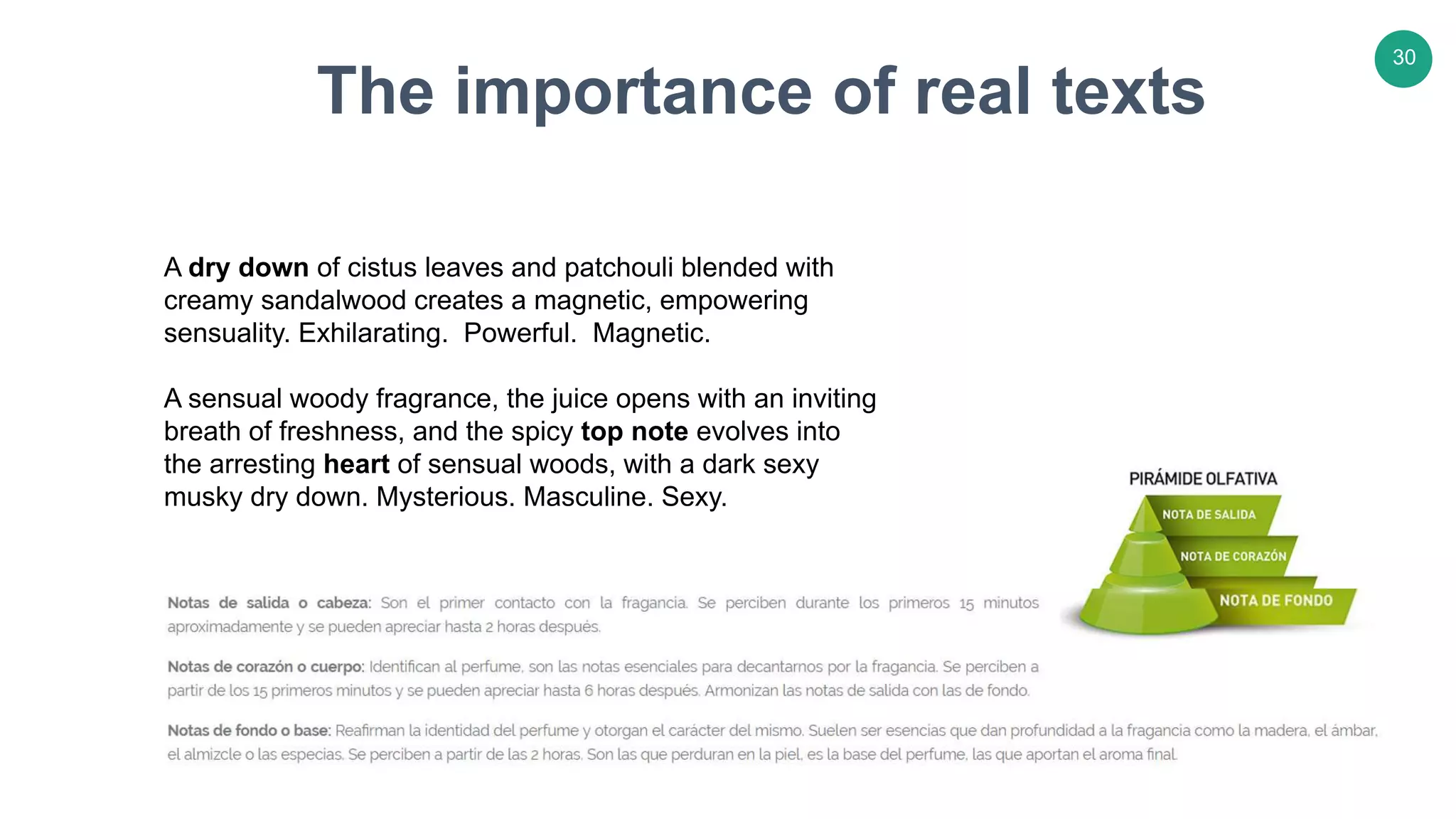
A dry down of cistus leaves and patchouli blended with
creamy sandalwood creates a magnetic, empowering
sensuality. Exhilarating. Powerful. Magnetic.
A sensual woody fragrance, the juice opens with an inviting
breath of freshness, and the spicy top note evolves into
the arresting heart of sensual woods, with a dark sexy
musky dry down. Mysterious. Masculine. Sexy.
The importance of real texts
31
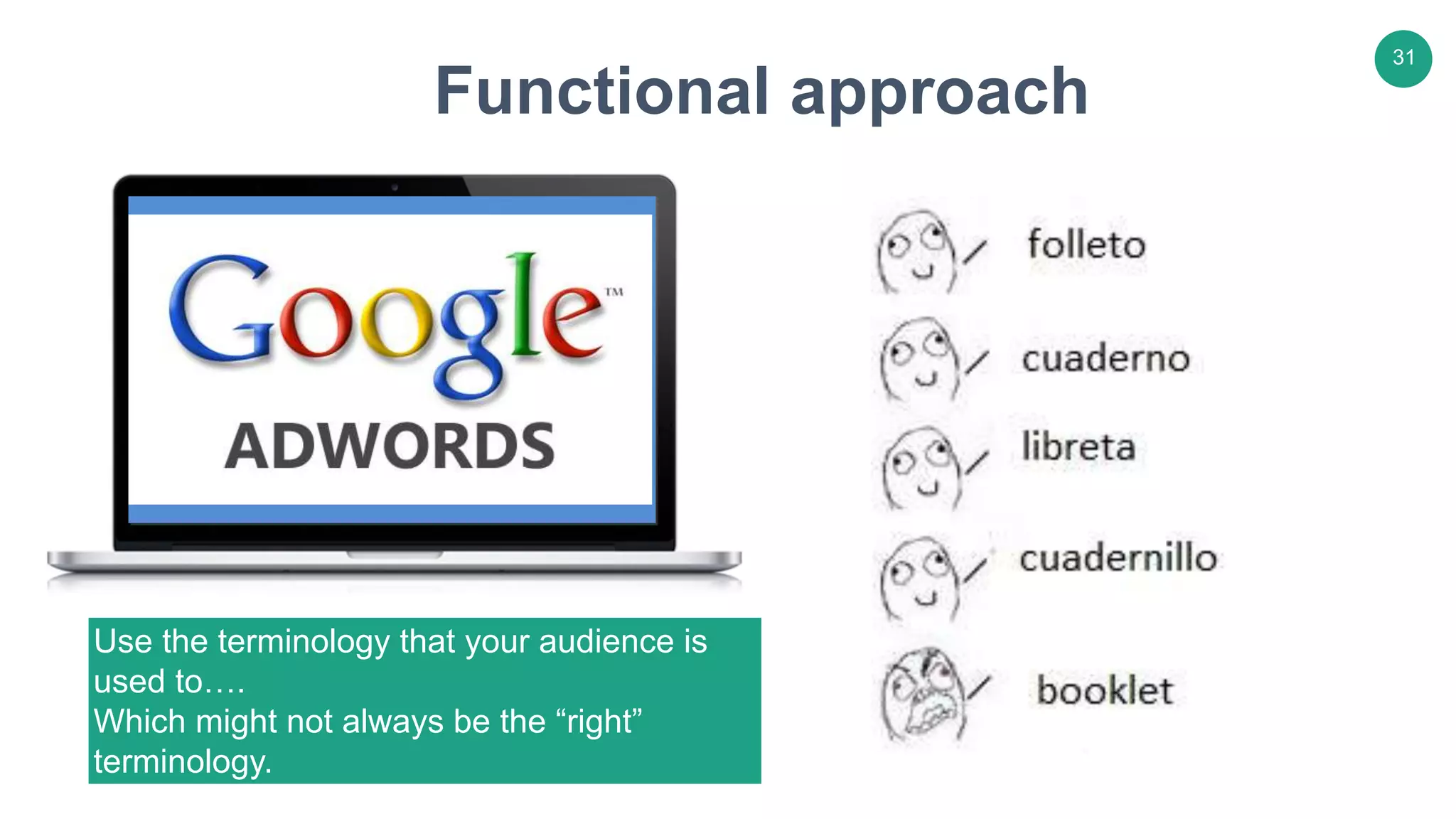
Functional approach
Use the terminology that your audience is
used to….
Which might not always be the “right”
terminology.
32
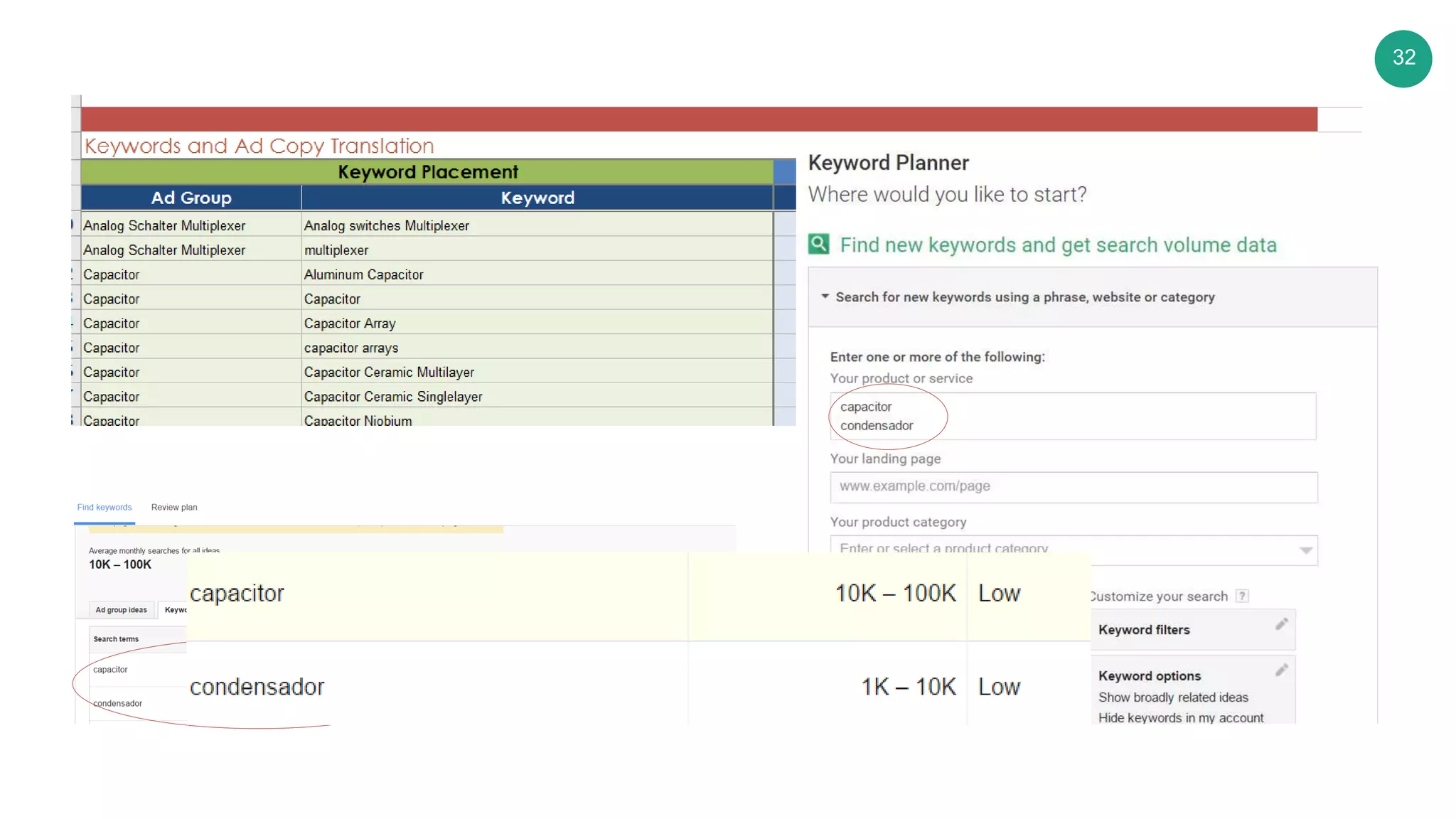
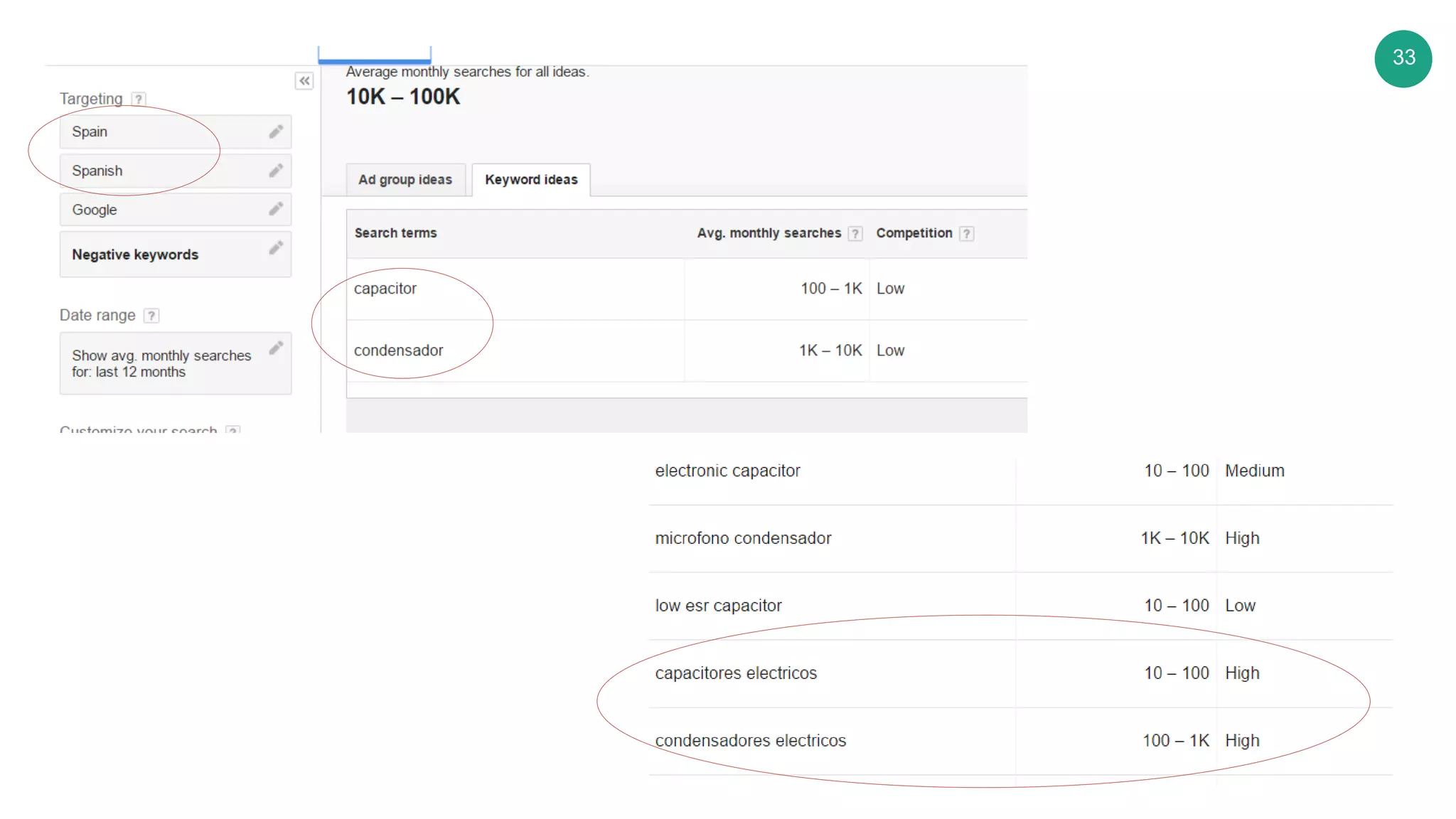
33
34
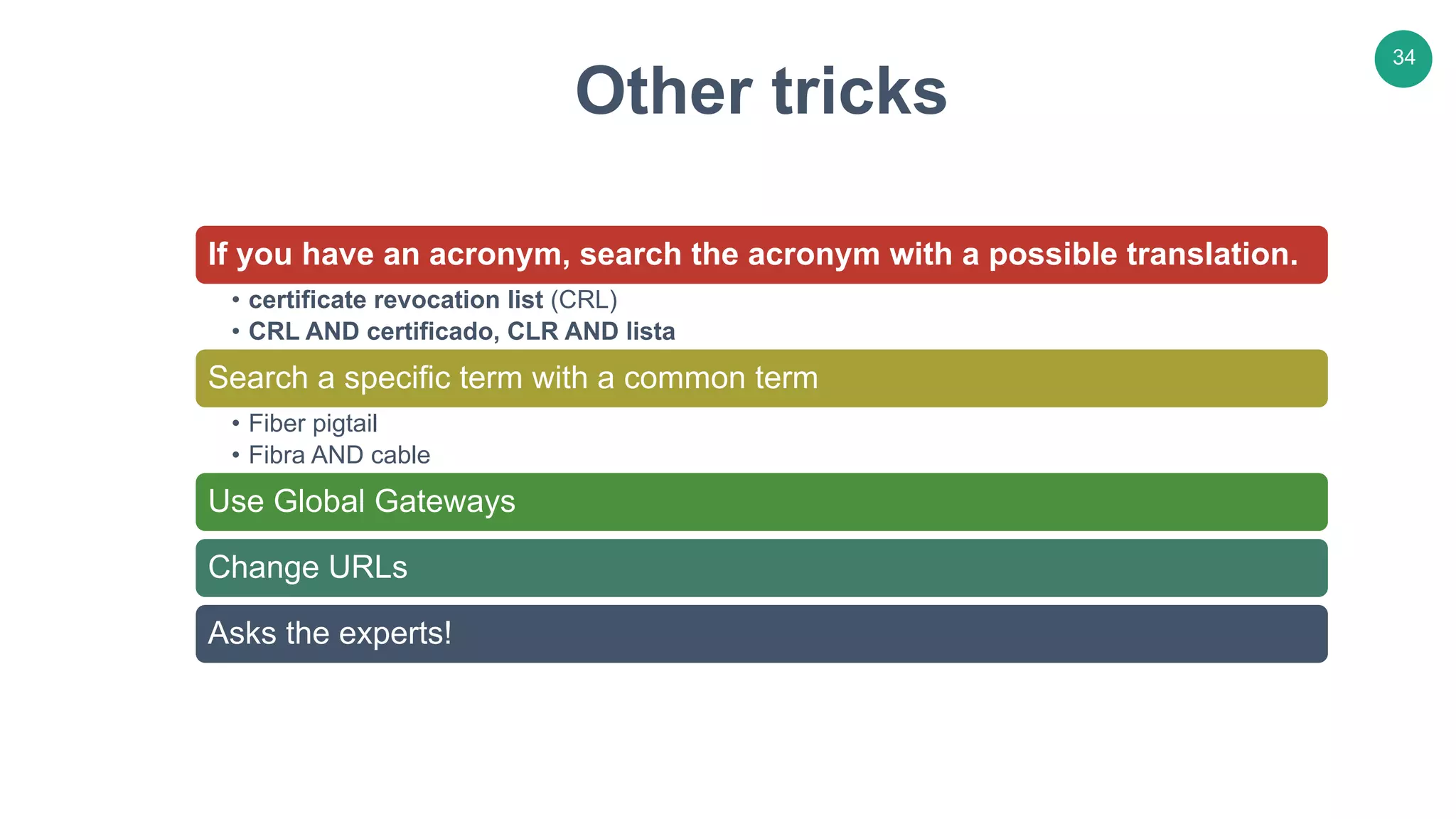
Other tricks
If you have an acronym, search the acronym with a possible translation.
• certificate revocation list (CRL)
• CRL AND certificado, CLR AND lista
Search a specific term with a common term
• Fiber pigtail
• Fibra AND cable
Use Global Gateways
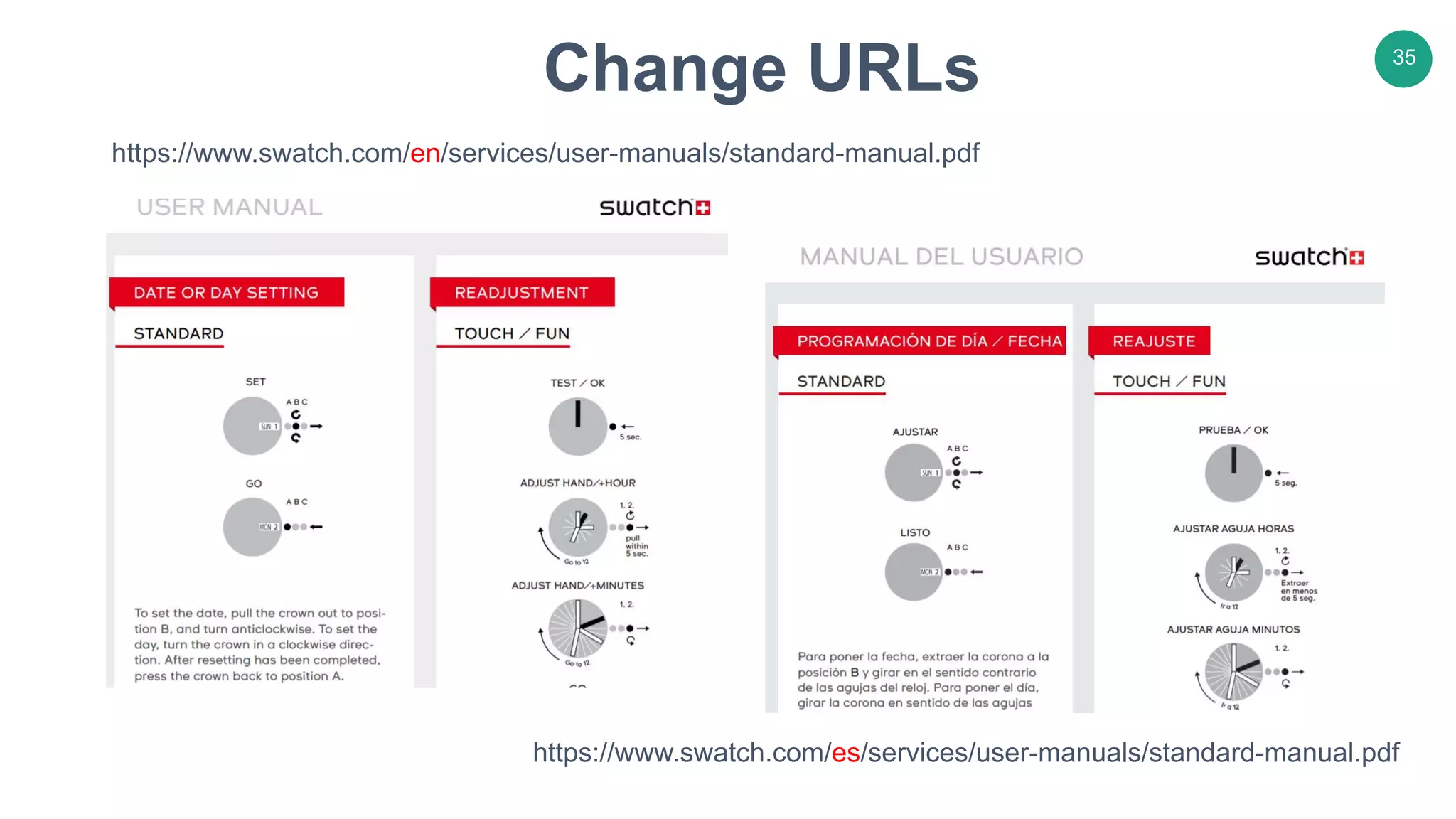
Change URLs
Asks the experts!
35
https://www.swatch.com/en/services/user-manuals/standard-manual.pdf
https://www.swatch.com/es/services/user-manuals/standard-manual.pdf
Change URLs
36
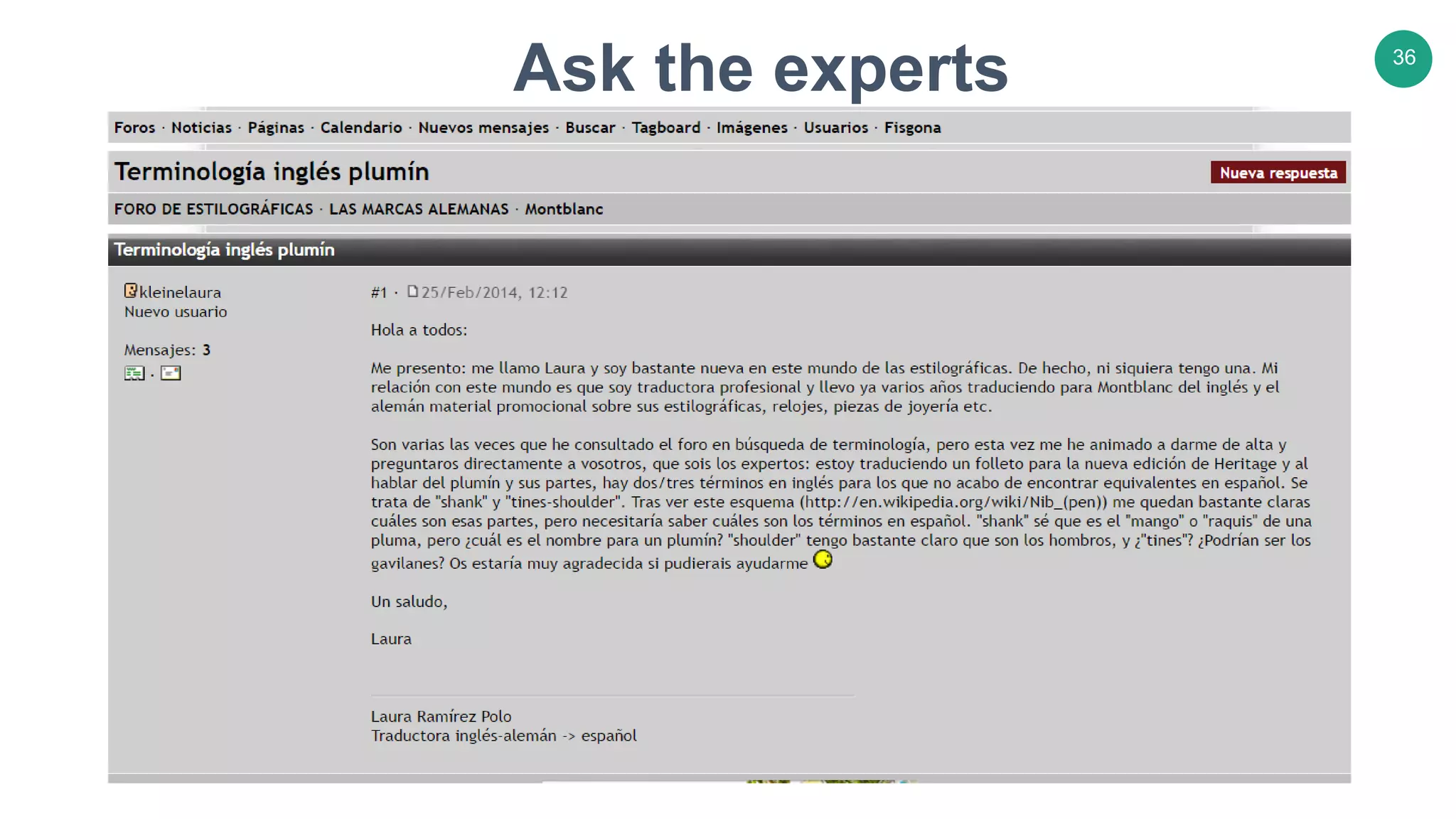
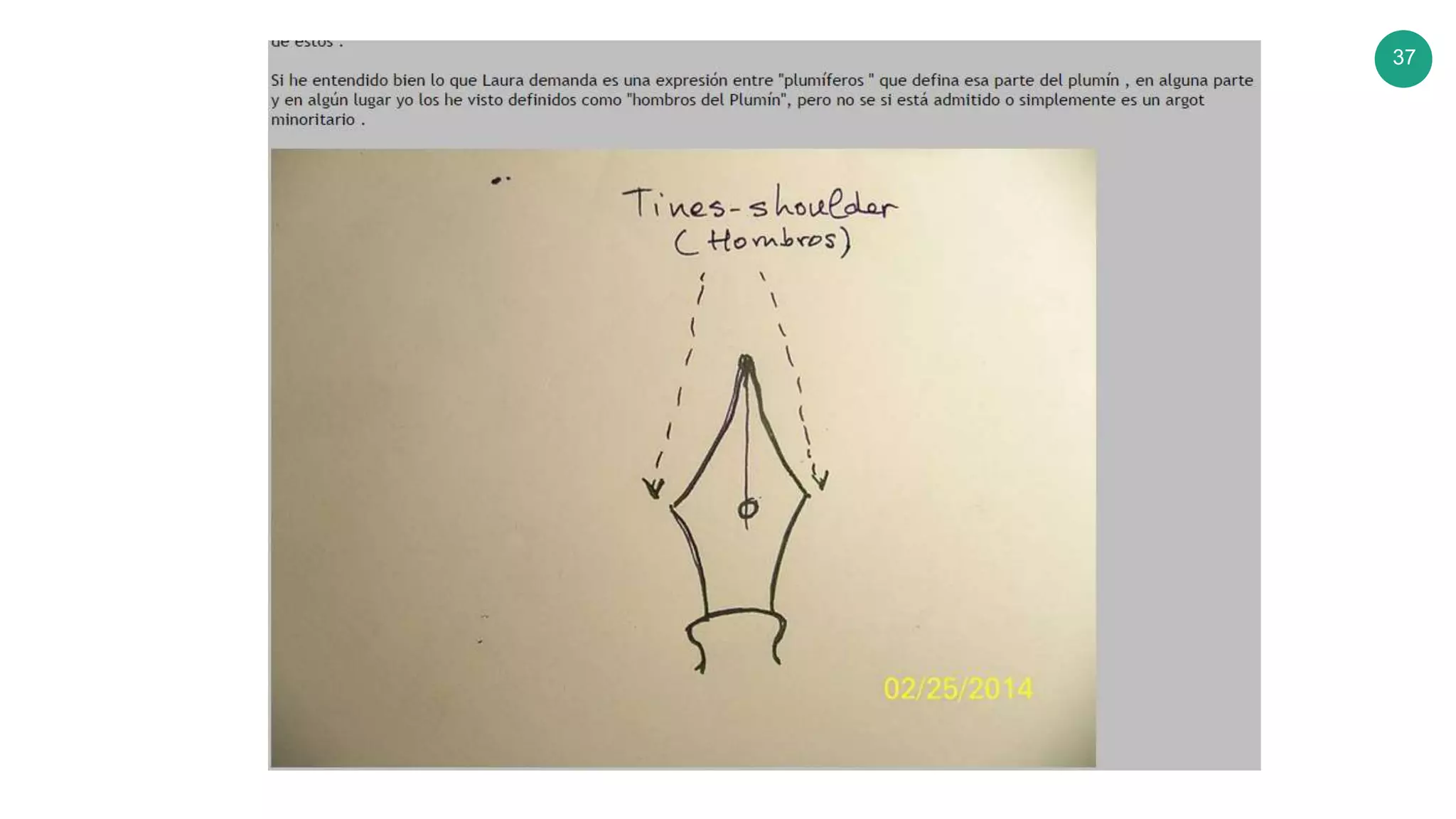
Ask the experts
37
38
Wrapping up…
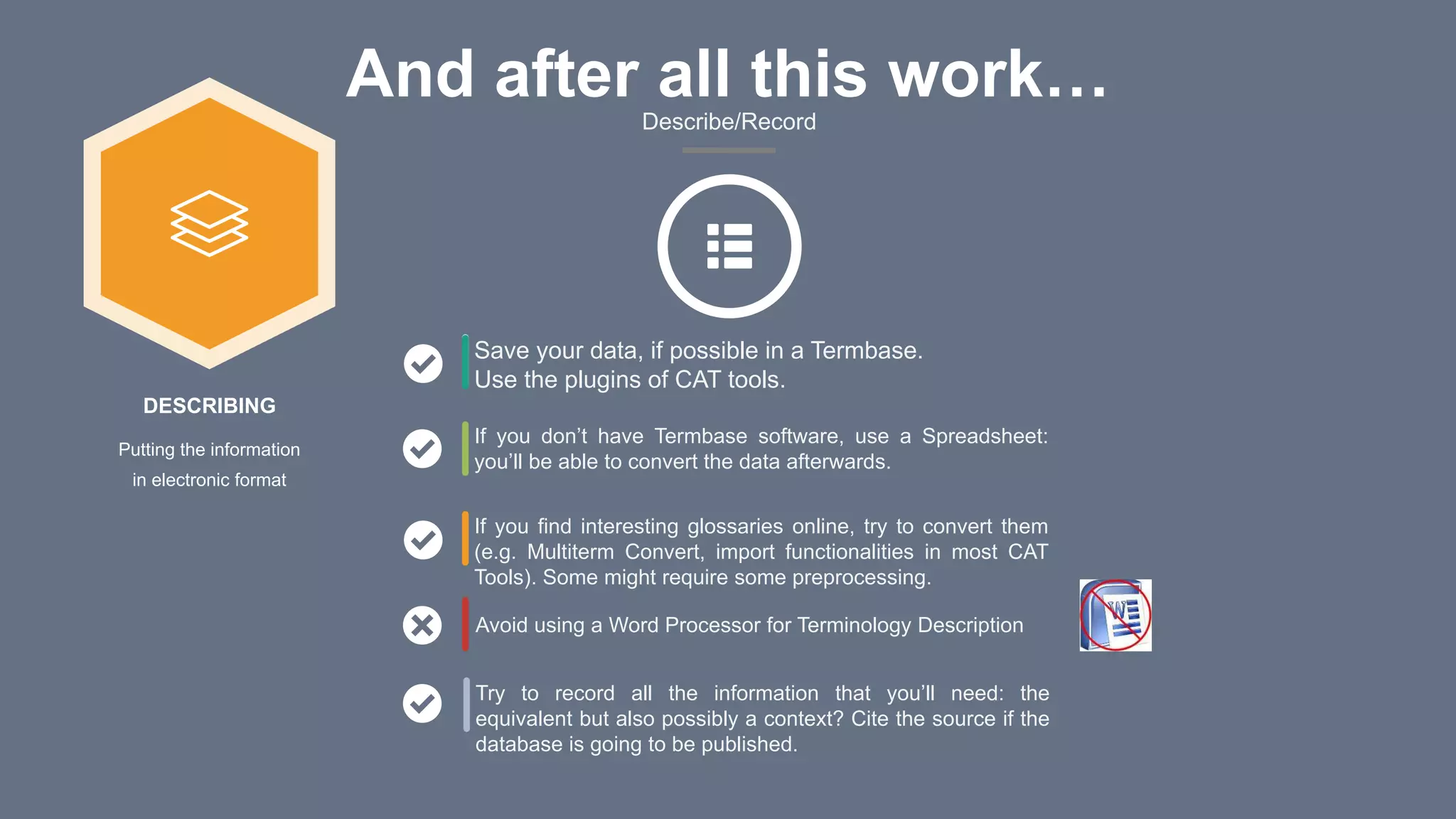
And after all this work…Describe/Record
Avoid using a Word Processor for Terminology Description
Save your data, if possible in a Termbase.
Use the plugins of CAT tools.
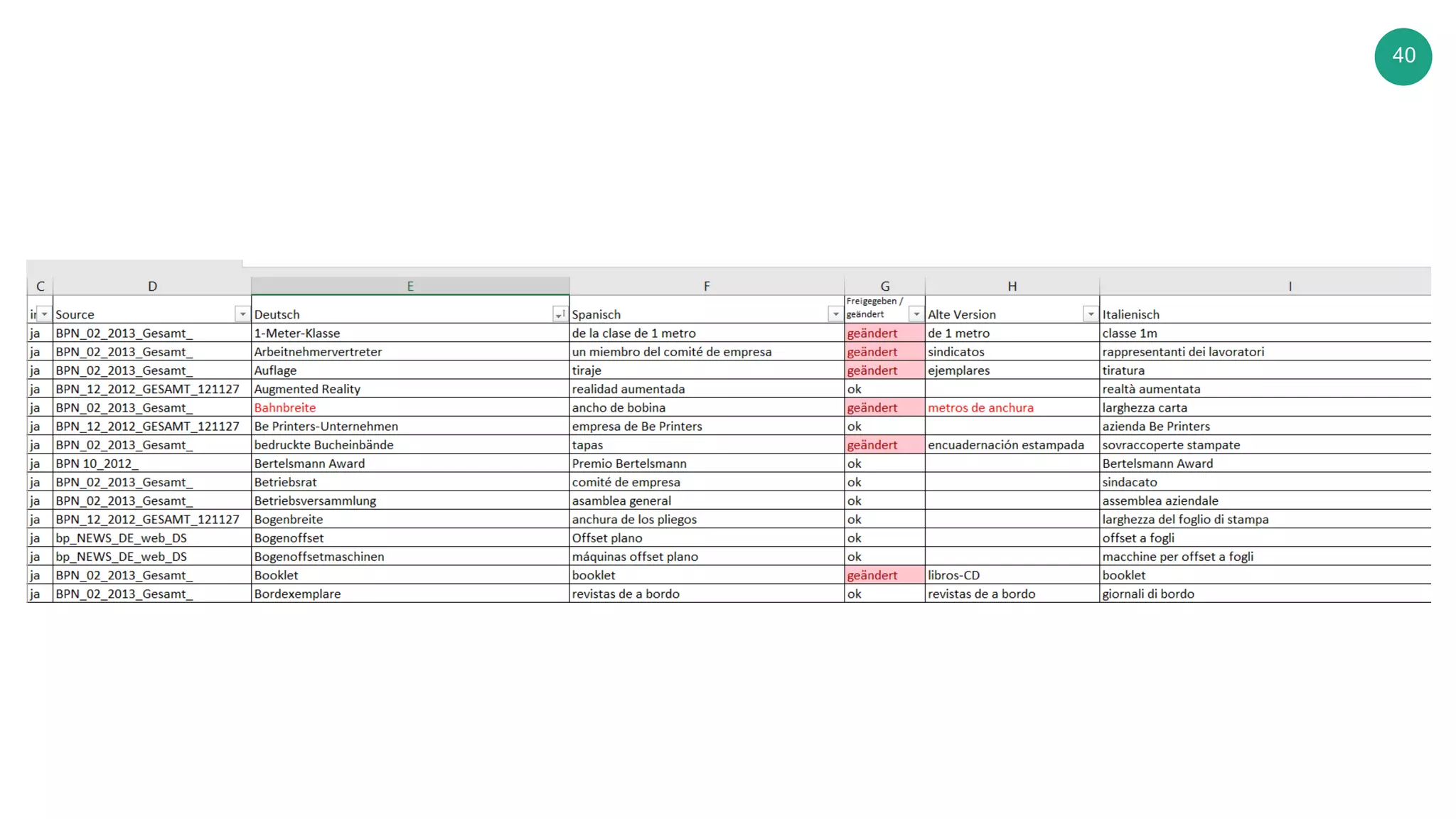
If you don’t have Termbase software, use a Spreadsheet:
you’ll be able to convert the data afterwards.
If you find interesting glossaries online, try to convert them
(e.g. Multiterm Convert, import functionalities in most CAT
Tools). Some might require some preprocessing.
Try to record all the information that you’ll need: the
equivalent but also possibly a context? Cite the source if the
database is going to be published.
DESCRIBING
Putting the information
in electronic format
40
v
41
It’s time to implement the terminology…
Term
Recognition
Terminology QA Excel Glossary
Functionalities
Terminology QA
with external tools
ApSIC XBench.
v
42
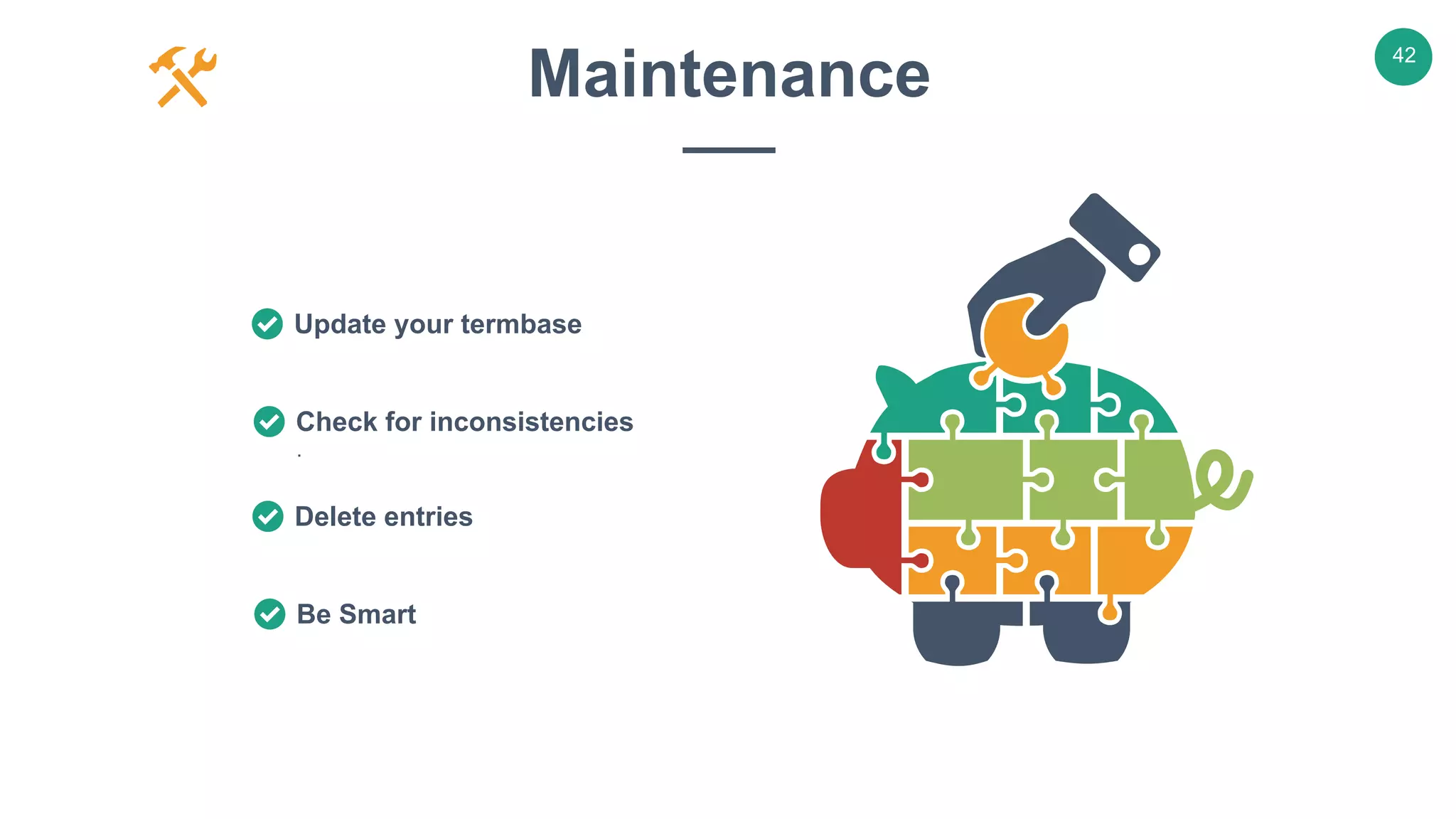
Maintenance
Update your termbase
.
Check for inconsistencies
Delete entries
Be Smart
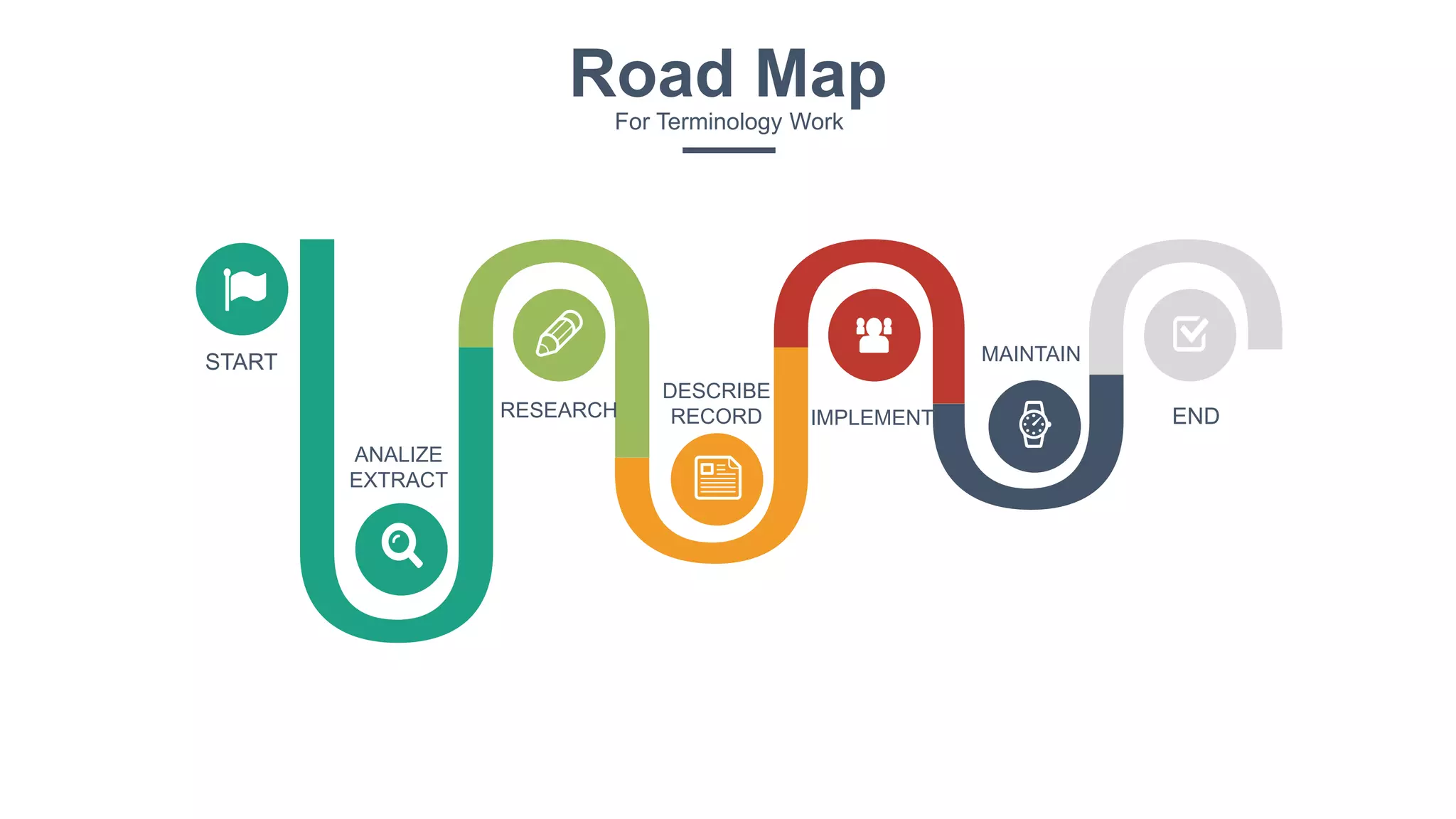
START
ANALIZE
EXTRACT
DESCRIBE
RECORDRESEARCH IMPLEMENT
MAINTAIN
END
Road MapFor Terminology Work
44
45
Arntz, R. (1993). Terminological equivalence and Translation, In erminology. Applications in
interdisciplinary communication (pp 5-19).
Bowker, L. (2014). Terminology and translation. In H. J. Kockaert & F. Steurs (Eds.), Handbook of
terminology 1 (pp. 302-321).
Childress, M. D. (2007). Terminology work saves more than it costs, InMultilingual
April/May 2007 (pp 43-46).
Gornostay, T. et al. (2010). Bridging the Gap–EuroTermBank Terminology Delivered to Users’
Environment. Proceedings of the 14th Annual European Association for Machine Translation
(EAMT) Conference..
Popiolek, M. (2014). Terminology management within a translation quality assurance process.
In H. J. Kockaert & F. Steurs (Eds.), Handbook of terminology 1 (pp. 341-359).
Vargas Sierra, C. (2016), Bilingual Terminology Extraction from TMX. A state-of-the-art overview,
Forum Translating in Europe, 2016.
References
46
THANK YOU
lauramip@Illinois.edu
@kleinelaura

Terminology: tips and tricks to boost your terminology work

  • 1.
    TERMINOLOGY Tips and tricksto boost your terminology work Laura Ramírez Polo University of Illinois @kleinelaura
  • 2.
  • 3.
    30-60 % 90% Timespent to solve terminological problems (Gornostay et al. 2010) Return on Investment On terminology management reported by some corporate studies (Childress,2007; Popiolek,2015) Terminology management In specialized translation Researching the specific terminology needed to complete any given translation can be a time-consuming and labour-intensive task (Bowker, 2014)Terminology work is “on backstage”, and customer or employers may not be fully aware of their benefits for QA. 3
  • 4.
    Terminology is thediscipline concerned with the collection, processing, description and presentation of terms, which are lexical items belonging to a specialized subject field (e.g. medicine, law, engineering, library science or art history). Bower (2014) What is terminology? From the point of view of the translation and localization industry practitioners, terminology management can be more practically defined as the activity of systematically collecting, processing, classifying and consistently applying vocabulary that has specific meaning in a given subject field or context (terms) according to some governing methodology– Popiolek (2014) 4
  • 5.
    Stages in theTerminology Process Setting up the infraestructure for managing terminology, doing term analysis and research, and recording that information MANAGEMENT Ensuring that appropriate terminology is used correctly and consistently throughout all the translated material; IMPLEMENTATION of an integrated terminology management data base – Ongoing maintenance and updating of terminology MAINTENANCE 5 Popiolek, 2014
  • 6.
    PROCESSING DESCRIBINGCOLLECTING Putting theinformation in electronic format Term researchTerm extraction or analysis Terminology Management 6
  • 7.
    Automatic Extraction Monolingual ATE Automatic extraction Bilingual ATEs(BATEs) Semi-automatic extraction Interactive extraction As you translate: monolingual extraction Manual extraction Collection: before or ad hoc Terminology Extraction or Analysis Before translating: monolingual extraction Tools for corpora analysis: monolingual extraction 7
  • 8.
    Automatic Term Extraction 8 VargasSierra, C. (2016), Bilingual Terminology Extraction from TMX. A state-of-the-art overview, Forum Translating in Europe, 2016.
  • 9.
  • 10.
  • 11.
  • 12.
    As you translate:Ad-hoc term analysis 12
  • 13.
  • 14.
    Dictionaries: monolingual, bilingual, general,specialized Terminology Databases: TERMCAT, IATE, UNTERM, WIPO Pearl etc. Other lexical resources: glossaries, vocabulary lists etc. Corpora: monolingual and aligned bilingual corpora Strategies for Term Research
  • 15.
    15 JAMES BOND CEO &FOUNDER Hi Everyone, we are Motagua Corp Google Custom Search Engines 15
  • 16.
    16 Site: Restricts the search toa site Boolean operators - OR “ “ * Related: List pages which Google consider to be related to another Ext: / Filetype: Restricts the results to a certain filetype Google Search Operators
  • 17.
  • 18.
    18 To search for… Otherlexical and terminological resources Texts!
  • 19.
  • 20.
    20 Start with lexicalresources Tensor Ajustador del cable Cable tensor Ajustador …
  • 21.
  • 22.
  • 23.
  • 24.
    24 Use Google Imagesfor textual matches
  • 25.
    25 Beware of thesources Accesorios de Camping Tienda de campaña sujetador… …
  • 26.
  • 27.
    27 Let’s look forreal (and reliable) texts!What about… catálogo accesorios camping site:es ext:pdf …
  • 28.
  • 29.
  • 30.
    30 A dry downof cistus leaves and patchouli blended with creamy sandalwood creates a magnetic, empowering sensuality. Exhilarating. Powerful. Magnetic. A sensual woody fragrance, the juice opens with an inviting breath of freshness, and the spicy top note evolves into the arresting heart of sensual woods, with a dark sexy musky dry down. Mysterious. Masculine. Sexy. The importance of real texts
  • 31.
    31 Functional approach Use theterminology that your audience is used to…. Which might not always be the “right” terminology.
  • 32.
  • 33.
  • 34.
    34 Other tricks If youhave an acronym, search the acronym with a possible translation. • certificate revocation list (CRL) • CRL AND certificado, CLR AND lista Search a specific term with a common term • Fiber pigtail • Fibra AND cable Use Global Gateways Change URLs Asks the experts!
  • 35.
  • 36.
  • 37.
  • 38.
  • 39.
    And after allthis work…Describe/Record Avoid using a Word Processor for Terminology Description Save your data, if possible in a Termbase. Use the plugins of CAT tools. If you don’t have Termbase software, use a Spreadsheet: you’ll be able to convert the data afterwards. If you find interesting glossaries online, try to convert them (e.g. Multiterm Convert, import functionalities in most CAT Tools). Some might require some preprocessing. Try to record all the information that you’ll need: the equivalent but also possibly a context? Cite the source if the database is going to be published. DESCRIBING Putting the information in electronic format
  • 40.
  • 41.
    v 41 It’s time toimplement the terminology… Term Recognition Terminology QA Excel Glossary Functionalities Terminology QA with external tools ApSIC XBench.
  • 42.
    v 42 Maintenance Update your termbase . Checkfor inconsistencies Delete entries Be Smart
  • 43.
  • 44.
  • 45.
    45 Arntz, R. (1993).Terminological equivalence and Translation, In erminology. Applications in interdisciplinary communication (pp 5-19). Bowker, L. (2014). Terminology and translation. In H. J. Kockaert & F. Steurs (Eds.), Handbook of terminology 1 (pp. 302-321). Childress, M. D. (2007). Terminology work saves more than it costs, InMultilingual April/May 2007 (pp 43-46). Gornostay, T. et al. (2010). Bridging the Gap–EuroTermBank Terminology Delivered to Users’ Environment. Proceedings of the 14th Annual European Association for Machine Translation (EAMT) Conference.. Popiolek, M. (2014). Terminology management within a translation quality assurance process. In H. J. Kockaert & F. Steurs (Eds.), Handbook of terminology 1 (pp. 341-359). Vargas Sierra, C. (2016), Bilingual Terminology Extraction from TMX. A state-of-the-art overview, Forum Translating in Europe, 2016. References
  • 46.

Editor's Notes

  • #5 As part of any translation project, translators must identify appropriate equivalents for the specialized terms that they encounter in a source text. In some cases, they must also take into account the particular terms preferred by their clients. Researching the specific terminology needed to complete any given translation can be a time-consuming and labour-intensive task, and it has long been recognized that it does not make sense to repeat this research when a new text needs to be translated. How many of you also record terms from the general language, or phraseology?
  • #6 For QA process Terminology management – Setting up the infrastructure for managing terminology and using it within the QA process; 2. Implementing terminology management – Ensuring that appropriate terminology is used correctly and consistently throughout all the translated material; 3. Maintaining an integrated terminology management data base – Ongoing maintenance and updating of terminology