Western blot

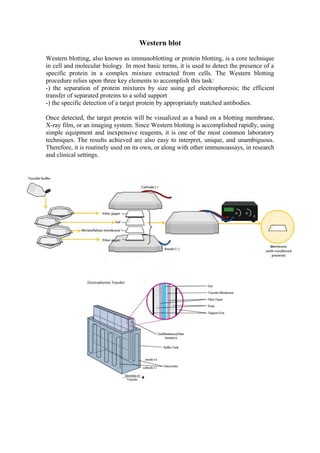
Western blotting, also known as immunoblotting or protein blotting, is a core technique
in cell and molecular biology. In most basic terms, it is used to detect the presence of a
specific protein in a complex mixture extracted from cells. The Western blotting
procedure relies upon three key elements to accomplish this task:
-) the separation of protein mixtures by size using gel electrophoresis; the efficient
transfer of separated proteins to a solid support
-) the specific detection of a target protein by appropriately matched antibodies.

Once detected, the target protein will be visualized as a band on a blotting membrane,
X-ray film, or an imaging system. Since Western blotting is accomplished rapidly, using
simple equipment and inexpensive reagents, it is one of the most common laboratory
techniques. The results achieved are also easy to interpret, unique, and unambiguous.
Therefore, it is routinely used on its own, or along with other immunoassays, in research
and clinical settings.
Southern blot

The Southern blot is a technique which is used to detect DNA in a sample, and
determine how much DNA is present. The analysis uses gel electrophoresis to separate
DNA fragments in a sample and then uses probes to detect DNA sequences of interest.
Southern blotting starts with a sample of DNA which has been extracted from cells. The
DNA is treated with restriction enzymes that cleave the nucleic acid into fragments of
varying sizes. Next, the DNA is run through a denaturing agarose gel electrophoresis.
This process separates the fragments into single strands at the same time as they are also
separated by size.
The next step in the Southern blot is to transfer the separated DNA fragments to a sheet
of nylon or nitrocellulose, which holds the fragments immobile. The sheet is incubated
with a hybridization probe of single-stranded DNA. The sequence of the probe is
designed so that it will bind to the DNA sequence that the experiment is attempting
to detect. Each probe fragment will bind to its complementary DNA sequence if it
exists in the sample, to form a section of double-stranded DNA.
The probe is labeled with a radioactive isotope, or with an enzyme. Multiple probes
can be used in the same experiment.


                               Southern blot - passos
1) DNA (genomic or other source) is digested with a restriction enzyme and separated
by gel electrophoresis, usually an agarose gel. Because there are so many different
restriction fragments on the gel, it usually appears as a smear rather than discrete bands.
2) The DNA is denatured into single strands by incubation with NaOH.
3) The DNA is transferred to a membrane which is a sheet of special blotting paper.
4) The blot is incubated with many copies of a probe which is single-stranded DNA.
This probe will form base pairs with its complementary DNA sequence and bind to
form a double-stranded DNA molecule. The probe cannot be seen but it is either
radioactive or has an enzyme bound to it.
5) The location of the probe is revealed by incubating it with a colorless substrate that
the attached enzyme converts to a colored product that can be seen or gives off light
which will expose X-ray film.
If the probe was labeled with radioactivity, it can expose X-ray film directly.

Técnicas

  • 1.
    Western blot Western blotting,also known as immunoblotting or protein blotting, is a core technique in cell and molecular biology. In most basic terms, it is used to detect the presence of a specific protein in a complex mixture extracted from cells. The Western blotting procedure relies upon three key elements to accomplish this task: -) the separation of protein mixtures by size using gel electrophoresis; the efficient transfer of separated proteins to a solid support -) the specific detection of a target protein by appropriately matched antibodies. Once detected, the target protein will be visualized as a band on a blotting membrane, X-ray film, or an imaging system. Since Western blotting is accomplished rapidly, using simple equipment and inexpensive reagents, it is one of the most common laboratory techniques. The results achieved are also easy to interpret, unique, and unambiguous. Therefore, it is routinely used on its own, or along with other immunoassays, in research and clinical settings.
  • 2.
    Southern blot The Southernblot is a technique which is used to detect DNA in a sample, and determine how much DNA is present. The analysis uses gel electrophoresis to separate DNA fragments in a sample and then uses probes to detect DNA sequences of interest. Southern blotting starts with a sample of DNA which has been extracted from cells. The DNA is treated with restriction enzymes that cleave the nucleic acid into fragments of varying sizes. Next, the DNA is run through a denaturing agarose gel electrophoresis. This process separates the fragments into single strands at the same time as they are also separated by size. The next step in the Southern blot is to transfer the separated DNA fragments to a sheet of nylon or nitrocellulose, which holds the fragments immobile. The sheet is incubated with a hybridization probe of single-stranded DNA. The sequence of the probe is designed so that it will bind to the DNA sequence that the experiment is attempting to detect. Each probe fragment will bind to its complementary DNA sequence if it exists in the sample, to form a section of double-stranded DNA. The probe is labeled with a radioactive isotope, or with an enzyme. Multiple probes can be used in the same experiment. Southern blot - passos
  • 3.
    1) DNA (genomicor other source) is digested with a restriction enzyme and separated by gel electrophoresis, usually an agarose gel. Because there are so many different restriction fragments on the gel, it usually appears as a smear rather than discrete bands. 2) The DNA is denatured into single strands by incubation with NaOH. 3) The DNA is transferred to a membrane which is a sheet of special blotting paper. 4) The blot is incubated with many copies of a probe which is single-stranded DNA. This probe will form base pairs with its complementary DNA sequence and bind to form a double-stranded DNA molecule. The probe cannot be seen but it is either radioactive or has an enzyme bound to it. 5) The location of the probe is revealed by incubating it with a colorless substrate that the attached enzyme converts to a colored product that can be seen or gives off light which will expose X-ray film. If the probe was labeled with radioactivity, it can expose X-ray film directly.