Temperament and Character Inventory

2 March 2012
DOPP, MWI Bermuda
Marcel Westerlund
Consultant Forensic and Adult Psychiatrist
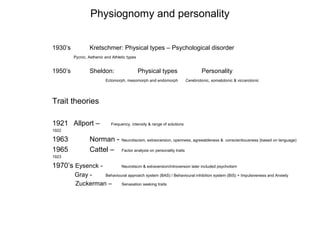
Physiognomy and personality
1930’s

Kretschmer: Physical types – Psychological disorder
Pycnic, Asthenic and Athletic types

1950’s

Sheldon:

Physical types

Ectomorph, mesomorph and endomorph

Personality
Cerebrotonic, somatotonic & viccerotonic

Trait theories
1921 Allport –

Frequency, intensity & range of solutions

1922

1963
1965

Norman Cattel –

Neurotiscism, extravcersion, openness, agreeableness & conscientiousness (based on language)
Factor analysis on personality traits

1923

1970’s Eysenck -

Neurotiscm & extraversion/introversion later included psychotism

Gray Behavioural approach system (BAS) / Behavioural inhibition system (BIS) + Impulsiveness and Anxiety
Zuckerman –
Senasation seeking traits
Neuroscience and personality
Dopamin – Reward, pleasure and feeling good
Serotonin – Mood
Noradrenalin – Action

Behavioural genetics – Monozygotic & dizygotic twins studied according to heritability of personality traits
Evolutionary psychology – History, evoloution and genetics. Adaptation.
Temperament 40 - 60 % genetically dependant ( Loehlin 1982 )
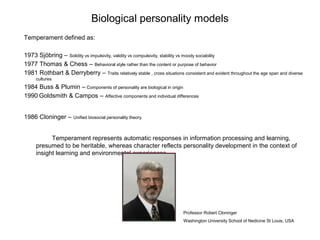
Biological personality models
Temperament defined as:
1973 Sjöbring – Solidity vs impulsivity, validity vs compulsivity, stability vs moody sociability
1977 Thomas & Chess – Behavioral style rather than the content or purpose of behavior
1981 Rothbart & Derryberry – Traits relatively stable , cross situations consistent and evident throughout the age span and diverse
cultures

1984 Buss & Plumin – Components of personality are biological in origin
1990 Goldsmith & Campos – Affective components and individual differences
1986 Cloninger – Unified biosocial personality theory.
Temperament represents automatic responses in information processing and learning,
presumed to be heritable, whereas character reflects personality development in the context of
insight learning and environmental experiences.

Professor Robert Cloninger
Washington University School of Nedicine St Louis, USA
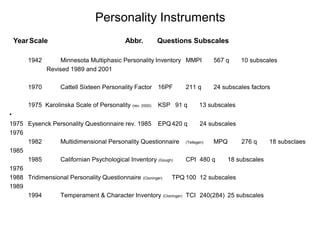
Personality Instruments
Year Scale
1942

1970

Abbr.

Questions Subscales

Minnesota Multiphasic Personality Inventory MMPI
Revised 1989 and 2001
Cattell Sixteen Personality Factor 16PF

1975 Karolinska Scale of Personality (rev. 2000)

211 q

KSP 91 q

567 q

10 subscales

24 subscales factors

13 subscales

•
1975 Eysenck Personality Questionnaire rev. 1985 EPQ 420 q
24 subscales
1976
1982
Multidimensional Personality Questionnaire (Tellegen)
MPQ
276 q
18 subsclaes
1985
1985
Californian Psychological Inventory (Gough)
CPI 480 q
18 subscales
1976
1988 Tridimensional Personality Questionnaire (Cloninger)
TPQ 100 12 subscales
1989
1994
Temperament & Character Inventory (Cloninger) TCI 240(284) 25 subscales
Requirements
•
•

Reliability – The accuracy with which the
questionnaire measures a given quality

•
•

Stability – Test and retest correlation.

•
•

Validity – The measure actually does assess
what it purports to assess.
Projections of dopamine neurons

Amfetamines, opiats,
cocaine, and alcohol
are all dopamine
agonists.

Prefrontal cortex,
central amygdala,
LC, habenula, nc of
striae terminalis, nc
accumbens,
hypothalamiska
kärnan nära
eminentia medialis
Projections of serotonin neurons

Septo-hippocampal area,
amygdala, Substantia
nigra, VMH, nc raphe &
accumbens, and frontal
tegmental area.
Projections of noradrenalin neurons

LC, Tegmental
area,
hypothalamus,
and limbic
system.
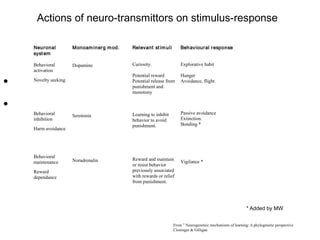
Actions of neuro-transmittors on stimulus-response
Neur onal
syst em

•
•

Monoam inerg m od.

Relevant st im uli

Behaviour al r esponse

Behavioral
activation

Dopamine

Curiosity.

Explorative habit

Potential reward
Potential release from
punishment and
monotony

Hunger
Avoidance, flight

Serotonin

Learning to inhibit
behavior to avoid
punishment.

Passive avoidance
Extinction.
Bonding *

Noradrenalin

Reward and maintain
or resist behavior
previously associated
with rewards or relief
from punishment.

Vigilance *

Novelty seeking

Behavioral
inhibition
Harm avoidance

Behavioral
maintenance
Reward
dependance

* Added by MW
From ” Neurogeneteic mechanisms of learning: A phylogenetic perspective
Cloninger & Gilligan
Stress
Inhibition

DA
Inhibition
5-HT activation

Ach/5-HT

5-HT

Downregulation of HPA

NA

CRF

Stimulation
Cortisol

HPA
Inhibition
DA/NA

Inhibition
ACTH

Inhibition

-endorfin

Stress-induced analgesia

Chatecholamin activation

Sedation

Active avoidance

Behavior activation

Increased visual discrimination & activation
Tyrosinhydroxylas activated

Sustained stress reduce type-II
glucoc.receptors in Hippocampus =
dexometason does not affect
glucocorticoider
Temperament
Associative learning

Unconscious automatic
reactions

Personality

Novelty Seeking

Dopamine

Exploratory excititment vs stoic rigidity

Impusiveness vs reflection

Extravagance vs reserve

Disorderliness vs regimentation
Temperament

Associative learning

Unconscious automatic
reactions

Personality

Harm Avoidance

Serotonin

Worry vs unhibited optimism

Fear of uncertainty vs confidence

Shyness vs gregariousness

Fatigability vs vigour
Temperament
Associative learning

Unconscious automatic
reactions

Personality

Reward Dependance

Noradrenaline

Sentimentality vs insensitiveness

Attachment vs detachment

Dependance vs independance
Temperament
Personality
Associative learning

Habitual system

Novelty Seeking

Harm Avoidance

Reward Dependance

Persistence

Passive activation

Passive avoidance

Social attachment

Partial reinforcement

Dopamin

Serotonin

Noradrenalin

Noradrenalin
Character
Conceptual insight

Conscious planning

Self-directedness

Individual

Responsibility

Purposefulness

Resourcefulness

Self-acceptance

Congruent second nature
Character
Conceptual insight

Conscious planning

Cooperativeness

The Environment

Social acceptance

Empathy

Helpfulness

Compassion

Integrated conscience
Character

Conceptual insight

Conscious planning

Self-Transcendence

The World

Self-forgetfulness

Transpersonal identity

Spiritual acceptance
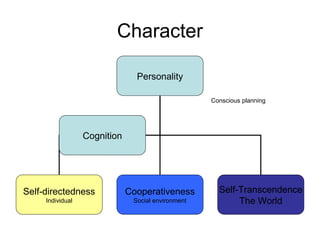
Character
Personality
Conscious planning

Cognition

Self-directedness

Cooperativeness

Individual

Social environment

Self-Transcendence
The World
TCI
Personality

Associative learning

Unconscious automatic reactions

Conceptual insight

Temperament

Character

Habitual system

Novelty Seeking
Passive activation

Harm Avoidance
Passive avoidance

Conscious planning

Cognition

Reward Dependence
Social attachment

Persistence
Partial reinforcement

Self-directedness
Individual

Cooperativeness
Social environment

Self-transcendence
The World
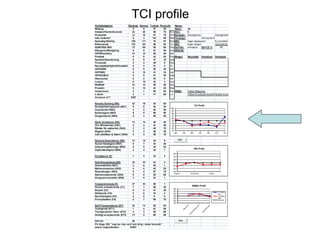
TCI profile
Validitetsskalor
Råvärde Normal T-värde Percentil
Namn:
Missing
0
0
47
35
Ålder:
Vaksam/Kontrollerande
22
20
56
70
SLI Kön:
Pedantisk
12
10
57
75
SUI Karaktär:
Icke önskvärt
9
3
101
99
RareTemptyp:
Spänstig/Uthållig
130
111
70
97
RunsBDI:
Erkännande
122
101
66
94
Tru BAI:
NUMTRUE REV
73
69
59
80
Trev Self-Dir:
Eftergiven/Medgörlig
8
6
61
85
Acq DSQ-40:
INTERmediacy
13
12
48
40
Intm
Praktisk
8
9
43
20
PrevMogen
Nyckfull/Oberäknelig
6
9
37
10
Up2
Tvivlande
2
4
36
8
Dou
Narcissistisk/Självtillfredställd
0
4
31
3
Tri
ANTRARE
5
5
48
40
Ant
INTPREV
8
10
41
15
Inpr
INTDOUBLE
5
5
51
55
Indo
Oberoende
0
2
34
5
Intr
Ledare
6
10
32
3
Insu
RAREUP
12
12
48
40
Rup
Proaktiv
9
10
43
25
Rne
Impairment
2
1
65
93
Imp EMBU
L-scale
2
1
71
98
L-s
Variance of T
2387
Novelty Seeking (NS)
Excitabilitet/upprymd (NS1)
Impulsivitet (NS2)
Extravagans (NS3)
Oorganiserad (NS4)

22
5
4
8
5

19
6
4
5
4

54
44
48
66
59

65
25
40
94
80

Harm Avoidance (HA)
Oro &Pessimism (HA1)
Rädsla för osäkerhet (HA2)
Blyghet (HA3)
Lätt uttröttbar & Asteni (HA4)

13
4
3
2
4

14
4
4
3
3

48
51
40
46
58

40
50
15
30
75

Reward Dependence (RD)
Social Känslighet (RD1)
Anknytningsförmåga (RD3)
Osjälvständighet (RD4)

13
6
5
2

15
7
5
4

35
42
44
35

6
20
25
7

Persistence (P)

1

4

33

4

Self-Directedness (SD)
Ansvarsfullhet (SD1)
Målmedvetenhet (SD2)
Resursmogen (SD3)
Självaccepterande (SD4)
Kongruent karaktär (SD5)

23
2
4
5
9
3

33
6
6
4
8
9

33
22
43
57
55
24

4
1
25
75
65
1

Cooperativeness (C)
Socialt accepterande (C1)
Empati (C2)
Stödjande (C3)
Barmhärtighet (C4)
Principfasthet (C5)

27
7
5
5
2
8

34
7
5
6
8
7

26
46
47
33
9
56

1
30
35
4
0
70

Self-Transcendence (ST)
Tankspridd (ST1)
Transpersonell ident. (ST2)
Andligt accepterande (ST3)

24
7
4
13

13
4
3
5

66
61
55
68

Neurotisk

Immature

Immature

Father Rejecting
Father Emotional WarmthMother Emotional Warmth

TCI Profil
100
90
80
70
60
50
40
30
20
10
NS

HA

RD

PE

SD

CO

ST

Åter

CRI Profil
80
70
60
50
40
30
20

94
85
65
96

SD+CO
50
På fråga 230: "Jag har inte varit helt ärlig i detta formulär"
svarar respondenten:
SANT

45
k
Disorganized
Disorganized
Anti-social 6,1/10,2
Ingen depression
Ej suicidrisk
Ingen ångest
Sannolikhet
Immature
SD+CO %
60

Kognitiv

Emotionell

Fysisk

EMBU Profil
80
70
60
50
40
30
20

T-Värde
Far
T-Värde
Mor
Normal

Åter
Reliability and validity
Rarity scale: Sum of the least frequently endorsed item response from each of the
25 subscales. Endorsement across all indicates a deliberate effort
to
depict oneself in a highly unlikely way or careless disregard for the
content of items being endorsed.

Runs:

Number of sequences of consecutive true/false answers.
Average 120. Fewer than 5 % have as many as 134 or as few as
100 of all 240.

Number of true endorsements:
Tendencay to answer yes more or less frequently than
usual.

Scale of like items and Scale of Unlike Items
Extent of which respondent is consistent in responding.
Cronbach Alpha
Cronbach's alpha measures how well a set of items (or variables) measures a single
unidimensional latent construct. It is a reliability test.

Most variables show values around or above 0.70 but persistence and
empathy generally shows poor values.
Lack of evidence
Does the Dimensions of the Temperament and Character Inventory Map a
Simple
Genetic Architecture? Evidence From Molecular Genetics and Factor Analysis
Jeffrey H. Herbst, Ph.D., Alan B.
Zonderman, Ph.D., Robert R. McCrae, Ph.D. and Paul T. Costa, Jr., Ph.D.

Am J Psychiatry 157:1285-1290, August 2000
TCI profile

TCI Profil
100
90
80
70
60
50
40
30
20
10
NS

HA

RD

PE

SD

CO

ST
A tool in your pocket
TCI in 3 dimensions
Passion vs Histrionic

Sensitive vs Narcissistic

Adventurous vs
Antisocial

Y

Explosive vs Borderline

Stable vs Cyclothymic

Z

Avoidant vs Schizoid

Cautious vs Passive-dependant

X

Methodical vs Obsessional
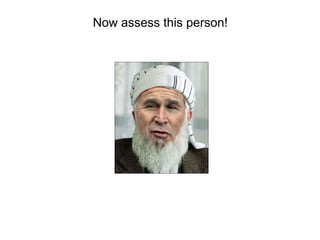
Now assess this person!
And this leader!
What about our next leader?
Results
George W Bush

Dalai Lama

David Cameron

TCI English

  • 1.
    Temperament and CharacterInventory 2 March 2012 DOPP, MWI Bermuda Marcel Westerlund Consultant Forensic and Adult Psychiatrist
  • 2.
    Physiognomy and personality 1930’s Kretschmer:Physical types – Psychological disorder Pycnic, Asthenic and Athletic types 1950’s Sheldon: Physical types Ectomorph, mesomorph and endomorph Personality Cerebrotonic, somatotonic & viccerotonic Trait theories 1921 Allport – Frequency, intensity & range of solutions 1922 1963 1965 Norman Cattel – Neurotiscism, extravcersion, openness, agreeableness & conscientiousness (based on language) Factor analysis on personality traits 1923 1970’s Eysenck - Neurotiscm & extraversion/introversion later included psychotism Gray Behavioural approach system (BAS) / Behavioural inhibition system (BIS) + Impulsiveness and Anxiety Zuckerman – Senasation seeking traits
  • 3.
    Neuroscience and personality Dopamin– Reward, pleasure and feeling good Serotonin – Mood Noradrenalin – Action Behavioural genetics – Monozygotic & dizygotic twins studied according to heritability of personality traits Evolutionary psychology – History, evoloution and genetics. Adaptation. Temperament 40 - 60 % genetically dependant ( Loehlin 1982 )
  • 4.
    Biological personality models Temperamentdefined as: 1973 Sjöbring – Solidity vs impulsivity, validity vs compulsivity, stability vs moody sociability 1977 Thomas & Chess – Behavioral style rather than the content or purpose of behavior 1981 Rothbart & Derryberry – Traits relatively stable , cross situations consistent and evident throughout the age span and diverse cultures 1984 Buss & Plumin – Components of personality are biological in origin 1990 Goldsmith & Campos – Affective components and individual differences 1986 Cloninger – Unified biosocial personality theory. Temperament represents automatic responses in information processing and learning, presumed to be heritable, whereas character reflects personality development in the context of insight learning and environmental experiences. Professor Robert Cloninger Washington University School of Nedicine St Louis, USA
  • 5.
    Personality Instruments Year Scale 1942 1970 Abbr. QuestionsSubscales Minnesota Multiphasic Personality Inventory MMPI Revised 1989 and 2001 Cattell Sixteen Personality Factor 16PF 1975 Karolinska Scale of Personality (rev. 2000) 211 q KSP 91 q 567 q 10 subscales 24 subscales factors 13 subscales • 1975 Eysenck Personality Questionnaire rev. 1985 EPQ 420 q 24 subscales 1976 1982 Multidimensional Personality Questionnaire (Tellegen) MPQ 276 q 18 subsclaes 1985 1985 Californian Psychological Inventory (Gough) CPI 480 q 18 subscales 1976 1988 Tridimensional Personality Questionnaire (Cloninger) TPQ 100 12 subscales 1989 1994 Temperament & Character Inventory (Cloninger) TCI 240(284) 25 subscales
  • 6.
    Requirements • • Reliability – Theaccuracy with which the questionnaire measures a given quality • • Stability – Test and retest correlation. • • Validity – The measure actually does assess what it purports to assess.
  • 7.
    Projections of dopamineneurons Amfetamines, opiats, cocaine, and alcohol are all dopamine agonists. Prefrontal cortex, central amygdala, LC, habenula, nc of striae terminalis, nc accumbens, hypothalamiska kärnan nära eminentia medialis
  • 8.
    Projections of serotoninneurons Septo-hippocampal area, amygdala, Substantia nigra, VMH, nc raphe & accumbens, and frontal tegmental area.
  • 9.
    Projections of noradrenalinneurons LC, Tegmental area, hypothalamus, and limbic system.
  • 10.
    Actions of neuro-transmittorson stimulus-response Neur onal syst em • • Monoam inerg m od. Relevant st im uli Behaviour al r esponse Behavioral activation Dopamine Curiosity. Explorative habit Potential reward Potential release from punishment and monotony Hunger Avoidance, flight Serotonin Learning to inhibit behavior to avoid punishment. Passive avoidance Extinction. Bonding * Noradrenalin Reward and maintain or resist behavior previously associated with rewards or relief from punishment. Vigilance * Novelty seeking Behavioral inhibition Harm avoidance Behavioral maintenance Reward dependance * Added by MW From ” Neurogeneteic mechanisms of learning: A phylogenetic perspective Cloninger & Gilligan
  • 11.
    Stress Inhibition DA Inhibition 5-HT activation Ach/5-HT 5-HT Downregulation ofHPA NA CRF Stimulation Cortisol HPA Inhibition DA/NA Inhibition ACTH Inhibition -endorfin Stress-induced analgesia Chatecholamin activation Sedation Active avoidance Behavior activation Increased visual discrimination & activation Tyrosinhydroxylas activated Sustained stress reduce type-II glucoc.receptors in Hippocampus = dexometason does not affect glucocorticoider
  • 12.
    Temperament Associative learning Unconscious automatic reactions Personality NoveltySeeking Dopamine Exploratory excititment vs stoic rigidity Impusiveness vs reflection Extravagance vs reserve Disorderliness vs regimentation
  • 13.
    Temperament Associative learning Unconscious automatic reactions Personality HarmAvoidance Serotonin Worry vs unhibited optimism Fear of uncertainty vs confidence Shyness vs gregariousness Fatigability vs vigour
  • 14.
    Temperament Associative learning Unconscious automatic reactions Personality RewardDependance Noradrenaline Sentimentality vs insensitiveness Attachment vs detachment Dependance vs independance
  • 15.
    Temperament Personality Associative learning Habitual system NoveltySeeking Harm Avoidance Reward Dependance Persistence Passive activation Passive avoidance Social attachment Partial reinforcement Dopamin Serotonin Noradrenalin Noradrenalin
  • 16.
  • 17.
    Character Conceptual insight Conscious planning Cooperativeness TheEnvironment Social acceptance Empathy Helpfulness Compassion Integrated conscience
  • 18.
    Character Conceptual insight Conscious planning Self-Transcendence TheWorld Self-forgetfulness Transpersonal identity Spiritual acceptance
  • 19.
  • 20.
    TCI Personality Associative learning Unconscious automaticreactions Conceptual insight Temperament Character Habitual system Novelty Seeking Passive activation Harm Avoidance Passive avoidance Conscious planning Cognition Reward Dependence Social attachment Persistence Partial reinforcement Self-directedness Individual Cooperativeness Social environment Self-transcendence The World
  • 21.
    TCI profile Validitetsskalor Råvärde NormalT-värde Percentil Namn: Missing 0 0 47 35 Ålder: Vaksam/Kontrollerande 22 20 56 70 SLI Kön: Pedantisk 12 10 57 75 SUI Karaktär: Icke önskvärt 9 3 101 99 RareTemptyp: Spänstig/Uthållig 130 111 70 97 RunsBDI: Erkännande 122 101 66 94 Tru BAI: NUMTRUE REV 73 69 59 80 Trev Self-Dir: Eftergiven/Medgörlig 8 6 61 85 Acq DSQ-40: INTERmediacy 13 12 48 40 Intm Praktisk 8 9 43 20 PrevMogen Nyckfull/Oberäknelig 6 9 37 10 Up2 Tvivlande 2 4 36 8 Dou Narcissistisk/Självtillfredställd 0 4 31 3 Tri ANTRARE 5 5 48 40 Ant INTPREV 8 10 41 15 Inpr INTDOUBLE 5 5 51 55 Indo Oberoende 0 2 34 5 Intr Ledare 6 10 32 3 Insu RAREUP 12 12 48 40 Rup Proaktiv 9 10 43 25 Rne Impairment 2 1 65 93 Imp EMBU L-scale 2 1 71 98 L-s Variance of T 2387 Novelty Seeking (NS) Excitabilitet/upprymd (NS1) Impulsivitet (NS2) Extravagans (NS3) Oorganiserad (NS4) 22 5 4 8 5 19 6 4 5 4 54 44 48 66 59 65 25 40 94 80 Harm Avoidance (HA) Oro &Pessimism (HA1) Rädsla för osäkerhet (HA2) Blyghet (HA3) Lätt uttröttbar & Asteni (HA4) 13 4 3 2 4 14 4 4 3 3 48 51 40 46 58 40 50 15 30 75 Reward Dependence (RD) Social Känslighet (RD1) Anknytningsförmåga (RD3) Osjälvständighet (RD4) 13 6 5 2 15 7 5 4 35 42 44 35 6 20 25 7 Persistence (P) 1 4 33 4 Self-Directedness (SD) Ansvarsfullhet (SD1) Målmedvetenhet (SD2) Resursmogen (SD3) Självaccepterande (SD4) Kongruent karaktär (SD5) 23 2 4 5 9 3 33 6 6 4 8 9 33 22 43 57 55 24 4 1 25 75 65 1 Cooperativeness (C) Socialt accepterande (C1) Empati (C2) Stödjande (C3) Barmhärtighet (C4) Principfasthet (C5) 27 7 5 5 2 8 34 7 5 6 8 7 26 46 47 33 9 56 1 30 35 4 0 70 Self-Transcendence (ST) Tankspridd (ST1) Transpersonell ident. (ST2) Andligt accepterande (ST3) 24 7 4 13 13 4 3 5 66 61 55 68 Neurotisk Immature Immature Father Rejecting Father Emotional WarmthMother Emotional Warmth TCI Profil 100 90 80 70 60 50 40 30 20 10 NS HA RD PE SD CO ST Åter CRI Profil 80 70 60 50 40 30 20 94 85 65 96 SD+CO 50 På fråga 230: "Jag har inte varit helt ärlig i detta formulär" svarar respondenten: SANT 45 k Disorganized Disorganized Anti-social 6,1/10,2 Ingen depression Ej suicidrisk Ingen ångest Sannolikhet Immature SD+CO % 60 Kognitiv Emotionell Fysisk EMBU Profil 80 70 60 50 40 30 20 T-Värde Far T-Värde Mor Normal Åter
  • 22.
    Reliability and validity Rarityscale: Sum of the least frequently endorsed item response from each of the 25 subscales. Endorsement across all indicates a deliberate effort to depict oneself in a highly unlikely way or careless disregard for the content of items being endorsed. Runs: Number of sequences of consecutive true/false answers. Average 120. Fewer than 5 % have as many as 134 or as few as 100 of all 240. Number of true endorsements: Tendencay to answer yes more or less frequently than usual. Scale of like items and Scale of Unlike Items Extent of which respondent is consistent in responding.
  • 23.
    Cronbach Alpha Cronbach's alphameasures how well a set of items (or variables) measures a single unidimensional latent construct. It is a reliability test. Most variables show values around or above 0.70 but persistence and empathy generally shows poor values.
  • 24.
    Lack of evidence Doesthe Dimensions of the Temperament and Character Inventory Map a Simple Genetic Architecture? Evidence From Molecular Genetics and Factor Analysis Jeffrey H. Herbst, Ph.D., Alan B. Zonderman, Ph.D., Robert R. McCrae, Ph.D. and Paul T. Costa, Jr., Ph.D. Am J Psychiatry 157:1285-1290, August 2000
  • 25.
  • 26.
    A tool inyour pocket
  • 27.
    TCI in 3dimensions Passion vs Histrionic Sensitive vs Narcissistic Adventurous vs Antisocial Y Explosive vs Borderline Stable vs Cyclothymic Z Avoidant vs Schizoid Cautious vs Passive-dependant X Methodical vs Obsessional
  • 28.
  • 29.
  • 30.
    What about ournext leader?
  • 31.
    Results George W Bush DalaiLama David Cameron