Taxonomy and Binomial
Nomenclature
Dr. DEEPAK RAWAL
Assistant Professor
Department of Zoology
MLSU Udaipur
•Aristotle: Historia Animalium
•>95% organisms are invertebrates
•Out of them, 80% are arthropods
•Species is unit of classification
•Taxis: arrangement
•Nomia:distribution
•Term taxonomy coined by A. P. de Condolle
• 1.7-1.8 million species described already
• *Viruses are not included.
•Def: Branch of science deals with identification,
nomenclature and classification of organisms.
•Systematics: determination of evolutionary
relationships.
•Old taxonomy: based on homology/morphology
•New taxonomy/neosystematics/biosystematics:
based on Phylogeny/DNA barcoding/Molecular
taxonomy
Father of Taxonomy: Carolus Linnaeus
Taxon: singular; Taxa: plural
Why we need taxonomy?
1. Different languages in different regions.
2. Misleading common names such as starfish, sea
horse, jelly fish etc.
3. Analogy/homoplasies such as bats and birds
4. Universal and unique in research.
*Taxonomic categories/ranks/hierarchies:
•Domain- Eukaryota/Eukarya
•Kingdom- Animalia
•Subkingdom- Eumetazoa/Metazoa
•Clade (unranked) - Bilateria
•Clade (unranked)- Coelomata
• Infrakingdom- Protostomia
•Superphylum- Ecdysozoa
•Phylum-Arthropoda
•Superclass- Hexapoda
•Class- Insecta
•Subclass- Pterygota
•Infraclass- Neoptera
•Superorder- Endopterygota/Holometabola
•Order- Diptera
•Suborder- Nematocera
•Infraorder- Culicomorpha
•Superfamily- Chironomoidea Universal suffixes
•Family- Chironomidae
•Subfamily- Chironominae
•Tribe- Chironomini
•Genus- Chironomus
•Species- Chironomus circumdatus Kieffer, 1916
Cladogram/evolutionary tree/phylogenetic tree
Monophyletic/Paraphyletic/Polyphyletic groups
BINOMIAL NOMENCLATURE
Before: all taxa were used
In future: may be numbering system
CAROLUS LINNAEUS- SYSTEMA NATURAE
(1758)
BINOMIAL NOMENCLATURE
ICZN-INTERNATIONAL CODE OF ZOOLOGICAL NOMENCLATURE
ICNafp-INTERNATIONAL CODE OF NOMENCLATURE FOR ALGAE, FUNGI AND
PLANTS
ICTN-INTERNATIONAL CODE FOR TAXONOMY OF VIRUSES
BINOMIAL NOMENCLATURE
FIRST WORD- GENUS
SECOND WORD- SPECIES EPITHET
eg- Homo sapiens
BINOMIAL NOMENCLATURE
NAME MUST BE LATINIZED AND PRITNTED IN
ITALLIC FONT STYLE
eg- Einfeldia pritiensis Singh and Rawal, 2016
BINOMIAL NOMENCLATURE
AUTHOR’ S NAME AND YEAR OF PUBLICATION
MAY USED AFTER NAME
eg- Homo sapiens Linn., 1758
BINOMIAL NOMENCLATURE
NAME MUST BE UNIQUE AND
UNAMBIGUOUS
BINOMIAL NOMENCLATURE
NOT TOO SHORT NOT TOO LONG
BINOMIAL NOMENCLATURE
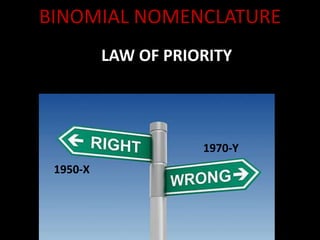
LAW OF PRIORITY
1950-X
1970-Y
BINOMIAL NOMENCLATURE
MORPHEME ‘†’ MAY USED FOR EXTINCT SPECIES
eg.-Tyrannosaurus rex † or † Tyrannosaurus rex
1950-X
1970-Y
BINOMIAL NOMENCLATURE
Tautonyms: Gorilla gorilla
1950-X
1970-Y
BINOMIAL NOMENCLATURE
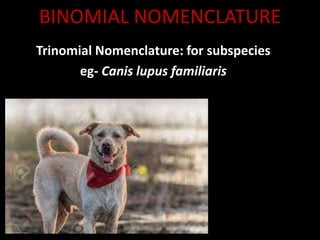
Trinomial Nomenclature: for subspecies
eg- Canis lupus familiaris
1950-X
1970-Y
BINOMIAL NOMENCLATURE
Hybrids: Not species
Mule= Equus asinus (male donkey)*Equus caballus (female horse)
1950-X
1970-Y
THANK YOU
1950-X
1970-Y

taxonomy-210331065052.pdf