Philippines Tax
System
A Taxation presentation for ILA315
by:
Jariyaporn Seenay
58-51024-25552
TABLE OF CONTENTS
• Who pays taxes
• Who are exempted to pay
• Tax rates
• Tax forms & Procedures
• Personal Income Tax
• Tax exempt income
WHO PAYS TAXES
Resident citizens receiving income from sources within or outside
the Philippines:
• Employees deriving purely compensation income from 2 or more
employers, concurrently or successively at anytime during the taxable
year
• Self-employed individuals receiving income from the conduct of trade
or business and/or practice of profession
• Individuals deriving mixed income – Compensation income and
income from the conduct of trade or business and/or practice of
profession
WHO PAYS TAXES
• Marginal Income Earners
• Non-resident citizens receiving income from sources within the
Philippines
• Aliens, whether resident or not, receiving income from sources within
the Philippines
WHO ARE EXEMPTED TO PAY
• A citizen of the Philippines who leaves the Philippines during the taxable
year to reside abroad, either as an immigrant or for employment on a
permanent basis
• A citizen of the Philippines who works and derives income from abroad
and whose employment requires him to be physically present abroad
most of the time during the taxable year / OFWs
• A citizen who has been previously considered as a non-resident citizen
and who arrives in the Philippines at any time during the year to reside
permanently in the Philippines will likewise be treated as a non-resident
citizen during the taxable year in which he arrives in the Philippines,
with respect to his income derived from sources abroad until the date of
his arrival in the Philippines.
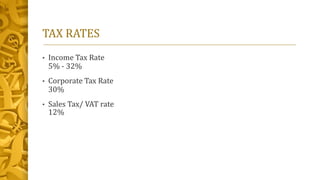
TAX RATES
• Income Tax Rate
5% - 32%
• Corporate Tax Rate
30%
• Sales Tax/ VAT rate
12%
TAX FORMS & PROCEDURES
• BIR Form Nos. 1700 / 1701 / 1701Q / 1702 / 1702Q
• 1700: Annual Income Tax Return for Individuals Earning Purely Compensation
Income (Including Non-Business/Non-Profession Income)
• 1701: Annual Income Tax Return for Self-Employed Individuals, Estates and Trusts
• 1702: Annual Income Tax Return for Corporations, Partnerships and Other Non-
Individual Taxpayers
*Q = Quarterly
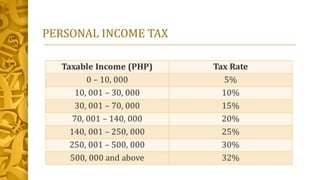
PERSONAL INCOME TAX
• Residents are taxed progressively
• Up to 32%
• The Philippine Annual Income Tax Return (BIR Form 1700) is filed and
taxes are due to the Philippine Bureau of Internal Revenue on or before
15 April of the year following the applicable calendar year.
• The tax year is a calendar year which ends 31 December of each year.
PERSONAL INCOME TAX
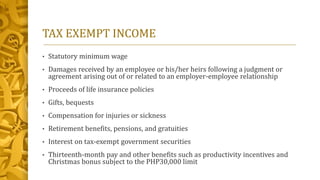
TAX EXEMPT INCOME
• Statutory minimum wage
• Damages received by an employee or his/her heirs following a judgment or
agreement arising out of or related to an employer-employee relationship
• Proceeds of life insurance policies
• Gifts, bequests
• Compensation for injuries or sickness
• Retirement benefits, pensions, and gratuities
• Interest on tax-exempt government securities
• Thirteenth-month pay and other benefits such as productivity incentives and
Christmas bonus subject to the PHP30,000 limit
THANK YOU FOR YOUR
ATTENTION

Taxation in Philippines

  • 1.
    Philippines Tax System A Taxationpresentation for ILA315 by: Jariyaporn Seenay 58-51024-25552
  • 2.
    TABLE OF CONTENTS •Who pays taxes • Who are exempted to pay • Tax rates • Tax forms & Procedures • Personal Income Tax • Tax exempt income
  • 3.
    WHO PAYS TAXES Residentcitizens receiving income from sources within or outside the Philippines: • Employees deriving purely compensation income from 2 or more employers, concurrently or successively at anytime during the taxable year • Self-employed individuals receiving income from the conduct of trade or business and/or practice of profession • Individuals deriving mixed income – Compensation income and income from the conduct of trade or business and/or practice of profession
  • 4.
    WHO PAYS TAXES •Marginal Income Earners • Non-resident citizens receiving income from sources within the Philippines • Aliens, whether resident or not, receiving income from sources within the Philippines
  • 5.
    WHO ARE EXEMPTEDTO PAY • A citizen of the Philippines who leaves the Philippines during the taxable year to reside abroad, either as an immigrant or for employment on a permanent basis • A citizen of the Philippines who works and derives income from abroad and whose employment requires him to be physically present abroad most of the time during the taxable year / OFWs • A citizen who has been previously considered as a non-resident citizen and who arrives in the Philippines at any time during the year to reside permanently in the Philippines will likewise be treated as a non-resident citizen during the taxable year in which he arrives in the Philippines, with respect to his income derived from sources abroad until the date of his arrival in the Philippines.
  • 6.
    TAX RATES • IncomeTax Rate 5% - 32% • Corporate Tax Rate 30% • Sales Tax/ VAT rate 12%
  • 7.
    TAX FORMS &PROCEDURES • BIR Form Nos. 1700 / 1701 / 1701Q / 1702 / 1702Q • 1700: Annual Income Tax Return for Individuals Earning Purely Compensation Income (Including Non-Business/Non-Profession Income) • 1701: Annual Income Tax Return for Self-Employed Individuals, Estates and Trusts • 1702: Annual Income Tax Return for Corporations, Partnerships and Other Non- Individual Taxpayers *Q = Quarterly
  • 8.
    PERSONAL INCOME TAX •Residents are taxed progressively • Up to 32% • The Philippine Annual Income Tax Return (BIR Form 1700) is filed and taxes are due to the Philippine Bureau of Internal Revenue on or before 15 April of the year following the applicable calendar year. • The tax year is a calendar year which ends 31 December of each year.
  • 9.
  • 10.
    TAX EXEMPT INCOME •Statutory minimum wage • Damages received by an employee or his/her heirs following a judgment or agreement arising out of or related to an employer-employee relationship • Proceeds of life insurance policies • Gifts, bequests • Compensation for injuries or sickness • Retirement benefits, pensions, and gratuities • Interest on tax-exempt government securities • Thirteenth-month pay and other benefits such as productivity incentives and Christmas bonus subject to the PHP30,000 limit
  • 11.
    THANK YOU FORYOUR ATTENTION

Editor's Notes

  • #4 Compensation Income = Salary, wages, incentives and commissions
  • #5 MIE: They are self-employed business owners whose annual total gross sales or receipts do not exceed PHP100,000.
  • #7 The corporate income tax rate both for domestic and resident= 30% based on net taxable income. Excluded are: Dividends received from domestic corporations Interest on Philippine currency bank deposit Yield from trust funds. = A variety of assets intended to provide benefits to an individual or organization.  It is important to note that foreign corporations, whether resident or nonresident, are taxable only on income derived from sources within the Philippines. A 12% value added tax (VAT) of the gross selling price is imposed to all: Importation Sale Barter = Exchange (goods or services) for other goods or services without using money.
  • #8 For “with payment” File the return in triplicate (two copies for the BIR and one copy for the taxpayer) with the Authorized Agent Bank (AAB) of the place where taxpayer is registered or required to be registered. In places where there are no AABs, the return will be filed directly with the Revenue Collection Officer or duly Authorized Treasurer of the city or municipality in which such person has his legal residence or principal place of business in the Philippines, or if there is none, filing of the return will be at the Office of the Commissioner. For “no payment” File the return with the concerned Revenue District Office (RDO) where the taxpayer is registered. However, "no payment" returns filed late shall be accepted by the RDO but instead shall be filed with an Authorized Agent Bank (AAB) or Collection Officer/Deputized Municipal Treasurer (in places where there are no AABs), for payment of necessary penalties.
  • #11 BEQUEST: The act of giving personal property or money such as stocks, bonds, jewelry and cash left to an individual or organization through the provisions of a will or estate plan. Bequests can be made to family, friends, institutions or charities. GRATUITIES: a tip given to a waiter, taxicab driver, etc