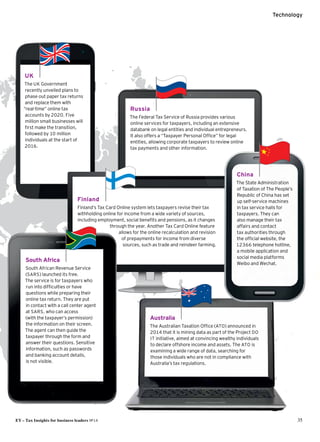
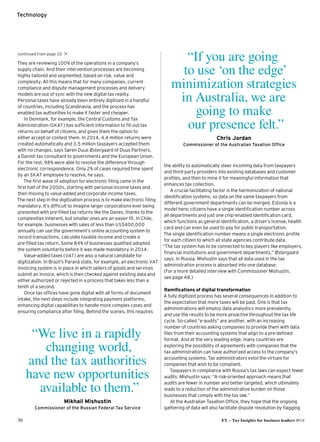
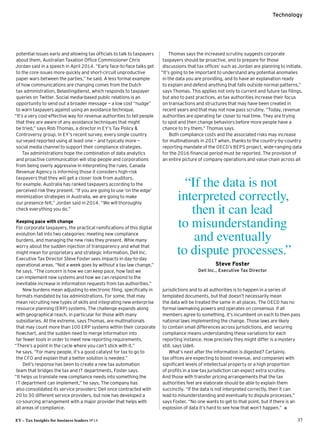
№ 14
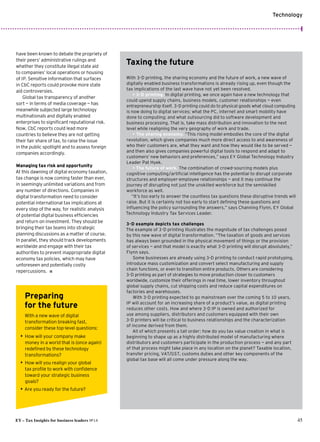
FOCUS
Technology
Disruptive
change for tax
authorities
and tax functions
Hack attacks
and data protection
headaches
Unlocking value
from data
Mikhail Mishustin
Commissioner of the Russian
Federal Tax Service
0
1 Credits:picturealliance/dpa,RandyGlassStudio(Illustration)
EY – Tax Insights for business leaders №14 3
Jay Nibbe
Global Vice Chair Tax
Technology: a taxing exercise
Technology is reinventing the world of
business. The invention of the integrated
circuit in 1958 made desktop computing cheap
and pervasive and forever changed the way
that we handle information. The digital
technologies that followed — PCs, mobile
phones and the cloud — have had a similarly
dramatic impact on the way people do
business. Today, a company can go global 
in a fraction of the time it previously took to
build out an international organization.
The disruptive potential of digital
technologies has also profoundly affected 
tax policy. In an era where you can start a
company from your laptop in a coffee shop in
Nairobi, a concept like physical presence is
turned upside down. This, in turn, calls into
question many international tax principles,
transfer pricing rules and decades’ worth of
tax treaties relating to business practices that
have quickly become outdated. For both tax
authorities and tax departments, technology
disruption and the digital era usher in a thicket
of complexities.
Increasingly, companies are responding
to the digital era with new technologies that
drive organizational and business changes. Tax
departments need to understand and manage
their roles in these transformative exercises.
Finance transformation can disrupt the tax
function in two ways: the loss of highly
knowledgeable tax resources at the local level
and the erosion of skills and competencies
stemming from globalization or regionalization
of processes. Technology transformation in
the business operations often improves the
connection to customers but can inadvertently
alter the organization tax cost and the bottom
line, impacting return on investment.
While a great deal of work has been 
done, to date no consensus has been reached
on a framework of how to tax digital activities.
Consequently, companies must deal with a
patchwork of national tax policies, with new
direct and indirect taxes emerging at the city,
state and national level. Such taxes not only
have financial implications, but increasingly
require companies to alter or restructure their
business operations to remain competitive.
The patchwork of legislation requires the
business tax function to devote more
resources to monitoring and assessing the
impact of these new tax rules.
The changing environment and global nature 
of business are also bolstering global calls
from the public, activists and governments for
heightened levels of tax transparency. From
2016, the OECD has recommended companies
with more than €750 million in revenue 
will be required to submit to tax authorities
country-by-country reports on a number of
different tax and financial data points. This
information, drawn from their enterprise
resource planning (ERP) systems, which will
likely require remediation to accurately
provide the information.
Tax authorities are embracing technology
as well. Many countries are taking advantage
of digitization to introduce new e-invoicing
requirements into their national legislation to
assist with GST, VAT or other revenue-based
taxes. Others are going a step further, asking
companies to provide electronic audit files
directly from their ERP systems. In every
corner of the world, technology disruptions are
layering new complexities and pressures on
business and their tax function.
Technology change is not all disruption.
Some tax departments are finding that they
can unlock valuable information for the
business through the use of data analytics. 
Tax departments are using analytics around
transaction tax, financial reporting and
transfer pricing to detect risk, reduce
controversy and eliminate unwarranted costs
in a variety of areas. How to effectively
leverage the “big data” of an organization 
to add enterprise value is of increasing
importance.
All of this change means that tax 
function leaders must also evolve to adopt 
and leverage these new technologies. 
It’s critical to increase communication with 
key stakeholders, further align with the
business and its supply chain and customer
interface, and leverage technology to respond
to tax law changes. New technologies must 
be understood and acquired; new talent, 
skills and competencies must be added; 
and sustained investment in technology must
be secured.
These are challenging, yet exciting 
times for the tax leaders of today and
tomorrow. While technology will continue 
to disrupt the tax world, it also offers a
promise of great solutions.
4	 EY – Tax Insights for business leaders №14
Technology
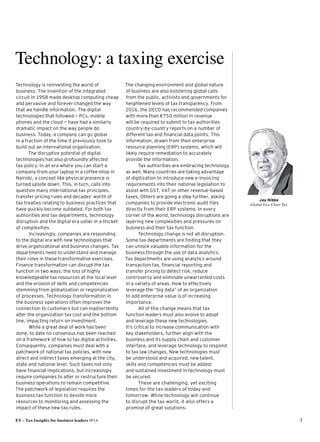
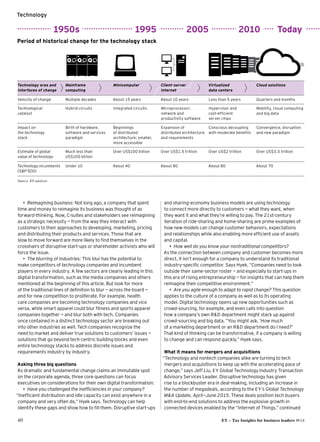
1990The pre-digital age
In 1990, books were sold in stores, banking was done at local branches that followed bankers’ hours, and the cloud referred to
puffy, white things. Nearly 90 million US households had residential phone service versus just 5.3 million mobile phone subscribers.
­Long-distance calls were only billed by the minute. People used fax machines. Just 15% of US households owned computers.
Computer bulletin boards were accessed using dial-up modems. The internet was a text-based enigma. Email use was largely the ­
domain of universities, governments and the military. But change was coming…
Doing
business
Banking
Shopping
Paying
taxes
Technology
EY – Tax Insights for business leaders №14	 5
“The concern is not so much that
there will be greater levels of
transparency and closer to real-time
access to data, but how we can
respond to the inevitable increase in
information requests from taxing
authorities to provide meaningful,
contextual and accurate explanations.”
Steve Foster
Executive Director,
Global Tax Operations
Dell Inc.
Credits:JonRiley/GettyImages,TetraImages/Corbis,Comstock/GettyImages,BobRowan/ProgressiveImage/Corbis,RoganMacdonald
Technology
6	 EY – Tax Insights for business leaders №14
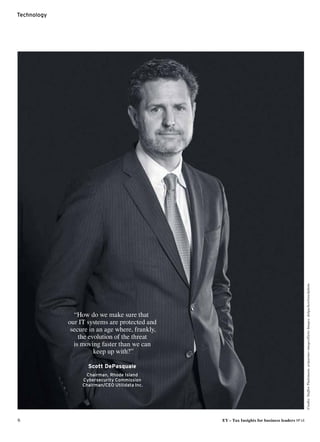
“How do we make sure that
our IT systems are protected and
secure in an age where, frankly,
the evolution of the threat
is moving faster than we can
keep up with?”
Scott DePasquale
Chairman, Rhode Island
Cybersecurity Commission
Chairman/CEO Utilidata Inc.
Credits:SteffenThalemann,artpartner-images/GettyImages,dolgachov/istockphoto
EY – Tax Insights for business leaders №14	 7
Technology
Doing
business
Banking
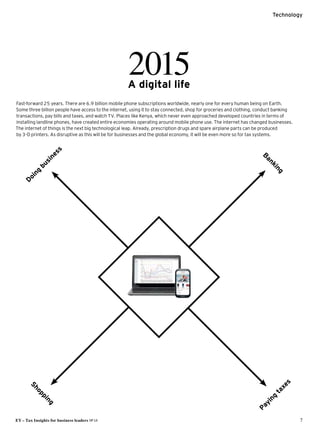
2015A digital life
Fast-forward 25 years. There are 6.9 billion mobile phone subscriptions worldwide, nearly one for every human being on Earth.
Some three billion people have access to the internet, using it to stay connected, shop for groceries and clothing, conduct ­banking
­transactions, pay bills and taxes, and watch TV. Places like Kenya, which never even approached developed countries in terms of
­installing landline phones, have created entire economies operating around mobile phone use. The internet has changed businesses.
The internet of things is the next big technological leap. Already, prescription drugs and spare airplane parts can be produced
by 3-D printers. As disruptive as this will be for businesses and the global economy, it will be even more so for tax systems.
Shopping
Paying
taxes
Credits:VornameName
8 EY – Tax Insights for business leaders №14
Technology
FOCUS
Technology
Tax thought leadership
for the digital economy
We regularly publish reports that examine how technology
will impact various aspects of taxation.
 ey.com/digitaltax
Reviewing global
digital tax
­developments
Get the latest on the
OECD’s BEPS project and
an in-depth view of the
UK’s Diverted Profits Tax.
Also in this review is a
look at tax transparency,
as well as digital tax
trends and disconnects
across borders.
Awakening to the
new realities of digital
economy taxation
Multinational technology
companies will see a
significant upward
pressure on their global
tax rates in 2016.
Read about the new
realities and impact of
digital economy taxation.
3-D printing turning
manufacturing
upside down
3-D printing could take
mass distribution and
innovation to the next
level, while realigning
the very geography
of work and trade.
This report looks at how
the use of 3-D printing
in manufacturing could
upend tax strategies.
Tech companies at
the forefront of a new
­global tax environment
Ever-evolving and
increasingly borderless
cloud-based business
models have set off
a scramble among
companies and
governments around
the world to grasp cloud
taxation issues and
impacts. Explore how
recent developments
could impact your
business.
Tax Insights’ global editorial board
Tax Insights welcomes York Zöllkau, EMEIA’s Tax Leader, to the global editorial team.
York and the other members of the global editorial board bring together
important ­insights from EY’s extensive network of professionals keeping you
up-to-date on the latest tax matters and trends impacting your business.
Credits:RandyGlassStudio(Illustrations)
Jay Nibbe
Global Vice Chair Tax
Jim Hunter
Asia-Pacific Tax Leader
York Zöllkau
EMEIA Tax Leader
Kate Barton
Americas Vice Chair Tax
Kenji Amino
Japan Tax Leader
EY – Tax Insights for business leaders №14 9
Technology
The three factors shaping
the indirect-tax landscape
Learn how technology – in addition to
transparency and talent – will influence
indirect tax policy.
Tax transparency requires access
to quality data
A to-do list for data to ensure companies
can meet new transparency obligations.
Minimizing value chain risk
in a changing world
Keep value chain risks in check as
digital innovation spurs restructuring
of global business operations.
Tax Insights platform
Technology is transforming the tax
industry. Our website offers the
latest updates and in-depth analysis
of new developments.
 taxinsights.ey.com
Disruptive influences
	10	 The digital economy is giving rise
to a “technology race” with both
businesses and governments
using IT to unearth new sources
of value and risk. And that means
learning new skills.
Business unusual
	12	 In the past, governments usually
lagged behind technology adoption
by companies. Today, they are
­surging ahead. Tax functions will
need to embrace new technologies
to catch up.
Engineering success
	18	 How does a tiny country ensure
growth and wealth? First, become
a technology leader. Then invite
the rest of the world to become
“e-residents.”
The technology-enabled
tax function
	20	 Spreadsheets are so yesterday.
Keeping up with ever-growing
­demands for tax-related data calls
for a well-developed and
effectively deployed operational
tax technology strategy.
Weak link — improving
data ­security
	24	 A hacker attack is every company’s
worst nightmare. But regulations
aimed at protecting consumer data
by deleting it may be at odds
with the need of tax jurisdictions
to retain it.
Extracting sense from the noise
	26	 Unlocking value from the massive
amounts of data generated by IT
is enabling companies from
banks to retailers to seize new
­market ­opportunities and maintain
a competitive advantage.
Tax administration gets
a makeover
	32	 Across the globe, the future of tax
collection is electronic, online
and automated. Going digital
is a big investment for a tax
­authority, but one likely to pay
off if done right.
The technology blur …
	38	 The era of continuous innovation
has produced digitization on a
global scale, reimagining it as a
strategic necessity for businesses,
and the blurring of once distinct
industry sectors.
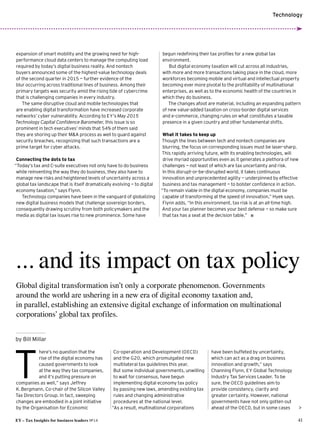
… and its impact on tax policy
	41	 The digital economy has led
­governments to look at the way
they tax companies. The resulting
pressure on companies generates
uncertainty, which can hamper
global performance.
Enhancing visibility
for ­indirect taxes
	46	 Indirect tax is one of the most
complex pieces of a company’s
overall tax profile. Coming to
grips with it must begin with tax
and IT professionals learning to
speak the same language.
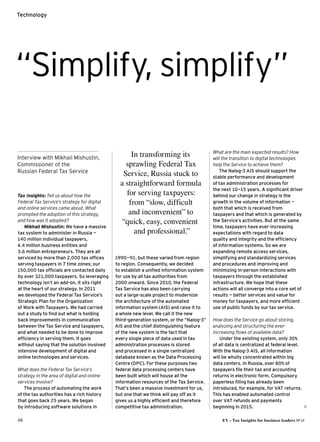
Interview
	48	 The Russian Federal Tax
Service is in the midst
of overhauling its 25-year-old
automated tax ­information
system. Commissioner
Mikhail Mishustin provides
his insights.
TAX ONLINE TAX PRINT
№ 14
FOCUS
Technology
Disruptive
change for tax
authorities
and tax functions
Hack attacks
and data protection
headaches
Unlocking value
from data
Mikhail Mishustin
Commissioner of the Russian
Federal Tax Service
10 EY – Tax Insights for business leaders №14
Technology
n a recent flight to China, I picked up a business
magazine from the inflight selection. In it, I learned
that more than 20% of companies in the top
1,500 US companies by market capitalization have
zero dollars of inventory recorded in their financial
statements.The largest is forecasted in 2015
to be a US$70 billion company — a company with no recorded
inventory whatsoever.
This is an astounding fact that underscores a massive and
permanent transition in the way we do business today. As the
Organisation for Economic Co-operation and Development (OECD)
stated recently, “The digital economy is increasingly becoming
the economy itself.”
O
by York Zöllkau, Europe, Middle East,
India and ­Africa Tax Leader, EY
Digital transformation has had — and will continue to have —
substantial impacts on how companies manage their tax functions,
for a great many different reasons. In virtually every case,
these impacts have disrupted the way the tax function carries
out its operations.
	 This comes at the same time as the tax landscape is changing
around us, driven by concerted actions by the G20 and OECD,
and creating additional risks.
In fact, such operational disruptions are identified as one of
the leading sources of tax risk by respondents to EY’s 2014 Tax
risk and controversy survey. When asked to identify the pressures
contributing most highly to operational tax risk, 75% of
respondents cited insufficient resources to cover tax function
Disruptive
influencesPutting technology
at the core of
the tax department
Technology
EY – Tax Insights for business leaders №14 11
activities, 64% cited insufficient internal communication,
while 57% cited a lack of process or technology.
An elusive definition
The biggest issue vexing tax leaders is that governments can’t
agree on what the digital economy is, let alone how to tax it.
Some want to tax it right. Most, unfortunately, want to tax
it right now. Because no consensus can be reached on how to tax
digital activities, companies have to deal with a patchwork of
national approaches, with new direct and indirect taxes emerging
at the city, state or national level on a weekly basis. Witness
Chicago’s ­so-called Amusement Tax, which affects streaming
entertainment companies.The additional compliance burden
created by such granular approaches presents a nightmare
scenario for business to have to manage.
When such taxes are considered across the geographic
footprint of a multinational company, it is easy to see why more tax
function resources must be assigned to monitoring and assessing
the impacts of new taxes, as well as measuring their impact on
uncertain tax positions, the tax provision, and overall effective tax
rates (ETR).That is unfortunate, when tax leaders could instead
be using their limited time to look at using technology to unlock the
value that undoubtedly resides in a company’s data.
As a second example, the UK recently introduced a Diverted
Profits Tax, intended to apply to large multinational enterprises
with business activities in the UK who enter into ”contrived”
arrangements to divert profits from the UK by avoiding
a UK taxable permanent establishment (PE) and/or by other
contrived arrangements between connected entities. Such taxes
may not only produce operational impacts, they may actually
require companies to restructure their operations. In that vein,
there are certainly more companies including explanatory
statements on tax risks and potentially increasing tax burdens in
their financial statements, indicating that internally, operational
disruption is also likely occurring.
Disruption ahead
Alongside policy disruption, many companies are leveraging new
technologies as key enablers within their finance transformation
programs; tax departments, in turn, must understand and
manage their roles in these transformative exercises, because
their good intentions aside, finance transformation can negatively
disrupt the tax function in two ways if not managed with due care
and attention.
First, and because of their very nature of regionalizing or
centralizing activities, they can result in the loss of highly
knowledgeable tax resources at the local level. As they standardize
and consolidate their operations, companies are effectively
striving to do more with less.
Second, the globalization or regionalization of processes can
lead to an erosion of skills and competencies. Take global VAT
compliance as an example: all of that activity may get moved from
well-established country teams and into a shared services location,
in a different part of the world, operated by people who have
been newly hired. That presents major risks but also opportunities
to enhance quality through better scale and focus.
Externally, new technologies are also supporting the many
global calls from the public, activists and governments for
heightened levels of tax transparency. From 2016 onwards,
the OECD has recommended that companies with more than
€750 million (or local equivalent) in revenues be required
to submit country-by-country reports on a number of different
tax and financial data points which they will need to draw
from their often distributed and inconsistent ERP systems.
This is placing distinct operational pressures on companies
already, as they run pilot programs which unearth the need for
new investment and headcount. Without such investment, few can
be sure that the data they provide is both available in terms of
system accessibility and data accuracy, but also clear and free of
anomalies which may not be fully understood by the tax
authorities, resulting in a potential audit or heightened scrutiny.
The disruption caused by new technologies does not end
with the transparency debate. Many countries are taking
advantage of digitization to pass new e-invoicing requirements
into their national legislation, while others are going a step
further, asking companies to provide electronic audit files
directly from their ERP systems. In every corner of the world,
we see new disruptions of this type, all layering new pressures
on tax department leaders.
Managing the technological transformation
As there is with every dark cloud, though, the leading companies
are finding silver linings in the disruption. Many tax departments,
for example, discover they can unlock valuable tax information
via the use of data analytics. Here, we see tax departments using
transactional analytics, tax reporting analytics, risk analysis
and monitoring, supply chain analysis, transfer pricing analytics
or other bespoke, targeted analytics in areas such as pricing
and margin modelling for new indirect taxes.
Despite the wide number of challenges faced by tax, there
are some common themes that affect tax departments. The first
is talent. While the tax function of 15 years ago may have been
focused almost exclusively on tax technical and planning skills,
companies today are now in search of tax people who are able to
manage new technology challenges.
The second area is investment. Here, many tax departments
are finding that the availability of new technologies either
internally or externally (i.e., to governments) means that a
technology race is developing, with each side pressing ahead
to do more to use technology to unearth new sources of value
or risk. Globalizing operating models mean that tax technology
systems need to be globalized also. Governments want to
secure greater volumes of financial data from companies; and
tax administrations are digitizing their end-to-end processes,
making it critical that business either keep up with
or exceed that pace of change.
Finally, the need to adopt and sustain new technologies
means that tax function leaders now need to sustain far better
relationships across the business, including with both the
executive layer, finance and IT. Investment budgets must be
advocated for, new technologies must be acquired and
implemented, and the skills and competencies to put in play
opportunities such as data analytics must be secured.
These are all new skills for the tax department to learn and
implement, at a time when the very world of tax is changing
around them. ı
12 EY – Tax Insights for business leaders №14
Technology
Business
unusual –
The future is here –
and some tax authorities
got here first
EY – Tax Insights for business leaders №14 13
Technology
People have embraced technology as part
of everyday life. In the future, so-called
­wearables — glasses, wristbands, clothing,
sneakers and other items embedded
with technology — will allow users to monitor
their ­health, take pictures, play computer
games, and even enhance their performance
in the workplace.
Credit:MardisCoers/Kontributor/GettyImages
14 EY – Tax Insights for business leaders №14
Technology
by Dr. Paul Kielstra
he old world of tax planning, provision and
compliance, as well as the old tax function 
that went with it, are being transformed 
by advanced information technology. 
Often, it’s governments, such as Brazil’s
catalyzing change.
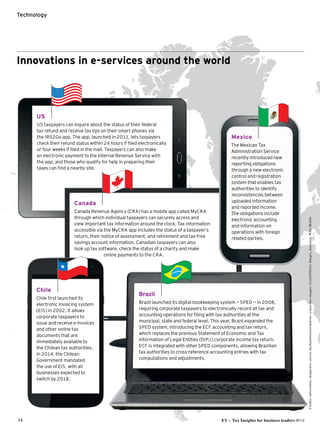
Over the past decade, Brazil has imposed
various requirements on companies to provide
highly detailed business information, in some cases in real time.
Two are particularly noteworthy. First, all billing for goods and
services must now take place through one of several electronic
processes. Each of these involves, as an early step, communication
of the invoice to the government. Tax authorities must evaluate
and approve the information on it before the transaction it covers
can proceed. In effect, the authorities now know of every sale
before it is legally completed and can block ones where they
dispute the level of indirect tax.
Second, Brazil now requires companies to use a standardized
public digital bookkeeping system (SPED) with separate 
subsystems for accounting and tax. These replace traditional
bookkeeping ledgers and, at the end of each year, companies 
must submit their complete SPED files — a detailed record 
of every single business transaction — to the authorities.
The result is such a high level of transparency that the ongoing
need to file annual indirect or direct tax returns may soon be
redundant, or at the very least turn into simple reconciliation
events. As Gary Paice, EY Americas Director of Tax Performance
Advisory, puts it, in such circumstances “the idea of filing is 
not relevant per se. If you send an invoice in real time, what
opportunity do you have to do anything after the fact?” Chris
DeVito, Sr. Director, International Taxation at Johnson  Johnson,
agrees. In a decade or so, he notes “the government will calculate
the tax return for you; tax compliance professionals should have
very little manual work to perform.”
The nature of the audit is also fundamentally different. 
Aidan O’Carroll, EY’s Global Compliance and Reporting Leader,
explains that “Brazilian tax authorities, by law, can directly
interrogate the information in a taxpayer’s financial system and
come to a conclusion based on the information they retrieve.”
Governments at the forefront
Brazil is far from alone in its use of IT for tax oversight. DeVito
notes that in many countries “tax inspectors want to drill into 
what you are doing and why. It’s getting to be more and more of a
challenge for companies.” In Latin America, Argentina and 
Mexico have developed similar systems for electronic invoicing
and, further afield, China is doing so. Even if not interposing
themselves in transactions, numerous governments are extracting
data directly from corporate systems as part of VAT and GST
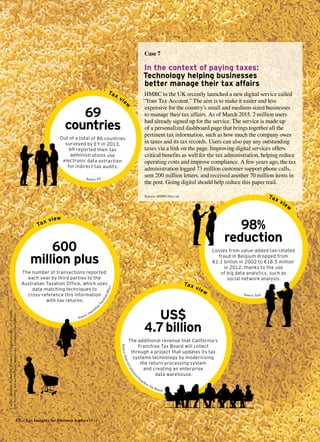
audits — at least 69 countries, according to an EY survey in 2014.1
As for income tax, Russian authorities have begun putting in
place their own system to interrogate company financial records
directly. O’Carroll says, “The vision of the Russian tax
administration was clear that the need to submit a formal tax
return may well become redundant. This may become the case 
for a number of countries where authorities have the ability 
to inquire directly into corporate records and come to their own
view on what is payable.”
Although most of these examples are from emerging 
market countries, the trend is visible in developed ones as well.
Australia has already expressed interest in developing the ability 
to interrogate directly corporate records there.
Changes will reach every level: Jim Buttonow, Director 
of Tax Practice and Procedure at HR Block and Chairperson of
the Internal Revenue Service’s (IRS) Electronic Tax Administration
Advisory Committee, expects that in the United States the 
IRS will establish online accounts within seven years for 
all individual taxpayers and small businesses. These will allow 
real-time interaction and constant maintenance of a zero balance
on taxes payable.
It is not common for governments to be on the leading edge 
of applying technology, says Ray Imbrogno, Sr. Director, 
Global Tax at Pfizer. “Today, the interesting stage in the process of
greater use of technology is the increasing sophistication on the
government side,” he says.
This acumen has transcended administrative matters such as
processing return filings and collecting payments to include
competencies like direct interrogation and analytics. Information
technology now gives tax authorities the ability to obtain far
greater transparency into company activity. Paice recalls 
a VP of Tax in a country with electronic invoicing telling him that 
“the government sees the data before I do.”
With comprehensive, granular information on all company
financial activities, tax authorities can ensure greater compliance
and accuracy. Already, for example, some governments are
exploiting greater data to apply complex rules-based algorithms 
to assess errors and decide on targets for further investigation. 
The resulting audits, O’Carroll adds, are real-time and “capture
more tax, more quickly and prevent tax avoidance rapidly 
rather than having to deal with cases that are potentially several
years old.”
In the very near future, even substantial retrospective action
may seem old-fashioned. Buttonow predicts that tax authorities
“will become much more engaged in prevention than in post-filing
actions. The cost difference is tremendous: prevention is the 
best way to go.”
Indeed, at an extreme, a jurisdiction could, based on 
a full knowledge of the business’s economic activity, simply 
Technology is disrupting the way the
tax function works. As tax authorities
adopt new tools and systems to keep
better track of taxpayers, companies and
and their tax liabilities, ­employees need
to change their mindset and recognize
the opportunities and ­benefits that
technology will bring.
T
EY – Tax Insights for business leaders №14 15
Technology

stop companies from adopting objectionably
aggressive tax positions from the outset. The
development of greater cooperation between tax
authorities and need for country-by-country
reporting under BEPS will only add to the tools at
the disposal of even relatively poor governments ­—
especially as the accounting and IT costs involved 
in providing this data are borne largely by the
companies themselves.
If knowledge is power, tax authorities will have 
a far greater sway than ever before. As Robert
Norton, Chief Income Tax Officer at Vertex, 
says, these developments may “take a while to
become more widespread, but they are coming.
They will catch some companies off guard.”
Wanted: tech-savvy tax function
Many companies are surprisingly ill-prepared for
the technological requirements governments are
imposing and their implications. As Paice puts it,
“the drivers in tax are changing enormously, but
most tax people are adapting new technology only
when the things around them force them to.”
Norton agrees, saying that, in his experience as a
vendor, “tax people don’t see the value of new
technology. They have been using spreadsheets for
most of their tasks for over 20 years and are 
slow to grasp new technologies that would replace
them even though this would very likely improve
controls and efficiency.”
This reflects not hostility to information
technology per se; use of tax modules in ERP
systems and tax elements in data warehouses have
grown more sophisticated over the years. Instead,
the particular needs of the tax function in the past,
as well as its traditional position within the company,
have given it an often justified reputation for slow
adoption of technology.
“Tax is a subject that is very different country-
by-country,” O’Carroll says. “The skill set that 
you want has historically been focused on national
and international technical laws, and not led by
technology.” Any software, he adds, has to 
date been both complex and country-specific,
requiring a multinational to purchase numerous
national software solutions that do not typically
work together.
Moreover, reliance on complex tools that they 
do not understand inside-out does not come
naturally to tax practitioners. Imbrogno jokes that if
“they could do what they do with a calculator and
paper, they would probably still be doing it.” The
reason, he explains, is that tax people want to verify
and confirm data as much as possible because 
of the potential exposure the company would face 
if they got it wrong.
If anything, current trends will only strengthen
this tendency. In the past, Imbrogno says, the tax
Johnson  Johnson: a tax function
lays the ­foundation for the future
Given the ever-increasing focus on tax compliance and reporting
in today’s business environment, the traditional approach
to tax at American multinational Johnson  Johnson (JJ) was
no longer ­sustainable.
In the past, tax at JJ had been a decentralized activity:
different local operating units used diverse technology tools
which required manual intervention to integrate; and outside the
US, the company often relied on non-tax professionals in
Finance rather than specialists.
To better meet current challenges, the company is moving
toward a global tax function, a project which Larry Kanner,
Sr. Director Global EPS Tax, says JJ has “identified as of critical
importance.” This does not mean complete centralization. Some
activities will remain local. Nevertheless, the corporate
level will exercise overall governance and, insofar as possible,
processes and technological tools will become standardized.
New technology will be essential to this transformation,
eventually allowing automated provision across much of the world
and the elimination of substantial manual and spreadsheet-based
work. To get to that point, JJ is putting some essential basics
in place.
This begins outside the tax function, says Chris DeVito,
JJ’s Sr. Director, International Taxation. “The key to make
advanced analytics and cognitive computing work is its integration
and alignment with the underlying data.” The most important
step to allow the use of these tools is making data legal entity
compliant when generated and across the entire ERP system.
“A lot of companies overlook that, but they will have nothing but
problems.”
As a result, the tax function is heavily involved in JJ’s
current, wider finance ERP and data warehousing transformations.
“For the tax function to be effective, it has to be integrated,”
concludes DeVito.
Meanwhile, the tax function is also adopting more advanced
software in areas where it has lagged behind to date. Kanner lists a
few basics, such as calendaring automated provision, and audit
management.
Finally, the company is addressing the cultural barriers to
technology adoption. DeVito explains that “we are trying to
educate the JJ tax community that ‘Excel is manual – period.’ ”
Those in tax are being challenged to adopt more advanced
solutions as and when they become available rather than reflexively
defaulting to last year’s spreadsheet.
16 EY – Tax Insights for business leaders №14
Technology
function’s deliverable was a return and the defense of the numbers
within it. Now, with jurisdictions increasingly seeking to get data
from the source and saying how they think it should have been
reported, “the onus will be on the tax function to really look at the
data and do an internal audit of themselves.”
Meanwhile, tax has for decades been a notoriously isolated
function in many businesses. As a result, company-wide
technology decisions have frequently failed to take account of its
needs. Paice explains that “data is often not aligned in a way that
tax needs, with companies using a business rather than a legal
entity analysis. For the tax function, the challenge is not just
looking for big data, but good data.”
The result, says Norton, is that “tax people spend most of their
time just pushing data around. In looking through data systems
designed for management or financial reporting, those needing
legal entity data for tax reporting are left to fend for themselves.”
This eats into not only the time in which they could be providing
more value-added analysis for the business, it also leaves little
spare time to implement new technology. “They are so busy
crossing the t’s and dotting the i’s in terms of compliance and
reporting, they don’t have the time to envision what the world
could look like,” he adds.
This state of affairs is no longer sustainable, especially in
countries which require increasingly granular tax data from
companies provided in specific formats.
In the inevitable transition, though, tax functions should
embrace new technological opportunities rather than having IT
thrust upon them. They provide the tools that companies 
will need to thrive in the new regulatory environment.
The promise of analytics and cognitive computing
Data analytics — or big data when applied to increasingly large
databases — are already transforming companies for the better: 
a 2013 survey published in the MIT Sloan Management Review
found that 67% of executives believed use of analytics improved
the company’s competitive advantage significantly.2 There is no
reason why the tax function could not benefit to a similar degree.
Although still not widely deployed, the potential of an imminent
flowering of cognitive computing — with its ability to use natural
language and draw on structured and unstructured data — is even
greater than current analytics. More important, cognitive tools
handle specific complex problems from a generalized interface 
and show the user how they drew their conclusions. They may
therefore represent the general tax tool capable of finally weaning
tax functions from ever more complex spreadsheets.
The most obvious use for such technology is to catch up where
tax authorities have gone ahead. Paice says that “most corporate
tax departments are unaware of exactly what capabilities are in
place at the government and what is actually being tested.
Moreover, they have few mechanisms for examining analytically
what the authorities are looking for.” This should not be the case.
Imbrogno believes that “if a government can ask for information
and do analytics, chances are the company can do the same 
thing. Increased reporting requirements will lead to companies
doing a lot of internal analytics before data leaves.”
This is part of an even broader approach to enhanced risk
management which new technology opens up. O’Carroll explains
that tax functions will need “to do intelligent analytics to identify
areas of weakness early in the process because they will need to
respond to authorities more quickly. Tax functions need to improve
here,” but, he adds, “the necessary tools are already appearing.”
Cognitive computing could be even more powerful in this area,
making it easier for tax functions to predict where problems might
happen. Tax managers could then address those potential risks
before they occur.
Risk management, however, is only part of tax management.
Advanced analytics can help across the entire tax life cycle of
planning, accounting, compliance and controversy. This activity is
currently more advanced in indirect taxes than elsewhere, but the
benefits already have the potential to be substantial. At one global
pharmaceutical company, EY’s analytics not only reduced
compliance risk on VAT by improving accuracy, they identified
€4.5 million in cash savings and improved the working capital
position by €150 million.
Possible applications range from the very specific — such as
data-triggered transactional error or compliance warnings — 
to providing detailed scenarios and models to drive strategic
decision making around not just tax but areas such as the supply
chain as well as general risk management.
The ultimate promise is a function less encumbered by the
mundane tasks of data manipulation and more able to make a
strategic contribution to the business.
Tax does not yet seem to be embracing this brave new world. 
In a recent EY survey of nearly 1,000 tax and finance executives
in 27 countries, only 21% reported that they used any form of
custom software — many presumably not analytics-enabled — for
tax modeling. More used spreadsheets, or did the work by hand.
Similarly, just 41% used some type of custom tool for data
warehousing and roughly 70% believed they would require
additional resources for the immediate challenge of collecting
information required under BEPS, let alone doing more advanced
things with company data.3
This slowness may reflect the problem that, while essential,
purchasing new IT tools will only be a first step. To benefit 
from the promise of analytics and cognitive computing, tax
functions will have to change how they operate and find a new
place within companies.
A new role for the tax function
At most businesses, the tax function needs to learn to walk before
it can run when it comes to applying technology. In order to derive
In a decade or so “the government
will calculate the tax return
for you; tax ­compliance
professionals should have very
­little manual work to perform.”
Chris DeVito
Sr. Director, International Taxation
at Johnson  Johnson
EY – Tax Insights for business leaders №14 17
Technology
the benefits of analytics and cognitive computing, they will 
require far better data than currently available. Spending
substantial time reshaping and manipulating information gathered
for other purposes will not work in a world where real-time
compliance is already a requirement in some jurisdictions and
companies are looking for rapid insights into data.
To get tax-sensitized data with the speed needed goes beyond
modifying ERP systems — no small task in itself. “Tax calculations
and categorization will need to be pushed upstream” to wherever
relevant data is generated within the company, Paice explains.
In order to engage in the conversation needed with colleagues
to bring this about, tax functions will have to develop new skills,
according to Paice. “The typical tax person is not very technology­
savvy (in general). Few departments have any personnel who are
‘power users,’ and most barely have ‘users.’”
O’Carroll adds that at many firms it would represent “a real 
step change for the tax function to truly understand how an 
ERP system operates and how to interrogate it for information in
real time.” In the future, the tax function will need to understand
and use technology far better.
One useful approach is creation of a tax technology group 
as “a bridge between the ERP world and a very focused tax
environment,” says Imbrogno. This is not, however, a way to
sidestep the skills issues; for Imbrogno “the key attribute 
of an ideal colleague” for such a group is that he or she is a tax 
person with an affinity for technology, not a programmer 
learning about tax.”
Beyond raising its technology game, engaging with the
company in the necessary way will mean a significant cultural
change across the company so that tax works in partnership 
with various functions, in particular finance and IT.
For its part, tax will have to become much more familiar with
how the rest of the business operates and how it generates data. 
It can no longer retreat to its silo.
At the same time, tax has to raise its profile so its needs 
are understood and accommodated. Here, the large number 
of finance functions currently experiencing data-driven
transformations represent a golden opportunity. So will the
adoption of cognitive computing systems more generally by
businesses in the coming years. As Imbrogno notes, though, in
such situations, “tax organizations have to fight their way to 
the table to make sure the way information is generated takes 
into account tax data requirements.”
Paice explains that this involves educating colleagues. “The
finance team is not used to tax being so integrated into early
processes. The tax leader has to be able to tell people how and why
this vision should change, that tax will be playing a somewhat
different role and be embedded in the business to a greater degree.”
In practice, other parts of the company are likely to welcome
this greater embeddedness once they see its advantages. This 
can start very early in the process. Kevin McWilliams, VP Tax 
at International Paper, recalls that when his department engaged 
in discussions at the start of his company’s recent financial
transformation effort “after people understood what we needed,
we found a lot of them saying, ‘Gee, that’s great. We could use 
that level of detail too.’” He adds that it was therefore possible to
create “a coalition of the willing” within finance to design
infrastructure that serves the whole organization.
Once such partnerships are set in motion, the benefits will 
grow because working with trustworthy information will free up
substantial time within the function. This will allow it, in Imbrogno’s
words, “to focus on the result rather than understanding all of 
the data.”
By permitting the department to focus on more value-added
activities all will gain, adds Norton. As a result “insights will 
be much more available to business operators to help them
understand the tax dynamics of the business.”
Companies, then, in order to keep up with the increasing
requirements of regulators have little option but to exploit 
the latest developments in information technology. Doing this 
right will benefit the whole business.ı
1	 “The age of big data: challenges and opportunities for indirect tax strategies,”
Performance, August 2014.
2	 David Kiron, Renee Boucher Ferguson and Pamela Kirk Prentice, “From Value 
to Vision: Reimagining the Possible with Data Analytics,” March 2013.
3	 See survey results in Managing operational tax risk: Find the right people,
processes and technology to manage record-to-report risks, EY, 2014.
Key action points
•• Ensure that the tax function has the technology
needed to meet increasingly granular and
­real-time information filing and compliance
­requirements in the near future.
•• Learn what analytic tests tax authorities are
likely to apply to company data and proactively
assess the data for accuracy.
•• Create a vision of the future tax function,
­including not just its more exacting data needs
but a present and forward-looking culture that
works closely with, and provides strategic value
to, the whole company.
•• Improve communication. This includes with
business partners in the company in order to
carry out the new vision, and with tax authorities
to address the more pressing ­requirements of
real-time compliance.
•• Make tax-sensitized data at the point of
­generation the norm throughout the company.
•• Develop the skills within the function to use
technology more intensively and work in closer
partnership with other parts of the business,
­especially, but not exclusively, finance and IT.
•• Consider ways that applying analytics and
­cognitive computing can make new or more
­effective use of tax-sensitized data.
18 EY – Tax Insights for business leaders №14
Credits:AndrasKralla,EikoKink
Technology
t 1.3 million inhabitants,
tiny Estonia isn’t so tiny when
it comes to technology.
Since the collapse of the
Soviet Union in 1991, Estonia
has achieved a series of technological
“firsts” — including a smart photo ID card
and online voting — that have made it the
envy of more developed nations. The
country also recently introduced an
effective automated system for combating
VAT fraud. Now, the government has come
up with a scheme for letting nonresidents
in on some of the technological benefits
that Estonians enjoy.
For most of the last decade, Estonia
has ranked among the top 20 in the World
Bank’s Ease of Doing Business Index. In
2015, it came in 17th. Much of that
success is a by-product of the country’s
support for and investment in electronic
government infrastructure.
Beginning in 2000, for example, the
Estonian government embarked on a
series of e-government measures that
culminated in the introduction of a smart
photo ID card in 2002.
With the ID card, suddenly Estonian
citizens had a single, secure device that
could be used as a national ID card for
travel within the EU, a national health
insurance card, proof of ID for logging
Engineering
success
Estonia recently became the first country to offer the
opportunity to register as an e-resident. This is only the
latest in a string of innovations that the Baltic state –
known as “Silicon Valley with a moat” – has introduced to
ease the delivery of government services to its citizens.
by Giselle Weiss
A 
Small country, big idea
Despite this success, Estonia has a problem
familiar to many small countries, which is
how to achieve growth and wealth. A
logical answer to that question is “people.”
But in recent years Estonia’s population
has been declining.
Immigration is one solution to bolstering
a shrinking population. But, especially
today and in Europe, that’s a thorny issue.
Moreover, says Taavi Kotka, a software
engineer, entrepreneur and currently
Estonia’s CIO, “immigrants actually don’t
want to come to Estonia. The weather is
bad. And at the same latitude you have
Norway and Sweden, which offer way
better social benefits.”
If you can’t grow the population, what
about growing your customer base? In
September 2014, Kotka and fellow
government officials submitted an entry to
an Estonian Development Fund business
idea contest. Titled “10 million e-Estonians
by 2025,” the entry won the contest and
immediately garnered wide support from
the private sector and government.
The idea was to extend the already
established practice of issuing digital
IDs for residents, to nonresidents.
“Foreigners will be able to receive a secure
Estonian e-identity,” Kotka wrote in the
essay. “This creates a unique opportunity
to provide a new set of remotely usable
global services.”
E-residency isn’t about citizenship.
Rather, it’s about giving foreigners the
same rights as Estonians to execute
essentially every public and private
transaction in digital form.
For example, businesspeople from
neighboring countries could administer
existing Estonian businesses and real
estate online.
into bank accounts, a prepaid public
transport ticket in certain cities, for digital
signatures, for internet voting (i-voting),
for accessing private personal data in
government databases, and for picking
up e-prescriptions.
By 2007, Estonians could cast their
ballots from any Internet-connected
computer, anywhere in the world. And by
2013, some 95% of tax declarations in
Estonia were being filed electronically —
often with just a few clicks on a mobile
phone — compared with 84.5% in the UK.
“It sounds simple,” says Marek Helm,
head of Estonia’s Tax and Customs Board.
“But I can tell you, it was a kind of paradigm
[shift] in Estonian society.”
Taavi Kotka
Estonia’s CIO
Marek Helm
Head of Estonia’s Tax and Customs Board
EY – Tax Insights for business leaders №14 19
Technology
Freelancers and entrepreneurs could
use e-residency as a location-independent,
virtual business environment. Visiting
academics and tourists could enjoy the
same online benefits as locals. And
developers could benefit from e-residency
as a platform to scale their own services.
Most e-residents wouldn’t be paying
taxes to the Estonian government,
although the scheme’s designers do
envision Estonia being able to collect and
remit taxes due to other jurisdictions.
Instead, revenues for Estonia — and the
jobs those revenues would create — are
expected to flow from the demand of
e-residents, no matter how remote, for
auditors, credit, medical consultation and
other types of services within the country.
The number 10 million was more or less
random. “Basically we picked a number
because it’s ambitious, but not impossible,”
says Kotka. “Many VCs [venture capitalists]
have actually told me that this number is
not ambitious enough.”
Getting e-residency under way
Kotka launched a website that attracted
more than 4,000 subscribers its first day.
On November 1, Estonia’s parliament
unanimously approved legislation allowing
e-residency. The first e-residency card was
issued the next month, to a British
journalist for The Economist magazine.
E-residency employs the same
technology used for the residents’ ID card,
which means that the cost to the
government was essentially nil. A small
application fee (€50 euros plus processing)
covers the costs of implementation.
Prospective e-residents have been able
to apply online since May 2015.
Application is followed by a background
check, and ID cards, once approved, must
be retrieved in person from specified
Estonian embassies, consulates or police
and border guard board stations.
Asked about security, Kotka emphasizes
that the underlying technology — digital
signature and digital authentication —
has been in use in Estonia since 2002:
“We have built e-voting and very sensitive
stuff on top of that also. To our knowledge,
and according to our studies, it has never
been breached.”
New e-residents reveal mixed results
using the service. Says Kotka, “It’s like a
chicken-and-egg problem. There won’t be
too many services before there is a
significant customer base. But at the same
time, customers actually expect to get
more services.”
To date, 5,000 people have applied for
e-residency, and 4,500 have received it.
According to Kotka, the government
doesn’t have to explain its reasons for
turning down an application. A negative
background check is one factor. Another
deterrent to completing the process may
simply be the need to pick it up in person.
“During the first year we thought if we could
get 2,000, it would be nice,” says Kotka.
“Now it seems that we will get 10,000.”
A culture of e-government
E-residency is not the only technological
initiative under way in Estonia. Another
current focus is combating value-added tax
(VAT) fraud.
VAT is the government’s second-largest
source of income (behind social security
contributions). But fraud is admittedly
widespread.
In 2012, for example, the Tax and
Customs Board estimated €222 million
lost to fraud out of a total of €1.5 billion
in VAT revenues. “VAT fraud is like a
business sector itself,” says Marek Helm.
Together with the Tax and Customs
Board, Taavi Kotka’s team devised a digital
system for automating VAT control in
Estonia. Companies were required to
report any b2b transaction over €1,000
to the tax authority.
Previously, businesses were obliged
simply to report the total amount of output
VAT (VAT charged) and input VAT (VAT
paid). Now they must provide the details
corresponding to that total amount.
Consequently, the tax authority is able to
analyze the entire transaction chain, and to
target its audits more precisely.
The new system sparked opposition
especially from small and medium-sized
entities. But it had the attraction of
simplicity and transparency. And it resulted
in a 12% improvement in VAT capture.
“That’s huge,” says Kotka. In July 2015,
the Estonian Tax and Customs Board
reported that businesses had paid
€95 million more in VAT the first half
of the year than in the equivalent period
for the previous year.
The Estonian government has also
announced a “no-legacy” principle that
would require renewing state IT systems
and technologies at specified intervals
to remain state-of-the-art. Other
technology-related reforms being
discussed include personalizing education
for students, and optimizing access to
health care.
Kotka himself is already thinking
about how to ensure data continuity in a
world where government services are
increasingly online. Options include
backing up data both within the country,
and on foreign servers, in what Kotka calls
“data embassies.” Both e-residency and
data embassies are consistent with
Estonia’s self-declared move toward “a
country without borders.”
No other country has commented
officially in the English-language
media on Estonia’s e-residency program.
Elsewhere, Kotka has enumerated several
risks — sustainability, public relations,
ID theft, cyberattack — but none that
suggest other countries might have
a problem with the idea. In contrast,
he says, interest is keen.
Estonia may have been first, but it is
unlikely to be alone for long. The EU is
working on an electronic ID as part of its
Digital Agenda for Europe that includes a
digital economy and a digital single market.
Already far ahead, and itself part of the EU,
Estonia can serve as a role model. It has,
after all, over two decades of experience,
from e-tax, to e-police, to e-school.
Marek Helm sums it up like this: “It’s a
way of living.” ı
Key action points
for administrations
•• Review e-services for effectiveness
and ease of use or if not yet
committed to e-services, investigate
efficiencies and demand for them
by stakeholders.
•• Consider whether a “no-legacy”
approach might relieve you of the
cost of maintaining outdated
systems.
•• Depending on your location, if you
are heavily invested in e-services,
consider whether your contingency
systems are sufficient to protect
your data from extraordinary events.
Technology
20 EY – Tax Insights for business leaders №14
From good
to outstanding –
the technology-
enabled tax
function
The days of manually analyzing 100,000 lines of data
are quickly coming to an end. Technology is
transforming tax functions, helping them to save
time and do more value-added analysis.
EY – Tax Insights for business leaders №14 21
Technology
Credits:arlindo71 / GettyImages,SilviaReiche / GettyImages
hat would it mean to be an “outstanding” 
tax function? Is the idea a pipe dream or 
a realistic possibility? In fact, global shifts in
governmental tax policy and the increasing
need for the tax function to show value 
have made the shift from good towards
outstanding not just a possibility for today’s
tax departments, but a mandate. And technology is the linchpin 
to making it happen.
New technology, new capabilities
A discussion about enhancing the tax function using technology
begs the question, “so what’s new?” After all, for example,
automated tools that reduce reliance on duplicative, error-prone
manual spreadsheets are not new.Yet surveys of the Fortune
1000 indicate that more than 50% of respondents continue to use
spreadsheets to calculate and consolidate their tax provisions,
suggesting that certain aspects of automation may still be 
relatively “quick wins” for many companies on the road towards
excellence.
Likewise, the concept of a tax department integrating more
effectively with their company’s financial reporting systems is not
new either. What is new is that more powerful tax tools and ERP
systems have become available. “A few years ago,” says Andrew
Burman, a tax technology partner with EY in London, “tax had 
to accept whatever data came out of the ERP system and rescue
what they could, often developing their own offline pieces of kit 
or putting data in Excel and playing around with it.”
Now, much more powerful and flexible inherent systems in
both finance and tax allow automation and the elimination of much
duplicate work and provide better information to tax. A process
that used to require manually wading through 50,000 or 100,000
lines of data can now be an automated system with business rules,
checks and balances that requires only a double-check of a small
handful of invoices.“You can save substantial time and produce
more powerful information,” Burman says, “while also enabling a
value-added review process at the other end that wouldn’t have
been possible in the same way a few years ago.”
How companies use visualization software to compare VAT
rates across jurisdictions is one such example. “If the VAT rate in 
a particular jurisdiction is 19.6%, and the average for that location
is showing as 21%, a potential problem has been identified,“ 
says Daren Campbell, a partner in EY’s Tax Technology and Data
Analytics Services.
“The user can click on that jurisdiction and the data will be
broken out, showing all the items where you paid more or less than
the 19.6% and you can keep drilling down. Before, companies
really weren’t able to do that, but with the new tools, companies
can now look at every transaction.”
This can lead to large refunds, he says, because the analytics
often reveal that a company has paid tax where it shouldn’t, 
as opposed to missing tax where it should have paid. “The tools
and technology have expanded to allow a better and much 
more efficient way to look at information. Visualizations allow us 
to identify outliers and quickly drill down and review and make
determinations on those outliers.” 
W
by Gerri Chanel
22 EY – Tax Insights for business leaders №14
Technology
New external pressures
Not only is technology stronger than ever, so is pressure to meet
external demands for tax-related information and transparency.
From OECD country-by country reporting and its Common
Reporting Standard to the U.S. Foreign Account Tax Compliance
Act (FATCA) to other legislation, governments across the globe are
demanding unprecedented amounts of information.
Moreover, disparate groups want different information and in
different formats. Increased use of more powerful technology
offers the only practical solution to meeting these demands and to
enhancing the likelihood that the information provided to these
disparate users will also be consistent.
When companies aren’t prepared, significant disruptions can
occur. For example, some countries in Latin America are now
demanding an almost contemporaneous feed of company invoices
and/or journal entries and trial balances, often in their own
designated format.
“It’s a real paradigm shift,” says Carolyn Bailey, EY’s Digital
Government Tax Transformation Leader for Latin America. Very
big companies doing business in Latin America are being refused
refunds because they cannot provide data to the taxing authorities
the way they’re being asked to provide it, she says “Companies in
business for a century are having problems complying with the
rules, as are new companies that are growing like crazy, but their
systems, processes and data are just not ready to comply with
these kinds of rules. And it is only likely to get worse.”
The road to “outstanding”
An outstanding tax department is one that is “absolutely
integrated with the business and is leveraging technology to
deliver value to the business,” says Albert Lee, EY’s Asia Pacific
Tax Performance Advisory Leader. “A tax function whose data
needs are well-integrated into the company’s financial systems 
can harness a huge pool of ‘big data’ in a strategic way,” he says,
rather than gathering and manipulating scraps of data on a
request-by-request basis. “This allows a tax function to spend
much less time doing manual data-gathering and much more time
doing analysis and driving value.”
Many roads lead towards “outstanding.” The path can begin
with individual projects to improve or replace a spreadsheet-based
process all the way to a holistic, strategic redesign of a tax
department’s function. The challenge for many companies, says
Burman, is simply knowing where to begin. The first step might be
an exploration of the tax department’s current frustrations or
“pain points,” which can result in a number of short-term, “quick
wins.” The next step is determining where the tax department
should be to meet not only current demands but also those on the
horizon and then developing a road map — an operational strategy — 
to make it happen. A technology strategy — the tools and systems
intended to achieve the operational strategy — is a parallel process.
It is critical, Burman, says, that the tax function integrates with
the business as much as possible so that it will be involved in any
systems design in order that the resulting systems will gather data
needed for tax and in a way tax can use. Another common
challenge, says Burman, is getting financial buy-in for the plans,
which often means increasing the CFO’s awareness of how tax
does what it does and the inherent level of risk in the tax area.
Sally Stiles, Chief Tax Officer for Caterpillar, Inc., the world’s
leading manufacturer of construction and mining equipment,
diesel and natural gas engines, industrial gas turbines and
diesel-electric locomotives, says, “If I had to tell a group of CFOs
why they need to invest in their tax operations, I would say that
they need to fully understand the amount of risk on their financial
statements from tax, which is one of the biggest numbers on the
financial statements.”
Many of these risks are different from the past, she says.
“There is an enormous amount of competition among countries to
grab as much tax revenue as they can and this is not something
that is going to go away. Companies will have to defend against
unreasonable government positions and face the increase in data
requests and resulting assertions, which are going to become
more and more onerous from countries around the globe.”
Transforming the tax department — the Caterpillar project
Caterpillar is one global company that has commenced a strategic
rethink of its entire tax function. What led the company to begin
such a massive undertaking? “There wasn’t a single event that led
us to transformation,” says Stiles. “However, there was a growing
awareness that there weren’t enough of us to go around [and]
there was a great need within our business to be better partners,”
says Stiles.
One of the key objectives for Caterpillar’s planned
transformation − a long-term initiative still in progress − is to
create more transparency over its global operations. As Stiles 
and her people looked at how to achieve this, “the first thing 
we realized is that we really didn’t have a strategy in place, so the 
first thing we did was to ask ourselves how the tax department
should set up its operations to have a world-class view from 
a Caterpillar perspective.”
Key action points
•• Use data and analytics to drive value from 
the tax function.
•• Seek opportunities to use technology to reduce
duplication of effort and manual entry errors.
•• Identify “quick win” opportunities for short-term
progress that will also help to achieve
longer-term progress.
•• Leverage systems already used by other areas
of the business.
•• Develop an effective tax technology and 
data strategy and understand the “art of the
possible” for your business, what needs to
change and how.
•• Use technology to integrate tax with the rest 
of the business.
EY – Tax Insights for business leaders №14 23
Technology
A crucial part of the vision involves the points of intersection
and integration with the finance function. Some elements of the
company’s tax transformation can be undertaken independently,
but other aspects must be done in conjunction with a very large
finance transformation. It is a significant challenge to find the time
to do both, Stiles says, “but recognizing that finance
transformation is part of the solution for tax transformation”
makes it worth the effort.
Another challenge, she says, is ensuring that the tax agenda
and resources are embedded in the finance transformation.
Overcoming this challenge involves, in part, making connections 
to, and working with, leaders on the finance transformation 
team to explain the role of tax and the potential costs of not having
the company’s finance systems properly tax-enabled.
These are ongoing challenges, with the transformation of
Caterpillar’s ERP system planned to continue for several years.  
Caterpillar’s vision encompasses many uses of technology,
including, among others:
• self-serve access to data by tax professionals with a good
understanding of underlying systems and tools,
• a tax data repository to support reporting, planning
compliance and audit defense, and
• an integrated framework of applications designed with
processes embedded and data optimization. These will include 
a single source of data for all processes, integration with tax
calculation engines and analytical tools and an integration 
with finance resulting in an accelerated financial close cycle 
with respect to tax.
Caterpillar’s ongoing transformation is intended to be
all-encompassing. For a selection of specific technology-based
improvement examples, see the table below.
From good enough to outstanding
Five years ago,“tax generally took what information the business
produced and made the best of it,” says Burman. That may 
have been “good enough” then but it’s a standard that no longer
measures up in an environment presenting more external
demands and risk than ever before and simultaneously, more
internal pressure to do more with less and do it all faster. 
A well-developed and effectively deployed operational tax
technology strategy is key to addressing these challenges.
Creating and executing such a road map will put a company’s tax
function on the road to excellence in the short term and best
prepare it for the years and challenges ahead. ı
Sally Stiles, Chief Tax Officer of Caterpillar, Inc., participated in an 
EY webcast on “Tax and Finance Transformation” on October 13, 2015.
To access the webcast, visit the ‘On-demand’ section at ey.com/webcasts,
or use the following quick link: http://bit.ly/1Khp50d
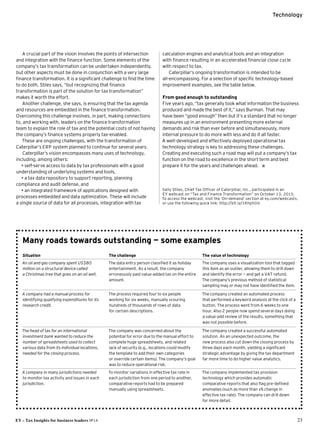
Many roads towards outstanding — some examples
Situation The challenge The value of technology
An oil and gas company spent US$80
million on a structural device called
a Christmas tree that goes on an oil well.
The data entry person classified it as holiday
entertainment. As a result, the company
erroneously paid value-added tax on the entire
amount.
The company uses a visualization tool that tagged
this item as an outlier, allowing them to drill down
and identify the error — and get a VAT refund. 
The company’s previous method of statistical
sampling may or may not have identified the item.
A company had a manual process for
identifying qualifying expenditures for its
research credit.
The process required four to six people
working for six weeks, manually scouring
hundreds of thousands of rows of data 
for certain descriptions.
The company created an automated process 
that performed a keyword analysis at the click of a
button. The process went from 6 weeks to one
hour. Also 2 people now spend several days doing
a value-add review of the results, something that
was not possible before.
The head of tax for an international
investment bank wanted to reduce the
number of spreadsheets used to collect
various data from its individual locations,
needed for the closing process.
The company was concerned about the
potential for error due to the manual effort to
complete huge spreadsheets, and related 
lack of security (e.g., locations could modify
the template to add their own categories 
or override certain items). The company’s goal
was to reduce operational risk.
The company created a successful automated
solution. As an unexpected outcome, the 
new process also cut down the closing process by
three days each month, yielding a significant
strategic advantage by giving the tax department
far more time to do higher value analytics.
A company in many jurisdictions needed
to monitor tax activity and issues in each
jurisdiction.
To monitor variations in effective tax rate in
each jurisdiction from one period to another,
comparative reports had to be prepared
manually using spreadsheets.
The company implemented tax provision
technology which provides automatic
comparative reports that also flag pre-defined
anomalies (such as more than x% change in
effective tax rate). The company can drill down 
for more detail.
24 EY – Tax Insights for business leaders №14
Technology
Weak link –
improving data
security
In the digital era, companies and governments are racing
to stay ahead of thieves and protect personal data.
by Joseph Stanley-Smith
he age of criminals sneaking into buildings
in the dead of night to steal secrets is over.
Should infiltrators want to take information
from a company in the 21st century, they are
likely to break in completely undetected in
broad daylight, taking several months to
explore every room and high-security vault to
assess what is worth stealing. Then — and only
then — will the hackers strike.
The security guards one might expect to be monitoring cameras
or pacing hallways are instead hunched up over their computers,
poring over web traffic on the group network, hoping to spot
anomalies. In the face of ever-developing threats, companies must
be vigilant to equip themselves against cyber criminals who are
moving faster than most national governments can keep up with.
“You can’t realistically stop an infiltration of a network by a
hacker if they really want to get in — I don’t care how good
your encryption and your security is,” says Scott DePasquale,
Chairman of the Rhode Island Cybersecurity Commission.
“What you can prevent is them taking and exfilling [extracting]
that data and information out.”
A sophisticated hack can be catastrophic for a company.
If it is executed with skill and precision, companies can lose
sensitive product information to corporate espionage, reams
of consumer information to malicious hacking syndicates
and potentially a significant chunk of its share price once the
world finds out — and find out it will.
For tax departments, data loss is particularly dangerous.
Company data will contain tax information which is only required
to be disclosed to tax authorities. Companies do not want this
commerically sensitive information stolen and disclosed publicly.
The tax world has recently seen the leakage of confidential
documents, first in Hong Kong and then later in Luxembourg.
Both leaks triggered extensive press coverage, much of it negative
for companies.
Guarding personal data
As if the threat of data loss were not enough, companies
operating in the European Union (EU) will soon have to contend
with harmonized legislation designed to protect consumers
from having their data lost, stolen or exploited.
“Personal data protection, as of today, is not a priority in
practice,” says Fabrice Naftalski, an EY Practice Group Leader —
IP/IT Data privacy. “Confidentiality is a priority because companies
want to protect their know-how, their strategic information, their
financial information — but they are not very interested in the
protection of personal data. That’s something that needs to be
improved in the management of transactions.”
The EU’s data protection regulation (the Regulation) asks much
more of companies when it comes to data privacy and security,
making them more accountable in their role as data custodians.
“It’s not accountability as in the US, [where] very often when
you speak from accountability you refer to self-regulation,” says
Naftalski. “Under the EU Regulation, companies will have to
implement specific procedures, specific tools, as provided by the
regulations. There will be less flexibility.”
The Regulation was first presented in January 2012 by the
European Commission and is expected to be voted on by the
EU Parliament in late 2015 or early 2016. A two-year transition
period will follow, giving companies time to prepare to be
T 
EY – Tax Insights for business leaders №14 25
Technology
compliant. Impact assessments will be required for sensitive 
data processing. Customer information will have to be deleted
after a certain time period, and it may become compulsory 
for every company to appoint someone to take responsibility for
data protection.
Two years is not a long time to overhaul IT systems designed 
to store data rather than delete or obscure it. And although
compliance with the Regulation will make data far safer, the
penalties proposed in draft versions of the Regulation would
impose fines of €1 million (US$1.13 million) or 5% of a company’s
global turnover, groupwide, should companies fail to adequately
protect customer data.
Even more damaging for companies that suffer a breach is the
impact on share prices, exacerbated by another of the Regulation’s
stipulations: that companies must notify customers within 72
hours of data breach. When the PlayStation network, operated by
Sony Computer Entertainment, was hacked in December 2014,
account details of 70 million users were taken — and the company’s
share price tumbled by a tenth in one week. One website was
months from an IPO before data of 30 million of its users was
leaked online.
The easiest way to protect consumer data is to delete it as 
soon as it is no longer required. “German law says that if you don’t
need data anymore, then you must delete it, and if you must 
retain it, then you limit the access,” says Peter Katko of EY.
“For instance, you may buy what could be considered
“embarrassing items” online. Then you pay, and then warranty
periods expire, so there is no more need for the online retailers to
actually keep this data.”
This presents a unique challenge for tax departments, 
however. Many jurisdictions require companies to retain data 
for 10 years or more.
“Maybe you returned the items and the retailer deducted the
loss in the books because they had to unwind the purchase
contract, and then after eight years the tax authority questions
this,” hypothesizes Katko.
“You must prove this scenario, and therefore you have the
retention,” he continues. “But it must be ensured that only 
for such exceptional cases access to the files is granted, and that
not every retail employee or accounting employee has access.
Retained data must be really stored in full security.”
Incentives versus regulation
Governments outside of Europe will be carefully watching the
progress of the EU Regulation, but the approach will certainly not
be mimicked worldwide. In the US, a more free-market approach 
is favored; bills are moving through the House of Representatives
and the Senate that seek to remove legislation preventing data
sharing with the Government.
“I think incentives are better than regulations,” says Chairman 
of Rhode Island’s Cybersecurity Commission DePasquale. “What
we need to do is make sure that organizations don’t perceive
sharing, engagement and addressing the issue as a big liability. 
I assure you, if that’s the case, we’re going to shut down 
any opportunity to use their assets to fight this battle we have 
with cyberspace.”
DePasquale is also an advocate of information sharing between
companies and governments, an area that is already beginning to
open up. “If you’re financial services, if you’re in-house for a
defense contractor, you want to be sharing threats with others,”
he said. “That model is now evolving into information-sharing
analysis organizations, which are less sector-specific.”
Additionally in the US, private companies can rely on a network
of warfare squadrons and a computer defense network team in 
the Air Force and Army National Guard — usually employed to
monitor the Air Force grid and protect Army networks — to rush 
to their aid in the event of a disaster.
While companies can fight external threats using technology,
collaboration and even the military, the threat from within is far
greater. A UK freedom of information request revealed that more
than 15,833 mobile phones were lost on the London Underground
in 2013, as well as 506 tablets and 528 laptops. The information
on a single company laptop or mobile phone is enough to give a
hacker access to that company’s network.
Staff must also be trained to avoid threats while in the office.
“The weakest link in an organization is the insider, and the insider
threat can either be nefarious or unwitting,” says DePasquale. 
“If one of your employees or one of your stakeholders opens up 
an email that they shouldn’t, or they open up an attachment, 
they can give a hacker immediate administrative access to the
system, unwittingly.”
Training for staff has to be woven into the fabric of an organization.
Companies cannot expect to get by relying only on annual refresher
courses; they must promote good cyber hygiene as rigorously as
conventional hygiene is promoted in restaurants.
Security is now the responsibility of every staff member,
stakeholder and outsourced worker — not just the poor fellow on
the night desk who gets the blame when an opportunist thief
shimmies in through an upstairs window and steals the CEO’s 
golf clubs. ı
Key action points
•• Invest in the right technology: The best
technology is necessary not only to guard
against hackers, but to ensure compliance with
the new EU data protection regulation.
•• Invest in the right skills: Every organization
needs people with the skill set to assess the
malicious threats and potential threats that can
arise from data privacy issues. Every company
should identify someone to take ultimate
responsibility for data protection.
•• Invest in staff: Ensure staff are not only 
given adequate training, but constantly made
aware of the importance of data protection,
particularly when working remotely. 
Good cyber hygiene should be systemic.
26 EY – Tax Insights for business leaders №14
EY – Tax Insights for business leaders №14 27
How does your
company analyze the
vast amount of data
it captures daily?
Extracting
sense 
from
the noise
28 EY – Tax Insights for business leaders №14
Case 2
Airline:
Predicting aircraft
maintenance faults
An airline in the Middle East is using a new
technology that gives it greater insight into the
maintenance of its aircraft fleet. The technology
gathers and reviews data from various systems
and components on planes, issuing a warning if
it detects any impending maintenance issues.
The airline can then make informed and timely
decisions regarding the maintenance of its
aircraft instead of waiting for a maintenance
issue to arise. Based on this use of technology,
the airline anticipates a number of benefits,
including a decline in unscheduled maintenance,
a reduction in flight delays and cancellations,
and lower maintenance costs.
Case 1
Banking:
More security for customers,
less fraud for financial
institutions
A global credit card company is gathering more
information for customers’ profiles as well as
increasing the use of neural networks to analyze
that data. The goal is to improve security and
clamp down on fraud. The credit card company
believes that it can improve fraud detection
in credit card transactions by up to 175% through
these new measures. The improvements would
apply to both online transactions as well as
purchases in brick-and-mortar stores.
6
zettabytes*
The volume of data generated or
processed in 2014 was ­forecasted
to exceed 6 zettabytes, 
increasing to 40 zettabytes
by 2020.
F
rom seemingly innocuous activities, such as
looking at a website to sharing a photo with friends
online, we are generating a data footprint
at nearly every moment of our waking lives. Companies
everywhere are developing the technical capacity to
analyze the vast amounts of information they have
captured. The value in big data lies in the insights that
businesses can draw from it rather than in the raw
information itself. As our case studies and facts and
figures over the coming pages show, companies that
possess the know-how to unlock the maximum value
from their data can harvest new market opportunities and
establish a sustainable competitive advantage.
Source: IDC
Source: company press release Source: company press release
EY – Tax Insights for business leaders №14 29
Case 4
Retail:
Increasing sales by 40%
A European e-payments provider is helping
online retailers improve their checkout solutions
for customers, leading to more purchases.
A key feature is that qualified customers no
longer have to reach for their credit card to pay
for an online purchase, but can instead agree
to pay after delivery. The backbone is an
extensive fraud detection system. The European
company analyzes multiple sets of data, including
publicly available information as well as the
time and type of purchase to assess each
customer’s credit risk. Those who do not pass
the test must pay up front.
Case 3
Mining:
Driving ­productivity
A global mining giant is turning to big data to
help maintain its equipment, thereby improving
productivity and safety. Data captured from
sensors mounted on the equipment will be
reviewed by data scientists at its new analytics
center in India. Using predictive mathematics,
machine learning and advanced modelling,
the aim is to spot problems before the equipment
breaks down. It is hoped that maintenance costs
will decline, and there will be fewer interruptions
to mining operations.
6.8 billion
mobile
subscribers
There are currently 6.8 billion active 
mobile subscriptions worldwide, 
the equivalent of 96% of the 
global population.
80%
Eighty percent of 
organizations are in the 
early stages of big data 
initiatives.
*How much
is a zettabyte?
It’s quite a large number of bytes: 
a 1 with 21 zeroes behind it. 
If we had a HD video camera set up to
film constantly since the dinosaurs
died out 100 million years ago, 
the hard disk of that camera would
have filled up with about 
6.5 zettabytes of data.   
Source: E
Y
Source: International Telecommunications Union
Source: company press release Source: company website, Financial Times, The New York Times
30 EY – Tax Insights for business leaders №14
+20%
Companies that ­effectively
use data ­outperform peers
by as much as 20%.
3.2 billion
online users
The world currently has 
3.2 billion internet users, 
representing around 44% of 
the world’s population.
4.9 billion
connected
things
The internet of things (IOT) is growing 
exponentially. 4.9 billion connected 
things are in use in 2015, up 30% from
2014, and the number is expected 
to reach 25 billion by 2020.
47 billion
transactions
E-commerce transactions and global 
mobile payments are increasing 
at a rapid pace. Between 2011­—15, 
m-payments are expected to grow by 
60.8% to 47 billion transactions.
Case 6
Health care:
Fighting cancer through
improved ­evidence-based
diagnosis
In the US, hospitals are deploying big data
to determine the best course of treatment
for cancer patients. Medical literature
is expanding far too rapidly for oncologists
to keep up with all the latest research and
developments. Technology helps to review
data from various sources: doctors’experience,
genomic data, published research, best practices
and treatment guidelines. The aim is to help
develop more personalized, effective and
evidence-based treatments for cancer patients.
Case 5
Media:
Knowing what content
customers want
to watch next
A US-based content provider is using information
gathered daily from vast amounts of data to
predict what kind of content will be most popular
with viewers. The data includes searches and
ratings, as well as information about when
viewers pause or rewind a scene. The company
is using that data to help determine its content
lineup, including buying new shows or producing
its own series and movies. The company
believes data can be a good predictor of hits.
Source: Gigaom, Wired, The New York Times Source: company website
Source: EY
Source: Gartner Inc
.
Source: Capgemini
Source: International Telecommunications Un
ion
EY – Tax Insights for business leaders №14 31
98%
reduction
Losses from value-added tax-related
fraud in Belgium dropped from 
€1.1 billion in 2002 to €18.5 million
in 2012, thanks to the use 
of big data analytics, such as
social network analysis.
Tax view
600
million plus
The number of transactions reported 
each year by third parties to the 
Australian Taxation Office, which uses
data-matching techniques to 
cross-reference this information 
with tax returns.
Tax view
US$
4.7billion
The additional revenue that California’s
Franchise Tax Board will collect 
through a project that updates its tax
systems technology by modernizing 
the return processing system 
and creating an enterprise 
data warehouse.
Tax view
69
countries
Out of a total of 86 countries 
surveyed by EY in 2013, 
69 reported their tax 
administrations use 
electronic data extraction
for indirect tax audits.
Tax vie
w
Case 7
In the context of paying taxes:
Technology helping businesses
better manage their tax affairs
HMRC in the UK recently launched a new digital service called
“Your Tax Account.” The aim is to make it easier and less
expensive for the country’s small and medium-sized businesses
to manage their tax affairs. As of March 2015, 2 million users
had already signed up for the service. The service is made up
of a personalized dashboard page that brings together all the
pertinent tax ­information, such as how much the company owes
in taxes and its tax records. Users can also pay any outstanding
taxes via a link on the page. Improving digital services offers
critical benefits as well for the tax administration, helping reduce
operating costs and improve compliance. A few years ago, the tax
administration logged 73 million customer support phone calls,
sent 200 million ­letters, and received another 70 million items in
the post. Going ­digital should help reduce this paper trail.
Source: HMRC/Gov.uk
Source: Australia
nTaxationOffice
Source: SAS
Source:StateofCalifornia
Franchise Tax Board
Credits:MathiasHofstetter,Rawpixel,EllieNator,art_zzz/Fotolia,
4x6,Vectorig,AdrianHillman,majivecka,Leontura/istockphoto
Source: EY
32 EY – Tax Insights for business leaders №14
Technology
A
t the Russian Federal Tax Service’s Moscow
headquarters, Commissioner Mikhail Mishustin
surveys his operations from a wall of screens that
display both the past, present and future of
taxation. A map of the city projected on them
pulses with blinking circles, flashing and beeping
according to real-time data, showing tax office
locations and warning when lineups for service are stretching too
long. Mishustin or his deputies can dispatch service workers to
where the waits are longest.Tax collectors know if they make it
easier for taxpayers to file their returns, they’ll collect more
money in the process and perhaps create a little goodwill in the
eyes of the public.
But taxpayers lining up to file their returns may soon be a
thing of the past. In Russia and across the globe, the tax process is
going paperless. The future of tax collection is electronic, online
and automated. That’s in part because young people would rather
download an app than line up in a government building, but also
because tax administrations want it that way. Banishing paper
means taking in returns, receipts and other supporting documents
in formats that can easily be absorbed into databases, making it
easier for tax offices to identify wrongdoings and collect more.
Commissioner Mishustin can project another map on his wall of
screens that makes this clear as well. This time it’s a map of the whole
country, and clicking on any region brings up a database of its tax
returns. The far left column is a dot, in either green, yellow or red.
It’s the latter group he’s most interested in: red-dot returns are the
best candidates for an audit. Thanks to this system, the tax office
boosted VAT collection by more than 20% in the most recent tax year,
and it couldn’t have done it without digitizing everything and using
newly crafted data analytics tools to search for risks in the data.
“Electronic communication is not a fashion statement but an
essential requirement,” says Mishustin. “We live in a rapidly
changing world, and the tax authorities have new opportunities
available to them.”
Countries that haven’t made these moves are likely to in the
future if they want to keep up. Going digital is a big investment
for a tax authority, but one highly likely to be made in conjunction
with two other important developments: a new wave of
transparency requirements for taxpayers and an unprecedented
commitment between countries to share information.
Tax commissioners around the world will be waiting for the
opportunity to access company country-by-country reporting data,
for example, with the Organisation for Economic Co-operation
and Development (OECD) recently estimating that it believes base
erosion and profit shifting (BEPS) costs governments between
US$100 billion to US$240 billion annually.
Tax adminis
a makeover
by Matt Mossman
Tax authorities around the world are using
technology to modernize their processes
and systems in different ways. It is a large
investment, but one that brings the promise
of greater efficiency and transparency for
tax administrations.
EY – Tax Insights for business leaders №14 33
Technology
continued on page 36 
tration gets
Global picture of taxes paid
The early success of the US Government in forcing American
taxpayers to disclose assets held outside the country through the
Foreign Account Tax Compliance Act (FATCA) — enforced
in part by access to third-party information — has emboldened
governments that are concerned about global tax evasion or
avoidance by individuals and corporations. Indeed, the OECD’s two
year project on assessing BEPS made it a major outcome that
multinationals share much more information with tax authorities.
With reporting beginning in 2017, according to the OECD’s
timetable for the national implementation of these
recommendations, multinational companies will be required to
produce and share with tax administrators a complete, global
picture of their taxes paid. This will give tax administrations access
to unprecedented amounts of detailed information.
While the business community has voiced concerns about
both the compliance burden and commercial sensitivity of
the data, it has been muted in part by the ability of financial firms
to provide more data on their American customers via FATCA,
says Michael Udell, founder of the Washington, DC-based tax
consultancy District Economics Group: “It made it more difficult for
multinational corporations to maintain that country-by-country
reporting was too burdensome.”
Alongside FATCA and BEPS, tax administrators are also
boosting their access to information through third parties.
That type of information — such as income reported by employers,
brokers or pension administrators — will be aggregated from far
more sources in the future. One source is other government
organizations, as digitization makes it easier for them to share.
There will also be data coming in from financial services
providers, and other tax administrations — increasingly, they are
sharing information as well. One important challenge for tax
officials will be to cope with the inflow of data, which, in the case
of country-by-country reporting, could be like a tsunami.
This is one of the main reasons that electronic filing of taxes and
supporting documents is important — manually converting paper
documents to digital data would be too timely and costly. Certainly
tax administrations believe that offering electronic filing and
online interaction with taxpayers is a service to the latter, and
incentivizes greater compliance, but it’s the chance to get the data
and use it to boost collections that’s perhaps more valuable.
Udell expects that once the BEPS country-by-country mandate
kicks in, tax offices will require a few years to digest the initial
wave of data they receive. After that period of discovery, however,
is a big unknown. Collections are likely to rise, but exactly where
or by how much isn’t completely clear. Multinationals should brace
themselves for more questions from tax authorities than before.
Out of sync with new digital tax world
The move from paper to digital will be a profound investment of
both time and money for revenue authorities. Procedures will be
overhauled in both customer service and internal functions. In the
former category are the electronic submissions of information and
online portals to facilitate the process, both from taxpayers and
from third parties required to submit information about their
tax-paying clients. The latter category starts with automated
processes to steer incoming data into existing databases and
taxpayer profiles, and also includes developing the ability to use it
to boost yield.
Impacts will hit individuals and corporations. For all types
of taxpayers, this means electronic filing of returns, documents
and other correspondence, often through websites or online
portals in which returns can be submitted, viewed or amended.
But tax administration digitization does not simply mean
e-filing of tax returns. The new digital reality for business is far
more complex. The leading countries, through their leverage
of such vast amounts of data, are developing real-time audit and
assessment capabilities.
US
US taxpayers can inquire about the status of their federal
tax refund and receive tax tips on their smart phones via
the IRS2Go app. The app, launched in 2011, lets taxpayers
check their refund status within 24 hours if filed electronically
or four weeks if filed in the mail. Taxpayers can also make
an electronic payment to the Internal Revenue Service with
the app, and those who qualify for help in preparing their
taxes can find a nearby site.
34 EY – Tax Insights for business leaders №14
Technology
Innovations in e-services around the world
Canada
Canada Revenue Agency (CRA) has a mobile app called MyCRA
through which individual taxpayers can securely access and
view important tax information around the clock. Tax information
accessible via the MyCRA app includes the status of a taxpayer’s
return, their notice of assessment, and retirement and tax-free
savings account information. Canadian taxpayers can also
look up tax software, check the status of a charity and make
online payments to the CRA.
Brazil
Brazil launched its digital bookkeeping system — SPED — in 2008,
requiring corporate taxpayers to electronically record all tax and
accounting operations for filing with tax authorities at the
municipal, state and federal level. This year, Brazil expanded the
SPED system, introducing the ECF accounting and tax return,
which replaces the previous Statement of Economic and Tax
Information of Legal Entities (DIPJ) corporate income tax return.
ECF is integrated with other SPED components, allowing Brazilian
tax authorities to cross-reference accounting entries with tax
computations and adjustments.
Chile
Chile first launched its
electronic invoicing system
(EIS) in 2002. It allows
corporate taxpayers to
issue and receive e-invoices
and other online tax
documents that are
immediately available to
the Chilean tax authorities.
In 2014, the Chilean
Government mandated
the use of EIS, with all
businesses expected to
switch by 2018.
Mexico
The Mexican Tax
Administration Service
recently introduced new
reporting obligations
through a new electronic
control and registration
system that enables tax
authorities to identify
inconsistencies between
uploaded information
and reported income.
The obligations include
electronic accounting
and information on
operations with foreign
related parties.
Credits:mbortolino,dolgachov,alexsl,dashadima/istockphoto,artpartner-images,CostinT/GettyImages,Samsung,WikoMobile
UK
The UK Government
recently unveiled plans to
phase out paper tax returns
and replace them with
“real-time” online tax
accounts by 2020. Five
million small businesses will
first make the transition,
followed by 10 million
individuals at the start of
2016.
EY – Tax Insights for business leaders №14 35
Technology
Finland
Finland’s Tax Card Online system lets taxpayers revise their tax
withholding online for income from a wide variety of sources,
including employment, social benefits and pensions, as it changes
through the year. Another Tax Card Online feature
allows for the online recalculation and revision
of prepayments for income from diverse
sources, such as trade and reindeer farming.
Australia
The Australian Taxation Office (ATO) announced in
2014 that it is mining data as part of the Project DO
IT initiative, aimed at convincing wealthy individuals
to declare offshore income and assets. The ATO is
examining a wide range of data, searching for
those individuals who are not in compliance with
Australia’s tax regulations.
South Africa
South African Revenue Service
(SARS) launched its free.
The service is for taxpayers who
run into difficulties or have
questions while preparing their
online tax return. They are put
in contact with a call center agent
at SARS, who can access
(with the taxpayer’s permission)
the information on their screen.
The agent can then guide the
taxpayer through the form and
answer their questions. Sensitive
information, such as passwords
and banking account details,
is not visible.
Russia
The Federal Tax Service of Russia provides various
online services for taxpayers, including an extensive
databank on legal entities and individual entrepreneurs.
It also offers a “Taxpayer Personal Office” for legal
entities, allowing corporate taxpayers to review online
tax payments and other information.
China
The State Administration
of Taxation of The People’s
Republic of China has set
up self-service machines
in tax service halls for
taxpayers. They can
also manage their tax
affairs and contact
tax authorities through
the official website, the
12366 telephone hotline,
a mobile application and
social media platforms
Weibo and Wechat.
36 EY – Tax Insights for business leaders №14
Technology
continued from page 33 
They are reviewing 100% of the operations in a company’s
supply chain. And their intervention processes are becoming
highly tailored and segmented, based on risk, value and
complexity. All this means that for many companies, current
compliance and dispute management processes and delivery
models are out of sync with the new digital tax reality.
Personal taxes have already been entirely digitized in a handful
of countries, including Scandinavia, and the process has
enabled tax authorities to make it faster and cheaper.
In Denmark, for example, the Central Customs and Tax
Administration (SKAT) has sufficient information to fill out tax
returns on behalf of citizens, and gives them the option to
either accept or contest them. In 2014, 4.4 million returns were
created automatically and 3.5 million taxpayers accepted them
with no changes, says Søren Duus Østergaard of Duus Partners,
a Danish tax consultant to governments and the European Union.
For the rest, 98% were able to resolve the difference through
electronic correspondence. Only 2% of cases required time spent
by an SKAT employee to resolve, he says.
The first wave of adoption for electronic filing came in the
first half of the 2000s, starting with personal income taxes and
then moving to value-added and corporate income taxes.
The next step in the digitization process is to make electronic filing
mandatory. It’s difficult to imagine larger corporations ever being
presented with pre-filled tax returns like the Danes, thanks to the
complexities inherent, but smaller ones are an easier fit. In Chile,
for example, businesses with sales of less than US$400,000
annually can use the government’s online accounting system to
record transactions, calculate taxable income and create a
pre-filled tax return. Some 84% of businesses qualified adopted
the system voluntarily before it was made mandatory in 2014.
Value-added taxes (VAT) are also a natural candidate for
digitization. In Brazil’s Paraná state, for example, an electronic VAT
invoicing system is in place in which sellers of goods and services
submit an invoice, which is then checked against existing data and
either authorized or rejected in a process that takes less than a
tenth of a second.
Once tax offices have gone digital with all forms of document
intake, the next steps include integrating payment platforms,
enhancing digital capabilities to handle more complex cases and
ensuring compliance after filing. Behind the scenes, this requires
the ability to automatically steer incoming data from taxpayers
and third-party providers into existing databases and customer
profiles, and then to mine it for meaningful information that
enhances tax collection.
A crucial facilitating factor is the harmonization of national
identification systems, so data on the same taxpayers from
different government departments can be merged. Estonia is a
model here; citizens have a single identification number across
all departments and just one chip-enabled identification card,
which functions as general identification, a driver’s license, health
card and can even be used to pay for public transportation.
The single identification number means a single electronic profile
for each citizen to which all state agencies contribute data.
“The tax system has to be connected to key players like employers,
financial institutions and government departments,” Østergaard
says. In Russia, Mishustin says that all data used in the tax
administration process is absorbed into one database.
(For a more detailed interview with Commissioner Mishustin,
see page 48.)
Ramifications of digital transformation
A fully digitized process has several consequences in addition to
the expectation that more taxes will be paid. One is that tax
administrations will employ data analystics more prevalently,
and use the results to be more proactive throughout the tax life
cycle. So-called “e-audits” are another, with an increasing
number of countries asking companies to provide them with data
files from their accounting systems that align to a pre-defined
format. And at the very leading edge, many countries are
exploring the possibility of agreements with companies that the
tax administration can have authorized access to the company’s
accounting systems. Tax administrators extol the virtues for
companies that wish to be compliant.
Taxpayers in compliance with Russia’s tax laws can expect fewer
audits. Mishustin says: “A risk-oriented approach means that
audits are fewer in number and better targeted, which ultimately
leads to a reduction of the administrative burden on those
businesses that comply with the tax law.”
At the Australian Taxation Office, they hope that the ongoing
gathering of data will also facilitate dispute resolution by flagging
“If you are going
to use ‘on the edge’
minimization strategies
in Australia, we are
going to make
our presence felt.”
Chris Jordan
Commissioner of the Australian Taxation Office
“We live in a rapidly
changing world,
and the tax authorities
have new opportunities
available to them.”
Mikhail Mishustin
Commissioner of the Russian Federal Tax Service
EY – Tax Insights for business leaders №14 37
Technology
potential issues early and allowing tax officials to talk to taxpayers
about them, Australian Taxation Office Commissioner Chris
Jordan said in a speech in April 2014. “Early face-to-face talks get
to the core issues more quickly and short-circuit unproductive
paper wars between the parties,” he said. A less formal example
of how communications are changing comes from the Dutch
tax administration, Belastingdienst, which responds to taxpayer
queries on Twitter. Social media-based public relations is an
opportunity to send out a broader message — a low cost “nudge”
to warn taxpayers against using an avoidance technique.
“It’s a very cost-effective way for revenue authorities to tell people
that they are aware of any avoidance techniques that might
be tried,” says Rob Thomas, a director in EY’s Tax Policy 
Controversy group. In EY’s recent survey, every single country
surveyed reported using at least one — and typically more —
social media channel to support their compliance strategies.
Tax administrations hope the combination of data analytics
and proactive communication will stop people and corporations
from being overly aggressive in interpreting the rules. Canada
Revenue Agency is informing those it considers high-risk
taxpayers that they will get a closer look from auditors,
for example. Australia has ranked taxpayers according to the
perceived risk they present. “If you are going to use ‘on the edge’
minimization strategies in Australia, we are going to make
our presence felt,” Jordan said in 2014. “We will thoroughly
check everything you do.”
Keeping pace with change
For corporate taxpayers, the practical ramifications of this digital
evolution fall into two categories: meeting new compliance
burdens, and managing the new risks they present. Whle many
worry about the sudden injection of transparency and what that
might mean for proprietary and strategic information, Dell Inc.
Executive Tax Director Steve Foster sees impacts in day-to-day
operational areas. “Not a week goes by without a tax law change,”
he says. “The concern is how we can keep pace, how fast we
can implement new systems and how we can respond to the
inevitable increase in information requests from tax authorities.”
New burdens mean adjusting to electronic filing, specifically in
formats mandated by tax administrations. For some, that may
mean recruiting new types of skills and integrating new enterprise
resource planning (ERP) systems. The challenge expands along
with geographical reach, in particular for those with many
subsidiaries. At the extreme, says Thomas, are multinationals
that may count more than 100 ERP systems within their corporate
flowchart, and the sudden need to merge information into
far fewer tools in order to meet new reporting requirements.
“There’s a point in the cycle where you can’t stick with it,”
he says. “For many people, it’s a good catalyst for tax to go to
the CFO and explain that a better solution is needed.”
Dell’s response has been to create a new tax automation
team that bridges the tax and IT departments, Foster says.
“It helps us translate new compliance needs into something the
IT department can implement,” he says. The company has
also consolidated its service providers: Dell once contracted with
20 to 30 different service providers, but now has developed a
co-sourcing arrangement with a major provider that helps with
all areas of compliance.
Thomas says the increased scrutiny suggests corporate
taxpayers should be proactive, and to prepare for those
discussions that tax offices’ such as Jordan are planning to initiate.
“It’s going to be important to understand any potential anomalies
in the data you are providing, and to have an explanation ready
to explain and defend anything that falls outside normal patterns,”
says Thomas. This applies not only to current and future tax filings,
but also to past practices, as tax authorities increase their focus
on transactions and structures that may have been created in
recent years and that may not now pass scrutiny. “Today, revenue
authorities are operating far closer to real time. They are trying
to spot and then change behaviors before more people have a
chance to try them,” Thomas says.
Both compliance costs and the associated risks may increase
for multinationals in 2017 when, thanks to the country-by-country
reporting mandate of the OECD’s BEPS project, wide-ranging data
for the 2016 financial period must be reported. The provision of
an entire picture of company operations and value chain across all
jurisdictions and to all authorities is to happen in a series of
templated documents, but that doesn’t necessarily mean
the data will be treated the same in all places. The OECD has no
formal lawmaking powers and operates on consensus ­if all
members agree to something, it’s incumbent on each to then pass
national laws implementing the change. Those laws are likely
to contain small differences across jurisdictions, and securing
compliance means understanding these variations for each
reporting instance. How precisely they might differ is a mystery
still, says Udell.
What’s next after the information is digested? Certainly,
tax offices are expecting to boost revenue, and companies with
significant levels of intellectual property or a high proportion
of profits in a low-tax jurisdiction can expect extra scrutiny.
And those with transfer pricing arrangements that the tax
authorities feel are elaborate should be able to explain them
succinctly. “If the data is not interpreted correctly, then it can
lead to misunderstanding and eventually to dispute processes,”
says Foster. “No one wants to get to that point, but if there is an
explosion of data it’s hard to see how that won’t happen.”ı
“If the data is not
interpreted correctly,
then it can lead
to misunderstanding
and eventually
to dispute processes.”
Steve Foster
Dell Inc., Executive Tax Director
Technology
38 EY – Tax Insights for business leaders №14
Autonomous concept car on display at the North American International Auto Show. The seats are arranged so that passengers
can face each other while the car drives itself. The car can also be controlled manually by any of the passengers.
Industry — The digital transformation
The
technology
blur...Cutting across industries,
accelerating change and disrupting tax
Technology
EY – Tax Insights for business leaders №14 39
by Sam McClendon

ake the car business. A US$2.7 billion August
2015 deal in which three German automakers
jointly acquired GPS mapping technology
drew worldwide attention to the industry’s
competition with tech,which began several
years ago when a handful of tech companies
began exploring market entry through
autonomous vehicles. These examples are
merely the tip of a very large iceberg.
Technology innovation continues to push boundaries that have
traditionally shaped businesses, industries and world markets.
In today’s global digital economy, the boundaries between the
technology industry and other industries are blurring rapidly —
perhaps even disappearing.
“It’s going to continue to become more and more challenging
to define what is a tech company and what is an industrial
manufacturer, or a retailer, or any other type of enterprise,”
says EY Global Technology Industry Leader Pat Hyek.
Companies across all sectors are digitally reimagining virtually
every aspect of their business, from customer relationships
and revenue models to supply chains and corporate strategies.
“Increasingly, companies with data and information are considering
themselves to be technology companies,” Hyek adds.
“Any one of the new decisions made — arguably every one —
will also have a tax implication,” says Channing Flynn, EY Global
Technology Industry Tax Services Leader.
Spotting the trends
This era of continuous innovation is triggering unrelenting waves
of change, first producing such disruptive digital technologies
as smart mobility and cloud computing and now accelerating
their evolution,driving convergence and amplifying the potential
for even more profound impact on the way business is done and
money is made worldwide.
Amid this rapid digital transformation, EY’s Global Technology
Sector has identified three defining trends:
•	 Digitization on a global scale: Cloud computing, smart
mobility, social networking and big data analytics have so far had
the greatest impact of the multiple disruptive technologies now
in play. Look for these technologies to continue to drive digital
transformation across all industries at an ever-increasing pace,
blurring the lines between the technology sector and all others.
What do banks, automobile manufacturers,
taxi and hotel companies, and cable
and satellite TV providers all have in
common? Like the music business before
them, they suddenly face competition
from technology companies.
T
Credit:JimWest/SciencePhotoLibrary
Technology
40 EY – Tax Insights for business leaders №14
•	 Reimagining business: Not long ago, a company that spent
time and money to reimagine its business was thought of as
forward-thinking. Now, C-suites and stakeholders see reimagining
as a strategic necessity — from the way they interact with
customers to their approaches to developing, marketing, pricing
and distributing their products and services.Those that are
slow to move forward are more likely to find themselves in the
crosshairs of disruptive start-ups or shareholder activists who will
force the issue.
•	 The blurring of industries: This blur has the potential to
make competitors of technology companies and incumbent
players in every industry. A few sectors are clearly leading in this
digital transformation, such as the media companies and others
mentioned at the beginning of this article. But look for more
of the traditional lines of definition to blur — across the board —
and for new competition to proliferate. For example, health
care companies are becoming technology companies and vice
versa, while smart apparel could blur fitness and sports apparel
companies together — and blur both with tech. Companies
once contained in a distinct technology sector are breaking out
into other industries as well.Tech companies recognize the
need to market and deliver true solutions to customers’ issues —
solutions that go beyond tech-centric building blocks and even
entire technology stacks to address discrete issues and
requirements industry by industry.
Asking three big questions
As dramatic and fundamental change claims an immutable spot
on the corporate agenda, three core questions can focus
executives on considerations for their own digital transformation:
•	 Have you challenged the inefficiencies in your company?
“Inefficient distribution and idle capacity can exist anywhere in a
company and very often do,” Hyek says.Technology can help
identify these gaps and show how to fill them. Disruptive start-ups
and sharing-economy business models are using technology
to connect more directly to customers — what they want, when
they want it and what they’re willing to pay.The 21st-century
iteration of ride-sharing and home-sharing are prime examples of
how new models can change customer behaviors, expectations
and relationships while also enabling more efficient use of assets
and capital.
•	 How well do you know your nontraditional competitors?
As the connection between company and customer becomes more
direct, it isn’t enough for a company to understand its traditional
industry-specific competitor. Says Hyek,“Companies need to look
outside their same-sector roster — and especially to start-ups in
this era of rising entrepreneurship — for insights that can help them
reimagine their competitive environment.”
•	 Are you agile enough to adapt to rapid change? This question
applies to the culture of a company as well as to its operating
model. Digital technology opens up new opportunities such as
crowd-sourcing, for example, and even calls into question
how a company’s own RD department might stack up against
crowd-sourcing and big data.“You might ask, ‘How much
of a marketing department or an RD department do I need?’
That kind of thinking can be transformative, if a company is willing
to change and can respond quickly,” Hyek says.
What it means for mergers and acquisitions
“Technology and nontech companies alike are turning to tech
mergers and acquisitions to keep up with the accelerating pace of
change,” says Jeff Liu, EY Global Technology Industry Transaction
Advisory Services Leader. Disruptive technology has given
rise to a blockbuster era in deal-making, including an increase in
the number of megadeals, according to the EY’s Global Technology
MA Update, April—June 2015. These deals position tech buyers
with end-to-end solutions to address the explosive growth in
connected devices enabled by the “Internet of Things,” continued
Technology eras and
interfaces of change
Mainframe
computing
Minicomputer Client-server
internet
Virtualized
data centers
Cloud solutions
Velocity of change Multiple decades About 15 years About 10 years Less than 5 years Quarters and months
Technological
catalyst
Hybrid circuits Integrated circuits Microprocessor;
network and
productivity software
Hypervisor and
cost-efficient
server chips
Mobility, cloud computing
and big data
Impact on
the technology
stack
Birth of hardware,
software and services
paradigm
Beginnings
of distributed
architecture; smaller,
more accessible
Expansion of
distributed architecture
and requirements
Conscious decoupling
with moderate benefits
Convergence, disruption
and new paradigm
Estimate of global
value of technology
Much less than
US$100 billion
Over US$100 billion Over US$1.5 trillion Over US$2 trillion Over US$3.5 trillion
Technology incumbents
(SP 500)
Under 10 About 40 About 80 About 80 About 70
1950s 1995 2005 2010 Today
Source: EY analysis
Period of historical change for the technology stack
Technology
EY – Tax Insights for business leaders №14 41
expansion of smart mobility and the growing need for high-
performance cloud data centers to manage the computing load
required by today’s digital business reality. And nontech
buyers announced some of the highest-value technology deals
of the second quarter in 2015 — further evidence of the
blur occurring across traditional lines of business. Among their
primary targets was security amid the rising tide of cybercrime
that is challenging companies in every industry.
The same disruptive cloud and mobile technologies that
are enabling digital transformation have increased corporate
networks’ cyber vulnerability. According to EY’s May 2015
Technology Capital Confidence Barometer, this issue is so
prominent in tech executives’ minds that 54% of them said
they are shoring up their MA process as well to guard against
security breaches, recognizing that such transactions are a
prime target for cyber attacks.
Connecting the dots to tax
“Today’s tax and C-suite executives not only have to do business
while reinventing the way they do business, they also have to
manage new risks and heightened levels of uncertainty across a
global tax landscape that is itself dramatically evolving — to digital
economy taxation,” says Flynn.
Technology companies have been in the vanguard of globalizing
new digital business models that challenge sovereign borders,
consequently drawing scrutiny from both policymakers and the
media as digital tax issues rise to new prominence. Some have
... and its impact on tax policy
Global digital transformation isn’t only a corporate phenomenon. Governments
around the world are ushering in a new era of digital economy taxation and,
in parallel, establishing an extensive digital exchange of information on multinational
corporations’ global tax profiles.
by Bill Millar
here’s no question that the
rise of the digital economy has
caused governments to look
at the way they tax companies,
and it’s putting pressure on
companies as well,” says Jeffrey
K. Bergmann, Co-chair of the Silicon Valley
Tax Directors Group. In fact, sweeping
changes are embodied in a joint initiative
by the Organisation for Economic
T
begun redefining their tax profiles for a new global tax
environment.
But digital economy taxation will cut across all industries,
with more and more transactions taking place in the cloud, more
workforces becoming mobile and virtual and intellectual property
becoming ever more pivotal to the profitability of multinational
enterprises, as well as to the economic health of the countries in
which they do business.
The changes afoot are material, including an expanding pattern
of new value-added taxation on cross-border digital services
and e-commerce, changing rules on what constitutes a taxable
presence in a given country and other fundamental shifts.
What it takes to keep up
Though the lines between tech and nontech companies are
blurring, the focus on corresponding issues must be laser-sharp.
This rapidly arriving future, with its enabling technologies, will
drive myriad opportunities even as it generates a plethora of new
challenges — not least of which are tax uncertainty and risk.
In this disrupt-or-be-disrupted world, it takes continuous
innovation and unprecedented agility — underpinned by effective
business and tax management — to bolster confidence in action.
“To remain viable in the digital economy, companies must be
capable of transforming at the speed of innovation,” Hyek says.
Flynn adds, “In this environment, tax risk is at an all-time high.
And your tax planner becomes your best defense — so make sure
that tax has a seat at the decision table.” ı
Co-operation and Development (OECD)
and the G20, which promulgated new
multilateral tax guidelines this year.
But some individual governments, unwilling
to wait for consensus, have begun
implementing digital economy tax policy
by passing new laws, amending existing tax
rules and changing administrative
procedures at the national level.
“As a result, multinational corporations
have been buffeted by uncertainty,
which can act as a drag on business
innovation and growth,” says
Channing Flynn, EY Global Technology
Industry Tax Services Leader. To be
sure, the OECD guidelines aim to
provide consistency, clarity and
greater certainty. However, national
governments have not only gotten out
ahead of the OECD, but in some cases
42 EY – Tax Insights for business leaders №14
Technology
are seen to be diverging from its draft
guidelines.
The stakes are high for both
governments and corporate taxpayers.
Governments are trying to balance the
need to develop their own national digital
economies alongside their fears of
losing tax revenues to the twin forces
of globalization and digitization.“And for
companies, there is a pressing need to
consider how new, digital era tax policy will
change their risk profiles, operational
efficiency and profitability,” Flynn says.
Three early patterns of digital economy
taxation emerge from the OECD’s work
and from various new national tax policies:
a trend toward introducing value-added
taxes/goods and services taxes (VAT/GST)
on cross-border digital services
and e-commerce; a focus on intellectual
property (IP) and its taxable value;
and changing rules on what it means,
in a virtual world, for a company to have a
taxable presence in any given country.
Beyond the classic technology-policy lag
Government policy always tends to lag
behind technological development. In the
tax world, policy had remained relatively
unchanged until this year — even amid so
much unprecedented and now accelerating
digital change in how companies conduct
business and make money.
In fact, widely accepted rules and
procedures by which global tax authorities
assess and collect taxes on the profits of
now-global digital businesses have not been
substantially updated in over 70 years —
with the changes made in the meantime not
adequately addressing the fast-changing
technology landscape. An overarching
principle has been preventing the double
taxation of cross-border business.That is,
any given dollar, euro, yuan or yen of profit
should be taxable by only one national
jurisdiction. And broadly speaking, various
tax authorities have held to concepts such
as “resident,” “nexus” and “permanent
establishment” as yardsticks for
determining which nation is entitled to tax
which profits of which enterprise.
Consider the rules for permanent
establishment (PE). A key tenet of
international tax law is that in order for a
government to levy a tax on profits,
a business must maintain a substantive
physical footprint within its borders.
Branches, factories, warehouses and the
Unveiling digital economy taxation
The final report by the Organisation for Economic Co-operation and
Development (OECD) on the Base Erosion and Profit Shifting project
(BEPS) released 5 October 2015 summarizes considerations for the
taxation issues within the digital economy.
The focus now shifts to the actions that countries will take in
response to the BEPS recommendations. Future work in the area of
Action 1 will be conducted in consultation with a broad range of
stakeholders, and on the basis of a detailed mandate to be developed
by the OECD during 2016 in the context of designing an inclusive
post-BEPS monitoring process. A supplementary report reflecting the
outcome of continued work on the overall taxation of the digital
economy should be released by 2020.
“The BEPS Project report is a balancing act between the needs
of governments and of global, digitally enabled business,” says Raffaele
Russo, the OECD’s point person on BEPS. Solving such a complex
interplay required a comprehensive updating of the framework
for taxation of cross-border activity. Its new multilateral tax guidelines
were forged over two years by consensus among the 34 OECD member
nations, with input from private stakeholders and non-OECD nations.
Russo describes the framework as “principles with muscle.”
One principle is tying tax to economic reality, for example in
matters such as intellectual property. This principle targets how digital
transformation is perceived to enable companies to shift income
to low-tax jurisdictions using legal structures as opposed to genuine
value-creation.
“Muscle” comes in the form of country-by-country reporting,
under which parent companies will be required to provide standardized
reports on operations to local tax authorities, who will compare notes
with peers in other countries. “If a group has 10,000 employees
in France and Germany and one employee in a tax haven – but all the
profit is allocated to the tax haven – then France and Germany
will want to have a closer look,” Russo says.
Principles also apply to nations, since “you can’t ask taxpayers
to play fair if governments won’t play fair,” says Russo, noting national
tax incentives aimed at luring digital economy business. A principles-
based approach will also help keep global tax policy up-to-date in
the face of continuing technological advancements such as 3-D printing,
robotics and artificial intelligence.
BEPS update from OECD,
based on an interview with Raffaele Russo,
Head of BEPS Project, OECD
EY – Tax Insights for business leaders №14 43
Technology
For ongoing
BEPS analysis
To analyze the 15 action items
and the work still ahead, including
the impact on the digital economy,
EY is conducting a series of
webcasts in addition to providing
ongoing analysis on our BEPS
webpage. Interested parties are
invited to register at:
ey.com/GL/en/Services/Tax/
OECD-base-erosion-and-profit-shifting-project
presence of managerial decision-makers
can all constitute such a PE, thus
making the profitability of such activities
taxable in the host country.
Fast-forward to the digital economy
At the present, multinationals across
all sectors are digitally reimagining
virtually every aspect of their business,
with technology companies leading
the way. In the past, to sell goods across
borders could require a company
to invest significantly in storefronts,
warehouses and even a local sales force,
thus creating a PE.
“Today, almost any cross-border
business can be instantly monetized in any
country with no physical presence, in the
traditional sense,” says Flynn. Doing
business might take little more than a
search engine or an auction site — even the
servers handling the transactions might
not be owned by the seller.
The markets in question can range from
traditional consumer goods, such as
clothing, to technology-infused services,
such as ride-sharing and smartphone
movie rentals, to business-to-business
goods and services.
“While some aspects of the tax
rules may need updating, there should
not be a complete rewriting as the core
principles are still right and relevant today,”
says Barbara Angus, International Tax
Policy Services Leader, of EY in the US.
Since February 2013, the OECD
and representatives of its member states
have been working on new multilateral
guidelines under the so-called base erosion
and profit shifting project (see BEPS
update from the OECD, page 42).
But multilateral collaboration has not
precluded the member states and other
countries from taking unilateral actions.
Nations are increasingly politically driven
to redress a situation in which they say that
digital business models unfairly shift profits
internationally for tax avoidance, thereby
reducing the tax revenues they need to run
their countries. For their part, companies
counter that they are operating within the
laws established by these very same
governments, codified in international
norms and agreed to in bilateral treaties.
While updating may be needed, as
Angus says, unilateral changes to existing
laws can lead to problems including market
distortions, and they can hamper global
Jeffrey K. Bergmann
is Vice President, Tax and Treasury,
of NetApp, Inc., an over US$6 billion
provider of computer storage and data
management. He also co-chairs the
Silicon Valley Tax Directors Group
(SVTDG), an organization composed
of 78 representatives from leading
technology companies, whose
stated mission is to strive for the
implementation of long-term
tax policies that will allow the US
high-technology industry to continue
to be innovative and competitive
in the global marketplace. The group’s
policy papers are available at
www.svtdg.org.
economic performance due to the resulting
complexity of rules and administration
for corporate strategists and their
tax departments.The enormity of the tax
challenge cannot be overstated, as large
multinationals and their tax authorities
each try from different perspectives to
untangle intragroup/intercompany transfer
pricing of assets, functions and risks —
along with their related tax implications —
in vast global operations and supply chains.
Digital economy
tax trends
1
Open season on digital VAT
In these early days of digital economy
taxation, one clear pattern is emerging:
tax authorities worldwide are targeting
cross-border digital services and
e-commerce for VAT/GST. This open
season on digital VAT — now being declared
in many countries — presents a dilemma
for multinational corporations: do they
pass along these end-user costs to
customers or somehow absorb them?
VAT/GST changes affecting
cross-border digital transactions have been
proposed and enacted in various
jurisdictions in 2015, including Australia,
Belarus, the European Union, Israel,
Japan, New Zealand, South Korea,
Tanzania, Turkey and elsewhere.
For example, Australia and New Zealand
have released proposals to apply GST
to “remote” services and low-value
importations supplied by nonresident
suppliers to domestic customers. Before,
Australia was not applying indirect taxes to
international e-commerce goods valued
below a threshold of AU$1,000 (US$700);
now that threshold is being eliminated.
Since VAT/GST is a tax on the value
added by each link in a supply chain, it can
quickly become a real cost to companies
if not managed effectively. Issues range
from VAT that is not charged to customers
and paid to tax authorities, to missed
opportunities for recovering VAT on costs
in the supply chain. Global VAT rates
average around 20%, with penalties for
noncompliance (commonly up to 100%
of the VAT due).
44 EY – Tax Insights for business leaders №14
Technology
2
IP as a threshold issue for digital
economy taxation
Worldwide, tax authorities’ focus on IP is
intensifying.“The way countries look at
how IP is taxed influences the way we hold
and manage our intellectual property,”
says Bergmann, who in addition to
co-chairing the Silicon Valley Tax Directors
Group is also Vice President, Tax and
Treasury, at NetApp, Inc., a California-
based provider of computer storage and
data management.
Often IP is developed initially in one
country and transferred offshore for future
development in a tax-advantaged
jurisdiction, while being commercialized in
products and services that are sold in
markets around the world. Countries such
as Ireland, Luxembourg, Switzerland and
the UK have been competing to lure
multinationals’ IP and related development
and commercialization functions onto their
shores, using so-called “patent boxes”
or “innovation boxes” with favorable
tax terms and rates. Others have looked
at what is known as “stateless income,”
in cases where the IP licenses alone
have been relocated to zero-tax locations,
and begun to cry foul.
All of which leads to another emerging
trend in digital economy taxation.That
is, any notion of zero-tax. Stateless income
is now fading on the digital tax landscape,
while companies are considering more
onshoring of IP ownership together
with related development and
commercialization to countries with
favorable tax environments.
Silicon Valley issues urgent call for
US innovation box
In the context of this second trend in
digital economy taxation, the Silicon Valley
Tax Directors Group is pointing out to US
legislators that while other countries have
instituted patent boxes or innovation boxes,
the US has not. “I’d say the single most
important message to Congress today is
that US international tax reform, including
an innovation box, is urgent for this year,”
Bergmann says.
The urgency of Bergmann’s message
is conveyed in terms of US jobs, the future
of America’s RD capacity and the
preservation of its tax base. The multilateral
BEPS guidelines and recent unilateral tax
changes are making it more critical than
ever to revamp US tax laws, he says, given
America’s worldwide tax system (compared
to most countries’ territorial tax systems)
and its comparatively high corporate tax
rate (35%, vs. an OECD average of around
25%).
Otherwise, these converging pressures
will increasingly incentivize US companies
to develop and hold patents and other IP
offshore, as more countries join the ranks
of Ireland, Luxembourg, Switzerland
and the UK in creating patent boxes and
other IP-friendly terms and conditions.
In an era of enormous digital innovation,
the US risks seeing priceless IP ownership
and RD jobs migrate from the US to
a range of other nations if it doesn’t take
immediate action, Bergmann says.
At the same time, an innovation box
could be a mechanism to mitigate the
“lockout effect” that the US tax system has
had on some expensive-to-repatriate
overseas earnings on IP, as his group’s
78 member companies have written to key
congressional representatives. Their
letters to Congress state that existing tax
laws effectively preclude companies with
IP abroad from bringing it back to the US.
Instead, they ask for an innovation box
with a lower tax rate — one that also allows
US corporations to treat a distribution
of qualifying IP from a controlled foreign
corporation as a dividend eligible for a
100% deduction, to allow IP held abroad to
be transferred tax-free to the US.
Key legislators are now circulating
a discussion draft to legislate the
creation of a US innovation box. And while
the US presidential election may impact
Congress’s ability to pass comprehensive
tax legislation and other measures,
Bergmann says there is increasing
receptivity to moving the innovation box
forward. “We think it’s urgently needed
this year,” he concludes.
3
Taxable presence in a virtual world
The rules on what constitutes a taxable
presence in a country are also changing
rapidly as a result of the digital economy.
While the OECD BEPS Project has
been finalizing its approach to PE, some
member countries have moved ahead with
new taxes (e.g., the UK’s diverted profits
tax) or administrative procedures
addressing what they perceive as artificial
avoidance of PE, enabled by digital
economy business models. Other countries,
meanwhile, have proposed or declared
that a certain type or level of digital
business can constitute a “virtual PE”
in their country for tax purposes.
Frustration is leading some in the
private sector to question just how far the
proliferation of PEs will go, with all of
their attendant obligations for taxes and
compliance, and whether this trend
could only undermine the international
goal of advancing shared stakes in global
investment and trade.
Digitization ushers in tax transparency
Underpinning digital economy taxation
will be the OECD’s new country-by-country
(CbC) reports, due as early as 2017, for
2016 financial data in countries adopting
their use. (A group including Australia,
Canada, France, Germany, Japan and the
UK has already established such an
exchange.)
The CbC reports’ initiative calls for
comprehensive global operational
reporting by companies (including
coverage of all locations, legal entities and
branches of operation), to be shared
among relevant countries via government
information exchange mechanisms.
Digitally enabled themselves, the
standardized CbC reports are expected to
usher in a new era of tax transparency.
In some ways, greater transparency
in taxation has already taken center stage
in the competition among nations to
promote investment in their own digital
economies. Competing tax jurisdictions
“… US
international
tax reform …
is urgent
for this year.”
Jeffrey K. Bergmann
Vice President, Tax and Treasury,
of NetApp, Inc.
EY – Tax Insights for business leaders №14 45
Technology
Taxing the future
With 3-D printing, the sharing economy and the future of work, a new wave of
digitally enabled business transformations is already rising up, even though the
tax implications of the last wave have not yet been resolved.
• 3-D printing. In digital printing, we once again have a new technology that
could upend supply chains, business models, customer relationships — even
entrepreneurship itself. 3-D printing could do to physical goods what cloud computing
is now doing to digital services; what the PC, internet and smart mobility have
done to computing; and what outsourcing did to software development and
business processing. That is, take mass distribution and innovation to the next
level while realigning the very geography of work and trade.
• The sharing economy. “This rising model embodies the core of the digital
revolution, which gives companies much more direct access to and awareness of
who their customers are, what they want and how they would like to be served —
and then also gives companies powerful digital tools to respond and adapt to
customers’ new behaviors and preferences,” says EY Global Technology Industry
Leader Pat Hyek.
• The future of work. The combination of crowd-sourcing models plus
cognitive computing / artificial intelligence has the potential to disrupt corporate
structures and employer-employee relationships — and it may continue the
journey of disrupting not just the unskilled workforce but the semiskilled
workforce as well.
“It’s too early to answer the countless tax questions these disruptive trends will
raise. But it is certainly not too early to start defining these questions and
influencing the policy surrounding the answers,” says Channing Flynn, EY Global
Technology Industry Tax Services Leader.
3-D example depicts tax challenges
The example of 3-D printing illustrates the magnitude of tax challenges posed
by this new wave of digital transformation. “The taxation of goods and services
has always been grounded in the physical movement of things or the provision
of services — and that model is exactly what 3-D printing will disrupt absolutely,”
Flynn says.
Some businesses are already using 3-D printing to conduct rapid prototyping,
introduce mass customization and convert select manufacturing and supply
chain functions, or even to transition entire products. Others are considering
3-D printing as part of strategies to move production closer to customers
worldwide, customize their offerings in real time, lower inventory throughout
global supply chains, cut shipping costs and reduce capital expenditures on
factories and warehouses.
With 3-D printing expected to go mainstream over the coming 5 to 10 years,
IP will account for an increasing share of a product’s value, as digital printing
reduces other costs. How and where 3-D IP is owned and authorized for
use among suppliers, distributors and customers equipped with their own
3-D printers will be critical to business relationships and the characterization
of income derived from them.
All of which presents a tall order: how do you tax value creation in what is
beginning to shape up as a highly distributed model of manufacturing where
distributors and customers participate in the production process — and any part
of that process might take place in any location on the planet? Taxable location,
transfer pricing, VAT/GST, customs duties and other key components of the
global tax base will all come under pressure along the way.
have been known to debate the propriety of
their peers’ administrative rulings and
whether they constitute illegal state aid
to companies’ local operations or housing
of IP. Sensitive information that surfaces
in CbC reports could provoke more state
aid controversies.
Global tax transparency of another
sort — in terms of media coverage — has
meanwhile subjected large technology
multinationals and digitally enabled
enterprises to significant reputational risk.
Now, CbC reports could lead more
countries to believe they are not getting
their fair share of tax, to raise the issue
in the public spotlight and to assess foreign
companies accordingly.
Managing tax risk and opportunity
At this dawning of digital economy taxation,
tax change is now coming faster than ever,
in seemingly unlimited variations and from
any number of directions. Companies in
digital transformation need to consider
potential international tax implications at
every step of the way, for realistic analysis
of potential digital business efficiencies
and return on investment.They should be
bringing their tax teams into strategic
planning discussions as a matter of course.
In parallel, they should track developments
worldwide and engage with their tax
authorities to prevent inappropriate digital
economy tax policies, which may have
unforeseen and potentially costly
repercussions.ı
Preparing
for the future
With a new wave of digital
transformation breaking fast,
consider these top-level questions:
•• How will your company make
money in a world that is (once again)
redefined by these technology
transformations?
•• How will you realign your global
tax profile to work with confidence
toward your strategic business
goals?
•• Are you ready for the future?
46 EY – Tax Insights for business leaders №14
Technology
Enhancing
visibility
for indirect
taxes
he landscape — challenging and rocky terrain with
obscured views.“Visibility into tax processes has never
been more important,” says Klaus Olbrich, Senior Tax
Consultant, SAP.
“Perhaps more than any other tax events,
information on indirect tax comes from many parts of
an organization,” says Andre Hengst, Executive Director with EY’s
Indirect Tax group in Germany. “Purchasing, sales, accounts
receivable, accounts payable, bookkeeping … all of these are
processing transactions that impact indirect tax. But they may be
on different systems, using disparate processes, and they may be
getting data from multiple jurisdictions based on information that
is similar, but often ambiguous — all of which create challenges.”
Now, into that context comes the burgeoning demand from
governments for direct access to company transactional data.
“There is no question that indirect tax is one of the most complex
pieces of a company’s overall tax profile,” says Faranak Naghavi of
the EY Americas, Tax Performance Advisory and Indirect Tax
practice. “One of the most critical elements in maintaining an
effective indirect tax function is access to accurate and relevant
T
by Sam McClendon
Indirect tax professionals must learn how to leverage
the full power of technological innovation.
EY – Tax Insights for business leaders №14 47
Technology
data and you can’t get that with any degree of consistency or
efficiency if you’re working with a solution, an approach or
processes that are cobbled together. If a company has gone
through mergers and acquisitions, the scenario is even more
complicated and disjointed as you try to combine the variety
of systems and processes. Dealing with inadequate data means
dealing with incorrect information, and that can be costly.”
Even as companies struggle to gain oversight of their indirect
VAT and GST positions and the myriad tax-relevant sources that
define them, reaching across the aisle or out of the silo in an effort
to refine the data is almost counterintuitive. “Tax professionals
often don’t speak the same language as their colleagues in IT,
so one doesn’t know what the other needs and neither knows how
to ask for it.” The same could be said for corporate tax
professionals and their counterparts in business and finance,
often working without a road map that makes the connection
between the actions they take in their respective functional
areas and the downstream tax impact.
Elements of a successful framework ­— what it takes
to get it right and what it means if you don’t
Is this the time for technology to change the landscape of indirect
tax? More to the point, can technology actually tame the vast and
varied processes that make up indirect tax? The faint of heart
might hesitate, thinking the requirements for getting accurate
and unambiguous indirect tax data overwhelming and always just
out of reach. Technologists may disagree. “The solutions are out
there,” says Olbrich, “but we still see the challenge of tax data
that doesn’t yet interact with the other data … and that is the first
prerequisite.”
Standardization. Both Hengst and Naghavi concur.
“Standardization is the key,” says Naghavi. “In a perfect world,”
says Hengst, “the data fields for reporting all transactions
would be unambiguous and clearly defined. Going further,
tax determinations should be embedded in accounts receivable,
accounts payable and any other areas that drive the aggregation
of indirect tax data.” Not all functions or jurisdictions would
use all the fields, but what is entered in a given place would
always mean the same thing, no matter who is providing the
input. That way, non-tax professionals will always be entering the
appropriate tax-relevant data.
Effective user interface. “User interfaces must be coherent,”
says Olbrich. That means they should work across business
lines and tasks, across platforms and with the right applications.
“We are looking for the same level of anytime/anywhere
connectivity, personalization and responsiveness that
entertainment and communications offer,” he says. Businesses
need to be able to make smarter, better decisions, and make
them more quickly with the support of real-time information.
“Technology makes that possible.”
Strategy. Too often, decisions are made that have a tax
impact — as virtually all of them do — without involving tax in the
strategic discussions or factoring tax into the formative decisions.
Tax requirements become an afterthought, considered only
insofar as they dovetail with other business and finance
requirements. “That can be a costly mistake,” says Naghavi.
“If companies don’t spend the time and money to include
tax in their finance or technology transformations up front,
they inevitably end up spending money later to in retrofitting
or replacing the systems or in increased cost of compliance,
potentially substantial penalties, additional resources and
audit expenses.”
Continuous connectivity between tax and IT. This is one
of the most essential yet most challenging elements of a good
technology framework to put into place, primarily because
of that “language gap” between the two functions. “Indirect tax
content is not static,” says Hengst. It changes as regulations
change from country to country and as companies acquire,
merge or spin-off entities. Tax has to be able to tell IT what they
need and IT has to understand enough of the language of tax to
help them with the processes for adjusting, adapting and
complying. As Olbrich sees it, this need may even change the
makeup of the tax department: “I think we will see a leading
practice become the adding resources to the tax department that
have been cross-trained in both tax and IT. Companies with the
foresight to do that can solve a significant piece of the indirect tax
challenge with that one move.” ı
Key action points
•• Develop a dedicated indirect tax plan that is
integrated with the overall tax strategy and
supported by tax and the CFO. Take the plan
beyond compliance and the process of cranking
out returns to leverage all that technology
has to offer.
•• Hire, train or otherwise assign a liaison to work
between tax and IT and serve as a translator
whenever necessary.
•• Evaluate any solution — built or bought —
before making the investment. Don’t
oversimplify, overcomplicate or look for a big
bang. Just concentrate on the details that
matter most given the particular fact pattern
and make sure they can be covered.
•• Plan for ongoing maintenance to keep up
with changes in the business and industry
environments as well as in global and
country-specific compliance and reporting
requirements.
•• Consider the analytic tests tax authorities
may employ as part of indirect tax audits and
proactively assess the relevant data.
•• Be curious and remain so.The working world,
the array of available technology and the
evolutionary power of data and analytics can
change at unprecedented speed. Today’s
solution is just the starting point, so be sure
that someone is keeping in touch with what
comes next.
48	 EY – Tax Insights for business leaders №14
Technology
Tax Insights: Tell us about how the
Federal Tax Service’s strategy for digital
and online services came about. What
prompted the adoption of this strategy,
and how was it adopted?
Mikhail Mishustin: We have a massive
tax system to administer in Russia —
140 million individual taxpayers,
4.4 million business entities and
3.6 million entrepreneurs. They are all
serviced by more than 2,000 tax offices
serving taxpayers in 7 time zones; our
150,000 tax officials are contacted daily
by over 321,000 taxpayers. So leveraging
technology isn’t an add-on, it sits right
at the heart of our strategy. In 2011
we developed the Federal Tax Service’s
Strategic Plan for the Organization
of Work with Taxpayers. We had carried
out a study to find out what is holding
back improvements in communication
between the Tax Service and taxpayers,
and what needed to be done to improve
efficiency in serving them. It goes
without saying that the solution involved
intensive development of digital and
online technologies and services.
What does the Federal Tax Service’s
strategy in the area of digital and online
services involve?
The process of automating the work
of the tax authorities has a rich history
that goes back 25 years. We began
by introducing software solutions in
What are the main expected results? How
will the transition to digital technologies
help the Service to achieve them?
The Nalog-3 AIS should support the
stable performance and development
of tax administration processes for
the next 10—15 years. A significant driver
behind our change in strategy is the
growth in the volume of information —
both that which is received from
taxpayers and that which is generated by
the Service’s activities. But at the same
time, taxpayers have ever-increasing
expectations with regard to data
quality and integrity and the efficiency
of information systems. So we are
expanding remote access services,
simplifying and standardizing services
and procedures and improving and
minimizing in-person interactions with
taxpayers through the established
infrastructure. We hope that these
actions will all converge into a core set of
results — better services and value for
money for taxpayers, and more efficient
use of public funds by our tax service.
How does the Service go about storing,
analyzing and structuring the ever-
increasing flows of available data?
Under the existing system, only 30%
of all data is centralized at federal level.
With the Nalog-3 AIS, all information
will be wholly concentrated within big
data centers. In Russia, over 80% of
taxpayers file their tax and accounting
returns in electronic form. Compulsory
paperless filing has already been
introduced, for example, for VAT returns.
This has enabled automated control
over VAT refunds and payments
beginning in 2015. 
“Simplify, simplify”
In transforming its
sprawling Federal Tax
Service, Russia stuck to
a straightforward formula
for serving taxpayers:
from “slow, difficult
and inconvenient” to
“quick, easy, convenient
and professional.”
Interview with Mikhail Mishustin,
Commissioner of the
Russian Federal Tax Service
1990—91, but these varied from region
to region. Consequently, we decided
to establish a unified information system
for use by all tax authorities from
2000 onward. Since 2010, the Federal
Tax Service has also been carrying
out a large-scale project to modernize
the architecture of the automated
information system (AIS) and raise it to
a whole new level. We call it the new
third-generation system, or the “Nalog-3”
AIS and the chief distinguishing feature
of the new system is the fact that
every single piece of data used in tax
administration processes is stored
and processed in a single centralized
database known as the Data Processing
Centre (DPC). For these purposes two
federal data processing centers have
been built which will house all the
information resources of the Tax Service.
That’s been a massive investment for us,
but one that we think will pay off as it
gives us a highly efficient and therefore
competitive tax administration.
EY – Tax Insights for business leaders №14 49
Technology
Credit:AlexanderShalgin / ITAR-TASSPhoto / Corbis
“In Russia, over 80% of taxpayers file their tax and
­accounting returns in electronic form.
Compulsory paperless filing has already been introduced,
for example, for VAT returns.”
Mikhail Mishustin
Commissioner of the Russian Federal Tax Service
50	 EY – Tax Insights for business leaders №14
Technology
Some companies express the view that
the tax authorities’ digitization drive is due
to the new transparency and disclosure
requirements. In their opinion, this leads to
such an increase in the administrative
burden that companies are essentially
performing some of the functions of a tax
administration. How would you respond
to that view?
Generally speaking, information on the
life and activities of a company is already
contained in taxpayers’ accounting
systems in a structured, electronic form.
It is simply a matter of enabling that
information to be presented to the tax
administration on a systematic basis and
by automated means. It is not information
that would otherwise be hidden from the
tax authorities. We can access the
information by conducting tax audits,
but that really would represent an
additional administrative burden on the
businesses concerned. It is certainly
true of any new system that certain initial
costs are faced. However, those costs
decrease significantly within a short time,
and the development of a risk-oriented
approach means that audits are fewer
and better targeted, which ultimately
leads to a reduction of the administrative
burden on business.
How is information on changes
communicated to taxpayers? How hard,
or how easy, is it for taxpayers to adapt
to changes in the system?
The main tools are the official
website of the Federal Tax Service and
the mass media. Our portal is one of the
highest rated among Russian government
websites, and we make every effort
to ensure that taxpayers experience a
minimum of difficulty in adapting to
changes in the area of tax administration.
Our updated site contains all necessary
information, presented in simple and
accessible language, about new
developments in tax law, current tax
rates and reliefs, the availability of online
services, and so on. As an example
of our efforts, the site developers have
tried to ensure that any information
can be found within three clicks.
Electronic services are an important
component of the site. Russian residents —
individuals and legal entities — are now
obliged to submit notifications of controlled
foreign companies (CFCs). How much
time will it take for your Service to possess
full information? How might this affect
tax collection rates?
Under the new CFC rules, from
2015 taxpayers are obliged to disclose
information on their ownership
interests in foreign organizations and
unincorporated foreign structures
(where certain conditions are met).
From 2017 taxpayers will be obliged to
submit notifications regarding
organizations and structures which are
classed as controlled foreign companies
and to pay tax on undistributed profits
of such companies. At the same time,
our experience in this field tells us
that exchanging information with foreign
tax administrations is an important
instrument in tackling the issue
of tax avoidance. We are trying to be
transparent in the way we work. I think
that taxpayers are likewise well advised
to embrace transparency, maintain a
constructive relationship with the tax
service and pay their taxes responsibly.
In view of the Service’s participation
in the OECD Forum on Tax Administration,
how important is international and regional
cooperation with the tax administrations
of other countries?
Participation in the Forum is very
important for the Federal Tax Service.
It enables us to provide important input
into the international tax agenda and
learn about international leading
practices in the field of taxation. Another
traditional form of cooperation is the
international exchange of information in
the tax sphere which takes place
on the basis of double taxation treaties.
We also have a fairly broad program of
cooperation in tax matters with our close
neighbors, implemented through the
platforms of the Coordinating Council of
Heads of Tax Services of CIS Countries
and the Expert and Tax Committee
of the Eurasian Economic Commission
within the Eurasian Economic Union.
I might add that the exchange of
information with those countries on
payments of indirect taxes takes
place on an automatic basis. ı
Mikhail Mishustin
Commissioner of the Russian Federal Tax Service
Mikhail Mishustin graduated from the Moscow Machine Tool Institute (1989)
in computer-aided design. He received his PhD in Economics in 1992.
In 1995—96, he was Deputy General Director and Chairman of the
International Computer Club. In 1998, he was made Deputy Head of the
Russian Federal Tax Service. He then held other agency leadership positions
before being appointed as Commissioner of the Federal Tax Service in 2010.
In addition to his responsibilities in the Federal Tax Service, Mishustin is
also vice-chair of the OECD’s Forum on Tax Administration (FTA).
The FTA was created in 2002 and is a unique forum on tax administration
for Commissioners from 46 OECD and non-OECD countries, including
every member of the G20. Mishustin is currently coordinating an FTA project
on the provision of taxpayer e-services.
7time zones
This gives an idea of the colossal scale
of the Federal Tax Service. Over 2,000 tax
offices serve taxpayers across those
zones.The number of individuals registered
with the Russian tax authorities is around
140 million.The number of organizations is
around 4.4 million. And the number of
private entrepreneurs is around 3.6 million.
Every day, 321,000 people contact
the tax authorities.Those people are served
by 150,000 tax officials.
For more, see:
nalog.ru/eng/1.html
Russia
Technology
EY – Tax Insights for business leaders №14 51
EY | Assurance | Tax | Transactions | Advisory
About EY
EY is a global leader in assurance, tax, transaction
and advisory services. The insights and quality 
services we deliver help build trust and confidence 
in the capital markets and in economies the world
over. We develop outstanding leaders who team to
deliver on our promises to all of our stakeholders. 
In so doing, we play a critical role in building a better
working world for our people, for our clients and 
for our communities.
EY refers to the global organization, and may refer 
to one or more, of the member firms of Ernst  Young
Global Limited, each of which is a separate legal 
entity. Ernst  Young Global Limited, a UK company
limited by guarantee, does not provide services 
to clients. For more information about our 
organization, please visit ey.com.
About EY’s Tax Services
Your business will only succeed if you build it on 
a strong foundation and grow it in a sustainable 
way. At EY, we believe that managing your tax 
obligations responsibly and proactively can make 
a critical difference. Our 38,000 talented tax 
professionals, in more than 140 countries, give 
you technical knowledge, business experience, 
consistency and an unwavering commitment to
quality service — wherever you are and whatever
tax services you need.
© 2015 EYGM Limited.
All Rights Reserved.
EYG no. DL1457
ED 1116
This material has been prepared for general 
informational purposes only and is not intended to
be relied upon as accounting, tax or other 
professional advice. Please refer to your advisors
for specific advice.
The views of third parties set out in this 
publication are not necessarily the views of 
the global EY organization or its member firms. 
Moreover, they should be seen in the context 
of the time they were made.
ey.com/taxinsights
Imprint
Publisher:
EYGS LLP, on behalf of EY Global Tax
Becket House
1 Lambeth Palace Road
London, SE1 7EU, United Kingdom
Editor in Chief: Jay Nibbe
Editorial Board: Jim Hunter, Kenji Amino, 
Kate Barton, York Zöllkau
Marketing Director: Alfred Raucheisen
Program Lead: Alexander Lorimer
Publishing House:
C3 Creative Code and Content (Switzerland) AG
c3.co/switzerland
c3ch@c3.co
Publishing Director: Bernadette Costello
Editor: Catherine McLean
Creative Director: Urs Arnold
Editorial Designers: Monika Häfliger, 
Claudia Veit, Charis Arnold
Printers:
Druckhaus Kaufmann, Germany
druckhaus-kaufmann.de
Fry Communications Inc., US
frycomm.com
United Printing  Publishing, Abu Dhabi, UAE
upp.ae
All rights reserved. Contents of this
publication may not be reproduced
whole or in part without written
consent of the copyright owner.
This issue will be distributed as an
insert in the Financial Times globally 
in November 2015.
©2015EYGMLimited.AllRightsReserved.ED0917
Is technology
coming before
your people ?
EY’s global People Advisory Services bring the
diverse knowledge and insights you need to help
your people transform your business.
ey.com/pas #BetterQuestions

tax14-technology-abo-version-lowres-151020

  • 1.
    № 14 FOCUS Technology Disruptive change for tax authorities andtax functions Hack attacks and data protection headaches Unlocking value from data Mikhail Mishustin Commissioner of the Russian Federal Tax Service
  • 2.
  • 3.
    EY – Tax Insightsfor business leaders №14 3 Jay Nibbe Global Vice Chair Tax Technology: a taxing exercise Technology is reinventing the world of business. The invention of the integrated circuit in 1958 made desktop computing cheap and pervasive and forever changed the way that we handle information. The digital technologies that followed — PCs, mobile phones and the cloud — have had a similarly dramatic impact on the way people do business. Today, a company can go global in a fraction of the time it previously took to build out an international organization. The disruptive potential of digital technologies has also profoundly affected tax policy. In an era where you can start a company from your laptop in a coffee shop in Nairobi, a concept like physical presence is turned upside down. This, in turn, calls into question many international tax principles, transfer pricing rules and decades’ worth of tax treaties relating to business practices that have quickly become outdated. For both tax authorities and tax departments, technology disruption and the digital era usher in a thicket of complexities. Increasingly, companies are responding to the digital era with new technologies that drive organizational and business changes. Tax departments need to understand and manage their roles in these transformative exercises. Finance transformation can disrupt the tax function in two ways: the loss of highly knowledgeable tax resources at the local level and the erosion of skills and competencies stemming from globalization or regionalization of processes. Technology transformation in the business operations often improves the connection to customers but can inadvertently alter the organization tax cost and the bottom line, impacting return on investment. While a great deal of work has been done, to date no consensus has been reached on a framework of how to tax digital activities. Consequently, companies must deal with a patchwork of national tax policies, with new direct and indirect taxes emerging at the city, state and national level. Such taxes not only have financial implications, but increasingly require companies to alter or restructure their business operations to remain competitive. The patchwork of legislation requires the business tax function to devote more resources to monitoring and assessing the impact of these new tax rules. The changing environment and global nature of business are also bolstering global calls from the public, activists and governments for heightened levels of tax transparency. From 2016, the OECD has recommended companies with more than €750 million in revenue will be required to submit to tax authorities country-by-country reports on a number of different tax and financial data points. This information, drawn from their enterprise resource planning (ERP) systems, which will likely require remediation to accurately provide the information. Tax authorities are embracing technology as well. Many countries are taking advantage of digitization to introduce new e-invoicing requirements into their national legislation to assist with GST, VAT or other revenue-based taxes. Others are going a step further, asking companies to provide electronic audit files directly from their ERP systems. In every corner of the world, technology disruptions are layering new complexities and pressures on business and their tax function. Technology change is not all disruption. Some tax departments are finding that they can unlock valuable information for the business through the use of data analytics. Tax departments are using analytics around transaction tax, financial reporting and transfer pricing to detect risk, reduce controversy and eliminate unwarranted costs in a variety of areas. How to effectively leverage the “big data” of an organization to add enterprise value is of increasing importance. All of this change means that tax function leaders must also evolve to adopt and leverage these new technologies. It’s critical to increase communication with key stakeholders, further align with the business and its supply chain and customer interface, and leverage technology to respond to tax law changes. New technologies must be understood and acquired; new talent, skills and competencies must be added; and sustained investment in technology must be secured. These are challenging, yet exciting times for the tax leaders of today and tomorrow. While technology will continue to disrupt the tax world, it also offers a promise of great solutions.
  • 4.
    4 EY – TaxInsights for business leaders №14 Technology 1990The pre-digital age In 1990, books were sold in stores, banking was done at local branches that followed bankers’ hours, and the cloud referred to puffy, white things. Nearly 90 million US households had residential phone service versus just 5.3 million mobile phone subscribers. ­Long-distance calls were only billed by the minute. People used fax machines. Just 15% of US households owned computers. Computer bulletin boards were accessed using dial-up modems. The internet was a text-based enigma. Email use was largely the ­ domain of universities, governments and the military. But change was coming… Doing business Banking Shopping Paying taxes
  • 5.
    Technology EY – Tax Insightsfor business leaders №14 5 “The concern is not so much that there will be greater levels of transparency and closer to real-time access to data, but how we can respond to the inevitable increase in information requests from taxing authorities to provide meaningful, contextual and accurate explanations.” Steve Foster Executive Director, Global Tax Operations Dell Inc. Credits:JonRiley/GettyImages,TetraImages/Corbis,Comstock/GettyImages,BobRowan/ProgressiveImage/Corbis,RoganMacdonald
  • 6.
    Technology 6 EY – TaxInsights for business leaders №14 “How do we make sure that our IT systems are protected and secure in an age where, frankly, the evolution of the threat is moving faster than we can keep up with?” Scott DePasquale Chairman, Rhode Island Cybersecurity Commission Chairman/CEO Utilidata Inc. Credits:SteffenThalemann,artpartner-images/GettyImages,dolgachov/istockphoto
  • 7.
    EY – Tax Insightsfor business leaders №14 7 Technology Doing business Banking 2015A digital life Fast-forward 25 years. There are 6.9 billion mobile phone subscriptions worldwide, nearly one for every human being on Earth. Some three billion people have access to the internet, using it to stay connected, shop for groceries and clothing, conduct ­banking ­transactions, pay bills and taxes, and watch TV. Places like Kenya, which never even approached developed countries in terms of ­installing landline phones, have created entire economies operating around mobile phone use. The internet has changed businesses. The internet of things is the next big technological leap. Already, prescription drugs and spare airplane parts can be produced by 3-D printers. As disruptive as this will be for businesses and the global economy, it will be even more so for tax systems. Shopping Paying taxes
  • 8.
    Credits:VornameName 8 EY –Tax Insights for business leaders №14 Technology FOCUS Technology Tax thought leadership for the digital economy We regularly publish reports that examine how technology will impact various aspects of taxation.  ey.com/digitaltax Reviewing global digital tax ­developments Get the latest on the OECD’s BEPS project and an in-depth view of the UK’s Diverted Profits Tax. Also in this review is a look at tax transparency, as well as digital tax trends and disconnects across borders. Awakening to the new realities of digital economy taxation Multinational technology companies will see a significant upward pressure on their global tax rates in 2016. Read about the new realities and impact of digital economy taxation. 3-D printing turning manufacturing upside down 3-D printing could take mass distribution and innovation to the next level, while realigning the very geography of work and trade. This report looks at how the use of 3-D printing in manufacturing could upend tax strategies. Tech companies at the forefront of a new ­global tax environment Ever-evolving and increasingly borderless cloud-based business models have set off a scramble among companies and governments around the world to grasp cloud taxation issues and impacts. Explore how recent developments could impact your business. Tax Insights’ global editorial board Tax Insights welcomes York Zöllkau, EMEIA’s Tax Leader, to the global editorial team. York and the other members of the global editorial board bring together important ­insights from EY’s extensive network of professionals keeping you up-to-date on the latest tax matters and trends impacting your business. Credits:RandyGlassStudio(Illustrations) Jay Nibbe Global Vice Chair Tax Jim Hunter Asia-Pacific Tax Leader York Zöllkau EMEIA Tax Leader Kate Barton Americas Vice Chair Tax Kenji Amino Japan Tax Leader
  • 9.
    EY – Tax Insightsfor business leaders №14 9 Technology The three factors shaping the indirect-tax landscape Learn how technology – in addition to transparency and talent – will influence indirect tax policy. Tax transparency requires access to quality data A to-do list for data to ensure companies can meet new transparency obligations. Minimizing value chain risk in a changing world Keep value chain risks in check as digital innovation spurs restructuring of global business operations. Tax Insights platform Technology is transforming the tax industry. Our website offers the latest updates and in-depth analysis of new developments.  taxinsights.ey.com Disruptive influences 10 The digital economy is giving rise to a “technology race” with both businesses and governments using IT to unearth new sources of value and risk. And that means learning new skills. Business unusual 12 In the past, governments usually lagged behind technology adoption by companies. Today, they are ­surging ahead. Tax functions will need to embrace new technologies to catch up. Engineering success 18 How does a tiny country ensure growth and wealth? First, become a technology leader. Then invite the rest of the world to become “e-residents.” The technology-enabled tax function 20 Spreadsheets are so yesterday. Keeping up with ever-growing ­demands for tax-related data calls for a well-developed and effectively deployed operational tax technology strategy. Weak link — improving data ­security 24 A hacker attack is every company’s worst nightmare. But regulations aimed at protecting consumer data by deleting it may be at odds with the need of tax jurisdictions to retain it. Extracting sense from the noise 26 Unlocking value from the massive amounts of data generated by IT is enabling companies from banks to retailers to seize new ­market ­opportunities and maintain a competitive advantage. Tax administration gets a makeover 32 Across the globe, the future of tax collection is electronic, online and automated. Going digital is a big investment for a tax ­authority, but one likely to pay off if done right. The technology blur … 38 The era of continuous innovation has produced digitization on a global scale, reimagining it as a strategic necessity for businesses, and the blurring of once distinct industry sectors. … and its impact on tax policy 41 The digital economy has led ­governments to look at the way they tax companies. The resulting pressure on companies generates uncertainty, which can hamper global performance. Enhancing visibility for ­indirect taxes 46 Indirect tax is one of the most complex pieces of a company’s overall tax profile. Coming to grips with it must begin with tax and IT professionals learning to speak the same language. Interview 48 The Russian Federal Tax Service is in the midst of overhauling its 25-year-old automated tax ­information system. Commissioner Mikhail Mishustin provides his insights. TAX ONLINE TAX PRINT № 14 FOCUS Technology Disruptive change for tax authorities and tax functions Hack attacks and data protection headaches Unlocking value from data Mikhail Mishustin Commissioner of the Russian Federal Tax Service
  • 10.
    10 EY –Tax Insights for business leaders №14 Technology n a recent flight to China, I picked up a business magazine from the inflight selection. In it, I learned that more than 20% of companies in the top 1,500 US companies by market capitalization have zero dollars of inventory recorded in their financial statements.The largest is forecasted in 2015 to be a US$70 billion company — a company with no recorded inventory whatsoever. This is an astounding fact that underscores a massive and permanent transition in the way we do business today. As the Organisation for Economic Co-operation and Development (OECD) stated recently, “The digital economy is increasingly becoming the economy itself.” O by York Zöllkau, Europe, Middle East, India and ­Africa Tax Leader, EY Digital transformation has had — and will continue to have — substantial impacts on how companies manage their tax functions, for a great many different reasons. In virtually every case, these impacts have disrupted the way the tax function carries out its operations. This comes at the same time as the tax landscape is changing around us, driven by concerted actions by the G20 and OECD, and creating additional risks. In fact, such operational disruptions are identified as one of the leading sources of tax risk by respondents to EY’s 2014 Tax risk and controversy survey. When asked to identify the pressures contributing most highly to operational tax risk, 75% of respondents cited insufficient resources to cover tax function Disruptive influencesPutting technology at the core of the tax department
  • 11.
    Technology EY – Tax Insightsfor business leaders №14 11 activities, 64% cited insufficient internal communication, while 57% cited a lack of process or technology. An elusive definition The biggest issue vexing tax leaders is that governments can’t agree on what the digital economy is, let alone how to tax it. Some want to tax it right. Most, unfortunately, want to tax it right now. Because no consensus can be reached on how to tax digital activities, companies have to deal with a patchwork of national approaches, with new direct and indirect taxes emerging at the city, state or national level on a weekly basis. Witness Chicago’s ­so-called Amusement Tax, which affects streaming entertainment companies.The additional compliance burden created by such granular approaches presents a nightmare scenario for business to have to manage. When such taxes are considered across the geographic footprint of a multinational company, it is easy to see why more tax function resources must be assigned to monitoring and assessing the impacts of new taxes, as well as measuring their impact on uncertain tax positions, the tax provision, and overall effective tax rates (ETR).That is unfortunate, when tax leaders could instead be using their limited time to look at using technology to unlock the value that undoubtedly resides in a company’s data. As a second example, the UK recently introduced a Diverted Profits Tax, intended to apply to large multinational enterprises with business activities in the UK who enter into ”contrived” arrangements to divert profits from the UK by avoiding a UK taxable permanent establishment (PE) and/or by other contrived arrangements between connected entities. Such taxes may not only produce operational impacts, they may actually require companies to restructure their operations. In that vein, there are certainly more companies including explanatory statements on tax risks and potentially increasing tax burdens in their financial statements, indicating that internally, operational disruption is also likely occurring. Disruption ahead Alongside policy disruption, many companies are leveraging new technologies as key enablers within their finance transformation programs; tax departments, in turn, must understand and manage their roles in these transformative exercises, because their good intentions aside, finance transformation can negatively disrupt the tax function in two ways if not managed with due care and attention. First, and because of their very nature of regionalizing or centralizing activities, they can result in the loss of highly knowledgeable tax resources at the local level. As they standardize and consolidate their operations, companies are effectively striving to do more with less. Second, the globalization or regionalization of processes can lead to an erosion of skills and competencies. Take global VAT compliance as an example: all of that activity may get moved from well-established country teams and into a shared services location, in a different part of the world, operated by people who have been newly hired. That presents major risks but also opportunities to enhance quality through better scale and focus. Externally, new technologies are also supporting the many global calls from the public, activists and governments for heightened levels of tax transparency. From 2016 onwards, the OECD has recommended that companies with more than €750 million (or local equivalent) in revenues be required to submit country-by-country reports on a number of different tax and financial data points which they will need to draw from their often distributed and inconsistent ERP systems. This is placing distinct operational pressures on companies already, as they run pilot programs which unearth the need for new investment and headcount. Without such investment, few can be sure that the data they provide is both available in terms of system accessibility and data accuracy, but also clear and free of anomalies which may not be fully understood by the tax authorities, resulting in a potential audit or heightened scrutiny. The disruption caused by new technologies does not end with the transparency debate. Many countries are taking advantage of digitization to pass new e-invoicing requirements into their national legislation, while others are going a step further, asking companies to provide electronic audit files directly from their ERP systems. In every corner of the world, we see new disruptions of this type, all layering new pressures on tax department leaders. Managing the technological transformation As there is with every dark cloud, though, the leading companies are finding silver linings in the disruption. Many tax departments, for example, discover they can unlock valuable tax information via the use of data analytics. Here, we see tax departments using transactional analytics, tax reporting analytics, risk analysis and monitoring, supply chain analysis, transfer pricing analytics or other bespoke, targeted analytics in areas such as pricing and margin modelling for new indirect taxes. Despite the wide number of challenges faced by tax, there are some common themes that affect tax departments. The first is talent. While the tax function of 15 years ago may have been focused almost exclusively on tax technical and planning skills, companies today are now in search of tax people who are able to manage new technology challenges. The second area is investment. Here, many tax departments are finding that the availability of new technologies either internally or externally (i.e., to governments) means that a technology race is developing, with each side pressing ahead to do more to use technology to unearth new sources of value or risk. Globalizing operating models mean that tax technology systems need to be globalized also. Governments want to secure greater volumes of financial data from companies; and tax administrations are digitizing their end-to-end processes, making it critical that business either keep up with or exceed that pace of change. Finally, the need to adopt and sustain new technologies means that tax function leaders now need to sustain far better relationships across the business, including with both the executive layer, finance and IT. Investment budgets must be advocated for, new technologies must be acquired and implemented, and the skills and competencies to put in play opportunities such as data analytics must be secured. These are all new skills for the tax department to learn and implement, at a time when the very world of tax is changing around them. ı
  • 12.
    12 EY –Tax Insights for business leaders №14 Technology Business unusual – The future is here – and some tax authorities got here first
  • 13.
    EY – Tax Insightsfor business leaders №14 13 Technology People have embraced technology as part of everyday life. In the future, so-called ­wearables — glasses, wristbands, clothing, sneakers and other items embedded with technology — will allow users to monitor their ­health, take pictures, play computer games, and even enhance their performance in the workplace. Credit:MardisCoers/Kontributor/GettyImages
  • 14.
    14 EY –Tax Insights for business leaders №14 Technology by Dr. Paul Kielstra he old world of tax planning, provision and compliance, as well as the old tax function that went with it, are being transformed by advanced information technology. Often, it’s governments, such as Brazil’s catalyzing change. Over the past decade, Brazil has imposed various requirements on companies to provide highly detailed business information, in some cases in real time. Two are particularly noteworthy. First, all billing for goods and services must now take place through one of several electronic processes. Each of these involves, as an early step, communication of the invoice to the government. Tax authorities must evaluate and approve the information on it before the transaction it covers can proceed. In effect, the authorities now know of every sale before it is legally completed and can block ones where they dispute the level of indirect tax. Second, Brazil now requires companies to use a standardized public digital bookkeeping system (SPED) with separate subsystems for accounting and tax. These replace traditional bookkeeping ledgers and, at the end of each year, companies must submit their complete SPED files — a detailed record of every single business transaction — to the authorities. The result is such a high level of transparency that the ongoing need to file annual indirect or direct tax returns may soon be redundant, or at the very least turn into simple reconciliation events. As Gary Paice, EY Americas Director of Tax Performance Advisory, puts it, in such circumstances “the idea of filing is not relevant per se. If you send an invoice in real time, what opportunity do you have to do anything after the fact?” Chris DeVito, Sr. Director, International Taxation at Johnson  Johnson, agrees. In a decade or so, he notes “the government will calculate the tax return for you; tax compliance professionals should have very little manual work to perform.” The nature of the audit is also fundamentally different. Aidan O’Carroll, EY’s Global Compliance and Reporting Leader, explains that “Brazilian tax authorities, by law, can directly interrogate the information in a taxpayer’s financial system and come to a conclusion based on the information they retrieve.” Governments at the forefront Brazil is far from alone in its use of IT for tax oversight. DeVito notes that in many countries “tax inspectors want to drill into what you are doing and why. It’s getting to be more and more of a challenge for companies.” In Latin America, Argentina and Mexico have developed similar systems for electronic invoicing and, further afield, China is doing so. Even if not interposing themselves in transactions, numerous governments are extracting data directly from corporate systems as part of VAT and GST audits — at least 69 countries, according to an EY survey in 2014.1 As for income tax, Russian authorities have begun putting in place their own system to interrogate company financial records directly. O’Carroll says, “The vision of the Russian tax administration was clear that the need to submit a formal tax return may well become redundant. This may become the case for a number of countries where authorities have the ability to inquire directly into corporate records and come to their own view on what is payable.” Although most of these examples are from emerging market countries, the trend is visible in developed ones as well. Australia has already expressed interest in developing the ability to interrogate directly corporate records there. Changes will reach every level: Jim Buttonow, Director of Tax Practice and Procedure at HR Block and Chairperson of the Internal Revenue Service’s (IRS) Electronic Tax Administration Advisory Committee, expects that in the United States the IRS will establish online accounts within seven years for all individual taxpayers and small businesses. These will allow real-time interaction and constant maintenance of a zero balance on taxes payable. It is not common for governments to be on the leading edge of applying technology, says Ray Imbrogno, Sr. Director, Global Tax at Pfizer. “Today, the interesting stage in the process of greater use of technology is the increasing sophistication on the government side,” he says. This acumen has transcended administrative matters such as processing return filings and collecting payments to include competencies like direct interrogation and analytics. Information technology now gives tax authorities the ability to obtain far greater transparency into company activity. Paice recalls a VP of Tax in a country with electronic invoicing telling him that “the government sees the data before I do.” With comprehensive, granular information on all company financial activities, tax authorities can ensure greater compliance and accuracy. Already, for example, some governments are exploiting greater data to apply complex rules-based algorithms to assess errors and decide on targets for further investigation. The resulting audits, O’Carroll adds, are real-time and “capture more tax, more quickly and prevent tax avoidance rapidly rather than having to deal with cases that are potentially several years old.” In the very near future, even substantial retrospective action may seem old-fashioned. Buttonow predicts that tax authorities “will become much more engaged in prevention than in post-filing actions. The cost difference is tremendous: prevention is the best way to go.” Indeed, at an extreme, a jurisdiction could, based on a full knowledge of the business’s economic activity, simply Technology is disrupting the way the tax function works. As tax authorities adopt new tools and systems to keep better track of taxpayers, companies and and their tax liabilities, ­employees need to change their mindset and recognize the opportunities and ­benefits that technology will bring. T
  • 15.
    EY – Tax Insightsfor business leaders №14 15 Technology stop companies from adopting objectionably aggressive tax positions from the outset. The development of greater cooperation between tax authorities and need for country-by-country reporting under BEPS will only add to the tools at the disposal of even relatively poor governments ­— especially as the accounting and IT costs involved in providing this data are borne largely by the companies themselves. If knowledge is power, tax authorities will have a far greater sway than ever before. As Robert Norton, Chief Income Tax Officer at Vertex, says, these developments may “take a while to become more widespread, but they are coming. They will catch some companies off guard.” Wanted: tech-savvy tax function Many companies are surprisingly ill-prepared for the technological requirements governments are imposing and their implications. As Paice puts it, “the drivers in tax are changing enormously, but most tax people are adapting new technology only when the things around them force them to.” Norton agrees, saying that, in his experience as a vendor, “tax people don’t see the value of new technology. They have been using spreadsheets for most of their tasks for over 20 years and are slow to grasp new technologies that would replace them even though this would very likely improve controls and efficiency.” This reflects not hostility to information technology per se; use of tax modules in ERP systems and tax elements in data warehouses have grown more sophisticated over the years. Instead, the particular needs of the tax function in the past, as well as its traditional position within the company, have given it an often justified reputation for slow adoption of technology. “Tax is a subject that is very different country- by-country,” O’Carroll says. “The skill set that you want has historically been focused on national and international technical laws, and not led by technology.” Any software, he adds, has to date been both complex and country-specific, requiring a multinational to purchase numerous national software solutions that do not typically work together. Moreover, reliance on complex tools that they do not understand inside-out does not come naturally to tax practitioners. Imbrogno jokes that if “they could do what they do with a calculator and paper, they would probably still be doing it.” The reason, he explains, is that tax people want to verify and confirm data as much as possible because of the potential exposure the company would face if they got it wrong. If anything, current trends will only strengthen this tendency. In the past, Imbrogno says, the tax Johnson  Johnson: a tax function lays the ­foundation for the future Given the ever-increasing focus on tax compliance and reporting in today’s business environment, the traditional approach to tax at American multinational Johnson  Johnson (JJ) was no longer ­sustainable. In the past, tax at JJ had been a decentralized activity: different local operating units used diverse technology tools which required manual intervention to integrate; and outside the US, the company often relied on non-tax professionals in Finance rather than specialists. To better meet current challenges, the company is moving toward a global tax function, a project which Larry Kanner, Sr. Director Global EPS Tax, says JJ has “identified as of critical importance.” This does not mean complete centralization. Some activities will remain local. Nevertheless, the corporate level will exercise overall governance and, insofar as possible, processes and technological tools will become standardized. New technology will be essential to this transformation, eventually allowing automated provision across much of the world and the elimination of substantial manual and spreadsheet-based work. To get to that point, JJ is putting some essential basics in place. This begins outside the tax function, says Chris DeVito, JJ’s Sr. Director, International Taxation. “The key to make advanced analytics and cognitive computing work is its integration and alignment with the underlying data.” The most important step to allow the use of these tools is making data legal entity compliant when generated and across the entire ERP system. “A lot of companies overlook that, but they will have nothing but problems.” As a result, the tax function is heavily involved in JJ’s current, wider finance ERP and data warehousing transformations. “For the tax function to be effective, it has to be integrated,” concludes DeVito. Meanwhile, the tax function is also adopting more advanced software in areas where it has lagged behind to date. Kanner lists a few basics, such as calendaring automated provision, and audit management. Finally, the company is addressing the cultural barriers to technology adoption. DeVito explains that “we are trying to educate the JJ tax community that ‘Excel is manual – period.’ ” Those in tax are being challenged to adopt more advanced solutions as and when they become available rather than reflexively defaulting to last year’s spreadsheet.
  • 16.
    16 EY –Tax Insights for business leaders №14 Technology function’s deliverable was a return and the defense of the numbers within it. Now, with jurisdictions increasingly seeking to get data from the source and saying how they think it should have been reported, “the onus will be on the tax function to really look at the data and do an internal audit of themselves.” Meanwhile, tax has for decades been a notoriously isolated function in many businesses. As a result, company-wide technology decisions have frequently failed to take account of its needs. Paice explains that “data is often not aligned in a way that tax needs, with companies using a business rather than a legal entity analysis. For the tax function, the challenge is not just looking for big data, but good data.” The result, says Norton, is that “tax people spend most of their time just pushing data around. In looking through data systems designed for management or financial reporting, those needing legal entity data for tax reporting are left to fend for themselves.” This eats into not only the time in which they could be providing more value-added analysis for the business, it also leaves little spare time to implement new technology. “They are so busy crossing the t’s and dotting the i’s in terms of compliance and reporting, they don’t have the time to envision what the world could look like,” he adds. This state of affairs is no longer sustainable, especially in countries which require increasingly granular tax data from companies provided in specific formats. In the inevitable transition, though, tax functions should embrace new technological opportunities rather than having IT thrust upon them. They provide the tools that companies will need to thrive in the new regulatory environment. The promise of analytics and cognitive computing Data analytics — or big data when applied to increasingly large databases — are already transforming companies for the better: a 2013 survey published in the MIT Sloan Management Review found that 67% of executives believed use of analytics improved the company’s competitive advantage significantly.2 There is no reason why the tax function could not benefit to a similar degree. Although still not widely deployed, the potential of an imminent flowering of cognitive computing — with its ability to use natural language and draw on structured and unstructured data — is even greater than current analytics. More important, cognitive tools handle specific complex problems from a generalized interface and show the user how they drew their conclusions. They may therefore represent the general tax tool capable of finally weaning tax functions from ever more complex spreadsheets. The most obvious use for such technology is to catch up where tax authorities have gone ahead. Paice says that “most corporate tax departments are unaware of exactly what capabilities are in place at the government and what is actually being tested. Moreover, they have few mechanisms for examining analytically what the authorities are looking for.” This should not be the case. Imbrogno believes that “if a government can ask for information and do analytics, chances are the company can do the same thing. Increased reporting requirements will lead to companies doing a lot of internal analytics before data leaves.” This is part of an even broader approach to enhanced risk management which new technology opens up. O’Carroll explains that tax functions will need “to do intelligent analytics to identify areas of weakness early in the process because they will need to respond to authorities more quickly. Tax functions need to improve here,” but, he adds, “the necessary tools are already appearing.” Cognitive computing could be even more powerful in this area, making it easier for tax functions to predict where problems might happen. Tax managers could then address those potential risks before they occur. Risk management, however, is only part of tax management. Advanced analytics can help across the entire tax life cycle of planning, accounting, compliance and controversy. This activity is currently more advanced in indirect taxes than elsewhere, but the benefits already have the potential to be substantial. At one global pharmaceutical company, EY’s analytics not only reduced compliance risk on VAT by improving accuracy, they identified €4.5 million in cash savings and improved the working capital position by €150 million. Possible applications range from the very specific — such as data-triggered transactional error or compliance warnings — to providing detailed scenarios and models to drive strategic decision making around not just tax but areas such as the supply chain as well as general risk management. The ultimate promise is a function less encumbered by the mundane tasks of data manipulation and more able to make a strategic contribution to the business. Tax does not yet seem to be embracing this brave new world. In a recent EY survey of nearly 1,000 tax and finance executives in 27 countries, only 21% reported that they used any form of custom software — many presumably not analytics-enabled — for tax modeling. More used spreadsheets, or did the work by hand. Similarly, just 41% used some type of custom tool for data warehousing and roughly 70% believed they would require additional resources for the immediate challenge of collecting information required under BEPS, let alone doing more advanced things with company data.3 This slowness may reflect the problem that, while essential, purchasing new IT tools will only be a first step. To benefit from the promise of analytics and cognitive computing, tax functions will have to change how they operate and find a new place within companies. A new role for the tax function At most businesses, the tax function needs to learn to walk before it can run when it comes to applying technology. In order to derive In a decade or so “the government will calculate the tax return for you; tax ­compliance professionals should have very ­little manual work to perform.” Chris DeVito Sr. Director, International Taxation at Johnson  Johnson
  • 17.
    EY – Tax Insightsfor business leaders №14 17 Technology the benefits of analytics and cognitive computing, they will require far better data than currently available. Spending substantial time reshaping and manipulating information gathered for other purposes will not work in a world where real-time compliance is already a requirement in some jurisdictions and companies are looking for rapid insights into data. To get tax-sensitized data with the speed needed goes beyond modifying ERP systems — no small task in itself. “Tax calculations and categorization will need to be pushed upstream” to wherever relevant data is generated within the company, Paice explains. In order to engage in the conversation needed with colleagues to bring this about, tax functions will have to develop new skills, according to Paice. “The typical tax person is not very technology­ savvy (in general). Few departments have any personnel who are ‘power users,’ and most barely have ‘users.’” O’Carroll adds that at many firms it would represent “a real step change for the tax function to truly understand how an ERP system operates and how to interrogate it for information in real time.” In the future, the tax function will need to understand and use technology far better. One useful approach is creation of a tax technology group as “a bridge between the ERP world and a very focused tax environment,” says Imbrogno. This is not, however, a way to sidestep the skills issues; for Imbrogno “the key attribute of an ideal colleague” for such a group is that he or she is a tax person with an affinity for technology, not a programmer learning about tax.” Beyond raising its technology game, engaging with the company in the necessary way will mean a significant cultural change across the company so that tax works in partnership with various functions, in particular finance and IT. For its part, tax will have to become much more familiar with how the rest of the business operates and how it generates data. It can no longer retreat to its silo. At the same time, tax has to raise its profile so its needs are understood and accommodated. Here, the large number of finance functions currently experiencing data-driven transformations represent a golden opportunity. So will the adoption of cognitive computing systems more generally by businesses in the coming years. As Imbrogno notes, though, in such situations, “tax organizations have to fight their way to the table to make sure the way information is generated takes into account tax data requirements.” Paice explains that this involves educating colleagues. “The finance team is not used to tax being so integrated into early processes. The tax leader has to be able to tell people how and why this vision should change, that tax will be playing a somewhat different role and be embedded in the business to a greater degree.” In practice, other parts of the company are likely to welcome this greater embeddedness once they see its advantages. This can start very early in the process. Kevin McWilliams, VP Tax at International Paper, recalls that when his department engaged in discussions at the start of his company’s recent financial transformation effort “after people understood what we needed, we found a lot of them saying, ‘Gee, that’s great. We could use that level of detail too.’” He adds that it was therefore possible to create “a coalition of the willing” within finance to design infrastructure that serves the whole organization. Once such partnerships are set in motion, the benefits will grow because working with trustworthy information will free up substantial time within the function. This will allow it, in Imbrogno’s words, “to focus on the result rather than understanding all of the data.” By permitting the department to focus on more value-added activities all will gain, adds Norton. As a result “insights will be much more available to business operators to help them understand the tax dynamics of the business.” Companies, then, in order to keep up with the increasing requirements of regulators have little option but to exploit the latest developments in information technology. Doing this right will benefit the whole business.ı 1 “The age of big data: challenges and opportunities for indirect tax strategies,” Performance, August 2014. 2 David Kiron, Renee Boucher Ferguson and Pamela Kirk Prentice, “From Value to Vision: Reimagining the Possible with Data Analytics,” March 2013. 3 See survey results in Managing operational tax risk: Find the right people, processes and technology to manage record-to-report risks, EY, 2014. Key action points •• Ensure that the tax function has the technology needed to meet increasingly granular and ­real-time information filing and compliance ­requirements in the near future. •• Learn what analytic tests tax authorities are likely to apply to company data and proactively assess the data for accuracy. •• Create a vision of the future tax function, ­including not just its more exacting data needs but a present and forward-looking culture that works closely with, and provides strategic value to, the whole company. •• Improve communication. This includes with business partners in the company in order to carry out the new vision, and with tax authorities to address the more pressing ­requirements of real-time compliance. •• Make tax-sensitized data at the point of ­generation the norm throughout the company. •• Develop the skills within the function to use technology more intensively and work in closer partnership with other parts of the business, ­especially, but not exclusively, finance and IT. •• Consider ways that applying analytics and ­cognitive computing can make new or more ­effective use of tax-sensitized data.
  • 18.
    18 EY –Tax Insights for business leaders №14 Credits:AndrasKralla,EikoKink Technology t 1.3 million inhabitants, tiny Estonia isn’t so tiny when it comes to technology. Since the collapse of the Soviet Union in 1991, Estonia has achieved a series of technological “firsts” — including a smart photo ID card and online voting — that have made it the envy of more developed nations. The country also recently introduced an effective automated system for combating VAT fraud. Now, the government has come up with a scheme for letting nonresidents in on some of the technological benefits that Estonians enjoy. For most of the last decade, Estonia has ranked among the top 20 in the World Bank’s Ease of Doing Business Index. In 2015, it came in 17th. Much of that success is a by-product of the country’s support for and investment in electronic government infrastructure. Beginning in 2000, for example, the Estonian government embarked on a series of e-government measures that culminated in the introduction of a smart photo ID card in 2002. With the ID card, suddenly Estonian citizens had a single, secure device that could be used as a national ID card for travel within the EU, a national health insurance card, proof of ID for logging Engineering success Estonia recently became the first country to offer the opportunity to register as an e-resident. This is only the latest in a string of innovations that the Baltic state – known as “Silicon Valley with a moat” – has introduced to ease the delivery of government services to its citizens. by Giselle Weiss A  Small country, big idea Despite this success, Estonia has a problem familiar to many small countries, which is how to achieve growth and wealth. A logical answer to that question is “people.” But in recent years Estonia’s population has been declining. Immigration is one solution to bolstering a shrinking population. But, especially today and in Europe, that’s a thorny issue. Moreover, says Taavi Kotka, a software engineer, entrepreneur and currently Estonia’s CIO, “immigrants actually don’t want to come to Estonia. The weather is bad. And at the same latitude you have Norway and Sweden, which offer way better social benefits.” If you can’t grow the population, what about growing your customer base? In September 2014, Kotka and fellow government officials submitted an entry to an Estonian Development Fund business idea contest. Titled “10 million e-Estonians by 2025,” the entry won the contest and immediately garnered wide support from the private sector and government. The idea was to extend the already established practice of issuing digital IDs for residents, to nonresidents. “Foreigners will be able to receive a secure Estonian e-identity,” Kotka wrote in the essay. “This creates a unique opportunity to provide a new set of remotely usable global services.” E-residency isn’t about citizenship. Rather, it’s about giving foreigners the same rights as Estonians to execute essentially every public and private transaction in digital form. For example, businesspeople from neighboring countries could administer existing Estonian businesses and real estate online. into bank accounts, a prepaid public transport ticket in certain cities, for digital signatures, for internet voting (i-voting), for accessing private personal data in government databases, and for picking up e-prescriptions. By 2007, Estonians could cast their ballots from any Internet-connected computer, anywhere in the world. And by 2013, some 95% of tax declarations in Estonia were being filed electronically — often with just a few clicks on a mobile phone — compared with 84.5% in the UK. “It sounds simple,” says Marek Helm, head of Estonia’s Tax and Customs Board. “But I can tell you, it was a kind of paradigm [shift] in Estonian society.” Taavi Kotka Estonia’s CIO Marek Helm Head of Estonia’s Tax and Customs Board
  • 19.
    EY – Tax Insightsfor business leaders №14 19 Technology Freelancers and entrepreneurs could use e-residency as a location-independent, virtual business environment. Visiting academics and tourists could enjoy the same online benefits as locals. And developers could benefit from e-residency as a platform to scale their own services. Most e-residents wouldn’t be paying taxes to the Estonian government, although the scheme’s designers do envision Estonia being able to collect and remit taxes due to other jurisdictions. Instead, revenues for Estonia — and the jobs those revenues would create — are expected to flow from the demand of e-residents, no matter how remote, for auditors, credit, medical consultation and other types of services within the country. The number 10 million was more or less random. “Basically we picked a number because it’s ambitious, but not impossible,” says Kotka. “Many VCs [venture capitalists] have actually told me that this number is not ambitious enough.” Getting e-residency under way Kotka launched a website that attracted more than 4,000 subscribers its first day. On November 1, Estonia’s parliament unanimously approved legislation allowing e-residency. The first e-residency card was issued the next month, to a British journalist for The Economist magazine. E-residency employs the same technology used for the residents’ ID card, which means that the cost to the government was essentially nil. A small application fee (€50 euros plus processing) covers the costs of implementation. Prospective e-residents have been able to apply online since May 2015. Application is followed by a background check, and ID cards, once approved, must be retrieved in person from specified Estonian embassies, consulates or police and border guard board stations. Asked about security, Kotka emphasizes that the underlying technology — digital signature and digital authentication — has been in use in Estonia since 2002: “We have built e-voting and very sensitive stuff on top of that also. To our knowledge, and according to our studies, it has never been breached.” New e-residents reveal mixed results using the service. Says Kotka, “It’s like a chicken-and-egg problem. There won’t be too many services before there is a significant customer base. But at the same time, customers actually expect to get more services.” To date, 5,000 people have applied for e-residency, and 4,500 have received it. According to Kotka, the government doesn’t have to explain its reasons for turning down an application. A negative background check is one factor. Another deterrent to completing the process may simply be the need to pick it up in person. “During the first year we thought if we could get 2,000, it would be nice,” says Kotka. “Now it seems that we will get 10,000.” A culture of e-government E-residency is not the only technological initiative under way in Estonia. Another current focus is combating value-added tax (VAT) fraud. VAT is the government’s second-largest source of income (behind social security contributions). But fraud is admittedly widespread. In 2012, for example, the Tax and Customs Board estimated €222 million lost to fraud out of a total of €1.5 billion in VAT revenues. “VAT fraud is like a business sector itself,” says Marek Helm. Together with the Tax and Customs Board, Taavi Kotka’s team devised a digital system for automating VAT control in Estonia. Companies were required to report any b2b transaction over €1,000 to the tax authority. Previously, businesses were obliged simply to report the total amount of output VAT (VAT charged) and input VAT (VAT paid). Now they must provide the details corresponding to that total amount. Consequently, the tax authority is able to analyze the entire transaction chain, and to target its audits more precisely. The new system sparked opposition especially from small and medium-sized entities. But it had the attraction of simplicity and transparency. And it resulted in a 12% improvement in VAT capture. “That’s huge,” says Kotka. In July 2015, the Estonian Tax and Customs Board reported that businesses had paid €95 million more in VAT the first half of the year than in the equivalent period for the previous year. The Estonian government has also announced a “no-legacy” principle that would require renewing state IT systems and technologies at specified intervals to remain state-of-the-art. Other technology-related reforms being discussed include personalizing education for students, and optimizing access to health care. Kotka himself is already thinking about how to ensure data continuity in a world where government services are increasingly online. Options include backing up data both within the country, and on foreign servers, in what Kotka calls “data embassies.” Both e-residency and data embassies are consistent with Estonia’s self-declared move toward “a country without borders.” No other country has commented officially in the English-language media on Estonia’s e-residency program. Elsewhere, Kotka has enumerated several risks — sustainability, public relations, ID theft, cyberattack — but none that suggest other countries might have a problem with the idea. In contrast, he says, interest is keen. Estonia may have been first, but it is unlikely to be alone for long. The EU is working on an electronic ID as part of its Digital Agenda for Europe that includes a digital economy and a digital single market. Already far ahead, and itself part of the EU, Estonia can serve as a role model. It has, after all, over two decades of experience, from e-tax, to e-police, to e-school. Marek Helm sums it up like this: “It’s a way of living.” ı Key action points for administrations •• Review e-services for effectiveness and ease of use or if not yet committed to e-services, investigate efficiencies and demand for them by stakeholders. •• Consider whether a “no-legacy” approach might relieve you of the cost of maintaining outdated systems. •• Depending on your location, if you are heavily invested in e-services, consider whether your contingency systems are sufficient to protect your data from extraordinary events.
  • 20.
    Technology 20 EY –Tax Insights for business leaders №14 From good to outstanding – the technology- enabled tax function The days of manually analyzing 100,000 lines of data are quickly coming to an end. Technology is transforming tax functions, helping them to save time and do more value-added analysis.
  • 21.
    EY – Tax Insightsfor business leaders №14 21 Technology Credits:arlindo71 / GettyImages,SilviaReiche / GettyImages hat would it mean to be an “outstanding” tax function? Is the idea a pipe dream or a realistic possibility? In fact, global shifts in governmental tax policy and the increasing need for the tax function to show value have made the shift from good towards outstanding not just a possibility for today’s tax departments, but a mandate. And technology is the linchpin to making it happen. New technology, new capabilities A discussion about enhancing the tax function using technology begs the question, “so what’s new?” After all, for example, automated tools that reduce reliance on duplicative, error-prone manual spreadsheets are not new.Yet surveys of the Fortune 1000 indicate that more than 50% of respondents continue to use spreadsheets to calculate and consolidate their tax provisions, suggesting that certain aspects of automation may still be relatively “quick wins” for many companies on the road towards excellence. Likewise, the concept of a tax department integrating more effectively with their company’s financial reporting systems is not new either. What is new is that more powerful tax tools and ERP systems have become available. “A few years ago,” says Andrew Burman, a tax technology partner with EY in London, “tax had to accept whatever data came out of the ERP system and rescue what they could, often developing their own offline pieces of kit or putting data in Excel and playing around with it.” Now, much more powerful and flexible inherent systems in both finance and tax allow automation and the elimination of much duplicate work and provide better information to tax. A process that used to require manually wading through 50,000 or 100,000 lines of data can now be an automated system with business rules, checks and balances that requires only a double-check of a small handful of invoices.“You can save substantial time and produce more powerful information,” Burman says, “while also enabling a value-added review process at the other end that wouldn’t have been possible in the same way a few years ago.” How companies use visualization software to compare VAT rates across jurisdictions is one such example. “If the VAT rate in a particular jurisdiction is 19.6%, and the average for that location is showing as 21%, a potential problem has been identified,“ says Daren Campbell, a partner in EY’s Tax Technology and Data Analytics Services. “The user can click on that jurisdiction and the data will be broken out, showing all the items where you paid more or less than the 19.6% and you can keep drilling down. Before, companies really weren’t able to do that, but with the new tools, companies can now look at every transaction.” This can lead to large refunds, he says, because the analytics often reveal that a company has paid tax where it shouldn’t, as opposed to missing tax where it should have paid. “The tools and technology have expanded to allow a better and much more efficient way to look at information. Visualizations allow us to identify outliers and quickly drill down and review and make determinations on those outliers.” W by Gerri Chanel
  • 22.
    22 EY –Tax Insights for business leaders №14 Technology New external pressures Not only is technology stronger than ever, so is pressure to meet external demands for tax-related information and transparency. From OECD country-by country reporting and its Common Reporting Standard to the U.S. Foreign Account Tax Compliance Act (FATCA) to other legislation, governments across the globe are demanding unprecedented amounts of information. Moreover, disparate groups want different information and in different formats. Increased use of more powerful technology offers the only practical solution to meeting these demands and to enhancing the likelihood that the information provided to these disparate users will also be consistent. When companies aren’t prepared, significant disruptions can occur. For example, some countries in Latin America are now demanding an almost contemporaneous feed of company invoices and/or journal entries and trial balances, often in their own designated format. “It’s a real paradigm shift,” says Carolyn Bailey, EY’s Digital Government Tax Transformation Leader for Latin America. Very big companies doing business in Latin America are being refused refunds because they cannot provide data to the taxing authorities the way they’re being asked to provide it, she says “Companies in business for a century are having problems complying with the rules, as are new companies that are growing like crazy, but their systems, processes and data are just not ready to comply with these kinds of rules. And it is only likely to get worse.” The road to “outstanding” An outstanding tax department is one that is “absolutely integrated with the business and is leveraging technology to deliver value to the business,” says Albert Lee, EY’s Asia Pacific Tax Performance Advisory Leader. “A tax function whose data needs are well-integrated into the company’s financial systems can harness a huge pool of ‘big data’ in a strategic way,” he says, rather than gathering and manipulating scraps of data on a request-by-request basis. “This allows a tax function to spend much less time doing manual data-gathering and much more time doing analysis and driving value.” Many roads lead towards “outstanding.” The path can begin with individual projects to improve or replace a spreadsheet-based process all the way to a holistic, strategic redesign of a tax department’s function. The challenge for many companies, says Burman, is simply knowing where to begin. The first step might be an exploration of the tax department’s current frustrations or “pain points,” which can result in a number of short-term, “quick wins.” The next step is determining where the tax department should be to meet not only current demands but also those on the horizon and then developing a road map — an operational strategy — to make it happen. A technology strategy — the tools and systems intended to achieve the operational strategy — is a parallel process. It is critical, Burman, says, that the tax function integrates with the business as much as possible so that it will be involved in any systems design in order that the resulting systems will gather data needed for tax and in a way tax can use. Another common challenge, says Burman, is getting financial buy-in for the plans, which often means increasing the CFO’s awareness of how tax does what it does and the inherent level of risk in the tax area. Sally Stiles, Chief Tax Officer for Caterpillar, Inc., the world’s leading manufacturer of construction and mining equipment, diesel and natural gas engines, industrial gas turbines and diesel-electric locomotives, says, “If I had to tell a group of CFOs why they need to invest in their tax operations, I would say that they need to fully understand the amount of risk on their financial statements from tax, which is one of the biggest numbers on the financial statements.” Many of these risks are different from the past, she says. “There is an enormous amount of competition among countries to grab as much tax revenue as they can and this is not something that is going to go away. Companies will have to defend against unreasonable government positions and face the increase in data requests and resulting assertions, which are going to become more and more onerous from countries around the globe.” Transforming the tax department — the Caterpillar project Caterpillar is one global company that has commenced a strategic rethink of its entire tax function. What led the company to begin such a massive undertaking? “There wasn’t a single event that led us to transformation,” says Stiles. “However, there was a growing awareness that there weren’t enough of us to go around [and] there was a great need within our business to be better partners,” says Stiles. One of the key objectives for Caterpillar’s planned transformation − a long-term initiative still in progress − is to create more transparency over its global operations. As Stiles and her people looked at how to achieve this, “the first thing we realized is that we really didn’t have a strategy in place, so the first thing we did was to ask ourselves how the tax department should set up its operations to have a world-class view from a Caterpillar perspective.” Key action points •• Use data and analytics to drive value from the tax function. •• Seek opportunities to use technology to reduce duplication of effort and manual entry errors. •• Identify “quick win” opportunities for short-term progress that will also help to achieve longer-term progress. •• Leverage systems already used by other areas of the business. •• Develop an effective tax technology and data strategy and understand the “art of the possible” for your business, what needs to change and how. •• Use technology to integrate tax with the rest of the business.
  • 23.
    EY – Tax Insightsfor business leaders №14 23 Technology A crucial part of the vision involves the points of intersection and integration with the finance function. Some elements of the company’s tax transformation can be undertaken independently, but other aspects must be done in conjunction with a very large finance transformation. It is a significant challenge to find the time to do both, Stiles says, “but recognizing that finance transformation is part of the solution for tax transformation” makes it worth the effort. Another challenge, she says, is ensuring that the tax agenda and resources are embedded in the finance transformation. Overcoming this challenge involves, in part, making connections to, and working with, leaders on the finance transformation team to explain the role of tax and the potential costs of not having the company’s finance systems properly tax-enabled. These are ongoing challenges, with the transformation of Caterpillar’s ERP system planned to continue for several years. Caterpillar’s vision encompasses many uses of technology, including, among others: • self-serve access to data by tax professionals with a good understanding of underlying systems and tools, • a tax data repository to support reporting, planning compliance and audit defense, and • an integrated framework of applications designed with processes embedded and data optimization. These will include a single source of data for all processes, integration with tax calculation engines and analytical tools and an integration with finance resulting in an accelerated financial close cycle with respect to tax. Caterpillar’s ongoing transformation is intended to be all-encompassing. For a selection of specific technology-based improvement examples, see the table below. From good enough to outstanding Five years ago,“tax generally took what information the business produced and made the best of it,” says Burman. That may have been “good enough” then but it’s a standard that no longer measures up in an environment presenting more external demands and risk than ever before and simultaneously, more internal pressure to do more with less and do it all faster. A well-developed and effectively deployed operational tax technology strategy is key to addressing these challenges. Creating and executing such a road map will put a company’s tax function on the road to excellence in the short term and best prepare it for the years and challenges ahead. ı Sally Stiles, Chief Tax Officer of Caterpillar, Inc., participated in an EY webcast on “Tax and Finance Transformation” on October 13, 2015. To access the webcast, visit the ‘On-demand’ section at ey.com/webcasts, or use the following quick link: http://bit.ly/1Khp50d Many roads towards outstanding — some examples Situation The challenge The value of technology An oil and gas company spent US$80 million on a structural device called a Christmas tree that goes on an oil well. The data entry person classified it as holiday entertainment. As a result, the company erroneously paid value-added tax on the entire amount. The company uses a visualization tool that tagged this item as an outlier, allowing them to drill down and identify the error — and get a VAT refund. The company’s previous method of statistical sampling may or may not have identified the item. A company had a manual process for identifying qualifying expenditures for its research credit. The process required four to six people working for six weeks, manually scouring hundreds of thousands of rows of data for certain descriptions. The company created an automated process that performed a keyword analysis at the click of a button. The process went from 6 weeks to one hour. Also 2 people now spend several days doing a value-add review of the results, something that was not possible before. The head of tax for an international investment bank wanted to reduce the number of spreadsheets used to collect various data from its individual locations, needed for the closing process. The company was concerned about the potential for error due to the manual effort to complete huge spreadsheets, and related lack of security (e.g., locations could modify the template to add their own categories or override certain items). The company’s goal was to reduce operational risk. The company created a successful automated solution. As an unexpected outcome, the new process also cut down the closing process by three days each month, yielding a significant strategic advantage by giving the tax department far more time to do higher value analytics. A company in many jurisdictions needed to monitor tax activity and issues in each jurisdiction. To monitor variations in effective tax rate in each jurisdiction from one period to another, comparative reports had to be prepared manually using spreadsheets. The company implemented tax provision technology which provides automatic comparative reports that also flag pre-defined anomalies (such as more than x% change in effective tax rate). The company can drill down for more detail.
  • 24.
    24 EY –Tax Insights for business leaders №14 Technology Weak link – improving data security In the digital era, companies and governments are racing to stay ahead of thieves and protect personal data. by Joseph Stanley-Smith he age of criminals sneaking into buildings in the dead of night to steal secrets is over. Should infiltrators want to take information from a company in the 21st century, they are likely to break in completely undetected in broad daylight, taking several months to explore every room and high-security vault to assess what is worth stealing. Then — and only then — will the hackers strike. The security guards one might expect to be monitoring cameras or pacing hallways are instead hunched up over their computers, poring over web traffic on the group network, hoping to spot anomalies. In the face of ever-developing threats, companies must be vigilant to equip themselves against cyber criminals who are moving faster than most national governments can keep up with. “You can’t realistically stop an infiltration of a network by a hacker if they really want to get in — I don’t care how good your encryption and your security is,” says Scott DePasquale, Chairman of the Rhode Island Cybersecurity Commission. “What you can prevent is them taking and exfilling [extracting] that data and information out.” A sophisticated hack can be catastrophic for a company. If it is executed with skill and precision, companies can lose sensitive product information to corporate espionage, reams of consumer information to malicious hacking syndicates and potentially a significant chunk of its share price once the world finds out — and find out it will. For tax departments, data loss is particularly dangerous. Company data will contain tax information which is only required to be disclosed to tax authorities. Companies do not want this commerically sensitive information stolen and disclosed publicly. The tax world has recently seen the leakage of confidential documents, first in Hong Kong and then later in Luxembourg. Both leaks triggered extensive press coverage, much of it negative for companies. Guarding personal data As if the threat of data loss were not enough, companies operating in the European Union (EU) will soon have to contend with harmonized legislation designed to protect consumers from having their data lost, stolen or exploited. “Personal data protection, as of today, is not a priority in practice,” says Fabrice Naftalski, an EY Practice Group Leader — IP/IT Data privacy. “Confidentiality is a priority because companies want to protect their know-how, their strategic information, their financial information — but they are not very interested in the protection of personal data. That’s something that needs to be improved in the management of transactions.” The EU’s data protection regulation (the Regulation) asks much more of companies when it comes to data privacy and security, making them more accountable in their role as data custodians. “It’s not accountability as in the US, [where] very often when you speak from accountability you refer to self-regulation,” says Naftalski. “Under the EU Regulation, companies will have to implement specific procedures, specific tools, as provided by the regulations. There will be less flexibility.” The Regulation was first presented in January 2012 by the European Commission and is expected to be voted on by the EU Parliament in late 2015 or early 2016. A two-year transition period will follow, giving companies time to prepare to be T 
  • 25.
    EY – Tax Insightsfor business leaders №14 25 Technology compliant. Impact assessments will be required for sensitive data processing. Customer information will have to be deleted after a certain time period, and it may become compulsory for every company to appoint someone to take responsibility for data protection. Two years is not a long time to overhaul IT systems designed to store data rather than delete or obscure it. And although compliance with the Regulation will make data far safer, the penalties proposed in draft versions of the Regulation would impose fines of €1 million (US$1.13 million) or 5% of a company’s global turnover, groupwide, should companies fail to adequately protect customer data. Even more damaging for companies that suffer a breach is the impact on share prices, exacerbated by another of the Regulation’s stipulations: that companies must notify customers within 72 hours of data breach. When the PlayStation network, operated by Sony Computer Entertainment, was hacked in December 2014, account details of 70 million users were taken — and the company’s share price tumbled by a tenth in one week. One website was months from an IPO before data of 30 million of its users was leaked online. The easiest way to protect consumer data is to delete it as soon as it is no longer required. “German law says that if you don’t need data anymore, then you must delete it, and if you must retain it, then you limit the access,” says Peter Katko of EY. “For instance, you may buy what could be considered “embarrassing items” online. Then you pay, and then warranty periods expire, so there is no more need for the online retailers to actually keep this data.” This presents a unique challenge for tax departments, however. Many jurisdictions require companies to retain data for 10 years or more. “Maybe you returned the items and the retailer deducted the loss in the books because they had to unwind the purchase contract, and then after eight years the tax authority questions this,” hypothesizes Katko. “You must prove this scenario, and therefore you have the retention,” he continues. “But it must be ensured that only for such exceptional cases access to the files is granted, and that not every retail employee or accounting employee has access. Retained data must be really stored in full security.” Incentives versus regulation Governments outside of Europe will be carefully watching the progress of the EU Regulation, but the approach will certainly not be mimicked worldwide. In the US, a more free-market approach is favored; bills are moving through the House of Representatives and the Senate that seek to remove legislation preventing data sharing with the Government. “I think incentives are better than regulations,” says Chairman of Rhode Island’s Cybersecurity Commission DePasquale. “What we need to do is make sure that organizations don’t perceive sharing, engagement and addressing the issue as a big liability. I assure you, if that’s the case, we’re going to shut down any opportunity to use their assets to fight this battle we have with cyberspace.” DePasquale is also an advocate of information sharing between companies and governments, an area that is already beginning to open up. “If you’re financial services, if you’re in-house for a defense contractor, you want to be sharing threats with others,” he said. “That model is now evolving into information-sharing analysis organizations, which are less sector-specific.” Additionally in the US, private companies can rely on a network of warfare squadrons and a computer defense network team in the Air Force and Army National Guard — usually employed to monitor the Air Force grid and protect Army networks — to rush to their aid in the event of a disaster. While companies can fight external threats using technology, collaboration and even the military, the threat from within is far greater. A UK freedom of information request revealed that more than 15,833 mobile phones were lost on the London Underground in 2013, as well as 506 tablets and 528 laptops. The information on a single company laptop or mobile phone is enough to give a hacker access to that company’s network. Staff must also be trained to avoid threats while in the office. “The weakest link in an organization is the insider, and the insider threat can either be nefarious or unwitting,” says DePasquale. “If one of your employees or one of your stakeholders opens up an email that they shouldn’t, or they open up an attachment, they can give a hacker immediate administrative access to the system, unwittingly.” Training for staff has to be woven into the fabric of an organization. Companies cannot expect to get by relying only on annual refresher courses; they must promote good cyber hygiene as rigorously as conventional hygiene is promoted in restaurants. Security is now the responsibility of every staff member, stakeholder and outsourced worker — not just the poor fellow on the night desk who gets the blame when an opportunist thief shimmies in through an upstairs window and steals the CEO’s golf clubs. ı Key action points •• Invest in the right technology: The best technology is necessary not only to guard against hackers, but to ensure compliance with the new EU data protection regulation. •• Invest in the right skills: Every organization needs people with the skill set to assess the malicious threats and potential threats that can arise from data privacy issues. Every company should identify someone to take ultimate responsibility for data protection. •• Invest in staff: Ensure staff are not only given adequate training, but constantly made aware of the importance of data protection, particularly when working remotely. Good cyber hygiene should be systemic.
  • 26.
    26 EY –Tax Insights for business leaders №14
  • 27.
    EY – Tax Insightsfor business leaders №14 27 How does your company analyze the vast amount of data it captures daily? Extracting sense  from the noise
  • 28.
    28 EY –Tax Insights for business leaders №14 Case 2 Airline: Predicting aircraft maintenance faults An airline in the Middle East is using a new technology that gives it greater insight into the maintenance of its aircraft fleet. The technology gathers and reviews data from various systems and components on planes, issuing a warning if it detects any impending maintenance issues. The airline can then make informed and timely decisions regarding the maintenance of its aircraft instead of waiting for a maintenance issue to arise. Based on this use of technology, the airline anticipates a number of benefits, including a decline in unscheduled maintenance, a reduction in flight delays and cancellations, and lower maintenance costs. Case 1 Banking: More security for customers, less fraud for financial institutions A global credit card company is gathering more information for customers’ profiles as well as increasing the use of neural networks to analyze that data. The goal is to improve security and clamp down on fraud. The credit card company believes that it can improve fraud detection in credit card transactions by up to 175% through these new measures. The improvements would apply to both online transactions as well as purchases in brick-and-mortar stores. 6 zettabytes* The volume of data generated or processed in 2014 was ­forecasted to exceed 6 zettabytes, increasing to 40 zettabytes by 2020. F rom seemingly innocuous activities, such as looking at a website to sharing a photo with friends online, we are generating a data footprint at nearly every moment of our waking lives. Companies everywhere are developing the technical capacity to analyze the vast amounts of information they have captured. The value in big data lies in the insights that businesses can draw from it rather than in the raw information itself. As our case studies and facts and figures over the coming pages show, companies that possess the know-how to unlock the maximum value from their data can harvest new market opportunities and establish a sustainable competitive advantage. Source: IDC Source: company press release Source: company press release
  • 29.
    EY – Tax Insightsfor business leaders №14 29 Case 4 Retail: Increasing sales by 40% A European e-payments provider is helping online retailers improve their checkout solutions for customers, leading to more purchases. A key feature is that qualified customers no longer have to reach for their credit card to pay for an online purchase, but can instead agree to pay after delivery. The backbone is an extensive fraud detection system. The European company analyzes multiple sets of data, including publicly available information as well as the time and type of purchase to assess each customer’s credit risk. Those who do not pass the test must pay up front. Case 3 Mining: Driving ­productivity A global mining giant is turning to big data to help maintain its equipment, thereby improving productivity and safety. Data captured from sensors mounted on the equipment will be reviewed by data scientists at its new analytics center in India. Using predictive mathematics, machine learning and advanced modelling, the aim is to spot problems before the equipment breaks down. It is hoped that maintenance costs will decline, and there will be fewer interruptions to mining operations. 6.8 billion mobile subscribers There are currently 6.8 billion active mobile subscriptions worldwide, the equivalent of 96% of the global population. 80% Eighty percent of organizations are in the early stages of big data initiatives. *How much is a zettabyte? It’s quite a large number of bytes: a 1 with 21 zeroes behind it. If we had a HD video camera set up to film constantly since the dinosaurs died out 100 million years ago, the hard disk of that camera would have filled up with about 6.5 zettabytes of data. Source: E Y Source: International Telecommunications Union Source: company press release Source: company website, Financial Times, The New York Times
  • 30.
    30 EY –Tax Insights for business leaders №14 +20% Companies that ­effectively use data ­outperform peers by as much as 20%. 3.2 billion online users The world currently has 3.2 billion internet users, representing around 44% of the world’s population. 4.9 billion connected things The internet of things (IOT) is growing exponentially. 4.9 billion connected things are in use in 2015, up 30% from 2014, and the number is expected to reach 25 billion by 2020. 47 billion transactions E-commerce transactions and global mobile payments are increasing at a rapid pace. Between 2011­—15, m-payments are expected to grow by 60.8% to 47 billion transactions. Case 6 Health care: Fighting cancer through improved ­evidence-based diagnosis In the US, hospitals are deploying big data to determine the best course of treatment for cancer patients. Medical literature is expanding far too rapidly for oncologists to keep up with all the latest research and developments. Technology helps to review data from various sources: doctors’experience, genomic data, published research, best practices and treatment guidelines. The aim is to help develop more personalized, effective and evidence-based treatments for cancer patients. Case 5 Media: Knowing what content customers want to watch next A US-based content provider is using information gathered daily from vast amounts of data to predict what kind of content will be most popular with viewers. The data includes searches and ratings, as well as information about when viewers pause or rewind a scene. The company is using that data to help determine its content lineup, including buying new shows or producing its own series and movies. The company believes data can be a good predictor of hits. Source: Gigaom, Wired, The New York Times Source: company website Source: EY Source: Gartner Inc . Source: Capgemini Source: International Telecommunications Un ion
  • 31.
    EY – Tax Insightsfor business leaders №14 31 98% reduction Losses from value-added tax-related fraud in Belgium dropped from €1.1 billion in 2002 to €18.5 million in 2012, thanks to the use of big data analytics, such as social network analysis. Tax view 600 million plus The number of transactions reported each year by third parties to the Australian Taxation Office, which uses data-matching techniques to cross-reference this information with tax returns. Tax view US$ 4.7billion The additional revenue that California’s Franchise Tax Board will collect through a project that updates its tax systems technology by modernizing the return processing system and creating an enterprise data warehouse. Tax view 69 countries Out of a total of 86 countries surveyed by EY in 2013, 69 reported their tax administrations use electronic data extraction for indirect tax audits. Tax vie w Case 7 In the context of paying taxes: Technology helping businesses better manage their tax affairs HMRC in the UK recently launched a new digital service called “Your Tax Account.” The aim is to make it easier and less expensive for the country’s small and medium-sized businesses to manage their tax affairs. As of March 2015, 2 million users had already signed up for the service. The service is made up of a personalized dashboard page that brings together all the pertinent tax ­information, such as how much the company owes in taxes and its tax records. Users can also pay any outstanding taxes via a link on the page. Improving digital services offers critical benefits as well for the tax administration, helping reduce operating costs and improve compliance. A few years ago, the tax administration logged 73 million customer support phone calls, sent 200 million ­letters, and received another 70 million items in the post. Going ­digital should help reduce this paper trail. Source: HMRC/Gov.uk Source: Australia nTaxationOffice Source: SAS Source:StateofCalifornia Franchise Tax Board Credits:MathiasHofstetter,Rawpixel,EllieNator,art_zzz/Fotolia, 4x6,Vectorig,AdrianHillman,majivecka,Leontura/istockphoto Source: EY
  • 32.
    32 EY –Tax Insights for business leaders №14 Technology A t the Russian Federal Tax Service’s Moscow headquarters, Commissioner Mikhail Mishustin surveys his operations from a wall of screens that display both the past, present and future of taxation. A map of the city projected on them pulses with blinking circles, flashing and beeping according to real-time data, showing tax office locations and warning when lineups for service are stretching too long. Mishustin or his deputies can dispatch service workers to where the waits are longest.Tax collectors know if they make it easier for taxpayers to file their returns, they’ll collect more money in the process and perhaps create a little goodwill in the eyes of the public. But taxpayers lining up to file their returns may soon be a thing of the past. In Russia and across the globe, the tax process is going paperless. The future of tax collection is electronic, online and automated. That’s in part because young people would rather download an app than line up in a government building, but also because tax administrations want it that way. Banishing paper means taking in returns, receipts and other supporting documents in formats that can easily be absorbed into databases, making it easier for tax offices to identify wrongdoings and collect more. Commissioner Mishustin can project another map on his wall of screens that makes this clear as well. This time it’s a map of the whole country, and clicking on any region brings up a database of its tax returns. The far left column is a dot, in either green, yellow or red. It’s the latter group he’s most interested in: red-dot returns are the best candidates for an audit. Thanks to this system, the tax office boosted VAT collection by more than 20% in the most recent tax year, and it couldn’t have done it without digitizing everything and using newly crafted data analytics tools to search for risks in the data. “Electronic communication is not a fashion statement but an essential requirement,” says Mishustin. “We live in a rapidly changing world, and the tax authorities have new opportunities available to them.” Countries that haven’t made these moves are likely to in the future if they want to keep up. Going digital is a big investment for a tax authority, but one highly likely to be made in conjunction with two other important developments: a new wave of transparency requirements for taxpayers and an unprecedented commitment between countries to share information. Tax commissioners around the world will be waiting for the opportunity to access company country-by-country reporting data, for example, with the Organisation for Economic Co-operation and Development (OECD) recently estimating that it believes base erosion and profit shifting (BEPS) costs governments between US$100 billion to US$240 billion annually. Tax adminis a makeover by Matt Mossman Tax authorities around the world are using technology to modernize their processes and systems in different ways. It is a large investment, but one that brings the promise of greater efficiency and transparency for tax administrations.
  • 33.
    EY – Tax Insightsfor business leaders №14 33 Technology continued on page 36  tration gets Global picture of taxes paid The early success of the US Government in forcing American taxpayers to disclose assets held outside the country through the Foreign Account Tax Compliance Act (FATCA) — enforced in part by access to third-party information — has emboldened governments that are concerned about global tax evasion or avoidance by individuals and corporations. Indeed, the OECD’s two year project on assessing BEPS made it a major outcome that multinationals share much more information with tax authorities. With reporting beginning in 2017, according to the OECD’s timetable for the national implementation of these recommendations, multinational companies will be required to produce and share with tax administrators a complete, global picture of their taxes paid. This will give tax administrations access to unprecedented amounts of detailed information. While the business community has voiced concerns about both the compliance burden and commercial sensitivity of the data, it has been muted in part by the ability of financial firms to provide more data on their American customers via FATCA, says Michael Udell, founder of the Washington, DC-based tax consultancy District Economics Group: “It made it more difficult for multinational corporations to maintain that country-by-country reporting was too burdensome.” Alongside FATCA and BEPS, tax administrators are also boosting their access to information through third parties. That type of information — such as income reported by employers, brokers or pension administrators — will be aggregated from far more sources in the future. One source is other government organizations, as digitization makes it easier for them to share. There will also be data coming in from financial services providers, and other tax administrations — increasingly, they are sharing information as well. One important challenge for tax officials will be to cope with the inflow of data, which, in the case of country-by-country reporting, could be like a tsunami. This is one of the main reasons that electronic filing of taxes and supporting documents is important — manually converting paper documents to digital data would be too timely and costly. Certainly tax administrations believe that offering electronic filing and online interaction with taxpayers is a service to the latter, and incentivizes greater compliance, but it’s the chance to get the data and use it to boost collections that’s perhaps more valuable. Udell expects that once the BEPS country-by-country mandate kicks in, tax offices will require a few years to digest the initial wave of data they receive. After that period of discovery, however, is a big unknown. Collections are likely to rise, but exactly where or by how much isn’t completely clear. Multinationals should brace themselves for more questions from tax authorities than before. Out of sync with new digital tax world The move from paper to digital will be a profound investment of both time and money for revenue authorities. Procedures will be overhauled in both customer service and internal functions. In the former category are the electronic submissions of information and online portals to facilitate the process, both from taxpayers and from third parties required to submit information about their tax-paying clients. The latter category starts with automated processes to steer incoming data into existing databases and taxpayer profiles, and also includes developing the ability to use it to boost yield. Impacts will hit individuals and corporations. For all types of taxpayers, this means electronic filing of returns, documents and other correspondence, often through websites or online portals in which returns can be submitted, viewed or amended. But tax administration digitization does not simply mean e-filing of tax returns. The new digital reality for business is far more complex. The leading countries, through their leverage of such vast amounts of data, are developing real-time audit and assessment capabilities.
  • 34.
    US US taxpayers caninquire about the status of their federal tax refund and receive tax tips on their smart phones via the IRS2Go app. The app, launched in 2011, lets taxpayers check their refund status within 24 hours if filed electronically or four weeks if filed in the mail. Taxpayers can also make an electronic payment to the Internal Revenue Service with the app, and those who qualify for help in preparing their taxes can find a nearby site. 34 EY – Tax Insights for business leaders №14 Technology Innovations in e-services around the world Canada Canada Revenue Agency (CRA) has a mobile app called MyCRA through which individual taxpayers can securely access and view important tax information around the clock. Tax information accessible via the MyCRA app includes the status of a taxpayer’s return, their notice of assessment, and retirement and tax-free savings account information. Canadian taxpayers can also look up tax software, check the status of a charity and make online payments to the CRA. Brazil Brazil launched its digital bookkeeping system — SPED — in 2008, requiring corporate taxpayers to electronically record all tax and accounting operations for filing with tax authorities at the municipal, state and federal level. This year, Brazil expanded the SPED system, introducing the ECF accounting and tax return, which replaces the previous Statement of Economic and Tax Information of Legal Entities (DIPJ) corporate income tax return. ECF is integrated with other SPED components, allowing Brazilian tax authorities to cross-reference accounting entries with tax computations and adjustments. Chile Chile first launched its electronic invoicing system (EIS) in 2002. It allows corporate taxpayers to issue and receive e-invoices and other online tax documents that are immediately available to the Chilean tax authorities. In 2014, the Chilean Government mandated the use of EIS, with all businesses expected to switch by 2018. Mexico The Mexican Tax Administration Service recently introduced new reporting obligations through a new electronic control and registration system that enables tax authorities to identify inconsistencies between uploaded information and reported income. The obligations include electronic accounting and information on operations with foreign related parties. Credits:mbortolino,dolgachov,alexsl,dashadima/istockphoto,artpartner-images,CostinT/GettyImages,Samsung,WikoMobile
  • 35.
    UK The UK Government recentlyunveiled plans to phase out paper tax returns and replace them with “real-time” online tax accounts by 2020. Five million small businesses will first make the transition, followed by 10 million individuals at the start of 2016. EY – Tax Insights for business leaders №14 35 Technology Finland Finland’s Tax Card Online system lets taxpayers revise their tax withholding online for income from a wide variety of sources, including employment, social benefits and pensions, as it changes through the year. Another Tax Card Online feature allows for the online recalculation and revision of prepayments for income from diverse sources, such as trade and reindeer farming. Australia The Australian Taxation Office (ATO) announced in 2014 that it is mining data as part of the Project DO IT initiative, aimed at convincing wealthy individuals to declare offshore income and assets. The ATO is examining a wide range of data, searching for those individuals who are not in compliance with Australia’s tax regulations. South Africa South African Revenue Service (SARS) launched its free. The service is for taxpayers who run into difficulties or have questions while preparing their online tax return. They are put in contact with a call center agent at SARS, who can access (with the taxpayer’s permission) the information on their screen. The agent can then guide the taxpayer through the form and answer their questions. Sensitive information, such as passwords and banking account details, is not visible. Russia The Federal Tax Service of Russia provides various online services for taxpayers, including an extensive databank on legal entities and individual entrepreneurs. It also offers a “Taxpayer Personal Office” for legal entities, allowing corporate taxpayers to review online tax payments and other information. China The State Administration of Taxation of The People’s Republic of China has set up self-service machines in tax service halls for taxpayers. They can also manage their tax affairs and contact tax authorities through the official website, the 12366 telephone hotline, a mobile application and social media platforms Weibo and Wechat.
  • 36.
    36 EY –Tax Insights for business leaders №14 Technology continued from page 33  They are reviewing 100% of the operations in a company’s supply chain. And their intervention processes are becoming highly tailored and segmented, based on risk, value and complexity. All this means that for many companies, current compliance and dispute management processes and delivery models are out of sync with the new digital tax reality. Personal taxes have already been entirely digitized in a handful of countries, including Scandinavia, and the process has enabled tax authorities to make it faster and cheaper. In Denmark, for example, the Central Customs and Tax Administration (SKAT) has sufficient information to fill out tax returns on behalf of citizens, and gives them the option to either accept or contest them. In 2014, 4.4 million returns were created automatically and 3.5 million taxpayers accepted them with no changes, says Søren Duus Østergaard of Duus Partners, a Danish tax consultant to governments and the European Union. For the rest, 98% were able to resolve the difference through electronic correspondence. Only 2% of cases required time spent by an SKAT employee to resolve, he says. The first wave of adoption for electronic filing came in the first half of the 2000s, starting with personal income taxes and then moving to value-added and corporate income taxes. The next step in the digitization process is to make electronic filing mandatory. It’s difficult to imagine larger corporations ever being presented with pre-filled tax returns like the Danes, thanks to the complexities inherent, but smaller ones are an easier fit. In Chile, for example, businesses with sales of less than US$400,000 annually can use the government’s online accounting system to record transactions, calculate taxable income and create a pre-filled tax return. Some 84% of businesses qualified adopted the system voluntarily before it was made mandatory in 2014. Value-added taxes (VAT) are also a natural candidate for digitization. In Brazil’s Paraná state, for example, an electronic VAT invoicing system is in place in which sellers of goods and services submit an invoice, which is then checked against existing data and either authorized or rejected in a process that takes less than a tenth of a second. Once tax offices have gone digital with all forms of document intake, the next steps include integrating payment platforms, enhancing digital capabilities to handle more complex cases and ensuring compliance after filing. Behind the scenes, this requires the ability to automatically steer incoming data from taxpayers and third-party providers into existing databases and customer profiles, and then to mine it for meaningful information that enhances tax collection. A crucial facilitating factor is the harmonization of national identification systems, so data on the same taxpayers from different government departments can be merged. Estonia is a model here; citizens have a single identification number across all departments and just one chip-enabled identification card, which functions as general identification, a driver’s license, health card and can even be used to pay for public transportation. The single identification number means a single electronic profile for each citizen to which all state agencies contribute data. “The tax system has to be connected to key players like employers, financial institutions and government departments,” Østergaard says. In Russia, Mishustin says that all data used in the tax administration process is absorbed into one database. (For a more detailed interview with Commissioner Mishustin, see page 48.) Ramifications of digital transformation A fully digitized process has several consequences in addition to the expectation that more taxes will be paid. One is that tax administrations will employ data analystics more prevalently, and use the results to be more proactive throughout the tax life cycle. So-called “e-audits” are another, with an increasing number of countries asking companies to provide them with data files from their accounting systems that align to a pre-defined format. And at the very leading edge, many countries are exploring the possibility of agreements with companies that the tax administration can have authorized access to the company’s accounting systems. Tax administrators extol the virtues for companies that wish to be compliant. Taxpayers in compliance with Russia’s tax laws can expect fewer audits. Mishustin says: “A risk-oriented approach means that audits are fewer in number and better targeted, which ultimately leads to a reduction of the administrative burden on those businesses that comply with the tax law.” At the Australian Taxation Office, they hope that the ongoing gathering of data will also facilitate dispute resolution by flagging “If you are going to use ‘on the edge’ minimization strategies in Australia, we are going to make our presence felt.” Chris Jordan Commissioner of the Australian Taxation Office “We live in a rapidly changing world, and the tax authorities have new opportunities available to them.” Mikhail Mishustin Commissioner of the Russian Federal Tax Service
  • 37.
    EY – Tax Insightsfor business leaders №14 37 Technology potential issues early and allowing tax officials to talk to taxpayers about them, Australian Taxation Office Commissioner Chris Jordan said in a speech in April 2014. “Early face-to-face talks get to the core issues more quickly and short-circuit unproductive paper wars between the parties,” he said. A less formal example of how communications are changing comes from the Dutch tax administration, Belastingdienst, which responds to taxpayer queries on Twitter. Social media-based public relations is an opportunity to send out a broader message — a low cost “nudge” to warn taxpayers against using an avoidance technique. “It’s a very cost-effective way for revenue authorities to tell people that they are aware of any avoidance techniques that might be tried,” says Rob Thomas, a director in EY’s Tax Policy Controversy group. In EY’s recent survey, every single country surveyed reported using at least one — and typically more — social media channel to support their compliance strategies. Tax administrations hope the combination of data analytics and proactive communication will stop people and corporations from being overly aggressive in interpreting the rules. Canada Revenue Agency is informing those it considers high-risk taxpayers that they will get a closer look from auditors, for example. Australia has ranked taxpayers according to the perceived risk they present. “If you are going to use ‘on the edge’ minimization strategies in Australia, we are going to make our presence felt,” Jordan said in 2014. “We will thoroughly check everything you do.” Keeping pace with change For corporate taxpayers, the practical ramifications of this digital evolution fall into two categories: meeting new compliance burdens, and managing the new risks they present. Whle many worry about the sudden injection of transparency and what that might mean for proprietary and strategic information, Dell Inc. Executive Tax Director Steve Foster sees impacts in day-to-day operational areas. “Not a week goes by without a tax law change,” he says. “The concern is how we can keep pace, how fast we can implement new systems and how we can respond to the inevitable increase in information requests from tax authorities.” New burdens mean adjusting to electronic filing, specifically in formats mandated by tax administrations. For some, that may mean recruiting new types of skills and integrating new enterprise resource planning (ERP) systems. The challenge expands along with geographical reach, in particular for those with many subsidiaries. At the extreme, says Thomas, are multinationals that may count more than 100 ERP systems within their corporate flowchart, and the sudden need to merge information into far fewer tools in order to meet new reporting requirements. “There’s a point in the cycle where you can’t stick with it,” he says. “For many people, it’s a good catalyst for tax to go to the CFO and explain that a better solution is needed.” Dell’s response has been to create a new tax automation team that bridges the tax and IT departments, Foster says. “It helps us translate new compliance needs into something the IT department can implement,” he says. The company has also consolidated its service providers: Dell once contracted with 20 to 30 different service providers, but now has developed a co-sourcing arrangement with a major provider that helps with all areas of compliance. Thomas says the increased scrutiny suggests corporate taxpayers should be proactive, and to prepare for those discussions that tax offices’ such as Jordan are planning to initiate. “It’s going to be important to understand any potential anomalies in the data you are providing, and to have an explanation ready to explain and defend anything that falls outside normal patterns,” says Thomas. This applies not only to current and future tax filings, but also to past practices, as tax authorities increase their focus on transactions and structures that may have been created in recent years and that may not now pass scrutiny. “Today, revenue authorities are operating far closer to real time. They are trying to spot and then change behaviors before more people have a chance to try them,” Thomas says. Both compliance costs and the associated risks may increase for multinationals in 2017 when, thanks to the country-by-country reporting mandate of the OECD’s BEPS project, wide-ranging data for the 2016 financial period must be reported. The provision of an entire picture of company operations and value chain across all jurisdictions and to all authorities is to happen in a series of templated documents, but that doesn’t necessarily mean the data will be treated the same in all places. The OECD has no formal lawmaking powers and operates on consensus ­if all members agree to something, it’s incumbent on each to then pass national laws implementing the change. Those laws are likely to contain small differences across jurisdictions, and securing compliance means understanding these variations for each reporting instance. How precisely they might differ is a mystery still, says Udell. What’s next after the information is digested? Certainly, tax offices are expecting to boost revenue, and companies with significant levels of intellectual property or a high proportion of profits in a low-tax jurisdiction can expect extra scrutiny. And those with transfer pricing arrangements that the tax authorities feel are elaborate should be able to explain them succinctly. “If the data is not interpreted correctly, then it can lead to misunderstanding and eventually to dispute processes,” says Foster. “No one wants to get to that point, but if there is an explosion of data it’s hard to see how that won’t happen.”ı “If the data is not interpreted correctly, then it can lead to misunderstanding and eventually to dispute processes.” Steve Foster Dell Inc., Executive Tax Director
  • 38.
    Technology 38 EY –Tax Insights for business leaders №14 Autonomous concept car on display at the North American International Auto Show. The seats are arranged so that passengers can face each other while the car drives itself. The car can also be controlled manually by any of the passengers. Industry — The digital transformation The technology blur...Cutting across industries, accelerating change and disrupting tax
  • 39.
    Technology EY – Tax Insightsfor business leaders №14 39 by Sam McClendon ake the car business. A US$2.7 billion August 2015 deal in which three German automakers jointly acquired GPS mapping technology drew worldwide attention to the industry’s competition with tech,which began several years ago when a handful of tech companies began exploring market entry through autonomous vehicles. These examples are merely the tip of a very large iceberg. Technology innovation continues to push boundaries that have traditionally shaped businesses, industries and world markets. In today’s global digital economy, the boundaries between the technology industry and other industries are blurring rapidly — perhaps even disappearing. “It’s going to continue to become more and more challenging to define what is a tech company and what is an industrial manufacturer, or a retailer, or any other type of enterprise,” says EY Global Technology Industry Leader Pat Hyek. Companies across all sectors are digitally reimagining virtually every aspect of their business, from customer relationships and revenue models to supply chains and corporate strategies. “Increasingly, companies with data and information are considering themselves to be technology companies,” Hyek adds. “Any one of the new decisions made — arguably every one — will also have a tax implication,” says Channing Flynn, EY Global Technology Industry Tax Services Leader. Spotting the trends This era of continuous innovation is triggering unrelenting waves of change, first producing such disruptive digital technologies as smart mobility and cloud computing and now accelerating their evolution,driving convergence and amplifying the potential for even more profound impact on the way business is done and money is made worldwide. Amid this rapid digital transformation, EY’s Global Technology Sector has identified three defining trends: • Digitization on a global scale: Cloud computing, smart mobility, social networking and big data analytics have so far had the greatest impact of the multiple disruptive technologies now in play. Look for these technologies to continue to drive digital transformation across all industries at an ever-increasing pace, blurring the lines between the technology sector and all others. What do banks, automobile manufacturers, taxi and hotel companies, and cable and satellite TV providers all have in common? Like the music business before them, they suddenly face competition from technology companies. T Credit:JimWest/SciencePhotoLibrary
  • 40.
    Technology 40 EY –Tax Insights for business leaders №14 • Reimagining business: Not long ago, a company that spent time and money to reimagine its business was thought of as forward-thinking. Now, C-suites and stakeholders see reimagining as a strategic necessity — from the way they interact with customers to their approaches to developing, marketing, pricing and distributing their products and services.Those that are slow to move forward are more likely to find themselves in the crosshairs of disruptive start-ups or shareholder activists who will force the issue. • The blurring of industries: This blur has the potential to make competitors of technology companies and incumbent players in every industry. A few sectors are clearly leading in this digital transformation, such as the media companies and others mentioned at the beginning of this article. But look for more of the traditional lines of definition to blur — across the board — and for new competition to proliferate. For example, health care companies are becoming technology companies and vice versa, while smart apparel could blur fitness and sports apparel companies together — and blur both with tech. Companies once contained in a distinct technology sector are breaking out into other industries as well.Tech companies recognize the need to market and deliver true solutions to customers’ issues — solutions that go beyond tech-centric building blocks and even entire technology stacks to address discrete issues and requirements industry by industry. Asking three big questions As dramatic and fundamental change claims an immutable spot on the corporate agenda, three core questions can focus executives on considerations for their own digital transformation: • Have you challenged the inefficiencies in your company? “Inefficient distribution and idle capacity can exist anywhere in a company and very often do,” Hyek says.Technology can help identify these gaps and show how to fill them. Disruptive start-ups and sharing-economy business models are using technology to connect more directly to customers — what they want, when they want it and what they’re willing to pay.The 21st-century iteration of ride-sharing and home-sharing are prime examples of how new models can change customer behaviors, expectations and relationships while also enabling more efficient use of assets and capital. • How well do you know your nontraditional competitors? As the connection between company and customer becomes more direct, it isn’t enough for a company to understand its traditional industry-specific competitor. Says Hyek,“Companies need to look outside their same-sector roster — and especially to start-ups in this era of rising entrepreneurship — for insights that can help them reimagine their competitive environment.” • Are you agile enough to adapt to rapid change? This question applies to the culture of a company as well as to its operating model. Digital technology opens up new opportunities such as crowd-sourcing, for example, and even calls into question how a company’s own RD department might stack up against crowd-sourcing and big data.“You might ask, ‘How much of a marketing department or an RD department do I need?’ That kind of thinking can be transformative, if a company is willing to change and can respond quickly,” Hyek says. What it means for mergers and acquisitions “Technology and nontech companies alike are turning to tech mergers and acquisitions to keep up with the accelerating pace of change,” says Jeff Liu, EY Global Technology Industry Transaction Advisory Services Leader. Disruptive technology has given rise to a blockbuster era in deal-making, including an increase in the number of megadeals, according to the EY’s Global Technology MA Update, April—June 2015. These deals position tech buyers with end-to-end solutions to address the explosive growth in connected devices enabled by the “Internet of Things,” continued Technology eras and interfaces of change Mainframe computing Minicomputer Client-server internet Virtualized data centers Cloud solutions Velocity of change Multiple decades About 15 years About 10 years Less than 5 years Quarters and months Technological catalyst Hybrid circuits Integrated circuits Microprocessor; network and productivity software Hypervisor and cost-efficient server chips Mobility, cloud computing and big data Impact on the technology stack Birth of hardware, software and services paradigm Beginnings of distributed architecture; smaller, more accessible Expansion of distributed architecture and requirements Conscious decoupling with moderate benefits Convergence, disruption and new paradigm Estimate of global value of technology Much less than US$100 billion Over US$100 billion Over US$1.5 trillion Over US$2 trillion Over US$3.5 trillion Technology incumbents (SP 500) Under 10 About 40 About 80 About 80 About 70 1950s 1995 2005 2010 Today Source: EY analysis Period of historical change for the technology stack
  • 41.
    Technology EY – Tax Insightsfor business leaders №14 41 expansion of smart mobility and the growing need for high- performance cloud data centers to manage the computing load required by today’s digital business reality. And nontech buyers announced some of the highest-value technology deals of the second quarter in 2015 — further evidence of the blur occurring across traditional lines of business. Among their primary targets was security amid the rising tide of cybercrime that is challenging companies in every industry. The same disruptive cloud and mobile technologies that are enabling digital transformation have increased corporate networks’ cyber vulnerability. According to EY’s May 2015 Technology Capital Confidence Barometer, this issue is so prominent in tech executives’ minds that 54% of them said they are shoring up their MA process as well to guard against security breaches, recognizing that such transactions are a prime target for cyber attacks. Connecting the dots to tax “Today’s tax and C-suite executives not only have to do business while reinventing the way they do business, they also have to manage new risks and heightened levels of uncertainty across a global tax landscape that is itself dramatically evolving — to digital economy taxation,” says Flynn. Technology companies have been in the vanguard of globalizing new digital business models that challenge sovereign borders, consequently drawing scrutiny from both policymakers and the media as digital tax issues rise to new prominence. Some have ... and its impact on tax policy Global digital transformation isn’t only a corporate phenomenon. Governments around the world are ushering in a new era of digital economy taxation and, in parallel, establishing an extensive digital exchange of information on multinational corporations’ global tax profiles. by Bill Millar here’s no question that the rise of the digital economy has caused governments to look at the way they tax companies, and it’s putting pressure on companies as well,” says Jeffrey K. Bergmann, Co-chair of the Silicon Valley Tax Directors Group. In fact, sweeping changes are embodied in a joint initiative by the Organisation for Economic T begun redefining their tax profiles for a new global tax environment. But digital economy taxation will cut across all industries, with more and more transactions taking place in the cloud, more workforces becoming mobile and virtual and intellectual property becoming ever more pivotal to the profitability of multinational enterprises, as well as to the economic health of the countries in which they do business. The changes afoot are material, including an expanding pattern of new value-added taxation on cross-border digital services and e-commerce, changing rules on what constitutes a taxable presence in a given country and other fundamental shifts. What it takes to keep up Though the lines between tech and nontech companies are blurring, the focus on corresponding issues must be laser-sharp. This rapidly arriving future, with its enabling technologies, will drive myriad opportunities even as it generates a plethora of new challenges — not least of which are tax uncertainty and risk. In this disrupt-or-be-disrupted world, it takes continuous innovation and unprecedented agility — underpinned by effective business and tax management — to bolster confidence in action. “To remain viable in the digital economy, companies must be capable of transforming at the speed of innovation,” Hyek says. Flynn adds, “In this environment, tax risk is at an all-time high. And your tax planner becomes your best defense — so make sure that tax has a seat at the decision table.” ı Co-operation and Development (OECD) and the G20, which promulgated new multilateral tax guidelines this year. But some individual governments, unwilling to wait for consensus, have begun implementing digital economy tax policy by passing new laws, amending existing tax rules and changing administrative procedures at the national level. “As a result, multinational corporations have been buffeted by uncertainty, which can act as a drag on business innovation and growth,” says Channing Flynn, EY Global Technology Industry Tax Services Leader. To be sure, the OECD guidelines aim to provide consistency, clarity and greater certainty. However, national governments have not only gotten out ahead of the OECD, but in some cases
  • 42.
    42 EY –Tax Insights for business leaders №14 Technology are seen to be diverging from its draft guidelines. The stakes are high for both governments and corporate taxpayers. Governments are trying to balance the need to develop their own national digital economies alongside their fears of losing tax revenues to the twin forces of globalization and digitization.“And for companies, there is a pressing need to consider how new, digital era tax policy will change their risk profiles, operational efficiency and profitability,” Flynn says. Three early patterns of digital economy taxation emerge from the OECD’s work and from various new national tax policies: a trend toward introducing value-added taxes/goods and services taxes (VAT/GST) on cross-border digital services and e-commerce; a focus on intellectual property (IP) and its taxable value; and changing rules on what it means, in a virtual world, for a company to have a taxable presence in any given country. Beyond the classic technology-policy lag Government policy always tends to lag behind technological development. In the tax world, policy had remained relatively unchanged until this year — even amid so much unprecedented and now accelerating digital change in how companies conduct business and make money. In fact, widely accepted rules and procedures by which global tax authorities assess and collect taxes on the profits of now-global digital businesses have not been substantially updated in over 70 years — with the changes made in the meantime not adequately addressing the fast-changing technology landscape. An overarching principle has been preventing the double taxation of cross-border business.That is, any given dollar, euro, yuan or yen of profit should be taxable by only one national jurisdiction. And broadly speaking, various tax authorities have held to concepts such as “resident,” “nexus” and “permanent establishment” as yardsticks for determining which nation is entitled to tax which profits of which enterprise. Consider the rules for permanent establishment (PE). A key tenet of international tax law is that in order for a government to levy a tax on profits, a business must maintain a substantive physical footprint within its borders. Branches, factories, warehouses and the Unveiling digital economy taxation The final report by the Organisation for Economic Co-operation and Development (OECD) on the Base Erosion and Profit Shifting project (BEPS) released 5 October 2015 summarizes considerations for the taxation issues within the digital economy. The focus now shifts to the actions that countries will take in response to the BEPS recommendations. Future work in the area of Action 1 will be conducted in consultation with a broad range of stakeholders, and on the basis of a detailed mandate to be developed by the OECD during 2016 in the context of designing an inclusive post-BEPS monitoring process. A supplementary report reflecting the outcome of continued work on the overall taxation of the digital economy should be released by 2020. “The BEPS Project report is a balancing act between the needs of governments and of global, digitally enabled business,” says Raffaele Russo, the OECD’s point person on BEPS. Solving such a complex interplay required a comprehensive updating of the framework for taxation of cross-border activity. Its new multilateral tax guidelines were forged over two years by consensus among the 34 OECD member nations, with input from private stakeholders and non-OECD nations. Russo describes the framework as “principles with muscle.” One principle is tying tax to economic reality, for example in matters such as intellectual property. This principle targets how digital transformation is perceived to enable companies to shift income to low-tax jurisdictions using legal structures as opposed to genuine value-creation. “Muscle” comes in the form of country-by-country reporting, under which parent companies will be required to provide standardized reports on operations to local tax authorities, who will compare notes with peers in other countries. “If a group has 10,000 employees in France and Germany and one employee in a tax haven – but all the profit is allocated to the tax haven – then France and Germany will want to have a closer look,” Russo says. Principles also apply to nations, since “you can’t ask taxpayers to play fair if governments won’t play fair,” says Russo, noting national tax incentives aimed at luring digital economy business. A principles- based approach will also help keep global tax policy up-to-date in the face of continuing technological advancements such as 3-D printing, robotics and artificial intelligence. BEPS update from OECD, based on an interview with Raffaele Russo, Head of BEPS Project, OECD
  • 43.
    EY – Tax Insightsfor business leaders №14 43 Technology For ongoing BEPS analysis To analyze the 15 action items and the work still ahead, including the impact on the digital economy, EY is conducting a series of webcasts in addition to providing ongoing analysis on our BEPS webpage. Interested parties are invited to register at: ey.com/GL/en/Services/Tax/ OECD-base-erosion-and-profit-shifting-project presence of managerial decision-makers can all constitute such a PE, thus making the profitability of such activities taxable in the host country. Fast-forward to the digital economy At the present, multinationals across all sectors are digitally reimagining virtually every aspect of their business, with technology companies leading the way. In the past, to sell goods across borders could require a company to invest significantly in storefronts, warehouses and even a local sales force, thus creating a PE. “Today, almost any cross-border business can be instantly monetized in any country with no physical presence, in the traditional sense,” says Flynn. Doing business might take little more than a search engine or an auction site — even the servers handling the transactions might not be owned by the seller. The markets in question can range from traditional consumer goods, such as clothing, to technology-infused services, such as ride-sharing and smartphone movie rentals, to business-to-business goods and services. “While some aspects of the tax rules may need updating, there should not be a complete rewriting as the core principles are still right and relevant today,” says Barbara Angus, International Tax Policy Services Leader, of EY in the US. Since February 2013, the OECD and representatives of its member states have been working on new multilateral guidelines under the so-called base erosion and profit shifting project (see BEPS update from the OECD, page 42). But multilateral collaboration has not precluded the member states and other countries from taking unilateral actions. Nations are increasingly politically driven to redress a situation in which they say that digital business models unfairly shift profits internationally for tax avoidance, thereby reducing the tax revenues they need to run their countries. For their part, companies counter that they are operating within the laws established by these very same governments, codified in international norms and agreed to in bilateral treaties. While updating may be needed, as Angus says, unilateral changes to existing laws can lead to problems including market distortions, and they can hamper global Jeffrey K. Bergmann is Vice President, Tax and Treasury, of NetApp, Inc., an over US$6 billion provider of computer storage and data management. He also co-chairs the Silicon Valley Tax Directors Group (SVTDG), an organization composed of 78 representatives from leading technology companies, whose stated mission is to strive for the implementation of long-term tax policies that will allow the US high-technology industry to continue to be innovative and competitive in the global marketplace. The group’s policy papers are available at www.svtdg.org. economic performance due to the resulting complexity of rules and administration for corporate strategists and their tax departments.The enormity of the tax challenge cannot be overstated, as large multinationals and their tax authorities each try from different perspectives to untangle intragroup/intercompany transfer pricing of assets, functions and risks — along with their related tax implications — in vast global operations and supply chains. Digital economy tax trends 1 Open season on digital VAT In these early days of digital economy taxation, one clear pattern is emerging: tax authorities worldwide are targeting cross-border digital services and e-commerce for VAT/GST. This open season on digital VAT — now being declared in many countries — presents a dilemma for multinational corporations: do they pass along these end-user costs to customers or somehow absorb them? VAT/GST changes affecting cross-border digital transactions have been proposed and enacted in various jurisdictions in 2015, including Australia, Belarus, the European Union, Israel, Japan, New Zealand, South Korea, Tanzania, Turkey and elsewhere. For example, Australia and New Zealand have released proposals to apply GST to “remote” services and low-value importations supplied by nonresident suppliers to domestic customers. Before, Australia was not applying indirect taxes to international e-commerce goods valued below a threshold of AU$1,000 (US$700); now that threshold is being eliminated. Since VAT/GST is a tax on the value added by each link in a supply chain, it can quickly become a real cost to companies if not managed effectively. Issues range from VAT that is not charged to customers and paid to tax authorities, to missed opportunities for recovering VAT on costs in the supply chain. Global VAT rates average around 20%, with penalties for noncompliance (commonly up to 100% of the VAT due).
  • 44.
    44 EY –Tax Insights for business leaders №14 Technology 2 IP as a threshold issue for digital economy taxation Worldwide, tax authorities’ focus on IP is intensifying.“The way countries look at how IP is taxed influences the way we hold and manage our intellectual property,” says Bergmann, who in addition to co-chairing the Silicon Valley Tax Directors Group is also Vice President, Tax and Treasury, at NetApp, Inc., a California- based provider of computer storage and data management. Often IP is developed initially in one country and transferred offshore for future development in a tax-advantaged jurisdiction, while being commercialized in products and services that are sold in markets around the world. Countries such as Ireland, Luxembourg, Switzerland and the UK have been competing to lure multinationals’ IP and related development and commercialization functions onto their shores, using so-called “patent boxes” or “innovation boxes” with favorable tax terms and rates. Others have looked at what is known as “stateless income,” in cases where the IP licenses alone have been relocated to zero-tax locations, and begun to cry foul. All of which leads to another emerging trend in digital economy taxation.That is, any notion of zero-tax. Stateless income is now fading on the digital tax landscape, while companies are considering more onshoring of IP ownership together with related development and commercialization to countries with favorable tax environments. Silicon Valley issues urgent call for US innovation box In the context of this second trend in digital economy taxation, the Silicon Valley Tax Directors Group is pointing out to US legislators that while other countries have instituted patent boxes or innovation boxes, the US has not. “I’d say the single most important message to Congress today is that US international tax reform, including an innovation box, is urgent for this year,” Bergmann says. The urgency of Bergmann’s message is conveyed in terms of US jobs, the future of America’s RD capacity and the preservation of its tax base. The multilateral BEPS guidelines and recent unilateral tax changes are making it more critical than ever to revamp US tax laws, he says, given America’s worldwide tax system (compared to most countries’ territorial tax systems) and its comparatively high corporate tax rate (35%, vs. an OECD average of around 25%). Otherwise, these converging pressures will increasingly incentivize US companies to develop and hold patents and other IP offshore, as more countries join the ranks of Ireland, Luxembourg, Switzerland and the UK in creating patent boxes and other IP-friendly terms and conditions. In an era of enormous digital innovation, the US risks seeing priceless IP ownership and RD jobs migrate from the US to a range of other nations if it doesn’t take immediate action, Bergmann says. At the same time, an innovation box could be a mechanism to mitigate the “lockout effect” that the US tax system has had on some expensive-to-repatriate overseas earnings on IP, as his group’s 78 member companies have written to key congressional representatives. Their letters to Congress state that existing tax laws effectively preclude companies with IP abroad from bringing it back to the US. Instead, they ask for an innovation box with a lower tax rate — one that also allows US corporations to treat a distribution of qualifying IP from a controlled foreign corporation as a dividend eligible for a 100% deduction, to allow IP held abroad to be transferred tax-free to the US. Key legislators are now circulating a discussion draft to legislate the creation of a US innovation box. And while the US presidential election may impact Congress’s ability to pass comprehensive tax legislation and other measures, Bergmann says there is increasing receptivity to moving the innovation box forward. “We think it’s urgently needed this year,” he concludes. 3 Taxable presence in a virtual world The rules on what constitutes a taxable presence in a country are also changing rapidly as a result of the digital economy. While the OECD BEPS Project has been finalizing its approach to PE, some member countries have moved ahead with new taxes (e.g., the UK’s diverted profits tax) or administrative procedures addressing what they perceive as artificial avoidance of PE, enabled by digital economy business models. Other countries, meanwhile, have proposed or declared that a certain type or level of digital business can constitute a “virtual PE” in their country for tax purposes. Frustration is leading some in the private sector to question just how far the proliferation of PEs will go, with all of their attendant obligations for taxes and compliance, and whether this trend could only undermine the international goal of advancing shared stakes in global investment and trade. Digitization ushers in tax transparency Underpinning digital economy taxation will be the OECD’s new country-by-country (CbC) reports, due as early as 2017, for 2016 financial data in countries adopting their use. (A group including Australia, Canada, France, Germany, Japan and the UK has already established such an exchange.) The CbC reports’ initiative calls for comprehensive global operational reporting by companies (including coverage of all locations, legal entities and branches of operation), to be shared among relevant countries via government information exchange mechanisms. Digitally enabled themselves, the standardized CbC reports are expected to usher in a new era of tax transparency. In some ways, greater transparency in taxation has already taken center stage in the competition among nations to promote investment in their own digital economies. Competing tax jurisdictions “… US international tax reform … is urgent for this year.” Jeffrey K. Bergmann Vice President, Tax and Treasury, of NetApp, Inc.
  • 45.
    EY – Tax Insightsfor business leaders №14 45 Technology Taxing the future With 3-D printing, the sharing economy and the future of work, a new wave of digitally enabled business transformations is already rising up, even though the tax implications of the last wave have not yet been resolved. • 3-D printing. In digital printing, we once again have a new technology that could upend supply chains, business models, customer relationships — even entrepreneurship itself. 3-D printing could do to physical goods what cloud computing is now doing to digital services; what the PC, internet and smart mobility have done to computing; and what outsourcing did to software development and business processing. That is, take mass distribution and innovation to the next level while realigning the very geography of work and trade. • The sharing economy. “This rising model embodies the core of the digital revolution, which gives companies much more direct access to and awareness of who their customers are, what they want and how they would like to be served — and then also gives companies powerful digital tools to respond and adapt to customers’ new behaviors and preferences,” says EY Global Technology Industry Leader Pat Hyek. • The future of work. The combination of crowd-sourcing models plus cognitive computing / artificial intelligence has the potential to disrupt corporate structures and employer-employee relationships — and it may continue the journey of disrupting not just the unskilled workforce but the semiskilled workforce as well. “It’s too early to answer the countless tax questions these disruptive trends will raise. But it is certainly not too early to start defining these questions and influencing the policy surrounding the answers,” says Channing Flynn, EY Global Technology Industry Tax Services Leader. 3-D example depicts tax challenges The example of 3-D printing illustrates the magnitude of tax challenges posed by this new wave of digital transformation. “The taxation of goods and services has always been grounded in the physical movement of things or the provision of services — and that model is exactly what 3-D printing will disrupt absolutely,” Flynn says. Some businesses are already using 3-D printing to conduct rapid prototyping, introduce mass customization and convert select manufacturing and supply chain functions, or even to transition entire products. Others are considering 3-D printing as part of strategies to move production closer to customers worldwide, customize their offerings in real time, lower inventory throughout global supply chains, cut shipping costs and reduce capital expenditures on factories and warehouses. With 3-D printing expected to go mainstream over the coming 5 to 10 years, IP will account for an increasing share of a product’s value, as digital printing reduces other costs. How and where 3-D IP is owned and authorized for use among suppliers, distributors and customers equipped with their own 3-D printers will be critical to business relationships and the characterization of income derived from them. All of which presents a tall order: how do you tax value creation in what is beginning to shape up as a highly distributed model of manufacturing where distributors and customers participate in the production process — and any part of that process might take place in any location on the planet? Taxable location, transfer pricing, VAT/GST, customs duties and other key components of the global tax base will all come under pressure along the way. have been known to debate the propriety of their peers’ administrative rulings and whether they constitute illegal state aid to companies’ local operations or housing of IP. Sensitive information that surfaces in CbC reports could provoke more state aid controversies. Global tax transparency of another sort — in terms of media coverage — has meanwhile subjected large technology multinationals and digitally enabled enterprises to significant reputational risk. Now, CbC reports could lead more countries to believe they are not getting their fair share of tax, to raise the issue in the public spotlight and to assess foreign companies accordingly. Managing tax risk and opportunity At this dawning of digital economy taxation, tax change is now coming faster than ever, in seemingly unlimited variations and from any number of directions. Companies in digital transformation need to consider potential international tax implications at every step of the way, for realistic analysis of potential digital business efficiencies and return on investment.They should be bringing their tax teams into strategic planning discussions as a matter of course. In parallel, they should track developments worldwide and engage with their tax authorities to prevent inappropriate digital economy tax policies, which may have unforeseen and potentially costly repercussions.ı Preparing for the future With a new wave of digital transformation breaking fast, consider these top-level questions: •• How will your company make money in a world that is (once again) redefined by these technology transformations? •• How will you realign your global tax profile to work with confidence toward your strategic business goals? •• Are you ready for the future?
  • 46.
    46 EY –Tax Insights for business leaders №14 Technology Enhancing visibility for indirect taxes he landscape — challenging and rocky terrain with obscured views.“Visibility into tax processes has never been more important,” says Klaus Olbrich, Senior Tax Consultant, SAP. “Perhaps more than any other tax events, information on indirect tax comes from many parts of an organization,” says Andre Hengst, Executive Director with EY’s Indirect Tax group in Germany. “Purchasing, sales, accounts receivable, accounts payable, bookkeeping … all of these are processing transactions that impact indirect tax. But they may be on different systems, using disparate processes, and they may be getting data from multiple jurisdictions based on information that is similar, but often ambiguous — all of which create challenges.” Now, into that context comes the burgeoning demand from governments for direct access to company transactional data. “There is no question that indirect tax is one of the most complex pieces of a company’s overall tax profile,” says Faranak Naghavi of the EY Americas, Tax Performance Advisory and Indirect Tax practice. “One of the most critical elements in maintaining an effective indirect tax function is access to accurate and relevant T by Sam McClendon Indirect tax professionals must learn how to leverage the full power of technological innovation.
  • 47.
    EY – Tax Insightsfor business leaders №14 47 Technology data and you can’t get that with any degree of consistency or efficiency if you’re working with a solution, an approach or processes that are cobbled together. If a company has gone through mergers and acquisitions, the scenario is even more complicated and disjointed as you try to combine the variety of systems and processes. Dealing with inadequate data means dealing with incorrect information, and that can be costly.” Even as companies struggle to gain oversight of their indirect VAT and GST positions and the myriad tax-relevant sources that define them, reaching across the aisle or out of the silo in an effort to refine the data is almost counterintuitive. “Tax professionals often don’t speak the same language as their colleagues in IT, so one doesn’t know what the other needs and neither knows how to ask for it.” The same could be said for corporate tax professionals and their counterparts in business and finance, often working without a road map that makes the connection between the actions they take in their respective functional areas and the downstream tax impact. Elements of a successful framework ­— what it takes to get it right and what it means if you don’t Is this the time for technology to change the landscape of indirect tax? More to the point, can technology actually tame the vast and varied processes that make up indirect tax? The faint of heart might hesitate, thinking the requirements for getting accurate and unambiguous indirect tax data overwhelming and always just out of reach. Technologists may disagree. “The solutions are out there,” says Olbrich, “but we still see the challenge of tax data that doesn’t yet interact with the other data … and that is the first prerequisite.” Standardization. Both Hengst and Naghavi concur. “Standardization is the key,” says Naghavi. “In a perfect world,” says Hengst, “the data fields for reporting all transactions would be unambiguous and clearly defined. Going further, tax determinations should be embedded in accounts receivable, accounts payable and any other areas that drive the aggregation of indirect tax data.” Not all functions or jurisdictions would use all the fields, but what is entered in a given place would always mean the same thing, no matter who is providing the input. That way, non-tax professionals will always be entering the appropriate tax-relevant data. Effective user interface. “User interfaces must be coherent,” says Olbrich. That means they should work across business lines and tasks, across platforms and with the right applications. “We are looking for the same level of anytime/anywhere connectivity, personalization and responsiveness that entertainment and communications offer,” he says. Businesses need to be able to make smarter, better decisions, and make them more quickly with the support of real-time information. “Technology makes that possible.” Strategy. Too often, decisions are made that have a tax impact — as virtually all of them do — without involving tax in the strategic discussions or factoring tax into the formative decisions. Tax requirements become an afterthought, considered only insofar as they dovetail with other business and finance requirements. “That can be a costly mistake,” says Naghavi. “If companies don’t spend the time and money to include tax in their finance or technology transformations up front, they inevitably end up spending money later to in retrofitting or replacing the systems or in increased cost of compliance, potentially substantial penalties, additional resources and audit expenses.” Continuous connectivity between tax and IT. This is one of the most essential yet most challenging elements of a good technology framework to put into place, primarily because of that “language gap” between the two functions. “Indirect tax content is not static,” says Hengst. It changes as regulations change from country to country and as companies acquire, merge or spin-off entities. Tax has to be able to tell IT what they need and IT has to understand enough of the language of tax to help them with the processes for adjusting, adapting and complying. As Olbrich sees it, this need may even change the makeup of the tax department: “I think we will see a leading practice become the adding resources to the tax department that have been cross-trained in both tax and IT. Companies with the foresight to do that can solve a significant piece of the indirect tax challenge with that one move.” ı Key action points •• Develop a dedicated indirect tax plan that is integrated with the overall tax strategy and supported by tax and the CFO. Take the plan beyond compliance and the process of cranking out returns to leverage all that technology has to offer. •• Hire, train or otherwise assign a liaison to work between tax and IT and serve as a translator whenever necessary. •• Evaluate any solution — built or bought — before making the investment. Don’t oversimplify, overcomplicate or look for a big bang. Just concentrate on the details that matter most given the particular fact pattern and make sure they can be covered. •• Plan for ongoing maintenance to keep up with changes in the business and industry environments as well as in global and country-specific compliance and reporting requirements. •• Consider the analytic tests tax authorities may employ as part of indirect tax audits and proactively assess the relevant data. •• Be curious and remain so.The working world, the array of available technology and the evolutionary power of data and analytics can change at unprecedented speed. Today’s solution is just the starting point, so be sure that someone is keeping in touch with what comes next.
  • 48.
    48 EY – TaxInsights for business leaders №14 Technology Tax Insights: Tell us about how the Federal Tax Service’s strategy for digital and online services came about. What prompted the adoption of this strategy, and how was it adopted? Mikhail Mishustin: We have a massive tax system to administer in Russia — 140 million individual taxpayers, 4.4 million business entities and 3.6 million entrepreneurs. They are all serviced by more than 2,000 tax offices serving taxpayers in 7 time zones; our 150,000 tax officials are contacted daily by over 321,000 taxpayers. So leveraging technology isn’t an add-on, it sits right at the heart of our strategy. In 2011 we developed the Federal Tax Service’s Strategic Plan for the Organization of Work with Taxpayers. We had carried out a study to find out what is holding back improvements in communication between the Tax Service and taxpayers, and what needed to be done to improve efficiency in serving them. It goes without saying that the solution involved intensive development of digital and online technologies and services. What does the Federal Tax Service’s strategy in the area of digital and online services involve? The process of automating the work of the tax authorities has a rich history that goes back 25 years. We began by introducing software solutions in What are the main expected results? How will the transition to digital technologies help the Service to achieve them? The Nalog-3 AIS should support the stable performance and development of tax administration processes for the next 10—15 years. A significant driver behind our change in strategy is the growth in the volume of information — both that which is received from taxpayers and that which is generated by the Service’s activities. But at the same time, taxpayers have ever-increasing expectations with regard to data quality and integrity and the efficiency of information systems. So we are expanding remote access services, simplifying and standardizing services and procedures and improving and minimizing in-person interactions with taxpayers through the established infrastructure. We hope that these actions will all converge into a core set of results — better services and value for money for taxpayers, and more efficient use of public funds by our tax service. How does the Service go about storing, analyzing and structuring the ever- increasing flows of available data? Under the existing system, only 30% of all data is centralized at federal level. With the Nalog-3 AIS, all information will be wholly concentrated within big data centers. In Russia, over 80% of taxpayers file their tax and accounting returns in electronic form. Compulsory paperless filing has already been introduced, for example, for VAT returns. This has enabled automated control over VAT refunds and payments beginning in 2015. “Simplify, simplify” In transforming its sprawling Federal Tax Service, Russia stuck to a straightforward formula for serving taxpayers: from “slow, difficult and inconvenient” to “quick, easy, convenient and professional.” Interview with Mikhail Mishustin, Commissioner of the Russian Federal Tax Service 1990—91, but these varied from region to region. Consequently, we decided to establish a unified information system for use by all tax authorities from 2000 onward. Since 2010, the Federal Tax Service has also been carrying out a large-scale project to modernize the architecture of the automated information system (AIS) and raise it to a whole new level. We call it the new third-generation system, or the “Nalog-3” AIS and the chief distinguishing feature of the new system is the fact that every single piece of data used in tax administration processes is stored and processed in a single centralized database known as the Data Processing Centre (DPC). For these purposes two federal data processing centers have been built which will house all the information resources of the Tax Service. That’s been a massive investment for us, but one that we think will pay off as it gives us a highly efficient and therefore competitive tax administration.
  • 49.
    EY – Tax Insightsfor business leaders №14 49 Technology Credit:AlexanderShalgin / ITAR-TASSPhoto / Corbis “In Russia, over 80% of taxpayers file their tax and ­accounting returns in electronic form. Compulsory paperless filing has already been introduced, for example, for VAT returns.” Mikhail Mishustin Commissioner of the Russian Federal Tax Service
  • 50.
    50 EY – TaxInsights for business leaders №14 Technology Some companies express the view that the tax authorities’ digitization drive is due to the new transparency and disclosure requirements. In their opinion, this leads to such an increase in the administrative burden that companies are essentially performing some of the functions of a tax administration. How would you respond to that view? Generally speaking, information on the life and activities of a company is already contained in taxpayers’ accounting systems in a structured, electronic form. It is simply a matter of enabling that information to be presented to the tax administration on a systematic basis and by automated means. It is not information that would otherwise be hidden from the tax authorities. We can access the information by conducting tax audits, but that really would represent an additional administrative burden on the businesses concerned. It is certainly true of any new system that certain initial costs are faced. However, those costs decrease significantly within a short time, and the development of a risk-oriented approach means that audits are fewer and better targeted, which ultimately leads to a reduction of the administrative burden on business. How is information on changes communicated to taxpayers? How hard, or how easy, is it for taxpayers to adapt to changes in the system? The main tools are the official website of the Federal Tax Service and the mass media. Our portal is one of the highest rated among Russian government websites, and we make every effort to ensure that taxpayers experience a minimum of difficulty in adapting to changes in the area of tax administration. Our updated site contains all necessary information, presented in simple and accessible language, about new developments in tax law, current tax rates and reliefs, the availability of online services, and so on. As an example of our efforts, the site developers have tried to ensure that any information can be found within three clicks. Electronic services are an important component of the site. Russian residents — individuals and legal entities — are now obliged to submit notifications of controlled foreign companies (CFCs). How much time will it take for your Service to possess full information? How might this affect tax collection rates? Under the new CFC rules, from 2015 taxpayers are obliged to disclose information on their ownership interests in foreign organizations and unincorporated foreign structures (where certain conditions are met). From 2017 taxpayers will be obliged to submit notifications regarding organizations and structures which are classed as controlled foreign companies and to pay tax on undistributed profits of such companies. At the same time, our experience in this field tells us that exchanging information with foreign tax administrations is an important instrument in tackling the issue of tax avoidance. We are trying to be transparent in the way we work. I think that taxpayers are likewise well advised to embrace transparency, maintain a constructive relationship with the tax service and pay their taxes responsibly. In view of the Service’s participation in the OECD Forum on Tax Administration, how important is international and regional cooperation with the tax administrations of other countries? Participation in the Forum is very important for the Federal Tax Service. It enables us to provide important input into the international tax agenda and learn about international leading practices in the field of taxation. Another traditional form of cooperation is the international exchange of information in the tax sphere which takes place on the basis of double taxation treaties. We also have a fairly broad program of cooperation in tax matters with our close neighbors, implemented through the platforms of the Coordinating Council of Heads of Tax Services of CIS Countries and the Expert and Tax Committee of the Eurasian Economic Commission within the Eurasian Economic Union. I might add that the exchange of information with those countries on payments of indirect taxes takes place on an automatic basis. ı Mikhail Mishustin Commissioner of the Russian Federal Tax Service Mikhail Mishustin graduated from the Moscow Machine Tool Institute (1989) in computer-aided design. He received his PhD in Economics in 1992. In 1995—96, he was Deputy General Director and Chairman of the International Computer Club. In 1998, he was made Deputy Head of the Russian Federal Tax Service. He then held other agency leadership positions before being appointed as Commissioner of the Federal Tax Service in 2010. In addition to his responsibilities in the Federal Tax Service, Mishustin is also vice-chair of the OECD’s Forum on Tax Administration (FTA). The FTA was created in 2002 and is a unique forum on tax administration for Commissioners from 46 OECD and non-OECD countries, including every member of the G20. Mishustin is currently coordinating an FTA project on the provision of taxpayer e-services. 7time zones This gives an idea of the colossal scale of the Federal Tax Service. Over 2,000 tax offices serve taxpayers across those zones.The number of individuals registered with the Russian tax authorities is around 140 million.The number of organizations is around 4.4 million. And the number of private entrepreneurs is around 3.6 million. Every day, 321,000 people contact the tax authorities.Those people are served by 150,000 tax officials. For more, see: nalog.ru/eng/1.html Russia
  • 51.
    Technology EY – TaxInsights for business leaders №14 51 EY | Assurance | Tax | Transactions | Advisory About EY EY is a global leader in assurance, tax, transaction and advisory services. The insights and quality services we deliver help build trust and confidence in the capital markets and in economies the world over. We develop outstanding leaders who team to deliver on our promises to all of our stakeholders. In so doing, we play a critical role in building a better working world for our people, for our clients and for our communities. EY refers to the global organization, and may refer to one or more, of the member firms of Ernst  Young Global Limited, each of which is a separate legal entity. Ernst  Young Global Limited, a UK company limited by guarantee, does not provide services to clients. For more information about our organization, please visit ey.com. About EY’s Tax Services Your business will only succeed if you build it on a strong foundation and grow it in a sustainable way. At EY, we believe that managing your tax obligations responsibly and proactively can make a critical difference. Our 38,000 talented tax professionals, in more than 140 countries, give you technical knowledge, business experience, consistency and an unwavering commitment to quality service — wherever you are and whatever tax services you need. © 2015 EYGM Limited. All Rights Reserved. EYG no. DL1457 ED 1116 This material has been prepared for general informational purposes only and is not intended to be relied upon as accounting, tax or other professional advice. Please refer to your advisors for specific advice. The views of third parties set out in this publication are not necessarily the views of the global EY organization or its member firms. Moreover, they should be seen in the context of the time they were made. ey.com/taxinsights Imprint Publisher: EYGS LLP, on behalf of EY Global Tax Becket House 1 Lambeth Palace Road London, SE1 7EU, United Kingdom Editor in Chief: Jay Nibbe Editorial Board: Jim Hunter, Kenji Amino, Kate Barton, York Zöllkau Marketing Director: Alfred Raucheisen Program Lead: Alexander Lorimer Publishing House: C3 Creative Code and Content (Switzerland) AG c3.co/switzerland c3ch@c3.co Publishing Director: Bernadette Costello Editor: Catherine McLean Creative Director: Urs Arnold Editorial Designers: Monika Häfliger, Claudia Veit, Charis Arnold Printers: Druckhaus Kaufmann, Germany druckhaus-kaufmann.de Fry Communications Inc., US frycomm.com United Printing Publishing, Abu Dhabi, UAE upp.ae All rights reserved. Contents of this publication may not be reproduced whole or in part without written consent of the copyright owner. This issue will be distributed as an insert in the Financial Times globally in November 2015.
  • 52.
    ©2015EYGMLimited.AllRightsReserved.ED0917 Is technology coming before yourpeople ? EY’s global People Advisory Services bring the diverse knowledge and insights you need to help your people transform your business. ey.com/pas #BetterQuestions