TAUS Best Practices
Evaluating Post-Editor Performance Guidelines
January 2014
Why do we need guidelines for Post-Editor
performance?
Machine translation (MT) with post-editing is fast becoming a standard
practice in our industry. This means that organizations need to be able to
easily identify, qualify, train and evaluate Post-Editor performance.
Today, there are many methodologies in use, resulting in a lack of cohesive
standards as organizations take various approaches for evaluating
performance. Some use Final Output Quality Evaluation or Post-Editor
Productivity as a standalone metric. Others analyze quality data such as
“over-edit” or “under-edit” of the Post-Editor’s effort or evaluate the
percentage of MT suggestions used versus MT suggestions that are discarded
in the final output.
An agreed set of best practices will help the industry fairly and efficiently
select the most suitable talent for post-editing work and identify the training
opportunities that will help translators and new players, such as
crowdsourcing resources, become highly skilled and qualified Post-Editors.
Related guidelines
These guidelines should be applied in combination with three related
TAUS Guidelines:
• Machine Translation Post-editing Guidelines, which help customers
and service providers set clear quality expectations and can be used
as a basis on which to instruct post-editors.
• Machine Translation Post-editing Productivity Testing
Guidelines, which provide guidance on the design and
measurement for both short and long-term productivity tests.
• Pricing MT-Post-Editing Guidelines, which share current wisdom on
how to arrive at a predictive, fair and appropriate pricing model.
Scope
This Guideline focuses on the analysis and
interpretation of productivity testing results
combined with the evaluation of the final postedited output and scores obtained via industrystandard automated scoring metrics in order to
evaluate post-editors’ performance. It does not
cover design and execution of post-editing
productivity tests, post-editing quality levels and
pricing recommendations.
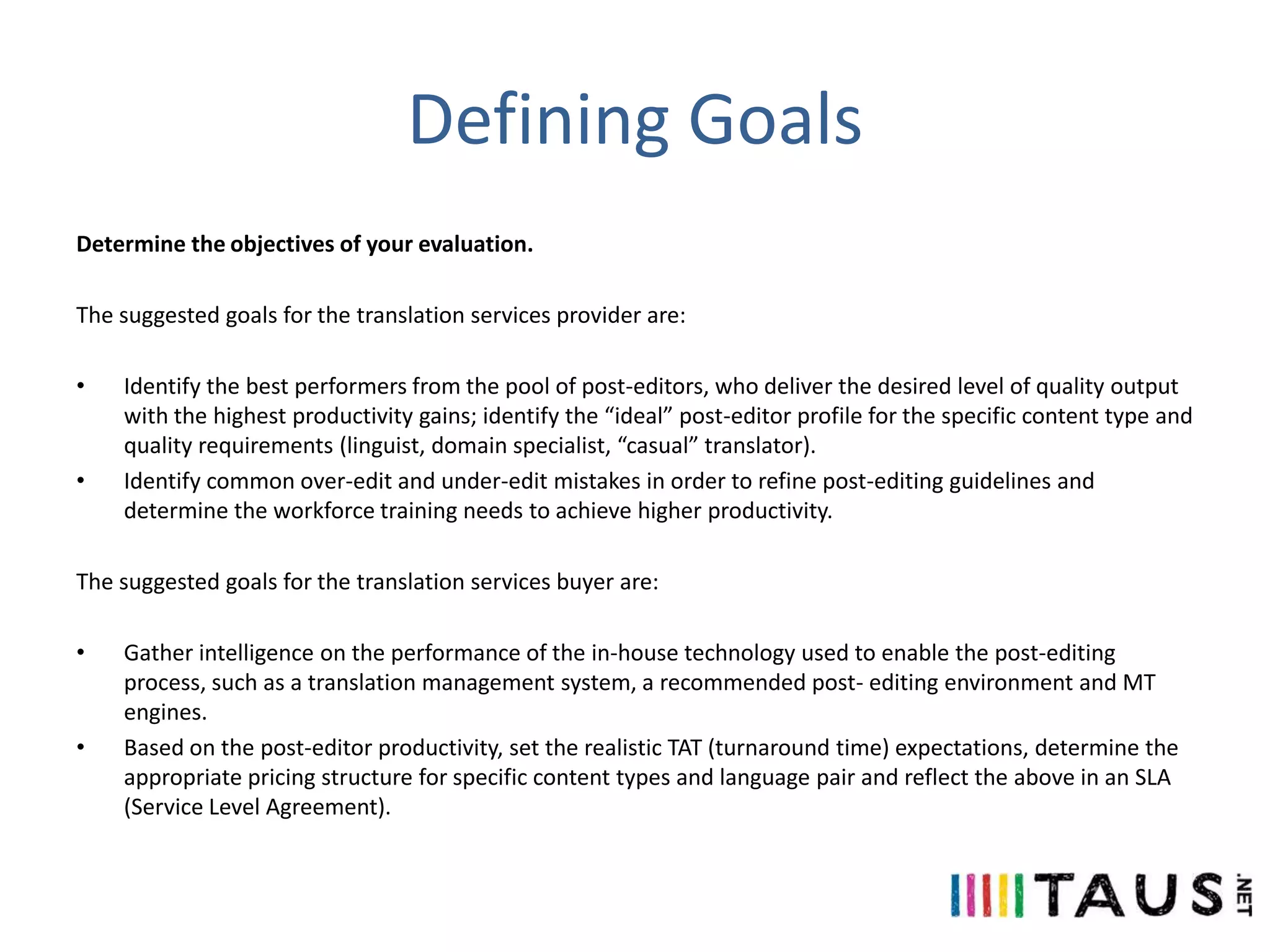
Defining Goals
Determine the objectives of your evaluation.
The suggested goals for the translation services provider are:
•

•

Identify the best performers from the pool of post-editors, who deliver the desired level of quality output
with the highest productivity gains; identify the “ideal” post-editor profile for the specific content type and
quality requirements (linguist, domain specialist, “casual” translator).
Identify common over-edit and under-edit mistakes in order to refine post-editing guidelines and
determine the workforce training needs to achieve higher productivity.

The suggested goals for the translation services buyer are:
•

•

Gather intelligence on the performance of the in-house technology used to enable the post-editing
process, such as a translation management system, a recommended post- editing environment and MT
engines.
Based on the post-editor productivity, set the realistic TAT (turnaround time) expectations, determine the
appropriate pricing structure for specific content types and language pair and reflect the above in an SLA
(Service Level Agreement).
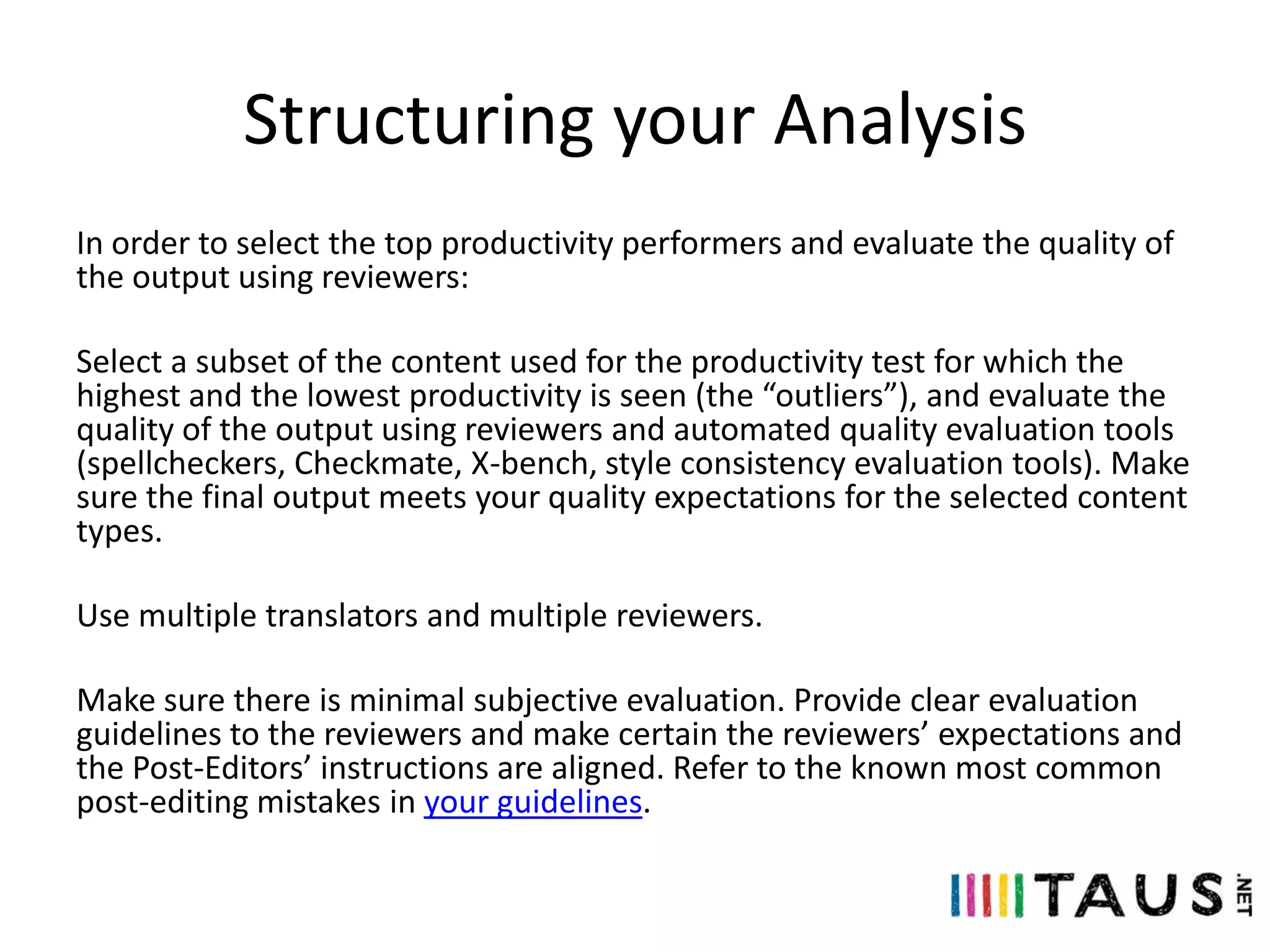
Structuring your Analysis
In order to select the top productivity performers and evaluate the quality of
the output using reviewers:
Select a subset of the content used for the productivity test for which the
highest and the lowest productivity is seen (the “outliers”), and evaluate the
quality of the output using reviewers and automated quality evaluation tools
(spellcheckers, Checkmate, X-bench, style consistency evaluation tools). Make
sure the final output meets your quality expectations for the selected content
types.
Use multiple translators and multiple reviewers.
Make sure there is minimal subjective evaluation. Provide clear evaluation
guidelines to the reviewers and make certain the reviewers’ expectations and
the Post-Editors’ instructions are aligned. Refer to the known most common
post-editing mistakes in your guidelines.
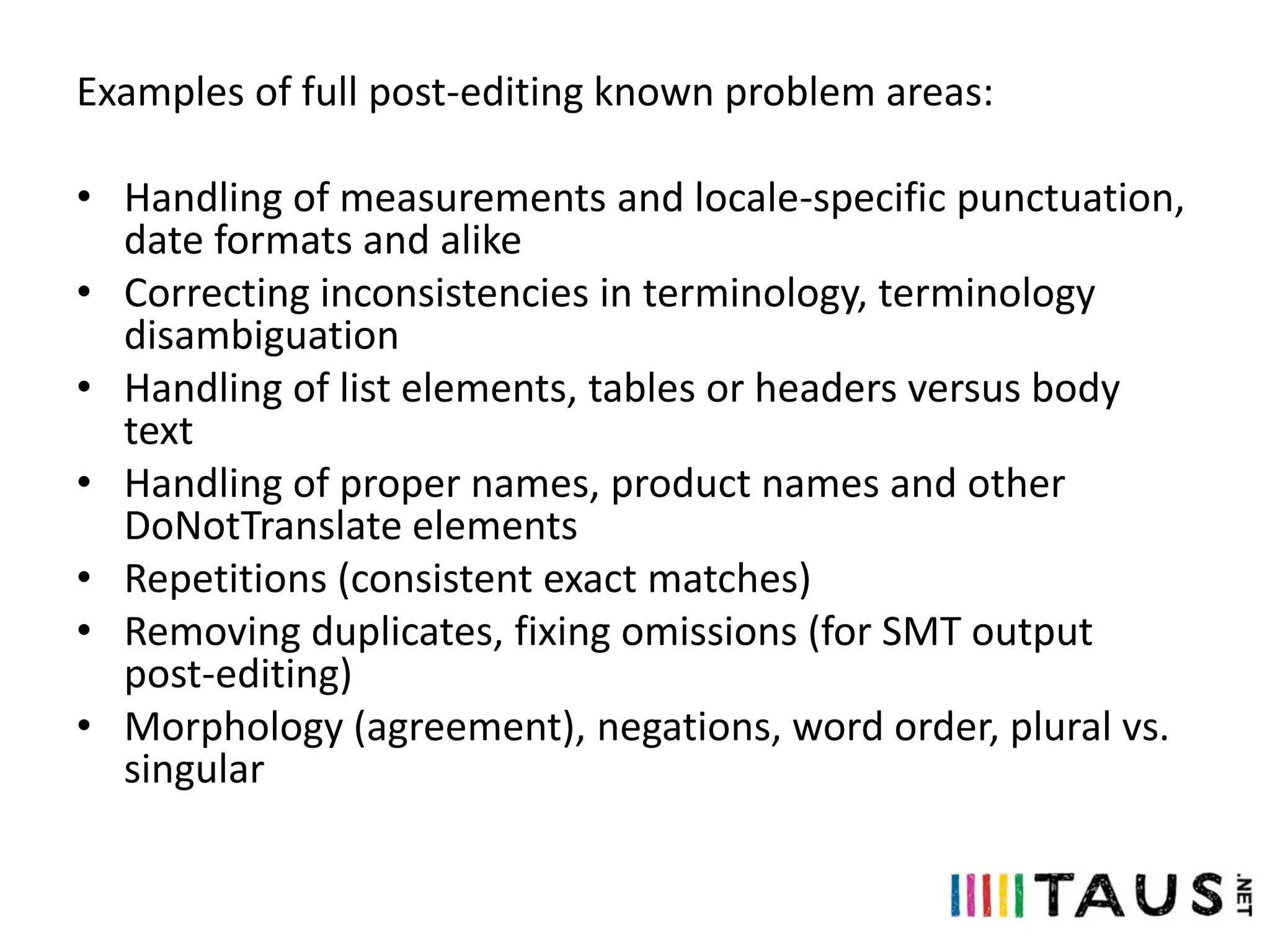
Examples of full post-editing known problem areas:

• Handling of measurements and locale-specific punctuation,
date formats and alike
• Correcting inconsistencies in terminology, terminology
disambiguation
• Handling of list elements, tables or headers versus body
text
• Handling of proper names, product names and other
DoNotTranslate elements
• Repetitions (consistent exact matches)
• Removing duplicates, fixing omissions (for SMT output
post-editing)
• Morphology (agreement), negations, word order, plural vs.
singular
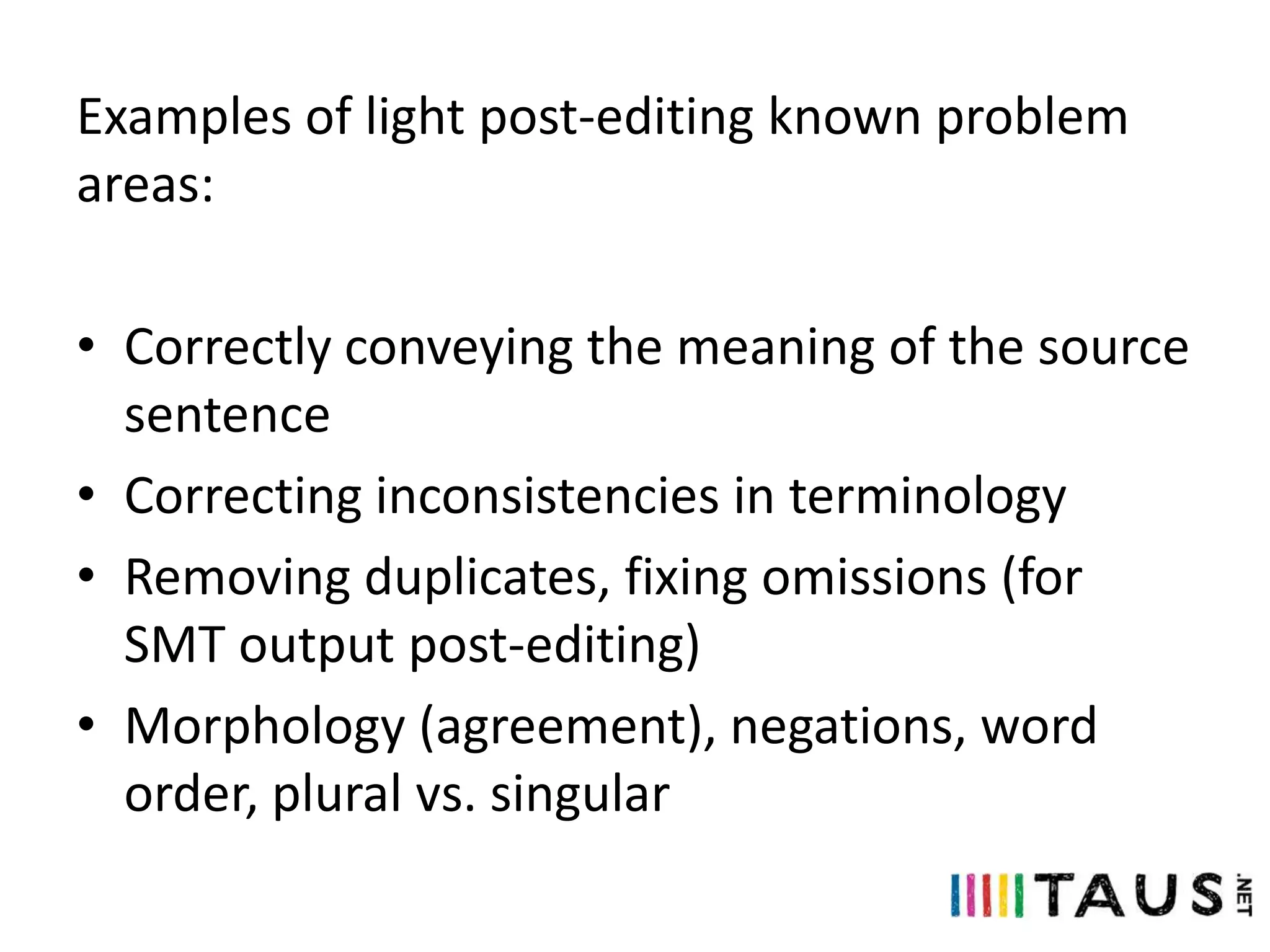
Examples of light post-editing known problem
areas:
• Correctly conveying the meaning of the source
sentence
• Correcting inconsistencies in terminology
• Removing duplicates, fixing omissions (for
SMT output post-editing)
• Morphology (agreement), negations, word
order, plural vs. singular
In order to identify the common over-edit and
under-edit patterns:
Obtain edit distance and MT quality data for the
content post-edited during the productivity
evaluation, using the industry-standard
methods, e.g. GTM, Levenshtein, BLEU, TER.
If your productivity evaluation tool captures this
data, obtain information on the changes made by
post-editors, i.e. edit location, nature of edits; if
your tool doesn’t capture such data a simple file
difference tool can be used.
You will be able to determine realistic turnaround
time and pricing expectations based on the
productivity and quality data. Always have a clear
human translation benchmark for reference (e.g.
2000 words per day for European languages) unless
your tool allows you to capture the actual inproduction data.
For smaller LSPs and freelance translators, tight
turnaround projects or other limited bandwidth
scenarios reliance on legacy industry information is
recommended.
Analyzing Results
Make sure that the final output quality matches the desired quality
level for the selected content type, differentiate between the full postediting quality level and light post-editing quality level (refer to the
TAUS Machine Translation Post-editing Guidelines for further
clarification).
Assess individual post-editors’ performance using side-by-side data for
more than one post-editor; use the individual post-editor data to
identify the most suitable post-editor profile for the specific content
types and quality levels.
Calculate the mode (the number which appears most often in a set of
numbers) based on scores of multiple post-editors to obtain data
specific to certain content/quality/language combination; gather data
for specific sentence length ranges and sentence types.
Do not use obtained productivity data in isolation in order to calculate
expected daily throughputs and turnaround times, as the reported values
reflect the “ideal” off-production scenario; add time necessary for
terminology and concept research, administrative tasks, breaks and alike.
Identify best and worst performing sentence types (length, presence/absence
of DNT elements, tags, terminology, certain syntactic structures) and gather
best practices for post-editors on most optimal handling of such sentences
and elements.

Analyze edit distance data alongside with the MT quality evaluation data and
assessment by reviewers to determine whether the edits made by posteditors were necessary for meeting the output quality requirements, gather
best practices for specific edit types. Do not use edit distance data in isolation
to evaluate the post-editor performance.
Analyze the nature of edits using the data obtained during the productivity
tests, use top performer’s data to create recommendations for lower
performers; use the obtained information to provide feedback on the MT
engine.
Matrix
It is recommended that you create a clear matrix of post-editing productivity,
quality, TAT and pricing discount expectations based on the results of your
analysis. The proposed matrix structure is below:
• Content type and purpose of content
• Expected post-edited output quality level; risk assessment and error
tolerance by error type for the specific content
• CAT-enabled environment or isolated post-editing environment; if the
former – whether it will have an impact on the expected productivity gains
• Human translation daily throughput (use industry-standard daily
throughout expectations as a benchmark)
• Post-editing daily throughput (based on productivity gain percentages)
• Productivity gain (per hour, per day)
• Expected pricing discount based on the factors above
Our thanks to:
Olga Beregovaya (Welocalize) for drafting and editing these guidelines based on the breakout
session at the TAUS Quality Evaluation Summit.
The following organizations reviewed and gave feedback on the first version of the Guidelines at
the TAUS Quality Evaluation Summit 9 October 2013, San Jose:
2M Language Services, Adobe, AVB Vertallingen, Blackberry, CNC
Software, Inc., CrossLang, DFKI, Digital
Linguistics, eBay, EBSCO, Eventbrite, Gengo, Google, Hewlett
Packard, Intuit, KantanMT, Lionbridge, Localization Institute, MasterWord Services
Inc., Microsoft, PayPal, PTC and Zynga.
Reviewers: Achim Ruopp (TAUS), Willem Stoeller (International Consulting LLC) and Attila Görög
(TAUS)
Feedback
To give feedback on how to improve the guidelines, please write to dqf@tauslabs.com.

TAUS Evaluating Post-Editor Performance Guidelines

  • 1.
    TAUS Best Practices EvaluatingPost-Editor Performance Guidelines January 2014
  • 2.
    Why do weneed guidelines for Post-Editor performance? Machine translation (MT) with post-editing is fast becoming a standard practice in our industry. This means that organizations need to be able to easily identify, qualify, train and evaluate Post-Editor performance. Today, there are many methodologies in use, resulting in a lack of cohesive standards as organizations take various approaches for evaluating performance. Some use Final Output Quality Evaluation or Post-Editor Productivity as a standalone metric. Others analyze quality data such as “over-edit” or “under-edit” of the Post-Editor’s effort or evaluate the percentage of MT suggestions used versus MT suggestions that are discarded in the final output. An agreed set of best practices will help the industry fairly and efficiently select the most suitable talent for post-editing work and identify the training opportunities that will help translators and new players, such as crowdsourcing resources, become highly skilled and qualified Post-Editors.
  • 3.
    Related guidelines These guidelinesshould be applied in combination with three related TAUS Guidelines: • Machine Translation Post-editing Guidelines, which help customers and service providers set clear quality expectations and can be used as a basis on which to instruct post-editors. • Machine Translation Post-editing Productivity Testing Guidelines, which provide guidance on the design and measurement for both short and long-term productivity tests. • Pricing MT-Post-Editing Guidelines, which share current wisdom on how to arrive at a predictive, fair and appropriate pricing model.
  • 4.
    Scope This Guideline focuseson the analysis and interpretation of productivity testing results combined with the evaluation of the final postedited output and scores obtained via industrystandard automated scoring metrics in order to evaluate post-editors’ performance. It does not cover design and execution of post-editing productivity tests, post-editing quality levels and pricing recommendations.
  • 5.
    Defining Goals Determine theobjectives of your evaluation. The suggested goals for the translation services provider are: • • Identify the best performers from the pool of post-editors, who deliver the desired level of quality output with the highest productivity gains; identify the “ideal” post-editor profile for the specific content type and quality requirements (linguist, domain specialist, “casual” translator). Identify common over-edit and under-edit mistakes in order to refine post-editing guidelines and determine the workforce training needs to achieve higher productivity. The suggested goals for the translation services buyer are: • • Gather intelligence on the performance of the in-house technology used to enable the post-editing process, such as a translation management system, a recommended post- editing environment and MT engines. Based on the post-editor productivity, set the realistic TAT (turnaround time) expectations, determine the appropriate pricing structure for specific content types and language pair and reflect the above in an SLA (Service Level Agreement).
  • 6.
    Structuring your Analysis Inorder to select the top productivity performers and evaluate the quality of the output using reviewers: Select a subset of the content used for the productivity test for which the highest and the lowest productivity is seen (the “outliers”), and evaluate the quality of the output using reviewers and automated quality evaluation tools (spellcheckers, Checkmate, X-bench, style consistency evaluation tools). Make sure the final output meets your quality expectations for the selected content types. Use multiple translators and multiple reviewers. Make sure there is minimal subjective evaluation. Provide clear evaluation guidelines to the reviewers and make certain the reviewers’ expectations and the Post-Editors’ instructions are aligned. Refer to the known most common post-editing mistakes in your guidelines.
  • 7.
    Examples of fullpost-editing known problem areas: • Handling of measurements and locale-specific punctuation, date formats and alike • Correcting inconsistencies in terminology, terminology disambiguation • Handling of list elements, tables or headers versus body text • Handling of proper names, product names and other DoNotTranslate elements • Repetitions (consistent exact matches) • Removing duplicates, fixing omissions (for SMT output post-editing) • Morphology (agreement), negations, word order, plural vs. singular
  • 8.
    Examples of lightpost-editing known problem areas: • Correctly conveying the meaning of the source sentence • Correcting inconsistencies in terminology • Removing duplicates, fixing omissions (for SMT output post-editing) • Morphology (agreement), negations, word order, plural vs. singular
  • 9.
    In order toidentify the common over-edit and under-edit patterns: Obtain edit distance and MT quality data for the content post-edited during the productivity evaluation, using the industry-standard methods, e.g. GTM, Levenshtein, BLEU, TER. If your productivity evaluation tool captures this data, obtain information on the changes made by post-editors, i.e. edit location, nature of edits; if your tool doesn’t capture such data a simple file difference tool can be used.
  • 10.
    You will beable to determine realistic turnaround time and pricing expectations based on the productivity and quality data. Always have a clear human translation benchmark for reference (e.g. 2000 words per day for European languages) unless your tool allows you to capture the actual inproduction data. For smaller LSPs and freelance translators, tight turnaround projects or other limited bandwidth scenarios reliance on legacy industry information is recommended.
  • 11.
    Analyzing Results Make surethat the final output quality matches the desired quality level for the selected content type, differentiate between the full postediting quality level and light post-editing quality level (refer to the TAUS Machine Translation Post-editing Guidelines for further clarification). Assess individual post-editors’ performance using side-by-side data for more than one post-editor; use the individual post-editor data to identify the most suitable post-editor profile for the specific content types and quality levels. Calculate the mode (the number which appears most often in a set of numbers) based on scores of multiple post-editors to obtain data specific to certain content/quality/language combination; gather data for specific sentence length ranges and sentence types.
  • 12.
    Do not useobtained productivity data in isolation in order to calculate expected daily throughputs and turnaround times, as the reported values reflect the “ideal” off-production scenario; add time necessary for terminology and concept research, administrative tasks, breaks and alike. Identify best and worst performing sentence types (length, presence/absence of DNT elements, tags, terminology, certain syntactic structures) and gather best practices for post-editors on most optimal handling of such sentences and elements. Analyze edit distance data alongside with the MT quality evaluation data and assessment by reviewers to determine whether the edits made by posteditors were necessary for meeting the output quality requirements, gather best practices for specific edit types. Do not use edit distance data in isolation to evaluate the post-editor performance. Analyze the nature of edits using the data obtained during the productivity tests, use top performer’s data to create recommendations for lower performers; use the obtained information to provide feedback on the MT engine.
  • 13.
    Matrix It is recommendedthat you create a clear matrix of post-editing productivity, quality, TAT and pricing discount expectations based on the results of your analysis. The proposed matrix structure is below: • Content type and purpose of content • Expected post-edited output quality level; risk assessment and error tolerance by error type for the specific content • CAT-enabled environment or isolated post-editing environment; if the former – whether it will have an impact on the expected productivity gains • Human translation daily throughput (use industry-standard daily throughout expectations as a benchmark) • Post-editing daily throughput (based on productivity gain percentages) • Productivity gain (per hour, per day) • Expected pricing discount based on the factors above
  • 14.
    Our thanks to: OlgaBeregovaya (Welocalize) for drafting and editing these guidelines based on the breakout session at the TAUS Quality Evaluation Summit. The following organizations reviewed and gave feedback on the first version of the Guidelines at the TAUS Quality Evaluation Summit 9 October 2013, San Jose: 2M Language Services, Adobe, AVB Vertallingen, Blackberry, CNC Software, Inc., CrossLang, DFKI, Digital Linguistics, eBay, EBSCO, Eventbrite, Gengo, Google, Hewlett Packard, Intuit, KantanMT, Lionbridge, Localization Institute, MasterWord Services Inc., Microsoft, PayPal, PTC and Zynga. Reviewers: Achim Ruopp (TAUS), Willem Stoeller (International Consulting LLC) and Attila Görög (TAUS) Feedback To give feedback on how to improve the guidelines, please write to dqf@tauslabs.com.